Every soul in Dort passes through Sheol once. It waits at the river, crosses into the Weighing, and is dispatched by the Adjudicator with the same inevitability as water reaching the sea. A death witnessed by one of Nyxollox's death-keepers is sealed against interference for the length of that crossing. Undeath is what happens when the crossing is interrupted anyway, by a necromancer's working, an old grudge that refused to end at the grave, or a plane like the Dim where the difference between dead and gone is thinner than it should be.
Nyxollox's faith does not treat undeath as a spooky inconvenience. It is a violation of the order Sheol exists to maintain, and the priesthood trains specifically to recognize and stop it. That framing matters more than any individual monster's stat block: a lich in this chapter is not a wizard who got creative with immortality, it is a theft from the Weighing that a real institution is actively hunting. Treat the creatures here as the thing death-keepers exist to fight, not as a horror-movie backdrop with no stakes attached.
Not every entry is a threat in the same register. A Bone Swarm is a hazard with no memory of who it used to be. A Bonewright is a craftsman who never stopped working. A Lich planned for this. What unites them is only that none of them completed the crossing they were owed, and none of them are getting it back on their own.
At the table: let a death-keeper NPC matter when one is present. A funeral with proper rites is not set dressing, it is the reason the thing in the crypt down the road never had the chance to happen here.
Armored Skeleton
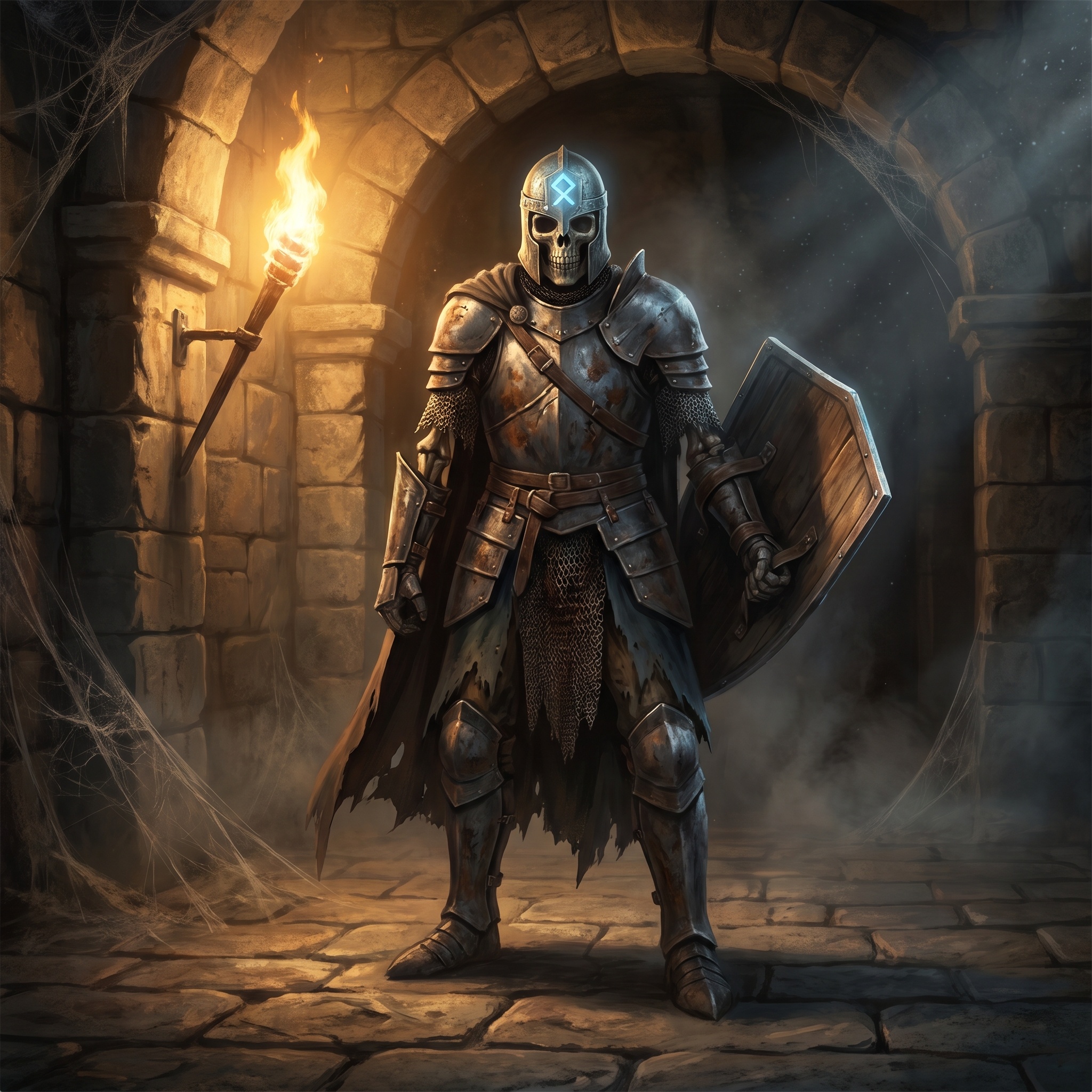
Role: Elite Undead Guardian Where It Appears: Noble tombs, battlefield graves, sealed war vaults.
What It Is
Armored skeletons usually retain a single duty: guard the door, hold the bridge, kill anyone wearing the wrong colors. The armor often matters more than the bones. Their plates, shields, and helms carry the command sigils that keep the remains moving long after memory and muscle are gone.
They are not infectious and do not create more dead. They are weapons left loaded by a war, tomb, family, or necromancer who expected the future to remain an enemy.
Ecology and Behavior
Armored skeletons endure where duty was bound to equipment: noble tombs, sealed armories, war vaults, old bridge forts, and battlefield graves. Without new commands they repeat the last instruction. A door guardian may ignore people outside the threshold and cut down the same people once they cross it.
They have no appetite, fear, or ambition. Age affects the shell around them instead: rusted hinges, fused shields, brittle leather, and sigils dimmed by soot or grave mold. Clever delvers study the armor before testing the blade.
Signs and Knowledge
Secret Lore or Craft (Hard) can identify the command sigil and where to disrupt it. Warfare or Lore (Average) recognizes the armor's original allegiance.
Other signs include skeletons standing in formation long after collapse, shield marks on one side of a doorway, old heraldry scratched out by later occupants, and a boundary line with bones only on one side.
Armored Skeleton (Elite)
- Skills: Heavy Melee 3, Readiness 3, Fortitude 4, Perception 2.
- Attacks: Tomb Blade (Heavy Melee; Damage 7; Crit 4; Defensive 1).
- Abilities: Shielded Dead — Add 1 Bane to attacks from the front while it holds formation or a doorway.
- Abilities: Command Sigil — Secret Lore or Craft (Hard) can disrupt its animating sigil for 6 Wounds ignoring Resistance.
- Soul: Claimable, the crossing it was owed was interrupted rather than completed; at death the soul resumes that crossing and is dispatched normally at Sheol, having been raised without its consent.
Tactics
An armored skeleton holds choke points and rarely pursues beyond its assigned boundary. It turns its shield toward the largest threat and keeps pressure steady. If multiple armored skeletons guard a site, they may form a crude wall even without intelligence.
The encounter works best when the boundary is legible. Let players discover that retreating beyond a line, showing the right colors, or disrupting the sigil changes the fight.
Harvesting and Trade
| Component | Value | Use | Harvest |
|---|---|---|---|
| Old armor | 400-1,800 gold Flargons | Restoration, disguise, historical sale | Craft (Average), legal ownership may be disputed |
| Animating sigil dust | 250-600 gold Flargons | Necromantic study, counter-sigil work | Secret Lore or Craft (Hard), illicit in most places |
| Heraldic fragments | 100-800 gold Flargons | Identifying tomb, war, or noble claim | Lore (Average) |
Variants
- Bridge Dead: Bound to hold one crossing and ignore anything off it.
- Vault Plate: Heavier armor, slower movement, stronger doorway defense.
- False Herald: Repainted by later villains to frame an old house or army.
Barrow Lord
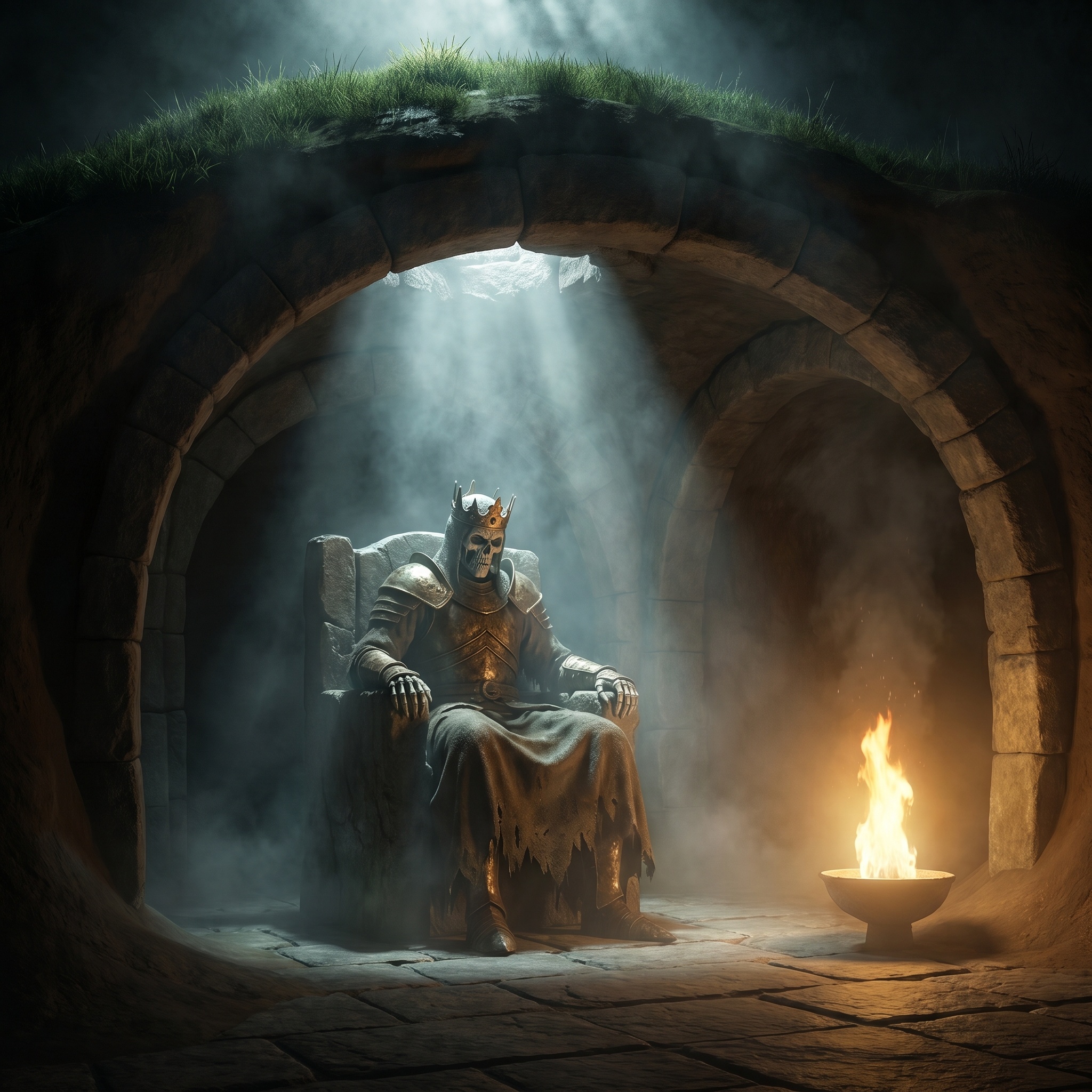
Role: Nemesis Undead Sovereign Where It Appears: Ancient barrows, royal mounds, forgotten hill forts.
"The barrow speaks before the creature does. You feel the weight of its claim on the hill — on everything within sight of the hill — before the door opens." — Survey note, Tomb Registry Office, Antaea
What It Is
Barrow lords remember rulership as possession. They do not haunt a tomb; they hold court beneath the earth and consider the living temporary tenants. A barrow lord may be crowned in bronze, bone, gold, antler, or river stone, but the posture is always sovereign.
They are not vampires or infectious undead. Their power is title, burial, oath, and land-memory. The barrow is their court, their fortress, and their argument that death did not end ownership.
Ecology and Behavior
Barrow lords persist in ancient mounds, royal graves, hill forts, and buried halls where rulership was tied to land and lineage. They gather dead retainers, oathbound servants, ancestral shades, and lesser tomb guardians. Some receive offerings from locals who remember enough to fear them.
They care about trespass, tribute, lineage, and insult. A barrow lord may parley with descendants, recognize lawful offerings, or demand fealty from anyone standing on what it considers its domain. Theft is rebellion. Archaeology is invasion. Neglect may be worse than either.
Signs and Knowledge
Lore, Culture, or Theology (Hard) identifies the barrow's dynasty and proper offering. Survival (Average) spots old boundary markers hidden in the landscape.
Other signs include hill paths that curve like processional roads, animals avoiding the mound crown, buried stones carved with land claims, and dreams of kneeling before a ruler no history book names.
Barrow Lord (Nemesis)
- Skills: Heavy Melee 4, Leadership 5, Lore 4, Intimidation 5, Secret Lore 4.
- Attacks: Barrow Blade (Heavy Melee; Damage 10; Crit 3; Pierce 2); Royal Command (Leadership; Damage 8 Strain; Range Medium).
- Abilities: Dead Court — Once per round, command one undead ally at Short range to act with 1 Boon.
- Abilities: Trespass Judgment — Living intruders in the barrow add 1 Bane to social checks against the lord unless carrying lawful offering or lineage claim.
- Abilities: Dread — Fear 3.
- Soul: Claimable, the crossing it was owed was interrupted rather than completed; at death the soul resumes that crossing and is dispatched normally at Sheol, having been raised without its consent.
Tactics
A barrow lord demands oath, summons retainers, and punishes theft. It opens with judgment because it believes the case is already proven: the living entered its court. In battle, it uses dead allies to control space while Royal Command breaks confidence.
Give the party noncombat levers: offerings, lineage proof, returning stolen goods, challenging the lord's claim, or invoking a successor. Killing the barrow lord may settle the mound or unleash every dead obligation it held in place.
Harvesting and Trade
| Component | Value | Use | Harvest |
|---|---|---|---|
| Grave regalia | Priceless, politically explosive | Royal claims, curses, museum theft, ransom | Lore and Culture (Hard), removal has consequences |
| Barrow blade | 2,000-7,000 gold Flargons | Weapon, sovereignty relic, oath focus | Theology or Secret Lore (Hard) |
| Court tablets | 1,000-5,000 gold Flargons | Land claims, forgotten laws, genealogy | Lore (Average) |
Variants
- Hill-Fort King: Commands warriors and treats modern borders as rebellion.
- River Barrow Queen: Demands offerings from boats and floodplain villages.
- Nameless Usurper: Buried as ruler, but the true bloodline can break its claim.
Bone Swarm
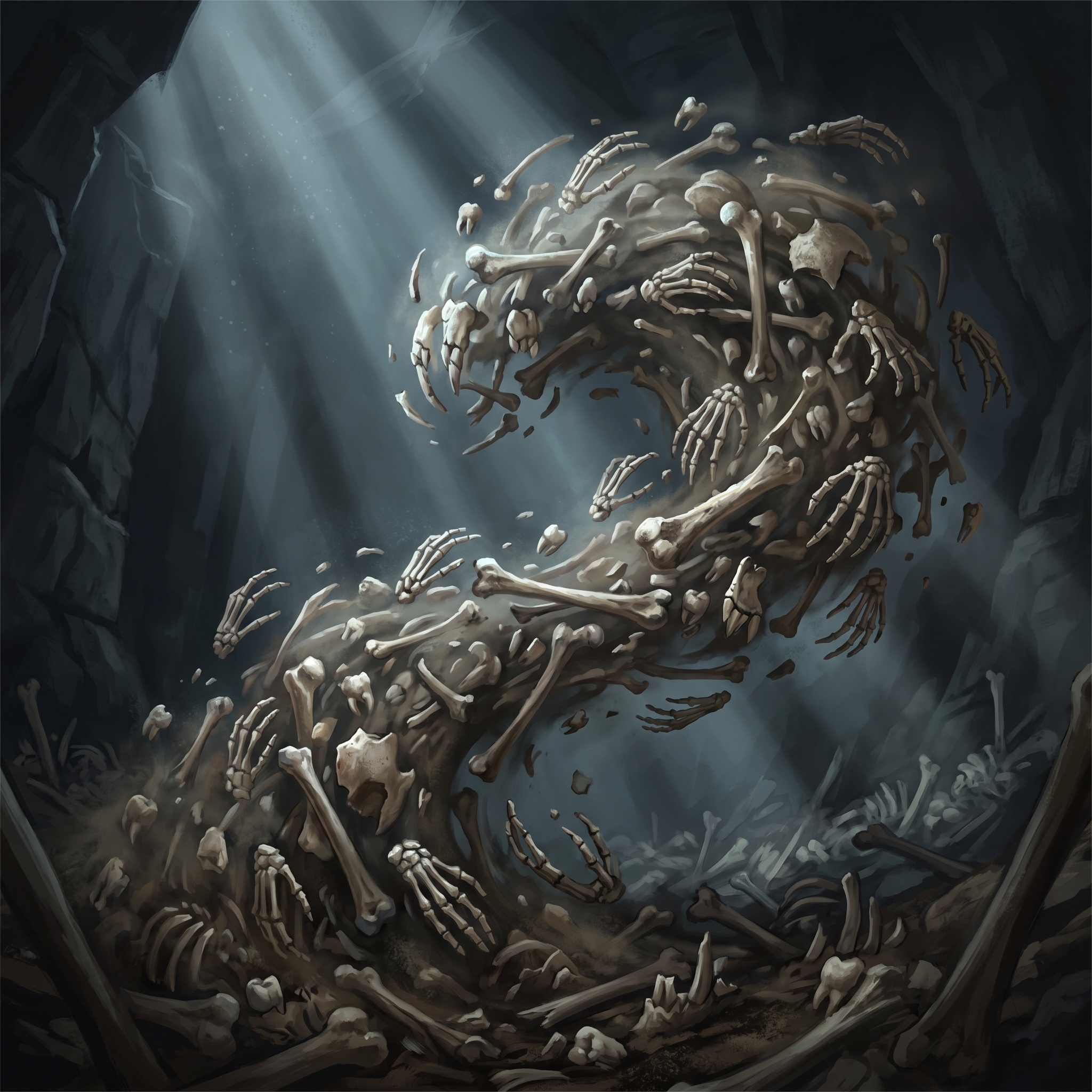
Role: Minion Swarm / Hazard Where It Appears: Ossified battlefields, old slaughterhouses, collapsed crypts, sites of mass death without proper burial.
Bone Swarms are not animated skeletons. They are animated bone — fragments, splinters, and loose pieces moving together without any single body as a template. The danger is the direction.
Signs and Knowledge: Perception (Average) hears the rattling before contact. Secret Lore (Average) knows they have no single target — area attacks are the answer.
Bone Swarm (Minion)
- Group Size: One swarm.
- Skills: Unarmed 3, Fortitude 4, Perception 2.
- Attacks: Bone Flurry (Unarmed; Damage 5; Crit 4; Bleeding 1; Blast 3 at Engaged).
- Abilities: Swarm Body — Single-target melee and ranged attacks add 1 Bane. Area attacks deal full damage.
- Abilities: Crush to Stop — Reduce to 0 by blunt force or area attack; sharp weapons are inefficient.
- Soul: Claimable, one for each person the remains came from; at death those souls resume the crossing they were owed and are dispatched normally at Sheol, having been raised without consent.
- Tactics: Engulfs a single target if possible, showers the formation otherwise.
- Encounter Use: Use as a site hazard in crypts and charnel pits. Combine with other undead.
- Harvesting and Trade: No harvest value. The components are just old bones.
Variants
Directed Bone Swarm: Being actively controlled by a necromancer; treats the controller's commands as tactical orders.
Bonewright
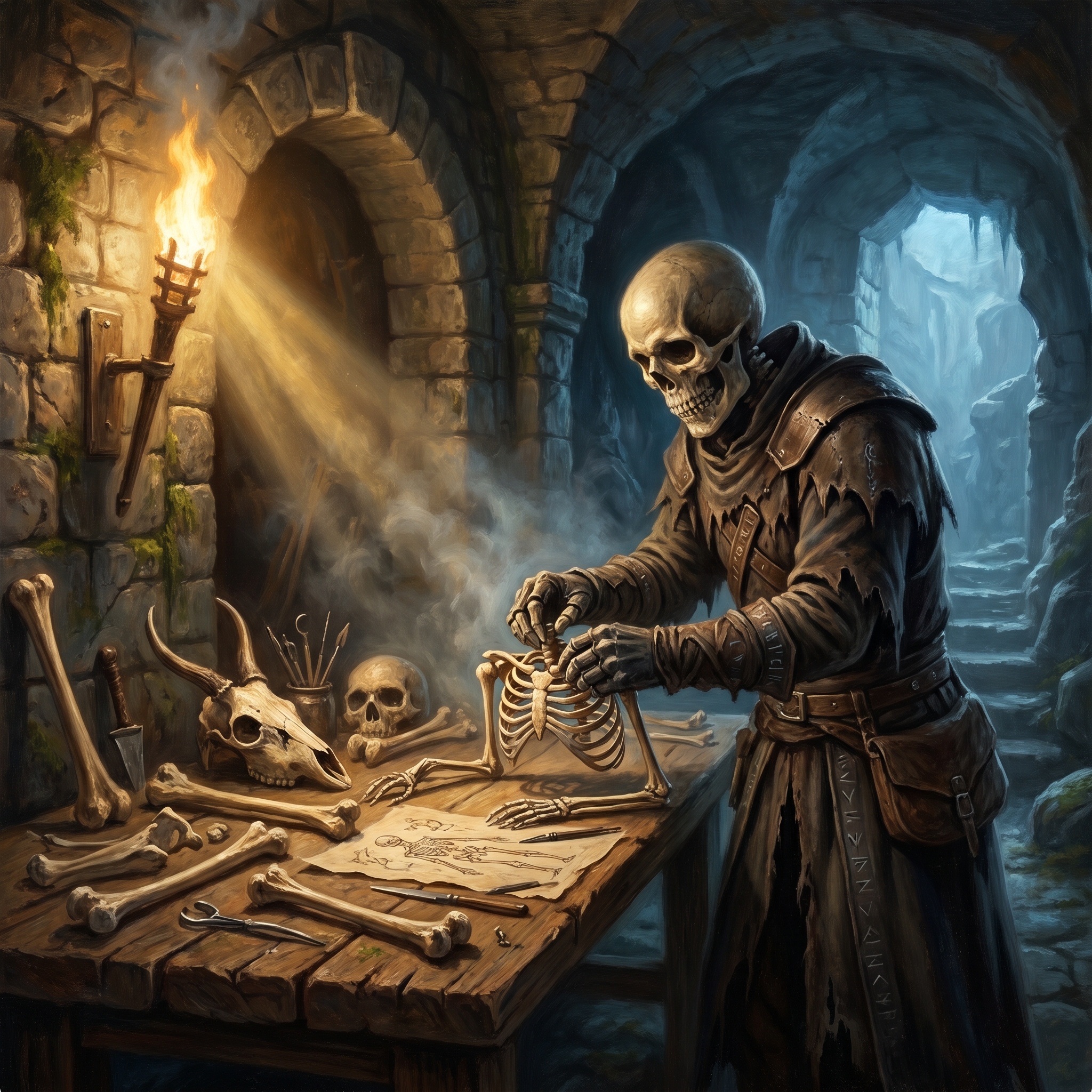
Role: Elite Undead Maker Where It Appears: Ossuaries, necromancer workshops, cursed craft halls.
What It Is
Bonewrights are artisan-dead obsessed with assembly. They do not spread undeath; they build it when supplied with remains and time. Their hands are delicate, their workshops are orderly, and their idea of repair is not constrained by the body's original owner.
They are makers, not plague carriers. The horror is craft without consent: bones sorted by usefulness, saints mixed with thieves, children used for small joints, warriors used for reach.
Ecology and Behavior
Bonewrights haunt ossuaries, necromancer workshops, cursed craft halls, and tombs where remains were cataloged too well. Some were artisans in life. Others are the lingering intelligence of a workshop, expressed through whatever bones can hold tools.
They value rare bones, intact joints, old surgical tools, and pattern books. A bonewright may bargain for remains, steal from battlefields, or repair undead guardians for a master it no longer remembers.
Signs and Knowledge
Medicine, Craft, or Secret Lore (Average) identifies deliberate assembly marks. Theology (Hard) can tell which funerary taboos have been broken.
Other signs include labeled bones, workbenches too clean for a tomb, skeletons with mismatched proportions, and small test constructs sweeping the floor.
Bonewright (Elite)
- Skills: Craft 5, Secret Lore 4, Medicine 3, Light Melee 2, Perception 3.
- Attacks: Bone Awl (Light Melee; Damage 5; Crit 4; Pierce 1); Splinter Burst (Heavy Ranged; Damage 5; Crit 4; Range Short; Bleeding 1).
- Abilities: Field Assembly - As an Action in a bone-rich area, repair 4 Wounds to an undead ally or skeleton group.
- Soul: Claimable, the crossing it was owed was interrupted rather than completed; at death the soul resumes that crossing and is dispatched normally at Sheol, having been raised without its consent.
Tactics
A bonewright hides behind creations, repairs guardians, and flees with rare bones or pattern books if the workshop falls. It uses Splinter Burst to punish clusters and Field Assembly to keep larger undead active.
The encounter should give players workshop choices: smash the pattern book, rescue identified remains, disrupt the assembly table, or stop the bonewright before it finishes something worse.
Evidence and Trade
| Find | Value | Use | Recovery |
|---|---|---|---|
| Annotated bone-patterns | 800-2,000 gold Flargons illicitly | Necromantic construction, proof of crimes | Secret Lore or Medicine (Hard) |
| Tool roll | 500-1,600 gold Flargons | Craft, surgery, illegal necromancy | Craft or Medicine (Average) |
| Labeled remains | Varies | Restitution, identity, funerary repair | Theology or Lore (Average) |
Variants
- Ossuary Curator: Claims every bone is better protected in its catalog.
- Battlefield Stitcher: Builds composite soldiers from mass graves.
- Saint-Bone Forger: Creates fake relics and undead reliquaries.
Cairn Shade
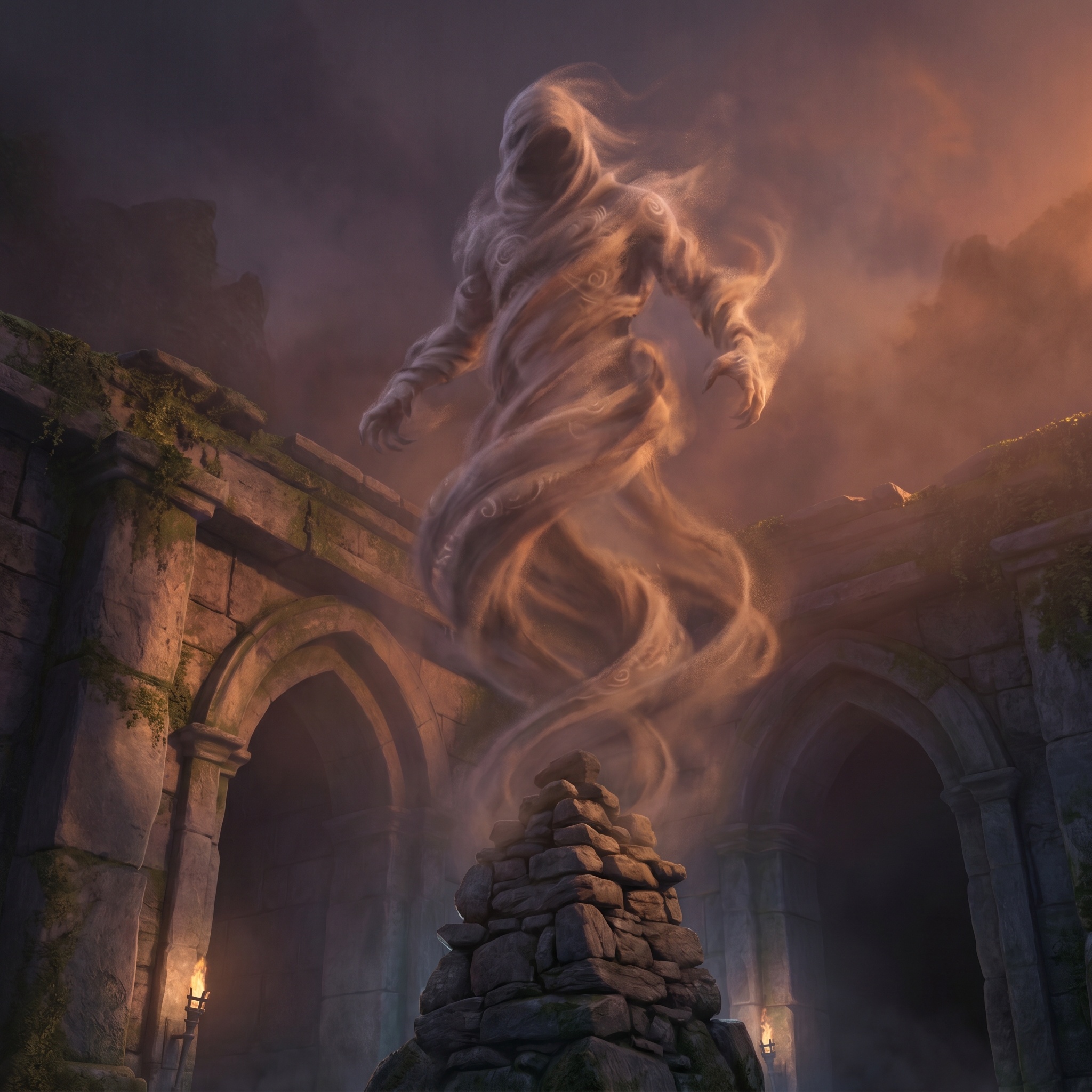
Role: Elite Spirit / Guardian Where It Appears: Burial cairns, old roads, battlefield mounds.
What It Is
Cairn shades are not evil by default. They guard the boundary between memory and violation. They become violent when graves are disturbed or names are erased. A cairn shade is grave dust, wind, and identity clinging to a burial place hard enough to take shape.
They are among the more negotiable dead. A cairn shade wants recognition, repair, and respect. It attacks when the living treat the dead as obstacles, treasure containers, or forgotten problems.
Ecology and Behavior
Cairn shades linger around burial cairns, battlefield mounds, old road graves, and emergency burials where the dead were given names but not peace. They may know fragments of the road, the battle, the family line, or the broken promise that left the cairn exposed.
They react strongly to names. A shade whose name is remembered may become calm, mournful, or helpful. A shade whose cairn is robbed, mocked, or paved over becomes a guardian storm of cold and grit.
Signs and Knowledge
Lore, Culture, or Theology (Average) identifies burial customs and proper address. Perception (Hard) hears names whispered in the cairn wind.
Other signs include stones that roll back into place overnight, grave flowers that never fully dry, dust moving against the wind, and travelers unconsciously lowering their voices near the mound.
Cairn Shade (Elite)
- Skills: Stealth 4, Perception 4, Readiness 4, Lore 3, Intimidation 3.
- Attacks: Grave Chill (Willpower; Damage 7 Strain; Range Short); Dust Claw (Unarmed; Damage 5; Crit 4).
- Abilities: Half-Corporeal — Mundane physical attacks add 1 Bane unless using salt, iron, blessed tools, or grave-goods.
- Abilities: Name Rite — Speaking the buried name with respect suppresses its attacks for one round; Lore or Negotiation (Average) to do correctly under pressure.
- Soul: Claimable, the crossing it was owed was interrupted rather than completed; at death the soul resumes that crossing and is dispatched normally at Sheol, having been raised without its consent.
Tactics
A cairn shade warns first if the violation is not severe. It chills, blinds with dust, and drives grave-breakers away from the mound rather than pursuing across miles. If the buried name is spoken properly, it hesitates long enough for apology, repair, or escape.
Use it as a moral encounter with teeth. The party can fight, but restoring stones, returning grave goods, or learning names may be the better victory.
Harvesting and Trade
| Component | Value | Use | Harvest |
|---|---|---|---|
| Grave dust | 200-900 gold Flargons illegally | Spirit rites, curses, memory ink | Theology or Secret Lore (Hard), usually desecration |
| Name stone rubbing | 100-800 gold Flargons | Genealogy, legal claims, spirit appeasement | Lore or Culture (Average) |
| Burial token | Varies | Resolving the shade, identifying descendants | Should be returned, not sold |
Variants
- Roadside Shade: Protects travelers who honor it and punishes those who rob the dead.
- Battle Cairn Shade: Holds many names and may speak as a chorus.
- Erased Name Shade: More violent because no one remembers the proper rite.
Cemetery Sovereign
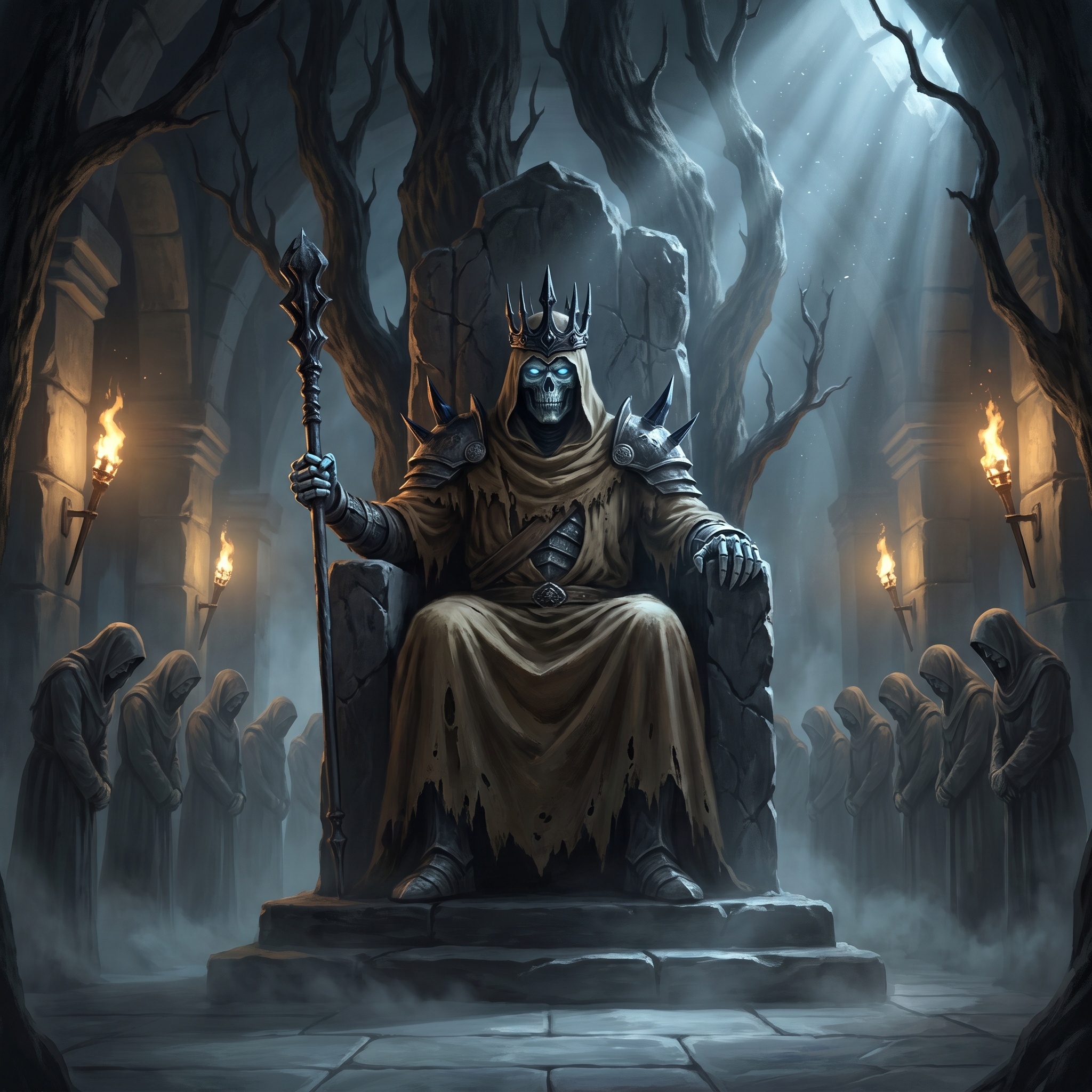
Role: Nemesis Grave-Domain Ruler Where It Appears: Old cemeteries, necropolis districts, plague memorials, graveyards built over older graveyards.
"The dead there vote. Not metaphorically. There is a process. The Sovereign counts the coins." — Academic note, Silver Road Studies — appended by a later hand: do not publish
The Sovereign rules a cemetery because the living failed to keep its names. It is not a blood-drinking noble dead, not a corpse plague, and not a simple necromancer. It is a legal mind made from burial custom, grief, and centuries of neglected promises.
What It Is
The Cemetery Sovereign is a grave-domain ruler formed from burial law, neglected names, repeated grief, and promises the living stopped honoring. It wears a crown because cemeteries are jurisdictions. It speaks like a magistrate because the dead have cases.
It is not a common undead lord and does not spread undeath by killing. The Sovereign's power comes from the cemetery recognizing its authority. Headstones, ledgers, funeral paths, family plots, pauper trenches, plague memorials, and older graves beneath newer ones all become part of its court.
Ecology and Behavior
Cemetery Sovereigns arise where the living repeatedly fail their dead: names scraped away, graves resold, plague pits hidden, poor burials paved over, soldiers dumped without rites, or family promises abandoned. The Sovereign may begin as one powerful dead person, but it becomes larger than that identity as more forgotten claims gather around it.
It prefers order. Grave theft, careless exhumation, false genealogy, and political erasure enrage it. Respectful visitors, mourners, and restorers may be treated as petitioners rather than prey. The party can negotiate, litigate, restore names, or face the cemetery as a hostile government.
Signs and Knowledge
Lore, Theology, Genealogy, or Law (Hard) identifies the cemetery's legal pattern and the names most important to the Sovereign's authority. Negotiation (Hard) can frame a petition without accidentally admitting guilt.
Other signs include graves reordered overnight by date of death rather than location, forgotten names appearing in frost, mourners addressed by ancestors they never named, cemetery gates closing like courtroom doors, and skeletons standing aside for anyone carrying a proper burial record.
Cemetery Sovereign (Nemesis)
- Skills: Lore 5, Leadership 5, Secret Lore 5, Negotiation 5, Readiness 5.
- Attacks: Grave Edict (Leadership; Damage 10 Strain; Crit 3; Range Medium); Scepter of Ash (Heavy Melee; Damage 9; Crit 4; Pierce 2).
- Abilities: By Right of Burial — Within its cemetery, it may command non-infectious skeletons, shades, and funeral remnants as if they were officials of a court.
- Abilities: Name Restored — Speaking a forgotten true name from the cemetery removes 5 Strain from the Sovereign or inflicts 5 Strain if used against it with proper rite.
- Abilities: Dread — Fear 4.
- Soul: None of its own, it formed from burial law and neglected names rather than from one person; at death nothing passes, though the names it holds are still owed their crossing.
Tactics
The Sovereign negotiates first when the party enters with respect. It asks names, purpose, authority, and what right the living claim over the dead. If angered, it issues legal warnings before violence, then commands ordered dead to block exits, seize thieves, and bring offenders before its throne.
The strongest counterplay is restoration. Speaking true names, returning grave goods, exposing illegal exhumations, or producing old burial contracts can wound or calm it more effectively than steel.
Evidence and Trade
There is no ethical harvest. Grave ledgers and restored names are socially valuable, not market goods. The practical reward is legal truth, released dead, inherited property, and peace with a cemetery that has become a court.
| Find | Value | Use | Recovery |
|---|---|---|---|
| Restored grave ledger | Varies, often priceless to families | Inheritance, rites, release of dead, political proof | Genealogy, Lore, or Law (Hard) |
| Forgotten true name | Not a commodity | Weakens or heals the Sovereign, restores identity | Theology or Investigation (Hard) |
| Illegal exhumation record | 2,000-10,000 gold Flargons as evidence | Exposes officials, grave robbers, or noble theft | Law or Streetwise (Average) |
| Funeral court seal | 1,500-6,000 gold Flargons illicitly | Passage through grave-domain law | Theology or Negotiation (Hard), dangerous to misuse |
Variants
- Plague Memorial Sovereign: Protects mass graves and hates officials who hid the dead.
- Necropolis Magistrate: Rules a whole district with clerks, bailiffs, and named dead.
- Erased Regiment Sovereign: Commands soldiers denied burial honors after a political defeat.
Corpse Candle
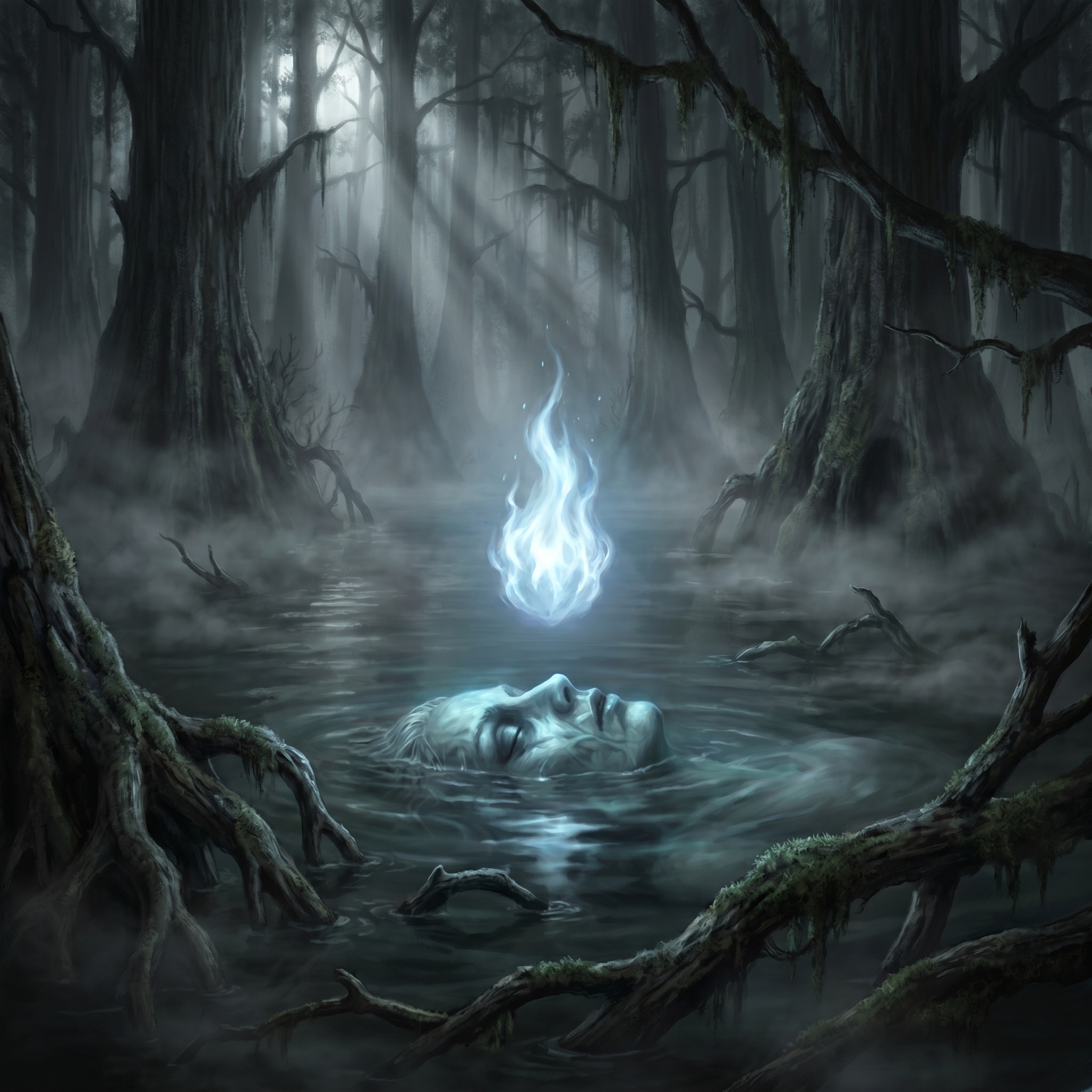
Role: Minion Lure / Spirit Hazard Where It Appears: Swamps, grave roads, battlefields, drowned paths.
Corpse candles are small death-lights that lure the exhausted toward bad footing. They are not intelligent but appear where grief has worn a path.
Corpse Candle (Minion)
- Group Size: 1-6.
- Skills: Stealth 4, Deception 3 as lure, Perception 3.
- Attacks: Cold Flicker (Willpower; Damage 3 Strain; Range Short).
- Abilities: Follow the Light - Tired, grieving, or lost targets add 1 Bane to resist following unless warned.
- Soul: None, a corpse candle is grave-light drawn to a worn path rather than a person's remains; at death nothing passes.
- Tactics: Drift away from safe paths toward water, pits, or waiting threats.
- Harvesting and Trade: No stable remains. Bottled corpse-light rumors are usually fraud.
Death Hound

Role: Elite Hunter Where It Appears: Old graveyards, crossroads with violent history, places where the Silver Road runs close to the surface.
A death hound is not a dog. It was, once. Now it is a marker of something the Silver Road has not finished with.
What It Is
Death Hounds are formed from loyal or significant animals that died in proximity to major deaths or on Silver Road transit sites. They do not decay. They maintain the shape and behavior of hunting animals but serve no living master — or serve something that is not living.
They are often encountered near places where souls are delayed, accumulated, or disputed. Whether they are guardians, hunting tools of the Silver Road, or simply opportunistic undead is contested.
Signs and Knowledge: Secret Lore or Adventuring Lore (Average) identifies them as undead by the absence of breath mist, decayed scent, and the hollow eyes.
Death Hound (Elite)
- Skills: Unarmed 4, Athletics 4, Stealth 3, Perception 5, Survival 4.
- Attacks: Soul Bite (Unarmed; Damage 8; Crit 3; Pierce 2; Strain 3 on hit).
- Abilities: Soul Sense — Can detect living creatures and unprocessed souls at Medium range regardless of visibility or stealth.
- Abilities: Undying Pursuit — Cannot be Frightened or Demoralized. Does not give up a chase until the target is down or leaves the Death Hound's territory.
- Abilities: Regeneration — At the start of each of this creature's turns, it heals 2 Wounds. Fire damage suppresses this until the start of its next turn.
- Abilities: Sanctified Ground Weakness — On blessed or consecrated ground, add 2 Banes to all checks and cannot regenerate Wounds.
- Soul: No claimable coin exists, a death hound forms from an animal rather than a person; at death canon does not specify (default).
Tactics: Pursues relentlessly, bites to accumulate Strain on targets, does not stop for pack formation. It does not ambush — it simply arrives.
Encounter Use: Best as a tracker or pursuit creature rather than an ambush creature. Use when the party needs to feel hunted.
Harvesting and Trade
| Harvest | Buyer | Check | Typical Value | Use | Complication |
|---|---|---|---|---|---|
| Soul-Bone Fragment | Silver Road scholar, exorcist | Hard Secret Lore | 600–1,600 gold Flargons | Soul-transit research, ward experiments | May attract further Death Hounds to the carrier |
Variants
Pack of Death Hounds: Three together, operating in coordinated pursuit with flanking behavior. Treat as Minions with WND 12 each and full Death Hound abilities.
Drowned Dead
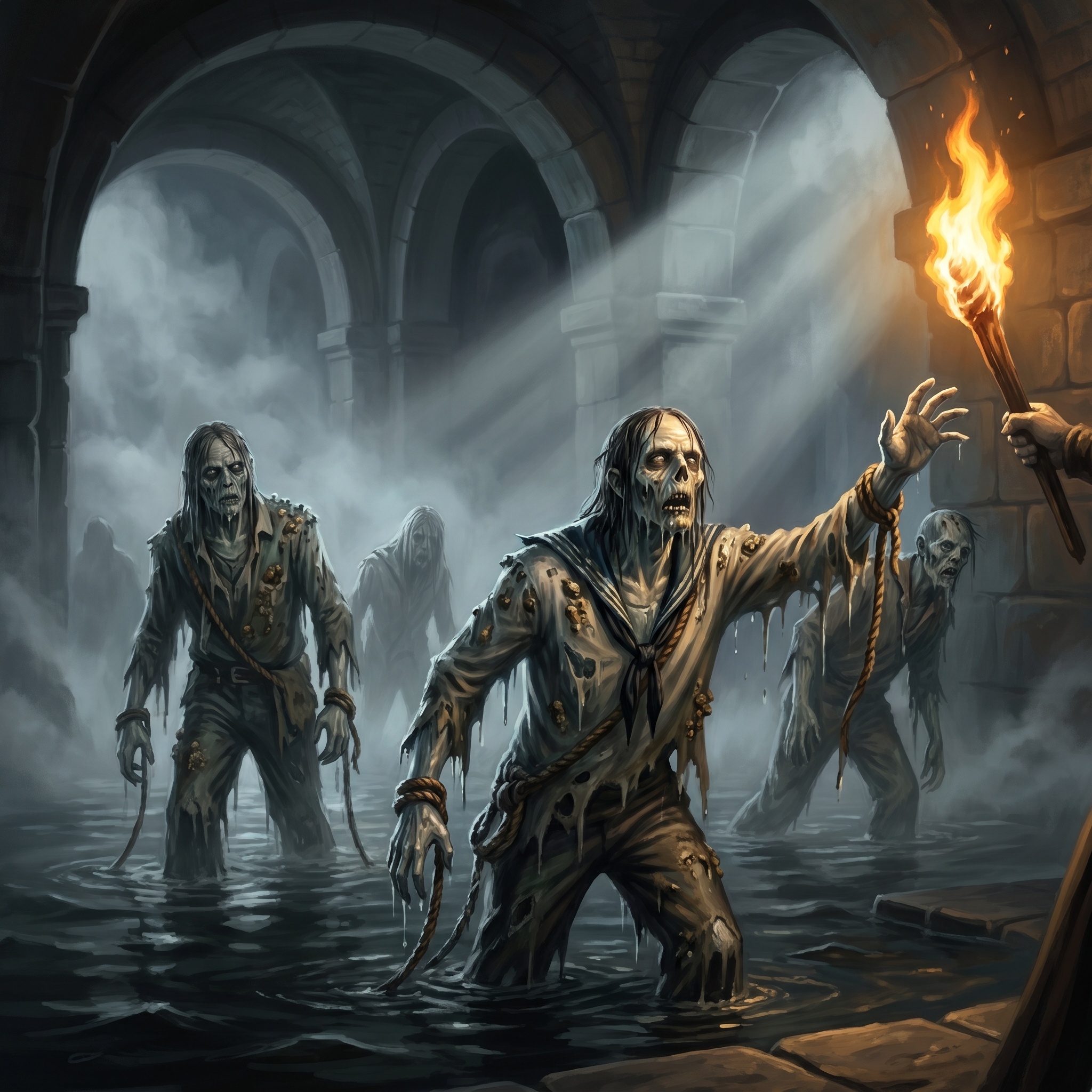
Role: Minion Undead Hazard Where It Appears: Shipwrecks, flooded mines, river graves, drowned villages.
Drowned dead are bodies animated by waterlogged site-memory, not contagious corpses. They repeat the last panic of drowning and drag warmth toward the same end.
Drowned Dead (Minion)
- Group Size: 3-10.
- Skills: Unarmed 3, Athletics 3 in water, Fortitude 3.
- Attacks: Waterlogged Grip (Unarmed; Damage 5; Crit 5; Grabbed on 2 Boons).
- Abilities: Drag Below — A Grabbed target in water suffers 3 Strain at the start of its turn unless it succeeds at Average Athletics.
- Soul: Claimable, one for each person the remains came from; at death those souls resume the crossing they were owed and are dispatched normally at Sheol, having been raised without consent.
- Tactics: Grab, pull into water, ignore pain.
- Harvesting and Trade: No harvest. Personal effects may identify the dead.
Frost Wight
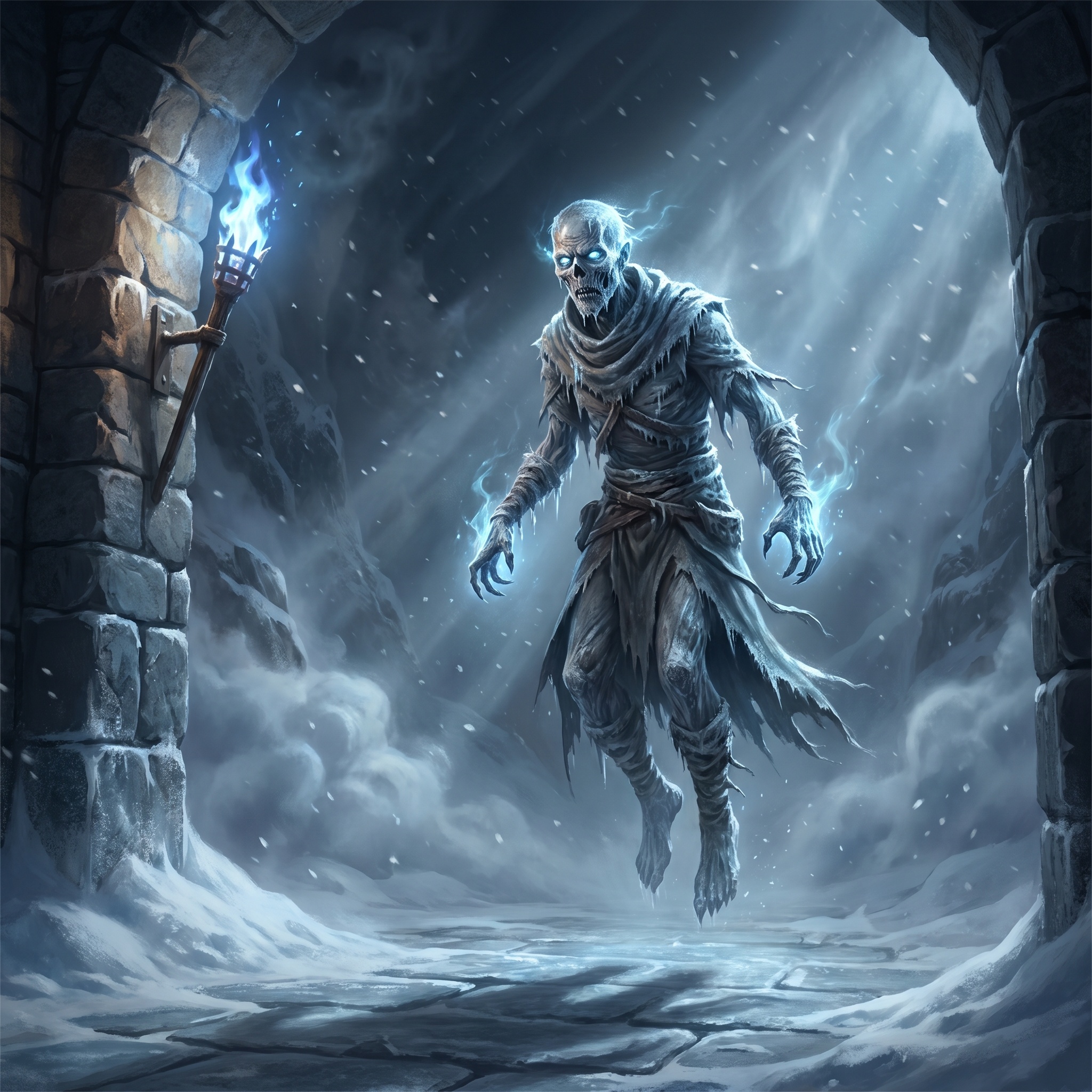
Role: Nemesis Undead Controller Where It Appears: Snowbound ruins, abandoned forts, glacial passes, cold battlefields. Source: Dort Monsters - Frost Wight.
"It does not speak. It whispers the names of things you have lost. This is not communication. It is inventory." — Adventuring Lore, chapter on cold-site adversaries
A Frost Wight is a cold-preserved dead intelligence wrapped in nullifying winter. It is not an infectious corpse and it does not create more of itself by killing. The horror is more precise: it can make warmth, courage, and memory fail.
What It Is
The body appears humanoid but wrong: too upright, too still, with joints that seem to remember motion rather than perform it. Cold distorts the air around it like heat shimmer in reverse. Fires gutter blue. Speech becomes difficult, not because the wight is loud, but because the world near it feels less convinced that living voices matter.
Some Frost Wights retain fragments of old identity. Others are only site pressure and death memory wearing a body. Named wights should have grievances, boundaries, and repeated phrases. Nameless ones should feel like the place itself learned to hate warmth.
Ecology and Behavior
Frost Wights haunt abandoned cold places: snowbound forts, glacial passes, frozen battlefields, and ruins where people died badly and were not properly remembered. They are solitary and territorial. They do not rage. They approach with methodical certainty, weakening resolve before touching flesh.
They are drawn to isolation. A hut cut off in a storm, a watchtower whose signal fire went out, a pass where travelers huddle in separate shelters: these are places where a Frost Wight becomes more than a monster. It becomes a pressure on decisions.
Signs and Knowledge
Field signs: sudden temperature drop, frost on the inside of shelters, fires burning blue or low, animals refusing warm buildings, missing names in journals, bodies preserved without ordinary decay.
Adventuring Lore or Secret Lore (Average): identifies a Frost Wight site and the need for fire, sunlight, and formation discipline.
Secret Lore or Planar Lore (Hard): understands null cold and knows morale effects fail near the wight unless protected by firelight.
Lore tied to the site (Hard): identifies what the wight remembers, which may allow negotiation, banishment, or a way to make sunlight matter.
Frost Wight (Nemesis)
- Skills: Unarmed 4, Reflexes 4, Fortitude 5, Perception 4, Secret Lore 3, Intimidation 5.
- Attacks: Frost Touch (Unarmed; Damage 8; Crit 3; Pierce 2, Stun 3); Killing Cold (Willpower; Damage 7 Strain; Crit 4; Range Short).
- Abilities: Null Cold Aura — Living creatures at Short range add 1 Bane to Readiness, Charm, Leadership, and Negotiation checks. Firelight within Engaged range suppresses this aura for that creature.
- Abilities: Paralyzing Whisper — As an Action, target one creature at Short range that can hear it. The target makes a Hard Readiness check. On failure, it is Immobilized until the end of its next turn. On 2 Banes, it is also Staggered.
- Abilities: Erasure Touch — Once per encounter, after Frost Touch deals Wounds to an Immobilized or incapacitated target, the wight may spend 2 Peril. The target suffers a Critical Injury with +30 to the roll. If this would kill the target, records and memories of the death become supernaturally unreliable at the GM's discretion. This does not erase player agency or campaign records.
- Abilities: Fire and Sun Weakness — Fire attacks add 2 Boons and ignore 3 Resistance. Direct sunlight destroys a Frost Wight at the end of its next turn unless it escapes sunlight or the GM declares it a named exception.
- Soul: Claimable, the crossing it was owed was interrupted rather than completed; at death the soul resumes that crossing and is dispatched normally at Sheol, having been raised without its consent.
Tactics: First beat, the wight suppresses morale with its aura and moves toward the weakest nerve in the group. Second beat, it uses Paralyzing Whisper on an isolated or frightened target. Third beat, it uses Frost Touch on the immobilized target or withdraws from fire. It does not waste effort on those standing together in light unless forced.
Encounter Use: Give players warning: frost silence, extinguished fires, animals refusing shelter, names missing from memorials. The correct preparation is fire, light, and formation discipline. Do not use Erasure Touch to invalidate a player's record of play; use it to make witnesses, documents, and NPC memory unreliable.
Harvesting and Trade
Frost Wights should rarely have a parts market. Most useful remains are site relics or banishment evidence, not organs.
| Harvest | Buyer | Check | Typical Value | Use | Complication |
|---|---|---|---|---|---|
| Nullfrost Shard | Exorcist, cold alchemist, scholar | Hard Secret Lore or Medicine | 1,000-3,000 gold Flargons | Wards against fear, cold-preservation study | Melts into useless water if warmed carelessly |
| Site Relic | Descendant, temple, local authority | Lore to identify | 200-5,000 gold Flargons | Restitution, banishment proof, memorial rites | Taking it without rite may strengthen the haunting |
| Wight Ash after Sun Destruction | Exorcist, saint-maker, historian | Average Secret Lore | 500-1,500 gold Flargons | Confirmation of destruction | Fraud is common and dangerous |
Variants
Lesser Frost Wight: Elite, WND 24, no Erasure Touch.
Named Frost Wight: Nemesis, WND 50, STR 28, sunlight harms but does not instantly destroy it. Give it a grievance and one rite that can weaken it before battle.
Frost Wight of Shoing
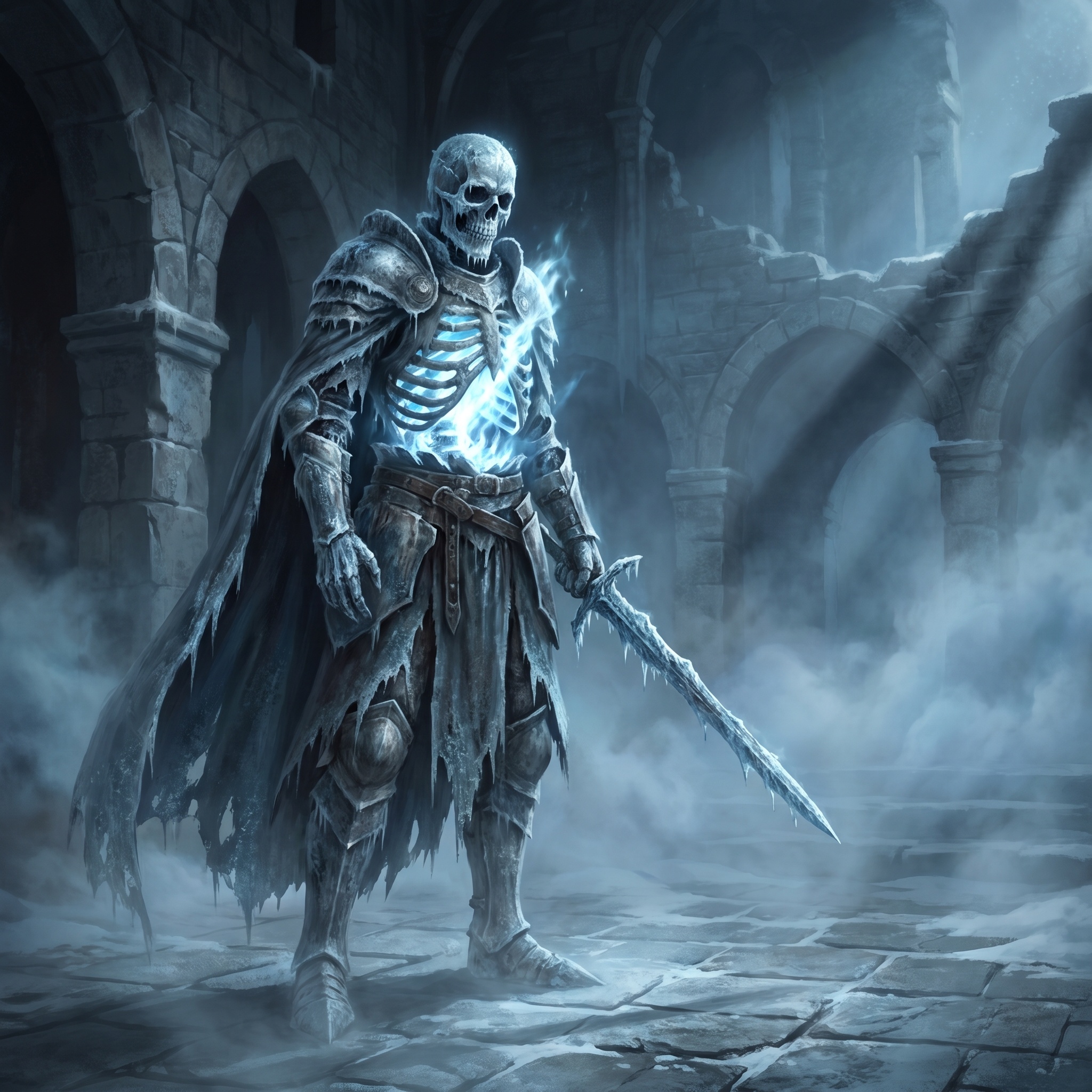
Role: Nemesis Restless Dead Lord Where It Appears: Shoing ruins, snowbound estates, battlefields buried under ice.
"The garrison disappeared in the third year of occupation. Every record of their names has since become unreliable. We are told this is coincidence." — Shoing Historical Commission, note on the Coldfort Gap, 3044 ME
This wight remembers every slight done to House Shoing and very little else. It is not infectious. Its victims do not become wights. They become evidence in a grievance older than most border maps.
What It Is
The Frost Wight of Shoing is a dead noble bound to grievance, lineage, and ancestral cold. It is not a disease, not a curse that spreads by bite, and not a source of new wights. It is a single wrongness left standing after House Shoing's old feuds froze into memory.
Its body wears ruined finery under frost-rimmed armor. Blue-white fire burns in its ribs when anger wakes it. Its voice carries the authority of a court that no longer exists, and it expects titles, debts, and insults to be remembered with legal precision.
Ecology and Behavior
The wight haunts Shoing ruins, snowbound estates, border battlefields, and halls where old noble property was stolen during collapse. It is most active during hard frost, anniversaries, and political moments when the Shoing name is invoked or erased.
It does not attack everyone. Servants who use the right forms of address may be ignored. Thieves carrying Shoing plate may be hunted across miles. Descendants of rival houses may be interrogated, judged, or spared if they can prove a debt was paid.
Signs and Knowledge
Lore, Genealogy, or Secret Lore (Hard) identifies the grievance pattern and the names the wight recognizes. Negotiation may work only if the speaker uses correct titles and addresses the old wrong directly.
Other signs include frost inside sealed rooms, noble portraits scraped clean of rival faces, ledgers preserved under ice, dueling scars appearing on mirrors, and dead soldiers arranged by banner as if awaiting judgment.
Frost Wight of Shoing (Nemesis)
- Skills: Leadership 4, Heavy Melee 4, Intimidation 5, Lore 3, Fortitude 5, Readiness 5.
- Attacks: Frosted Noble Blade (Heavy Melee; Damage 11; Crit 3; Pierce 2; Cold); Accusing Gaze (Willpower; Damage 8 Strain; Crit 4; Range Short).
- Abilities: Old Grievance — Against creatures bearing Shoing colors, names, debts, or stolen goods, the wight adds 1 Boon to attacks.
- Abilities: Cold Hall — The encounter area becomes freezing difficult terrain while the wight remains unturned.
- Soul: Claimable, the crossing it was owed was interrupted rather than completed; at death the soul resumes that crossing and is dispatched normally at Sheol, having been raised without its consent.
Tactics
The wight begins with accusation. It demands names, titles, houses, debts, and reasons for trespass. Characters who answer carelessly may give it exactly the legal target it wants. Characters who answer well may buy time, force a duel, or redirect the grievance.
In battle, it freezes exits, targets oathbreakers and relic thieves, and uses Accusing Gaze to break confidence before closing with the blade. If mocked rather than answered, it retreats into ancestral ice and turns the estate itself against intruders.
Evidence and Trade
There is no ethical harvest. The useful material is legal, historical, and spiritual evidence. Selling Shoing relics can spread the grievance to the buyer if the wight still has power to recognize the theft.
| Find | Value | Use | Recovery |
|---|---|---|---|
| Shoing claim ledger | 2,000-10,000 gold Flargons | Resolves inheritance, proves debt, redirects grievance | Lore or Investigation (Hard) |
| Frost-preserved signet | 1,500-6,000 gold Flargons | Identity proof, noble seal, rite focus | Craft or Lore (Average) |
| Rival confession record | Varies | Political leverage, wight pacification | Investigation or Secret Lore (Hard) |
| Ancestral blade fragments | 3,000-9,000 gold Flargons | Restitution, noble relic, cold enchantment study | Negotiation or Craft (Hard) |
Variants
- Duel Wight: Demands honorable challenge before bloodshed.
- Ledger Wight: Hunts debtors and anyone who bought stolen property.
- Battlefield Shoing: Commands frozen dead soldiers without creating new undead.
Frostbound Dead
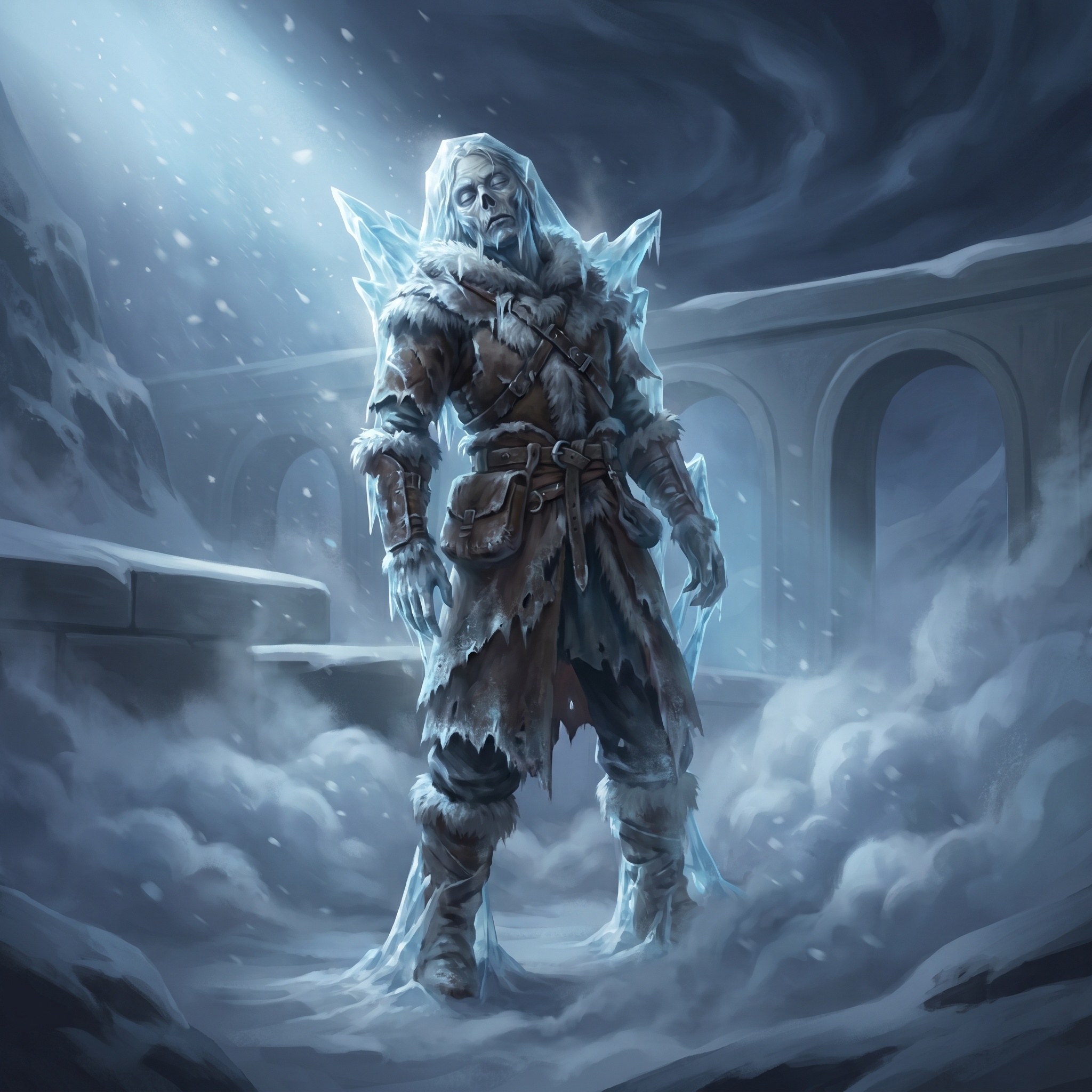
Role: Minion Undead Hazard Where It Appears: Mountain passes, glaciers, winter roads.
Frostbound dead are cold-preserved bodies animated by exposure, despair, and site pressure. They are not Frost Wights; they are what gathers around one.
Frostbound Dead (Minion)
- Group Size: 3-12.
- Skills: Unarmed 2, Fortitude 4, Survival 2.
- Attacks: Frozen Grip (Unarmed; Damage 5; Crit 5; Stun 1).
- Abilities: Cold Body — Fire attacks add 1 Boon and ignore 1 Resistance.
- Abilities: Blizzard Blend — In snow or whiteout, add 1 Bane to detect them before they move.
- Soul: Claimable, one for each person the remains came from; at death those souls resume the crossing they were owed and are dispatched normally at Sheol, having been raised without consent.
- Tactics: Emerge in storm, grab, hold prey in cold.
- Harvesting and Trade: No harvest. Identification of bodies may matter.
Funeral Pyre Remnant
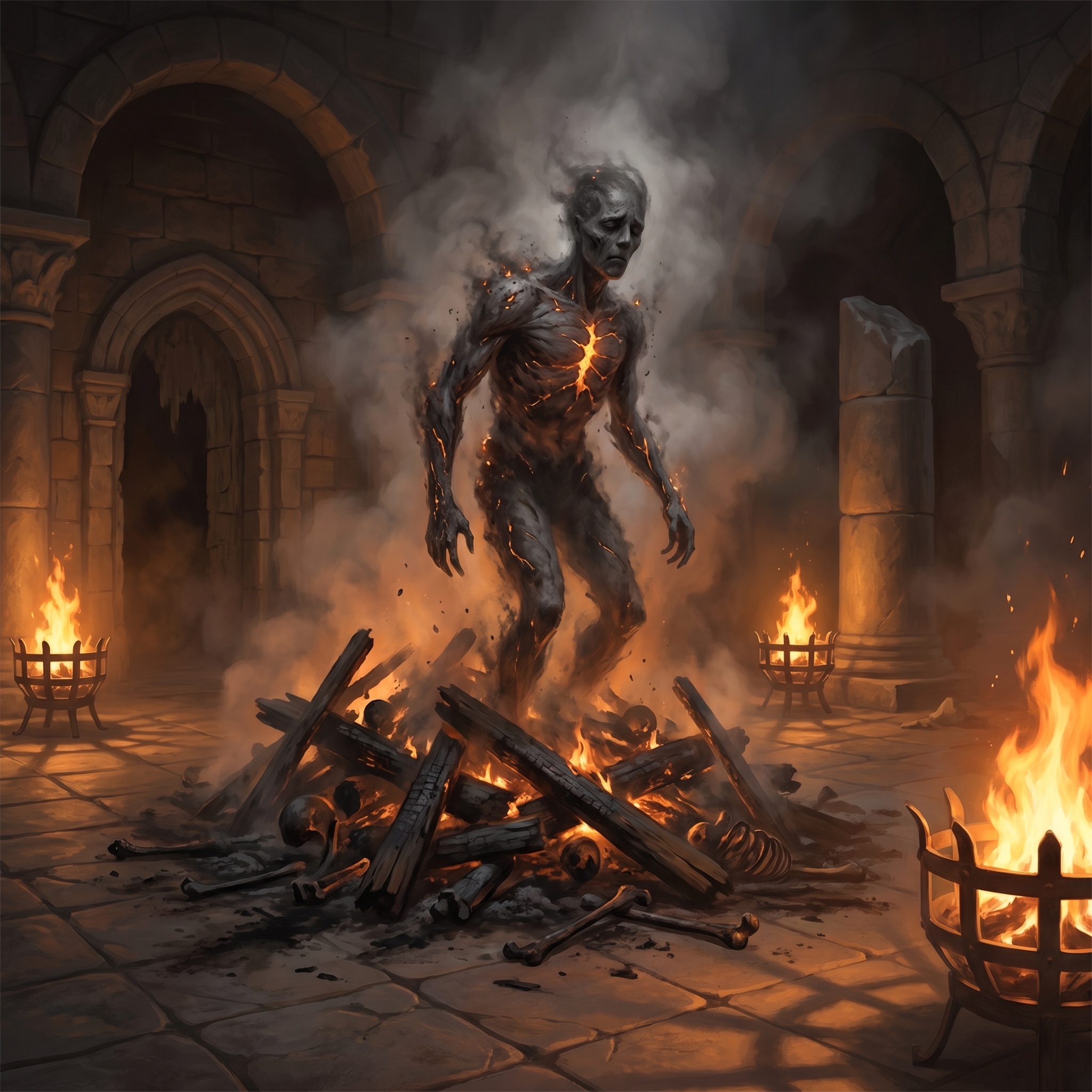
Role: Elite Elemental Undead Where It Appears: Improper cremation sites, battlefield pyres, plague burn pits.
What It Is
Funeral pyre remnants are what happens when fire completes the body but not the rite. They burn with the insult of being disposed of rather than mourned. Their shapes are ash, ember, bone-light, and the posture of someone rising from a pyre that was never given a name.
They are undead and elemental at once: not a fire spirit wearing a corpse, but a failed funeral made hot enough to walk.
Ecology and Behavior
Funeral pyre remnants appear at improper cremation sites, plague burn pits, battlefield pyres, and places where bodies were destroyed to hide evidence. They may guard ashes, attack looters, or punish anyone who treats remains as refuse.
They are drawn to offerings, names, and unfinished rites. A respectful mourner may survive where an armed scavenger burns. Fire strengthens them unless it is ritually prepared, blessed, salted, or tied to the proper funerary tradition.
Signs and Knowledge
Theology or Culture (Average) recognizes an incomplete cremation rite. Survival or Natural Philosophy (Average) notices ash that stays warm in rain.
Other signs include offerings burned before anyone lights them, soot handprints on grave markers, smoke that bends toward names, and scavenged pyres reigniting when disturbed.
Funeral Pyre Remnant (Elite)
- Skills: Unarmed 3, Fortitude 4, Readiness 4, Intimidation 3.
- Attacks: Ember Grasp (Unarmed; Damage 7; Crit 4; Burn 2); Ash Breath (Willpower; Damage 5 Strain; Range Short; Blast 3).
- Abilities: Improper Fire — Fire attacks heal 2 Wounds instead of damaging it unless blessed, salted, or ritually named.
- Abilities: Douse and Name — Water suppresses Burn; a correct funerary name adds 1 Boon to banishment or social resolution.
- Soul: Claimable, the crossing it was owed was interrupted rather than completed; at death the soul resumes that crossing and is dispatched normally at Sheol, having been raised without its consent.
Tactics
A funeral pyre remnant burns offerings, punishes looters, and attacks those who treat remains as refuse. It closes with Ember Grasp, then uses Ash Breath when surrounded. It may pause if someone speaks a correct funerary name or begins the rite that was denied.
The encounter should make respect tactically useful. Water helps, but names and proper rites turn the fight into a possible release.
Harvesting and Trade
| Component | Value | Use | Harvest |
|---|---|---|---|
| Respectfully gathered pyre ash | 300-1,200 gold Flargons | Funerary rites, warding, spirit ink | Theology or Culture (Average) |
| Ember bone | 600-1,800 gold Flargons illicitly | Fire-necromancy, curse anchors | Secret Lore (Hard), taboo |
| Name cinder | Priceless to kin | Identifies one of the dead, completes rite | Theology (Hard) |
Variants
- Plague Pit Remnant: Contains many unnamed dead and spreads panic rather than disease.
- Battle Pyre Remnant: Reacts to banners, weapons, and battlefield commands.
- Hidden-Crime Remnant: Protects evidence of murder burned with the body.
Ghoul
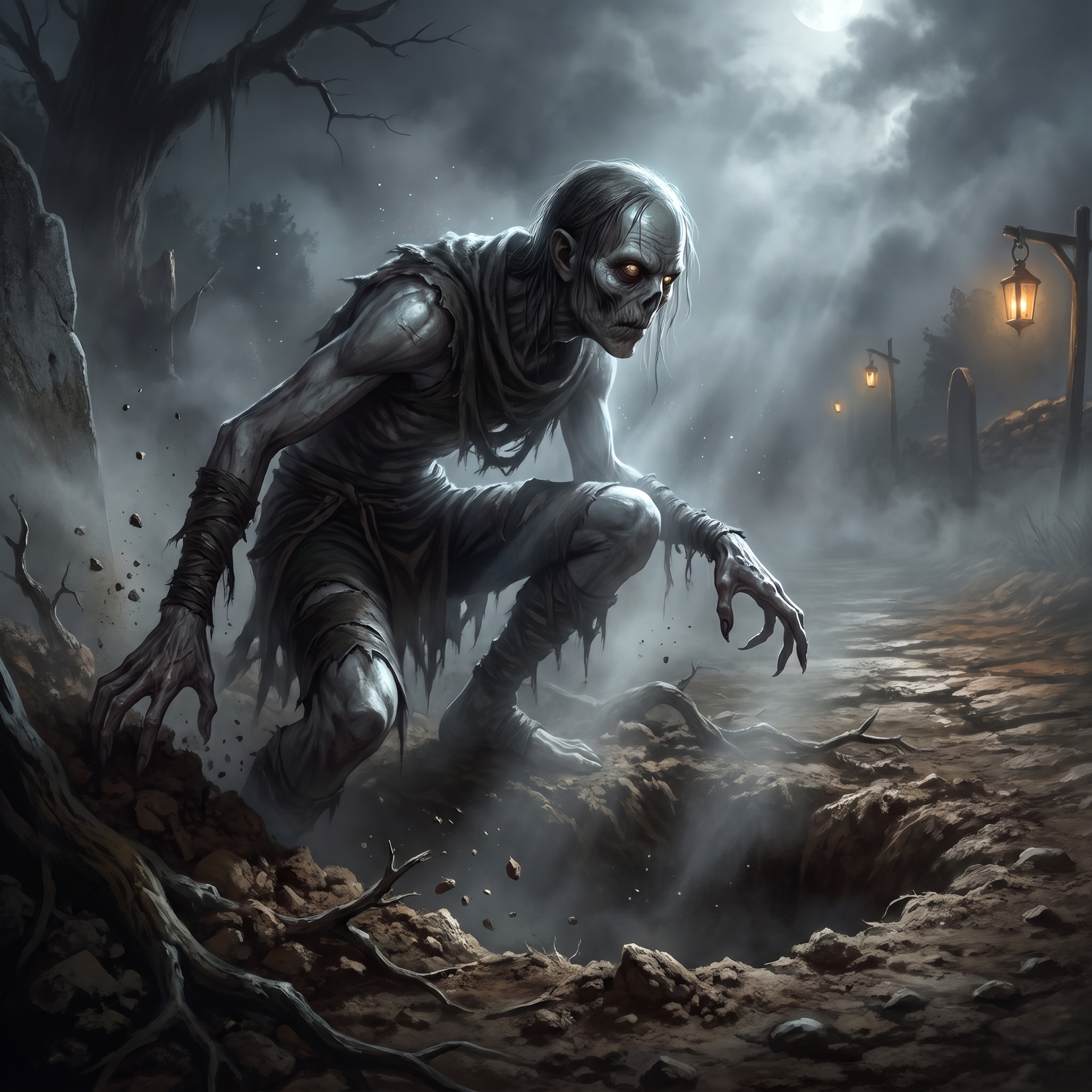
Role: Elite Lurker / Ambusher Where It Appears: Graveyards, battlefields, plague pits, any site with large numbers of the dead and insufficient rites.
A Ghoul is not the dead that kept walking. It is the hungry thing that came to the dead. The distinction matters when you are trying to understand what you found.
What It Is
Ghouls are undead predators that feed on corpses but prefer fresh kills. They are not the product of a specific necromantic working — they arise where the dead are numerous and the rites have failed, drawn or generated by the concentration of unprocessed death. Some scholars argue they are a natural scavenger of the Silver Road, filling a role in the soul ecosystem; most exorcists consider this an interesting theory to pursue after the immediate problem is handled.
They are lean, fast, and have a paralyzing touch that makes fresh prey easier to manage. They do not speak. They do not negotiate.
Ecology and Behavior
Ghouls inhabit grave sites, ruins, and the aftermath of large battles. They are nocturnal scavengers who prefer to eat what the earth has already given them but will ambush travelers who camp too near their feeding grounds. A Ghoul that has developed a taste for living prey is significantly more dangerous than one that eats the recently dead.
Signs and Knowledge
Survival or Adventuring Lore (Average): identifies disturbed grave sites with Ghoul feeding signs.
Secret Lore (Hard): knows the paralysis mechanism and that fire disrupts their coordination more than blades do.
Ghoul (Elite)
- Skills: Unarmed 4, Stealth 4, Athletics 4, Perception 3, Fortitude 4.
- Attacks: Raking Claws (Unarmed; Damage 8; Crit 3; Pierce 1, Vicious 5); Paralyzing Bite (Unarmed; Damage 6; Crit 4; Stun 3 on 2 Boons — see Paralysis).
- Abilities: Paralysis — On Paralyzing Bite Stun, target makes a Hard Fortitude check. On failure, it is Immobilized until end of its next turn. On 2 Banes, Immobilized for two turns.
- Abilities: Grave Sense — Detects living creatures by smell at Short range in darkness or underground.
- Abilities: Frenzy at Fresh Blood — If a living creature is wounded in the same scene, the Ghoul adds 1 Boon to attacks that round.
- Abilities: Dread — Fear 2.
- Soul: Claimable, the crossing it was owed was interrupted rather than completed; at death the soul resumes that crossing and is dispatched normally at Sheol, having been raised without its consent.
Tactics: The Ghoul targets the rear of a group, attempts to paralyze one target, and drags them away. It avoids bright fire and loud noise but does not retreat from a meal it has secured.
Encounter Use: Use Ghouls in multiples in places the party must spend time — a burial site they are searching, a crypt they need to open. The paralysis should create a rescue situation, not just an attrition fight.
Harvesting and Trade
| Harvest | Buyer | Check | Typical Value | Use | Complication |
|---|---|---|---|---|---|
| Paralysis Gland | Alchemist, surgeon | Hard Medicine | 600–1,400 gold Flargons | Surgical paralytic, poison study | Remains active after death; mishandling causes Stun 2 |
| Finger Bones | Collector, curse-breaker | Average Survival | 100–300 gold Flargons | Minor wards, trophies | No meaningful value without authenticated site |
Variants
Ghoul Pack Leader: Nemesis, WND 34, can direct Ghouls as a group and gains 1 Peril when a paralyzed target is within its reach.
Grave Hag
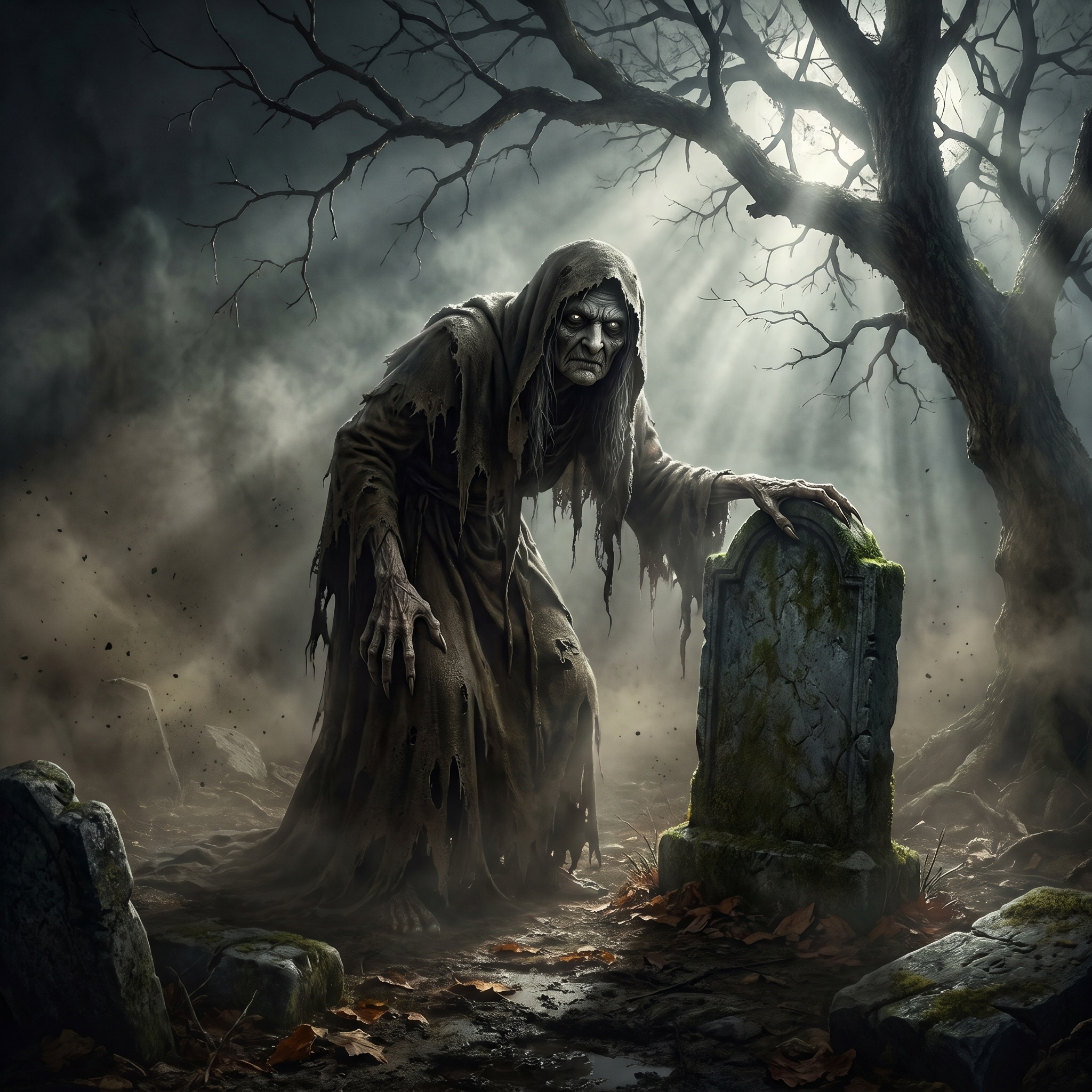
Role: Elite Social Threat / Controller Where It Appears: Old grave sites, crossroads, the edges of settlements where the living and dead share the same boundary.
A Grave Hag is alive. It is also dead. The church that manages souls has a strong opinion about this and the Grave Hag has had longer than the church to work out its position on theirs.
What It Is
A Grave Hag is a person who interfered with their own death — not through a formal Lich ritual, but through an accumulation of forbidden practices, soul-adjacent dealings, and the consumption of things that should not be consumed. The result is a being that is neither cleanly alive nor cleanly dead. Its vital signs are wrong. It ages but does not die. It feeds on grief, fear, and occasionally something more physical.
They are intelligent, experienced, and deeply knowledgeable about the boundary between life and death in practical terms. Some serve as curers or oracles. Most have their own agendas that predate the current political situation by generations.
Ecology and Behavior
A Grave Hag maintains a specific location — usually a crossroads grave site, the edge of a graveyard, or an old building where many have died — and offers services to those who find her. The services are real. The prices are negotiated in terms most people do not understand until afterward.
Signs and Knowledge: Secret Lore or Lore (Average) identifies the Grave Hag's nature from her appearance and the site conditions. Negotiation (Hard) reads her pricing language safely.
Grave Hag (Elite)
- Skills: Medicine 4, Secret Lore 4, Lore 4, Negotiation 4, Deception 4, Perception 4.
- Attacks: Withering Hex (Secret Lore; Damage 7 Strain; Range Short; Stun 2 on 2 Boons); Grave Touch (Unarmed; Damage 6; Crit 4).
- Abilities: Half-Dead Body — Immune to poison and disease. Fire and sacred attacks deal normal damage; all other sources reduce damage by 1 before Resistance.
- Abilities: Mummy Rot — On 2 Boons from Grave Touch that wounds the target, the target makes a Hard Willpower check. Failure contracts Mummy Rot; the target loses 2 maximum Wounds after each extended rest and adds 1 Bane to Medicine checks made to recover from Critical Injuries. Recovery does not occur naturally while the curse remains active. Cure by Hard Medicine and a curse-breaking rite tied to the grave hag's burial ground or victim bargain. Untreated Mummy Rot is eventually fatal.
- Abilities: Grief Sense — Fear 3. Detects emotional distress, grief, and fear at Short range. Adds 1 Boon to all social checks against a target that is frightened, mourning, or desperate.
- Abilities: The Price — Once per scene, the Grave Hag may name a price for assistance. If the party agrees and accepts the assistance, the price is binding. She does not lie about what the price is.
- Soul: Claimable, and the hag interfered with her own death rather than suffering it; at death the crossing resumes and the soul is directed to the Denied Chamber of the Vault of the Unclaimed.
Tactics: Negotiates before fighting. If combat begins, she uses Withering Hex to buy retreat time and withdraws to her site's advantages — hidden passages, cursed ground, accumulated artifacts.
Encounter Use: Use as a moral choice rather than a fight. The party needs something she has. The price will be real.
Harvesting and Trade
The Grave Hag typically survives party encounters and is not available to harvest. If somehow killed, her accumulated materials include ingredients and knowledge worth considerable amounts to the right buyers — and no reputable buyer will want to be that buyer.
Variants
Benevolent Grave Hag: Same stat block; her prices are fair and she considers herself a community resource. The horror is that this version is harder to categorize.
Grave Knight
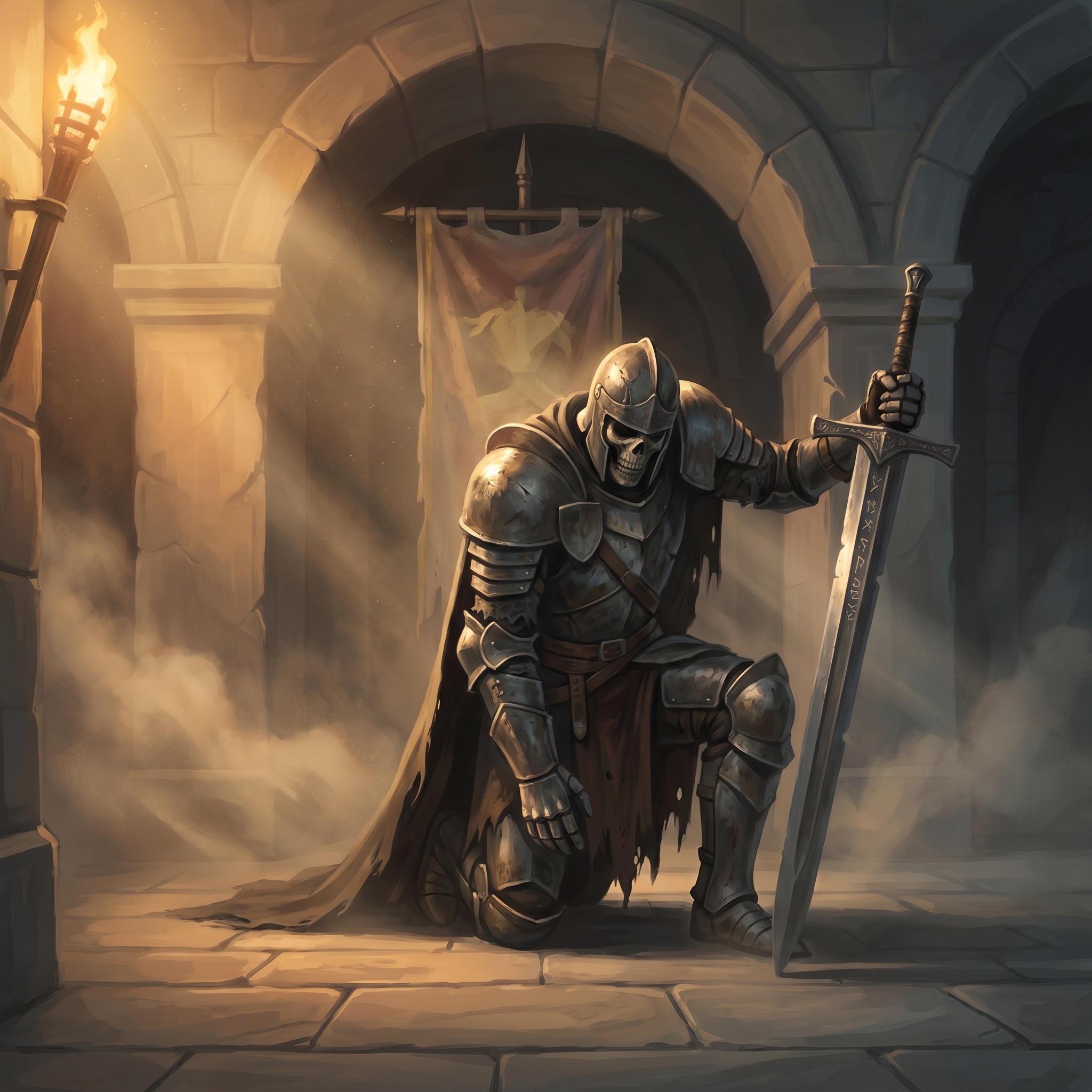
Role: Nemesis Undead Commander Where It Appears: Battlefields, betrayed castles, knightly tombs.
"It serves a contract that has outlived the party who signed it. The terms cannot be renegotiated. The other signatory is dead. It is still waiting for performance." — Legal note, Sheol transit records, appended to a deceased soul's file
What It Is
Grave knights are oath-bound martial dead. They retain tactics, pride, and command presence. Some still believe the war is ongoing. Others know perfectly well that the war ended and consider the living cowards for accepting it.
A grave knight is not just a large armored undead. It is martial identity without mercy, an oath that kept its sword arm after the heart stopped. Its name, banner, betrayal, or last command should matter.
Ecology and Behavior
Grave knights rise from battlefields, betrayed castles, knightly tombs, and massacre sites where command was tied to unfinished duty. They attract lesser dead, not by raising infection, but because old soldiers remember command even in fragments. Skeleton bands, armored dead, and battlefield spirits may fall into formation around them.
They are proud and hierarchical. A grave knight may challenge leaders, recognize heraldry, punish cowardice, or parley under ancient rules before battle. Some can be laid to rest by revealing betrayal, returning a banner, or proving the war is truly over.
Signs and Knowledge
Lore, Warfare, or Culture (Hard) identifies the knight's name, banner, or betrayal. Theology or Secret Lore (Hard) knows what rite might release the oath.
Other signs include dead soldiers arranged in formation, banners that stir without wind, old commands whispered at dusk, and battlefield scavengers found kneeling as if judged.
Grave Knight (Nemesis)
- Skills: Heavy Melee 5, Leadership 4, Fortitude 5, Readiness 5, Lore 3, Intimidation 4.
- Attacks: Grave Greatsword (Heavy Melee; Damage 11; Crit 3; Pierce 2, Vicious 5); Commanding Rebuke (Leadership; Damage 6 Strain; Range Short).
- Abilities: Dead Command — Allied skeletons or dead soldiers at Short range add 1 Boon to attacks.
- Abilities: Oath Armor — Reduce damage by 3 before Resistance against attacks from enemies who do not know the knight's name or betrayal.
- Soul: Claimable, the crossing it was owed was interrupted rather than completed; at death the soul resumes that crossing and is dispatched normally at Sheol, having been raised without its consent.
Tactics
A grave knight challenges leaders, commands minions, and punishes retreat. It uses lesser dead to control space while it seeks an honorable or symbolically important target. If the party knows its name or betrayal, the fight becomes less one-sided and more personal.
Run the grave knight with ceremony. It may salute, accuse, demand banners, or call the party by ranks they do not hold. Even a violent encounter should feel like stepping into an old war's command tent.
Harvesting and Trade
| Component | Value | Use | Harvest |
|---|---|---|---|
| Grave greatsword | 2,000-6,000 gold Flargons | Weapon, relic, curse anchor | Lore or Theology (Hard) to claim safely |
| Oath seal | 1,000-3,000 gold Flargons | Exorcism, historical proof, noble leverage | Culture or Secret Lore (Hard) |
| Tarnished plate | 1,500-5,000 gold Flargons | Armor, memorial restoration, house claim | Legal ownership often contested |
Variants
- Banner Knight: Cannot rest while its standard is lost or defiled.
- Betrayed Castellan: Guards a castle against descendants of the traitor.
- Last Captain: Commands a whole field of dead who still await orders.
Hunger Ghost
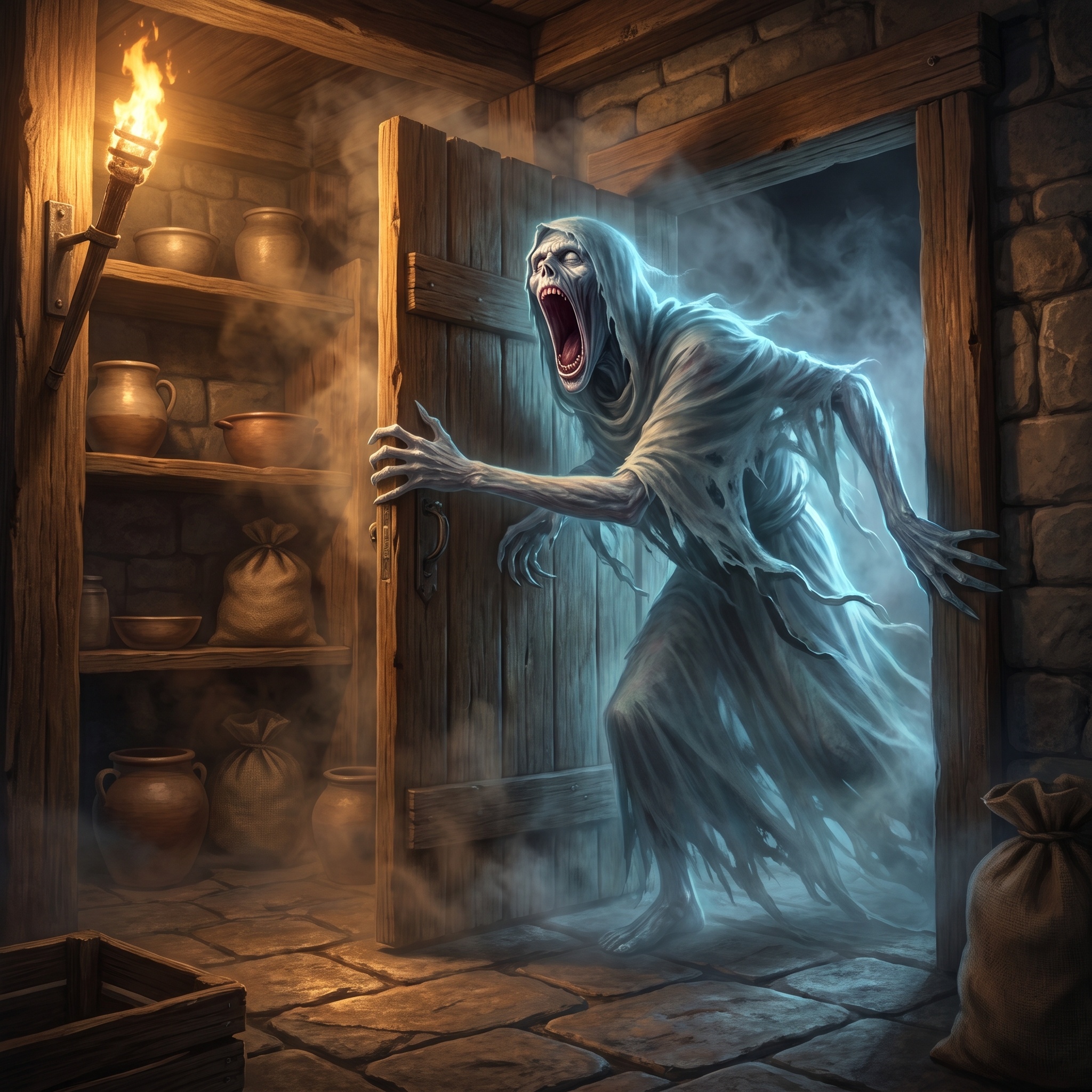
Role: Elite Spirit Predator Where It Appears: Famine houses, abandoned granaries, siege ruins.
What It Is
Hunger ghosts are need without a body. They feed on deprivation, making full people feel empty and desperate people violent. A hunger ghost is gaunt even as a spirit, with a mouth too wide, hands too long, and attention fixed on any sign that someone else has enough.
They are born from famine, siege, hoarding, locked granaries, and deaths where food existed but was withheld. They are not punishment for hunger. They are what hunger becomes when injustice gives it a place to haunt.
Ecology and Behavior
Hunger ghosts gather in abandoned granaries, famine houses, siege ruins, locked pantries, and roads where refugees died within sight of stores they could not reach. They spoil food, intensify cravings, and turn scarcity into accusation.
They are drawn to people who have skipped meals, rationed too long, or carry guilt about food. They retreat from shared meals, salt, communal fire, and honest distribution because those acts contradict the isolation that sustains them.
Signs and Knowledge
Survival, Theology, or Lore (Average) identifies a hunger haunting. Medicine (Average) distinguishes supernatural deprivation from ordinary starvation symptoms.
Other signs include sealed jars full of ash, pantries cold in summer, fresh bread molding in minutes, and arguments about food becoming sudden and vicious.
Hunger Ghost (Elite)
- Skills: Stealth 4, Perception 4, Intimidation 3, Readiness 4.
- Attacks: Starving Touch (Willpower; Damage 7 Strain; Range Short); Cold Claw (Unarmed; Damage 5; Crit 4).
- Abilities: Empty Belly - Targets who have not eaten today add 1 Bane to resist its abilities.
- Abilities: Spoil Stores - Once per scene, ruin exposed food in a small area unless protected by salt, blessing, or sealed containers.
- Soul: Claimable, the crossing it was owed was interrupted rather than completed; at death the soul resumes that crossing and is dispatched normally at Sheol, having been raised without its consent.
Tactics
A hunger ghost spoils food, isolates the hungry, and attacks the person most afraid of not having enough. It uses Starving Touch to turn discipline into desperation. It withdraws from shared meals, fire, salt lines, and acts of communal care.
The encounter should make supplies matter without punishing bookkeeping. A single visible ration, locked pantry, or stolen grain cart can carry the whole scene.
Evidence and Trade
| Find | Value | Use | Recovery |
|---|---|---|---|
| Famine ledger | 500-2,500 gold Flargons | Names hoarders, victims, and hidden stores | Lore or Streetwise (Average) |
| Anchor bowl or key | Varies | Lays the ghost to rest, identifies culprit | Theology or Secret Lore (Hard) |
| Spoiled grain sample | 100-600 gold Flargons | Haunting proof, alchemical study | Natural Philosophy (Average) |
Variants
- Siege Ghost: Targets commanders, quartermasters, and anyone carrying keys.
- Pantry Wraith: Bound to one locked storehouse and the family that controlled it.
- Road Hunger: Follows refugee paths and grows worse when travelers hoard.
Lich
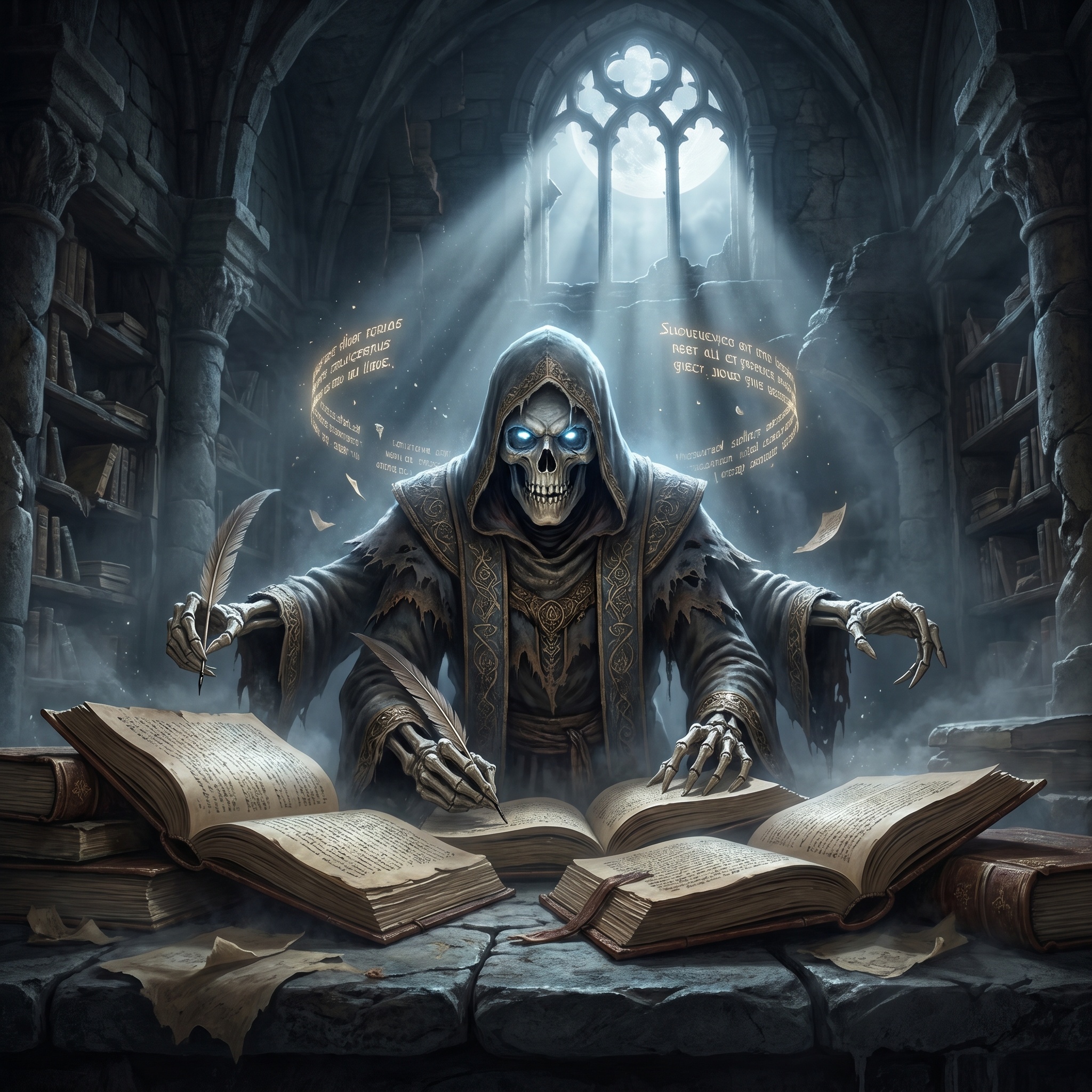
Role: Nemesis Scholar-Predator Where It Appears: Ancient towers, sealed libraries, ruins that predate the current civilization, anywhere a person with extreme knowledge chose to stop dying.
"It is not undead in the way a corpse is undead. It chose this. It understands what it is and has had centuries to make peace with the implications. The part that should frighten you is that it considers us the temporary ones." — Assessment note, Order of the Quiet Survey, access restricted
A Lich is not a failure of death. It is a refusal of it — deliberate, prepared, and usually irreversible by the time anyone realizes what has been accomplished.
What It Is
A Lich is a spellcaster who performed the Phylactery Rite before death, transferring their soul's anchor from their body to a prepared object and sustaining their body through ongoing magical preservation. The body continues to decay but extremely slowly, arrested by the continuous discharge of arcane energy. After centuries, most Liches appear as preserved skeletal figures still wearing the clothes of their last living decade.
The intelligence is intact. The knowledge is intact. The personality is intact, though centuries of solitude and the absence of physical sensation tends to erode the parts of personality that relate to other people.
Ecology and Behavior
A Lich has an agenda that predates the party by decades to centuries. It may be completing research, protecting something, waiting for a specific astronomical or political event, or simply existing — having outlived the urgency that drove the original ritual.
Liches are not uniformly hostile. They are uniformly pragmatic. A party that offers information, a problem, or resources the Lich values is more interesting than a party that just opens the door. The Lich has seen parties open the door before. It has remained.
The Phylactery is the critical vulnerability. The Lich can be destroyed in combat but regenerates within days from the Phylactery's location unless the Phylactery is also destroyed. Most Liches conceal the Phylactery in an entirely separate location and under extensive secondary protection.
Signs and Knowledge
Secret Lore (Hard): identifies Lich presence from the arcane discharge patterns in the area.
Secret Lore (Severe): understands the Phylactery Rite, can theorize where one might be hidden, and knows that combat alone will not end this.
Lich (Nemesis)
- Skills: Secret Lore 5, Natural Philosophy 5, Planar Lore 4, Intimidation 4, Lore 5, Perception 4.
- Attacks: Bone Touch (Unarmed; Damage 6; Crit 4; Stun 3); Arcane Discharge (Secret Lore; Damage 12; Crit 3; Range Long; Pierce 4).
- Abilities: Phylactery Anchor — When reduced to 0 Wounds, the Lich's body collapses but is not destroyed. It reforms near the Phylactery's location within 1d4 days unless the Phylactery is also destroyed. The Phylactery's location and nature are a separate discovery.
- Abilities: Arcane Mastery — The Lich may cast two spell-equivalent abilities per round rather than one. It does not require somatic components.
- Abilities: Fear Aura — Fear 4. Living creatures at Short range add 1 Bane to Readiness checks.
- Abilities: Death Ward — Once per encounter, when the Lich would be reduced below 10 Wounds by a single hit, reduce the damage to bring it to exactly 10 instead.
- Soul: Claimable, but anchored in the phylactery rather than the body; the crossing resumes only once the phylactery is destroyed, and the soul is then directed to the Denied Chamber of the Vault of the Unclaimed as one that pursued its own undeath.
Tactics: The Lich assesses first. It uses Arcane Discharge at range on the biggest threats while maintaining conversation. It does not commit to melee unless the party has destroyed all other options. If losing, it may simply stop fighting and ask the party what they actually want.
Encounter Use: Use the Lich as an information encounter as much as a combat one. It knows things no living person knows. It may have conditions, exchanges, or requests. The fight is available but it is not the only path.
Harvesting and Trade
| Harvest | Buyer | Check | Typical Value | Use | Complication |
|---|---|---|---|---|---|
| Personal Library | Arcane Faculty, Secret Lore scholar | Lore to prioritize | 5,000–50,000 gold Flargons | Centuries of research, techniques, histories | May contain knowledge that is dangerous to possess |
| Remaining Arcane Implements | Wardwright, collector | Secret Lore or Craft to assess | 2,000–20,000 gold Flargons | Enchanted tools still functional | Some are the Phylactery; handling without identification is very risky |
| Phylactery (destroyed) | Exorcist, academic | Hard Secret Lore to authenticate | 3,000–10,000 gold Flargons | Proof of permanent death, academic study | Attempting to use rather than destroy it has historical precedent and uniformly bad outcomes |
Variants
Young Lich: Nemesis, WND 30, STR 20. Recently completed the Rite. Still adjusting to being dead. More emotionally present, which makes it stranger to deal with.
Mourning Veil
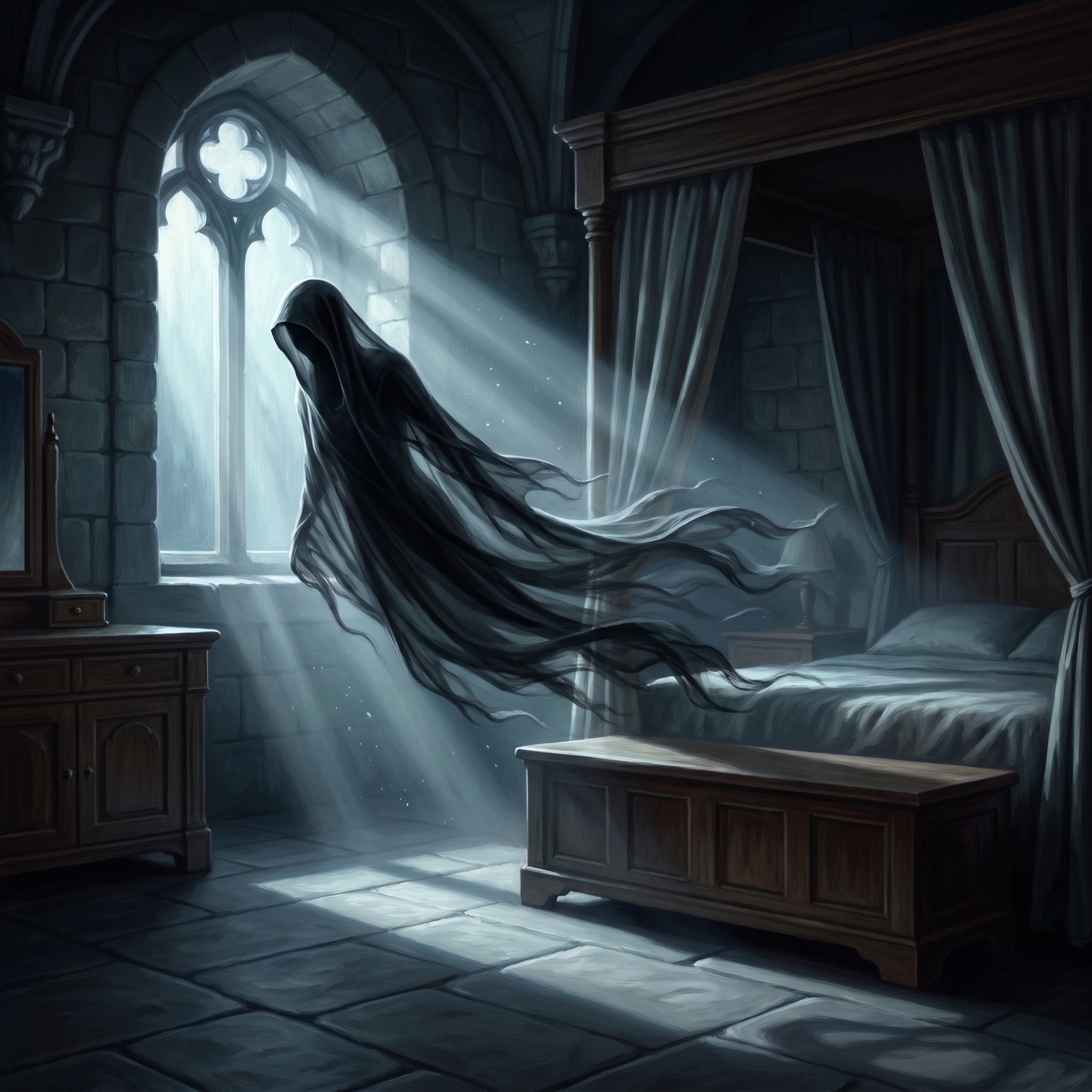
Role: Elite Emotional Spirit Where It Appears: Houses of unresolved grief, murder rooms, abandoned nurseries.
What It Is
Mourning veils feed on grief without understanding it. They preserve sorrow the way amber preserves insects. They appear as drifting black cloth, a figure seen sideways, or a veil across a room no one remembers hanging.
They are dangerous because they make grief feel like loyalty. A victim may resist rescue because moving on feels like betrayal.
Ecology and Behavior
Mourning veils form in houses of unresolved grief, murder rooms, abandoned nurseries, sickbeds, and places where mourning was forbidden or never allowed to end. They anchor to letters, veils, deathbed cloth, toys, portraits, or rooms kept exactly as they were.
They isolate mourners and preserve rituals of sorrow. Curtains stay drawn. Windows stick shut. Meals go cold. Visitors begin whispering. The veil grows stronger when grief is private, repetitive, and unnamed.
Signs and Knowledge
Charm, Theology, or Medicine (Average) identifies grief unnaturally sustained. Perception (Hard) spots the veil's anchor object before it attacks.
Other signs include rooms that smell shut even when opened, letters recopied in the same hand, portraits turned toward beds, and mourners unable to say what they want grief to become.
Mourning Veil (Elite)
- Skills: Charm 4, Stealth 4, Perception 4, Readiness 4.
- Attacks: Grief Wrap (Charm; Damage 7 Strain; Range Short); Cold Thread (Unarmed; Damage 4; Crit 5).
- Abilities: Old Sorrow - Targets with recent loss add 1 Bane to resist its Charm attacks.
- Abilities: Open the Windows - Sunlight, fresh air, and named remembrance remove 1 Bane from checks against it.
- Soul: None, a mourning veil is preserved sorrow rather than a person; at death nothing passes.
Tactics
A mourning veil isolates mourners, smothers hope, and flees from communal remembrance. It attacks those with recent loss first, not because it hates them, but because they are easiest to wrap. It retreats from sunlight, fresh air, opened rooms, and people naming the dead with love rather than fixation.
Use it for haunted houses where emotional resolution is part of survival. The best counter may be gathering the family, reading the letter, opening the windows, or admitting the murder.
Evidence and Trade
| Find | Value | Use | Recovery |
|---|---|---|---|
| Anchor veil or cloth | Varies | Resolves haunting, identifies death or mourner | Theology or Charm (Hard) |
| Preserved letter | 200-1,500 gold Flargons | Confession, inheritance clue, emotional key | Lore or Culture (Average) |
| Grief-dark thread | 300-1,200 gold Flargons illicitly | Memory magic, mourning rites | Secret Lore (Hard), ethically fraught |
Variants
- Nursery Veil: Anchored to a child's room and especially strong against caretakers.
- Widow's Veil: Protects or imprisons one grieving spouse.
- Murder Veil: Cannot rest until the death is named truthfully.
Mummy
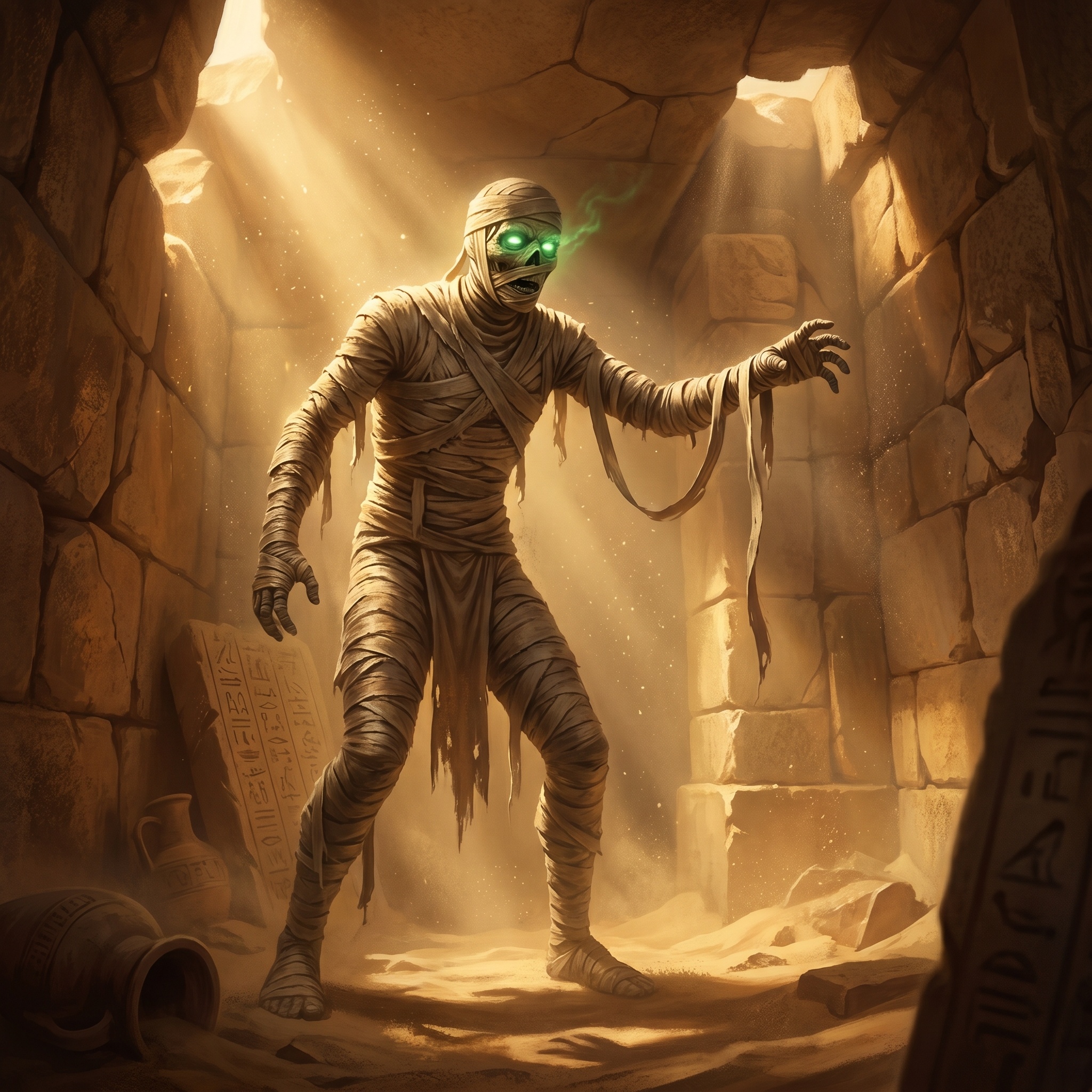
Role: Elite Guardian / Curser Where It Appears: Desert tombs, sealed burial sites, ancient preservation chambers.
The mummy does not wake up because it is angry. It wakes up because someone entered without the rite, and the rite was part of the architecture.
What It Is
A Mummy is a preserved dead body sustained by preservation magic and a protective curse bound to a specific tomb or object. It is not spontaneous undeath — it is intentional installation. Someone built it this way. The curse is the lock; the mummy is the mechanism.
Ecology and Behavior
A Mummy does not move when undisturbed. It stands, kneels, or lies in whatever position it was placed and remains until the trigger conditions are met — usually entry without authorization, touching a guarded object, or crossing a marked threshold. Once activated it pursues relentlessly until the intruder is dead or outside the guarded boundary.
The curse it carries spreads by touch. This is intentional design. The tomb's builders wanted intrusion to carry consequences even for those who escaped.
Signs and Knowledge: Lore or Secret Lore (Average) identifies a mummy from natural preserved remains. Lore (Hard) identifies the specific curse and the rite that could have prevented this.
Mummy (Elite)
- Skills: Unarmed 4, Fortitude 5, Intimidation 4, Lore 3.
- Attacks: Cursed Grasp (Unarmed; Damage 9; Crit 3; Pierce 2).
- Abilities: Mummy Rot — On 2 Boons from Cursed Grasp that wounds the target, the target makes a Hard Willpower check. Failure contracts Mummy Rot; the target loses 2 maximum Wounds and 1 Might after each extended rest and adds 1 Bane to Medicine checks made to recover from Critical Injuries. Recovery does not occur naturally while the curse remains active. Cure by Hard Medicine and a ritual component from the tomb's creation tradition. Untreated Mummy Rot is eventually fatal.
- Abilities: Fire Weakness — Fire attacks add 2 Boons and ignore Resistance. A burning Mummy adds 2 Banes to its own checks.
- Abilities: Tomb Bound — The Mummy cannot cross the tomb's outer threshold. It will not pursue past it.
- Soul: Claimable, the crossing it was owed was interrupted rather than completed; at death the soul resumes that crossing and is dispatched normally at Sheol, having been raised without its consent.
Tactics: Slow but relentless within the tomb. It uses layout — narrow passages, false floors, prepared obstacles — more than tactical improvisation. The tomb was designed to help it.
Encounter Use: Use Mummy Rot as a pacing mechanism. The party can leave with the Rot and then needs to deal with it, creating a secondary objective.
Harvesting and Trade
| Harvest | Buyer | Check | Typical Value | Use | Complication |
|---|---|---|---|---|---|
| Preserved Wrapping | Alchemist, curse-breaker | Hard Medicine with gloves | 400–1,200 gold Flargons | Rot-study, preservation compound research | Still carries Mummy Rot contact risk |
| Curse Seal Amulet | Lore scholar, collector | Lore to identify | 1,000–4,000 gold Flargons | Tomb authentication, academic value | May still be active |
Variants
Ancient Mummy: Nemesis, WND 44. Replace Mummy Rot with Ancient Mummy Rot — On 2 Boons from Cursed Grasp that wounds the target, the target makes a Severe Willpower check. Failure contracts Ancient Mummy Rot; the target loses 3 maximum Wounds and 1 Might after each extended rest and adds 1 additional Trial Die to Medicine checks made to treat the curse or recover from Critical Injuries. Recovery does not occur naturally while the curse remains active. Cure by Severe Medicine and a ritual component from the tomb's creation tradition. Untreated Ancient Mummy Rot is eventually fatal.
Ossuary Swarm
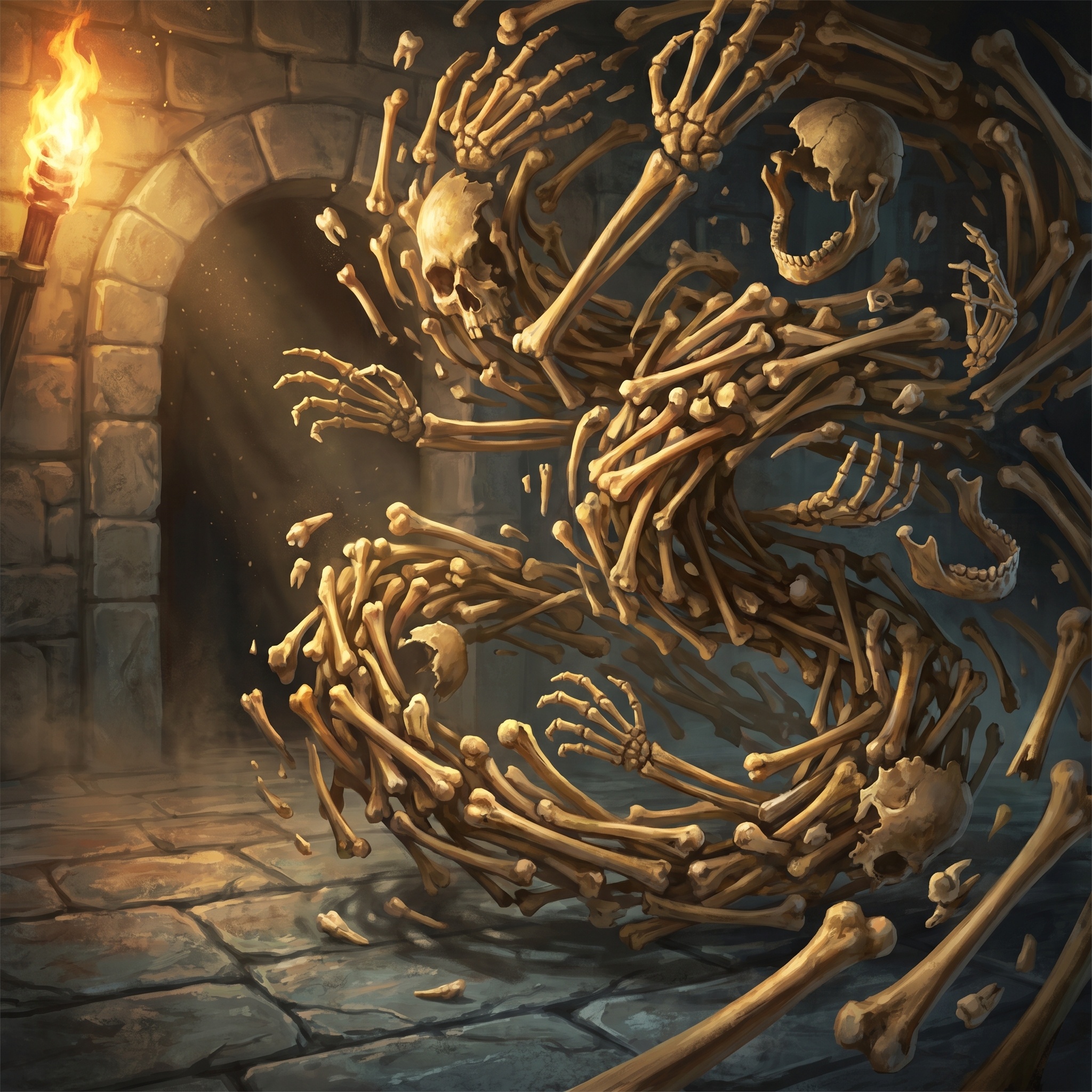
Role: Minion Swarm Where It Appears: Ossuaries, mass graves, bone shrines.
An ossuary swarm is bone animated by disturbed funerary order. It does not infect. It punishes movement and noise.
Ossuary Swarm (Minion)
- Group Size: One swarm.
- Skills: Unarmed 3, Fortitude 4.
- Attacks: Bone Flurry (Unarmed; Damage 6; Crit 5; Bleeding 1).
- Abilities: Swarm Body - Non-area attacks add 1 Bane.
- Abilities: Respect the Dead - A correct funerary prayer or name-listing can halt it for one round with Lore or Negotiation (Hard).
- Soul: Claimable, one for each person the remains came from; at death those souls resume the crossing they were owed and are dispatched normally at Sheol, having been raised without consent.
- Tactics: Fill corridors, strip flesh, retreat to bone piles.
- Harvesting and Trade: No ethical harvest.
Poltergeist
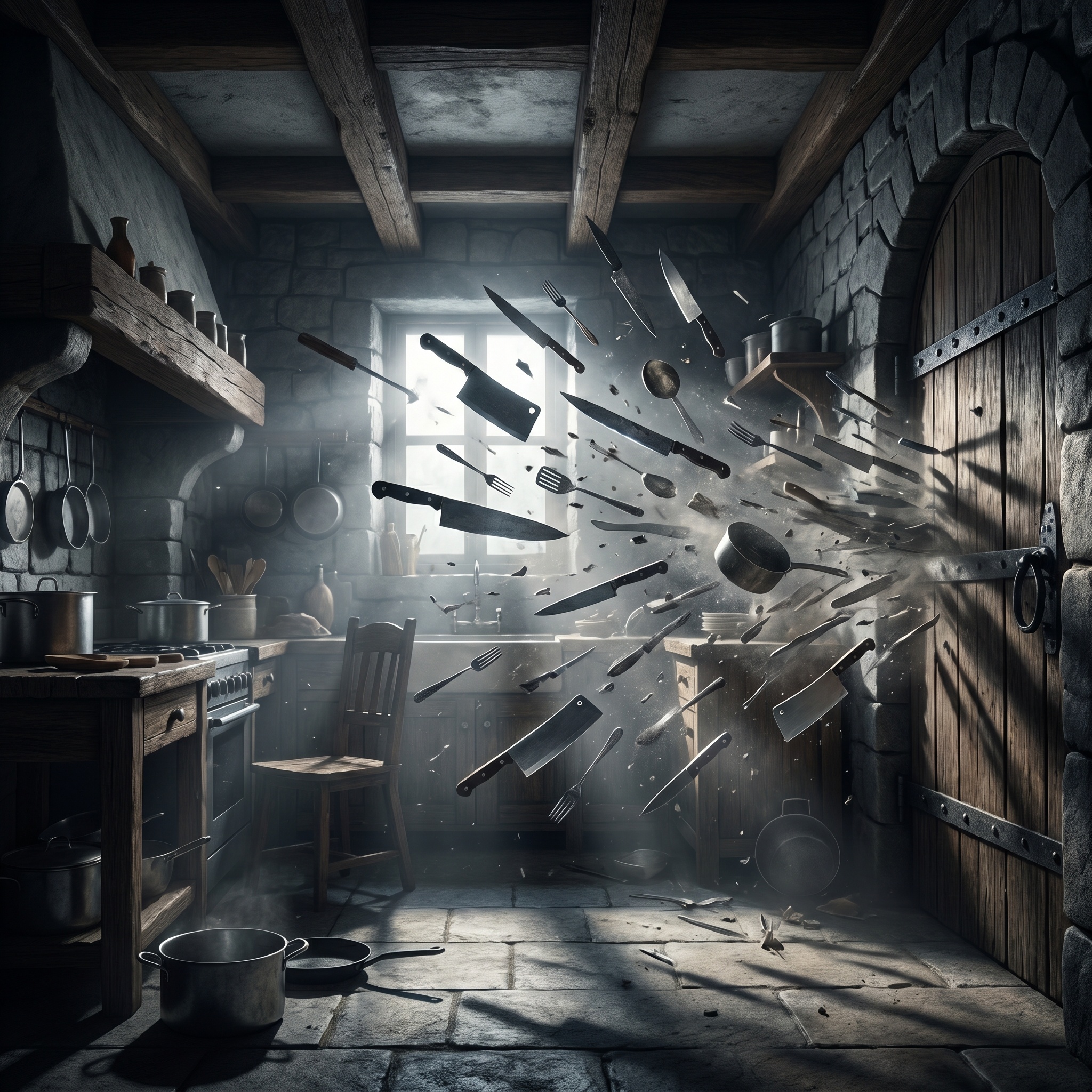
Role: Elite Controller / Hazard Where It Appears: Homes, inns, any enclosed space where someone died with unresolved rage.
A poltergeist is not a ghost in the usual sense. There is nothing to talk to. There is only anger that has learned to pick things up.
What It Is
A Poltergeist forms when a soul does not fully depart from a space — not from purpose or grief, but from accumulated rage. What remains is the emotional residue without the intelligence. It does not remember who it was or why it is angry. It simply is angry, and it acts on that anger through the physical objects in its space.
It is invisible and cannot be harmed by physical attacks. The correct approach is to resolve what anchors it — the source of the original anger — which requires investigation, not combat.
Signs and Knowledge: Adventuring Lore (Average) identifies a Poltergeist from a structured haunting. Secret Lore (Hard) identifies what kind of unresolved event could anchor one.
Poltergeist (Elite)
- Skills: Unarmed 3, Perception 3, Fortitude 5.
- Attacks: Hurled Object (Unarmed; Damage 7; Crit 4; Range Short; can use any available object as a thrown weapon); Swarm of Debris (Unarmed; Damage 5; Crit 4; Blast 3; Range Engaged).
- Abilities: Intangible — Cannot be targeted by physical attacks. Only magical attacks, blessed weapons, or environmental dispelling (resolving the anchor) deals Wounds.
- Abilities: Room Control — At the start of each round, the Poltergeist may move any unsecured object in the room up to Short range as an incidental.
- Abilities: Anchor — The Poltergeist has a specific object, room, or unresolved event that sustains it. Identifying and resolving the anchor (Hard Secret Lore or Lore investigation) is the only way to permanently dispel it. Destroying it to 0 Wounds causes it to retreat; it reforms in 24 hours unless the anchor is resolved.
- Soul: Claimable, the crossing it was owed was interrupted rather than completed; at death the soul resumes that crossing and is dispatched normally at Sheol, having been raised without its consent.
Tactics: Throws sharp objects, blocks exits, collapses shelving. Attacks whoever approaches the anchor point most directly.
Encounter Use: The fight is the wrong answer. Give the party enough environmental clues that investigation is clearly the path.
Harvesting and Trade
Nothing survives the dispelling. What the party finds is the anchor: an object with a story, a hidden room, a name.
Variants
Bound Poltergeist: Someone is deliberately sustaining the rage through a ritual. Resolving the anchor also implicates them.
Revenant
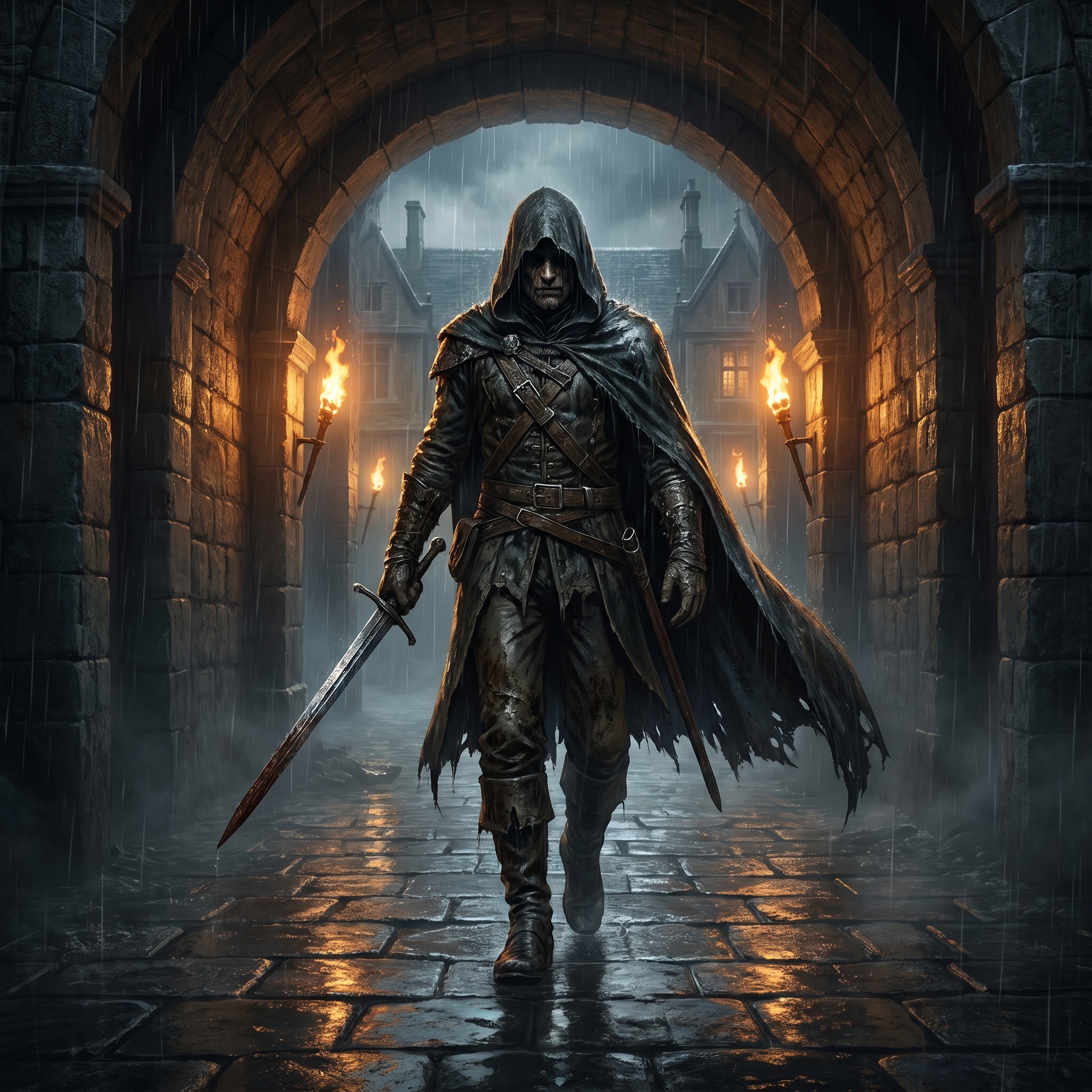
Role: Nemesis Pursuer Where It Appears: Anywhere its unfinished vow leads.
"It came back for one reason. It finished that reason. It did not leave." — Adventuring Lore, note on revenants — appended in a different hand: some do not
What It Is
A revenant is not a disease and not a common corpse. It is a dead person dragged forward by a single unresolved oath, injustice, or command strong enough to hold shape after death. Some deserve help. Some deserve a grave with chains.
Ecology and Behavior
A revenant exists on a line between person and verdict. It remembers enough to pursue, accuse, and suffer, but the oath narrows everything. Food, comfort, fear, pain, and ordinary persuasion fall away unless they touch the unfinished matter.
Revenants appear anywhere their vow leads: a manor, battlefield, court, ship, wedding road, or hidden grave. They may cross impossible distances and ignore dangers that would stop the living. The more just the oath, the more tragic the obstacle; the more corrupted the oath, the more the revenant becomes a moving sentence with no judge left.
Signs and Knowledge
Lore or Secret Lore (Hard) identifies the vow pattern. Negotiation may work only if it addresses the vow directly.
Other signs include the same dead figure appearing closer each night, animals refusing its trail, wounds that reopen near oath objects, and witnesses dreaming the last promise made before death.
Revenant (Nemesis)
- Skills: Heavy Melee 4, Fortitude 5, Perception 4, Survival 4, Readiness 5, Intimidation 3.
- Attacks: Oath Weapon (Heavy Melee; Damage 9; Crit 3; Vicious 5); Dead Grip (Unarmed; Damage 7; Crit 4; Grabbed on 2 Boons).
- Abilities: Unfinished Oath — Add 1 Boon to checks pursuing or attacking the oath-target.
- Abilities: Rise Again — If destroyed without resolving its oath, it reforms in 1d6 nights unless buried with proper rite and the oath's truth addressed.
- Soul: Claimable, the crossing it was owed was interrupted rather than completed; at death the soul resumes that crossing and is dispatched normally at Sheol, having been raised without its consent.
Tactics
A revenant ignores distractions, disables blockers, and speaks only to oath-relevant targets. It will walk through a burning room to reach the person named by its vow, but it may stop for a sentence that changes the truth of that vow. It does not waste effort on cruelty unless cruelty was part of what made it.
Use a revenant as a pursuit arc, not just a fight. The party should have chances to investigate the oath, protect the target, prove a misunderstanding, perform a rite, or decide the revenant is right.
Evidence and Trade
| Find | Value | Use | Recovery |
|---|---|---|---|
| Oath-token | Varies | Resolves or redirects the revenant's vow | Lore, Negotiation, or Secret Lore (Hard) |
| Grave goods | 300-2,000 gold Flargons | Identity, inheritance, evidence | Legal and spiritual consequences likely |
| Last wound trace | 400-1,200 gold Flargons to occultists | Murder proof, necromantic study | Medicine or Secret Lore (Hard) |
Variants
- Wronged Duelist: Bound to a broken challenge or poisoned duel.
- Command Revenant: Still obeys a military order that no longer makes sense.
- False-Oath Revenant: Pursues the wrong target because the truth was hidden at death.
Seething Mass
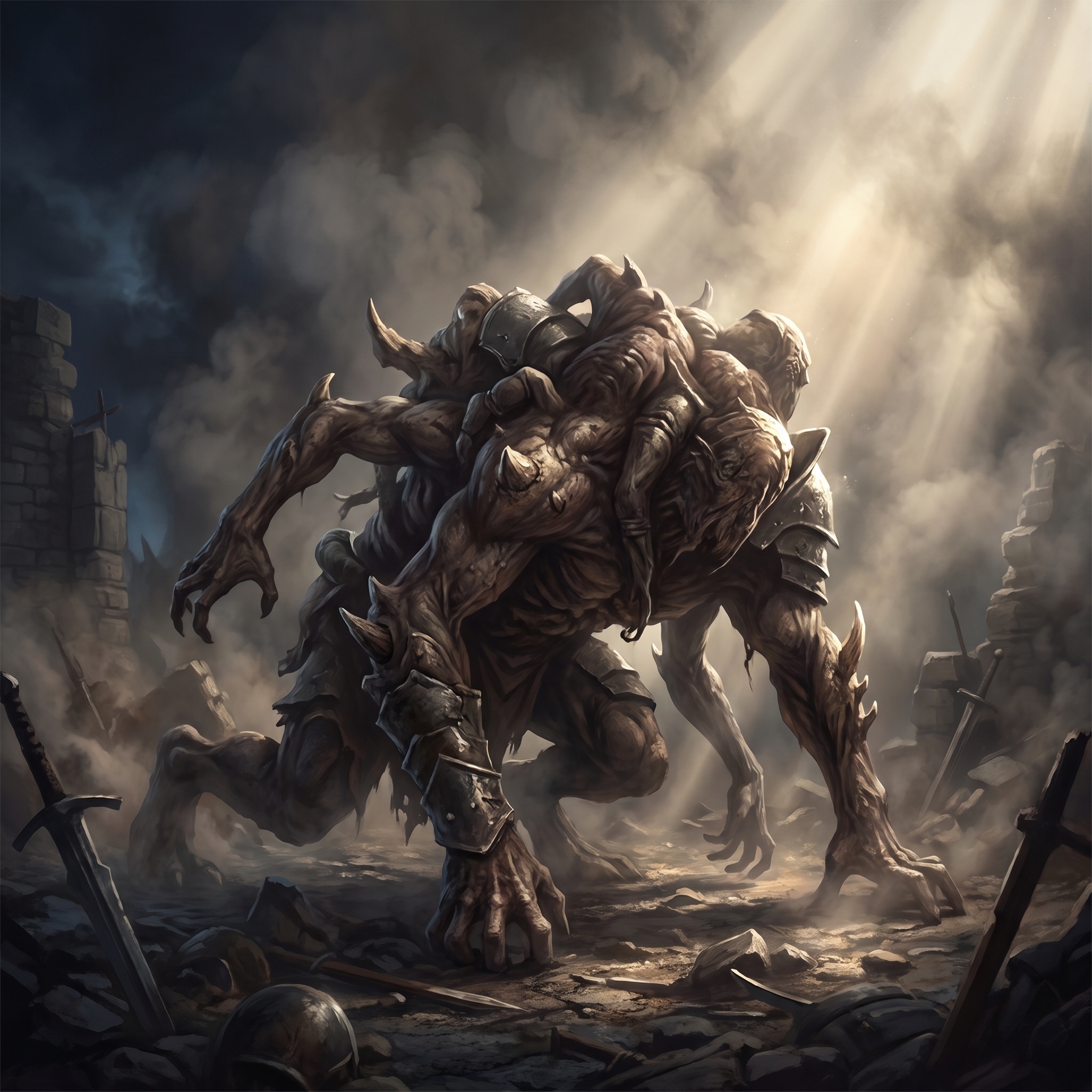
Role: Elite Bruiser / Horror Where It Appears: Mass battle sites, plague pits, anywhere large numbers of dead were left without separation or rites.
A Seething Mass is not a creature that was built. It is what happens when the dead are left close enough together that whatever animates them starts to cooperate.
What It Is
A Seething Mass forms when multiple animated bodies fuse under accumulated necromantic discharge. The result has no shared intelligence — the components are not working together, they are simply tangled — but the physical mass is enormous, and the force of several animated corpses operating from one shared structure is proportionally destructive.
Signs and Knowledge: Adventuring Lore (Average) identifies battle site conditions that produce Seething Masses. Medicine (Average) identifies the composition from remains.
Seething Mass (Elite)
- Skills: Unarmed 4, Fortitude 5, Athletics 3.
- Attacks: Crushing Slam (Unarmed; Damage 11; Crit 4; Knockdown on 2 Boons); Engulf (Unarmed; Damage 8; Crit 4; Grabbed on hit — must be escaped with Hard Athletics or the target is partially inside the mass).
- Abilities: Multiple Wounds Required — Reduce damage from any single hit by 2 before Resistance; the mass is spread enough to absorb localized force.
- Abilities: Fire Breaks It — Fire attacks add 2 Boons. A burning Mass reduces to two separate Armored Skeletons with current Wounds halved. Resulting Armored Skeletons use the Armored Skeleton entry in this catalog.
- Soul: Claimable, one for each person the remains came from; at death those souls resume the crossing they were owed and are dispatched normally at Sheol, having been raised without consent.
Tactics: Moves slowly but inexorably. Attempts to engulf the nearest target and crush the formation with bulk.
Encounter Use: Use at old battlefield sites as a reminder that cleanup matters. The horror is recognition — characters who can see what it is made of.
Harvesting and Trade
No meaningful harvest. What it is made of can be identified, which may create obligations to the dead.
Variants
Pit Mass: Larger Nemesis version, WND 43, STR 20. Breaks into three Ghouls when destroyed rather than Skeletons.
Skeleton Band
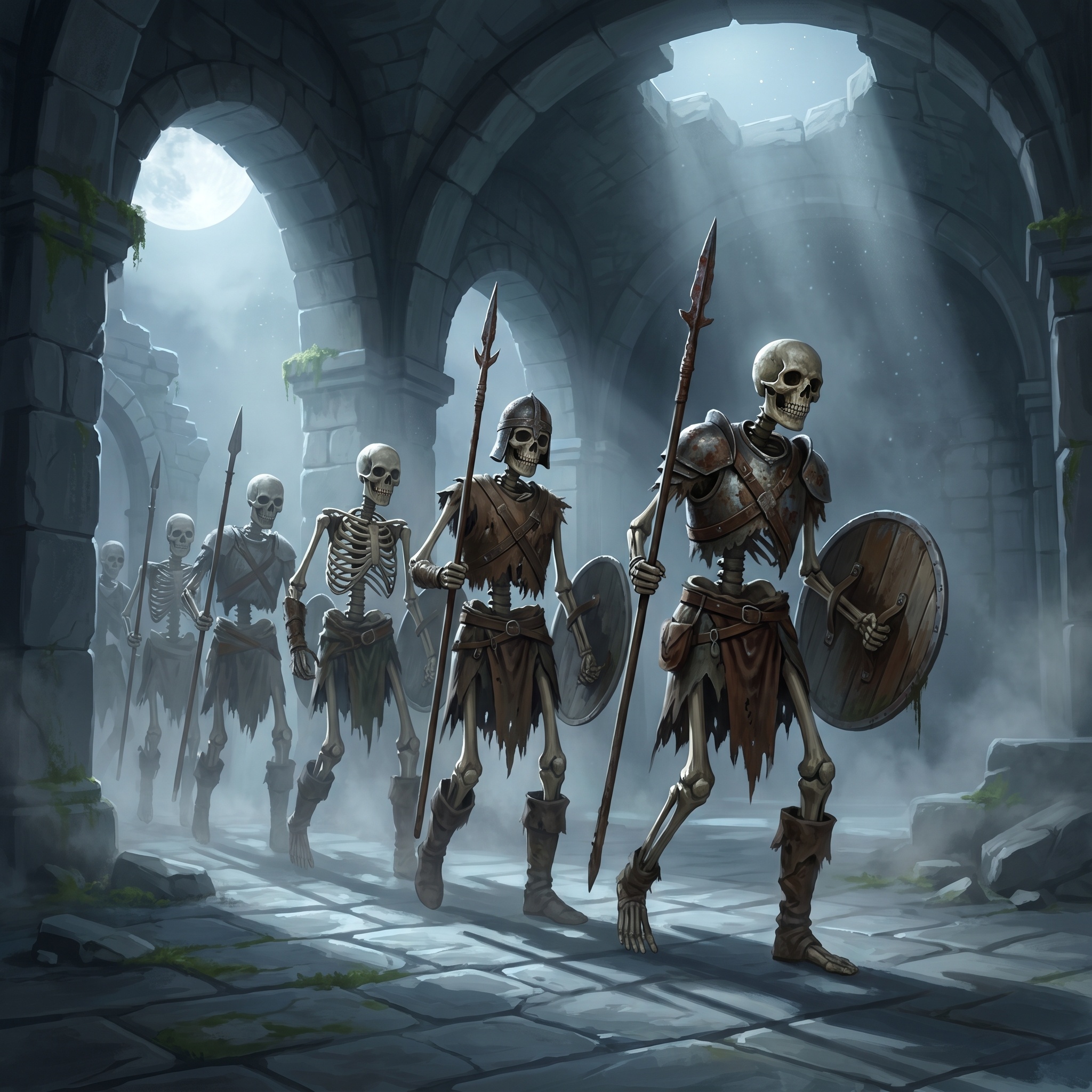
Role: Minion Undead Troop Where It Appears: Tombs, old battlefields, necromancer workrooms, cursed armories.
Skeleton bands are simple dead matter under command, habit, or site-memory. They are not infectious and do not multiply by killing.
Skeleton Band (Minion)
- Group Size: 4-12.
- Skills: Heavy Melee 2, Light Ranged 1, Readiness 2.
- Attacks: Grave Spear (Heavy Melee; Damage 5; Crit 4); Bone Bow (Light Ranged; Damage 4; Crit 5; Range Medium).
- Abilities: No Nerve to Break - Immune to fear, social pressure, poison, and morale effects.
- Soul: Claimable, one for each person the remains came from; at death those souls resume the crossing they were owed and are dispatched normally at Sheol, having been raised without consent.
- Tactics: Obey last command, hold formation badly but relentlessly.
- Harvesting and Trade: No ethical harvest. Necromancers may buy intact articulated remains illegally.
Tomb Choir
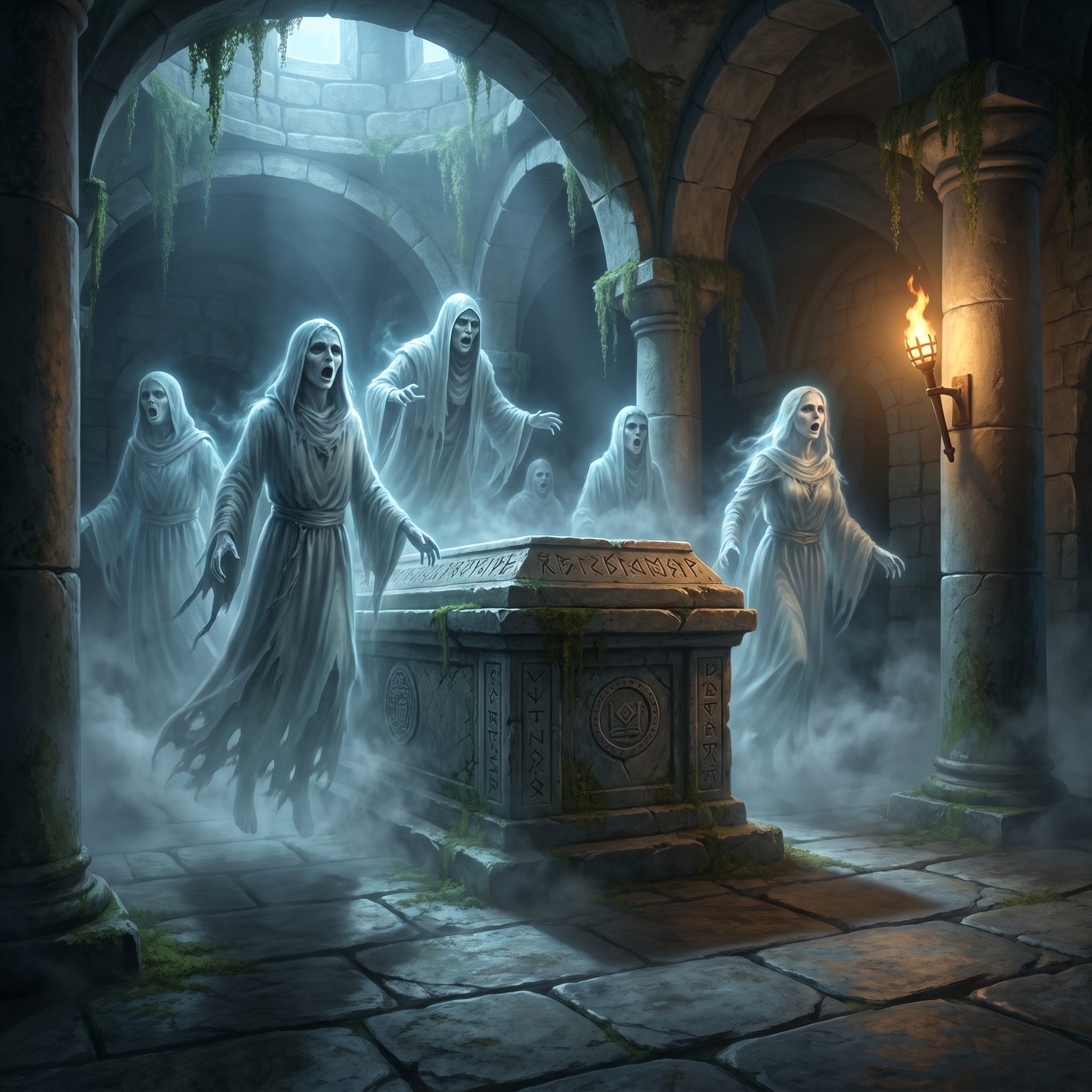
Role: Elite Spirit Swarm / Controller Where It Appears: Noble tombs, plague chapels, sealed crypts.
What It Is
A tomb choir is a collective haunting. It repeats funeral songs until listeners cannot remember why they came. The voices may belong to mourners, priests, plague dead, murdered servants, or an entire household trapped in the moment ceremony failed.
The choir is not a swarm of bodies. It is a ritual that learned to defend itself. The danger is surrender: sitting down, lowering weapons, weeping, and waiting for the song to finish when it never will.
Ecology and Behavior
Tomb choirs form where mourning was interrupted, weaponized, or made compulsory. Noble tombs, plague chapels, sealed crypts, and family vaults are common homes. They repeat fragments of hymns, names, accusations, and last words until those sounds become the architecture of the haunting.
They may not understand intruders as enemies. Some believe the living are late mourners. Others treat noise, laughter, or theft as desecration. A choir tied to a specific sarcophagus may calm if the proper funeral verse is completed.
Signs and Knowledge
Theology, Lore, or Culture (Average) identifies the funeral tradition. Charm or Negotiation (Hard) can join the song without being swallowed by it.
Other signs include candles relit in sealed rooms, mourners' benches worn by no living congregation, names repeated in dust, and travelers forgetting why they opened the crypt door.
Tomb Choir (Elite)
- Skills: Charm 4, Readiness 5, Lore 3, Stealth 3.
- Attacks: Funeral Song (Charm; Damage 7 Strain; Range Medium); Cold Hands (Unarmed; Damage 4; Crit 5).
- Abilities: Forget Purpose - On 2 Banes from Funeral Song, target loses its next Maneuver unless an ally calls them by name.
- Abilities: Harmony Body - Area effects work normally; single-target physical attacks add 1 Bane.
- Soul: Claimable, one for each person the remains came from; at death those souls resume the crossing they were owed and are dispatched normally at Sheol, having been raised without consent.
Tactics
A tomb choir sings, separates, and makes intruders sit down to wait for death. It attacks memory and urgency first, then uses cold hands against anyone who tries to break the circle. Calling allies by name, interrupting the rhythm, completing the missing verse, or opening sealed exits can all weaken its control.
Use it when you want a tomb encounter that tests identity and purpose. The question is not only "Can we destroy it?" but "What grief made this place keep singing?"
Evidence and Trade
| Find | Value | Use | Recovery |
|---|---|---|---|
| Written funeral verses | 300-1,500 gold Flargons | Names, crimes, lineage claims, appeasement | Lore or Theology (Average) |
| Mourner tokens | Varies | Identifies the dead and their families | Culture (Average) |
| Echo-stained wax | 200-800 gold Flargons | Memory rites, spirit inks | Secret Lore (Hard) |
Variants
- Plague Choir: Sings names too numerous for one family and reacts to healing magic.
- Noble Lament: Protects one bloodline's tomb and attacks rival heraldry.
- Choir Without Names: More dangerous because no one can call the singers back individually.
Tomb Wraith
Role: Elite Lurker / Drainer Where It Appears: Ancient sealed tombs, sacred sites that have lost their sanctification, old temples to forgotten gods.
A Tomb Wraith is further gone than a ghost but not as far gone as a Shadow. Something of the person survived. Not enough to matter.
What It Is
Tomb Wraiths form from souls that were bound to a specific location at death — typically through a tomb-sealing rite — and have been there long enough that the binding has eroded everything except the territorial impulse. They are not protecting the tomb; they are haunting it. The distinction is that protection has a purpose and a set of conditions. A Wraith is just here, indefinitely, and intruders interrupt an endless wait.
Signs and Knowledge: Adventuring Lore or Secret Lore (Average) identifies Wraith behavior from ordinary ghost phenomena. Lore (Hard) identifies what rite originally bound the soul to the site.
Tomb Wraith (Elite)
- Skills: Unarmed 3, Stealth 4, Perception 4, Intimidation 4, Fortitude 4.
- Attacks: Chilling Touch (Unarmed; Damage 7; Crit 4; Stun 2; Range Engaged; passes through armor — ignores Resistance).
- Abilities: Incorporeal — Cannot be harmed by nonmagical weapons. Passes through solid surfaces as a Maneuver.
- Abilities: Tomb Territory — In the original tomb, adds 1 Boon to all checks. Cannot pursue beyond the tomb boundary.
- Abilities: Sacred Symbol — A displayed holy symbol adds 1 Bane to the Wraith's attacks against the bearer and prevents Chilling Touch from ignoring Resistance against that target.
- Soul: Claimable, the crossing it was owed was interrupted rather than completed; at death the soul resumes that crossing and is dispatched normally at Sheol, having been raised without its consent.
Tactics: Passes through walls to approach isolated targets, uses Chilling Touch on armored characters who rely on Resistance, retreats through solid surfaces.
Encounter Use: The Wraith makes armor less relevant in dungeons. Use in conjunction with other undead who do rely on Resistance to create pressure from both directions.
Harvesting and Trade
No physical remains. What the party may find is the original binding object — a name tablet, a sealed urn, a coin — which is worth something academically or to descendants.
Variants
Freed Wraith: The binding site was destroyed; the Wraith now wanders. No Tomb Territory bonus but no boundary limit either.
Wight
Role: Elite Controller / Drainer Where It Appears: Old tombs, battlefields with unfinished purposes, ruins of households destroyed by violence.
A Wight knows it is here. Most undead do not. That is the distinguishing quality and the reason they are more dangerous.
What It Is
A Wight is the preserved undead of someone who died with strong unfulfilled intent — not specific enough to be a Revenant, not tied to a site like a Cairn Shade, but strong enough that the soul did not travel the Silver Road cleanly. What remained is intelligent, aware of its condition, and entirely hostile to the living vitality it no longer has.
Its touch drains life force directly — not Wounds, but the capacity to generate them, which is subtler and harder to treat.
Ecology and Behavior
Wights are solitary and territorial. They occupy the space of their death or rise and defend it. A Wight in an old keep has usually come to see the keep as still theirs. They do not eat or sleep. They endure and resent.
Signs and Knowledge
Adventuring Lore or Secret Lore (Average): identifies Wight signs — sustained cold, light dimming without draft, animals refusing old buildings.
Lore (Hard): knows the life drain mechanic and that holy symbols and sunlight are effective deterrents.
Wight (Elite)
- Skills: Unarmed 4, Intimidation 4, Perception 4, Secret Lore 3, Fortitude 4.
- Attacks: Withering Touch (Unarmed; Damage 7; Crit 3; Life Drain on hit); Cold Strike (Unarmed; Damage 8; Crit 4; Stun 2 on 2 Boons).
- Abilities: Life Drain — On a successful Withering Touch, the target loses 2 from their maximum Wound total until treated with Hard Medicine or a rest at a sacred site. A character reduced to 0 maximum Wounds falls unconscious and begins dying. This reduction does not heal normally.
- Abilities: Cold Aura — Living creatures at Engaged range add 1 Bane to Readiness checks.
- Abilities: Sunlight Vulnerability — In direct sunlight, the Wight cannot use Life Drain and adds 1 Bane to all checks.
- Soul: Claimable, the crossing it was owed was interrupted rather than completed; at death the soul resumes that crossing and is dispatched normally at Sheol, having been raised without its consent.
Tactics: The Wight targets Withering Touch over damage, focusing on the character with the highest Wound total. It does not hurry. It believes it has time.
Encounter Use: The life drain should be treated as a secondary clock. A party that defeats a Wight but has members with reduced maximum Wounds needs to address that before the next encounter.
Harvesting and Trade
| Harvest | Buyer | Check | Typical Value | Use | Complication |
|---|---|---|---|---|---|
| Cold Remnant Core | Secret Lore researcher, exorcist | Hard Secret Lore | 800–2,000 gold Flargons | Undeath study, cold enchantments | Continues draining vitality if mishandled |
Variants
Wight Lord: Nemesis, WND 31, Life Drain reduces maximum Wounds by 4 and affects two targets on a wide swing.
Zombie
Role: Minion Infectious Swarm Where It Appears: Plague sites, ruined settlements, old battlefields, anywhere the dead were not properly treated and something spread through them.
A single zombie is not the danger. The danger is that it takes one bite to make another, and there are a lot of bodies.
What It Is
The Zombie Plague is a disease of the dead — or nearly dead. It does not animate corpses by magic. It keeps them moving after the body should have stopped. The result has no intelligence, no memory, no purpose except movement toward warm bodies and the instinct to bite. It does not think. It does not feel pain. It does not stop.
A zombie decays. Given enough time, one collapses on its own. The problem is that by then, it has usually bitten something.
Signs and Knowledge: Adventuring Lore (Average) identifies Zombie Plague from ordinary undead; knows the infection rules. Medicine (Hard) identifies early-stage infection in a living character before symptoms are obvious.
Zombie (Minion)
- Group Size: 3-10.
- Skills: Unarmed 2, Fortitude 4, Perception 2.
- Attacks: Grasping Bite (Unarmed; Damage 5; Crit 4; Grabbed on 2 Boons).
- Abilities: Infectious Bite — A character bitten by Grasping Bite must make a Hard Willpower check or gain Infection Stage 1 (Zombie Plague). Stage 1: No visible effect; character is infectious with any bite they deliver. Stage 2 (after next extended rest without treatment): Character suffers 1 Bane to all checks and loses 2 from their maximum Wound total. Stage 3 (after another rest): Character falls into a fever and dies within hours, rising as a Zombie in the next group they join. Treatment: Hard Medicine within Stage 1 or Stage 2 halts progression; Stage 3 cannot be reversed.
- Abilities: Won't Stay Down — When a Zombie group would be reduced to 0 Wounds, roll 1d10. On a 7+, one Zombie remains with 1 Wound.
- Abilities: Drawn to Warmth — Zombies always move toward the nearest living creature. They do not use cover, tactics, or retreat.
- Soul: Claimable, the crossing it was owed was interrupted rather than completed; at death the soul resumes that crossing and is dispatched normally at Sheol, having been raised without its consent.
- Tactics: The group shuffles toward noise and light. They do not charge. They arrive. Those in reach bite; those not in reach keep walking.
- Encounter Use: Zombies are a resource problem. Use them in numbers, in darkness, on narrow roads. The threat is the infection, the attrition, and the decision of what to do with a companion who was bitten an hour ago and has not told anyone.
- Harvesting and Trade: No harvest value. Destroyed remains should be burned. Transport without burning is inadvisable.
Variants
Bloated Zombie: Elite, WND 17, on death explodes in a short-range Poison 2 burst. Old and distended; visibly different.
Plague Walker: Minion, but the disease is at Stage 2 in the zombie itself — harder to be near without risk.