The Problem with Powerful Rewards
In a world where souls are currency and the gods are active political agents, a truly powerful magical object is not neutral. It is embedded in the same cosmological structure everything else is embedded in. A relic from a destroyed temple has a history: it was made for someone, by someone, in service of something. Finding it does not grant clean ownership. It generates inquiry, interest, and sometimes claims.
This chapter is about how to use powerful rewards in Ix without reducing them to generic magic items. The most memorable rewards in an Ix campaign are memorable because they create obligations, attract attention, and sometimes demand something back.
Bloodstones
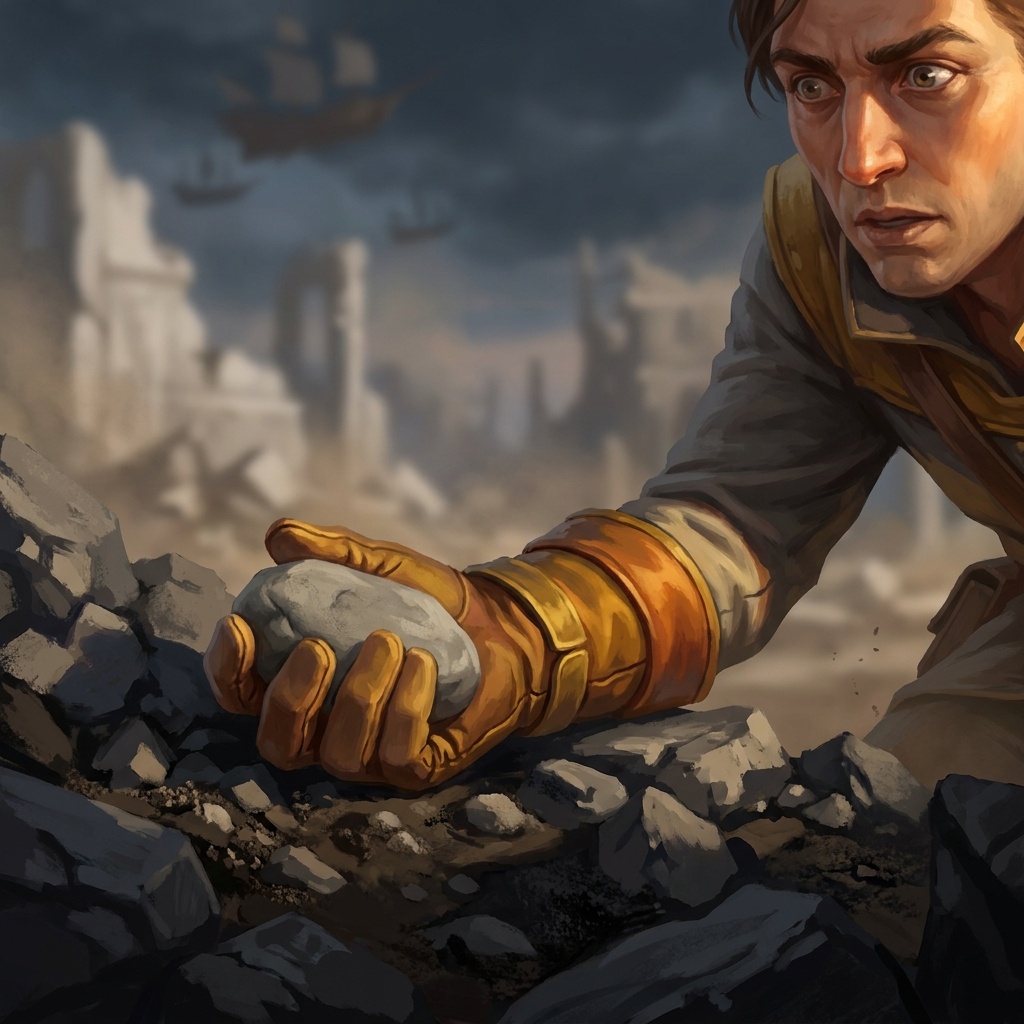
An Izon Bloodstone is a fragment of the dead god Izon's divine substance, left in the Prime after his death. These are the most cosmologically significant objects in the world, and they work by a rule that distinguishes them from every other powerful thing: no magic can detect them. No divine working, no arcane scrying, no ancient rite can locate a Bloodstone. It reads as ordinary stone to every spell ever devised. A Bloodstone can only be found by hand and by chance: when a mortal physically picks one up, they know immediately what they hold, and they feel a constant pull toward it.
GM-facing truth: The pull is real. It is not a metaphor for obsession. It is the Bloodstone communicating direction, toward what, is unclear. Characters who hold a Bloodstone feel it as an orientation that does not correspond to any compass direction. It is toward something specific, and the something specific changes as circumstances change.
What a Bloodstone does: A known path to godhood: a Bloodstone, if properly handled, allows a mortal to consolidate divine power. This is not a fast process, a safe one, or a guaranteed one. The god Izon is dead. His fragments are scattered. Accumulating enough to do something with requires resources and knowledge the party probably does not have when they find the first one.
What a Bloodstone costs immediately: The moment a character holds one, they are a target. Not from the gods (the Bloodstone is undetectable) but from anyone who knows what Bloodstones are and has been watching for the observable signs of their discovery, specifically, a mortal who seems to be oriented toward something, who returns to a specific direction when lost, who makes decisions that are hard to explain. Verrell the Transmuter of Frosthaven has been watching for exactly these signs.
Bloodstone as campaign spine: A Bloodstone discovery is a multi-session (often multi-chronicle) revelation. Introduce it as a found object in a ruin or riverbed. Let the discovering character experience the pull. Do not explain it. Let investigation drive the revelation. The player who decides to follow the pull has just signed up for a campaign arc.
Relics
A relic is an object with genuine divine history, something that was part of a saint's life, participated in a significant divine event, or was crafted under direct divine commission. Relics are not passive items. They are cosmological evidence. Possessing them creates obligations and attracts institutional attention.
The Reliquary Guardian's logic applied to all relics: Every genuine relic has people who care about it. A tooth of Nyxollox's founding saint is not unowned: the faith considers it under permanent custody, even if physical possession has lapsed for centuries. A weapon blessed by Themela's hand in a specific battle is registered in the Truth-keepers' archives. A fragment of Echo's first charter belongs to the Accord even if it has been missing for eight hundred years.
Relic rewards at the table: When a relic enters the party's hands, give it provenance. Who made it? Who held it? Who has been looking for it? The provenance is the reward. A sword is equipment. A sword that belonged to the general who held Aldenmere against the first Oshalan mission and was consecrated by a Jula Legion commander the night before the battle is an object with weight in multiple institutional memories.
How relics create obligations: The receiving character does not have to do anything with a relic. They can sell it, destroy it, or ignore it. The relic does not care. But the people who care about it will notice it is moving again: an accurate divine archive (Echo), a faith's institutional memory (Nyxollox, Jula), a noble house's inheritance claim (Themela's courts). Let these notices arrive as consequences of the relic appearing in the world rather than as immediate obstacles.
Forbidden Knowledge
Some rewards are not objects. They are information that cannot be unknowing: the real location of a dead god's remaining divine substrate, the true name of an infernal entity currently operating in the city, the specific terms of a contract binding a ruling house to a hellish creditor, the identity of the Ancient operating behind the Sentient Spire.
The rule for forbidden knowledge: Once a player character knows something, they know it. The setting rewards investigation with genuine answers. When the answer is a piece of knowledge that creates immediate new pressure, present it fully and let the party decide what to do with it.
The pressure forbidden knowledge creates is specific: something will be done to suppress it, verify it, steal it, or weaponize it before the party can act on it. The information is a resource. Other actors will recognize it as such.
Magical Equipment in Ix
Standard magical equipment, weapons with persistent enchantments, armor with ward effects, tools with augmented function, exists in Ix but is less important than the setting's relational rewards. The most valuable equipment in the world is equipment that connects its holder to something: a cleric's vestments that represent standing with their faith, a document that grants access to an Echo archive, a warrant with Themela's seal that makes a legal process available, a military commission with the White Rose Legion that provides a specific kind of support.
When building rewards, ask: does this reward a relationship as well as a stat? The answer does not have to be yes. Standard magical equipment is real and useful. But the rewards players remember are the ones that changed what was possible in the world, not the ones that raised a number.
Magic Items: What the GM Builds
Magic items come in four kinds, sorted first by who could have made them. The two routine, mortal-craftable tiers, consumables (a spell poured into a vessel) and augmentations (magic worn in a living body), together with attunement (a bearer holds attuned permanent items up to their Willpower; augmentations are a separate small pool of three) and identification, all live player-side in the Player's Guide, Chapter Eight. This section is your tool for the other two: the bespoke and sentient items no mortal can make. Permanent enchantment is Ancient magic, the direct imposition of will on the planes, so every such item was made by an Ancient or a god, once, for a reason. That is why there is no "+1 sword" in Ix: a permanent item is a singular thing with a history and, usually, an agenda.
Composing a Bespoke Item — A Tool for the GM
Players cannot make these. An Ancient or a god did, long before the party found it. But you design it, and you want it to sit consistently inside the system. Compose one from four parts.
1, Tier (its ceiling).
| Tier | Power level | Shape |
|---|---|---|
| Lesser | cantrip to journeyman | one modest property |
| Greater | adept to master | two properties, or one strong property and a small one |
| Relic | master and beyond | a signature power plus several properties, and almost always a will, a price, or both |
2, Effects (the menu). Draw one or more:
- Augury of dice — add 1 Boon, remove 1 Bane, or upgrade a die on a defined category of check.
- Ward — +X Resistance, +X Melee or Ranged Defense, +X Wounds or Strain.
- Edge — add or raise a weapon Quality (Pierce, Vicious, Burn, Stun, Accurate, Defensive…), +X damage, or lower the Crit rating.
- Bound spell — the item casts a specific spell; unlike a mortal scroll, a relic may hold an Adept or Master working and cast it cleanly.
- Reactive grace — once per scene or session, a triggered save: turn a hit, recover, slip a range band, shrug off a condition.
- Utility — light, waterbreathing, a tongue, a sense, sustenance, a sealed pocket of space.
Price each effect against the nearest spell or Quality, just as you would balance a new spell (Ix Player Guide, Chapter Nine: the full spell list and the GMG Chapter Nine spell design framework both apply): if it outclasses its closest comparison at the same cost, raise the cost or the tier.
3, Tradition (its voice, and its limits). Every item resonates with a source, and the source shapes both flavor and restriction:
- Arcane — runed, precise, structured: the work of the academies' lost masters, or of the fey.
- Divine — a god's relic, and it carries that god's Forbidden Grant (Player's Guide, Chapter Ten). A blade of Nyxollox will not empower the raising of the dead; a relic of Themela will not abet a deception. Insult the god's nature and the item goes cold in your hand.
- Primal — elemental or living, tied to a source: an Ember blade dims far from fire, a tide-bound ring weakens inland.
- Ancient / unsourced — the strangest and most dangerous: power answering to no tradition, often burning Beacon-bright across the planes when used (Player's Guide, Chapter Nine) and drawing exactly the wrong attention.
4, Cost, and the catch. Each active power states how it is paid, and here the item decides, pick the model that fits:
- Strain — the bearer pays, like casting. Best for small, frequent effects.
- Charges — X uses, recharging on a condition: dawn, a ritual, spilled blood, a soul coin spent, immersion in its element.
- Once per scene or session — clean and bookkeeping-free; right for a signature power.
And at Relic tier, give it a catch: an obligation, an upkeep (a coin, a death, a kept vow), a curse on the unworthy, an attention it draws (a faith, an infernal claimant, the Telum Venandi), or a will of its own. A relic that costs nothing is a relic you have not finished designing.
Sentient Items and the Zoranti Weapons
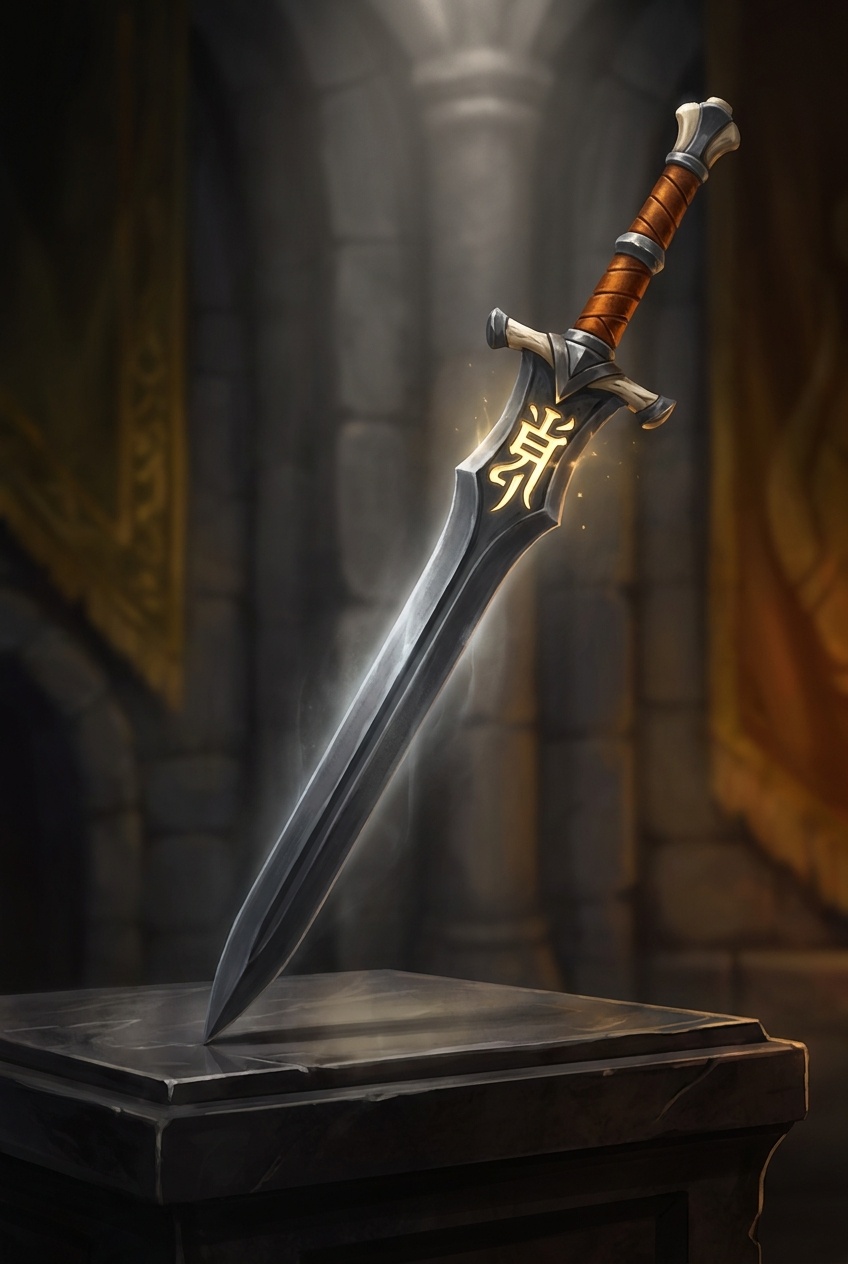
The most dangerous thing an Ancient-tier working can do is wake. A sentient item is a Relic with a mind: its own nature, its own wants, and the power to act on them. Run it as an NPC: give it Willpower, Charisma, the skills it cares about, and a Disposition toward its current bearer.
| Disposition | The item… |
|---|---|
| Hostile | fights you: imposes Bane Dice, refuses to function, or seizes a moment to act against you |
| Wary | tests you: withholds its best until you prove worthy |
| Accepting | serves: full properties, honest counsel |
| Devoted | champions you: lends more than it must, warns of danger, acts in your defense |
Disposition moves with how you treat the item and honor its nature. When the bearer's will and the item's diverge over something it cares about, contest it: the bearer's Discipline against the item's Willpower. Lose, and the item has its way: the strike goes wide, the word stays unspoken, the blade turns in your hand.
The Zoranti Weapons. One hundred and twenty-eight, forged by the dwarven master Mikello Zoranti for the faith of Pollaran and infused with a will no mortal craft should have been able to give them, the nearest anyone has come to Ancient making, and never safely repeated. What was bound into the steel came from Bellum, the soul plane of unceasing war: not individual spirits but war-will states, distilled essences of battles so complete they left permanent impressions on the planar fabric. Pulled from Bellum and sealed into steel, those states adapted. The nearest equivalent to their old cycle of conflict was the souls of those the weapon killed. The weapons, at the structural level, are hungry in the way a body needs water.
Each weapon was given a long name at the forge. Those binding syllables are not ornamental: they constrain the weapon's will and temper its power until it has fulfilled its purpose. As purpose is served, syllables burn away. What remains at the end is the true name the weapon was always meant to arrive at. A weapon still carrying most of its forge-name is manageable. A weapon that has reached its true name is something else.
Every Zoranti Weapon can do three things no other item can: seek its own wielder through compulsion (stronger the more evolved the weapon), test and potentially dominate a wielder whose will is weaker than its own, and, at the wielder's deliberate intent, destroy a soul on a killing blow: unmake it at the structural level, scatter it beyond any possible recovery, past resurrection, past divine intervention. The weapons cannot perform soul destruction without the wielder's deliberate choice. This is the one act they do not pursue independently. They are, however, exceptionally persuasive about when it is warranted.
The most evolved weapons (those near or at their true names) are given practical consideration even by divine beings. A god struck by one cannot simply withdraw until either the wielder is dealt with or the weapon's immediate purpose is satisfied. Most gods encountering the weapon called Ja on a battlefield would choose different terrain.
Each is at once a peerless weapon and a warrior with a code: they choose their wielders, refuse the unworthy, and turn on any who fight without honor, treachery, poison, a blow against the helpless or the fallen (Pollaran's Forbidden Grant, made personal and armed). The sect called the Telum Venandi exists to find and manage them; members risk death every time they handle one. Several are unaccounted for, and a lost Zoranti is a campaign, not a loot drop. Treat each as a Relic: top-tier damage, Pierce and Vicious, a signature war-power, Devoted-tier aid to a worthy bearer, and the standing threat of betrayal to an unworthy one.
A Starter Reliquary
A dozen ready items across the tiers. Kind · tier/tradition — effect — cost or catch.
Consumables
- Knitvein Draught — consumable. Drink to heal 3 Wounds (Lesser Heal). One use. A few gold.
- Bound Scroll — consumable. Releases one casting of the spell scribed into it; the reader must possess the matching casting skill or the Scroll Reader talent for that tradition. Cost scales with the spell's tier.
- Stingerwand — consumable, wand. Five charges of Arcane Bolt; re-bind to recharge. Wants Arcana 1 to aim.
- Cinderglass Vial — consumable. Thrown: alchemical fire, Burn 2 (as the equipment entry). One use.
Augmentations
- Ink of the Sure Hand — augmentation. +1 Boon Die to one chosen skill's checks. One slot.
- Warding Sigil — augmentation. +1 Resistance. One slot.
- Mark of Might — augmentation. +1 Might, never above 5. One slot.
- Gillmark — augmentation. Breathe water freely. One slot.
Bespoke items
- The Quiet Lantern — bespoke, Lesser, Arcane. Sheds light only the bearer and named companions can perceive. Passive.
- Oathkeeper's Band — bespoke, Greater, Divine (Talbar). Once per session you know when a sworn agreement is broken in your presence; +1 Boon to checks enforcing a sealed deal. Carries Talbar's Forbidden Grant; it will not aid a fraud.
- Stormcord Spear — bespoke, Greater, Primal (Zephyr). +1 damage and Stun 1; once per scene a thrown cast returns to your hand on a gust (Strain 2). Goes dull in dead, still air far from open sky.
- The Unmade Edge — Relic, Ancient / unsourced. Once per session, one strike ignores the target's Resistance entirely. Catch: each use flares Beacon-bright across the planes; something is always watching, and now it knows where you are.
Sentient: the Zoranti
- Vael, the Ninth Edge — Zoranti longsword, Relic, Divine (Pollaran). Greatsword damage, Pierce 2, Vicious 2; once per encounter a true strike against a worthy foe (upgrade a die and add a Breakthrough effect). Devoted aid to an honorable wielder; refuses a coward; turns on one who strikes the helpless. Starts Wary.
- The Mercy — Zoranti dagger, Relic, Divine (Pollaran). A blade that kills only cleanly and never tortures; aids a wielder who defends others, and will not be raised against the surrendered. Starts Accepting toward the merciful, Hostile toward the cruel.
Named Relics of the Core Faiths
These are actual objects in the world: not legendary or invented, but documented and institutionally significant. When a relic enters a campaign, the GM should know which of these it is, where it is normally held, and who would notice it moving.
Echo's Faith
The Canticle of Jolem's Witnesses: a bound collection of testimonies gathered from people present at Jolem's execution. No magical function; its significance is purely testimonial: it documents that Jolem existed and was killed for specific reasons. Multiple claimed original copies exist in major Accord halls across several regions. The faith considers the question of which is "real" to be healthy scholarly debate. What matters is that the content is consistent.
Manni's Amulet: a small carved-bone disc bearing an early version of the crowd-symbol, claimed to have been worn by Manni Shalk, one of the early keepers. Said to grant a particular quality of being heard when a speaker is trying to reach a crowd in crisis. The Accord's own scholars consider the attribution "probable rather than certain." Held in the Accord's most established hall in the relevant region; travels occasionally to communities in significant unrest.
Nyxollox's Faith
Bakwan's Everlasting Paint: a ceramic jar of black paint that does not deplete, with a cup of white paint at its base that similarly refills. Created at the moment of Bakwan Occal's initiation, according to tradition, as a gift to ensure the priesthood would never run short. The paint itself has no magical properties beyond its eternal supply. Its significance is ceremonial: the first striping of every new death-priest's head uses paint from this jar. Held in the central temple of the order in Jazirah's largest city; brought out for all formal initiations and for Bakwan's Day.
The Brooches of the Kallian Daughters, eighteen identical silver brooches shaped like two clasped hands intertwined, inscribed with the names of the Daughters. Worn as tokens of protection during service in combat zones. The faith claims no priest wearing one has ever been killed in service in a war zone. Whether the protection is magical or merely the result of increased caution is debated. Distributed by the high council to priests being sent to active conflict zones; returned after service.
Oshala's Order
The Golden Tablets: the original tablets discovered by the first prophet Quhamman: slabs of hammered gold inscribed in ancient script, dimensions of a large book, that do not tarnish and whose inscriptions have never faded. The physical foundation of the Order's claim to revealed religion. Held in the Inner Sanctum of the Order's oldest temple in Iskash, accessible only to the highest-ranked judge-clerics under formal ceremonial conditions. Replicas exist; the Order maintains a sharp legal distinction between them.
The Seal of the First Covenant: a heavy iron stamp bearing the rhombus symbol, its edges worn smooth, used to stamp the registry tokens of Quhamman's original initiates. Documents stamped with this seal are recognized throughout Oshalan-controlled territory as bearing the highest possible authority. Held alongside the Golden Tablets in Iskash's Inner Sanctum.
Jula's Faith
Nashan's Cranium, the skull of Nashan Cawdin, blessed by Jula's divine kiss. Used in initiation rites for those ascending to the higher echelons of the clergy. Each aspirant kisses the skull, pledging eternal service. The skull is missing its lower jaw, in circumstances that have never been explained. Legend holds that if the missing jaw is found and reattached, the blessing granted to those who kiss it on the mouth would be extraordinary, the answer to which has generated decades of searching and speculation. Kept in the most sacred chamber of Jula's primary temple; accessible only during initiation ceremonies.
Jula's Midnight Blooms, white roses that bloom outside Jula's temples at the darkest hour of night. The number that bloom indicates the degree of divine intervention required in the region in the coming period. The highest count ever recorded was six roses, which preceded a civil war. The blooms must be harvested before noon; they bestow a prophetic vision on a senior cleric who is then tasked with resolving the conflict. They wither immediately if removed from sacred ground.
Themela's Faith
The Scales of Absolute Balance, silver scales engraved with the two ravens, said to have been blessed by Themela herself. When any two items are placed on them, they find the true balance regardless of enchantments or tricks. Cannot be fooled or deceived. Held in the central Judgment Hall of a major city; brought out for trials where the stakes are highest.
The Gavel of Final Verdict: a gavel carved from ancient oak with a raven's feather embedded in the handle. Judges who have wielded it report enhanced clarity of mind and a sense of certainty in their reasoning. Some believe a judge cannot use it to deliver an unjust verdict. Rotates among the most senior judges in the major Judgment Halls, carried only by those with decades of service and unstained reputations.
Thulgard's Faith
The Hearthstone of Garlan: a smooth, fire-colored stone said to have been carried in Garlan Mudspade's toolbelt. Never cools entirely, maintaining constant warmth. Temples place it at the center of their hearths as a focus for the ritual lighting of the communal fire. The original is held by the oldest Thulgard community hall; copies have been made for many temples.
Ellin's Ember Hammer, forged from melted nails taken from destroyed homes, bearing the names of every family a legendary keeper helped rebuild. Said to ring loudest when striking unsteady foundations. Used during construction blessings to consecrate new buildings. Travels between five villages, staying in each for a season; never stored, only carried or actively used.
Pollaran's Faith
The Zoranti Weapons, 128 weapons commissioned by the faith from the dwarven artificer Mikello Zoranti and infused with sufficient will that they developed their own consciousness. They are perfect instruments of war that can choose their wielders, refuse orders, and cut down friend as easily as foe if disrespected. A sect called the Telum Venandi exists solely to locate and manage these weapons, members risk death every time they handle one. Several are unaccounted for. Their locations, when known, are closely held information.
The seven named weapons confirmed to exist, with their last known dispositions:
| Name | Type | Purpose | Disposition | Last Known |
|---|---|---|---|---|
| Crangali | War hammer | Defeat giants | Righteous, protective | Rockmount |
| Dolorum | Dagger | Sorrows and despair | Malevolent, patient | Unknown |
| Ja | Great bow | Defeat armies | Relentless, amoral | Rumored at Temple of Waziya |
| Nymir | Whip | Purification | Devoted, ruthless | Unknown |
| Rivok | Flail | Bind planar creatures | Commanding, indifferent | Unknown |
| Shamshiel | Longsword | Destroy undead | Zealous, lawful | House Carna |
| Vorshen | Longsword | Punish misused magic | Cunning, single-minded | Unknown |
Shamshiel's presence at House Carna is a documented institutional fact, publicly known. Ja's connection to the Temple of Waziya is a rumor with enough independent sources to take seriously. Dolorum's location is unknown and treated as an active concern by the Telum Venandi: a weapon whose purpose is sorrows and despair, in unknown hands, has an obvious trajectory. For the Telum Venandi as an active faction, including the Dolorum front clock, see Chapter Six (Factions, Fronts, and Clocks).
Shamshiel at House Carna — GM Notes
Shamshiel's purpose is the destruction of undead: a zealous, lawful weapon that has spent its existence seeking out the animated dead and removing them from the world. House Carna is a human-supremacist noble house whose primary interests are property control, trade leverage, and the legal suppression of non-human economic participation. They are not an undead-hunting organization. They are not a faith institution. They do not generate the encounters with undead that give Shamshiel reason to exist.
The weapon is not content. This is the situation's GM utility.
A Zoranti weapon held by a wielder whose life provides no opportunity to fulfill its purpose enters a slow, pressuring state: Disposition is Wary sliding toward Hostile. Shamshiel has been at House Carna long enough that the household's senior members have noticed that the sword is difficult to carry, that it resists being locked away, and that two people who attempted to use it for ordinary purposes suffered consequences they have not publicized. The current heir to House Carna inherited the weapon two decades ago and has kept it in a locked display case in his private study. He will not speak about it in any formal setting.
What Shamshiel wants, at the functional level, is a wielder who will actually use it for its purpose. The Telum Venandi are aware of its location but cannot acquire it through legal means and have not yet identified a wielder who would satisfy both the weapon and the organizational standard for "trustworthy." House Carna would sell Shamshiel under the right conditions, framed correctly; they do not want the liability, but they will not acknowledge the liability publicly.
Campaign hooks. A party that investigates the weapon faces a problem: acquiring it from House Carna means either purchasing it (significant leverage required), stealing it (a crime from a powerful noble house), or convincing the heir to release it voluntarily (requires understanding what he actually knows about it). Any of these approaches puts the party in possession of a weapon that will immediately begin assessing whether they are the wielder it has been waiting for. A party member who has been fighting undead, is willing to continue, and holds Pollaran's or Nyxollox's faith as a genuine framework stands a reasonable chance of beginning at Wary rather than Hostile. Everyone else should expect the weapon to be uncooperative until that changes.
Using Named Relics at the Table
The principle that makes named relics work is simple: they are not neutral. Every relic above has an institution that cares about it, a location it is normally held, and a history of who has touched it. When a relic moves, found, stolen, sold, or carried out of its normal context, the institution that cares about it will notice. Not immediately. Not with perfect information. But eventually.
The GM's job when introducing a named relic is to decide: who knows this exists, where does the institution think it is, and what happens when those two things diverge? The relic does not have to be magical to generate plot. The Canticle of Jolem's Witnesses has no magical function whatsoever. It is still worth killing over.