Dort is a feudal world with flying ships, guild economies, active magical trade, and a material culture that runs from peasant iron to enchanted plate. Characters move through all of it. This chapter tells you what things cost, what they do, and how much you can carry before the weight starts working against you.
The flargon is Dort's standard currency. How far it goes depends on where you are and who you are: a laborer's daily gold barely stretches to a meal and a roof, while a merchant's gold bars buy weapons, passage, and favors.
Currency: Flargons
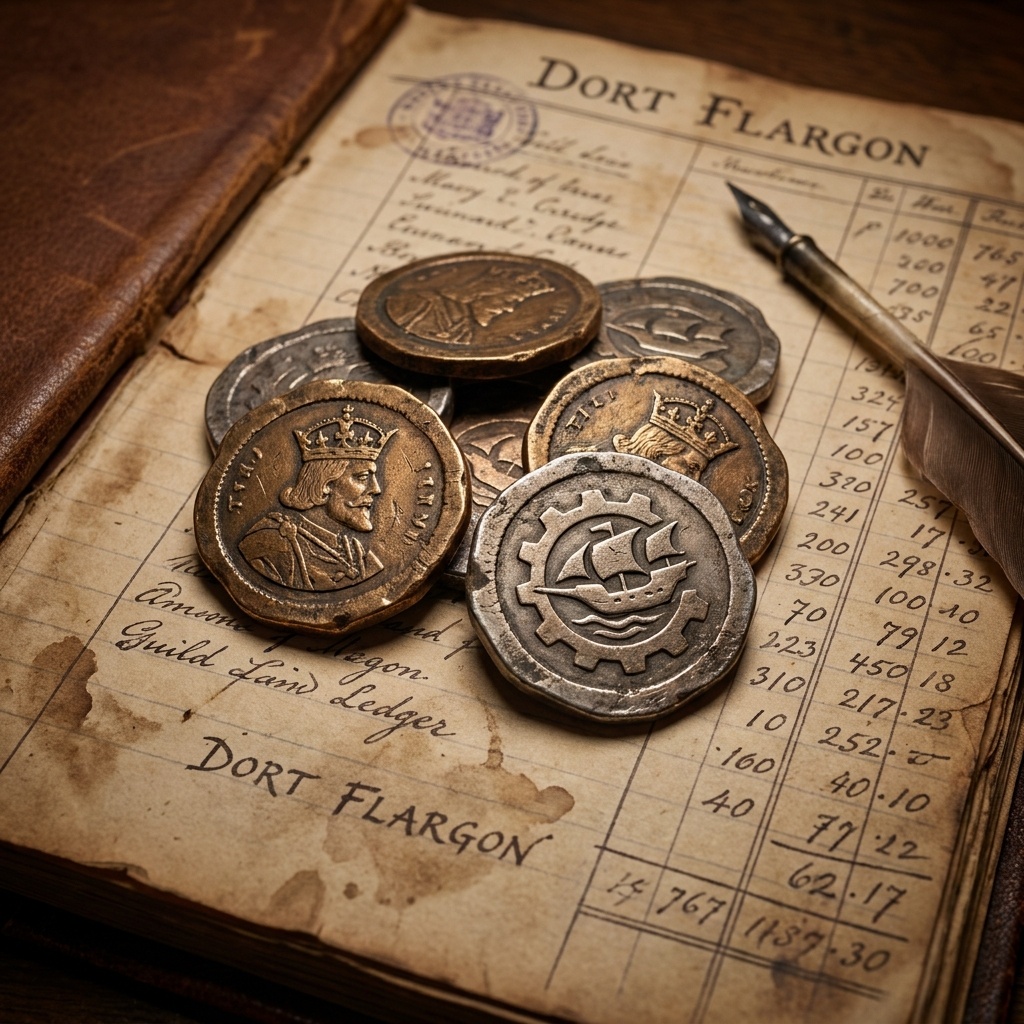
The flargon is the coin of Dort, minted under royal warrant and accepted across guild territories, city-states, and most of the known plane. Two denominations circulate: silver and gold flargons. The exchange rate is standardized by Accord decree and enforced by guild contract: twenty silver flargons to one gold.
| Denomination | Abbreviation | Equivalent |
|---|---|---|
| Silver flargon | sf | Base unit |
| Gold flargon | gf | 20 silver flargons |
| Gold Bar | — | 100 gold flargons |
A common laborer earns roughly one gold flargon per day, and a skilled hand thirty to fifty silver. A meal at a roadside tavern costs ten or twenty silver flargons. A decent sword costs a few gold. Full plate armor is measured in Gold Bars. Magical items (foci, enchanted gear, crafted implements) start expensive and run higher.
Starting Wealth. Characters begin play with a starting gear package appropriate to their Career (see the Starting Gear Packages section of this chapter) plus 2d10 gold flargons in pocket money. The package represents equipment accumulated over a career, not purchased at character creation. The pocket money is spending coin on hand when the adventure begins.
With 2–20 gf in pocket money, a starting character can afford basic weapons, light armor, and adventuring supplies. Chain armor (150 gf minimum) and heavier protection are beyond ordinary pocket-money purchases unless they come from a starting gear package or another explicit character option.
Haggling
The prices in this chapter are what a fair seller asks. Whether you actually pay that is a different question, and in Dort, where bargaining is a way of life in some markets and an insult in others, it is worth resolving properly.
Haggling uses a static social check, not an opposed roll. The question it answers is not "can this character negotiate?": it is "can this character talk this particular seller into a financially unfavorable decision?" A skilled negotiator has a real edge, but no one walks away with a discount every time they shop. Most merchants would rather wait for the next customer than sell something valuable at a loss.
This is the same framework used for all social checks against a resistant NPC; one rule, not two. The commercial version simply has a harder ceiling (up to Severe) because money is harder to part with than wariness. The general procedure is in the GM Guide, Chapter Two, Social Checks Against Resistance.
Haggling settles a single price on a single item. For the larger game, buying cargo in bulk, running it through risk, and selling it into a hungry market, see the Trade and Mercantile Play rules in the GM Guide (Chapter Eight). Haggling changes a deal; trade creates the deal.
The Procedure
You may haggle over a single item or a small group of closely related items. State your offer before you roll: the actual price you are proposing. Then make one check, using Negotiation by default; Charm, Intimidation, or Deception may apply depending on your approach and on what failure will cost you.
You get one attempt per transaction. A failed haggle ends the bargaining over that item, further attempts require genuinely new leverage, a different seller, or a real change in circumstances. (Otherwise the party just passes the item around until someone rolls well.) On a success the seller accepts your stated price; do not squeeze a larger discount out of net Successes afterward. You chose your risk when you named the number.
Step 1 — Base Difficulty: The Marketplace
Whether bargaining is even expected sets the floor.
| Situation | Base Difficulty |
|---|---|
| Haggling is expected (flea market, open-air bazaar, private sale) | Average |
| The seller has some flexibility, but haggling is not normally done (a small independent shop) | Hard |
| The item has a posted price and the seller has little reason to move (a large guild storefront) | Severe |
| The seller has no authority to change the price (a clerk in a noble's armory) | No check permitted |
Step 2 — The Seller's Resolve
Upgrade the difficulty once for each point of the seller's Willpower above 1. This upgrades Trial Dice to Crisis Dice: it makes a stubborn seller volatile to deal with, not merely harder.
| Seller | Willpower | Upgrades |
|---|---|---|
| Easily pressured or conflict-averse | 1 | 0 |
| Typical seller | 2 | 1 |
| Experienced merchant | 3 | 2 |
| Hard-nosed trader or guild representative | 4 | 3 |
| Nearly immovable | 5 | 4 |
A merchant whose entire livelihood is the deal may warrant one additional upgrade: that is trained expertise, not raw stubbornness.
Step 3 — Size of the Ask
The first 15% of price movement is free. Every additional full 15% adds a Trial Die. The same scale governs selling, asking a markup above fair value works exactly like asking a discount below it.
| Requested Discount or Markup | Adjustment |
|---|---|
| Up to 15% | No additional difficulty |
| 16–30% | +1 Trial Die |
| 31–45% | +2 Trial Dice |
| 46–60% | +3 Trial Dice |
| More than 60% | Normally impossible without extraordinary leverage |
Examples. Ten percent off a sword at a flea market begins at Average. The same ten percent off in a conventional weapon shop begins at Severe. Thirty-five percent off at a market stall begins at Average, then adds two Trial Dice for the size of the ask. Selling an ordinary gem for 25% over its fair value uses the same scale in the other direction.
Step 4 — Circumstances
Use Trial Dice only for major factors that genuinely change whether a deal is reasonable. Use Boon and Bane Dice for softer leverage, relationships, presentation, timing, minor complications. This keeps the pool readable.
| Circumstance | Adjustment |
|---|---|
| Seller is desperate to complete the sale | −1 Trial Die |
| Seller is eager to clear inventory, but not desperate | Add 1 Boon Die |
| Seller is especially unwilling to part with money or stock | +1 Trial Die |
| Item has a meaningful defect not already priced in | −1 Trial Die |
| Buyer is buying in bulk or offering valuable repeat business | Add 1 Boon Die |
| Item is scarce, in high demand, or hard to replace | +1 Trial Die |
| Buyer has credible alternatives and the seller knows it | Add 1 Boon Die |
| Seller knows the buyer urgently needs the item | Add 1 Bane Die |
Illegal Goods
An illegal item does not automatically make a seller easier to pressure: it can cut either way. A smuggler who controls a scarce prohibited item expects a risk premium; a thief trying to dump a recognizable chalice before the guard arrives is another matter entirely.
| Illegal-Goods Situation | Adjustment |
|---|---|
| Smuggler controls a scarce prohibited item and expects a risk premium | +1 Trial Die |
| Seller needs to unload stolen goods before the authorities arrive | −1 Trial Die |
| Buyer is an unknown asking suspicious questions | Add 1 Bane Die |
| Buyer has an established relationship with the seller | Add 1 Boon Die |
| Buyer threatens to expose the seller | Use Intimidation instead of Negotiation (with consequences) |
Defects and Deception
The defect discount is not free for the asking. A player cannot simply declare "this armor looks scratched."
| Situation | Handling |
|---|---|
| The item has a genuine, meaningful defect | Reduce difficulty by 1 |
| The buyer identifies a hidden defect with an appropriate skill | Reduce difficulty by 1 |
| The buyer falsely claims the item is defective | Use Deception for the haggle, or require a prior Deception check |
| The seller already priced the defect in | No reduction |
Reading the Result
A haggle is more interesting when failure is more than "the price stays the same."
| Result | Effect |
|---|---|
| Success | The seller accepts your stated price. |
| Failure | The seller refuses. Negotiation over this item is closed without new leverage. |
| Boon | The seller reveals something useful, throws in a minor accessory, offers a future lead, or simply stays friendly. |
| Bane | The seller turns irritable: reduced availability, payment demanded up front, or you are remembered as trouble. |
| Breakthrough | An unusually favorable term: access to hidden stock, a standing arrangement, or valuable market information. |
| Calamity | The deal collapses: price raised, an associate alerted, your desperation spotted, or suspicion of criminal intent. |
Haggling in brief
A static social check, not an opposed roll. Base difficulty is Average where bargaining is expected, Hard where the seller has some give, Severe where a posted price barely moves. Upgrade once per point of the seller's Willpower above 1. State your price first; the first 15% of movement is free, every further 15% adds a Trial Die, and more than 60% needs extraordinary leverage. Major factors (desperation, scarcity, real defects) shift Trial Dice; soft factors (relationships, bulk, urgency, presentation) add Boon or Bane Dice. A failed check ends negotiation for that transaction.
Weapons
Weapon entries list the following profile: Damage, Crit, Range, Enc (encumbrance), Qualities, and Price. Damage is the incoming amount before Resistance on a successful hit. Crit is the number of Boons that must be spent to trigger a Critical Injury with this weapon (a Breakthrough may always be spent instead). Range is the distance bracket the weapon operates at. Enc is the item's encumbrance count toward your carry threshold. Qualities are special mechanical properties defined in the Item Qualities section of this chapter.
Weapons are organized by the skill used to wield them.
Unarmed
The default unarmed profile is Damage equal to your Might, Crit 5, Range Engaged, no qualities. This profile is free; every character has it. Species with natural weapons use a profile defined in their species entry. The Unarmed skill covers brawling, grappling, and trained fighting arts; it does not cover improvised weapons. Swinging a bottle uses Light Melee with Inaccurate 1; throwing one uses Light Ranged with Inaccurate 1.
| Weapon | Damage | Crit | Range | Enc | Qualities | Price |
|---|---|---|---|---|---|---|
| Unarmed strike | Might | 5 | Engaged | 0 | — | — |
| Brawler's wrap | Might | 4 | Engaged | 0 | — | 10 sf |
| Iron knuckles | Might+1 | 4 | Engaged | 0 | Pierce 1 | 50 sf |
Light Melee
Fast, precise weapons designed for one-handed use: daggers, short swords, rapiers, hand axes, clubs, maces. Governed by the Light Melee skill, linked to Might.
| Weapon | Damage | Crit | Range | Enc | Qualities | Price |
|---|---|---|---|---|---|---|
| Dagger | 3 | 3 | Engaged | 0 | Accurate 1 | 4 gf |
| Short sword | 4 | 3 | Engaged | 1 | — | 150 sf |
| Rapier | 4 | 2 | Engaged | 1 | Accurate 1, Defensive 1 | 10 gf |
| Hand axe | 4 | 3 | Engaged | 1 | Vicious 1 | 6 gf |
| Club / baton | 3 | 4 | Engaged | 1 | Stun 2 | 2 gf |
| Mace | 5 | 4 | Engaged | 1 | Pierce 1 | 9 gf |
Heavy Melee
Weapons built for power, reach, or two-handed grip: longswords, greatswords, battleaxes, warhammers, spears, polearms. Governed by the Heavy Melee skill, linked to Might.
| Weapon | Damage | Crit | Range | Enc | Qualities | Price |
|---|---|---|---|---|---|---|
| Longsword | 6 | 3 | Engaged | 2 | — | 15 gf |
| Greatsword | 7 | 3 | Engaged | 3 | Vicious 1 | 450 sf |
| Battleaxe | 7 | 3 | Engaged | 2 | Vicious 2 | 20 gf |
| Warhammer | 7 | 4 | Engaged | 2 | Pierce 2, Inaccurate 1 | 350 sf |
| Spear | 5 | 3 | Short | 2 | Defensive 1 | 6 gf |
| Halberd / polearm | 7 | 3 | Short | 3 | Defensive 1, Vicious 1 | 25 gf |
Light Ranged
Carried, drawn, and thrown arms: shortbows, longbows, hand crossbows, slings, thrown weapons, javelins. Governed by the Light Ranged skill, linked to Agility.
| Weapon | Damage | Crit | Range | Enc | Qualities | Price |
|---|---|---|---|---|---|---|
| Sling | 3 | 5 | Medium | 0 | Inaccurate 1 | 1 gf |
| Shortbow | 4 | 4 | Medium | 1 | — | 10 gf |
| Longbow | 5 | 3 | Long | 2 | — | 350 sf |
| Hand crossbow | 4 | 3 | Short | 1 | — | 250 sf |
| Thrown dagger | 3 | 4 | Short | 0 | Limited Ammo 1 | 4 gf |
| Javelin | 5 | 3 | Medium | 1 | Limited Ammo 1 | 30 sf |
Ammunition
Bows and crossbows require appropriate ammunition. Running out mid-encounter imposes the Out of Ammo condition (you cannot use the weapon until reloaded; an Action to retrieve from a pack, or a Maneuver if you carry a loaded spare). After most encounters, roughly half of spent arrows and bolts can be recovered from the battlefield (GM discretion based on conditions). Alchemical and special ammunition cannot be recovered.
| Ammunition | Compatible Weapons | Enc | Price | Notes |
|---|---|---|---|---|
| Arrows (quiver, 20) | Shortbow, Longbow | 1 | 50 sf | Standard hunting/war arrows |
| Broadhead arrows (quiver, 20) | Shortbow, Longbow | 1 | 4 gf | +1 damage; not recoverable |
| Bolts (case, 10) | Hand Crossbow | — | 1 gf | Standard bolts |
| Bolts (case, 10) | Heavy Crossbow, Arbalest | 1 | 30 sf | Heavier construction |
| Sling stones (pouch, 20) | Sling | — | 10 sf | Typically sourced from terrain |
| Fire arrows (each) | Any bow | — | 4 gf | Deals fire damage; Burn 1 on hit; not recoverable |
| Broadhead bolts (case, 10) | Any crossbow | 1 | 50 sf | +1 damage; not recoverable |
| Javelin (carried, each) | Light Ranged | 1 | 30 sf | Single use as thrown weapon |
The Wanderer's Arrows. Starting packages that include bows list their starting quiver as part of the package (e.g., "Shortbow + 20 arrows"). This is the standard starting quiver above. Replacement quivers are purchased separately.
Heavy Ranged
Weapons requiring bracing, winding, or a setup action: heavy crossbows, siege weapons, ship-mounted arms. Governed by the Heavy Ranged skill, linked to Agility.
| Weapon | Damage | Crit | Range | Enc | Qualities | Price |
|---|---|---|---|---|---|---|
| Heavy crossbow | 6 | 2 | Long | 2 | Slow-Firing 1, Pierce 2 | 25 gf |
| Arbalest | 8 | 2 | Long | 3 | Slow-Firing 2, Pierce 3 | 50 gf |
| Ballista (crew, shipboard) | 10 | 2 | Long | — | Slow-Firing 2, Pierce 3, Blast 2 | 500 gf |
| Catapult (crew, siege/shipboard) | 12 | 2 | Extreme | — | Slow-Firing 3, Blast 4, Inaccurate 1 | 1,200 gf |
| Heavy bolt-thrower (ship-mounted only) | 12 | 2 | Long | — | Slow-Firing 2, Pierce 4 | — |
| Arcane lance (ship-mounted only) | 11 | 3 | Long | — | Slow-Firing 1, Pierce 2; a crew caster spends 2 Strain to fire | — |
Shipboard and Siege Weapons. Ballistas, catapults, and similar crew weapons are mounted on ships or fixed positions. They require a trained crew (one operator with Heavy Ranged, one assistant) and a minimum of one full round to prepare. They are not portable. A character with Heavy Ranged may operate them; without the skill, they add 2 Bane Dice to the attack.
Ship-mounted only weapons (heavy bolt-thrower, arcane lance) cannot be dismounted or purchased separately. They are capital-ship systems listed here for reference; full rules appear in the GM Guide, Chapter Fourteen.
Armor
Armor can increase your Resistance, your Defense, or both. Resistance is calculated as half Might (rounded up) plus armor bonus. Shields add Defense rather than Resistance. Armor entries list: Resistance Bonus, Defense Bonus (if any), Encumbrance, and Price.
| Armor | Resistance Bonus | Defense Bonus | Encumbrance | Price |
|---|---|---|---|---|
| Padded coat | +1 | — | 1 | 50 sf |
| Leather armor | +0 | +1 Melee | 1 | 10 gf |
| Studded leather | +1 | +1 Melee | 2 | 20 gf |
| Chain shirt | +2 | — | 2 | 150 gf |
| Chain hauberk | +2 | +1 Melee | 3 | 200 gf |
| Scale armor | +3 | — | 3 | 500 gf |
| Half-plate | +3 | +1 Melee | 3 | 900 gf |
| Full plate | +4 | +2 Melee | 3* | 1,500 gf |
| Buckler | +0 | +1 Melee | 1 | 4 gf |
| Shield (standard) | +0 | +2 Melee | 2 | 150 sf |
| Tower shield | +0 | +3 Melee, +1 Ranged | 3 | 15 gf |
Full plate applies 1 Bane Die to Athletics and Reflexes checks while armored.
Armor, Shields, and the Defensive Quality. Armor and shields provide their listed Defense bonuses while worn or readied. The Defensive quality on a weapon applies to all melee attacks regardless of whether a shield is readied. Characters can use all three. Armor, shield, and Defensive bonuses stack unless a specific item says otherwise.
Encumbrance
Characters can carry a number of items equal to Might + 5 without penalty. This is your carry threshold. Encumbrance measures what is awkward to actively carry: weapons in hand, shields, loose packs, bundles, tools, and the bulk of gear worn on the body. Most weapons and pieces of gear count as one item of encumbrance; exceptions are noted in the tables above.
For every point of encumbrance you carry above your threshold, add 1 Bane Die to physical checks (Athletics, Reflexes, Stealth, and combat checks where movement is a factor).
Worn armor is easier to carry than armor in your arms. When armor is worn properly, reduce its listed encumbrance by 3, to a minimum of 0. When armor is carried, packed, or slung over a shoulder rather than worn, it uses its full listed encumbrance. Shields are not armor for this rule; a readied shield counts normally.
Backpacks increase your carrying threshold. A worn backpack counts as 1 encumbrance, but increases your carry threshold by 4 while worn. If you drop the backpack, you lose both the backpack's 1 encumbrance and its +4 threshold.
Trivially small items (a handful of coins, a belt pouch, a folded note) do not count against encumbrance. The GM has final judgment on what qualifies as trivial.
| Encumbrance Above Threshold | Penalty |
|---|---|
| 1 | Add 1 Bane Die to physical checks |
| 2 | Add 2 Bane Dice to physical checks |
| 3 | Add 3 Bane Dice to physical checks |
| 4+ | Cannot move under own power |
Adventuring Gear
General equipment for field use. Encumbrance is listed per item where it matters; trivial items (candles, chalk, a note) are not counted individually.
| Item | Enc | Price | Notes |
|---|---|---|---|
| Rope (50 ft, hemp) | 1 | 30 sf | Athletics check to climb without pitons |
| Rope (50 ft, silk) | 1 | 6 gf | Lighter; +1 Boon Die to climbing checks |
| Grappling hook | 1 | 50 sf | Requires rope to function |
| Pitons and hammer (set of 6) | 1 | 2 gf | Required for safe climbing |
| Climbing kit (rope, pitons, hammer, harness) | 2 | 150 sf | +1 Boon Die to Athletics (climbing) checks |
| Torch (bundle of 6) | 1 | 10 sf | Burns 1 hour each; illuminates Short range |
| Lantern (oil, hooded) | 1 | 4 gf | Burns 4 hours per flask; illuminates Medium range |
| Lamp oil (flask) | — | 10 sf | — |
| Tinder box | — | 10 sf | Starting a fire without it requires a Survival check |
| Trail rations (1 week) | 2 | 50 sf | Per person; required for Fortitude checks in the field |
| Waterskin | — | 10 sf | Required for sustained travel |
| Bedroll | 2 | 30 sf | Sleeping without one adds 1 Bane Die to the following day's checks |
| Tent (2-person) | 3 | 6 gf | — |
| Backpack | 1 | 50 sf | While worn, increases carry threshold by 4 |
| Saddlebag pair | — | 5 gf | Attaches to mount; holds 4 items of encumbrance |
| Healer's kit | 1 | 10 gf | Required for Medicine checks in the field; 5 uses |
| Surgeon's kit | 2 | 80 gf | Reduces Medicine check difficulty by 1; 3 uses |
| Lockpick tools | — | 150 sf | Required for Subterfuge checks on mechanical locks |
| Thieves' tools (full) | 1 | 50 gf | +1 Boon Die to Subterfuge checks |
| Mapping kit (quills, ink, paper) | — | 50 sf | — |
| Spyglass | — | 150 gf | Removes Short range penalties from Perception at Long range |
| Manacles (iron) | 1 | 5 gf | Difficulty 4 Subterfuge or Athletics check to escape |
| Block and tackle | 3 | 10 gf | Required for hoisting loads above carry threshold |
| Alchemist's fire (vial) | — | 50 gf | Limited Ammo 1; Burn 2 on hit; treat as thrown Light Ranged attack |
| Disguise kit | 1 | 6 gf | Required for sustained disguise; +1 Boon Die to Deception for appearance |
| Writing kit | — | 50 sf | Quills, ink, folded paper |
| Magnifying lens | — | 4 gf | +1 Boon Die to Perception checks examining fine detail |
Poisons and Alchemicals
Poisons are regulated (and absolutely used) throughout Dort. Guild chemists, apothecary houses, and independent operators all supply them. Acquiring poison legally requires either a licensed trade affiliation or the knowledge to find an unlicensed source. Acquiring it illegally requires Streetwise.
Poison has three delivery methods: injury (applied to a blade, takes effect when the coated weapon causes the target to suffer at least 1 Wound), contact (skin exposure; touching an item treated with it, or a successful Unarmed attack), and ingested (must be eaten or drunk).
Poison entries state whether Resistance applies. If an entry says the target suffers Wounds, those Wounds bypass Resistance unless the entry says otherwise. If an entry says the target takes poison damage, apply Resistance normally.
Unless stated otherwise, a creature that is aware they have been poisoned may attempt a Fortitude check at the listed difficulty to reduce the effect. The GM may rule that certain creatures (constructs, undead) are immune.
Applying an injury poison requires a Maneuver. This can be done before entering structured play (at no cost, outside initiative) or on a character's turn during combat using one of their available Maneuvers. If a character has already used their one free Maneuver on their turn (for movement, aiming, or anything else), applying poison in the same turn costs 2 Strain as a second Maneuver. A coated weapon retains its poison charge for one successful hit or until the encounter ends. Applying contact poison to an item (a door handle, a cup) requires an Action and persists until triggered or cleaned off.
| Poison | Delivery | Difficulty to Resist | Effect | Price |
|---|---|---|---|---|
| Drowse | Contact/Ingested | Easy (1) | Target adds to all checks until the end of the encounter; minion-tier targets are immediately incapacitated | 30 gf |
| Deepslumber | Ingested | Average (2) | Target falls unconscious within one minute (10 rounds); lasts 4 hours unless disturbed | 80 gf |
| Bloodlock | Injury | Hard (3) | Prevents wound recovery for 24 hours; Medicine checks to heal during that time add | 150 gf |
| Carrion Drop | Injury | Average (2) | Target suffers 2 Wounds at the start of each of their turns for 3 rounds (not blocked by Resistance) | 200 gf |
| Stonedust | Contact | Hard (3) | Target adds to all Agility-based checks and cannot Sprint for the encounter | 100 gf |
| Unguent of Truth | Ingested | Severe (4) | Target cannot deliberately lie for one hour; they know they have been dosed | 350 gf |
| Widow's Breath | Ingested | Extreme (5) | Target takes 6 poison damage per hour for 8 hours (reduced by Resistance per instance, minimum 0 Wounds per instance); fatal without an antidote or Average Medicine check applied within 6 hours | 800 gf |
| Antidote (general) | — | — | On application, the target may immediately re-roll any active poison resist check with ; ends Drowse and Stonedust immediately | 50 gf |
| Antidote (specific) | — | — | Ends one named poison's effects immediately; restores wound recovery blocked by Bloodlock | 150 gf |
The Assassin Path. Chapter Seven includes the Assassin Ix talent path, which covers the use of poison in combination with surprise and tactical positioning. The advanced tier of that path includes the Clean Kill talent: when a target is incapacitated and you have personally observed or studied their physiology (i.e., you are familiar with their biology; you cannot clean-kill a sleeping dragon without a credible knowledge check on draconic anatomy), a successful Stealth check ends them. Consult Chapter Seven for full talent prerequisites.
Services
Common services priced in flargons. Costs assume a guild city or established trade settlement. Remote locations may charge double or refuse service.
| Service | Price | Notes |
|---|---|---|
| Meal (common, tavern) | 10 sf | — |
| Meal (good quality) | 20–30 sf | Inn or private household |
| Meal (fine dining) | 20–50 sf | Upper guild district, private club |
| Room (common house, per night) | 1 gf | Shared sleeping space |
| Room (inn, private, per night) | 30–50 sf | Single room, locked door |
| Room (quality lodging, per night) | 10–20 gf | Private suite |
| Stabling (horse, per night) | 1 gf | Feed, water, basic care |
| Bath (communal) | 10 sf | — |
| Bath (private) | 50 sf | — |
| Hireling (unskilled, per day) | 1 gf | Porter, laborer |
| Hireling (skilled, per day) | 30–50 sf | Teamster, cook, sailor, hunter, local guide, craftsman |
| Specialist (per day) | 20–50 gf | Physician, engineer, master artisan, translator, sage |
| Armed guard (per day) | 2–4 gf | Caravan guard, watchman, ordinary mercenary |
| Veteran guard (per day) | 10–30 gf | Experienced soldier, scout, bodyguard |
| Elite retainer (per day) | 40–100 gf | Knight, renowned guide, master physician, expert occultist |
| Courier (city) | 1 gf | Message delivery, same day |
| Courier (intercity) | 10 sf per day travel | — |
| Healer's care (Medicine check + materials) | 50–200 sf | Cost depends on injury severity |
| Passage (river barge, per day) | 1 gf | — |
| Passage (merchant ship, per week) | 10–30 gf | Includes bunk and rations |
| Passage (flying ship, per week) | 50–150 gf | Luxury or utility |
| Accord contract review (legal) | 100 gf | Standard guild rate; complex contracts higher |
| Guild registration fee | 50–500 gf | Varies by guild tier |
| Bribe (minor official) | 50–100 sf | Results not guaranteed |
| Bribe (senior official) | 50–200 gf | Results not guaranteed |
Weekly Lifestyle Costs
Between sessions, the GM may ask what standard of living the party maintains. This matters when living costs become relevant to the fiction: a character running short on funds, maintaining a social front, or trying to live below notice. Most of the time this runs in the background; state your lifestyle and it is handled.
| Lifestyle | Weekly Cost | What It Covers |
|---|---|---|
| Frugal | 5 gf / week | Common lodging (shared room), simple meals, basic personal care. The life of a traveling laborer or apprentice. Unremarkable. |
| Comfortable | 15 gf / week | Private room at a decent inn, good meals twice a day, occasional bath. The life of a skilled tradesperson or junior guild member. |
| Prosperous | 30 gf / week | Quality lodging, three solid meals, minor social access. The life of a successful merchant or junior officer. Doors that were closed to you comfortable-style open at this tier. |
| Wealthy | 50+ gf / week | Private suite or rented rooms, fine dining, household staff, social standing commensurate with the expense. Visible enough to attract attention; important enough to receive it on favorable terms. |
Characters who neglect to pay lifestyle costs for a week are assumed to have maintained Frugal living by default. At GM discretion, sustained poverty-tier living in a context where it is visible (a noble court, an expensive city, a faction negotiation where appearances matter) may add to social checks where status is relevant.
Hiring help for more than a day's odd job, guards, guides, a household, or followers runs on the full Hirelings, Followers, and Retainers rules (loyalty, morale, hazard pay, and stat templates) in the GM Guide, Chapter Eight.
Trade and Mercantile Play
Haggling (earlier in this chapter) handles a single price on a single item. Trade is the larger game: buying a commodity where it is cheap, carrying it through risk, and selling it somewhere it is dear. If your character has a mercantile career or background (Merchant, Factor, Privateer, Navigator, Sailor, or similar), this is part of what you do.
The full trade procedure is in the GM Guide, Chapter Eight. Here is what you need to know as a player.
The Four Steps
A trade run has four moments where your skills matter.
1. Find the opportunity. Use Streetwise, Negotiation, or Lore to identify what is undervalued here and wanted elsewhere. A well-traveled character asks around; a scholarly one consults trade records. Success names a profitable commodity and destination. Failure means the route is crowded or the information is stale.
2. Buy the cargo. Only roll if you are pressing for better terms than standard. Use Negotiation (or Deception if misrepresenting yourself or the goods). Standard wholesale needs no check. You are trying to improve the margin, not guarantee the purchase.
3. Transport it. The GM calls for one check per meaningful leg of the journey. Which skill depends on how you're moving: Survival overland, Operate by river or road vehicle, Piloting by flying ship, Riding for a beast train, Leadership to hold a caravan together. This is where things go wrong, or don't.
4. Sell. Use Negotiation or Streetwise to convert the cargo into coin at the destination. A market that needs your goods badly is easier; a saturated market is harder.
The Money
Profit is a margin, not a precise calculation. The GM sets a base percentage by route type: an established safe route might return 10%, a dangerous or distant one 40% or more. Your rolls across all four steps shift that margin up or down. A Breakthrough anywhere improves the margin significantly; a Calamity creates a complication the GM plays out.
The trade system does not replace Haggling; they work in sequence. Trade decides whether the opportunity is good. Haggling sharpens one specific term within it: a purchase price, a tariff, a storage arrangement.
What This Means at the Table
A character with Merchant or Navigator as their career has the skills this takes. A character without those careers can still run a trade route; the checks are just harder. The GM sets market conditions, complications, and what events happen along the transport leg. Your job is to make the right calls and survive the interesting ones.
Magical Foci
Arcane casters (those working in the Arcana tradition) rely on physical technique to draw power from the Arcana plane. Gestures, vocal components, material components, and focal devices form the grammar of the working. A focus is the practitioner's primary physical instrument: the channel through which trained intention becomes structured effect.
A focus does not change which spells a caster knows or what tradition they work in. It is a quality tool, nothing more, and quality tools make the work more reliable. Using a quality focus adds 1 Boon Die to casting checks made with the Arcana or Primal tradition. Divine casters use prayer and covenant rather than focal devices, but some do carry holy symbols that function analogously; see the entry below.
Foci must be held or worn and accessible to provide their benefit. A focus that is taken, destroyed, or fumbled in the middle of a working removes the bonus immediately.
Foci do not stack. Regardless of how many foci or holy symbols a character carries, the casting bonus is always exactly 1 Boon Die per check. Wearing an arcane amulet and carrying a journeyman's staff provides no more benefit than either item alone. The quality of attention and attunement is the resource, not the number of objects.
| Focus | Tradition | Benefit | Enc | Price |
|---|---|---|---|---|
| Apprentice's wand (wood, carved) | Arcana | +1 Boon Die to Arcana casting checks | — | 50 gf |
| Journeyman's staff (hardwood, inscribed) | Arcana | +1 Boon Die to Arcana casting checks | 1 | 150 gf |
| Arcane amulet (inscribed silver) | Arcana | +1 Boon Die to Arcana casting checks; worn | — | 200 gf |
| Elementalist's focus (elemental material) | Primal | +1 Boon Die to Primal casting checks | — | 200 gf |
| Ritual tome (inscribed, hand-copied) | Arcana | +1 Boon Die to Arcana casting checks for ritual spells only | 1 | 300 gf |
| Master's staff (rare wood, gem-set) | Arcana | +1 Boon Die to Arcana casting checks | 1 | 800 gf |
| Holy symbol (standard, deity-marked) | Divine | +1 Boon Die to Divine casting checks | — | 20 gf |
| Holy symbol (blessed, consecrated) | Divine | +1 Boon Die to Divine casting checks | — | 100 gf |
Foci Are Not Magical. A focus is an expensive, quality-crafted physical tool. It does not store spells, charge power, or function as a weapon without separate ability. What makes it valuable is precision of craft and the practitioner's attunement to it; a master's staff bought off a market stall has the same mechanical benefit as one carved over five years, because the benefit is about the quality of the instrument, not its history. That said, some foci do have histories, and those histories belong to the setting, not the stat block.
Required Focus. Some spells list a Required Focus in their spell block (for example: Required Focus: Holy symbol). This is different from the standard optional focus bonus. A required focus is a necessary component of the working; the spell cannot be cast without it. It does not grant an additional Boon Die on top of the standard focus benefit; the required item fills the same slot. If the required focus is also an appropriate optional focus for the tradition, the caster benefits from the +1 Boon Die as normal while holding it.
Combined Tradition Foci
Casters who have learned a combined tradition (Theomancy, Necromancy, or Shamanism) or High Magic work at the seam between schools, and the instruments that serve them must be built to hold that tension. A standard arcane focus was not made with Theomancy in mind; a holy symbol was not crafted to steady a Necromancer's grip on the boundary between living and dead. A practitioner who wants a casting bonus for their combined tradition must carry a combined tradition focus keyed to that specific blend.
Combined tradition foci follow the same rules as standard foci: they must be held or worn, they do not stack with other foci or holy symbols, and they provide exactly 1 Boon Die per check, but only to casting checks made within the combined tradition they are built for. A Theomantic lens does not aid a Necromancy cast; a Necromancer's ossuary focus does not aid a Shamanism working. Only a character with the appropriate tradition talent (Theomancer, Necromancer, Shaman, or Archmage) may attune to and use a combined tradition focus.
| Combined Focus | Tradition | Benefit | Enc | Price |
|---|---|---|---|---|
| Theomantic lens (silvered glass, deity-marked runes) | Theomancy | +1 Boon Die to Theomancy casting checks | — | 600 gf |
| Ossuary focus (bone-and-silver reliquary) | Necromancy | +1 Boon Die to Necromancy casting checks | 1 | 600 gf |
| Shaman's cord (knotted, spirit-tied) | Shamanism | +1 Boon Die to Shamanism casting checks | — | 500 gf |
| Triadic focus (bound triad of arcane, holy, natural materials) | High Magic | +1 Boon Die to High Magic casting checks | 1 | 2,000 gf |
The triadic focus is extraordinarily rare, typically commission-crafted for a specific Archmage or recovered from one. No market stocks them.
Mounts and Vehicles
Mounts and mundane vehicles are sold in any sizable market. Full mount profiles, characteristics, skills, and abilities, live in the Ix Adversary Catalog, Chapter Thirty (Beasts & Animals); vehicle profiles, Speed, Handling, and cargo, live in the GM Guide (Chapter Fourteen). The prices below are typical for a guild city in peacetime, and run higher on the frontier or in war. Flying ships are not casually bought: they are commissioned, inherited, or seized (see the GM Guide).
| Mount | Price | Vehicle | Price | |
|---|---|---|---|---|
| Donkey | 80 gf | Wheelbarrow | 10 gf | |
| Ox | 150 gf | Handcart | 20 gf | |
| Pony | 150 gf | Canoe | 30 gf | |
| Mule | 200 gf | Cart | 50 gf | |
| Riding horse | 300 gf | Rowboat / Sled | 100 gf | |
| Draft horse | 350 gf | Wagon | 250 gf | |
| Camel | 400 gf | Covered wagon | 400 gf | |
| Light warhorse | 1,500 gf | Fishing boat | 800 gf | |
| Heavy warhorse | 3,500 gf | Heavy freight wagon | 1,000 gf | |
| Carriage | 1,500 gf | |||
| Riding saddle & bridle | 100 gf | River barge / Coach | 3,000 gf | |
| Pack saddle | 50 gf | Small sailing vessel | 8,000 gf | |
| Light / heavy barding | 500 / 1,500 gf | Merchant ship | 50,000+ gf |
The mounted-combat rules in Chapter Thirteen read off your mount's Wounds and Resistance, so the numbers you need as a rider are repeated here.
| Mount | Price | Wounds | Resistance | One Trait |
|---|---|---|---|---|
| Donkey | 80 gf | 8 | 1 | Sure-Footed on narrow, rocky ground |
| Ox | 150 gf | 13 | 2 | Draft Animal; pulls heavy loads, slow |
| Pony | 150 gf | 9 | 1 | Small Mount; a lighter rider or a pack |
| Mule | 200 gf | 10 | 2 | Stubborn; will not be driven into obvious danger |
| Riding horse | 300 gf | 11 | 2 | Swift in a chase, but Easily Spooked |
| Draft horse | 350 gf | 20 | 4 | Panic Stampede; a poor combat mount |
| Camel | 400 gf | 11 | 2 | Desert Adaptation; heat, thirst, arid terrain |
| Light warhorse | 1,500 gf | 13 | 3 | Battle-Trained; Mounted Charge |
| Heavy warhorse | 3,500 gf | 15 | 4 | Battle-Trained; carries barding without panic |
Magic Items
Magic in Dort does not come off a shelf. There is one hard truth beneath everything here: permanent enchantment is Ancient magic, the direct imposition of will upon the planes (Chapter Nine), and no mortal, however masterful, can do it. What a mortal can make is one of two lesser things: a consumable (a spell poured into a vessel) or an augmentation (magic worn in a living body). Every permanent magic object, every true magic weapon, ring, and relic, was made by an Ancient or a god, once, for a reason, and is found in play, never bought. That is why there is no "+1 sword" in Ix.
| Kind | Made by | Lasts | What it is |
|---|---|---|---|
| Consumable — potion, scroll, wand | a mortal caster | used up | a stored spell |
| Augmentation — tattoo, graft, mark | a mortal specialist | as long as the body | magic worn in the flesh |
| Bespoke item — weapon, ring, relic | an Ancient or a god | permanent | unique; found, never bought |
| Sentient item — the Zoranti | an Ancient-tier working | permanent, awake | a relic with a mind |
The bespoke and sentient items, relics, the Zoranti weapons, are GM-placed treasures; their rules are in the GM Guide, Chapter Seven. What you can buy or make is below.
Attunement: the Soul's Load
A permanent item works for you only once you have bound it to yourself, a quiet settling over days of carrying and use. You can hold a number of attuned permanent items equal to your Willpower; beyond that, further items go inert for you. Augmentations are bound to the body, not the soul, and counted separately; you can sustain three by default (the Augmented talent in Chapter Seven raises this to four, and may only be taken once). Consumables need no attunement; you use them and they are gone. See the Consumables section below for full usage and crafting rules. Foci never stack (above).
Consumables
The everyday magic item, and the only one a party can reliably manufacture. A caster binds a spell they already know into a vessel using their casting skill, time, and materials. Consumables come in three forms: scrolls, potions, and wands. Using a consumable costs no Strain to the user. That cost was paid by the maker during crafting.
Scrolls
A scroll is a spell inscribed onto treated vellum by a caster who already knows it. The inscription does the hard work; using the scroll completes it.
Who can use a scroll. You must possess the casting skill matching the scroll's tradition (Arcana, Divine, or Primal), or hold the Scroll Reader talent with that tradition selected. A scroll for a combined tradition (Theomancy, Necromancy, or Shamanism) can be used by anyone who possesses at least one of the component skills or holds Scroll Reader for one of them.
Using a scroll. Reading a scroll requires an Action. Make the casting check for the spell at the difficulty listed on the scroll. The scroll is consumed regardless of outcome, success or failure. Extra successes, boons, and calamities apply normally. A calamity on a scroll cast produces the same result as a calamity while casting the spell directly.
Potions
A potion is a spell poured into liquid form, shaped to affect only the one who drinks it. Where a scroll requires a roll, a potion guarantees its effect.
Who can use a potion. Anyone. No casting skill is required.
What potions can contain. Potions hold spells that affect the drinker directly: healing, removing conditions, granting temporary characteristic or skill bonuses, or conferring a limited ability for a duration. A potion cannot hold an attack spell, a spell that targets another creature, or an area effect. If a spell would not logically benefit the person drinking it, it cannot be made into a potion.
Using a potion. Drinking a potion is a Maneuver during structured play. The effect is immediate and guaranteed; no roll is made. Any bonus to numeric effects baked in during brewing applies automatically.
Wands
A wand holds a fixed number of charges of a single spell. One wand, one spell. The spell cannot be changed after the wand is made.
Who can use a wand. The user must possess the relevant casting skill at any rank. Wands are caster tools, not general-use items.
Using a wand. Activating a wand is an Action. The spell fires with no casting check and no strain cost to the user. One charge is spent per use.
Wand charges. Each wand has a maximum charge capacity set by the creator's casting skill rank at the time of creation (minimum 1, maximum 5). A wand below capacity can be recharged by anyone who can cast its spell.
Crafting Consumables
Any caster who knows a spell may attempt to craft a consumable version of it during downtime. The crafting check is an Average difficulty check using the relevant casting skill (Arcana, Divine, Primal, or the applicable combined tradition). If the spell being scribed or brewed lists a Consumed Material, that material is also required and consumed during crafting. See the individual spell entry for what the material is and what it costs. Most spells have no consumed material requirement; the costs below cover the consumable vessel itself.
All crafting: 1 Boon reduces the crafting time by 1 hour (minimum 1 hour).
Scribing a Scroll
| Time | 1 hour per difficulty level of the spell |
| Materials | One scroll sheet (50 sf), plus the spell's Consumed Material if listed in the spell entry |
| Strain | The scribe suffers 1 Strain per difficulty level at session end; requires full rest to clear |
On a failed check, the scroll sheet and components are consumed and no scroll is produced. A Calamity consumes materials and may produce an additional consequence at GM discretion. Quality results from the scribing check are inscribed into the scroll itself; they apply when the scroll is used, not when it is made.
| Scribing Result | Effect When the Scroll Is Used |
|---|---|
| Every 2 extra successes (up to 3 reductions total) | Casting difficulty reduced by 1 (minimum Difficulty 1) |
| 2 Boons | Casting checks made from this scroll add |
Brewing a Potion
| Time | 1 hour per difficulty level of the spell |
| Materials | 10 sf (container) plus 100 gf per difficulty level, plus the spell's Consumed Material if listed in the spell entry |
On a failed check, all materials are consumed and no potion is produced. A Calamity consumes materials and may produce an additional consequence. Quality results are built into the potion at brewing time and apply automatically when it is drunk.
| Brewing Result | Effect |
|---|---|
| Each extra success (up to 3) | +1 to one numeric effect (wounds healed, bonus amount, or duration in appropriate units) |
Creating a Wand
| Time | 1 day per charge slot |
| Materials | 100 gf (wand body, or more for a custom commission) plus gem foci per charge slot (see table) plus material components per charge |
| Maximum charges | Creator's relevant casting skill rank at time of creation |
One crafting check is made per day of work. A success completes that charge slot. A Calamity loses that day's gem foci and material components without completing the slot.
| Spell Difficulty | Gem Foci Cost per Charge |
|---|---|
| 1 | 250 gf |
| 2 | 500 gf |
| 3 | 1,000 gf |
| 4 | 2,000 gf |
| 5 | 4,000 gf |
| Wand Creation Result | Effect |
|---|---|
| 3 Boons | +1 bonus charge slot completed (up to the creator's skill rank maximum) |
Recharging a Wand
| Eligible | Anyone who can cast the spell the wand holds |
| Time | 1 hour per difficulty level of the spell (for the full session, regardless of charges added) |
| Materials | Material components for the spell, once per charge being added |
Make one check. On a success, charges are added up to the wand's maximum capacity. On a failure, materials are consumed and no charges are added. A Calamity consumes materials, adds no charges, and the GM may apply an additional consequence.
| Recharging Result | Effect |
|---|---|
| 3 Boons | +1 bonus charge (up to maximum) |
Consumables at Market. Players who purchase rather than craft consumables will find them through licensed apothecaries, enchanting guilds, and private arrangement. Prices below reflect materials plus skilled labor and assume common spells without exotic components. Exotic component costs are in addition to these figures.
| Consumable | Market Price |
|---|---|
| Scroll (Difficulty 1) | 10–20 gf |
| Scroll (Difficulty 2) | 30–60 gf |
| Scroll (Difficulty 3) | 120–200 gf |
| Scroll (Difficulty 4) | 400–700 gf |
| Scroll (Difficulty 5) | Rare; 1,000 gf+ |
| Potion (Difficulty 1) | 150–200 gf |
| Potion (Difficulty 2) | 250–350 gf |
| Potion (Difficulty 3) | 400–550 gf |
| Potion (Difficulty 4) | 600–800 gf |
| Wand (Diff. 1, 1–2 charges) | 500–800 gf |
| Wand (Diff. 2, 1–2 charges) | 1,200–1,800 gf |
| Wand (Diff. 3, 1–2 charges) | 2,200–3,000 gf |
Augmentations
Permanent yet routine, because the magic is carried by your own life, not bound into dead matter. A specialist (a tattooist inking planar pigment, an alchemist, a primal shaman, a divine marker) sets it over time and coin, with a Fortitude check to endure it.
An augmentation grants one bonus, and a bonus is not the same as raising the trait. It adds to a derived value, grants a Boon Die on a category of check, an extra rank in a skill, a sense, or +1 to a characteristic. Because it is a bonus laid over you, not a true increase:
- it is dispellable (suppressed by dispel magic or a nullifying field such as the Well of Void) and removable (by an invasive procedure);
- a characteristic bonus can never raise your effective value above 5;
- it does not touch the Growth-talent economy, and it fills one of your augmentation slots (three by default).
| Augmentation | Typical Price |
|---|---|
| Skill or sense mark (+1 Boon to a skill; a minor utility) | 200–400 gf |
| Ward mark (+1 Resistance or a Defense) | 500–800 gf |
| Vital mark (+1 Wounds or Strain) | 400–600 gf |
| Characteristic mark (+1 to a characteristic; effective max 5) | 2,000+ gf, rarely offered |
Identifying an Item
The Auralight cantrip (Chapter Nine) reads an item's tradition (Arcana, Divine, Primal, or combined) and rough strength (cantrip-level, Journeyman, Adept, or Master-tier). That is all it tells you. Tradition and approximate power, nothing more.
Deeper identification (specific properties, effects, prerequisites, history, provenance) comes from Arcana, Lore, Secret Lore, or Planar Lore checks, from extended research, or from the item's own history. The GM sets difficulty based on how obscure, ancient, or deliberately hidden the item is. There is no spell that tells you everything; the reward for investigation is what makes powerful items feel like discoveries rather than purchases.
Some items hide their gifts until you attune, meet a condition, or simply use them enough to learn them. A sentient item tells you what it wants you to know, when it wants to.
Item Qualities
These qualities appear on weapons and armor throughout this chapter. Where a quality has a numeric rating (Vicious 2, Pierce 1, etc.), the number sets the magnitude of the effect.
| Quality | Effect |
|---|---|
| Accurate X | Add X Boon Dice to attack checks made with this weapon. |
| Blast X | Spend 2 Boons to deal X damage to all other targets Engaged with the original target. |
| Burn X | Spend 2 Boons to ignite the target with the weapon or spell's effect; the target suffers X Wounds at the start of each of its turns until extinguished. The target or an Engaged ally may spend an Action to end Burn. Note: the open-flame Immolation condition causes 2 Wounds per turn. Weapons and spells with Burn X cause exactly X Wounds; only the weapon or spell's listed rating applies, not the Immolation value. |
| Auto-Fire | Add 1 Trial Die to the attack. On a hit, spend 2 Boons per additional hit; each extra hit deals the weapon's base damage plus net Successes, allocable to the original target or another target Engaged with or within Short range of it. |
| Linked X | After a hit, spend 2 Boons per additional hit, up to X times, applied to the original target only. No attack penalty. |
| Defensive X | Add X Melee Defense while the weapon or shield is readied. |
| Disorient X | On a hit, the target gains the Disoriented condition for X rounds. |
| Ensnare X | On a hit, the target is Immobilized. Breaking free is an Action: an Athletics or Reflexes check at a difficulty set by X (1 = Average, 2 = Hard, 3 = Severe). |
| Guided X | Remove X Trial Dice from the attack pool (minimum 0 Trial Dice). If fewer than X Trial Dice are in the pool, downgrade the remaining ones to Bane Dice instead. Represents exceptional precision that cuts through uncertainty. |
| Inaccurate X | Add X Bane Dice to attack checks made with this weapon. |
| Knockdown | On a hit, the target falls Prone. Some entries instead require spending 2 Boons; the entry says so. |
| Limited Ammo X | This item may be used X times before it must be reloaded, retrieved, or replaced. |
| Pierce X | Ignore X points of the target's Resistance on a hit. |
| Poison X | On a hit (or as the entry specifies), the target suffers X Wounds at the start of each of its turns, ignoring Resistance, until it succeeds on an Average Fortitude check at the end of its turn. |
| Slow-Firing X | After attacking, this weapon cannot be fired again for X rounds without spending an Action to ready it. |
| Stun X | Spend 2 Boons to inflict X Strain instead of, or in addition to, the weapon's normal Wound damage. |
| Vicious X | Add +X to Critical Injury rolls caused by this weapon. |
Starting Gear Packages
Starting packages give players a functional kit without requiring item-by-item shopping. Players may take a package as written or build an equivalent package with GM approval.
Each package lists items, their field encumbrance, and the character type it fits. Field encumbrance assumes armor is worn and a listed backpack is worn. Packages do not replace starting coin: every starting character receives 2d10 gold flargons in addition to their package.
Warrior
A fighter ready for field work: armed, armored, provisioned.
| Item | Enc |
|---|---|
| Longsword | 2 |
| Dagger | — |
| Chain hauberk | 3 |
| Standard shield | 2 |
| Healer's kit | 1 |
| Trail rations (1 week) | 2 |
| Waterskin | — |
| Backpack | 1 |
| Rope (hemp, 50 ft) | 1 |
| Torch (bundle of 6) | 1 |
| Field Encumbrance | 10 |
Scholar
Books, instruments, and the tools of someone who reads the situation before acting in it.
| Item | Enc |
|---|---|
| Dagger | — |
| Padded coat | 1 |
| Apprentice's wand | — |
| Writing kit | — |
| Mapping kit | — |
| Magnifying lens | — |
| Trail rations (1 week) | 2 |
| Waterskin | — |
| Lantern (oil) + 2 flasks | 1 |
| Healer's kit | 1 |
| Field Encumbrance | 4 |
Rogue
Light, mobile, and prepared for options the other characters pretend don't exist.
| Item | Enc |
|---|---|
| Rapier | 1 |
| Dagger (×2) | — |
| Leather armor | 1 |
| Lockpick tools | — |
| Rope (silk, 50 ft) | 1 |
| Grappling hook | 1 |
| Disguise kit | 1 |
| Trail rations (1 week) | 2 |
| Waterskin | — |
| Torch (bundle of 6) | 1 |
| Field Encumbrance | 7 |
Tradesperson
Guild-certified, practical, and carrying the gear that earns money.
| Item | Enc |
|---|---|
| Short sword | 1 |
| Studded leather | 2 |
| Thieves' tools | 1 |
| Writing kit | — |
| Mapping kit | — |
| Trail rations (1 week) | 2 |
| Waterskin | — |
| Backpack | 1 |
| Field Encumbrance | 5 |
Mage
Arcana tradition. What they lack in armor they make in options.
| Item | Enc |
|---|---|
| Dagger | — |
| Journeyman's staff | 1 |
| Padded coat | 1 |
| Trail rations (1 week) | 2 |
| Waterskin | — |
| Writing kit | — |
| Candles (bundle) | — |
| Tinder box | — |
| Rope (hemp, 50 ft) | 1 |
| Field Encumbrance | 4 |
Wanderer
A traveler prepared for the road and not much else. Adaptable.
| Item | Enc |
|---|---|
| Hand axe | 1 |
| Shortbow + 20 arrows | 2 |
| Leather armor | 1 |
| Bedroll | 2 |
| Trail rations (1 week) | 2 |
| Waterskin | — |
| Backpack | 1 |
| Rope (hemp, 50 ft) | 1 |
| Torch (bundle of 6) | 1 |
| Tinder box | — |
| Field Encumbrance | 10 |
Devoted
A cleric, pilgrim guide, or temple guard: faith-forward and prepared to tend the wounded.
| Item | Enc |
|---|---|
| Mace | 1 |
| Chain shirt | 2 |
| Shield | 2 |
| Holy symbol (blessed) | — |
| Healer's kit (5 uses) | 1 |
| Prayer book or devotional texts | 1 |
| Bedroll | 2 |
| Trail rations (3 days) | 1 |
| Waterskin | — |
| Backpack | 1 |
| Field Encumbrance | 9 |
Pair this package with the Pilgrim Guide, Cleric, Healer, or Temple Guard career. The holy symbol is the starting focus for Divine casting.
Primal Adept
A shaman-in-training, hedge witch, or wilderness caster: draws on the natural world rather than study or faith.
| Item | Enc |
|---|---|
| Hand axe | 1 |
| Leather armor | 1 |
| Elementalist's focus | — |
| Herb pouch (10 doses, first aid and foraging materials) | 1 |
| Survival kit (rope, tinder, rations 3 days) | 3 |
| Bedroll | 2 |
| Waterskin | — |
| Backpack | 1 |
| Journal and charcoal sticks | — |
| Field Encumbrance | 8 |
Pair this package with the Herbalist, Wandering Shaman, Hedge Witch, or Scout career. The elementalist's focus provides the Primal casting bonus.