Choosing Your Species
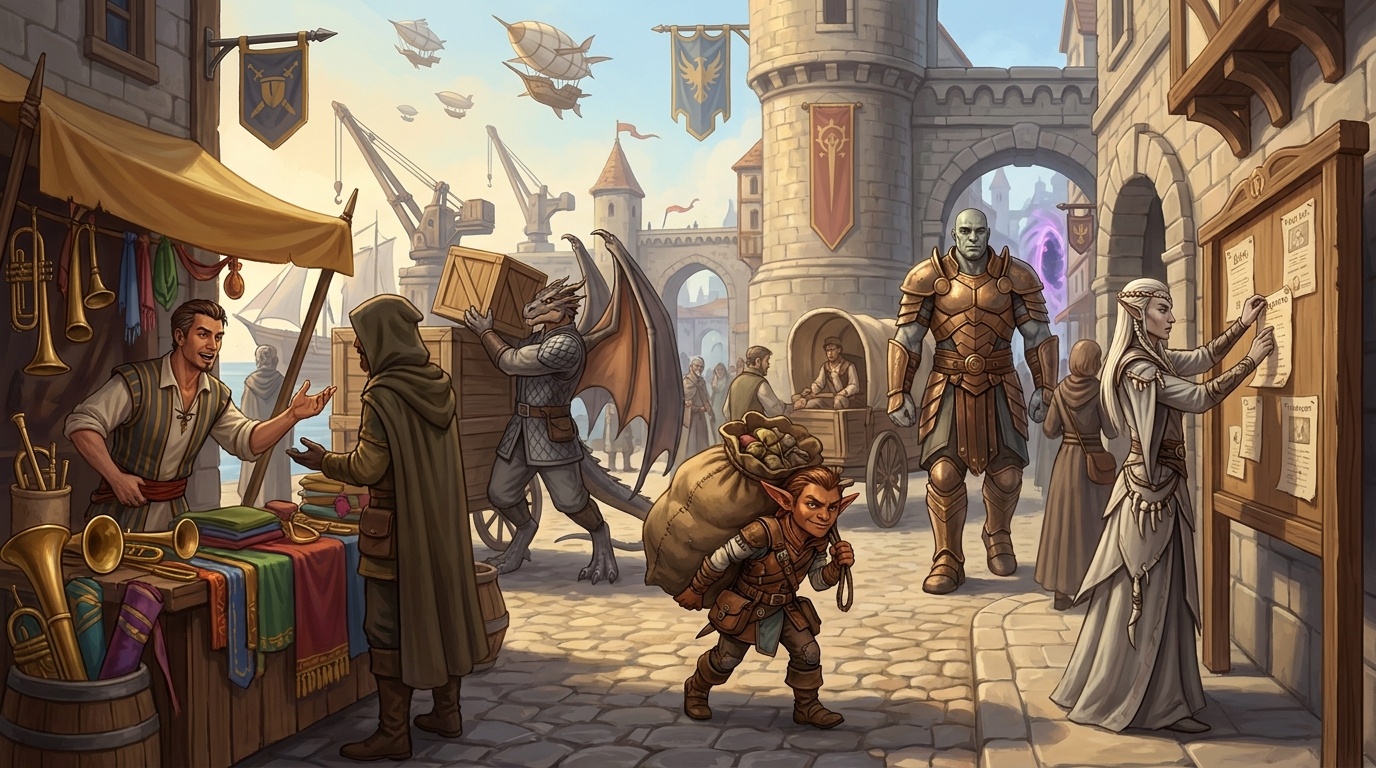
Your species choice is a fictional and cultural identity; the frame through which your character understands the world before they have done anything in it. A dwarf from Irna's mountain holds and a human from the same region share a geography and probably a language, but they do not share a relationship to time, to craft, or to the weight of a promise. Those differences matter at the table. They are the substance of species choice.
Every species in Dort is a real people with a history, an economy, and a relationship to the gods and the political structures of their region. Your choice of species tells you where you fit before the adventure begins; who recognizes you on sight, who makes assumptions about you, and what you carry into every room you walk into.
Mechanically, species choice sets your starting characteristic values, your Wound Points, your Strain Points, your Starting Experience, any free skill ranks, and one or more special abilities. The Exodus NDS baseline is a human: all six characteristics at 2, 10 + Might Wound Points, 10 + Willpower Strain Points, 110 XP.
Every other species modifies from that baseline in ways that reflect who they are.
This chapter covers the core playable species most commonly encountered across Dort's major regions and most appropriate for an initial Ix campaign.
The Core Playable Species
These species detailed here are the most widely distributed peoples in Dort's central regions, the most likely to appear in any adventuring party, and the ones whose cultural context the rest of this book assumes the GM and players share. This is not a claim that other species are less interesting or less available. Additional peoples exist throughout Dort beyond those detailed here.
Each entry below contains enough to build and play a character of that species: the narrative context, the mechanical package, and a short section on what playing that species actually involves at the table.
When you read these entries, read them as descriptions of real peoples rather than collections of stat bonuses.
Human
There is no single way to look at a human and know what you are seeing. What identifies a human as human is not appearance but something subtler: a quality of forward momentum, an alertness that comes from knowing, somewhere below conscious thought, that seventy years is not very long and that there is ground still to cover.
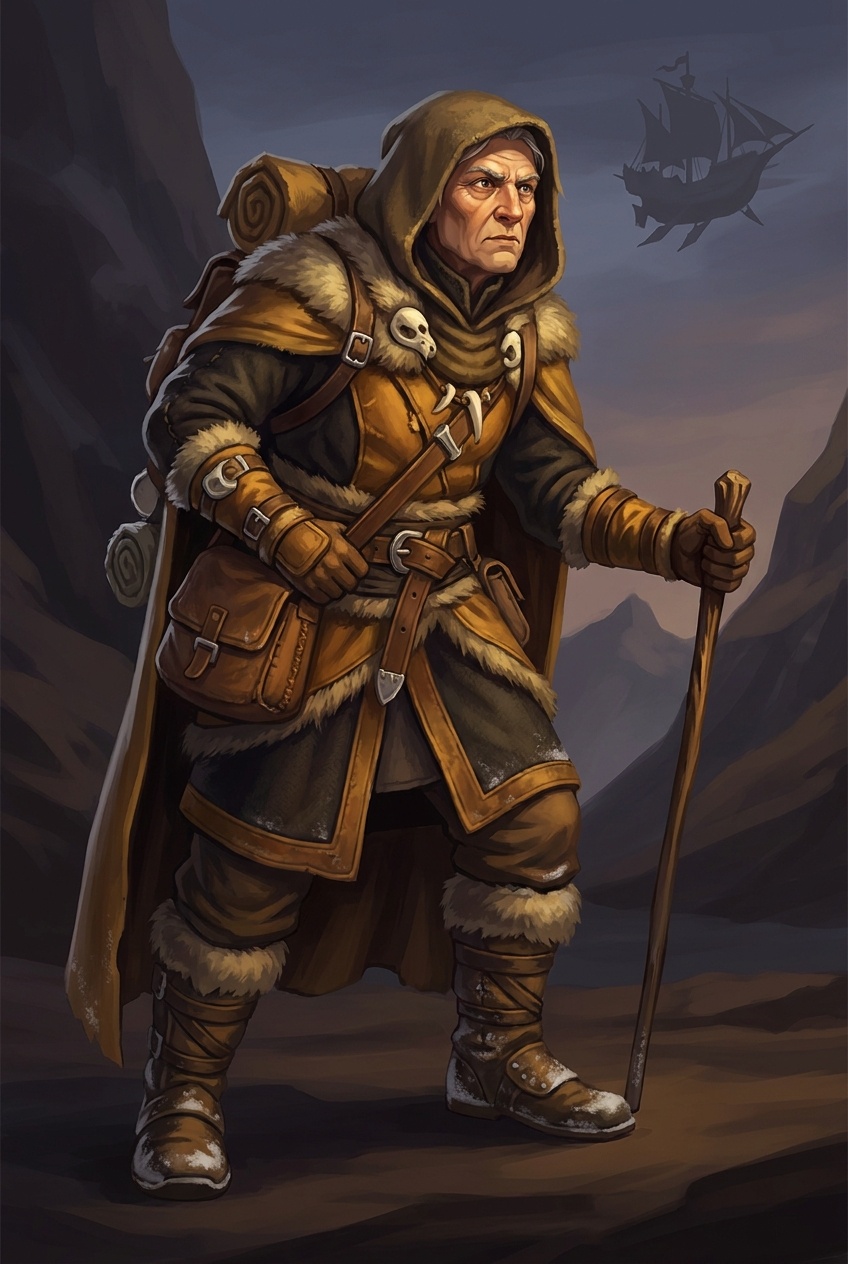
Humans hold the world because they are genuinely good at everything. Not exceptional at any one thing (most other peoples outperform them in their domain of specialization) but adaptable in ways that compound across a lifetime. A human who decides to learn something learns it. A human who needs to navigate a social situation they have never encountered before draws on a well of improvisation that is part experience, part instinct, and part sheer will to figure it out.
The short life is not incidental to this. The urgency of seventy years produces in most humans a driven quality: a tendency to commit, to decide, to move. You see it in the way they build; human cities do not take three generations to complete, because humans do not have three generations to spare. You see it in the way they form alliances, break them, and form new ones within a single lifetime. History moves faster in human hands than in anyone else's.
The five major human cultures of Dort are different enough that outsiders sometimes forget they share a base. Irna's peoples are pragmatic, laconic, and organized around the economics and governing. Shoing's vast land produced human cultures built around regional honor, courtly obligation, and wild magic. Funta's continental interior developed traditions of oral history and kinship organization that encode thousands of years of accumulated knowledge in forms that survive every political change. Jazirah's cities come with a religious rule that changes everything about them. Antaea's city-states, confederations, older communities, and trade corridors carry the cultural layering of a continent that absorbed migration and outside contact without becoming anyone's colony. These are not the same people. They share a lifespan, a capacity for adaptation, and a tendency to fill whatever space they occupy.
Humans range from five feet to six feet four and from 120 to 230 pounds, with variation broad enough that no physical feature reliably identifies one. The body reaches adulthood by the early twenties and shows visible aging from the forties onward. What does identify a human is subtler: the momentum, the orientation toward what comes next. Their cultural values organize around achievement (status earned by what you have done, not what you were born as), the weight of family as a continuity institution, and a complicated relationship with ambition that is celebrated and condemned in equal measure, which is at least honest about what ambition actually does. Oath-breaking and family betrayal are the deepest social transgressions in most human cultures: not because humans are especially honorable, but because in a short life, trust is expensive to lose.
Human names follow the conventions of the home region, not the species. The full breakdown by homeland is in Naming Your Character at the end of this chapter.
Human
- Wound Points: 10 + Might
- Strain Points: 10 + Willpower
- Starting Experience: 110 XP
- Free Skills: Any two skills (1 rank each), chosen at character creation
Adaptive: Once per session, when making a check using a skill in which the human currently has no ranks, they may add to the roll.
Playing a Human
- You bring the highest starting XP in the species lineup and the most flexible free skill selection. The two free skill ranks can go anywhere. This is the mechanical expression of adaptability; a human character concept can be realized without compromise.
- In a mixed-species group, you are often the character most aware of the present moment. Elves have seen this kind of thing before and expect to see it again. You probably will not. That urgency is character material, not a limitation.
- Your regional origin matters more than your species when it comes to how others first read you. A Jazirah human and an Irna human at the same table are almost different peoples in everything except biology. Play your specific origin, not a generic human.
- The room you walk into has no existing species-based calculation attached to you. No one is afraid before you speak; no one is reverential; no one is running a calculation about your elemental breath or your infernal heritage. The absence of that dynamic is more useful than it looks. You have the unusual privilege of arriving unread, which means the first impression you make is actually about you.
- Humans carry views about other peoples that are often half-true at best. The persistent ones: elves seem inflexible (patience reads as rigidity to people in a hurry); dwarves are stubborn in ways that are accurate more often than dwarves acknowledge; Smalings are soft (false, conflict-averse and soft are different things, a distinction most humans miss); orcs are violent by nature (inaccurate for most, accurate for specific factions, applied wholesale anyway). These opinions are held with the specific confidence of people who do not expect to live long enough to be proven wrong.
Smaling
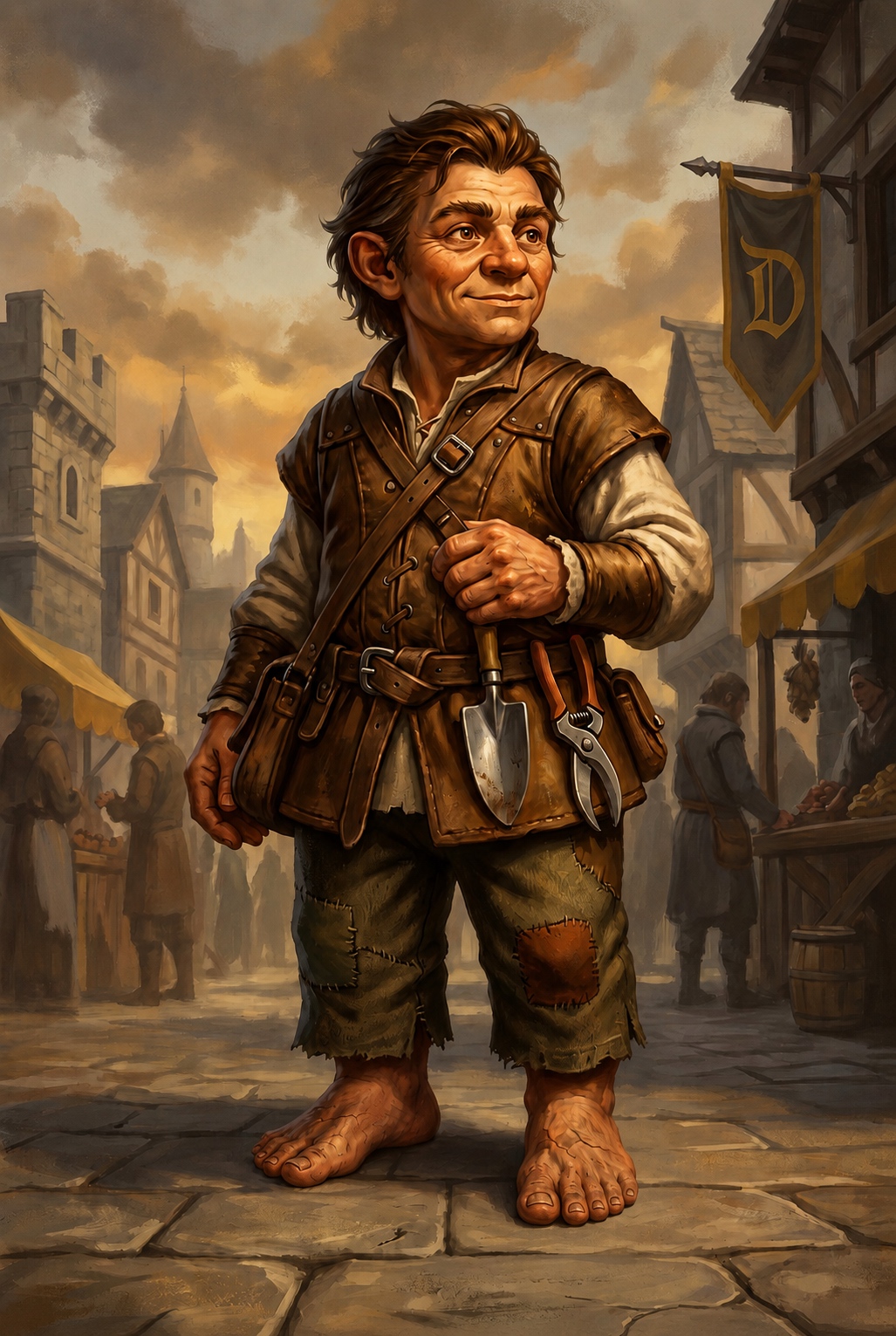
They are shorter than most peoples' furniture is tall. The feet are the first thing anyone notices after the height: broad, heavily calloused, bare in all weather, capable of walking the same ground as booted soldiers without complaint and arriving in better condition.
Smaling civilization is agricultural to its foundation, making them the finest farmers in Dort. Not the most innovative, not the most expansive, but the most consistent and fed. Village councils of elders manage seasonal planting compacts (agreements between neighboring villages about what gets planted where, in what rotation, and across what timescale) and these compacts have been renewed and refined for centuries. The result is a network of agricultural agreements that functions as a quiet administrative achievement most outsiders never bother to see, because it looks like farmers talking to other farmers about turnips.
The Smaling relationship to conflict is one of principled non-confrontation, not cowardice, a distinction they will make clearly if pressed, and not pacifism exactly, but a preference for the question what is this actually worth before any other question is asked. They are not easy to provoke. They are not undefended; Smaling villages that have been threatened have produced responses that surprised the threateners considerably. But the decision to respond with force is treated as the last resort.
Kraut is the spiritual heart of Smaling culture. The god of the harvest answered the cry of Ol' Seamus, an old Smaling farmer kneeling in the ash of a burned and salted farm, and the relationship that grew from that moment has shaped Smaling civilization ever since. The faith is flat, unglamorous, and consistent: work the soil with faith, share the abundance, and the field yields more than you planted. Most Smalings who worship do so through the labor itself, not through ceremony.
Smalings stand between two feet eight inches and three feet four and weigh between 40 and 65 pounds, built slight rather than stocky. The feet are broad, heavily calloused, and rarely shod; they are the hallmark feature, recognized across Dort before anything else about the species is. Adult standing by Smaling reckoning arrives around age 25. Visible aging is slow through the middle decades and tends to arrive all at once past 50, at which point the Smaling community recognizes someone as "deep-rooted," a term that means what it sounds like. They live between 110 and 130 years, and those past 100 are treated as something close to living land-memory.
Two things carry moral weight in Smaling culture beyond ordinary social expectation: hospitality (poor hospitality is not rudeness, it is a failure of something foundational) and the planting compact (breaking the rotational agreements between neighboring villages is understood as a harm to the land itself, not merely to the people). Selling ancestral land is the deepest transgression most Smalings can name, because land in their tradition is obligation, not property.
Smaling names follow the English countryside tradition: earthy, warm, immediately readable. Examples and the full guidance are in Naming Your Character.
Smaling
- Wound Points: 8 + Might
- Strain Points: 10 + Willpower
- Starting Experience: 85 XP
- Free Skills: Charm (1 rank)
Resilience of the Small: Reduce strain suffered from Fear effects and Intimidation checks by 2 (minimum 0). Once per session, the Smaling may spend 1 Fortune Point to shrug off a Fear or Intimidation effect entirely, not suppressing it, but declining to be moved by it; this also prevents the Frightened condition from that source.
Good Soil: Once per session, when making a Lore, Survival, or Negotiation check involving food production, agricultural systems, rural community structures, or land and terrain assessment, treat the Smaling as having at least 3 trained ranks in the relevant skill. The knowledge is specific and grounded; the Smaling may know things about a region's farming patterns that no academic would think to record.
Keen Nose: Remove 1 from Perception checks that rely on scent or airborne trace. Applies continuously without requiring any action to activate.
Playing a Smaling
- You are almost always the smallest person in the room, and the physical fact of that generates a continuous layer of lived experience that most other species never have to navigate.
- The pragmatic non-confrontation is a genuine orientation, not cowardice. The what is this worth comes before the what can I do about it. Playing this as active reasoning.
- The village you left is still with you. The planting compact wisdom, the community-scale thinking, the practiced eye for what actually matters versus what just feels urgent; these inform how a Smaling reads any situation.
- When others meet a Smaling, the first adjustment is physical. The small frame and bare feet arrive before the competence does. What follows is the recalibration: the pragmatic question that cuts straight to what matters, knowledge of land and community that no outside expert would have thought to gather, and the quality of not being moved by pressure that would unsettle a larger person. The usual impression, given time: smaller than expected, more grounded than expected, harder to dismiss than the height suggested.
- The views a Smaling carries about other peoples tend toward the practical and specific: most other peoples are in too much of a hurry to notice what they already have; gnomes are right about most things culinary and considerably more dramatic about it than strictly necessary; dwarves eat worse than they could, given what they have access to. The opinions are not hostile. They are agricultural.
Dwarves
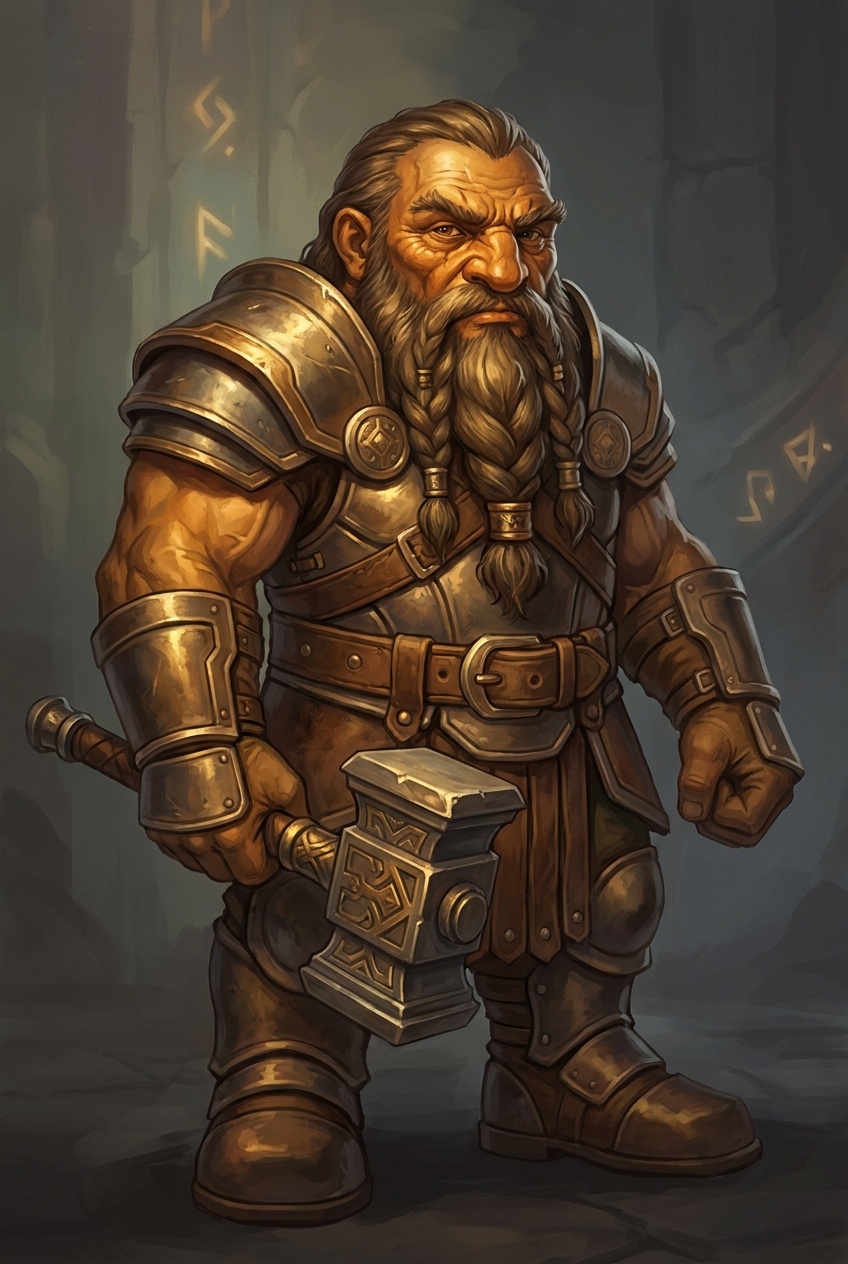
The first read on a dwarf is compact density. Four and a half feet is a common adult height, but the silhouette communicates nothing soft. Broad through the shoulder, thick-necked, with limbs carrying more mass per inch than almost any other humanoid; dwarves look exactly as difficult to move as they are.
To forge, carve, or build is not merely a trade among the Khazarum; it is an act of continuity between the living and all who came before. The doctrine of craft-debt holds that every dwarven life was made possible by the labors of the dead, and the way you honor your ancestors is by making something that will outlast you. Dwarven clan structure organizes around this philosophy. The clan is the primary legal, economic, and social unit, with clan names that are compound Khazuri roots worn smooth by centuries of use and formal oath-making that carries legal weight equal to any signed document. A spoken promise between dwarves is binding in a way that other peoples often find inflexible, and this is not a misperception. Breaking an oath damages not just the individual but their clan's reputation for generations.
The Khazarum built the oldest roads still in use in Irna, cut the great mine-passages of Funta's interior, and carved harbor foundations that half of Shoing's coastal cities rest upon. Dwarven faith divides naturally between Caminus (god of the forge and mastery through labor) and Bronthe; god of stone and the honest truth of what bears weight. An individual dwarf typically has a stronger relationship with one than the other, and which one reveals something about whether they see their work as transformation or as preservation.
Dwarves live nearly three centuries and carry that time in the particular grain of their skin, which acquires with age something closer to well-worked leather than to wrinkle. They stand between four feet four and four feet ten and weigh between 150 and 230 pounds, denser than the frame suggests: bone structure built for force rather than speed, musculature organized for sustained work. Deep Dwarves run slightly shorter, with grey-white to ash skin and eyes larger and more sensitive than their surface kin, adjusted across generations for light conditions that would read as total darkness to anyone else. Adult standing is marked by the Khaz-Tond, the first independent work accepted by the clan, typically achieved between ages 20 and 30. Those who reach 180 are called Khaz-Dur: elders in a tradition that means they have had generations to get it right, and they are given the weight that implies.
Dwarven taboos are specific and held seriously: abandoning a piece of craft mid-work, betraying a clan oath, wasting worked metal, and speaking ill of the honored dead without evidence. These are not abstract prohibitions. They are the structural conditions that make dwarven civilization function, and violations are remembered at the clan level for generations.
Dwarven names are forged from Old Norse and Proto-Germanic phonological roots, hard stops and short vowels, nothing soft. The full naming tradition is in Naming Your Character.
Two lineages are available for play: the Surface Dwarf (Khazarum) of the mountain holds and deep mines, and the Deep Dwarf (Kaz-Dhur), who retreated to extreme depth during the Primordial Conflict to escape the warfare with the surface elves, and emerged changed in ways that surface dwarves find simultaneously recognizable and alien.
Surface Dwarf (Khazarum)
- Wound Points: 12 + Might
- Strain Points: 10 + Willpower
- Starting Experience: 90 XP
- Free Skills: Fortitude (1 rank)
Stone-Sense: Remove from all Perception and Readiness checks made in dim or torch-lit conditions. Does not apply in complete magical darkness.
Tough Frame: Add +1 to Resistance value. Stacks with worn armor.
Craft-Debt: Once per session, when making a crafting, engineering, or repair check, invoke ancestral tradition to guarantee exceptional quality: on any success, treat the result as if one additional had been generated. Add to all checks made to identify the quality, age, origin, or weak points of worked stone or metal objects.
Oath-Bound: When a dwarf declares a specific goal or oath aloud to at least one witness, they may spend 2 Strain to add to a single check made directly toward completing that declared goal. Once per declared oath; requires genuine pursuit.
Deep Dwarf (Kaz-Dhur)
- Wound Points: 12 + Might
- Strain Points: 10 + Willpower
- Starting Experience: 85 XP
- Free Skills: Perception (1 rank)
Tough Frame: As Surface Dwarf above.
True Darkvision: Remove all from Perception and Readiness checks caused by darkness. Magical darkness adds only one rather than normal penalties.
Deep Silence: In underground environments, make a free Perception check (Average ) to detect movement through vibration, identify structural weaknesses in surrounding stone, or determine the direction of nearest water, air flow, or open space. Does not function on the surface.
Light Sensitivity: Add to all Perception checks and combat checks made in direct sunlight or equivalent bright-light conditions.
Playing a Dwarf
- You bring the most mechanically reliable damage-absorbing presence in the core species lineup. High Might and Willpower simultaneously means high Wound Points and a high Strain threshold. You stay in fights longer and you stay functional.
- The contrast between the face shown to outsiders (guarded, formal, slow to decide) and the face shown within trusted company (expressive, boisterous, devoted to craft and feast) is rich character material. You are not cold. You are careful about who gets to know you are not cold.
- An oath you have declared aloud is a fact. The people who heard you say it will remember. Play accordingly.
- When others meet a dwarf, they meet the gap between the formal exterior and what is actually behind it. Outsiders see the guarded manner, the deliberate pace, the weight of a promise. What they are not given, initially, is the warmth, the boisterous company over a good meal, the absolute commitment to the people who have been admitted to the inside. The outside-to-inside journey is long for a reason: a dwarf who trusts you has committed something with the same weight as a spoken oath.
- Dwarves observe other peoples with a craftsperson's eye for what has not been built to last. Surface peoples are careless with materials and structures, building things meant to hold weight without adequate preparation. Elves are passive to the point of uselessness in a genuine crisis, a view dwarves acknowledge is unfair but that persists anyway. Orcs will eventually fight, not as a slur but as a working assumption about what the Boss-right system rewards in the long term. These are held as assessments rather than prejudices, which does not make them fully accurate.
Elves
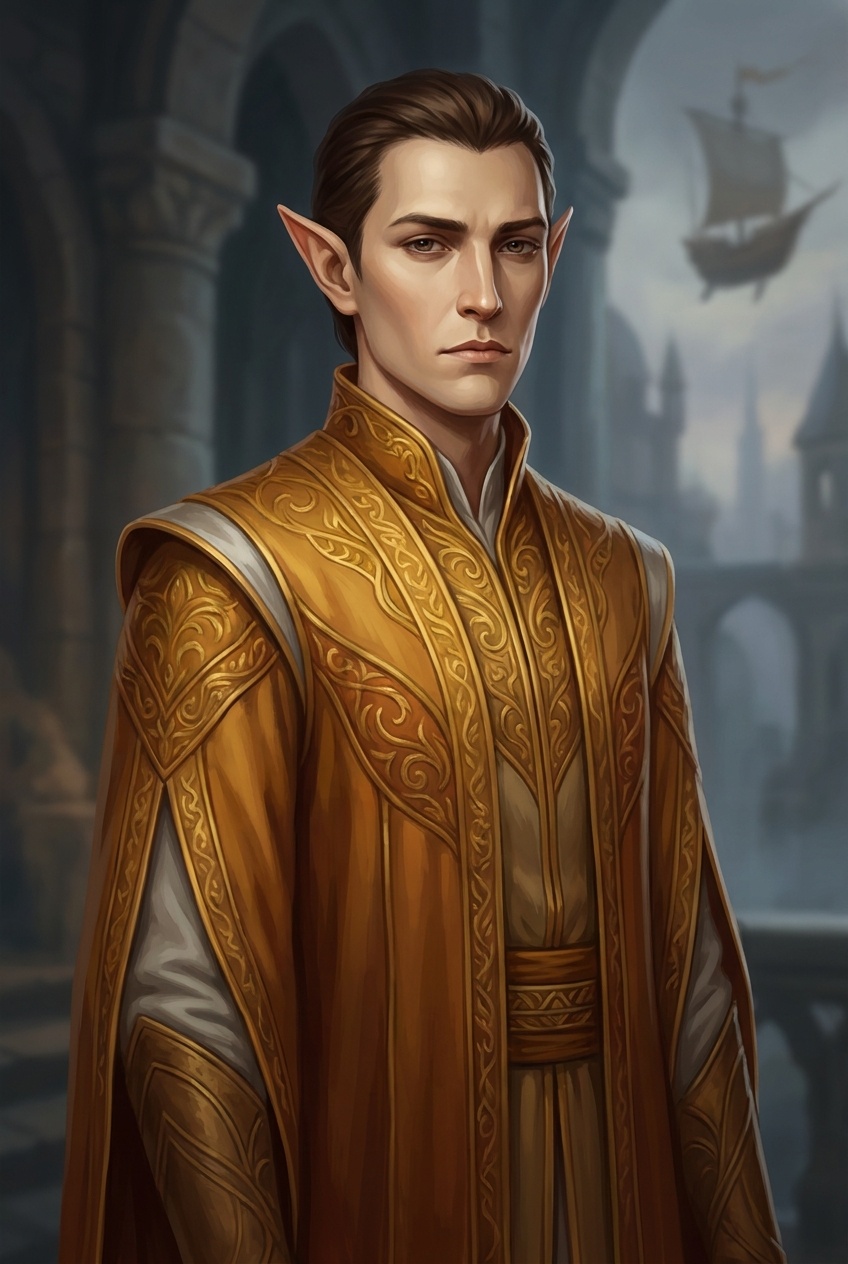
The features that most reliably identify an elf to any observer are the ears, distinctly pointed and mobile in a limited range that functions as a secondary emotional register, and a quality of stillness in casual situations that other peoples most often describe as unsettling. Elves do not fidget.
The Aelvari self-name means "those of the long remembering," and this is the organizing fact of elven civilization across all four lineages. To remember is a moral act. Forgetting is not a neutral failure; it is a diminishment of what existed. Elves are expected to carry the memory of their lineage, their promises, and the notable events of their lifetimes forward, intact. They live seven centuries and more, and a very old elf carries a quality of presence that is difficult to describe as anything other than geological; they have simply been present for so long that the world has shaped itself slightly around them.
What the three surface lineages share in their history is the memory of the Unraveling; a cascading failure of the great age of elven civilization several thousand years ago, driven by magical catastrophe, external pressure, and an internal fracture that the elven records are deliberately vague about. The aftermath, centuries of withdrawal turned inward and focused on preservation over engagement, is what elven histories call the Long Silence. The Moren's departure from the surface coincided with the Unraveling, and their relationship with the surface branches has never recovered from whatever happened then.
The High Elves of Irna's ancient courts carry the weight of remembering the Age of Voices most heavily; a civilizational solemnity that outsiders often mistake for arrogance and that the Aelvari themselves experience as grief with nowhere appropriate to put it. The Sea Elves are the most cosmopolitan, maintaining port communities along every continent's coast. The Sand Elves of Jazirah's deep interior are the least known outside their region, which is partly by design.
The physical baseline is tall and lean: five feet eight to six feet four for High and Sea lineages, with Sand and Moren lineages running slightly shorter and finer-boned. Weight runs from 130 to 180 pounds, consistently underestimating the apparent frame. The ears are pointed and mobile, functioning as a secondary emotional register; an elf who is not controlling their ears is more readable than they may intend. The eyes are large and wide-set, with a quality of attention that most other peoples find unnerving in sustained conversation. Cultural adulthood arrives around sixty, which is when the Aelthis, the formal oath tradition (in which a broken promise constitutes a permanent social rupture), first applies in full. Those past five centuries carry what their culture calls the Silvae: a quality of geological presence that shorter-lived peoples consistently underestimate at first meeting.
The taboos organized around elven values are worth naming: destroying records or art without cause, breaking an Aelthis oath, forgetting a name (which is a failure of memory as moral practice), and acting before grief has been acknowledged. An elf who moves too quickly after a loss is understood to have dishonored what was lost.
Elven names are discovered rather than invented, drawn from Welsh and Finnish phonological tradition: soft, flowing, open-voweled. No hard K sounds, no guttural stops. Details are in Naming Your Character.
Four lineages are available for play. All share two foundational traits.
Keen Senses: Remove from all Perception and Readiness checks. Elves are never Surprised unless the attacker specifically succeeded at a Stealth check against them first.
Long Memory: Once per session, draw on centuries of accumulated experience to recall a relevant detail, connection, or pattern that no living record would contain. Functions as a free Lore check (Average ) on any topic within an elf's lived or culturally transmitted experience. Additional uses within the same session cost 2 Strain each.
High Elf (Aelvar-Mir)
- Wound Points: 10 + Might | Strain Points: 10 + Willpower
- Starting Experience: 90 XP | Free Skills: Lore (1 rank)
- Special Abilities: Keen Senses; Long Memory
Arcane Attunement: Add to all Lore checks involving arcane history, spell identification, or magical theory. Once per session, identify the source, school, or likely intended effect of any magical phenomenon they can observe, even without formal training, as if succeeding on an Average Lore check.
Sea Elf (Aelvar-Miral)
- Wound Points: 10 + Might | Strain Points: 10 + Willpower
- Starting Experience: 90 XP | Free Skills: Athletics (1 rank)
- Special Abilities: Keen Senses; Long Memory
Wayfinder: Remove from all navigation-related checks at sea or in coastal environments. Once per session, identify the optimal route between two known points, including conditions and hazards, without requiring a check. Sea Elves do not get lost on water or in sight of the coast.
Sea-Born: No penalties for underwater movement or combat. Add to all Athletics checks in aquatic environments.
Sand Elf (Aelvar-Dunar)
- Wound Points: 10 + Might | Strain Points: 11 + Willpower
- Starting Experience: 90 XP | Free Skills: Survival (1 rank)
- Special Abilities: Keen Senses; Long Memory
Desert-Adapted: No strain or penalties from heat exhaustion, dehydration, or arid conditions. Remove from all Survival and navigation checks in desert or arid terrain.
Eye Membrane: Remove all added by bright light, glare, airborne dust, or similar visual impediments to Perception checks.
Moren (Aelvar-Moren)
- Wound Points: 10 + Might | Strain Points: 11 + Willpower
- Starting Experience: 85 XP | Free Skills: Stealth (1 rank)
- Special Abilities: Keen Senses; Long Memory
True Darkvision: Remove all from Perception and Readiness checks caused by darkness. Magical darkness adds only one .
Bioluminescent Sense: Once per encounter as a Quick Action, sense the number and general position of all living creatures within Short range, even through walls or in complete darkness, by reading heat, vibration, and faint biological luminescence. Does not function on the surface in daylight.
Light Sensitive: Add to all Perception and ranged combat checks in direct bright light.
Playing an Elf
- The world projects its feelings about elves onto your character constantly: reverence for age, envy of longevity, resentment of the knowing quality that centuries of observation produces. These arrive in how NPCs speak to you before you have said anything.
- Relationships with shorter-lived peoples carry a particular texture. You will watch families across three or four generations. Playing the ongoing attachment (rather than the detachment that outsiders expect) is the more interesting choice.
- The Age of Voices was greater than what exists now. Every elf knows this. What your character does with that knowledge (mourning, rebuilding, or simply accepting the long turn of things) is a defining orientation worth establishing early.
- When others meet an elf, the first thing they register is the stillness. No fidgeting; no displacement behavior; the pointed ears moving once and then settling. What follows depends on the elf's actual mood, which the ears are reporting with some accuracy if you know how to read them. The reputation for being distant or cold is a misread of stillness as absence. What is actually present is attention, and elves who find you interesting are fully engaged in a way that the composure does not make obvious.
- Elves carry specific views about shorter-lived peoples that they generally do not offer unless asked. The persistent ones: shorter-lived peoples are reckless with consequences they will not live to see; dwarves confuse the permanence of the object with the permanence of the meaning, which are different things; humans build new things faster than they learn what they built last time. These are not contemptuous exactly. They are the assessments of something geological, watching something riverine.
Orc
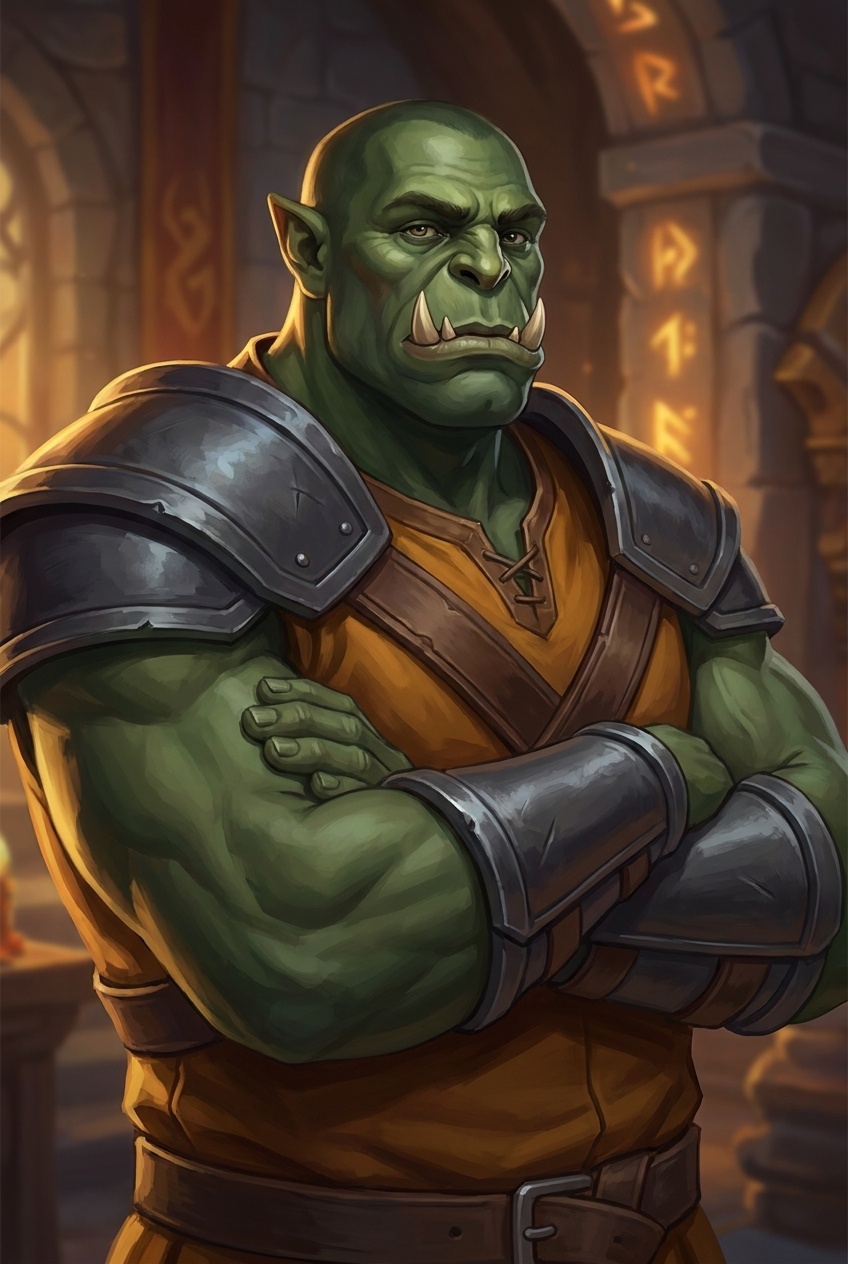
The first read on an orc is large, green, and deliberately present. They stand between six feet and seven, built in a way that suggests the upper body received more than its share of everything: shoulders wide, arms heavy, neck thick, the whole frame proportioned for force.
The clan is the organizing fact of orcish existence. Not the family, not the nation, not the religion: the clan, defined by Boss allegiance rather than blood, fluctuating in membership as challenges succeed and fail, ranging from a warband of thirty to an army of several thousand following an exceptionally capable leader. An orc without a clan is a diminished thing, not as a matter of philosophy but as a matter of practical reality. The clan provides standing, identity, purpose, and the context in which an orc's deeds have meaning. The Boss leads by demonstrated strength; when that individual loses to a challenger, command transfers. The system produces both exceptionally effective leaders and catastrophic ones, and orcish culture is comfortable with both outcomes.
Orcish society invests in the immediate rather than the long horizon. An orc who has proven themselves in ten fights has more standing than an orc with a better plan for eleven. This is not stupidity; it is a fundamentally different relationship to time and consequence. The short-term focus is physiological as well as cultural: orcs have a measurably higher pain threshold than most peoples, not the absence of pain but the genuine capacity to continue functioning through injury that would incapacitate others. Surface wounds heal fast.
Orcs appear across Dort in frontier roles, mercenary companies, and wherever demonstrated individual capacity matters more than institutional standing. In regions where the Oshalan Order has not penetrated, orcish clans hold recognized territory by right of strength. In regions where it has, the relationship between orcish clan authority and the Order's hierarchy produces an ongoing tension that neither side has resolved.
They run from 220 to 320 pounds, heavier through the torso and upper limbs than the height already suggests. The skin is grey-green to deep forest-green: an inherent trait rather than a regional variation, consistent across every continent an orc has ever been born on. The tusks are upward-curving lower canines, used for display, intimidation, and in close fighting; they are the first thing most peoples notice after the scale. Small dark-toned eyes sit under pronounced brow ridges that give most orcs a permanent expression of intensity whether they intend it or not. Adulthood is marked by the Urgnak, the first-blood naming ceremony held between ages 16 and 17. Physical prime peaks somewhere between 30 and 45; the aging that follows arrives faster than most other peoples experience.
The cultural prohibitions that carry genuine weight: fleeing a fight without the Boss's order (which is not cowardice, it is a violation of the system that makes clan trust possible), challenging a Boss by any means other than an open declared challenge, and betraying the clan to outsiders, which ends in death rather than exile. Dying without having fought is understood as a failure of character.
Orc names are declarations: guttural, short, hard-consonanted, with clan names in orcish phonological roots. Details are in Naming Your Character.
Orc
- Wound Points: 12 + Might
- Strain Points: 10 + Willpower
- Starting Experience: 85 XP
- Free Skills: Intimidation (1 rank), or by clan
Relentless: When suffering a Critical Injury, reduce the result by 10 (minimum 1). Once per encounter, when an orc would be reduced to 0 Wounds, they may spend 2 Strain to remain at 1 Wound instead.
Warrior's Rush: When the orc moves toward and attacks an enemy in the same turn, add +1 damage to the attack and the Knockdown quality if it doesn't already have it. Once per turn, on the first attack only.
Tusked: Add +1 damage to all Unarmed checks. When making an Intimidation check involving visible physical presence or direct threat (the kind where the other person can see your tusks) add to the roll.
Orc Clans
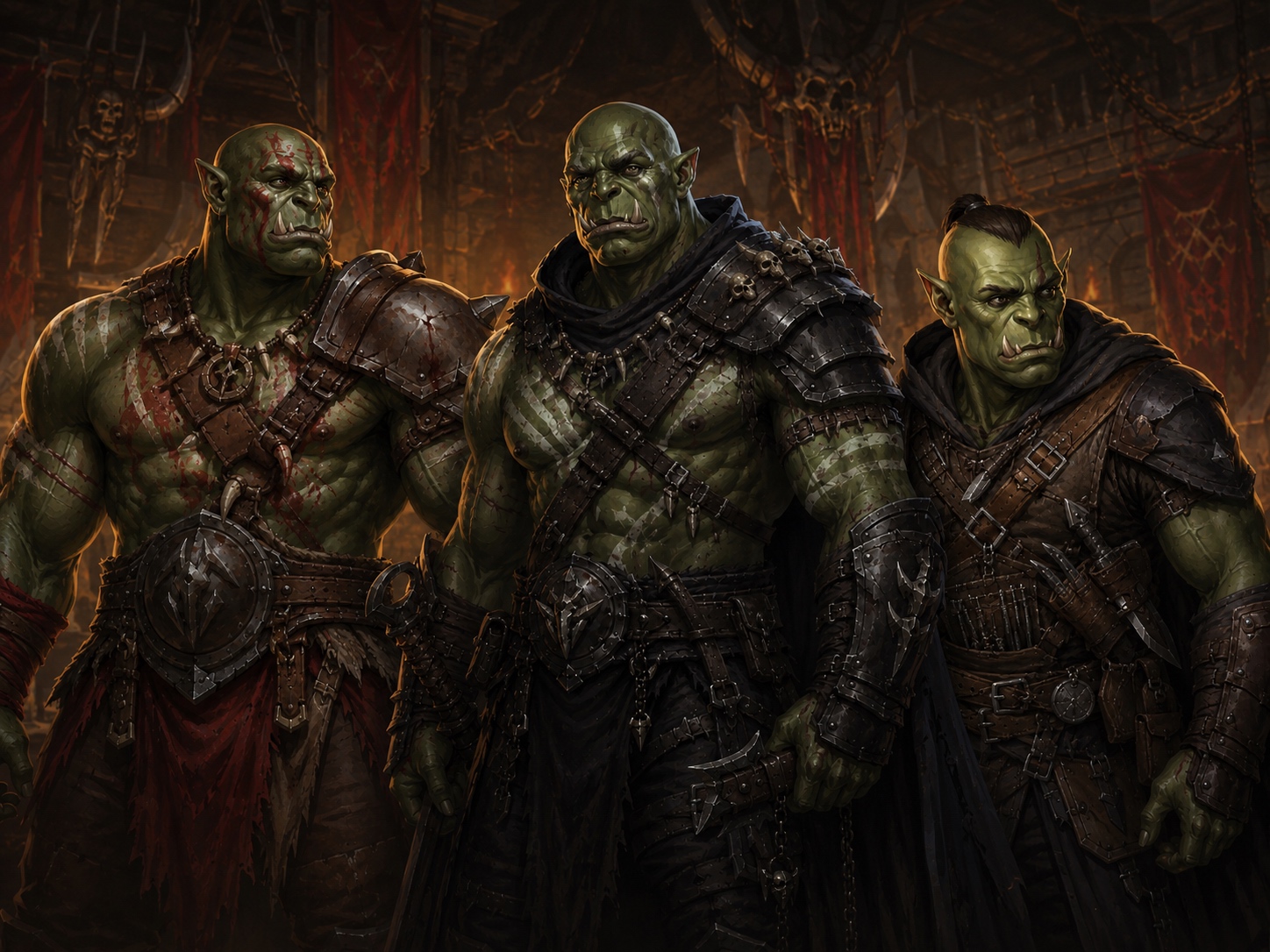
Clan membership is the organizing fact of orcish identity before any individual characteristic is. An orc's clan name comes first in formal address; the question "what clan?" arrives within the first exchange with any other orc you meet. Physiology is consistent across all clans, the stat block above applies regardless of affiliation, but fighting doctrine, cultural emphasis, and tactical focus vary enough that two orcs from different clans would describe themselves as completely different kinds of people, and they would both be right.
Five major clans appear most often across Irna and the wider world. Each replaces the standard free Intimidation skill unless noted, and adds one clan-specific trait.
Grakkan: The Crushers
The most widespread clan and the one most peoples picture when they say "orc" without further specification. Grakkan doctrine is direct force: go at the hardest point and be harder to stop than it is. Boss-selection favors the largest and strongest. By volume, most orcs a party encounters in Irna will be Grakkan.
- Free Skill: Intimidation (1 rank)
- Crusher's Rush: When using Warrior's Rush, add +1 additional damage (total +2 above base). The Knockdown quality applies to any target struck, not only targets attacked on initial approach.
Kharband: The Blood-Sworn
The most disciplined major clan, and the one with the strongest tradition of contract work with outside peoples. A Kharband orc who swears to something holds it absolutely: a reputation earned across generations and worth more to the clan than most victories. Boss-selection still favors strength but weights political acumen more than most clans do. The Kharband Coalition (the Second Great Unification, sixty years ago) was built on this reputation, and other peoples have not forgotten it.
- Free Skill: Discipline (1 rank)
- Oath Reputation: When fulfilling a declared contract or sworn agreement, add 1 Boon Die to all checks made in direct service of that fulfillment. In initial social encounters with non-orcs who have dealt with Kharband before, add 1 Boon Die to the first social check.
Urgzog: The Frenzy
The Urgzog have ritualized the battle-madness that other orcs experience occasionally into a deliberate practice: chanting, ritual preparation, and the specific physical state they call the battle-heat. In this state they are exceptionally dangerous and largely indifferent to injury. Outside of combat, Urgzog orcs are often quieter and more deliberate than Grakkan. The intensity has to go somewhere.
- Free Skill: Fortitude (1 rank)
- Battle-Heat: When the Urgzog has suffered at least 1 Wound in the current encounter, they ignore the effects of the Disoriented condition for the remainder of that encounter.
Dakrim: The Death-Marked
Fear as a weapon, used with craft. The Dakrim specialize in psychological warfare: arriving before the battle and leaving signs, making their presence felt through seemingly impossible infiltrations, using darkness and silence as tools. Their Boss is typically the most tactically sophisticated fighter in the clan rather than the physically largest. A Dakrim orc is not a smaller or weaker orc; they are an orc who has learned that the mind breaks before the body does.
- Free Skill: Stealth (1 rank)
- The Fear Arrives First: Add 1 Boon Die to Intimidation checks against any target who has not yet witnessed the Dakrim in direct combat during this encounter. Once a target has seen you fight, the bonus no longer applies against them.
Zaggon: The Shadow-Clan
By orc standards, the Zaggon are close to a pariah clan. Their methods (stealth, information-gathering, operating without engaging) are regarded by other clans as borderline cowardly. The Zaggon regard this as proof that other clans are predictable, which is an asset. Every major Warboss who achieved significant unification used Zaggon intelligence to accomplish it, while publicly treating the Zaggon as lesser. The Zaggon are aware of this pattern and consider it a form of tribute. A Zaggon character in an adventuring party is the most unusual orc at the table.
- Free Skill: Stealth or Perception (choose one, 1 rank)
- Prior Intelligence: Remove 1 Bane Die from all Stealth and Perception checks. Once per session, reveal specific prior intelligence about a target, location, or organization: tactical and positional information gathered in advance. This functions as a free Hard Lore check on that subject; the GM confirms plausibility.
Playing an Orc
-
Demonstrated strength and present action are the primary language of meaning, not as a limitation, but as a coherent worldview. The Boss-right system creates natural party dynamics: who in the group does your character think is worth following, and how do they express that?
-
The Relentless ability changes how you engage with combat across a full session, not just a single fight. An orc who takes a critical and keeps going is doing something other species cannot do.
-
An orc operating outside clan context (someone whose clan was destroyed, who left, or who is forming something new) has already made a defining choice. Every clan member you meet will want to know what happened. Have an answer.
-
When others meet an orc, they are making a decision in real time about whether this specific orc is something to worry about. The scale does it: six feet and more, heavy through the upper body, tusks visible. Your character has seen that reaction their entire adult life and has already decided how to use those few seconds. Most orcs who operate outside clan territory have learned to let the initial recalibration run and work in the gap it creates.
-
The views an orc holds about other peoples reflect the Boss-right system applied outward: settled peoples are soft, which is at least partially accurate in physical terms, though orcs acknowledge that soft peoples build things that outlast any single clan; non-orcish leadership is always subject to challenge by someone stronger, which is an accurate read of how the system would work if everyone played by orcish rules (most do not); one's own clan is better than other clans, which is a universal orcish position and genuinely believed by everyone holding it.
Drakin
A Drakin walking into a room has already changed it. The wings fold at rest into a shape that runs from shoulder to knee. The mosaic scales (no two alike, each an interlocking field of colors that are never just one thing) catch the light as they move. The internal glow pulses once, and the temperature in the room is very slightly different than it was.
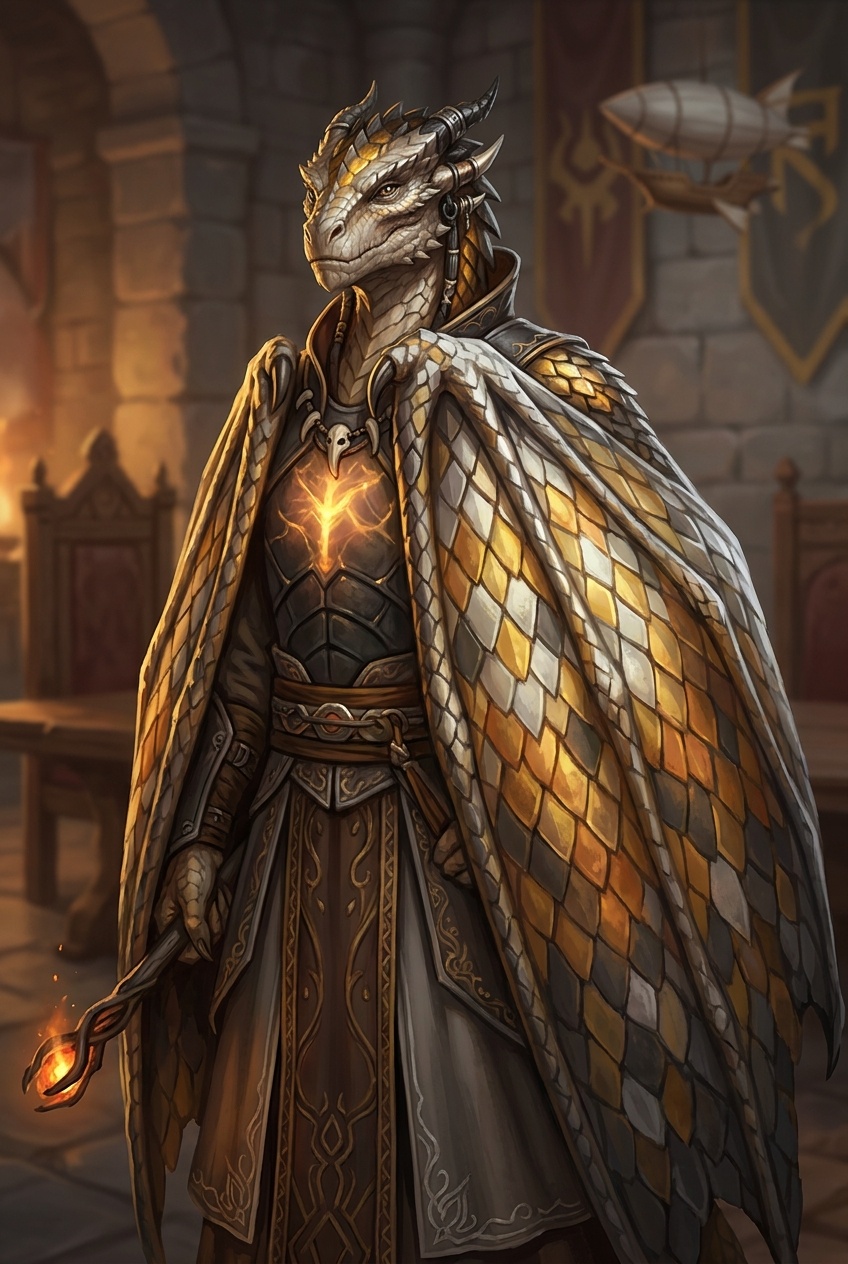
They are dragon-kin, not half-dragons, not failed dragons, not imitation dragons, but something that could not have existed before their ancestors chose to bridge the gap between draconic and mortal. The mosaic pattern of their scales is the literal expression of this: no single color, no pure lineage, something made from the intersection of what came before. True dragons use the word Mockwyrm. Drakin have spent centuries demonstrating exactly how wrong that assessment is.
The physical baseline is large and consistently so: six feet to seven and a half, 220 to 380 pounds, and always denser than the frame suggests because the skeletal structure and musculature required to support wings and tail are not visible from the outside. The wings fold from shoulder to just below the knee at rest and span two to three times the Drakin's height at full extension. The tail is load-bearing and expressive, communicating mood in ways that most non-Drakin read incorrectly; most Drakin who know better allow this. The internal glow of the elemental core deepens with strong emotion, strengthens in environments that match the lineage's element, and is the first thing many peoples notice in dim light. Adult standing is recognized around age 20 to 25, through demonstrated elemental control under pressure rather than through a fixed age or ceremony. The visible markers of elderhood (deepening scale color, more elaborate horn development, a steadier elemental glow) begin around age 100. Most Drakin live between 120 and 180 years.
Drakin culture places high weight on the earned name (accomplishment as the source of legitimate standing, not draconic heritage alone), on the mosaic as self (the scale pattern as a mark of being something distinct and coherent, rather than a dilution of purity), and on what they call the honest breath (using the breath weapon carelessly or as empty theater is understood as a specific dishonesty, showing the real thing and wasting it). Drakin who have achieved enough that the dragon community's derogatory framing no longer attaches to them in any practical context are given an informal honorific within enclave communities.
Drakin names carry draconic tradition, Sanskrit-influenced and open-voweled, with a two-part structure of personal name and earned epithet. The full naming guide is in Naming Your Character.
Seven elemental lineages exist, each with distinct physiology, elemental affinity, and characteristic. All share four foundational traits.
Flight: As a Maneuver, a Drakin may move up to Medium range vertically or horizontally through open air; this movement counts as maintaining altitude for that round. A Drakin who remains airborne without moving must spend a Maneuver to hover. Outside combat, they fly freely. Flight is disrupted by grappling, knockdown, or confined spaces. For sustained flight endurance and stealth restrictions while airborne, see Chapter Thirteen (Flying Characters in Combat).
Scale Armor: Natural protection from their mosaic scales. Add +1 to Resistance value. Stacks with worn armor.
Elemental Resistance: When subjected to damage or effects matching their lineage's element, the Drakin may increase the difficulty of that attack or effect once. For spell and ability effects, this adds 1 Trial Die to the attacker's casting or effect check. For physical attacks using the matching element (a fire-enchanted weapon against an Ember-kin, etc.), this adds 1 Bane Die to the attacker's roll instead.
Elemental Breath: Once per encounter, as an Action, exhale the lineage's breath at no cost. Each additional use within the same encounter costs 3 Strain.
Playing a Drakin
- You are impossible to miss. Every room you enter, someone is making a decision about what you are before you have said anything. How you manage that (whether you use it, deflect it, or simply operate despite it) is a significant part of Drakin characterization.
- The breath weapon took years to learn to control. The discipline around when and how you use it is not just tactical; it is a statement about who you are.
- Your lineage is visible in your scales and your presence before your name is known. What goes before and after that first impression is yours to establish.
- Lineage shapes the experience. An Ember-kin's relationship with their most visually stereotypical "dragon" presentation is different from an Umbral-kin's experience of triggering fear and suspicion at the edges of the firelight, which is different from a Prism-kin's experience of being treated as a magical curiosity.
- When others meet a Drakin, they have approximately three seconds of recalibration before any social content begins: the wingspan, the scale pattern, the temperature differential, the glow. If the Drakin has been through this a thousand times (they have), they know what those three seconds look like and have made a decision about how to use them. Most Drakin find the reaction manageable. A few have made it a deliberate professional practice. Almost none are indifferent, because indifference to a thousand repetitions of the same response requires an effort that looks like acceptance from the outside and is not entirely.
- The views Drakin hold about other peoples are filtered through the awareness of arriving assessed rather than unknown. The dragon community's contempt is noted and provides motivation rather than deference. Peoples who conflate Drakin with true dragons are wrong in ways Drakin have learned to correct without visible irritation. Peoples who treat them as dangerous until proven otherwise are doing something understandable that Drakin can work with. Peoples who treat the mosaic scales as an invitation to touch without asking are making a significant social error that tends not to be repeated.
Drakin Lineages
Ember-kin
The fire lineage; the most immediately recognizable Drakin, and the one most people picture when they say "dragon" without further specification. Scales run in red, orange, and deep charcoal with a heat-shimmer at close range. They run the warmest of any lineage; sustained contact is uncomfortable for cold-blooded creatures.
Ember-kin
- Wound Points: 11 + Might | Strain Points: 9 + Willpower
- Starting Experience: 75 XP | Free Skills: Intimidation (1 rank)
- Special Abilities: Flight; Scale Armor; Elemental Resistance (fire); Elemental Breath
Searing Exhalation: Fire cone striking all targets within Short range ahead. Damage 7 (fire), Burn 2: targets who fail a Fortitude check (Average) continue suffering 2 damage at the start of each of their turns until extinguished.
Forge-Born: No penalties from heat or extreme fire conditions. Add 1 Boon Die to any check involving smithing, fire management, or working with heated materials.
Tide-kin
The water lineage; lean and long, scales shifting through deep blue, grey-green, and near-black. The most capable Drakin swimmers. Their breath is not steam or spray but a focused high-pressure column of water that hits with concussive force.
Tide-kin
- Wound Points: 10 + Might | Strain Points: 9 + Willpower
- Starting Experience: 75 XP | Free Skills: Athletics (1 rank)
- Special Abilities: Flight; Scale Armor; Elemental Resistance (water/cold); Elemental Breath
Tidal Blast: Focused high-pressure water strike, single target, Short range. Damage 8, Knockdown (2 Boons): spend 2 Boons to knock the target Prone. Additional Boons may push the target one range band directly away.
Ocean-Adapted: No penalties for underwater movement or combat. Can breathe water for extended periods. Remove 1 Bane Die from Athletics checks in aquatic environments.
Gale-kin
The wind lineage; the lightest Drakin frame, silver-white and ice-blue scales, built for speed aloft. In the air they are something different: not simply airborne, but native to it. On the ground they carry the slightly restless quality of something waiting to be in its correct element.
Gale-kin
- Wound Points: 9 + Might | Strain Points: 9 + Willpower
- Starting Experience: 75 XP | Free Skills: Reflexes (1 rank)
- Special Abilities: Flight; Scale Armor; Elemental Resistance (lightning/wind); Elemental Breath
Cyclone Blast: Wind cone striking all targets within Short range ahead. Damage 6, Disorient 2: targets gain the Disoriented condition for 2 rounds (add 1 Bane Die to all checks for that duration).
Apex Flier: The Flight Maneuver may move two range bands instead of one. Fine aerial maneuvers (hovering, sharp reversals, diving attacks) impose no additional Bane Dice. Storm conditions and wind effects that would penalize other fliers add only 1 Bane Die instead of 2.
Ore-kin
The metal and earth lineage; the heaviest Drakin frame, scales dense with mineral content giving them the look of hammered iron or burnished copper. Their breath is superheated mineral particulate, molten metal shards propelled under pressure. They can identify most ore compositions by scent.
Ore-kin
- Wound Points: 12 + Might | Strain Points: 9 + Willpower
- Starting Experience: 75 XP | Free Skills: Fortitude (1 rank)
- Special Abilities: Flight; Scale Armor; Elemental Resistance (earth/metal); Elemental Breath
Molten Strike: Single-target molten metal projection, Short range. Damage 8, Pierce 2. On a hit, the target also suffers Scorching Residue: they take 1 molten damage at the start of their next turn unless they succeed on an Average Fortitude check. Resistance applies and can reduce the residue to 0 Wounds.
Mineral Constitution: Scale Armor bonus increases to +2 Resistance instead of +1. They do not suffer mechanical penalties from being encumbered; their body carries the weight.
Anchor-kin
The gravity lineage; dark and heavy-looking scales in blacks and deep purples with silver shimmer. Their exhalation treats the area ahead as briefly, intensely subject to multiplied weight. What falls under it stays down. They feel weight distribution and load-bearing stress passively, with an architectural intuition and an uncanny ability to identify structural weak points.
Anchor-kin
- Wound Points: 10 + Might | Strain Points: 11 + Willpower
- Starting Experience: 70 XP | Free Skills: Discipline (1 rank)
- Special Abilities: Flight; Scale Armor; Elemental Resistance (gravity/force); Elemental Breath
Gravity Surge: Affects all targets in a cone (Short range). Targets must succeed on an Athletics check (Average) or gain the Prone condition and be limited to Engaged range movement for one round. Flying targets that fail are forced to ground level immediately.
Weight Sense: Add 1 Boon Die to Perception checks involving structural integrity, weight-bearing, or detecting concealed passages. Once per session, identify the precise structural weak point of any constructed object or building: the next action targeting that weak point gains 1 additional net Success.
Prism-kin
The arcane lineage; iridescent silver, white, and crystal-clear scales that refract light into faint spectra. They feel the presence and shape of magical workings the way other lineages feel heat or weight. Their breath disrupts active magical effects. Among other peoples: treasured advisor or dangerous liability, depending on how those people feel about having their magic countered without warning.
Prism-kin
- Wound Points: 10 + Might | Strain Points: 9 + Willpower
- Starting Experience: 70 XP | Free Skills: Lore (1 rank)
- Special Abilities: Flight; Scale Armor; Elemental Resistance (arcane/magic); Elemental Breath
Arcane Unweaving: Single-target arcane disruption, Short range. Damage 7, and immediately removes one active magical effect from the target (GM determines which if multiple). The target also adds 3 Bane Dice to their next check from arcane overload.
Arcane Resonance: Add 1 Boon Die to Perception and Readiness checks to detect, identify, or assess magical effects. Remove 1 Bane Die from Lore checks related to magical theory, history, or spell identification.
Umbral-kin
The shadow lineage; the most unsettling Drakin to encounter, and they know it. Scales in the deepest black available to biology, with faint iridescent purple-grey at certain angles. Their connection is to the Dim Plane; while they are not creatures of that plane, they are more comfortable with it than any mortal should be. Among the Drakin, valued and kept at a slight distance simultaneously.
Umbral-kin
- Wound Points: 10 + Might | Strain Points: 11 + Willpower
- Starting Experience: 70 XP | Free Skills: Stealth (1 rank)
- Special Abilities: Flight; Scale Armor; Elemental Resistance (shadow/void); Elemental Breath
Dim Veil: Cone of Dim Plane material, Short range. Rather than Wound damage, all targets in the area suffer 4 Strain and become Disoriented. Targets must succeed on a Readiness check (Average) or also be unable to accurately determine range to any target for one round.
Plane-Edge: Once per encounter as an Action, partially step into the Dim Plane: incorporeal and invisible for one round. While in this state, cannot attack or be attacked, cannot be detected by mundane senses, and may move through solid objects freely. At the end of the round, return to the material plane at any location passed through during the step. Magical detection is not excluded by this effect: effects that sense magical presence, Dim Plane energy, or non-physical signatures may still register the character at GM discretion.
Goliath
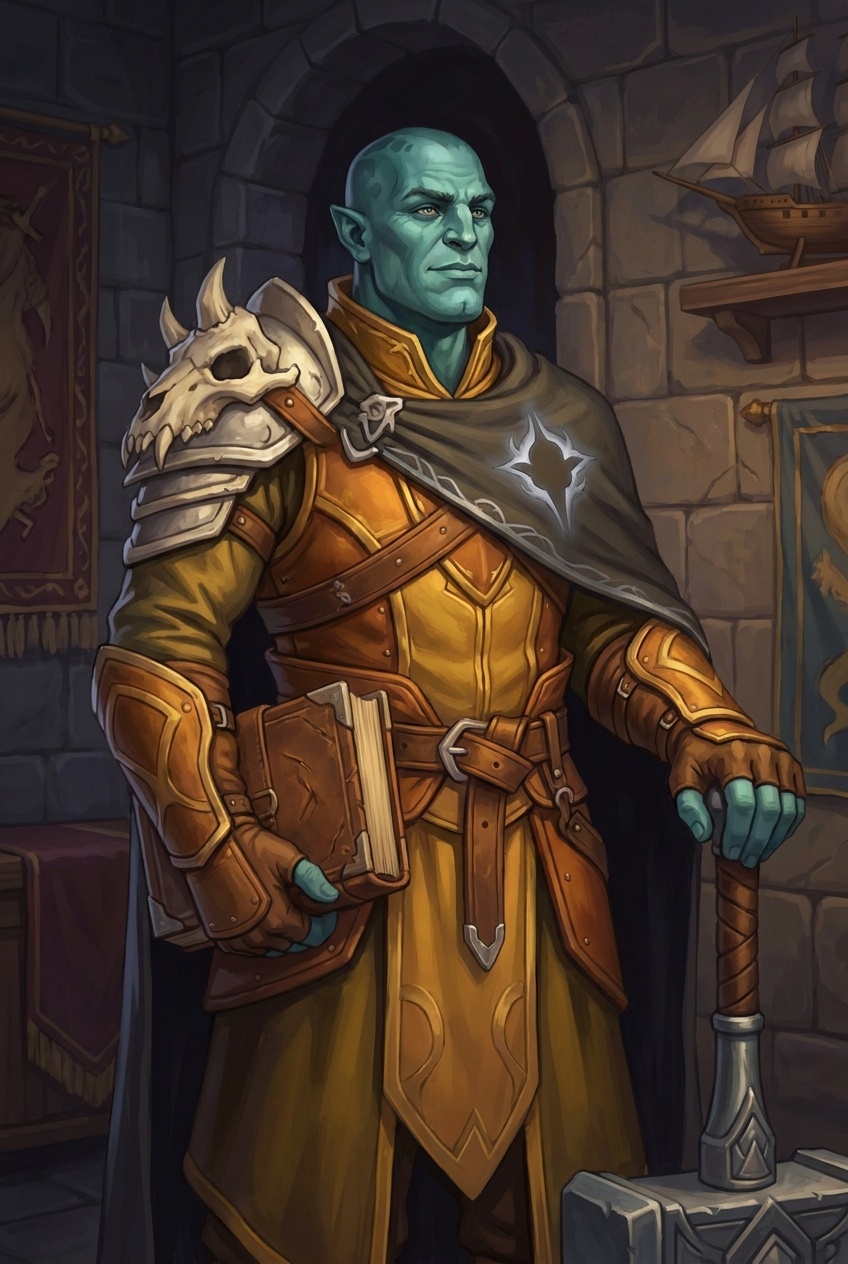
The first read is scale. Seven and a half feet of blue-green muscle and bone, standing in a doorway that was not built for them, looking at you with the patient attention of someone who has learned to wait out anything that does not immediately require a response. The second read is intelligence. They are not what the scale suggests.
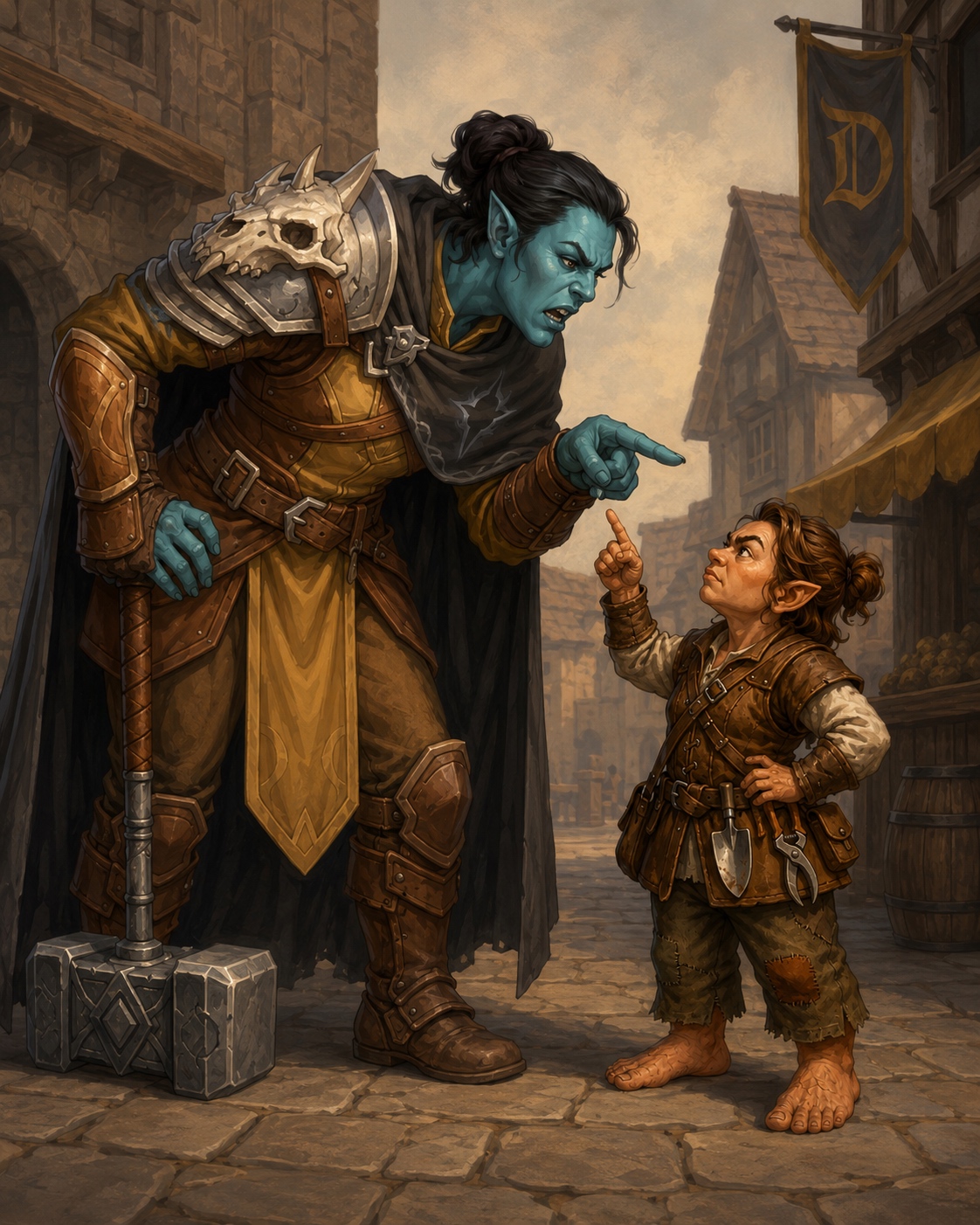
Goliaths live where other peoples cannot. The mountain ranges and high plateaus they call home are places that kill unprepared lowlanders through cold, altitude, and terrain alone, and Goliaths have inhabited them for longer than any adjacent civilization has been recording. Their bodies are adapted to conditions that defeat other beings, and their culture is built on the specific wisdom produced by generations of that adaptation: practical, direct, organized around what actually works, and deeply unimpressed by the forms of status that only make sense in places where the mountains are not trying to kill you.
The deed-name tradition is how their culture stores and transmits everything it has learned. You are your most significant deed, not what you were born, not who your parents were, but what you have actually done under pressure, witnessed and formally recognized by your community. The name changes when you do something greater.
They stand from seven feet four to eight feet six and are as dense as the height implies: altitude-adapted lungs, bone structure built for highland terrain, a natural buoyancy in water that does not exist. Most Goliaths cannot swim casually; the same density that works in highland terrain works against them in water, which they file as a known limitation without embarrassment. The skin runs through a spectrum that stays within the blue-green register: grey-blue, teal, seafoam, deep blue-grey, sage, and forest green, with natural pigmentation markings that are present from birth and unique to the individual (these are not cultural tattoos; they are pigmentation, and the distinction matters to Goliaths). Adult standing by community reckoning arrives around 16 to 18, when the first deed has been witnessed and formally recognized. Most Goliaths live between 90 and 130 years: a shorter span than several of the peoples they move among, which the culture addresses through the deed-name tradition directly. You live on through what you actually did.
Goliath culture does not organize its values around declarations. Deed over declaration, cunning and tactical intelligence over raw force, and oral tradition as the repository of collective knowledge are the operative principles. Material wealth is not a status marker; what you have done is.
Goliath names are deed-forward: a childhood name given short and physical, an adult name earned through witnessed action. The full tradition is in Naming Your Character.
Goliath
- Wound Points: 13 + Might
- Strain Points: 10 + Willpower
- Starting Experience: 70 XP
- Free Skills: Athletics (1 rank)
Mountain-Born: No penalties from altitude, thin air, cold temperatures, or highland environmental hazards. At elevations where non-Goliaths would need Hard or Severe checks just to function, Goliaths operate normally. Snow, ice, rocky highland terrain, and mountain weather do not count as difficult terrain.
Dense Frame: Add +1 to Resistance value. Stacks with worn armor. Upgrade the difficulty of any check made to grapple, push, knock down, or reposition a Goliath once.
Deed-Name Drive: Once per session, when making a check on an action that could plausibly be deed-worthy (a significant combat, dangerous rescue, high-stakes negotiation, or extreme feat of endurance) spend 2 Strain before rolling to treat one net Failure as a Success. The GM must confirm the action qualifies before the Strain is spent.
Tactical Positioning: When the Goliath has not moved this round and has spent at least one round in their current position, add 1 Boon Die to all combat checks from that position. When entering a new location, make a free Perception check (Easy) to identify the tactically superior position within the space; moving to it costs only one Maneuver regardless of distance within Short range.
Large Frame: Doorways, furniture, and spaces built for standard-sized peoples are a constant negotiation. The GM may apply 1 Bane Die to actions in genuinely confined spaces where the Goliath's size is a direct impediment. Goliaths cannot enter structures built to dwarven or gnomish scale without extraordinary difficulty.
Playing a Goliath
- The tactical intelligence is real and operates continuously. In any room, you are reading the space the way you would read terrain; exits, chokepoints, who is the actual threat, what the other people are afraid of. Play this as active assessment, not passive presence.
- The deed-name culture means accomplishment is the currency of identity. Having a deed name you cannot defend is worse than having none.
- You are the largest and most physically imposing person in almost every room. Other people have already decided what that means. Your choices across the session are what makes that decision right or wrong.
- When others meet a Goliath, the scale arrives first: eight feet of blue-green density in a doorway not built for it. What arrives immediately after is the quality of attention. Goliaths entering a space are reading it: exits, sight lines, who carries a weapon, what the room is afraid of. This is not aggression; it is how they move through the world. Most people sense they are being assessed before they understand why. Goliaths with social experience have learned to time this assessment less visibly. Those without have learned to wait out the initial alarm.
- Goliaths tend toward individual assessment over categorical judgment, but some working assumptions persist: lowland peoples have generally not had to solve the problem of being killed by their environment, which produces certain assumptions that highland peoples do not share; physical size is not the same as danger, a distinction Goliaths apply with more precision than most peoples apply to them; and every room is terrain, evaluated accordingly.
Vaelhari
In High Crown they are the most present person in the room; precise, elevated, watching everything with the quality of someone lit from inside by something very far away. You come back three hours later and find them in Low Ember: warmer, faster, filling the room differently, as if more of them has arrived since you left. This is not a mood. It is what they are.
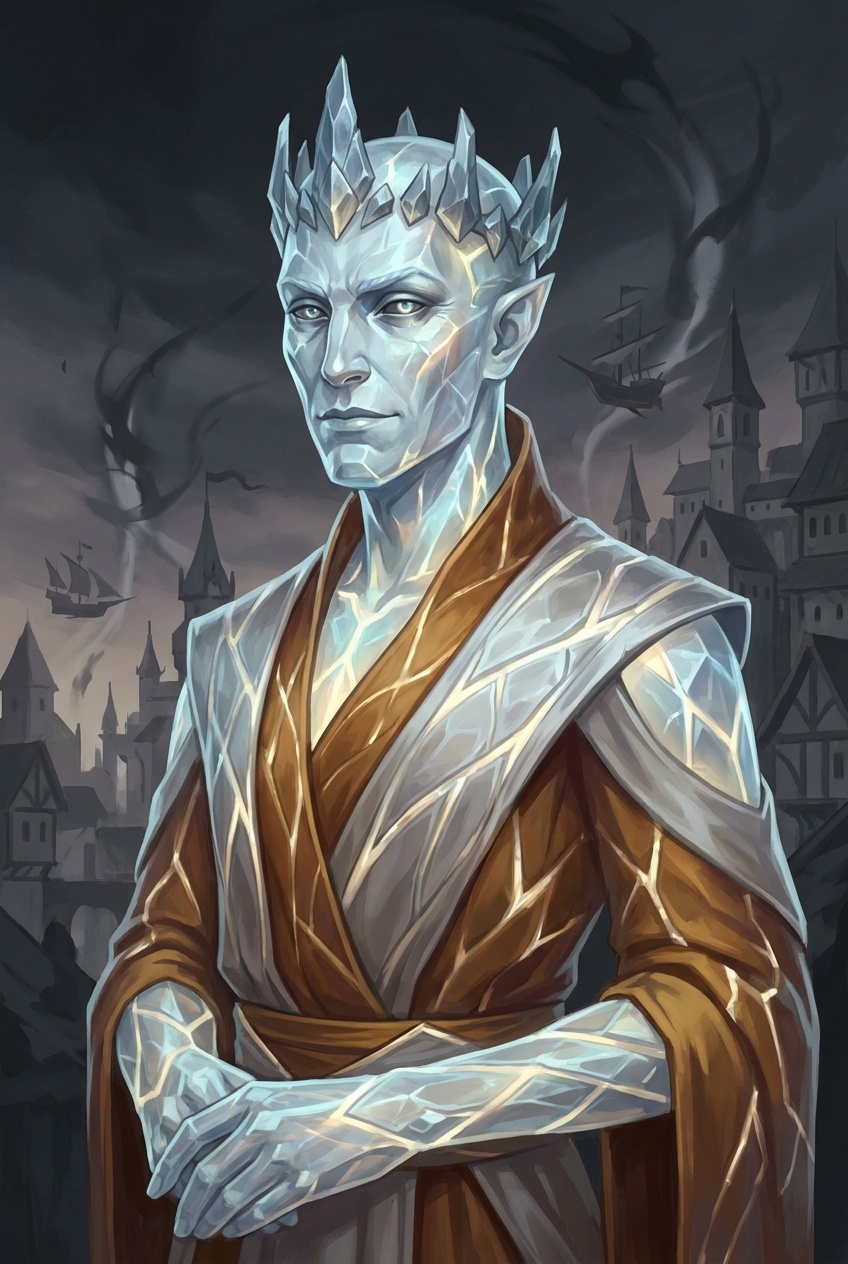
The Vaelhari are not of Dort originally. They came from the Deep Arcana (the inhabited inner regions of the Arcane Plane) and they carry that origin in their blood in ways that are neither metaphorical nor subtle. The phase cycle tied to the wandering planet Vaeltharis is not a magical effect they produce; it is a biological process as ordinary to them as breathing, and as impossible to fully suppress. The Attunement (the core of Vaelhari philosophy) holds that the phases are not problems to be managed but truths to be inhabited.
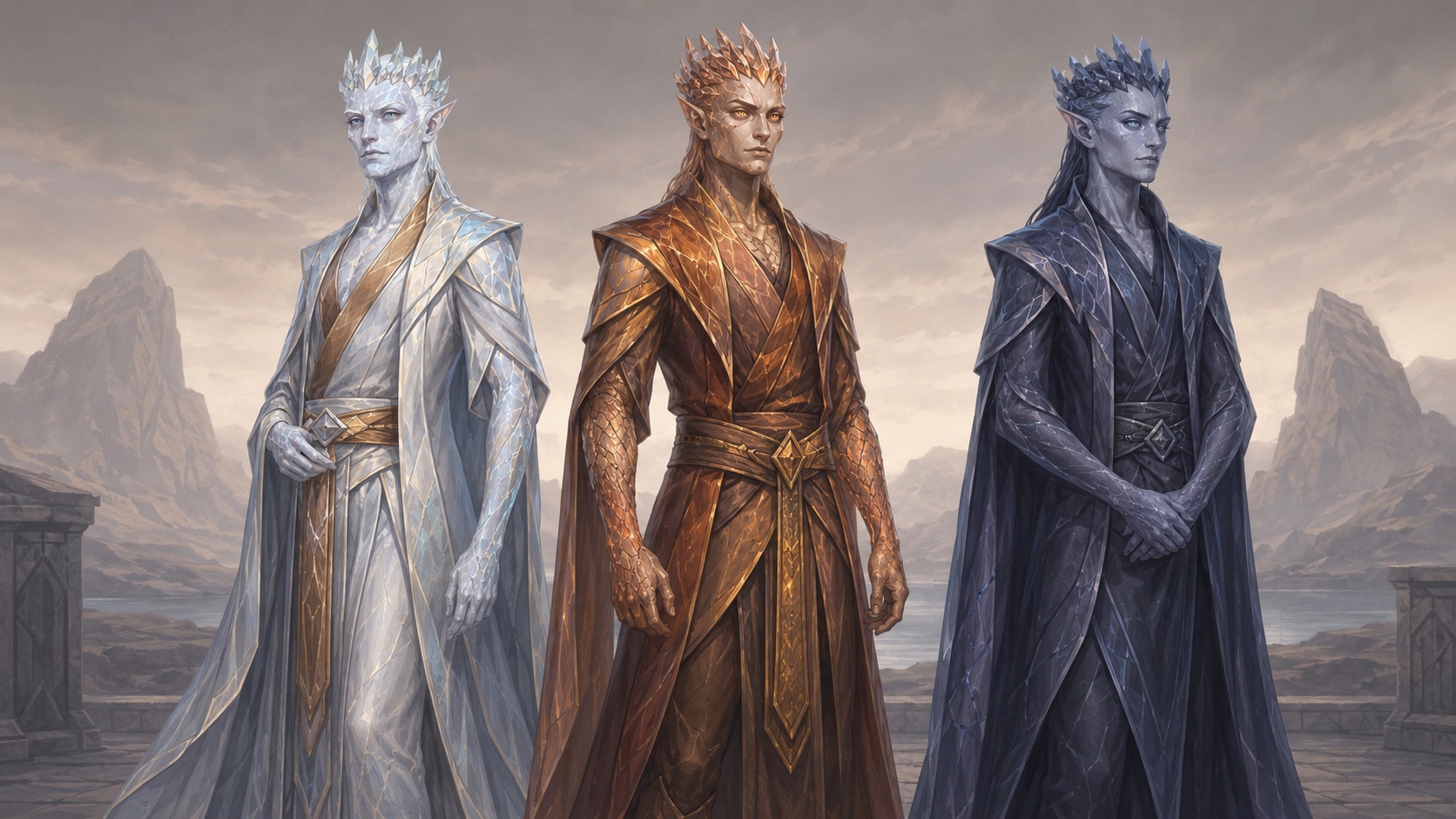
They are among the oldest peoples in Dort, living four to six centuries in the Prime. They stand lean and tall, typically six feet to just over six feet ten, and the apparent height varies slightly by phase: High Crown sharpens the silhouette into something that reads taller; Low Ember fills it in and grounds it. The phase changes are not cosmetic adjustments. In High Crown, the skin carries a crystalline quality and projects something cold and far away from inside. In Low Ember, the skin is physically warmer to the touch and the texture at the forearms and neck becomes rougher and more present. In Veiled Turn, the skin absorbs light rather than reflecting it and the face settles inward into something that takes concentration to read. These are the same person across all three states.
Two taboos structure Vaelhari life more visibly than others: suppressing a phase transition through alchemy or arcane means (viewed as self-erasure, the denial of what one actually is), and speaking another Vaelhari's True Name, the name given at birth and kept private for a lifetime. Most Vaelhari observe silence in the Veiled Turn: not a rule, but the natural expression of a phase that draws inward.
Vaelhari names carry Arcana-plane cadence: luminous, precise, and slightly formal even in intimacy. Some carry a second name tied to phase, place of birth, or philosophical lineage. The full tradition is in Naming Your Character.
Vaelhari
- Wound Points: 10 + Might
- Strain Points: 12 + Willpower
- Starting Experience: 80 XP
- Free Skills: Lore (1 rank)
Phase Shift: The Vaelhari's inner state and outer form track the position of Vaeltharis, a wandering planet cycling three times each year through Dort's sky. The GM establishes the active phase based on the campaign's in-world calendar; phases last weeks and transition gradually over a day. If the campaign does not track exact dates, the GM chooses the starting phase at character creation and changes it only at a major travel, downtime, or season break. The Vaelhari cannot suppress a phase transition without violating core cultural taboo.
- High Crown (Vaeltharis near zenith): Crystalline, cool-toned presence sharpens recall. Remove 1 Bane Die from Lore, Perception, and knowledge checks. In this phase the Vaelhari reads unmistakably as Vaelhari to anyone who knows what to look for.
- Low Ember (Vaeltharis near horizon): Warmed physicality makes them more fully present. Add 1 Boon Die to Athletics, Fortitude, and Intimidation checks. Gain +1 natural Resistance for the duration.
- The Veiled Turn (Vaeltharis absent): Light-absorbing skin and inward focus aid concealment. Remove 1 Bane Die from Stealth and Readiness checks. Others add 1 Bane Die to Perception checks to track or identify the Vaelhari.
Arcane Instinct: Origin in the Deep Arcana makes the relationship to magic ancestral rather than learned. Remove 2 Bane Dice from any check to identify, understand, or respond to magical effects, arcane phenomena, or supernatural presences. Once per session, treat one Lore check involving magical knowledge as an automatic success without rolling.
The Long View: Four to six centuries of lived history produces pattern recognition that shorter lives cannot match. Once per session, when the Vaelhari recognizes a current situation as an instance of something they or their community has encountered before, add 2 Boon Dice and upgrade the check once on any Lore, Readiness, or knowledge check to draw on that pattern recognition.
Playing a Vaelhari
-
The phase cycle is not a problem to be solved. It is what you are. Play the texture difference between phases, not as instability, but as three genuinely different modes of the same person.
-
You have almost certainly seen more than anyone else in the room, and you know it. When you choose to say what you actually know, it lands differently.
-
The shortened lifespan in the Prime (four to six centuries instead of over a thousand) is not something most Vaelhari discuss openly. It sits at the center of how they understand themselves.
-
When others meet a Vaelhari, the phase in effect sets the terms. High Crown is precise and elevated, watching everything from a slight remove; the room knows something is paying full attention. Low Ember is warmer and more present; the engagement is more immediate and the room may not identify what changed. Veiled Turn is the most disorienting for those who don't know what they're seeing: the person is quieter, harder to reach, pulling light toward themselves in a way that is not exactly visible but is felt. Someone who has met a Vaelhari before in a different phase without knowing may not recognize them as the same person.
-
The views Vaelhari hold about other peoples are shaped by watching the long patterns. There is a wariness toward the Aelvar that is historically grounded and sometimes unfair to individuals with no stake in the old grievance, but the history is real. Human institutional memory is consistently underestimated by peoples who don't realize that writing things down produces continuity that outlasts the individual. And coexistence always feels more precarious to a people who have lived long enough to see the arrangement reverse.
Serren
The markings move. Not quickly (you would not notice it if you were not paying attention) but they do not hold still. The eyes cast their own light. In a dark room, you would know exactly where they are.
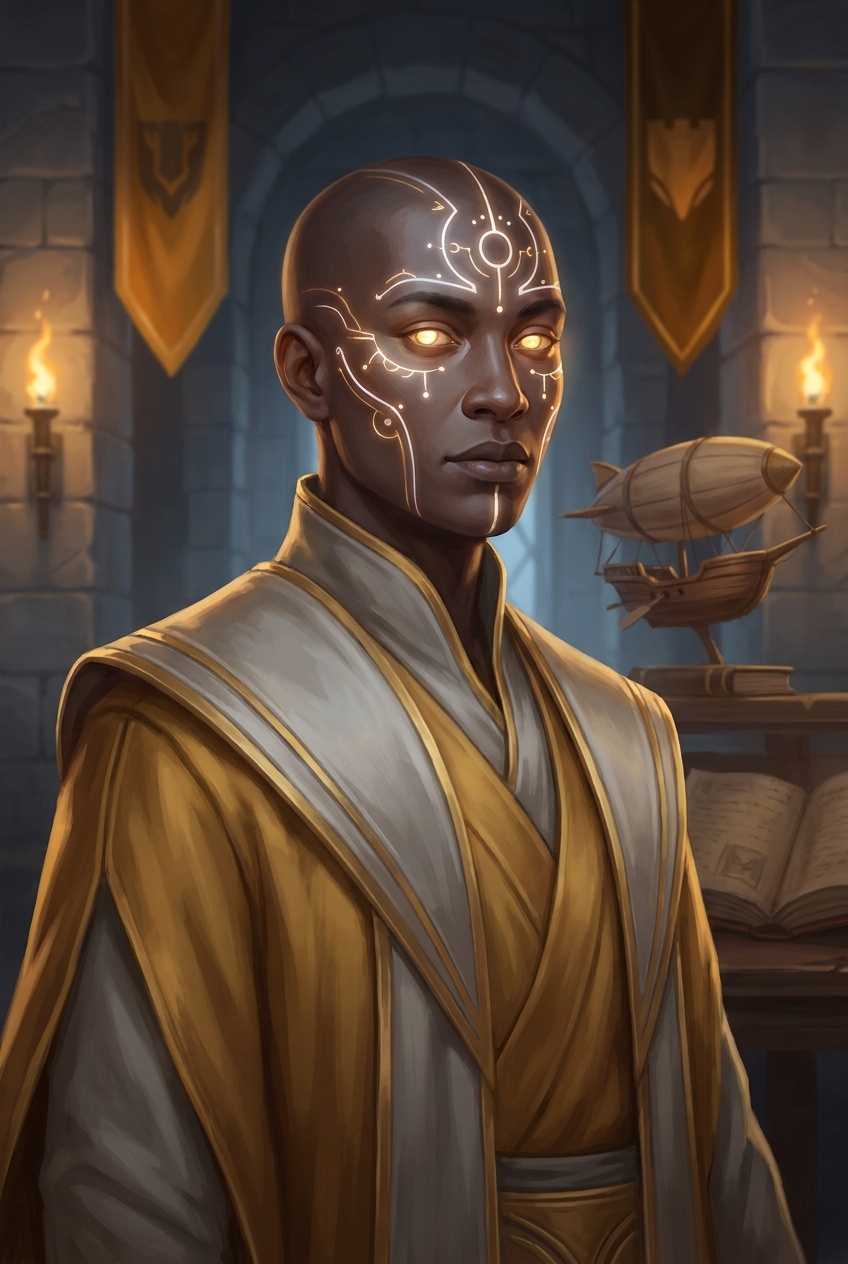 The Serren carry celestial blood; descended from unions between the Aelar of Paradiso and mortal peoples in generations past. The gods eventually forbade this congress, and the Aelar largely honored the prohibition, which is why Serren are fewer and rarer than their infernal-heritage counterparts.
The life of a Serren is partly a negotiation with what they appear to be. Rural communities receive them as sacred figures; which most Serren find somewhere between burdensome and suffocating. Cosmopolitan cities treat them as one unusual people among many. Neither reception is without complication.
Serren are humanoid in proportion and broadly human in height and build: close enough to the mortal baseline to move unnoticed at distance. What identifies them in proximity is fourfold: skin markings that trace patterns suggesting water finding a surface or light diffused through glass, present from birth, brightening rather than darkening with age, unique to each individual; crown structures that grow upward from the skull (symmetrical arches in Radiant lineages, warmer organic curves in Mercy lineages); eyes that project light outward rather than absorbing it, soft and consistent, visible at close range and perceptible in darkness without functioning as usable lamplight; and, in some Serren, wings large enough to be functional, present in some and absent in others with no reliable lineage pattern. They live between 130 and 160 years, reaching adulthood in their early twenties at a pace comparable to the human timeline.
Serren communities have developed specific values around the gap between what they appear to be and what they actually are: honest presence (being genuinely themselves rather than performing virtue or normalcy); care as choice (care given because it matches one's appearance is not the same as care given because it is chosen, a distinction that matters particularly in Mercy lineages); and accurate witness, the Radiant tradition of bearing precise witness to what actually happened rather than what people want to have happened.
The taboos in most Serren communities are equally specific: accepting genuine worship from mortals (allowing people to organize their spiritual lives around you as a Serren specifically is viewed as a corruption of something important) and performing divinity (presenting oneself as having divine authority when you are, in fact, not authorized to speak for Paradiso).
Serren names are usually mortal names shaped by family culture, with a second sacred or descriptive name added as the celestial mark becomes socially legible. The full tradition is in Naming Your Character.
Two lineages exist: Radiant Serren and Mercy Serren. Both share two foundational traits.
Celestial Mark: The Serren's celestial heritage is permanently visible. Eyes project soft outward light; in complete darkness, this illuminates a small area around the face and cannot be suppressed. In lit conditions the glow is detectable at close range. Skin markings are invariant through life. This trait has no mechanical benefit, but its narrative implications are pervasive: in any environment where the Serren's appearance is legible, it generates a response.
Celestial Resilience: Latent Paradiso heritage provides resistance to spiritual and magical harm. Reduce Strain suffered from magical sources, Intimidation checks, Fear effects, or infernal powers by 2 (minimum 0). Once per session, spend 1 Fortune Point to shrug off a Fear or Intimidation effect entirely, including the Frightened condition it would inflict, representing the steadying quality of celestial inheritance under direct spiritual pressure.
Radiant Serren
Precision lineage: structured, ordered, symmetrical crown structures, markings that converge rather than spread. Their celestial connection trends toward truth-finding and witness.
- Wound Points: 10 + Might | Strain Points: 11 + Willpower
- Starting Experience: 85 XP | Free Skills: Discipline (1 rank)
- Special Abilities: Celestial Mark; Celestial Resilience
Precise Witness: Once per encounter, when directly observing a statement or scene, make a free Perception check (Average) to determine whether what is being presented is accurate or concealed, not the truth itself, but whether truth or deception is operating. This is sensitivity to discrepancy, not magical truth-detection.
Structured Light: Once per encounter as a Maneuver, direct the eye glow at one target within Short range. The target must succeed on a Fortitude check (Average) or add 1 Bane Die to their next check from the disorienting flash of directed light. Does not function in bright full daylight.
Mercy Serren
Warmth lineage: organic, branching crown structures, markings that spread and reach outward. Their celestial connection trends toward care and comfort.
- Wound Points: 10 + Might | Strain Points: 12 + Willpower
- Starting Experience: 85 XP | Free Skills: Medicine (1 rank)
- Special Abilities: Celestial Mark; Celestial Resilience
Tending Charisma: When making a Medicine check to heal an ally, heal 1 additional Wound on a success beyond what the result would normally provide. When an ally within Short range recovers Strain through any means, they recover 1 additional Strain from proximity to the Mercy Serren's ambient warmth.
Ambient Light: The Mercy Serren's encompassing glow has a calming physiological effect. All non-hostile characters within Short range may remove 1 Bane Die from their next social check. This is passive and cannot be suppressed while the Serren's light is present.
Playing a Serren
- The reverence is unwelcome in the specific way that having someone decide what you are before you speak is always unwelcome. How much space you allow others' projections to occupy is a defining choice.
- Your celestial heritage does not come with a virtue requirement. You can be selfish, dishonest, or simply ordinary about it. What you cannot do is be invisible.
- Some Serren bloodlines bear visible wings, and those Serren experience this most openly. Most have developed the widest range of strategies for managing the dynamic.
- When others meet a Serren, the markings and the light arrive before the personality does. The response in most communities is already established before the Serren speaks: reverence in rural areas, over-politeness in cosmopolitan ones, the studied neutrality of people trying not to stare. What the initial response does not often include is genuine curiosity about the person rather than the heritage. Serren who have navigated this their whole lives have usually developed a clear sense of which version of the reception they are getting and how long it takes to move from it to something more ordinary.
- The views Serren hold about other peoples are shaped by the experience of being treated as a category rather than a person. The ones that recur: being believed to be perfect is one of the lonelier experiences available; most people would rather have a symbol than a person; Zerren probably understand some version of this from the other direction, which generates a specific sympathy that does not always translate into easy relationship.
Zerren
The markings are the first thing you notice. Not scars; they do not look like damage, though damage is what they most resemble. Fracture lines, fault lines, the geometry of something that was whole and then was not. Present from birth. Deepening with age. The horns angle downward. The eyes glow from within. You know what you are looking at before you have a name for it.
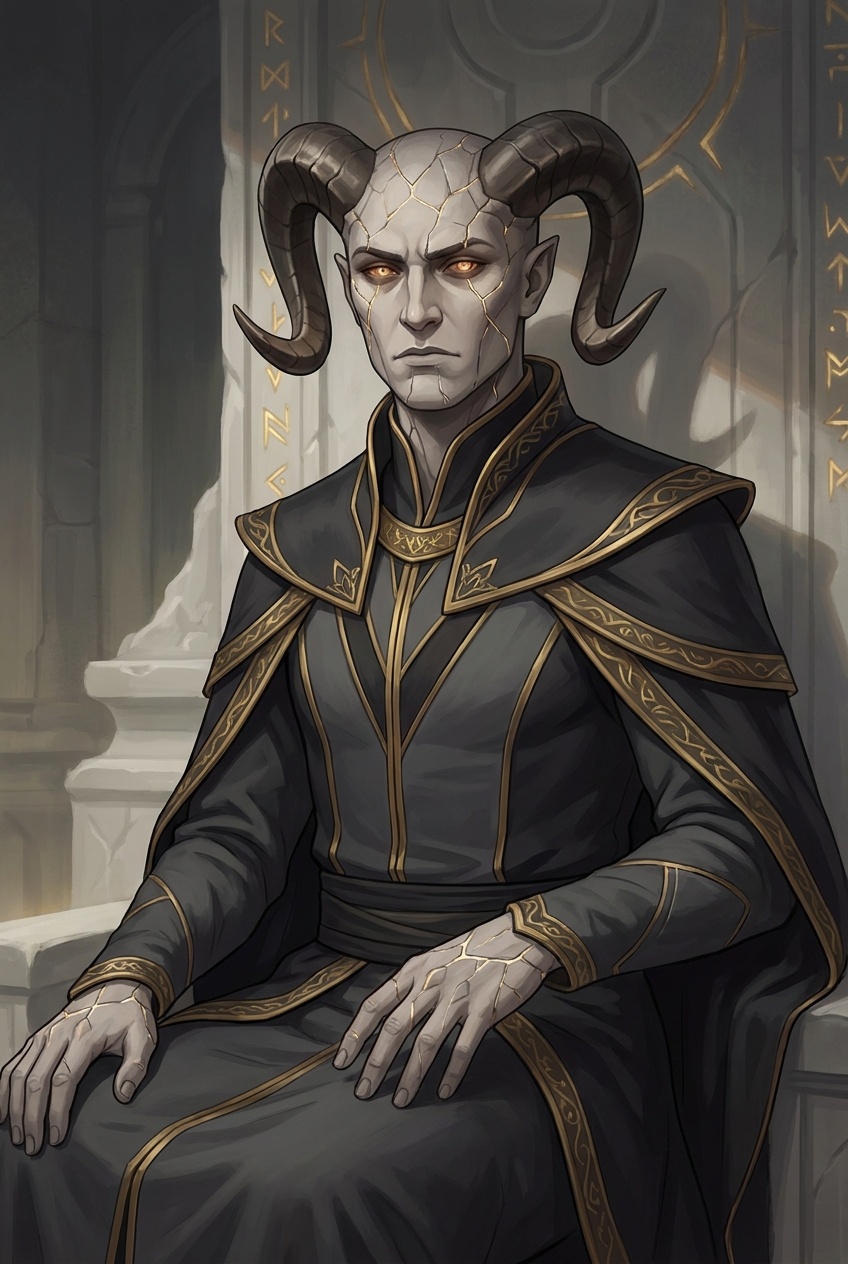 The Zerren carry infernal blood; descended from unions between devil-kind and demon-kind of the Hells and mortal peoples. The gods forbade this congress; the Hells largely ignored the prohibition and continue to do so. Zerren are born into every generation. They carry the Hells in their blood as a tendency, not a sentence: the pull toward control or appetite is present, but what they do with that pull is their own choice. The question of that choice is the central one of Zerren life.
Zerren are humanoid in proportion and comparable to humans in height, with build that varies by lineage: Dominion Zerren tend lean and controlled; Ravage Zerren more often present stocky or irregularly powerful. The fracture markings run across the body in patterns that recall cracked earth or fault lines in stone, present from birth, deepening in color with age, invariant in structure through life. In Dominion Zerren, the markings have structural coherence: radiating from consistent origin points, cleanly edged, organized. In Ravage Zerren, the markings are genuinely asymmetric and irregular, with no organizing principle visible even in retrospect. The horns angle downward in both lineages (Dominion: symmetrical matched pairs, smoothly curved; Ravage: commonly mismatched, different angles, some appearing to have fractured mid-growth and continued). The eyes glow from within, a contained ember behind glass rather than a projected light, most visible in darkness and perceptible on close inspection in a lit room. They live between 130 and 160 years, reaching adulthood in their early twenties.
Zerren culture has developed around three persistent values: intentionality (acting from deliberate choice rather than the infernal pull, which is the central work of a Zerren life); earned trust (demonstrated reliability over time counts for more than stated character, because trust has not historically been extended freely, and most Zerren know it); and acknowledged heritage (the distinction between pretending not to be what you are and choosing how to be what you are is one most Zerren communities have made explicit and defend).
The taboos held within Zerren communities are two in particular: a Zerren who hides from their own children what they are has abandoned those children, left them unprepared for what they will face; and a Zerren who gives themselves entirely to the infernal pull without effort is viewed not with admiration but with something closer to grief. The pull is not shameful. Surrendering to it without resistance is.
Zerren names often carry deliberate restraint: controlled, grounded, recognizably mortal, as an answer to infernal assumptions. Dominion names tend toward symmetry and paired sounds; Ravage names toward shorter and more forceful forms. The full tradition is in Naming Your Character.
Two lineages exist: Dominion Zerren and Ravage Zerren. Both share two foundational traits.
Heat Tolerance: Zerren show a modest echo of their infernal origin. No impairment in hot, arid, or extreme heat conditions; immune to environmental heat damage. Reduce all fire damage taken by 1 (minimum 0).
The Pull: Each Zerren has an innate infernal tendency defining their lineage: Dominion toward control, structure, and the management of outcomes; Ravage toward appetite, direct action, and the refusal of indirection. Once per session, when a Zerren deliberately acts in full accordance with their lineage's pull, add 2 Boon Dice to the relevant check. This bonus applies only to deliberate, declared choice, not reactive or unconscious behavior. The player must declare the use before rolling.
Dominion Zerren
Symmetrical fracture markings, matched horn pairs, organized damage. Their cultural emphasis runs toward intentionality and the deliberate navigation of the infernal inheritance.
- Wound Points: 10 + Might | Strain Points: 10 + Willpower
- Starting Experience: 80 XP | Free Skills: Discipline (1 rank)
- Special Abilities: Heat Tolerance; The Pull (Dominion)
Fracture Map: When entering a new social situation, negotiation, or structured interaction, make a Savvy check (Easy) as a free action to identify the key leverage points, hidden interests, and pressure points in the situation. On success, remove 2 Bane Dice from all social checks made in that specific encounter. This is pattern-reading, not magic.
Composed Under Gaze: Immune to Bane Dice from being observed, scrutinized, monitored, or from being the focus of attention in social contexts. Add 1 Boon Die to Readiness and social checks when acting under any form of scrutiny: public observation, intense interrogation, high-stakes performance.
Ravage Zerren
Asymmetrical fracture markings, mismatched horn pairs, irregular powerful build. Their lineage pull runs toward direct engagement and the refusal of indirection.
- Wound Points: 12 + Might | Strain Points: 10 + Willpower
- Starting Experience: 80 XP | Free Skills: Intimidation (1 rank)
- Special Abilities: Heat Tolerance; The Pull (Ravage)
Fractured Aspect: Add 1 Boon Die to all Intimidation checks. Opponents who have not previously encountered a Ravage Zerren (GM's discretion) add 1 Bane Die to Readiness checks when first subjected to the Ravage Zerren's Intimidation in an encounter.
Infernal Endurance: Reduce all Critical Injury results by 10 (minimum 1). Once per session, when the Zerren would be Incapacitated, spend 1 Fortune Point to immediately recover 3 Strain and take one additional action before the Incapacitated status applies, not preventing the status, but deferring its full effect by one beat.
Playing a Zerren
- The fear most Zerren live with is becoming what others assume they are. The cultural emphasis on intentionality (acting from deliberate choice rather than impulse) is a direct response to that fear.
- The Pull is available once per session as a mechanical reward for leaning into your lineage's tendency. The player decides when to use it, not the GM.
- The Marked Existence of being visually identifiable as infernal-descent follows you into every new space. Some Zerren resent it. Some use it. Few are indifferent.
- When others meet a Zerren, they are aware of being assessed before any social content is exchanged. The fracture markings, the downward horns, the glow in the eyes: in most communities, this is legible as something before it is legible as someone, and most Zerren have lived with that sequence their whole lives. Dominion Zerren tend to walk into this with the composed presentation their lineage's cultural emphasis produces. Ravage Zerren are more direct about the discomfort, and occasionally more deliberate about using it. What neither does is perform harmlessness. That is the one performance most Zerren communities decide is not worth maintaining.
- The views Zerren hold about other peoples are filtered through the experience of being watched. The persistent ones: outsiders will eventually find a reason for suspicion regardless of behavior, which is a prediction accurate often enough to have become a working assumption; Dominion-heritage Zerren are more trustworthy than Ravage-heritage ones, a stereotype Zerren hold about each other that Ravage individuals push back against with considerable force within Zerren communities; and the Aelar of Paradiso have made their position on Zerren clear and do not require deference.
Gnome
The first read on a gnome is compact energy. Three and a half to four feet tall, proportionally small rather than stocky or reedy, with faces that convey more information per second than most peoples' expressions. Hands small, precise, famous for what they can feel through touch that larger fingers miss entirely. Even at rest they carry the quality of a spring wound but not released.
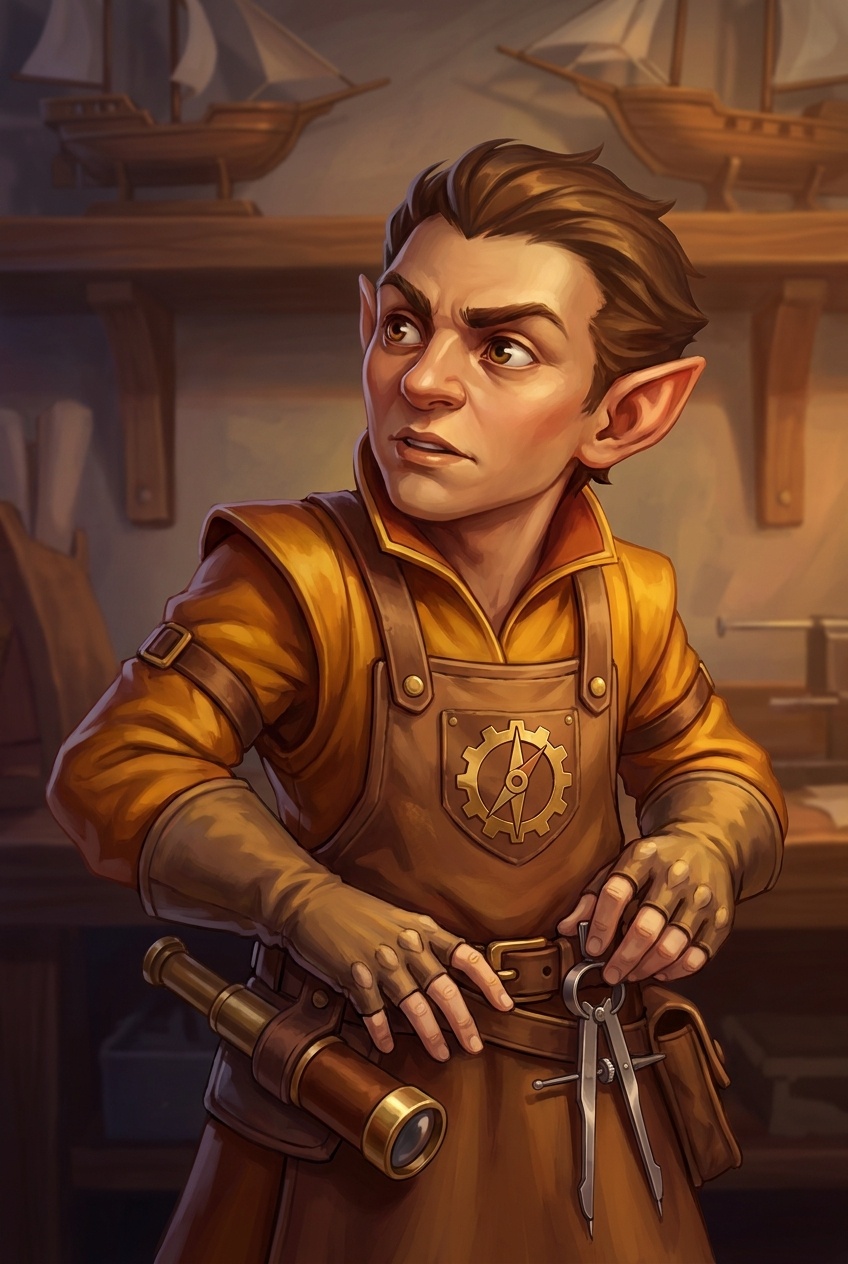 The civilization the Zannori have built is organized around two great obsessions: the mechanical and the culinary. To other peoples these seem like separate concerns. To gnomes they are expressions of the same underlying drive: understanding how things work, improving on what exists, and keeping the best of what you discover absolutely secret. Gnomish guild structure is the architecture through which this philosophy operates: the Tinkerer Guilds govern mechanical arts and engineering; the Cook Guilds govern culinary tradition and ingredient sourcing. Both function simultaneously as professional orders, social families, and secret-keeping fraternities of extraordinary intensity. A guild secret is sacred property; sharing your guild's core techniques with outsiders is the deepest betrayal a gnome can commit.
What lies beneath both guilds is a shared philosophical principle that gnomes will not always articulate but that structures everything they do: the work perfected is the point. Good enough is not good enough. A Cook Guild Grand Master who stops refining their foundational recipe is considered by their peers to have given up on something essential. A Tinkerer who accepts a mechanism that works without asking whether it works elegantly has failed at the most interesting part. This is why gnomish communities are simultaneously the most secretive and the most information-hungry peoples in Dort: the curiosity is required by the work, and the secrecy protects the results.
Gnomes live three to four centuries. A gnome past two hundred carries the particular authority of someone who has had a very long time to perfect what they know, and they are rarely subtle about it. They stand between three feet four and three feet ten and weigh between 50 and 80 pounds, lighter than the compact energy suggests. The hair is the cultural touchstone: famously unruly and resistant to discipline, which most gnomes treat as confirmation that some things simply will not be reduced to something lesser. The eyes are large for the face, and the quality of focus they carry when a gnome has found something interesting is specific enough that most people who have spent time around gnomes can identify it.
The taboos within gnomish guild culture are held as seriously as the values: sharing guild secrets with outsiders, deliberate sabotage of another gnome's work, claiming another gnome's invention or recipe as your own, and wasting quality materials on careless work. These are not abstract ethical positions; they are the rules that make the guild system function, and violating them is taken personally by everyone who spent decades mastering the same tradition.
Gnome names draw from Northern Italian and Dutch/Flemish phonological traditions: musical, warm, vowel-final, with a bouncy rhythm. No English compound words. Details are in Naming Your Character.
Gnome
Gnomish society has no biological subspecies: Tinkerer Guild, Cook Guild, and Unaffiliated are professional and social distinctions, not physical ones. Guild affiliation shapes the free skill choice and the flavor of Guild Expertise, but the stat block is the same for all gnomes.
- Wound Points: 8 + Might
- Strain Points: 10 + Willpower
- Starting Experience: 85 XP
- Free Skills: Craft (1 rank) if Tinkerer Guild; Medicine (1 rank) if Cook Guild; Streetwise (1 rank) if Unaffiliated
Fine Motor Mastery: Gnomish fine-motor precision and sensory acuity in touch translate directly into results. Add to all checks involving delicate manipulation, instrument use, lockwork, mechanism repair, food preparation, surgical tasks, or any action where the quality of touch matters more than force. This applies to Craft and Medicine checks by default, and extends to any other skill where the GM determines precision is the defining factor.
Guild Expertise: A gnome's guild represents decades of specialized knowledge passed through master-to-apprentice lineage. Once per session, call upon this deep knowledge to make a free Lore or Craft/Medicine check (Average ) on a topic within their guild's domain. On success, the result exceeds what available records contain; the gnome produces a detail, technique, or insight that comes from transmitted mastery rather than publicly accessible information. Additional uses within the same session cost 2 Strain each.
Insatiable Curiosity: Once per scene, spend a Quick Action to observe a mechanism, creature, or situation for one round and ask the GM one specific question about how it functions, how it was made, or what its weakness is. The GM answers truthfully within what the gnome's relevant skills would plausibly reveal. This is not magic or supernatural perception; it is the result of a mind trained from age eight to find the function behind the form.
Playing a Gnome
- You are the most reliable knowledge-gathering and pattern-recognition character in most parties. The combination of Intellect 3 and Savvy 3 makes you hard to deceive and slow to miss things. Fine Motor Mastery compounds across a session in ways that are not flashy and that solve real problems.
- The guild politics are character material, not flavor text. Which guild do you belong to? What secrets do you carry? What do you desperately want to know? What are you willing to do to find out? These questions are not background detail; they are the engine of a gnome character.
- The unaffiliated gnome (someone who left or was expelled) has already made a defining choice. Every gnome they meet will want to know why. Have an answer.
- When others meet a gnome, the first reading is compact and precise and slightly overwhelming in the information being generated per second. The face conveys more per expression than most peoples use for theater. The attention, when it is on something the gnome finds interesting, is total: focused, noting everything, asking questions more specific than most people are prepared for. What others frequently underestimate is the patience. A gnome who has spent forty years perfecting a recipe is familiar with the concept of taking as long as the work requires.
- The views gnomes hold about other peoples run through the lens of craft and cuisine. Non-gnomish cooking is sincere but underinformed: a consistent position held without hostility. Dwarves are too in love with permanence to appreciate the value of improvement, which is the gnomish way of saying dwarven craft is very good and also very finished, and finishing is not a virtue. Humans will buy anything with an impressive demonstration, which is accurate. Elves care considerably less about how long something lasts and considerably more about how good it is right now, which gnomes find unexpectedly respectable.
How Dort Reads You
Your species is the first thing most people in Dort notice about you. Before you speak, before anyone knows your name or your career, the room has already made a calculation. Understanding that calculation is part of playing your character honestly.
The general principle across most of Dort: culture and familiarity matter more than species. In any major trade city (Frosthaven, Gwajin, The Crown, Passhall, the Heavens) every species passes through regularly. Nobody stops to stare at a Drakin on the docks of Frosthaven. A Zerren in the Accord's contract clinic in a major city is unusual in background, not in presence. The world is large and most people who move through it have seen most things.
What changes is where you are and who's watching. Rural communities, isolated villages, and places where only one or two species are common will react to anything unfamiliar. The reaction is not always hostile (sometimes it is awe, sometimes excessive hospitality, sometimes the specific wariness of people who don't know what to make of something) but it is always present.
The Species Most People Have Opinions About
Humans are everywhere. They are the unremarkable baseline against which everything else is measured. A human walking into a room generates no reaction based on species. Regional culture generates plenty of reaction (a Jazirah human and an Irnan human read as different peoples) but the human species itself is background noise. This is both an advantage (invisible) and occasionally a disadvantage (nobody assumes you are interesting or special on arrival).
Smalings are almost universally well-received. They carry the accumulated goodwill of a people who have been trading partners, agricultural specialists, and reliable community members across every region for centuries. Even in places with strong species tensions, Smalings tend to be exempt. The usual reaction is warmth, sometimes condescension, occasionally protective instinct. Almost no one is hostile to a Smaling on sight.
Orcs carry complicated standing. The existence of monstrous orcish warbands, raiders, and the broader category of "orc-adjacent monster" in the wilderness means that a traveling orc without clear affiliation triggers a defensive calculation in many communities. This is not universal (cities with significant Greyfang presence have learned to distinguish professional soldier from raider) but in a farming village that has lost livestock to orc raids, the calculation happens before you finish saying hello. Playing this honestly means sometimes having to prove yourself, and sometimes not being given the chance.
Drakin generate visible reactions almost everywhere. In major cities, awe; in rural areas, fear and awe in equal measure; in places without prior contact, something close to panic. The wingspan, the scales, the internal luminescence: nothing about a Drakin says "ordinary traveler." This cuts both ways. You walk into a negotiation with attention already secured. You also walk into every tavern with every eye on you before you've ordered. The internal glow at close range and the temperature differential make casual concealment difficult. Most Drakin have developed a broad tolerance for being the most noticed person in any room. What that tolerance looks like in practice is your characterization work.
Serren are read as sacred figures by communities unfamiliar with them, and as an unusual but not remarkable people by cities that have seen them before. The glowing eyes and shifting markings are visible at close range and cannot be suppressed. In rural or religiously traditional communities, this often generates reverence, which is burdensome in its own way. The reaction is almost never hostile; it ranges from worship to unease to the careful over-politeness of people trying not to stare.
Zerren generate visible discomfort in communities where infernal heritage is culturally fraught, which is most communities, given the Hells' visibility and the infernal cult presence across Dort. Unfamiliar rural populations see the horns, the fracture markings, the internal glow, and make a calculation about what kind of entity is standing in their threshold. Cities are more experienced; an Oshalan-dominated city will assess your registry status before your species; a Accord-influenced city will treat you with professional caution rather than hostility. Most Zerren who travel learn to arrive with clear context: who they work for, why they're here, what they want. Ambiguity costs.
Gnomes are unusual sights outside of cities with academic or engineering institutions. They generate curiosity before anything else: an intense, focused interest in what you're carrying, what you know, what guild you belong to. Communities that have dealt with gnome traders and artificers before are genuinely pleased to see them. Communities that haven't don't know quite what to make of the compact, precise, extremely attentive person who just walked in and started asking questions about the structural integrity of their mill.
The Exceptions
Carna (and House Carna's sphere of influence in eastern Irna) treats non-humans as structurally marginal. Not always hostile (the ideology expresses itself through paperwork and legal inconvenience rather than open aggression) but non-human characters will face checkpoint scrutiny, elevated guild licensing requirements, and the institutional assumption that they belong in peripheral positions. Human characters in Carna territory may be approached as natural allies. This is a situation to navigate, not necessarily to fight.
Oshalan-administered territories (particularly Iskash and other fully Ordered cities in Jazirah) generate reactions based primarily on registry status and devotional standing, not species. A registered, Oshala-observant non-human is in better standing than an unregistered human. The hierarchy is ideological and administrative rather than species-based, which makes it no less constrictive, but differently so.
Naming Your Character
Your character's name is the first thing another person in Dort learns about them. In a world where the Accord archives everything and Oshala's registries record every household, names carry institutional weight as well as personal identity. Each species has its own naming tradition, built from centuries of cultural logic. A name that sounds wrong for its species is a flag: an elf with an Irnan human name is either from a very unusual background or has not thought carefully about how they want to be read.
Human Names
Humans have no single naming tradition; they take from the culture of their home region.
Irna draws from English and Northern European cadences, strong consonants, familiar sounds, surnames that are occupational, geographic, or clan-based: Thane, Kavan, Frost, Harrington, Voss.
Jazirah uses Arabic-influenced names with emphatic consonants and flowing vowels. Patronymic constructions (ibn, bint, al-) are common: al-Uzam, ibn Rashad, Kavan al-Dalah.
Shoing, Eastern Shoing draws from Japanese naming tradition; Southern Shoing draws from South and Southeast Asian traditions. The honor culture means full names are used formally; shortened or familiar names signal social proximity.
Funta names come from African and indigenous traditions that vary by tribe. Names are often earned through deeds as much as assigned at birth.
Antaea uses broadly Mediterranean and Latin-influenced naming in cities; highly regional in the interior.
When building an Irna-default campaign, English/Northern European naming conventions cover most Human characters naturally.
Elf / Aelvar Names
Elven names are discovered rather than invented, Welsh and Finnish phonological traditions give them a soft, flowing, musical quality.
Sound profile: Open vowels, diphthongs (ae, ai, ia, iel), soft consonants (l, r, n, th, s). No hard K sounds, no guttural stops.
First names: Built from meaningful roots and endings. Roots: Gal- (radiance), Gil- (star), Nael- (moonlit), Vael- (shadow/dusk), Mel- (beloved), Thal- (stalwart). Endings: -iel, -eth, -ion, -wen, -aelin, -ithil.
Examples: Galadwen, Naelis, Silmireth, Caelion, Vaelith, Mirethon, Thalion.
Surnames: Must follow the same phonemic rules. Never English compounds. An elven surname sounds elvish. Examples: Caelindra, Solvaelin, Thalithorn, Mirsoleth.
Lineage notes: Aelvar-Dunar (Sand Elves) tend toward sparser names within the same tradition, fewer diphthongs, slightly more consonant-final, reflecting the desert's economy.
Dwarf / Khazarum Names
Dwarven names are forged, Old Norse and Proto-Germanic traditions, hard stops, closed syllables, punchy.
Sound profile: Hard K (always K, never soft C), hard G, rolled R, Z, V. Short vowels: A, O, U dominate. Names end on hard consonants.
First names: 1–2 syllables for most; 3 syllables marks an elder or lord. Examples: Kurdak, Vorkal, Grimnok, Brondur, Thagrin, Brekund, Nardim.
Clan names (surnames): Two dwarven roots joined in dwarven phonology. Never English compound surnames. Nar+dim = Nardim (forge-deep). Vor+dal = Vordal (stone-hall). Brak+ond = Brakond (battle-enduring). Kur+bor = Kurbor (mountain-bearing). Gor+dim = Gordim (iron-deep).
A note on the rule: "Stonehammer" is a Human word describing a dwarf. Dwarves do not name themselves in other species' languages. Build surnames from dwarven roots.
Smaling Names
Smalings are the one species whose surnames are genuine English compound words, earthy, warm, and immediately readable.
First names: Short, antique-English feel, often nickname-like: Barlo, Rosco, Tobbin, Ferdo, Willo, Perrin, Daisy, Myrtie.
Surnames: Natural-world + geographic: Meadowbrook, Underhill, Briarfoot, Thornburrow, Elderbank, Cotterfield, Ryelholm. If the surname sounds heroic or adventurous, it is wrong. If it could appear on a 19th-century English village sign, it is probably right.
Orc Names
Orc names are declarations. Guttural, short, unmistakable.
Sound profile: Hard G, K, Z, rolled R, GH, KH, D, B. Minimal vowels, A, O, U only, short and hard. Names end in hard stops: -k, -g, -z, -r, -n.
First name examples: Grakh, Zorn, Durnak, Bograk, Korgaz, Khravun, Zargon.
Clan names: Hard compound roots in orcish phonology. Grak+dur = Grakdur. Bok+zarn = Bokzarn. No soft or elvish sounds anywhere.
Drakin Names
Drakin carry Draconic naming tradition, names that recognize a nature rather than label it at birth. Sanskrit-influenced and open-voweled.
Sound profile: Long open vowels, soft clusters (-vr-, -nd-, -lm-, -sh-). 3–4 syllables for a full name; many Drakin use a 2-syllable short form day-to-day.
First name examples (full): Varathan, Ashviru, Surathiel, Navethira, Dhruvan. Short forms: Vara, Ashvi, Sura, Nave.
Elemental lineage notes: Fire-aligned Drakin tend toward Nar- root sounds; stone-aligned toward Vrak-; void-adjacent toward harder consonants. These are tendencies, not rules.
Clan names: Draconic phonology, describing the ancestral dragon territory or the nature of the lineage's first recognized ancestor.
Goliath Names
Goliath names are deed-forward. A childhood name is short and physical; an adult name often changes after a public accomplishment.
Sound profile: Broad vowels, hard consonants, strong endings: -ar, -ok, -un, -ath, -or. Names should sound like they can be shouted across stone and weather.
First name examples: Korath, Borrun, Thava, Rokhan, Merok, Vashara.
Deed names: Earned through witnessed action. They are translated freely in common speech: Gateholder, Storm-Back, Emberhand, Bridge-Taker, Last-to-Fall. A Goliath with a deed name is expected to be able to defend it.
Vaelhari Names
Vaelhari names carry Arcana-plane cadence: luminous, precise, and slightly formal even in intimacy.
Sound profile: V, L, R, TH, S, soft K; long vowels and three-syllable forms are common. Names often feel balanced around a central sound.
First name examples: Vaelira, Solathen, Merithal, Kalyth, Oravael, Thesira.
House or phase names: Some Vaelhari use a second name tied to phase, place of birth, or philosophical lineage: High Crown names are cooler and sharper; Low Ember names warmer and more open; Veiled Turn names shorter and quieter.
Serren Names
Serren names are usually mortal names shaped by family culture, with a second sacred or descriptive name added when the celestial mark becomes socially legible.
Sound profile: Clear vowels, gentle consonants, names that can sound like blessings without becoming titles.
First name examples: Elian, Marisel, Veyra, Joseth, Halina, Serathel.
Marked names: Radiant lines favor names associated with witness, light, and precision. Mercy lines favor names associated with warmth, care, and shelter. Some Serren reject sacred naming entirely and use ordinary regional names as an assertion of personhood.
Zerren Names
Zerren names often carry deliberate restraint. Many families choose names that sound controlled, grounded, and recognizably mortal as an answer to infernal assumptions.
Sound profile: Z, V, R, K, TH, and hard final consonants; fracture without chaos. Dominion names tend toward symmetry and paired sounds. Ravage names tend toward shorter, forceful forms.
First name examples: Zareth, Varkel, Ruzhan, Kethra, Drazik, Thavren.
Family names: Some Zerren use regional mortal surnames. Others use chosen names that mark intention rather than blood: Vowheld, Ashbound, Redline, Graven, Cinderwake. A Zerren surname is often a statement about what the family refuses to become.
Gnome Names
Gnomish names draw from Northern Italian and Dutch/Flemish phonological traditions: musical and warm, with a bouncy quality that comes from the Zannori language's rhythm. Given names are typically vowel-final in the Italian tradition: -ino, -etta, -ozzo, -a, -o are characteristic endings; double consonants (-zz-, -nn-, -tt-) appear as a flavor element throughout. Family names follow the same logic: compound Zannori morphemes, or Dutch-style constructions with Van- or De- prefixes for older coastal trading families.
Sound profile: Italian-style forms are more common inland; Dutch-style constructions more common among established port-trade families. English compound words like "Cogsworth" or "Sprocketwheel" are not gnomish names and should not be used. A gnome is not a clockwork punchline; their naming tradition is warm and musical.
Given name examples: Bizzolino, Veltrino, Gimmella, Tivvoline, Pombolino, Zollavetta.
Family names: Compound Zannori morphemes or Dutch-style constructions. Examples: Veltrazzo, Saccafonni, Piccavazzo, Zannocci, Van Belvinke, De Torrinola.