Below Sheol, the upper four layers of the Hells run on law. Tyrannus enforces Zagan's decrees as though they were physics. Avaricia prices every soul that passes through Pyxata's markets. Mendacium buries the truth so thoroughly under Cozen's forgeries that even honest testimony stops mattering. Malicor administers cruelty the way a guild administers apprenticeships, with records, standards, and promotion. All mortal transit into the Hells resolves to Tyrannus regardless of destination, and the Keeper of the Bridge will negotiate a crossing on terms that are never hidden and never kind. Every documented traveler paid more than they believed they had agreed to.
Devils do not lie to get what they want. They do not need to. A devil's contract says exactly what it does, and it holds exactly as written, which is worse. The Iron Decree, the Gilded Assay, and the Shifting Face are the mortal cults that grew out of this discipline, and the entries in this chapter, Contract Devils, Infernal Clerks, Ledger Imps, Pact Collectors, are the field agents of that same bureaucracy: patient, punctual, and completely uninterested in whether the mortal signing understood the terms.
A separate kind of devil works outside the layer hierarchy entirely. The Tempters predate the current order of the Hells and answer to no lord. Ash Tempter and Zephyros belong to this older category: freelance, mobile, and building their own standing one signed soul at a time rather than serving a patron's court.
Two entries here, the placeholder servitors tied to Erosmire, are provisional. Erosmire is Buuna Moc's demon-ruled layer, not devil territory, and the Universe Bible's content boundary on that layer is strict: clinical, insinuating, never enumerated. They stay in this chapter until that material is written, at which point they may belong in Demons instead.
At the table: let devils talk first. A fight that opens with a contract on the table is more dangerous than one that opens with a weapon, because the players will not know what they agreed to until the terms come due.
Devil Talents
Any devil in this chapter can be built up from its base stat block using the talents below. Spend XP equal to a talent's Tier cost from whatever budget the encounter calls for; there is no requirement to buy talents in Tier order. Devilish Fortitude and Devilish Greater Fortitude cannot both be active on the same devil, buying the Greater version replaces the base version. Summon Minion and Summon Elite cannot both be used in the same encounter, even if a devil has purchased both.
Devilish Fortitude
Tier: 1 Type: Reaction Trigger: The devil suffers a Critical Injury. Cost: None. Effect: Ignore the first Critical Injury result inflicted on this devil during the encounter. The triggering hit still deals its normal damage. Limits: Only the first Critical Injury of the encounter is ignored.
Fine Print
Tier: 1 Type: Passive Trigger: The devil makes a Negotiation, Deception, or Intimidation check to offer, alter, or enforce a bargain. Cost: None. Effect: Add 1 Boon to the check. Limits: Only applies to checks tied to an actual bargain, threat, or contract.
Hellborn Resistance
Tier: 1 Type: Passive Trigger: The devil takes Fire damage. Cost: None. Effect: Reduce Fire damage taken by 2, after Resistance. Limits: Does not apply to non-Fire damage, even from a source that also inflicts Burn.
Devilish Greater Fortitude
Tier: 2 Type: Reaction Trigger: The devil suffers a Critical Injury. Cost: None. Effect: Ignore up to 2 Critical Injury results inflicted on this devil during the encounter. Limits: Replaces Devilish Fortitude. Does not scale with Willpower or any other characteristic.
Devil Step
Tier: 2 Type: Active Trigger: The devil's turn. Cost: Action, once per encounter. Effect: The devil steps through infernal space to any point within Extreme range of its current position, ignoring intervening terrain and effects that would block normal movement. Limits: Cannot be used to enter a space the devil could not normally occupy. Does not grant an attack.
Infernal Authority
Tier: 2 Type: Active Trigger: The devil's turn. Cost: Maneuver. Effect: Choose one Devil or Demon ally within Short range. That ally may immediately take one Maneuver, or use its Action if it has not yet acted this round. Limits: Each ally may be granted early action this way only once per round. Does not grant the devil an additional action.
Allure
Tier: 3 Type: Active Trigger: The devil's turn. Cost: Action. Effect: Choose one sentient target within Extreme range. The target immediately uses its Action and Maneuver to move toward the devil by the most direct path available. At the end of the target's turn, it may make an opposed Willpower check against the devil to end the compulsion. If it fails, the compulsion continues next turn. Limits: A target that breaks free cannot be targeted by this devil's Allure again for the rest of the encounter. The compulsion ends immediately if the target becomes Engaged with the devil.
Channel Hellfire
Tier: 3 Type: Active Trigger: The devil's turn. Cost: Action, usable a number of times per encounter equal to the devil's Willpower. Effect: Make a ranged attack against one target within Medium range. On a hit, deal 7 damage (Fire) and apply Burn 2. Spend 2 Boons to ignite nearby combustible material. Limits: Cannot be used more times in an encounter than the devil's Willpower rating.
Infernal Vigor
Tier: 3 Type: Active Trigger: The devil's turn. Cost: Action, once per encounter. Effect: The devil heals Wounds equal to twice its Savvy rating. Limits: Once per encounter only.
Summon Minion
Tier: 4 Type: Active Trigger: The devil's turn. Cost: Action, once per encounter. Effect: One Minion-tier Devil group of the GM's choice, appropriate to the scene, arrives adjacent to the devil and acts immediately after it in the current round's initiative order. The summoned group remains for the rest of the encounter or until destroyed. Limits: Once per encounter. Cannot be used if Summon Elite has already been used this encounter.
Bring the Hells
Tier: 4 Type: Active Trigger: The devil's turn. Cost: Action. Effect: The area within Medium range of the devil reshapes to mirror its home layer. The area is difficult terrain for non-Devils. Non-Devils add 1 Bane to Combat checks made while inside the area. Limits: Persists until the devil leaves the area or the encounter ends. Does not affect other Devils or Demons.
Summon Elite
Tier: 5 Type: Active Trigger: The devil's turn. Cost: Action, once per encounter. Effect: One Elite-tier Devil of the GM's choice, appropriate to the scene, arrives adjacent to the devil and acts immediately after it in the current round's initiative order. The summoned devil remains for the rest of the encounter or until destroyed. Limits: Once per encounter. Cannot be used if Summon Minion has already been used this encounter.
True Name Contract
Tier: 5 Type: Active Trigger: The devil's turn. Cost: Action, once per encounter. Effect: Make an opposed Willpower check against one target within Short range. On a win, the target is bound by one contract clause for the rest of the encounter, chosen by the GM to fit the scene. Examples: the target cannot attack the devil unless the devil attacks first; the target must spend its first maneuver each turn moving away from its nearest ally; the devil may reroll one die per round caused by the target's attacks. Limits: Once per encounter. The clause must be a single, clear condition set before the check is made, not adjusted afterward.
Ash Tempter
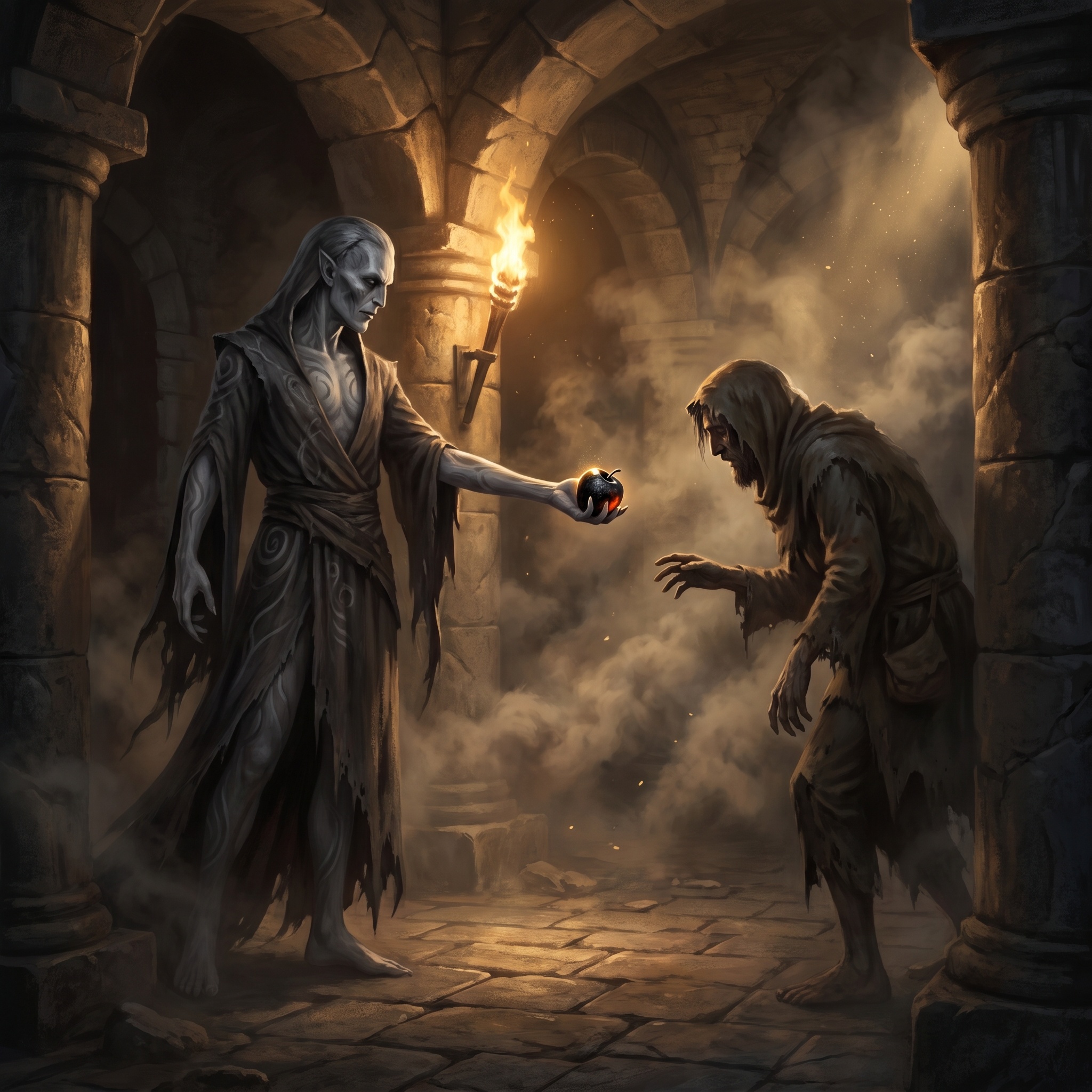
Role: Elite Social Predator Where It Appears: Disaster sites, famine roads, burned temples, refugee camps.
What It Is
Ash tempters come where loss has made people practical. They offer relief without comfort and make survival feel like consent. They appear graceful, soot-soft, and calm in places where everyone else is hungry, injured, or ashamed of what survival has required.
An ash tempter is most dangerous when the offer is useful. Food, shelter, medicine, revenge, a missing child, a safe road, a name crossed off a list: the tempter brings exactly enough help to make refusal feel cruel.
Ecology and Behavior
Ash tempters haunt disaster sites, famine roads, burned temples, refugee camps, plague cordons, and battle aftermaths. They do not create suffering from nothing; they arrive where suffering has already weakened the moral architecture of a community.
They isolate the ashamed. A person who has stolen food, abandoned kin, hidden medicine, or survived when others did not is easier to bargain with. The tempter frames damnation as practicality and compassion as waste.
Signs and Knowledge
Secret Lore or Theology (Hard) identifies ash fruit and relief bargains. Medicine or Survival (Average) notices that the tempter's aid solves symptoms while increasing dependence.
Other signs include warm ash without fire, gifts that spoil after sunrise, survivors who cannot explain the terms they accepted, and relief caches marked with no known charity sign.
Ash Tempter (Elite)
- Skills: Charm 5, Negotiation 4, Deception 4, Secret Lore 3, Readiness 4.
- Attacks: Ember Touch (Unarmed; Damage 5; Crit 4; Burn 1); Merciful Lie (Charm; Damage 7 Strain; Range Short).
- Abilities: Relief Price — Targets suffering hunger, injury, grief, or exhaustion add 1 Bane to resist social checks from the tempter.
- Soul: No claimable coin exists, and devils hold claims rather than being claimed; at death canon does not specify (default).
Tactics
An ash tempter offers relief, isolates the ashamed, and summons collectors if exposed. It uses Merciful Lie before Ember Touch because it wants consent, not corpses. In a fight, it tries to force heroes to choose between pursuing it and protecting the vulnerable people gathered around its aid.
The encounter should make the bargain tempting at the table. The tempter's help should solve a real immediate problem while creating a worse claim later.
Evidence and Trade
| Find | Value | Use | Recovery |
|---|---|---|---|
| Ash fruit sample | 500-1,800 gold Flargons before sunrise | Proof of infernal aid, hunger magic research | Natural Philosophy or Secret Lore (Hard) |
| Relief ledger | Varies | Names of bound survivors, collector schedule | Streetwise or Lore (Average) |
| Soot seal | 400-1,600 gold Flargons | Identifies patron devil or collection terms | Secret Lore (Average) |
Variants
- Famine Tempter: Trades food for future obedience.
- Battlefield Mercy: Offers healing in exchange for one later betrayal.
- Refuge Road Guide: Gets people to safety by selling pieces of their future.
Ashwing Courier
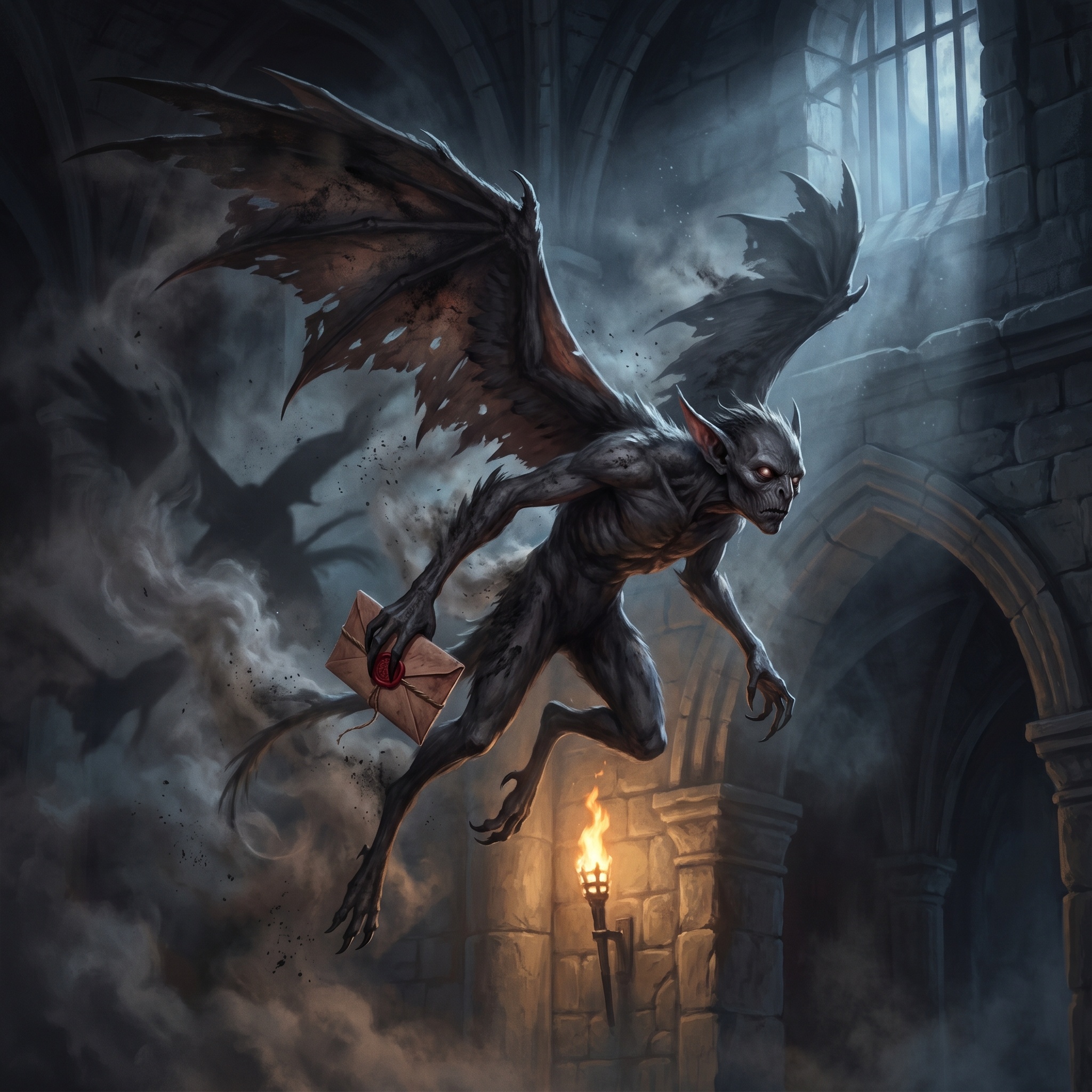
Role: Minion Messenger / Harrier Where It Appears: Infernal correspondence routes, cult cells, rooftops.
Ashwing couriers carry messages that burn after being read, sometimes before. They are cowards with important envelopes.
Ashwing Courier (Minion)
- Group Size: 1-3.
- Skills: Reflexes 4, Stealth 3, Perception 3, Deception 2.
- Attacks: Ash Claw (Unarmed; Damage 3; Crit 5; Burn 1).
- Abilities: Burn Notice — As an incidental when captured or killed, attempt to ignite carried message. Prevent with Average Reflexes or Subterfuge.
- Soul: No claimable coin exists, and devils hold claims rather than being claimed; at death canon does not specify (default).
- Tactics: Flee upward, burn message, scream for stronger devils.
- Harvesting and Trade: Ashwing pinions sell for 200-500 gold Flargons to message-magic crafters.
Buuna Moc Placeholder Servitor

Role: Placeholder Infernal Servitor Where It Appears: PLACEHOLDER - Paul.
[PLACEHOLDER - Paul] This entry is intentionally not expanded until the table boundary for Buuna Moc material is confirmed.
Buuna Moc Placeholder Servitor (Elite)
- Skills: Charm 5, Deception 4, Secret Lore 4, Negotiation 4, Readiness 4.
- Attacks: PLACEHOLDER - Paul.
- Abilities: Boundary Placeholder — Do not use until Paul defines the safe table-facing behavior.
- Soul: No claimable coin exists, and devils hold claims rather than being claimed; at death canon does not specify (default).
- Tactics: PLACEHOLDER - Paul.
- Harvesting and Trade: No harvest.
Contract Devil
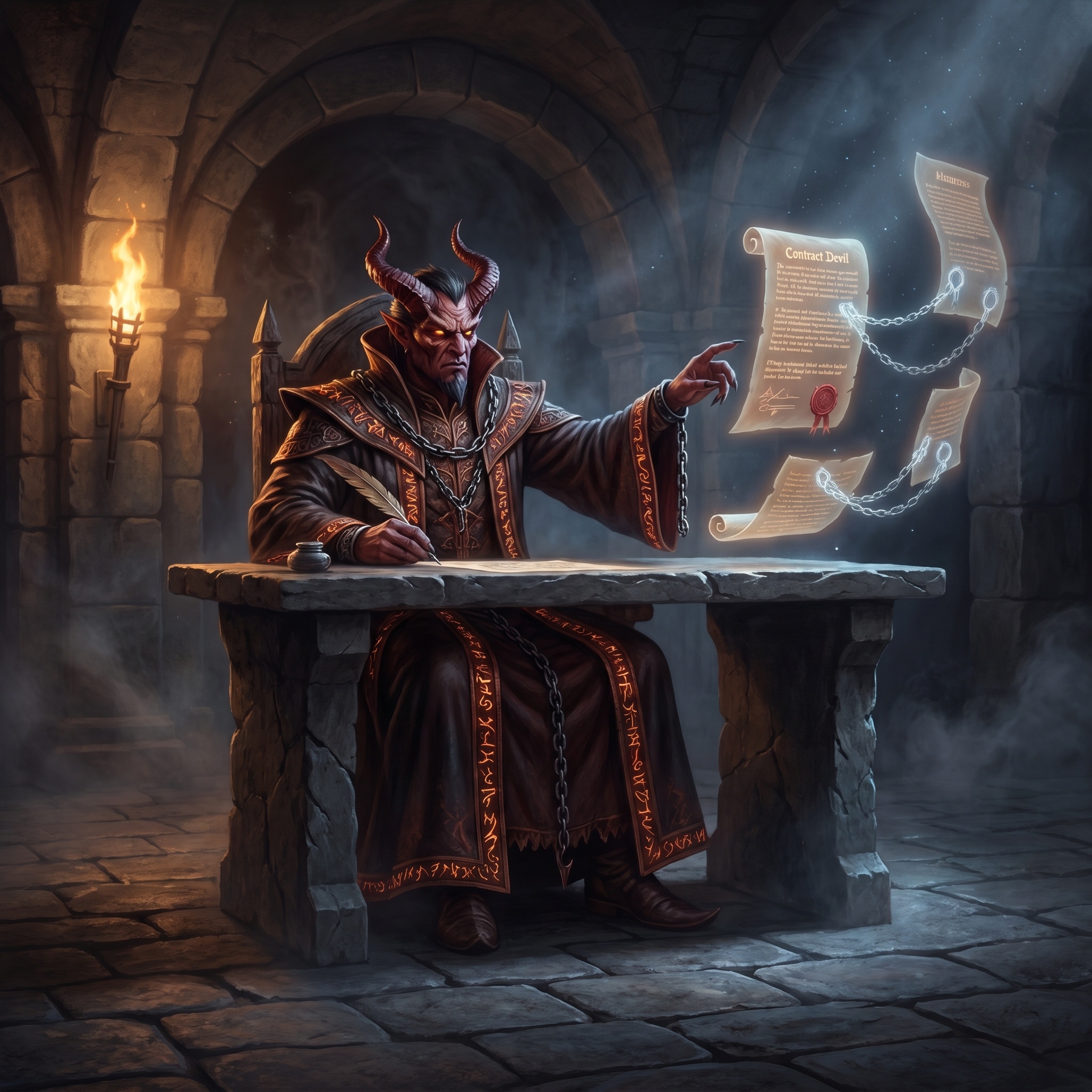
Role: Nemesis Social / Infernal Authority Where It Appears: Infernal courts, mortal contract rooms, debt-claim scenes.
"It does not lie. This is the part people forget. Every word is technically accurate. It is what the words are shaped to make you hear that kills you." — Warning note appended to a recovered contract, Temple of Echo
What It Is
Contract devils do not tempt with chaos. They tempt with enforceability. They know desperate mortals often fear uncertainty more than damnation. A contract devil is an infernal authority wrapped in seals, witness chains, precedent, and the patient confidence of someone who believes every soul can be converted into a clause.
They are not merely tempters. They are administrators of damnation, brought in when a bargain needs structure, enforcement, transfer, or litigation.
Ecology and Behavior
Contract devils appear in infernal courts, mortal contract rooms, debt-claim scenes, arbitration chambers, and anywhere a bargain has grown too valuable for lesser agents. They prefer rooms with tables, witnesses, and clear jurisdiction. Violence is useful only when it reinforces enforceability.
They respect procedure because procedure is their hunting ground. A contract devil may honor a loophole if it is valid, then spend a century arranging for the loophole to become bait for someone else.
Signs and Knowledge
Negotiation, Lore, or Secret Lore (Hard) identifies infernal jurisdiction language. Perception (Hard) notices witness chains or seals arranged to make escape a contractual act.
Other signs include documents that copy themselves, chairs placed like a tribunal, candles burning in numerical patterns, and everyone in the room feeling that speaking casually might count as agreement.
Contract Devil (Nemesis)
- Skills: Negotiation 5, Secret Lore 5, Lore 4, Deception 4, Intimidation 4, Heavy Melee 3.
- Attacks: Clause Chain (Heavy Melee; Damage 8; Crit 4; Grabbed on 2 Boons); Binding Argument (Negotiation; Damage 9 Strain; Range Medium).
- Abilities: Binding Clause - Once per scene, name a promise a target made. If true, target adds 2 Banes to actions that directly violate it for one round.
- Abilities: Infernal Immunities - Add 2 Boons to resist fire, fear, poison, and mundane legal intimidation.
- Soul: No claimable coin exists, and devils hold claims rather than being claimed; at death canon does not specify (default).
Tactics
A contract devil establishes jurisdiction, binds movement with clauses, and uses minions for violence. It names promises at tactically cruel moments: when a hero needs to break a vow, abandon a post, or strike someone under protection. If threatened physically, it tries to convert the assault into breach, contempt, or forfeiture.
The encounter should be a legal battlefield. Let the party argue, produce counterclaims, attack the seals, challenge jurisdiction, or win by making the devil enforce a clause it dislikes.
Evidence and Trade
| Find | Value | Use | Recovery |
|---|---|---|---|
| Signed originals | Priceless | Release clauses, leverage, proof of infernal claim | Negotiation or Secret Lore (Hard) |
| Infernal seals | 1,000-4,000 gold Flargons | Counter-contracts, court evidence, occult study | Secret Lore (Hard) |
| Precedent chain links | 600-2,200 gold Flargons | Binding rituals, legal magic | Craft and Lore (Hard) |
Variants
- Debt Magistrate: Specializes in inherited obligations and family collateral.
- War-Court Devil: Enforces surrender terms, prisoner exchanges, and betrayal clauses.
- Succession Notary: Turns bloodline disputes into soul claims.
Erosmire Placeholder Servitor
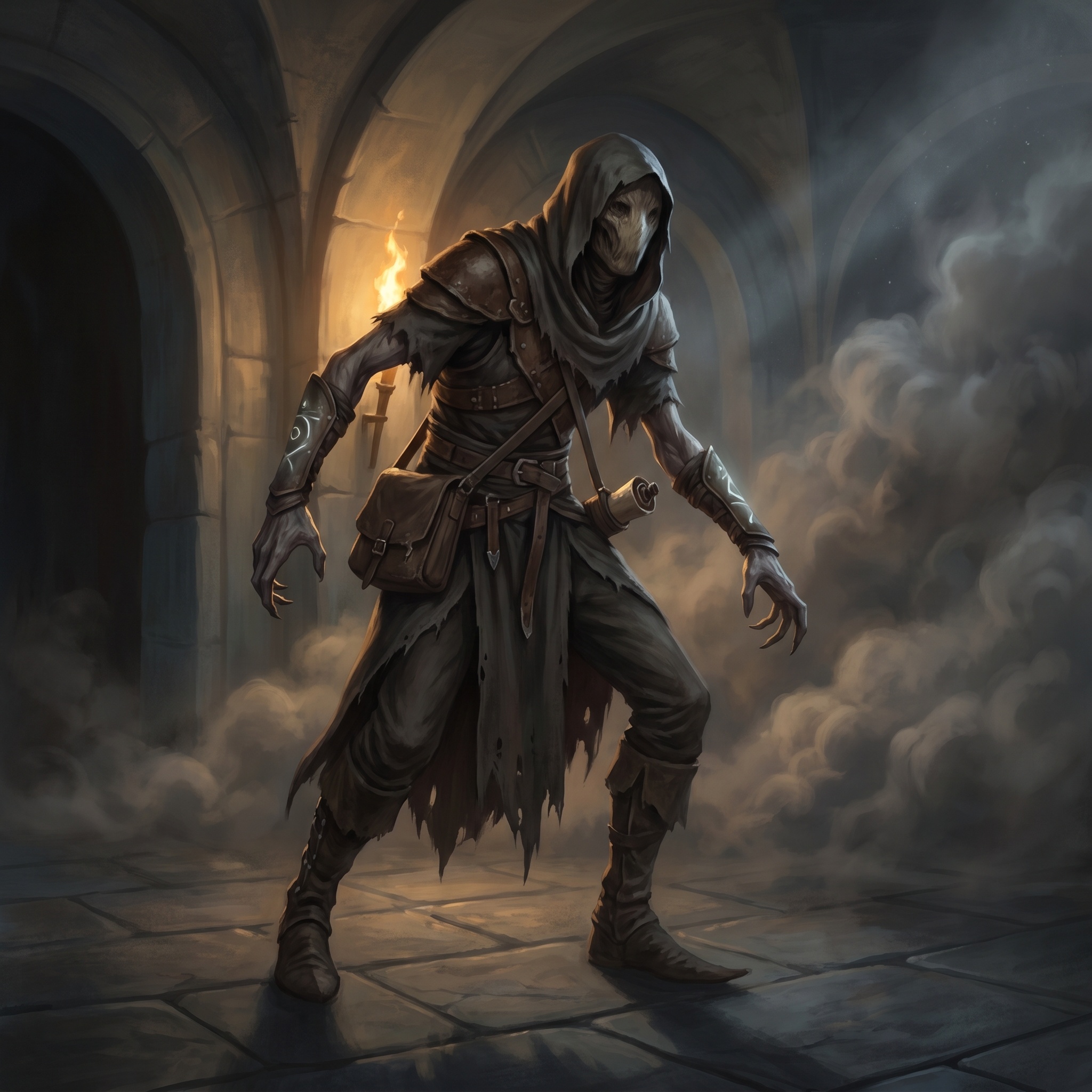
Role: Placeholder Infernal Servitor Where It Appears: PLACEHOLDER - Paul.
[PLACEHOLDER - Paul] This entry needs author review before drafting. The Ix Bible requires clinical framing for Buuna Moc / Erosmire material: insinuate appetite and predation, never catalog acts or write for titillation.
Erosmire Placeholder Servitor (Elite)
- Skills: Charm 5, Deception 4, Negotiation 4, Perception 4, Readiness 4.
- Attacks: Predatory Whisper (Charm; Damage 7 Strain; Range Short).
- Abilities: Boundary Placeholder - Do not use until Paul defines the safe table-facing behavior.
- Soul: No claimable coin exists, and devils hold claims rather than being claimed; at death canon does not specify (default).
- Tactics: PLACEHOLDER - Paul.
- Harvesting and Trade: No harvest.
Hell Hound

Role: Minion Infernal Hunter Where It Appears: Infernal kennels, contract collections, cult compounds.
Hell hounds are bred for pursuit and terror. They understand command, guilt scent, and the difference between prey and witness.
Hell Hound (Minion)
- Group Size: 2-6.
- Skills: Unarmed 3, Survival 4, Perception 4, Athletics 3, Intimidation 2.
- Attacks: Burning Bite (Unarmed; Damage 7; Crit 4; Burn 2).
- Abilities: Smoke Track - Add 1 Boon to track frightened or contract-marked prey.
- Abilities: Fire-Bred - Fire attacks reduce damage by 4 before Resistance.
- Abilities: Dread - Fear 2.
- Soul: No claimable coin exists, and devils hold claims rather than being claimed; at death canon does not specify (default).
- Tactics: Run prey down, flank, drive targets toward handler.
- Harvesting and Trade: Ember glands and iron collars sell for 800-1,600 gold Flargons if removed with Medicine or Craft (Hard).
Infernal Advocate
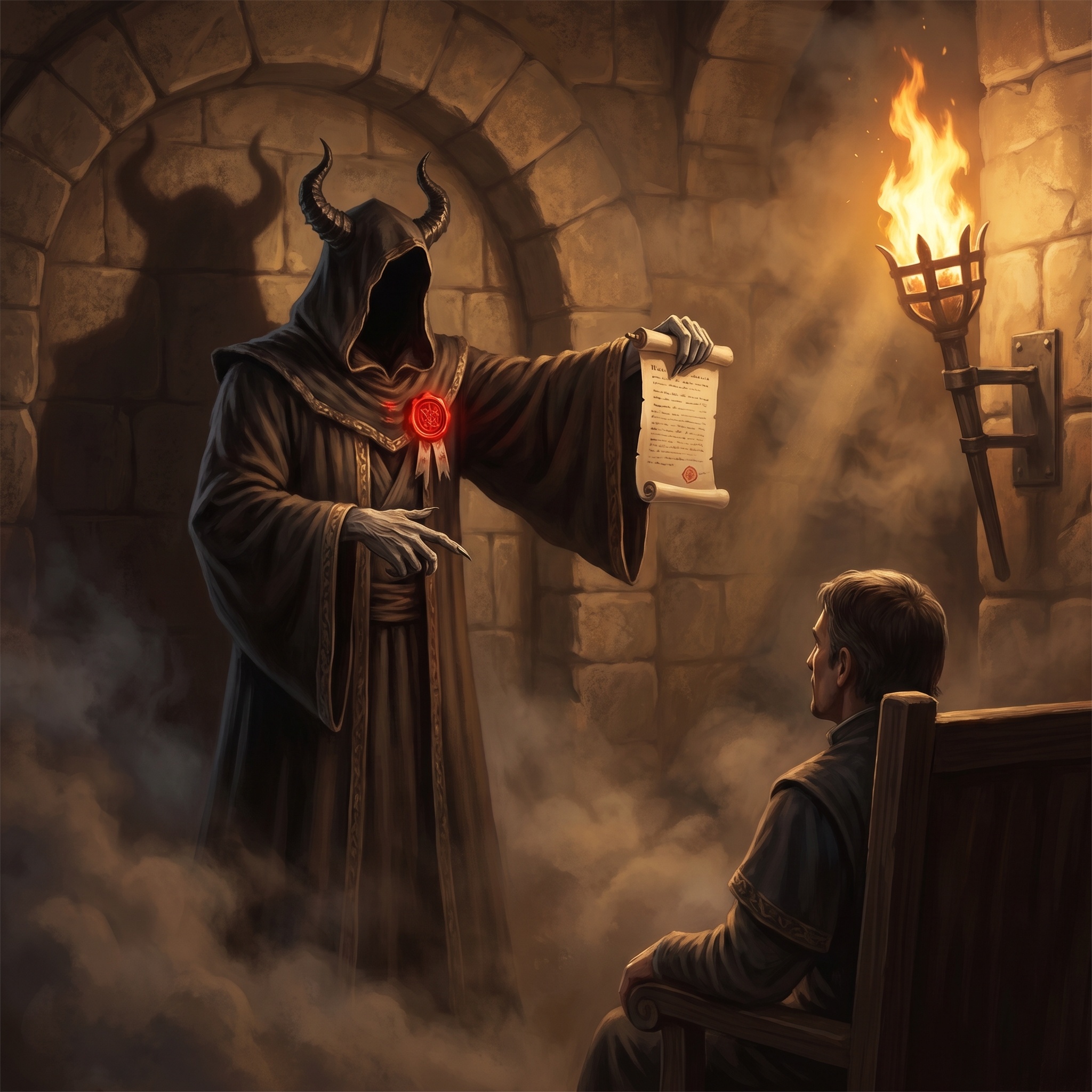
Role: Nemesis Legal / Social Threat Where It Appears: Courts, arbitration chambers, noble contract disputes.
"It does not want your soul specifically. It wants your soul's position in the chain. What that position was connected to is what it was really after." — Temple of Nyxollox private briefing, access restricted
What It Is
Infernal advocates win without revealing themselves when possible. Their goal is precedent: one ruling that makes the next soul easier to claim. They may appear as mortal lawyers, court advisors, robed devils, or shadows behind a magistrate's chair.
The advocate is a Nemesis because victory changes the rules. Even if no soul is taken today, a bad ruling can make future exploitation lawful, respectable, and repeatable.
Ecology and Behavior
Infernal advocates appear in courts, arbitration chambers, noble contract disputes, temple councils, succession hearings, and anywhere a formal decision can become a weapon. They study local law, custom, bias, and fear. They prefer a mortal judge because mortal legitimacy carries farther than infernal force.
They avoid open combat until exposed. Their battlefield is forum control: who may speak, what evidence counts, which definition applies, and whether mercy is admissible.
Signs and Knowledge
Lore, Negotiation, or Secret Lore (Hard) identifies infernal precedent patterns. Culture (Average) spots when local procedure is being bent toward an outside logic.
Other signs include arguments that sound reasonable until applied broadly, witnesses intimidated by technicality, precedent drafts prepared before trial, and a shadow that reacts when the judge speaks.
Infernal Advocate (Nemesis)
- Skills: Negotiation 5, Lore 5, Deception 5, Secret Lore 4, Intimidation 4, Charm 3.
- Attacks: Devastating Argument (Negotiation; Damage 9 Strain; Range Medium); Quill Thorn (Light Ranged; Damage 4; Crit 5; Range Short).
- Abilities: Precedent Trap - Once per scene, force a target to choose: accept a legal disadvantage or suffer 5 Strain resisting publicly.
- Soul: No claimable coin exists, and devils hold claims rather than being claimed; at death canon does not specify (default).
Tactics
An infernal advocate controls the forum, isolates language, and avoids fighting unless exposed. It pressures one speaker into a bad concession, then uses that concession against everyone. If violence starts, it tries to frame the party as proof that its argument was needed.
Run this encounter with stakes outside the stat block: a prisoner, inheritance, temple charter, town law, or treaty clause. Defeating the advocate means winning the record, not just the room.
Evidence and Trade
| Find | Value | Use | Recovery |
|---|---|---|---|
| Precedent drafts | 1,500-6,000 gold Flargons to courts or enemies | Reveals future exploitation, overturns ruling | Lore or Negotiation (Hard) |
| Case notes | 800-3,000 gold Flargons | Identifies patron, target, and pressure points | Subterfuge or Streetwise (Average) |
| Infernal quill | 700-2,200 gold Flargons | Contract magic, forgery, occult proof | Secret Lore (Hard) |
Variants
- Succession Advocate: Turns inheritance law into soul leverage.
- Temple Counsel: Uses doctrine to legalize cruelty.
- Arbitration Devil: Appears neutral until both sides accept the forum.
Infernal Clerk

Role: Elite Social Threat Where It Appears: Counting houses, court offices, contract clinics, discreet salons.
What It Is
An infernal clerk may be mortal, damned, or merely employed. They rarely fight unless cornered. Their weapon is exact language at the moment someone is desperate. They dress like functionaries, not cultists: clean cuffs, tidy ledgers, dry ink, and a desk positioned so the client feels small.
Infernal clerks are useful because they make evil administrative. A village does not need a horned tyrant when one patient notary can turn debt, inheritance, marriage, and prison release into hooks.
Ecology and Behavior
Infernal clerks operate where people sign things under pressure: courts, counting houses, debt offices, military payroll rooms, and back chambers of respectable salons. Some know exactly what powers they serve. Others insist they only process agreements and that consequences are the signer's responsibility.
They prefer leverage to violence. A clerk gathers secrets, tracks obligations, and introduces people to worse bargains only after ordinary options are exhausted. If threatened physically, they stall with procedure, witnesses, hidden guards, or a document that makes attacking them legally inconvenient.
Signs and Knowledge
Lore, Streetwise, or Secret Lore (Hard) identifies infernal contract formulae hidden inside ordinary clauses. Negotiation (Average) spots language that gives the clerk too much interpretive power.
Other signs include ink that dries too quickly, witnesses who cannot remember signing, ledgers warm to the touch, and clients who defend the clerk even while ruined by the agreement.
Infernal Clerk (Elite)
- Skills: Negotiation 4, Deception 4, Lore 3, Secret Lore 3, Streetwise 3, Light Melee 1.
- Attacks: Letter Opener (Light Melee; Damage 3; Crit 5); Contract Pressure (Negotiation; Damage 5 Strain; Range Short).
- Abilities: Fine Print - Once per scene, reveal a prior agreement, debt, or social obligation that adds 1 Bane to a target's next Negotiation or Leadership check unless disproven.
- Soul: Claimable only when the clerk is a mortal in infernal employ, in which case it goes to judgment carrying whatever the clerk signed; a damned clerk is already claimed and nothing further passes.
Tactics
An infernal clerk offers terms, isolates the desperate, and leaves before steel appears. If forced into a confrontation, they attack Strain through shame, debt, and technicalities while looking for an exit. They do not want to win a duel; they want the party to become liable for starting one.
Run the encounter as a negotiation with teeth. The clerk's office, witnesses, seals, and records are part of the battlefield. Destroying the clerk may be easier than undoing the paperwork.
Evidence and Trade
| Find | Value | Use | Recovery |
|---|---|---|---|
| Contract ledger | 800-3,000 gold Flargons to the right buyer | Evidence, blackmail, debt relief, plot leads | Lore or Streetwise (Hard) to interpret safely |
| Infernal wax seals | 250-900 gold Flargons | Contract magic, forgery, occult research | Secret Lore (Average), risky to reuse |
| Client index | Varies | Names of victims, patrons, and leverage points | Subterfuge (Average) |
Variants
- Debt Office Clerk: Specializes in fees, collateral, and debtor prison transfers.
- Marriage Broker: Hides infernal obligations in dowries, inheritance, and family contracts.
- Court Archivist: Controls old judgments and can resurrect dead claims at the worst time.
Infernal Provincial Collector

Role: Nemesis Infernal Administrator Where It Appears: Corrupt courts, debtor prisons, infernal offices, conquered provinces.
"It has held that territory for one hundred and twelve years. In that time, it has never taken a soul by force. It has not needed to." — Sheol Transit Authority, provincial account, restricted
The Collector is the devil sent when a region's sins become organized enough to audit. It does not tempt with fireworks. It brings receipts, precedent, and carefully indexed ruin. Its preferred battle is making the heroes legally responsible for someone else's bargain.
What It Is
An Infernal Provincial Collector is a devil with jurisdiction. It is not the first whisper of temptation. It arrives after enough people have signed, sold, delayed, compromised, and benefited that damnation can be managed like a tax district.
It looks refined because disorder is for amateurs. Ink-black antlers, red ledger robes, contract chains, stamped warrants, and polite speech make its violence feel official. The Collector's favorite weapon is not pain. It is the moment a decent person realizes the paperwork is technically correct.
Ecology and Behavior
Collectors appear in corrupt courts, debtor prisons, conquered provinces, infernal offices, and noble territories where vice has become procedure. They audit bargains, enforce penalties, adjust ownership of souls, and convert local officials into instruments of collection.
They prefer existing institutions. A Collector does not need to burn a courthouse when the judges will stamp its orders. It does not need cultists when bailiffs, clerks, jailers, and creditors already understand leverage.
Signs and Knowledge
Secret Lore, Law, or Lore (Hard) identifies infernal jurisdiction clauses and the point where a mortal contract became a provincial claim. Negotiation (Hard) can challenge a technicality without conceding the Collector's authority.
Other signs include debt records that balance too perfectly, prison bells rung at exact infernal hours, officials who say "procedure" instead of "mercy," and red wax seals appearing on documents written before the Collector arrived.
Infernal Provincial Collector (Nemesis)
- Skills: Lore 5, Deception 5, Secret Lore 5, Negotiation 5, Heavy Ranged 4, Readiness 5.
- Attacks: Contract Chain (Heavy Ranged; Damage 10; Crit 4; Range Medium; Ensnare 2); Clause of Pain (Secret Lore; Damage 10 Strain; Crit 3; Range Medium).
- Abilities: Filed Claim - Once per encounter, name an obligation a target has accepted. If true, that target adds 2 Banes to attacks against the Collector until it spends an Action repudiating the claim.
- Abilities: Summon Bailiff - Once per encounter, create a group of 4 infernal bailiff minions.
- Soul: No claimable coin exists, and devils hold claims rather than being claimed; at death canon does not specify (default).
Tactics
The Collector weaponizes bargains before blades are drawn. It names obligations, assigns liability, targets leaders, and forces the party to spend time repudiating claims while bailiffs tighten the field. It prefers Strain damage, entanglement, public witnesses, and exits protected by legal authority.
If physically threatened, it tries to make the violence look unlawful. Killing the Collector may not void the contracts unless the party also secures, destroys, or countersigns the ledgers.
Evidence and Trade
The ledgers are worth money, but destroying or properly voiding them may free more people than selling them. Rival devils buy them for advantage. Rebel courts buy them to identify victims. Debtors may beg for pages containing family names.
| Find | Value | Use | Recovery |
|---|---|---|---|
| Provincial ledger | 4,000-9,000 gold Flargons, more to rebels | Frees debtors, proves corruption, maps infernal claims | Secret Lore or Law (Hard) |
| Contract chain links | 1,500-5,000 gold Flargons | Binding wards, evidence of enforcement | Craft or Secret Lore (Hard) |
| Red jurisdiction seal | 2,000-8,000 gold Flargons | Challenges authority, opens infernal offices | Law or Lore (Hard) |
| Bailiff summons index | Varies | Names mortal collaborators | Investigation or Streetwise (Average) |
Variants
- Debtor Province Collector: Controls prisons, workhouses, and family obligations.
- Conquered Court Collector: Uses occupation law as infernal leverage.
- Rival Auditor: Will help the party only to ruin another devil's claim.
Ledger Imp

Role: Minion Spy / Annoyance Where It Appears: Counting houses, infernal offices, debtor homes.
Ledger imps record weakness. They are rarely brave, but they are hard to keep from listening.
Ledger Imp (Minion)
- Group Size: 1-4.
- Skills: Stealth 4, Deception 3, Perception 4, Subterfuge 3, Streetwise 3.
- Attacks: Ink Claw (Light Melee; Damage 3; Crit 5); Shame Whisper (Deception; Damage 3 Strain; Range Short).
- Abilities: Write It Down — If it observes a secret, debt, or fear for one round, its patron may learn it later unless the ledger is destroyed.
- Soul: No claimable coin exists, and devils hold claims rather than being claimed; at death canon does not specify (default).
- Tactics: Hide, listen, flee through tiny spaces.
- Harvesting and Trade: Ink glands sell for 150-400 gold Flargons to forgers and curse-scribes.
Named Contract Nemesis
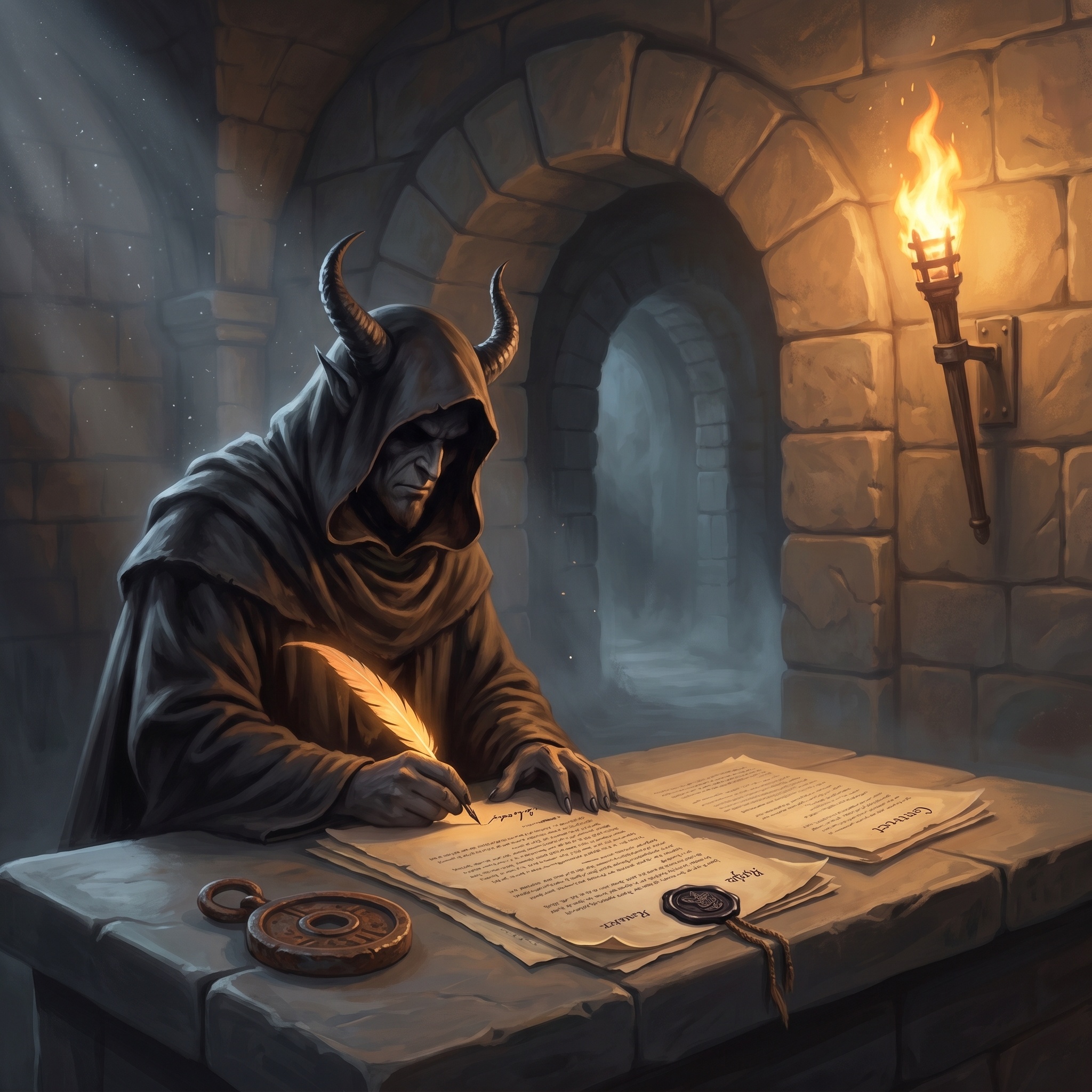
Role: Nemesis Campaign Antagonist Where It Appears: Long-term infernal arcs, noble bargains, kingdom-level debt.
"The contract was valid. The signature was genuine. The person who signed it no longer exists in any form we can locate. The terms have still not been fulfilled." — Infernal Contract Registry, case pending, outstanding since 2987 ME
What It Is
Use this as a template for a named contract antagonist tied to a specific campaign. The name, layer, vice, and contract style should be authored for the story. This is the devil behind the local clerk, the advocate's precedent, the noble bargain, or the kingdom-level debt.
A named contract nemesis should not feel interchangeable. Give it a signature courtesy, a favorite kind of loophole, a visible portfolio of ruined clients, and one promise it always keeps.
Ecology and Behavior
Named contract antagonists operate across arcs. They build debt over sessions, collect through proxies, sponsor mortal institutions, and appear only when victory is already likely. Their influence should be visible before their body is: policy changes, family bargains, sealed inheritances, rescue offers, charitable fronts, and impossible coincidences.
They prefer networks to duels. A direct fight should occur only after the party has damaged the contract web, found the true name, exposed the claim, or forced the devil to defend a personal stake.
Signs and Knowledge
Secret Lore, Negotiation, or Lore (Hard) identifies the antagonist's contract style. Streetwise (Average) sees the same seal, phrase, or relief organization appearing in unrelated crises.
Other signs include proxies using identical courtesy, debts transferable across jurisdictions, contracts that reference events before they happen, and witnesses feeling grateful to the same unseen patron.
Named Contract Nemesis (Nemesis)
- Skills: Negotiation 5, Deception 5, Secret Lore 5, Leadership 4, Intimidation 4, Light Melee 4.
- Attacks: Named Blade (Light Melee; Damage 8; Crit 3; Pierce 3); Claim the Clause (Negotiation; Damage 10 Strain; Range Medium).
- Abilities: Private Peril Reserve - Begins each major scene with 3 private Peril usable only for contract, escape, or social-pressure abilities.
- Abilities: Clause Prepared Earlier - Once per session, reveal a prior contract clause that changes the legal or supernatural stakes of the scene.
- Soul: No claimable coin exists, and devils hold claims rather than being claimed; at death canon does not specify (default).
Tactics
A named contract nemesis builds debt over sessions, collects through proxies, and appears only when victory is already likely. It uses Clause Prepared Earlier to make past mercy, haste, or compromise matter now. If forced into combat, it fights to exit with the contract network intact.
The campaign reward is not body harvest. It is voiding the network, freeing debtors, exposing patrons, and making the devil's favorite promise impossible to keep.
Evidence and Trade
| Find | Value | Use | Recovery |
|---|---|---|---|
| Master contract index | Campaign-level value | Frees debtors, exposes network, identifies true stakes | Secret Lore and Negotiation (Hard) |
| True-name clause | Priceless | Forces audience, weakens escape, enables banishment | Secret Lore (Hard), protected by proxies |
| Proxy ledger | 3,000-10,000 gold Flargons to major rivals | Maps mortal agents and fronts | Streetwise or Lore (Hard) |
Variants
- Inheritance Devil: Owns futures through bloodline debt and succession law.
- Mercy Patron: Saves people at terrible prices and keeps every receipt.
- Kingdom Creditor: Holds roads, armies, taxes, and noble titles as collateral.
Oath-Eater
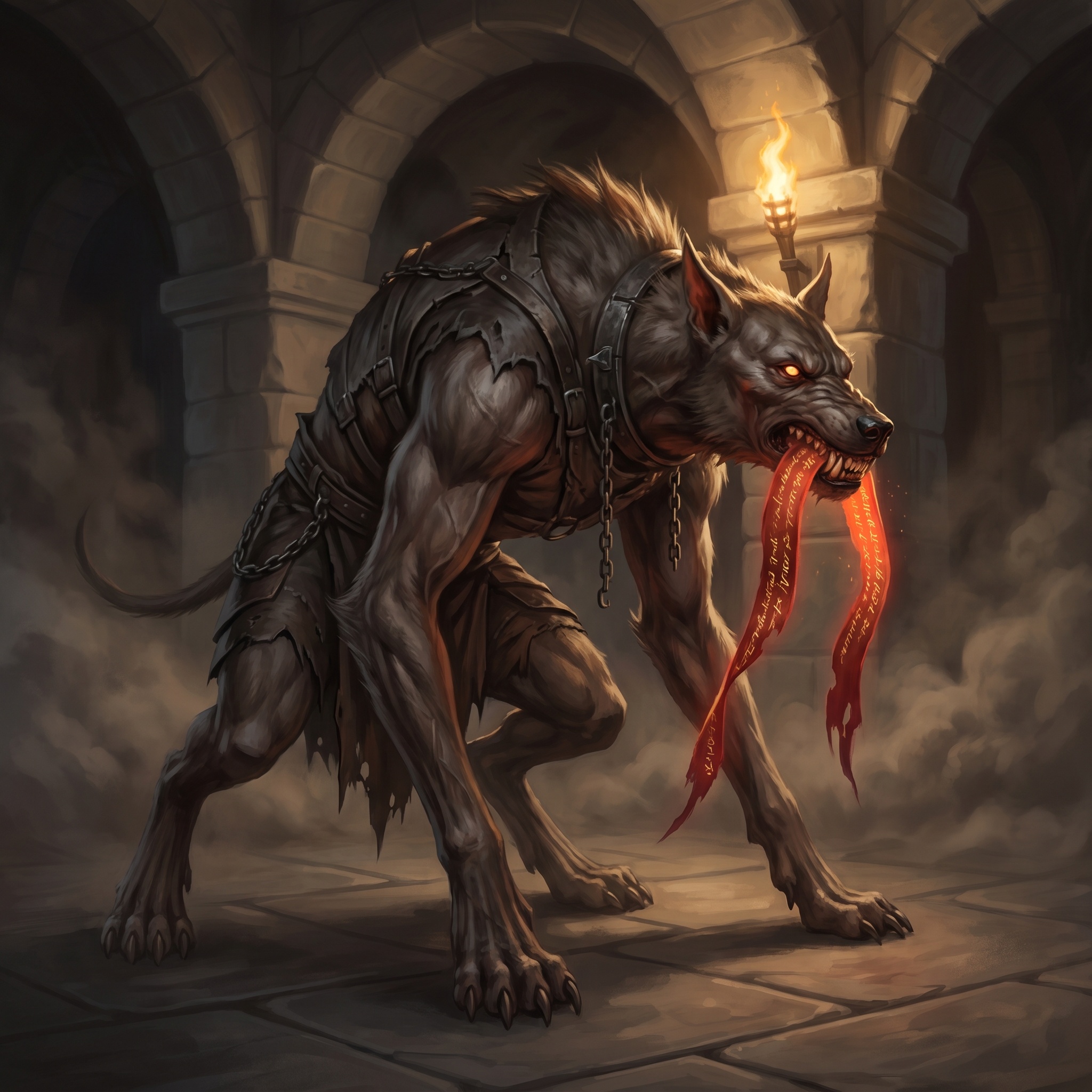
Role: Elite Tracker / Punisher Where It Appears: After broken bargains, oath sites, court roads.
What It Is
Oath-eaters hunt those who breach infernal terms. They smell contradiction and feed on the moment someone says "I never promised." They are gaunt, houndlike infernal trackers with script glowing between their teeth and a talent for finding the guilty part of a sentence.
An oath-eater is not a judge. It does not care whether the bargain was fair. It cares whether the breach is real enough to chew.
Ecology and Behavior
Oath-eaters appear after broken bargains, oath sites, court roads, debtor flights, and attempted loophole escapes. They may be dispatched by contract devils, bailiffs, infernal advocates, or the bargain itself. Once given a scent, they track through distance, disguise, and ordinary legal denial.
They feed on contradiction. A target who admits the breach and seeks lawful remedy may confuse or delay one. A target who lies, rationalizes, or repeats false innocence becomes easier to find.
Signs and Knowledge
Secret Lore, Negotiation, or Survival (Hard) identifies an oath-eater's trail. Perception (Average) notices spoken promises tasting like smoke nearby.
Other signs include vow ribbons chewed through, ink bite marks on contracts, dogs hiding under tables, and the target hearing their own broken words repeated at night.
Oath-Eater (Elite)
- Skills: Unarmed 4, Survival 5 when tracking oath-breakers, Perception 5, Readiness 4, Intimidation 3.
- Attacks: Clause Bite (Unarmed; Damage 9; Crit 3; Pierce 2); Accusatory Howl (Intimidation; Damage 6 Strain; Range Medium).
- Abilities: Scent Breach - Automatically tracks a target who knowingly broke a supernatural bargain unless warded.
- Abilities: Bite the Promise - Against oath-breakers, Clause Bite gains +2 damage.
- Soul: No claimable coin exists, and devils hold claims rather than being claimed; at death canon does not specify (default).
Tactics
An oath-eater tracks relentlessly, howls to isolate, and bites the guilty first. It ignores bodyguards unless they interfere. If multiple people share the breach, it attacks the one most responsible, then the one most afraid.
Counterplay should involve terms: confession, remedy, counterclaim, warding, or proving the bargain void. Pure flight buys time but rarely solves the hunt.
Harvesting and Trade
| Component | Value | Use | Harvest |
|---|---|---|---|
| Clause teeth | 700-1,500 gold Flargons | Oathbinding, bounty magic, breach detection | Medicine or Secret Lore (Hard) |
| Scent script | 500-1,800 gold Flargons | Tracking broken vows, legal wards | Secret Lore (Hard), fades quickly |
| Iron collar tag | 400-1,200 gold Flargons | Identifies dispatcher or contract court | Lore or Negotiation (Average) |
Variants
- Marriage Oath-Eater: Hunts broken infernal family bargains and inheritance vows.
- War-Pact Hound: Tracks deserters, oathbreakers, and treaty violators.
- Loophole Eater: Sent when a target followed the letter but violated a hidden intent.
Pact Collector
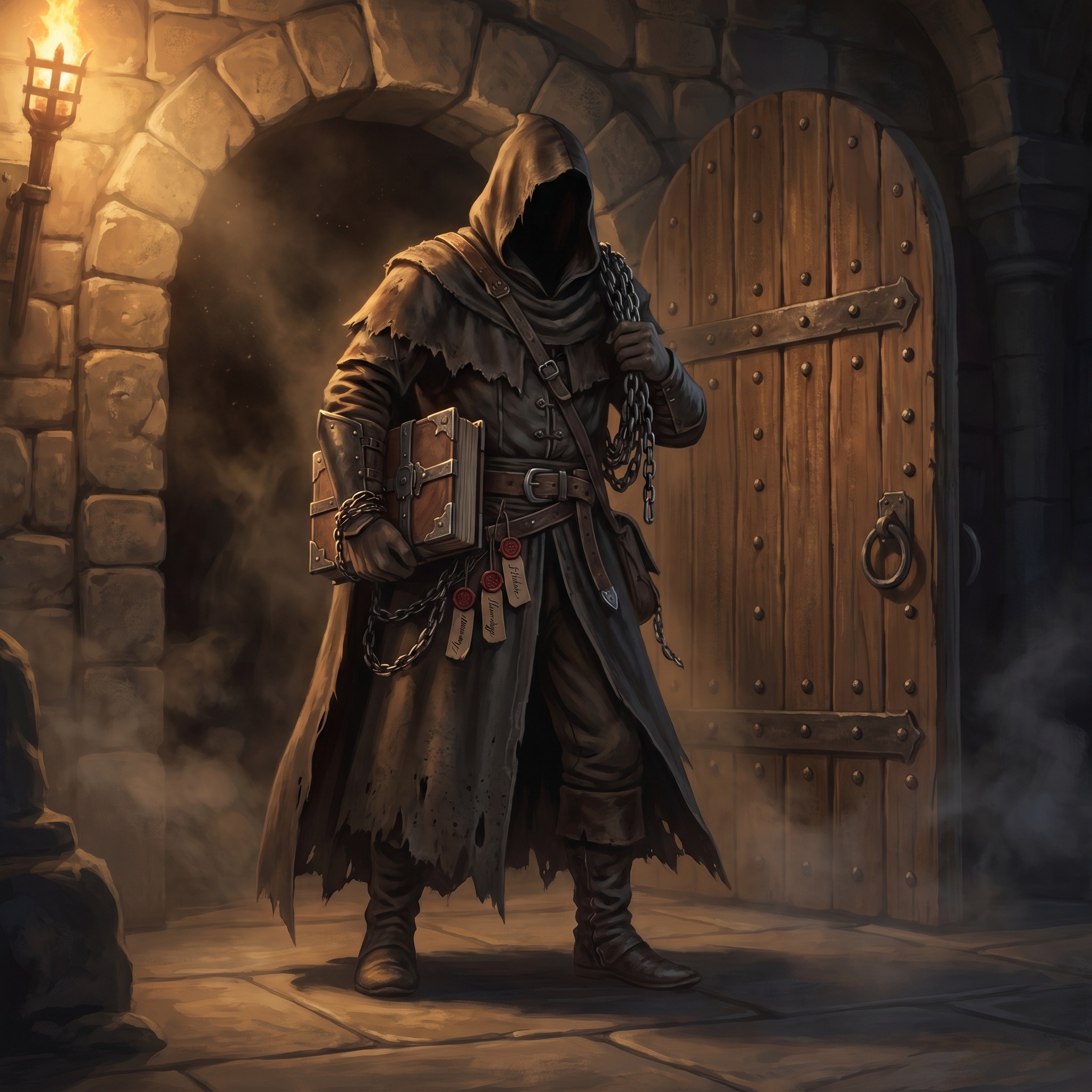
Role: Elite Tracker / Enforcer Where It Appears: Contract default scenes, debtor hunts, night roads.
What It Is
Pact collectors arrive after negotiation has failed. They do not argue terms. They inventory collateral. A collector is hooded, methodical, and heavy with chains, ledgers, name-tags, and tools meant to make a living person feel like an item already listed.
They are elite because they are focused. They do not need to hate the debtor, understand the bargain, or enjoy the work. They simply enforce the claim.
Ecology and Behavior
Pact collectors appear at contract default scenes, debtor hunts, night roads, safehouses, and doorsteps where someone thought distance would matter. They work for contract devils, infernal courts, corrupt bailiffs, and private patrons who bought collection rights.
They prepare exits first. A collector marks doors, names collateral, identifies witnesses, and chooses the easiest thing to seize that will force compliance. Sometimes that is the debtor. Sometimes it is a keepsake, title, shadow, or ally.
Signs and Knowledge
Secret Lore, Negotiation, or Streetwise (Average) identifies collection marks. Perception (Hard) notices exits tagged before the collector announces itself.
Other signs include name-tags nailed under thresholds, chains that rattle before arrival, animals hiding from doorways, and debts suddenly feeling physically heavy.
Pact Collector (Elite)
- Skills: Heavy Melee 4, Survival 4, Perception 4, Intimidation 4, Negotiation 3.
- Attacks: Claim Chain (Heavy Melee; Damage 8; Crit 4; Grabbed on 2 Boons); Ledger Brand (Willpower; Damage 6 Strain; Range Short).
- Abilities: Collateral Sense - Knows the direction of a contract-marked target at Long range if on the same plane.
- Soul: No claimable coin exists, and devils hold claims rather than being claimed; at death canon does not specify (default).
Tactics
A pact collector marks exits, chains the debtor, and ignores unrelated resistance until obstructed. It uses Ledger Brand to make the target feel the claim, then Claim Chain to remove them. If the party blocks collection, they become obstruction rather than prey, which may change the legal stakes.
The encounter should make the debt specific. A collector is much stronger when everyone knows what is being claimed and why the paperwork almost supports it.
Evidence and Trade
| Find | Value | Use | Recovery |
|---|---|---|---|
| Claim chains | 1,000-2,500 gold Flargons to dangerous buyers | Evidence, restraint magic, contract tracing | Secret Lore or Craft (Hard) |
| Name-tags | Varies | Identifies debtor, collateral, and court | Negotiation or Lore (Average) |
| Collection writ | 800-3,000 gold Flargons | Challenges claim, exposes patron | Negotiation or Secret Lore (Hard) |
Variants
- Collateral Collector: Seizes objects, shadows, or memories instead of bodies.
- Night Road Collector: Hunts debtors between towns and marks milestones.
- Purchased Claim Collector: Works for a mortal who bought infernal collection rights.
Sealed Gate Warden

Role: Nemesis Guardian Where It Appears: Infernal gates, cult vaults, sealed thresholds.
"The gate has been sealed for eighty years. The warden is not guarding against entry. It is guarding against exit." — Infernal Geography, chapter on bound entities, restricted edition
What It Is
Gate wardens are built around denial. They do not chase. They decide who may cross and what price remains unpaid. A sealed gate warden is an armored infernal guardian with keys embedded in its body, each one tied to a threshold, debt, or forbidden passage.
It is a Nemesis because the fight is not about pursuit. It is about access. The warden can turn a doorway, portal, vault, or legal boundary into the center of the scene.
Ecology and Behavior
Sealed gate wardens stand before infernal gates, cult vaults, sealed thresholds, contract archives, and prisons where escape would invalidate someone powerful's claim. They may serve a devil, a court, or the gate itself.
They care about authorization, price, and boundary. A warden may allow enemies to approach, speak, or even retreat, but forced entry changes everything. Some can be bargained with if the petitioner understands the key's debt.
Signs and Knowledge
Craft, Secret Lore, or Rifts (Hard) identifies which embedded key controls which passage. Perception (Average) notices the warden never steps away from the threshold line.
Other signs include doors that close before arguments end, keys turning inside the warden's chest, air pressure changing at the boundary, and footprints stopping exactly where law begins.
Sealed Gate Warden (Nemesis)
- Skills: Heavy Melee 5, Fortitude 5, Readiness 5, Secret Lore 4, Intimidation 4.
- Attacks: Keyed Halberd (Heavy Melee; Damage 11; Crit 3; Pierce 3); Gate Rebuke (Willpower; Damage 8 Strain; Range Short).
- Abilities: Threshold Law — While guarding its gate, forced movement and teleportation effects against it add 2 Banes.
- Abilities: Lock the Way — Once per encounter, close one exit, portal, or passage for one round unless opened with Hard Craft, Secret Lore, or Rifts.
- Soul: No claimable coin exists, and devils hold claims rather than being claimed; at death canon does not specify (default).
Tactics
A sealed gate warden holds the threshold, isolates trespassers, and punishes forced entry. It uses Lock the Way to split the party or prevent retreat, then stands where movement must pass through its reach. It does not abandon the gate unless its mandate is rewritten.
The encounter should include ways to interact with the threshold: keys, passphrases, paid prices, alternate doors, broken seals, or legal arguments about who has right of passage.
Harvesting and Trade
| Component | Value | Use | Harvest |
|---|---|---|---|
| Embedded keys | 2,000+ gold Flargons each | Gate control, vault access, infernal proof | Craft and Secret Lore (Hard), may remain linked |
| Threshold seal | 1,500-5,000 gold Flargons | Portal wards, court evidence | Rifts or Secret Lore (Hard) |
| Warden plate | 1,000-3,000 gold Flargons | Armor, ward anchors | Craft (Hard) |
Variants
- Archive Warden: Guards contracts and closes pages like doors.
- Prison Gate Warden: Prevents escape more fiercely than entry.
- Pilgrim Toll Warden: Allows passage only after a symbolic or literal price is paid.
Zephyros
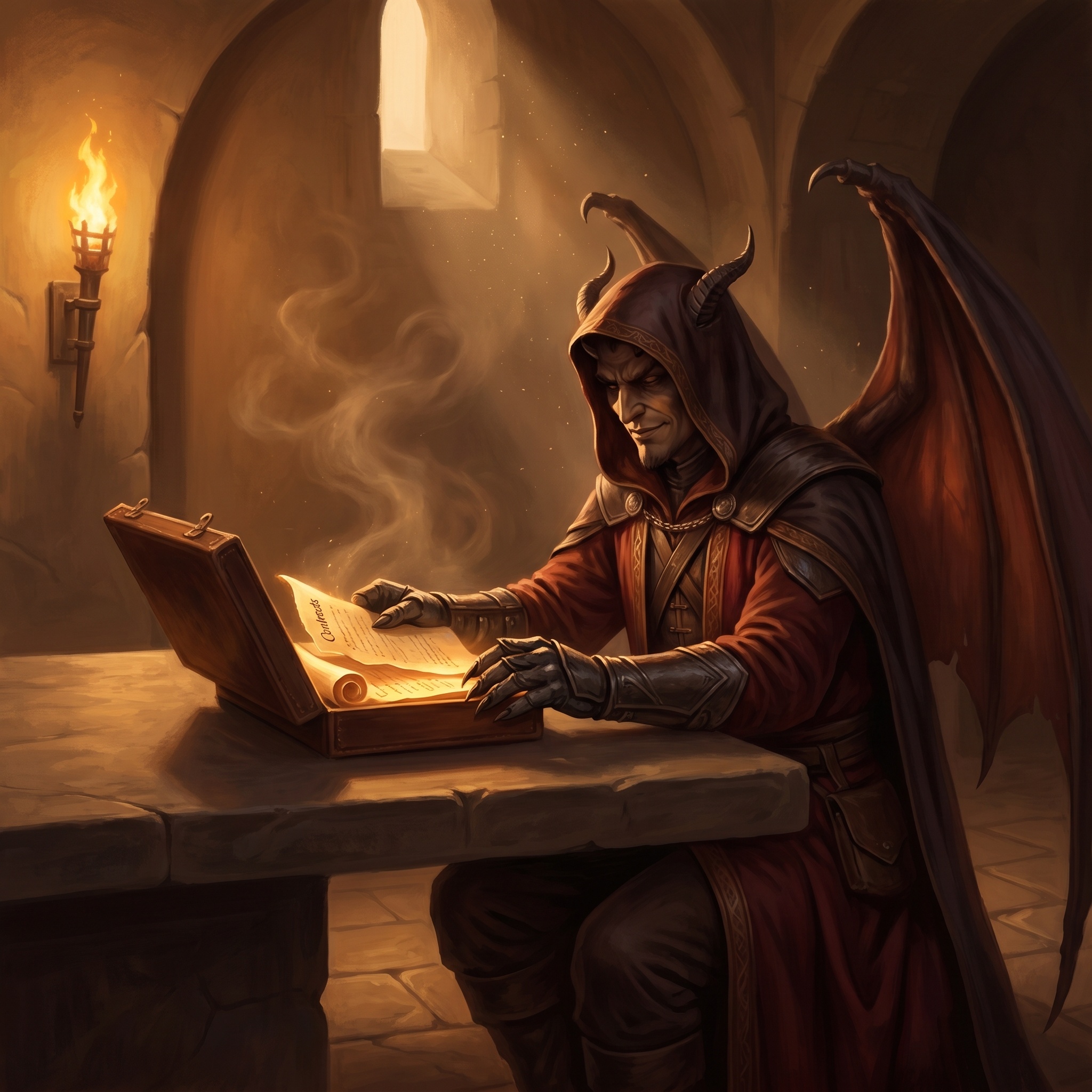
Role: Nemesis Contract Devil Where It Appears: Wherever desire has become negotiable. Source: Dort Infernal - Zephyros.
"It does not blow things away. It changes what direction means for anything standing near it." — Infernal Geography, entry on Zephyros — third edition revised and reclassified upward
What He Is
Zephyros studies a target before approaching and wears the face that will be trusted. He honors the letter of every bargain. That is the cruelty. He is not a roaring devil of chains and flame; he is the confidant at the table, the old friend at the door, the patron who understands why this one exception should be allowed.
Zephyros should feel personal. He does not tempt random crowds when one well-chosen desire can compromise a bloodline, company, temple, or adventuring party.
Ecology and Behavior
Zephyros moves through mortal need. He appears where desire has become negotiable: sickrooms, war rooms, inheritance disputes, lonely roads, failed businesses, forbidden romances, and moments when a hero cannot bear the cost of doing the right thing.
He researches before contact. Names, debts, old shame, private ambitions, grief, and friendships are all tools. When he finally offers terms, the target should recognize the offer as something they already wanted but had not dared price aloud.
Signs and Knowledge
Secret Lore or Negotiation (Hard) identifies Zephyros by contract structure rather than face. Perception or Charm (Hard) notices that his persona reflects the target's desire too perfectly.
Other signs include warm lamplight where none should be, clauses phrased as kindness, witnesses remembering different faces, and prior bargains that ended exactly as written and horribly as lived.
Zephyros (Nemesis)
- Skills: Negotiation 5, Deception 5, Charm 5, Secret Lore 5, Streetwise 4, Light Melee 3.
- Attacks: Silver Knife (Light Melee; Damage 6; Crit 3; Pierce 2); Perfect Offer (Negotiation; Damage 9 Strain; Range Short).
- Abilities: Face You Need - Add 2 Boons to first Deception or Charm check against a target whose desire he has studied.
- Abilities: Exact Terms - Once per scene, turn an accepted verbal agreement into binding leverage unless the target immediately succeeds at Hard Negotiation or Secret Lore.
- Soul: No claimable coin exists, and devils hold claims rather than being claimed; at death canon does not specify (default).
Tactics
Zephyros avoids combat, separates targets, offers what they already wanted, and leaves collectors behind. If forced into violence, he uses Perfect Offer to fracture resolve and retreats behind binding terms, witnesses, or infernal jurisdiction. He prefers making the party argue with each other.
Run him as a campaign pressure point. The danger is not whether the party can stab him today; it is whether they can afford to refuse him when he finally names the price.
Evidence and Trade
| Find | Value | Use | Recovery |
|---|---|---|---|
| Signed contract | Priceless and dangerous | Leverage, rescue target, infernal proof | Negotiation or Secret Lore (Hard) |
| Draft clauses | 1,500-5,000 gold Flargons to occult courts or rivals | Shows intended victim and loopholes | Secret Lore (Hard) |
| Persona token | Varies | Identifies a face he used and who trusted it | Charm, Lore, or Streetwise (Average) |
Variants
- Friendly Zephyros: Appears as the person most likely to be forgiven.
- Patron Zephyros: Offers funding, legitimacy, and protection with perfect paperwork.
- Last-Minute Zephyros: Arrives only when every other option has visibly failed.