Dort's dragons are not one species with color variants. Each true line is a physical plane's nature concentrated into something that can fly and hold a grudge. An Ember Dragon carries the Ember plane's fire in its blood the way a coal carries heat after the flame is gone. A Gale Dragon is the Zephyr made muscular and territorial. An Ore Dragon is the Mineral Plane's patience given claws, content to wait a century for a vein to mature before it moves. A Tide Dragon answers to the same pull that runs the Tidal Realm's currents. An Umbral Dragon has spent enough time near the Dim that its shadow no longer quite matches its body. A Prism Dragon bends light the way Arcana bends possibility. An Anchor Dragon holds gravity around itself the way other dragons hold heat, and the wreckage it collects stays exactly where it left it, in orbit, for as long as the dragon lives.
Not everything in this chapter is a true dragon. Dragon-kin, dragon-touched guardians, and creatures merely raised in a dragon's territory are cataloged alongside the seven true lines, and the difference matters at the table: a hatchling or an elder of a true line is a plane's will given teeth, while a dragon-touched beast is closer to wildlife that grew up too near something enormous.
At the table: a young dragon is a disaster. An elder is a weather system with opinions. Do not let a Nemesis-tier dragon fight fair, and do not let the party forget which plane they are actually standing next to.
Anchor Orbital Hoard-Keeper
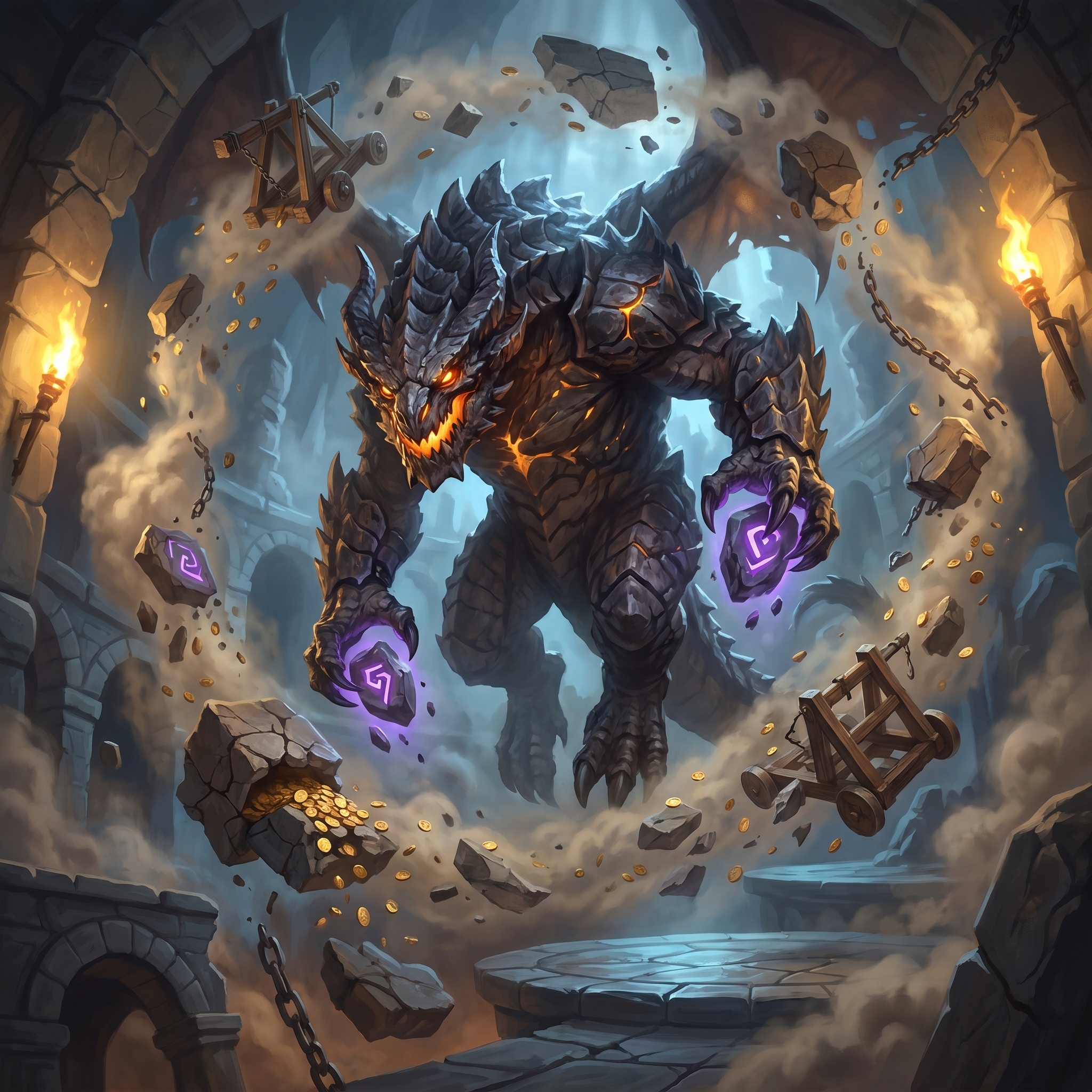
Role: Nemesis Gravity Hoard Guardian Where It Appears: Anchor dragon ranges, collapsed treasuries, craters with objects circling above them.
"It has held that range for longer than any human family has held land near it. The floating things above the ridge include a mill wheel we know by description from two generations back." — Boundary assessment, Plateau Survey Commission, 3089 ME
What It Is
The Hoard-Keeper is not a true dragon. It is a gravity-touched guardian bred or shaped by long exposure to Anchor dragon territory. It understands ownership, tribute, and debt, but not mercy. Everything it has lifted into orbit is part of its accounting.
Ecology and Behavior
The Hoard-Keeper lairs in Anchor dragon ranges, collapsed treasuries, craters, and broken fortresses where valuables and siege engines float in slow orbit. It records ownership by mass and proximity. If an object rises into its field, it has been counted.
It may have been created by a dragon, shaped by territory, or grown from a hoard guardian under Anchor pressure. It is not interested in spending treasure, only retaining it.
Signs and Knowledge
Adventuring Lore, Natural Philosophy, or Survival (Hard) identifies local orbit before entering it. Perception (Average) notices loose objects drifting toward the same center.
Other signs include stones circling silently, footprints that lift at the edges, old siege engines suspended above craters, and tribute markers nailed to the ground.
Anchor Orbital Hoard-Keeper (Nemesis)
- Skills: Heavy Melee 5, Athletics 5, Fortitude 5, Perception 4, Readiness 4.
- Attacks: Crushing Maw (Heavy Melee; Damage 14; Crit 3; Pierce 3); Orbital Debris (Heavy Ranged; Damage 12; Crit 4; Range Medium; Blast 1).
- Abilities: Local Orbit — Loose unattended objects within Medium range float unless secured. Difficult terrain becomes three-dimensional and unstable.
- Abilities: Drop the Hoard — Once per encounter, it drops a suspended object as an Area attack at Short range, Damage 14, Knockdown on 2 Boons.
- Soul: No claimable coin exists; at death canon does not specify (default).
Tactics
The Hoard-Keeper keeps enemies under falling objects, blocks retreat with orbiting debris, and protects the true hoard entrance. It uses Local Orbit to turn dropped weapons, coins, and rubble into hazards.
Harvesting and Trade
| Component | Value | Use | Harvest |
|---|---|---|---|
| Gravity nodules | 2,000-4,500 gold Flargons | Anchor instruments, hoard wards | Natural Philosophy or Craft (Hard) while levitating |
| Orbital debris map | Varies | Finds true hoard entrance | Survival or Adventuring Lore (Hard) |
| Breastplate plates | 1,500-4,000 gold Flargons | Gravity armor research | Craft (Hard) |
Variants
- Crater Keeper: Guards a fallen treasury and uses siege debris.
- Tribute Accountant: Accepts payment but never returns mistakes.
- Dragon-Made Keeper: Carries a true dragon's ownership mark.
Cave Drake
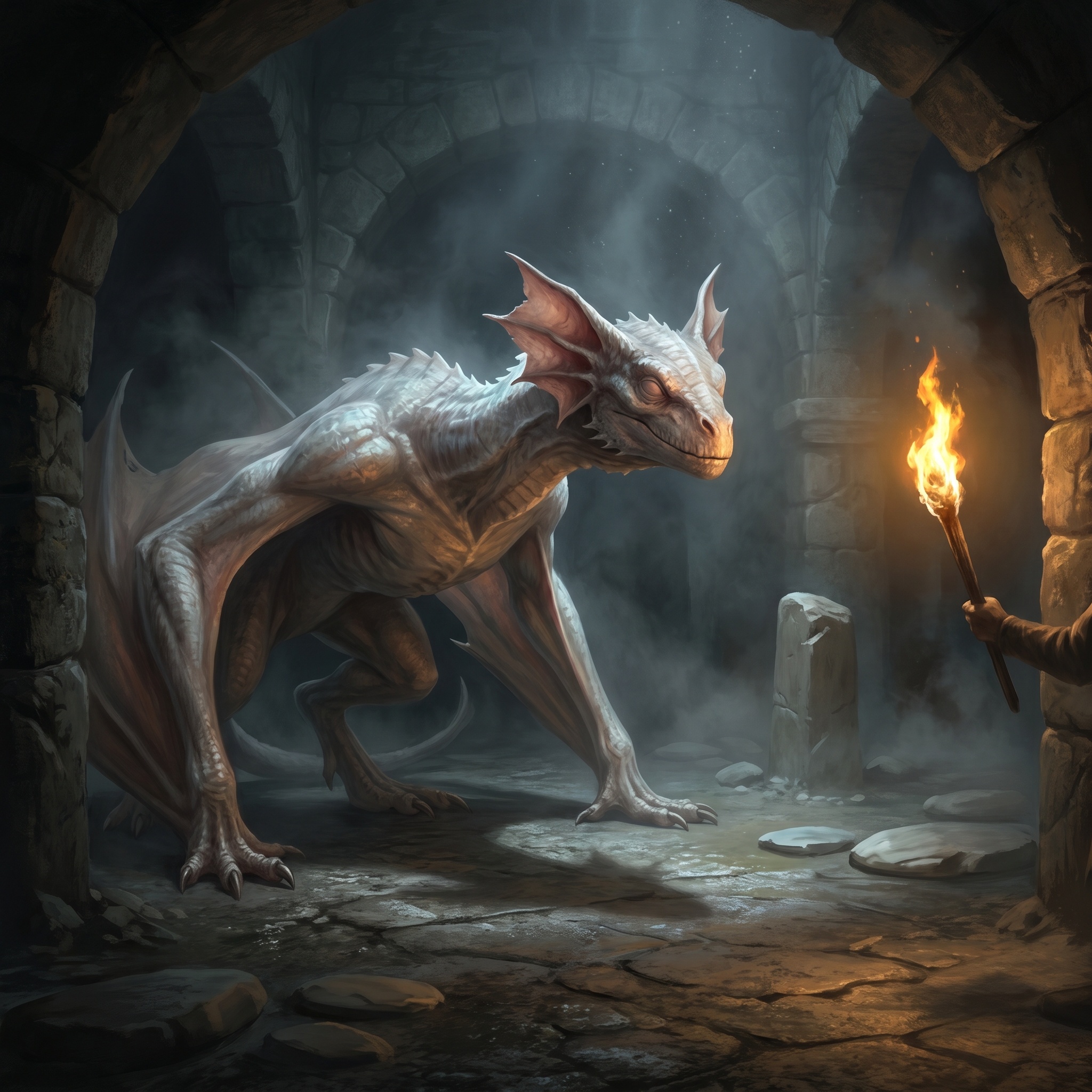
Role: Elite Lurker Where It Appears: Deep caves, underroads, blind aquifers.
What It Is
Cave drakes hunt by heat and vibration. They dislike open sky and panic at thunder. Pale, blind, and broad-frilled, they are adapted to stone dark rather than dragon majesty.
They are excellent dungeon predators because torches, footsteps, and warm bodies all announce prey.
Ecology and Behavior
Cave drakes live in deep caves, underroads, blind aquifers, limestone chambers, and abandoned mines. They lair near warm vents, fungus fields, and water routes where animals pass. They do not like wide-open spaces and may refuse to cross moonlit ground.
They are not stupid. They learn the difference between steady torchlight and thrown decoys, but cold bait and thunderous noise can still break their hunting pattern.
Signs and Knowledge
Survival or Natural Philosophy (Average) identifies heat-hunting behavior. Perception (Hard) hears frilled ears flex before attack.
Other signs include torches going missing, claw marks at warmth height, prey cached near vents, and smooth paths through fungus where a large body passes often.
Cave Drake (Elite)
- Skills: Heavy Melee 3, Stealth 3 in caves, Athletics 4, Perception 5 by heat/vibration.
- Attacks: Blind Bite (Heavy Melee; Damage 9; Crit 3; Pierce 2); Claws (Heavy Melee; Damage 7; Crit 4).
- Abilities: Heat Sense — Ignores darkness against warm targets; cold decoys can mislead it.
- Soul: No claimable coin exists; at death canon does not specify (default).
Tactics
A cave drake stalks lights, bites the warmest target, and flees thunderous sound. It attacks from darkness but does not need sight to fight. It favors narrow passages where prey cannot scatter far from heat sources.
Counterplay includes cold decoys, muffled movement, sudden thunder, and forcing it into open ground.
Harvesting and Trade
| Component | Value | Use | Harvest |
|---|---|---|---|
| Heat-sensing frills | 800-1,800 gold Flargons | Instruments, blind-navigation aids | Medicine or Survival (Hard) |
| Pale hide | 400-1,200 gold Flargons | Camouflage, cave gear | Survival (Average) |
| Vent-stone gizzard | 300-1,000 gold Flargons | Heat charms, cave alchemy | Medicine (Average) |
Variants
- Aquifer Drake: Hunts from flooded cracks and warm springs.
- Mine Drake: Learns cart schedules and lantern routes.
- Thunder-Shy Elder: Larger specimen with an exploitable fear of storms.
Dragon Hatchling Template
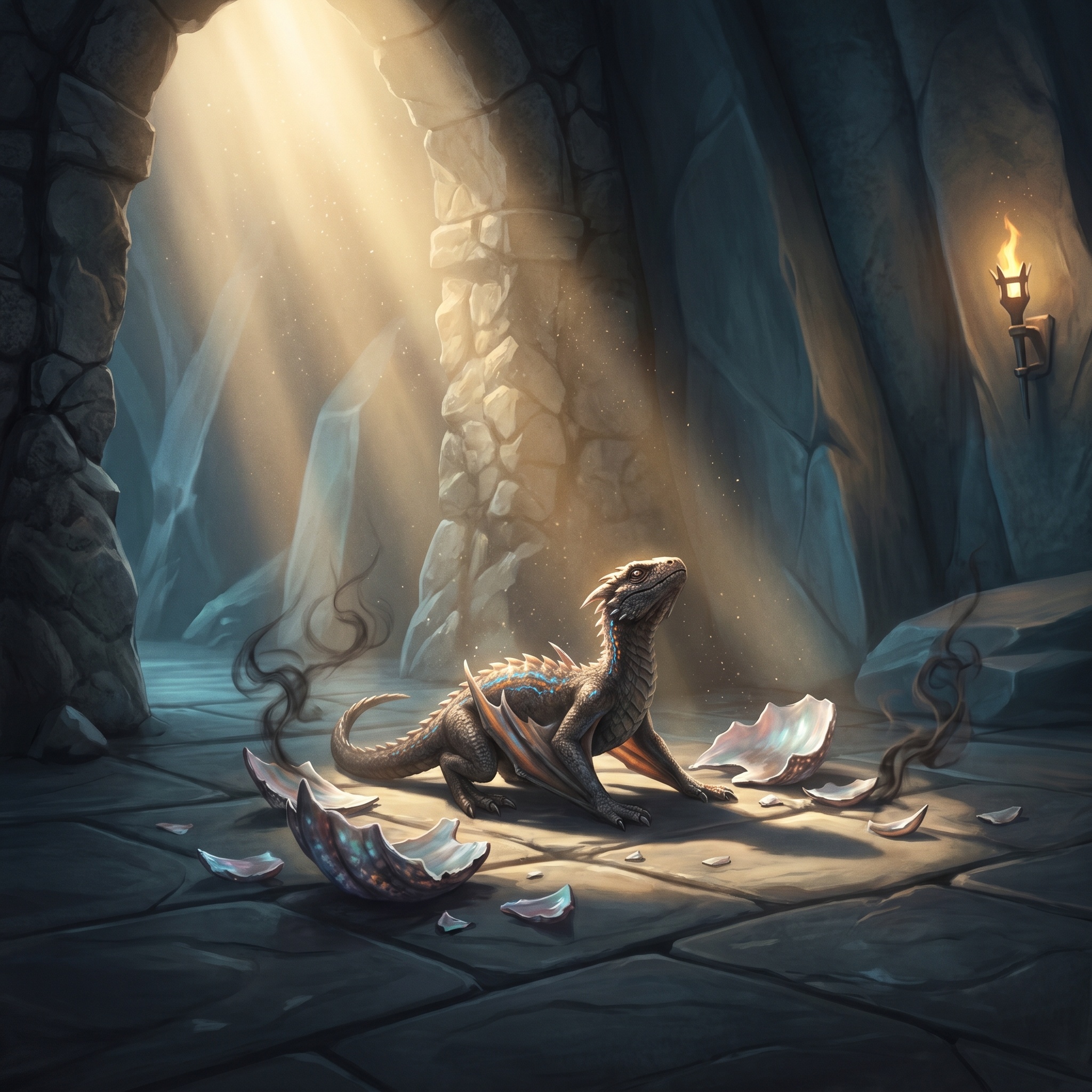
Role: Elite Young Apex Where It Appears: Dragon nests, egg chambers, protected lairs.
What It Is
Hatchlings are not pets. They are infant apex beings with incomplete control and a mother's territory around them. Even newly hatched true dragons carry the weight of Dort's draconic order: Anchor, Ember, Gale, Ore, Prism, Tide, or Umbral.
This template should be customized by dragon type. A hatchling is vulnerable by dragon standards, not by the standards of people standing too close to the nest.
Ecology and Behavior
Dragon hatchlings appear in nests, egg chambers, protected lairs, and hidden nursery territories. They are curious, hungry, territorial, and poorly regulated. Elemental expression comes as sneezes, panic flares, accidental breath, or instinctive calls that may travel farther than anyone wants.
The real encounter is rarely just the hatchling. Parents, cults, hunters, territory effects, and the moral catastrophe of harming a young true dragon all matter.
Signs and Knowledge
Draconic Lore, Survival, or Planar Lore (Average) identifies the hatchling's type from shell, scent, and elemental residue. Perception (Hard) notices the parent-territory warning signs before the nest.
Other signs include cracked shells that still radiate type energy, prey cached too neatly for ordinary animals, and small claw marks near lair features too dangerous for anything else to approach.
Dragon Hatchling (Elite)
- Skills: Heavy Melee 2, Athletics 3, Reflexes 3, Perception 3, Readiness 3.
- Attacks: Young Bite (Heavy Melee; Damage 7; Crit 4; Pierce 1); Claws (Heavy Melee; Damage 6; Crit 4).
- Abilities: Unstable Element - Once per encounter, make a Short-range breath-like attack, Damage 7, with a quality matching type.
- Soul: No claimable coin exists; at death canon does not specify (default).
Tactics
A hatchling panics, lashes out, and calls a parent by instinct. It does not fight efficiently. It bites whatever is closest, breathes when frightened, and retreats toward heat, shadow, water, stone, wind, prism-light, or anchor-stable terrain depending on type.
Use hatchlings for rescue, moral pressure, or territory complications rather than trophy fights.
Relics and Trade
| Find | Value | Use | Recovery |
|---|---|---|---|
| Shed shell fragments | 1,000-4,000 gold Flargons | Type research, wards, proof of nest | Survival or Draconic Lore (Average), only if abandoned |
| Nursery residue | 500-2,000 gold Flargons | Locating territory effects | Planar Lore (Average) |
| Egg or hatchling | Not legitimate trade | Kidnapping one creates dragon-scale consequences | Do not treat as loot |
Variants
- Hidden Brood: Concealed by a parent or trusted mortal caretakers.
- Orphaned Hatchling: Dangerous because every faction wants it.
- Territory-Strong Hatchling: Type trait flares more often near lair features.
Dragon, Anchor
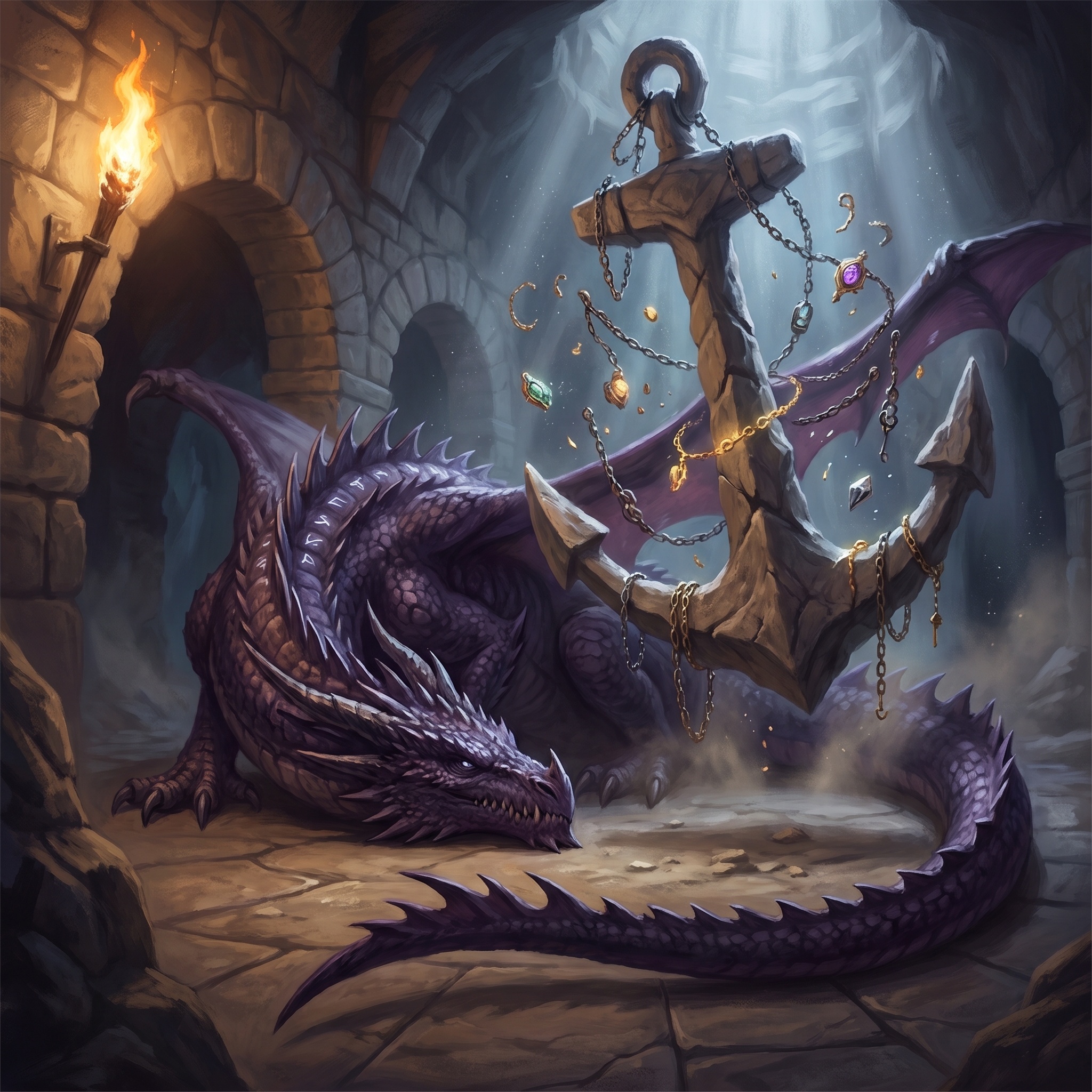
Role: Nemesis Apex Controller Where It Appears: High plateaus, mountain basins, coastal cliffs, and other stable lair sites with visible gravitational anomalies. Source: Dort Dragons - Anchor Dragon.
"The land became wrong before the dragon was seen. Stones rested on ledge undersides. Horses refused roads. Three days before the attack, my water bowl drifted to the ceiling." — Field surveyor's record, Plateau of Cracked Glass
The Anchor Dragon weaponizes the assumption that down is a constant. It pins prey under impossible weight, removes footing with sudden zero-gravity pockets, and keeps a hoard of stolen objects orbiting above its lair. Communities near one do not describe it first as a dragon; they describe the land becoming wrong.
What It Is
An Anchor Dragon is one of Dort's seven true dragons, aligned to gravity rather than a visible element. Its scales are dark purple-black and seem to swallow light instead of reflecting it. Its pale eyes are often the only clear feature at range. Size is unreliable: an adult can compress itself into a dense, compact form or expand into a larger, lighter shape without changing the fact that its presence makes the body feel heavy.
The dragon's territory is a field of pressure. Horses refuse roads. Birds avoid the air above the lair. Stones rest on ledge undersides where no hand could have placed them. The hoard floats in orbit overhead: coins, wagons, doors, siege parts, personal trophies, and objects that have been missing from distant households for decades.
Ecology and Behavior
Anchor Dragons are patient territorial predators. They do not chase prey through the landscape; they make the landscape choose for them. A deer, caravan, warband, or flying machine entering the field becomes a moving mass in the dragon's senses. It knows weight, direction, density, and momentum before it cares about color or sound.
Their lairs reshape local life. Plants grow squat and thick-rooted under chronic gravitational pressure. Animals born near the lair become dense-boned and heavily muscled or learn avoidance patterns that outsiders cannot read. The closest ring of the territory is not barren because the dragon burns or poisons it; it is barren because movement becomes too expensive.
Anchor Dragons think in force relationships. They do not rage quickly. They test intruders by increasing pressure, watching who panics, who anchors themselves, who tries magic, and who keeps moving. If a party withdraws at the first warning, the dragon may let them go. If they continue toward the hoard or lair, the encounter has already begun.
Signs and Knowledge
Field signs: increasing body weight without fatigue, deeply compacted soil, short thick vegetation, floating debris above a distant ridge, animals lying down and refusing to rise, objects fallen sideways or upward.
Survival or Adventuring Lore (Average): recognizes the territory as a dragon-scale anomaly and advises retreat before the pressure worsens.
Natural Philosophy or Planar Lore (Hard): identifies gravity-plane influence, predicts high-gravity and reverse-gravity hazards, and knows anchors or tethers reduce the worst effects.
Secret Lore (Severe): identifies which floating objects are likely part of a deliberate hoard pattern rather than accidental debris, allowing a party to infer the lair center.
Dragon, Anchor (Nemesis)
- Skills: Heavy Melee 4, Athletics 5, Fortitude 5, Perception 5, Natural Philosophy 3, Planar Lore 3, Intimidation 4.
- Attacks: Bite (Heavy Melee; Damage 12; Crit 3; Pierce 3, Vicious 5); Claws (Heavy Melee; Damage 10; Crit 4; Pierce 2); Tail Sweep (Heavy Melee; Damage 9; Crit 4; on 2 Boons, knock Prone).
- Abilities: Gravity Field — All non-dragon creatures at Short range add 1 Bane to Athletics, Reflexes, Riding, and Piloting checks. At Engaged range, add 2 Banes instead. A prepared character using anchors, magic, or specialized gear reduces this by 1.
- Abilities: Pinning Weight — As an Action, target one creature or vehicle at Medium range. The target makes a Hard Athletics, Fortitude, Riding, Piloting, or Operate check as appropriate. On failure, it is Immobilized until the end of its next turn. On 2 Banes, it also suffers 4 Wounds ignoring Resistance.
- Abilities: Reverse Down — Once per encounter, or by spending 2 Peril, the dragon reverses gravity in a zone at Short range. Creatures in the zone make a Hard Reflexes check or fall upward to Short range, then crash back at the end of the next round for Damage 10. Anchored targets add 1 Boon.
- Abilities: Mass Sense — The dragon detects moving creatures, vehicles, and heavy objects within Long range unless they are weightless, extradimensional, or deliberately shielded.
- Abilities: Dread — Fear 3.
- Soul: No claimable coin exists; at death canon does not specify (default).
Tactics: First beat, the dragon increases field pressure and identifies the heaviest threats. Second beat, it pins the strongest melee combatant, mount, or vehicle. Third beat, it reverses gravity under clustered targets and closes only after formation breaks. It prefers to defeat morale before bodies.
Encounter Use: Use the lair as the encounter. Floating debris, high-gravity zones, sideways falls, tether points, and the slow orbit of the hoard should all be actionable. Prepared parties should be rewarded for pitons, ropes, ballast, counter-gravity magic, crawling movement, and plans that overload the dragon's attention in multiple directions.
Harvesting and Trade
Killing an Anchor Dragon is rare enough to become history. Selling its parts openly is often a political act, because dragons notice dragon markets. Shed material, abandoned lair objects, and carefully documented gravity anomalies are safer hooks than butchered remains.
| Harvest | Buyer | Check | Typical Value | Use | Complication |
|---|---|---|---|---|---|
| Gravity Organ Lattice | Natural philosopher, siege engineer, planar scholar | Severe Medicine or Natural Philosophy | 20,000-80,000 gold Flargons | Gravity instruments, lifting engines, prison vaults | On failure, a local gravity surge injures the harvester or ruins the tissue |
| Dense Rib or Femur Segment | Structural engineer, master armorer, noble collector | Hard Medicine or Craft | 6,000-20,000 gold Flargons | Compact supports, impossible counterweights, prestige craft | Extremely heavy; transport may become the adventure |
| Light-Absorbing Scale Plate | Wardwright, stealth artisan, collector | Hard Survival or Craft | 3,000-9,000 gold Flargons | Glare reduction, shadow-work foci, status trophies | Black-market sale can draw dragon or scholar attention |
| Orbital Hoard Object | Original owner, historian, fence | Varies | 100-100,000 gold Flargons | Restitution, research, ransom, evidence | Removing one object can destabilize nearby debris |
Variants
Young Anchor Dragon: Elite, RES 6, WND 20, remove Reverse Down, Gravity Field affects only Engaged range.
Elder Anchor Dragon: Nemesis, RES 9, WND 45, STR 30. Gravity Field affects Medium range and the orbital hoard can be used once per encounter as a Damage 14 Area hazard.
Elder Dragon Template
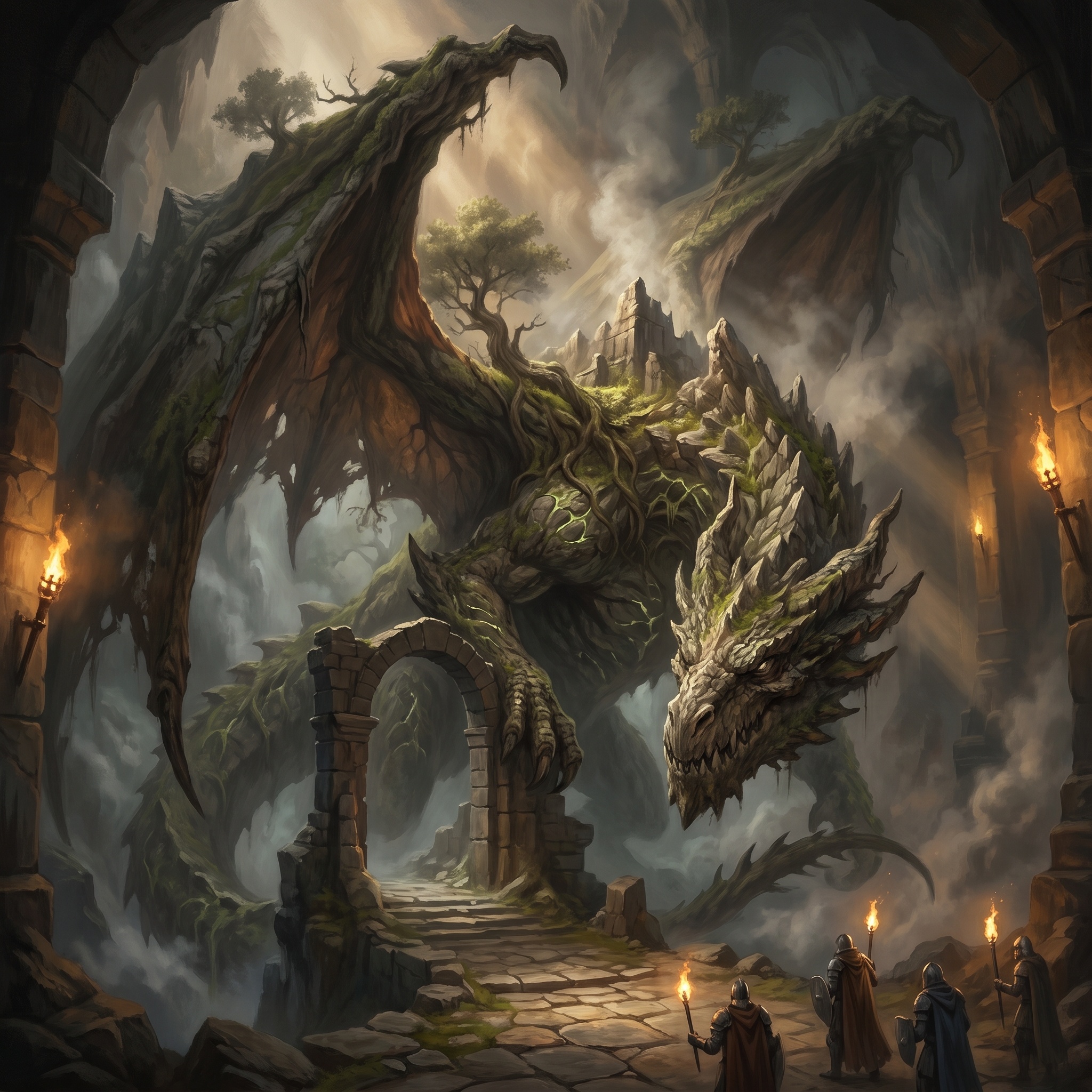
Role: Nemesis Campaign Apex Where It Appears: Ancient territories, legendary lairs, continental threats.
"The world adjusts to accommodate them. Not by choice. The world simply has less say than it did." — Natural Philosophy of Dragon Territory, author's warning, page one
What It Is
An elder dragon is not a harder dragon fight. It is a campaign premise with wings. Its territory is history, ecology, politics, and weather braided around an apex will. In Dort, elder true dragons are tied to the primary dragon expressions of the realm and should be treated as setting-scale powers.
An elder dragon encounter begins long before initiative. Supply lines fail, courts shift policy, local monsters move, and the landscape starts taking sides.
Ecology and Behavior
Elder dragons occupy ancient territories, legendary lairs, continental fault lines, and places where their type has had generations to rewrite the region. They think in seasons, bloodlines, migrations, mineral seams, tides, shadows, winds, and magical economies.
They negotiate only when negotiation is useful. They may be wise, monstrous, honorable, alien, or all of these depending on type and history. They are never just big reptiles with treasure.
Signs and Knowledge
Adventuring Lore, Planar Lore, or regional History (Hard) identifies elder-scale territory behavior. Survival (Average) notices that the land is responding before the dragon appears.
Other signs include old treaties still obeyed by villages, monsters moving out of pattern, type effects woven into roads and weather, and local legends functioning as practical survival advice.
Elder Dragon (Nemesis)
- Skills: Heavy Melee 5, Athletics 5, Fortitude 5, Perception 5, Planar Lore 5, Intimidation 5.
- Attacks: Elder Bite (Heavy Melee; Damage 15; Crit 3; Pierce 5); Elder Breath (Heavy Ranged; Damage 15; Crit 3; Range Long; type qualities). After using Elder Breath, this creature cannot use it again until the end of its next turn.
- Abilities: Territory Is Body — In its lair region, once per round create a terrain complication as an incidental.
- Abilities: Dread — Fear 4.
- Soul: No claimable coin exists; at death canon does not specify (default).
Tactics
An elder dragon controls environment first, destroys logistics, and negotiates only from superiority. It rarely commits to a fair fight unless pride, hunger, territory, or long strategy requires presence. In its lair region, terrain is an extension of intent.
Use an elder dragon as a campaign structure. Victory may mean treaty, evacuation, stolen leverage, territory healing, or surviving one audience.
Relics and Trade
| Find | Value | Use | Recovery |
|---|---|---|---|
| Shed elder scale | 10,000+ gold Flargons | Legendary armor, wards, diplomacy | Adventuring Lore (Hard), ownership matters |
| Lair-terrain core | Campaign value | Regional magic, treaty leverage | Usually requires consent or disaster |
| Corpse remains | Economy-changing | War, crowns, artifacts | Getting them is the least likely part |
Variants
- Territorial Sovereign: Rules through ecology and tribute.
- Sleeping Catastrophe: The campaign is about not waking it.
- Treaty Elder: Can be bargained with if ancient protocol is honored.
Ember Dragon
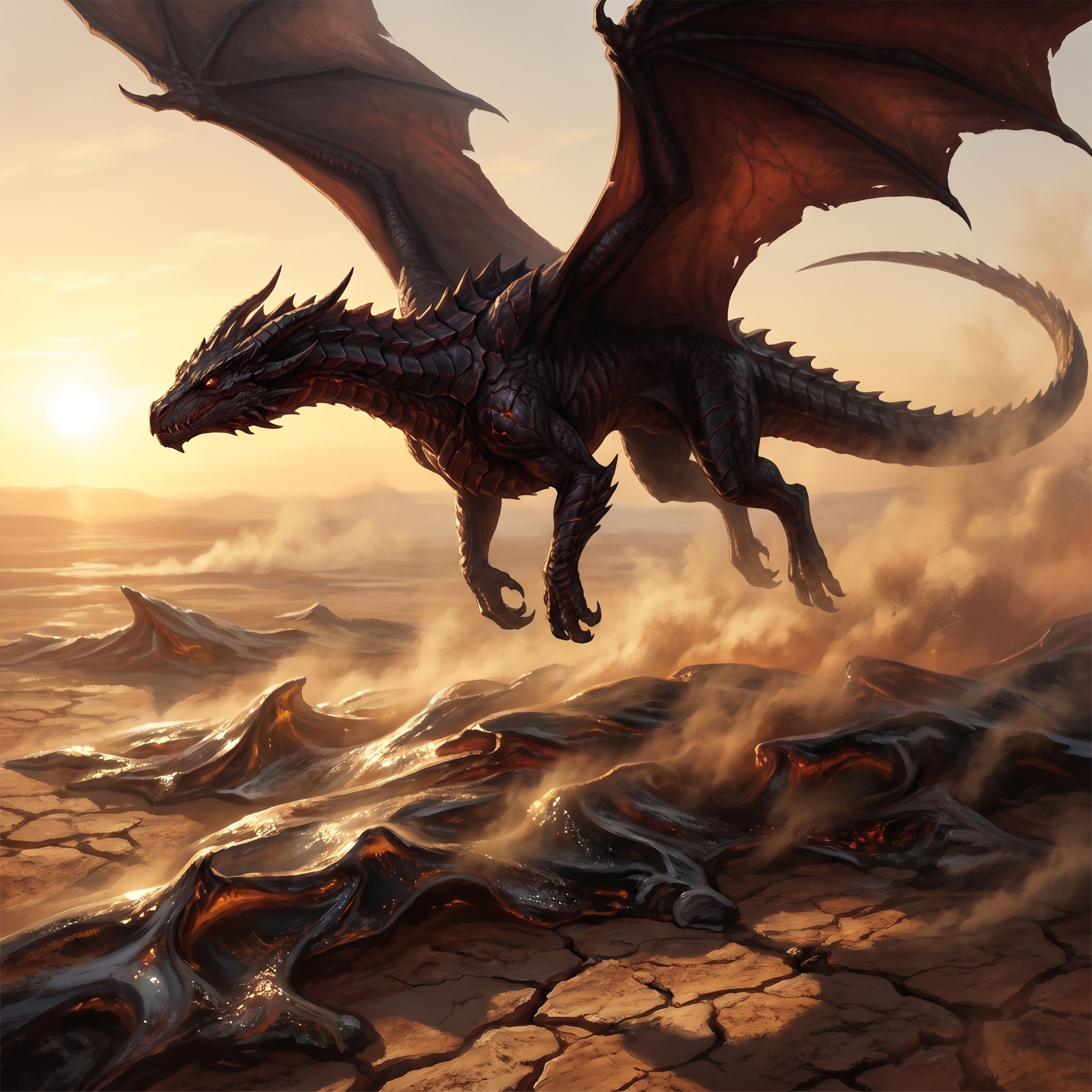
Role: Nemesis Apex Harrier Where It Appears: Deep deserts, volcanic badlands, glass fields, and heat-blasted lairs. Source: Dort Dragons - Ember Dragon.
"The glass is not a ruin. It is a feeding record. That field is where it hunted last season." — Desert route advisory, Jazirah Merchant Compact
The Ember Dragon is a flying furnace with a predator's patience. It kills from altitude, leaves glass where sand used to be, and treats fire as anatomy rather than spellcraft. Desert peoples speak of it like drought or wildfire: not evil, not negotiable, and never casual.
What It Is
An Ember Dragon is one of Dort's seven true dragons, aligned to the Fire Plane. Its body is long and lean by dragon standards, built for speed and high-temperature endurance. The dorsal scales run near-black to dark red, while the ventral surface glows like banked embers. Older individuals have a ceramic cracked texture across the scales, and the air around them bends with heat shimmer.
It does not breathe a vague cone of flame. It fires a focused stream hot enough to vitrify sand, melt stone surfaces, and cook large prey in a single pass. Glass fields across Jazirah and volcanic badlands often began as a hunting line.
Ecology and Behavior
Ember Dragons are deep-desert apex predators. They take large fauna, leaving scorched bones and glassy ground as feeding signs. Their territories can be enormous because one kill may feed them for days or weeks. They do not waste effort on every traveler. Most small groups cross a range without being attacked unless they approach a lair, interfere with a hunt, or look armed enough to matter.
Their presence changes the desert. Glass fields collect night condensation, shelter strange insects and reptiles, and become navigational landmarks. Scavengers follow dragon kills despite obvious danger because the nutrition is too great to ignore. Local tribes often know individual ranges better than any university map.
Ember Dragons are fully intelligent and highly selective. They remember intrusions, stolen remains, failed hunts, and insulting displays. A party that survives because the dragon left should not assume it won.
Signs and Knowledge
Field signs: fresh glass strips, heat haze without weather cause, white scorched bones, sulfur and heated-stone smell, desert predators shifting range, birds avoiding a column of air above a lair.
Survival or Adventuring Lore (Average): identifies fresh glass and knows the safe response is to change route immediately.
Natural Philosophy or Planar Lore (Hard): distinguishes Ember Dragon fire from mundane wildfire or volcanic activity and identifies cold, water, stone cover, and reflected heat as possible countermeasures.
Secret Lore (Severe): recognizes age and likely territory size from glass-field scale and burn pattern.
Ember Dragon (Nemesis)
- Skills: Heavy Melee 4, Athletics 4, Reflexes 5, Fortitude 5, Perception 4, Survival 4, Intimidation 4.
- Attacks: Bite (Heavy Melee; Damage 12; Crit 3; Pierce 3); Claws (Heavy Melee; Damage 10; Crit 4; Pierce 2); Tail (Heavy Melee; Damage 9; Crit 4); Fire Pass (Heavy Ranged; Damage 13; Crit 3; Range Medium; Burn 4, Pierce 4).
- Abilities: Focused Inferno — Breath weapon. Fire Pass may target one creature, vehicle, or zone-sized line at Medium range. Each additional uncancelled Success adds +1 damage as normal. Targets in flammable terrain also gain Burning 2 unless they spend an Action to extinguish it. After using Fire Pass as Focused Inferno, this creature cannot use it again until the end of its next turn.
- Abilities: Heat-Perfect Body — Immune to ordinary fire and heat. Magical or supernatural fire attacks add 2 Banes and reduce damage by 5 before Resistance.
- Abilities: Cold Aversion — Cold, heavy rain, deep water, or high-altitude freezing conditions reduce the dragon's Resistance by 2 and add 1 Bane to Fire Pass.
- Abilities: Thermal Sight — The dragon ignores darkness, smoke, and desert haze when detecting warm living targets.
- Abilities: Dread — Fear 3.
- Soul: No claimable coin exists; at death canon does not specify (default).
Tactics: First beat, the dragon attacks from Medium or Long range with Fire Pass. Second beat, it climbs and forces movement through burning terrain. Third beat, it dives on the most exposed target, then returns to altitude. If cold, heavy rain, or deep water changes the field, it withdraws, circles, and waits for the environment to favor it again.
Encounter Use: Ember Dragons punish open-ground fights. Give prepared parties canyons, stone shelters, sudden cold, water sources, reflective glass, or collapsed ruins they can exploit. The party should know the terrain is lethal before initiative starts.
Harvesting and Trade
Ember Dragon parts are valuable enough to fund wars and foolish expeditions. Most legitimate buyers demand proof the parts came from a dead or shed source rather than a poached nesting site. In Jazirah, some communities treat careless trade in Ember Dragon remains as a threat to everyone in the range.
| Harvest | Buyer | Check | Typical Value | Use | Complication |
|---|---|---|---|---|---|
| Fire-Organ Tissue | Alchemist, fire mage, military artificer | Severe Medicine | 30,000-100,000 gold Flargons | Fire resistance, furnace rites, destructive reagents | Spoils without immediate heat-stable preservation |
| Ceramic Scale Plates | Smith, glassworker, wardwright | Hard Survival or Craft | 4,000-12,000 gold Flargons | Heat shielding, forge tools, elite armor facing | Hot for hours after death; careless handling burns gear |
| Ember Blood | Alchemist, desert healer, poisoner | Hard Medicine | 5,000-15,000 gold Flargons per sealed vial | Heat-tolerance compounds, fire wards | Coagulates into useless slag if cooled too quickly |
| Thermal Eye Lens | Scryer, hunter, military scout | Severe Medicine or Natural Philosophy | 10,000-40,000 gold Flargons | Heat-sight instruments | On Calamity, the lens cracks and releases blinding heat |
Variants
Young Ember Dragon: Nemesis, RES 8, WND 34, Fire Pass Damage 10, Cold Aversion also triggers in ordinary rain.
Elder Ember Dragon: Nemesis, RES 9, WND 45, STR 28. Fire Pass affects Long range and can leave glass terrain that counts as dangerous ground for the rest of the scene.
Gale Dragon
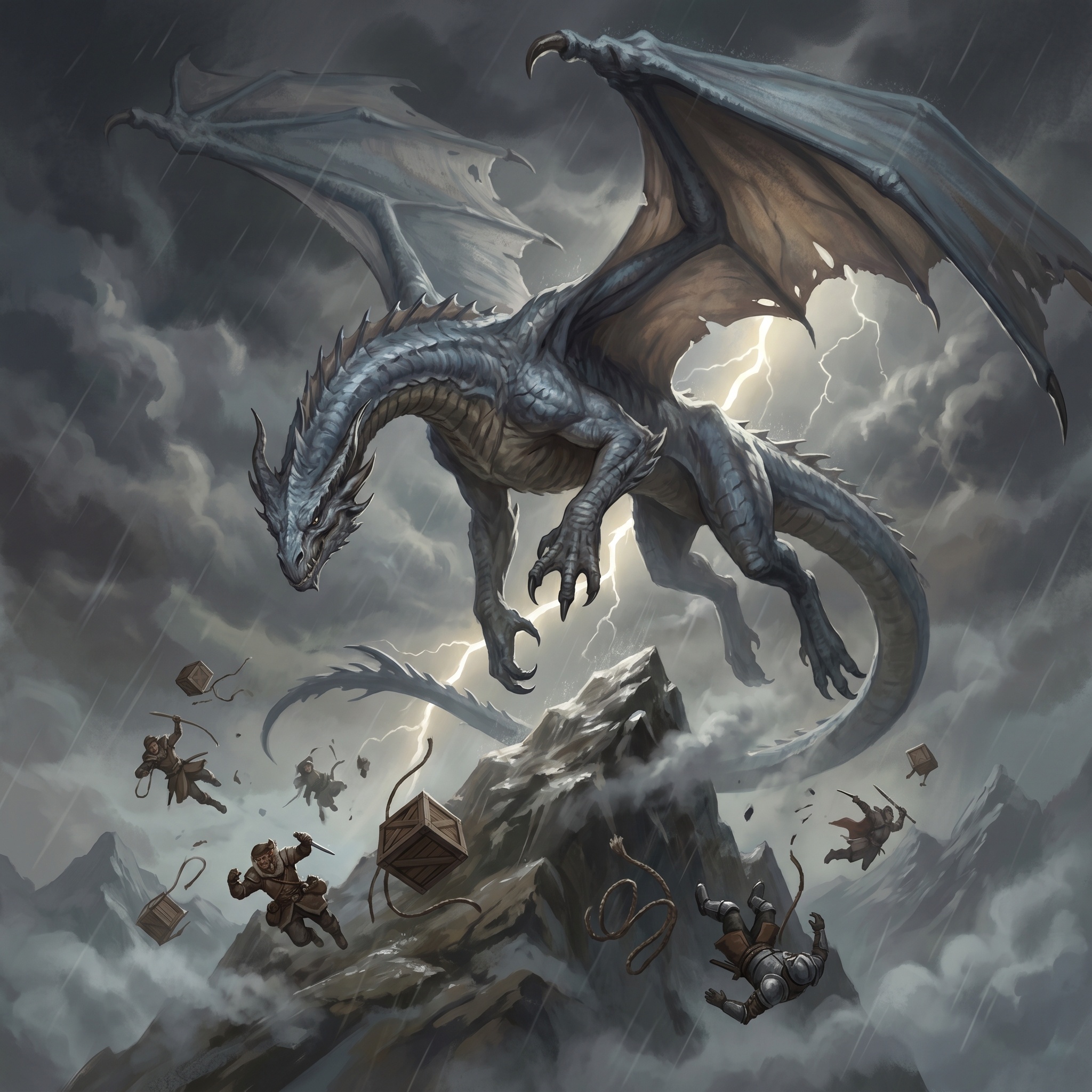
Role: Nemesis Apex Harrier Where It Appears: High mountains, open skies, storm corridors, and cliff nests. Source: Dort Dragons - Gale Dragon.
"You do not fight a Gale Dragon. You survive the angle it chose to approach from and hope it chose wrong." — Highland Survival Manual, Chon Buri Aerial Corps
The Gale Dragon wins by refusing the ground. It scatters formations, throws riders from mounts, and turns the air itself into a weapon. Travelers in its range do not watch the horizon; they watch the sky directly overhead.
What It Is
A Gale Dragon is one of Dort's seven true dragons, aligned to air and altitude. It is the smallest true dragon type, but the most agile and fastest in the sky. Its wings are extreme for its body, swept and long, with a pale sky-colored dorsal surface and darker overcast underside that make it difficult to see from above or below.
The Gale Dragon does not dominate by mass. It dominates by angle, altitude, and timing. A fight with one is usually a sequence of impacts from directions the party did not think were open.
Ecology and Behavior
Gale Dragons control high airspace. They hunt mountain birds, exposed highland megafauna, flying creatures, and anything foolish enough to occupy their sky. Their lairs are not caves but worked cloud formations: dense, persistent masses that hold interior spaces, lightning activity, and hoards of maps preserved on strange surfaces inside the cloud.
They are intelligent at a tempo that feels unfair. They make decisions quickly because their bodies demand it. They test wind, position, and fear in fractions of a moment. They are not reckless; they simply finish thinking before most creatures begin reacting.
Grounded parties may pass unnoticed if they keep low, avoid open ridges, and do not approach the lair cloud. Flying parties, airships, winged mounts, and cliffside camps are another matter. To a Gale Dragon, occupying the wrong altitude can be the same as trespass.
Signs and Knowledge
Field signs: a cloud that does not move with surrounding weather, sudden silence in the wind, mountain birds diving lower than normal, lightning scars below a persistent cloud, carcasses on exposed high ledges.
Survival or Adventuring Lore (Average): identifies unsafe exposed ridges, lair-cloud weather, and the need to leave high ground before clouds build.
Planar Lore or Natural Philosophy (Hard): identifies air-plane influence and predicts downdraft, pressure burst, and thin-air attack patterns.
Piloting or Riding (Hard): lets a flyer read the danger early enough to ground, anchor, or descend before the first pass.
Gale Dragon (Nemesis)
- Skills: Heavy Melee 3, Athletics 4, Reflexes 5, Perception 5, Survival 4, Piloting 5, Intimidation 3.
- Attacks: Claws (Heavy Melee; Damage 9; Crit 4; Pierce 2); Wing Shear (Heavy Melee; Damage 8; Crit 4; Blast 4); Diving Strike (Heavy Melee; Damage 11; Crit 3; Pierce 2, Vicious 5).
- Abilities: Downdraft — Breath weapon. Choose a zone at Medium range. Creatures in the zone make a Hard Athletics, Reflexes, Riding, or Piloting check. On failure, they are knocked Prone and pushed one range band. Flying targets that fail suffer Damage 8 before the movement. After using Downdraft, this creature cannot use it again until the end of its next turn.
- Abilities: Never Still — If the dragon moved this round, attacks against it at Medium range or farther add 1 Bane. Ranged attacks in high wind add another Bane.
- Abilities: Sky Claim — Once per round after a target fails a movement or balance check, the dragon may spend 1 Peril to move one range band as an incidental.
- Abilities: Dread — Fear 3.
- Soul: No claimable coin exists; at death canon does not specify (default).
Tactics: First beat, the dragon uses Downdraft to scatter the formation or cripple flight. Second beat, it isolates anyone near an edge, mount, glider, or flight rig. Third beat, it dives on a prone or separated target and climbs away before retaliation. On flat ground with no useful altitude, it simply leaves.
Encounter Use: Build the encounter around altitude, wind, ledges, flying craft, storm fronts, rope bridges, and shelter choices. A party should be able to improve its odds by getting under stone, grounding mounts, anchoring gear, or forcing the dragon into a narrow pass.
Harvesting and Trade
Gale Dragon remains are hard to recover because defeated individuals often fall into inaccessible terrain or vanish into weather. Shed wing membrane, respiratory tissue, and hoard maps are more plausible adventure rewards than a neatly butchered corpse.
| Harvest | Buyer | Check | Typical Value | Use | Complication |
|---|---|---|---|---|---|
| Wing Membrane Sheet | Aeronaut, sailmaker, light-armor artisan | Hard Medicine or Craft | 8,000-30,000 gold Flargons | Flight rigs, storm sails, flexible armor | Tears easily if removed after drying |
| Altitude Lung Tissue | Alchemist, healer, climber guild | Severe Medicine | 15,000-50,000 gold Flargons | Thin-air breathing compounds | Spoils rapidly below freezing cloud conditions |
| Storm-Polished Talon | Noble collector, weapon maker | Average Survival | 2,500-7,000 gold Flargons | Trophy, ritual knife, wind charm | Often claimed by highland communities as a warning relic |
| Lair Map Fragment | Cartographer, army scout, treasure hunter | Lore or Survival to authenticate | 1,000-50,000 gold Flargons | Lost passes, old borders, hidden routes | Some maps show routes that no longer exist |
Variants
Young Gale Dragon: Elite, RES 6, WND 18, Downdraft affects Short range and Never Still only works after a full move.
Elder Gale Dragon: Nemesis, RDEF 4, WND 42, STR 28. Downdraft may affect two adjacent zones, and the lair cloud counts as a regional storm hazard.
Gale Dragon of the Last Peak
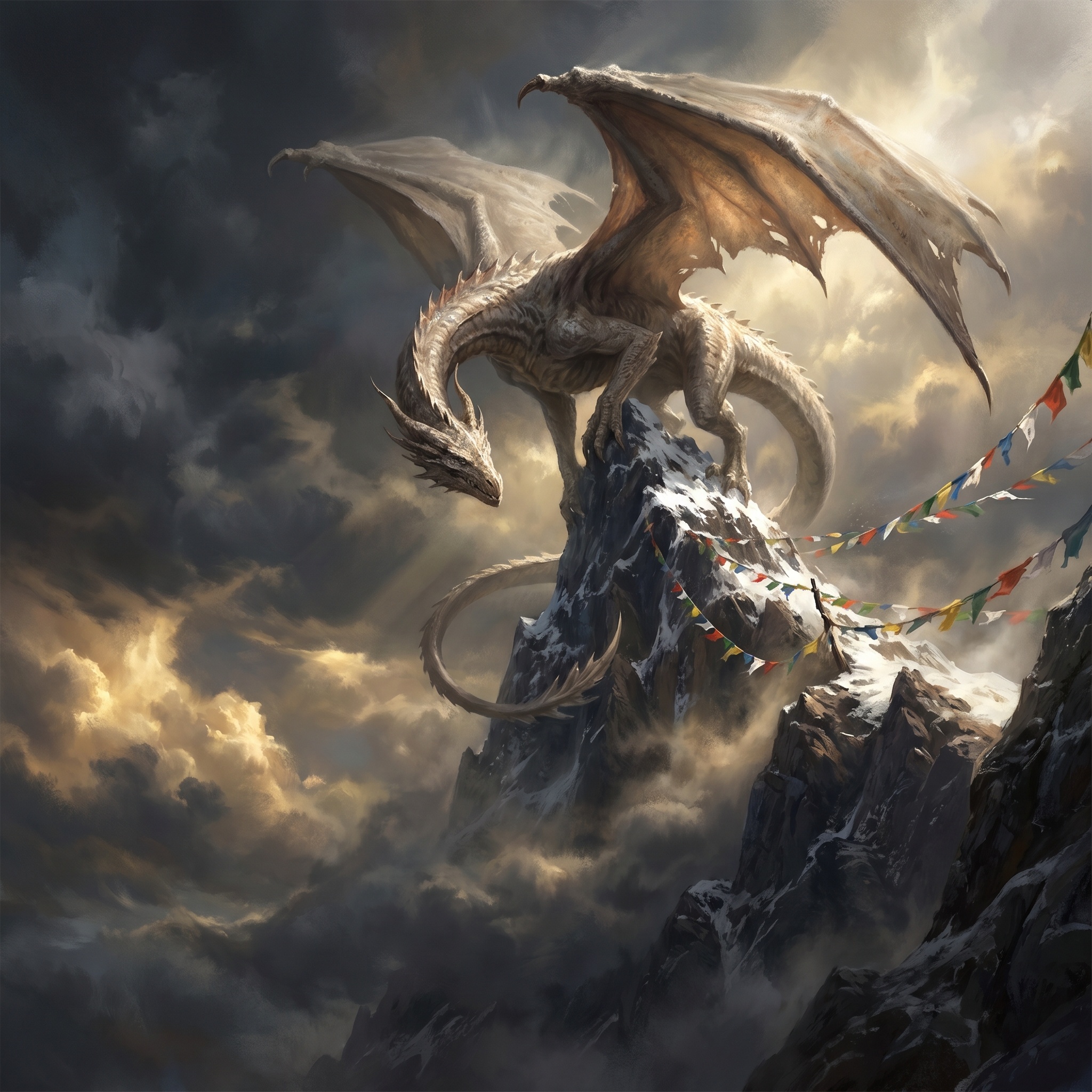
Role: Nemesis Sky Lair Apex Where It Appears: Highest peaks, storm roads, impossible bridges, pilgrim routes.
"It has held the pass for sixty years. Three expeditions have attempted it. None of the cartographers survived to update their maps." — Summit approach advisory, Last Peak Expedition Archive
This true Gale dragon has outlived every monastery that tried to name it. It treats climbers as weather unless they bring memory, song, or arrogance. It rarely kills pilgrims who turn back when warned. It always kills banners planted on its peak.
What It Is
The Gale Dragon of the Last Peak is a true dragon, not a drake, spirit, or local metaphor. It is the old sovereign of a needle mountain where the air thins into judgment. Its body is long, pale, and difficult to separate from cloud glare until it moves faster than the eye expected.
It has been named by monasteries, climbers, emperors, poets, and dying fools. None of the names lasted. The dragon remembers songs longer than stone and treats most mortal claims to the peak as weather noise.
Ecology and Behavior
The Last Peak is not simply high ground. It is an aerial territory of cliff roads, prayer flags, lightning-split bridges, old monasteries, and ledges where bones dry in clean air. The dragon hunts high-altitude beasts, flying predators, and trespassers who mistake survival for permission.
It is not needlessly cruel to pilgrims. A climber who turns back after the warning wind may live. A climber who plants a banner, builds a shrine without leave, or brings an army's flag onto the peak becomes a statement the dragon must answer.
Signs and Knowledge
Survival, Piloting, Riding, or Natural Philosophy (Hard) reads the Last Peak wind and identifies where a fall will become unrecoverable. Adventuring Lore or Lore (Hard) identifies old monastery records and knows which songs have previously bought conversation.
Other signs include flags shredded only above a certain elevation, cairns built beside empty boots, sudden stillness before impossible gusts, and monks who keep their proudest banners folded indoors.
Gale Dragon of the Last Peak (Nemesis)
- Skills: Athletics 5, Heavy Melee 5, Lore 4, Perception 5, Reflexes 5, Survival 5.
- Attacks: Sky Bite (Heavy Melee; Damage 15; Crit 3; Pierce 4); Peak-Gale Breath (Heavy Ranged; Damage 14; Crit 3; Range Long; Knockdown, Disorient 2). After using Peak-Gale Breath, this creature cannot use it again until the end of its next turn.
- Abilities: Last Peak Wind — Flying or climbing enemies within Medium range add 2 Banes unless anchored.
- Abilities: Choose the Fall — On 3 Boons with any attack, move the target one range band toward an edge or hazard.
- Abilities: Dread — Fear 3.
- Soul: No claimable coin exists; at death canon does not specify (default).
Tactics
The dragon tests resolve before it commits. It tears ropes, snaps ladders, scatters packs, and drops enemies into survivable terror so the wise can retreat. Once someone plants a claim on the peak or threatens the lair, the fight becomes lethal and vertical.
Use ledges, ropes, prayer bridges, ice, thin air, and warning gusts as active terrain. The dragon's goal is to make pride heavier than caution, then let gravity finish the argument.
Relics and Trade
No responsible harvest exists. Taking flesh from this dragon is a declaration against one of Dort's true dragons and may bring consequences far beyond the encounter. Shed material, old monastery records, and lost climbing relics are safer and more interesting treasure.
| Find | Value | Use | Recovery |
|---|---|---|---|
| Naturally shed flight scale | 2,000-4,000 gold Flargons | Wind wards, status proof, airship charms | Survival or Adventuring Lore (Hard), must prove it was shed |
| Peak-song manuscript | 1,000-8,000 gold Flargons | Negotiation with the dragon, monastery history | Lore or Performance (Average) |
| Fallen banner remains | Varies | Political evidence, family restitution | Survival (Average) on exposed ledges |
| Storm-polished horn sliver | 5,000-15,000 gold Flargons | Air magic focus | Rare; taking fresh horn creates blood debt |
Variants
- Merciful Peak Dragon: Allows retreat and honors true pilgrimage.
- Banner-Killer: Hunts any symbol of political claim.
- Storm-Oracle: Answers one song with one dangerous truth.
Glasswing Drake
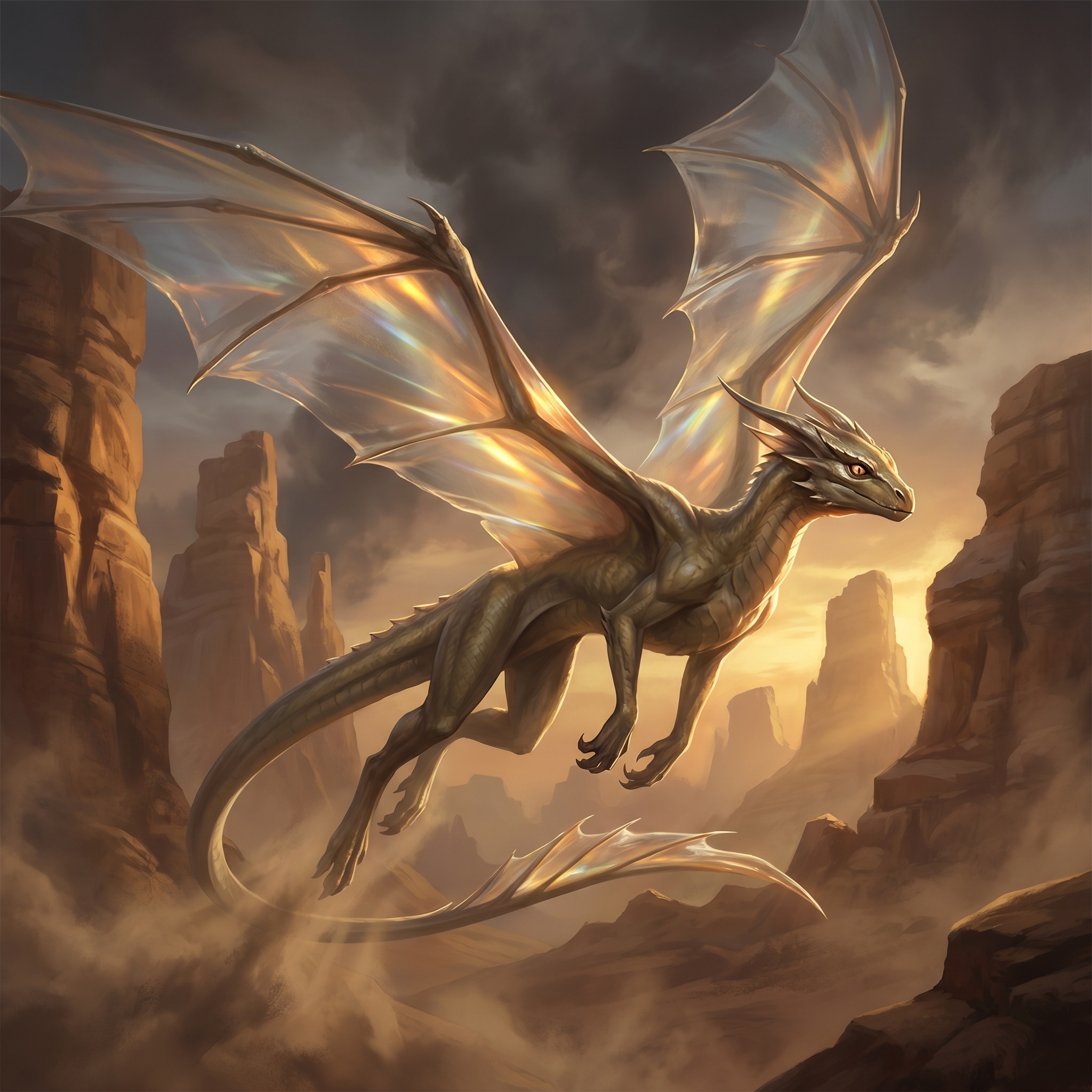
Role: Elite Aerial Harrier Where It Appears: Glass fields, deserts, Prism or Ember-adjacent territory.
What It Is
Glasswing drakes dazzle prey before striking. Their wings are fragile but beautiful enough to get fools killed. In bright sun they vanish into glare, then return as cutting talons and reflected heat.
They are draconic harriers adapted to glass fields, deserts, and Prism or Ember-adjacent territories.
Ecology and Behavior
Glasswing drakes nest in high reflective places: glass ridges, salt flats, ruined observatories, and sun-baked towers. They hunt by driving prey into glare and exhaustion. Broken wing panels are common around nests because rivals fight brutally for reflective perches.
They collect shiny objects for practical reasons. Reflections help hide the nest and dazzle intruders.
Signs and Knowledge
Survival or Perception (Hard) identifies moving glare as a drake rather than heat shimmer. Craft (Average) recognizes shed wing panels.
Other signs include cut shadows, blinding flashes before attacks, prey with shallow slicing wounds, and nests lined with mirror-bright debris.
Glasswing Drake (Elite)
- Skills: Reflexes 5, Heavy Melee 3, Perception 4, Stealth 3 in glare.
- Attacks: Glass Talons (Heavy Melee; Damage 7; Crit 4; Bleeding 1); Dazzle Flash (Willpower; Damage 5 Strain; Range Short).
- Abilities: Sun Dazzle — In bright light, attacks against it add 1 Bane unless eyes are shielded.
- Soul: No claimable coin exists; at death canon does not specify (default).
Tactics
A glasswing drake flashes, dives, and retreats toward the sun. It attacks eyes, reins, exposed hands, and anyone trying to aim upward. If clouds cover the light, it becomes more cautious.
Use glare as terrain. Eye coverings, shade, smoke, and fighting at dusk change the encounter.
Harvesting and Trade
| Component | Value | Use | Harvest |
|---|---|---|---|
| Intact wing panels | 1,000-2,500 gold Flargons | Lenses, signal mirrors, light wards | Survival and Craft (Hard) |
| Reflective talons | 400-1,200 gold Flargons | Cutting tools, prism foci | Survival (Average) |
| Sun-oil gland | 500-1,400 gold Flargons | Anti-glare polish, flare alchemy | Medicine (Average) |
Variants
- Salt-Flat Glasswing: Nearly invisible at noon.
- Observatory Nester: Uses old mirrors and lenses as lair defenses.
- Ember-Glare Drake: Adds heat shimmer and minor burns to its dives.
Lesser Drake
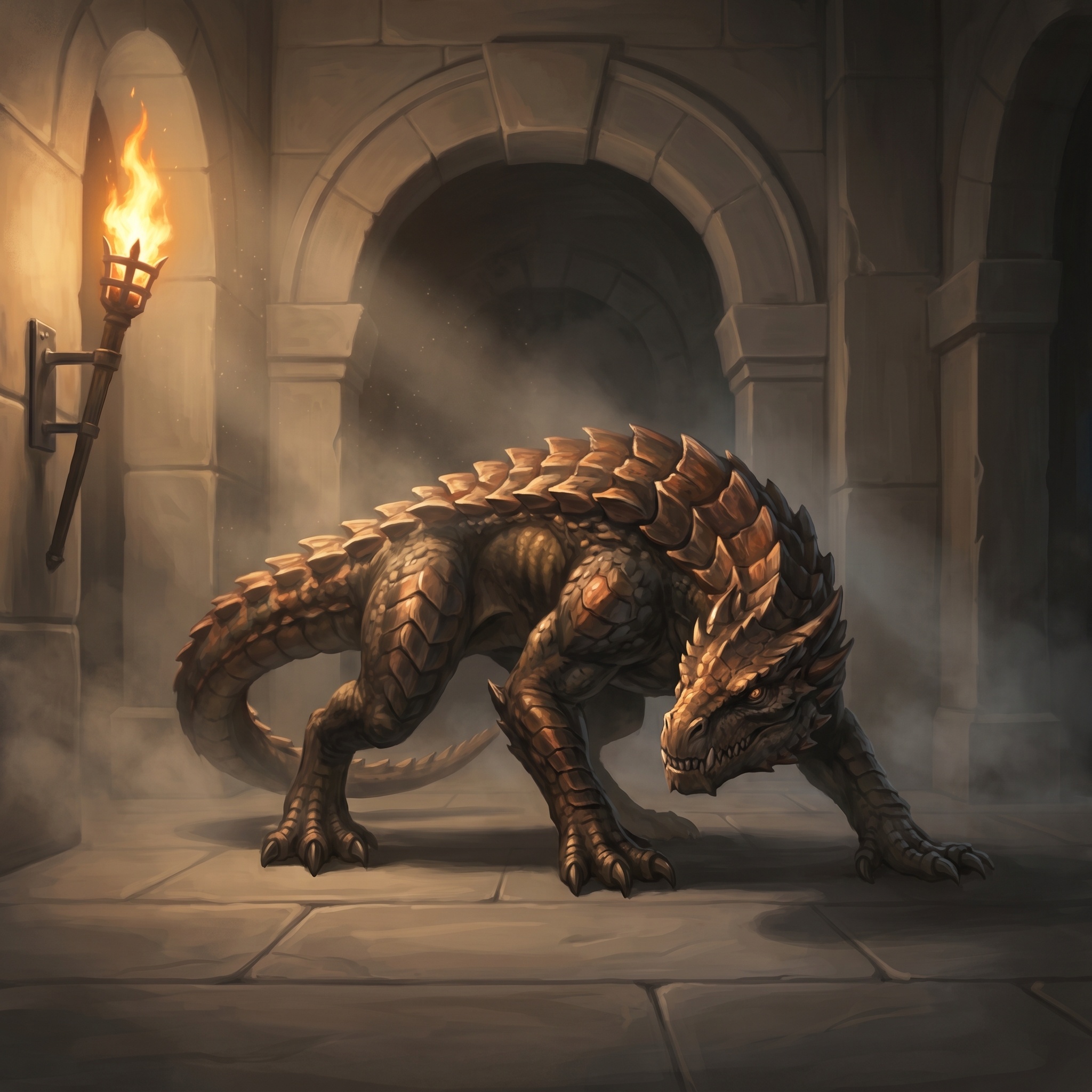
Role: Elite Bruiser Where It Appears: Highlands, ruins, dry forests, dragon-adjacent ranges.
What It Is
Lesser drakes are not true dragons. They are dangerous draconic animals with territorial aggression and little patience. They have enough draconic shape to inspire bad assumptions and enough animal instinct to punish them.
They make good regional predators in places touched by dragons without making every encounter about a true dragon's politics.
Ecology and Behavior
Lesser drakes appear in highlands, ruins, dry forests, dragon-adjacent ranges, and old roads where pack animals are common. They den in warm stone, broken towers, and root-caves with narrow approaches.
They are territorial more than hungry. A drake may drive intruders away, then return to smash abandoned gear or drag off a mount.
Signs and Knowledge
Survival or Adventuring Lore (Average) distinguishes lesser drake signs from young true dragon signs. Perception (Average) spots tail-sweep scars near den mouths.
Other signs include clawed warning rocks, gnawed tack, shed plates smaller than true dragon scales, and game trails that detour around sunning stones.
Lesser Drake (Elite)
- Skills: Heavy Melee 3, Athletics 4, Fortitude 4, Perception 3.
- Attacks: Drake Bite (Heavy Melee; Damage 9; Crit 3; Pierce 2); Tail Sweep (Heavy Melee; Damage 7; Crit 4; Knockdown on 2 Boons).
- Abilities: Territorial Rush — First attack against intruders in its den adds 1 Boon.
- Soul: No claimable coin exists; at death canon does not specify (default).
Tactics
A lesser drake charges, bites, and drives intruders away. It opens with Territorial Rush, then uses tail sweeps to keep space around the den. If badly wounded, it retreats to terrain too narrow for mounted pursuit.
Use it to make wilderness movement costly without invoking true dragon diplomacy.
Harvesting and Trade
| Component | Value | Use | Harvest |
|---|---|---|---|
| Hide and teeth | 400-1,000 gold Flargons | Armor trim, trophies, tools | Survival (Average) |
| Den musk gland | 200-700 gold Flargons | Repellent, lure, territory marker | Medicine or Survival (Average) |
| Back plates | 500-1,400 gold Flargons | Shields, scale tests | Craft or Survival (Average) |
Variants
- Ruin Drake: Uses broken walls and stairs as den defenses.
- Dry-Forest Drake: Ambushes from brush and fallen trees.
- Range Bull: Larger solitary drake that dominates a mountain pass.
Ore Dragon
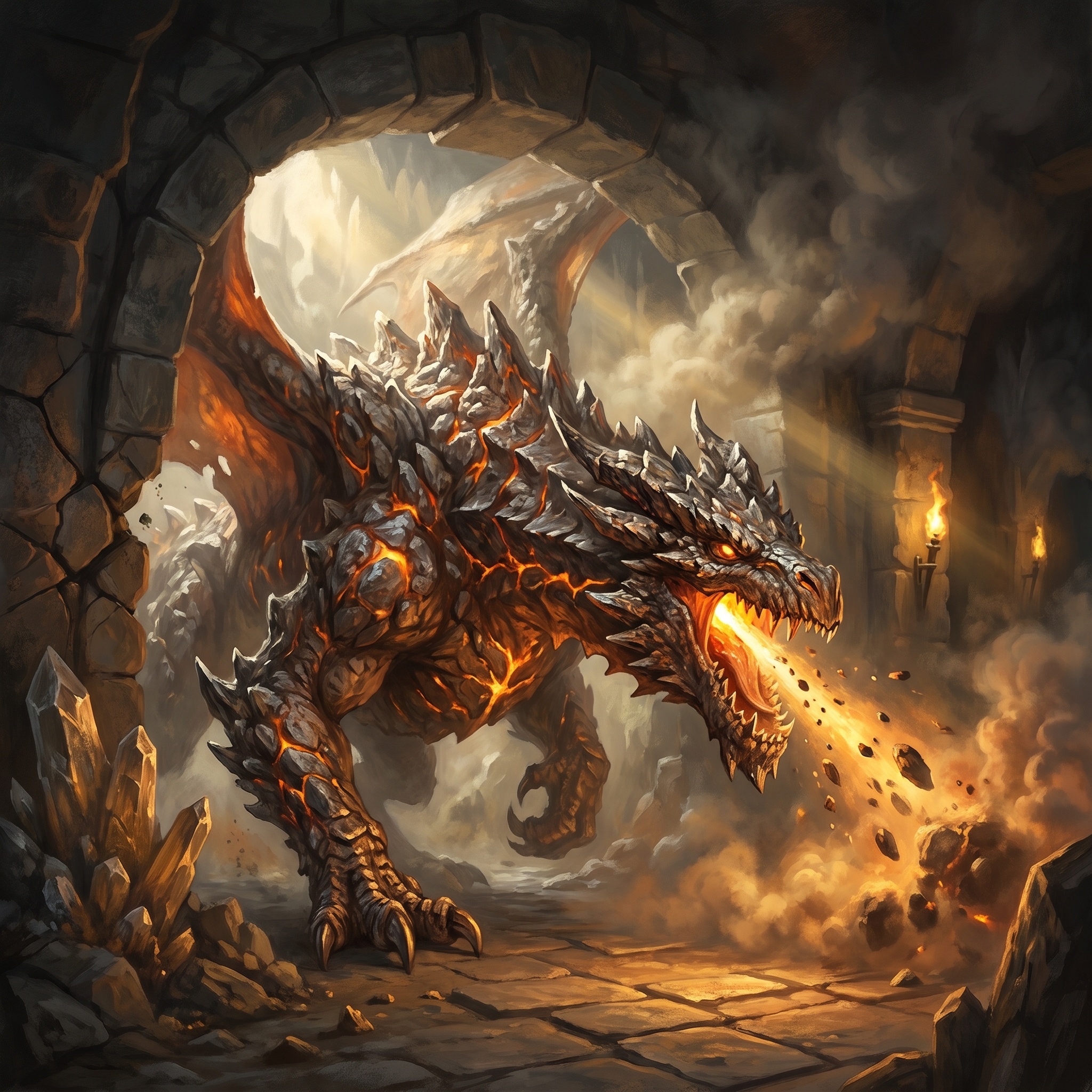
Role: Nemesis Apex Bruiser Where It Appears: Deep mines, ore veins, mountain roots, and abandoned dwarven works. Source: Dort Dragons - Ore Dragon.
"The quakes began three years before the attack. We logged them as geological. The surveyors who disagreed were correct." — Mining authority incident report, Quillian Deep, 3071 ME
The Ore Dragon is a moving mine collapse. Its hide incorporates metal and stone over centuries, and its lair is usually mistaken for a geological disaster until it starts thinking. Miners in its range do not ask whether the deep earth is dangerous; they ask whether it is occupied.
What It Is
An Ore Dragon is one of Dort's seven true dragons, aligned to mineral and deep stone. It is the largest and physically strongest of the seven. Its body is broad, dense, and built to move through solid rock. Older individuals carry mineral streaks in their scales, so a dragon that has lived in copper-rich territory may show green-blue metallic veining across black iron hide.
Its lair has no door. A true Ore Dragon lair is a sealed chamber in deep rock, accessible because the dragon passes through the earth. Mortal tunnels near it are not approaches; they are mistakes waiting to become tombs.
Ecology and Behavior
Ore Dragons reshape geology over centuries. Their passage creates tunnels, alters water tables, exposes mineral-rich stone, and leaves smooth-walled body-profile passages that later become habitats for deep creatures. Their presence may be recorded by surveyors long before anyone knows the cause: subsidence, missing foundation stones, rhythmic tremors, and mines abandoned for reasons the old records describe only as "the ground answered."
They are intelligent territorial strategists. An Ore Dragon knows its territory three-dimensionally: surface, tunnel, cavity, stress point, and ore vein. It does not attack because it is startled. It attacks after choosing the exact point where the ground will fail.
Ore Dragons rarely pursue on the surface. If prey moves away from the chosen strike point, the dragon may wait, reposition, or ignore it. If a fortress, mine, or town offends it, the attack begins below the foundations long before defenders see a scale.
Signs and Knowledge
Field signs: rhythmic deep tremors, animals staring at the ground, burrowing animals abandoning warrens, missing cornerstones, smooth oval tunnels through hard rock, metallic streaking in altered stone.
Survival, Adventuring Lore, or Craft (Average): identifies unnatural ground movement, unsafe mine signs, and the need to evacuate rather than investigate.
Natural Philosophy or Craft (Hard): distinguishes Ore Dragon passage from ordinary mining, sinkholes, or earthquakes.
Secret Lore or Planar Lore (Severe): identifies mineral-plane influence and predicts likely strike points from terrain stress.
Ore Dragon (Nemesis)
- Skills: Heavy Melee 5, Athletics 5, Fortitude 5, Perception 4, Natural Philosophy 4, Survival 3, Intimidation 4.
- Attacks: Crushing Bite (Heavy Melee; Damage 13; Crit 3; Pierce 4); Claws (Heavy Melee; Damage 11; Crit 4; Pierce 3); Tail Slam (Heavy Melee; Damage 10; Crit 4; Knockdown on 2 Boons).
- Abilities: Molten Rock Cast - Breath weapon. Heavy Ranged attack at Medium range, Damage 12, Crit 3, Blast 5, Burn 3, Pierce 3. On 2 Banes, the target area becomes difficult terrain.
- Abilities: Mineral Hide - Reduce Pierce from non-siege weapons by 2 before applying it. Hand weapons that deal 0 Wounds after Resistance may be damaged or lodged at the GM's discretion.
- Abilities: Burrow Through Stone - The dragon moves through natural stone at Short speed and leaves unstable tunnels behind. Following requires an Average Athletics or Adventuring Lore check; failure causes 3 Wounds from collapse and delay.
- Abilities: Ore Sense - Detects metal masses, armor, coins, and worked tools at Medium range through stone.
- Abilities: Dread - Fear 3.
- Soul: No claimable coin exists; at death canon does not specify (default).
Tactics: First beat, the dragon seals exits, breaks flooring, or attacks from below. Second beat, it uses Molten Rock Cast on grouped or armored targets. Third beat, it burrows to flank, collapse cover, or withdraw beneath the surface. It only stays aboveground when the terrain prevents escape or when it is certain it can end the fight.
Encounter Use: Ore Dragons are best in mines, vaults, deep roads, fortresses, and underground rivers where the battlefield can literally close. Give the party warning through tremors and animal behavior. Give prepared parties a reason to lure the dragon onto reinforced or open ground.
Harvesting and Trade
Ore Dragon remains are among the most economically dangerous materials in Dort. Mining houses, military powers, scholars, and kings all want them. The remains are also heavy enough that extraction may require an expedition of its own.
| Harvest | Buyer | Check | Typical Value | Use | Complication |
|---|---|---|---|---|---|
| Mineral Scale Plate | Armorer, metallurgist, noble house | Hard Craft or Survival | 7,000-25,000 gold Flargons | High-stress armor, vault doors, heat and pressure tools | Metal content varies by territory; fraud is common |
| Geological Sense Organ | Natural philosopher, deep-mining guild | Severe Medicine or Natural Philosophy | 30,000-120,000 gold Flargons | Deep navigation instruments, ore detection | Removing it intact may trigger postmortem tremors |
| Dense Bone Beam | Architect, siege engineer, temple builder | Hard Medicine or Craft | 10,000-40,000 gold Flargons | Load-bearing structures, sacred supports | Transport requires cranes, beasts, or magic |
| Hoarded Foundation Stone | Original settlement, historian, rival lord | Lore to authenticate | 1,000-200,000 gold Flargons | Proof of destroyed sites, legal claims, relic restitution | Returning one may reopen old land disputes |
Variants
Young Ore Dragon: Nemesis, RES 6, WND 24, no Mineral Hide reduction, Burrow Through Stone leaves obvious surface cracks.
Elder Ore Dragon: Nemesis, RES 9, WND 45, STR 32. Burrow Through Stone may collapse a zone once per encounter, and Ore Sense extends to Long range through stone.
Ore Dragon Under-King
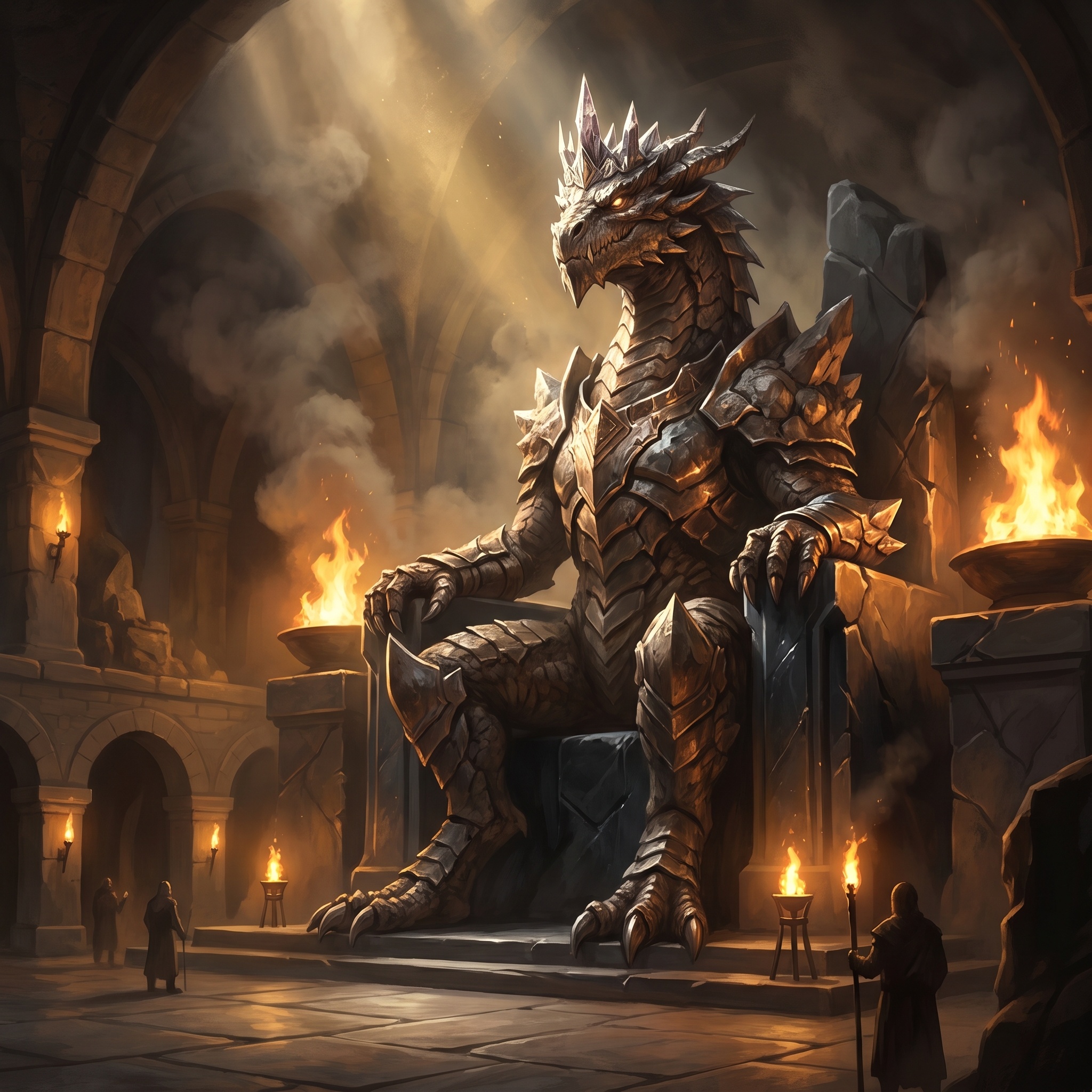
Role: Nemesis Subterranean Sovereign Where It Appears: Deep mines, sealed undercities, Ore dragon tribute realms.
"It did not destroy the mines. It absorbed them. The tunnels still exist. They lead somewhere different now." — Deep Road Survey, restricted, Quillian Authority
The Under-King is a dragon-adjacent ruler who governs by vein-right. Miners under its rule are not slaves in its own language; they are citizens who owe labor to the mountain. It bargains, taxes, marries dynasties, and buries rebels alive with ceremony.
What It Is
The Ore Dragon Under-King is a sovereign shaped by Ore dragon pressure, subterranean law, and generations of tribute politics. Some are true dragon kin. Some are ancient drakes invested with regalia. Some are not biologically draconic at all, but have been altered so thoroughly by ore, oath, and mountain magic that the distinction matters only to scholars.
The Under-King's body resembles a crowned drake of stone, iron, and mineral scale. Its voice carries through supports and mine rails. When it speaks in a deep hall, every pick, nail, hinge, and sword seems to answer.
Ecology and Behavior
The Under-King rules rather than merely lairs. Its domain may include mining towns, sealed undercities, tribute roads, smelters, ancestral vaults, and old Ore dragon borders. It taxes labor, regulates tunnels, grants vein-rights, and decides which families may cut which stone.
Its rule can be brutal without being chaotic. Miners may have courts, festivals, contracts, and food security under its reign. Rebels may also be sealed alive behind ceremonial stone. The GM should treat the Under-King as a political problem with a monster's body, not a random cave boss.
Signs and Knowledge
Craft, Warfare, or Lore (Hard) identifies the Under-King's law marks on supports, ingots, and tunnel doors. Draconic Lore or Natural Philosophy (Hard) distinguishes its Ore-touched authority from ordinary mine magic.
Other signs include tax tablets hammered into stone, tunnels that close after unpaid shipments, miners who call themselves citizens of the mountain, and diplomatic gifts made from the same vein as the recipient's ancestral weapons.
Ore Dragon Under-King (Nemesis)
- Skills: Leadership 5, Craft 5, Fortitude 5, Heavy Melee 5, Negotiation 4, Perception 4.
- Attacks: Royal Maul (Heavy Melee; Damage 15; Crit 3; Pierce 4); Iron Edict (Leadership; Damage 9 Strain; Crit 4; Range Medium).
- Abilities: Mountain's Due - Once per round in stone terrain, create a wall, fissure, or falling-rock hazard at Short range.
- Abilities: Tax the Blade - The first time each enemy hits the Under-King with a metal weapon, that weapon gains a temporary flaw until repaired.
- Abilities: Dread - Fear 3.
- Soul: No claimable coin exists; at death canon does not specify (default).
Tactics
The Under-King seals exits before battle looks inevitable. It isolates leaders, separates armed guests from retainers, and turns familiar tunnels into courtrooms with teeth. In a fight, it opens fissures, forces enemies to choose between position and equipment, then offers surrender terms that cost dearly.
It prefers victory that can be recorded. Captured enemies may become hostages, tax debtors, treaty witnesses, or examples carved into a gate. Killing everyone is less useful than making the next delegation bring the right tribute.
Relics and Trade
The crown and treaty tablets matter more than flesh. Dismembering the Under-King may start a succession war, while authenticating regalia can decide who controls an entire mining realm.
| Relic | Value | Use | Recovery |
|---|---|---|---|
| Under-King's crown | 10,000-40,000 gold Flargons, or a legal claim | Succession proof, museum prize, treaty focus | Lore, Negotiation, or Draconic Lore (Hard) |
| Treaty tablets | 5,000-15,000 gold Flargons each | Mine rights, old debts, political leverage | Investigation or Craft (Average) |
| Vein-right seal | 3,000-9,000 gold Flargons | Opens sealed shafts, proves authority | Craft or Secret Lore (Hard) |
| Royal scale-metal | 2,000-7,000 gold Flargons | Ore wards, prestige armor facing | Craft (Hard), ownership disputed by miners |
Variants
- Lawful Tyrant: Cruel but stable, with subjects who fear the alternative.
- Usurper Under-King: Holds the crown without ancestral right.
- Ore Dragon Vassal: Rules openly as steward for a true Ore dragon.
Oreback Drake
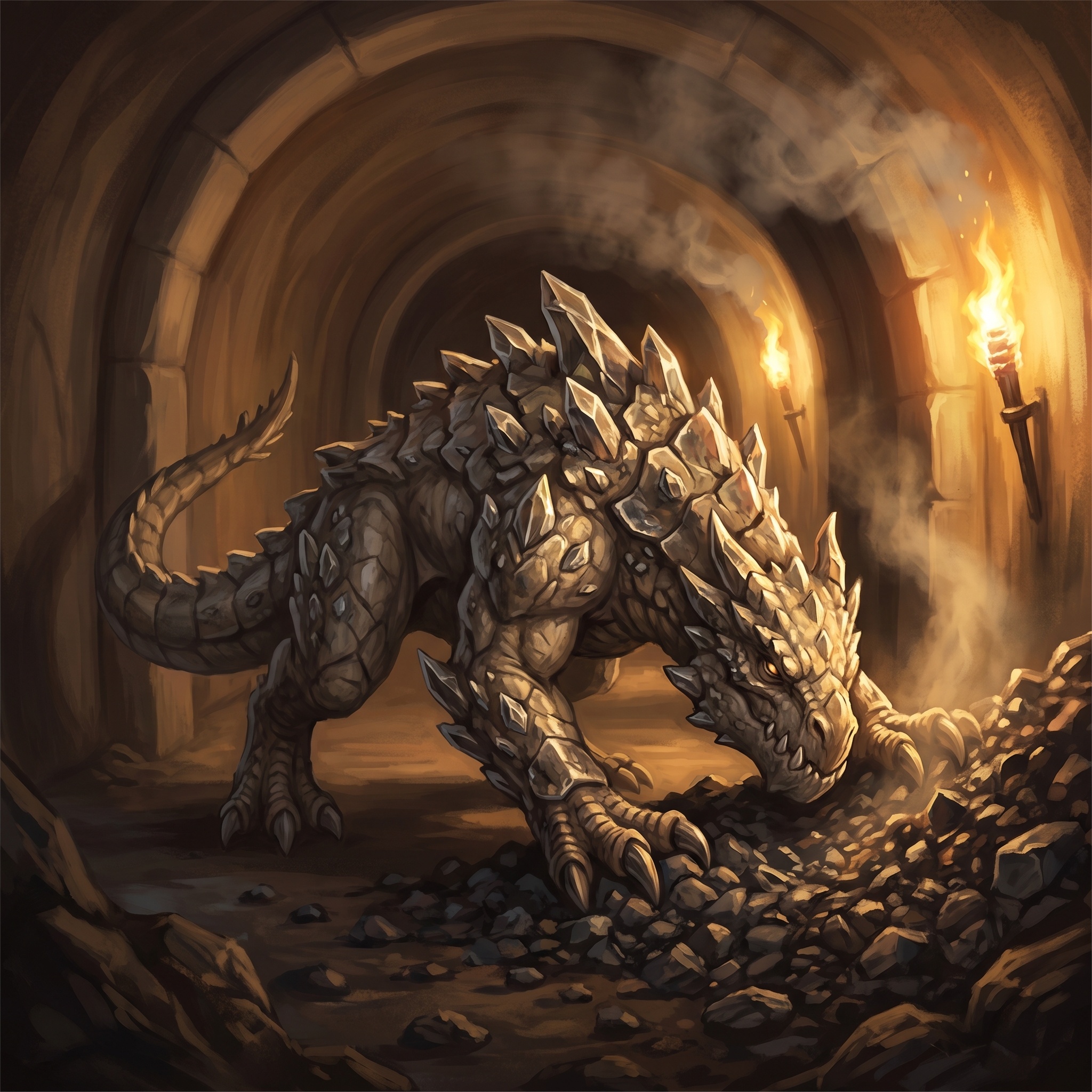
Role: Elite Bruiser Where It Appears: Mines, mountain scree, Ore Dragon territories.
What It Is
Oreback drakes feed on mineral-rich stone and small animals. Miners hate them because they ruin supports while looking for salt. Their backs carry mineral plates that vary by range, giving each specimen a local signature.
They are not Ore Dragons. They are stubborn draconic beasts adapted to stone, metal, and bad footing.
Ecology and Behavior
Oreback drakes live in mines, mountain scree, Ore Dragon territories, dry ravines, and collapsed forges. They chew stone for minerals and damage supports accidentally or deliberately while widening feeding paths.
They are territorial around salt licks, ore seams, and warm scree. Miners sometimes track them for rich veins, which is a good way to lose a crew.
Signs and Knowledge
Mining, Survival, or Draconic Lore (Average) identifies oreback feeding marks. Craft (Average) spots supports weakened by chewing.
Other signs include mineral dust on claw marks, half-eaten tool heads, scree piles that shift at night, and tunnels widened at drake shoulder height.
Oreback Drake (Elite)
- Skills: Heavy Melee 4, Athletics 4, Fortitude 5, Perception 3.
- Attacks: Ore Bite (Heavy Melee; Damage 10; Crit 4; Pierce 3); Plate Slam (Heavy Melee; Damage 8; Crit 4; Knockdown).
- Abilities: Stone Chewer - Can damage stone, doors, and supports as if using tools.
- Soul: No claimable coin exists; at death canon does not specify (default).
Tactics
An oreback drake bites armor, breaks footing, and retreats into scree. It uses Stone Chewer to turn doors, supports, and cover into liabilities. It is slow to anger but hard to stop once it commits.
Use it when terrain stability matters. Every strike near a mine support should make the room more tense.
Harvesting and Trade
| Component | Value | Use | Harvest |
|---|---|---|---|
| Ore plates | 800-1,800 gold Flargons | Armor, mineral surveys, forge catalysts | Craft or Survival (Average) |
| Stone-chewer teeth | 500-1,400 gold Flargons | Mining tools, drills, charms | Survival (Average) |
| Salt gut stones | 200-900 gold Flargons | Prospecting, alchemy | Medicine (Average) |
Variants
- Ironback: Stronger plates and magnetic dust around the den.
- Salt-Seam Drake: More aggressive around sweat, blood, and pack animals.
- Forge Ruin Drake: Sleeps in old slag and chews through worked metal.
Prism Dead-Zone Elder
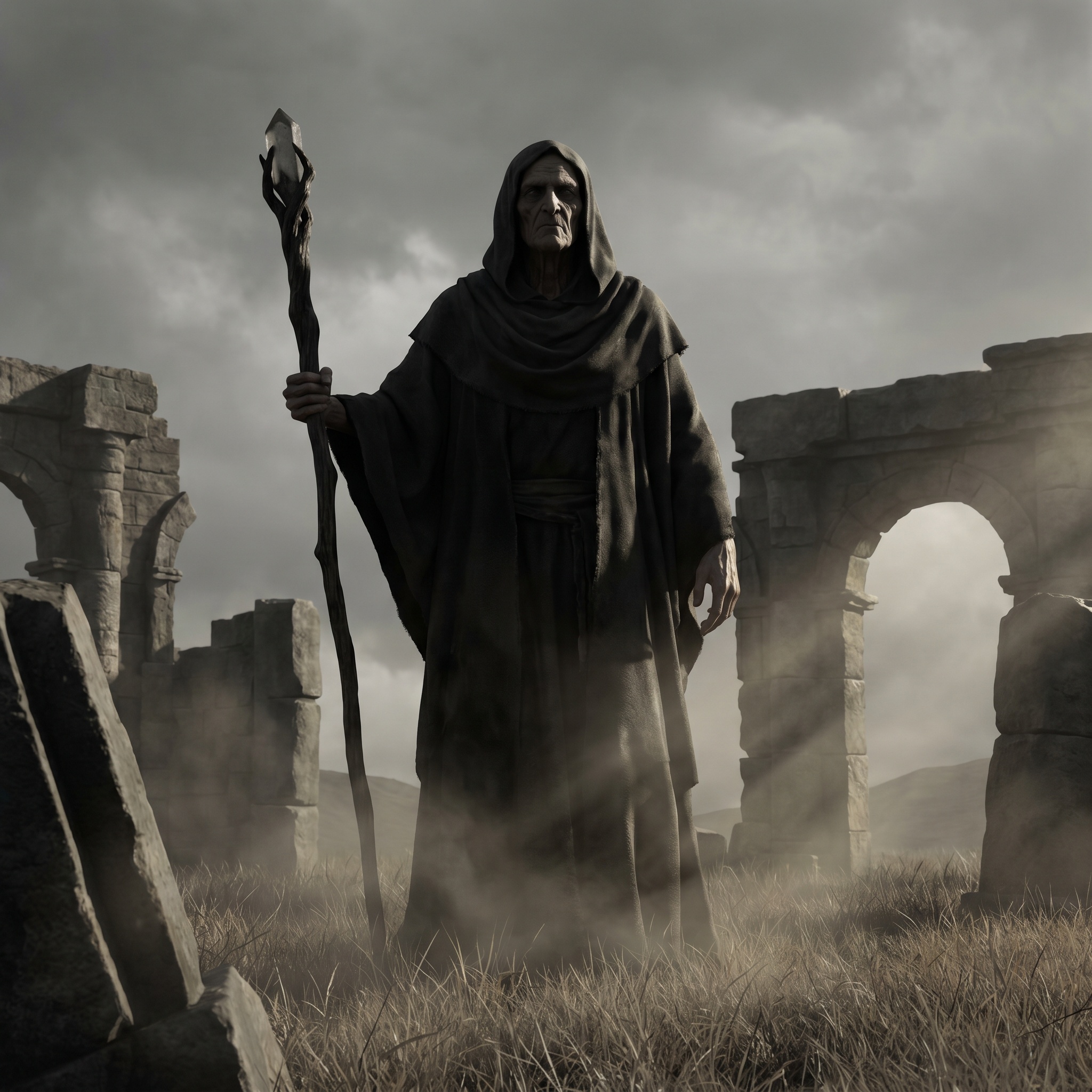
Role: Nemesis Anti-Magic Territorial Ruler Where It Appears: Prism-drained valleys, failed spell battlefields, villages that have forgotten color.
"The magic does not come back. Not the ley lines, not the minor workings, not the luck charms. Everything in a four-mile radius reads as spent. The dragon is still there." — Arcane Faculty anomaly report, Sentient Spire, 3101 ME
What It Is
The Elder was once a guardian of a bright place. Now it rules the blank center of a Prism dead-zone, a region where magic does not fail so much as lose interest. It is lucid, patient, and convinced that spellcasters are a weather event that must be prevented.
Ecology and Behavior
The Elder rules a colorless territory of muted magic, flat light, and people who have adapted to absence. It does not hate all visitors. It hates the return of uncontrolled spellwork and treats mages like flood, fire, or plague.
Villages inside the dead-zone may prefer the Elder's harsh stability to the magical disasters that came before. Removing it may restore color and danger together.
Signs and Knowledge
Planar Lore, Secret Lore, or Survival (Hard) maps the dead-zone edges. Medicine or Perception (Average) notices people inside the zone have adapted to low magic and muted color.
Other signs include spells losing texture before failing, pigments going dull, magical creatures avoiding the valley, and locals measuring distance by where color returns.
Prism Dead-Zone Elder (Nemesis)
- Skills: Readiness 5, Fortitude 5, Heavy Melee 4, Perception 5, Planar Lore 4, Survival 4.
- Attacks: Colorless Staff (Heavy Melee; Damage 10; Crit 3; Disorient 2); Null Glare (Arcana; Damage 8; Crit 4; Range Short; ignores magical concealment).
- Abilities: Dead-Zone Aura - Spells and magical item activations within Short range add 2 Banes. On a Calamity, the effect fizzles with no refund.
- Abilities: Drain Color - When a magical effect fails inside the aura, the Elder heals 4 Wounds or 4 Strain.
- Abilities: Dread - Fear 3.
- Soul: No claimable coin exists; at death canon does not specify (default).
Tactics
The Elder stands in the open, forces casters to enter the dead-zone, and punishes anyone protecting them. It invites magical overconfidence because failure feeds it.
Evidence and Trade
| Find | Value | Use | Recovery |
|---|---|---|---|
| Reliable dead-zone map | 1,000-2,500 gold Flargons | Military planning, safe travel | Planar Lore or Survival (Hard) |
| Colorless staff fragments | 1,500-4,000 gold Flargons | Anti-magic research | Secret Lore (Hard) |
| Dull soil samples | 300-1,200 gold Flargons | Dead-zone detection | Natural Philosophy (Average) |
Variants
- Village Elder: Locals defend it as protector.
- Battlefield Elder: Hates war magic above all else.
- Monastery Elder: Enforces a doctrine of magic abstinence.
Prism Dragon
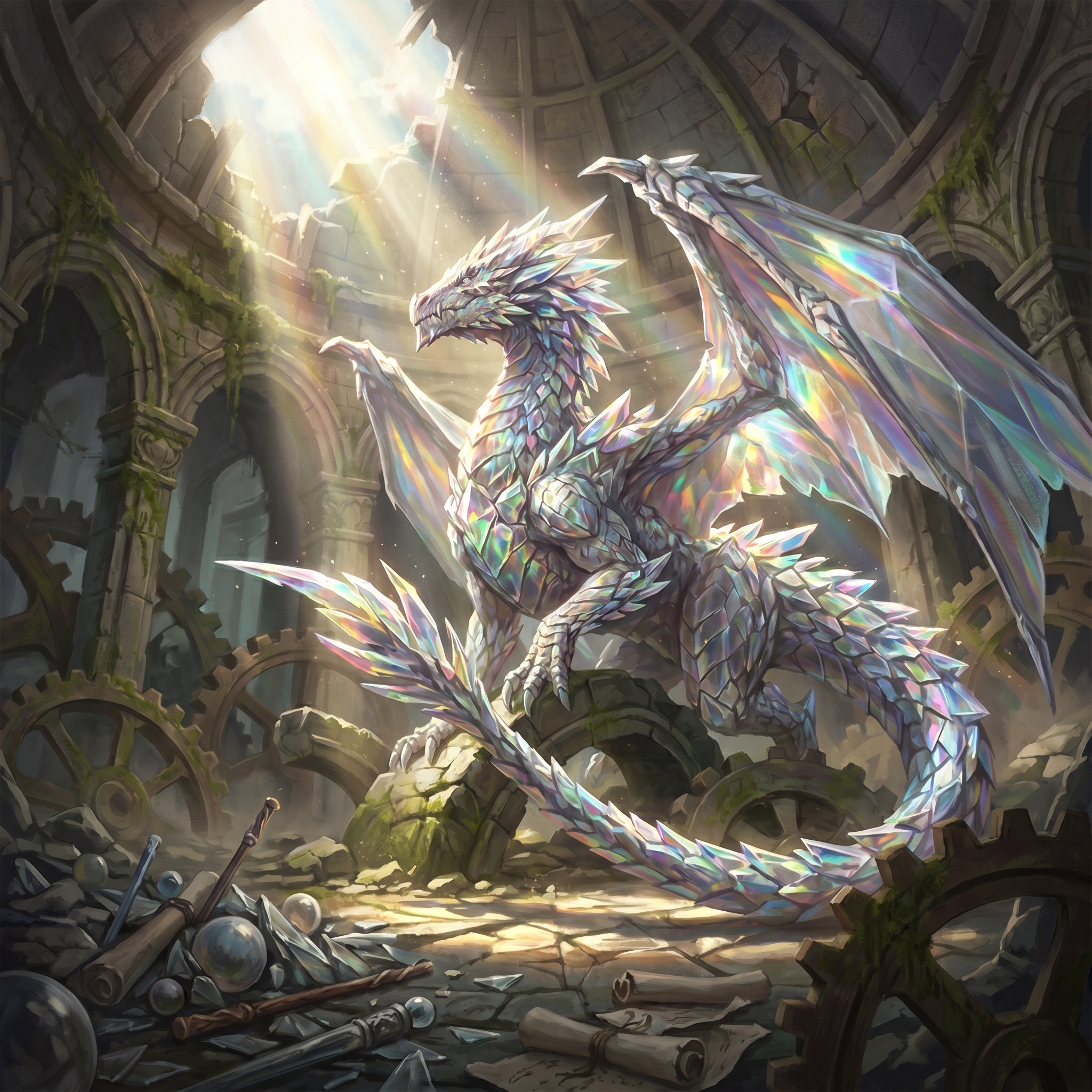
Role: Nemesis Apex Anti-Magic Controller Where It Appears: Ley intersections, old arcane sites, magical dead zones, and misdirected lairs. Source: Dort Dragons - Prism Dragon.
"It is not that the spells fail. It is that they arrive somewhere else. The dragon is not a dead zone. It is a redirection." — Arcane Faculty warning, distributed to all licensed practitioners
The Prism Dragon does not resist magic. It eats the shape of it. A party that responds with its strongest spells is handing the creature a loaded weapon. Practitioners fear it for a reason non-practitioners often misunderstand: the wizard is not helpless here, but every spell changes the dragon's economy.
What It Is
A Prism Dragon is one of Dort's seven true dragons, aligned to the Arcane Plane. It is large, fast, and physically dangerous, but its defining feature is the scale structure that refracts light and processes magic. In sunlight, color breaks over the terrain before the dragon is fully visible. Its eyes cycle through colors that do not match the light around it.
Prism Dragons sense magical workings as clearly as other predators sense movement. They know who is carrying a charged item, who has an active ward, who is shaping a spell, and often what the spell is becoming before it resolves.
Ecology and Behavior
Against ordinary prey, a Prism Dragon is a dragon: it hunts, flies, feeds, and rules territory. Against magically capable prey, it becomes something more specialized. It watches magical energy move, provokes spells, absorbs what it can, and uses stored power to unmake the party's best tools.
Long habitation creates magical dead zones. Items dim. Wards go quiet. Routes bend without appearing to turn. Practitioners describe the region as less present, as if the world's magical layer has been thinned or drained. Non-practitioners may notice only that their magical companions become tense.
The lair is protected by misdirection rather than a visible wall. People seeking it walk past, around, or away while believing they are moving correctly. Inside, the hoard usually contains drained magical items and secret documents, not ordinary coins.
Signs and Knowledge
Field signs: dimming magical items, repeated wrong turns near a known site, color-scatter without a visible source, drained charms, quiet arcane fields, magically trained animals refusing to proceed.
Adventuring Lore or Lore (Average): identifies the danger of relying on enchanted gear or obvious spellcasting.
Secret Lore, Planar Lore, or Natural Philosophy (Hard): identifies arcane absorption and knows simultaneous overload is safer than sequential powerful spells.
Craft or Secret Lore (Severe): identifies whether a drained item was emptied by Prism Dragon contact or by ordinary depletion.
Prism Dragon (Nemesis)
- Skills: Heavy Melee 4, Reflexes 4, Fortitude 4, Perception 5, Secret Lore 4, Planar Lore 5, Natural Philosophy 4, Intimidation 4.
- Attacks: Bite (Heavy Melee; Damage 12; Crit 3; Pierce 3); Claws (Heavy Melee; Damage 10; Crit 4); Arcane Unweaving Beam (Heavy Ranged; Damage 9 Strain or Wounds; Crit 4; Range Medium; Pierce 2).
- Abilities: Arcane Absorption - When a spell or magical attack targets the dragon, reduce its damage by 8 before Resistance. If the attack deals 0 Wounds, the dragon gains 1 stored charge. It can hold up to 3 charges.
- Abilities: Spend Stored Charge - Spend 1 stored charge to add 1 Boon to any check, increase Arcane Unweaving Beam damage by 2, or immediately end one minor magical effect at Short range.
- Abilities: Arcane Unweaving Beam - Breath weapon. If this attack hits a magical item, ward, spell effect, or summoned entity, the target's controller makes a Hard Planar Lore, Secret Lore, Craft, or relevant magic check. On failure, the effect is suppressed until the end of the scene.
- Abilities: Misdirection Lair - Checks to navigate toward the lair add 2 Banes unless the party has a true map, physical tether, or confirmed countermeasure.
- Abilities: Dread - Fear 3.
- Soul: No claimable coin exists; at death canon does not specify (default).
Tactics: First beat, the dragon provokes spellcasting from range, preferably while partially concealed by light or terrain. Second beat, it spends stored charge to suppress gear, reposition, or punish the caster. Third beat, it attacks non-magical defenders while the spellcasters hesitate. If overloaded by many simultaneous effects, it becomes briefly less tactical and more reflexive.
Encounter Use: Tell players what their characters notice: magic feels thin, items dim, routes bend, and the dragon seems more interested in spell preparation than in blades. The fair warning is part of the fear. Prepared parties should be able to win ground by using mundane force, bait spells, simultaneous overload, and physical tethers through the lair's misdirection.
Harvesting and Trade
Prism Dragon material drives arcane markets into a frenzy. It is also the easiest dragon material to fake, because most buyers desperately want to believe the scale in front of them is real.
| Harvest | Buyer | Check | Typical Value | Use | Complication |
|---|---|---|---|---|---|
| Prismatic Scale | Arcane instrument maker, wardwright, academy | Hard Craft or Natural Philosophy | 10,000-50,000 gold Flargons | Spell lenses, containment arrays, anti-magic wards | Still draws ambient magic; unsafe storage can drain minor items |
| Arcane Processing Organ | Collegium, secret cabal, planar scholar | Severe Medicine or Secret Lore | 50,000-200,000 gold Flargons | Absorption research, spell batteries, dangerous weapons | On failure, releases stored charge into the harvesting area |
| Unweaving Eye Lens | Scryer, inquisitor, relic breaker | Severe Medicine | 20,000-80,000 gold Flargons | Detecting enchantments, stripping false glamours | May reveal secrets the buyer was not meant to know |
| Drained Hoard Item | Original owner, collector, historian | Lore or Craft to authenticate | 500-100,000 gold Flargons | Evidence, craft salvage, political leverage | The item may be valuable because of who lost it, not what it does |
Variants
Young Prism Dragon: Nemesis, RES 8, WND 38, stored charge maximum 1, Misdirection Lair affects only immediate lair approaches.
Elder Prism Dragon: Nemesis, RES 9, WND 45, STR 34, stored charge maximum 5. Misdirection affects a whole region, and the magical dead zone can disable weak enchanted conveniences before combat begins.
Storm Kite
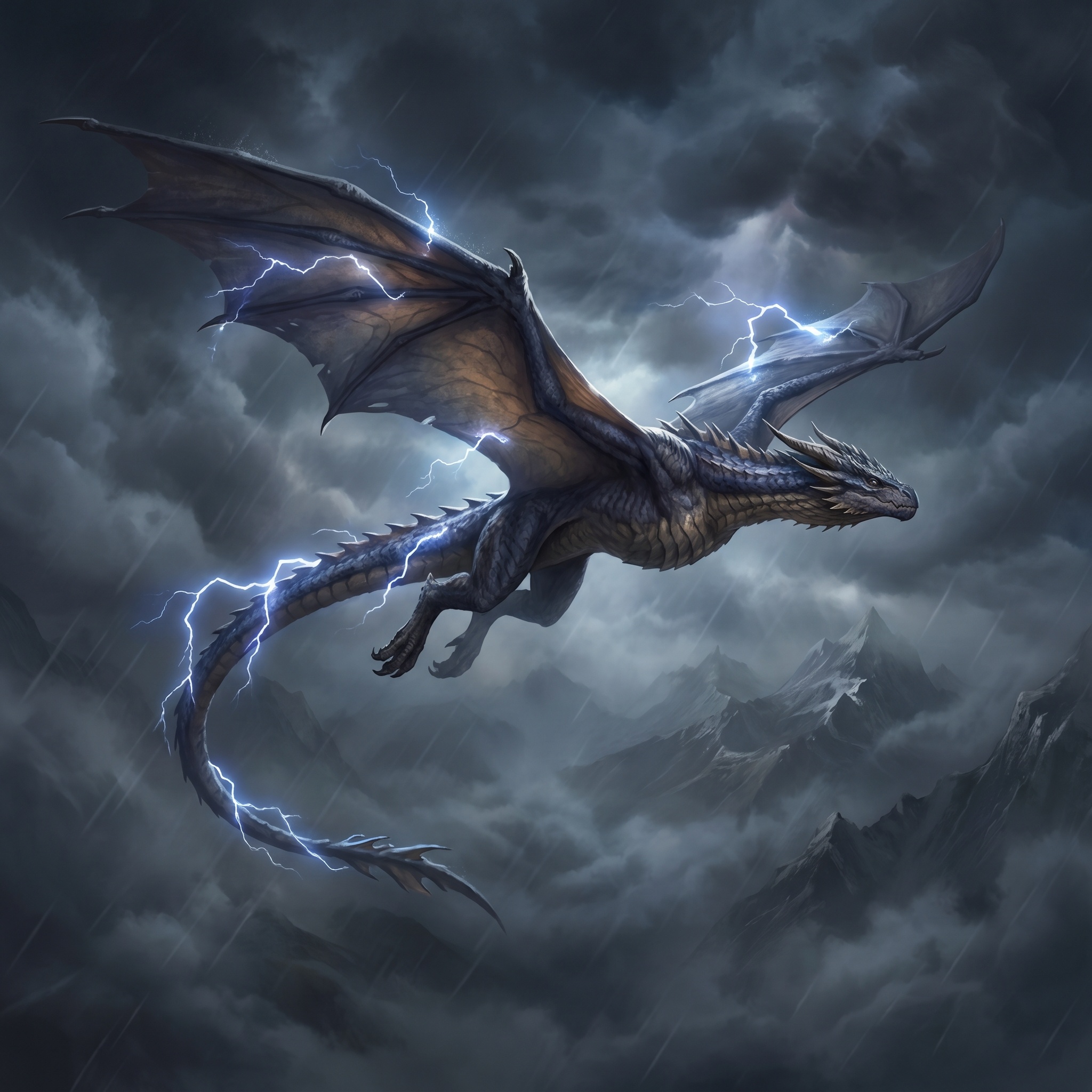
Role: Minion Aerial Harrier Where It Appears: Storm fronts, Gale Dragon ranges, high coasts.
Storm kites are small draconic fliers that gather before storms and harass anything shiny or flying.
Storm Kite (Minion)
- Group Size: 4-12.
- Skills: Reflexes 4, Perception 3, Unarmed 2.
- Attacks: Static Bite (Unarmed; Damage 4; Crit 5; Stun 1).
- Abilities: Storm Ride — In high wind, add 1 Boon to movement and attacks.
- Soul: No claimable coin exists; at death canon does not specify (default).
- Tactics: Swarm eyes and rigging, flee calm air.
- Harvesting and Trade: Charged tail filaments sell for 150-400 gold Flargons.
Tide Dragon
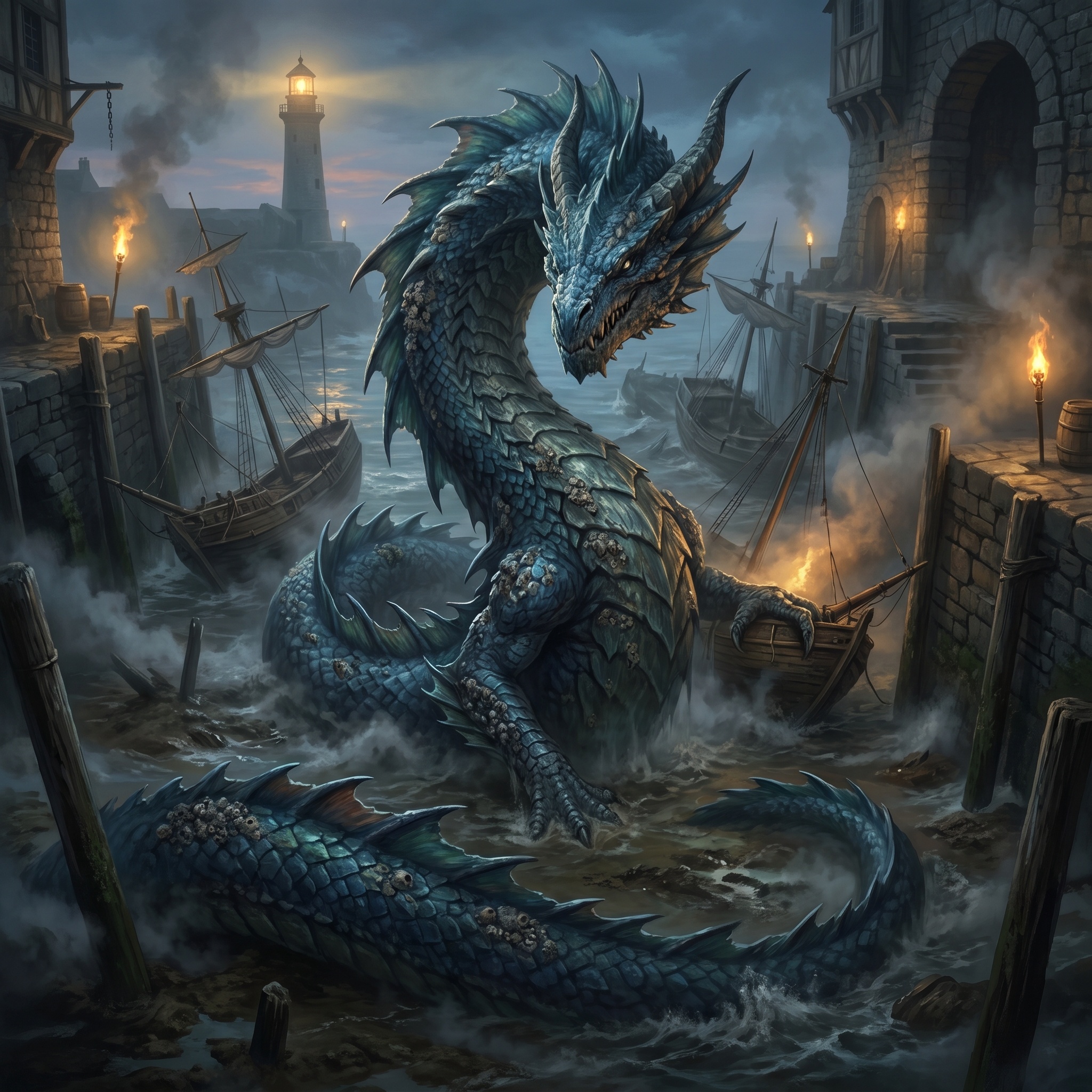
Role: Nemesis Apex Controller Where It Appears: Coasts, drowned ruins, tidal caves, reefs, and contested sea lanes. Source: Dort Dragons - Tide Dragon.
"It does not attack ships. It removes the sea from under them and waits." — Maritime advisory, Tidal Authority, Dort coastal survey
The Tide Dragon owns the border between land and water. It drowns roads, strands ships, empties harbors, and makes coastal communities negotiate with weather that has teeth.
What It Is
A Tide Dragon is one of Dort's seven true dragons, aligned to water and deep pressure. It is long, sinuous, and built for the ocean rather than the sky. The dorsal scales are blue-black, the underside pale like light seen from below water, and the tail ends in broad flukes that move more like a sea sovereign than a land beast.
Most people do not see a Tide Dragon. They see the current change direction, the fish vanish, the harbor drain too far, or the wake of something huge passing under a ship in calm weather. By the time the head breaks the surface, the encounter has already gone badly.
Ecology and Behavior
Tide Dragons regulate deep-ocean life by hunting the largest marine creatures and moving enough water to change food cycles above them. Their habitual routes can create upwellings that feed fisheries for generations. A village may depend on a dragon it has never named.
They are intelligent, solitary, and patient. Most vessels are beneath their concern unless they enter an inner territory, disturb a lair approach, travel during a reproductive aggression period, or offend a local pattern the dragon recognizes. Coastal people often treat route changes, cargo offerings, and bell silence as superstition; in some regions those practices are memory disguised as ritual.
The lair lies at crushing depth, often in trench walls, vent systems, or deep caves. Its hoard is everything the sea took and the dragon chose to keep: wreckage, cargo, figureheads, bells, relics, and personal objects whose owners died above.
Signs and Knowledge
Field signs: wrong-way current, deep-sea creatures in shallow water, sudden empty fishing runs, hull vibration without wind or wave, surface wake from an unseen body, seabirds abandoning a productive patch.
Survival or Operate (Average): identifies current anomalies and knows to change heading rather than investigate.
Natural Philosophy or Planar Lore (Hard): identifies water-plane influence and predicts surge, pressure, and shallow-water vulnerability.
Adventuring Lore or Lore (Severe): recognizes local offering, silence, or route traditions that may reduce the chance of provoking a known individual.
Tide Dragon (Nemesis)
- Skills: Heavy Melee 4, Athletics 5, Reflexes 4, Fortitude 5, Perception 5, Survival 5, Operate 4, Intimidation 4.
- Attacks: Bite (Heavy Melee; Damage 12; Crit 3; Pierce 3); Crushing Coil (Unarmed; Damage 11; Crit 4; target is Grabbed on 2 Boons); Tail Wave (Heavy Melee; Damage 9; Crit 4; Blast 4).
- Abilities: Tidal Surge - Breath weapon. Choose a shoreline, deck, cave, or zone at Medium range. Targets make a Hard Athletics, Reflexes, Operate, Riding, or Piloting check. On failure, they are knocked Prone, pushed one range band, and suffer Damage 8. Unsecured objects move with the surge.
- Abilities: Drown the Ground - Once per encounter, the dragon floods or drains a zone at Short range. The zone becomes difficult terrain; creatures without swimming or footing support add 1 Bane to physical checks there.
- Abilities: Amphibious Sovereign - Ignores underwater penalties and has Ranged Defense 3 while mostly submerged.
- Abilities: Current Sense - Detects movement in connected water out to Long range.
- Abilities: Dread - Fear 3.
- Soul: No claimable coin exists; at death canon does not specify (default).
Tactics: First beat, the dragon removes stable footing with Drown the Ground. Second beat, it uses Tidal Surge against clustered targets, docks, boats, or cave paths. Third beat, it drags one high-value target underwater and makes rescue the real encounter. It does not stand and trade blows on dry land unless forced.
Encounter Use: Tide Dragon fights should involve changing water levels. The map should not look the same at the end of round three. Give prepared parties ropes, boats, high ground, tide clocks, bells, harpoons, and the choice between saving people and striking the dragon.
Harvesting and Trade
Adult Tide Dragon remains are almost never recovered intact. Young beachings, shed scales, and material washed from old lairs are more plausible. Coastal communities may treat any sale as theft from the sea or proof of a coming disaster.
| Harvest | Buyer | Check | Typical Value | Use | Complication |
|---|---|---|---|---|---|
| Current-Sense Brain Matter | Navigator, natural philosopher, navy | Severe Medicine or Natural Philosophy | 30,000-120,000 gold Flargons | Current-reading instruments, deep-water charts | Spoils within hours unless preserved in cold brine |
| Pressure Scale Plate | Shipwright, diver guild, wardwright | Hard Survival or Craft | 7,000-25,000 gold Flargons | Hull reinforcement, pressure wards, diving bells | Heavy, slippery, and illegal in some ports |
| Gill Filament | Alchemist, healer, pearl diver | Hard Medicine | 8,000-30,000 gold Flargons | Water-breathing compounds, pressure tonics | Tears easily; damaged filaments lose most value |
| Lair-Wreck Relic | Original owner, harbor court, collector | Lore to authenticate | 500-200,000 gold Flargons | Restitution, inheritance claims, political proof | Claimants may outnumber the relics |
Variants
Young Tide Dragon: Nemesis, RES 7, WND 29, Current Sense extends to Medium range, Tidal Surge affects only one zone.
Elder Tide Dragon: Nemesis, WND 45, STR 32. Tidal Surge may also damage ships as a vehicle attack, and Current Sense covers an entire coastal approach.
Tunnel Drake
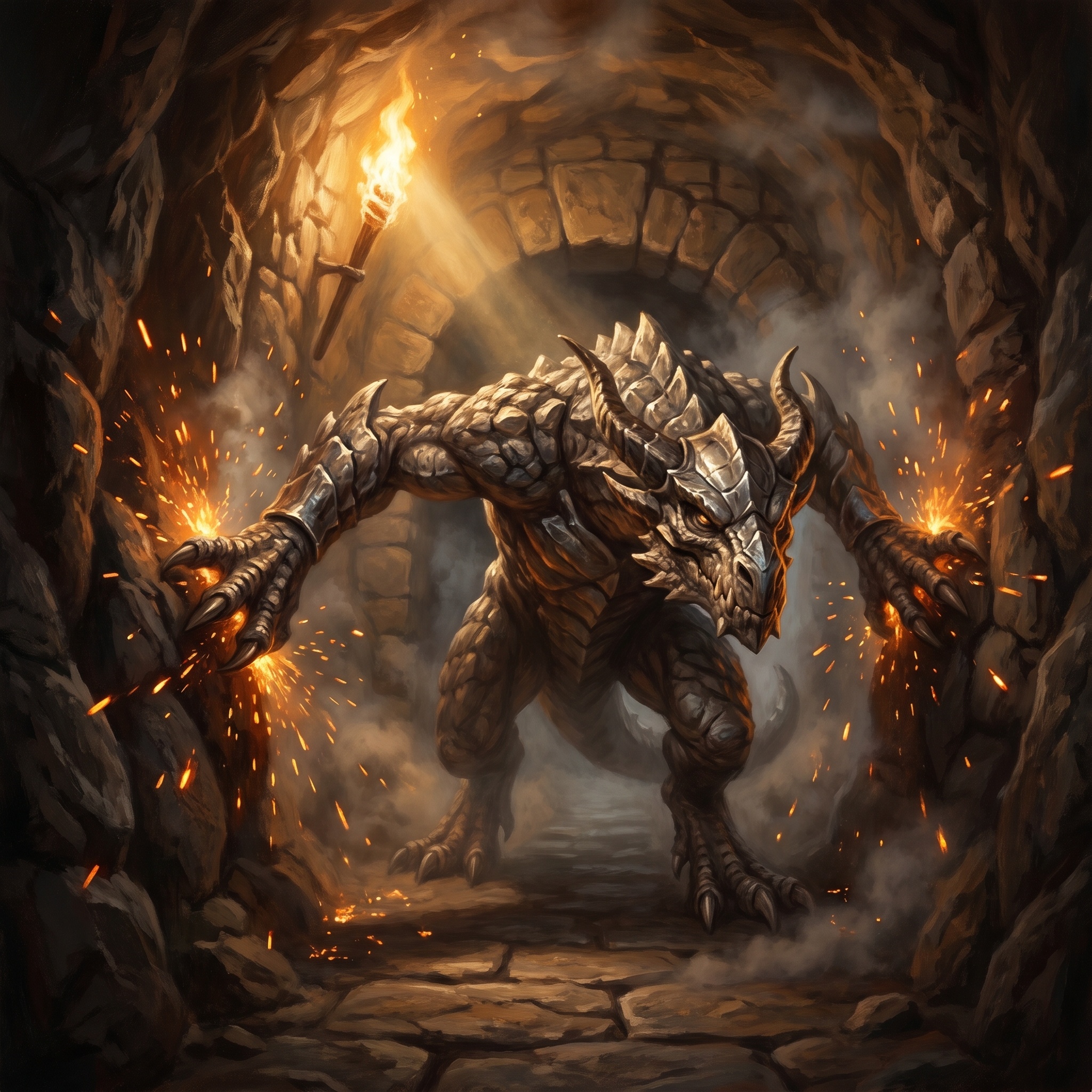
Role: Elite Bruiser / Lurker Where It Appears: Mines, lava tubes, deep roads, buried ruins.
What It Is
Tunnel drakes are wingless draconic predators with territorial habits and a taste for pack animals. They are clever enough to collapse weak supports and wait. Though draconic in shape and temperament, they are not true dragons of Dort's primary lineages; they are lesser kin adapted to the close dark.
Their bodies are low and muscular, with wedge skulls, sparks under their claws, and scales scarred by stone. A tunnel drake is not a cave lizard with pretensions. It understands territory, ambush routes, and the value of making prey run into narrow places.
Ecology and Behavior
Tunnel drakes lair in mines, lava tubes, buried aqueducts, and deep roads with multiple exits. They drag prey into side chambers and cache cracked bones behind loose stone. They like heat but do not require open flame, and many sleep against warm mineral seams.
They are solitary unless mated or young. Miners fear them because they learn the sound of work crews and may break supports to isolate one group from another. A tunnel drake that has tasted mule, ox, or riding beast may stalk caravans for days through connected underways.
Signs and Knowledge
Adventuring Lore or Draconic Lore (Average) distinguishes a tunnel drake from a young true dragon. Engineering or Craft (Hard) notices supports weakened by deliberate claw work.
Other signs include claw grooves at shoulder height, warm breath from side tunnels, half-collapsed galleries with no natural shift, and bones crushed lengthwise by a narrow bite.
Tunnel Drake (Elite)
- Skills: Heavy Melee 3, Athletics 4, Fortitude 4, Perception 3, Stealth 2.
- Attacks: Drake Bite (Heavy Melee; Damage 9; Crit 3; Pierce 2); Claws (Heavy Melee; Damage 8; Crit 4).
- Abilities: Tunnel Rush - In a narrow passage, add 1 Boon and +2 damage to the first charge.
- Abilities: Support Breaker - On 2 Boons, damage a wooden support, door, or scaffold.
- Soul: No claimable coin exists; at death canon does not specify (default).
Tactics
A tunnel drake charges through narrow spaces, bites hard, and retreats around corners before ranged attackers can line up. If the battlefield has supports, doors, scaffolds, or loose stone, it breaks them to split the party. It is bold in tunnels and cautious in open caverns.
Use a tunnel drake when terrain can change mid-fight. A collapsing brace, blocked mine cart track, or side tunnel full of smoke gives the creature its identity. In an empty square room, it is only a tough bite.
Harvesting and Trade
| Component | Value | Use | Harvest |
|---|---|---|---|
| Scales and teeth | 500-1,300 gold Flargons | Armor trim, spearheads, draconic trophies | Survival (Average) |
| Flame-resistant stomach stone | 1,000-2,400 gold Flargons | Heat wards, forge charms, alchemical crucibles | Medicine or Natural Philosophy (Hard), rare |
| Spark claws | 400-900 gold Flargons | Mining picks, ignition tools, ritual scoring | Craft or Survival (Average) |
Variants
- Coalback Drake: Soot-dark and comfortable in smoke-filled mines.
- Salt Tunnel Drake: Pale, blind, and drawn to blood and sweat.
- Old Road-Claimant: Larger specimen that controls a section of deep road and recognizes tribute.
Umbral Dragon
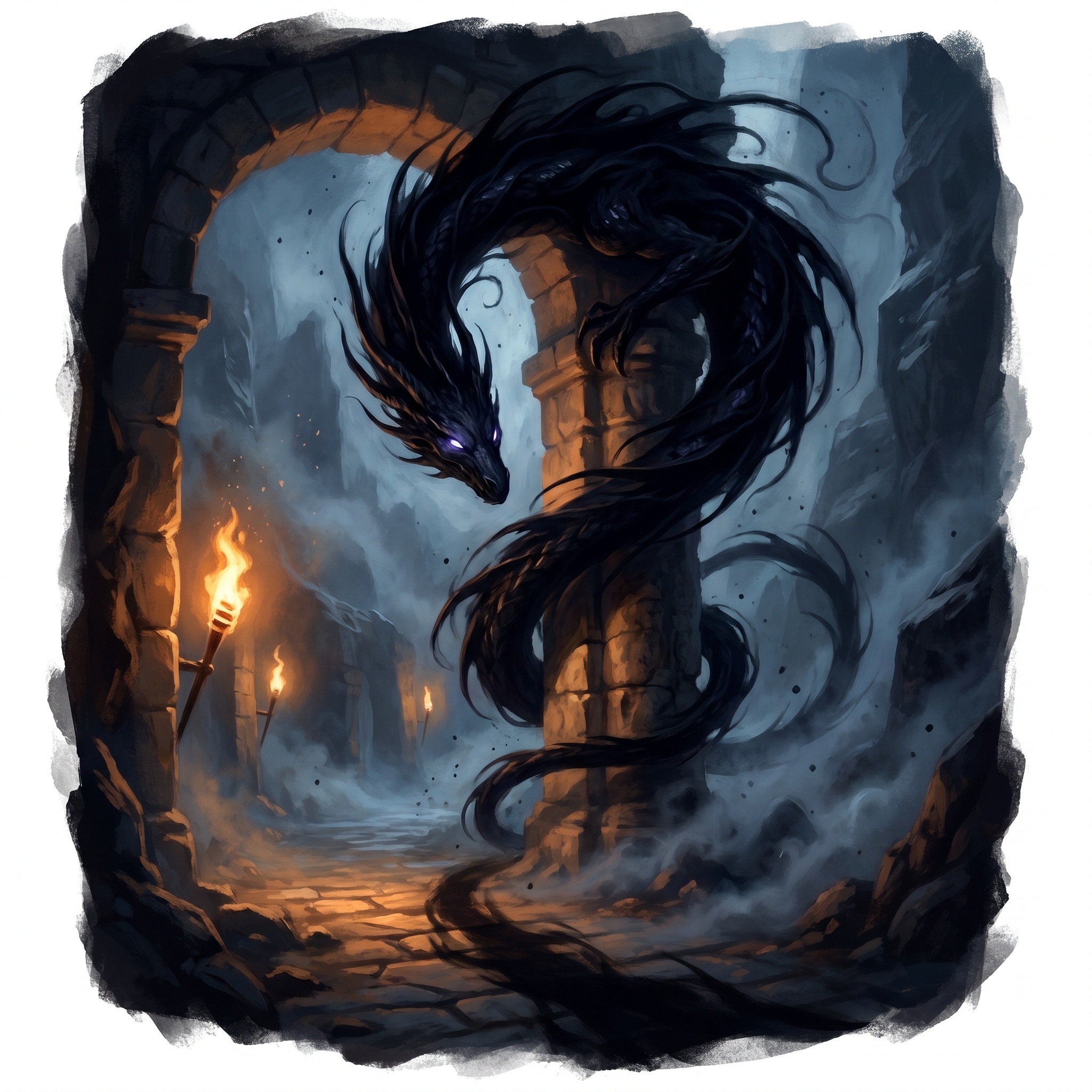
Role: Nemesis Apex Lurker Where It Appears: Moonless passes, deep forests, lightless ruins, old battlefields, and shadowed lairs. Source: Dort Dragons - Umbral Dragon.
"It does not kill. Not exactly. It keeps." — Planar Lore, chapter on the Dim, note on apex predators
The Umbral Dragon is included as one of Dort's seven true dragons. It is not treated as a general Void creature for this catalog. It hunts through absence, memory gaps, and the failure of light.
What It Is
An Umbral Dragon is one of Dort's seven true dragons, aligned to the Dim rather than the Void. That distinction matters. It is not an empty-world horror or a void-spawned thing; it is a dragon whose body exists partly in the Prime and partly in a shadow-adjacent plane where distance, substance, and witness do not behave cleanly.
In the Prime, it appears almost present: black scales, soft edges, pale still eyes, and a body that makes less sound than its size should allow. It does not simply hide in darkness. It makes light unreliable.
Ecology and Behavior
Umbral Dragons hunt by watching first. They observe from the Dim, learning routes, habits, sleep watches, family ties, and fear responses before they appear. When they act, they do so with information the prey never knew it gave away.
Their territories show subtle pressure rather than obvious ruin. Animals avoid empty spaces. Shadows feel too deep at dawn and dusk. Cold spots remain after the dragon's partial arrival. People vanish without blood, struggle, or tracks, and the remaining tracks sometimes begin or end mid-stride.
The hoard of an Umbral Dragon is not wealth in the ordinary sense. It keeps last things: last copies, last witnesses, last objects of a broken tradition, and sometimes the last living member of a line. Whether these remain alive, preserved, or simply held in a Dim-adjacent state is a matter for scholars and nightmares.
Signs and Knowledge
Field signs: cold patches with no weather cause, brittle fabric edges, tracks that start or end mid-stride, animals staring at empty space, shadows too dark for the available light, disappearances without violence.
Survival or Adventuring Lore (Average): identifies a recent supernatural disappearance site and warns against separating.
Planar Lore or Secret Lore (Hard): identifies Dim-plane overlap and knows that ordinary invisibility countermeasures are insufficient.
Planar Lore with Dim experience (Severe): identifies a likely overlay point and the brief vulnerability during full arrival or departure.
Umbral Dragon (Nemesis)
- Skills: Heavy Melee 4, Reflexes 5, Stealth 5, Perception 5, Secret Lore 4, Planar Lore 4, Intimidation 5.
- Attacks: Shadow Bite (Heavy Melee; Damage 11; Crit 3; Pierce 3); Claws (Heavy Melee; Damage 9; Crit 4); Dimming Breath (Heavy Ranged; Damage 8 Strain; Crit 4; Range Medium).
- Abilities: Light Refusal - In darkness or dim light, attacks against the dragon add 1 Bane. If the attacker relies on mundane torchlight, lantern light, or moonlight, add 2 Banes instead.
- Abilities: Dimming Breath - Fear 3. Breath weapon. Targets in a zone at Medium range make a Hard Readiness or Fortitude check. On failure, they suffer 8 Strain and cannot benefit from Boon dice created by light, morale, or leadership effects until the end of their next turn.
- Abilities: Step Through Shadow - Once per round, if the dragon begins in dim light or darkness, it may move from one shadowed position to another within Medium range as a Maneuver.
- Abilities: Name the Dark - Once per encounter, the dragon targets one creature it has observed for at least one round. The target makes a Hard Readiness check. On failure, it loses its next Maneuver and suffers 3 Strain.
- Soul: No claimable coin exists; at death canon does not specify (default).
Tactics: First beat, the dragon extinguishes or discredits light, then forces the party into dim terrain. Second beat, it uses Dimming Breath against the back line or the character holding morale together. Third beat, it Steps Through Shadow behind isolated targets. It takes people when the absence will break the group more than a corpse would.
Encounter Use: Do not run this as an invisible dragon that cheats. Run it as a creature that makes light unreliable and positioning terrifying. Give the party warning: cold spots, animal behavior, missing objects, shadows moving wrong, and the knowledge that staying together matters.
Harvesting and Trade
Umbral Dragon material is a frontier of Dim research. It is also a spiritual and legal hazard, because any part that remains partly elsewhere may be traceable by things that inhabit that elsewhere.
| Harvest | Buyer | Check | Typical Value | Use | Complication |
|---|---|---|---|---|---|
| Dim-Touched Scale | Planar scholar, shadow wardwright, spy master | Hard Planar Lore or Craft | 10,000-50,000 gold Flargons | Dim anchors, stealth wards, planar shielding | Mishandling creates cold spots and minor disappearances |
| Dual-Plane Organ | Secret cabal, university, Dim-walker | Severe Medicine and Planar Lore | 50,000-250,000 gold Flargons | Dim transit research, impossible prisons | On failure, part of the sample leaves the Prime |
| Pale Eye | Oracle, investigator, forbidden collector | Severe Medicine | 20,000-80,000 gold Flargons | Seeing overlap points, tracking disappearances | The eye may show what is watching back |
| Hoarded Last Thing | Historian, surviving culture, royal court | Lore to identify | Priceless or unsellable | Restoration, leverage, mourning, blackmail | Ownership may be morally impossible to settle |
Variants
Young Umbral Dragon: Nemesis, RES 6, WND 29, no Name the Dark, Step Through Shadow requires full darkness.
Elder Umbral Dragon: Nemesis, RES 9, WND 45, STR 34. Light Refusal affects Short range around it as an aura, and cold spots can become temporary Dim-overlap hazards.
Umbral Dragon of the No-Moon Pass
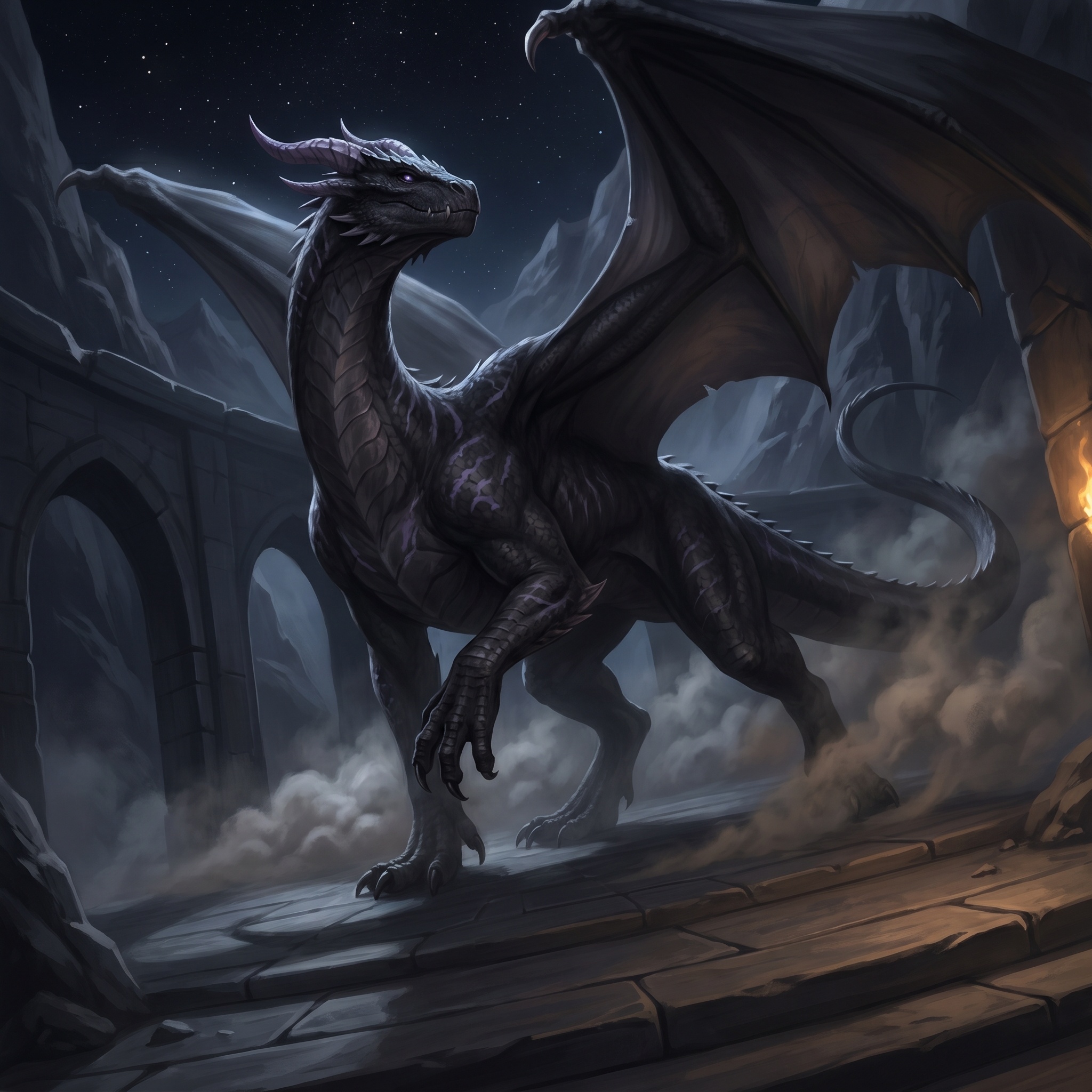
Role: Nemesis Night Road Sovereign Where It Appears: No-moon passes, old trade roads, eclipse shrines, border mountains.
"The pass has had no moon for forty years. We have confirmed the moon still exists. The dragon prefers this arrangement." — Cartographic survey note, No-Moon Pass — dated and then undated by a later hand
The Umbral dragon of the pass collects oaths spoken in darkness. Merchants pay it with secrets. Armies pay it with silence. It is not a Void creature; its power belongs to shadow, memory, and the absence of witness.
What It Is
The Umbral Dragon of the No-Moon Pass is a true dragon of shadow, not a Void thing and not an infectious darkness. It rules the road that only becomes fully itself when the moon is absent. In starlight the dragon appears as bent darkness around scale, horn, and eye. In torchlight it is too close before the flame admits it.
It collects oaths because oaths change behavior after the speaker leaves. A secret can buy passage, but a promise can build a road, end a war, or ruin a bloodline. The dragon remembers which kind each traveler offered.
Ecology and Behavior
The pass connects borders, smugglers, armies, desperate refugees, and merchant houses with too much to lose. The dragon does not close the road. It makes the road expensive in ways money cannot always solve.
Its rule creates a culture of careful speech. Caravans rehearse promises before entering. Armies march silently. Lovers avoid vows beneath clouded skies. Local guides know which shadows are merely shadows and which ones are listening.
Signs and Knowledge
Secret Lore, Draconic Lore, or Deception (Hard) identifies oath marks and the difference between a paid secret and a binding promise. Survival or Perception (Average) notices that sound and torchlight behave differently near the pass.
Other signs include trade posts with no windows facing the road, eclipse shrines maintained by rival nations, guide contracts written with blank spaces, and travelers who refuse to answer questions until sunrise.
Umbral Dragon of the No-Moon Pass (Nemesis)
- Skills: Deception 5, Heavy Melee 5, Perception 5, Secret Lore 5, Stealth 5, Discipline 5.
- Attacks: Night Bite (Heavy Melee; Damage 14; Crit 3; Pierce 4); Moonless Breath (Arcana; Damage 13; Crit 3; Range Long; Ensnare 2, Disorient 2).
- Abilities: No Witness - In darkness, enemies cannot spend Boons to grant allies bonuses against the dragon unless they can see one another.
- Abilities: Oath in the Dark - A creature that breaks a sworn bargain made in the pass adds 2 Banes to checks against the dragon for one year and one night.
- Abilities: Dread - Fear 4.
- Soul: No claimable coin exists; at death canon does not specify (default).
Tactics
The dragon extinguishes lights, separates witnesses, and makes allies unable to confirm what each other saw. It does not rush. It asks what the party will promise for passage, then punishes the first contradiction.
In combat, Moonless Breath pins one side of the formation while the dragon moves through darkness to threaten the speaker, not always the strongest fighter. It treats broken promises as open wounds and may pursue oathbreakers long after the physical fight ends.
Relics and Trade
Its shadow-shed scales are valuable, but cutting them from the body is a declaration of war against every oath-bound traveler who relies on the pass. Secrets, maps, and proof of old bargains often matter more than parts.
| Find | Value | Use | Recovery |
|---|---|---|---|
| Shadow-shed scale | 2,500-7,000 gold Flargons | Stealth craft, night wards, oath ink | Secret Lore or Survival (Hard), must be shed |
| Oath ledger fragment | 5,000-20,000 gold Flargons | Political leverage, curse arbitration | Investigation or Deception (Hard) |
| Eclipse shrine token | 1,000-4,000 gold Flargons | Safe conduct, guide payment, ritual proof | Negotiation or Lore (Average) |
| Moonless road map | 2,000-9,000 gold Flargons | Smuggling, military planning, rescue routes | Survival or Cartography (Hard) |
Variants
- Silent Road Dragon: Demands quiet passage and punishes spoken lies.
- Secret-Broker Dragon: Trades information between rivals without leaving the pass.
- Eclipse Judge: Enforces old treaties only during moonless nights.
Wyvern
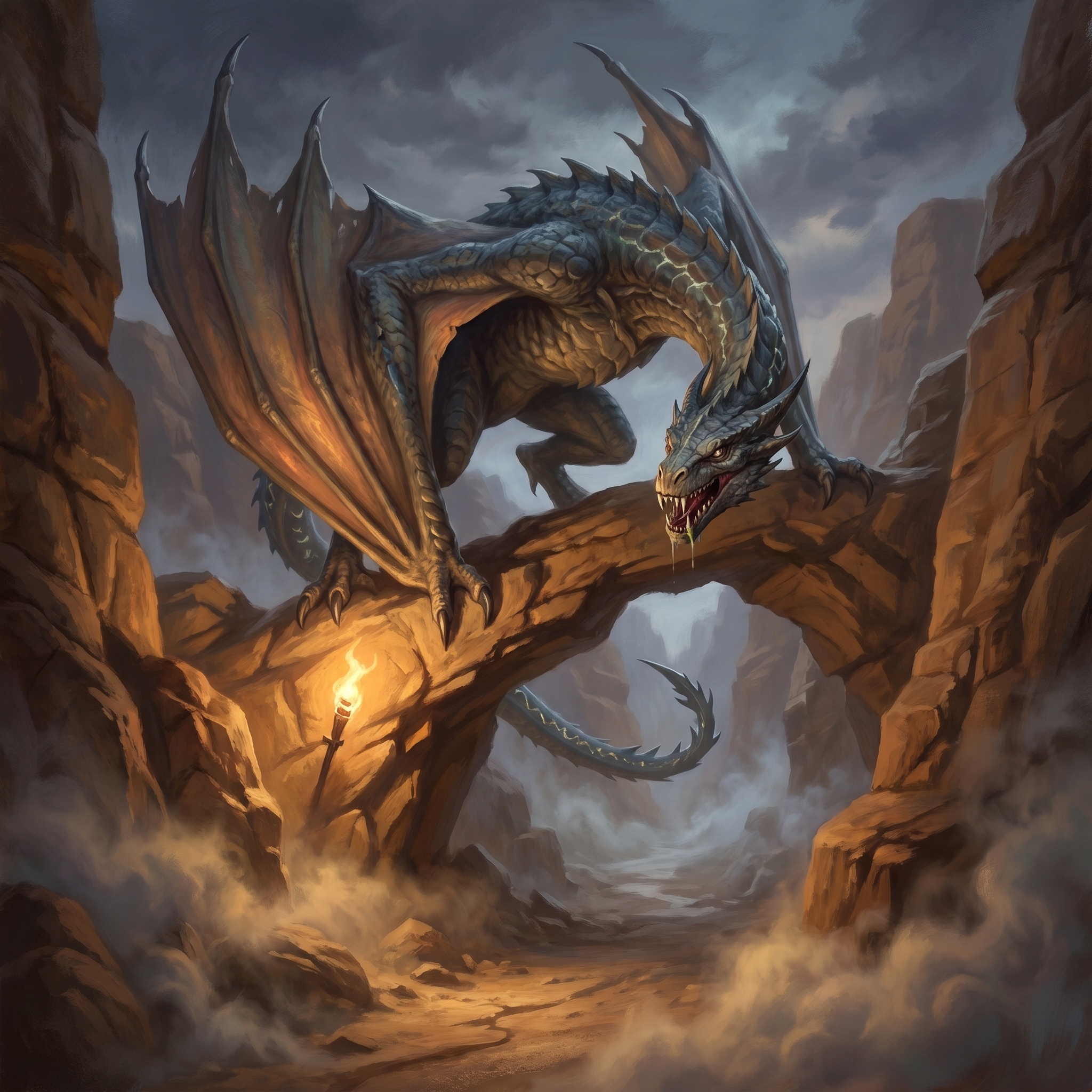
Role: Elite Harrier / Venom Predator Where It Appears: Cliffs, canyon roads, high ruins.
What It Is
Wyverns are aerial ambush predators with venomous tails. They are cunning animals, not speaking dragons. Their danger is vertical: a path that feels safe from ground predators may be directly under a wyvern's hunting perch.
They are often mistaken for lesser dragons by frightened travelers, which causes bad tactical decisions and worse rumors.
Ecology and Behavior
Wyverns lair on cliffs, canyon roads, high ruins, sea stacks, and broken towers. They prefer hunting routes with updrafts and drops. They sting first, climb or fly away, then wait for venom, fear, or bad footing to finish the work.
They are solitary except around rich nesting cliffs. Mated pairs are especially dangerous because one drives prey toward the other's perch.
Signs and Knowledge
Survival or Medicine (Average) identifies wyvern venom kills. Perception (Hard) spots white droppings and tail-scrape marks on high perches.
Other signs include bones on ledges, scratched canyon walls, missing goats with blood above ground level, and vultures refusing a particular cliff face.
Wyvern (Elite)
- Skills: Heavy Melee 4, Reflexes 4, Athletics 4, Perception 4, Survival 3.
- Attacks: Wyvern Bite (Heavy Melee; Damage 8; Crit 4); Venom Tail (Heavy Melee; Damage 8; Crit 3; Pierce 1, Poison 3).
- Abilities: Cliff Drop - On 2 Boons near a drop, move target one range band toward the edge.
- Soul: No claimable coin exists; at death canon does not specify (default).
Tactics
A wyvern stings, climbs, and waits for venom to weaken prey. It uses Cliff Drop to turn the battlefield into a threat. It avoids landing among multiple ready attackers unless defending a nest.
Counterplay includes shields overhead, forcing it into enclosed spaces, anchoring near drops, and treating poison quickly.
Harvesting and Trade
| Component | Value | Use | Harvest |
|---|---|---|---|
| Venom sacs | 1,000-2,400 gold Flargons | Antivenom, poison, monster research | Medicine (Hard) |
| Tail barb | 800-1,800 gold Flargons | Spearheads, poison channel tools | Survival or Medicine (Average) |
| Wing leather | 600-1,500 gold Flargons | Gliders, drumskins, armor trim | Survival (Average) |
Variants
- Canyon Wyvern: Expert at pushing prey toward edges.
- Sea-Stack Wyvern: Drops prey into surf and waits.
- Nesting Pair: One harries while the other guards the cliff.
Young Dragon Template
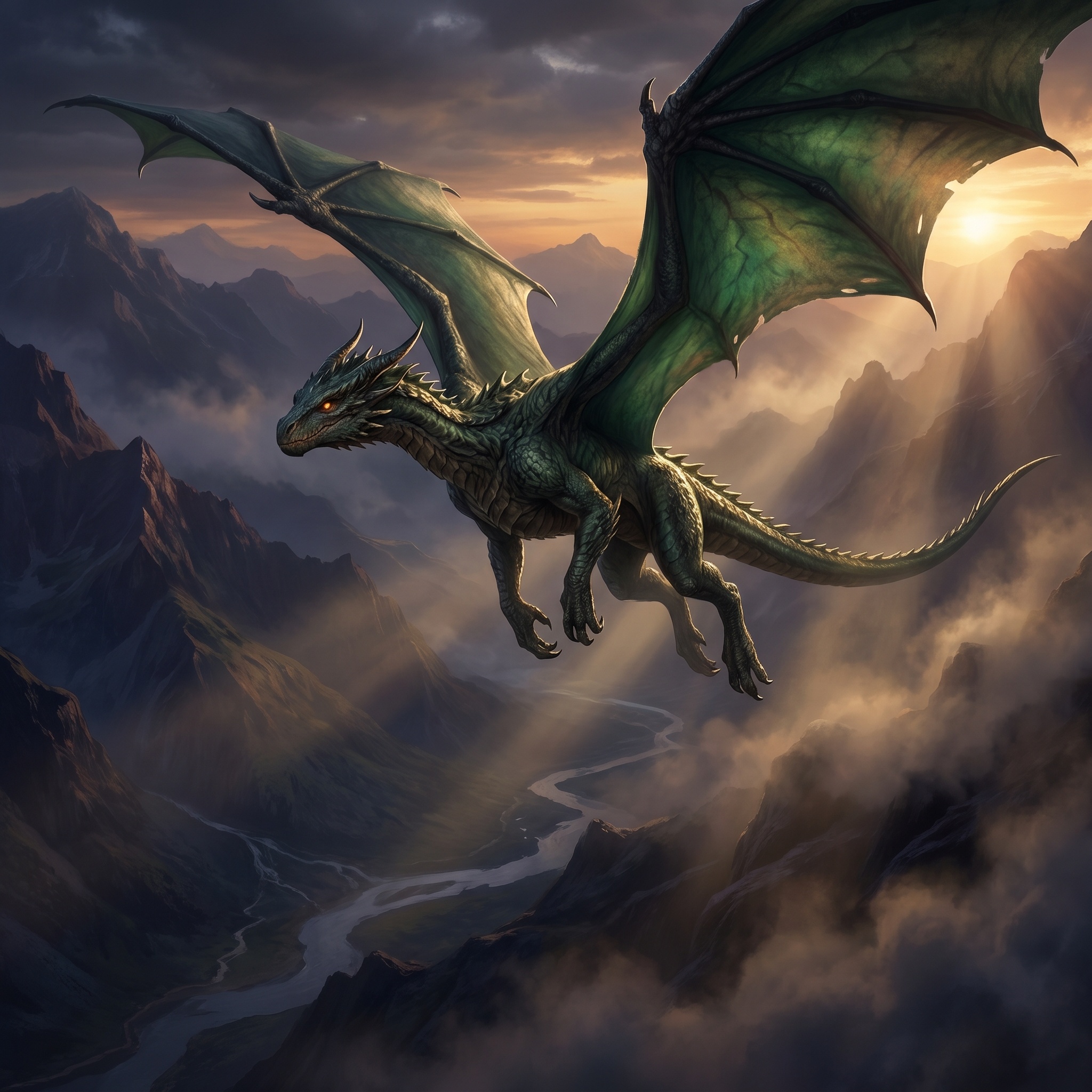
Role: Nemesis Regional Threat Where It Appears: Emerging territories, contested ranges.
"Every territory a young dragon claims, it intends to hold until it is old. This is the part that makes them dangerous." — Natural Philosophy of Dragon Territory, chapter two
What It Is
Young dragons have adult intelligence but not adult patience. They are testing territory, prey, and reputation. A young true dragon is already a regional political and ecological force, even if elders still consider it immature.
Customize by Dort's primary dragon types. Type changes terrain, temperament, breath quality, and what the dragon considers insult.
Ecology and Behavior
Young dragons appear in emerging territories, contested ranges, abandoned lairs, borderlands between elder domains, and regions where prey or tribute can support ambition. They test boundaries, raid rivals, punish trespass, and learn which mortals are useful.
They may negotiate, but usually from pride. A young dragon's greatest weakness is the need to be recognized as dangerous.
Signs and Knowledge
Draconic Lore or Survival (Average) identifies new territorial marks. Negotiation (Hard) can frame tribute or apology without sounding weak.
Other signs include prey populations changing quickly, weather or terrain reflecting type, tribute demands appearing before a lair is known, and lesser drakes avoiding a new route.
Young Dragon (Nemesis)
- Skills: Heavy Melee 4, Athletics 4, Reflexes 4, Fortitude 4, Perception 4, Survival 3.
- Attacks: Bite (Heavy Melee; Damage 10; Crit 3; Pierce 2); Claws (Heavy Melee; Damage 8; Crit 4).
- Abilities: Type Breath - Once every other round, Medium-range attack, Damage 10, type quality by dragon kind.
- Abilities: Dread - Fear 2.
- Soul: No claimable coin exists; at death canon does not specify (default).
Tactics
A young dragon displays power, punishes trespass, and withdraws before a permanent injury. It uses breath to shape the field, then melee to prove dominance. If embarrassed, it may retreat and retaliate later through territory, agents, or night raids.
The encounter should include reputation. Wounding, sparing, insulting, feeding, or bargaining with a young dragon should echo through the region.
Relics and Trade
| Find | Value | Use | Recovery |
|---|---|---|---|
| Shed scales | 2,000-7,000 gold Flargons | Type wards, armor, proof of contact | Survival or Draconic Lore (Average) |
| Breath-scorched terrain sample | 500-2,500 gold Flargons | Identifies type and age | Planar Lore (Average) |
| Body parts | Extremely valuable, politically suicidal | Forbidden trade, war trophies | Creates dragon and faction consequences |
Variants
- Claiming Dragon: Establishing a first territory and overreacting to tests.
- Exiled Young: Driven from an elder domain and desperate for legitimacy.
- Tribute Maker: Prefers structured tribute over constant hunting.