Every entry in this chapter used to be, or still technically is, someone else. A Werewolf, a Wererat, a Vampire Spawn, none of them started as monsters, they were infected, turned, or drained into what they are now. That history is the whole tension of the chapter: the thing attacking the party may also be a victim of the thing that made it, and the encounter is more interesting when both of those are true at once.
At the table: decide before the fight starts whether a cure is possible for this specific creature, and let that answer shape the encounter. A lycanthrope the party can save plays very differently than one the infection has already finished consuming.
Vampire

Role: Nemesis Lurker / Manipulator Where It Appears: Old estates, court society, occupied noble houses, anywhere there is money, blood, and a reason to stay still.
"It had been here for forty years. We found the accounts. The same name, appearing in ledgers and guest lists and witness statements, decade after decade, never aging in any portrait. The ones who noticed never mentioned it a second time." — Estate inventory, sealed by order of the provincial court
A Vampire is not a monster that happens to look human. It is a predator that weaponized human society, learned its rituals, and has had decades or centuries to practice passing through them undetected. Its hunger is not its most dangerous quality. Its patience is.
What It Is
The Vampire was once a mortal. What changed is contested among scholars: some attribute vampirism to an infernal contract unpaid at death, others to an ancient curse tied to specific bloodlines or sites, and a few to deliberate ritual transformation. What all agree on is that the resulting being retains full intelligence and memory, requires living blood to sustain itself, cannot tolerate direct sunlight, and can create others of its kind through repeated feeding.
A Vampire looks like what it was in life, preserved at the moment of turning. It does not decompose. It grows more controlled over time, not less. Old vampires are slower to anger, more careful with their feeding, and more likely to be running the town council than hunting in alleys.
Ecology and Behavior
A Vampire establishes itself by acquiring shelter, privacy, and a feeding arrangement it can sustain indefinitely without drawing investigation. This usually means wealth, social position, a household staff who do not ask questions, and a careful selection of victims who will not be missed or who can be explained. It is not careless. Carelessness is what got the last three killed.
They are solitary by nature — a territory can only sustain one Vampire comfortably — but will maintain Spawn as tools, bodyguards, or emergency feeding sources. The relationship between Vampire and Spawn is not affection. It is investment.
Signs and Knowledge
Field signs: servants with unexplained exhaustion and neck marks, a household where guests never quite remember what happened at dinner, portraits that stop aging, a property where the current owner's description matches records forty years old.
Adventuring Lore or Streetwise (Average): identifies vampire feeding patterns and the social cover they typically use.
Secret Lore or Medicine (Hard): distinguishes Vampire thrall condition from ordinary illness; identifies the three-feeding threshold before full turning begins.
Lore (Severe): knows the specific weakness profile — sunlight destruction, running water crossing difficulty, invitation requirement in sacred or warded spaces, and the ward-symbol that forces retreat.
Vampire (Nemesis)
- Skills: Unarmed 5, Stealth 4, Deception 5, Charm 5, Intimidation 4, Secret Lore 3, Perception 5.
- Attacks: Fanged Bite (Unarmed; Damage 8; Crit 3; Pierce 3; Grabbed on 2 Boons); Clawed Strike (Unarmed; Damage 9; Crit 3; Pierce 2, Vicious 5).
- Abilities: Vampiric Feeding — When the Vampire bites a Grabbed or willing target, it recovers 4 Wounds. The target must make a Hard Willpower check or gain Infection Stage 1 (Vampiric Curse). See Infectious Condition rules.
- Abilities: Vampiric Curse Stages — Stage 1: Target feels drawn to return to the Vampire; Hard Willpower to act against its interests while in the same scene. Stage 2 (after a second feeding): Target gains Vampire Thrall condition — adds 1 Bane to checks against the Vampire's direct commands; begins losing colour and vitality. Stage 3 (after a third feeding or failing a Severe Willpower check at Stage 2): Target dies and rises as a Vampire Spawn in the Vampire's service within one day.
- Abilities: Treatment — Stage 1 may be broken by Hard Medicine and a full day away from the Vampire. Stage 2 requires divine intervention or Hard Medicine with rare components. Stage 3 cannot be reversed; only destroying the Vampire before the Spawn rises prevents the turning.
- Abilities: Unnatural Dominance — Once per round as an incidental, force one creature at Short range to make a Hard Willpower check or lose its next Maneuver.
- Abilities: Sunlight Vulnerability — In direct sunlight, the Vampire loses 4 Wounds at the start of each of its turns and cannot benefit from Resistance. It will use every available action to reach cover or darkness.
- Abilities: Not a Key — In warded or sacred spaces, the Vampire cannot enter without permission. It cannot force or fake this — the ward knows.
- Soul: Claimable, the crossing it was owed was interrupted rather than completed; at death that crossing resumes at Sheol, and a vampire that sought its own transformation is directed to the Denied Chamber of the Vault of the Unclaimed.
Tactics: The Vampire avoids open combat. It maintains social distance, identifies the character most likely to be vulnerable to Charm, and works toward a private feeding. If forced into direct confrontation, it targets anyone who can break its Unnatural Dominance and uses Spawn or thralls as shields. It retreats to darkness if pressed.
Encounter Use: A Vampire encounter is primarily social and investigative. Combat is what happens when everything else has failed. Build the session around the discovery, the household politics, the thralls who defend something they can no longer explain, and the decision of what to do before Stage 3 is reached.
Harvesting and Trade
Vampire remains require immediate treatment — most dissolve in sunlight into ash and dark fluid. What survives is valuable and deeply dangerous to possess openly.
| Harvest | Buyer | Check | Typical Value | Use | Complication |
|---|---|---|---|---|---|
| Preserved Heart | Secret Lore practitioner, infernal researcher | Severe Medicine before dissolution | 5,000–20,000 gold Flargons | Vampiric research, binding rituals | Must be sealed before dawn; attracts other vampires |
| Fang Pair | Collector, poison smith, exorcist | Average Medicine | 800–2,000 gold Flargons | Antivenom basis, trophy, proof of kill | Possession is legally suspicious in most cities |
| Ash Residue | Alchemist, divine researcher | Average Survival | 200–800 gold Flargons | Ward components, undeath study | Fraud is common; buyers test authenticity aggressively |
Variants
Young Vampire: Nemesis, WND 30, STR 14, no Unnatural Dominance as incidental — costs a full Action. Still fully intelligent; just less practiced.
Ancient Vampire: Nemesis, WND 58, STR 30. Unnatural Dominance affects Medium range. The third Feeding Stage triggers within the same scene rather than the next day.
Vampire Spawn
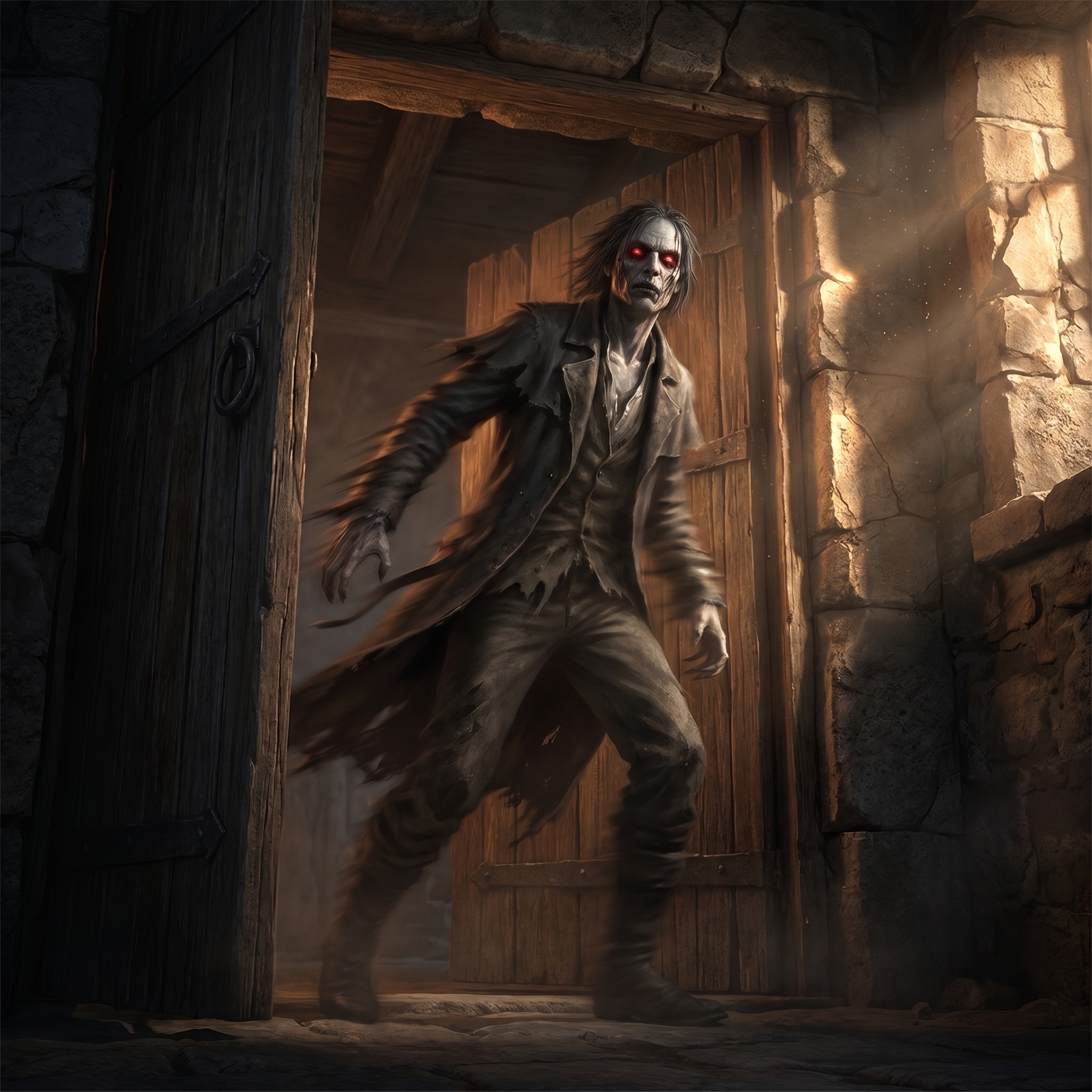
Role: Elite Lurker / Servant Where It Appears: Wherever a Vampire has established territory; old estates, crypts, abandoned upper floors, service quarters.
A Vampire Spawn was a person. It remembers being a person. It does not act like one anymore, and the gap between those two facts is what makes it useful to a Vampire and disturbing to everyone else.
What It Is
A Vampire Spawn is created when a mortal reaches Stage 3 of the Vampiric Curse and dies with the original Vampire's blood in their system. The result retains the mortal's memories and face but is bound to the creating Vampire's will and requires blood to sustain itself. It cannot create further Spawn. It does not age, does not sleep, and will not contradict the Vampire that made it.
Spawn are faster and stronger than mortals, harder to kill, and can pass as human in poor light. In good light, to anyone paying attention, they are wrong in small specific ways that are hard to name but impossible to unfeel.
Ecology and Behavior
A Spawn operates wherever its Vampire places it — as a household guard, a spy in another noble's service, a manager of the feeding supply, or a forward scout for a relocating Vampire. It carries out instructions with the intelligence of its former self, which makes it more effective and more dangerous than a mindless servant.
Spawn occasionally develop resentment toward their creating Vampire, particularly if they retain strong memories of their former life. This rarely manifests as open defiance, but a Spawn can be turned into an informant or ally if the party reaches it before the Vampire realizes what is happening.
Signs and Knowledge
Field signs: same as Vampire but more obvious — a servant who does not appear in daylight, who remembers things they shouldn't know, who deflects questions about their history.
Medicine or Adventuring Lore (Average): identifies Spawn physiology from a Vampire's.
Vampire Spawn (Elite)
- Skills: Unarmed 4, Stealth 4, Deception 3, Perception 4.
- Attacks: Bite (Unarmed; Damage 7; Crit 3; Pierce 2; Grabbed on 2 Boons); Strike (Unarmed; Damage 8; Crit 4).
- Abilities: Lesser Feeding — On a successful Bite against a Grabbed target, recover 2 Wounds. No infection: Spawn cannot pass on the curse.
- Abilities: Sunlight Vulnerability — Same as Vampire: loses 4 Wounds per turn in direct sunlight, cannot use Resistance.
- Abilities: Bound Will — While the creating Vampire is alive and within the same region, the Spawn adds 1 Boon to Willpower checks. If the Vampire is destroyed, the Spawn is immediately Staggered and may act independently.
- Soul: Claimable, the spawn was turned rather than choosing it; at death the interrupted crossing resumes and the soul is dispatched normally at Sheol.
Tactics: The Spawn engages from concealment, prioritizes isolating one target for feeding, and withdraws if the fight turns. It will not sacrifice itself for its Vampire; the bond is control, not loyalty.
Encounter Use: Use a Spawn as the first sign that a Vampire is nearby. It's the encounter before the encounter. Let the party realize what it is, and what it being here means.
Harvesting and Trade
| Harvest | Buyer | Check | Typical Value | Use | Complication |
|---|---|---|---|---|---|
| Former Identity Documents | Local court, family, fence | Lore to authenticate | 0–5,000 gold Flargons | Proof of who was taken, legal claims | May create grief, not just reward |
| Fang | Collector, exorcist | Average Survival | 300–800 gold Flargons | Minor ward components, trophies | Less potent than a true Vampire's |
Variants
Free Spawn: One whose creating Vampire has been destroyed. Gains Independence 3, may negotiate, still requires blood. Treat as potential ally or independent threat.
Werebear
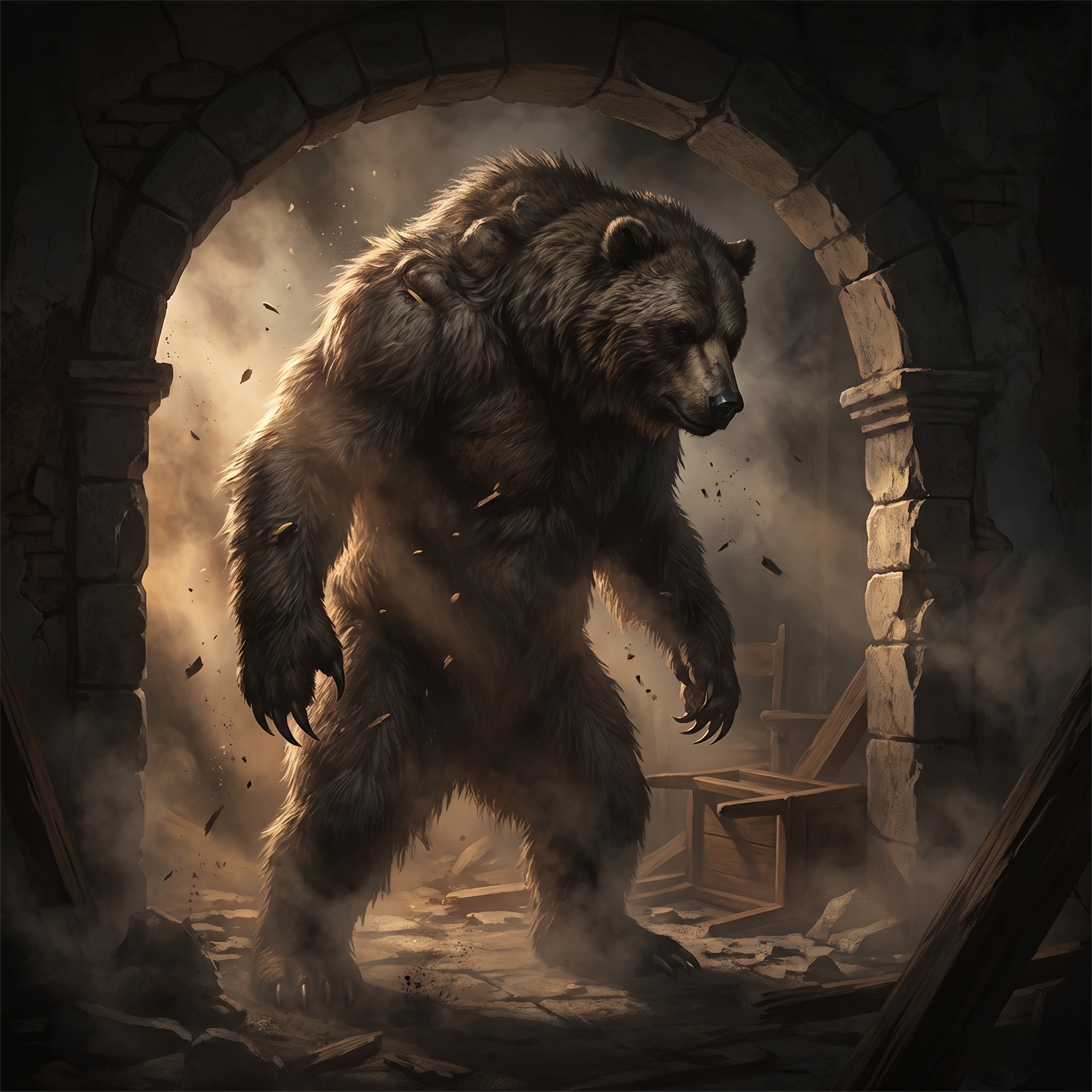
Role: Elite Bruiser / Shapeshifter Where It Appears: Mountain communities, isolated lodges, deep forest hermitages, ranger camps.
A Werebear in bear form is not subtle. It is a building with claws. The danger is not finding it — it is stopping it once found.
What It Is
Werebear lycanthropy differs from wolfcurse in temperament: the bear form tends to be less frenzied and more territorial. Afflicted individuals often adapt more successfully, choosing isolation over conflict and only transforming when threatened or at the moon's peak. This does not make them less dangerous. It makes them harder to find.
Ecology and Behavior
Werebears typically live at the edge of settled land — mountain rangers, deep forest trappers, hermit healers. They manage the curse through isolation and have usually made peace with their condition by the time anyone encounters them. An undiscovered Werebear may have lived in its territory for decades.
The bear form is larger and more powerful than the wolf form, but slower and less precise. A Werebear is less likely to hunt actively and more likely to defend a territory it considers its own. Entering that territory without permission is the mistake most people make once.
Signs and Knowledge
Survival (Average): identifies bear sign too large and with wrong gait patterns for an ordinary bear.
Medicine or Secret Lore (Hard): distinguishes lycanthrope bear from natural megafauna.
Werebear — Bear Form (Elite)
- Skills: Unarmed 5, Athletics 5, Fortitude 5, Perception 4, Survival 4, Intimidation 4.
- Attacks: Crushing Maul (Unarmed; Damage 11; Crit 3; Pierce 2, Vicious 5); Bear Hug (Unarmed; Damage 9; Crit 4; Grabbed on 2 Boons — Grabbed target suffers 5 Wounds at start of each turn).
- Abilities: Lycanthropic Scratch — A character wounded by Crushing Maul must make a Hard Willpower check or gain Infection Stage 1 (Lycanthropy — Bear). Stages and treatment follow Werewolf rules except the transformation produces a bear form rather than a wolf form.
- Abilities: Silver Vulnerability — As Werewolf.
- Abilities: Territorial Resolve — In its claimed territory, the Werebear adds 1 Boon to Fortitude and cannot be Frightened.
- Soul: Claimable, the curse did not take the person; at death it passes normally along the Silver Road to Sheol unless a claim exists.
Tactics: The Werebear charges the nearest threat, attempts a Bear Hug, and holds. It does not pursue fleeing intruders beyond its territory boundary. If the intruder has not come to harm it, it may stop short of killing — a single crushing demonstration that the boundary matters.
Encounter Use: Use as a territory encounter with a moral question. What did the party enter? Was it warned? Does it want to fight, or does it want them to leave?
Harvesting and Trade
| Harvest | Buyer | Check | Typical Value | Use | Complication |
|---|---|---|---|---|---|
| Silver-Killed Hide | Exorcist, collector | Hard Survival | 1,000–3,000 gold Flargons | Curse ward components | Silver-kill required for potency |
| Claw Sheath | Trophy buyer, healer | Average Survival | 200–600 gold Flargons | Trophies, ward experiments | Low value without provenance |
Variants
Settled Werebear: Stage 3, has managed the curse for years. Knows the moon cycle, has a system, does not want trouble. More likely to negotiate than fight if approached without aggression.
Wererat
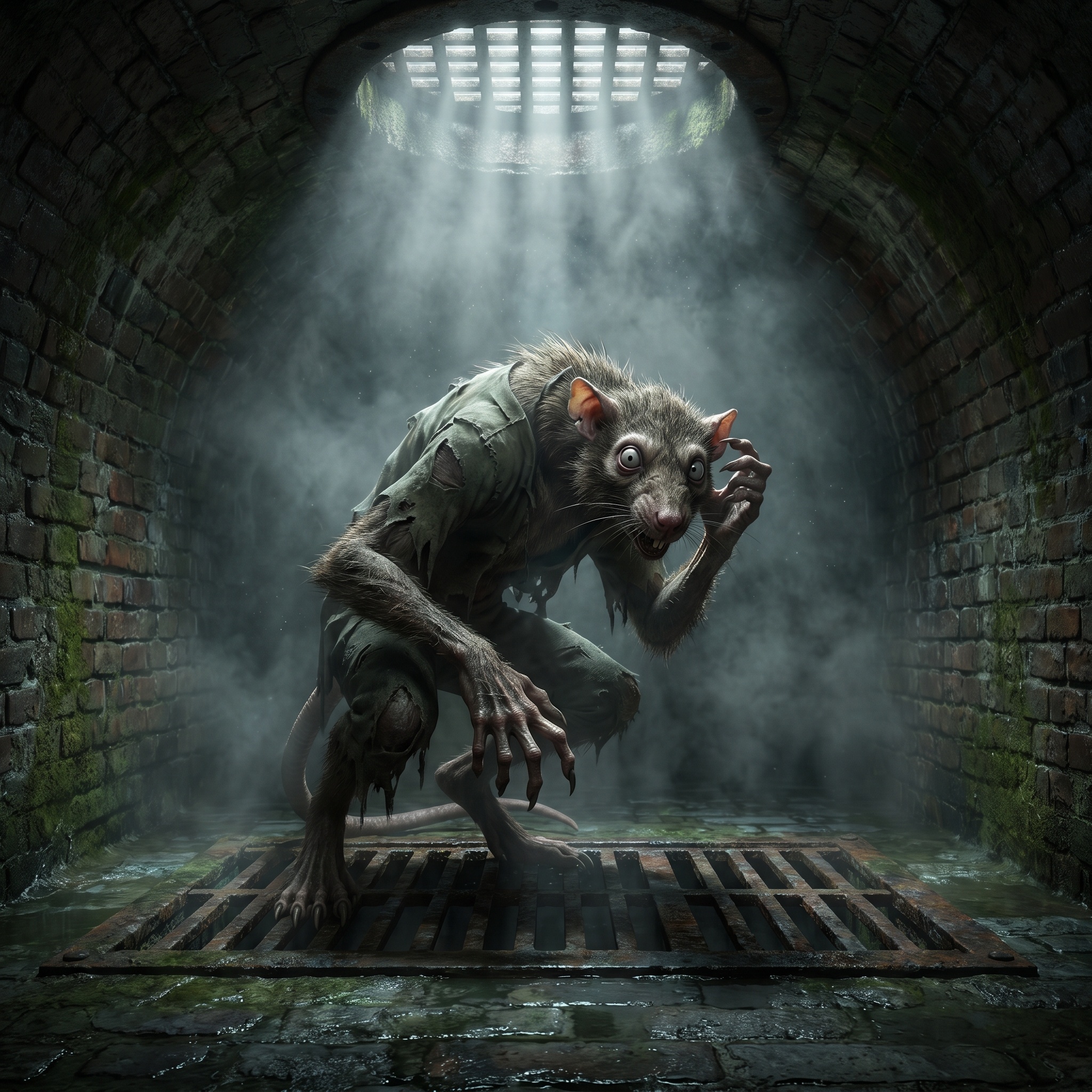
Role: Elite Lurker / Urban Shapeshifter Where It Appears: Cities, sewer networks, black markets, thieves' guilds, anywhere information and movement matter more than strength.
The Wererat does not fight the way the Werewolf does. It survives. Survival is the more dangerous skill.
What It Is
Wererat lycanthropy is the urban strain. Afflicted individuals are not powerful in the way a Werebear is powerful — the rat form is fast, small, and flexible, with exceptional senses and the ability to move through spaces a human cannot. The intelligence remains fully human. The combination of rat mobility and human cunning is what makes a Wererat dangerous, not its combat capacity.
Many Wererats are embedded in criminal networks, not because the curse drives crime but because the curse is useful there. Someone who can look like a rat, move through walls, and pass unnoticed has a professional advantage in certain lines of work.
Ecology and Behavior
Wererats build networks rather than territories. A single Wererat may have contacts, safe houses, and information channels across an entire city, all maintained from a position of complete anonymity. The curse is easier to hide in cities because the explanations are more available.
The rat form is not physically imposing but is nearly impossible to catch in an urban environment. Narrow passages, sewer connections, roof access, and the ability to squeeze through spaces too small for most creatures make a fleeing Wererat essentially gone within seconds.
Signs and Knowledge
Streetwise (Average): identifies unusual patterns of access, information leakage, or disappearances that suggest someone moving through walls.
Secret Lore or Medicine (Hard): distinguishes Wererat infection from other rat-bite diseases.
Wererat — Rat Form (Elite)
- Skills: Unarmed 3, Stealth 5, Perception 5, Subterfuge 4, Athletics 4, Streetwise 4.
- Attacks: Gnawing Bite (Unarmed; Damage 5; Crit 4; Pierce 1; Poison 1).
- Abilities: Lycanthropic Bite — A character bitten by Gnawing Bite must make a Hard Willpower check or gain Infection Stage 1 (Lycanthropy — Rat). Stages and treatment as Werewolf rules, except the transformation produces a rat form. Stage 3 Wererats gain the full Wererat stat block.
- Abilities: Squeeze Through — The Wererat may pass through any space a rat could fit through as a Maneuver.
- Abilities: Silver Vulnerability — As Werewolf.
- Abilities: Nervous Speed — If the Wererat moves before attacking, add 1 Boon to its attack.
- Soul: Claimable, the curse did not take the person; at death it passes normally along the Silver Road to Sheol unless a claim exists.
Tactics: The Wererat bites once, introduces the infection, and escapes. It uses Squeeze Through to reach spaces the party cannot follow. It returns later when the infection has had time to work, or never, if it has what it came for.
Encounter Use: The Wererat is most dangerous as an information problem or a social infiltration problem. The fight is what happens when someone is unlucky. The real encounter is finding out who in the city is one.
Harvesting and Trade
| Harvest | Buyer | Check | Typical Value | Use | Complication |
|---|---|---|---|---|---|
| Identity Materials (human form) | Investigator, guild | Streetwise to connect | Varies | Exposing network, legal action | May indict others beyond the target |
| Silver-Killed Remains | Exorcist, alchemist | Average Survival | 400–1,200 gold Flargons | Infection study, cure research | Rat form dissolves without silver kill |
Variants
Wererat Guild Broker: Human form specialist; rarely transforms, uses the threat of transformation as leverage. Negotiation 4, Deception 4.
Werewolf
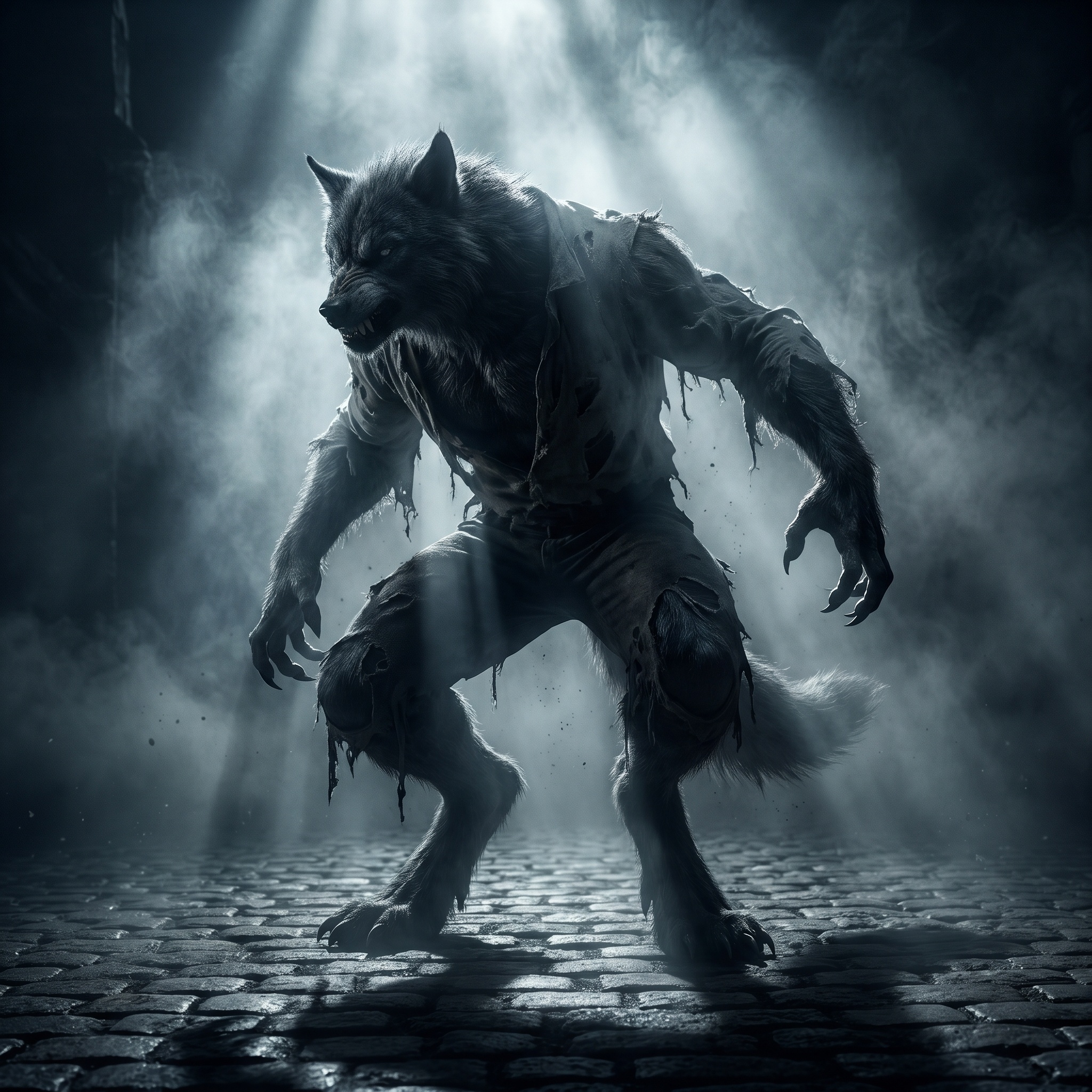
Role: Nemesis Shapeshifter Where It Appears: Forest roads, isolated farms, frontier towns, anywhere a person lives slightly apart from others and prefers it that way.
"The tracks changed mid-stride. One set of boot prints. Then the boot prints get farther apart, deeper at the toe. Then they are not boot prints. The trail does not stop — it changes." — Frontier guard report, road patrol, eastern Antaea
A Werewolf is not a monster that was once a person. It is still a person. That is the part that makes it hard to end and harder to investigate.
What It Is
Lycanthropy is a curse transmitted through deep wounding. The afflicted person retains full human identity and memory in human form and experiences the transformation — involuntary under the full moon, voluntary after sufficient time — as a loss of control rather than a change of self. The wolf form is larger, stronger, and faster than any natural wolf, with the intelligence of the person underneath and the hunger of something that has not eaten in a long time.
The afflicted person usually knows what they are. Most spend years hiding it, managing the moon cycle, and living with the damage they have already done.
Ecology and Behavior
A Werewolf is most dangerous in the days before and after a full moon, when the transformation is difficult to prevent and the hunger is hardest to manage. Outside that window, the afflicted person may be entirely ordinary — a farmer, a guard, a merchant — who has chosen a life that limits the damage.
Some adapt. They live near wilderness, arrange to be alone during the moon, and manage a territory the way a predator would. Some never adapt. The ones who never adapt accumulate history.
Voluntary transformation is possible once the curse has settled, typically after several full moon cycles. An experienced lycanthrope in wolf form has both the wolf's physical power and their own tactical intelligence. That combination is the most dangerous version of this creature.
Signs and Knowledge
Field signs: livestock deaths with no scavenging, boot prints becoming wolf prints, property damage at moon-peak with no explanation, a local person who is consistently unavailable at the full moon.
Survival or Adventuring Lore (Average): identifies lycanthrope attack patterns from ordinary wolf kills.
Medicine or Secret Lore (Hard): identifies the curse from examination of a victim or the transformed body.
Secret Lore (Severe): knows the full treatment window and the specific wolfsbane-and-silver approach before the first voluntary transformation locks the curse.
Werewolf — Wolf Form (Nemesis)
-
Skills: Unarmed 5, Athletics 5, Stealth 4, Perception 4, Survival 4, Intimidation 4.
-
Attacks: Mauling Bite (Unarmed; Damage 11; Crit 3; Pierce 3, Vicious 5); Rending Claws (Unarmed; Damage 9; Crit 4; Bleeding 1 on 2 Boons).
-
Abilities: Lycanthropic Bite — A character wounded by Mauling Bite must make a Hard Willpower check or gain Infection Stage 1 (Lycanthropy). See Infectious Condition rules.
-
Abilities: Lycanthropy Stages — Stage 1 (Curse Settles): No immediate effect; character is infectious. First full moon after infection triggers an involuntary transformation — the character loses control for the night (GM takes control of the character, who acts as a Werewolf Minion). Stage 2 (after two more full moons without treatment): Character begins experiencing wolf senses, urges, and instincts in human form. Add 1 Bane to social checks as human behavior becomes difficult to maintain. Stage 3 (after a fifth full moon): The curse is locked. Voluntary transformation is now possible; the character is a permanent lycanthrope.
-
Abilities: Treatment — Stage 1 only: Hard Medicine check using wolfsbane within three days of infection. Stage 2: Severe Medicine plus a divine or ancient rite, completed before Stage 3. Stage 3 is permanent without an extraordinary quest-level intervention.
-
Abilities: Silver Vulnerability — Attacks with silver weapons add 2 Boons and ignore 3 Resistance. The werewolf cannot regenerate Wounds dealt by silver.
-
Abilities: Frenzy Threshold — Below half Wounds, add 1 Boon to all attacks and 1 Bane to all other checks. The werewolf no longer retreats.
-
Soul: Claimable, the curse did not take the person; at death it passes normally along the Silver Road to Sheol unless a claim exists.
Tactics: The werewolf targets isolated creatures, uses terrain and speed to deny formation fighting, and focuses bite attacks on the most mobile opponent. It will not negotiate in wolf form. In human form before the transformation, the person inside may be terrified, resigned, or in denial — all of which are different encounters.
Encounter Use: Build the session around the identity, not the fight. A Werewolf is most interesting when the party knows — or suspects — who it is before the moon rises. The transformation should be witnessed. The decision about what to do should be harder than a combat roll.
Harvesting and Trade
| Harvest | Buyer | Check | Typical Value | Use | Complication |
|---|---|---|---|---|---|
| Silver-Killed Hide Patch | Exorcist, curse-breaker, collector | Hard Survival | 800–2,500 gold Flargons | Lycanthropy ward components | Only silver-killed specimens retain potency |
| Wolfsbane Extract (from scene) | Alchemist, healer | Average Natural Philosophy | 300–800 gold Flargons | Infection treatment, Stage 1 cure | Degrades within days without preservation |
| Identity Evidence | Family, local court | Lore to present | Varies | Closure, legal outcomes, estate claims | The family may not want to know |
Variants
Reluctant Werewolf: Stage 1 or 2 afflicted — still human, aware, trying to contain it. Use the human stat block with Unarmed 4, Athletics 4, and the Lycanthropic Bite ability in partial transformation.
Pack Leader: Nemesis, WND 50, STR 20. Controls one or more Stage 3 wolves as a pack; uses formation tactics and coordinates attacks with full tactical intelligence.