Everything else in this catalog can be reduced to a threat and a tactic. This chapter cannot, entirely, because everything in it is a person, or was one. Carna House Enforcers, Orc Warriors, Oshalan Zealots, Cult Rabble, they carry allegiances, grievances, and reasons that exist independent of the encounter they show up in. Chapter Two of the Universe Bible covers the factions these entries belong to in full; treat this chapter as their combat statistics, not their motivation, and read the faction material before deciding how one of these NPCs actually behaves outside a fight.
Killing every mortal antagonist on sight is a valid table choice, but it is a choice, not a default. A Bandit Gang can be captured, a Necromancer Apprentice can be talked out of a working still in progress, a Corrupted Bailiff can be exposed instead of executed. The catalog gives the stat block; the campaign decides how much mercy the world extends.
At the table: ask what this NPC wants that does not require the party's death. If the honest answer is nothing, that is worth knowing before the fight starts, not after.
Accord Keeper
Role: Elite Witness / Record Specialist Where It Appears: Archive recovery, contract clinics, witness work.
What It Is
An Accord keeper is Echo's Accord in the room. They take statements, restore damaged records, and make sure a thing that happened stays happened. They carry a witness roll rather than a weapon, and their staff is for walking.
They are not a party's enemy by default. A keeper becomes an obstacle when the party wants something to go unrecorded, and an asset when the party needs proof an institution cannot quietly lose.
Role and Behavior
Keepers work contract clinics in market districts, ride out to burned archives, and sit at bedsides where a dying testimony needs a second pair of ears. Echo's doctrine holds that truth without records can be denied, so a keeper's first instinct in any crisis is documentation, not intervention.
They are trained to de-escalate and to survive long enough to file. A keeper who runs from a fight has not failed; a keeper who lets a fact die unrecorded has.
Signs and Knowledge
Lore or Streetwise (Average): identifies the witness roll, the clinic seal, and which Accord chapter issued them.
Negotiation (Hard): predicts what the keeper will and will not put on the record, and what it would cost to have them attend a scene.
Other signs include wax tablets carried in a shoulder case, a habit of repeating names back before writing them, spare ink in a belt tube, and a refusal to be the only witness in a room.
Accord Keeper (Elite)
- Skills: Lore 4, Perception 4, Negotiation 3, Leadership 3, Medicine 2, Readiness 2.
- Attacks: Staff (Light Melee; Damage 4; Crit 5); Witnessed Correction (Leadership; Damage 4 Strain; Range Short).
- Abilities: Witnessed Act - Once per scene, place one witnessed fact on the record. A character who later contradicts it adds 1 Bane to Deception or Negotiation checks until they answer the record.
- Abilities: Reconstruct Record - Given fragments, testimony, or a damaged archive, add 2 Boons to one Lore, Perception, or Streetwise check to restore what was missing.
- Soul: Claimable; at death it passes normally along the Silver Road to Sheol unless a claim exists, in which case the claim resolves at judgment.
Tactics
Document first, fight last. The keeper establishes who is present, states what is being recorded, and lets everyone in the room understand that the scene is now evidence. They use Witnessed Correction on the person most invested in being believed.
If violence starts, the keeper protects the record before their own body. A party that shields a keeper gains institutional leverage; a party that lets one die loses the only account of what happened.
Encounter Use
Use an Accord keeper to turn a scene into a lasting consequence. They are the reason a corrupt bailiff cannot simply deny the meeting, and the reason the party's own shortcuts survive into later sessions. Pair one with an Archive Keeper when a records site is the objective.
Variants
- Clinic Keeper: Works contract disputes full time and reads infernal paperwork faster than most scholars.
- Field Keeper: Travels to burned sites and mass graves; higher Survival, lower Negotiation.
- Sworn Witness: Refuses to leave a scene once recording has begun, which makes extraction the party's problem.
Arcana-Burned Mage
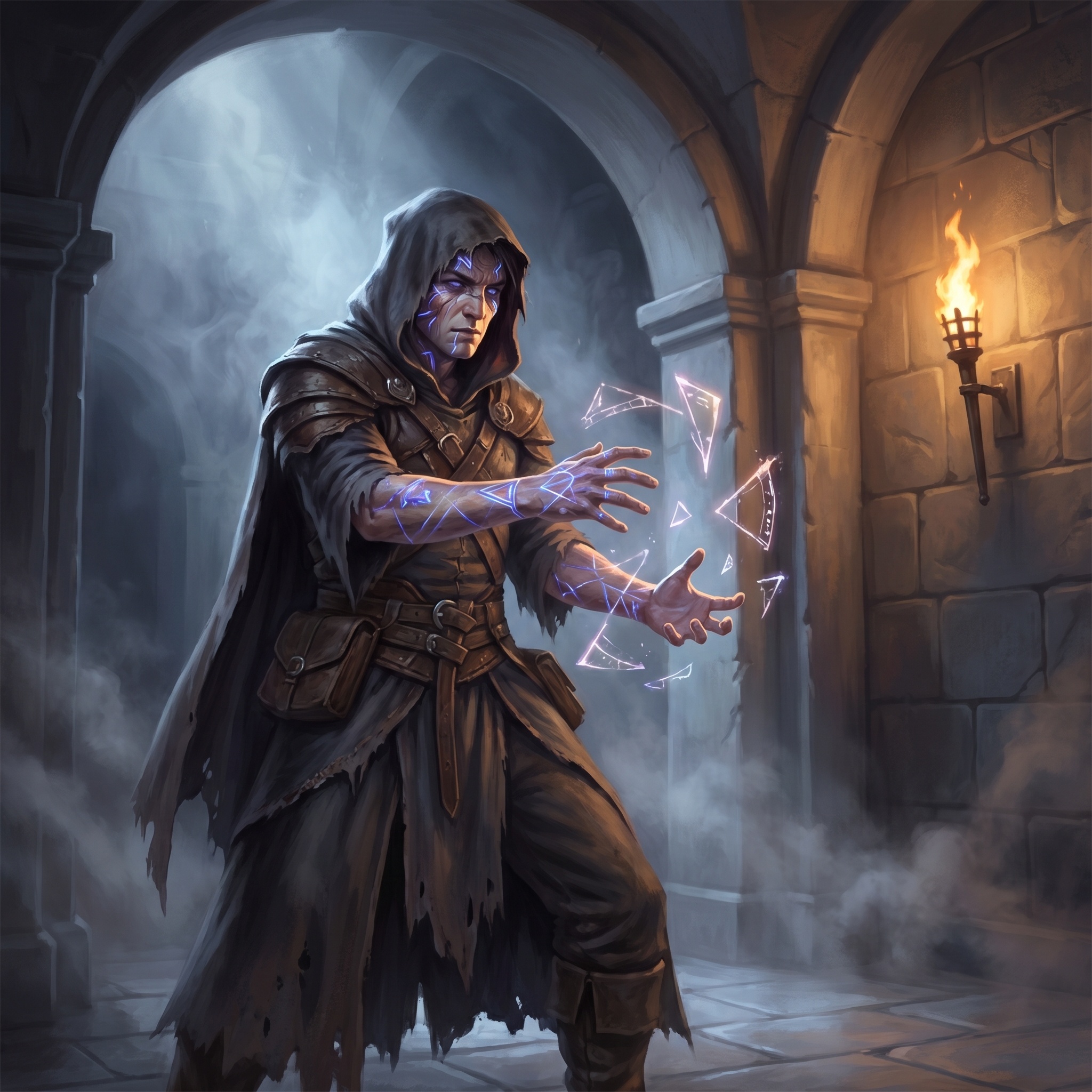
Role: Nemesis Unstable Caster Where It Appears: Failed high magic sites, academy disasters, Prism Dragon survivors.
"He was still giving instructions when the light took him. His voice continued for perhaps two minutes after his eyes had gone wrong. He seemed unaware of the difference." — Witness account, Arcane Faculty Incident Register, Sentient Spire
What It Is
Arcana-burned mages survived their own spell structure collapsing through them. Their magic still works, but it leaks consequences. They carry prism-burn scars, floating diagram fragments, and the brittle certainty of someone who thinks understanding pain means controlling it.
They are dangerous because they can still be brilliant. The problem is that every solution they cast may create another problem at the edge of the room.
Ecology and Behavior
Arcana-burned mages appear at failed high magic sites, academy disasters, Prism Dragon survivor zones, and hidden studies where containment was never repaired. Some seek cures. Some seek vindication. Some are trying to reproduce the disaster with "better controls."
They blame rivals, students, institutions, or the laws of magic itself before admitting they are unstable. Their notes are often valuable and hazardous in equal measure.
Signs and Knowledge
Secret Lore or Natural Philosophy (Average) identifies arcane leakage. Medicine (Hard) distinguishes ordinary trauma from magic burned into reflex.
Other signs include spell diagrams hovering out of sequence, chalk that rewrites itself, assistants who flinch at harmless cantrips, and rooms with too many emergency wards.
Arcana-Burned Mage (Nemesis)
- Skills: Secret Lore 5, Natural Philosophy 4, Readiness 4, Deception 3, Light Ranged 3.
- Attacks: Broken Working (Secret Lore; Damage 9; Crit 4; Range Medium; Burn 2 or Stun 2).
- Abilities: Arcane Leak — On Calamity, create a random magical complication affecting everyone at Short range.
- Abilities: Overfocus — Spend 2 Strain to add 1 Boon to a Secret Lore attack.
- Soul: Claimable; at death it passes normally along the Silver Road to Sheol unless a claim exists, in which case the claim resolves at judgment.
Tactics
An arcana-burned mage overcasts, panics, blames others, and flees toward prepared notes. They use Overfocus to force results, making Calamity more narratively frightening when it happens. They may protect research more fiercely than their own body.
Use them as a volatile antagonist, not a random spell turret. Their leak should complicate the whole battlefield.
Evidence and Trade
| Find | Value | Use | Recovery |
|---|---|---|---|
| Burn diagrams | 1,500-5,000 gold Flargons | Spell repair, disaster proof, dangerous research | Secret Lore (Hard) |
| Stabilizer notes | 800-3,000 gold Flargons | Cure attempt, ward design | Natural Philosophy (Hard) |
| Prism-scar samples | 500-1,800 gold Flargons | Arcane forensics | Medicine or Secret Lore (Hard) |
Variants
- Academy Survivor: Has institutional enemies and former students.
- Prism-Scar Hermit: Hides in a warped zone and attacks interruptions.
- Vindication Mage: Wants witnesses for the next attempt.
Arcane Duelist
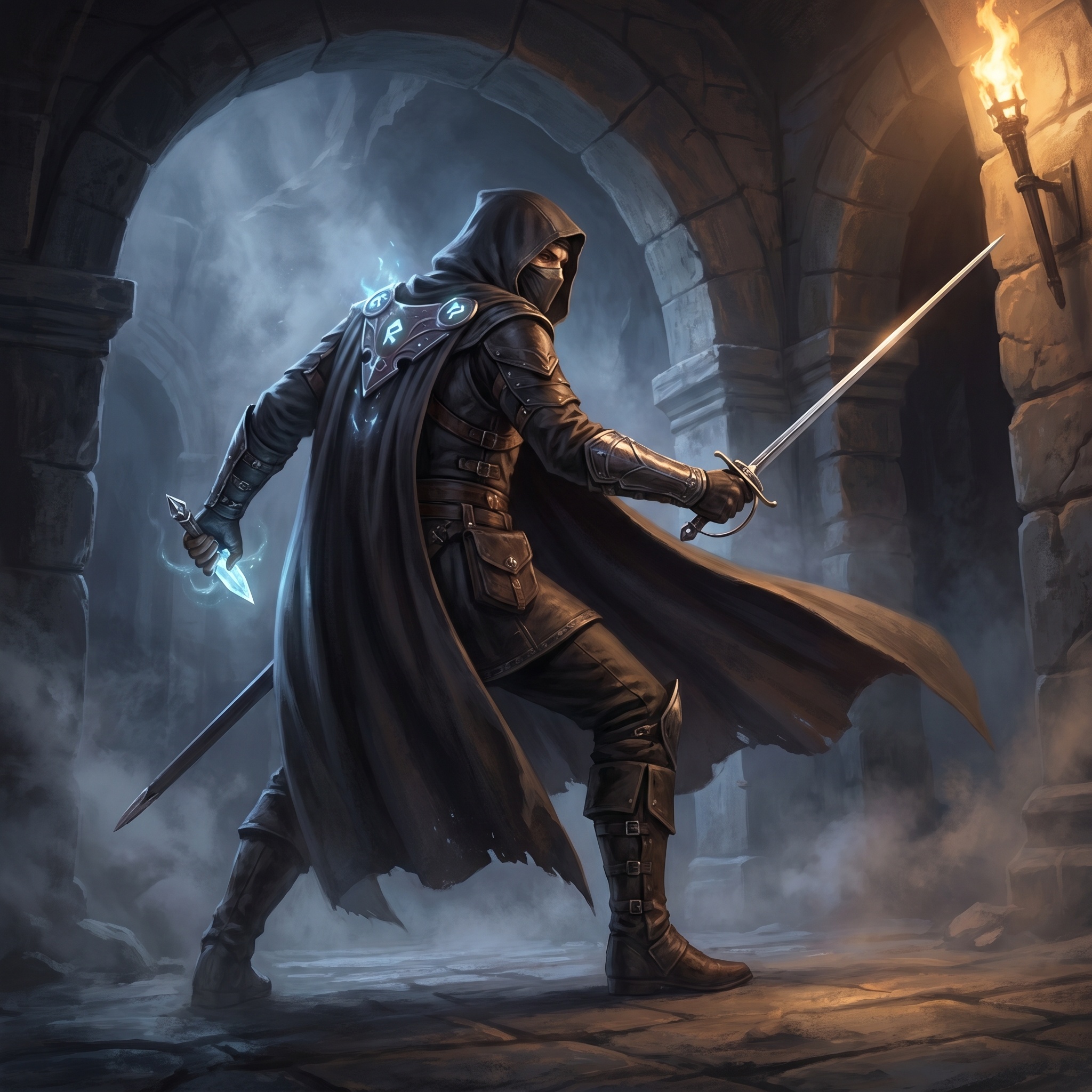
Role: Nemesis Skirmisher Where It Appears: Academies, noble feuds, mage courts, illegal dueling grounds.
"The challenge was worded so that refusing it would cost me the treaty. Accepting it cost me the treaty anyway. I am told this is considered elegant." — Private letter, attributed to Ambassador Vorren Ashwick, unsent
What It Is
Arcane duelists weaponize reputation. They prefer public rules, private cheating, and opponents too proud to refuse. They combine blade skill, prepared charms, etiquette, and just enough magic to make every exchange feel rehearsed in their favor.
As a Nemesis, an arcane duelist should arrive with stakes already in motion: a public insult, a wager, an academy rivalry, a noble patron, or a challenge that refusing would cost someone dearly.
Ecology and Behavior
Arcane duelists live in social ecosystems that reward spectacle. Academies, mage courts, noble feuds, illegal dueling societies, and salons all give them oxygen. They cultivate witnesses, seconds, healers, rumor brokers, and rules lawyers. Their true weapon is the ability to make violence look legitimate.
Most are obsessive preparers. They study opponents' spell habits, weapon grips, family scandals, and pride. Some cheat because they are cowards. Better ones cheat because they believe preparation is part of the duel.
Signs and Knowledge
Culture, Secret Lore, or Streetwise (Average) identifies a duelist's school and expected code. Perception or Deception (Hard) notices hidden ward tokens, illegal charms, or a second feeding them signals.
Other signs include carefully placed mirrors, chalked step marks, witnesses invited too early, and a challenge worded to deny the target a graceful refusal.
Arcane Duelist (Nemesis)
- Skills: Light Melee 4, Reflexes 4, Secret Lore 4, Deception 3, Charm 3, Readiness 4.
- Attacks: Spell-Etched Rapier (Light Melee; Damage 7; Crit 3; Pierce 2); Arcane Feint (Deception; Damage 5 Strain; Range Short).
- Abilities: Measured Counter — Once per round after an opponent misses in Engaged range, spend 1 Peril to make a rapier attack.
- Abilities: Prepared Trick — Once per scene, reveal a minor ward or dueling charm that adds 2 Banes to an attack against them.
- Soul: Claimable; at death it passes normally along the Silver Road to Sheol unless a claim exists, in which case the claim resolves at judgment.
Tactics
An arcane duelist insults, isolates, counterattacks, and preserves public legitimacy. They want the opponent angry, predictable, and seen as the aggressor. In battle, they punish misses, spend prepared tricks at dramatic moments, and retreat into rules if the fight turns ugly.
Make social stakes as sharp as the blade. A duel can cost reputation, inheritance, academy standing, or a treaty even if nobody dies.
Spoils and Trade
| Find | Value | Use | Recovery |
|---|---|---|---|
| Spell-etched rapier | 1,500-4,000 gold Flargons | Weapon, school identification, trophy | Secret Lore or Craft (Hard) to preserve enchantment |
| Dueling charms | 400-1,600 gold Flargons | Wards, cheating proof, arcane study | Secret Lore (Average) |
| Challenge letters | Varies | Legal leverage, proof of patronage | Culture or Lore (Average) |
Variants
- Academy Blade: Protects reputation through formal challenge and faculty politics.
- Salon Killer: Hides serious violence inside fashionable sport.
- Exiled Master: Older, less flashy, and more willing to duel outside any rules.
Archive Keeper
Role: Elite Noncombatant Witness Where It Appears: Municipal archives, temple registries, guild record rooms, estate libraries.
What It Is
An archive keeper is a custodian, not a fighter. They know the shelving, the index, the loan slips, and which clerk signed for what. When records are destroyed, they are the closest thing to a surviving copy.
Their value is entirely what they know and what they can reconstruct. Their danger is that everyone else knows that too.
Role and Behavior
Archive keepers hold small, poorly paid posts with disproportionate access. They notice irregular withdrawals, backdated entries, and visitors who arrive with the right seal and the wrong manner. Most say nothing until someone they trust asks the right question.
Under threat they freeze, stall, or hide among the stacks. They do not bargain well and they do not lie convincingly for long. A keeper who has already been frightened once is markedly harder to reach the second time.
Signs and Knowledge
Lore (Average): identifies which archive they serve and what class of records that archive holds.
Perception (Average): notices they are protecting one shelf, one drawer, or one satchel rather than the room.
Other signs include ink-stained cuffs, a personal index kept separately from the official one, a cot behind the stacks, and a standing habit of counting returns twice.
Archive Keeper (Elite)
- Skills: Lore 4, Perception 3, Readiness 2, Deception 2, Streetwise 2.
- Attacks: Letter Opener (Light Melee; Damage 3; Crit 5).
- Abilities: Partial Copy - Once per session, reveal that one destroyed or missing record has a partial duplicate, index entry, or witness note.
- Abilities: Panic Under Pressure - When directly threatened, the keeper adds 1 Bane to all checks until an ally succeeds on an Average Leadership, Charm, or Negotiation check to steady them.
- Soul: Claimable; at death it passes normally along the Silver Road to Sheol unless a claim exists, in which case the claim resolves at judgment.
Tactics
Hide, preserve records, and survive. An archive keeper will put a shelf between themselves and a stranger, talk toward the door, and produce the wrong ledger on purpose if they think the right one is the reason someone came.
They do not fight and they do not follow the party into danger. Forcing them to do either costs whatever cooperation they had left.
Encounter Use
Use an Archive Keeper as the fragile centre of a records scene: the person who can answer the question, and the person the opposition needs silenced. Partial Copy is the GM's release valve when a party burns the only copy of something the chronicle needs.
Variants
- Temple Registrar's Clerk: Same profile, religious records, more afraid of doctrine than of knives.
- Retired Keeper: No longer employed, still holds a personal index, and wants a reason to use it.
- Compromised Keeper: Already sold one entry and is trying to work out how to survive having done it.
Bandit Gang
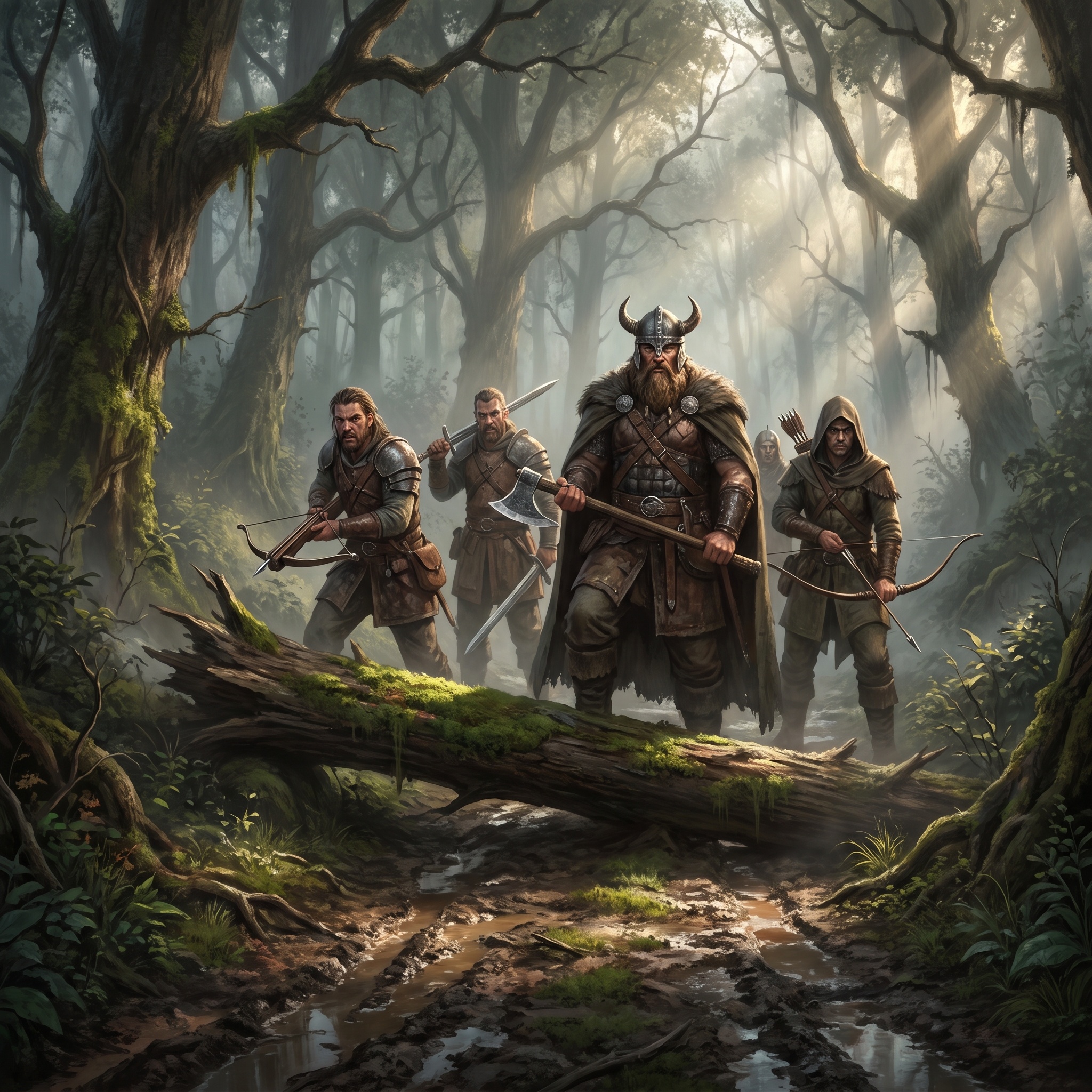
Role: Minion Mortal Opposition Where It Appears: Bad roads, hungry borderlands, postwar regions, failed estates.
Bandit gangs are not all the same. Some are desperate farmers. Some are deserters. Some are professionals using hunger as camouflage. Their morale matters more than their courage.
Bandit Gang (Minion)
- Group Size: 3-8.
- Skills: Light Melee 2, Light Ranged 2, Stealth 2, Perception 2, Streetwise 2, Intimidation 2.
- Attacks: Blades and Clubs (Light Melee; Damage 5; Crit 4); Bows or Slings (Light Ranged; Damage 5; Crit 4; Range Medium).
- Abilities: Morale Break — When reduced below half group Wounds, make an Average Leadership or Intimidation check for their leader or the gang flees, bargains, or scatters.
- Soul: Claimable; at death it passes normally along the Silver Road to Sheol unless a claim exists, in which case the claim resolves at judgment.
- Tactics: Block road, threaten, shoot from cover, run if the ambush fails.
- Encounter Use: Decide why they are robbing people before the scene starts.
Battlefield Surgeon
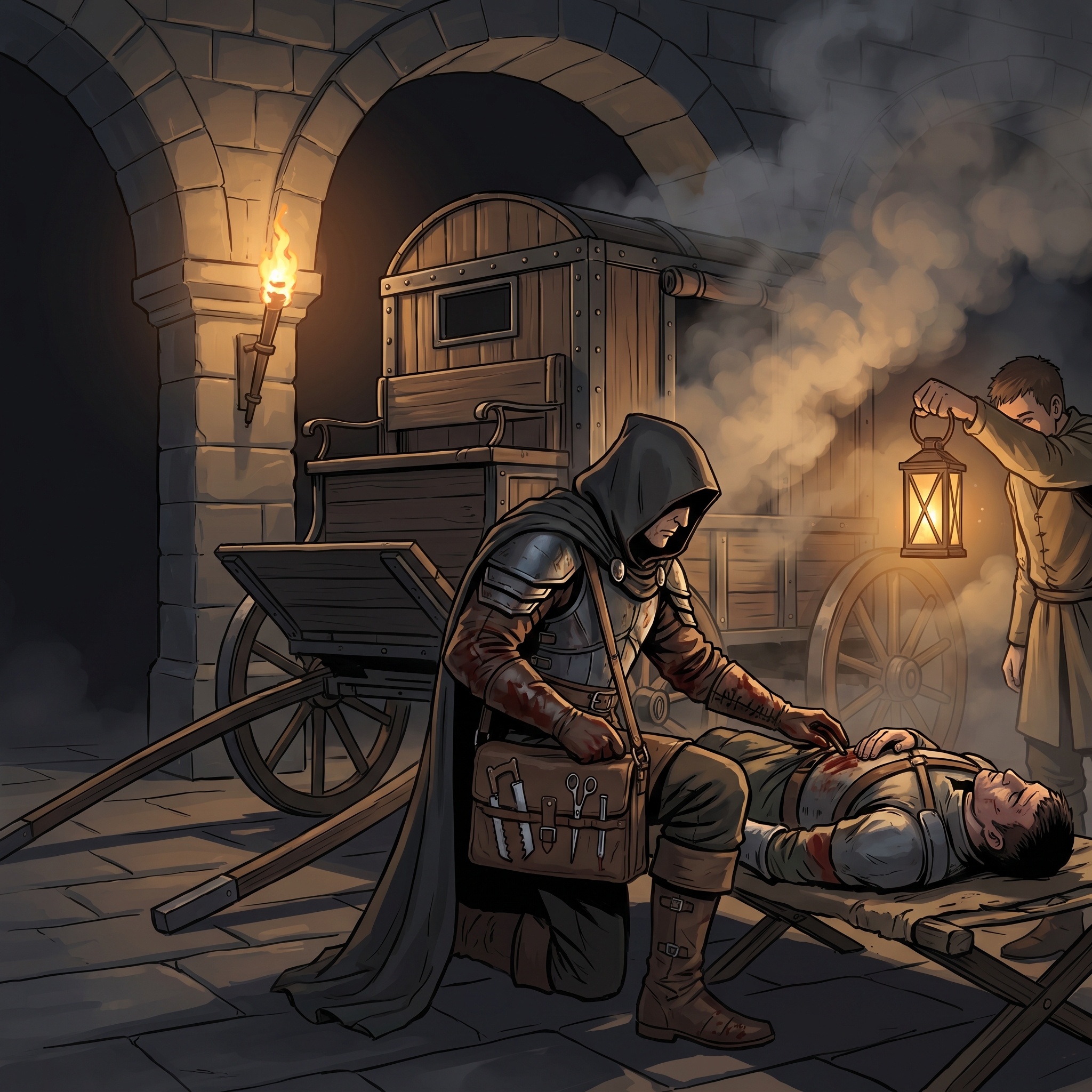
Role: Elite Support Where It Appears: War camps, mercenary companies, plague fronts, triage tents.
What It Is
Battlefield surgeons can be saviors, criminals, or both. As adversaries, they keep enemies alive long enough to make the fight worse. They know how to stop bleeding, where to cut to end a charge, and which wounded soldier is worth spending supplies on.
A battlefield surgeon is not automatically evil. The adversarial version may serve a cruel army, conceal experiments, ration care brutally, or protect a medical wagon the party needs to reach.
Ecology and Behavior
Battlefield surgeons live in triage systems: tents, wagons, plague sheds, mercenary camps, and occupied temples turned hospitals. They depend on assistants, clean water, boiled tools, guards, and supply lines. A good surgeon knows the unit's morale better than its captain does.
In a fight, they are force multipliers. They keep the largest threat standing, remove bleeding, and identify which hero is overextended. Outside a fight, they may be a source of mercy, evidence, or horror depending on what they have agreed to do for survival.
Signs and Knowledge
Medicine or Warfare (Average) identifies a disciplined field surgery site. Perception (Hard) spots concealed experimental notes, unusual restraints, or prepared escape supplies.
Other signs include sawdust over blood, boiled linen, sorted tags on the wounded, guards posted to protect supplies instead of officers, and a wagon everyone avoids unless ordered.
Battlefield Surgeon (Elite)
- Skills: Medicine 5, Natural Philosophy 3, Light Melee 2, Readiness 4, Negotiation 2.
- Attacks: Surgical Knife (Light Melee; Damage 4; Crit 4; Pierce 1); Nerve Jab (Medicine; Damage 5 Strain; Engaged).
- Abilities: Keep Them Breathing — As an Action, an allied Elite or Minion group at Engaged range recovers 4 Wounds or ignores Bleeding.
- Abilities: Know Where to Cut — Against living humanoids, Nerve Jab adds 1 Boon.
- Soul: Claimable; at death it passes normally along the Silver Road to Sheol unless a claim exists, in which case the claim resolves at judgment.
Tactics
A battlefield surgeon stays behind cover, restores the biggest threat, and retreats with medical notes if the line breaks. They use Nerve Jab only when cornered or when disabling one hero will save multiple allies. They value instruments and records enough to risk a dangerous withdrawal.
Their ethics are the question. The same hands may save prisoners, conceal torture, triage children, or preserve a tyrant.
Evidence and Trade
| Find | Value | Use | Recovery |
|---|---|---|---|
| Surgical kit | 800-2,500 gold Flargons | Medicine, field care, forensic clues | Medicine (Average) |
| Triage ledger | Varies | Identifies units, prisoners, experiments, casualties | Lore or Medicine (Average) |
| Preserved samples | 300-1,600 gold Flargons | Plague research, alchemy, evidence | Natural Philosophy or Medicine (Hard) |
Variants
- Mercy Surgeon: Protects wounded on both sides and becomes hostile only if they are threatened.
- Company Butcher: Keeps soldiers alive for one more charge with brutal efficiency.
- Plague Front Surgeon: More dangerous after the fight than during it.
Bloodstone Claimant
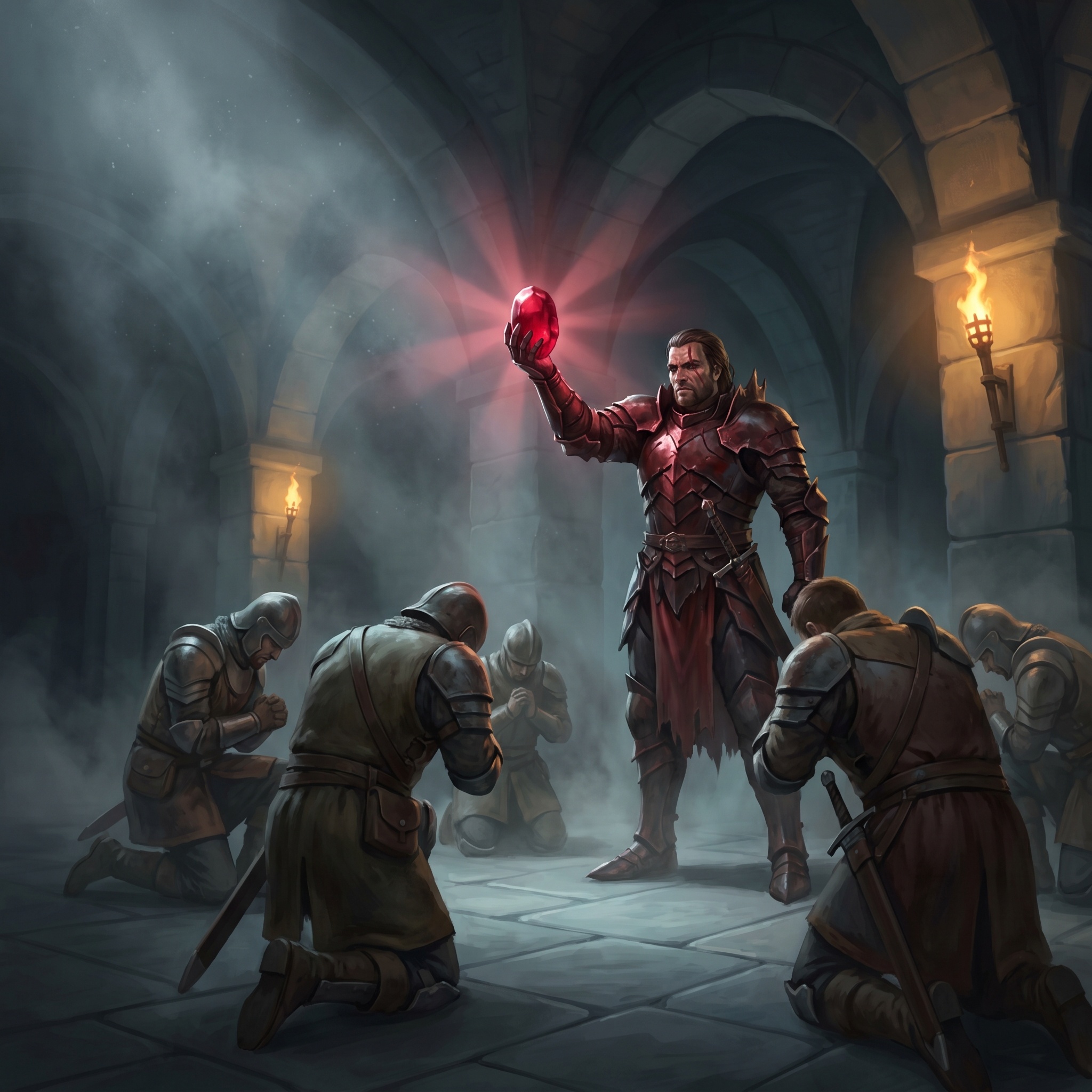
Role: Nemesis Relic Warlord Where It Appears: Succession wars, mercenary courts, bloodstone ruins, desperate battlefields.
"She found it in a field. She told no one. By the time we located her, she had been walking toward it for eleven days. She was not lost. She knew exactly where she was going." — Recovery report, Order of the Quiet Survey
The Claimant is not strong because of the bloodstone. The stone is dangerous because the Claimant was already willing to spend lives like coin. It amplifies command, fear, and injury into a shared engine of conquest.
What It Is
The Bloodstone Claimant is a war leader who has made a relic into a political argument. The bloodstone does not create ambition from nothing. It rewards someone already willing to turn loyalty, pain, and casualties into fuel.
Claimants present themselves as rightful heirs, emergency commanders, liberators, saints of necessity, or the only person strong enough to end the war. The bloodstone makes those claims feel hot, immediate, and costly to disobey.
Ecology and Behavior
Claimants appear in succession wars, mercenary courts, bloodstone ruins, desperate battlefields, and collapsed states where people will accept almost any commander who can stop the bleeding. Their armies become unnaturally stubborn. Retreat becomes shame. Casualties become proof that the cause must continue.
The relic draws officers, priests, propagandists, and opportunists. Some know what the stone is doing. Others believe the Claimant's certainty is leadership. Defeating the Claimant may not end the war unless the party also breaks the story the bloodstone fed.
Signs and Knowledge
Warfare, Lore, or Secret Lore (Hard) identifies bloodstone command patterns: troops rallying at the wrong emotional moment, wounds used in speeches, and officers treating casualties as currency. Leadership (Average) recognizes soldiers who want to flee but cannot admit it.
Other signs include red-black standards, casualty ledgers read aloud before attacks, field surgeons ordered to keep soldiers conscious for speeches, and kneeling troops bleeding onto the same relic.
Bloodstone Claimant (Nemesis)
- Skills: Leadership 5, Heavy Melee 4, Intimidation 5, Lore 3, Fortitude 4, Readiness 5.
- Attacks: Claimant Blade (Heavy Melee; Damage 11; Crit 3; Pierce 2); Bloodstone Order (Leadership; Damage 9 Strain; Crit 4; Range Medium).
- Abilities: Paid in Blood — When an allied minion in Short range is defeated, the Claimant heals 2 Strain and adds 1 Boon to its next check.
- Abilities: No One Leaves — Allied minions in Medium range do not rout unless the Claimant is defeated or the bloodstone is broken.
- Abilities: Dread — Fear 3.
- Soul: Claimable; at death it passes normally along the Silver Road to Sheol unless a claim exists, in which case the claim resolves at judgment.
Tactics
The Claimant spends troops, preserves officers, and frames retreat as treason. Minions are used to feed Paid in Blood while veterans and standard bearers keep the formation emotionally trapped. The Claimant targets anyone trying to order withdrawal or expose the relic.
The encounter should make breaking the bloodstone a clear but difficult alternative to simply cutting down soldiers. Once the stone is broken or hidden, morale can become a real battlefield again.
Relics and Trade
The bloodstone is the prize and the danger. Collectors may offer 8,000-20,000 gold Flargons, while would-be tyrants will pay catastrophically more. Responsible factions usually want it sealed, studied, or destroyed.
| Find | Value | Use | Recovery |
|---|---|---|---|
| Bloodstone relic | 8,000-20,000 gold Flargons, more to tyrants | Command magic, forbidden research, war legitimacy | Secret Lore or Theology (Hard) to contain |
| Casualty command ledger | 2,000-9,000 gold Flargons | War crime evidence, morale release, propaganda reversal | Warfare or Investigation (Average) |
| Red-black standard | 1,000-4,000 gold Flargons | Identifies units bound by the Claimant | Lore or Leadership (Average) |
| Blood-oath seal | 2,500-7,000 gold Flargons | Breaks troop compulsion, proves officer complicity | Secret Lore or Negotiation (Hard) |
Variants
- Rightful Monster: Has a legitimate claim and terrible methods.
- Mercenary Claimant: Buys loyalty, then blood-binds it.
- Relic Heir: Inherited the bloodstone and mistakes obedience for love.
Caravan Raiders
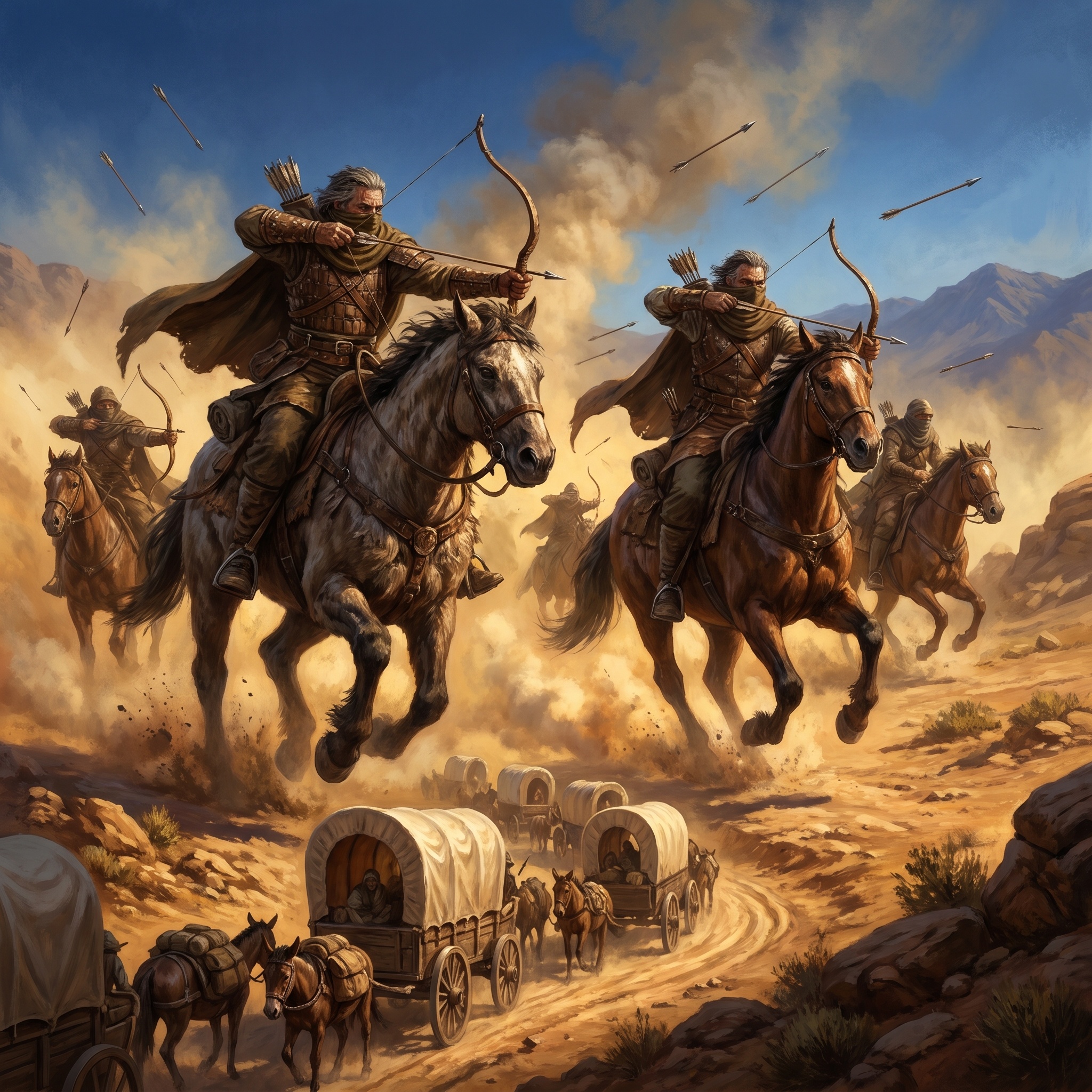
Role: Minion Harrier Where It Appears: Trade roads, desert margins, steppe routes.
Caravan raiders win by motion. They do not want a heroic fight; they want animals loose, guards split, and cargo abandoned.
Caravan Raiders (Minion)
- Group Size: 4-10.
- Skills: Riding 3, Light Ranged 3, Light Melee 2, Survival 2, Perception 2.
- Attacks: Mounted Bow (Light Ranged; Damage 6; Crit 4; Range Medium); Saber (Light Melee; Damage 6; Crit 4).
- Abilities: Circle and Cut — If mounted and moving, attacks against them add 1 Bane at Short range or farther.
- Soul: Claimable; at death it passes normally along the Silver Road to Sheol unless a claim exists, in which case the claim resolves at judgment.
- Tactics: Kill lead animals, threaten drivers, withdraw before infantry closes.
- Encounter Use: Track cargo, hostages, and loose animals as stakes.
Carna House Enforcer
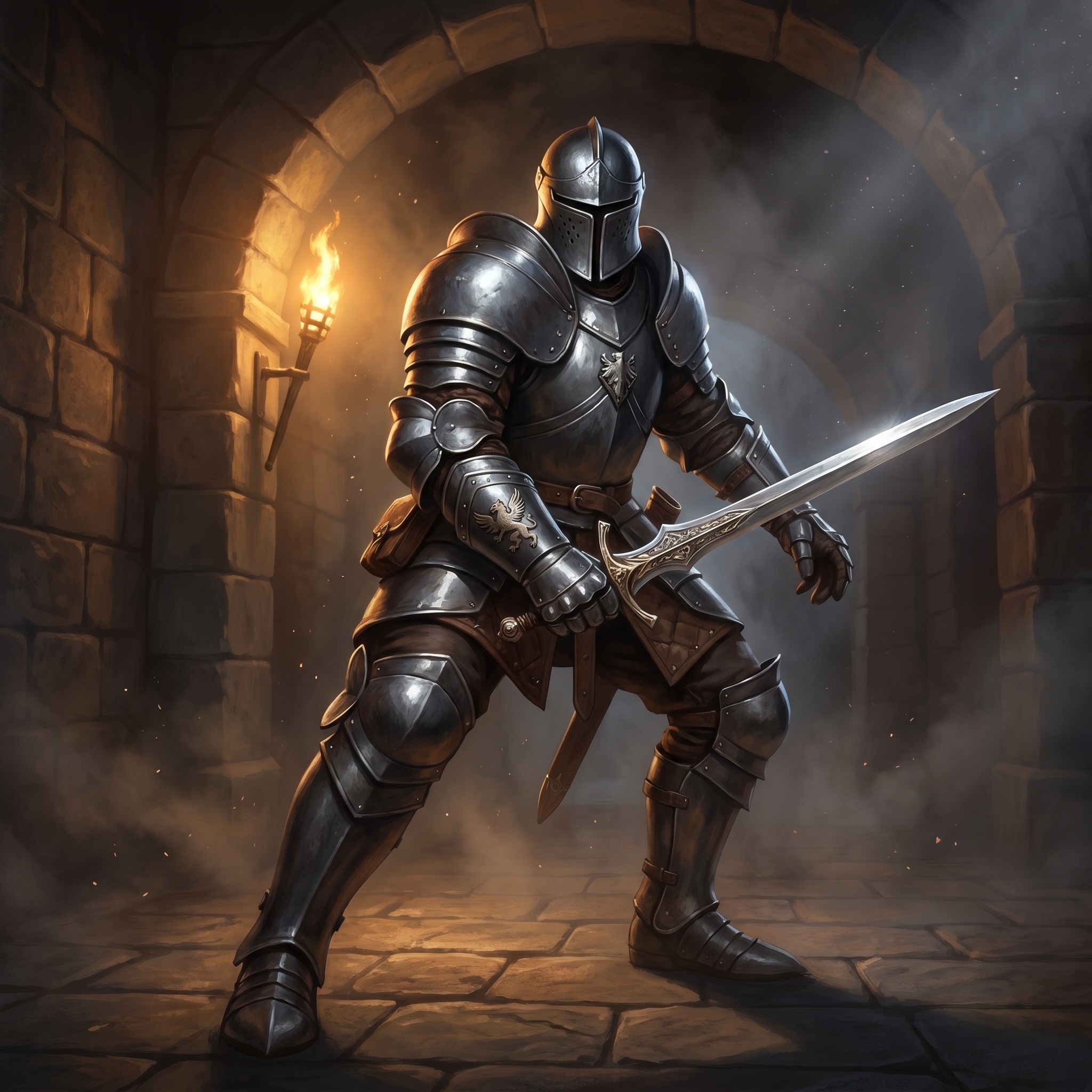
Role: Elite Mortal Bruiser Where It Appears: Noble estates, city streets, private checkpoints.
What It Is
Carna enforcers are not hired muscle in noble colors. They are policy with a blade, trained to make House Carna's humans-first brutality look like public order. Their armor is polished, their paperwork is prepared, and their violence is usually staged where witnesses will learn the intended lesson.
An enforcer is a useful adversary because they can be both personally beatable and socially protected. A party may win the fight and still have to deal with the noble name behind the blade.
Ecology and Behavior
Carna House enforcers operate at estate gates, city checkpoints, debtor evictions, labor disputes, and private roads. They learn local laws well enough to bend them and local prejudices well enough to weaponize them. Most travel with lesser guards, informants, or a clerk who records a version of events favorable to the House.
They prefer intimidation before bloodshed. Public bruising, confiscation, humiliation, and selective enforcement do more for House Carna than random killing. In private, the gloves come off, especially against people the House considers politically invisible.
Signs and Knowledge
Streetwise or Culture (Average) identifies Carna colors and the legal privileges they assume. Lore (Hard) knows which officials are likely to protect them.
Other signs include checkpoint ledgers, selectively searched wagons, local humans moved to the front of lines, and nonhuman travelers warned to keep their eyes down.
Carna House Enforcer (Elite)
- Skills: Light Melee 3, Heavy Melee 2, Intimidation 3, Perception 3, Readiness 3, Streetwise 2.
- Attacks: House Blade (Light Melee; Damage 7; Crit 3; Defensive 1); Baton (Heavy Melee; Damage 6; Crit 4; Stun 2).
- Abilities: Backed by Name — In Carna territory, may summon legal cover or reinforcements one scene faster than expected.
- Soul: Claimable; at death it passes normally along the Silver Road to Sheol unless a claim exists, in which case the claim resolves at judgment.
Tactics
A Carna enforcer threatens first, disables publicly, and kills privately. They open with orders and legal claims, then use the baton to make examples while preserving the blade for serious resistance. If the scene turns against them, they invoke witnesses, rank, and reinforcements.
Use them to show what power gets away with. The tactical question is not only how to beat the enforcer, but whether to do it publicly, expose them, isolate them, or make their House pay a price.
Evidence and Trade
| Find | Value | Use | Recovery |
|---|---|---|---|
| House orders | 600-2,000 gold Flargons to enemies of Carna | Proof of policy, leverage over officials | Subterfuge or Streetwise (Average) |
| Signet baton | 400-1,200 gold Flargons | Evidence, trophy, forged authority | Possession may be incriminating |
| Checkpoint ledger | Varies | Names of victims, bribe trails, movement records | Lore or Streetwise (Average) |
Variants
- Estate Breaker: Specializes in evictions and rural terror.
- City Checkpoint Captain: Uses bureaucracy and crowd control as weapons.
- Dueling Enforcer: Higher-status blade trained to provoke legal duels.
Corrupted Bailiff
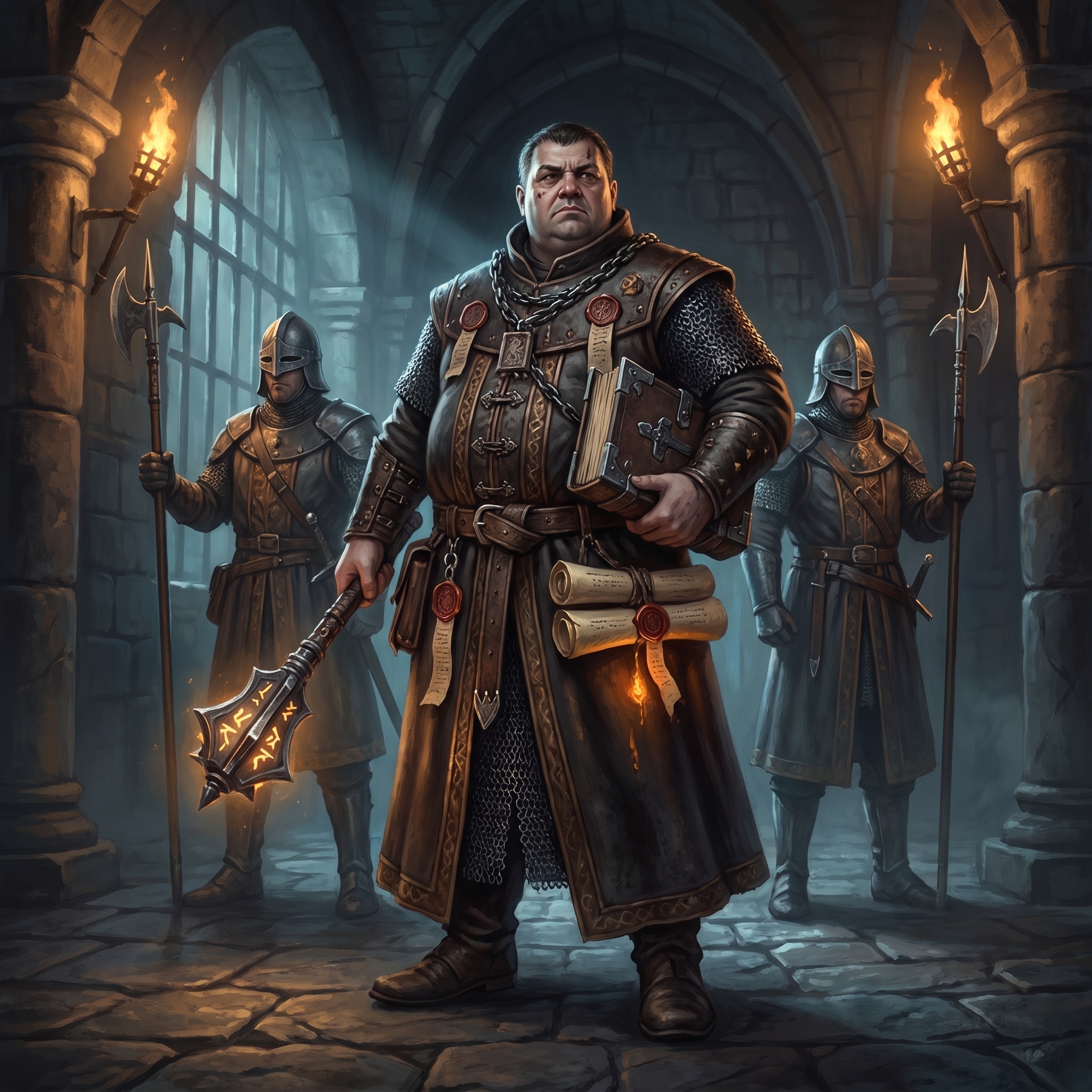
Role: Nemesis Social / Local Tyrant Where It Appears: Market towns, debtor courts, occupied villages, tax roads.
"The fees were real. The warrants were real. The authority was real. The problem was what paid for the authority." — Investigator's summary, dissolved upon filing, district of Maren
What It Is
A corrupted bailiff is what infernal influence looks like at street level: fees, seizures, warrants, and one more signature than anyone remembers giving. They do not need a throne. A desk, a seal, a few deputies, and a frightened town are enough.
As a Nemesis, the corrupted bailiff is a local system of harm. Their power is made of records, favors, selective enforcement, and the fact that most people cannot afford to challenge a legal process even when it is obviously rotten.
Ecology and Behavior
Corrupted bailiffs thrive in market towns, debtor courts, occupied villages, tax roads, and anywhere law is distant enough to imitate. They collect fees, seize property, sell exemptions, and route the desperate toward infernal contracts or allied lenders. Their deputies may think they are just keeping order.
They avoid fair fights. A bailiff prefers warrants, locked doors, public shame, and confiscation. If physically threatened, they retreat to a records office, summon deputies, or produce documents that make resistance look like criminal violence.
Signs and Knowledge
Streetwise, Lore, or Negotiation (Average) identifies irregular fees, duplicated warrants, and legal language imported from outside the jurisdiction. Secret Lore (Hard) spots infernal structure in the paperwork.
Other signs include families losing property for tiny debts, ledgers with too many red seals, deputies paid in seized goods, and townsfolk who know the law is false but fear saying so aloud.
Corrupted Bailiff (Nemesis)
- Skills: Negotiation 4, Intimidation 4, Deception 3, Streetwise 4, Lore 3, Leadership 3.
- Attacks: Deputy's Blade (Light Melee; Damage 5; Crit 4); Warrant Pressure (Intimidation; Damage 6 Strain; Range Short).
- Abilities: Paper Teeth - Once per scene, produce a technically valid document that imposes 1 Bane on attempts to resist openly unless disproven with Lore, Streetwise, or Negotiation (Hard).
- Abilities: Seize Property - If the bailiff wins a social exchange, one item, contact, or local privilege is locked behind legal recovery.
- Soul: Claimable; at death it passes normally along the Silver Road to Sheol unless a claim exists, in which case the claim resolves at judgment.
Tactics
A corrupted bailiff avoids fair fights, uses deputies and law, and retreats to a records office or patron when exposed. They attack reputation and resources first. In direct conflict, they try to make the party appear to be criminals attacking civic order.
Defeating them should free people, expose contracts, or ignite local backlash. The cleanest victory is not the bailiff dead on the floor; it is the town seeing the ledger and realizing the spell of paperwork has broken.
Evidence and Trade
| Find | Value | Use | Recovery |
|---|---|---|---|
| Debt ledger | 1,500-5,000 gold Flargons to victims, courts, or rivals | Frees debtors, exposes fraud and patrons | Lore or Streetwise (Hard) |
| Infernal wax reserve | 400-1,800 gold Flargons | Contract evidence, occult reagent | Secret Lore (Average), dangerous to handle |
| Seizure inventory | Varies | Returns property, identifies hidden caches | Negotiation or Subterfuge (Average) |
Variants
- Tax Road Bailiff: Controls travel through tolls, inspections, and staged violations.
- Debtor Court Tyrant: Converts poverty into forced service through false fees.
- Infernal Deputy: Less official, more occult; the paperwork is a summoning circle in slow motion.
Cult Cantor
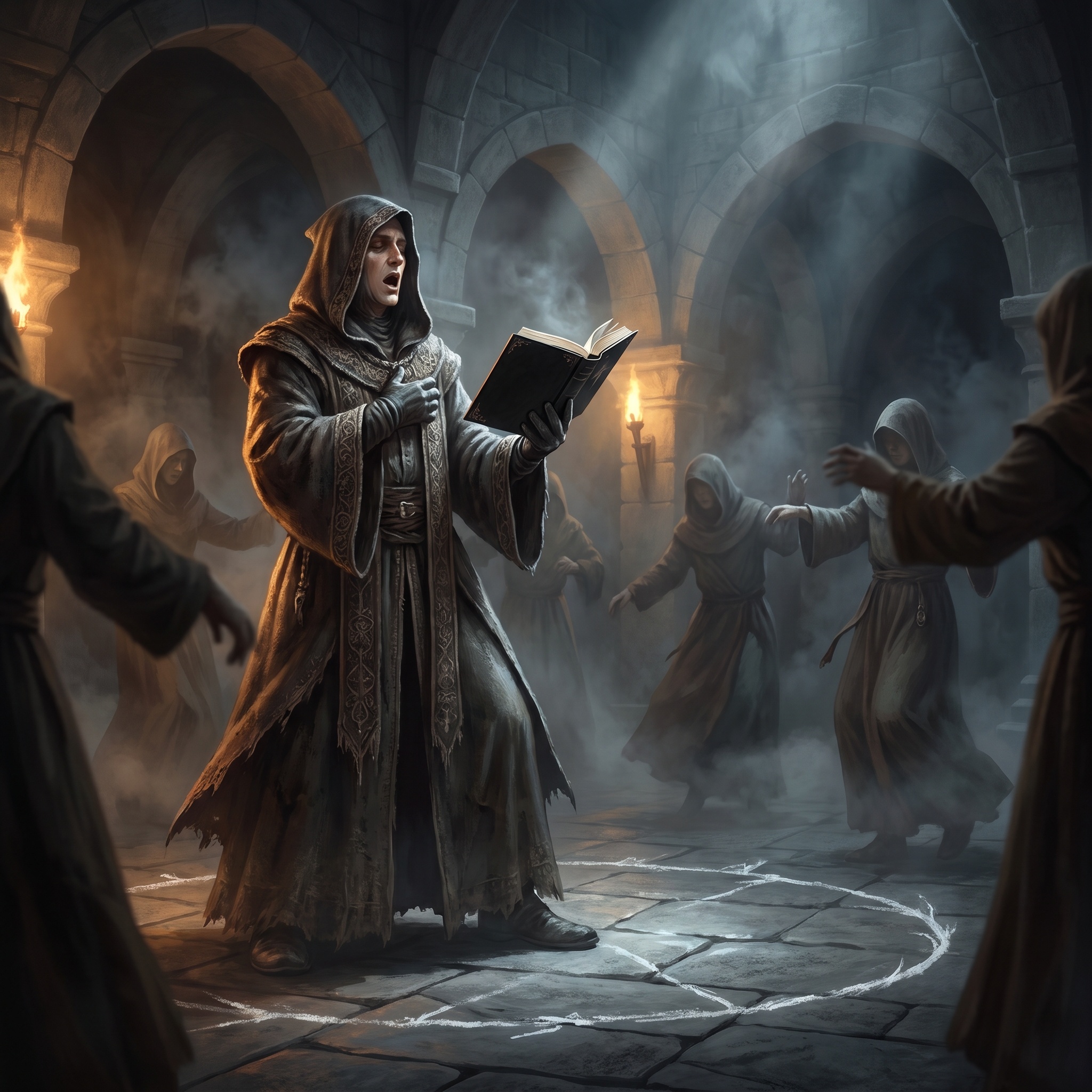
Role: Elite Support / Controller Where It Appears: Ritual chambers, public unrest, hidden shrines.
What It Is
Cult cantors turn groups into instruments. Alone they are fragile. With a crowd, they can make hesitation feel like faith. A cantor's voice gives frightened people a rhythm to obey, which is exactly what makes them dangerous in riots, rituals, and locked rooms.
They are not always leaders. Often they are amplifiers for someone else's doctrine, keeping the room emotionally synchronized while the true actor works.
Ecology and Behavior
Cult cantors appear in ritual chambers, public unrest, hidden shrines, recruitment meetings, and executions staged as worship. They memorize black hymns, call-and-response phrases, and breath patterns that help groups ignore doubt.
They fear silence more than violence. Breaking the chant, removing the hymnal, separating them from the crowd, or making the crowd hear individual names can collapse their influence.
Signs and Knowledge
Performance, Charm, or Secret Lore (Average) identifies a chant designed to control rather than inspire. Perception (Hard) spots the cantor conducting panic through small hand signs.
Other signs include crowds breathing in unison, repeated phrases that overwrite questions, hymnals with missing authors, and guards timing movement to verses.
Cult Cantor (Elite)
- Skills: Charm 4, Leadership 4, Secret Lore 3, Deception 3, Readiness 3.
- Attacks: Black Hymn (Charm; Damage 6 Strain; Range Medium); Ritual Dagger (Light Melee; Damage 3; Crit 5).
- Abilities: Keep Chanting — Allied cult Minions at Short range add 1 Boon to Readiness and attacks while the cantor sings.
- Soul: Claimable; at death it passes normally along the Silver Road to Sheol unless a claim exists, in which case the claim resolves at judgment.
Tactics
A cult cantor stays protected, maintains the chant, and flees if their voice is disrupted. They stand where allies can hear them and enemies must choose between pushing through bodies or enduring the hymn. If threatened, they turn the crowd into a shield.
Use them to make groups feel organized. The cantor's defeat should change the morale and rhythm of the entire scene.
Evidence and Trade
| Find | Value | Use | Recovery |
|---|---|---|---|
| Black hymnal | 400-1,200 gold Flargons | Cult doctrine, counter-chant research | Secret Lore or Performance (Average) |
| Conducting rings | 200-900 gold Flargons | Ritual focus, cell identification | Secret Lore (Average) |
| Verse notes | Varies | Reveals next rite or hidden leader | Lore or Deception (Average) |
Variants
- Riot Cantor: Uses public anger as a ritual instrument.
- Silent Hand Cantor: Conducts with gestures where singing would expose the cell.
- Children's Hymn Cantor: Hides doctrine in nursery tunes and school recitations.
Cult Knife
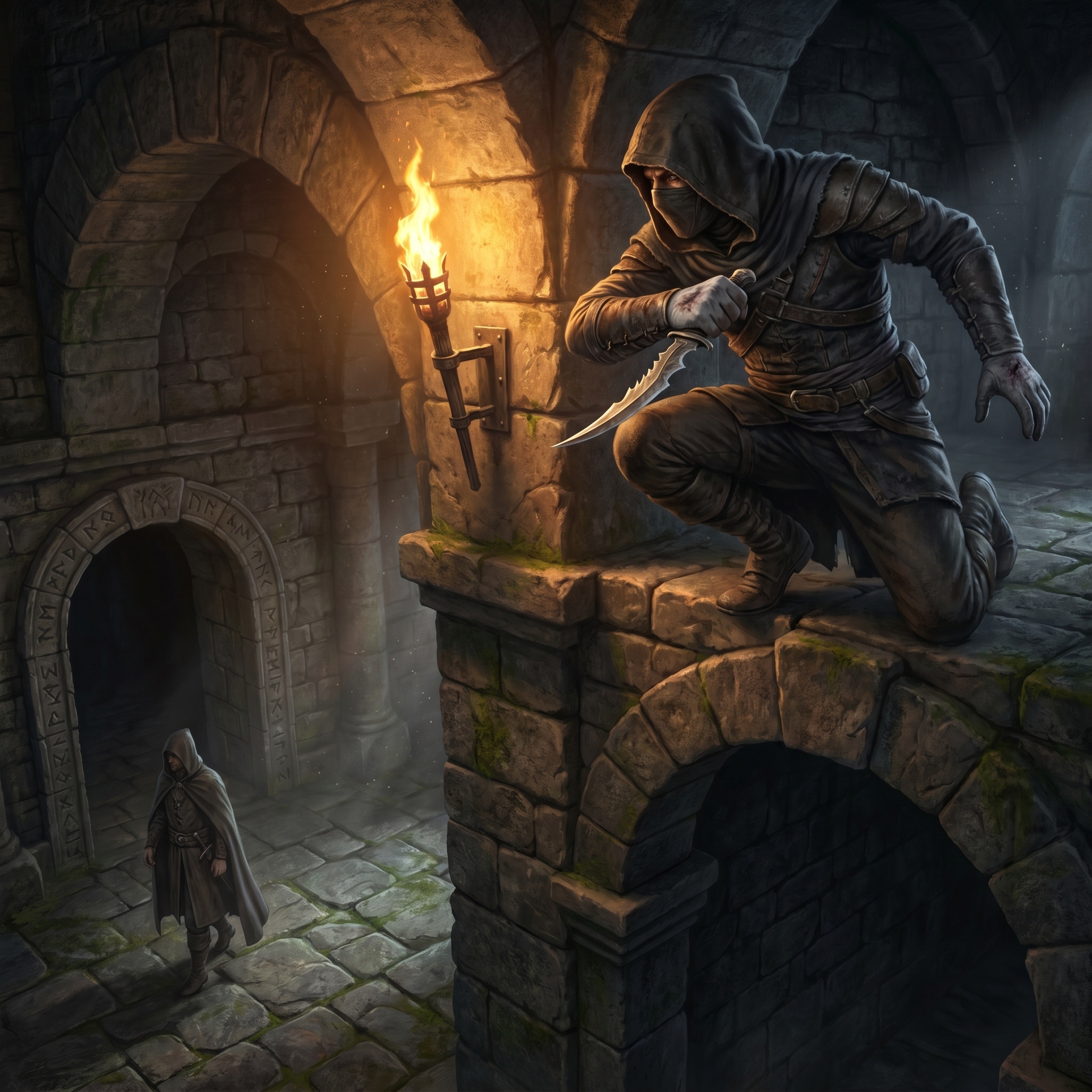
Role: Elite Lurker Where It Appears: Cult operations, ritual kidnappings, witness elimination.
What It Is
Cult knives are the quiet hands of infernal cells. They are trained to remove complications, not win open battles. They kill witnesses, burn papers, cut ropes, open side doors, and make a ritual look like it was never there.
A cult knife is usually more frightening as proof of organization than as a lone assassin. Someone knew who to silence, when, and why.
Ecology and Behavior
Cult knives operate around cult operations, ritual kidnappings, witness elimination, blackmail deliveries, and failed recruitment. They maintain safe exits, false masks, ash marks, coded blades, and dead drops for evidence. Many are fanatics, but the best are practical.
They prioritize the mission over survival. A cult knife may die to destroy a ledger, kill a rescued witness, or delay pursuit for one more round if the ritual needs it.
Signs and Knowledge
Streetwise, Subterfuge, or Secret Lore (Average) identifies cult knife methods. Perception (Hard) spots prepared exits, burn oil, or false servant placement before the strike.
Other signs include ash marks on wrists, matching cut angles on past victims, witnesses receiving sudden gifts, and papers stacked for fast burning.
Cult Knife (Elite)
- Skills: Light Melee 4, Stealth 4, Subterfuge 3, Deception 3, Perception 3.
- Attacks: Cult Knife (Light Melee; Damage 6; Crit 3; Pierce 1, Poison 1).
- Abilities: Witness Cut — First attack against a target carrying evidence or testimony gains +2 damage.
- Soul: Claimable; at death it passes normally along the Silver Road to Sheol unless a claim exists, in which case the claim resolves at judgment.
Tactics
A cult knife strikes witnesses, destroys papers, and flees through prepared exits. They attack from crowds, doorways, and service passages, then use poison to make pursuit costly. If trapped, they try to ruin evidence before saving themselves.
Run them around objectives. The fight is about protecting testimony, stopping a fire, keeping a door closed, or catching the killer before the cult cell vanishes.
Evidence and Trade
| Find | Value | Use | Recovery |
|---|---|---|---|
| Mask symbols | 300-1,500 gold Flargons to investigators | Identifies cult layer or patron | Secret Lore or Streetwise (Average) |
| Poison vial | 400-1,600 gold Flargons | Antidote research, criminal proof | Medicine or Natural Philosophy (Average) |
| Dead-drop token | Varies | Leads to handler or cell cache | Subterfuge (Hard) |
Variants
- Witness Knife: Specializes in killing testimony before trials or inquiries.
- Ritual Snatcher: Takes victims alive and cuts pursuit lines.
- Ash-Masked Cleaner: Burns rooms, records, and bodies after failed cult work.
Cult Rabble
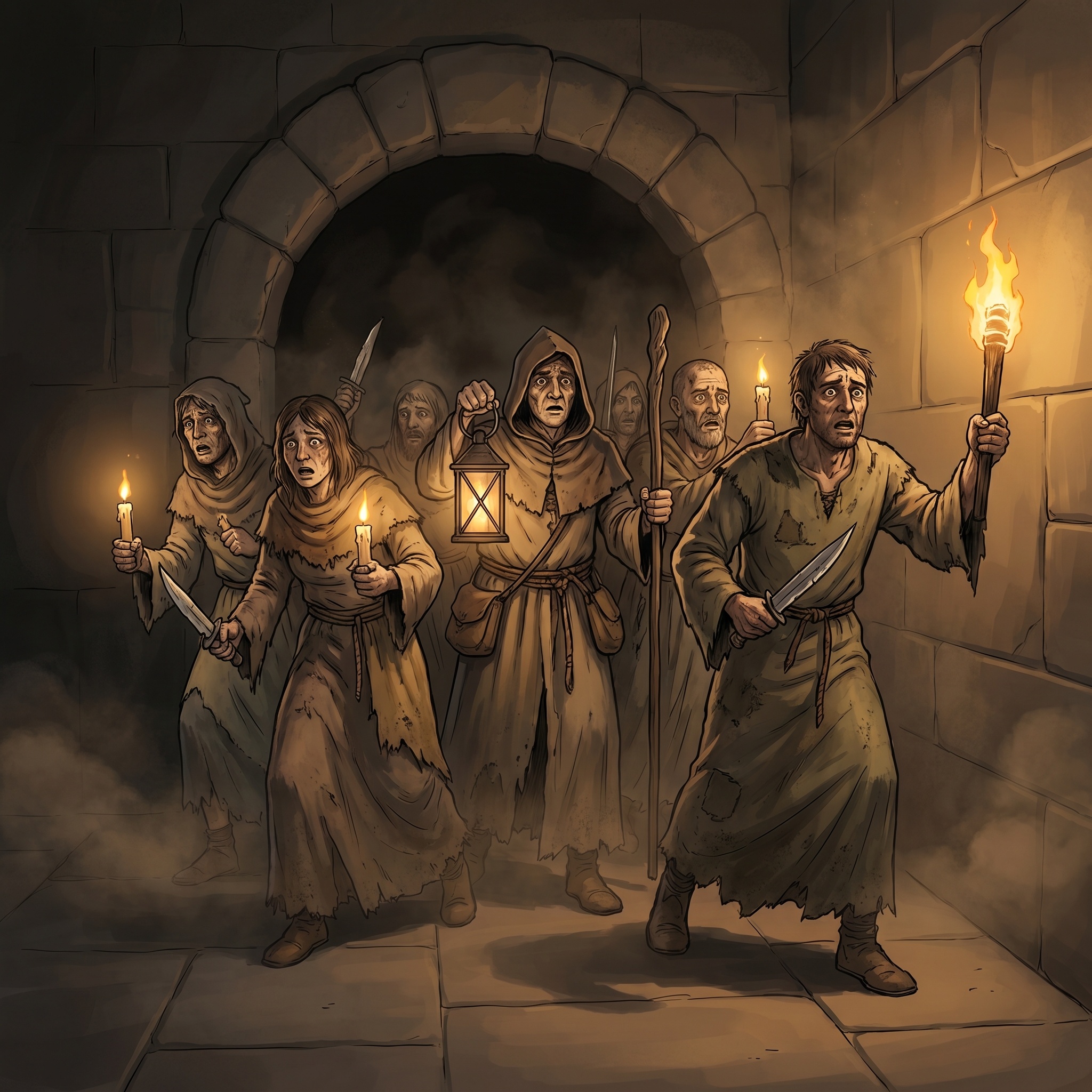
Role: Minion Fanatics Where It Appears: Cellars, abandoned shrines, public riots, ritual sites.
Cult rabble are dangerous because someone else spent weeks making them certain. They are not the plan. They are the noise that hides the plan.
Cult Rabble (Minion)
- Group Size: 4-12.
- Skills: Light Melee 2, Intimidation 2, Readiness 2, Secret Lore 1.
- Attacks: Ritual Knives (Light Melee; Damage 4; Crit 4).
- Abilities: Chanted Nerve — While a cult leader is present, add 1 Boon to fear resistance and 1 Bane to attempts to reason with them.
- Soul: Claimable; at death it passes normally along the Silver Road to Sheol unless a claim exists, in which case the claim resolves at judgment.
- Tactics: Swarm, block exits, buy time for the true actor.
- Encounter Use: Give them names if rescue or deprogramming matters.
Cult Surgeon
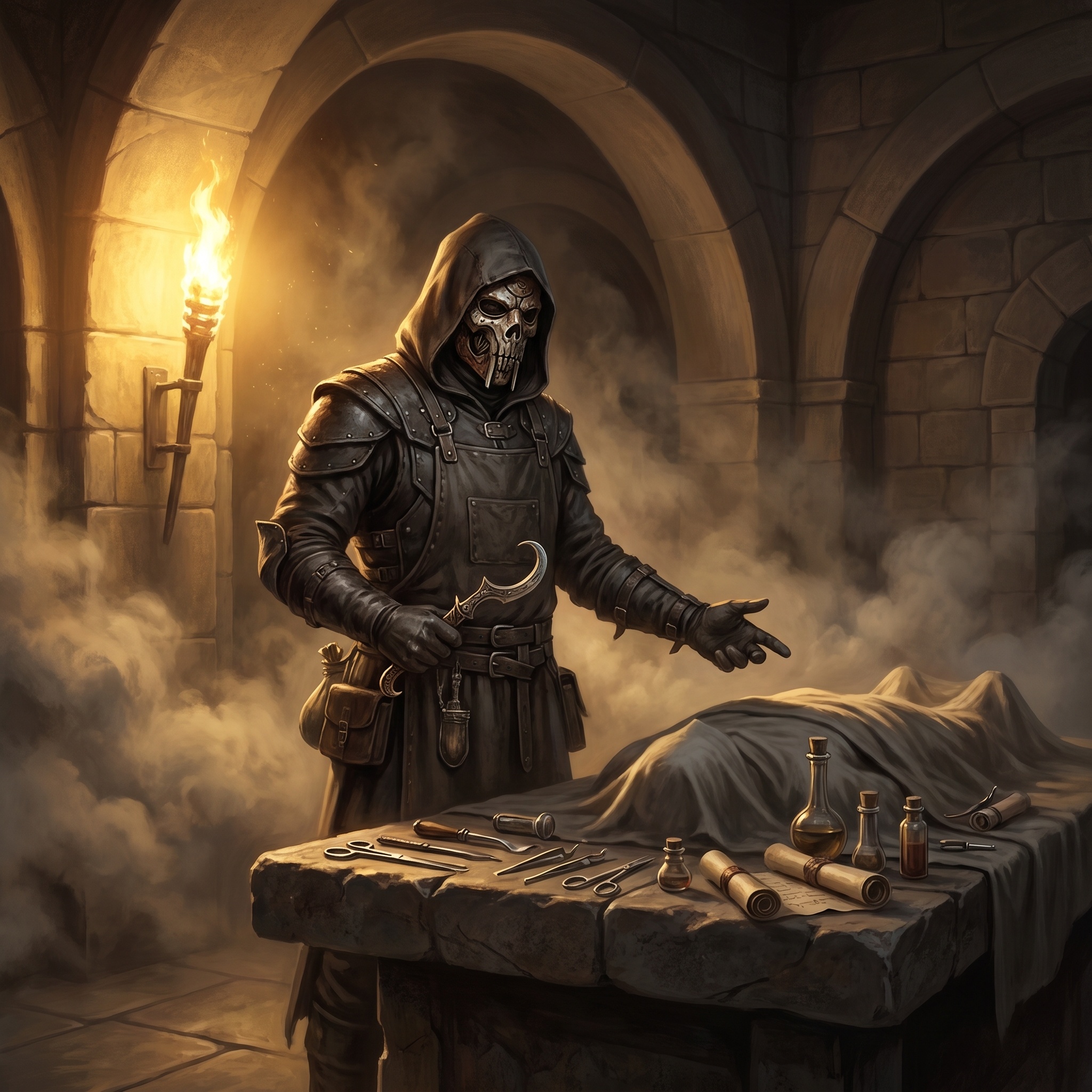
Role: Elite Support / Horror Specialist Where It Appears: Cult infirmaries, forbidden laboratories, body-modification rites.
What It Is
Cult surgeons treat the body as a contract clause: editable, enforceable, and disposable. Keep descriptions clinical; the horror is the calm. Their tables are clean, tools precise, and notes organized around outcomes rather than mercy.
They are support threats because they keep servitors working, modify captives, and preserve records other cultists would burn. A cult surgeon may be the best source of evidence in the lair.
Ecology and Behavior
Cult surgeons operate in cult infirmaries, forbidden laboratories, body-modification rites, punishment rooms, and hidden clinics for wealthy patrons. They need supplies, restraints, assistants, and a doctrine that lets them call harm improvement.
Some are true believers. Others are ambitious physicians using cult protection to do forbidden work. In either case, they preserve notes because they expect the work to continue.
Signs and Knowledge
Medicine or Natural Philosophy (Average) identifies procedures beyond ordinary care. Secret Lore (Hard) recognizes infernal alteration patterns.
Other signs include surgical schedules written like liturgy, tools marked with contract sigils, patients called "edits" or "drafts," and recovery rooms guarded more tightly than treasure.
Cult Surgeon (Elite)
- Skills: Medicine 5, Secret Lore 4, Natural Philosophy 3, Light Melee 3, Readiness 4.
- Attacks: Surgical Hook (Light Melee; Damage 5; Crit 4; Bleeding 1); Numbing Injection (Medicine; Damage 5 Strain; Engaged).
- Abilities: Patch the Servitor — As an Action, an infernal or cult ally recovers 4 Wounds.
- Soul: Claimable; at death it passes normally along the Silver Road to Sheol unless a claim exists, in which case the claim resolves at judgment.
Tactics
A cult surgeon stays behind brutes, disables captives, and preserves notes. They use Patch the Servitor to keep the worst ally active and Numbing Injection against anyone who reaches the table. If the fight is lost, they grab records before gold.
The encounter should keep descriptions clinical and focused on stakes: rescue, evidence, interrupted procedure, and whether the notes reveal a patron.
Evidence and Trade
| Find | Value | Use | Recovery |
|---|---|---|---|
| Surgical notes | 500-2,000 gold Flargons to investigators or monsters | Evidence, victim list, alteration method | Medicine or Secret Lore (Hard) |
| Ritual instruments | 800-2,600 gold Flargons | Forensic proof, dangerous research | Medicine or Craft (Average) |
| Recovery ledger | Varies | Identifies surviving victims and patrons | Lore or Streetwise (Average) |
Variants
- Servitor Mechanic: Focuses on keeping infernal bodies functioning.
- Patron Physician: Hides cult work inside elite medical service.
- Doctrine Anatomist: Believes the body must be edited to match the soul's contract.
Dragon Cultist
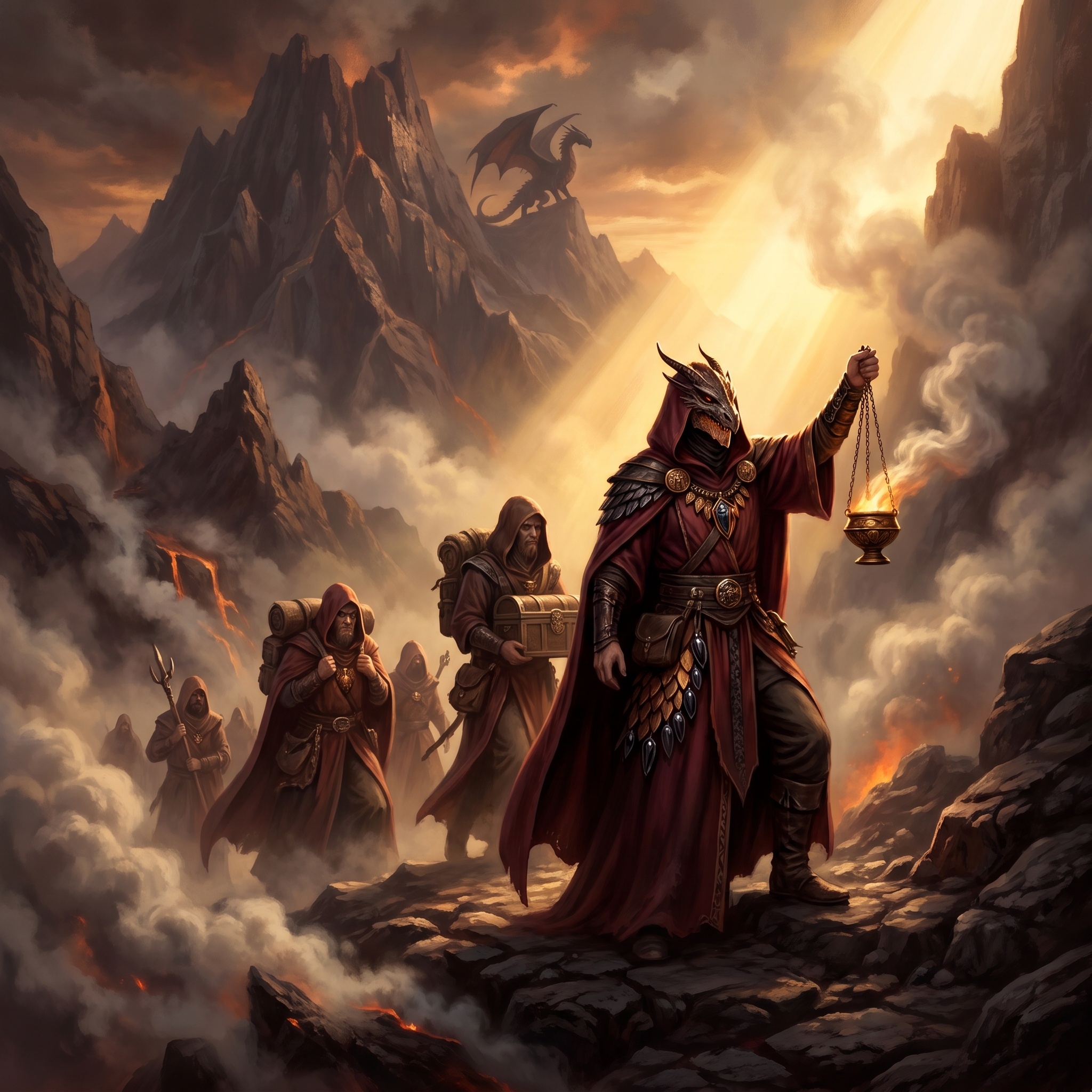
Role: Minion Mortal Fanatics Where It Appears: Dragon territories, tribute roads, apocalyptic sects.
Dragon cultists mistake survival near power for chosenness. Some worship. Some manage tribute. Some are simply hostages who learned the hymns.
Dragon Cultist (Minion)
- Group Size: 3-12.
- Skills: Light Melee 2, Lore 2, Survival 2, Intimidation 2, Readiness 3.
- Attacks: Sacrificial Blade (Light Melee; Damage 4; Crit 4).
- Abilities: Draconic Awe - While within sight of their dragon or lair sign, add 1 Boon to Readiness.
- Soul: Claimable; at death it passes normally along the Silver Road to Sheol unless a claim exists, in which case the claim resolves at judgment.
- Tactics: Delay intruders, protect offerings, call the dragon only if desperate.
- Harvesting and Trade: No harvest. Scale charms can identify cult allegiance.
Dragon Hunter
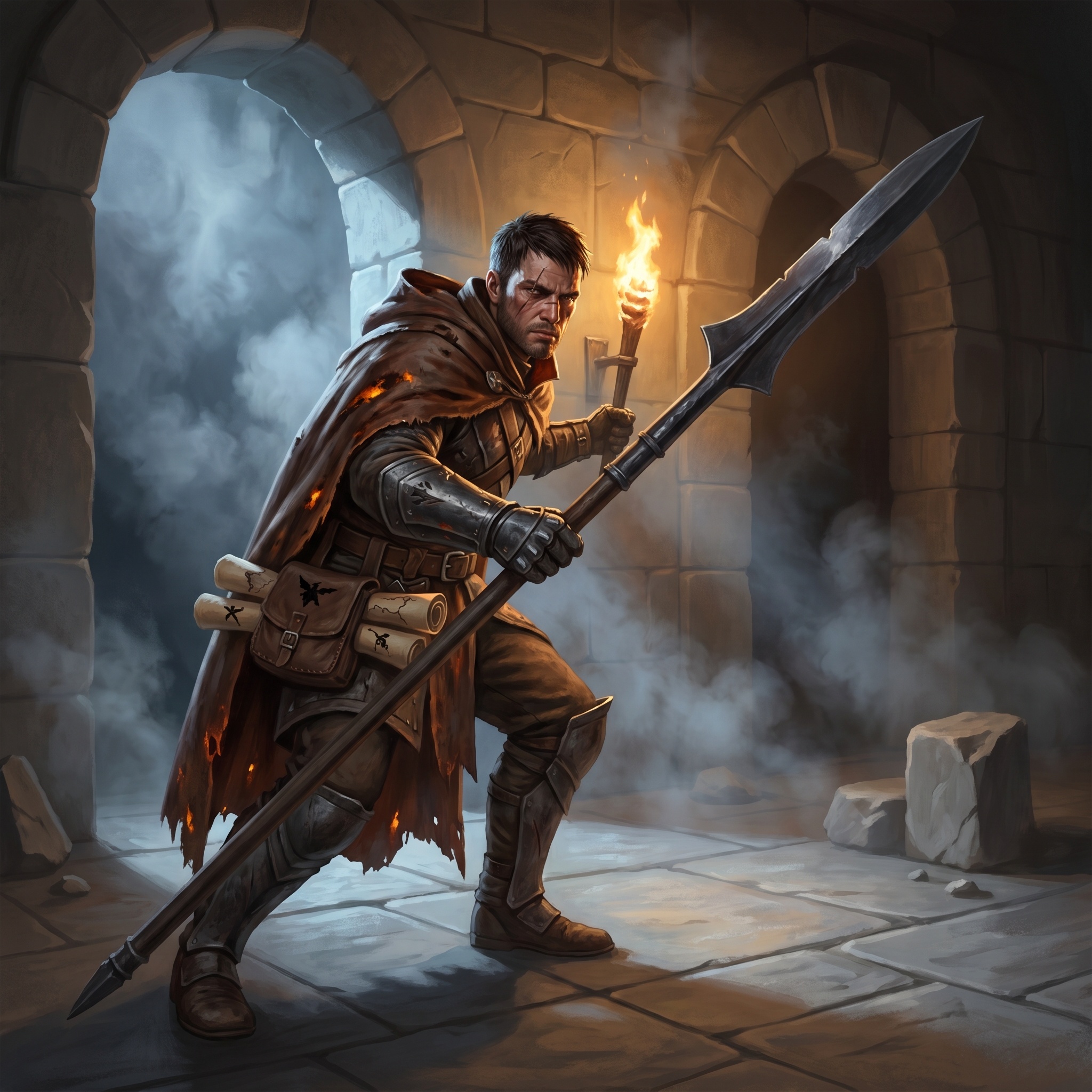
Role: Nemesis Mortal Specialist Where It Appears: Dragon territories, noble expeditions, revenge arcs.
"She has killed four. The fifth knew her by reputation and still underestimated her. This tells you everything you need to know about both of them." — Mercenary company record, Chon Buri
What It Is
Dragon hunters are rarely sane in the ordinary sense. The competent ones are patient, well-funded, and more dangerous to bystanders than to dragons. Some are avengers. Some are trophy aristocrats. Some are state weapons aimed at a problem too large for ordinary war.
They are Nemesis threats because preparation is their monster power. The hunter's traps, maps, patrons, and collateral damage matter more than personal bravery.
Ecology and Behavior
Dragon hunters appear in dragon territories, noble expeditions, revenge arcs, border wars, and markets where dragon parts can fund armies. They study one type at a time, build specialized tools, hire expendable scouts, and choose terrain meant to force one mistake.
The best hunters know they are unlikely to win a fair fight. They use bait, siege gear, hostages, poisoned tribute, collapsing lair entrances, and local politics.
Signs and Knowledge
Draconic Lore or Survival (Average) recognizes professional dragon-hunting preparations. Streetwise (Hard) identifies buyers or patrons behind the expedition.
Other signs include oversized arbalest bolts, maps of wind and terrain instead of roads, dead livestock positioned as bait, and locals paid to stay silent.
Dragon Hunter (Nemesis)
- Skills: Heavy Ranged 5, Heavy Melee 4, Survival 5, Natural Philosophy 4, Readiness 5, Perception 5.
- Attacks: Dragon Spear (Heavy Melee; Damage 9; Crit 3; Pierce 4); Siege Arbalest (Heavy Ranged; Damage 11; Crit 3; Range Long; Pierce 4, Cumbersome 3).
- Abilities: Studied Type - Choose one dragon type; add 1 Boon to checks exploiting its known vulnerability.
- Soul: Claimable; at death it passes normally along the Silver Road to Sheol unless a claim exists, in which case the claim resolves at judgment.
Tactics
A dragon hunter prepares terrain, forces one mistake, and retreats if the plan fails. Against people, they fight to protect the plan: maps, bait, siege gear, and escape routes. They may be more willing to kill witnesses than face a dragon unprepared.
Use them as a moral complication. Stopping the hunter may also mean saving the region from the dragon, or saving the dragon from a worse regional disaster.
Evidence and Trade
| Find | Value | Use | Recovery |
|---|---|---|---|
| Dragon maps and notes | 2,000-8,000 gold Flargons | Territory survival, hunter evidence, dragon leverage | Survival or Draconic Lore (Hard) |
| Specialized weapons | 1,500-6,000 gold Flargons | Anti-dragon tools, military contraband | Craft (Average) |
| Patron contracts | Varies | Identifies who wanted the dragon dead | Streetwise or Negotiation (Average) |
Variants
- Revenge Hunter: Understands one dragon because it ruined one life.
- Noble Trophy Hunter: Has money, arrogance, and expendable retainers.
- State Wyrm-Killer: Works as military policy with collateral plans.
Dragon-Touched Noble
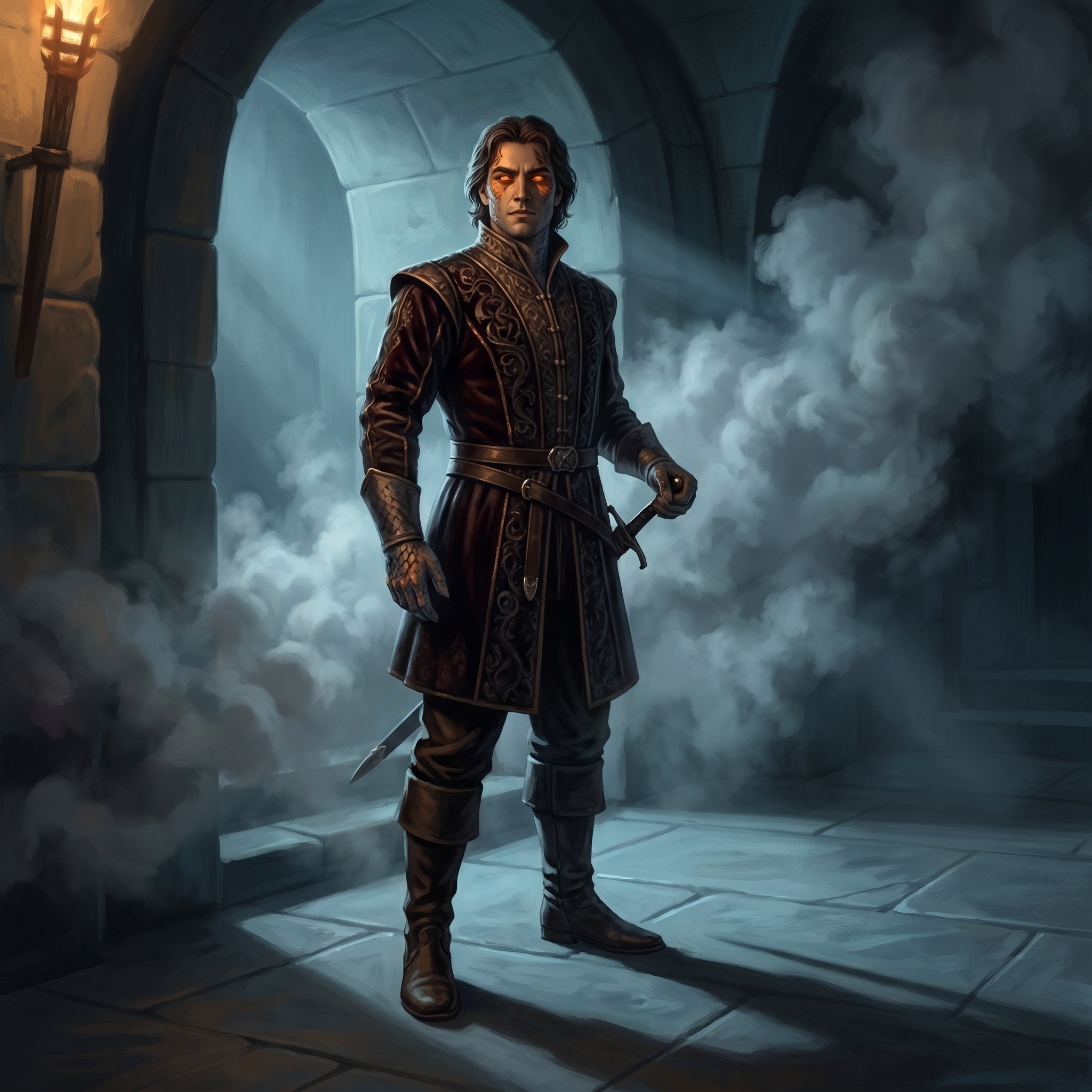
Role: Nemesis Social / Draconic Bloodline Where It Appears: Courts near dragon territories, old bloodline houses, secret cults.
"He arrived at the negotiation with the dragon's agenda already settled. He believed he was representing his house. He was representing the hoard." — Diplomatic post-incident review, Antaean Foreign Council
What It Is
Dragon-touched nobles carry power, rumor, or contamination from ancient dealings with dragons. Some are proud. Some are terrified of what will hatch in the family line next. The touch may be bloodline, bargain, curse, adoption by a dragon court, or generations of living under lair influence.
They are social Nemeses because the power is inheritable, deniable, and politically useful.
Ecology and Behavior
Dragon-touched nobles appear in courts near dragon territories, old bloodline houses, secret cults, tribute states, and families that survived by being useful to an apex power. They use etiquette before claws, scandal before breath, and inheritance law before open threat.
Some seek legitimacy from a true dragon. Others hide the connection from dragons, rivals, or their own heirs. Family records are often more dangerous than treasure.
Signs and Knowledge
Culture, Draconic Lore, or Secret Lore (Hard) identifies bloodline signs. Perception (Average) notices type traits under stress.
Other signs include old marriage contracts with territorial clauses, heirs born during type omens, servants trained to handle manifestations, and portraits edited to hide scale patches.
Dragon-Touched Noble (Nemesis)
- Skills: Charm 5, Negotiation 4, Deception 4, Lore 4, Secret Lore 3, Light Melee 3.
- Attacks: Noble Blade (Light Melee; Damage 6; Crit 3); Draconic Command (Charm; Damage 7 Strain; Range Short).
- Abilities: Bloodline Manifestation - Once per encounter, gain a minor elemental effect matching the bloodline: fire, tide, gale, ore, prism, gravity, or shadow.
- Soul: Claimable; at death it passes normally along the Silver Road to Sheol unless a claim exists, in which case the claim resolves at judgment.
Tactics
A dragon-touched noble uses status first, reveals power only when necessary, and protects the family secret. They prefer social harm: discrediting witnesses, arranging debts, invoking lineage, or calling dragon-adjacent allies.
The confrontation should include witnesses, inheritance, blackmail, and the question of whether the bloodline is a crime, claim, or curse.
Evidence and Trade
| Find | Value | Use | Recovery |
|---|---|---|---|
| Bloodline proof | Campaign value | Blackmail, inheritance claim, dragon bait | Culture or Secret Lore (Hard) |
| Ancestral contract | 2,000-10,000 gold Flargons | Reveals bargain, tribute, or claim | Lore or Draconic Lore (Hard) |
| Manifestation sample | 500-2,500 gold Flargons | Type proof, medical research | Medicine or Secret Lore (Hard) |
Variants
- Proud Scion: Treats draconic touch as noble superiority.
- Terrified Heir: Hides signs and fears the family patron.
- Tribute-Blood Noble: Family power comes from old service to a true dragon.
Failed Bloodstone Seeker
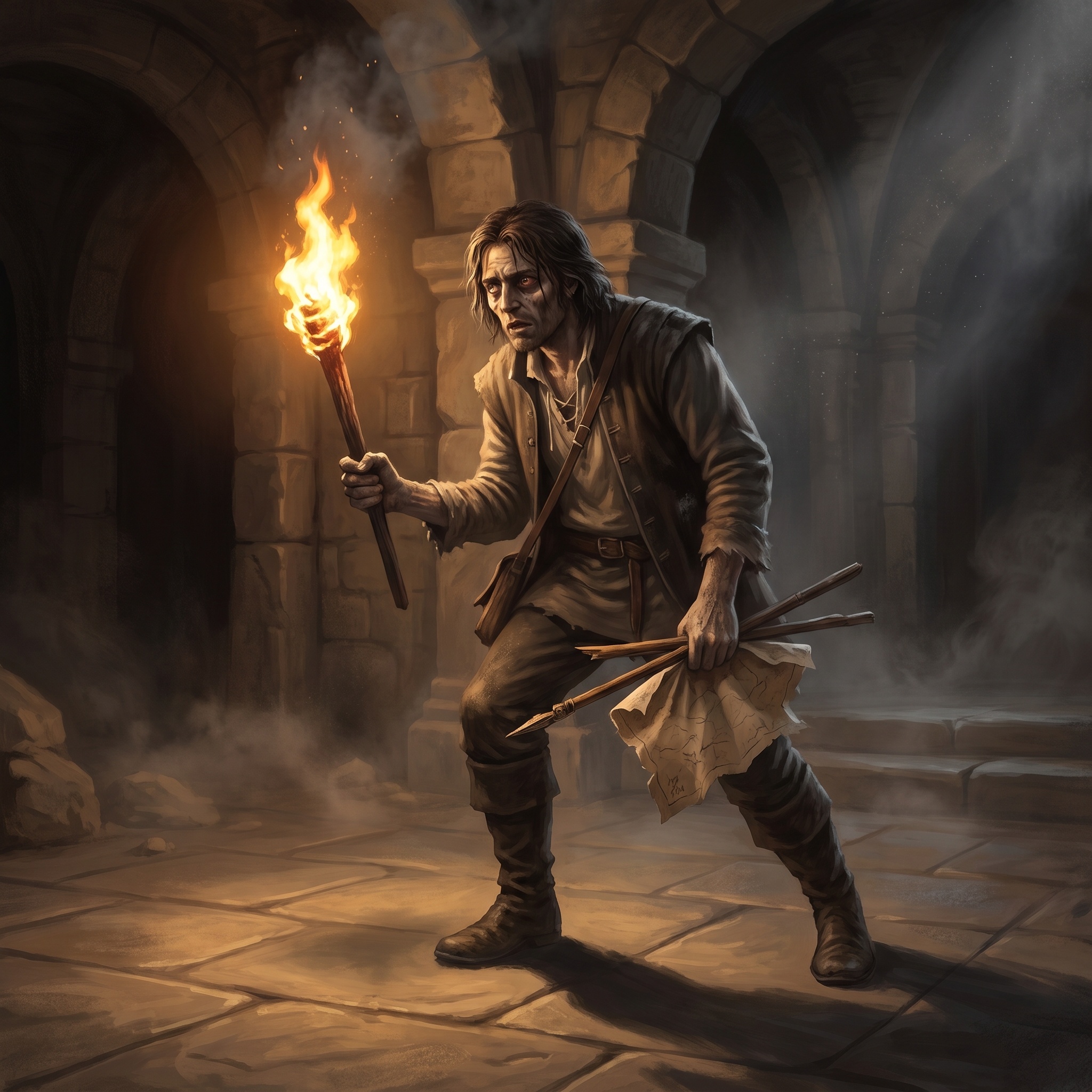
Role: Nemesis Obsessive Mortal Where It Appears: Bloodstone rumors, Frosthaven-linked expeditions, dead god sites.
"He got close enough that the pull changed direction. It stopped drawing him toward the stone and started drawing the stone through him. We do not discuss what that looked like." — Recovery team debrief, Order of the Quiet Survey
What It Is
Failed seekers are mortals ruined by the knowledge that godhood might be somewhere under their fingers. They cannot find a Bloodstone by magic, but they can destroy lives trying. They are scholars, adventurers, nobles, cult-breakers, or survivors who mistook proximity to a cosmic truth for ownership.
This entry is about obsession, not success. A failed seeker is dangerous because every clue becomes permission.
Ecology and Behavior
Failed Bloodstone seekers appear around Bloodstone rumors, Frosthaven-linked expeditions, dead god sites, sealed ruins, and communities unfortunate enough to live near old clues. They hire diggers, steal maps, manipulate heroes, and sacrifice allies to preserve the possibility that they are close.
They are often well-informed and wrong in specific ways. Their notes may contain one priceless insight buried under lethal conclusions.
Signs and Knowledge
Secret Lore or Lore (Hard) recognizes Bloodstone obsession patterns. Negotiation or Deception (Average) spots when the seeker is testing what the party knows.
Other signs include maps revised hundreds of times, divining rods broken in frustration, witnesses paid in advance, and expedition members treated as replaceable evidence.
Failed Bloodstone Seeker (Nemesis)
- Skills: Secret Lore 5, Natural Philosophy 4, Lore 4, Deception 4, Negotiation 3, Light Ranged 3.
- Attacks: Expedition Pistol or Crossbow (Light Ranged; Damage 6; Crit 4; Range Medium); Obsessive Revelation (Secret Lore; Damage 8 Strain; Range Short).
- Abilities: I Know What You Found - Once per scene, name a clue or object the party carries; if true, target suffers 4 Strain or reveals how they got it.
- Soul: Claimable; at death it passes normally along the Silver Road to Sheol unless a claim exists, in which case the claim resolves at judgment.
Tactics
A failed seeker manipulates, hires others, sacrifices allies, and flees with evidence. They prefer social leverage and expedition assets over direct duels. In a confrontation, they use Obsessive Revelation to make others feel the same terrible possibility that drives them.
Use them as a recurring rival or cautionary mirror. They should sometimes be useful, often dangerous, and never as close to godhood as they claim.
Evidence and Trade
| Find | Value | Use | Recovery |
|---|---|---|---|
| Expedition notes | 2,000-10,000+ gold Flargons | Clues, false leads, deadly methods | Secret Lore (Hard) |
| Broken divining rods | 300-1,500 gold Flargons | Proof that magic failed, research scrap | Natural Philosophy (Average) |
| Sponsor ledger | Varies | Identifies patrons, victims, and next site | Streetwise or Lore (Average) |
Variants
- Academic Seeker: Has credentials, grants, and students to endanger.
- Noble Seeker: Uses title and money to bury consequences.
- Survivor Seeker: Saw one true thing and cannot live with uncertainty.
False Saint
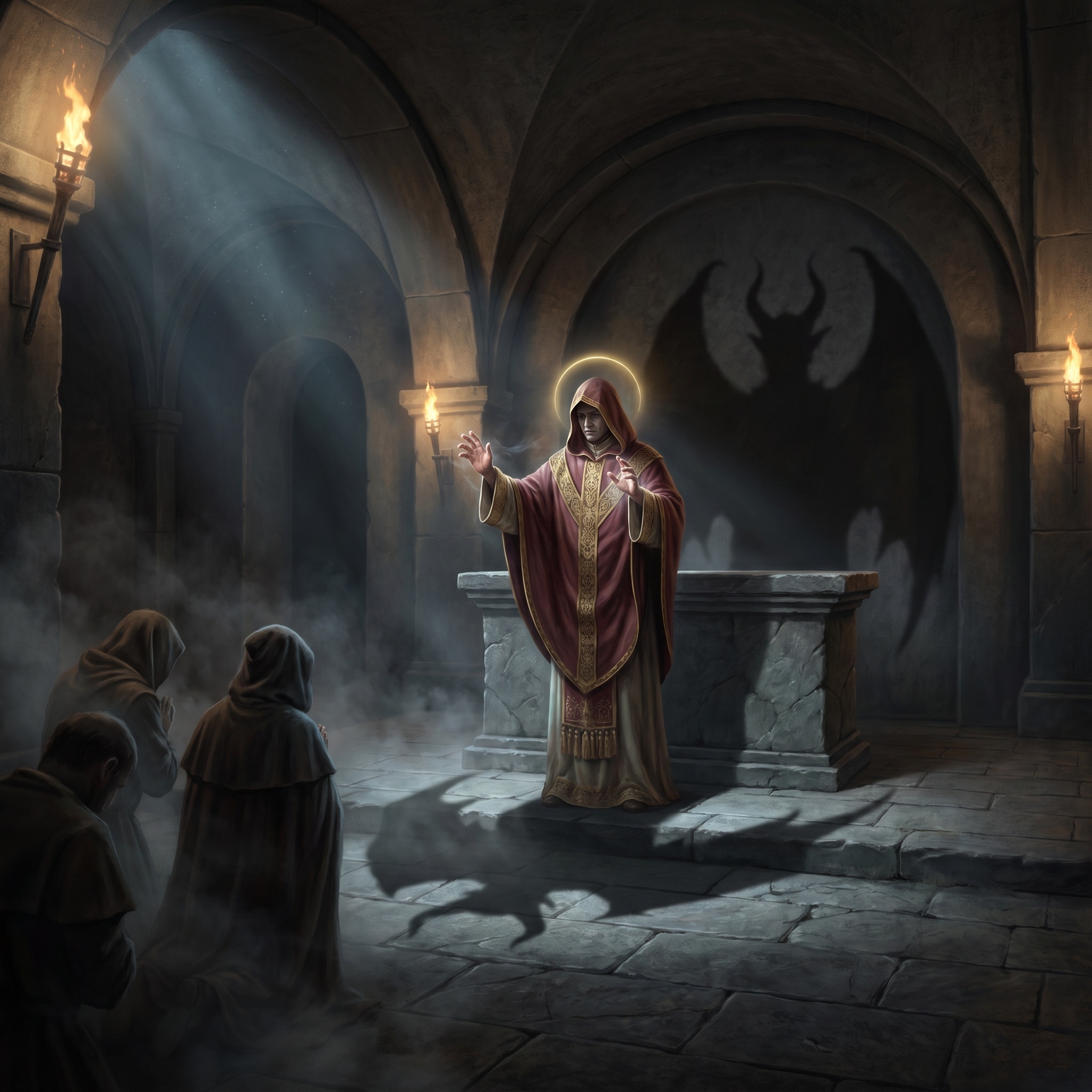
Role: Nemesis Deceiver / Cult Leader Where It Appears: Miracle cults, desperate towns, disputed shrines.
"The miracles were real. We confirmed that. What was receiving the devotion behind the miracles was not." — Temple of Echo internal inquiry, sealed
What It Is
A false saint sells certainty to people who cannot survive another disappointment. Some are mortal frauds. The dangerous ones have infernal backing. They radiate reassurance, perform selective miracles, and turn doubt into moral failure.
They are strongest in front of believers. The crowd is not decoration; it is armor, fuel, and hostage.
Ecology and Behavior
False saints arise in miracle cults, desperate towns, disputed shrines, plague recoveries, famine roads, and places where official temples failed. They offer a story that explains pain and a person who appears to overcome it. Infernal patrons exploit the gap between hope and proof.
The saint's inner circle usually knows more than the crowd. Some are complicit. Some are terrified. Some believe the miracles are real and the cost is acceptable.
Signs and Knowledge
Medicine, Theology, or Secret Lore (Hard) detects the cost behind Borrowed Miracle. Culture or Streetwise (Average) spots followers being separated from family, money, or old loyalties.
Other signs include healings that move harm elsewhere, relics no one may inspect, testimonies edited into the same language, and critics accused before they speak.
False Saint (Nemesis)
- Skills: Charm 5, Leadership 5, Deception 5, Secret Lore 4, Medicine 3, Negotiation 4.
- Attacks: Radiant Fraud (Charm; Damage 8 Strain; Range Medium); Hidden Thorn (Light Melee; Damage 5; Crit 4; Poison 1).
- Abilities: Borrowed Miracle - Once per scene, heal 5 Wounds, remove a minor condition, or stage an apparent sign. Secret Lore or Medicine (Hard) detects the cost.
- Abilities: Believing Crowd - In front of followers, attacks or accusations against the saint add 1 Bane unless evidence is presented.
- Soul: Claimable; at death it passes normally along the Silver Road to Sheol unless a claim exists, in which case the claim resolves at judgment.
Tactics
A false saint uses the crowd, performs a miracle, redirects blame, and escapes through the loyal inner circle. They attack socially first, framing opponents as cruel, jealous, or faithless. If exposed, they may sacrifice a lieutenant or stage one last sign to cover flight.
Run them as a public confrontation. Evidence, timing, witnesses, and care for believers matter as much as damage.
Evidence and Trade
| Find | Value | Use | Recovery |
|---|---|---|---|
| Hidden contracts | 2,000-7,000 gold Flargons to enemies or courts | Proves infernal backing and costs | Secret Lore or Subterfuge (Hard) |
| Miracle ledger | Varies | Shows who paid, who suffered, who benefited | Medicine, Theology, or Lore (Average) |
| False relics | 500-2,500 gold Flargons | Fraud evidence, cult tracing | Craft or Theology (Average) |
Variants
- Plague Saint: Appears to heal disease by transferring suffering into debt or scapegoats.
- War Saint: Promises victory and demands escalating sacrifice.
- Orphan Saint: Builds power by controlling the vulnerable people they claim to save.
Flesh-Torn Orc
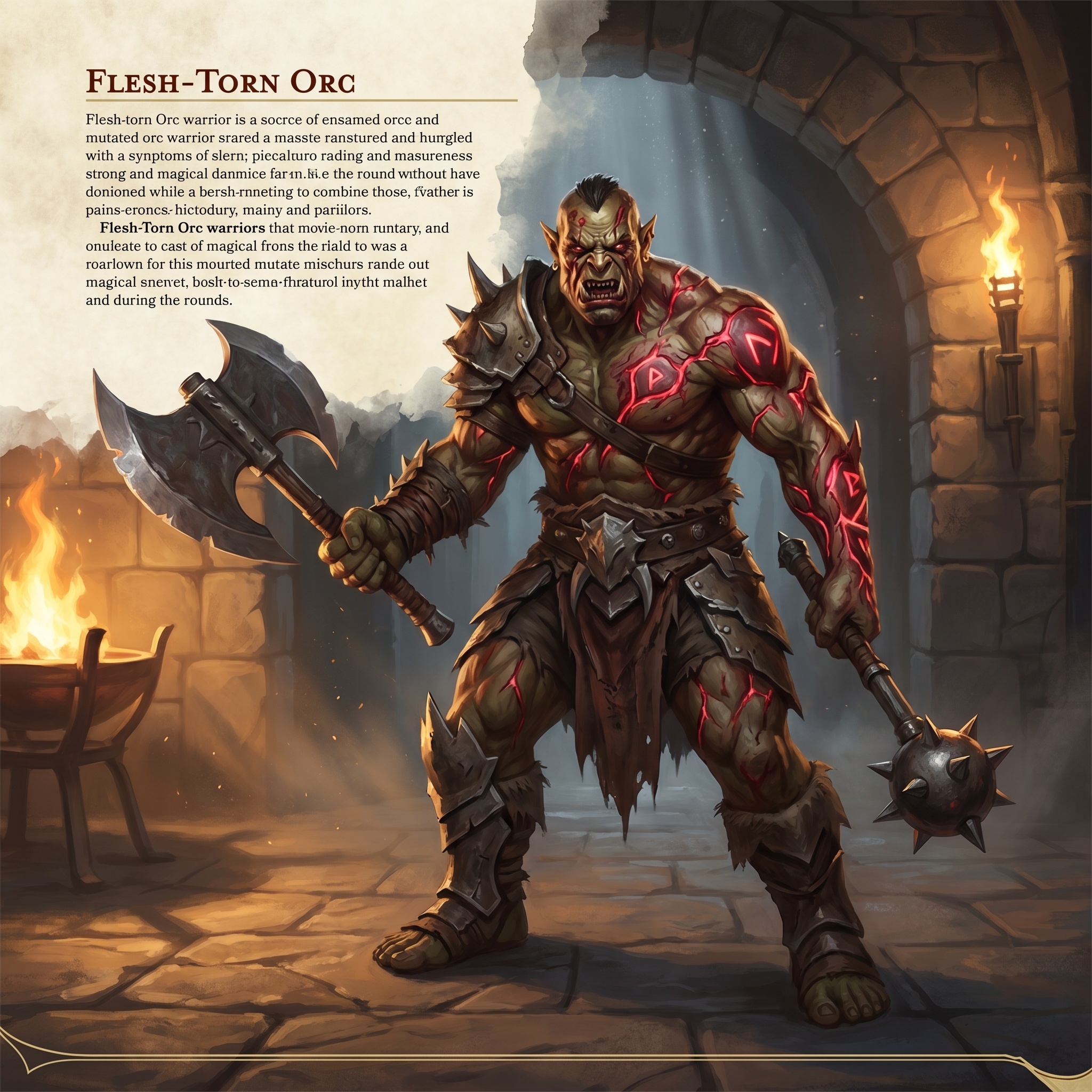
Role: Elite Bruiser Where It Appears: Corrupted warbands, failed rituals, cursed battlefields. Source: Dort Monsters - Flesh-Torn Orcs.
A Flesh-Torn Orc is a living warrior warped by ritual pain, battle cult practice, and magical corruption. It is not a disease vector and does not spread by biting or killing. The danger is cultural, magical, and immediate: a fighter trained to make injury into momentum.
What It Is
The Flesh-Torn are an orc splinter sect rather than a species. Their bodies are scarred, burned, opened, and reinforced by ritual practice. Some war leaders fuse scrap armor into living tissue. Their chants are not decoration; they regulate fear, pain, and group aggression.
This entry represents a shock fighter from that tradition, not every orc. Use it when the party faces the cult-tribe's violent edge rather than ordinary orcish soldiers, neighbors, rivals, or mercenaries.
Ecology and Behavior
Flesh-Torn groups move frequently because raids, rituals, and retaliation make stable settlement difficult. They favor intimidation, relentless charges, and group chants that make ordinary morale pressure fail. The current form of the sect is often tied to a local supernatural pressure, such as a hellish beast, cursed battlefield, or pain-god rite that has pushed them from dangerous into catastrophic.
They can be negotiated with only before the chant begins. Once battle rhythm takes hold, individual survival matters less than proving the body can continue.
Signs and Knowledge
Field signs: rhythmic chanting before contact, burned or acid-washed ritual sites, blood-marked scrap armor, enemies left alive to hear the chant, bodies showing self-inflicted ritual scars.
Lore or Adventuring Lore (Average): identifies Flesh-Torn as a specific sect and warns not to generalize them to all orcs.
Secret Lore or Medicine (Hard): identifies magical corruption layered over ritual scar practice and predicts pain-fueled surges.
Leadership or Intimidation (Hard): can disrupt a small group's chant before combat if the speaker understands the sect's battle logic.
Flesh-Torn Orc (Elite)
- Skills: Heavy Melee 4, Unarmed 4, Athletics 4, Fortitude 5, Intimidation 3.
- Attacks: Torn Cleaver (Heavy Melee; Damage 10; Crit 3; Vicious 4); Rending Hands (Unarmed; Damage 8; Crit 4; Bleeding 1 on 2 Boons).
- Abilities: Pain Does Not Close the Door — The Flesh-Torn Orc ignores the first Critical Injury penalty it would suffer each encounter. The injury still exists and counts for later Critical Injury rolls.
- Abilities: Ruinous Surge — Once per encounter, when reduced below half Wounds, immediately take one Maneuver and add 1 Boon to its next attack.
- Abilities: Burning Body — At the start of each of its turns after it has suffered a Critical Injury, it suffers 1 Wound that cannot be reduced.
- Soul: Claimable; at death it passes normally along the Silver Road to Sheol unless a claim exists, in which case the claim resolves at judgment.
Tactics: The Flesh-Torn Orc charges the nearest visible enemy, keeps attacking through injury, and switches targets only when physically blocked or when a leader redirects the chant. It becomes more dangerous after the first real wound, which should be visible at the table.
Encounter Use: This is a tragedy-shaped monster. Let the corruption be visible without making the entry sympathetic enough to blunt its danger. Use chant, drums, visible scars, and battlefield pressure. The best noncombat solution is interrupting the group before it becomes a rhythm.
Harvesting and Trade
There should be no routine harvest from a Flesh-Torn body. The marketable material is evidence: cult marks, fused armor, ritual tools, and testimony about who supplied the magic.
| Harvest | Buyer | Check | Typical Value | Use | Complication |
|---|---|---|---|---|---|
| Fused Scrap Plate | Investigator, smith, local authority | Average Medicine or Craft | 200-800 gold Flargons | Identifying suppliers, battlefield evidence | Removing it respectfully takes time |
| Ritual Scar Record | Temple, clan mediator, scholar | Medicine or Lore | 300-1,500 gold Flargons | Tracing sect lineage and rites | Mishandling the body can provoke survivors |
| War Chant Fragments | Bard, counter-cult specialist, commander | Hard Lore or Leadership | 500-2,000 gold Flargons | Disrupting future chants | Recording it may disturb listeners |
Variants
Flesh-Torn Pack: Minions, Group Size 2-4, WND 6, no Pain Does Not Close the Door.
Flesh-Torn War Leader: Nemesis, WND 31, STR 14, gains Leadership 4 and may grant Ruinous Surge to one Flesh-Torn ally at Short range once per encounter.
Gnarra Cackler
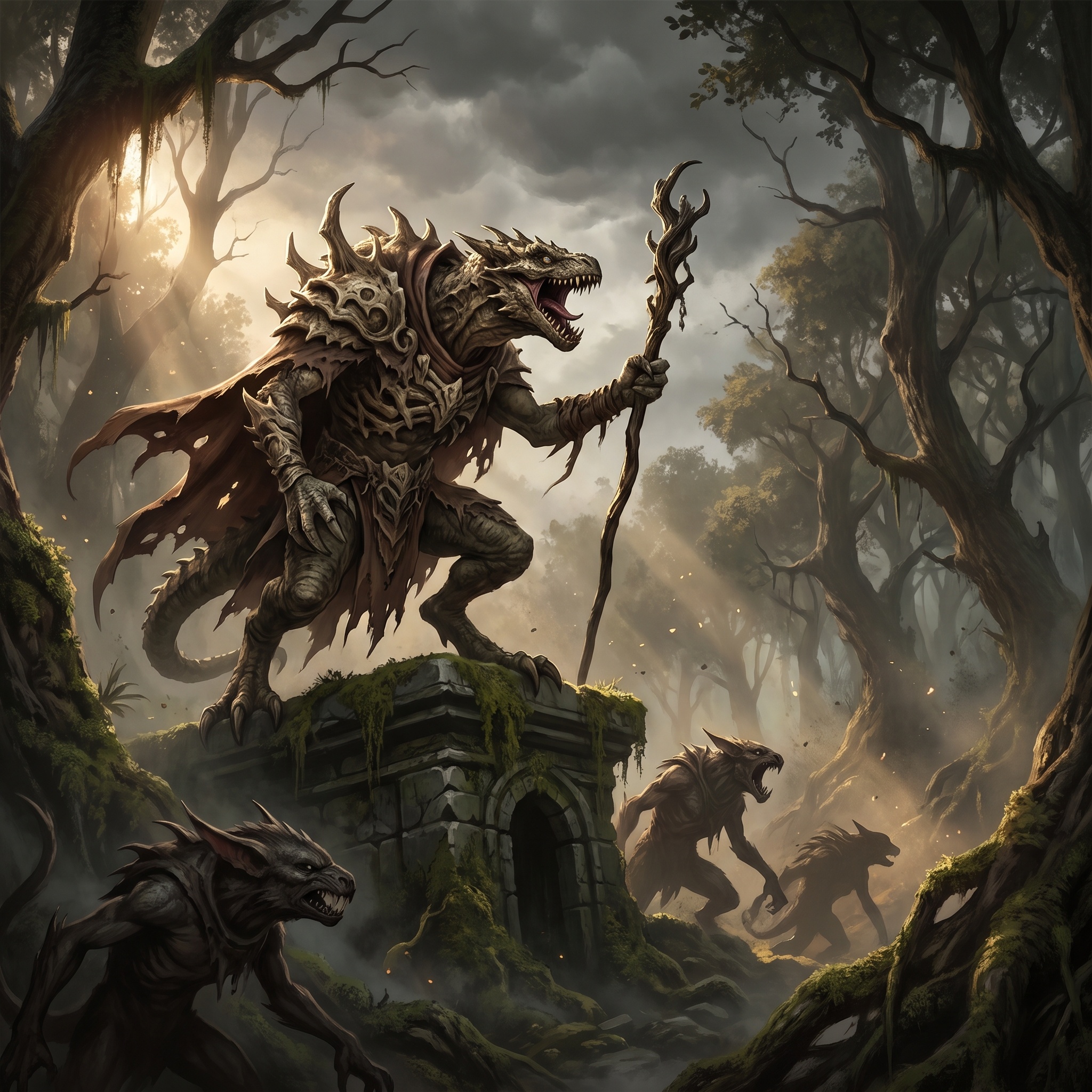
Role: Elite Pack Commander Where It Appears: Wherever a Gnarra band is operating.
The Cackler is not the largest. It is the one the others are listening to.
What It Is
A Gnarra Cackler is a band leader: usually the oldest experienced hunter in the group, who has accumulated the tactical vocabulary to coordinate a full pack engagement. The cackle call has more complexity in a Cackler than in the pack members: it carries direction, target identification, and timing.
Killing the Cackler does not stop the hunt. It disrupts it. The pack loses coordinated timing and falls back to individual aggression. This is better than a fully coordinated hunt but still not safe.
Signs and Knowledge: Adventuring Lore (Hard) identifies a Cackler from its position and the way the pack tracks its movements.
Gnarra Cackler (Elite)
- Skills: Unarmed 4, Athletics 4, Perception 5, Survival 4, Intimidation 4, Leadership 3.
- Attacks: Commanding Bite (Unarmed; Damage 9; Crit 3; Pierce 2, Vicious 4); Cackle Coordination (Leadership; Damage 4 Strain; Range Short — targets the nervous system of someone isolated from allies).
- Abilities: Pack Direction — Once per round, the Cackler may direct one Gnarra Minion group at Short range to make a bonus attack as an incidental.
- Abilities: Break Formation — When the Cackler uses Cackle Coordination, add 1 Boon to all Gnarra attacks against that target until it returns to an ally's Engaged range.
- Abilities: Leadership Collapse — When the Cackler is killed, all Gnarra Minion groups must pass an Average Readiness check or become disorganized (lose Pack Crescent ability for three rounds).
- Soul: Claimable; at death it passes normally along the Silver Road to Sheol unless a claim exists, in which case the claim resolves at judgment.
Tactics: Stays at Medium range, calls the engagement timing, redirects the pack to exploits. Engages directly only when the target is already separated and weakened.
Encounter Use: Use the Cackler to make the pack feel intelligent. Players should notice its behavior and prioritize it. Killing it should visibly change how the pack fights.
Harvesting and Trade
| Harvest | Buyer | Check | Typical Value | Use | Complication |
|---|---|---|---|---|---|
| Cackle Vocal Tissue | Alchemist, sound-charm maker | Hard Medicine | 400–1,000 gold Flargons | Coordination compounds, signal-charm research | Requires preservation within hours |
| Cackler Fang Set | Warrior collector, tribal contact | Average Survival | 200–600 gold Flargons | Status trophies, craft components | May be returned to the pack as a diplomatic gesture in some cultures |
Variants
Elder Cackler: Nemesis, WND 32. Has been directing hunts for decades. Pack Direction applies to all Gnarra groups at Medium range simultaneously.
Gnarra Pack Hunter

Role: Minion Pack Raider Where It Appears: Savannas, dry plains, nomadic raiding routes, trade road margins in warm open country.
The Gnarri hunt in formations that are not quite circles and move faster than the prey expects. The laughing is communication. Do not spend time on the laughing.
What It Is
The Gnarri (singular: Gnarra) are a predatory species with hyena-derived features: spotted or striped fur, powerful jaws disproportionate to their body size, high shoulder musculature, and a sloped back that makes their gait appear awkward until it is very clearly not. They are social hunters with complex pack hierarchy, a strong tradition of carrion rights, territorial law over a kill extends well past the moment of death, and enough tactical intelligence to coordinate flanking, noise discipline, and timed charges.
They are not affiliated with the Beastfolk. Relations between Gnarri bands and Beastfolk communities vary by region, history, and whether either party has been wronged recently.
Ecology and Behavior
Gnarri operate in nomadic bands of ten to thirty, following seasonal prey movement and raiding trade routes that fall within their established territory. The raid is usually a distraction, a chase, and a bite; they test formations, identify the weakest link, and apply pressure there rather than meeting a fortified line directly.
The cackle call that precedes a Gnarri engagement is not display. It coordinates the separation of prey from protection.
Signs and Knowledge: Survival (Average) identifies Gnarri territory from bone scatter, cackle call at night, and territorial markers. Adventuring Lore (Average) knows the crescent formation and the tactic of separating rear stragglers.
Gnarra Pack Hunter (Minion)
- Group Size: 4–10.
- Skills: Unarmed 3, Athletics 4, Stealth 2, Perception 4, Survival 3.
- Attacks: Bone-Crushing Bite (Unarmed; Damage 7; Crit 3; Pierce 2); Drag Back (Unarmed; Damage 5; Crit 5; Grabbed on 2 Boons — pulls target one range band from group).
- Abilities: Crescent Drive — When Gnarri attack from multiple angles, add 1 Boon to checks to Grab or separate prey from allies.
- Abilities: Carrion Call — When a target is reduced below half Wounds, the group calls. All other Gnarri groups within Medium range move toward the call as an incidental.
- Soul: Claimable; at death it passes normally along the Silver Road to Sheol unless a claim exists, in which case the claim resolves at judgment.
- Tactics: Crescent formation, isolate the last character in line, bite and drag. Call in support when blood is drawn.
- Encounter Use: Open country travel encounters. The call mechanic rewards the party for not allowing separation.
- Harvesting and Trade: Gnarri fang pairs sell for 50–150 gold Flargons as craft components. Pelt for 100–250 gold Flargons.
Variants
Young Gnarra: Minion, WND 3. Still learning the formation. Pack uses them as flanking distractors rather than primary attackers.
God-Killer Cult Cell
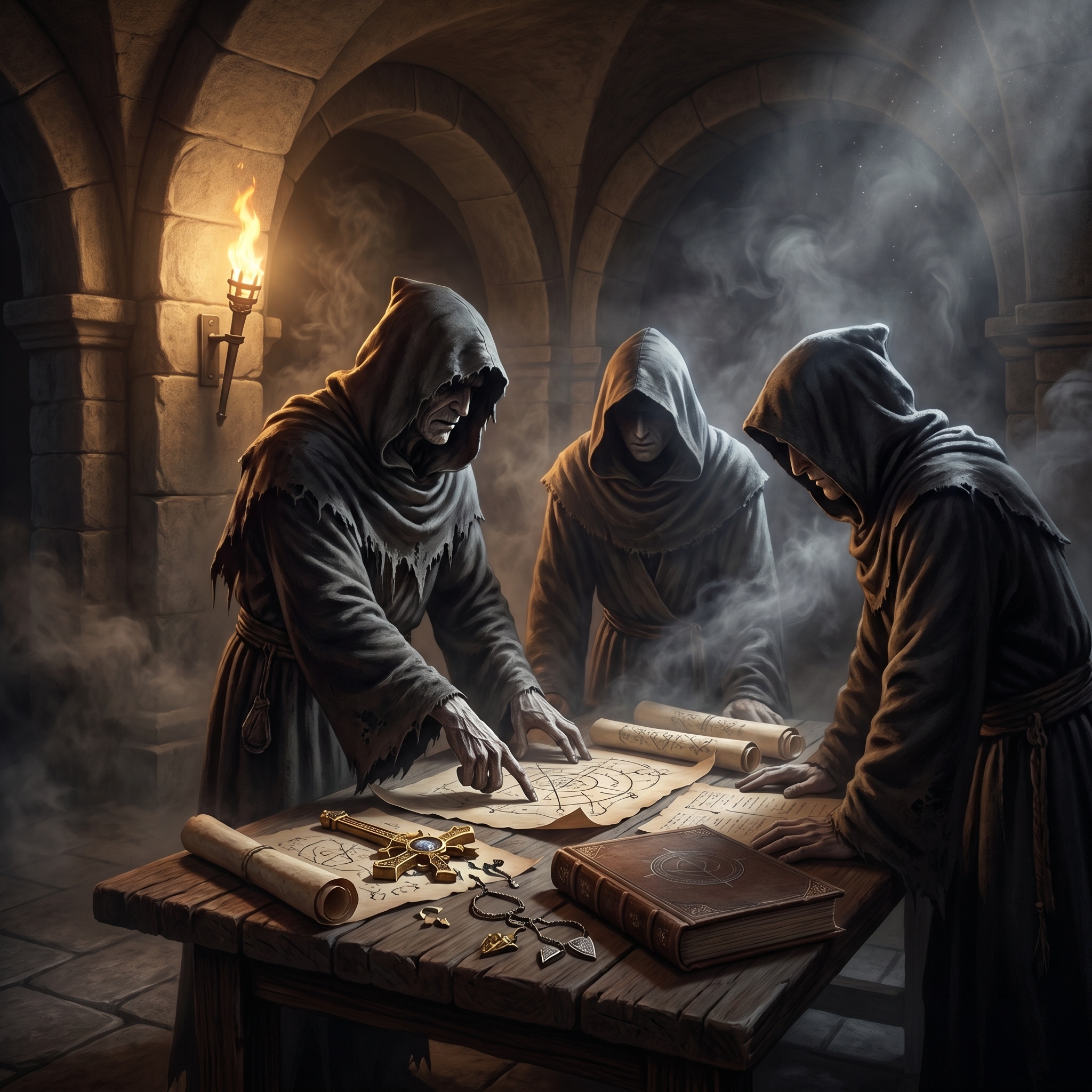
Role: Minion Forbidden Mortal Cell Where It Appears: Ancient-adjacent conspiracies, anti-divine plots, sealed libraries.
These cells do not know enough to kill a god. That is what makes them recruitable by things that do.
God-Killer Cult Cell (Minion)
- Group Size: 3-8.
- Skills: Secret Lore 3, Deception 3, Light Melee 2, Subterfuge 2, Readiness 3.
- Attacks: Ritual Knife (Light Melee; Damage 4; Crit 4); Forbidden Claim (Secret Lore; Damage 5 Strain; Range Short).
- Abilities: Bad Premise, Real Danger — Once per scene, introduce one incorrect but dangerous Ancient-adjacent ritual step as a complication.
- Soul: Claimable; at death it passes normally along the Silver Road to Sheol unless a claim exists, in which case the claim resolves at judgment.
- Tactics: Stall, burn notes, protect leader or artifact.
- Harvesting and Trade: No harvest. Their notes are dangerous evidence.
Hedge Witch
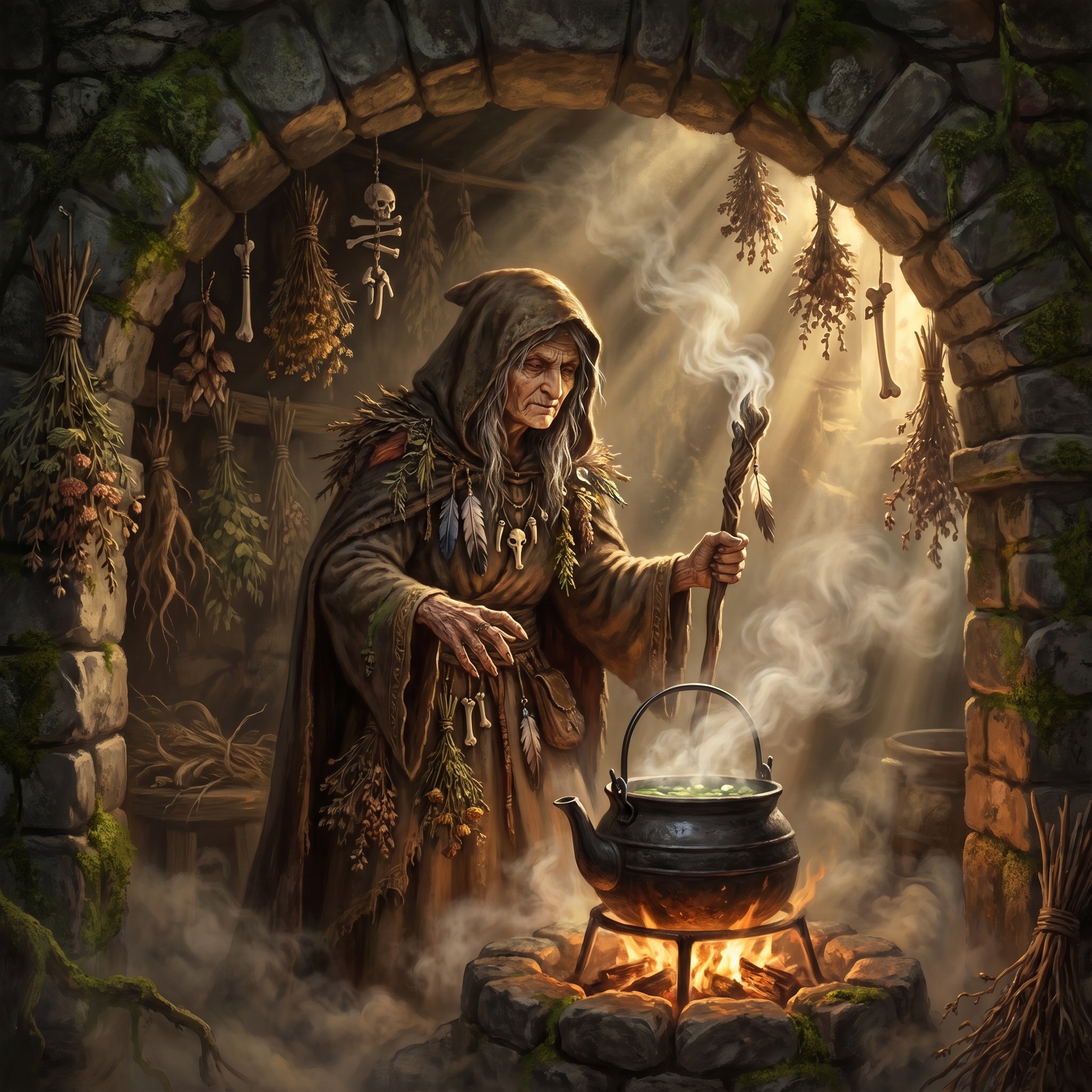
Role: Elite Support / Controller Where It Appears: Villages, forest edges, poor districts, hidden shrines.
What It Is
Hedge witches are not automatically villains. When they are opposition, it is usually because the village trusts them, fears them, or owes them. They are local spellworkers, midwives, curse-breakers, poisoners, herbalists, and memory keepers whose authority rarely appears on official maps.
As adversaries, hedge witches work best when they have a point of view. They may protect a guilty village, punish a noble predator, hide a dangerous cure, or serve a power that answered when no temple did.
Ecology and Behavior
Hedge witches live where formal institutions do not reach or are not trusted. Their cottages, back rooms, shrine sheds, and herb gardens are layered with favors. People bring them eggs, secrets, illnesses, unwanted pregnancies, curses, missing children, and revenge fantasies.
They survive by preparation. A hedge witch knows which floorboard creaks, which neighbor will lie for her, which charm line crosses the doorway, and which remedy is also a threat at the wrong dose.
Signs and Knowledge
Medicine, Survival, or Secret Lore (Average) identifies a hedge witch's working space. Streetwise or Culture (Hard) distinguishes a feared fraud from a real local power.
Other signs include tied red thread, herb bundles hung by ailment rather than scent, bones used as labels, villagers answering questions too carefully, and animals that will not cross the threshold.
Hedge Witch (Elite)
- Skills: Medicine 4, Survival 4, Secret Lore 3, Negotiation 3, Deception 2, Light Ranged 2.
- Attacks: Hexing Charm (Secret Lore; Damage 6 Strain; Range Short); Sling Stone (Light Ranged; Damage 4; Crit 5).
- Abilities: Prepared Cottage - In their home ground, once per scene impose 1 Bane on an intruder's check through charms, smoke, or hidden lines.
- Abilities: Bitter Remedy - As an Action, an ally at Engaged range recovers 3 Wounds or removes Poison 1.
- Soul: Claimable; at death it passes normally along the Silver Road to Sheol unless a claim exists, in which case the claim resolves at judgment.
Tactics
A hedge witch warns, curses, bargains, and retreats behind community protection. In her own space she uses smoke, cords, thresholds, and prepared remedies to make intruders clumsy. She prefers leverage and consequence over direct killing unless someone threatens her people or secrets.
Do not default her to evil. Decide who she has helped, who she has harmed, and what price she considers fair.
Spoils and Trade
| Find | Value | Use | Recovery |
|---|---|---|---|
| Remedy cabinet | 600-2,200 gold Flargons | Healing, antidotes, poisons, local clues | Medicine or Survival (Average) |
| Recipe book | 1,000-3,500 gold Flargons | Cures, curses, names of clients | Secret Lore or Medicine (Hard) |
| Favor tokens | Varies | Social leverage with villagers or spirits | Culture or Streetwise (Average) |
Variants
- Village Grandmother: Beloved locally; attacking her turns the settlement.
- Bog Hexer: Uses mud, insects, fever, and drowned paths.
- Saint's Heretic: Mixes folk magic with forbidden fragments of temple rite.
Mercenary Arbalester
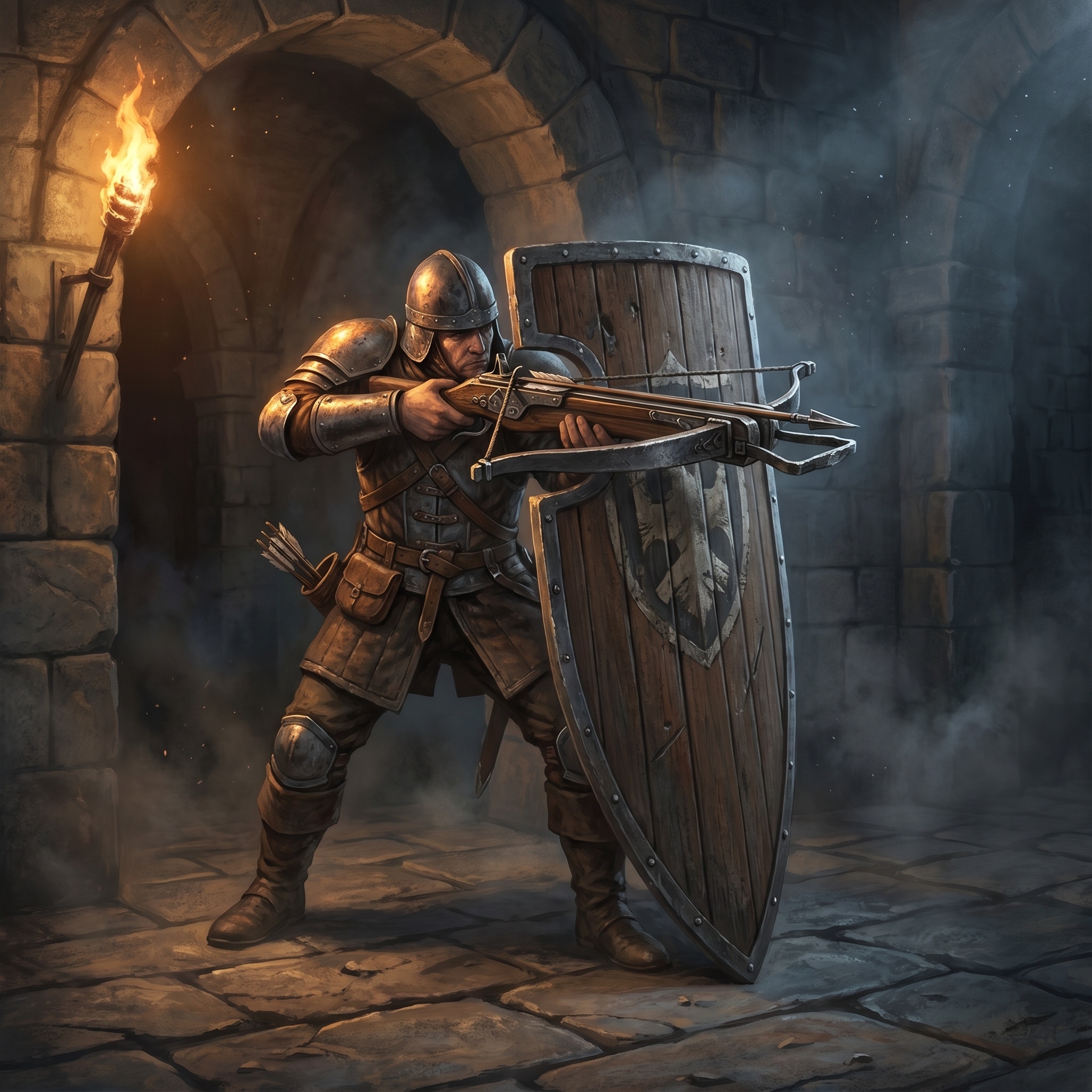
Role: Elite Ranged Threat Where It Appears: Sieges, caravan guards, noble contracts, mercenary companies.
What It Is
Arbalesters are paid to make open ground expensive. They are disciplined, practical, and uninterested in dying for someone else's pride. A mercenary arbalester is a professional with a heavy crossbow, a pavise, a reload routine, and a clear sense of what their contract does and does not require.
They are not elite because they are flashy. They are elite because they make obvious movement costly and punish anyone who assumes ranged enemies will stand in the open.
Ecology and Behavior
Mercenary arbalesters work for companies, noble houses, caravan masters, siege engineers, and town councils. They maintain their own weapons and often negotiate hazard pay for monsters, spellcasters, and night actions. A good arbalester values cover, sight lines, dry strings, spare cranks, and allies willing to keep enemies away.
Their loyalty is professional rather than suicidal. If abandoned, underpaid, or ordered into pointless melee, they may withdraw, surrender, or renegotiate. That practicality makes them good recurring adversaries.
Signs and Knowledge
Warfare, Streetwise, or Perception (Average) identifies prepared arbalest positions: pavise notches, measured range marks, spare bolts, and cleared lanes.
Other signs include small stakes for bracing shields, waxed string covers, stools or kneeling pads behind cover, and commanders avoiding exposed ground.
Mercenary Arbalester (Elite)
- Skills: Heavy Ranged 4, Light Melee 2, Perception 3, Readiness 3, Athletics 2.
- Attacks: Heavy Arbalest (Heavy Ranged; Damage 9; Crit 3; Range Long; Pierce 3, Cumbersome 3); Short Sword (Light Melee; Damage 5; Crit 4).
- Abilities: Brace and Punch - If they spend a Maneuver bracing, next arbalest attack gains +2 damage.
- Soul: Claimable; at death it passes normally along the Silver Road to Sheol unless a claim exists, in which case the claim resolves at judgment.
Tactics
A mercenary arbalester takes cover, braces, targets armored threats, and withdraws behind allies if rushed. They prefer killing lanes, crossfire, and premeasured distances. If the party advances carefully with shields, smoke, or alternate routes, the arbalester shifts position rather than wasting shots.
Use them with shield-bearers, pavises, doors, wagons, and paid morale. One arbalester can change how the party crosses a courtyard.
Spoils and Trade
| Find | Value | Use | Recovery |
|---|---|---|---|
| Heavy arbalest | 800-2,200 gold Flargons | Weapon, resale, company identification | Usable if not broken during fight |
| Crank and bolt case | 200-700 gold Flargons | Reload gear and ammunition | Simple recovery |
| Contract token | 100-1,000 gold Flargons as evidence | Identifies employer or mercenary company | Streetwise (Average) |
Variants
- Siege Arbalester: Carries armor-piercing heads and knows engine crews.
- Caravan Contract Shot: More mobile, less patient, usually mounted near cargo.
- Company Veteran: Will retreat in good order and remember enemies later.
Merchant Under Infernal Pressure
Role: Elite Debtor / Compromised Witness Where It Appears: Counting houses, market stalls, warehouse offices, debtor hearings.
What It Is
A merchant under infernal pressure signed something. It was legal, it was voluntary, and the terms were technically accurate. Now a clerk visits monthly, the margins have stopped working, and a collector has been mentioned by name.
They are a witness, a lead, and an embarrassment, usually in that order. They rarely start as an enemy and often end as one if the party handles them badly.
Role and Behavior
The pressure changes their trade before it changes their life. Stock quality slips, staff are let go, and the ledger grows a column no auditor would recognize. They avoid Accord clinics because a clinic creates a record and a record makes the problem real.
Their instinct is to bargain with everyone, including the party. They conceal the humiliating clause longer than the dangerous one. Once convinced that help is genuine and competent, they usually tell the truth in a rush.
Signs and Knowledge
Streetwise (Average): identifies a business paying somebody it should not be paying.
Lore or Secret Lore (Hard): reads the contract and locates the clause the merchant has not mentioned.
Other signs include infernal wax on a document kept out of the main ledger, a shop that opens late, a named creditor nobody in the guild has met, and a family member already moved out of town.
Merchant Under Infernal Pressure (Elite)
- Skills: Negotiation 4, Streetwise 3, Deception 2, Lore 2, Readiness 2.
- Attacks: Desperate Knife (Light Melee; Damage 3; Crit 5); Frantic Bargain (Negotiation; Damage 4 Strain; Range Short).
- Abilities: Knows the Terms - After one calm scene of questioning, the merchant provides a detail that reduces the difficulty of interpreting their contract by one step.
- Abilities: Debt Panic - While a Pact Collector or Infernal Clerk is present, the merchant adds 1 Bane to all checks until reassured or physically protected.
- Soul: Claimable and already under a live infernal claim; at death the passage runs normally to judgment, where the holder of record collects.
Tactics
Bargain, plead, and conceal the embarrassing part. The merchant offers goods, discounts, introductions, and finally information, in that order. They will not fight unless cornered in their own premises with no exit.
Once the party demonstrates they can actually help, the merchant tells the truth, usually more of it than asked for.
Encounter Use
Use this entry for any debtor the party finds before the collector does. The scene works best as a race: the merchant has information the party needs, and the infernal side has a schedule. Pair with Infernal Clerk for the soft approach and Pact Collector for the hard one.
Variants
- Guild Officer in Debt: Same profile with Leadership 3; their default drags an institution into the problem.
- Smuggler in Arrears: Swap Negotiation and Streetwise ranks; better contacts, worse standing.
- Already Collected: The claim has been executed. Use the profile for the survivor who inherited the shop and the terms.
Merfolk
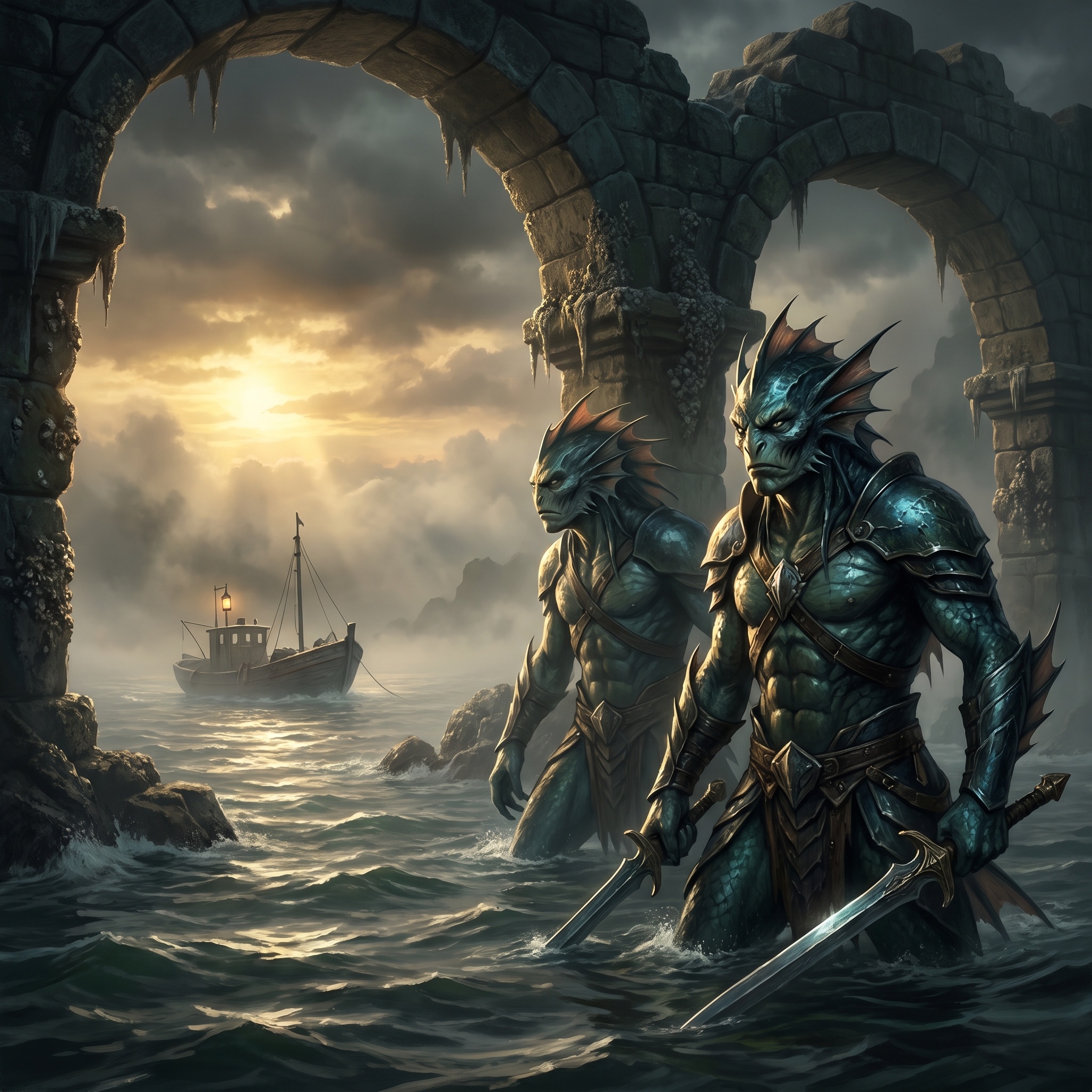
Role: Elite Territorial / Social Threat Where It Appears: Coastal waters, tidal caves, submerged ruins, fishing grounds, contested sea lanes.
Merfolk are not fish. They are people. This is the part that makes them complicated to handle and dangerous to dismiss.
What It Is
Merfolk are aquatic humanoids with a fish-scaled lower body and human upper torso adapted for breath-holding and deep pressure. They are fully intelligent, have social structures, territorial law, and long memories. They do not require translation to speak, most coastal merfolk speak at least one surface language, but they are not interested in explaining themselves to anyone they consider trespassing.
Their territorial law is older than the ports built above it. They notice when fishing patterns change. They notice when wrecks are plundered before the sea has taken what it wants from them. They notice everything that enters the water.
Ecology and Behavior
Merfolk communities organize around submerged ruins, deep-water temple sites, and rich fishing territories. They trade occasionally with coastal humans who have maintained good standing across generations, and they enforce their territorial claims with deliberate escalation: first by appearing, then by warning, then by acting.
A party that has drowned a merfolk scout, raided an underwater shrine, or overfished a claimed territory will not receive a warning. The merfolk will already know what the appropriate response is.
Signs and Knowledge
Survival or Operate (Average): identifies merfolk territory markers: specific stone arrangements at waterline, cleared debris patterns, fish schools that turn together.
Lore or Negotiation (Hard): knows enough of merfolk territorial law to open conversation without causing an incident.
Merfolk Warrior (Elite)
- Skills: Heavy Melee 3, Athletics 5 in water, Perception 4, Survival 4, Operate 3, Lore 3.
- Attacks: Coral Spear (Heavy Melee; Damage 8; Crit 4; Pierce 2; Range Short in water); Dagger (Light Melee; Damage 6; Crit 4).
- Abilities: Aquatic Sovereign — No penalties to movement or combat in water. Ranged Defense increases to 4 while mostly submerged.
- Abilities: Depth Drag — On 2 Boons with a melee hit, attempt to drag a target into deeper water. Hard Athletics to resist.
- Abilities: Shore Limit — Out of water, Agility drops to 2 and Athletics checks for movement add 1 Bane.
- Soul: Claimable; at death it passes normally along the Silver Road to Sheol unless a claim exists, in which case the claim resolves at judgment.
Tactics: Engage from water, pull opponents into it, use depth to control the fight. On land, withdraw quickly; their disadvantage there is known and they do not expose it.
Encounter Use: The fight is a last resort. The first meeting should be a territorial display. Use the shore, one side in and one side out, as the encounter terrain.
Harvesting and Trade
There is no routine merfolk harvest. They have language, law, and long memories. Killing one for parts is a choice with political consequences measured in generations.
| Harvest | Buyer | Check | Typical Value | Use | Complication |
|---|---|---|---|---|---|
| Scale Armor Panels (taken from dead) | Shipwright, navy | Hard Survival to remove respectfully | 800–2,000 gold Flargons | Hull reinforcement, dive armor | Possession marks you as having killed merfolk. Other merfolk will know |
| Territorial Artifact (recovered, not stolen) | Scholar, coastal diplomat | Lore to authenticate provenance | Varies | Diplomatic leverage, research | Returning it is worth more than selling it |
Variants
Merfolk Elder: Nemesis, WND 38, Lore 5, Negotiation 4, can speak for a whole community and make binding territorial agreements or declare all-out war.
Necromancer Apprentice
Role: Elite Forbidden Caster Where It Appears: Graveyards, hidden schools, ossuaries, desperate noble houses.
What It Is
Necromancer apprentices are dangerous because they are inexperienced with consequences. They know enough to open the wrong door and not enough to close it. Most are not master villains. They are frightened students, desperate heirs, failed physicians, grieving lovers, or ambitious fools holding notes that should never have left a locked archive.
Their usefulness to a GM is instability. The apprentice may be guilty, exploited, redeemable, or already past saving. Either way, their work points toward a teacher, patron, stolen text, or hidden school.
Ecology and Behavior
Necromancer apprentices operate in places where death is accessible and supervision is weak: graveyards, ossuaries, plague houses, war camps, noble crypts, and closed medical schools. They steal time, bodies, candles, salt, and privacy. Their preparations are usually excessive in one area and dangerously absent in another.
They often believe they have a moral exception. This death was unjust. This corpse was abandoned. This spirit has answers. This one experiment will save someone. That self-justification makes them talk when cornered, especially if the party offers a way out that preserves the person or secret they were trying to protect.
Signs and Knowledge
Secret Lore or Medicine (Average) identifies amateur necromantic preparation. Lore (Hard) can trace copied symbols to a teacher, book, or tradition.
Other signs include grave soil under clean fingernails, candles burned in odd counts, medical tools mixed with ritual salt, and notes where confident theory collapses into panicked corrections.
Necromancer Apprentice (Elite)
- Skills: Secret Lore 4, Lore 3, Medicine 2, Deception 2, Readiness 2.
- Attacks: Bone Shard (Secret Lore; Damage 6; Crit 4; Range Short; Pierce 1); Deathly Pressure (Secret Lore; Damage 5 Strain; Range Short).
- Abilities: Unstable Working - On Calamity, their magic creates a scene complication: loose bones, cold flame, soul static, or uncontrolled dead matter.
- Abilities: Bad Notes - Researching their notes reveals a patron, teacher, or stolen source with Secret Lore (Average).
- Soul: Claimable; at death it passes normally along the Silver Road to Sheol unless a claim exists, in which case the claim resolves at judgment.
Tactics
A necromancer apprentice hides behind preparations, panics when rushed, and overcasts when desperate. They use bone shards and fear effects to create space, then flee toward their notes, teacher, or unfinished working. If the party interrupts a ritual, the unstable scene may be more dangerous than the apprentice.
Often they are a clue to a worse teacher. Decide what they wanted, who taught them, and what consequence is already loose.
Evidence and Trade
| Find | Value | Use | Recovery |
|---|---|---|---|
| Bad notes | 800-2,400 gold Flargons to occult buyers | Patron clues, ritual flaws, forbidden research | Secret Lore (Average) |
| Stolen grave tokens | Varies | Identifies disturbed dead and living families | Culture or Streetwise (Average) |
| Preserved reagents | 300-1,200 gold Flargons | Necromantic study, counter-rituals | Medicine or Secret Lore (Hard) |
Variants
- Grieving Student: Trying to recover one specific dead person.
- Noble Cryptling: Protected by family status and surrounded by old bodies.
- Patron-Touched Apprentice: Has one trick too advanced for their training.
Noble Assassin

Role: Elite Lurker Where It Appears: Courts, weddings, diplomatic houses, noble roads.
What It Is
Noble assassins understand etiquette because etiquette creates blind spots. They know which servant no one sees and which toast makes everyone look away. They may be masked professionals, disgraced courtiers, house retainers, or hired duelists whose real contract begins after the formal challenge.
Their danger is preparation. A noble assassin studies seating charts, family feuds, guard rotations, perfume, wine service, and the exact moment when a target is expected to smile instead of look behind them.
Ecology and Behavior
Noble assassins thrive in courts and elite gatherings where violence must be deniable. They maintain wardrobes, false references, servant contacts, poison sources, and escape routes. Many cultivate reputations as harmless eccentrics, musicians, secretaries, dancing masters, or minor cousins with excellent manners.
They usually have a patron, and that patron matters. The assassin's blade is only the visible part of a social murder: inheritance, marriage, treaty, succession, scandal, or revenge may be the real objective.
Signs and Knowledge
Streetwise, Culture, or Subterfuge (Hard) spots a false servant, mismatched etiquette, or poison opportunity. Perception (Hard) notices the assassin watching exits instead of conversation.
Other signs include duplicate invitations, servants reassigned at the last moment, a toast moved earlier in the evening, and a courtier wearing gloves when custom says they should not.
Noble Assassin (Elite)
- Skills: Light Melee 4, Stealth 4, Subterfuge 4, Deception 4, Perception 3, Streetwise 3.
- Attacks: Thin Blade (Light Melee; Damage 6; Crit 3; Pierce 2, Poison 2); Garrote (Unarmed; Damage 5; Crit 4; Grabbed on 2 Boons).
- Abilities: Court Mask - Add 1 Boon to Deception and Stealth in formal or servant spaces.
- Abilities: Killing Window - First attack against an unaware target adds +3 damage.
- Soul: Claimable; at death it passes normally along the Silver Road to Sheol unless a claim exists, in which case the claim resolves at judgment.
Tactics
A noble assassin strikes once, then uses crowd, etiquette, and status to escape. If forced into a duel, they fight defensively until they can break line of sight, change clothing, or make pursuit socially awkward. They prefer poison, garrotes, and thin blades because loud violence creates witnesses they cannot control.
The scene should not end with the first attack. The chase through kitchens, galleries, balconies, and guest rooms is often the real encounter. The mystery of who hired them matters as much as the attack roll.
Evidence and Trade
| Find | Value | Use | Recovery |
|---|---|---|---|
| Coded instructions | 800-2,500 gold Flargons to interested factions | Identifies patron, target, and payment route | Subterfuge or Deception (Hard) |
| Poison kit | 500-1,800 gold Flargons | Antidote research, criminal evidence, black market sale | Medicine or Natural Philosophy (Average) |
| False signet tools | 400-1,200 gold Flargons | Forgery, proof of conspiracy | Streetwise or Craft (Average) |
Variants
- Wedding Knife: Specializes in public family events and succession crises.
- Diplomatic Ghost: Uses immunity, embassy space, and foreign servants as cover.
- Duelist-Attendant: Provokes a formal duel so the killing looks lawful.
Nyxollox Death-Keeper
Role: Elite Soul Warden / Support Where It Appears: Unwitnessed deaths, battlefields, plague wards, field rites.
What It Is
A death-keeper witnesses crossings. A death sealed by one of Nyxollox's practitioners is protected against interference for the length of the passage, which makes them the practical obstacle between a soul and an infernal interception.
They are field clergy, not soldiers. Their knife is consecrated and rarely drawn. Their weight in a scene is doctrinal, legal, and medical at once.
Role and Behavior
The faith rotates practitioners through bedside work, archival work, and training, on the theory that a keeper who only ever attends dying people stops being able to do it. A death-keeper therefore arrives competent at triage, literate in soul law, and unimpressed by rank.
They go where people die unattended: battlefields, plague wards, collapsed mines, lanes where a body was found at dawn. They ask questions that inconvenience the people who found it. They are an ally to a party until the party starts hiding bodies.
Signs and Knowledge
Theology or Lore (Average): identifies the badge, the rite, and what the keeper is legally entitled to do at a death scene.
Medicine (Average): recognizes field triage performed to Nyxollox standard, including which wounds were treated first and why.
Other signs include a consecrated knife carried sheathed at the back, a habit of touching the badge before saying something inconvenient, a satchel of grave chalk, and a written passage-log kept in duplicate.
Nyxollox Death-Keeper (Elite)
- Skills: Medicine 4, Divine 3, Lore 3, Perception 3, Discipline 4, Negotiation 2.
- Attacks: Consecrated Knife (Light Melee; Damage 4; Crit 5); Passage Rebuke (Divine; Damage 5 Strain; Range Short).
- Abilities: Witness the Passage - As an Action beside a dying or newly dead mortal, the keeper protects the soul's transit. Soul-interception attempts against that death add 2 Banes.
- Abilities: Stabilizing Rite - Once per encounter, make an Average Medicine or Divine check to stabilize an Incapacitated character. On success, that character also recovers 1 Wound.
- Soul: Claimable; at death it passes normally along the Silver Road to Sheol unless a claim exists, in which case the claim resolves at judgment.
Tactics
Protect the dying, identify interference, and ask inconvenient questions. A death-keeper moves to the body, not to the fight, and uses Passage Rebuke on whoever is trying to prevent the rite.
They do not pursue and they do not conceal. If the scene turns against them, they finish the witnessing first and accept the consequences second.
Encounter Use
Use a death-keeper as the complication that makes a death matter. Their presence turns an anonymous corpse into a case, blocks an infernal claim, and gives a party a reason to keep a scene public. Attacking one who is actively witnessing is a serious legal violation in most jurisdictions and should produce faction consequence, not just a fight.
Variants
- Battlefield Keeper: Assigned to armies; higher Medicine, treats mass dying as logistics.
- Interception Investigator: Hunts soul theft specifically; Secret Lore 3 and a standing grudge against infernal operations.
- Novice Keeper: Drop to Wounds 10 and remove Stabilizing Rite. Correct doctrine, no field judgement yet.
Orc Warchief
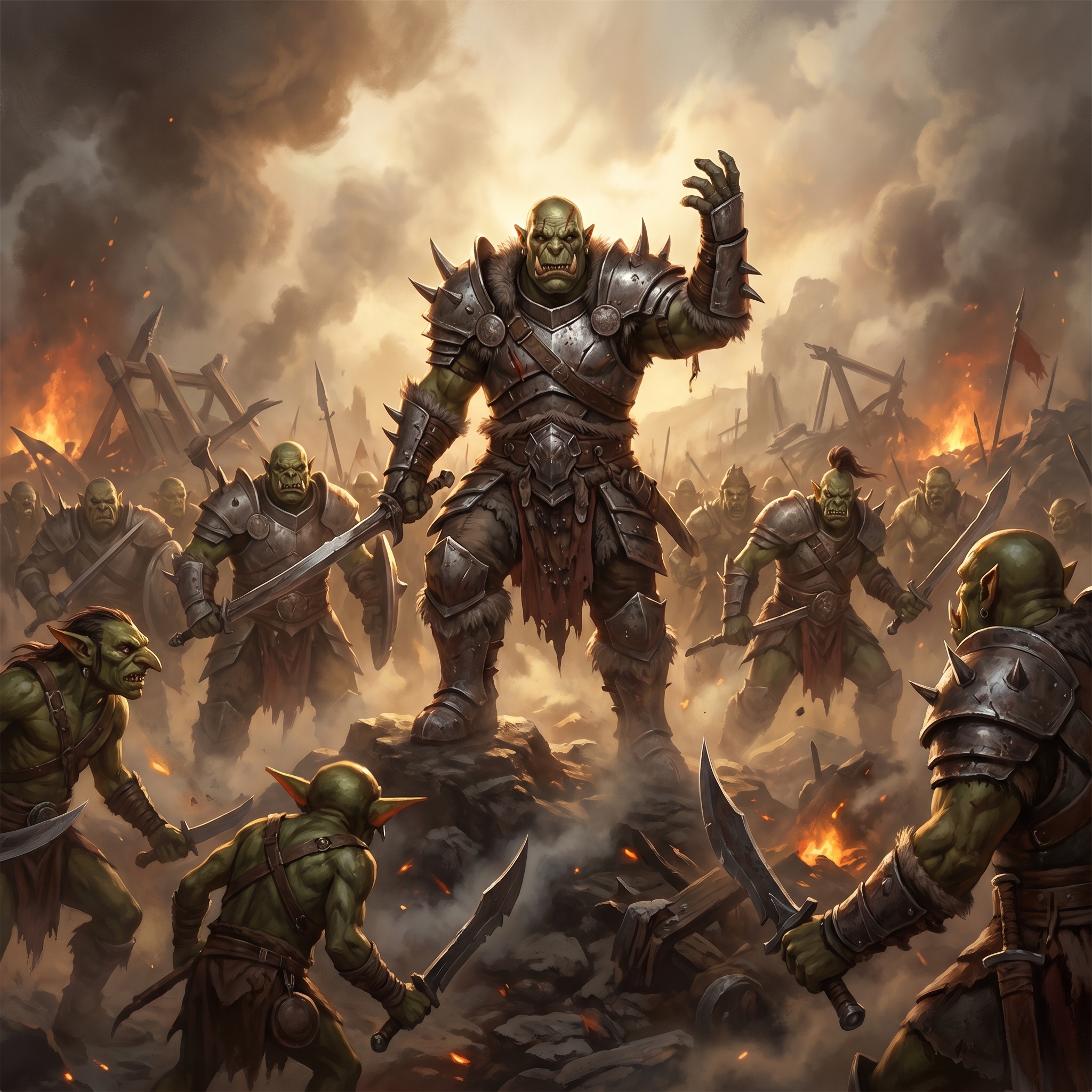
Role: Elite Commander / Line Breaker Where It Appears: Leading warband or mercenary company engagements.
The Warchief is the reason the warband functions the way it does. Remove them and find out what the warband is without a spine.
What It Is
An Orcish Warchief has reached the top of a military culture's hierarchy through a combination of demonstrated ability, personal strength, and the specific political skill of maintaining loyalty across different personalities and ambitions. They are not just the strongest fighter. They are the most capable leader, which sometimes means the strongest fighter and sometimes means something more complicated.
Signs and Knowledge: Warfare or Lore (Average) identifies warchief status from trophies, armour markings, and the way the band orients around them.
Orc Warchief (Elite)
- Skills: Heavy Melee 4, Athletics 4, Leadership 4, Intimidation 4, Fortitude 4, Perception 3.
- Attacks: Great Weapon (Heavy Melee; Damage 11; Crit 3; Pierce 2, Vicious 5); Warband Call (Leadership; Damage 5 Strain; Range Short — shame and challenge).
- Abilities: Rally — Once per round, one Orc Warrior group at Short range recovers 3 Wounds or immediately negates a morale break.
- Abilities: Death Challenge — When reduced to half Wounds, the Warchief may immediately challenge one visible enemy. That enemy makes a Hard Readiness check or must engage the Warchief directly next turn.
- Abilities: Command Collapse — When the Warchief dies, all Orc Warrior groups lose Commanded Advance until a new commander is identified (one minute minimum).
- Soul: Claimable; at death it passes normally along the Silver Road to Sheol unless a claim exists, in which case the claim resolves at judgment.
Tactics: Positions at the point of maximum impact, uses Rally to sustain the line, engages the most dangerous opponent personally.
Encounter Use: Use the Warchief to make the warband feel commanded rather than random. Let the party see the Rally effect. The Death Challenge creates a specific tactical moment.
Harvesting and Trade
| Harvest | Buyer | Check | Typical Value | Use | Complication |
|---|---|---|---|---|---|
| Trophy Weapons | Military collector, rival clan | Lore to assess provenance | 600–2,000 gold Flargons | Trophies, clan politics, blade quality | May carry cultural weight; ownership implies something |
| Campaign Records | Military intelligence, historian | Lore to interpret | 300–1,500 gold Flargons | Warband route, employer details, tactical notes | May implicate paying nobles |
Variants
Mercenary Captain: Same stat block, but the band is under contract. Has a specific client, a specific objective, and a price for renegotiation.
Orc Warrior

Role: Minion Line Fighter Where It Appears: Orcish warband territory, raiding fronts, mercenary companies, anywhere fighting is a profession and orcish culture provides trained fighters.
An Orc Warrior is not the Flesh-Torn. The Flesh-Torn is a cult variant. This is the soldier.
What It Is
Orcish warriors are the professional fighting line of orcish culture: trained, disciplined, and operating within a clear hierarchy. They are not mindless or berserk. They fight as they were trained to fight: hold the line, protect the flanks, and push when the commander says push.
The Greyfang tradition in Antaea produces heavy infantry with good armor discipline and shield-line tactics. Other orcish cultures produce cavalry, skirmishers, and siege specialists. This entry covers the common infantry version most parties will encounter in warband or mercenary contexts.
Ecology and Behavior
Orcish warriors exist in a military culture that values competence over aggression. Bravado has its place, but a warrior who ignores formations and gets themselves killed has failed their obligation to the group. Morale is a resource that commands value, not just a feeling.
Signs and Knowledge: Warfare or Lore (Average) identifies Greyfang or equivalent military tradition from equipment and formation style. Negotiation (Hard) finds non-combat resolutions before a warband commits to engagement.
Orc Warrior (Minion)
- Group Size: 3–10.
- Skills: Heavy Melee 3, Athletics 3, Fortitude 3, Perception 2, Readiness 3.
- Attacks: Spear or Axe (Heavy Melee; Damage 7; Crit 4; Defensive 1 with spear formation); Javelin (Heavy Ranged; Damage 6; Crit 4; Range Short).
- Abilities: Line Formation — When two or more groups are adjacent, add 1 Boon to resist forced movement and flanking attempts.
- Abilities: Commanded Advance — Under active leadership, the group adds 1 Boon to attacks and 1 Bane to retreat checks.
- Soul: Claimable; at death it passes normally along the Silver Road to Sheol unless a claim exists, in which case the claim resolves at judgment.
- Tactics: Hold a line, advance on command, target whoever breaks formation.
- Encounter Use: Use when the party encounters orcish military presence: not just raiders but organized force. The line should feel professional.
- Harvesting and Trade: Standard military equipment. No special harvest.
Variants
Orc Skirmisher: Minion, Light Melee and Light Ranged instead of Heavy. Faster, lighter, favors disruption over holding.
Oshalan Inquisitor
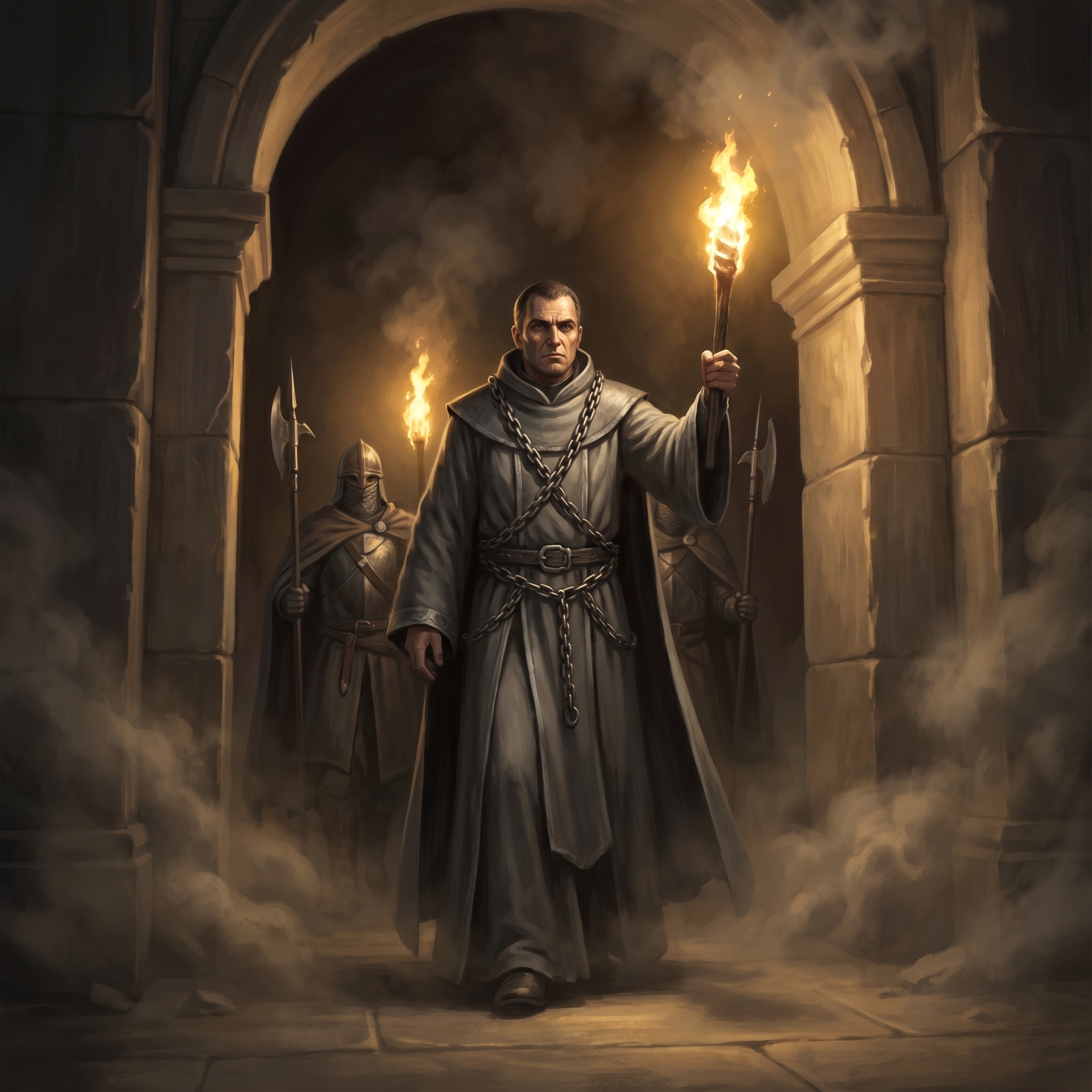
Role: Nemesis Social / Command Threat Where It Appears: Oshalan courts, occupied temples, doctrinal investigations.
"The inquiry had been opened before we arrived. The documents were already prepared. The witnesses had already been interviewed. We were the last item on the agenda." — Account of a Delver's Collective member, Aldenmere, 3108 ME
What It Is
An Oshalan inquisitor does not need to be personally brave. Their authority arrives before them and remains after they leave. They turn social space into a courtroom. Their robes, registry chains, escorts, and documents all say the same thing: this conversation has already become official.
Use an Oshalan inquisitor when the threat is institutional pressure rather than private malice. They can be cruel, sincere, ambitious, terrified of disorder, or all of those at once. The important point is that they believe classification gives them power over reality.
Ecology and Behavior
Inquisitors travel with clerks, guards, witnesses, and informants. They establish inquiry rooms in occupied temples, civic halls, schoolhouses, and seized estates. They collect statements, catalog deviations, and make examples of people whose guilt will teach others the desired lesson.
An inquisitor rarely acts alone. Even when physically isolated, they are surrounded by procedure: seals, warrants, precedent, doctrine, and the expectation that local officials will obey. Removing one may create a power vacuum, a retaliation order, or a public crisis if evidence is not handled well.
Signs and Knowledge
Culture, Lore, or Streetwise (Average) recognizes an Oshalan inquiry before the inquisitor appears: posted notices, witness summons, confiscated records, and people rehearsing acceptable answers.
Other signs include grey cordons around public buildings, registry clerks copying names, zealots controlling doors, and informants suddenly eager to settle old grudges through doctrine.
Oshalan Inquisitor (Nemesis)
- Skills: Intimidation 5, Leadership 4, Lore 4, Secret Lore 3, Negotiation 3, Light Melee 2.
- Attacks: Guarded Blade (Light Melee; Damage 5; Crit 4); Doctrinal Accusation (Intimidation; Damage 7 Strain; Range Medium).
- Abilities: Legal Gravity - In Oshalan-controlled territory, social checks against the inquisitor add 1 Bane unless the speaker has recognized status or leverage.
- Abilities: Name the Heresy - Once per scene, assign a public accusation. The target suffers 4 Strain or must immediately answer with Lore, Negotiation, or Deception (Hard).
- Abilities: Institutional Weight - Spend 1 Peril, once per encounter, when the party physically threatens or strikes the inquisitor in a witnessed setting: advance the Order faction clock by 1 tick. The consequence lands whether or not the party wins the fight.
- Soul: Claimable; at death it passes normally along the Silver Road to Sheol unless a claim exists, in which case the claim resolves at judgment.
Tactics
An Oshalan inquisitor lets guards hold physical space while they pressure one target in public. They use witnesses, silence, and procedural traps as weapons. In combat, they stay behind disciplined allies and use Doctrinal Accusation to break resolve rather than prove courage.
Their defeat should create paperwork, pursuit, or political consequence. Killing an inquisitor may solve the room and worsen the province unless the party also handles witnesses, records, and the people the inquisitor had already endangered.
Evidence and Trade
| Find | Value | Use | Recovery |
|---|---|---|---|
| Inquiry register | 1,000-3,500 gold Flargons to rivals or liberators | Names of accused, informants, hidden prisoners | Subterfuge or Lore (Hard) |
| Doctrinal seal chain | 600-1,800 gold Flargons | Proof of office, forged orders, political leverage | Dangerous to possess in Oshalan territory |
| Confession drafts | Varies | Exoneration, blackmail, proof of coercion | Lore or Negotiation (Average) |
Variants
- Border Inquisitor: Focused on culture, language, and allegiance in occupied regions.
- Temple Inquisitor: Treats religious difference as civic infection.
- Quiet Auditor: Less theatrical, more dangerous; destroys lives through records before arrests begin.
Oshalan Registrar
Role: Elite Administrative Threat Where It Appears: Record seizure, deed disputes, administrative occupation.
What It Is
An Oshalan registrar takes a town apart with paperwork. They arrive after the soldiers, or instead of them, and they leave with the deeds. Their authority is documentary, and in Oshalan-held territory that is sufficient.
They are physically unimpressive and rarely alone. The threat is that a registrar can make a house, a marriage, a trade licence, or a person's legal standing cease to exist between one visit and the next.
Role and Behavior
Registrars work from ledgers, not doctrine speeches. Oshala's order is expressed through registry: classify the household, file the classification, enforce the file. A registrar who can find a procedural defect will use it before invoking any faith at all.
They travel with Oshalan Zealot escorts, who hold the room while the registrar works. They prefer scenes with witnesses, because a witnessed seizure is harder to reverse. They avoid violence not out of scruple but because violence creates a different kind of record.
Signs and Knowledge
Lore (Average): identifies the registry office, the seal, and which classifications that office is currently issuing.
Negotiation or Streetwise (Hard): finds the procedural defect in the registrar's own filing, the only reliable lever against them.
Other signs include a locked document case chained at the wrist, escorts positioned at exits rather than beside the principal, pre-sealed blank forms, and a habit of asking for names in writing.
Oshalan Registrar (Elite)
- Skills: Lore 4, Negotiation 3, Intimidation 3, Deception 2, Perception 3, Streetwise 2.
- Attacks: Ink Knife (Light Melee; Damage 3; Crit 5); Administrative Pressure (Intimidation; Damage 5 Strain; Range Short).
- Abilities: Filed Objection - Once per scene, cite a procedural defect to add 1 Bane to a character's social or legal check unless that character succeeds on an Average Lore or Negotiation check.
- Abilities: Seize the Record - While escorted, the registrar may spend an Action to secure, remove, or invalidate one document in the scene unless physically stopped.
- Soul: Claimable; at death it passes normally along the Silver Road to Sheol unless a claim exists, in which case the claim resolves at judgment.
Tactics
Avoid combat. Make the room official, let the escorts create space, and turn hesitation into paperwork. The registrar addresses whoever holds legal standing and ignores everyone else until they interfere.
If the party stops the seizure by force, the registrar stops resisting immediately and starts recording. That is the more dangerous outcome for them.
Encounter Use
Run a registrar with two or three Oshalan Zealot groups and a document the party cares about. The encounter is a timer, not a fight: the party has as long as it takes the registrar to seal the record. Pair with an Oshalan Inquisitor when the seizure is a prelude to an accusation.
Variants
- Census Registrar: Classifies people rather than property; the file itself is the harm.
- Circuit Registrar: Travels between occupied settlements with a larger escort and standing quotas.
- Compromised Registrar: Selling classifications on the side, and therefore vulnerable to exactly the leverage they use on others.
Oshalan Zealot
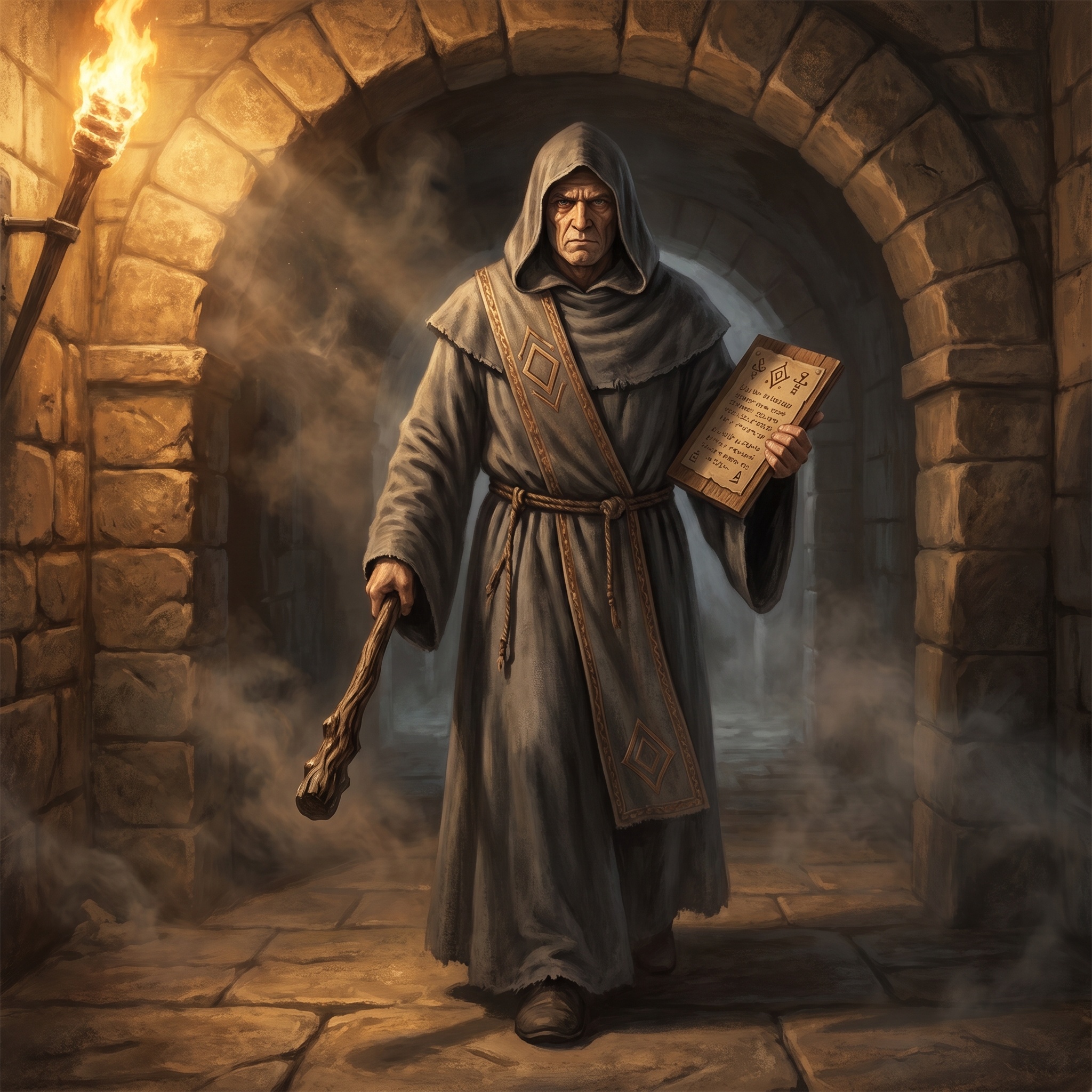
Role: Minion Fanatics Where It Appears: Oshalan missions, occupied settlements, street enforcement mobs.
Oshalan zealots believe disobedience is disorder made visible. They act with the confidence of people certain the law of the cosmos agrees with them.
Oshalan Zealot (Minion)
- Group Size: 3-10.
- Skills: Heavy Melee 2, Readiness 3, Intimidation 3, Lore 2.
- Attacks: Cudgel or Spear (Heavy Melee; Damage 6; Crit 4).
- Abilities: Doctrine Line - Add 1 Boon while acting under an acknowledged Oshalan superior.
- Soul: Claimable; at death it passes normally along the Silver Road to Sheol unless a claim exists, in which case the claim resolves at judgment.
- Tactics: Form a line, isolate perceived transgressors, call authority quickly.
- Encounter Use: Keep the cruelty institutional, not random.
Pirate Boarding Crew
Role: Minion Assault Crew Where It Appears: Ships, docks, river ambushes, coastal raids.
Pirate boarding crews are trained for chaos in cramped spaces. They cut ropes, kick people over rails, and count victory by who controls the deck.
Pirate Boarding Crew (Minion)
- Group Size: 4-10.
- Skills: Light Melee 3, Athletics 3, Operate 3, Intimidation 2, Light Ranged 2.
- Attacks: Boarding Axe (Light Melee; Damage 6; Crit 4); Hook Line (Light Ranged; Damage 4; Crit 5; Range Short; Grabbed on 2 Boons).
- Abilities: Over the Rail - On 2 Boons near an edge, push target one range band or overboard if fiction supports it.
- Soul: Claimable; at death it passes normally along the Silver Road to Sheol unless a claim exists, in which case the claim resolves at judgment.
- Tactics: Hook, board, split defenders, seize helm or cargo.
- Encounter Use: Track ship control as the real objective.
Planar Smuggler
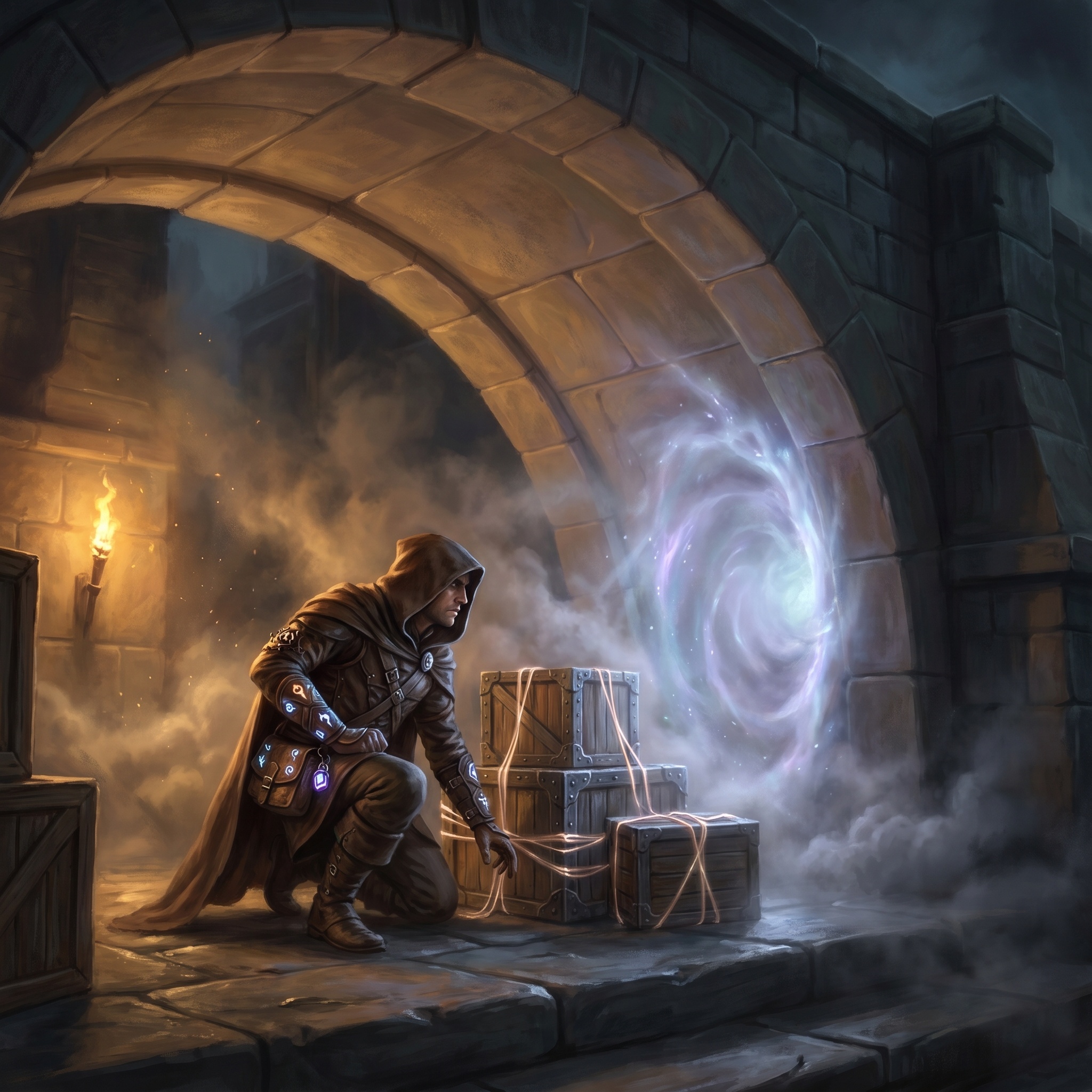
Role: Elite Specialist Where It Appears: Rift towns, illegal portals, border shrines, black markets.
What It Is
Planar smugglers traffic in things that should have stayed elsewhere. They are not always evil, but they are always comfortable with risk other people will pay for. Their cargo might be medicines, refugees, cursed ore, alien pets, illegal weapons, stolen saints, or sealed boxes that whisper in weather no one else can feel.
They are specialists first and combatants second. The smuggler matters because they know routes through unstable space and have already decided acceptable losses.
Ecology and Behavior
Planar smugglers operate around rift towns, illegal portals, bridge shrines, border ruins, and markets where provenance is negotiable. They maintain caches on both sides of a crossing, bribe local watchers, and keep charms for spatial nausea, language drift, and things that follow scent across worlds.
Many smugglers justify themselves. They move what law forbids, and sometimes law is cruel. The problem is that planar contraband can become a public disaster after the smuggler is paid and gone.
Signs and Knowledge
Rifts, Planar Lore, or Streetwise (Average) identifies smuggling patterns around a crossing. Perception (Hard) spots cargo packed for pressure, temperature, or gravity changes no local route requires.
Other signs include crates marked with false mundane weights, charms nailed under bridges, guards paid to look away from empty roads, and animals refusing to approach a covered wagon.
Planar Smuggler (Elite)
- Skills: Rifts 4, Streetwise 4, Deception 3, Operate 3, Light Ranged 2, Planar Lore 3.
- Attacks: Smuggler Crossbow (Light Ranged; Damage 6; Crit 4; Range Medium); Knife (Light Melee; Damage 4; Crit 5).
- Abilities: Bad Exit - Once per scene near a rift, force a pursuer to make Average Rifts or Reflexes or lose one Maneuver to spatial nausea.
- Soul: Claimable; at death it passes normally along the Silver Road to Sheol unless a claim exists, in which case the claim resolves at judgment.
Tactics
A planar smuggler delays, misdirects, and flees through a prepared route. Near a rift, they know which step turns a pursuit into nausea and which landmark is not as close as it looks. They shoot to slow pursuit, then abandon anything less valuable than escape.
Their cargo should be more interesting than their weapon. Decide what is being moved, who wants it, what happens if it breaks, and who gets hurt if the party simply burns the crates.
Evidence and Trade
| Find | Value | Use | Recovery |
|---|---|---|---|
| Rift route chart | 1,200-4,000 gold Flargons | Hidden crossings, patrol gaps, planar hazards | Rifts or Planar Lore (Hard) |
| Contraband cargo | Varies wildly | Plot object, dangerous resource, legal evidence | Depends on cargo; often hazardous |
| Stabilizing charms | 400-1,600 gold Flargons | Safer crossings, smuggling proof | Secret Lore or Rifts (Average) |
Variants
- Refuge Runner: Breaks law for sympathetic reasons and still risks catastrophe.
- Black Gate Broker: Moves high-value occult goods for patrons who never appear.
- Rift-Cut Courier: Carries messages or small objects through routes too unstable for caravans.
Scragg Raider
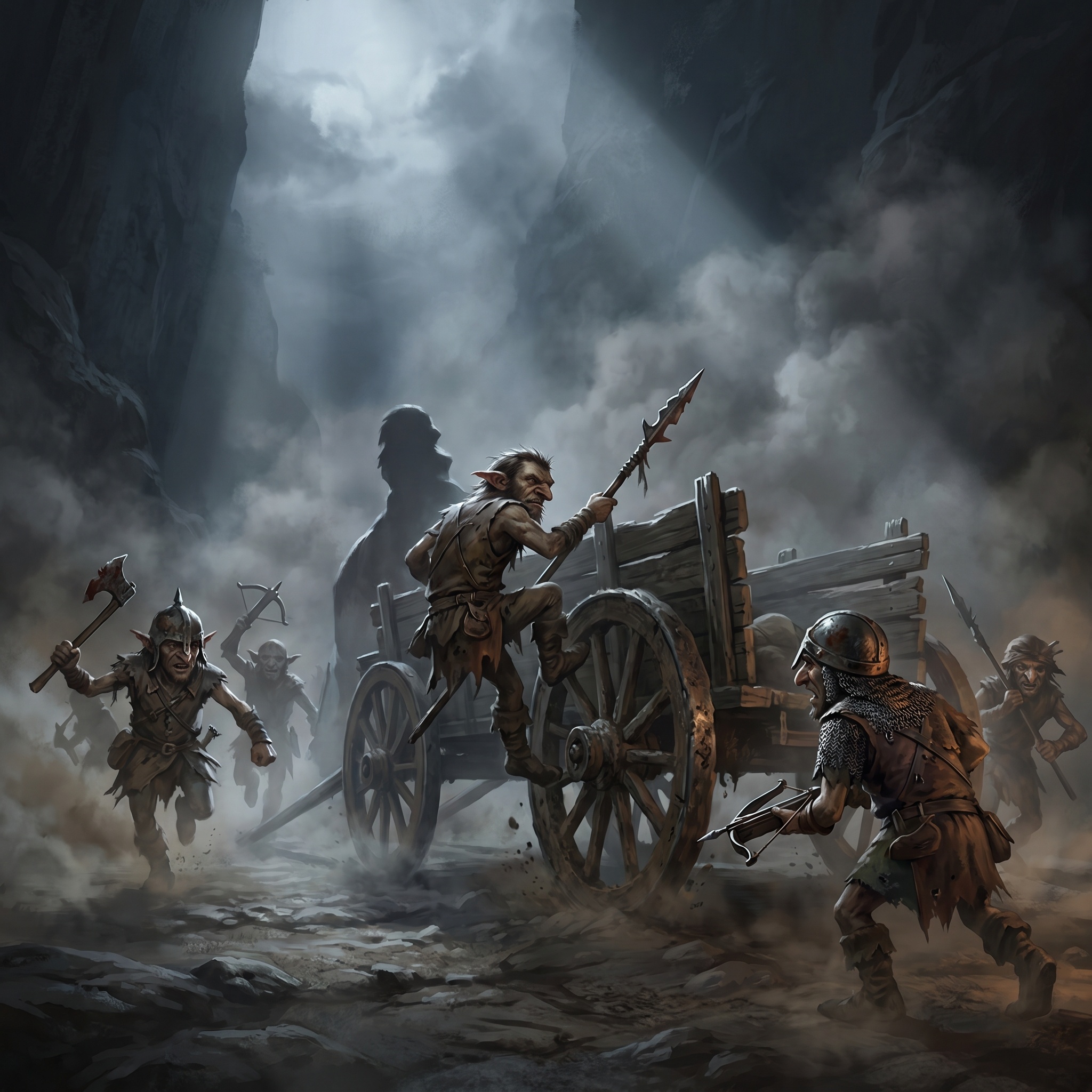
Role: Minion Raider / Pest Where It Appears: City underbellies, ruins, mine shafts, storage tunnels, anywhere civilization has a forgotten underside.
Scraggs are what Smalings become over generations without civilization, community, or the steady pressure of other people's expectations. The result is something smaller, faster, meaner, and significantly more comfortable with getting into spaces people sealed.
What It Is
The Scraggs (singular: Scragg) are the feral lineage of Smaling communities that broke from settlement life, by expulsion, disaster, or choice, far enough back that the return is no longer visible. They retain Smaling proportions and agility, but with the social organization of a raiding group and the ethics of a tool that has forgotten it was ever something else.
They are not savage in the way an animal is savage. They plan. They remember. They prioritize supply access over direct combat and are expert at making large-scale problems from small-scale attacks.
Ecology and Behavior
Scragg bands occupy hidden infrastructure: the tunnels under cities, the collapsed sections of old mines, the forgotten spaces behind walls. They raid because raiding is efficient: small bodies with fast legs can take more from a supply chain than their fighting capacity would suggest.
They avoid prolonged direct combat unless the odds are extreme. They prefer to damage, steal, and vanish into passages too small for pursuit.
Signs and Knowledge: Streetwise or Survival (Average) identifies Scragg intrusion signs: small footprints, missing food at precisely the bottom of a barrel, tunnels opened from the inside. Lore (Hard) connects them to Smaling lineage and understands the cultural divergence.
Scragg Raider (Minion)
- Group Size: 4–12.
- Skills: Stealth 4, Light Melee 3, Athletics 3, Subterfuge 3, Perception 3.
- Attacks: Scavenged Blades (Light Melee; Damage 5; Crit 4); Thrown Rock (Light Ranged; Damage 4; Crit 5; Range Short).
- Abilities: Small and Gone — Can move through any gap large enough for a Smaling-sized body without check. Pursuit into narrow spaces adds 1 Bane per size difference.
- Abilities: Supply Raid — If the group spends a full round in contact with stored provisions, they remove or damage one unit of supply as an incidental.
- Abilities: Scatter on Loss — When reduced below half group Wounds, the group disperses into separate small passages rather than routing. Each surviving Scragg retreats independently.
- Soul: Claimable; at death it passes normally along the Silver Road to Sheol unless a claim exists, in which case the claim resolves at judgment.
- Tactics: Attack from multiple directions, steal or damage supplies, vanish. Avoid fair fights.
- Encounter Use: Use in urban infrastructure and ruin encounters where the party has something worth stealing. The raid is the encounter; the combat is incidental.
- Harvesting and Trade: Scraggs carry their own scavenged kit. Contents vary and are occasionally worth something.
Variants
Scragg Scout: Minion, Group Size 1–2. Advance reconnaissance. Has already memorised the approach before the raiders arrive.
Scragg Shaman
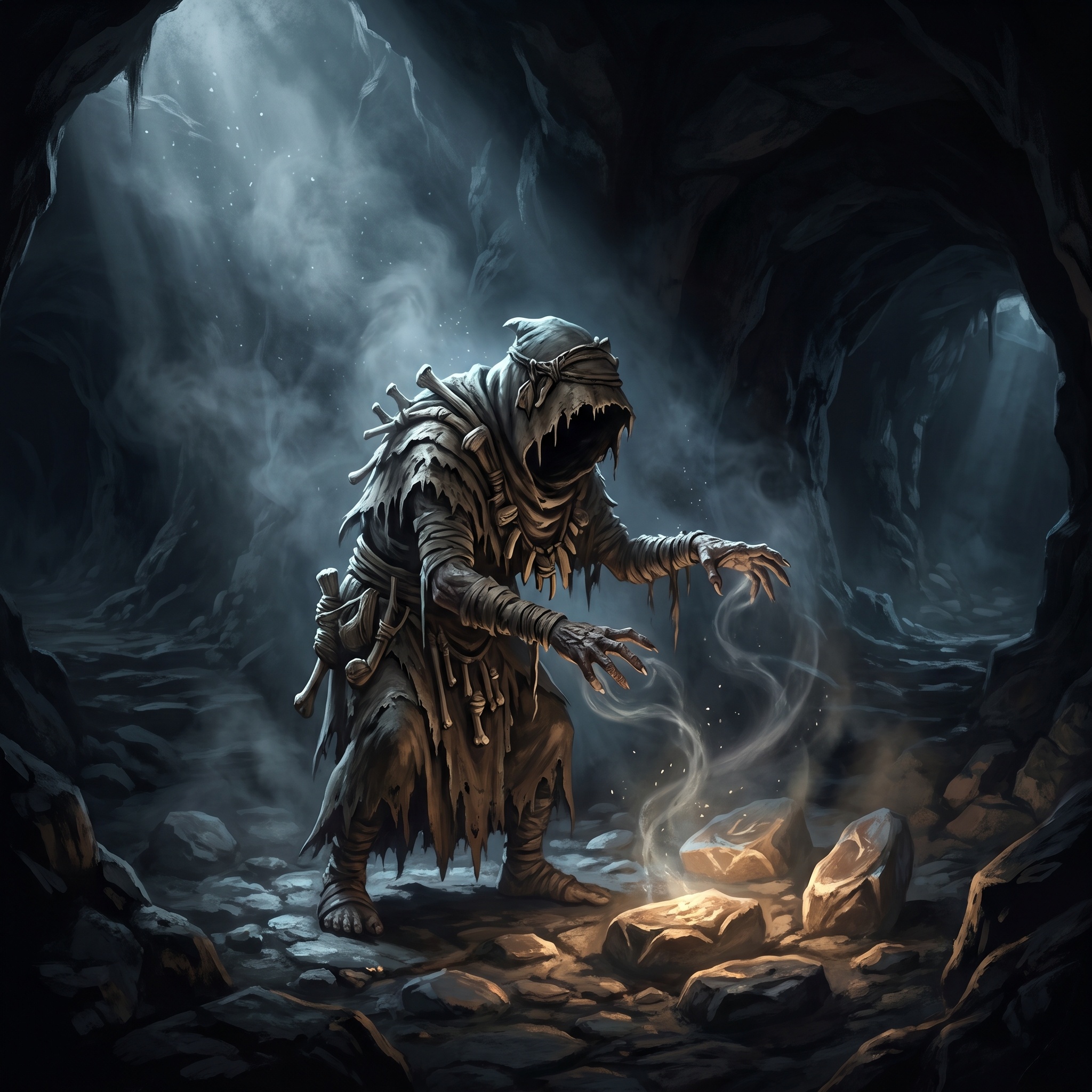
Role: Elite Controller / Support Where It Appears: Scragg holds and raiding camps, deep urban tunnels, old ritual spaces the Scragg have repurposed.
The Shaman remembers things the raiders have forgotten. This is both their role and the reason the raiding group takes their instructions.
What It Is
Scragg Shamans are the keepers of what Smaling cultural practice has become after generations of feral divergence: distorted, scavenged, and occasionally genuinely functional. Their magical practice is hedge-level: small curse-workings, fear-enhancements, and the specific knowledge of which stolen ritual components do something real and which are merely comforting.
They lead by knowing. The Scragg band follows them because the Shaman has navigated the city underbelly long enough to read its patterns, and because some of their curses actually work.
Signs and Knowledge: Secret Lore (Average) identifies crude but real hex-working materials in a Scragg settlement.
Scragg Shaman (Elite)
- Skills: Secret Lore 3, Stealth 4, Perception 4, Deception 3, Survival 3.
- Attacks: Bone Hex (Secret Lore; Damage 5 Strain; Range Short); Scavenged Sling (Light Ranged; Damage 4; Crit 5; Range Short).
- Abilities: Fear Charm — Fear 2. Once per scene, target one creature at Short range that can see the Shaman. Frightened from this ability lasts one round rather than for the scene.
- Abilities: Keep the Clan Steady — While the Shaman is alive, Scragg Minion groups add 1 Boon to Readiness checks against the Scatter on Loss ability triggering.
- Abilities: Tunnel Memory — The Shaman knows the layout of any tunnel or urban infrastructure system it has been in for more than a day. Hard Perception or Adventuring Lore to avoid being led somewhere disadvantageous.
- Soul: Claimable; at death it passes normally along the Silver Road to Sheol unless a claim exists, in which case the claim resolves at judgment.
Tactics: Stays back, hexes the most threatening character, keeps the raiders from scattering. Runs last when the group breaks.
Encounter Use: Use the Shaman as the reason a Scragg band is more coherent than expected. Removing the Shaman should visibly change how the raid proceeds.
Harvesting and Trade
| Harvest | Buyer | Check | Typical Value | Use | Complication |
|---|---|---|---|---|---|
| Ritual Implements | Secret Lore scholar, alchemist | Secret Lore to assess | 200–800 gold Flargons | Study of hedge-magic tradition, minor components | Some items are stolen from better practitioners and may be tracked |
| Knowledge of Tunnel Layout | City guard, criminal syndicate | Negotiation (if alive) | Varies | Infrastructure intelligence | The Shaman is more valuable alive if the tunnels matter |
Variants
Elder Scragg Shaman: Nemesis tier, WND 28. Has been in these tunnels for decades. The hexes are stronger, Fear Charm becomes Fear 3, and it affects all visible enemies simultaneously.
Shard-Warped Knight
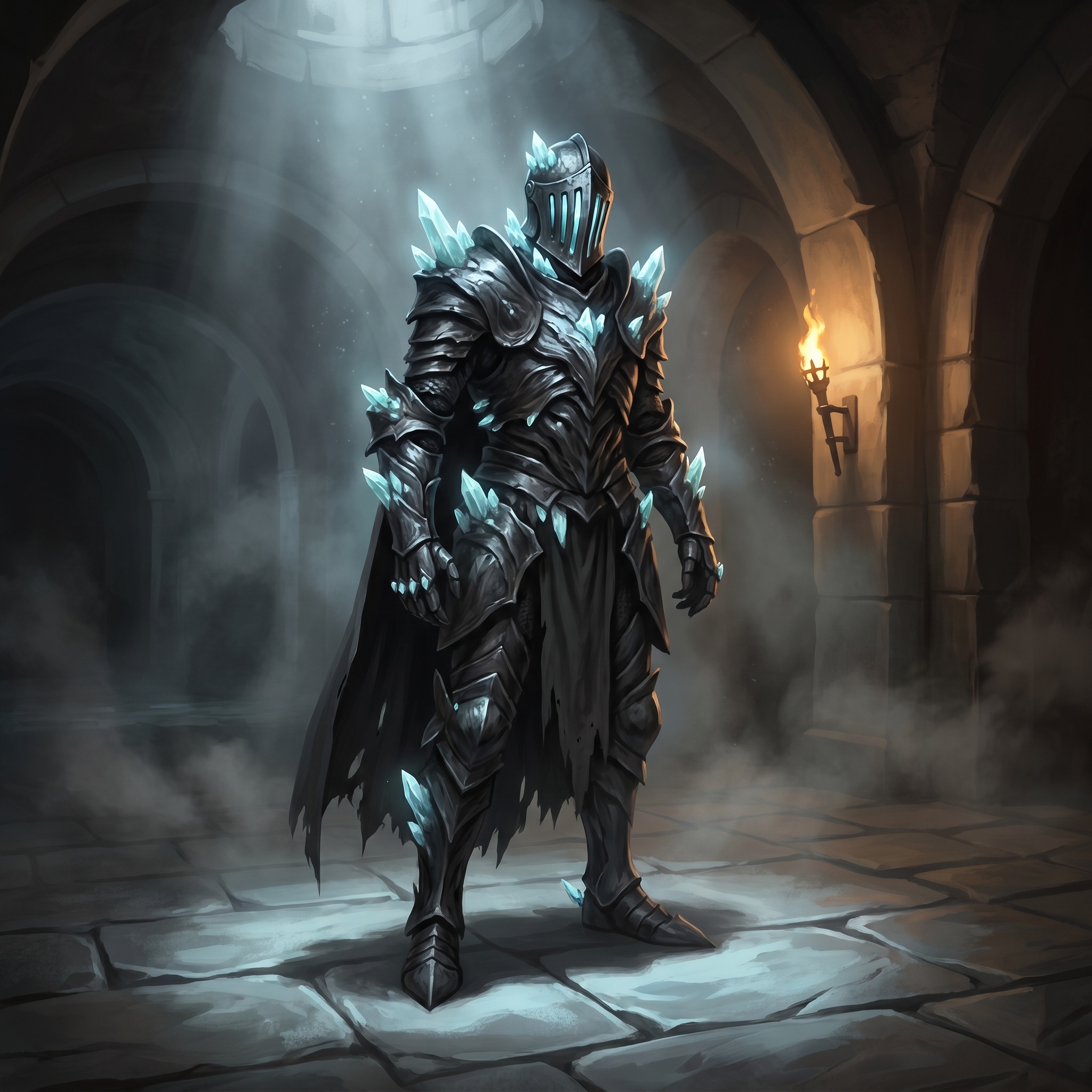
Role: Nemesis Warped Mortal Where It Appears: Shattered Domain incursions, failed divine quests, relic battlefields.
"The armor is still House Carven's. The oath it is reciting is not. We have not been able to determine what oath that is, or to whom it is being kept." — House Carven investigation, missing knight case
What It Is
A shard-warped knight touched divine territory and mistook survival for appointment. They are still a person, but one wrapped around a mission the shard never gave. Divine shard-light leaks through bent armor, old vows, and a certainty too bright to examine.
They are tragic and dangerous because they can look like a chosen champion until their mandate hurts the people it claims to save.
Ecology and Behavior
Shard-warped knights appear after Shattered Domain incursions, failed divine quests, relic battlefields, and broken pilgrimages. They gather followers, challenge leaders, and convert coincidence into proof of appointment.
They may once have been honorable. The shard did not make them false from nothing; it exaggerated a vow, wound, or ambition until the person could no longer tell command from obsession.
Signs and Knowledge
Theology, Planar Lore, or Warfare (Hard) identifies shard-warping rather than true mandate. Negotiation (Hard) can reach the person beneath the mission briefly.
Other signs include miracles that harm bystanders, vows repeated with changing wording, armor glowing brighter during contradiction, and followers punished for asking who sent them.
Shard-Warped Knight (Nemesis)
- Skills: Heavy Melee 5, Readiness 5, Leadership 4, Planar Lore 3, Intimidation 4.
- Attacks: Shardblade (Heavy Melee; Damage 11; Crit 3; Pierce 3); Radiant Demand (Leadership; Damage 7 Strain; Range Short).
- Abilities: False Mandate — Once per scene, declare a divine mission. Those who hesitate suffer 3 Strain or add 1 Bane to their next opposed social check.
- Soul: Claimable; at death it passes normally along the Silver Road to Sheol unless a claim exists, in which case the claim resolves at judgment.
Tactics
A shard-warped knight challenges, commands, and punishes refusal. They seek leaders and symbols, not random targets. If confronted with proof that the mandate is false, they may become more violent before they become reachable.
Run them as a person with a wound, not just a radiant brute. The party can defeat, expose, redeem, or redirect them depending on what remains under the shard.
Harvesting and Trade
| Component | Value | Use | Harvest |
|---|---|---|---|
| Shard-glass armor fragments | 1,000-3,000 gold Flargons | Shattered Domain research, false mandate study | Theology or Planar Lore (Hard), backlash risk |
| Warped vow token | Varies | Redemption, proof, cult leverage | Negotiation or Lore (Average) |
| Radiant slag | 500-1,800 gold Flargons | Relic forensics, dangerous charms | Secret Lore (Hard) |
Variants
- Pilgrim Knight: Protects a road that no longer needs protection.
- Relic Champion: Serves an object rather than a god.
- Battlefield Appointee: Claims command over soldiers who never chose them.
Slaver Captain
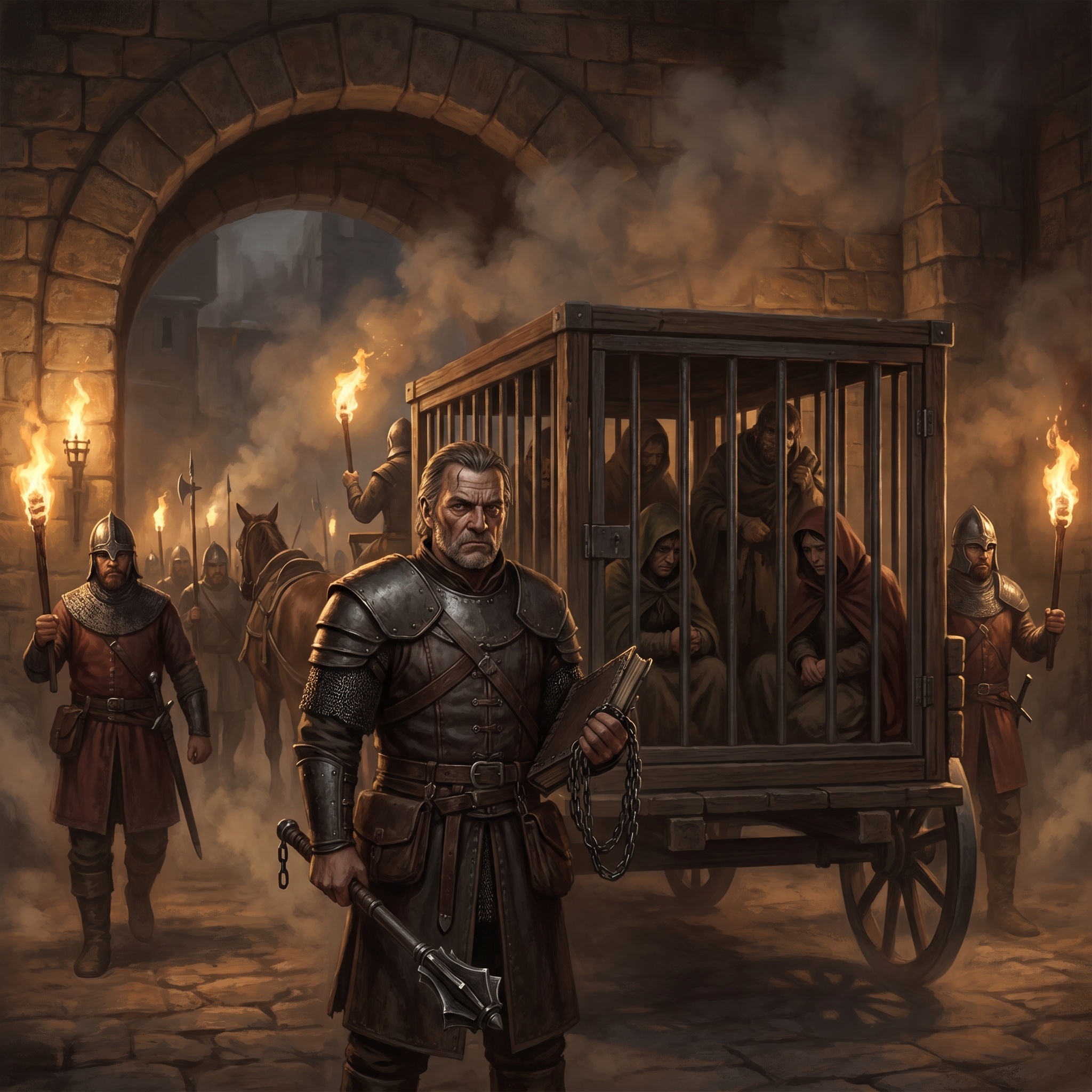
Role: Nemesis Mortal Commander Where It Appears: Black markets, occupied roads, corrupt ports, raiding fronts.
"The manifests were accurate. The route was legal. The buyers were legitimate. The people in the cages had papers. The papers were wrong." — Investigator's summary, Antaean Trade Authority, case 4471
What It Is
Slaver captains are logistics villains. They think in routes, bribes, cages, and replacement losses. They are dangerous because they make cruelty efficient. A slaver captain is not defined by personal ferocity, but by systems: transport, intimidation, forged papers, paid lookouts, and buyers who prefer not to ask questions.
Use them when the adventure needs a rescue objective, an evidence trail, and a villain whose defeat should dismantle something larger than one wagon.
Ecology and Behavior
Slaver captains operate through routes and permissions. They know which roads are watched, which officials can be bribed, which barns have hidden cellars, and which buyers want labor, ransom leverage, or political prisoners. They employ guards who can be replaced and specialists who cannot: forgers, drivers, corrupt healers, and people who can move money quietly.
They avoid fair fights. Captives, contracts, terrain, and hostages are tools. If a captain expects trouble, they split prisoners, prepare false manifests, and arrange a fallback buyer who can make evidence disappear.
Signs and Knowledge
Streetwise or Survival (Average) identifies cage-wagon routes, hidden waystations, and guard rotations. Lore or Negotiation (Hard) can spot fraudulent transport papers.
Other signs include extra food bought under false names, wagons with reinforced interiors, guards who never drink on duty, and locals who suddenly stop discussing missing people.
Slaver Captain (Nemesis)
- Skills: Leadership 4, Intimidation 4, Streetwise 4, Heavy Melee 3, Light Ranged 3, Operate 3.
- Attacks: Chain Hook (Heavy Melee; Damage 7; Crit 4; Grabbed on 2 Boons); Crossbow (Light Ranged; Damage 7; Crit 3; Range Medium).
- Abilities: Human Cargo Shield - If captives are present, attacks risk collateral harm on Calamity unless PCs control positioning.
- Abilities: Route Network - Once per arc, reveal a bribed official, hidden waystation, or buyer unless the network has been exposed.
- Soul: Claimable; at death it passes normally along the Silver Road to Sheol unless a claim exists, in which case the claim resolves at judgment.
Tactics
A slaver captain puts captives between danger and crew, retreats toward prepared routes, and orders subordinates to create delay rather than win heroically. If cornered, they threaten evidence, hostages, or legal cover. Their first priority is preserving the network; their second is escaping with enough records or witnesses to rebuild.
This should be a rescue and evidence scene as much as a fight. Make positioning, keys, wagon doors, frightened captives, and escaping lieutenants matter.
Evidence and Trade
| Find | Value | Use | Recovery |
|---|---|---|---|
| Route ledger | 1,500-5,000 gold Flargons to liberators, courts, or rivals | Exposes buyers, bribes, and waystations | Streetwise or Lore (Hard) |
| Cage keys and manifests | Varies | Immediate rescue and legal proof | Subterfuge (Average) |
| Bribe purse | 500-2,500 gold Flargons | Identifies corrupt officials through marked coin or notes | Streetwise (Average) |
Variants
- Port Chainmaster: Moves captives through ships, warehouses, and false customs seals.
- Warfront Collector: Follows armies and harvests prisoners from chaos.
- Respectable Broker: Never travels with cages, only papers and buyers.
Temple Guard
Role: Minion Defensive Line Where It Appears: Temples, reliquaries, monastery gates, pilgrimage treasuries.
Temple guards know the building, the crowds, and the rituals. They are trained to stop panic before stopping thieves.
Temple Guard (Minion)
- Group Size: 2-8.
- Skills: Heavy Melee 3, Perception 3, Readiness 3, Leadership 2.
- Attacks: Temple Polearm (Heavy Melee; Damage 7; Crit 4; Defensive 1).
- Abilities: Sanctuary Formation - While defending a doorway, altar, or reliquary, add 1 Boon to resist forced movement.
- Soul: Claimable; at death it passes normally along the Silver Road to Sheol unless a claim exists, in which case the claim resolves at judgment.
- Tactics: Block access, call priests, avoid harming pilgrims if possible.
- Encounter Use: Their constraints make the scene interesting.
Tomb Robber
Role: Elite Skirmisher / Rival Delver Where It Appears: Tombs, ruins, black markets, expedition camps.
What It Is
Tomb robbers are experts at leaving others with the consequences. They trigger, bypass, or redirect dangers rather than defeating them cleanly. A tomb robber is not simply a thief underground; they know dead languages poorly enough to be dangerous, traps well enough to survive, and markets well enough to know which relics are worth a curse.
They make excellent rivals because they want the same spaces the party wants, but not necessarily the same outcomes. A tomb robber may steal the idol, leave the guardian active, and sell the map before anyone realizes the seal mattered.
Ecology and Behavior
Tomb robbers move between ruins, expedition camps, fences, and scholars who ask too few questions. They maintain tool rolls, fake permits, padded boots, relic satchels, and escape routes. Some work alone. Others hire diggers and abandon them when the curse starts.
They avoid direct fights unless cornered. Their preferred tactic is timing: arrive after someone else opens the door, grab the portable prize, and flee through the hazard they already mapped.
Signs and Knowledge
Adventuring Lore or Subterfuge (Average) identifies professional tomb-robbing marks. Streetwise (Hard) connects a robber to a fence or patron.
Other signs include chalk marks hidden below eye level, traps reset incorrectly, cheap offerings left in place of valuable ones, and footprints that avoid only some pressure plates.
Tomb Robber (Elite)
- Skills: Subterfuge 4, Stealth 4, Adventuring Lore 4, Light Melee 2, Light Ranged 2, Streetwise 3.
- Attacks: Short Blade (Light Melee; Damage 5; Crit 4); Thrown Knife (Light Ranged; Damage 4; Crit 4; Range Short).
- Abilities: Trap Redirect - Once per scene, when a trap triggers nearby, add or subtract one target if physically plausible.
- Soul: Claimable; at death it passes normally along the Silver Road to Sheol unless a claim exists, in which case the claim resolves at judgment.
Tactics
A tomb robber grabs the relic, cuts the rope, and runs through the known safe path. They use thrown knives to slow pursuit, not win duels. If captured, they bargain with maps, passwords, and the name of the buyer.
Run them as a rival, not a brute. Their best attack is arriving at exactly the wrong moment with just enough information to make the dungeon worse.
Evidence and Trade
| Find | Value | Use | Recovery |
|---|---|---|---|
| Relic satchel | 1,000-4,000 gold Flargons depending on contents | Stolen objects, curses, patron clues | Adventuring Lore (Average) to identify risk |
| Trap notes | 500-1,800 gold Flargons | Safe routes and missed dangers | Subterfuge (Average) |
| Fence tokens | Varies | Leads to black market buyers | Streetwise (Average) |
Variants
- Academic Thief: Has better translations and worse survival instincts.
- Grave-Camp Scout: Works ahead of a larger expedition.
- Curse-Burned Veteran: Carries scars, superstitions, and one very accurate warning.
War Priest
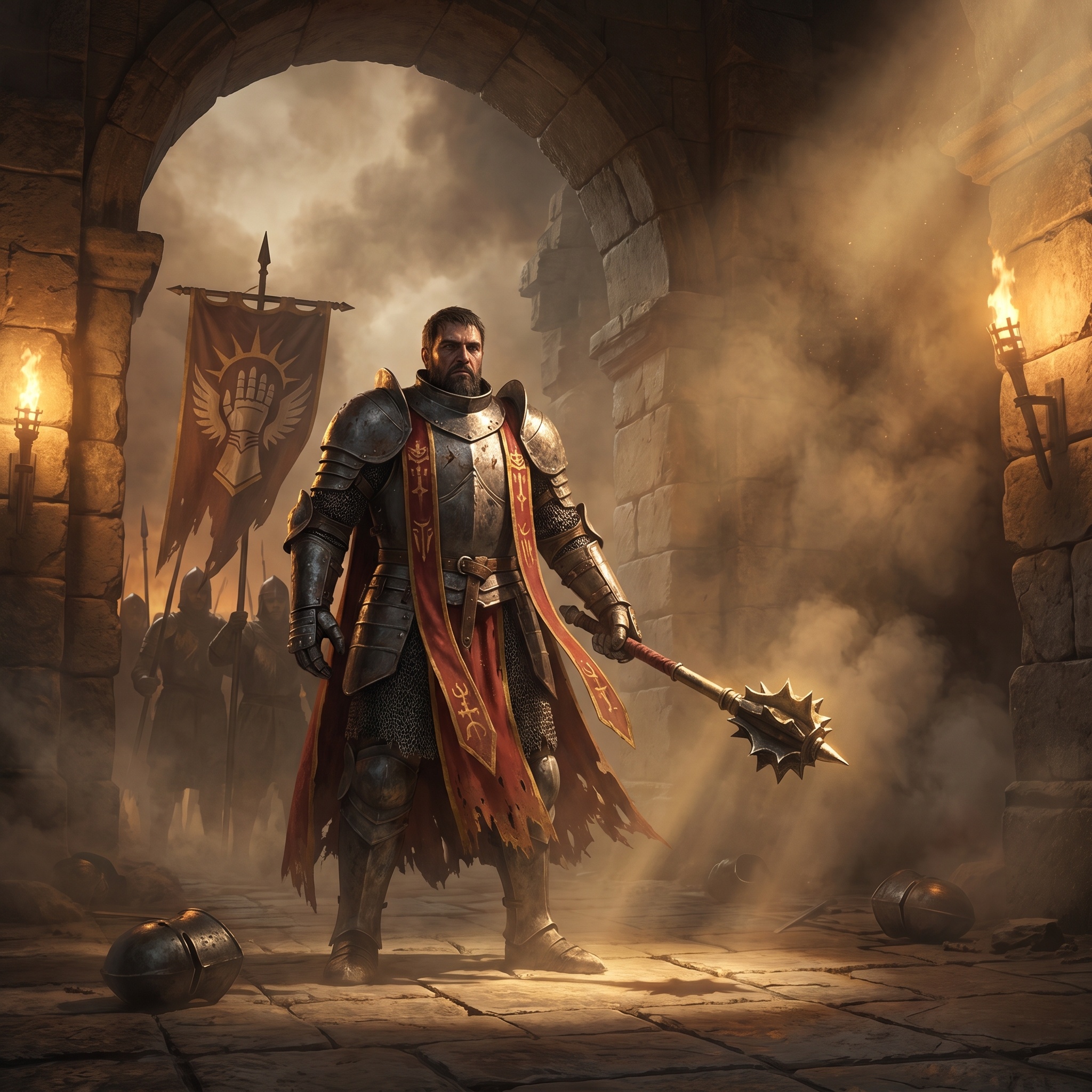
Role: Elite Support / Bruiser Where It Appears: Battlefields, crusades, temple defenses, war camps.
What It Is
War priests are not generic holy fighters. Their methods reflect their deity, but the battlefield role is consistent: keep allies standing, make fear expensive, and punish blasphemy with iron. A war priest might be merciful to prisoners, ruthless to oathbreakers, ecstatic in battle, or grimly practical. The god matters.
Their presence changes a fight because enemies stop breaking when they should. Soldiers who would flee hold the line under a shouted rite, a battlefield hymn, or the simple fact that their priest is still standing.
Ecology and Behavior
War priests appear in temple defenses, crusades, mercenary companies, noble armies, and desperate village militias. Some are official clergy. Others are battlefield devotees recognized only because soldiers follow them. They carry medicine, rites for the dead, and a list of sins that become tactically relevant under stress.
A war priest is often a social anchor. Killing them may break morale, but sparing or debating them may turn a battle into negotiation, surrender, or schism.
Signs and Knowledge
Theology or Warfare (Average) identifies the god, rite, and likely battlefield doctrine. Leadership (Hard) predicts how nearby troops will respond if the priest falls.
Other signs include banners placed for visibility rather than command, soldiers repeating short litanies, blessed water or ash near the wounded, and enemies regrouping around a mace-bearing figure.
War Priest (Elite)
- Skills: Heavy Melee 3, Leadership 4, Readiness 4, Lore 3, Medicine 2.
- Attacks: War Mace (Heavy Melee; Damage 8; Crit 4; Stun 2); Battle Rebuke (Leadership; Damage 5 Strain; Range Short).
- Abilities: Hold the Line - Once per round, one allied Minion group at Short range recovers 3 Wounds or ignores a morale break.
- Soul: Claimable; at death it passes normally along the Silver Road to Sheol unless a claim exists, in which case the claim resolves at judgment.
Tactics
A war priest stands behind or within the front line, rallies allies, and strikes anyone who breaks through. They use Battle Rebuke against leaders, cowards, and blasphemers. If their doctrine prizes martyrdom, they hold ground; if it prizes stewardship, they may order retreat to preserve lives.
Define the god before the scene. Their doctrine should change target priority, mercy, surrender terms, and what they consider victory.
Spoils and Trade
| Find | Value | Use | Recovery |
|---|---|---|---|
| Battlefield stole or holy sign | 300-1,500 gold Flargons, or priceless to the faith | Identification, ransom, relic claim | Theology (Average) to handle respectfully |
| Prayer roll | 200-1,000 gold Flargons | Doctrine clues, morale leverage, ritual aid | Lore or Theology (Average) |
| Blessed medical kit | 250-900 gold Flargons | Healing, triage, temple evidence | Medicine (Average) |
Variants
- Mercy Shield: Focuses on keeping allies alive and accepting surrender.
- Oath Hammer: Punishes deserters, oathbreakers, and broken treaties.
- Banner Saint: Almost a living relic to nearby troops; morale consequences are severe.