Starter Adversaries
The entries below give you something ready to put in the party's path in session one. They cover common road, cellar, tomb, faction, and infernal threats, plus every profile needed for the First Chronicle in Chapter Twelve. Each is a complete, balanced encounter piece. The Ix Adversary Catalog is the canonical source for all Ix stat blocks; this chapter reprints a starter subset of those entries, and if a value here ever disagrees with the Catalog, the Catalog is correct.
Minions act in groups and share a single Wound pool (the listed Wounds is per member); Elites are individuals. Use the tier rules in Chapter Nine for how Minions, Elites, and Nemeses behave, and the building and reskinning tools later in this chapter to retier or reflavor any of them.
Mortal Opposition
Bandit Gang — Minion
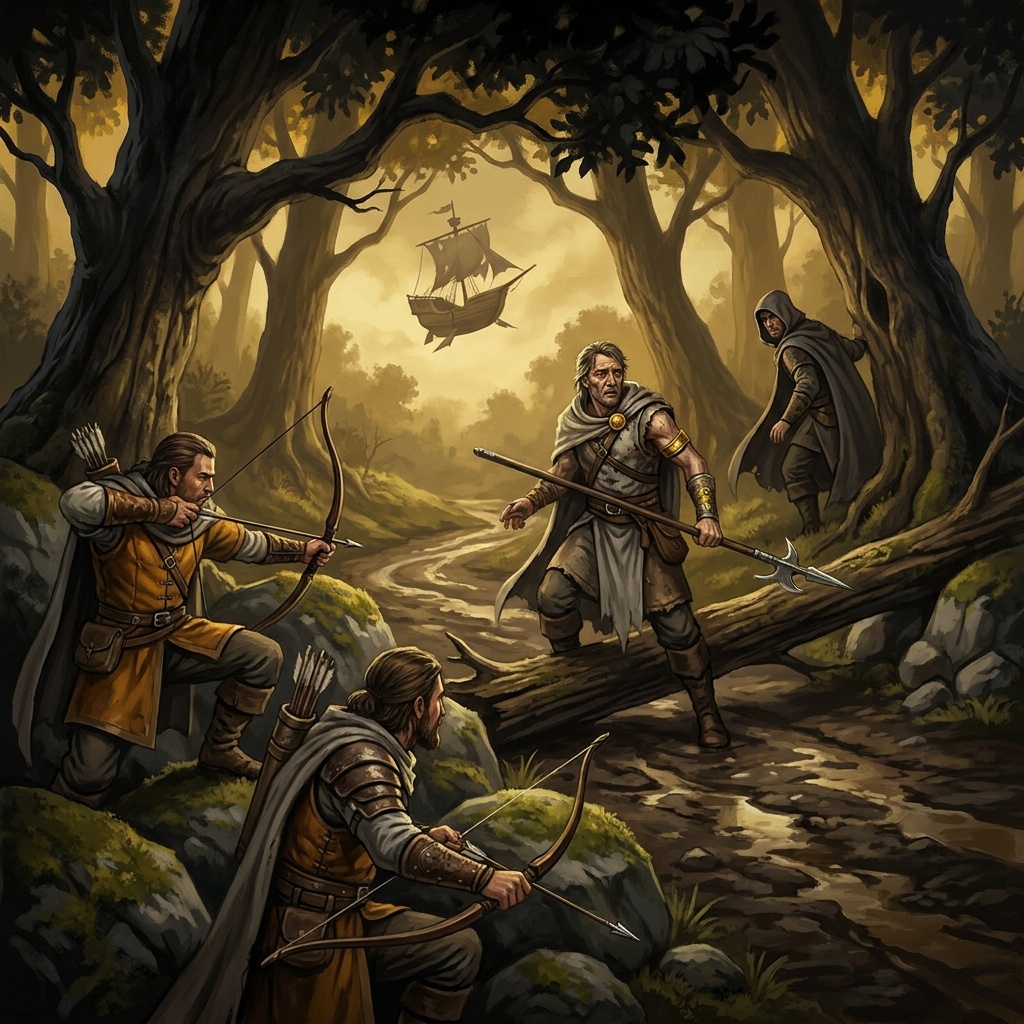 · Bad roads, hungry borderlands, failed estates. Group 3–8.
MIG 2 · AGI 3 · INT 2 · SAV 3 · WIL 2 · CHA 2 — Resistance 2 · Wounds 6 · Melee Def 0 · Ranged Def 1
Skills: Light Melee 2, Light Ranged 2, Stealth 2, Perception 2, Streetwise 2, Intimidation 2. Attacks: Blades and Clubs (Light Melee; Dmg 5; Crit 4); Bows or Slings (Light Ranged; Dmg 5; Crit 4; Medium). Abilities: Morale Break — when the group drops below half its Wounds, the leader makes an Average Leadership or Intimidation check, or the gang flees, bargains, or scatters. Tactics: Block the road, threaten, shoot from cover, run if the ambush fails. Decide why they are robbing people before the scene begins.
Orc Warrior — Minion
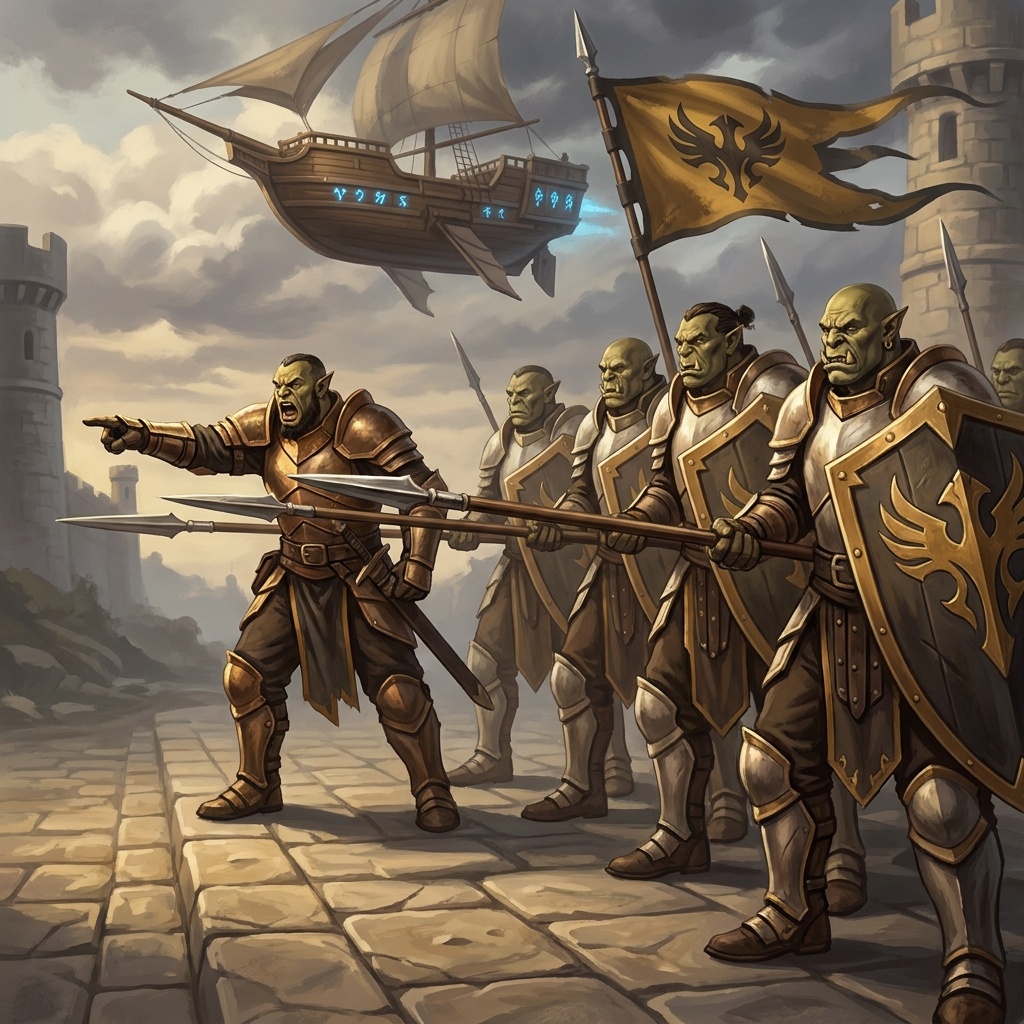 · Warband territory, raiding fronts, mercenary companies. Group 3-10.
MIG 4 · AGI 2 · INT 2 · SAV 3 · WIL 3 · CHA 1 — Resistance 3 · Wounds 6 · Melee Def 1 · Ranged Def 0
Skills: Heavy Melee 3, Athletics 3, Fortitude 3, Perception 2, Readiness 3. Attacks: Spear or Axe (Heavy Melee; Dmg 7; Crit 4; Defensive 1 with spear formation); Javelin (Heavy Ranged; Dmg 6; Crit 4; Short). Abilities: Line Formation — when two or more groups are adjacent, add to resist forced movement and flanking. Commanded Advance — under active leadership, add to attacks and to retreat checks. Tactics: Hold a line, advance on command, target whoever breaks formation. These are professional soldiers, not berserkers.
Beasts
Wolf — Minion
 · Forests, hills, winter borderlands. Group 3–8.
MIG 2 · AGI 3 · INT 1 · SAV 3 · WIL 2 · CHA 1 — Resistance 2 · Wounds 6 · Melee Def 1 · Ranged Def 0
Skills: Unarmed 3, Athletics 3, Stealth 3, Perception 3, Survival 3. Attacks: Pack Bite (Unarmed; Dmg 6; Crit 4; Hamstring on - target adds to movement checks until treated). Abilities: Pack Flank — add against a target already engaged with another wolf group. False Retreat — below half Wounds, the group may disengage to Short range instead of fleeing; if pursued, it turns and attacks with . Tactics: Circle the rear, pull mounts down, drag one target out of the light.
Dire Wolf — Minion
 · Deep wilderness, cold frontier, monster-touched woods. Group 3–8.
MIG 3 · AGI 3 · INT 1 · SAV 3 · WIL 2 · CHA 1 — Resistance 2 · Wounds 5 · Melee Def 1 · Ranged Def 0
Skills: Unarmed 3, Athletics 3, Stealth 2, Perception 3, Survival 3. Attacks: Pack Bite (Unarmed; Dmg 6; Crit 4; on , knock Prone). Abilities: Pack Circle — add against a target already engaged with another dire wolf group. Hamstring — if Pack Bite wounds a Prone target, that target adds to movement until treated. Tactics: Circle, make mounts and light targets Prone, drag a victim out of formation. A heavier, hungrier wolf.
Giant Rat — Minion · Sewers, cellars, granaries, anywhere food is stored. Group 3–12.
MIG 2 · AGI 3 · INT 1 · SAV 3 · WIL 2 · CHA 0 — Resistance 2 · Wounds 6 · Melee Def 0 · Ranged Def 0
Skills: Unarmed 2, Stealth 3, Athletics 3, Perception 3. Attacks: Gnawing Bite (Unarmed; Dmg 4; Crit 5). Abilities: Disease 1 (Rat Fever) — on 2 from a bite that wounds the target, the target makes an Average Willpower check. Failure: 1 Bane to all checks until the end of their next extended rest. Recovery: one extended rest with clean water and food. Cure: Average Medicine, fever herbs, antitoxin, or suitable divine healing. Swarm Attack — attacking a target already bitten by another rat this round adds . Tactics: Swarm the smallest or most isolated target; flee bright fire. Use them to make resting somewhere feel costly. (Plague Rat variant: replace Rat Fever with Disease 2 (Sewer Plague) — Hard Willpower; failure adds 1 Bane to all checks and prevents ordinary Wound recovery for two days; recovery requires two extended rests in clean conditions; cure by Hard Medicine, antitoxin, fever herbs from a trained healer, or suitable divine healing.)
Giant Spider — Elite
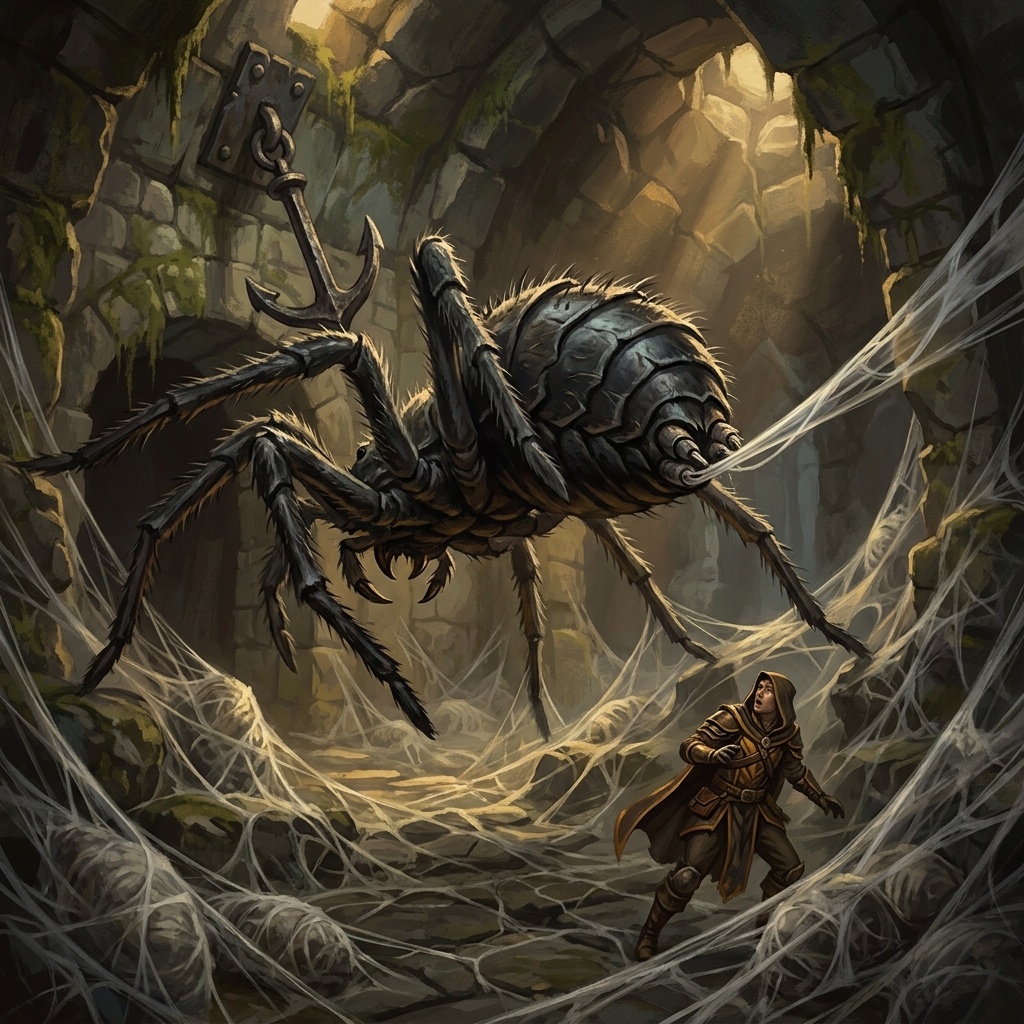 · Old forests, ruins, mines: anywhere with high anchor points and prey traffic.
MIG 3 · AGI 4 · INT 1 · SAV 4 · WIL 2 · CHA 0 — Resistance 3 · Wounds 20 · Melee Def 1 · Ranged Def 1
Skills: Unarmed 4, Stealth 4, Athletics 4, Perception 4. Attacks: Venom Bite (Unarmed; Dmg 7; Crit 4; Poison 2 on ); Web Shot (Heavy Ranged; Dmg 3; Crit 5; Short; Immobilized on hit - Average Reflexes to avoid). Abilities: Web Master — ignores web terrain; non-spiders add moving through it. Ambush Drop — first attack from a ceiling or web anchor adds and +2 damage. Tactics: Web the approach, wait above, drop on trapped prey, bite, let the poison work. (Brood Mother variant: Nemesis, Wounds 38, with 2–3 Minion spider groups.)
Restless Dead
Skeleton Band — Minion · Tombs, old battlefields, necromancer workrooms. Group 4–12.
MIG 2 · AGI 2 · INT 0 · SAV 1 · WIL 2 · CHA 0 — Resistance 2 · Wounds 5 · Melee Def 0 · Ranged Def 0
Skills: Heavy Melee 2, Light Ranged 1, Readiness 2. Attacks: Grave Spear (Heavy Melee; Dmg 5; Crit 4); Bone Bow (Light Ranged; Dmg 4; Crit 5; Medium). Abilities: No Nerve to Break — immune to fear, social pressure, poison, and morale effects. Tactics: Obey the last command given; hold formation badly but relentlessly. Simple dead matter under command or site-memory; not infectious.
Zombie — Minion · Plague sites, failed necromancy, cursed ground. Group 3–10.
MIG 3 · AGI 1 · INT 0 · SAV 2 · WIL 4 · CHA 0 — Resistance 2 · Wounds 6 · Melee Def 0 · Ranged Def 0
Skills: Unarmed 2, Fortitude 4, Perception 2. Attacks: Grasping Bite (Unarmed; Dmg 5; Crit 4; Grabbed on ). Abilities: Infectious Bite — a bitten character makes a Hard Willpower check or gains Zombie Plague (Stage 1: carrier; Stage 2 after a rest: 1 Bane to all checks, −2 max Wounds; Stage 3: dies and rises. Hard Medicine halts it before Stage 3). Won't Stay Down — when the group hits 0 Wounds, roll 1d10; on 7+ one zombie remains at 1 Wound. Drawn to Warmth — always moves toward the nearest living creature; no cover, no tactics, no retreat. Tactics: Zombies advance at a walk and never charge. Those in reach bite; the rest keep walking.
Ghoul — Elite · Graveyards, catacombs, ruins, the dark under cities.
MIG 3 · AGI 4 · INT 1 · SAV 3 · WIL 4 · CHA 0 — Resistance 4 · Wounds 20 · Melee Def 1 · Ranged Def 0
Skills: Unarmed 4, Stealth 4, Athletics 4, Perception 3, Fortitude 4. Attacks: Raking Claws (Unarmed; Dmg 8; Crit 3; Pierce 1, Vicious 5); Paralyzing Bite (Unarmed; Dmg 6; Crit 4; Stun 3 on - see Paralysis). Abilities: Paralysis — on a Paralyzing Bite Stun, the target makes a Hard Fortitude check or is Immobilized until the end of its next turn (two turns on 2 ). Grave Sense — smells living creatures at Short range in darkness. Frenzy at Fresh Blood — once any living creature is wounded in the scene, the Ghoul adds to its attacks that round. Abilities (continued): Dread — Fear 2. Tactics: Strikes the rear, paralyzes one target, drags them off. Avoids bright fire and loud noise; will not abandon a meal it has secured.
Infernal Operators
Pact Collector — Elite · Contract default scenes, debtor hunts, night roads.
MIG 4 · AGI 3 · INT 2 · SAV 4 · WIL 4 · CHA 1 — Resistance 5 · Wounds 20 · Melee Def 1 · Ranged Def 1
Skills: Heavy Melee 4, Survival 4, Perception 4, Intimidation 4, Negotiation 3. Attacks: Claim Chain (Heavy Melee; Dmg 8; Crit 4; Grabbed on ); Ledger Brand (Willpower; Dmg 6 Strain; Short). Abilities: Collateral Sense — knows the direction of a contract-marked target at Long range if on the same plane. Tactics: Mark exits first. Use Ledger Brand to make the debtor feel the claim, then Claim Chain to remove them. Unrelated resistance is ignored until it obstructs; a party that blocks collection stops being bystanders and becomes documented obstruction, which changes the legal stakes beyond this scene. The encounter is much stronger when the debt is specific and the paperwork almost holds up.
Infernal Clerk — Elite · Counting houses, court offices, contract clinics, discreet salons.
MIG 1 · AGI 2 · INT 4 · SAV 4 · WIL 3 · CHA 4 — Resistance 1 · Wounds 14 · Melee Def 0 · Ranged Def 0
Skills: Negotiation 4, Deception 4, Lore 3, Secret Lore 3, Streetwise 3, Light Melee 1. Attacks: Letter Opener (Light Melee; Dmg 3; Crit 5); Contract Pressure (Negotiation; Dmg 5 Strain; Short). Abilities: Fine Print — once per scene, reveal a prior agreement, debt, or social obligation that adds to a target's next Negotiation or Leadership check unless the party disproves it. Tactics: Offer terms. Isolate the desperate. Leave before steel appears. The Clerk's desk, witnesses, seals, and ledgers are the battlefield. If cornered, use Contract Pressure to drain Strain, declare the confrontation an official incident, and stall with procedure while looking for an exit. They do not want to win a duel; they want the party to become liable for starting one. Destroying the Clerk may be easier than undoing the paperwork.
Faction Pressure
Oshalan Inquisitor — Nemesis · Oshalan courts, occupied temples, doctrinal investigations.
MIG 2 · AGI 2 · INT 4 · SAV 4 · WIL 5 · CHA 4 — Resistance 3 · Wounds 18 · Strain 22 · Melee Def 0 · Ranged Def 1
Skills: Intimidation 5, Leadership 4, Lore 4, Secret Lore 3, Negotiation 3, Light Melee 2. Attacks: Guarded Blade (Light Melee; Dmg 5; Crit 4); Doctrinal Accusation (Intimidation; Dmg 7 Strain; Medium). Abilities: Legal Gravity — in Oshalan-controlled territory, social checks against the Inquisitor add unless the speaker has recognized status or leverage. Name the Heresy — once per scene, assign a public accusation; the target suffers 4 Strain or must answer immediately with Lore, Negotiation, or Deception (Hard). Peril: 1. Spend to activate Institutional Weight: once per encounter, when the party physically threatens or strikes the Inquisitor in a witnessed setting, immediately advance the Order faction clock by 1 tick. The consequence lands regardless of whether the party wins the fight. Tactics: Let guards hold physical space while pressuring one target publicly. Use witnesses, silence, and procedural traps as weapons. In combat, stay behind disciplined allies and use Doctrinal Accusation to break resolve rather than prove courage. Their defeat creates paperwork, pursuit, or political consequence; killing an Inquisitor may solve the room and worsen the province.
First Chronicle Profiles
Use these for the named roles in Chapter Twelve. They are built to support investigation, pressure, and limited violence; not every important NPC is meant to be fought.
Oshalan Zealot — Minion · Order agents, registry escorts, doctrinal street pressure. Group 3-10.
MIG 3 · AGI 2 · INT 2 · SAV 2 · WIL 3 · CHA 2 — Resistance 2 · Wounds 6 · Melee Def 0 · Ranged Def 0
Skills: Heavy Melee 2, Readiness 3, Intimidation 3, Lore 2. Attacks: Cudgel or Spear (Heavy Melee; Dmg 6; Crit 4). Abilities: Doctrine Line — add while acting under an acknowledged Oshalan superior. Tactics: Form a line, hold doors, isolate perceived transgressors, and call authority quickly. Apply the Oshalan Registered Position package below when you want assaulting them to carry a faction-clock consequence.
Oshalan Registrar — Elite · Record seizure, deed disputes, administrative occupation.
MIG 1 · AGI 2 · INT 4 · SAV 3 · WIL 4 · CHA 3 — Resistance 1 · Wounds 12 · Melee Def 0 · Ranged Def 0
Skills: Lore 4, Negotiation 3, Intimidation 3, Deception 2, Perception 3, Streetwise 2. Attacks: Ink Knife (Light Melee; Dmg 3; Crit 5); Administrative Pressure (Intimidation; Dmg 5 Strain; Short). Abilities: Filed Objection — once per scene, impose on a character's social or legal check by citing a procedural defect unless the character succeeds on Average Lore or Negotiation. Seize the Record — if escorted by Zealots, the Registrar can spend an Action to secure, remove, or invalidate one document in the scene unless physically stopped. Tactics: Avoid combat. Make the room official, let escorts create space, and turn hesitation into paperwork.
Accord Keeper — Elite · Archive recovery, contract clinics, witness work.
MIG 2 · AGI 2 · INT 4 · SAV 4 · WIL 3 · CHA 3 — Resistance 2 · Wounds 14 · Melee Def 0 · Ranged Def 0
Skills: Lore 4, Perception 4, Negotiation 3, Leadership 3, Medicine 2, Readiness 2. Attacks: Staff (Light Melee; Dmg 4; Crit 5); Witnessed Correction (Leadership; Dmg 4 Strain; Short). Abilities: Witnessed Act — once per scene, place one witnessed fact on the record. Characters who contradict it later add to Deception or Negotiation checks until they answer the record. Reconstruct Record — given fragments, testimony, or a damaged archive, add to one Lore, Perception, or Streetwise check to restore what was missing. Tactics: Document first, fight last. The Keeper turns scenes into evidence and gives the party institutional leverage if protected.
Nyxollox Death-Keeper — Elite · Unwitnessed deaths, soul protection, field rites.
MIG 2 · AGI 2 · INT 3 · SAV 4 · WIL 4 · CHA 3 — Resistance 2 · Wounds 15 · Melee Def 0 · Ranged Def 0
Skills: Medicine 4, Divine 3, Lore 3, Perception 3, Discipline 4, Negotiation 2. Attacks: Consecrated Knife (Light Melee; Dmg 4; Crit 5); Passage Rebuke (Divine; Dmg 5 Strain; Short). Abilities: Witness the Passage — as an Action beside a dying or newly dead mortal, protect the soul's transit; soul-interception attempts against that death add . Stabilizing Rite — once per encounter, make an Average Medicine or Divine check to stabilize an incapacitated character and restore 1 Wound on success. Tactics: Protect the dying, identify interference, and ask inconvenient questions. A Death-Keeper is an ally until the party starts hiding bodies.
Archive Keeper — Elite · Frightened witness, record custodian, noncombat specialist.
MIG 1 · AGI 2 · INT 4 · SAV 3 · WIL 2 · CHA 2 — Resistance 1 · Wounds 10 · Melee Def 0 · Ranged Def 0
Skills: Lore 4, Perception 3, Readiness 2, Deception 2, Streetwise 2. Attacks: Letter Opener (Light Melee; Dmg 3; Crit 5). Abilities: Partial Copy — once per session, reveal that one destroyed or missing record has a partial duplicate, index entry, or witness note. Panic Under Pressure — when directly threatened, add to checks until an ally succeeds on Average Leadership, Charm, or Negotiation to steady them. Tactics: Hide, preserve records, and survive. Their value is what they know and what they can reconstruct.
Merchant Under Infernal Pressure — Elite · Debtor, witness, compromised client.
MIG 1 · AGI 2 · INT 3 · SAV 3 · WIL 2 · CHA 4 — Resistance 1 · Wounds 11 · Melee Def 0 · Ranged Def 0
Skills: Negotiation 4, Streetwise 3, Deception 2, Lore 2, Readiness 2. Attacks: Desperate Knife (Light Melee; Dmg 3; Crit 5); Frantic Bargain (Negotiation; Dmg 4 Strain; Short). Abilities: Knows the Terms — after one calm scene of questioning, can provide a detail that reduces the difficulty of interpreting their contract by one step. Debt Panic — when a Pact Collector or Infernal Clerk is present, add to all checks until reassured or protected. Tactics: Bargain, plead, conceal embarrassment, then tell the truth when the party proves they can help.
Use Infernal Clerk for Merrit Vale or any disguised infernal contractor's contact. Use Pact Collector for the Session Four enforcement escalation. Use Oshalan Registrar with Oshalan Zealot groups for record seizure scenes.
Customizing Adversaries
The roster above is enough to start play, but campaigns grow past any fixed list. The tools below show how to reskin, retier, and build adversaries that fit your campaign's current fiction.
Reskinning: Changing the Costume
The simplest form of customization is reskinning, using an existing stat block and changing the lore, appearance, and faction context while leaving the mechanics unchanged.
When to use it: You need an adversary that fits a specific faction or location but the ready roster does not have an exact entry. You have an Oshalan Inquisitor but need a Talbar trade enforcer. You have a standard Zombie but need it to be a corporate debt-slave animated by an infernal experiment.
The process:
- Find the closest mechanical analogue in the ready roster.
- Change the name, description, and lore flavor.
- If the creature has a faction-specific ability, replace it with a thematically equivalent ability from a different faction. Keep the mechanical profile the same, same difficulty, same damage tier, same threat level.
- Update the Encounter Use note to describe the new context.
The constraint: Mechanics, wounds, and damage must stay within the original tier's range. A reskin of a Minion stays Minion. Reskinning changes the story, not the encounter difficulty.
Example: To turn the Oshalan Registrar into a Talbar deal-keeper antagonist, rename Filed Objection to Terms of Standing, replace the Order flavor with contract law, and swap Intimidation for Negotiation where appropriate. The check, difficulty, and consequence stay similar. The encounter now feels like a different faction without any math.
Adjusting Tier: Moving Creatures Up or Down
Promotion and demotion let you scale a creature's threat level to match your party's current capability without rebuilding from scratch.
Promoting a Minion to Elite:
- Give it individual Wounds (use the Elite examples above as a reference range for the creature type).
- Remove group pool mechanics.
- Add one Active ability if the creature type warrants it.
- Increase one skill by 1 rank.
Demoting an Elite to Minion:
- Replace individual Wound Points with a group pool. Use the original Wounds as the per-group-member contribution (round down).
- Remove the most complex Active ability; keep the most thematic Passive.
- Run it in groups of 3–6.
Promoting an Elite to Nemesis:
- Add Strain Points (typically half of Wounds, minimum 10).
- Add a Peril track (start at 2).
- Write a three-beat Tactics block (first-beat behavior, second-beat escalation, third-beat retreat or last resort).
- Add one signature ability tied to the creature's most distinctive quality.
Demoting a Nemesis to Elite:
- Remove Strain and Peril.
- Reduce Wounds by one-third.
- Keep the most interesting single ability; replace multi-step abilities with simpler versions that trigger once per encounter rather than spending Peril.
Building Faction Variants
Standard adversaries become more memorable when they carry faction identity. An Oshalan Zealot who has been to an Armenite training camp fights differently from one who has only ever been an administrative assistant in a registry office.
Faction ability packages are small sets of 1–2 abilities that represent faction training, equipment, or doctrine. Apply one package to any adversary to signal faction affiliation.
The Oshalan Order:
- Registered Position (Passive): Any attack against this adversary that would reduce it to zero Wounds triggers a Hard Lore or Streetwise check from the attacking character. On failure, the character's action is recognized as an assault on an Order official, creating a faction-clock tick for the Order against the party.
- Formation Doctrine (Passive, Minion only): While this Minion group is at full strength, attacks from the group add .
Echo's Accord:
- Witnessed Act (Passive): This adversary is always functionally "witnessed." Any consequence they suffer or deliver is on the public record, which may create institutional consequences separate from the combat outcome.
- De-escalation Training (Active): Once per encounter as a Maneuver, this character may attempt to halt combat, both sides make Willpower checks. If the adversary's Willpower result exceeds the party's, structured play ends for one round and the adversary may make a Negotiation check.
Infernal Operations:
- Contract Clause (Passive): This adversary has a claim on one party member's soul. They know it. The party member may not. If the party member reduces this adversary to zero Wounds, the adversary's superior triggers the clause as a response, producing an infernal follow-up within one session.
- Technical Accuracy (Passive): Any verbal statement this adversary makes is technically true. They cannot lie, but they will say technically true things designed to produce false conclusions. Characters succeeding at Hard Deception checks identify the gap between what was said and what was implied.
Nyxollox Faith:
- Death-Keeper Immunity (Passive): Religious doctrine in most jurisdictions makes attacking a Nyxollox death-keeper while they are actively witnessing a dying person a significant legal violation. Attacking one produces immediate community reaction and a Nyxollox faction-clock tick.
- Unwitnessed Threshold (Passive): If this character is killed without a Nyxollox practitioner present, they become a Spent. The GM notes this; it may produce a future encounter.
Building New Adversaries
When no ready entry fits and no reskin is close enough, build from scratch using the adversary tier framework.
Step 1: Choose the tier.
| Tier | Use Case | Wound Range | Strain |
|---|---|---|---|
| Minion (group) | Crowd encounters, faction mass | 5–15 per member | — |
| Elite (individual) | Scene-defining threats, lieutenants | 15–30 | — |
| Nemesis (full rules) | Chronicle antagonists, significant encounters | 30–80 | 15–30 |
Step 2: Set characteristics. Assign MIG, AGI, INT, SAV, WIL, CHA. Use 2 as the baseline for a mundane mortal. Exceptional creatures go to 4–5 in their primary characteristic. Nothing exceeds 5 unless it is genuinely extraordinary (Nemesis tier, ancient or divine).
Step 3: Assign skills. Pick 3–5 skills appropriate to the creature type. A martial creature needs a weapon skill. A social threat needs Negotiation or Deception. An ambush predator needs Stealth and Perception. Skills typically run 2–4 for Elites; 3–5 for Nemeses.
Step 4: Write attacks. Each attack needs: Skill, Damage, Crit rating, Range, and any qualities (Pierce, Vicious, Blast, etc.).
Damage reference by tier:
| Tier | Light Attack | Standard Attack | Heavy Attack |
|---|---|---|---|
| Minion | 4–5 | 6–7 | 8–9 |
| Elite | 6–8 | 8–10 | 10–12 |
| Nemesis | 8–10 | 10–14 | 14+ |
Step 5: Write 2–4 abilities. One should be a Passive (always-on condition), one should be an Active (costs an Action or is triggered). For Nemeses, one ability should require Peril to use at full strength: this is what makes the third-beat fight feel different from the first two.
Step 6: Write the Tactics block. Three beats: what the creature does when healthy, when wounded, and when cornered. A creature with no Tactics block is just numbers; a creature with a Tactics block is a person or thing with a survival strategy.
Special Ability Design Principles
Passives should change how the party approaches the encounter, not just add difficulty. Gravity Field (Anchor Dragon) does not just add Bane dice: it makes the party think about anchor points, movement, and positioning. A Passive that simply adds 1 Bane to all checks is weaker than a Passive that makes one specific category of check meaningful.
Actives should have clear triggers and clear consequences. Ambiguity about whether an ability activated, what it cost, and what it produced will slow structured play. If an ability has multiple options, list them separately. If it requires a check, specify the difficulty.
Peril abilities should escalate, not just repeat. A Nemesis spending Peril to use an ability should produce something qualitatively different from what the first two beats produced: a change in the encounter's shape, not just more damage. Reverse Down (Anchor Dragon, spend 2 Peril) does not increase damage; it restructures the entire field.
Adversary Customization at the Table
Build adversaries for the campaign's current fiction, not for mechanical optimality. The ready roster provides the baseline; your campaign's specific political situation, geography, and faction pressures provide the flavor that makes each adversary feel like part of the world rather than a stats page.
An Oshalan Zealot who has been radicalizing for six months in a community the party has been protecting fights with a specific kind of desperation that a generic Zealot stat block doesn't automatically express. The faction tag gets you halfway there; the session context gets you the rest.