Most of what a traveling party fights is not infernal, undead, or planar. It is wildlife defending territory, a bear surprised at a den, a pack of wolves that has learned campfires mean food. This chapter is Dort's mundane fauna: real-world analogs, a handful of creatures shaped by proximity to something larger (a Dragon-Blooded Beast, a Gravity-Broken Animal), and nothing here that requires a plane or a patron to explain it.
None of these creatures are evil. A Cave Lion is not a villain, it is hungry, or defending cubs, or both. Treat this chapter as the baseline the rest of the catalog gets measured against: if an encounter here feels like a fair fight at the party's level, the encounter is working as intended.
At the table: reskin freely. A Wolf statted here can be a Wild Dog Pack member, a trained hound, or a monster's mundane cover story. This chapter exists to be borrowed from, not treated as a fixed roster.
Mounts and working animals: this chapter holds the profiles for donkeys, mules, ponies, riding and draft horses, light and heavy warhorses, oxen, camels, and the Orcish War Brute. The mounted-travel and control rules that govern them are in GM Guide Chapter Fourteen; each entry's Riding line states what the animal carries.
Aurochs
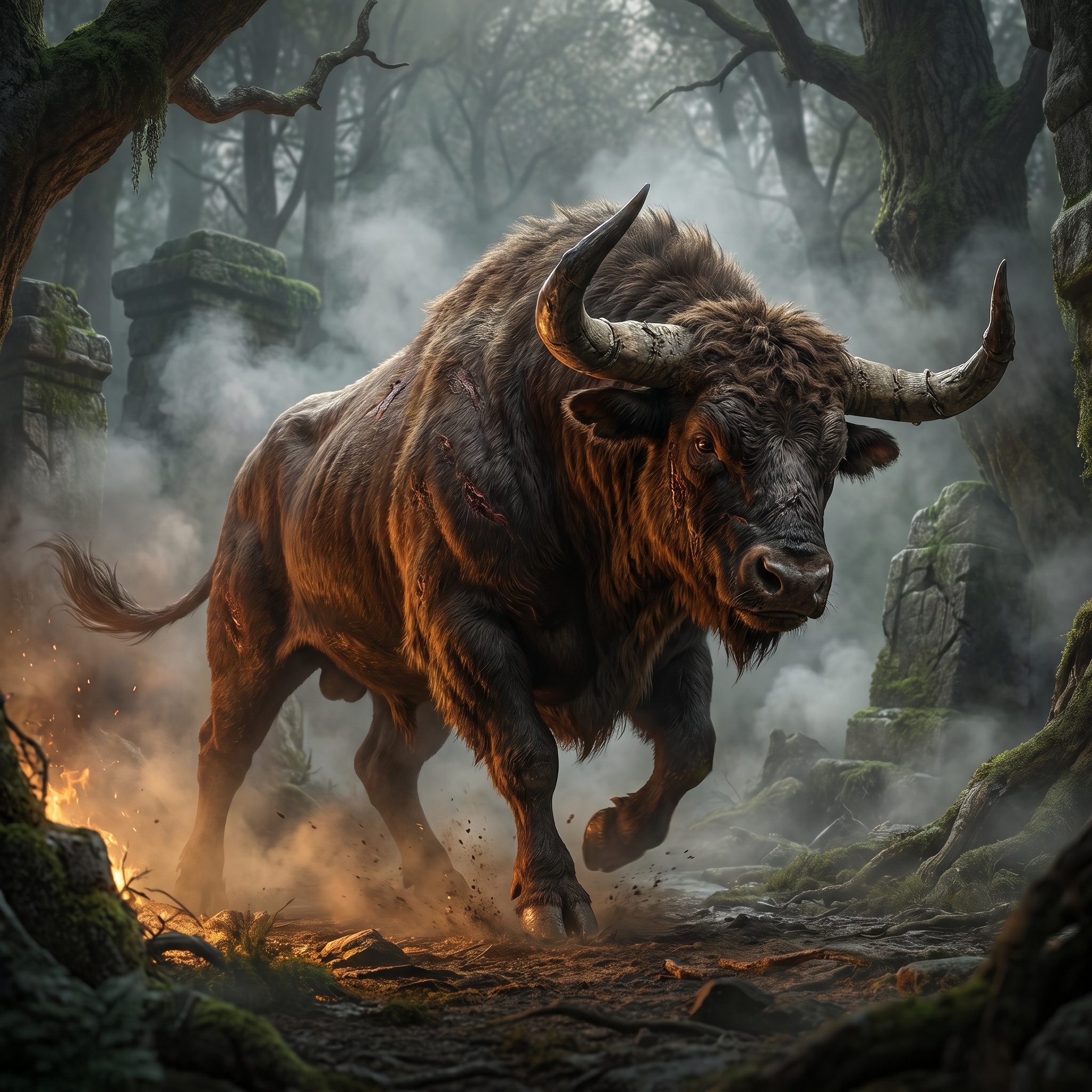
Role: Elite Herd Animal / Charger Where It Appears: Open plains, highlands, ancient forests, cattle-adjacent terrain.
An Aurochs is not a large cow. It is the thing cattle were domesticated from, after humanity spent generations selecting for the parts that do not kill handlers.
Signs and Knowledge: Survival (Average): identifies Aurochs ranging signs, reads herd behavior for whether they are grazing or alarmed.
Aurochs (Elite)
- Skills: Unarmed 3, Athletics 5, Fortitude 5, Intimidation 3.
- Attacks: Gore (Unarmed; Damage 11; Crit 3; Pierce 2, Knockdown on 2 Boons); Trample (Unarmed; Damage 9; Crit 4; against Prone targets only).
- Abilities: Stampede — If the Aurochs moved at least one range band before attacking, Gore deals +3 damage.
- Abilities: Herd Panic — If more than one Aurochs is present and one is wounded, all others immediately use their next Action to charge the nearest creature.
- Soul: No claimable coin exists; at death canon does not specify (default).
- Tactics: Charges the largest visible threat, gores, continues through. Does not stop for terrain.
- Encounter Use: Roads through grazing lands. Hunting expeditions gone wrong. A herd between the party and where it needs to be.
- Harvesting and Trade: Mature bull hide sells for 300–800 gold Flargons. Horn pair for 150–500 gold Flargons as craft material.
Variants
Aurochs Bull: Nemesis, WND 23. The biggest one in the herd. The others defer to it.
Beacon-Touched Beast
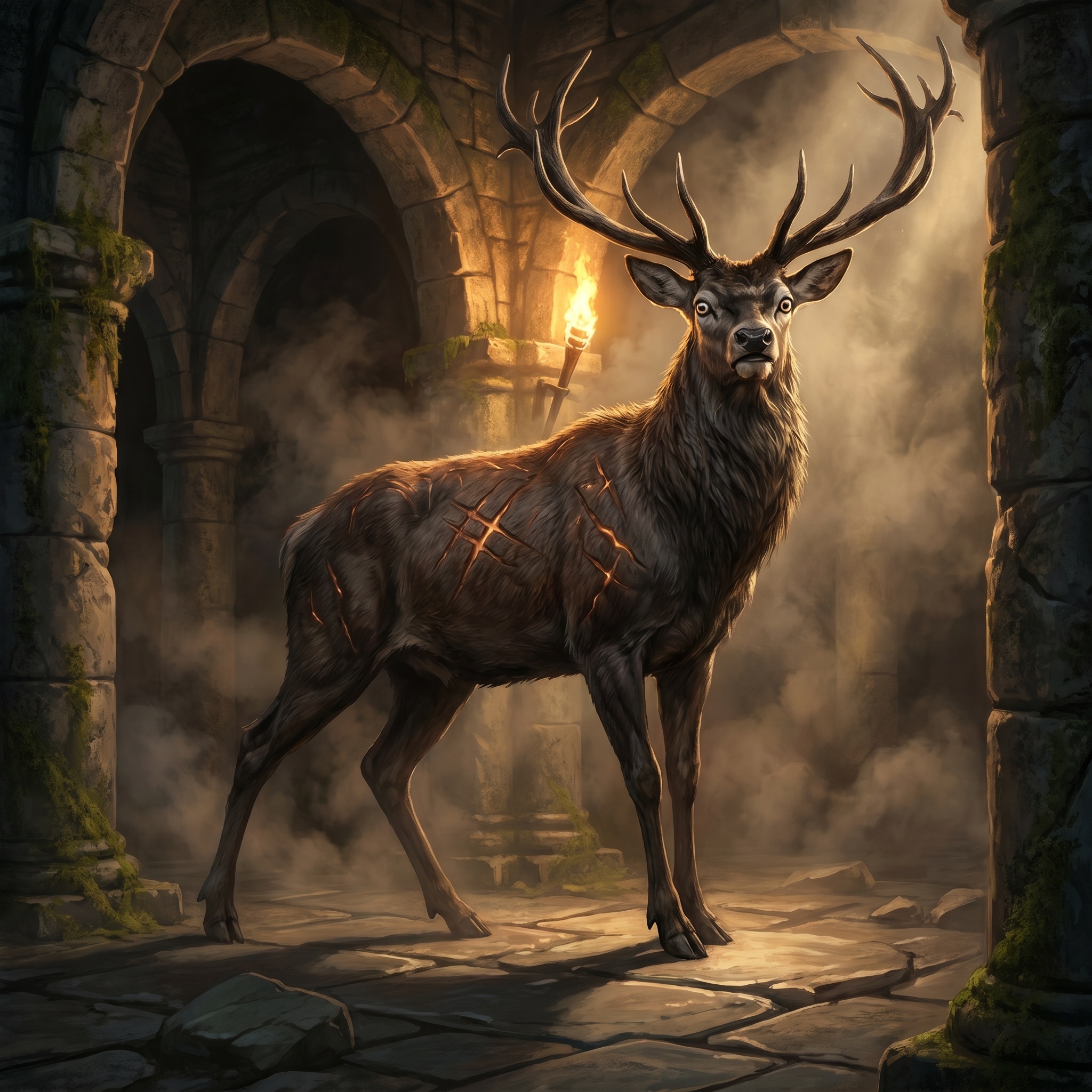
Role: Elite Warped Animal Where It Appears: Sites of excessive Ancient magic, sealed ruin margins.
What It Is
A beacon-touched beast is an animal that survived exposure to a power that announced itself too loudly across the planes. It is frightened, altered, and dangerous. Its scars glow with geometric light, and its eyes show an awareness no animal should have to carry.
It is not a villain. It is collateral damage with hooves, claws, teeth, or wings.
Ecology and Behavior
Beacon-touched beasts appear near sites of excessive Ancient magic, sealed ruin margins, failed beacons, and places where planar attention was drawn too sharply. Ordinary animals exposed to the event may become hyper-alert, migratory, violent, or obsessed with returning to the source.
They panic before they plan. Injury, loud magic, or sudden light can trigger planar startle. Some return unpredictably to the beacon site as if trying to understand what hurt them.
Signs and Knowledge
Survival or Planar Lore (Average) identifies warped migration and geometric scarring. Secret Lore (Hard) handles tissue without psychic backlash.
Other signs include animals avoiding a grazing route, luminous bone fragments in spoor, tracks that briefly duplicate, and prey species acting like predators when startled.
Beacon-Touched Beast (Elite)
- Skills: Unarmed 4, Athletics 4, Reflexes 4, Perception 4, Survival 4.
- Attacks: Warped Gore (Unarmed; Damage 9; Crit 4; Pierce 2); Shock Flare (Willpower; Damage 6 Strain; Range Short).
- Abilities: Planar Startle — On first injury each encounter, release Shock Flare as a reaction.
- Soul: No claimable coin exists; at death canon does not specify (default).
Tactics
A beacon-touched beast panic-charges, flees, and returns unpredictably. It does not fight with malice. It reacts to pain, light, and confinement. Calm handling, darkness, distance from the beacon, or druidic care may prevent a fight.
Use it to show that forbidden sites harm the landscape before anyone opens the sealed door.
Harvesting and Trade
| Component | Value | Use | Harvest |
|---|---|---|---|
| Scar tissue | 1,000-2,500 gold Flargons | Forbidden planar research | Secret Lore (Hard), mishandling causes 3 Strain |
| Luminous bone | 1,200-3,000 gold Flargons | Beacon detection, illegal instruments | Medicine or Survival (Hard) |
| Warped horn or claw | 600-1,800 gold Flargons | Warning talisman, research proof | Survival (Average) |
Variants
- Beacon Stag: Charges light sources and returns to the same ridge.
- Beacon Wolf: Pack behavior becomes erratic and too coordinated.
- Beacon Bird: Migrates through impossible routes and startles whole flocks.
Blackclaw Scorpion
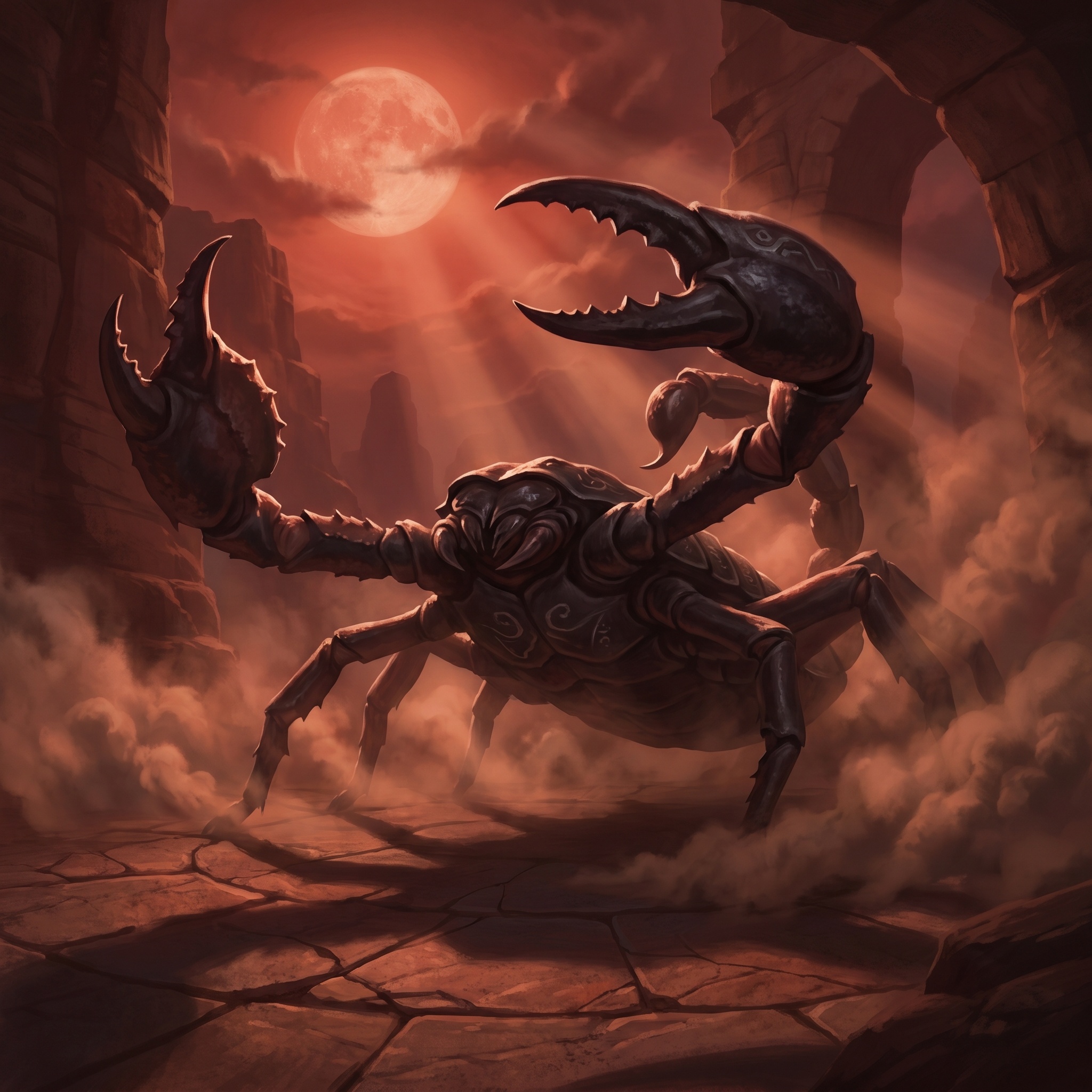
Role: Elite Ambusher / Bruiser Where It Appears: Deserts, volcanic flats, dry ruins, salt pans.
Blackclaw scorpions bury themselves beneath crusted earth and wait for vibration. They do not need much food, which means a lair can remain dangerous long after travelers think the road is unused.
What It Is
A Blackclaw Scorpion is a wagon-sized desert arachnid with heavy claws, black chitin, and venom potent enough to stop a caravan guard before the screaming starts. Its body is built for long stillness under crusted earth.
It is not clever, but it is perfectly suited to patience. A road can seem safe because nothing has crossed it recently; the scorpion sees that as good hunting.
Ecology and Behavior
Blackclaw Scorpions live in dry ruins, salt pans, volcanic flats, and desert roads where heat keeps competition low. They sense ground movement, burst from concealment, grab prey, sting, and either feed or retreat beneath crust if badly hurt.
They can go long periods without feeding. Old caravan routes abandoned for a season may become more dangerous, not less, because hungry scorpions have not been disturbed.
Signs and Knowledge
Field signs: crescent burrow lips, black chitin flakes, sting-killed animals with little blood, drag marks ending at cracked crust, birds avoiding a flat patch.
Survival (Average): spots burrow lips and recent movement.
Medicine (Hard): prepares antivenom or slows Poison 3 with field tools.
Natural Philosophy (Average): knows cold nights make the scorpion slower and midday heat makes it more reactive.
Blackclaw Scorpion (Elite)
- Skills: Unarmed 4, Stealth 3 while buried, Fortitude 4, Perception 3.
- Attacks: Crushing Claw (Unarmed; Damage 8; Crit 4; Grabbed on 2 Boons); Venom Sting (Unarmed; Damage 7; Crit 4; Pierce 1, Poison 3).
- Abilities: Tremor Sense — Detects ground movement at Short range even in darkness or smoke.
- Abilities: Buried Burst — First attack from concealment adds 1 Boon.
- Soul: No claimable coin exists; at death canon does not specify (default).
Tactics: The scorpion grabs with a claw, stings the grabbed target, and retreats underground if badly hurt. It prioritizes moving prey over armored stillness.
Encounter Use: Pair with fragile terrain, heat pressure, and the risk of pack animals bolting across buried lairs.
Harvesting and Trade
Blackclaw parts are practical desert trade goods, especially venom and chitin.
| Harvest | Buyer | Check | Typical Value | Use | Complication |
|---|---|---|---|---|---|
| Venom Gland | Alchemist, poisoner, physician | Hard Medicine or Survival | 600-1,400 gold Flargons | Antivenom, poison, painkiller research | Failure exposes harvester to Poison 2 |
| Black Chitin Plates | Armorer, shield maker | Average Survival or Craft | 300-900 gold Flargons | Light armor plates, shield facing | Brittle if dried too quickly |
| Claw Hooks | Trapper, toolmaker | Average Survival | 100-400 gold Flargons | Grapples, hooks, trophies | Heavy for their value |
Variants
Salt-Pan Blackclaw: Elite, gains Stealth 4 on white crust and venom inflicts 1 extra Strain.
Brood Mother Blackclaw: Nemesis, WND 32, STR 16, can call a minion group of young scorpions once per encounter.
Brown Bear

Role: Elite Territorial Bruiser Where It Appears: Forest margins, mountain passes, salmon rivers, cave mouths.
A Brown Bear is not hunting most travelers. It is occupying its territory and travelers entered it. The distinction does not change what happens next.
Signs and Knowledge: Survival (Average): identifies bear sign: track, scat, claw height on bark. (Hard): reads whether a bear is a male ranging, a mother with cubs, or a habituated problem bear.
Brown Bear (Elite)
- Skills: Unarmed 4, Athletics 4, Fortitude 5, Perception 3, Survival 3.
- Attacks: Swipe (Unarmed; Damage 10; Crit 3; Vicious 2, Knockdown on 2 Boons); Crushing Bite (Unarmed; Damage 9; Crit 4; Pierce 1).
- Abilities: Stand and Roar — As an Action, all creatures at Short range make an Average Readiness check or suffer 3 Strain.
- Abilities: Won't Drop Fast — First Critical Injury each encounter adds no immediate Bane.
- Soul: No claimable coin exists; at death canon does not specify (default).
- Tactics: Charges the nearest threat, keeps swatting until something stops or runs. Protecting cubs means it does not stop.
- Encounter Use: A bear is terrain with teeth. What does the party want that the bear is standing between?
Variants
Old Scarback: Nemesis, WND 26, ignores first two Critical Injury penalties. Has a history.
Camel
Role: Elite Working Animal / Desert Mount Where It Appears: Deserts, dry savannas, caravan routes, frontier trade towns.
What It Is
A camel is the desert traveler's mount and pack animal, bred for the long hauls between water that kill horses. It carries a rider or a substantial load across arid country at a steady pace.
Ecology and Behavior
Camels handle heat, thirst, and loose footing better than any other common working animal and cover open ground with a long economical stride. They are opinionated about handlers: an unfamiliar rider who asks for something difficult gets an argument first.
Signs and Knowledge: Survival (Average): judges a camel's condition, load, and remaining water. Riding (Average): handles one on the road; (Hard): handles an unfamiliar camel under pressure.
Camel (Elite)
- Skills: Athletics 1, Fortitude 2, Survival 2.
- Abilities: Desert Adaptation — to checks involving heat, scarce water, or arid terrain.
- Abilities: Long-Striding — to overland travel in open terrain.
- Abilities: Temperamental — when an unfamiliar rider attempts a difficult maneuver.
- Soul: No claimable coin exists; at death canon does not specify (default).
- Riding: Riding mount and pack animal. Carries one rider or a substantial load across arid country.
- Tactics: Not a fighter. It balks, bolts, or spits, and a rider who insists takes the Temperamental Bane Die.
- Encounter Use: Desert crossings and caravan scenes, and any pursuit where water and heat matter more than speed.
- Harvesting and Trade: A sound riding camel sells for about 400 gold Flargons in a guild city, higher on the frontier.
Carna Kennel Beast
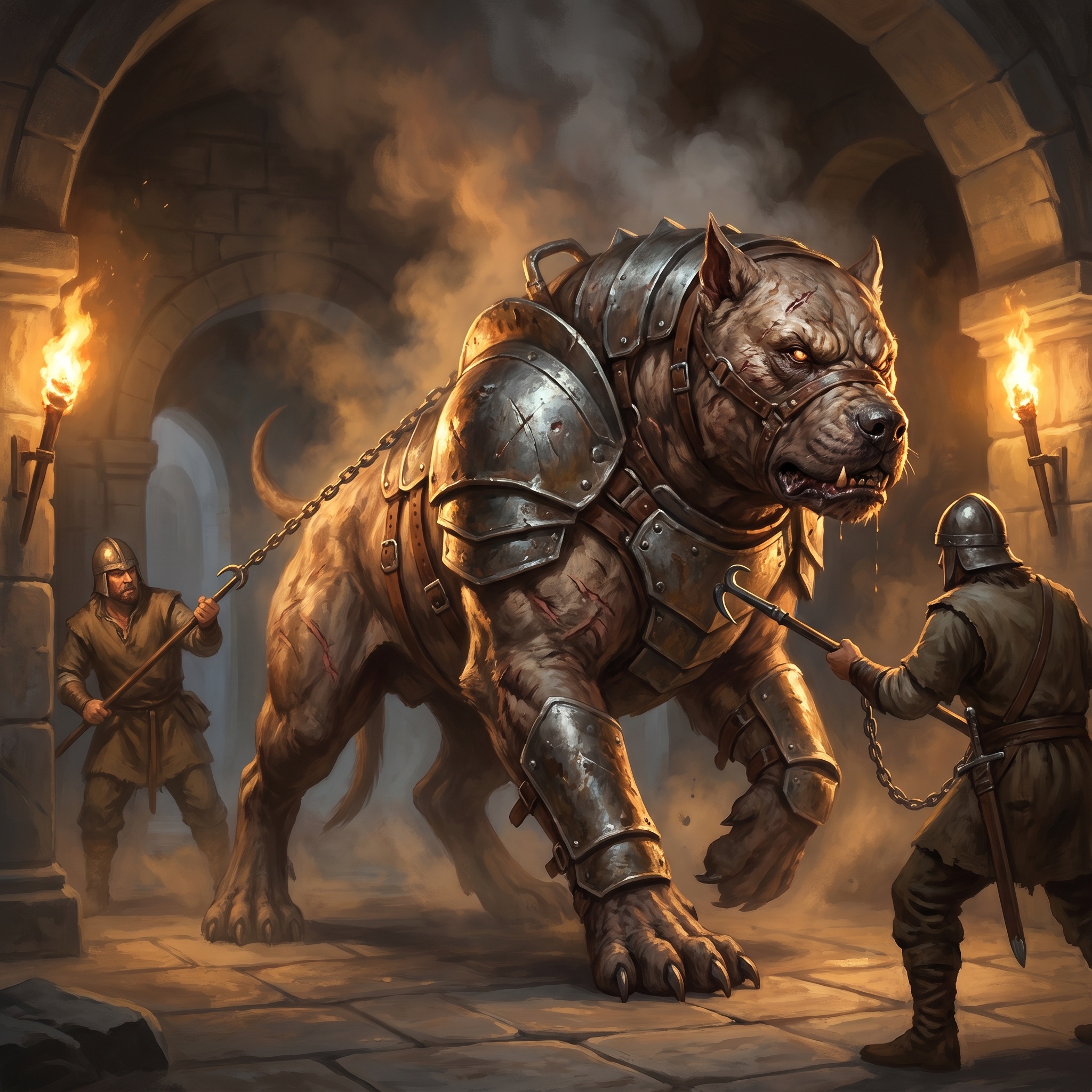
Role: Nemesis War Beast Where It Appears: Carna estates, siege camps, noble hunts, prison transfers.
"House Carna's beasts do not roam. They are placed. What you are looking at is not an animal that found you. It is a decision someone made about you." — Field briefing, Resistance cell, city of Aldenmere
The Kennel Beast is the surviving prize of a Carna breeding program. It is trained to recognize heraldry, drums, and the smell of fear in crowds. It is not evil, but it has been made into an institution's teeth.
What It Is
The Carna Kennel Beast is a living weapon bred for noble control, siege intimidation, and public fear. It is not a fiend, curse, or moral actor. It is an animal made enormous, conditioned hard, and taught that certain colors, drums, and commands mean prey.
Its hide is crossed with chain scars and fitted kennel armor. The armor often bears house marks, victory plates, and restraint rings that were never meant for battlefield mercy. Handlers use hooked poles, whistles, scent bundles, and banner drills to direct it.
Ecology and Behavior
The beast belongs wherever Carna power wants fear to look official: estate kennels, siege camps, noble hunts, prison transfers, public executions, and riot lines. It can survive wild if abandoned, but its behavior remains shaped by training. Heraldry, drums, marching cadence, and handler scent may trigger reactions long after the original masters are gone.
The tragedy is that the beast can be innocent of intent while still being too dangerous to ignore. A campaign can treat it as a monster, a rescue problem, a piece of evidence against a noble house, or all three.
Signs and Knowledge
Animal Handling, Warfare, or Survival (Hard) identifies Carna kennel commands and the points where training can be interrupted. Lore or Streetwise (Average) recognizes house armor and known breeding marks.
Other signs include gouged kennel doors, handler whistles buried with dead officers, claw marks at prisoner height, old enemy banners used as bite targets, and villages where children are taught never to run from drums.
Carna Kennel Beast (Nemesis)
- Skills: Athletics 5, Fortitude 5, Perception 4, Survival 4, Unarmed 5.
- Attacks: Kennel Bite (Unarmed; Damage 14; Crit 3; Pierce 3); Chain Sweep (Unarmed; Damage 10; Crit 4; Knockdown).
- Abilities: Trained to Banners — It adds 1 Boon to attacks against targets wearing marked enemy colors chosen by its handlers.
- Abilities: Handler Commands — While a trained handler is within Medium range, the beast may perform a free Maneuver once per round.
- Abilities: Dread — Fear 2.
- Soul: No claimable coin exists; at death canon does not specify (default).
Tactics
The Kennel Beast crashes lines and pins leaders while handlers keep it pointed at the right fear. It responds to whistles before words, banners before faces, and scent before argument. Once badly wounded or overstimulated, it may enter a blood frenzy and stop distinguishing handlers from targets.
Use the handlers as part of the encounter. Cutting whistle lines, confusing banner signals, masking scent, or calming the beast with Animal Handling can matter as much as damage.
Evidence and Trade
No respectable harvest exists. The valuable material proves who bred, trained, purchased, or deployed the beast. Selling trophies may protect the nobles who should be exposed.
| Find | Value | Use | Recovery |
|---|---|---|---|
| Kennel collar | 2,000-7,000 gold Flargons as evidence | Identifies house, handler, and breeding line | Lore or Streetwise (Average) |
| Handler whistle set | 800-3,000 gold Flargons | Command interruption, legal proof, training study | Animal Handling or Warfare (Hard) |
| Armor plates | 1,500-6,000 gold Flargons | Noble evidence, armorer signature, restitution | Craft or Lore (Average) |
| Scent bundle recipes | Varies | Proves planned targeting of families or banners | Investigation (Hard) |
Variants
- Hunt Beast: Trained to chase one family, bloodline, or uniform.
- Siege Breaker: Heavier armor and more chain sweep use.
- Abandoned Kennel Beast: Dangerous, frightened, and triggered by obsolete commands.
Cave Bear
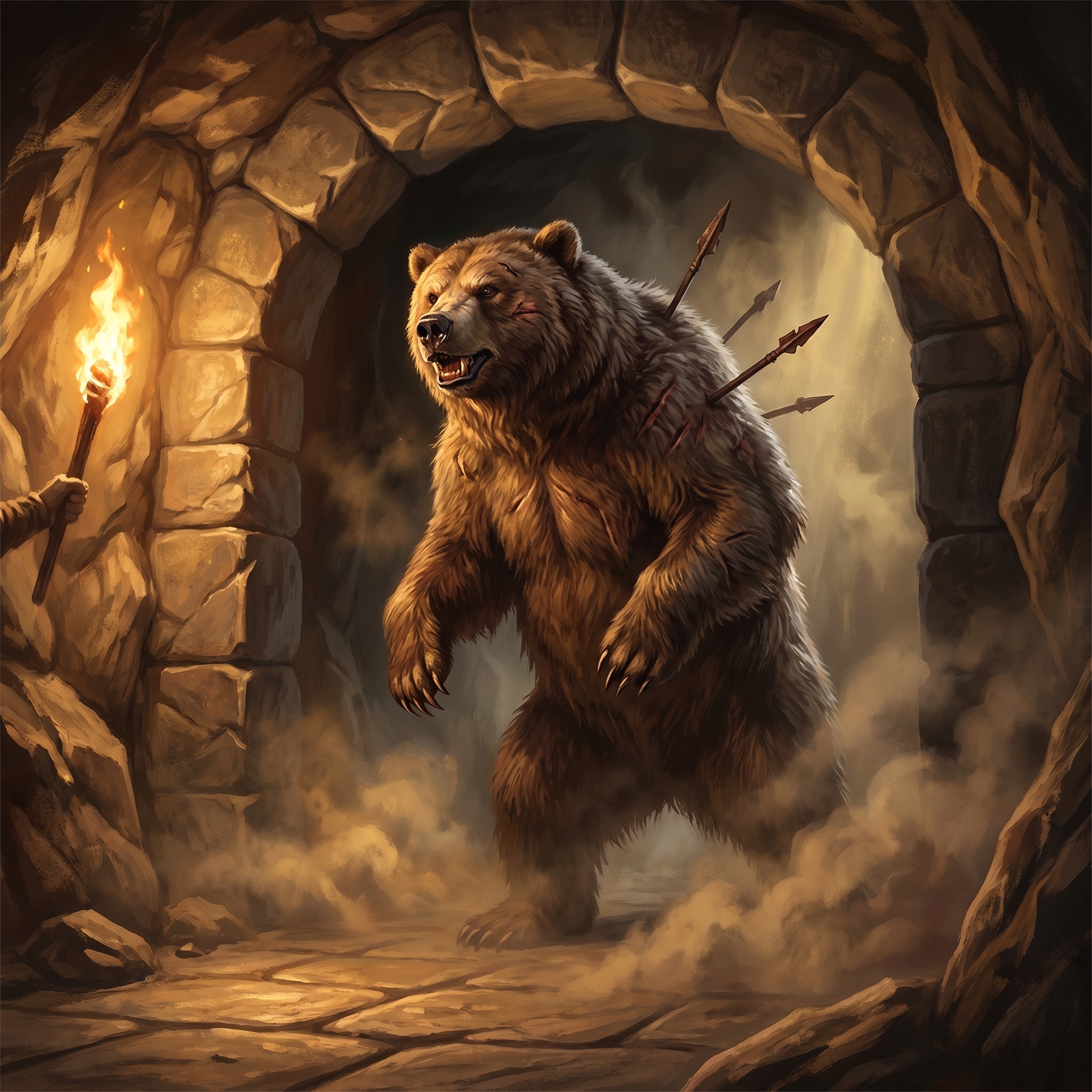
Role: Elite Bruiser Where It Appears: Mountain caves, old mines, cold forests, shrine caverns.
A cave bear is usually a problem because someone entered its den, threatened its cubs, or blocked its seasonal feeding path. It is not malicious, but it is strong enough that the distinction does not comfort anyone under its paws.
What It Is
Cave bears are massive denning predators adapted to cold forests, mountain caves, and abandoned mine mouths. Old spearheads in the hide are common enough to become a warning sign: many people survive wounding one only long enough to regret it.
They are animals, not villains. Most attacks come from surprise, hunger, cub defense, or humans choosing the same shelter during bad weather.
Ecology and Behavior
Cave bears follow seasonal feeding patterns and den cycles. They dig, mark trees, claim cave mouths, and remember routes to berry fields, salmon runs, carcass sites, and mineral licks. A cave bear blocking a pass may not be guarding treasure; it may simply be on the only path between den and food.
They are solitary outside mating and cub-rearing. A mother with cubs is more dangerous than a hungry male because intimidation rarely works and retreat may still look like pursuit.
Signs and Knowledge
Field signs: clawed bark above human height, musky den scent, overturned stones, scat with berries or bone, old claw marks at mine supports, large sleeping depressions near cave walls.
Survival (Average): identifies fresh sign, den scent, and direction of travel.
Survival (Hard): reads whether the bear is hunting, nesting, defending cubs, or avoiding another predator.
Medicine or Survival (Average): knows which parts preserve cleanly and which spoil fast.
Cave Bear (Elite)
- Skills: Unarmed 4, Athletics 4, Fortitude 5, Perception 3, Survival 3.
- Attacks: Mauling Claws (Unarmed; Damage 10; Crit 3; Vicious 3); Crushing Bite (Unarmed; Damage 9; Crit 4; Pierce 1).
- Abilities: Terrible Strength — On 2 Boons with Mauling Claws, the target is knocked Prone or shoved one range band.
- Abilities: Won't Drop Fast — The first Critical Injury suffered each encounter adds no immediate Bane to its checks, though the injury still counts.
- Soul: No claimable coin exists; at death canon does not specify (default).
Tactics: The bear charges the nearest threat, mauls until it stops moving, then turns on loud or painful targets. If protecting cubs, it attempts to drive enemies away from the den rather than pursue indefinitely.
Encounter Use: Best as a territorial crisis, not a random hallway fight. Put something the party wants behind the bear, then make nonlethal choices possible but difficult.
Harvesting and Trade
Cave bear parts are useful but common enough that local context matters more than rarity.
| Harvest | Buyer | Check | Typical Value | Use | Complication |
|---|---|---|---|---|---|
| Thick Hide | Tanner, winter outfitter | Average Survival | 100-250 gold Flargons | Cloaks, bedding, armor lining | Heavy and prone to rot if not scraped |
| Bear Fat | Cook, healer, trapper | Average Survival | 50-150 gold Flargons | Lamp fuel, salves, winter food | Attracts scavengers |
| Gall Bladder | Herbalist, fortitude alchemist | Average Medicine or Survival | 150-400 gold Flargons | Endurance tonics | Ruined by rough removal |
| Old Embedded Spearheads | Historian, local family | Lore to identify | 0-1,000 gold Flargons | Proof of old hunts, heirloom return | May identify the bear as part of a local story |
Variants
Den Mother: Elite, WND 20, gains 1 Boon to attacks while cubs are threatened.
Old Scar Bear: Nemesis, WND 26, STR 14, ignores the first two Critical Injury penalties each encounter.
Cave Lion
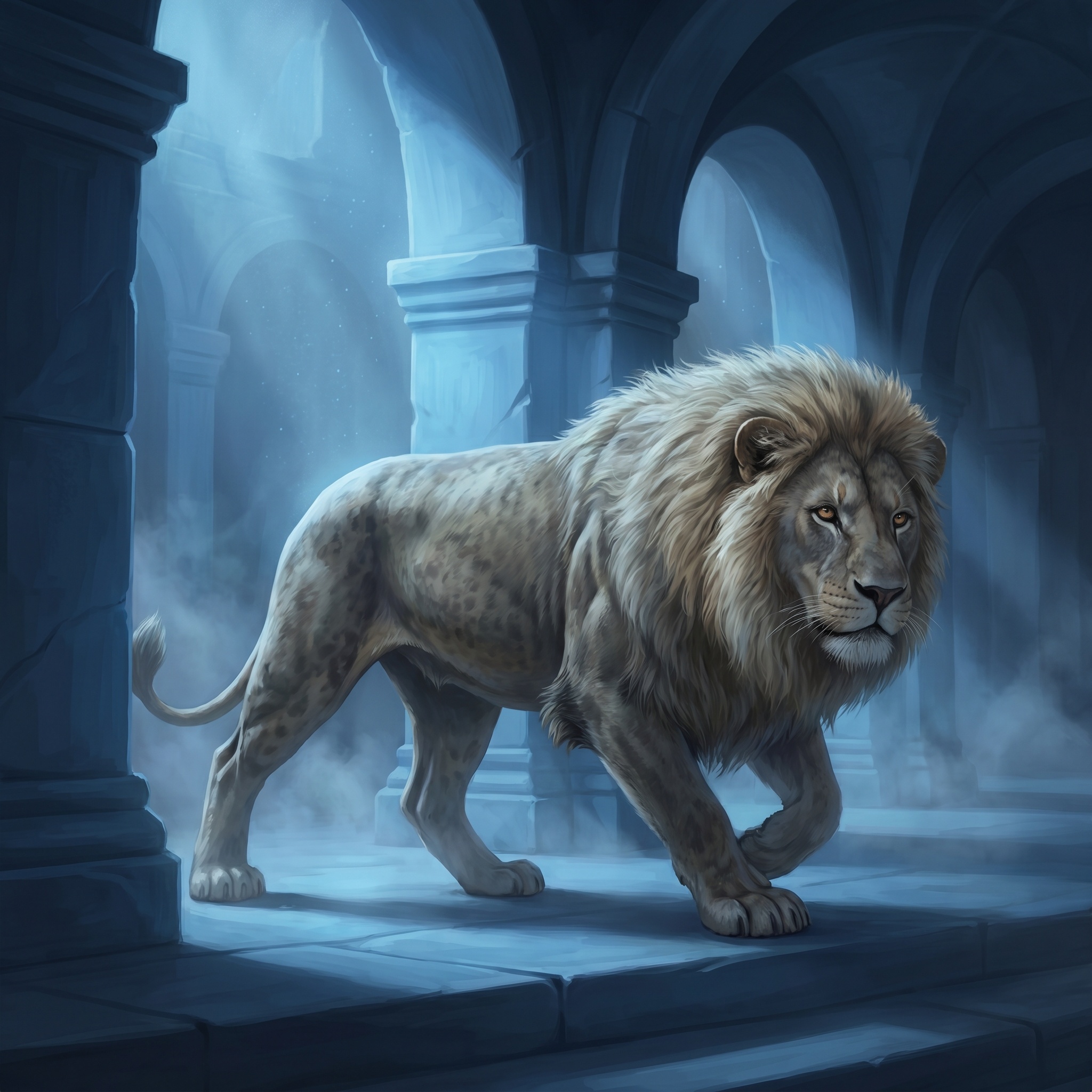
Role: Elite Ambusher Where It Appears: Caverns, highland caves, old mine vents, cold valleys.
Cave lions are social hunters that use darkness and stone echoes with frightening precision. They are not magical, which is exactly why experienced delvers sometimes underestimate them.
What It Is
A Cave Lion is a pale, heavy cat adapted to stone, darkness, and echo. It is not magical, which makes it easy to underrate in a book full of stranger things. That mistake kills delvers.
Its mane is often thin and pale, its paws broad, and its hunting style built around silence followed by sudden violence.
Ecology and Behavior
Cave Lions form small prides in limestone caves, old mine vents, highland caverns, and cold valleys with easy access to shelter. They learn echo patterns and use them to place prey in the dark. A pride may split lights, harry the rear, and attack only when someone stumbles or leaves the group.
They are ordinary predators with extraordinary terrain familiarity. If driven from a den, they often circle back through tunnels the party did not know existed.
Signs and Knowledge
Field signs: claw scrapes on stone, den musk, old bones behind limestone pillars, drag marks into low tunnels, sudden silence from cave birds or bats.
Survival (Average): identifies claw scrapes and den musk.
Perception (Hard): hears echo-placement or a tail brush before the pounce.
Adventuring Lore (Average): knows not to split lights in cave lion country.
Cave Lion (Elite)
- Skills: Unarmed 4, Stealth 4 in caves, Athletics 4, Perception 4, Survival 4.
- Attacks: Pounce (Unarmed; Damage 9; Crit 3; Knockdown on 2 Boons); Bite (Unarmed; Damage 8; Crit 4).
- Abilities: Echo Stalk — In caves, add 1 Boon to Stealth and Perception checks.
- Abilities: Pride Hunt — If another cave lion or allied predator has attacked the same target this round, add +2 damage.
- Soul: No claimable coin exists; at death canon does not specify (default).
Tactics: The lion splits lights, pounces the isolated, and drags prey behind stone. If the group holds formation and light, it withdraws and follows.
Encounter Use: Good for reminding parties that mundane predators are still lethal. Use echoes, low ceilings, side tunnels, and panic over losing the light.
Harvesting and Trade
Cave Lion harvest is mundane but useful. Unusually pale hides are worth more to collectors.
| Harvest | Buyer | Check | Typical Value | Use | Complication |
|---|---|---|---|---|---|
| Pale Hide | Tanner, noble, ranger | Average Survival | 200-500 gold Flargons | Cloaks, rugs, proof of kill | Blood staining lowers value |
| Claws | Hunter, charm maker | Average Survival | 50-200 gold Flargons | Necklaces, cave charms | Common unless from a known man-eater |
| Den Map from Tracks | Miner, rescue crew, local guide | Survival to interpret | 100-1,000 gold Flargons | Finding side passages | Requires fresh tracks |
Variants
Pride Mother: Elite, WND 20, Pride Hunt adds +3 damage while cubs are nearby.
Pale Cave King: Nemesis, WND 40, STR 16, Echo Stalk grants 2 Boons and it can roar to extinguish weak flames at Short range once per encounter.
Common Viper
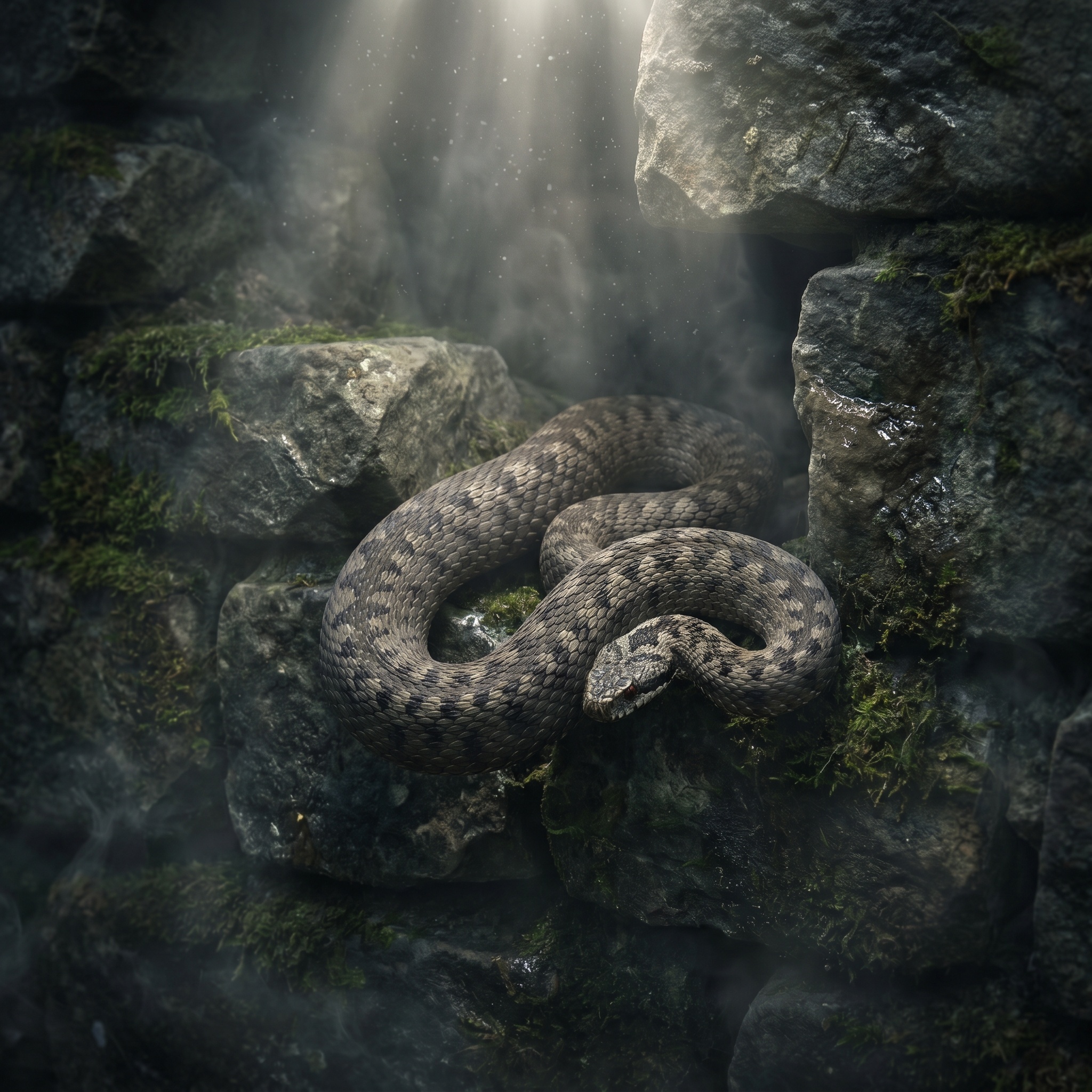
Role: Minion Venomous Hazard Where It Appears: Stone walls, dry grassland, scrubland, rocky hillsides, anywhere a small snake can find sun and shelter.
The most dangerous thing about a Common Viper is that it is common. It is everywhere, it blends perfectly into stone and dry grass, and it bites reflexively when a hand or foot appears without warning.
Signs and Knowledge: Survival (Average) identifies viper country and teaches the correct approach to stone walls and wood piles.
Common Viper (Minion)
- Group Size: 1 (encountered individually).
- Skills: Stealth 4, Unarmed 2.
- Attacks: Defensive Bite (Unarmed; Damage 2; Crit 5; Poison 2 on hit — Average Fortitude or 1 Bane to all checks and Wound total reduced by 1 for one day without treatment).
- Abilities: Camouflage — In natural terrain, Hard Perception to spot before disturbing.
- Soul: No claimable coin exists; at death canon does not specify (default).
- Tactics: Bites and retreats. No further engagement.
- Encounter Use: Hands in walls, feet in grass, general carelessness. A persistent background risk in appropriate terrain.
- Harvesting and Trade: Venom gland for 150–400 gold Flargons (Average Medicine). Common; antivenin demand exceeds supply in rural areas.
Variants
Asp: Functionally identical but neurotoxic rather than hemotoxic. The symptoms are different; the treatment is different. The wrong treatment for one given the other is dangerous.
Crowned Stag
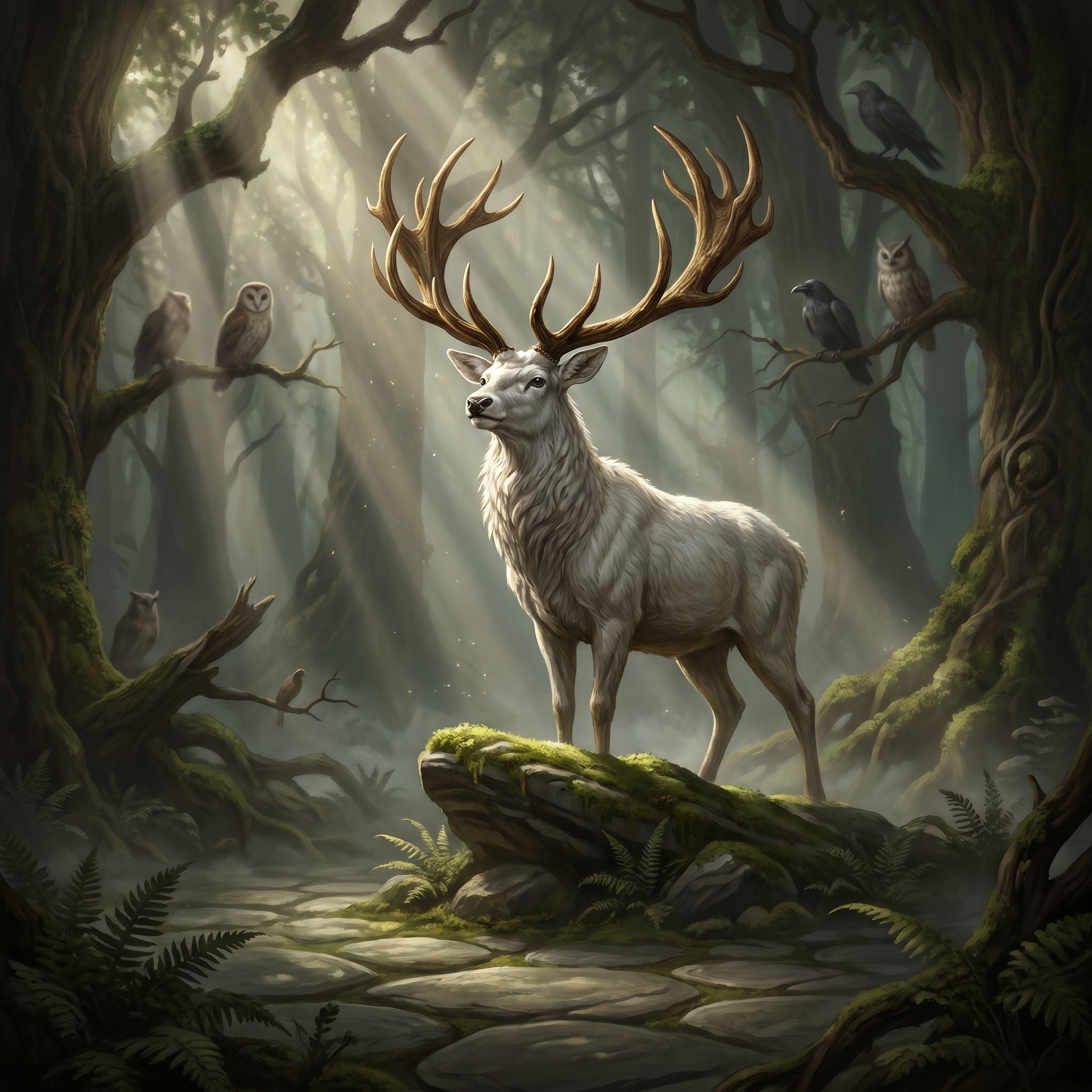
Role: Elite Guardian / Harrier Where It Appears: Old forests, sacred groves, druidic boundary sites, royal hunting preserves.
Crowned stags are not ordinary deer. They are grove-kept animals with a territorial sense that borders on judgment. Killing one without cause can turn local priests, foresters, and the land itself against a party.
What It Is
A Crowned Stag is a sacred or semi-sacred forest guardian, usually marked by pale coat, exceptional size, and antlers broad enough to look like a living crown. Some are blessed by local rites. Others are simply old, intelligent animals protected for generations until the forest around them learned the same boundaries.
It is not automatically friendly. It defends groves, nesting grounds, old burial trees, and hidden approaches by leading intruders into terrain that favors the forest.
Ecology and Behavior
Crowned Stags move with herds but act apart from them when a protected place is threatened. They warn before violence: appearing across a path, striking bark, snorting toward an unsafe direction, or driving lesser deer away.
Foresters, priests, and old noble houses may treat a specific stag as a legal or spiritual person. Killing one can create consequences far beyond the encounter.
Signs and Knowledge
Field signs: antler scoring on boundary trees, birds following a single stag, white hair caught in sacred thorns, deer tracks that circle a grove rather than enter it, old hunter marks cut down or overgrown.
Survival (Average): identifies the herd and whether the stag is leading or driving it.
Lore or Secret Lore (Hard): recognizes sacred protection signs and local consequences for harming the animal.
Negotiation or Survival (Hard): may allow a party to retreat respectfully or make an offering without a fight.
Crowned Stag (Elite)
- Skills: Athletics 4, Reflexes 4, Perception 4, Survival 4, Readiness 3.
- Attacks: Antler Strike (Unarmed; Damage 7; Crit 4; Pierce 1); Hoof Flurry (Unarmed; Damage 6; Crit 5).
- Abilities: Sacred Evasion — Once per round after being missed, move one range band as an incidental.
- Abilities: Grove Warning — If harmed in its bonded grove, birds and small animals alert nearby guardians or settlements within one hour.
- Soul: No claimable coin exists; at death canon does not specify (default).
Tactics: The stag strikes, withdraws, and leads intruders into roots, bogs, low branches, or waiting defenders. It does not fight to the death unless defending young, a grove, or a sacred boundary.
Encounter Use: Use as a moral and territorial encounter, not just a combatant. The party should understand that killing the stag is possible and may still be a mistake.
Harvesting and Trade
Only shed antlers are respectable in most regions. Poached parts can sell for more, but they bring legal and religious heat.
| Harvest | Buyer | Check | Typical Value | Use | Complication |
|---|---|---|---|---|---|
| Shed Crown Antler | Ritual carver, temple, noble | Average Survival | 200-600 gold Flargons | Grove charms, ceremonial tools | Must be naturally shed to be lawful in many places |
| Poached Antlers | Black-market collector | No check to sell, Lore to hide origin | 800-2,500 gold Flargons | Trophy, illicit rites | Foresters, priests, or spirits may investigate |
| White Tail Hair | Herbalist, charm maker | Average Survival, harmless if collected from brush | 50-200 gold Flargons | Boundary charms | Fraud is common |
Variants
Grove King: Nemesis, WND 32, STR 16, Grove Warning is immediate and Sacred Evasion works even after it is hit once per round.
Royal Preserve Stag: Elite, gains Ranged Defense 2 from dense trained terrain and alerts human wardens instead of spirits.
Dire Wolf
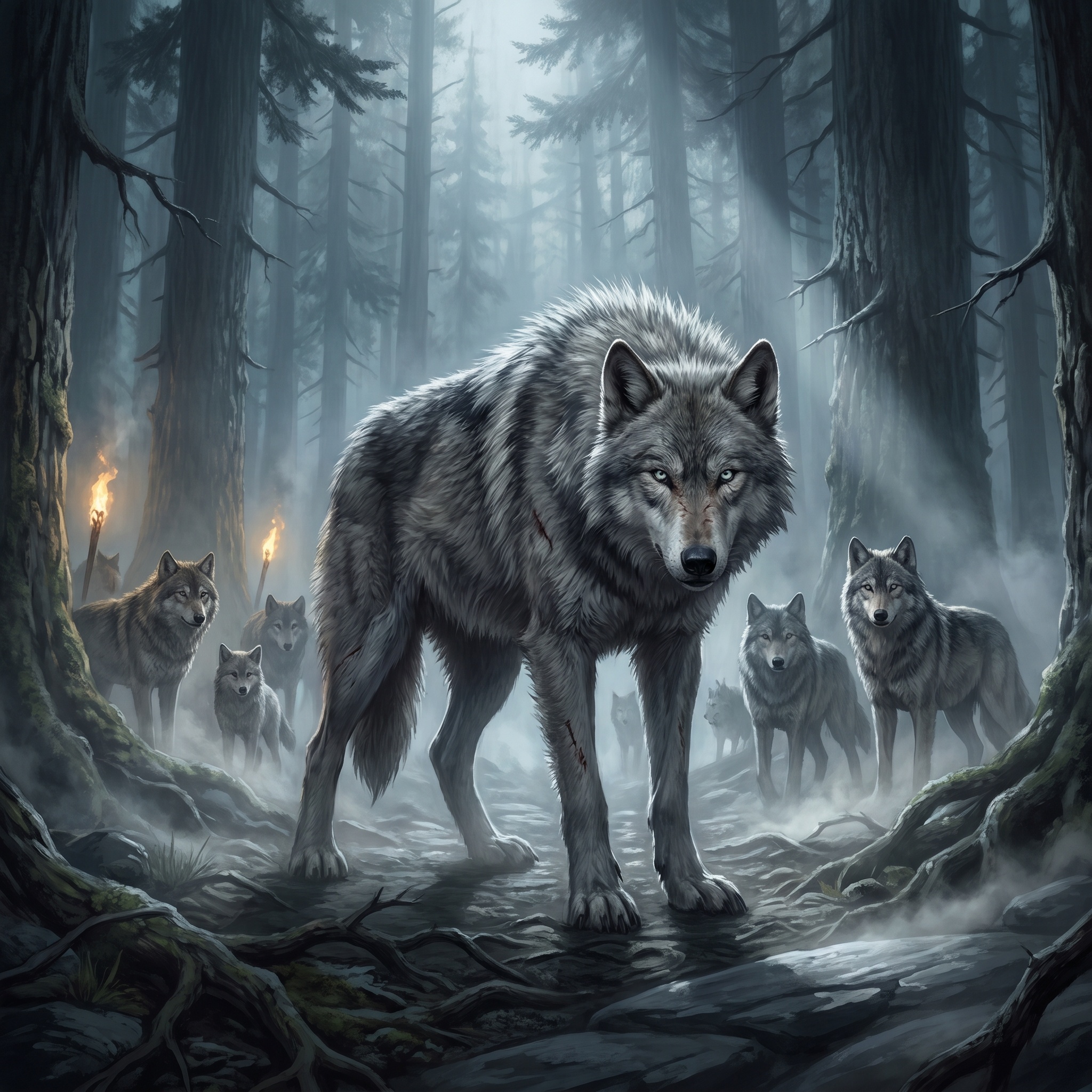
Role: Minion Harrier / Pack Predator Where It Appears: Boreal forests, mountain valleys, winter roads, abandoned frontier farms.
Dire wolves are not oversized dogs. They are disciplined pack hunters with enough memory to test a settlement's fences for weeks before committing to an attack. They prefer weak prey, but a hungry pack will treat armed travelers as a moving herd.
Signs and Knowledge: Survival (Average) identifies pack direction and size. Adventuring Lore (Hard) knows that dire wolves fake retreat to pull guards away from firelight.
Dire Wolf (Minion)
- Group Size: 3-8.
- Skills: Unarmed 3, Athletics 3, Stealth 2, Perception 3, Survival 3.
- Attacks: Pack Bite (Unarmed; Damage 6; Crit 4; on 2 Boons, knock Prone).
- Abilities: Pack Circle — Add 1 Boon to attacks against a target already Engaged with another dire wolf group.
- Abilities: Hamstring — If Pack Bite deals Wounds to a Prone target, that target adds 1 Bane to movement checks until treated.
- Abilities: Dread — Fear 1.
- Soul: No claimable coin exists; at death canon does not specify (default).
- Tactics: Circle the rear, knock down mounts or lightly armored targets, drag one victim out of formation.
- Encounter Use: Use tracks, howls, and missing livestock before the fight. Dire wolves should make night watches matter.
- Harvesting and Trade: Thick winter pelts sell for 50-120 gold Flargons each to furriers. Alpha teeth may sell for 100-200 to charm-makers, but most buyers consider them common trophy goods.
Dire Wolverine
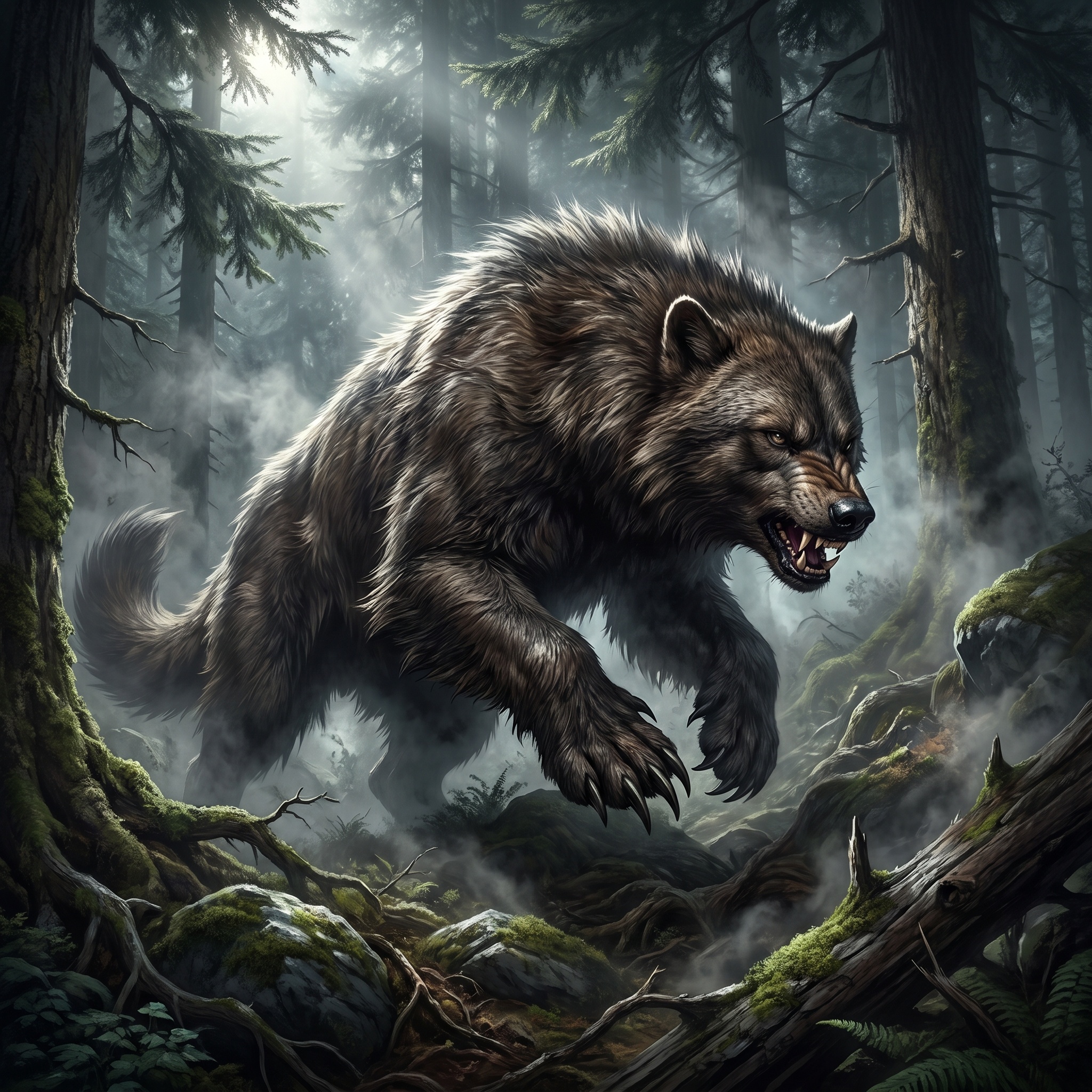
Role: Elite Relentless Predator Where It Appears: Northern forests, alpine tundra, deep snow country.
A Dire Wolverine attacks things that outweigh it by a factor of twenty and does not stop until something kills it or it finishes. Most things choose to leave.
Signs and Knowledge: Survival (Hard): identifies it approaching; the only reliable warning is the smell.
Dire Wolverine (Elite)
- Skills: Unarmed 4, Athletics 4, Fortitude 5, Perception 4.
- Attacks: Musk Spray (Special; once per encounter — all creatures at Engaged range make a Hard Fortitude check or add 1 Bane to all checks for the rest of the scene from nauseating spray); Raking Claws (Unarmed; Damage 9; Crit 3; Bleeding 1, Vicious 3).
- Abilities: Relentless — Cannot be Frightened. Does not retreat. Ignore the first Critical Injury penalty each encounter.
- Abilities: Rage at Wounds — Below half Wounds, add 1 Boon to all attacks.
- Soul: No claimable coin exists; at death canon does not specify (default).
- Tactics: Charges, musk-sprays, attacks the largest threat, does not yield. If everything leaves, it considers this a win.
- Encounter Use: Use to create a problem that cannot be reasoned with and barely cares about damage. Paired with other dangers it is worse.
- Harvesting and Trade: Musk glands are carefully valued by perfumers and trapmakers (300–800 gold Flargons if extracted without rupture, Hard Medicine). The fur is noted for cold-weather gear.
Variants
Giant Wolverine: Nemesis, WND 36. It has never stopped anything it started. The local settlement knows its track.
Donkey
Role: Elite Working Animal / Pack Animal Where It Appears: Farm tracks, mountain trails, mining camps, market roads.
What It Is
A donkey is a small, sure-footed pack animal that works ground a horse refuses. It is the cheapest reliable way to move a party's baggage.
Ecology and Behavior
Donkeys keep their footing on narrow, rocky, and broken trails where larger animals slip, and they carry a moderate load all day without complaint. They are not built to carry an armored adult, and a handler who tries anyway loses both the load and the animal's cooperation.
Signs and Knowledge: Survival (Average): judges load, condition, and whether a trail will hold. Riding (Average): keeps a laden donkey moving on bad ground.
Donkey (Elite)
- Skills: Fortitude 1, Survival 1.
- Abilities: Sure-Footed — to cross narrow, rocky, or uneven terrain.
- Abilities: Pack Animal — carries a moderate load; not a proper mount for an armored adult.
- Soul: No claimable coin exists; at death canon does not specify (default).
- Riding: Pack animal. Carries baggage, not an armored rider.
- Tactics: Does not fight. It plants its feet, and the party's supplies stop where it stops.
- Encounter Use: Trail and mountain travel. The donkey is what a party loses first when an ambush goes badly.
- Harvesting and Trade: A working donkey sells for about 80 gold Flargons.
Draft Horse
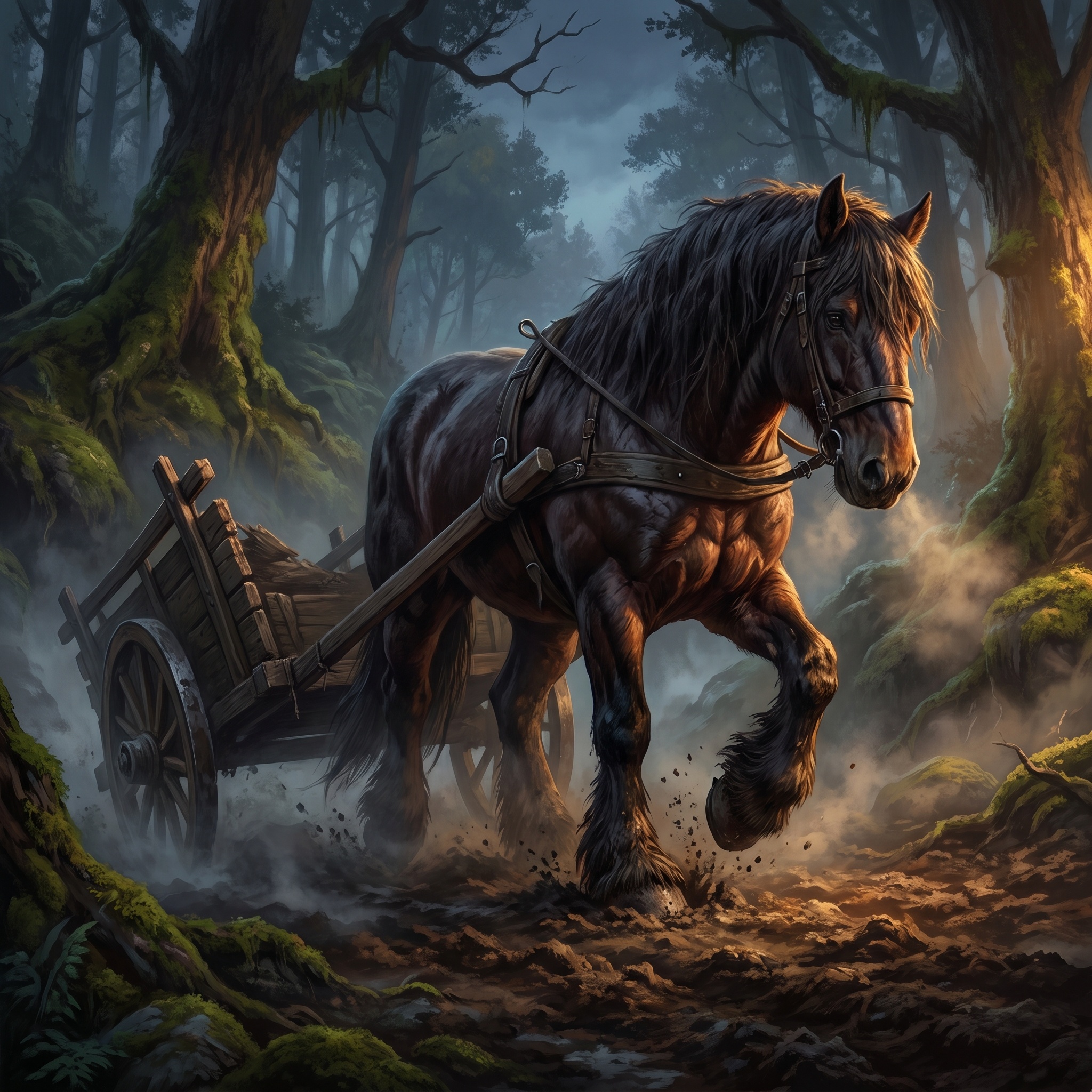
Role: Elite Working Animal / Emergency Hazard Where It Appears: Farms, city streets, siege lines, any working environment with horses.
A Draft Horse is not a war horse and it is not a monster. It is very large, very strong, and very frightened when things go wrong. At that point the distinction does not help.
Signs and Knowledge: Riding (Average): calms a panicked horse in a controlled environment. (Hard): controls one under fire, near a predator, or in a burning building.
Draft Horse (Elite)
- Skills: Athletics 5, Fortitude 4.
- Attacks: Kick (Unarmed; Damage 9; Crit 3; Knockdown on 2 Boons); Trample (Unarmed; Damage 8; Crit 4; against Prone targets).
- Abilities: Panic Stampede — When frightened or wounded without a trained handler in control, the horse runs in a random direction, attacking anything in its path. Hard Riding to regain control.
- Abilities: Work-Calm — Around familiar handlers in non-combat situations, add 1 Boon to all Riding checks.
- Abilities: Built to Pull — to hauling, dragging, or sustained labor.
- Abilities: Poor Combat Mount — to Riding checks to control it in combat.
- Soul: No claimable coin exists; at death canon does not specify (default).
- Riding: Draft animal. Pulls a cart alone or works in a wagon team; it is not a combat mount.
- Tactics: Panics; runs; kicks anything that blocks its path.
- Encounter Use: Fire scenes. Combat near working animals. The moment a Tumblethorn rolls into a corral.
- Harvesting and Trade: A living trained draft horse sells for 600–2,000 gold Flargons depending on breed, health, and papers. Parts have no special value.
Variants
Warhorse: Elite, WND 20, battle-trained. Does not panic from combat noise, blade flash, or blood. Kicks with intent, not fear.
Dragon-Blooded Beast
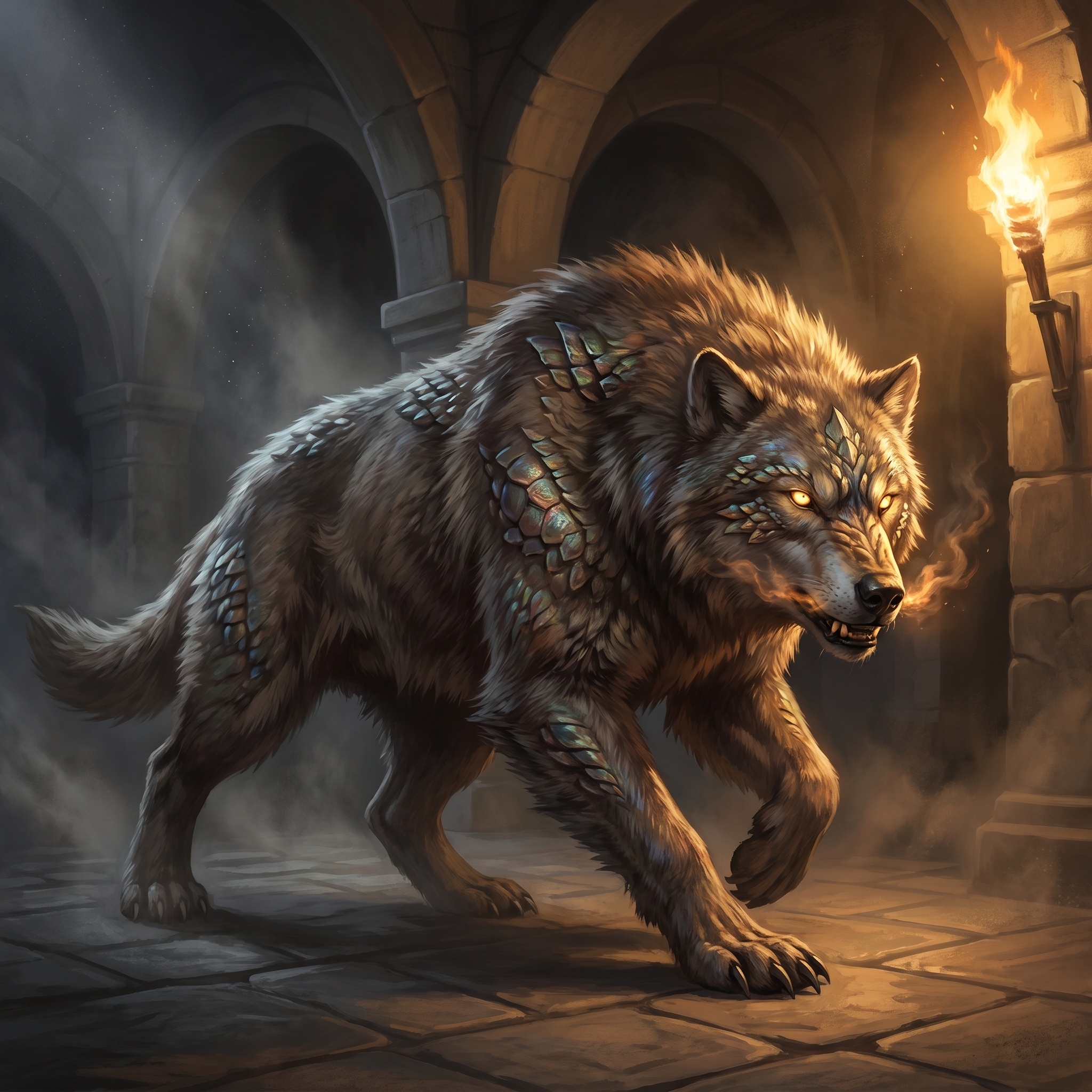
Role: Elite Warped Beast Where It Appears: Long-term dragon territories, lair runoff sites.
What It Is
Dragon-blooded beasts are animals altered by generations near dragon biology, blood, or elemental residue. They are not true dragons and not lesser drakes. They are local animals with scale patches, draconic eyes, type-touched breath, and instincts distorted by apex proximity.
They make dragon territory feel alive before the dragon appears.
Ecology and Behavior
Dragon-blooded beasts appear in long-term dragon territories, lair runoff sites, old nesting ranges, and places where shed scales, blood, breath, or elemental seepage entered the food chain. Predators become bolder; prey becomes stranger; scavengers become dangerous.
Their behavior remains rooted in the base animal, modified by type. An Umbral-touched panther hunts differently than a Tide-blooded crocodile or Ore-marked boar.
Signs and Knowledge
Survival or Draconic Lore (Average) identifies draconic alteration. Planar Lore (Hard) links the trait to a specific true dragon type.
Other signs include scale patches in otherwise ordinary hides, breath-scorched kills, lair-residue in water or soil, and animals showing less fear of true dragon scent than they should.
Dragon-Blooded Beast (Elite)
- Skills: Unarmed 4, Fortitude 4, Perception 4, Survival 4.
- Attacks: Draconic Bite (Unarmed; Damage 9; Crit 4; Pierce 2).
- Abilities: Trace Breath - Once per encounter, Short-range Damage 7 attack with quality matching local dragon type.
- Soul: No claimable coin exists; at death canon does not specify (default).
Tactics
A dragon-blooded beast hunts like the base animal, then surprises with an elemental trait. It does not use dragon strategy, but its altered breath or resistance can upend normal expectations.
Use it as a warning sign, a lair-region encounter, or proof that the dragon's influence has been present for generations.
Harvesting and Trade
| Component | Value | Use | Harvest |
|---|---|---|---|
| Blood and scale patches | 600-1,500 gold Flargons | Type reagents, territory proof | Survival or Medicine (Average) |
| Trace breath organ | 800-2,200 gold Flargons | Breath research, dangerous alchemy | Medicine and Draconic Lore (Hard) |
| Altered hide | 400-1,400 gold Flargons | Armor trim, ward tests | Survival (Average) |
Variants
- Anchor-Blooded: Dense, hard to move, territorial around stable ground.
- Prism-Blooded: Reflective hide and erratic magical reactions.
- Tide-Blooded: Amphibious and more patient than the base animal.
Drakin Flame Runner
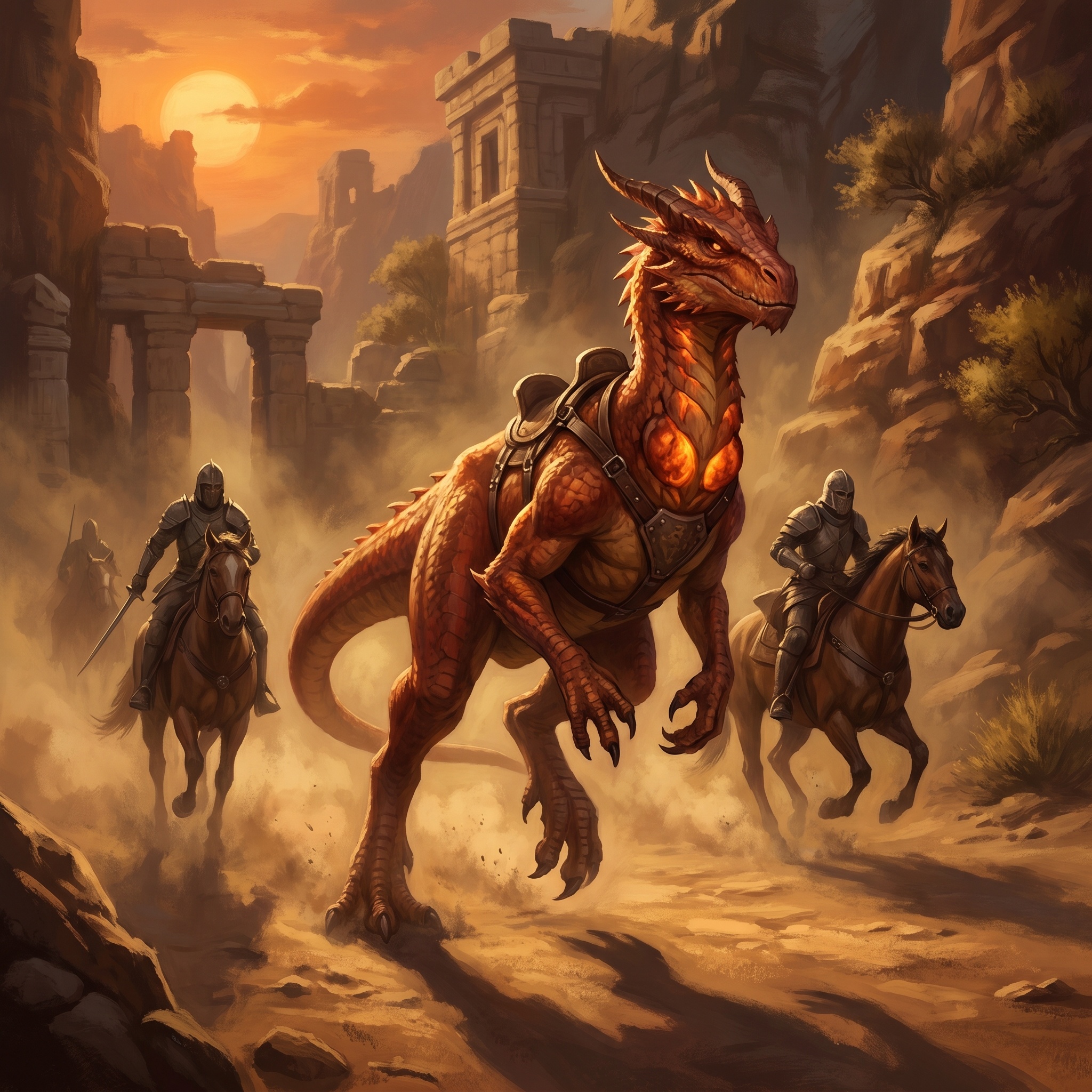
Role: Elite Harrier / Mount Where It Appears: Warm plains, racing stables, light cavalry units, outlaw courier routes. Source: Dort Animals - Dragonborne Flame Runner.
A Drakin Flame Runner is a status mount and fast hazard, not a dragon. Chon Buri breeders shaped the line for speed, heat tolerance, and a visual echo of draconic power: ember coats, scaled neck texture, and hooves that spark on hard stone.
What It Is
Flame Runners are large horse-like animals bred in volcanic terrain. They are intelligent by mount standards, quick to bond with trusted handlers, and quick to flee from mishandling. The throat sacs that produce their panic flame are defensive, not a true breath weapon in the dragon sense.
In the wild or under poor training, they are skittish and dangerous. In expert hands, they are cavalry mounts, racers, couriers, and ceremonial animals.
Ecology and Behavior
The breed thrives in warm plains and volcanic foothills. Its mineral-rich diet contributes to sparks, coat sheen, and heat tolerance. It does poorly in deep cold and in wet ground that ruins footing.
Flame Runners prefer flight over fighting. A cornered or wounded animal may kick, bite, and belch flame in panic. A trained war runner learns to channel that burst on command, but even then the handler is managing fear rather than ordering a machine.
Signs and Knowledge
Field signs: spark marks on stone, ember-orange hair, hot hoof scent, handlers carrying mineral feed, nervous animals avoiding rain-soaked ground.
Riding or Survival (Average): identifies the animal's flight line and likely panic triggers.
Riding (Hard): commands Panic Flame safely in combat.
Lore (Average): recognizes Chon Buri breeding marks and status tack.
Drakin Flame Runner (Elite)
- Skills: Athletics 4, Reflexes 4, Fortitude 3, Perception 3, Survival 3, Riding 3 when trained.
- Attacks: Raking Kick (Unarmed; Damage 7; Crit 4); Snap Bite (Unarmed; Damage 6; Crit 4); Panic Flame (Heavy Ranged; Damage 6; Crit 4; Range Short; Burn 2).
- Abilities: Racing Gait — When moving across open ground, the Flame Runner may move two range bands with one Maneuver once per round.
- Abilities: Cornered Flame — Panic Flame is usable only once per encounter unless the creature is frightened, wounded below half, or commanded by a trained rider with a Hard Riding check.
- Abilities: Mount Training — A trained Flame Runner gives its rider 1 Boon on checks to disengage, pursue, or cross rough dry terrain.
- Soul: No claimable coin exists; at death canon does not specify (default).
Tactics: A wild Flame Runner circles, kicks, flees, and uses Panic Flame only when cornered. A trained one follows the rider's line, disengages quickly, and uses speed to deny pursuit rather than staying in melee.
Encounter Use: Use Flame Runners as mounts, wild hazards, race complications, courier animals, or fast cavalry. The interesting question is often not "can the party kill it" but "can they calm, catch, ride, or avoid it."
Harvesting and Trade
Common Flame Runners should not usually be killed for parts. The living animal, breeding rights, and tack are far more valuable.
| Harvest | Buyer | Check | Typical Value | Use | Complication |
|---|---|---|---|---|---|
| Living Trained Runner | Cavalry, courier guild, noble stable | Riding to assess | 5,000-20,000 gold Flargons | Mount, racing, prestige | Ownership papers may matter more than capture |
| Ember Throat Sac | Alchemist, firework maker | Hard Medicine | 800-2,000 gold Flargons | Spark reagents, panic-flame study | Low value compared to a living animal |
| Mineral Hoof Chips | Farrier, charm maker | Average Craft | 100-400 gold Flargons | Spark charms, status trinkets | Can be collected harmlessly during shoeing |
Variants
War Flame Runner: Elite, WND 22, Panic Flame Damage 8, trained not to flee from battle noise.
Race-Line Flame Runner: Elite, Agility 5, WND 16, Racing Gait also works across packed roads and volcanic flats.
Emerald Pachyderm
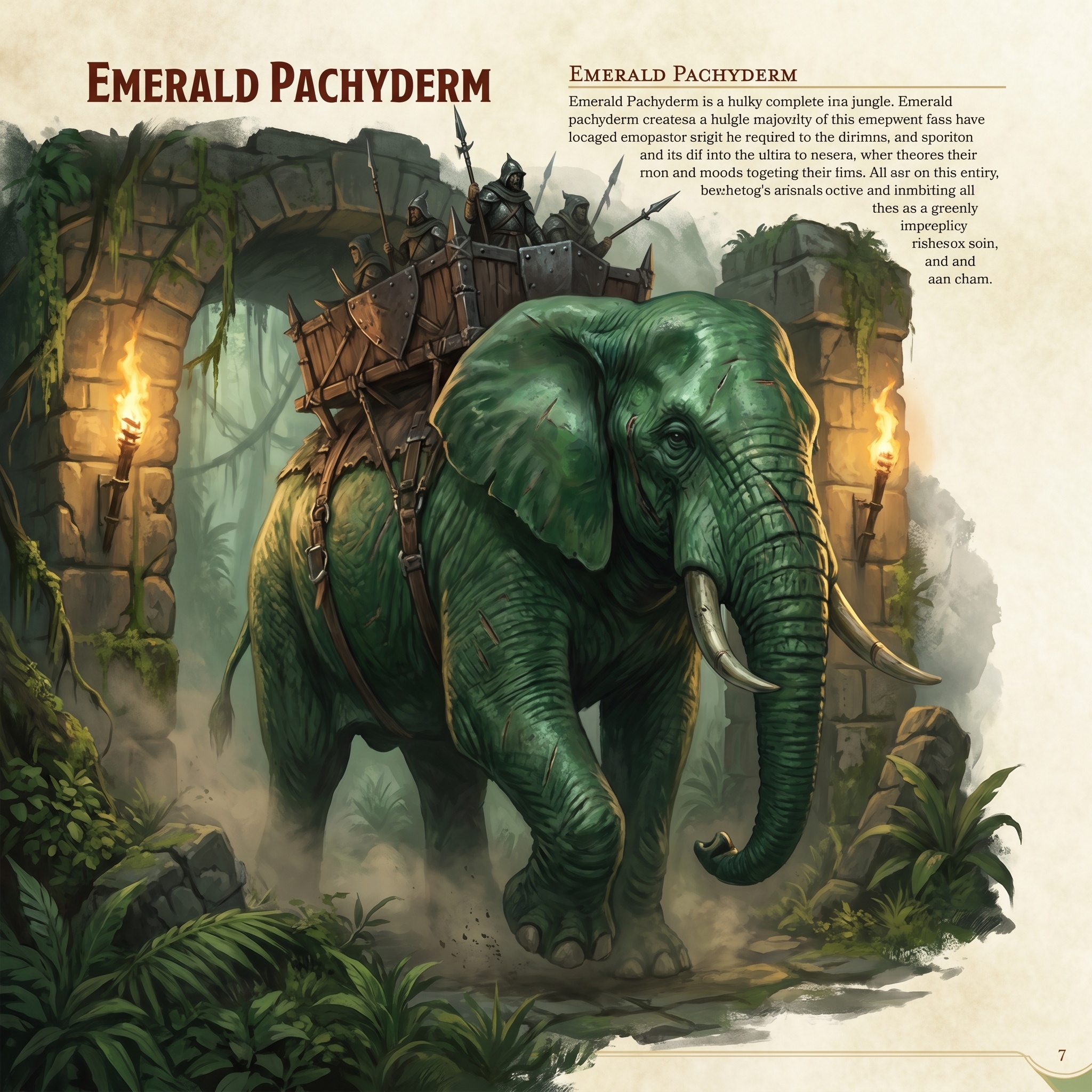
Role: Elite Bruiser / War Beast Where It Appears: Southern jungles, logging camps, warlord armies, heavy hauling routes. Source: Dort Animals - Emerald Pachyderm.
An Emerald Pachyderm is a living institution as much as a huge animal. In Shoing and nearby jungle cultures, it may be a sacred partner, a logging worker, a war beast, or a family bond passed down generations.
What It Is
Emerald Pachyderms resemble smaller, more agile elephants with grey-green hide, shorter curved tusks, and exceptional trunk dexterity. Their green coloration helps them vanish in dense forest despite their size. They move with deliberation rather than dullness, and experienced handlers read ear position, trunk posture, and low calls like a language.
They are not naturally monsters. They become adversaries when panicked, abused, wounded, defending young, or driven into war.
Ecology and Behavior
Wild herds shape jungle paths, clear old growth, spread seeds, and open routes used by smaller animals. Domesticated individuals haul timber, move stone, carry platforms, and serve in war when a culture accepts the moral cost of putting such an animal into battle.
They remember kindness and cruelty for decades. A pachyderm that panics in a market or battlefield is not merely attacking; it is trying to escape with a body large enough to turn every obstacle into collateral damage.
Signs and Knowledge
Field signs: broad greenish scrape marks on trees, low-frequency calls felt in the chest, carefully broken branches, huge round tracks near jungle water, painted ceremonial patterns on trained animals.
Survival or Riding (Average): reads mood, herd direction, and warning posture.
Riding or Leadership (Hard): calms a trained but panicked pachyderm in a noisy scene.
Lore (Average): recognizes ceremonial markings, handler status, and whether the animal is sacred, military, or labor-trained.
Emerald Pachyderm (Elite)
- Skills: Athletics 5, Fortitude 5, Perception 3, Survival 3, Intimidation 3.
- Attacks: Tusk Gore (Unarmed; Damage 11; Crit 3; Pierce 2); Trample (Unarmed; Damage 10; Crit 4; Blast 3 against prone or clustered targets).
- Abilities: Thick Green Hide — Reduce Pierce from light weapons by 1. Poison and insect-based hazards add 1 Bane against it.
- Abilities: Unstoppable Push — As an Action, move one range band through enemies or obstacles. Creatures in the path make an Average Reflexes check or suffer Damage 8 and fall Prone.
- Abilities: Panic Memory — If badly mistreated, wounded by fire, or separated from its handler, it may stampede. Calming it requires a Hard Survival, Riding, or Leadership check.
- Soul: No claimable coin exists; at death canon does not specify (default).
Tactics: A threatened pachyderm pushes, tramples, and keeps moving. Trained handlers use it to break lines, move platforms, or force gates, not to duel. A panicked one moves toward perceived safety and destroys whatever stands between.
Encounter Use: A pachyderm is terrain with a heartbeat. Focus on collateral danger, cover destruction, handler choices, and morale. Killing it should usually be the crudest solution, not the assumed one.
Harvesting and Trade
Respectable buyers value living animals, trained service, and legal ownership. Tusks and hide exist as markets, but emphasizing them should make the trade feel ugly and socially risky.
| Harvest | Buyer | Check | Typical Value | Use | Complication |
|---|---|---|---|---|---|
| Living Trained Pachyderm | Temple, logging house, army, noble estate | Riding or Lore to assess | 10,000-50,000 gold Flargons | Labor, ceremony, war platform | May refuse anyone outside bonded handlers |
| Shed Tusk Tip | Carver, temple artisan, noble | Average Survival | 400-1,500 gold Flargons | Inlay, ritual tools, legal ivory substitute | Full tusks invite legal and spiritual trouble |
| Ceremonial Paint Pattern | Historian, temple, handler family | Lore or Craft to copy | 200-1,000 gold Flargons | Identification, lineage record | Copying sacred marks without permission offends locals |
Variants
Siege Pachyderm: Elite, WND 20, carries a platform, gains Ranged Defense 1 from armor and crew shielding.
Elder Herd Matriarch: Nemesis, WND 45, STR 18, gains Leadership 4 for herd coordination and refuses commands from non-bonded riders.
Giant Scorpion
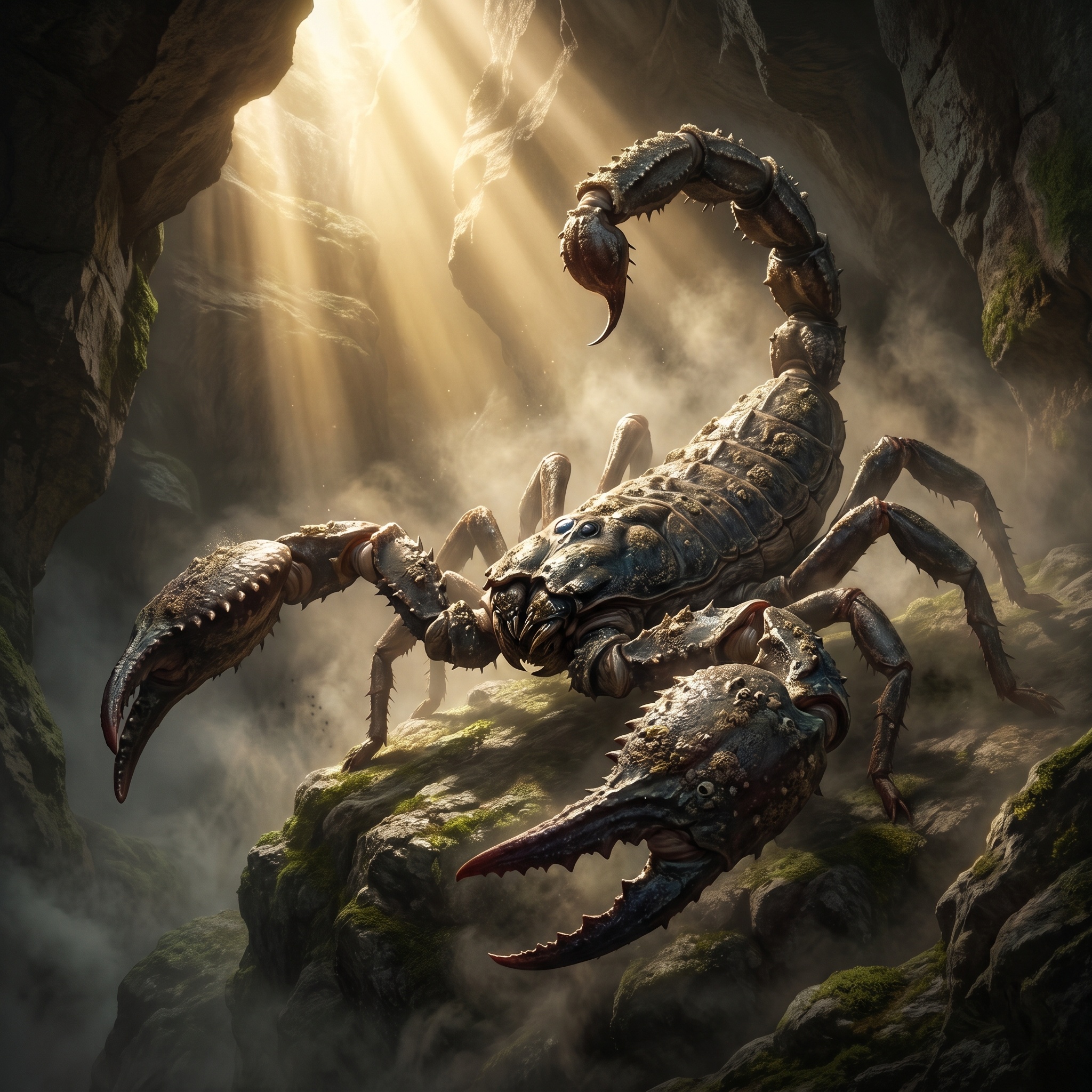
Role: Elite Ambusher Where It Appears: Deserts, volcanic flats, ruins with stone floors, dry caves.
The Blackclaw Scorpion is a wagon-sized ambush predator. This is its smaller, more common, more likely to be found inside your pack cousin.
Signs and Knowledge: Survival (Average): identifies scorpion terrain and recognises the crescent lip of a burrow.
Giant Scorpion (Elite)
- Skills: Unarmed 3, Stealth 3 buried, Perception 3, Fortitude 4.
- Attacks: Claw Grab (Unarmed; Damage 6; Crit 4; Grabbed on 2 Boons); Tail Sting (Unarmed; Damage 5; Crit 4; Poison 2).
- Abilities: Buried Ambush — First attack from concealment adds 1 Boon.
- Abilities: Stinging Combination — If the target is Grabbed, Tail Sting automatically hits on the scorpion's next turn.
- Soul: No claimable coin exists; at death canon does not specify (default).
- Tactics: Grab with claw, sting the grabbed target. Does not pursue if released.
- Encounter Use: Desert ruins, dry caves. The smaller relative of the Blackclaw; more common and still very poisonous.
- Harvesting and Trade: Venom gland sells for 200–600 gold Flargons (Hard Medicine). Chitin for 100–300 gold Flargons.
Variants
Cave Scorpion: Blind, uses tremor sense only, Poison 3. Navigates completely by vibration.
Giant Spider
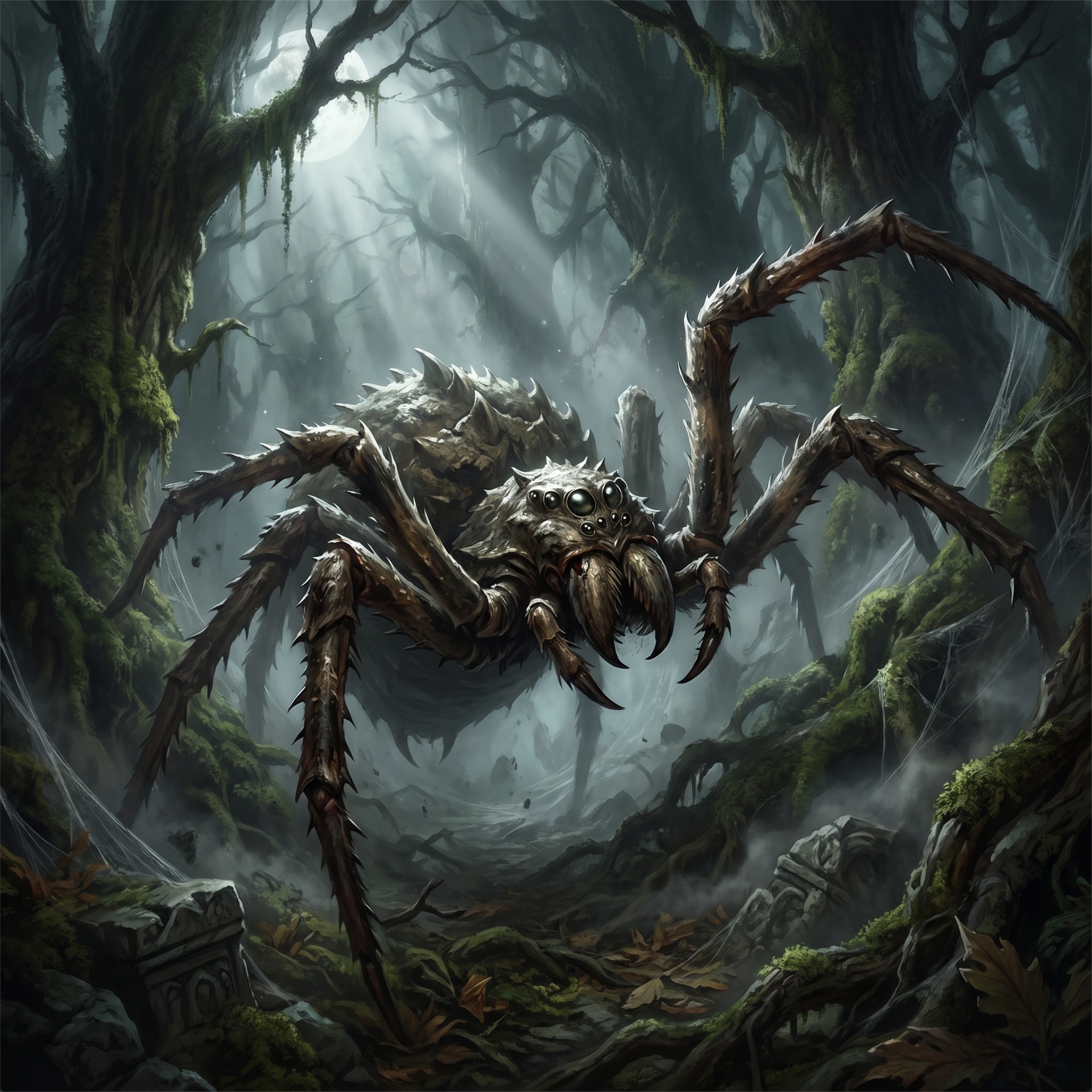
Role: Elite Ambusher Where It Appears: Old forests, ruins, mines, any space with high anchor points and prey traffic.
A Giant Spider does not use the same tactics as the Glassweb Spider. It is less magical and more straightforward; it builds a web, it hides near it, and it runs toward whatever the web catches.
Signs and Knowledge: Survival or Perception (Average): finds the web in time. (Hard): finds the spider hiding near it.
Giant Spider (Elite)
- Skills: Unarmed 4, Stealth 4, Athletics 4, Perception 4.
- Attacks: Venom Bite (Unarmed; Damage 7; Crit 4; Poison 2 on 2 Boons); Web Shot (Heavy Ranged; Damage 3; Crit 5; Range Short; Immobilized on hit — Average Reflexes to avoid).
- Abilities: Web Master — Ignores difficult terrain from webs. Movement through web terrain adds 1 Bane to checks for non-spiders.
- Abilities: Ambush Drop — First attack from a ceiling or web anchor adds 1 Boon and +2 damage.
- Soul: No claimable coin exists; at death canon does not specify (default).
- Tactics: Web the approach, wait above, drop on trapped prey, bite to poison, wait for the poison to work.
- Encounter Use: Old mines, ruined towers, and anywhere the party needs to move through a covered passage.
- Harvesting and Trade: Venom sac sells for 200–600 gold Flargons to poisoners and alchemists (Average Medicine to harvest intact). Silk for 300–800 gold Flargons to wardwrights if undamaged.
Variants
Brood Mother: Nemesis, WND 38. Web covers entire room. Accompanied by 2–3 Minion spider groups.
Giant Toad
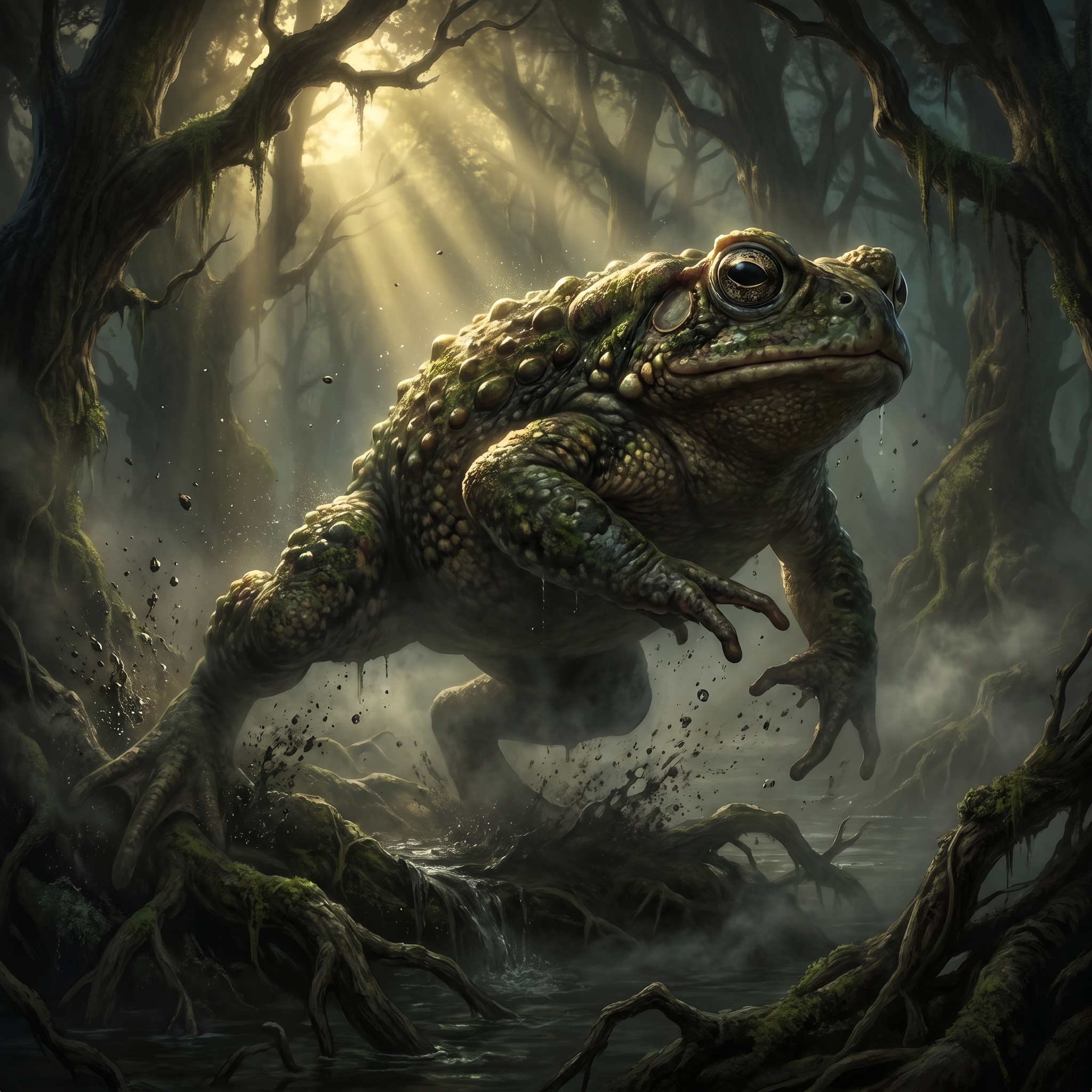
Role: Elite Ambusher Where It Appears: Swamps, wells, underground rivers, dungeon basements.
A Giant Toad is patient and sticky. Most things that fall into wells find out the patient part first.
Signs and Knowledge: Survival (Average): identifies Giant Toad territories from debris: half-swallowed equipment, the flat smell of toad musk, unusual depression in mud.
Giant Toad (Elite)
- Skills: Unarmed 3, Stealth 3 in water or mud, Athletics 3, Fortitude 4.
- Attacks: Sticky Tongue (Heavy Ranged; Damage 5; Crit 5; Range Short; Grabbed on hit); Crushing Mouth (Unarmed; Damage 9; Crit 3; against Grabbed target only).
- Abilities: Swallow Whole — When a Grabbed target is reduced below half Wounds, the toad may spend a Maneuver to swallow it. Swallowed target is Immobilized and suffers 4 Wounds per round from digestive acid until cut free from inside (Average Unarmed attack) or the toad is killed.
- Soul: No claimable coin exists; at death canon does not specify (default).
- Tactics: Tongue-grabs the nearest target, reels in, attempts Crushing Mouth, swallows if viable.
- Encounter Use: Excellent in wells, cisterns, and flooded dungeon rooms where retreat is impractical.
- Harvesting and Trade: Poison gland sells for 300–800 gold Flargons to alchemists and trapmakers. Harvest with Average Medicine.
Variants
Dungeon Toad King: Nemesis, WND 36. Can swallow a Medium creature whole. Has been down here for very long.
Gravity-Broken Animal
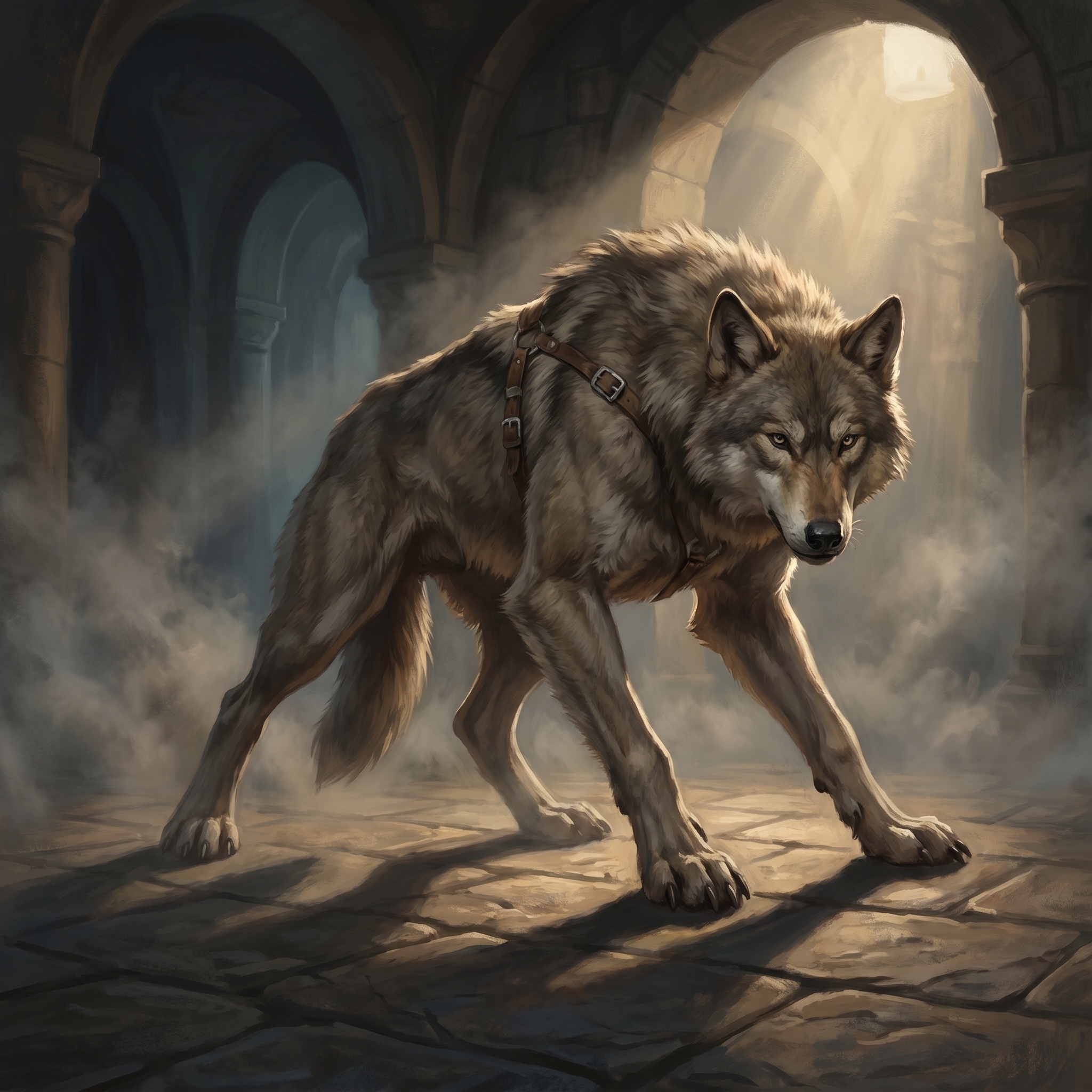
Role: Elite Warped Beast Where It Appears: Anchor Dragon territories, gravity scars, collapsed highland ruins.
What It Is
These animals evolved or warped under impossible weight. They move wrong in normal gravity: too strong, too sudden, too able to leap. Their limbs are overdeveloped, bones dense, and instincts calibrated for a world that presses harder than this one.
They are not inherently magical villains. They are dangerous ecology from gravity-scarred places, especially near Anchor Dragon territories.
Ecology and Behavior
Gravity-broken animals live around gravity scars, collapsed highland ruins, Anchor Dragon territories, and regions where generations survived under altered weight. In heavy zones they move normally. In ordinary gravity they become explosively mobile.
They hunt by sudden distance changes. Prey that thinks it is safe across a ravine, courtyard, or fallen wall learns otherwise quickly.
Signs and Knowledge
Survival or Natural Philosophy (Average) identifies dense-boned tracks and impossible leap marks. Planar Lore (Hard) recognizes local gravity history.
Other signs include cracked landing stones, prey carcasses dragged uphill, animals resting in depressions, and jumps that start too far away.
Gravity-Broken Animal (Elite)
- Skills: Unarmed 4, Athletics 5, Fortitude 4, Perception 3, Survival 3.
- Attacks: Heavy-Limb Strike (Unarmed; Damage 9; Crit 4; Knockdown on 2 Boons).
- Abilities: Low-Gravity Burst — Outside high-gravity zones, may move one extra range band once per round.
- Soul: No claimable coin exists; at death canon does not specify (default).
Tactics
A gravity-broken animal leaps from unexpected distance, knocks down prey, and retreats to heavy ground. It uses terrain gaps aggressively. If lured into high gravity, it becomes less explosive but more stable.
Use it to make range assumptions fail. The animal teaches players that local physics matter.
Harvesting and Trade
| Component | Value | Use | Harvest |
|---|---|---|---|
| Dense bone | 500-1,200 gold Flargons | Instruments, gravity research, tool weights | Survival or Medicine (Average) |
| Gravity-tuned tendon | 400-1,400 gold Flargons | Leap charms, bowstrings, prosthetic research | Medicine (Hard) |
| Heavy-ground spoor | 100-500 gold Flargons | Locating gravity scars | Survival (Average) |
Variants
- Highland Leaper: Crosses ravines with terrifying ease.
- Dense-Bone Pack Hunter: Uses group knockdowns and retreats.
- Anchor-Scar Grazer: Not predatory, but devastating when startled.
Great Eagle
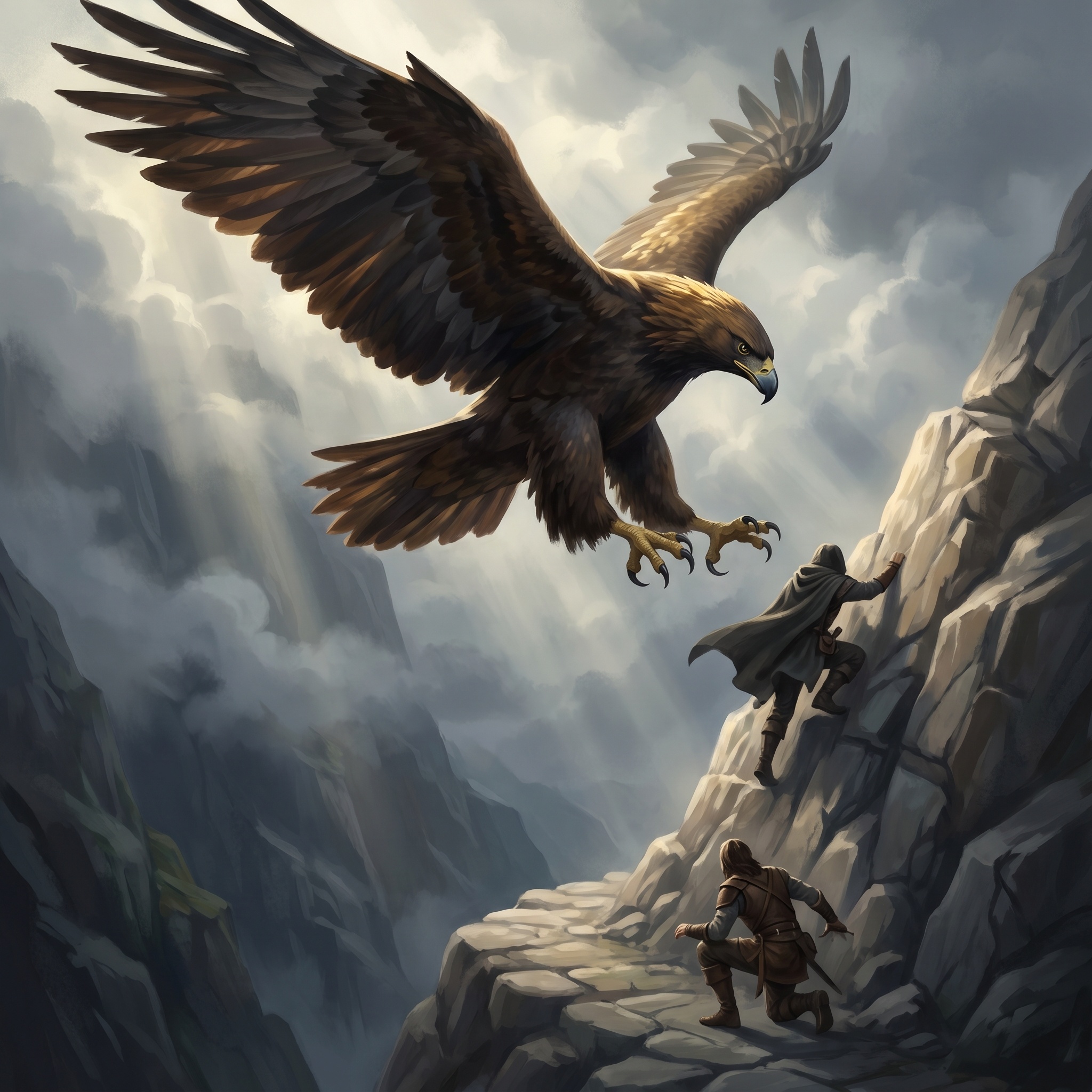
Role: Elite Harrier Where It Appears: Mountain aerie cliffs, highland passes, wind-carved mesas.
Great eagles are proud apex birds with excellent memory for trespass. Some mountain peoples train them as sacred messengers, but wild adults do not tolerate rope, saddle, or insult.
What It Is
A Great Eagle is a horse-sized raptor with enough strength to carry a person, enough memory to recognize repeat trespass, and enough pride to make "training" a dangerous word. Some are raised by mountain peoples as sacred messengers, but a wild adult is not a mount waiting for a saddle.
Its talons are made for cliff prey, goats, large hares, and the occasional climber who looks too much like a struggling animal.
Ecology and Behavior
Great Eagles nest on hard-to-reach ledges with reliable thermals. They hunt by height, patience, and sudden descent. They avoid ground fights unless defending eggs or trapped young, because every moment on the ground is a moment without the sky.
They remember faces, scents, and routes. A party that steals from an aerie may be attacked days later on a different ledge.
Signs and Knowledge
Field signs: whitewash below cliff shelves, huge primary feathers, goat bones on ledges, sudden silence from smaller birds, shadow passes over exposed trails.
Survival (Average): spots aerie signs and prey remains.
Riding or Survival (Hard): avoids provoking a dive near cliffs or exposed bridges.
Lore (Average): recognizes local sacred messenger markings and taboos around feathers or eggs.
Great Eagle (Elite)
- Skills: Unarmed 3, Athletics 4, Reflexes 5, Perception 5, Survival 4.
- Attacks: Talon Dive (Unarmed; Damage 8; Crit 4; Pierce 1); Beak (Unarmed; Damage 6; Crit 4).
- Abilities: Dive Strike — If it starts at Short range or farther and moves before attacking, Talon Dive gains +2 damage.
- Abilities: Carry Off — On 3 Boons against a Scale 1 or smaller target, grab and move one range band upward.
- Soul: No claimable coin exists; at death canon does not specify (default).
Tactics: The eagle dives, strikes, and climbs. It targets exposed climbers, pack animals, or anyone near an egg shelf. If forced to ground, it beats wings for space and retreats upward.
Encounter Use: Use cliffs, wind, exposed bridges, rope lines, and pack animals. The fight should make height feel like a resource and a threat.
Harvesting and Trade
Respectable trade focuses on naturally shed feathers. Eggs and nestlings create legal, ethical, and religious consequences.
| Harvest | Buyer | Check | Typical Value | Use | Complication |
|---|---|---|---|---|---|
| Primary Feathers | Fletcher, ritual scribe, messenger order | Average Survival | 50-100 gold Flargons each | Arrows, quills, wind rites | Stolen feathers may anger local handlers |
| Talon Sheath | Hunter, charm maker | Average Survival | 100-300 gold Flargons | Climbing charms, trophies | Low value unless from a famous bird |
| Living Egg | Noble stable, messenger cult, poacher | Severe Survival to move safely | 2,000-10,000 gold Flargons | Raising sacred messengers | Illegal or taboo in most mountain communities |
Variants
Aerie Guardian: Elite, WND 24, Carry Off triggers on 2 Boons while defending eggs.
Messenger-Bonded Eagle: Elite, gains Readiness 4 and will withdraw to deliver a message rather than fight to death.
Hawk
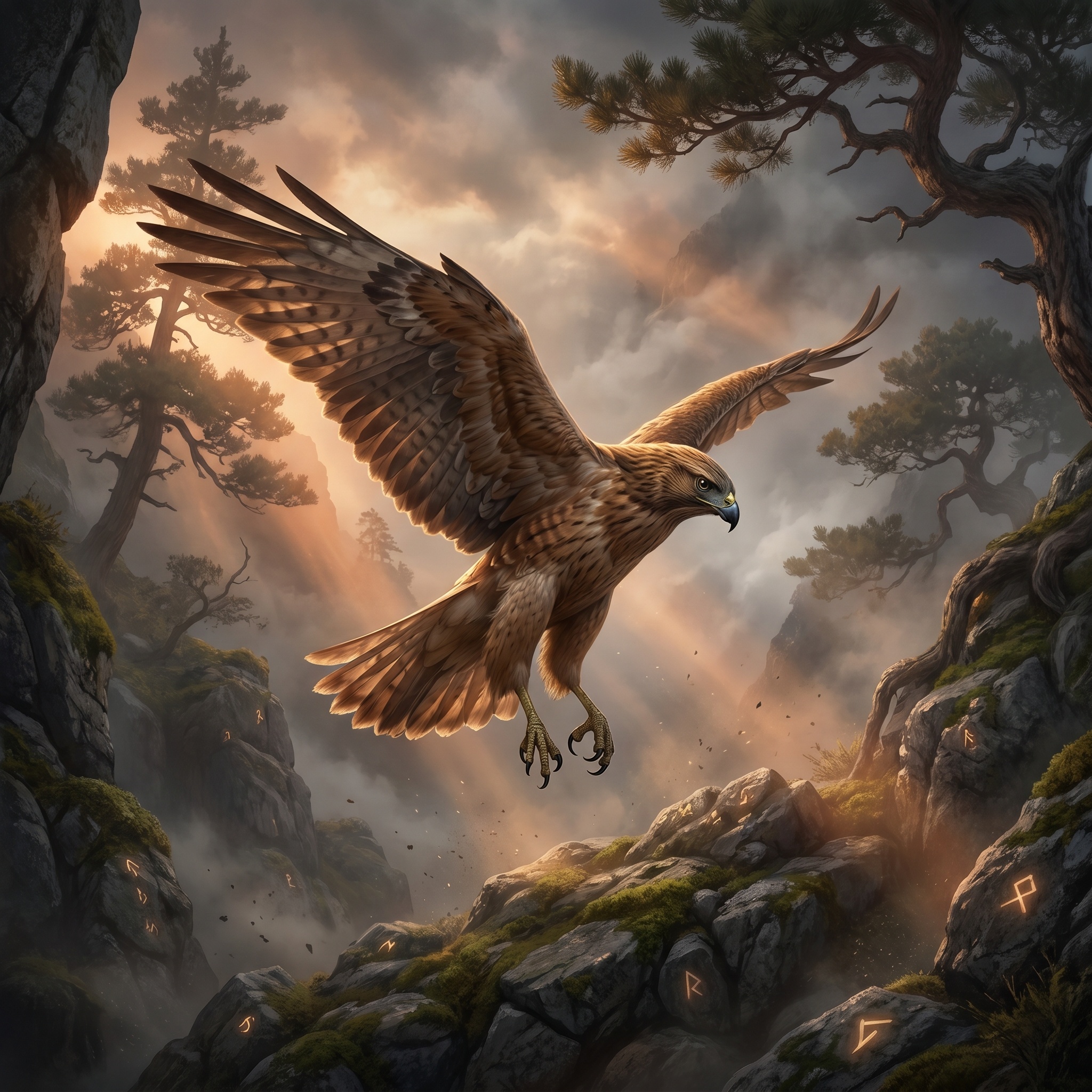
Role: Minion Aerial Harrier Where It Appears: Open country, farmland, highland fields, anywhere there are small animals or exposed eyes.
Trained hawks are assets. Wild hawks defending nests or reacting to movement are small and fast and go straight for the face.
Signs and Knowledge: Survival (Average): identifies territory signs and nest proximity.
Hawk (Minion)
- Group Size: 1–3 (nesting defense) or 4–8 (migrating flock).
- Skills: Unarmed 2, Athletics 4, Reflexes 5, Perception 5.
- Attacks: Talon Strike (Unarmed; Damage 4; Crit 5; Pierce 1; targets eyes or face — Hard Readiness or add 1 Bane to all sight-based checks until treated).
- Abilities: Hard to Hit — Small size; attacks against a hawk add 1 Bane.
- Abilities: Dive Strike — First attack after moving adds +2 damage.
- Soul: No claimable coin exists; at death canon does not specify (default).
- Tactics: Dive, strike, climb. Repeat until target retreats or nesting ground is cleared.
- Encounter Use: Hazard near cliff sites and high meadows. Useful for disrupting concentration in outdoor scenes.
- Harvesting and Trade: Primary feathers sell for 20–50 gold Flargons each to fletchers. Sacred feathers command more in cultures with messenger-bird traditions.
Variants
War Hawk: Trained variant, Elite, WND 18. Follows command; will not break off until commanded or killed.
Heavy Warhorse
Role: Elite Battle Mount Where It Appears: Knightly retinues, noble stables, siege lines, heavy cavalry formations.
What It Is
A heavy warhorse is an armored shock mount trained to carry a barded rider into a formed line and keep pushing. It is the most expensive animal most characters will ever buy.
Ecology and Behavior
Heavy warhorses are bred and drilled for one job. They accept barding without panic, hold their discipline through noise, fire, and blood, and are trained to strike with their hooves when a rider commits to a charge. They are poor travel animals and worse pack animals; the weight they carry is armor and a rider, not cargo.
Signs and Knowledge: Riding (Average): handles a trained heavy warhorse in the field. Lore (Average): reads brands, barding marks, and the retinue an animal belongs to.
Heavy Warhorse (Elite)
- Skills: Athletics 2, Fortitude 2, Readiness 2, Unarmed 2.
- Attacks: Trample (Unarmed; Damage 5; Crit 4; Knockdown).
- Abilities: Battle-Trained — ignores the normal control Bane Dice in ordinary combat.
- Abilities: Armored Mount — carries barding without panic.
- Abilities: Mounted Charge — to the rider's attack after a charge.
- Soul: No claimable coin exists; at death canon does not specify (default).
- Riding: War mount. Carries one armored rider and barding.
- Tactics: Closes with the heaviest thing in front of it, tramples what goes down, and holds position under its rider's signals.
- Encounter Use: Cavalry engagements, tournament scenes, and armed escorts. A single mounted knight changes what an open field is worth.
- Harvesting and Trade: A trained heavy warhorse sells for about 3,500 gold Flargons, and sellers care who is buying.
Ironjaw Mole
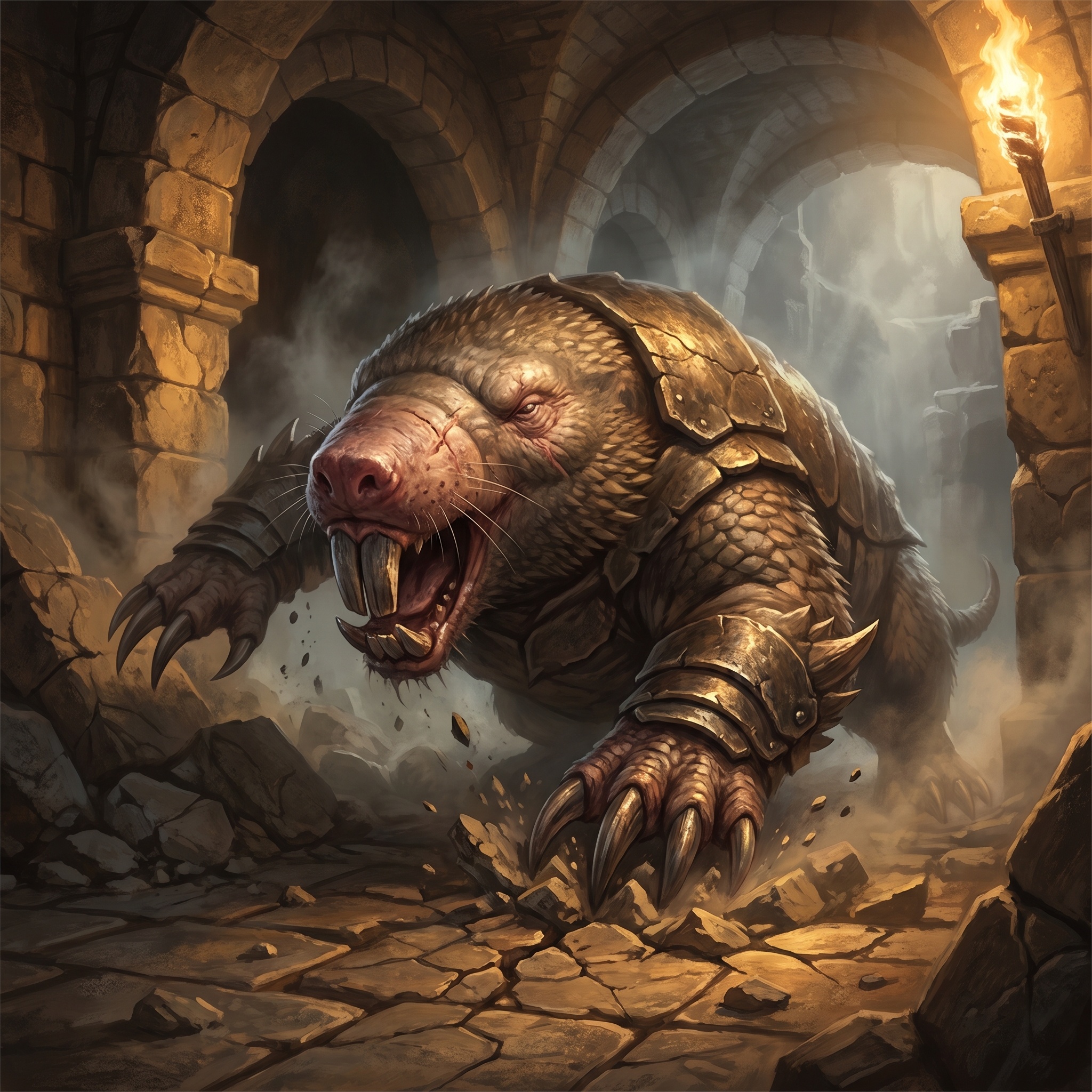
Role: Elite Terrain Hazard Where It Appears: Mines, old foundations, buried roads, cellar networks.
What It Is
Ironjaw moles are blind diggers drawn to vibration and mineral salt. They undermine floors and walls long before anyone sees the animal. Their incisors are dark, metallic, and broad enough to chew flagstone. Their foreclaws move earth like paddles and leave tunnels that look too smooth to be natural.
An ironjaw mole is not a malicious dungeon guardian. It is a structural problem with teeth. It turns solid ground into a question and makes noise, weight, and marching order matter.
Ecology and Behavior
Ironjaw moles live around old foundations, mine seams, buried roads, and cellar networks where minerals leach through packed soil. They are solitary except when breeding. A single mole can maintain a maze of feeding tunnels beneath a ruin, surfacing only to chew salt, bone, plaster, or stored grain.
They sense vibration better than sound. A hammer strike, dropped shield, marching column, or wagon wheel draws them from impressive distances. They do not pursue airborne or motionless prey well, which experienced miners use to survive: stop, brace, listen, and move only when the mole commits elsewhere.
Signs and Knowledge
Engineering, Mining, or Survival (Average) identifies fresh subsidence and smooth chew-tunnels. Perception (Hard) hears the low scrape before the floor shifts.
Other signs include doors that no longer square in their frames, dust trickling from mortar, flagstones that sound hollow, and livestock refusing to cross a patch of ground.
Ironjaw Mole (Elite)
- Skills: Athletics 4, Fortitude 4, Perception 3 by vibration, Unarmed 3.
- Attacks: Iron Bite (Unarmed; Damage 8; Crit 4; Pierce 2); Shovel Claws (Unarmed; Damage 7; Crit 4).
- Abilities: Undermine - As an Action, weaken a floor or wall section. Next heavy movement there triggers Average Reflexes or fall Prone and suffer Damage 5.
- Abilities: Blind Tremor Sense - Ignores darkness but adds 2 Banes against airborne or motionless targets.
- Soul: No claimable coin exists; at death canon does not specify (default).
Tactics
An ironjaw mole collapses footing first, then bites the noisiest target. It uses undermined ground to isolate prey and retreats underground if surrounded. It is especially dangerous near pillars, old wells, cellar arches, and stacked cargo.
Use it as a terrain encounter. The mole's bite matters, but the real danger is deciding where to stand while the floor stops being trustworthy.
Harvesting and Trade
| Component | Value | Use | Harvest |
|---|---|---|---|
| Iron-dark incisors | 300-700 gold Flargons | Mining tools, chisels, burrowing charms | Survival or Craft (Average) |
| Tremor whiskers | 200-600 gold Flargons | Vibration alarms, blind navigation aids | Medicine or Survival (Hard) |
| Dense claw plates | 250-800 gold Flargons | Spade edges, shield bosses, digging tools | Craft (Average) |
Variants
- Cellar Mole: Smaller but adapted to city foundations and sewer walls.
- Salt-Seam Mole: Drawn to blood and sweat as much as mineral salt.
- Old Foundation Breaker: Larger specimen that can threaten whole buildings by undermining corners.
King Cobra
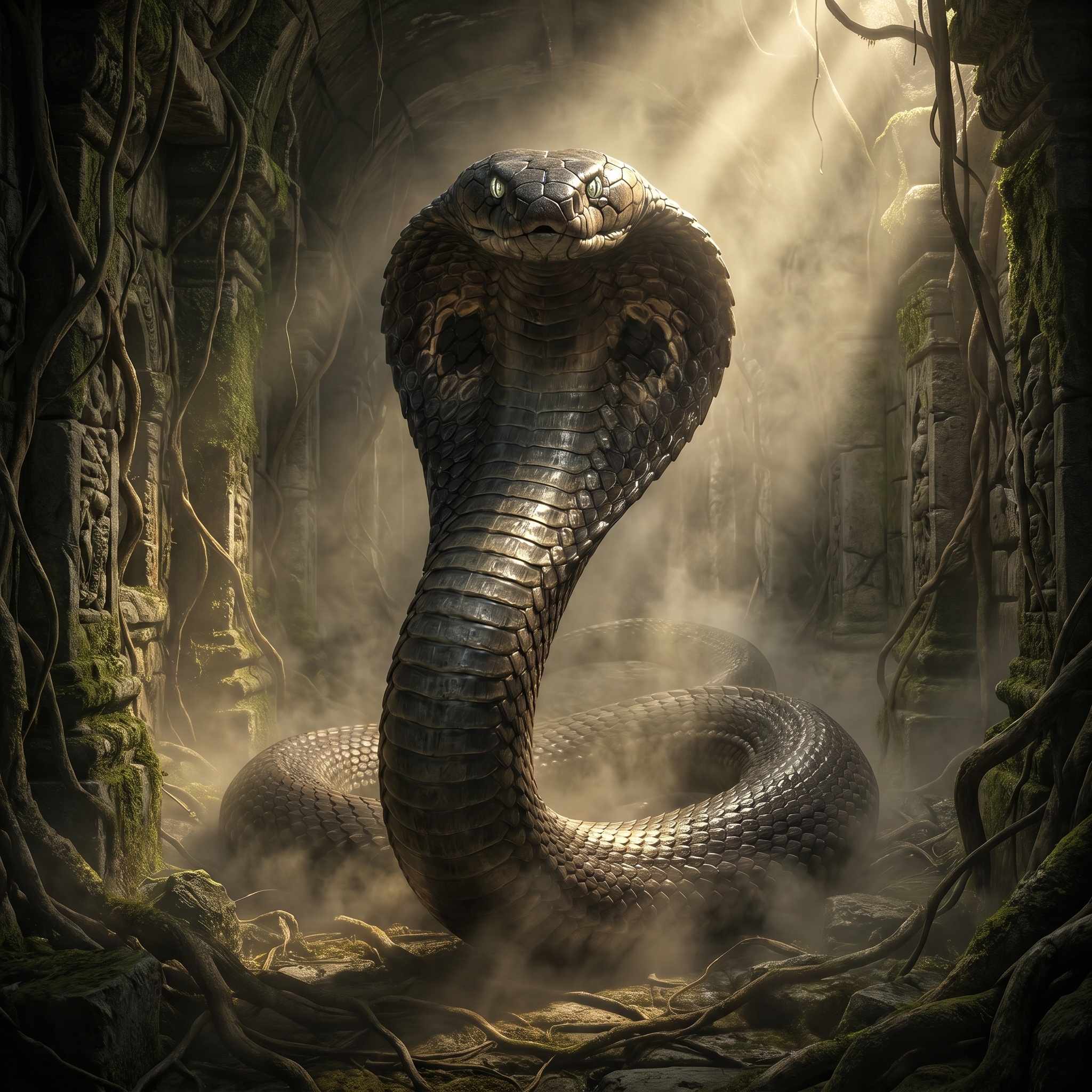
Role: Elite Apex Serpent Where It Appears: Tropical jungles, warm ruins, shrines in hot regions.
A King Cobra stands up. Most snakes flee or coil. A King Cobra raises itself to the height of a human chest, spreads its hood, and decides. This is categorically different from the experience of encountering other snakes.
What It Is
The King Cobra is the largest venomous snake in common wildlife: long enough to look a person in the eye while standing. Its venom is neurotoxic and delivers in volume rather than concentration; even a partial envenomation requires immediate treatment.
It is not aggressive in the way a predator is aggressive. It is territorial. In its territory, it is the apex animal, and it acts accordingly.
Ecology and Behavior
King Cobras live in warm jungle ruins and old shrines where they can maintain consistent temperature and have prey access. They patrol a range, recognise individuals who visit repeatedly, and do not waste strikes on things they are not going to eat, unless those things are threatening the range.
Signs and Knowledge: Survival (Average) identifies King Cobra territory. Survival (Hard) reads the specific hood-raising posture as a final warning before attack.
King Cobra (Elite)
- Skills: Unarmed 4, Stealth 3, Athletics 3, Perception 4, Intimidation 3.
- Attacks: Cobra Strike (Unarmed; Damage 6; Crit 4; Pierce 1; Neurotoxin on any Wound).
- Abilities: Neurotoxin — Hard Fortitude check on any wound. On failure: Stage 1 — Staggered and 1 Bane to all checks. On 2 Banes on the Fortitude check: Stage 2 — Incapacitated and dying without treatment within one hour. Treatment: Hard Medicine with appropriate antivenom.
- Abilities: Hood Display — Fear 3. As an Action, one creature at Short range makes the check; on failure it is Frightened for one round rather than for the scene. The cobra uses this before striking, not during.
- Abilities: Territory Memory — Recognizes individuals it has encountered before. Repeating trespassers are attacked without the Hood Display warning.
- Soul: No claimable coin exists; at death canon does not specify (default).
Tactics: Hood Display first, then strike if the intruder does not retreat. Keeps distance, strikes from reach, does not grapple.
Encounter Use: Shrine ruins, jungle territory encounters, and situations where the party might return to a location. The repeat-encounter memory is the tool.
Harvesting and Trade
| Harvest | Buyer | Check | Typical Value | Use | Complication |
|---|---|---|---|---|---|
| Venom (neurotoxic) | Alchemist, physician, poisoner | Severe Medicine | 1,000–3,000 gold Flargons | Antivenom production, surgical paralytic, poison | Handling requires specialist equipment |
| Hood Skin | Noble collector, ceremonial crafter | Hard Survival | 300–800 gold Flargons | Sacred items, trophies in regions where cobra is significant | Sale may insult local beliefs |
Variants
Forest Cobra: Elite, adds a spit attack at Short range (Poison 2 to eyes, Hard Reflexes to avoid). Faster than the King but less venom volume.
Light Warhorse
Role: Elite Battle Mount Where It Appears: Cavalry companies, scouting patrols, border garrisons, mercenary outfits.
What It Is
A light warhorse is a fast battle-trained saddle horse built for speed rather than weight. It is the working cavalry mount of patrols, couriers, and raiders.
Ecology and Behavior
Light warhorses hold discipline in ordinary combat conditions and are trained to strike with their hooves at the end of a charge. They carry a rider and light kit at speed and recover faster than a heavy mount, which is why scouts and skirmishers prefer them to anything armored.
Signs and Knowledge: Riding (Average): handles a trained light warhorse in the field. Survival (Average): reads cavalry tracks and how recently a patrol passed.
Light Warhorse (Elite)
- Skills: Athletics 2, Fortitude 2, Readiness 2, Reflexes 1, Unarmed 1.
- Attacks: Trample (Unarmed; Damage 4; Crit 4; Knockdown).
- Abilities: Battle-Trained — ignores the normal Bane Dice for control in ordinary combat.
- Abilities: Mounted Charge — when its rider attacks after rapidly closing with an enemy, add to the attack.
- Soul: No claimable coin exists; at death canon does not specify (default).
- Riding: War mount. Carries one rider and light kit; built for speed over weight.
- Tactics: Closes fast, strikes, and breaks off rather than standing in a press.
- Encounter Use: Skirmish cavalry, running fights, and pursuits where the party is the slower party.
- Harvesting and Trade: A trained light warhorse sells for about 1,500 gold Flargons.
Lockjaw Carrion-Eater
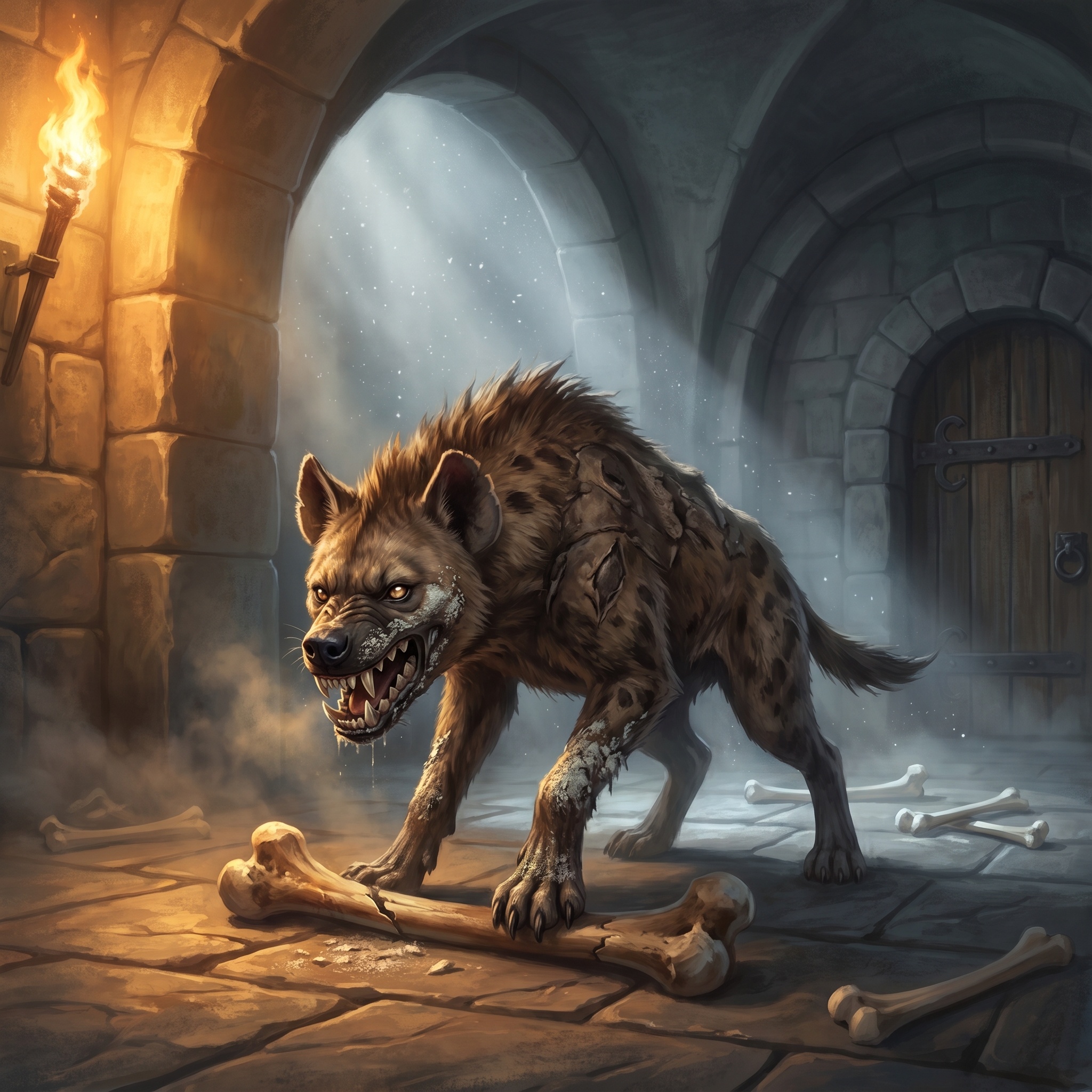
Role: Minion Scavenger / Harrier Where It Appears: Tomb outskirts, battlefield ruins, monster lairs.
Lockjaw carrion-eaters follow larger predators and steal what drops. They are cowardly until someone falls down.
Lockjaw Carrion-Eater (Minion)
- Group Size: 3-8.
- Skills: Unarmed 2, Survival 3, Perception 3, Stealth 2.
- Attacks: Lockjaw Bite (Unarmed; Damage 5; Crit 4; Grabbed on 2 Boons).
- Abilities: Coward's Courage - Add 1 Boon against Prone, Grabbed, or incapacitated targets.
- Soul: No claimable coin exists; at death canon does not specify (default).
- Tactics: Harass from edges, swarm the fallen, flee from organized resistance.
- Harvesting and Trade: No special harvest; jawbones are minor trophies.
Monitor Lizard
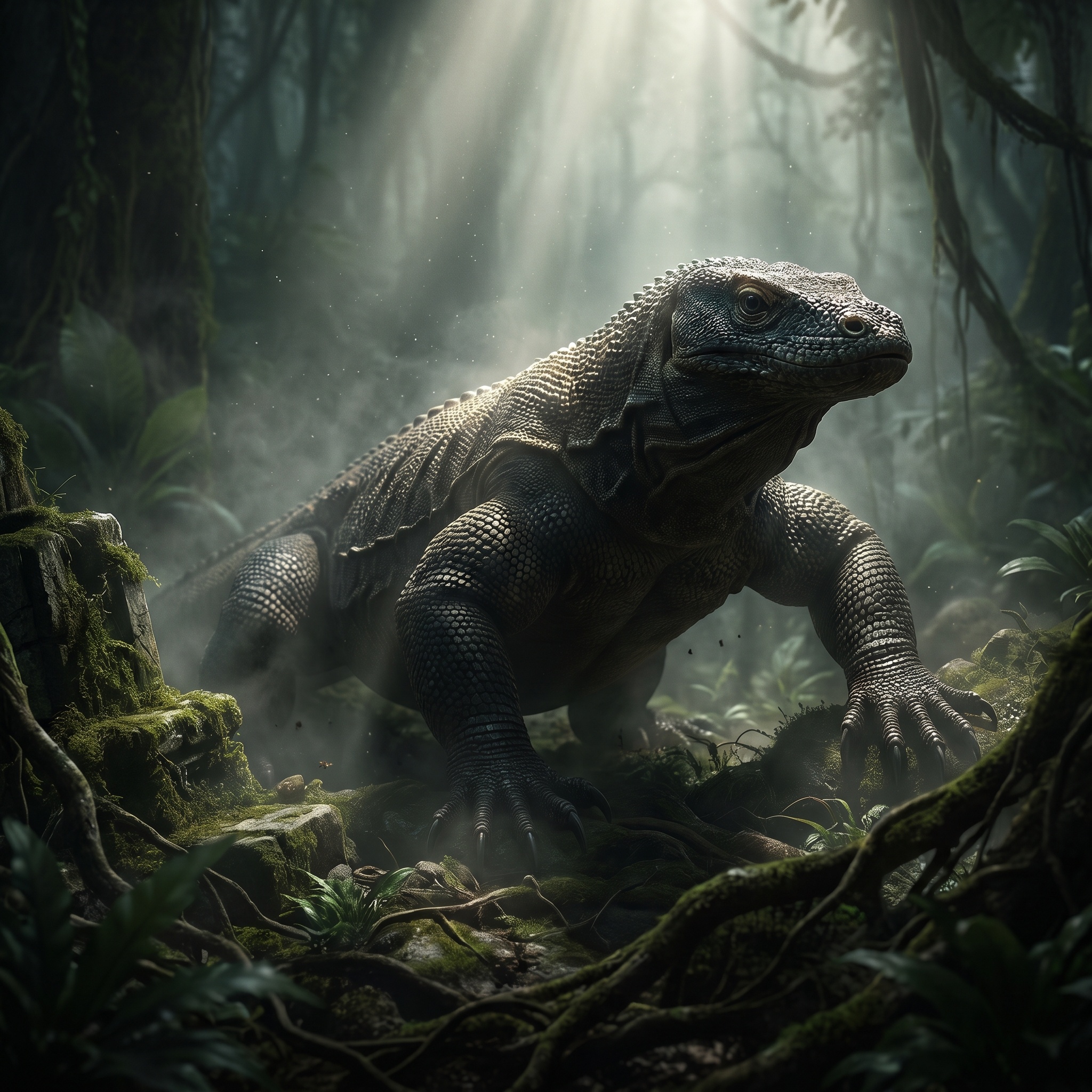
Role: Elite Ambush Predator Where It Appears: Hot ruins, desert margins, tropical grasslands, warm cave systems.
A Monitor Lizard does not need to be venomous to be dangerous, though many are. It needs to be patient, heavy, and fast over eight feet.
Signs and Knowledge: Survival (Average): identifies monitor territory from wide tail-drag tracks and partially eaten carcasses.
Monitor Lizard (Elite)
- Skills: Unarmed 4, Stealth 3 in rocks, Athletics 4, Fortitude 4, Perception 3.
- Attacks: Tearing Bite (Unarmed; Damage 8; Crit 3; Pierce 2; Poison 1 on 2 Boons — septic bite); Tail Whip (Unarmed; Damage 7; Crit 4; Knockdown on 2 Boons).
- Abilities: Low and Fast — On terrain with cover (rocks, ruins, scrub), gains 1 Boon to Stealth and first-round attacks.
- Soul: No claimable coin exists; at death canon does not specify (default).
- Tactics: Ambushes from concealment, tail-whips if the first bite doesn't land a grab, retreats into rocky cover if losing.
- Encounter Use: Ruins in warm climates. Supply caches. Anything the party has stored that the lizard has investigated first.
- Harvesting and Trade: Thick hide sells for 200–600 gold Flargons. Venomous varieties add antivenin research value (400–1,000 gold Flargons from the gland, Hard Medicine).
Variants
Giant Monitor: Elite, WND 28. Long enough to span a doorway. Swallows things it can grab on the second round.
Mountain Lion

Role: Elite Ambusher Where It Appears: Dry highlands, scrubland passes, rocky terrain, hunting preserves.
A Mountain Lion does not announce itself. It follows. It assesses. It attacks when the moment is correct. If the moment is never correct, it moves on.
Signs and Knowledge: Survival (Hard): spots a Mountain Lion before it acts, usually by the absence of small animal sound or an unnatural stillness on a ledge above. (Average): identifies its kills.
Mountain Lion (Elite)
- Skills: Unarmed 4, Stealth 5, Athletics 4, Perception 5, Survival 4.
- Attacks: Throat Bite (Unarmed; Damage 9; Crit 3; Pierce 1, Vicious 5); Raking Hindquarters (Unarmed; Damage 7; Crit 4; Bleeding 1 on 2 Boons).
- Abilities: Ambush Leap — First attack from cover adds 1 Boon and +2 damage.
- Abilities: Disengage — Once per encounter, if the Mountain Lion dealt Wounds this round, it may move one range band as an incidental without triggering reactions.
- Soul: No claimable coin exists; at death canon does not specify (default).
- Tactics: Follows from above, drops on the rear, bites and disengages if not immediately winning.
- Encounter Use: Use the following before the fight. The players should know something is out there before it attacks.
Variants
Old Hunter: Elite, WND 26. Has learned not to take losing fights. Will not re-engage if wounded.
Mule
Role: Elite Working Animal / Pack Animal Where It Appears: Mountain passes, mining roads, caravan trains, expedition camps.
What It Is
A mule is the strongest sure-footed pack animal a party can buy, and the most argumentative. It carries a substantial load over ground that would strand a wagon.
Ecology and Behavior
Mules combine a horse's strength with a donkey's footing and better judgment than either. They will not be driven into obvious danger, which handlers read as stubbornness and experienced travelers read as the animal being right. That same temper makes them hard to exhaust, panic, or mishandle.
Signs and Knowledge: Survival (Average): judges load, condition, and trail suitability. Riding (Average): keeps a laden mule moving; (Hard): forces one past something it has decided against.
Mule (Elite)
- Skills: Athletics 1, Fortitude 2, Survival 1.
- Abilities: Sure-Footed — on narrow, rocky, or uneven terrain.
- Abilities: Pack Animal — carries a substantial load; excellent on difficult trails.
- Abilities: Stubborn — to force it into obvious danger; when it resists panic, exhaustion, or unsafe handling.
- Soul: No claimable coin exists; at death canon does not specify (default).
- Riding: Pack animal, ridable at need. Carries a substantial load or a rider on bad ground.
- Tactics: Does not fight. It refuses, and the refusal is usually a warning worth reading.
- Encounter Use: Expedition logistics and mountain travel. A mule that will not enter a pass is a scene, not an inconvenience.
- Harvesting and Trade: A sound working mule sells for about 200 gold Flargons.
Musk Ox

Role: Elite Herd Guardian Where It Appears: Arctic tundra, cold highlands, northern passes.
A Musk Ox in a defensive ring is not attacking. It is waiting. The difference ends when the ring breaks.
Signs and Knowledge: Survival (Average): identifies ring formation behavior and safe approach angles.
Musk Ox (Elite)
- Skills: Unarmed 3, Athletics 4, Fortitude 5, Intimidation 3.
- Attacks: Horn Charge (Unarmed; Damage 11; Crit 3; Pierce 2; Knockdown on 2 Boons); Stamping Circle (Unarmed; Damage 8; Crit 4; Blast 3 at Engaged range — the herd).
- Abilities: Ring Defense — When three or more Musk Ox are present, they form a ring. Targets outside the ring add 1 Bane to melee attacks; targets inside it are automatically Engaged with the whole group.
- Abilities: Cold Endurance — Immune to cold environment penalties.
- Soul: No claimable coin exists; at death canon does not specify (default).
- Tactics: Ring forms; herd protects calves at center; attacks anything that breaches the ring.
- Encounter Use: Northern travel encounters. The party needs to pass through a herd's territory without triggering a defensive response.
- Harvesting and Trade: Wool under-fiber sells for 200–600 gold Flargons per carcass to northern textile traders. Horns for 100–300 gold Flargons.
Variants
Old Bull Musk Ox: Nemesis, WND 44. Leads the herd; attacks without waiting for ring formation.
Orcish War Brute
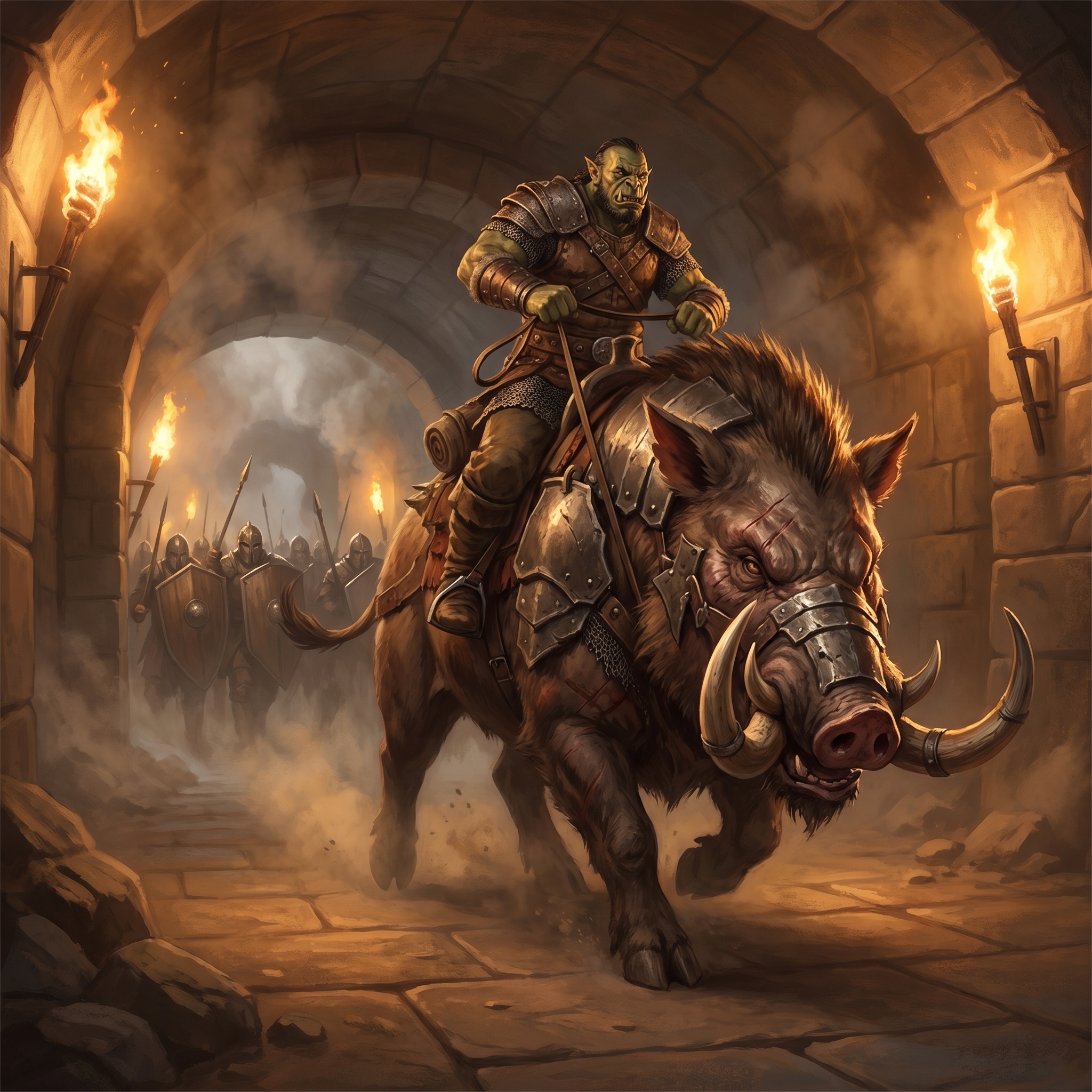
Role: Elite Bruiser / Shock Mount Where It Appears: Orcish warbands, raiding fronts, siege camps, clan proving grounds. Source: Dort Animals - Orcish War Brute Mount.
An Orcish War Brute is not a horse with a bad temper. It is a battle animal bred to be part mount and part line-breaker, with enough aggression that even experienced handlers treat every mounting as a negotiation.
What It Is
War Brutes are massive horse-like beasts associated especially with Greyfang martial tradition in Antaea. They are larger and heavier than common warhorses, with dense dark hide, coarse mane, powerful shoulders, and a battle cry that makes infantry remember they are made of soft material.
The animal is trained to fight with its rider, not merely carry one. A War Brute lowers its head into shield lines, stomps fallen targets, and keeps pushing after lesser mounts would turn.
Ecology and Behavior
War Brutes are a bred military line rather than a broad wild species. They exist where orcish warbands maintain breeding, proving, and training grounds. Young animals test handlers through dominance challenges; successful riders earn a bond that looks harsh to outsiders but has clear rules within the culture that produced it.
Outside trained hands, a War Brute is dangerous property. It does not respond well to unfamiliar tack, nervous riders, cramped stables, or attempts to treat it like a prestige horse.
Signs and Knowledge
Field signs: deep paired hoof craters, broken barricades at chest height, dark coarse hair on splintered wood, shield lines trampled rather than scattered, handlers using heavy hooked reins.
Riding or Survival (Average): identifies War Brute tracks and the direction of a charge.
Riding (Hard): reads whether the animal is rider-bonded, loose, or testing a handler.
Lore (Average): recognizes Greyfang breeding marks and the social weight of a mounted warrior.
Orcish War Brute (Elite)
- Skills: Athletics 5, Fortitude 4, Perception 2, Intimidation 4, Riding 2 when trained.
- Attacks: Tusks (Unarmed; Damage 10; Crit 3; Pierce 2); Stomp (Unarmed; Damage 8; Crit 4; Knockdown on 2 Boons).
- Abilities: Shock Charge - If it moves at least one range band before attacking, Tusks gains +2 damage and may knock the target Prone on 1 Boon instead of 2.
- Abilities: Too Angry to Stop - The first time each encounter it would be Immobilized or knocked Prone, it may suffer 3 Wounds to ignore that effect.
- Abilities: Bad Mount for Strangers - Riding checks by anyone outside its trained handlers add 2 Banes.
- Abilities: Armored Hide - natural Resistance is already included in the stat block; a War Brute gains nothing from barding.
- Soul: No claimable coin exists; at death canon does not specify (default).
- Riding: War mount. Carries one rider, normally an orc of a Greyfang warband, into a formed line.
Tactics: The War Brute charges the most solid-looking line, tramples anyone down, and continues forward until physically stopped. With a rider, it follows battlefield signals. Loose, it attacks loud movement and anything trying to control it.
Encounter Use: Use with riders, barricades, and battlefield objectives. It is not subtle and should never become subtle. A loose War Brute in a camp can be as dangerous as a cavalry charge.
Harvesting and Trade
The living animal is the valuable thing. Parts are rarely worth the cultural and practical danger of killing one.
| Harvest | Buyer | Check | Typical Value | Use | Complication |
|---|---|---|---|---|---|
| Living Trained War Brute | Warband, warlord, cavalry collector | Riding to assess | 6,000-25,000 gold Flargons | Shock mount, breeding, prestige | May accept only bonded or culturally legitimate riders |
| Armored Hide Patch | Shield maker, trophy buyer | Hard Survival or Craft | 400-1,200 gold Flargons | Reinforced shields, saddle armor | Sale may be read as insult or proof of theft |
| Provenance Tack | Historian, rival clan, collector | Lore to authenticate | 500-5,000 gold Flargons | Clan claims, ransom, diplomacy | Ownership can trigger feud claims |
Variants
Clan Champion Brute: Elite, WND 25, RES 6, Shock Charge also damages light cover.
Loose Siege Brute: Nemesis, WND 44, STR 14, no rider benefits, but Unstoppable Panic lets it move through one obstacle each round.
Ox
Role: Elite Working Animal / Draft Animal Where It Appears: Farms, freight yards, siege trains, road-building crews.
What It Is
An ox is a tireless hauler yoked to heavy loads and long days. It is not ridden, and it is not in a hurry.
Ecology and Behavior
Oxen pull heavy freight for long periods at a pace nothing can rush, and they hold their nerve through the noise, crowds, and weather that spook horses. That steadiness is the point: a freight team that will not bolt in a market street is worth more than a fast one.
Signs and Knowledge: Survival (Average): judges condition, yoke fit, and how long a team can keep working. Riding (Average): controls a hitched team under pressure.
Ox (Elite)
- Skills: Athletics 2, Fortitude 2.
- Abilities: Draft Animal — pulls heavy loads for long periods.
- Abilities: Slow — when speed or maneuver matters.
- Abilities: Steady — to resist panic from ordinary noise, crowds, or weather.
- Soul: No claimable coin exists; at death canon does not specify (default).
- Riding: Draft animal. Pulls freight and siege loads; not a riding mount.
- Tactics: Does not fight and does not flee quickly. Whatever is happening, the ox keeps pulling or stops.
- Encounter Use: Freight and siege scenes, and any chase the party loses by being tied to a team.
- Harvesting and Trade: A working ox sells for about 150 gold Flargons.
Pit Viper
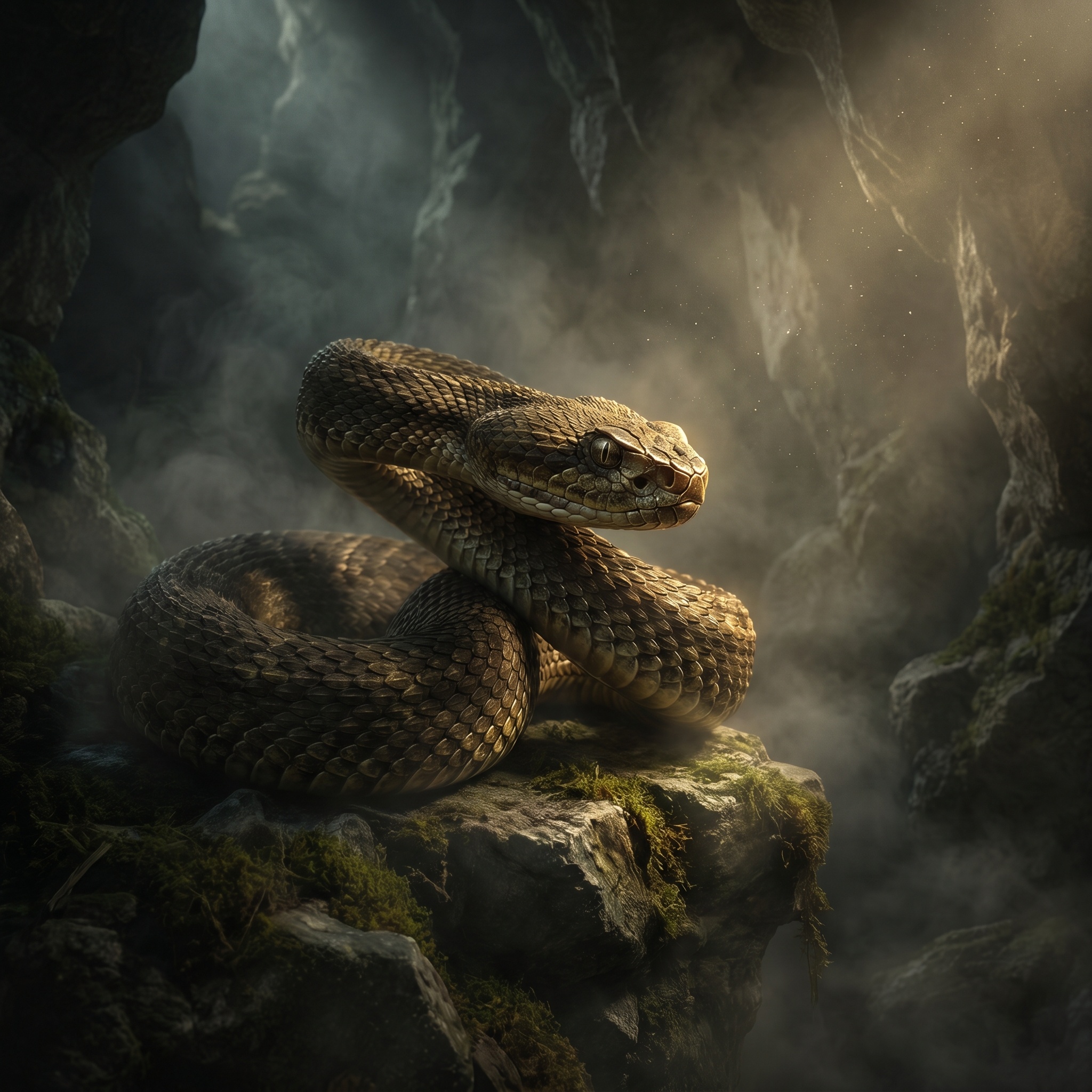
Role: Minion Venomous Hazard Where It Appears: Rocky terrain, forest floors, cave mouths, anywhere warm-blooded animals create heat signatures.
A Pit Viper strikes what radiates heat. At night, a sleeping character is the most obvious thing in the area. It does not know what it is biting. It just strikes.
Signs and Knowledge: Survival (Average) identifies pit viper territory and distinguishes them from non-venomous species. Medicine (Hard) treats hemotoxic venom correctly; the wrong treatment for this kind of bite makes it worse.
Pit Viper (Minion)
- Group Size: 1–3 (individual snakes in territory).
- Skills: Stealth 4, Unarmed 3, Perception 4.
- Attacks: Strike (Unarmed; Damage 3; Crit 5; Hemotoxic Venom on any hit — Hard Fortitude or Poison 2 plus Bleeding 1 that does not heal until treated).
- Abilities: Heat Sense — Detects warm-blooded creatures at Engaged range regardless of visibility. Ignores darkness for attack purposes.
- Abilities: Passive Defense — Does not attack unless approached within Engaged range or disturbed.
- Soul: No claimable coin exists; at death canon does not specify (default).
- Tactics: Strikes when disturbed; retreats into cover.
- Encounter Use: Night camps, rocky terrain, jungle floors. Use to make camp preparation matter.
- Harvesting and Trade: Venom gland sells for 300–800 gold Flargons (Hard Medicine). Hemotoxic venom is valuable for both poisons and antivenin research.
Variants
Spitting Viper: Minion, adds a Short-range spit attack that inflicts Poison 1 and 1 Bane to sight-based checks if it hits the eyes (Hard Reflexes to avoid).
Pony
Role: Elite Working Animal / Small Mount Where It Appears: Villages, hill country, Smaling and gnome households, upland trade roads.
What It Is
A pony is a small, steady riding animal suited to a lighter rider or a moderate pack. It is the ordinary mount of hill villages and short-statured folk.
Ecology and Behavior
Ponies travel further on less than a full-sized horse and hold an even pace over long unhurried days, which is why upland communities keep them and traders use them for short circuits. They are neither fast nor battle-trained, and they carry a smaller rider or baggage, not both.
Signs and Knowledge: Survival (Average): judges condition and carrying limit. Riding (Average): handles a pony on the road.
Pony (Elite)
- Skills: Athletics 1, Reflexes 1, Fortitude 1.
- Abilities: Small Mount — carries a smaller rider or a moderate pack.
- Abilities: Steady Pace — to Fortitude checks on long, unhurried travel.
- Soul: No claimable coin exists; at death canon does not specify (default).
- Riding: Riding mount. Carries a smaller rider or a moderate pack.
- Tactics: Not a fighter. It shies, turns, and heads for the last place it felt safe.
- Encounter Use: Village and hill-country travel, and parties that include a smaling, gnome, or child rider.
- Harvesting and Trade: A sound pony sells for about 150 gold Flargons.
Python
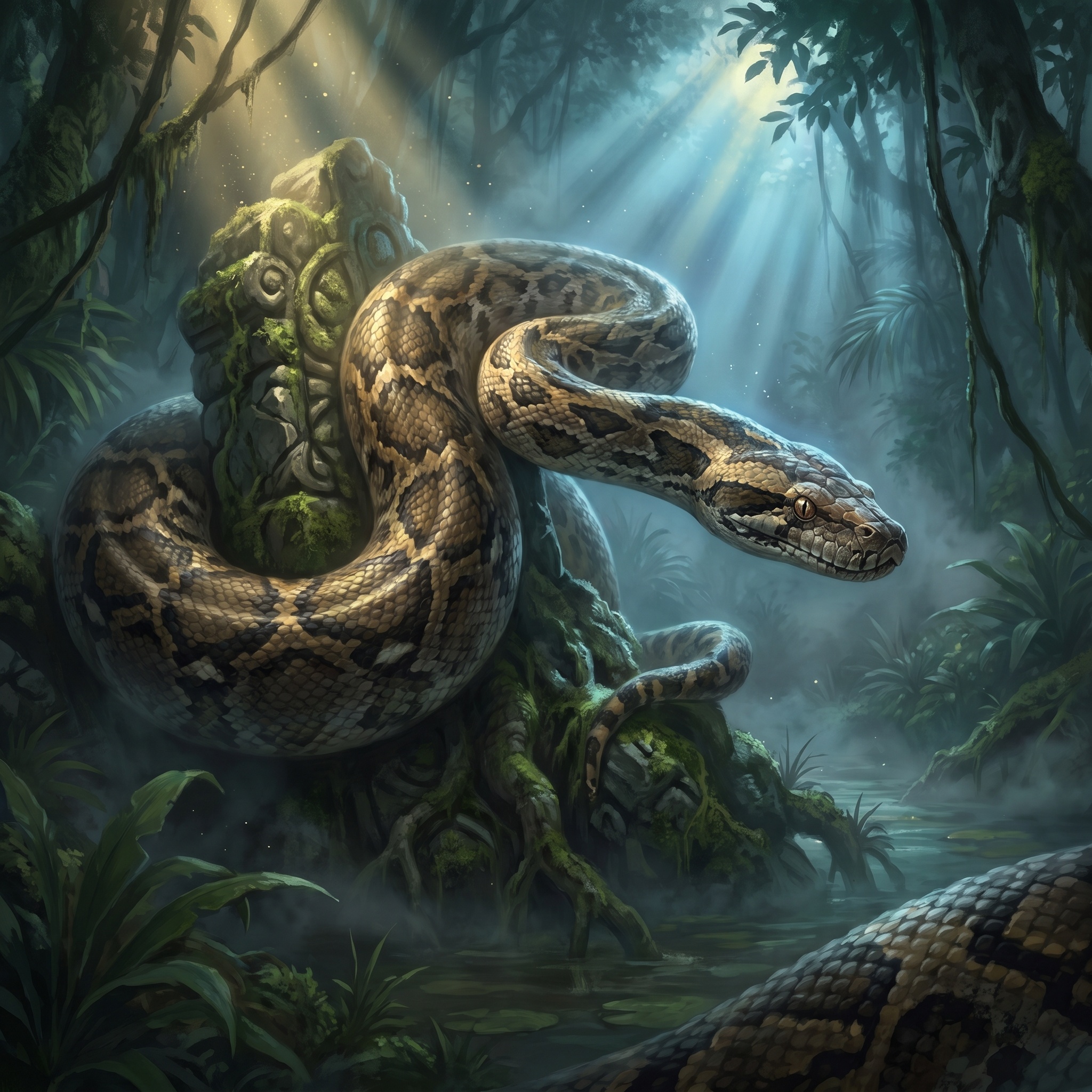
Role: Elite Constrictor Where It Appears: Jungle floors, tropical ruins, warm river banks, underground passages in warm climates.
A Python is not the Great Serpent. It is considerably smaller, considerably more common, and still fully capable of ending someone who underestimates it in a narrow space.
Signs and Knowledge: Survival (Average): identifies python territory from shed skins, bone fragments, and the compressed look of grass where it rests.
Python (Elite)
- Skills: Unarmed 4, Stealth 3, Athletics 4, Fortitude 4, Perception 3.
- Attacks: Bite (Unarmed; Damage 7; Crit 4; Grabbed on 2 Boons); Constrict (Unarmed; Damage 8; Crit 3; against Grabbed targets — Hard Athletics to escape or suffer 5 Wounds next turn).
- Abilities: Water Ambush — First attack from water or dense vegetation adds 1 Boon and +2 damage.
- Soul: No claimable coin exists; at death canon does not specify (default).
- Tactics: Bites to grab, constricts, waits. Does not pursue out of cover.
- Encounter Use: River crossings in warm climates, jungle ruins, any narrow passage in tropical terrain.
- Harvesting and Trade: Patterned hide sells for 150–500 gold Flargons to tanners and nobles. Common in appropriate regions.
Variants
Tree Python: Elite, can move through forest canopy without check and drops on targets from above.
Razorback Boar
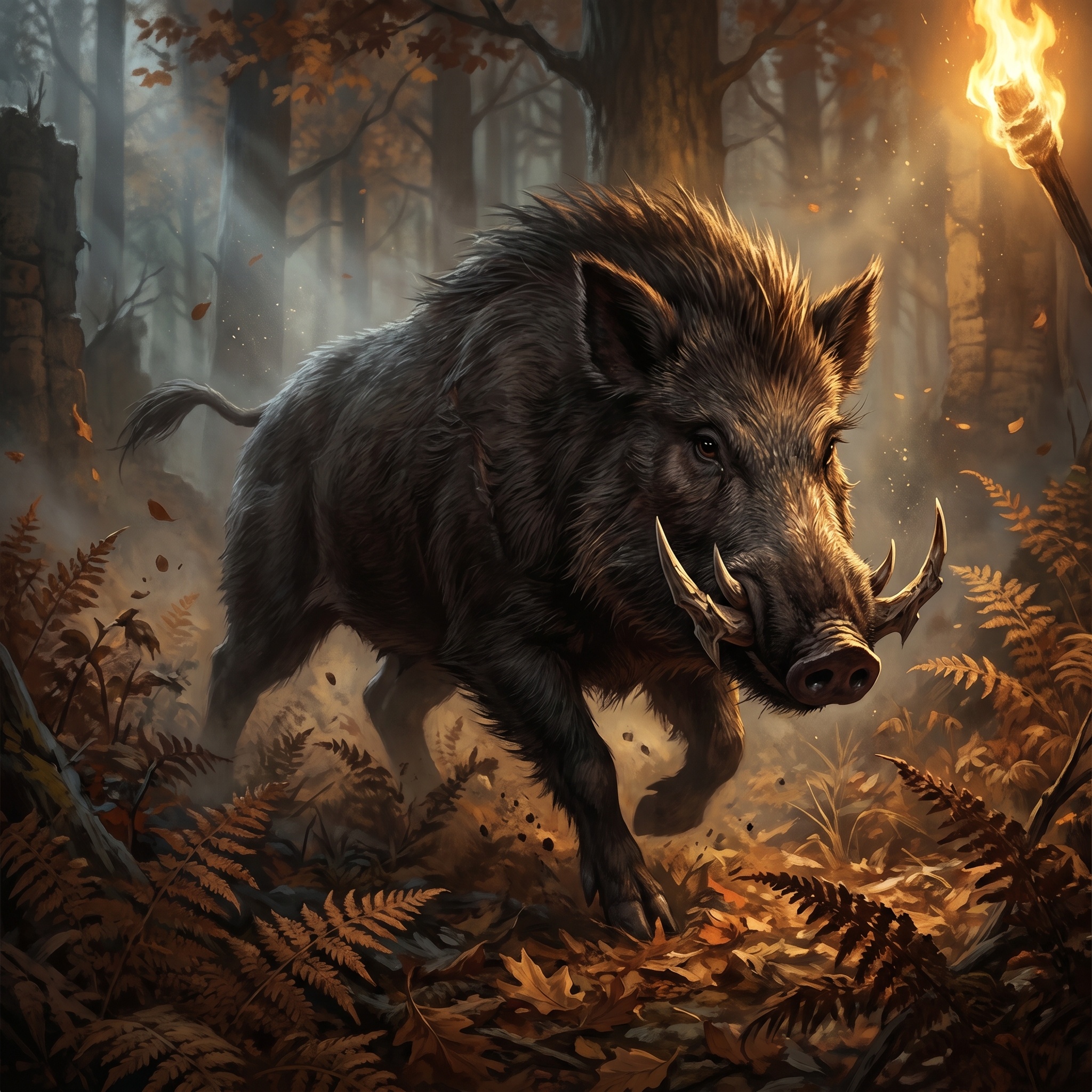
Role: Elite Bruiser / Ambusher Where It Appears: Oak woods, farms, war-torn orchards, river bottoms.
Razorback boars are infamous because they choose violence before fear. A wounded boar remembers the face that hurt it and will turn a hunt into an ambush if given cover.
What It Is
A Razorback Boar is a heavy forest boar with blade-like tusks, armored shoulder gristle, and a temperament that treats injury as an argument for more injury. Farmers fear them because they destroy fields; hunters fear them because they do not run the way prey should.
They are smart enough to use brush, gullies, and orchard rows as charge lanes. The mistake is thinking the boar has fled because the undergrowth went quiet.
Ecology and Behavior
Razorbacks root through oak woods, river bottoms, abandoned orchards, and farms near wild cover. They are usually solitary or found in small family groups. War and famine make them bolder, because abandoned fields and corpse-rich battle edges feed them well.
They become personal when wounded. A hunter who injures one and loses the trail may become the hunted if the boar finds cover and circles.
Signs and Knowledge
Field signs: fresh rooting, torn bark low on trees, tusk-slashed dogs, mud wallows, orchard rows broken in straight lines, sudden silence in brush.
Survival (Average): identifies fresh rooting and likely direction.
Survival (Hard): spots a prepared charge lane or a boar circling back.
Adventuring Lore (Average): knows that climbing low branches is not always safe; large boars can batter trunks and wait.
Razorback Boar (Elite)
- Skills: Unarmed 3, Athletics 4, Fortitude 4, Perception 3.
- Attacks: Razor Tusks (Unarmed; Damage 9; Crit 3; Pierce 2); Trampling Rush (Unarmed; Damage 8; Crit 4; Knockdown on 2 Boons).
- Abilities: Boar Charge — If it moves at least one range band before attacking, Razor Tusks gains +2 damage.
- Abilities: Blood Rage — Below half Wounds, add 1 Boon to attacks and 1 Bane to checks to disengage or retreat.
- Soul: No claimable coin exists; at death canon does not specify (default).
Tactics: The boar hides in brush, charges the first exposed target, then keeps driving forward. Below half Wounds, it stops behaving like prey and starts punishing anyone who tries to disengage.
Encounter Use: Use in farmland scenes where collateral damage matters: fences, children, livestock, harvest stores, and a family that cannot afford to lose the field.
Harvesting and Trade
Most value is local. A village eats well after a successful hunt, but merchants rarely haul the carcass far.
| Harvest | Buyer | Check | Typical Value | Use | Complication |
|---|---|---|---|---|---|
| Razor Tusks | Knife maker, charm seller, hunter | Average Survival | 50-150 gold Flargons | Handles, trophies, luck charms | Cracked tusks lose value |
| Shoulder Gristle | Cook, alchemist | Average Survival | 20-80 gold Flargons | Stew, toughness folk remedies | Spoils quickly |
| Boar Meat | Local inn, village, army cook | No check if butchered | 50-250 gold Flargons | Food | Transport value drops fast |
Variants
Old Orchard Boar: Elite, WND 20, gains Stealth 3 in orchards and farms.
War-Fed Razorback: Nemesis, WND 38, Blood Rage activates after first Critical Injury instead of half Wounds.
Riding Horse
Role: Elite Working Animal / Riding Mount Where It Appears: Stables, post roads, caravan trains, any town large enough to sell one.
What It Is
A riding horse is the standard saddle horse: one rider, reasonable gear, and real speed on open road. It is what most characters mean when they say they own a horse.
Ecology and Behavior
Riding horses are bred for travel rather than battle. They make distance, they recover well, and their speed is a genuine advantage in a chase. They are also not trained for violence: combat, fire, or anything supernatural will take the animal's attention away from its rider at exactly the wrong moment.
Signs and Knowledge: Survival (Average): judges condition, shoeing, and how far an animal has been pushed. Riding (Average): handles one on the road; (Hard): controls one during combat, fire, or supernatural terror.
Riding Horse (Elite)
- Skills: Athletics 2, Reflexes 1, Fortitude 1.
- Abilities: Mount — carries one rider and reasonable gear.
- Abilities: Swift — when its speed is an advantage in a chase or pursuit.
- Abilities: Easily Spooked — to Riding checks to control it during combat, fire, or supernatural terror.
- Soul: No claimable coin exists; at death canon does not specify (default).
- Riding: Riding mount. Carries one rider and reasonable gear.
- Tactics: Runs. A rider who wants it to stand in a fight is making a Riding check every time something goes wrong.
- Encounter Use: Road travel and pursuits. The Easily Spooked Bane Die is what turns a riding horse into a complication mid-combat.
- Harvesting and Trade: A sound saddle horse sells for about 300 gold Flargons.
Saber-Toothed Cat
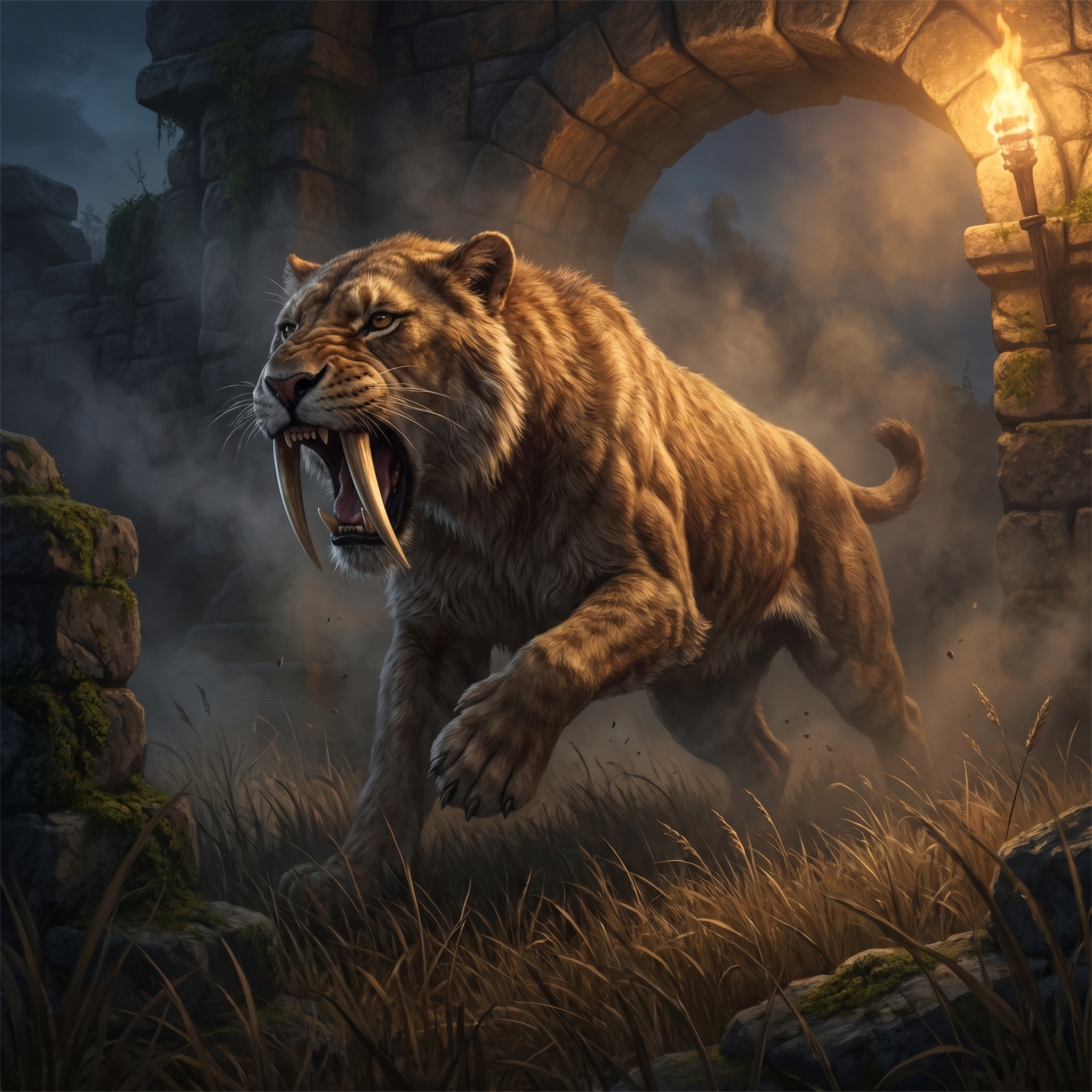
Role: Elite Ambusher / Executioner Where It Appears: Open plains, cold steppe, ancient hunting grounds.
Saber-toothed cats are ambush specialists built for one decisive wound. If the first strike fails, they often retreat rather than turn the hunt into a fair fight.
What It Is
A Saber-Toothed Cat is a heavy ambush predator built around a decisive bite. Its long fangs are not for repeated chewing combat; they are for ending a struggle quickly once prey is pinned.
It is dangerous because it is disciplined. If the kill does not happen cleanly, it may retreat and try again later rather than waste itself in a fair fight.
Ecology and Behavior
Saber-Toothed Cats favor open plains broken by tall grass, cold steppe, ancient hunting grounds, and scrub near game trails. They cache kills and return when the area quiets. They do not enjoy crowded battlefields but may stalk stragglers after one.
They read herd movement well and often attack at the edge of a panic, when prey is looking at something else.
Signs and Knowledge
Field signs: drag marks to a cache, paired deep punctures, crushed grass near ambush cover, scavengers waiting at a distance, old bones hidden under brush.
Survival (Average): identifies drag marks to a cache.
Survival (Hard): predicts likely ambush cover and whether the cat is still nearby.
Medicine (Average): recognizes saber punctures and how quickly a victim bled.
Saber-Toothed Cat (Elite)
- Skills: Unarmed 4, Stealth 4, Athletics 4, Perception 4, Survival 3.
- Attacks: Saber Bite (Unarmed; Damage 10; Crit 3; Pierce 2, Vicious 5); Raking Paws (Unarmed; Damage 7; Crit 4).
- Abilities: Killing Pounce - First attack from concealment adds 1 Boon and +2 damage.
- Abilities: Withdraw After Miss - Once per encounter after missing an attack, immediately move one range band as an incidental.
- Soul: No claimable coin exists; at death canon does not specify (default).
Tactics: The cat ambushes, bites, and retreats if wounded or denied a clean kill. It does not stay in a shield wall's reach unless cornered.
Encounter Use: Make the first round matter. This creature is about sudden violence, not attrition. Use it to make scouting, spacing, and rear guards important.
Harvesting and Trade
Fangs are the main prize. Hide value depends on how cleanly the creature was taken.
| Harvest | Buyer | Check | Typical Value | Use | Complication |
|---|---|---|---|---|---|
| Saber Fangs | Trophy buyer, ritual knife maker | Average Survival | 200-600 gold Flargons each | Knives, charms, status trophies | Cracked fangs lose most value |
| Spotted Hide | Tanner, noble, hunter | Average Survival | 200-800 gold Flargons | Cloaks, rugs | Bite and burn damage lower value |
| Ambush Cache | Local hunters, scavengers, party supplies | Survival to locate | Varies | Food, clues, missing gear | May draw the cat back |
Variants
Steppe Ghost: Elite, Stealth 5 in tall grass or snow, WND 20, Killing Pounce adds +4 damage.
Old Pride-Killer: Nemesis, WND 30, STR 15, Withdraw After Miss may trigger twice per encounter.
Shadow Monitor
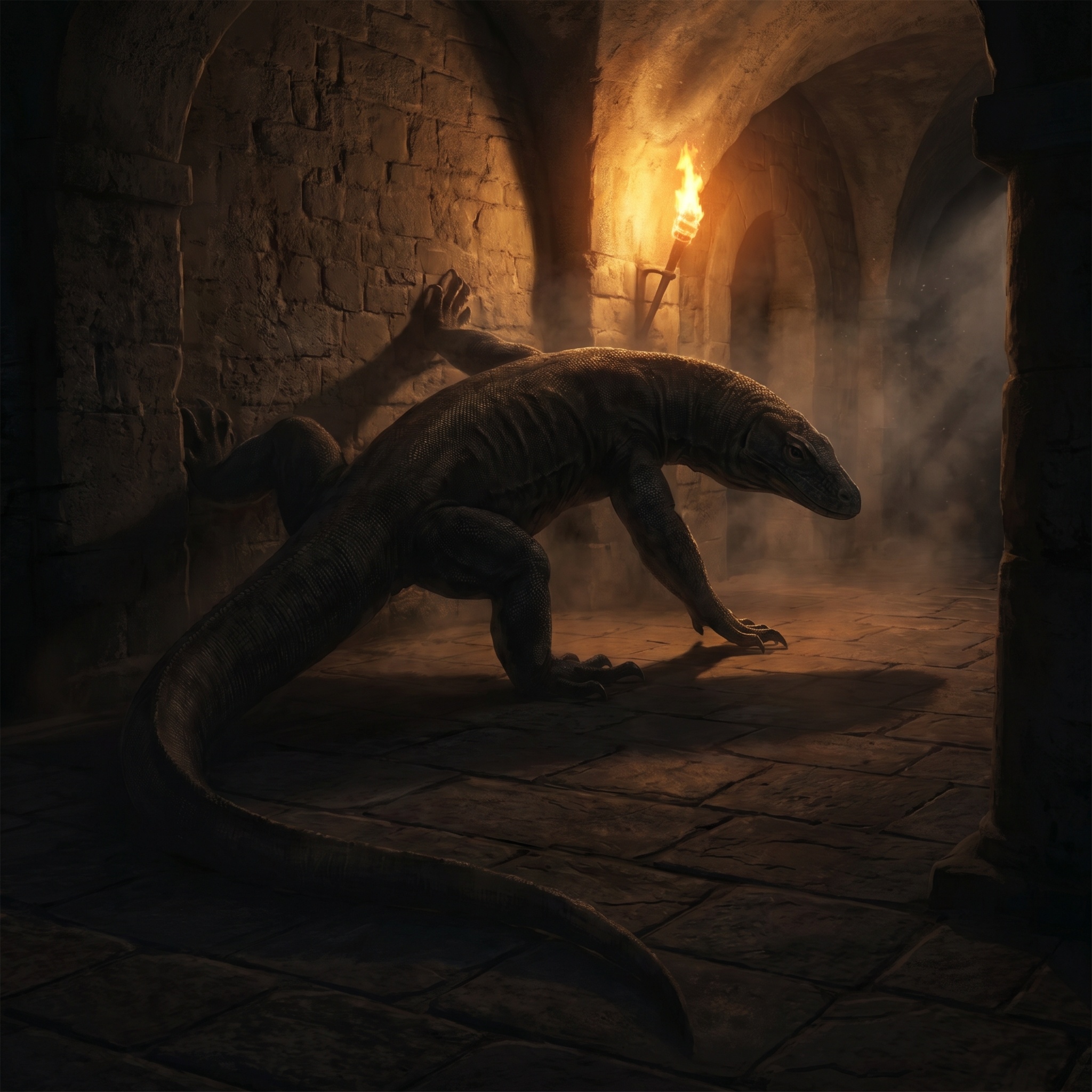
Role: Elite Lurker Where It Appears: Umbral Dragon territories, caves, old walls.
What It Is
Shadow monitors are draconic reptiles adapted to lightless territories. They are material predators, not Void entities. Their hides do not erase light; they drink enough of it to make edges uncertain.
They are ambush hunters for Umbral Dragon territories, caves, old walls, and ruined city undercrofts.
Ecology and Behavior
Shadow monitors live where darkness is stable: Umbral Dragon ranges, deep caves, abandoned walls, blackstone ruins, and old cisterns. They flatten against surfaces, wait near light sources, and drag prey into cracks where larger predators cannot follow.
They are solitary except during breeding. Hatchlings feed on insects around lamps, which can be the first sign of a nearby adult.
Signs and Knowledge
Survival or Adventuring Lore (Average) identifies missing-light hunting. Perception (Hard) notices a wall shadow breathing.
Other signs include torch soot scraped from one side only, claw marks inside narrow cracks, missing lantern-bearers, and small animals refusing dark wall edges.
Shadow Monitor (Elite)
- Skills: Stealth 5 in darkness, Unarmed 3, Reflexes 4, Perception 4.
- Attacks: Shadow Bite (Unarmed; Damage 7; Crit 4; Pierce 1).
- Abilities: Light-Slip Hide — In dim light, attacks against it add 1 Bane.
- Soul: No claimable coin exists; at death canon does not specify (default).
Tactics
A shadow monitor ambushes lights and drags prey into cracks. It targets the person making visibility possible, then retreats to dim surfaces where Light-Slip Hide matters. Bright, even illumination weakens its advantage.
Use it to make light placement tactical without invoking Void themes.
Harvesting and Trade
| Component | Value | Use | Harvest |
|---|---|---|---|
| Light-slip hide | 500-1,200 gold Flargons | Stealth cloaks, shade screens | Survival (Hard), value drops if overcut |
| Dark eye lenses | 400-1,000 gold Flargons | Night optics, alchemy | Medicine (Average) |
| Crack claws | 200-700 gold Flargons | Climbing hooks, lock picks | Craft or Survival (Average) |
Variants
- Wall Monitor: Hunts from masonry and ruined towers.
- Cistern Monitor: Uses water reflections to hide motion.
- Umbral Range Monitor: More patient and less afraid of magical darkness.
Shadow Panther
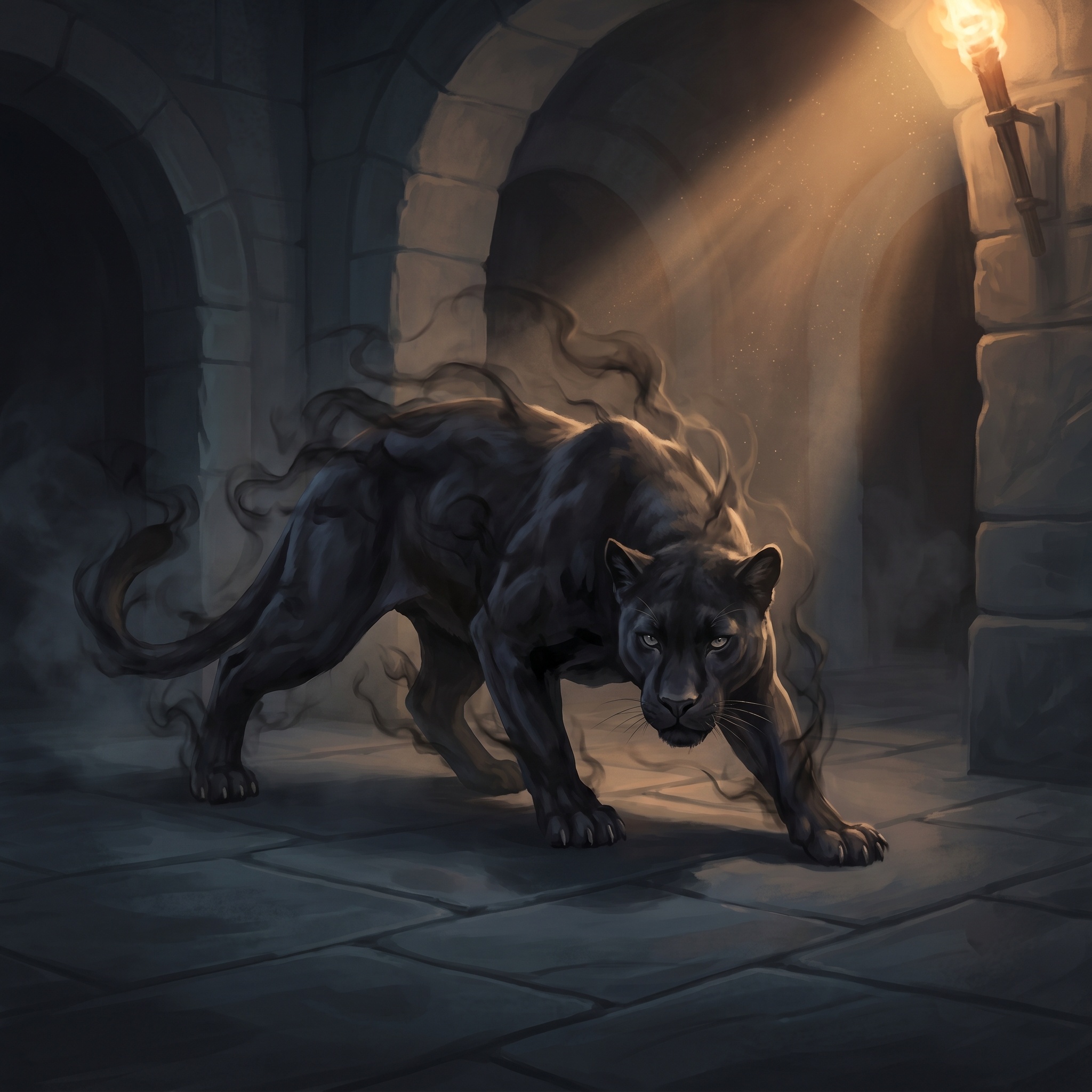
Role: Elite Ambusher Where It Appears: Old forests, deep ruins, moonless ravines.
What It Is
Shadow panthers are natural predators altered by long habitation in lightless places. They are not Void creatures; their gift is stealth, not absence. Their fur drinks torchlight, their paws fall without sound, and their eyes reflect only when they choose to let prey see them.
A shadow panther makes a strong wilderness or ruin threat because it is just intelligent enough to plan around the party's habits. It watches who carries light, who limps, who sleeps apart from the fire, and who reacts slowly when something moves at the edge of vision.
Ecology and Behavior
Shadow panthers descend from large cats that denned for generations in ravines, under-canopies, blackstone ruins, or caverns with faint magical seepage. They are solitary except for mothers with young. They maintain broad hunting ranges marked by clawed trees, dragged carcasses, and silent trails through brush.
They do not love darkness as an ideology. Darkness is simply where they win. They may break lanterns, knock cloaks over lamps, drag prey through water to douse torches, or wait until clouds cover the moon. A well-fed shadow panther may stalk intruders for sport and attack only if they enter its den.
Signs and Knowledge
Survival (Hard) identifies kills with no chase tracks. Perception (Hard) notices the shadow moving against the light.
Other signs include claw marks too high for wolves, drag trails that vanish under heavy cover, animals refusing to enter a dark ravine, and campfires that sputter in sudden gusts as something large passes just outside the light.
Shadow Panther (Elite)
- Skills: Unarmed 4, Stealth 5 in dim light, Perception 5, Reflexes 4.
- Attacks: Throat Bite (Unarmed; Damage 8; Crit 3; Pierce 1); Rake (Unarmed; Damage 7; Crit 4).
- Abilities: Light Edge — In dim light or darkness, attacks against it add 1 Bane.
- Abilities: Sudden Pounce — First attack from concealment adds +2 damage.
- Soul: No claimable coin exists; at death canon does not specify (default).
Tactics
A shadow panther does not start a fair fight. It circles downwind, tests the edges of torchlight, and pounces when someone is alone, prone, or distracted. If the first attack fails, it retreats into cover and attacks again later rather than standing in the open.
Use it to create tension across a travel scene or ruin approach. The first encounter may be a missing pack animal, the second a glimpse, the third a night attack. In a direct fight, make light placement and movement matter.
Harvesting and Trade
| Component | Value | Use | Harvest |
|---|---|---|---|
| Shadow-sheened hide | 600-1,500 gold Flargons | Cloaks, stealth charms, noble trophies | Survival (Hard), value drops if heavily pierced |
| Night eyes | 400-1,000 gold Flargons | Darkvision lenses and watchman talismans | Medicine or Survival (Hard) |
| Silent paw pads | 200-600 gold Flargons | Boots, thief tools, ritual components | Survival (Average) |
Variants
- Ravine Stalker: Excellent climber that attacks from above in narrow gullies.
- Lamp-Breaker: Trained or learned behavior focused on extinguishing carried lights.
- Old Blackmane: Nemesis panther with a known territory, scars, and a habit of stalking hunters who survived it once.
Striped Hyena
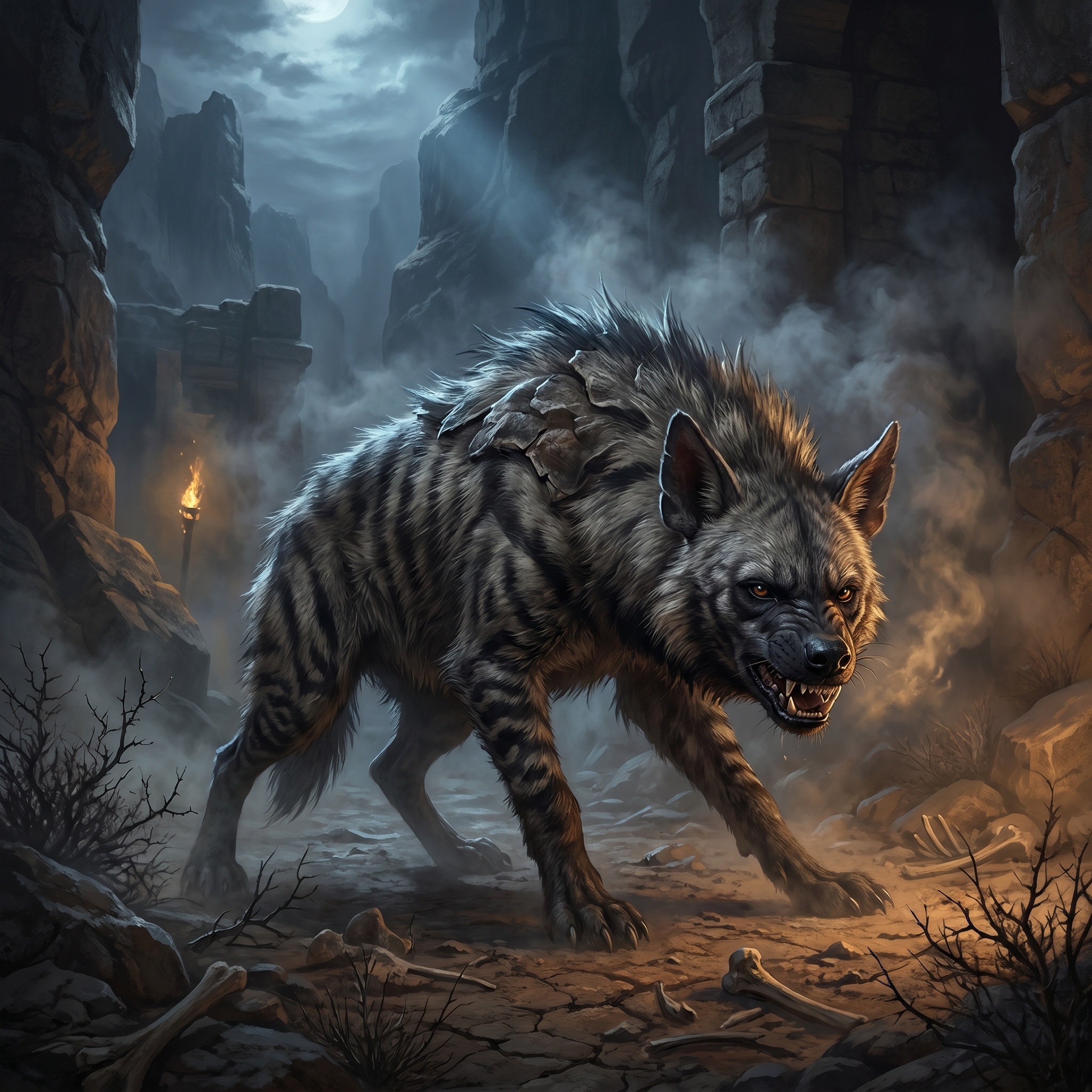
Role: Minion Scavenger-Predator Where It Appears: Deserts, dry savannas, battlefield margins, caravan routes.
The Striped Hyena is not the Gnarra. It is a large scavenging predator: clever, loud, and a great deal less interested in the outcome than the noise implies.
Signs and Knowledge: Survival (Average): identifies hyena territory by call patterns, bone scatter, and den entrances.
Striped Hyena (Minion)
- Group Size: 2–5.
- Skills: Unarmed 2, Athletics 3, Perception 3, Survival 3.
- Attacks: Bone Crunch (Unarmed; Damage 6; Crit 4; Pierce 1 against armor).
- Abilities: Carrion Sense — Detects blood, bodies, and wounded creatures at Medium range.
- Abilities: Waiting Game — Adds 1 Boon to attacks against wounded (below half Wounds) targets.
- Soul: No claimable coin exists; at death canon does not specify (default).
- Tactics: Circles wounded targets, calls to others, attacks only when odds are favourable.
- Encounter Use: Use in deserts and after battles. The calling before contact is the warning.
- Harvesting and Trade: No special value. Pelt is low-quality.
Variants
Pack Leader Hyena: Elite, WND 20. Directs the group; death causes them to scatter.
Vulture Flock
Role: Minion Scavenger / Harrier Where It Appears: Open country, battlefields, deserts, highland cliffs.
Vultures are scavengers. A flock of them around a dying or badly wounded target is a pressure problem as well as a morale one.
Signs and Knowledge: Survival (Average): circling vultures indicate something large and dying within sight range.
Vulture Flock (Minion)
- Group Size: 6–20.
- Skills: Unarmed 2, Athletics 3, Perception 4.
- Attacks: Pecking Swarm (Unarmed; Damage 4; Crit 5; against downed or Immobilized targets only — add 1 Boon).
- Abilities: Circling — As long as a creature below half Wounds is present in the scene, the flock does not scatter even when threatened.
- Soul: No claimable coin exists; at death canon does not specify (default).
- Tactics: Circles; lands on downed targets; scatters from fire and loud noise but returns.
- Encounter Use: Signal encounters: a flock circling something is a flag. Use them on downed allies to create urgency.
- Harvesting and Trade: Flight feathers have minor craft value (10–30 gold Flargons each). No special harvest.
Variants
Desert Vulture King: Elite, WND 18. Larger and more aggressive; attacks living targets below half Wounds.
Warthog
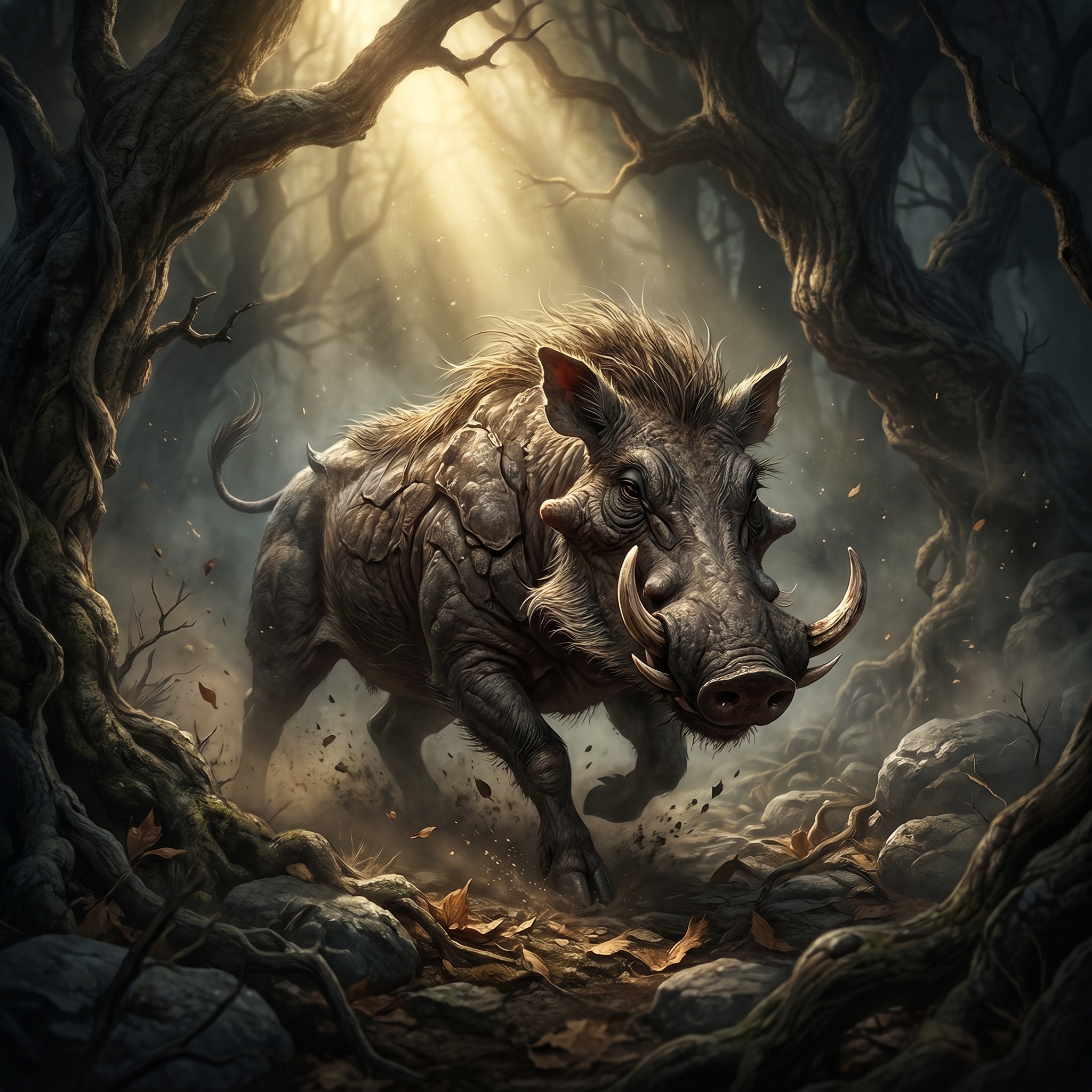
Role: Minion Aggressive Grazer Where It Appears: Savannas, scrublands, open farmland, desert margins.
A Warthog is a plough with tusks and a very short temper. Most people who are charged by one had time to avoid it and chose not to.
Signs and Knowledge: Survival (Average): identifies warthog burrow clusters and territorial markers.
Warthog (Minion)
- Group Size: 2–6.
- Skills: Unarmed 2, Athletics 3, Fortitude 3, Perception 2.
- Attacks: Tusk Slash (Unarmed; Damage 7; Crit 4; Bleeding 1).
- Abilities: Charge and Cut — If it moves before attacking, Tusk Slash gains +1 damage.
- Soul: No claimable coin exists; at death canon does not specify (default).
- Tactics: Charges, slashes, runs. Group-charges if cornered.
- Encounter Use: Route hazards in warm open country. Good at making mounts panic.
- Harvesting and Trade: Tusks sell for 50–150 gold Flargons as craft material. Meat is edible and valued locally.
Variants
Old Boar Warthog: Elite, WND 18. Aggressive beyond its weight class. Has the scars to prove multiple encounters.
Wild Boar
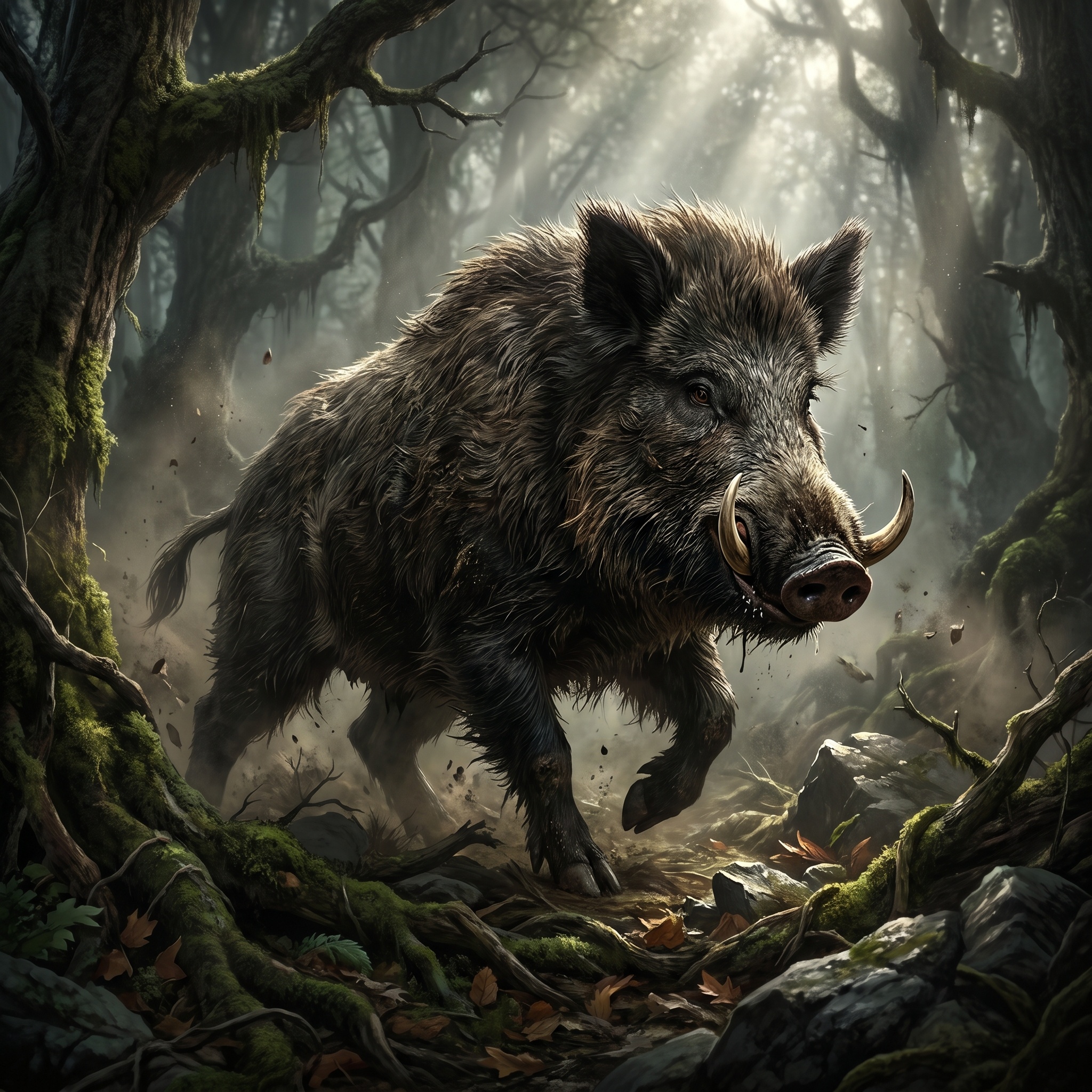
Role: Minion Aggressive Grazer Where It Appears: Oak forests, farmland edges, river bottoms, marshes.
This is not the Razorback Boar. It is smaller, more common, and encountered in groups. The charge pattern is identical. There are just more of them.
Signs and Knowledge: Survival (Average): identifies rooting, territory marking, and approach direction.
Wild Boar (Minion)
- Group Size: 2–5.
- Skills: Unarmed 2, Athletics 3, Perception 2, Fortitude 3.
- Attacks: Tusk Slash (Unarmed; Damage 7; Crit 4; Bleeding 1 on 2 Boons).
- Abilities: Group Charge — If two or more boars charge the same target simultaneously, the target must make an Average Athletics or be knocked Prone.
- Soul: No claimable coin exists; at death canon does not specify (default).
- Tactics: Scatter on charge, slash, continue through. Reform and repeat.
- Encounter Use: Farmland encounters. Foraging parties. Wherever someone has recently stored grain.
- Harvesting and Trade: Boar meat is valued locally (50–200 gold Flargons per animal). Tusks for 30–80 gold Flargons as craft material. Common.
Variants
Sow with Piglets: Minion, but attacks without retreat when piglets are in the area. More dangerous than the male.
Wild Dog Pack
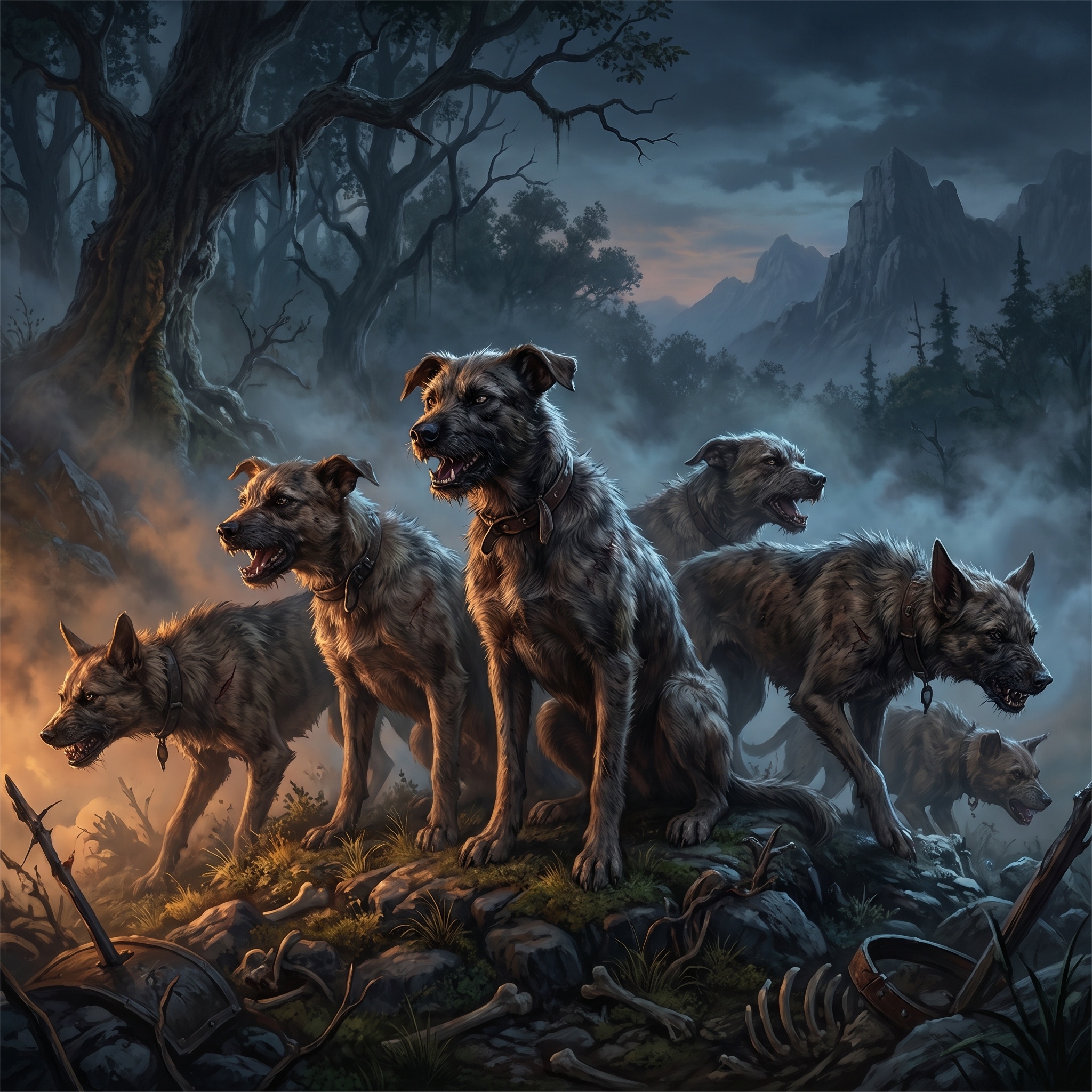
Role: Minion Scavenger-Hunter Where It Appears: City margins, battlefields, abandoned farms, war-torn roads.
Wild dogs are not wolves. They are bolder in cities, faster to scavenge, and significantly less interested in fair outcomes. They travel in ragged packs and are not afraid of buildings.
Signs and Knowledge: Survival or Streetwise (Average): identifies recent wild dog activity: scattered food, scavenged gear, territorial urine marks at chest height on posts.
Wild Dog Pack (Minion)
- Group Size: 4–10.
- Skills: Unarmed 2, Athletics 3, Stealth 2, Perception 3.
- Attacks: Snapping Bite (Unarmed; Damage 5; Crit 4; Grabbed on 2 Boons).
- Abilities: Disease 1 (Vermin Fever) — On 2 Boons from a Snapping Bite that wounds the target, the target makes an Average Willpower check. Failure brings a minor fever before the next rest; the target adds 1 Bane to all checks until the end of the next day without treatment. Recovery requires one extended rest in clean conditions. Cure by Average Medicine, fever herbs, antitoxin, or suitable divine healing removes the effect.
- Abilities: Scatter and Return — If the group is reduced below half Wounds, it withdraws to Short range and reassesses. It attacks again if targets are weakened or alone.
- Soul: No claimable coin exists; at death canon does not specify (default).
- Tactics: Target the smallest, the wounded, the one who dropped something worth fighting over.
- Encounter Use: Use as a pressure problem in cities and on roads after battles. Good at revealing who in the party is already hurt.
- Harvesting and Trade: No harvest value.
Variants
Pack Leader: Elite, WND 22. Attacks with 1 Boon; death disperses the pack.
Wolf

Role: Minion Pack Predator Where It Appears: Forest roads, mountain valleys, winter borderlands.
Wolves are not Dire Wolves. They are smaller, faster, and smarter about when to commit. A pack of wolves tests its prey: separates, watches, and attacks only when the math works.
Signs and Knowledge: Survival (Average): identifies pack direction, reads howl patterns, knows the retreat that is not a retreat.
Wolf (Minion)
- Group Size: 3–8.
- Skills: Unarmed 3, Athletics 3, Stealth 3, Perception 3, Survival 3.
- Attacks: Pack Bite (Unarmed; Damage 6; Crit 4; Hamstring on 2 Boons — target adds 1 Bane to movement checks until treated).
- Abilities: Pack Flank — Add 1 Boon to attacks against a target already engaged with another wolf group.
- Abilities: False Retreat — When the pack group drops below half Wounds, it may disengage and reposition to Short range rather than fleeing. If the party pursues, it turns and attacks with 1 Boon.
- Soul: No claimable coin exists; at death canon does not specify (default).
- Tactics: Circle the rear, pull mounts, drag one target out of light.
- Encounter Use: Use wolves in weather and darkness. The howls before contact are the encounter.
- Harvesting and Trade: Pelts sell for 30–80 gold Flargons each to furriers. Common; low individual value.
Variants
Dire Wolf Kin: Elite, WND 17, Hamstring is automatic on any Wound. Larger, rangier, hunts alone or in pairs.