Not every dangerous thing in Dort answers to a plane, a god, or a cult. A Chimera does not serve Buuna Moc. A Griffon has no theological grievance. A Bridge Troll wants a toll paid, not a soul claimed. These are the setting's inherited monster-manual stock: predators and fabled beasts that exist because a wilderness needs teeth in it, without needing a cosmology to justify the teeth.
That does not make them simple. A Bridge Troll runs its crossing like a business with centuries of precedent behind it. A Manticore hunts with more patience than its reputation suggests. What unites this chapter is only that none of them require a session of world-building lore before a GM can use them. Drop one in, reskin it freely, and let the encounter be about the fight and the terrain rather than the metaphysics.
At the table: this is the chapter to reach for when a region needs a dangerous animal and the campaign does not need another faction. Use these to fill the space between the plot-relevant threats.
Bridge Troll
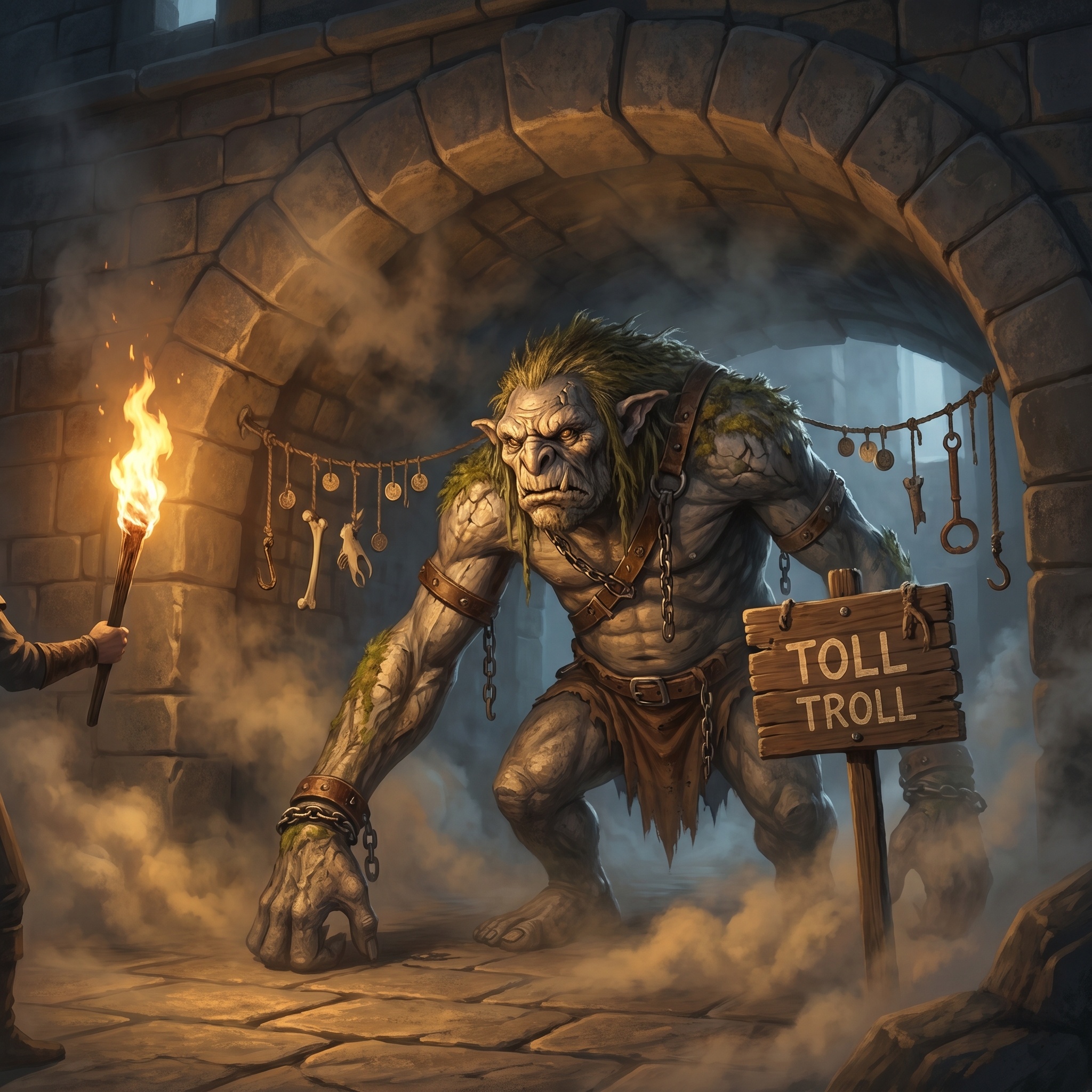
Role: Nemesis Bruiser / Social Obstacle Where It Appears: Old bridges, ravines, ford roads, border crossings.
"It let us pass the third time when we remembered its name. The name was not difficult. We had simply not thought to use it." — Travel journal, Merchant Oran Kettwell, Antaea routes
Bridge trolls are not giant-kind. They are old, ugly, territorial fae-adjacent brutes with a deep sense of payment. Some are barely verbal. Others keep ledgers more honestly than barons.
What It Is
A Bridge Troll is a territorial brute bound by habit, appetite, and a concept of payment that may be older than the bridge it guards. It is not giant-kind. It is not just a big bandit. The bridge, ford, or ravine is part of the creature's identity.
Some Bridge Trolls barely speak beyond price and threat. Others know every toll paid for fifty years and can recite which baron cheated which widow.
Ecology and Behavior
Bridge Trolls claim crossings because crossings create leverage. Food, coin, livestock, secrets, and safe passage all move through narrow places. A troll that holds one long enough becomes part of local economy, law, and folklore.
They prefer payment to injury. Fighting damages the bridge, scares future toll, and risks fire. But cheating a troll can turn a social obstacle into a murder scene very quickly.
Signs and Knowledge
Field signs: toll ropes, bone charms, repaired bridge stones too large for humans to move, warning graffiti, fish bones under the span, ledgers wrapped in oilskin.
Lore or Adventuring Lore (Average): knows local toll customs and safe forms of address.
Negotiation (Hard): may reduce the demanded price without a fight.
Bureaucratic or legal context via Lore (Hard): may prove the troll's claimed toll is invalid, inherited, or already paid.
Bridge Troll (Nemesis)
- Skills: Heavy Melee 4, Athletics 5, Fortitude 5, Perception 3, Intimidation 4, Negotiation 2.
- Attacks: Toll Club (Heavy Melee; Damage 11; Crit 3; Knockdown on 2 Boons); Hurl Stone (Heavy Ranged; Damage 9; Crit 4; Range Short).
- Abilities: Regrowth Meat - At the end of each round, recover 3 Wounds unless damaged by fire or acid that round.
- Abilities: Bridge Claim - On its bridge or ford, add 1 Boon to Athletics and Intimidation checks.
- Soul: No claimable coin exists; at death canon does not specify (default).
Tactics: The troll demands payment, blocks crossing, and knocks enemies into water or ravine if cheated. If badly burned, it retreats under the bridge and attacks supports, making the crossing itself the hostage.
Encounter Use: Make negotiation real. Fighting should be one possible bad answer. A good Bridge Troll scene has prices, loopholes, local witnesses, and a bridge the party may need intact.
Harvesting and Trade
Troll tissue is valuable because it regrows, but it spoils into useless sludge unless preserved correctly.
| Harvest | Buyer | Check | Typical Value | Use | Complication |
|---|---|---|---|---|---|
| Regenerative Tissue | Alchemist, battlefield surgeon | Hard Medicine | 800-1,800 gold Flargons | Healing research, graft tonics | Requires acid-washed jars within one hour |
| Troll Bile | Alchemist, tanner, acid worker | Hard Medicine or Survival | 500-1,500 gold Flargons | Preservation acids, anti-regrowth compounds | Burns containers not prepared for it |
| Toll Ledger | Local court, merchant guild, historian | Lore to interpret | 0-5,000 gold Flargons | Debt proof, local claims, blackmail | May show the party owes more than expected |
Variants
Ledger Troll: Nemesis, Negotiation 4, Lore 3, lower damage by 1 but can weaponize debts and names in social scenes.
Broken-Bridge Troll: Nemesis, WND 43, Bridge Claim applies to rubble and collapsed crossings; angrier, less negotiable.
Carrion Crawler
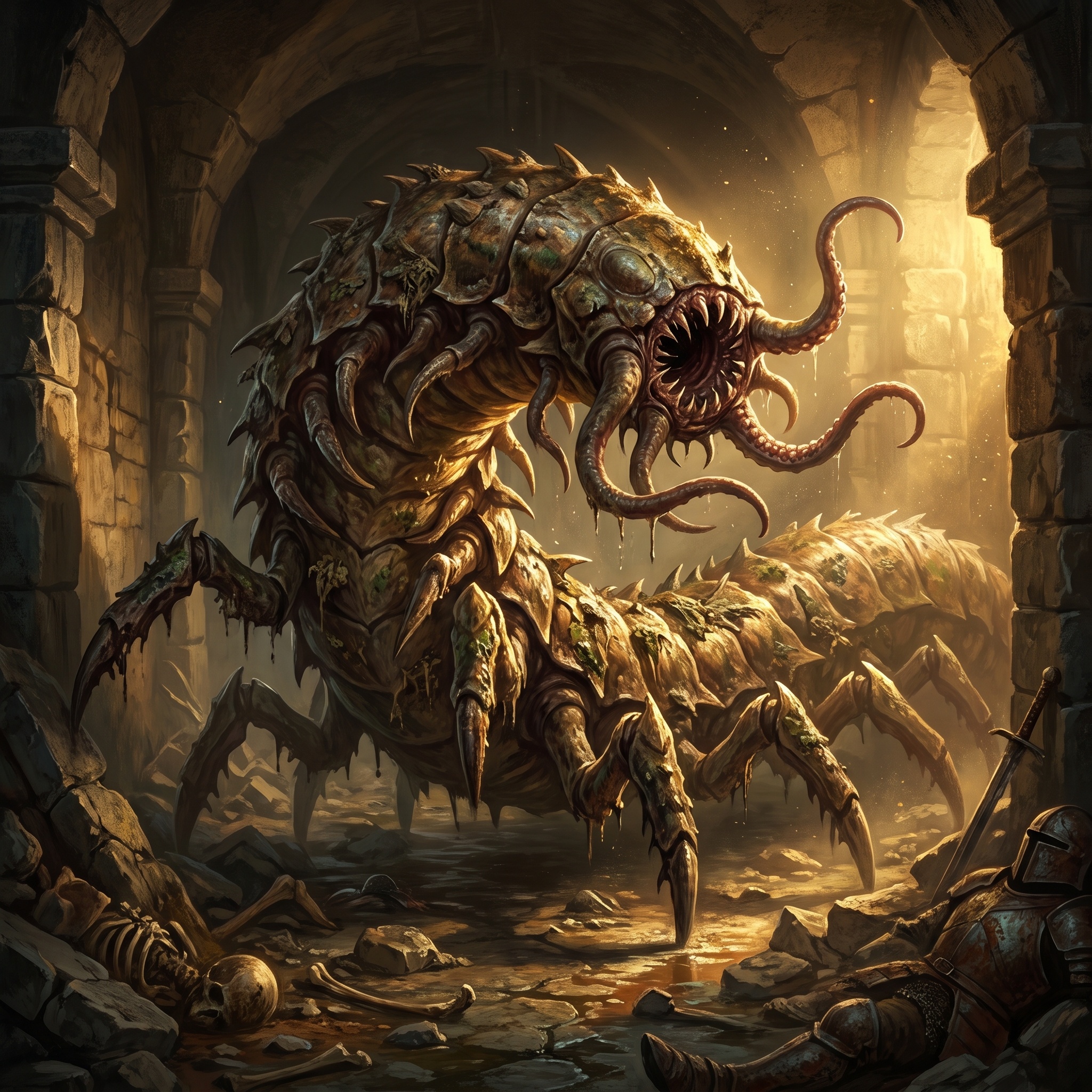
Role: Elite Dungeon Predator Where It Appears: Crypts, sewers, underground passages with accessible corpses.
A Carrion Crawler arrives after the fight. It is drawn to blood and the recently dead, and it paralyzes the living because the living are annoying rather than frightening.
Signs and Knowledge: Adventuring Lore (Average): identifies the pale chitinous trails and the smell of a Carrion Crawler's territory.
Carrion Crawler (Elite)
- Skills: Unarmed 3, Stealth 3 in sewers, Perception 4, Fortitude 4.
- Attacks: Tentacle Lash (Unarmed; Damage 5; Crit 5; Range Short; Paralysis on 2 Boons — Hard Fortitude or Immobilized for one round); Mandible Bite (Unarmed; Damage 8; Crit 4; Pierce 1; against Immobilized targets only).
- Abilities: Multiple Tentacles — May attempt Tentacle Lash against two different targets in one Action.
- Abilities: Attracted to Blood — If a living creature is Wounded in the scene, add 1 Boon to all its checks next round.
- Soul: No claimable coin exists; at death canon does not specify (default).
- Tactics: Paralyzes from distance, bites paralyzed targets, retreats back into passage.
- Encounter Use: Sewers and underground after a fight. Reward the party for handling their downed allies before the crawler gets to them.
- Harvesting and Trade: Paralytic gland sells for 400–1,000 gold Flargons (Hard Medicine). Claw segments for 100–300 gold Flargons.
Variants
Pit Crawler: Nemesis, WND 36. Can paralyze three targets simultaneously; has learned which passages lead to fresh bodies.
Cave Fisher
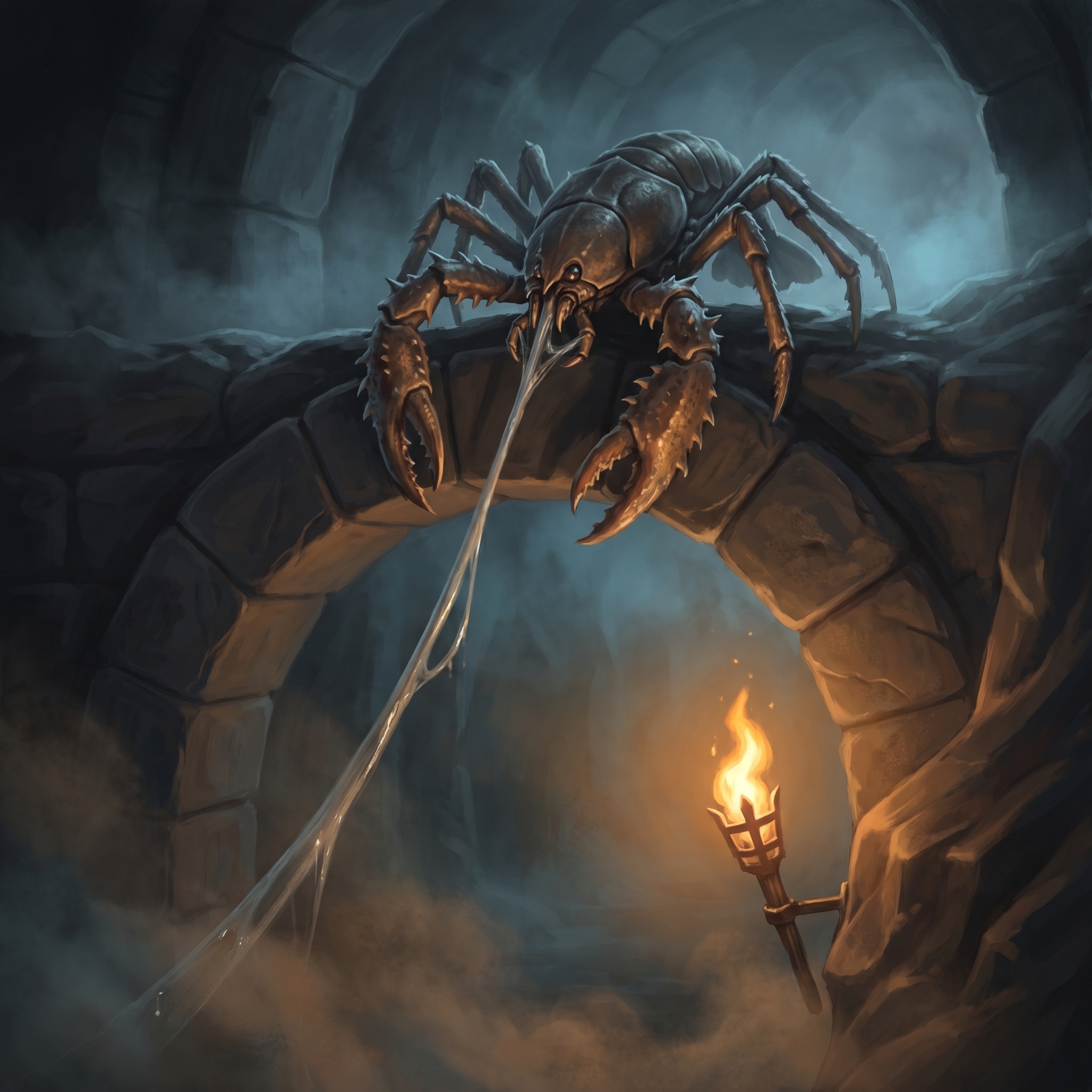
Role: Elite Lurker Where It Appears: Caverns, sinkholes, bridge undersides, mine galleries.
What It Is
Cave fishers cast sticky filaments into paths below. The victim thinks they touched a rope until it tightens and the ceiling starts pulling. The creature itself resembles a pale crustacean folded into a crack, with claws braced against stone and a spinneret that can cast adhesive line across open air.
Cave fishers are classic dungeon predators because they turn the party's own formation against them. The front line passes beneath the filament. The second rank notices too late. The light-bearer looks up only after someone is already rising into darkness.
Ecology and Behavior
Cave fishers need ceiling cracks, ledges, and steady traffic. They live above animal trails, mine cart routes, underbridges, and tunnel junctions. A fisher's den is usually narrow enough that only one or two people can reach it at a time, which lets the creature defend its meal while the rest of the party struggles below.
They molt several times in their lives, leaving brittle shells that inexperienced delvers mistake for dead threats. Fishers are solitary except during breeding season, when several may cast lines into the same chamber. They fear sustained flame because it ruins the filament glands.
Signs and Knowledge
Adventuring Lore (Average) identifies old empty shells. Perception (Hard) sees the filament.
Other signs include smooth drag marks that end beneath a ceiling crack, bones tucked high in alcoves, broken lanterns with no footprints nearby, and a faint vinegar smell from fresh adhesive. Dust thrown ahead may reveal the line before contact.
Cave Fisher (Elite)
- Skills: Heavy Ranged 4, Athletics 3, Stealth 3, Perception 3.
- Attacks: Filament Snare (Heavy Ranged; Damage 3; Crit 5; Range Short; Grabbed on hit); Mandibles (Unarmed; Damage 7; Crit 4).
- Abilities: Reel In — As a Maneuver, pull a Grabbed target one range band toward the fisher unless the target succeeds at Average Athletics or Reflexes.
- Abilities: Cut the Line — The filament has RES 1 and WND 4.
- Soul: No claimable coin exists; at death canon does not specify (default).
Tactics
A cave fisher opens with Filament Snare from concealment, reels a target upward, then uses the victim's body and the ceiling angle as cover. If the line is cut, it retreats deeper into the crack and casts again only if it still has surprise or elevation.
Use the fisher to make equipment matter. Ropes, polearms, grapnels, thrown dust, shields raised overhead, and quick cutting tools should all help. The creature is unfair only if the party had no way to suspect a vertical threat.
Harvesting and Trade
| Component | Value | Use | Harvest |
|---|---|---|---|
| Filament glands | 250-600 gold Flargons | Adhesive, surgical binding, trap lines | Medicine or Natural Philosophy (Average), spoils if overdried |
| Spinneret hook | 150-400 gold Flargons | Fine grapnels and line guides | Craft (Average) |
| Molted shell | 50-200 gold Flargons | Lightweight plates, false monster signs | Simple collection if intact |
Variants
- Bridge Fisher: Casts from bridge undersides and targets riders or pack animals.
- Crystal Fisher: Filament is harder to see and resonates when struck.
- Old Line-Caster: Larger specimen with several prepared anchor lines in one chamber.
Chimera
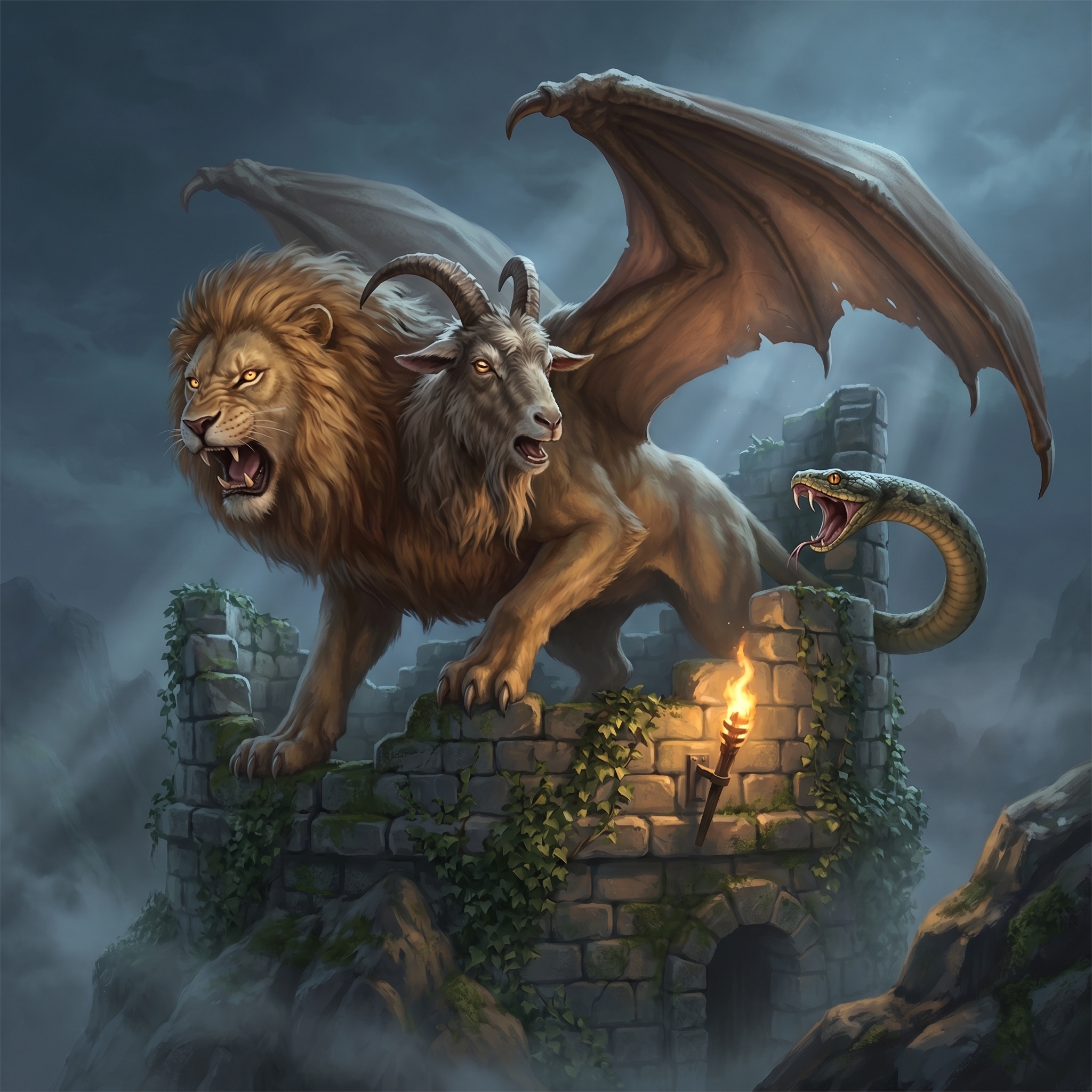
Role: Nemesis Bruiser / Controller Where It Appears: Broken highlands, cursed breeding pits, remote ruins, volcanic scrub.
"It does not decide between its heads. It argues. The argument is fast and it always reaches the same conclusion: you." — Adventuring Lore primer, chapter on composite creatures
A chimera is a living argument between three hungers. It is not smart in a human way, but each head watches, reacts, and remembers different threats. This makes it hard to distract and harder to flank.
What It Is
A chimera is a composite predator with three competing centers of appetite: lion, goat, and serpent. Each head watches a different part of the battlefield and responds with different instincts. The result is not intelligence so much as overlapping vigilance.
Some chimeras are natural monstrosities from cursed regions. Others are the legacy of breeding pits, failed alchemy, or old war magic that kept making weapons after the war ended.
Ecology and Behavior
Chimeras claim broken highlands, ruined watchtowers, volcanic scrub, and cliffs where they can see prey from multiple angles. They are territorial and irritable because their own instincts do not fully agree. One head may want to feed, another to posture, another to strike at movement.
They do not form packs. Mated pairs are rare and catastrophic for nearby herds. A chimera lair often contains bones sorted accidentally by which head preferred which prey.
Signs and Knowledge
Field signs: mixed tracks from one body, scorched and poisoned carcasses, horn-scarred stone, three-direction watch marks near a lair, prey remains dragged to high ground.
Adventuring Lore (Average): identifies mixed tracks and knows the creature is hard to flank.
Natural Philosophy (Hard): knows which head controls which attack and which glands are valuable.
Survival (Hard): reads which head has been dominant recently from feeding remains and predicts opening behavior.
Chimera (Nemesis)
- Skills: Unarmed 4, Athletics 4, Fortitude 4, Perception 4, Survival 3, Intimidation 3.
- Attacks: Lion Bite (Unarmed; Damage 10; Crit 3; Pierce 2); Horn Crush (Unarmed; Damage 9; Crit 4; Knockdown on 2 Boons); Serpent Strike (Unarmed; Damage 7; Crit 4; Poison 2).
- Abilities: Three-Headed Vigilance — Immune to normal flanking benefits; ambush checks against it add 1 Bane.
- Abilities: Discordant Breath — Once every other round, Short range blast of choking heat and venom; Heavy Ranged, Damage 9, Blast 4, Burn 2 or Poison 2 chosen by GM.
- Soul: No claimable coin exists; at death canon does not specify (default).
Tactics: The chimera opens with breath, gores armored targets, bites fallen prey, and serpent-strikes anyone trying to circle. It resists feints well but can be baited by presenting different threats to different heads.
Encounter Use: Use terrain that lets each head matter: ledges, broken walls, multiple approaches, and a reason the party cannot simply back away. Let players discover that blinding or distracting one head does not solve the whole creature.
Harvesting and Trade
Chimera harvesting is lucrative because each head carries different useful tissue. It is also dangerous because the serpent glands can remain active after death.
| Harvest | Buyer | Check | Typical Value | Use | Complication |
|---|---|---|---|---|---|
| Serpent Venom Gland | Alchemist, poisoner, physician | Hard Medicine or Natural Philosophy | 800-1,800 gold Flargons | Antivenom, venom, paralytic study | Calamity exposes harvester to Poison 2 |
| Fire-Throat Sac | Alchemist, pyrotechnician | Hard Medicine | 800-2,000 gold Flargons | Fire oils, breath studies | Can rupture if cut with hot metal |
| Horn Crown | Trophy buyer, wandwright | Average Survival | 400-1,200 gold Flargons | Trophies, rough foci | Low value if cracked during fight |
| Mixed Hide Panels | Armorer, collector | Average Survival | 300-900 gold Flargons | Patchwork armor, proof of kill | Hard to tan evenly |
Variants
Pit-Bred Chimera: Nemesis, WND 50, gains 1 Boon to attacks while in an arena, kennel, or enclosed ruin.
Old Three-Hunger: Nemesis, STR 22, Discordant Breath can choose both Burn 2 and Poison 2 by spending 2 Strain.
Dunemaw Pit
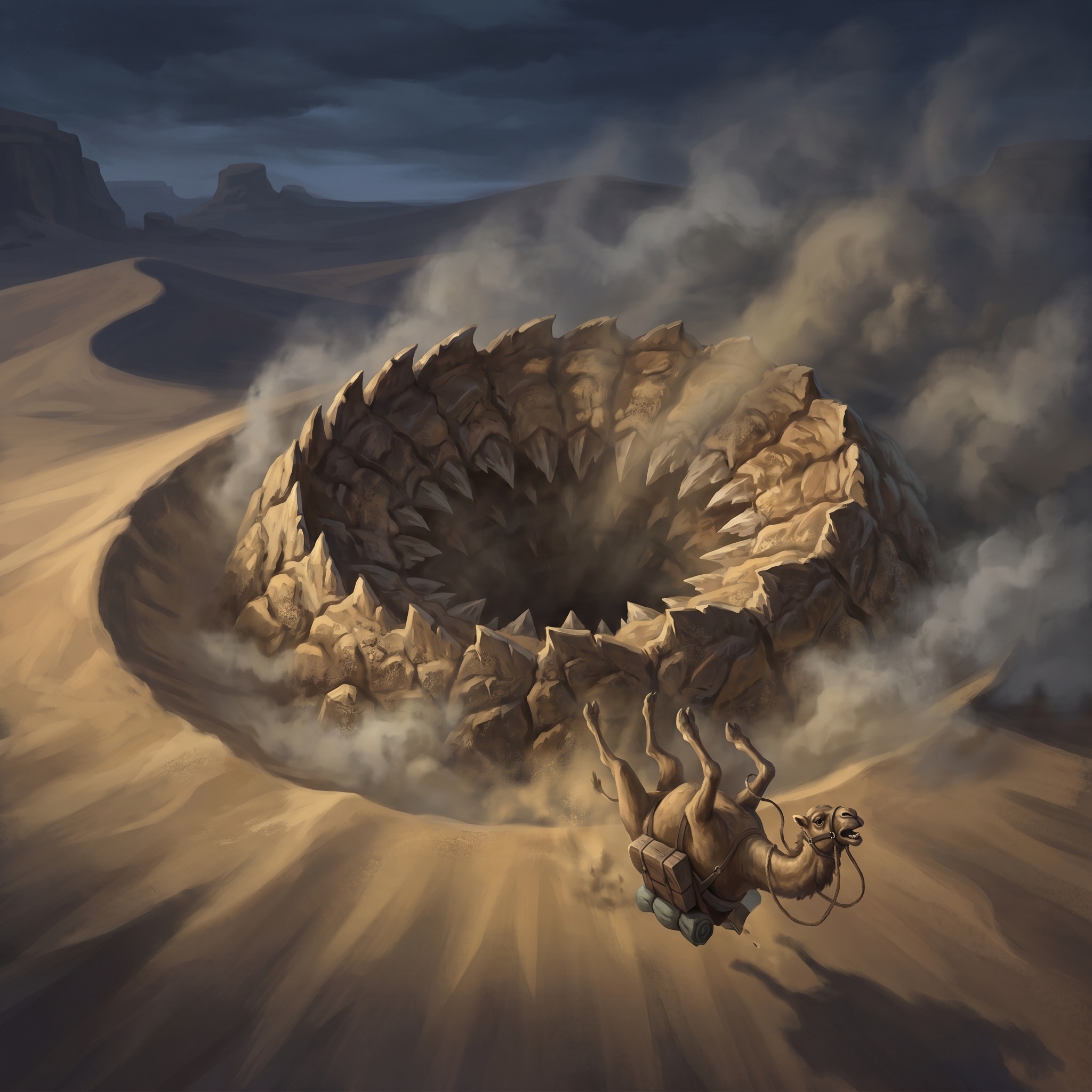
Role: Elite Ambusher Where It Appears: Deep dunes, dry basins, caravan grave routes. Source: Dort Monsters - Dunemaw Pit.
A Dunemaw Pit is the desert pretending to be empty. It is not a pit dug by another creature but a buried, sessile predator: a muscular throat, inward teeth, and tendrils lying just beneath the sand until weight and vibration wake it.
What It Is
The visible creature is usually only a circular depression, a ripple under sand, or a caravan animal suddenly dropping where the ground seemed solid. The main body remains buried and moves slowly through loose substrate between meals. A large Dunemaw can swallow a pack animal and leave behind only a collapsed bowl of stained sand.
It is mindless in the social sense, but not random. It waits where traffic is predictable: old routes, dry basins, dune saddles, and wind-erased paths where travelers are least able to read the ground.
Ecology and Behavior
Dunemaws feed rarely. One large meal can sustain a pit for months, which is why known territories can seem safe for long stretches before killing several travelers in one day. They detect vibration and prefer heavy targets: camels, wagons, armored people, and anyone running.
Desert communities mark known pits with cairns when they can do so safely. The problem is that Dunemaws relocate after feeding, slowly burrowing sideways beneath the sand and leaving old warnings behind.
Signs and Knowledge
Field signs: circular depressions, absence of small animal tracks, wind-smoothed bowls, old cairns that seem misplaced, faint sand breathing, scattered cargo without bodies.
Survival or Adventuring Lore (Average): identifies likely Dunemaw ground and safe spacing for a caravan.
Survival (Hard): spots a buried Dunemaw before it opens, usually by reading track absence rather than the creature itself.
Natural Philosophy (Hard): identifies old feeding bowls and predicts relocation direction from sand collapse.
Dunemaw Pit (Elite)
- Skills: Stealth 4 while buried, Athletics 4, Fortitude 4, Perception 3.
- Attacks: Maw Clamp (Unarmed; Damage 10; Crit 3; Pierce 2); Sand Drag (Unarmed; Damage 7; Crit 4; Grabbed on 2 Boons).
- Abilities: Buried Predator — Detecting a hidden Dunemaw requires a Hard Survival or Adventuring Lore check. Failure with 2 Banes places one target at Engaged range when the fight starts.
- Abilities: Pull Under — When Maw Clamp deals Wounds, the target makes a Hard Athletics or Reflexes check. On failure, it is dragged beneath the sand, Immobilized, and begins suffocating at the end of its next turn unless freed.
- Soul: No claimable coin exists; at death canon does not specify (default).
Tactics: The Dunemaw opens from concealment, grabs the heaviest target, and retreats below the surface rather than fighting the whole group. It targets rescue attempts with tendrils because moving bodies create more vibration.
Encounter Use: One Dunemaw is a rescue scene. Two are a disaster. Use spacing, pack animals, wagons, water skins, ropes, and the question of whether the party saves cargo or people first.
Harvesting and Trade
Dunemaw remains are useful but unpleasant. Many caravan towns pay for proof a local pit is dead, which may be more valuable than the creature's parts.
| Harvest | Buyer | Check | Typical Value | Use | Complication |
|---|---|---|---|---|---|
| Tendril Fiber | Ropemaker, trapper, alchemist | Average Survival | 300-800 gold Flargons | Buried snares, sand anchors, tough cordage | Fibers twitch for hours after death |
| Maw Teeth | Collector, desert hunter, toolmaker | Average Survival | 200-600 gold Flargons | Saw edges, trophies, warnings | Often cracked by bad extraction |
| Digestive Sand Gland | Alchemist, tanner, poisoner | Hard Medicine | 800-1,800 gold Flargons | Desiccants, leather stripping, acid mixtures | Leaks caustic slurry on failed harvest |
| Confirmed Kill Token | Caravan guild, route warden | Proof, no check | 500-2,000 gold Flargons | Bounty and route safety | Guild may demand location confirmation |
Variants
Brood Dunemaw: Minion version, WND 6 each, Group Size 2-4, no Pull Under suffocation.
Old Route Dunemaw: Elite, WND 20, Buried Predator adds 3 Banes to detection after a sandstorm, but it cannot relocate quickly after feeding.
Griffon
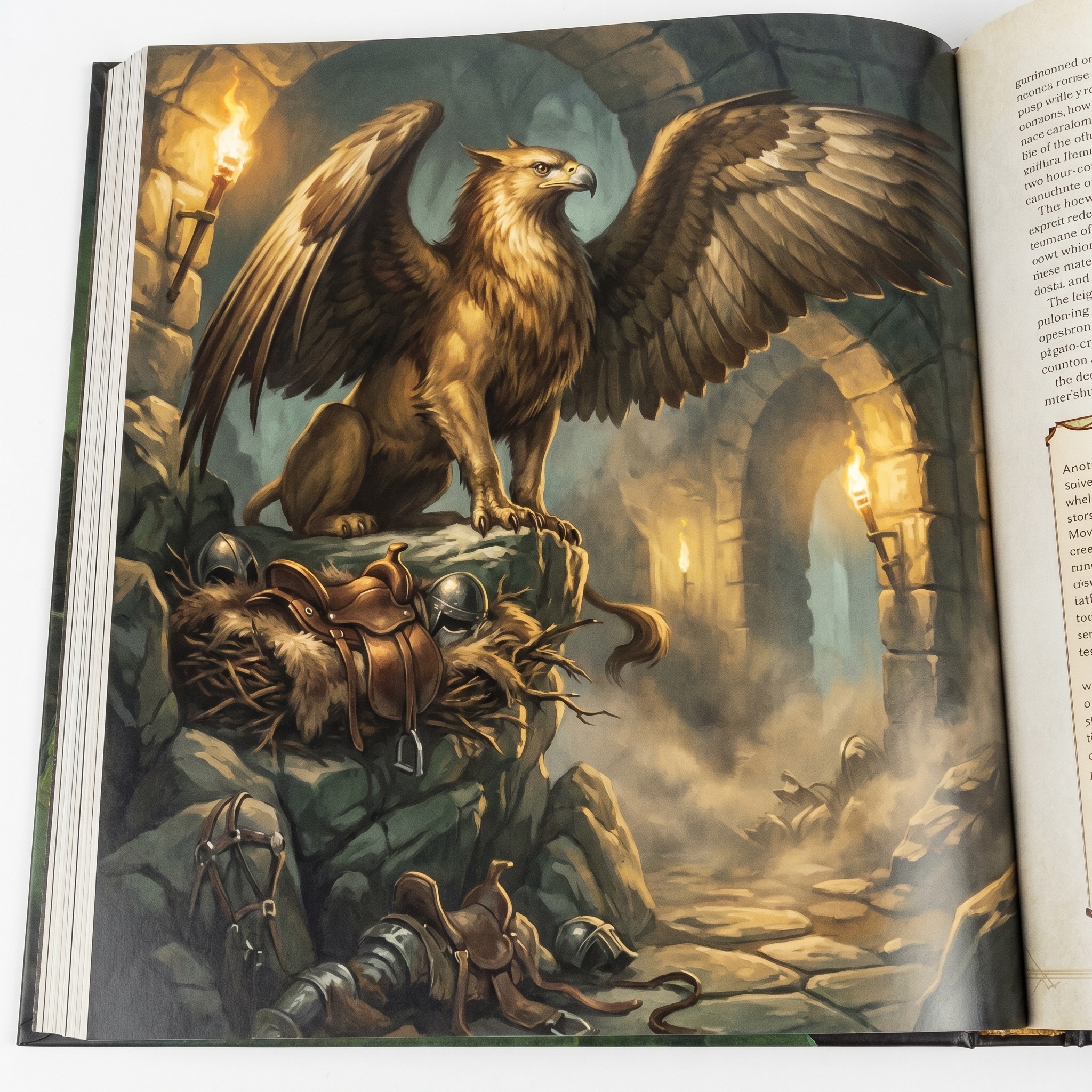
Role: Elite Harrier / Guardian Where It Appears: Mountain aeries, noble hunting ranges, high passes.
Griffons are proud, trainable only when raised from the shell, and violently possessive of nesting cliffs. Wild griffons target horses first; trained ones learn to target commanders.
What It Is
A griffon is an eagle-fronted, lion-bodied aerial predator with a particular hatred for vulnerable mounts. It is strong enough to carry a rider, proud enough to resist humiliation, and smart enough to remember the difference between a handler and a thief.
Wild griffons are nest guardians and horse-killers. Trained griffons are expensive military assets raised from eggs under strict control.
Ecology and Behavior
Griffons nest on cliffs overlooking grazing, roads, or high passes. They hunt by stoop, seize with talons, and retreat to ledges where ground-bound prey cannot easily follow. Their territories are often contested by nobles who want prestige beasts and shepherds who want their herds alive.
A wild adult cannot simply be broken to saddle. Attempts usually produce dead trainers. Eggs and hatchlings can be raised, which is why griffon eggs create immediate legal, ethical, and military attention.
Signs and Knowledge
Field signs: plucked horse remains, lion-like scat with feathers, cliff nests lined with tack, claw marks on saddle leather, mounts refusing a pass.
Survival (Average): identifies griffon sign and nest direction.
Riding (Hard): keeps mounts from panicking at scent or overhead cries.
Lore or Riding (Hard): distinguishes wild, noble-trained, and military-trained behavior.
Griffon (Elite)
- Skills: Unarmed 4, Athletics 4, Reflexes 4, Perception 4, Survival 3.
- Attacks: Talons (Unarmed; Damage 9; Crit 3; Pierce 2); Beak (Unarmed; Damage 8; Crit 4).
- Abilities: Horse Terror - Fear 2, ordinary mounts only. Mounts within Short range add 1 Bane to Riding checks unless battle-trained.
- Abilities: Cliff Hunter - Add 1 Boon when attacking a target near a ledge, slope, or drop.
- Soul: No claimable coin exists; at death canon does not specify (default).
Tactics: A griffon scatters mounts, seizes isolated targets, and defends its nest before pursuing fleeing prey. Trained griffons target officers, banners, and exposed casters under rider command.
Encounter Use: Griffons are excellent for mounted travel complications, noble beast politics, stolen egg plots, and cliffside rescues. Make the horses matter.
Harvesting and Trade
Griffon parts have value, but living eggs are the trade that starts wars and lawsuits.
| Harvest | Buyer | Check | Typical Value | Use | Complication |
|---|---|---|---|---|---|
| Wing Feathers | Fletchers, heralds, ritualists | Average Survival | 200-600 gold Flargons per bundle | Arrows, heraldry, air charms | Military buyers ask where they came from |
| Talons | Weapon maker, trophy collector | Average Survival | 400-1,000 gold Flargons | Hooks, dagger hilts, trophies | Low value compared to egg trade |
| Living Egg | Noble house, military aerie, poacher | Severe Survival to move safely | 5,000-30,000 gold Flargons | Raising trained griffons | Immediate legal, ethical, and military attention |
| Nest Tack | Original owner, collector | Lore to identify | 100-5,000 gold Flargons | Proof of past kills, heirlooms | May identify dead riders |
Variants
Noble-Trained Griffon: Elite, gains Riding 4 when mounted and will withdraw to protect its rider.
Aerie Matron: Nemesis, WND 32, Horse Terror affects Medium range while defending eggs.
Harpy
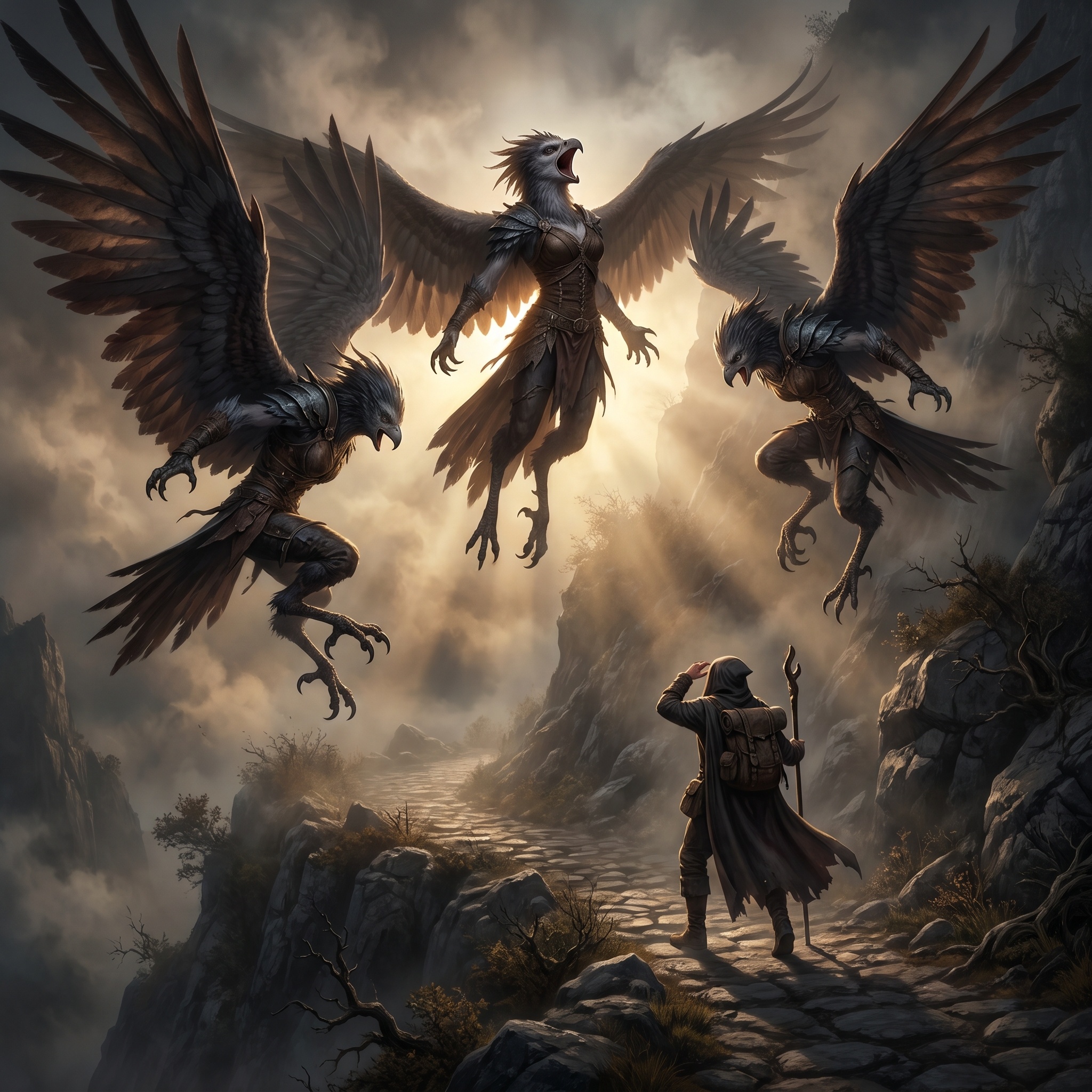
Role: Elite Harrier / Controller Where It Appears: Coastal cliffs, mountain passes, ancient ruins, anywhere with good thermals and travelers below.
The song is not beautiful. It is specifically calibrated to make you think it is beautiful, which is a different thing.
What It Is
A Harpy is a winged humanoid predator with human upper body, avian wings and lower body, and a call that interferes with the listener's judgment. The song does not create love or loyalty; it creates a compulsive need to approach, which is sufficient for the harpy's purposes.
Ecology and Behavior
Harpies nest in small groups on inaccessible cliffs and hunt roads, ships, and coastal settlements. Their nests are dense with stolen objects — not hoarded for value, but accumulated because the harpy instinct is to carry things back. Food, trinkets, and occasionally survivors who got close enough.
Signs and Knowledge
Survival (Average): identifies harpy nesting sites by whitewash, debris, and the absence of other cliff birds.
Adventuring Lore (Average): knows about the compulsion song and the value of ears blocked before contact.
Harpy (Elite)
- Skills: Unarmed 3, Athletics 4, Reflexes 4, Charm 4, Perception 3.
- Attacks: Talons (Unarmed; Damage 8; Crit 3; Pierce 2); Beak (Unarmed; Damage 6; Crit 4).
- Abilities: Luring Song — As an Action, one creature at Medium range that can hear the harpy makes an Average Willpower check. On failure, it must spend its next Action moving toward the harpy rather than attacking or retreating. Blocked ears (wax, cloth, hands) grant immunity.
- Abilities: Dive and Carry — If a target is at Engaged range and under half their maximum Wounds, the harpy may attempt to carry them aloft. Hard Athletics to resist.
- Soul: No claimable coin exists; at death canon does not specify (default).
Tactics: One harpy sings; others dive on distracted targets. If prey blocks ears, they shift to direct aerial harassment, forcing people toward ledges.
Encounter Use: Give the party warning — harpy territory is known locally. The correct preparation (blocked ears, ranged weapons, staying off ledges) should be achievable.
Harvesting and Trade
| Harvest | Buyer | Check | Typical Value | Use | Complication |
|---|---|---|---|---|---|
| Wing Feathers | Fletchers, charm makers | Average Survival | 100–300 gold Flargons | Arrows, minor sound charms | Common; low individual value |
| Vocal Cords | Alchemist, charm specialist | Hard Medicine | 600–1,500 gold Flargons | Compulsion components, ward research | Must be preserved in salt within hours |
Variants
Harpy Matron: Nemesis, WND 34, Luring Song affects two targets simultaneously, Charm 5.
Hippogriff
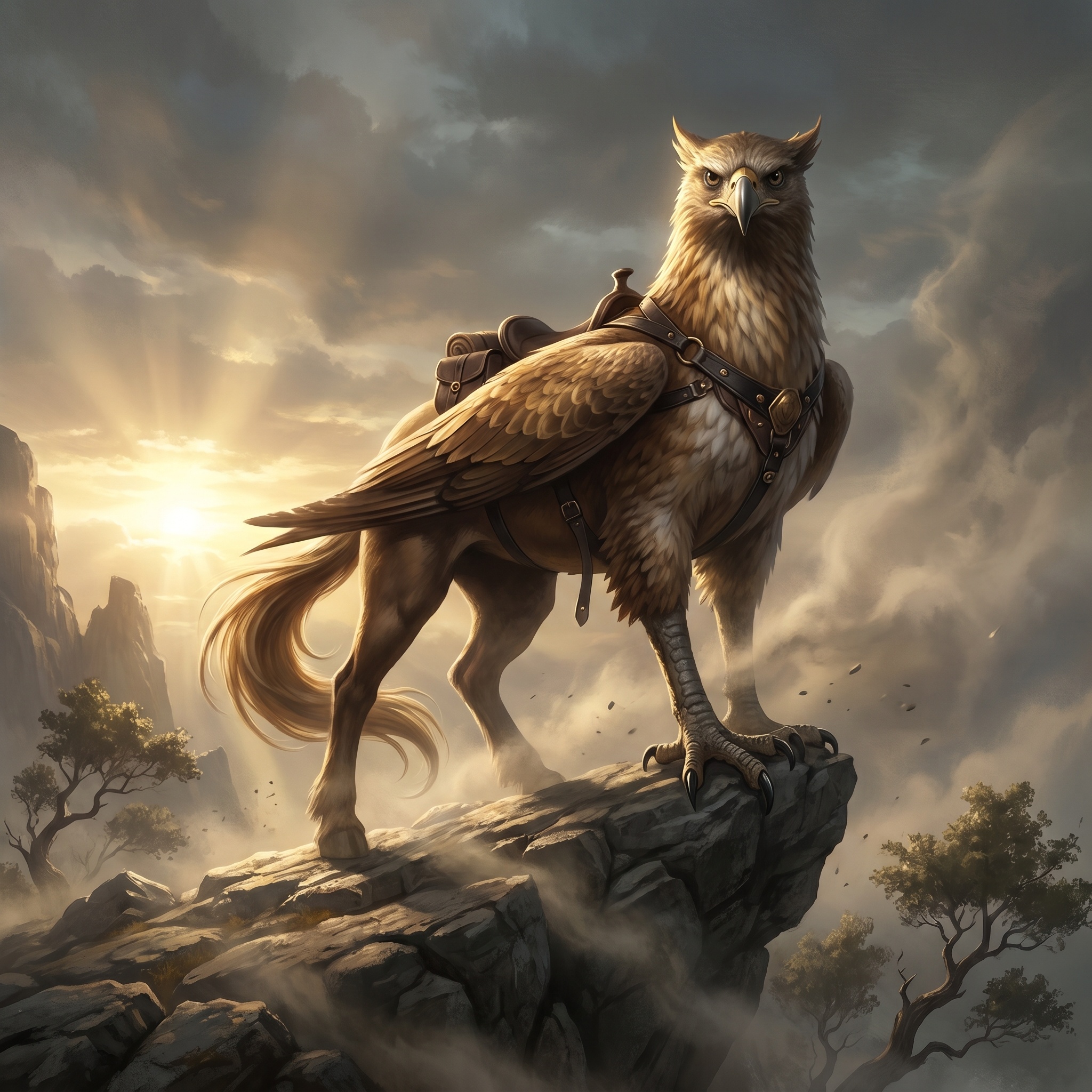
Role: Elite Harrier / Mount Where It Appears: Highland stables, courier orders, wild cliff meadows.
Hippogriffs are more social and less murderous than griffons, but they are still predators with hooves. A trained hippogriff is a strategic asset. A frightened one is a falling accident looking for a rider.
What It Is
A hippogriff is a horse-bodied, eagle-fronted flying beast prized as a courier mount and highland riding animal. Compared to griffons, hippogriffs are more social, more trainable, and less inclined to treat every horse as prey. That does not make them safe.
Their panic response is upward. This is useful in the wild and deadly for a rider who loses control near cliffs, towers, or storm winds.
Ecology and Behavior
Wild hippogriffs graze and hunt in cliff meadows, highland valleys, and windy plateaus. They form loose herds with dominant breeding pairs and several young adults. They prefer flight to combat and usually flee unless cornered or defending young.
Trained hippogriffs are strategic assets for couriers, scouts, and nobles. Good training focuses on trust, wind reading, and not climbing blindly when injured.
Signs and Knowledge
Field signs: mixed hoof and talon tracks, clipped high meadow grass, down feathers in saddle brush, cliff dung, circular landing marks.
Riding (Average): handles a trained animal in calm conditions.
Riding (Hard): controls panic climb after injury or thunder.
Survival (Hard): approaches a wild herd without triggering flight.
Hippogriff (Elite)
- Skills: Athletics 4, Reflexes 4, Perception 3, Riding 4 when trained, Survival 3, Unarmed 3.
- Attacks: Talon Kick (Unarmed; Damage 7; Crit 4); Beak (Unarmed; Damage 6; Crit 4).
- Abilities: Sure Wing - Add 1 Boon to checks involving aerial travel through wind, cliffs, or mountain thermals.
- Abilities: Panic Climb - When injured, may immediately move one range band upward as a reaction once per encounter.
- Soul: No claimable coin exists; at death canon does not specify (default).
Tactics: Wild hippogriffs flee unless cornered. Trained ones strike and reposition under rider command. If injured, they climb first and think later.
Encounter Use: More useful as mount, prize, rescue target, courier asset, or aerial travel complication than as a pure enemy. The conflict is often ownership, trust, weather, or a bad landing.
Harvesting and Trade
No respectable market focuses on dead hippogriff parts. Tack, bloodline papers, training rights, and the living animal are the value.
| Harvest | Buyer | Check | Typical Value | Use | Complication |
|---|---|---|---|---|---|
| Living Trained Hippogriff | Courier order, scout company, noble | Riding to assess | 7,000-30,000 gold Flargons | Flight mount, courier service | May reject new rider or panic in unfamiliar tack |
| Bloodline Papers | Stable master, noble court | Lore to authenticate | 1,000-10,000 gold Flargons | Breeding rights, legal ownership | Forgery is common |
| Flight Tack | Courier, saddler, collector | Craft or Riding to assess | 500-4,000 gold Flargons | Safe riding, resale | Poor tack causes falls |
| Shed Pinions | Fletchers, charm makers | Average Survival | 50-200 gold Flargons | Minor wind charms | Low value unless from famous line |
Variants
Courier Hippogriff: Elite, Sure Wing grants 2 Boons for long-distance travel checks, but WND drops to 16.
Wild Cliff Stallion: Nemesis, WND 34, STR 14, Panic Climb may trigger twice per encounter and can carry a grabbed target upward.
Manticore
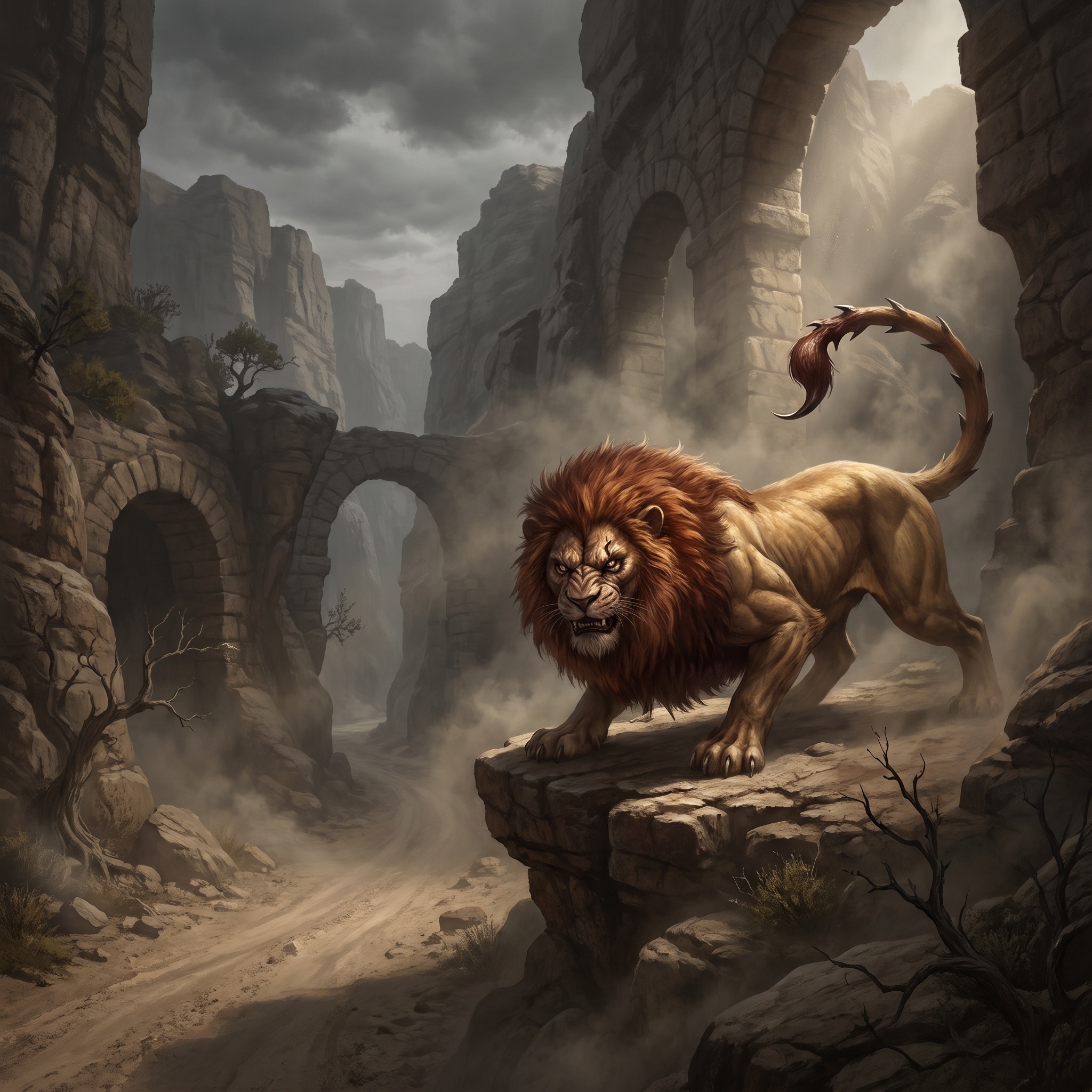
Role: Nemesis Lurker / Harrier Where It Appears: Badlands, canyon roads, ruined towers, dry mountain caves.
"It asked for something impossible and then waited while we realized it had already taken the alternative." — Road incident report, Antaean Border Survey
Manticores are intelligent enough to bargain and cruel enough that bargaining rarely helps. They prefer toll-taking ambushes, riddling threats, and slow pursuit of prey that wounded their pride.
What It Is
A manticore is a leonine predator with a barbed tail, a face too close to human comfort, and enough language to make cruelty deliberate. It is not a mastermind, but it understands fear, bargaining, and the value of a hostage on a canyon road.
Manticores like height and conversation. They would rather make prey look up, answer, hesitate, and then bleed.
Ecology and Behavior
Manticores claim badland caves, ruined towers, canyon ledges, and dry mountain shelves where tail spines can reach roads below. They hunt livestock, travelers, and rival predators. Some establish toll territories and learn local coinage, titles, and insults.
They remember humiliation. A party that wounds one and leaves it alive may find future camps harassed by spines, threats, and missing pack animals.
Signs and Knowledge
Field signs: tail-spine kills, bones below ledges, scratched riddles or threats, carcasses left as warnings, voices from above in empty canyons.
Adventuring Lore (Average): identifies tail-spine kills and likely firing perches.
Negotiation or Intimidation (Hard): can buy time if the manticore is not hungry or publicly insulted.
Survival (Hard): identifies whether the manticore is nesting, toll-taking, or stalking a specific target.
Manticore (Nemesis)
- Skills: Unarmed 4, Heavy Ranged 4, Stealth 3, Perception 4, Deception 3, Intimidation 4.
- Attacks: Bite and Claws (Unarmed; Damage 9; Crit 3; Pierce 1); Tail Spines (Heavy Ranged; Damage 8; Crit 4; Range Medium; Pierce 2, Poison 2).
- Abilities: Cruel Volley - Tail Spines may target two characters at Short range of each other by adding 1 Bane.
- Abilities: Mocking Voice - As an Action, one target at Medium range makes a Hard Readiness check or suffers 4 Strain and adds 1 Bane to its next attack against the manticore.
- Soul: No claimable coin exists; at death canon does not specify (default).
Tactics: The manticore opens from height with spines, taunts healers or archers, and lands only to finish isolated prey. If negotiations begin, it keeps a line of retreat and demands something humiliating as well as useful.
Encounter Use: Let it talk. A silent manticore is wasted. Use it when the encounter should include insults, delay, tolls, hostages, and the risk that the monster follows the party later.
Harvesting and Trade
Manticore parts have strong black-market value. Legal alchemists may buy venom for antidote work, but poisoners pay more and ask fewer questions.
| Harvest | Buyer | Check | Typical Value | Use | Complication |
|---|---|---|---|---|---|
| Tail Venom Gland | Poisoner, alchemist, physician | Hard Medicine or Survival | 800-1,800 gold Flargons | Venom, antivenom, pain draughts | Failure exposes harvester to Poison 2 |
| Barbed Tail Spines | Fletcher, assassin, collector | Average Survival | 400-1,200 gold Flargons | Poisoned bolts, trophies | Possession is illegal in some cities |
| Mocking Tongue | Curse-worker, grotesque collector | Hard Medicine | 500-1,500 gold Flargons | Voice charms, intimidation fetishes | Many buyers are worse than the monster |
Variants
Old Toll Manticore: Nemesis, Negotiation 4, Deception 4, and knows local names, debts, and road customs.
Spine-Sick Manticore: Elite, WND 28, fewer spines but Poison 3; erratic and harder to bargain with.
Marsh Troll
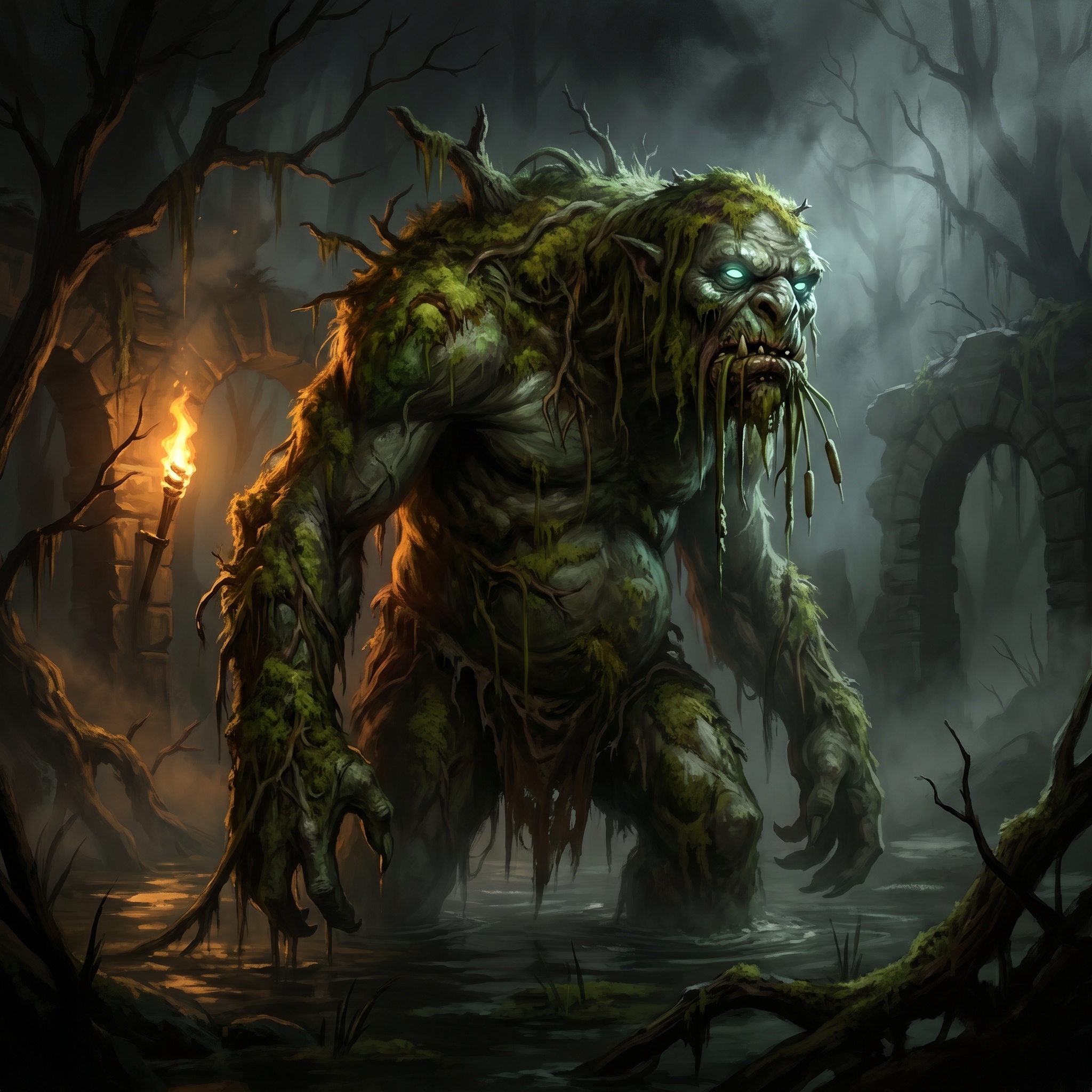
Role: Nemesis Lurker / Bruiser Where It Appears: Marshes, peat bogs, drowned roads, reed-choked ruins.
"It drowned the first three people who came to rescue the fourth. This is not spite. This is method." — Survival guide, Tallow Marsh region
Marsh trolls are less talkative than bridge trolls and more patient. They preserve stolen goods under water and sometimes arrange bones as territory markers.
What It Is
A Marsh Troll is a wetland ambush brute with mossy hide, long arms, and the patience to wait under black water until a crossing becomes a drowning. It is related in table role to the bridge troll, but not in temperament. It bargains less and drags more.
Its regrowth is fed by swamp rot, water, and stubborn meat. Fire, acid, and salt interrupt the process.
Ecology and Behavior
Marsh Trolls claim drowned roads, peat bogs, reed-choked ruins, and old causeways where travelers cannot move quickly. They preserve stolen goods under water, wedge bones into territory markers, and learn which paths locals avoid.
They are not mindless. They understand that a rescue attempt creates more prey. They often grab the second person into the water rather than the first.
Signs and Knowledge
Field signs: false reed beds, troll stink under peat gas, bones tied into mud markers, gear preserved under water, missing bridge planks near marsh crossings.
Survival (Hard): identifies false reed beds, troll stink, and safe footing.
Adventuring Lore (Hard): knows to use fire, acid, or salt before wounds close.
Negotiation or Intimidation (Hard): may redirect a fed troll, but a hungry one wants bodies more than words.
Marsh Troll (Nemesis)
- Skills: Unarmed 4, Athletics 5, Stealth 3 in marsh, Fortitude 5, Perception 4.
- Attacks: Hook Claws (Unarmed; Damage 10; Crit 3; Bleeding 1); Drowning Grip (Unarmed; Damage 8; Crit 4; Grabbed on 2 Boons).
- Abilities: Swamp Regrowth - Recover 3 Wounds at the end of each round unless damaged by fire, acid, or salt that round.
- Abilities: Drown Pull - A Grabbed target in water must make Average Athletics at start of its turn or suffer 3 Strain.
- Soul: No claimable coin exists; at death canon does not specify (default).
Tactics: The troll ambushes from water, grabs, submerges, and retreats through mud channels. It targets rescuers, torch bearers, and anyone carrying salt or acid.
Encounter Use: Use in poor visibility where rescue is difficult. The encounter should be about mud, water depth, line of sight, and whether the party can keep fire alive.
Harvesting and Trade
Marsh Troll tissue spoils in direct sun and keeps trying to become swamp again.
| Harvest | Buyer | Check | Typical Value | Use | Complication |
|---|---|---|---|---|---|
| Regenerative Moss | Alchemist, wound healer, swamp witch | Hard Medicine or Survival | 700-1,600 gold Flargons | Regrowth tonics, graft study | Must be salted immediately |
| Troll Bile | Tanner, acid worker, alchemist | Hard Medicine | 500-1,400 gold Flargons | Hide treatment, anti-regrowth mixtures | Eats through ordinary bottles |
| Preserved Stolen Goods | Original owner, fence, local court | Lore to identify | Varies | Restitution, evidence, loot | Mud-preserved items may implicate locals |
Variants
Peat-Bog Troll: Nemesis, Stealth 4 in bogs, Swamp Regrowth recovers 4 Wounds unless stopped.
Salt-Scarred Marsh Troll: Nemesis, WND 34, regrows only 2 Wounds but adds 1 Boon against anyone carrying salt.
Owlcat Brute
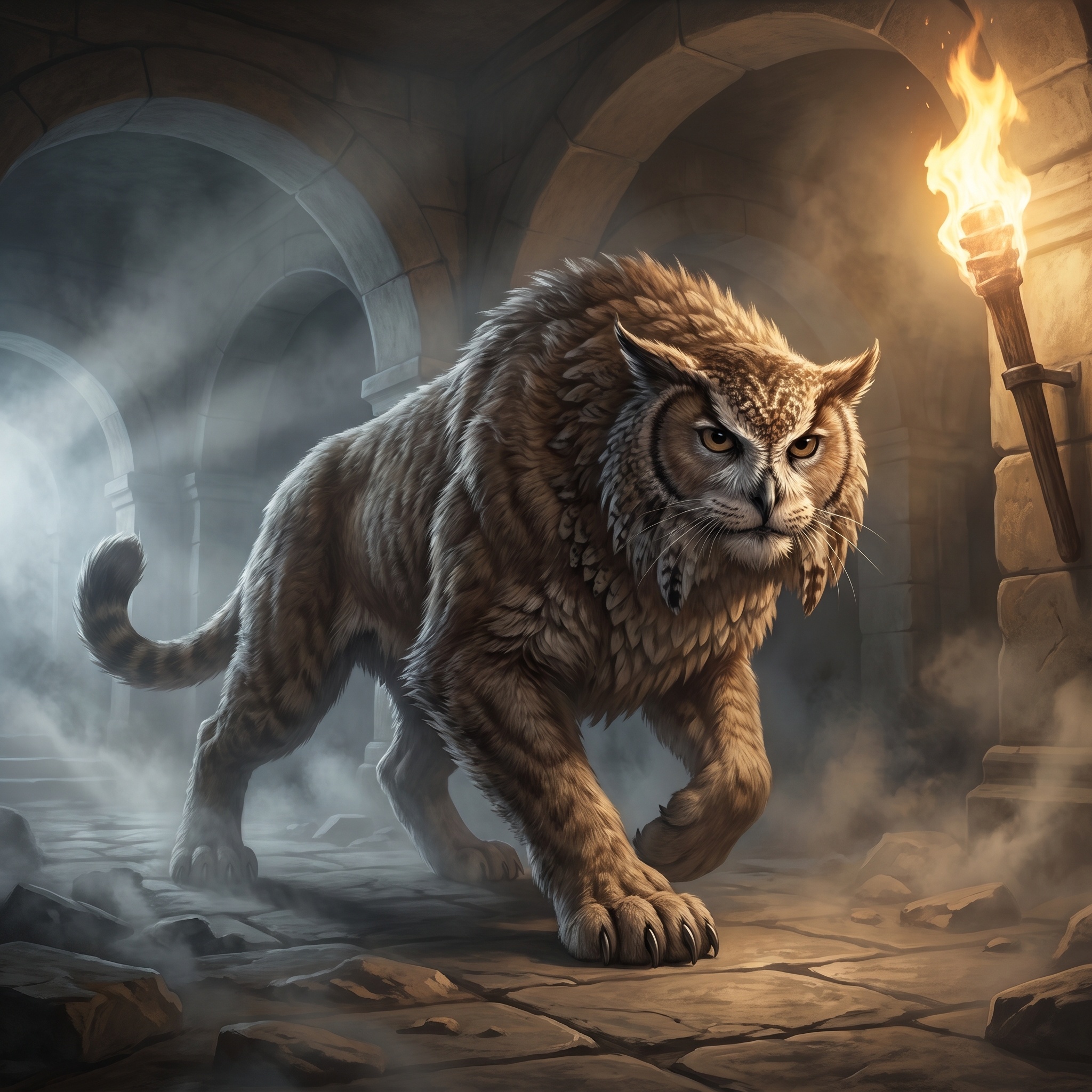
Role: Elite Ambusher Where It Appears: Old forests, moonlit ruins, silent hunting preserves.
The owlcat brute fills the same ecological fear as several tavern stories: something large enough to maul a horse and quiet enough to do it beside a campfire. It sees small motion in darkness and hates bells.
What It Is
An Owlcat Brute is a large feline predator with an owl-like facial disk, feathered shoulders, and silent paws. It is built to notice tiny movements in darkness and cross leaf litter without warning. The first obvious sign is often the absence of all smaller night sounds.
It is animal-cunning, not malicious. Unfortunately, its ecological role is to remove the smallest or least alert member of a group before the rest understands what happened.
Ecology and Behavior
Owlcat Brutes haunt old forests, moonlit ruins, overgrown hunting preserves, and abandoned estates where stone and branch both offer high perches. They stalk from above, wait for repeated patterns, and pounce on movement at the edge of light.
Bells and sudden metallic noise disrupt their focus. Foresters in owlcat country hang small chimes near camps, though experienced brutes sometimes learn to wait until wind masks the warning.
Signs and Knowledge
Field signs: silent kill sites, no alarm calls from birds, talon-like claw marks on bark, feathered fur caught on stone, prey dragged upward before being eaten.
Survival (Hard): identifies owlcat kills and likely approach routes.
Perception (Hard): notices the absence of normal night sounds before the attack.
Adventuring Lore (Average): knows bells, pans, or other metallic noise can startle it briefly.
Owlcat Brute (Elite)
- Skills: Unarmed 4, Stealth 4, Perception 5, Reflexes 4, Survival 4.
- Attacks: Silent Pounce (Unarmed; Damage 9; Crit 3; Pierce 1); Raking Claws (Unarmed; Damage 8; Crit 4; Bleeding 1 on 2 Boons).
- Abilities: Soundless Paws - Adds 2 Boons to Stealth checks in forest or ruin terrain.
- Abilities: Bell Startle - Sudden loud metallic sound at Short range adds 1 Bane to its next check.
- Soul: No claimable coin exists; at death canon does not specify (default).
Tactics: The owlcat watches from above, pounces on the smallest moving target, and drags prey into brush or up broken stone. If startled by bells, it relocates rather than immediately fleeing.
Encounter Use: Use as a stalking encounter where the party knows something is nearby before it strikes. The warning should be atmospheric but concrete: missing sound, disturbed birds, or a pack animal staring upward.
Harvesting and Trade
Owlcat parts are niche stealth components. The hide is valuable only if the fight did not ruin it.
| Harvest | Buyer | Check | Typical Value | Use | Complication |
|---|---|---|---|---|---|
| Ear Tufts and Whiskers | Stealth charm maker, hunter | Average Survival | 300-750 gold Flargons | Silence charms, predator lures | Value drops if blood-matted |
| Soundless Paw Pads | Cobbler, thief, scout | Hard Medicine or Survival | 600-1,400 gold Flargons | Quiet soles, stalking tools | Spoils quickly if not salted |
| Patterned Hide | Noble, ranger, collector | Hard Survival | 500-2,000 gold Flargons | Cloaks, proof of kill | Worth little if cut by blades |
Variants
Moon-Ruin Owlcat: Elite, Stealth 5 in ruins, Bell Startle affects it only once per scene.
Old Man-Eater Brute: Nemesis, WND 38, STR 16, gains Deception 2 for baiting camps with dragged gear or false sounds.
Roc
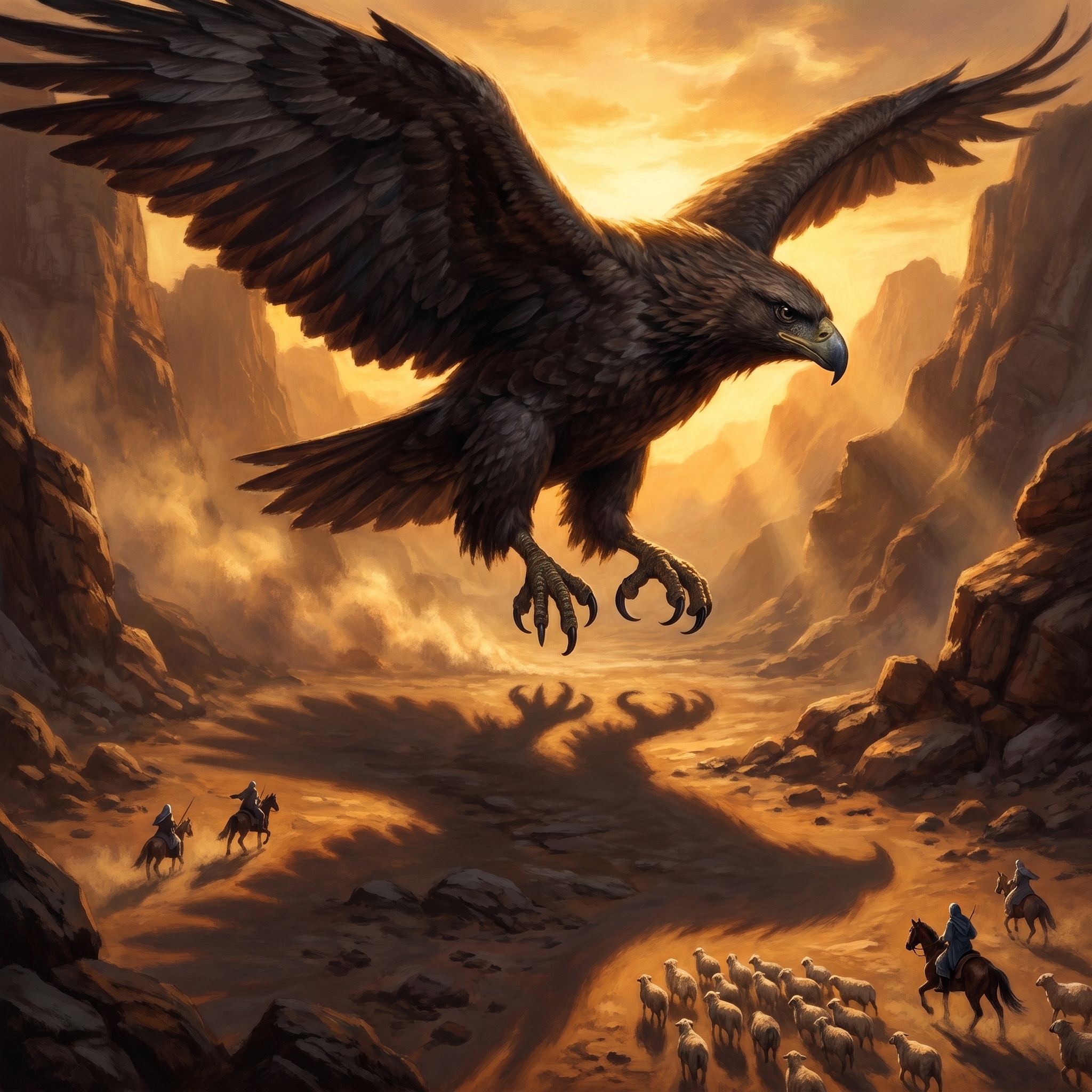
Role: Nemesis Apex Harrier Where It Appears: Remote mountain ranges, high desert cliffs, storm coasts.
"It did not attack the village. It landed nearby. The difference, at that scale, was academic." — Coastal survey incident log, Storm Coast
A roc is a weather event with talons. It does not hate villages; it mistakes their largest animals, carts, and sometimes roofs for things worth carrying away.
What It Is
A roc is a colossal predatory bird large enough to turn a valley into a hunting ground. Its wings shadow roads. Its talons can take wagons, aurochs, siege beasts, and sections of roof if the shape reads as prey from above.
It is not malicious and does not need to be. Scale makes its mistakes catastrophic.
Ecology and Behavior
Rocs nest in remote heights with access to vast hunting territories. Their routes become part of local weather wisdom: certain passes go silent, shepherds move herds early, and villages build heavy shelters not for storms but for shadows.
A roc feeds infrequently but dramatically. It seizes large prey, climbs, and drops anything that fights too hard. Scavengers and smaller predators follow the aftermath of a roc kill for days.
Signs and Knowledge
Field signs: enormous shadow crossings, cliff nests visible as whole-tree structures, livestock vanished without blood trails, crushed roof beams, long wing-scrape marks in snow or sand.
Survival (Hard): identifies a roc hunting route and likely return window.
Adventuring Lore (Hard): knows that heavy cover and anchoring matter more than shooting upward.
Operate or Craft (Hard): can secure carts, siege gear, or roofs against being mistaken for portable prey.
Roc (Nemesis)
- Skills: Unarmed 4, Athletics 5, Reflexes 4, Fortitude 4, Perception 5, Survival 4.
- Attacks: Mountain Talons (Unarmed; Damage 12; Crit 3; Pierce 3); Beak Hammer (Unarmed; Damage 10; Crit 4).
- Abilities: Skyhook — On 2 Boons with Mountain Talons, grab a target or object up to wagon-sized. Escaping requires a Hard Athletics or Reflexes check.
- Abilities: Drop Prey — A grabbed target may be dropped from Short or Medium height for Damage 8 or 12.
- Abilities: Wingstorm — As an Action, creatures at Engaged range make an Average Athletics check or fall Prone and move one range band away.
- Soul: No claimable coin exists; at death canon does not specify (default).
Tactics: The roc seizes the largest visible prey, climbs, drops it if harmed, and returns from another angle. It uses Wingstorm when grounded or when too many small attackers cluster near its legs.
Encounter Use: A roc encounter is about shelter, panic, anchoring, and verticality. Give the party things to secure: children, pack animals, a bridge crew, a royal carriage, a siege engine, or themselves.
Harvesting and Trade
Roc remains are valuable but huge. Harvesting one is a logistics problem, and transporting the harvest may attract every opportunist in the region.
| Harvest | Buyer | Check | Typical Value | Use | Complication |
|---|---|---|---|---|---|
| Flight Feathers | Sailmaker, fletcher, wind mage | Hard Survival | 1,500-4,000 gold Flargons per usable bundle | Storm sails, giant arrows, flight rites | Difficult to transport without damage |
| Talon Hook | Siege engineer, trophy hall, shipwright | Hard Survival or Craft | 3,000-9,000 gold Flargons | Cranes, grapnels, prestige trophies | Requires block and tackle to move |
| Heart Sinew | Alchemist, aeronaut, ritualist | Severe Medicine | 5,000-15,000 gold Flargons | Flight magic, endurance cords | Spoils quickly if not stretched and salted |
| Nest Timber | Builder, historian, local village | Craft or Lore | 500-5,000 gold Flargons | Rare wood, evidence of stolen structures | May include recognizable stolen beams |
Variants
Young Roc: Elite, WND 20, cannot grab wagon-sized targets, Drop Prey max Damage 8.
Storm-Coast Roc: Nemesis, RDEF 4 in storms and Wingstorm also extinguishes mundane flames at Short range.
Ruin Basilisk
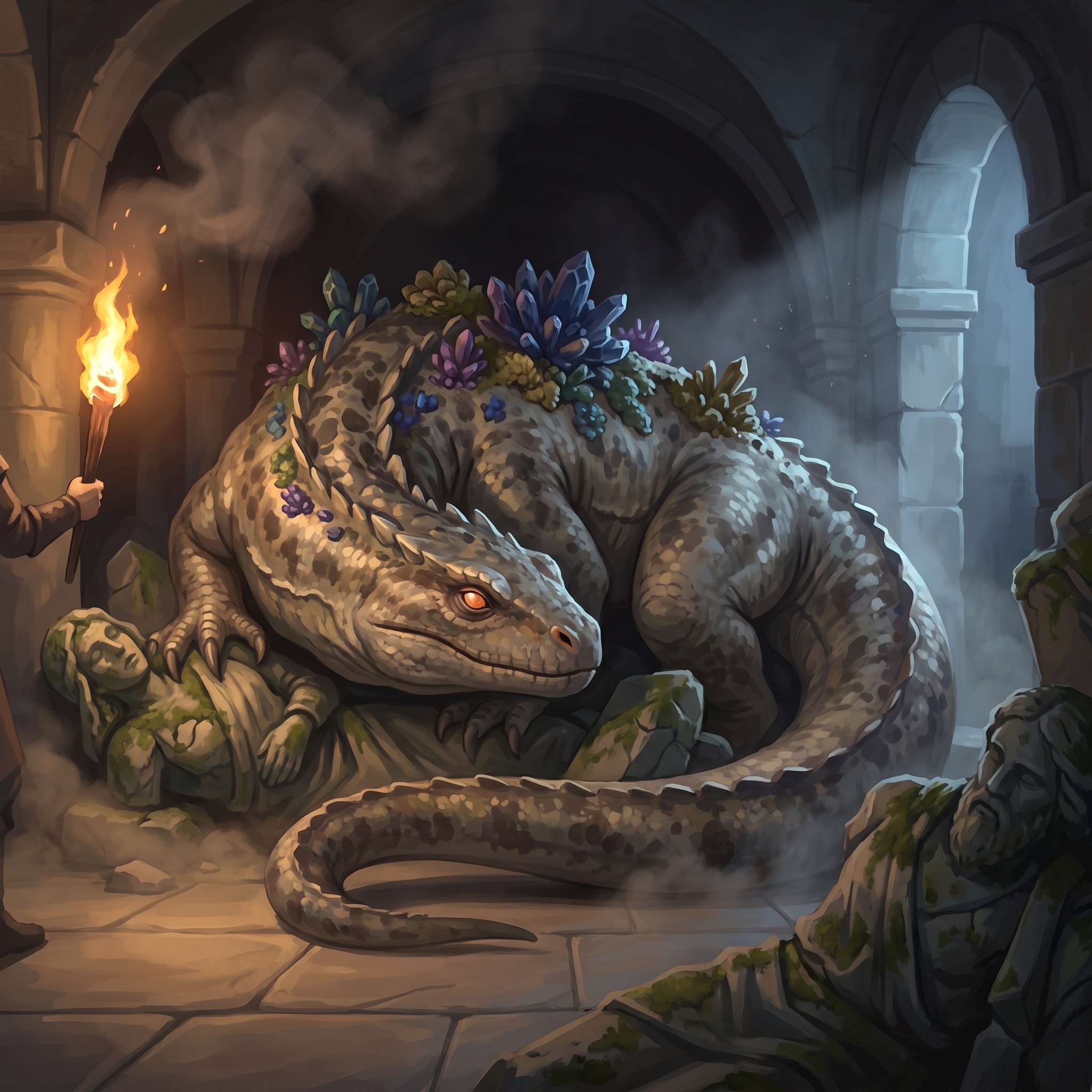
Role: Elite Controller Where It Appears: Ancient ruins, statue gardens, mineral springs.
What It Is
Ruin basilisks are smaller cousins of the Stone-Gaze Basilisk adapted to long-abandoned settlements. Their mineralization is slower but harder to notice until joints lock. They are mottled, low-bodied reptiles with stone-colored hides, mineral blooms along the spine, and patient eyes that look like wet pebbles.
Unlike the larger Stone-Gaze Basilisk, a ruin basilisk rarely dominates a whole region. It dominates a courtyard, bath complex, statue garden, or broken plaza where cover and false silhouettes make its gaze difficult to track.
Ecology and Behavior
Ruin basilisks favor places already full of stone shapes. They nest among statues, broken columns, mineral springs, and old civic monuments. Their prey becomes part of the camouflage over time: stiff birds on fountain rims, rats frozen in cracks, a thief crouched forever behind a plinth.
They are patient hunters. A ruin basilisk may retreat after applying the first stage of mineralization, then follow at a distance while the victim slows. They eat mineral-rich tissue first, leaving brittle skins and gray dust that can make old ruins look naturally weathered.
Signs and Knowledge
Survival or Adventuring Lore (Hard) identifies too many small statues with fear postures. Natural Philosophy (Average) recognizes fresh mineral blooms on old stone.
Other signs include insects fixed to walls, footprints that stop beside partial stone flakes, and local animals refusing to cross open plazas. Characters familiar with the Stone-Gaze Basilisk may recognize this as a lesser but more subtle cousin.
Ruin Basilisk (Elite)
- Skills: Stealth 4 in ruins, Unarmed 3, Perception 4, Fortitude 3.
- Attacks: Stone Bite (Unarmed; Damage 7; Crit 4); Tail Hook (Unarmed; Damage 5; Crit 5).
- Abilities: Slow Gaze — Hard Fortitude or gain Mineralized 1. Cannot directly inflict Mineralized 2 unless target is already Mineralized 1. Mineralized 1: the target's movement speed is halved and it adds 1 Bane to AGI-based checks. Mineralized 2: the target cannot move and gains +2 Soak until the condition ends; a Hard Fortitude check at the end of each round allows recovery to Mineralized 1.
- Abilities: Statue Stillness — Add 2 Banes to detect while motionless among statuary.
- Soul: No claimable coin exists; at death canon does not specify (default).
Tactics
A ruin basilisk hides among statues, uses Slow Gaze, retreats through rubble, and repeats once panic spreads. It avoids direct melee unless cornered or facing a target already slowed by mineralization. It uses broken sight lines well, stepping behind pillars and reappearing where the party expected a statue.
The encounter should reward observation. Covering eyes, using mirrors, knocking down false statues, tracking fresh dust, and forcing the basilisk into open ground are all meaningful responses.
Harvesting and Trade
| Component | Value | Use | Harvest |
|---|---|---|---|
| Eye lenses | 600-1,400 gold Flargons | Petrification study, mineral sight charms | Medicine and Natural Philosophy (Hard) |
| Mineral spines | 400-1,000 gold Flargons | Stonebinding reagents, sculptor's pigments | Survival or Craft (Average) |
| Gizzard stones | 250-700 gold Flargons | Antidote research, masonry rituals | Medicine (Average) |
Variants
- Fountain Basilisk: Lairs in mineral water and leaves victims crusted with white stone.
- Statue Garden Basilisk: Almost impossible to spot while still among carved figures.
- Civic Ruin Basilisk: Has learned patrol routes through plazas, arcades, and old courtrooms.
Stonehook Crawler
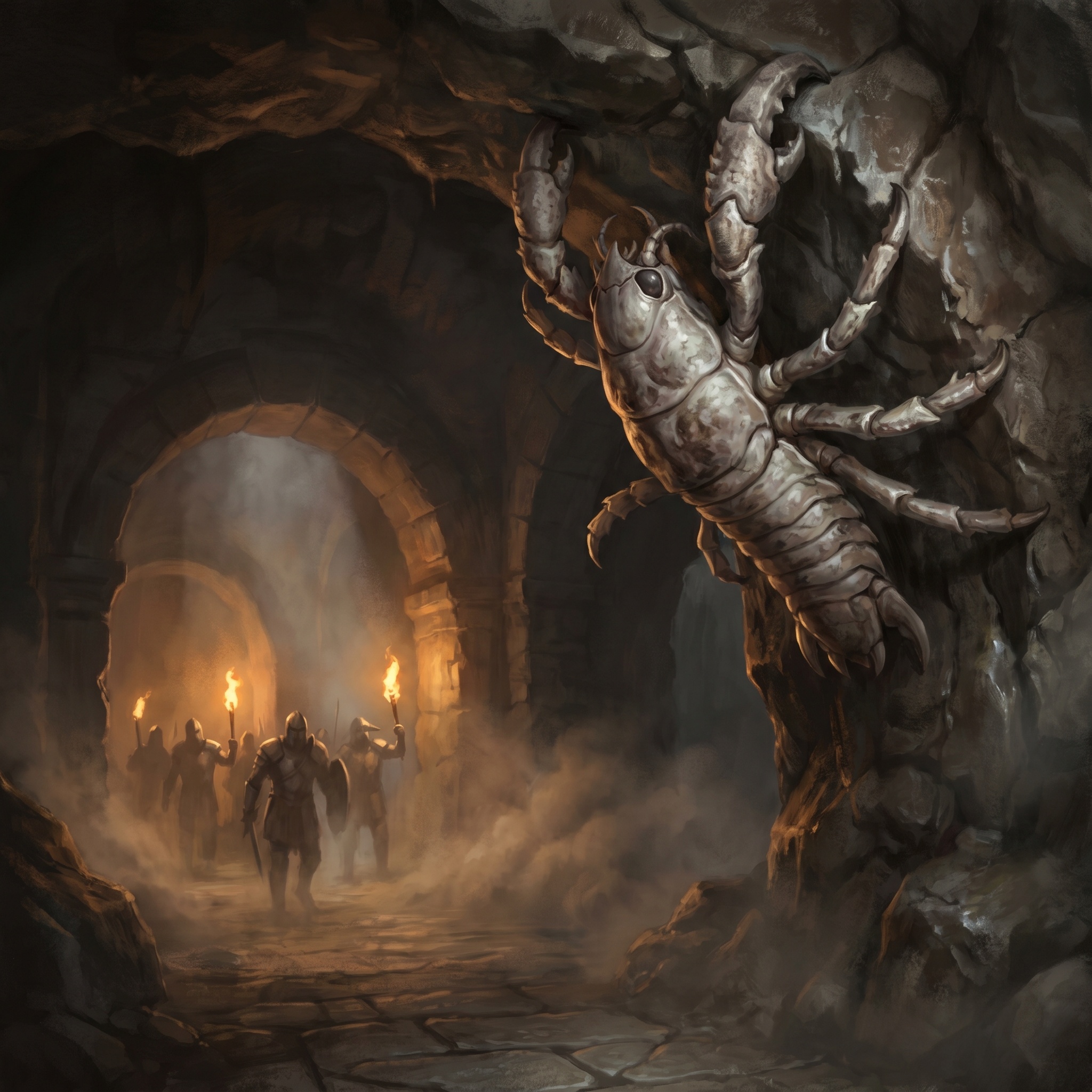
Role: Elite Ambusher / Controller Where It Appears: Caverns, tomb ceilings, mine shafts, underbridges.
What It Is
Stonehook crawlers hang where torchlight is worst. They hook prey, lift it off the ground, and wait for companions to make bad climbing choices. Their many legs end in hardened stone hooks that bite into ceilings, bridge undersides, and carved vault ribs.
A stonehook crawler is not a genius, but it understands panic. It attacks the rear, the smallest, or the one carrying light, then carries that target upward where rescue becomes difficult. Old tomb builders sometimes encouraged crawlers to live in entry halls because the creatures ask no wages and respect no bribes.
Ecology and Behavior
Stonehook crawlers live in vertical territory: shafts, bell towers, sinkholes, cavern chimneys, and ruined bridges. They need rough overhead surfaces and retreat crevices. Their nests are piles of dropped belongings, cracked bones, and shed hooks cemented to stone with a chalky secretion.
They hunt by patience. A crawler may remain motionless for days, reading vibration through its hooks. It knows the difference between a single rat and a line of armored travelers. It prefers prey it can lift quickly, but a hungry crawler may attack pack animals, dangling ropes, or climbers halfway up a wall.
Signs and Knowledge
Perception (Hard) notices claw scars overhead. Adventuring Lore (Hard) predicts drop zones.
Other signs include abandoned ropes cut from above, scattered gear directly beneath ceiling cracks, old blood on high stone, and a dry clicking sound when torch heat reaches the crawler's hooks.
Stonehook Crawler (Elite)
- Skills: Athletics 4, Stealth 3, Perception 3, Unarmed 4.
- Attacks: Hooking Claws (Unarmed; Damage 8; Crit 4; Grabbed on 2 Boons); Drop Slam (Unarmed; Damage 9; Crit 4).
- Abilities: Ceiling Grip — Moves on ceilings and walls without checks; forced movement checks against it add 1 Bane.
- Abilities: Lift Prey — A Grabbed target may be moved one range band upward as a Maneuver.
- Soul: No claimable coin exists; at death canon does not specify (default).
Tactics
A stonehook crawler drops on a rear or isolated target, grabs, and climbs. Once above the floor, it uses height as a weapon: biting, threatening to drop prey, and forcing rescuers to climb under pressure. If badly hurt, it may release its victim to cover its retreat.
The encounter is strongest when the vertical space matters. Give the room beams, chains, ledges, hanging roots, or old scaffolds so players can respond without simply rolling attacks from below.
Harvesting and Trade
| Component | Value | Use | Harvest |
|---|---|---|---|
| Hook claws | 200-500 gold Flargons | Climbing gear, pit traps, grapnels | Craft or Survival (Average) |
| Chalk secretion | 150-450 gold Flargons | Stone adhesive and masonry repairs | Craft (Hard), dries quickly |
| Vibration plates | 300-750 gold Flargons | Tremor alarms, sensitive locks | Natural Philosophy (Hard) |
Variants
- Bridge Crawler: Hunts from bridge undersides and drops prey into water or ravines.
- Tomb Crawler: Smaller, quieter, and adapted to carved ceilings.
- Deep Hook Matriarch: Larger Elite or Nemesis specimen that controls a whole vertical shaft.
Thorn Cockatrice
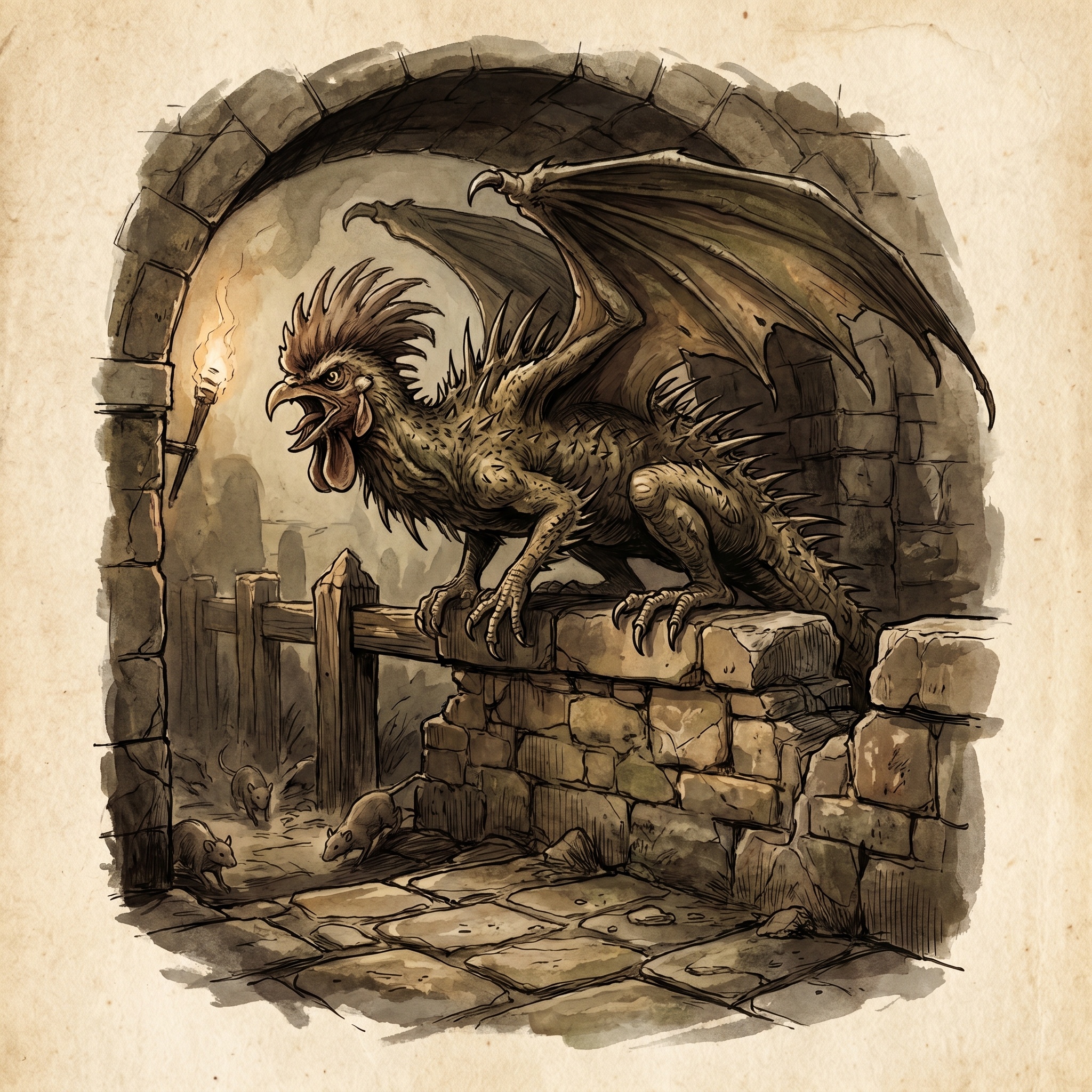
Role: Minion Controller / Pest Where It Appears: Farms near old ruins, hedge mazes, abandoned orchards.
Thorn cockatrices are territorial pests whose peck carries a stiffening venom. They are less deadly than basilisks but far more likely to be encountered in numbers near people.
Signs and Knowledge: Survival (Average) identifies three-toed tracks and quill scratches. Medicine (Hard) knows how to counter the venom.
Thorn Cockatrice (Minion)
- Group Size: 3-10.
- Skills: Unarmed 2, Reflexes 3, Perception 2, Stealth 2.
- Attacks: Venom Peck (Unarmed; Damage 4; Crit 5); Quill Scratch (Unarmed; Damage 3; Crit 5).
- Abilities: Stiffening Venom - On 2 Boons with Venom Peck, target adds 1 Bane to Agility-linked checks until treated with Average Medicine.
- Abilities: Furious Flutter - Add 1 Bane to attacks against them while the group has more than half Wounds remaining.
- Soul: No claimable coin exists; at death canon does not specify (default).
- Tactics: Swarm ankles, retreat into hedges, attack anyone who chases.
- Encounter Use: Good as a nuisance that becomes dangerous around ledges, wells, or farm animals.
- Harvesting and Trade: Venom sacs sell for 50-150 gold Flargons per group if harvested within an hour with Medicine or Survival (Average).
Troll
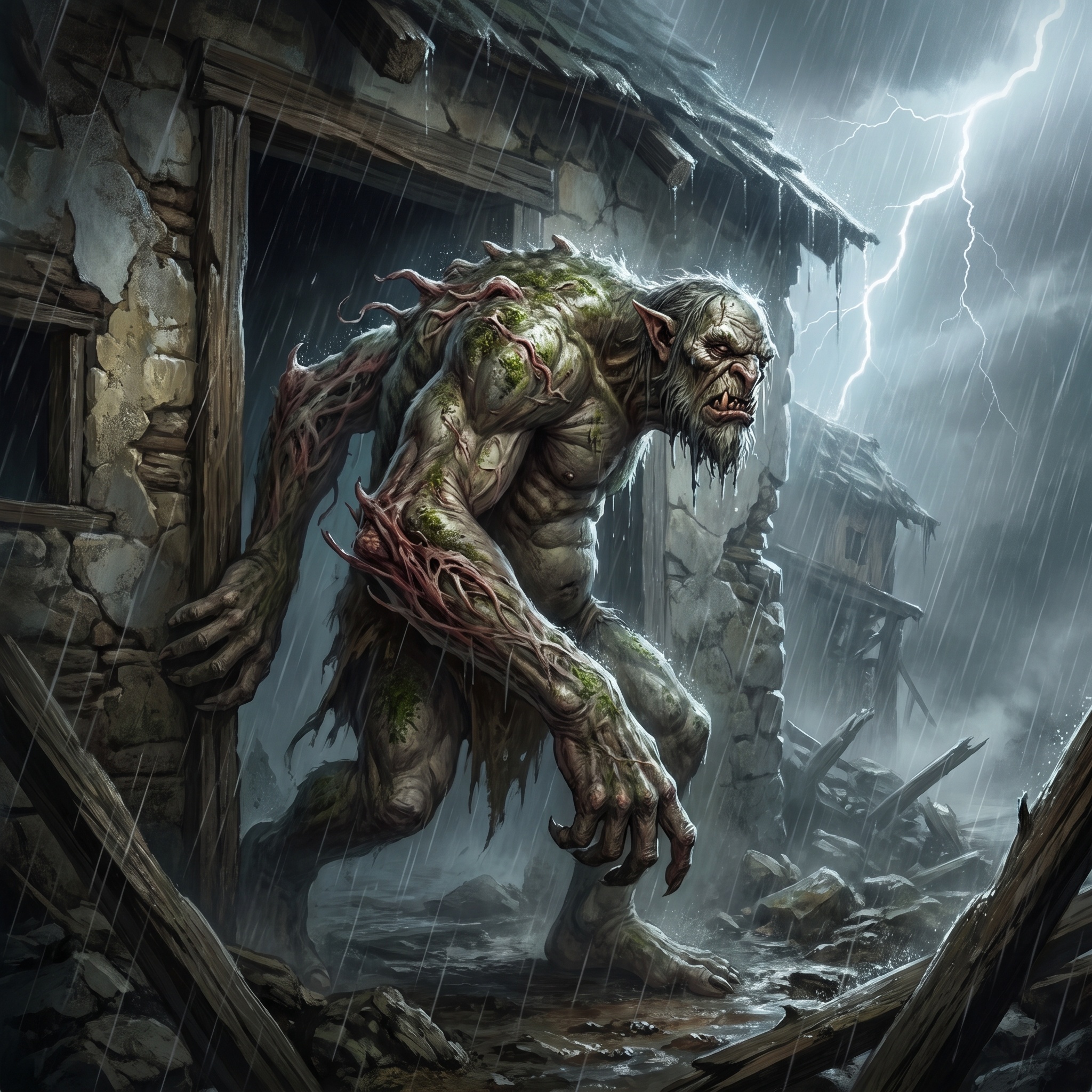
Role: Elite Bruiser / Regenerator Where It Appears: Wetland edges, ruined buildings, cave mouths, ravines, anywhere water is close and food comes through predictably.
A troll is not clever. It does not need to be. It heals.
What It Is
Trolls are large, long-limbed, and built around one biological fact: their tissue regenerates at a rate that makes most wounds temporary. Cut off a limb, it grows back. Bring it to zero Wounds, and if you walk away, it gets up again. The only reliable answer is fire or acid, both of which interrupt the regeneration cycle at the tissue level.
They are not the Bridge Troll of the roads, which is a different, older, and stranger creature entirely. A common troll is simply a large hungry thing that will not stay dead unless the party finishes the job correctly.
Ecology and Behavior
Trolls live near predictable food sources — wetlands with fish and waterfowl, ravines with road traffic, cave systems near animal trails. They eat large volumes and frequently. They are not territorial in the way a predator with a plan is territorial; they are territorial the way a fire is: whatever is nearby gets consumed first.
Signs and Knowledge
Survival (Average): identifies troll kills — multiple deep gashes, little blood left on the carcass, regenerated severed limbs left behind.
Adventuring Lore (Average): knows the fire/acid requirement; knows cutting attacks heal back.
Troll (Elite)
- Skills: Unarmed 5, Athletics 4, Fortitude 5, Perception 3.
- Attacks: Rending Claws (Unarmed; Damage 10; Crit 3; Pierce 2, Vicious 5); Bite (Unarmed; Damage 9; Crit 4; Pierce 1).
- Abilities: Regeneration — At the end of each round, the troll recovers 3 Wounds unless it took fire or acid damage that round.
- Abilities: Fire and Acid Weakness — Fire and acid attacks add 1 Boon and prevent Regeneration for that round.
- Abilities: Limb Persistence — Severed limbs remain active for one round. A severed hand still grasps; a severed arm still swings.
- Soul: No claimable coin exists; at death canon does not specify (default).
Tactics: The troll charges, claws, and ignores most damage. It targets whoever is dealing the most damage. It does not run — it has no reason to believe anything can stop it. If fire appears, it flinches, which is the first sign it understands fear.
Encounter Use: Use a troll to punish parties that rely on attrition without a plan. The correct preparation — fire, acid, a torch, a bottle of oil — should feel rewarding. Discovery mid-fight that regeneration exists should feel terrifying.
Harvesting and Trade
| Harvest | Buyer | Check | Typical Value | Use | Complication |
|---|---|---|---|---|---|
| Regenerative Tissue | Battlefield surgeon, alchemist | Hard Medicine within one hour of acid/fire death | 800–2,000 gold Flargons | Healing research, graft experiments | Still tries to regrow; must be acid-preserved |
| Troll Bile | Tanner, acid worker | Hard Medicine | 400–1,200 gold Flargons | Preservation acid, anti-regrowth compounds | Burns through ordinary containers |
Variants
River Troll: Elite, RES 6, gains Stealth 3 in water and Drown Pull (as Marsh Troll). Smaller than a standard troll but faster.
Cave Troll: Elite, WND 20, STR 16. Regeneration recovers 4 Wounds. Blind in daylight.