Most of what guards a sealed ruin was never alive to begin with, and that is the point. An Ancient-Built Automaton does not tire, does not negotiate, and does not recognize an emissary carrying the right seal, because the civilization that would have honored that seal is centuries gone. It responds to conditions written into it before anyone currently living was born, and it will keep responding to them long after everyone currently living is gone too.
A handful of entries here are guardians of newer make, gargoyles, oathbound statues, reliquary keepers bound to a specific shrine or vow rather than a lost empire. The distinction matters for motive: a Shrine Guardian can sometimes be satisfied, because someone is still alive who remembers what it was built to protect. An Ancient-Built Automaton cannot, because nobody is.
At the table: a construct's threat is procedural, not personal. Give players something to learn, the trigger, the ward, the countersign, rather than something to plead with. The correct answer to most of this chapter is a puzzle, not a conversation.
Ancient-Built Automaton
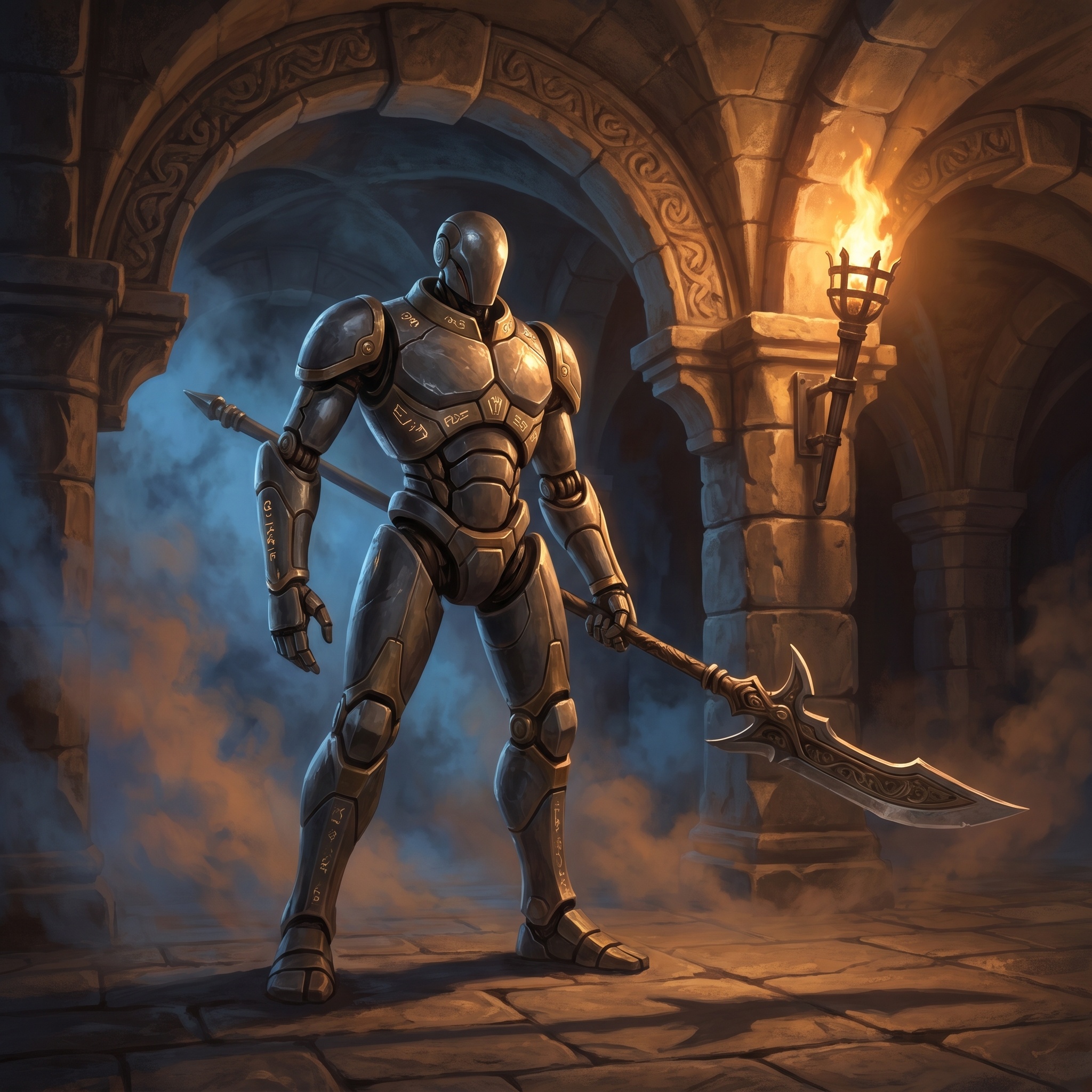
Role: Nemesis Construct Guardian Where It Appears: Sealed pre-divine ruins, impossible vaults, Ancient-adjacent laboratories.
"It responded to nothing. Not fire, not parley, not the symbol we found carved above the threshold. It stopped only when we crossed back over the line we had not known was there." — Expedition account, sealed by the Order of the Quiet Survey
What It Is
Ancient-built automatons do not look crafted so much as decided. Their motion is too clean, their surfaces too continuous, and their commands older than divine language. They are not the Ancients. They are remnants of systems built near Ancient power, still executing instructions no living culture fully understands.
As a Nemesis, the automaton is a boundary with fists. It should make a sealed ruin feel categorically different from a dungeon with old stone.
Ecology and Behavior
Ancient-built automatons stand in sealed pre-divine ruins, impossible vaults, Ancient-adjacent laboratories, and corridors where the original context is gone. They do not patrol like soldiers unless the command says patrol. They execute conditions: admit, deny, neutralize, preserve, reset.
Their logic can be exploited, but rarely persuaded. The right phrase, object, body position, or environmental state may matter more than social argument.
Signs and Knowledge
Natural Philosophy or Secret Lore (Severe) can identify a command condition. Craft (Hard) recognizes materials that should not accept normal tools.
Other signs include perfectly smooth impact marks, doors opened by geometry rather than hinges, dust cleared in exact arcs, and failed divine symbols scratched into nearby walls by later intruders.
Ancient-Built Automaton (Nemesis)
- Skills: Heavy Melee 5, Fortitude 5, Perception 4, Natural Philosophy 5, Readiness 5.
- Attacks: Seamless Limb (Heavy Melee; Damage 12; Crit 3; Pierce 4); Force Pulse (Heavy Ranged; Damage 9; Crit 4; Range Medium; Knockdown on 2 Boons).
- Abilities: Pre-Divine Materials — Mundane weapons reduce damage by 3 before Resistance.
- Abilities: Command Logic — Secret Lore or Natural Philosophy (Severe) can identify a command condition; exploiting it adds 2 Boons to bypass checks.
- Soul: None, it was never alive; at death nothing passes.
Tactics
An Ancient-built automaton executes its boundary command, neutralizes tools, and ignores negotiation unless the words satisfy command logic. It targets devices, keys, spell focuses, and anyone attempting to alter the ruin's state. It does not posture or rage.
The encounter should reward observation. Repeating patterns, command states, ancient access tokens, and environmental resets give players more than attrition.
Harvesting and Trade
| Component | Value | Use | Harvest |
|---|---|---|---|
| Pre-divine actuator | Priceless | Forbidden engineering, ruin access, catastrophic weapons | Natural Philosophy and Craft (Severe) |
| Command lattice shard | 5,000-20,000+ gold Flargons | Logic study, bypass keys | Secret Lore (Severe) |
| Seamless material plate | 3,000-10,000 gold Flargons | Armor research, toolmaking | Craft (Hard), difficult to cut |
Variants
- Vault Decider: Allows entry only under a condition no one remembers.
- Reset Walker: Repairs the ruin by removing intruders and alterations.
- Witness Automaton: Records everything and attacks anyone who damages evidence.
Dragon Hoard Guardian
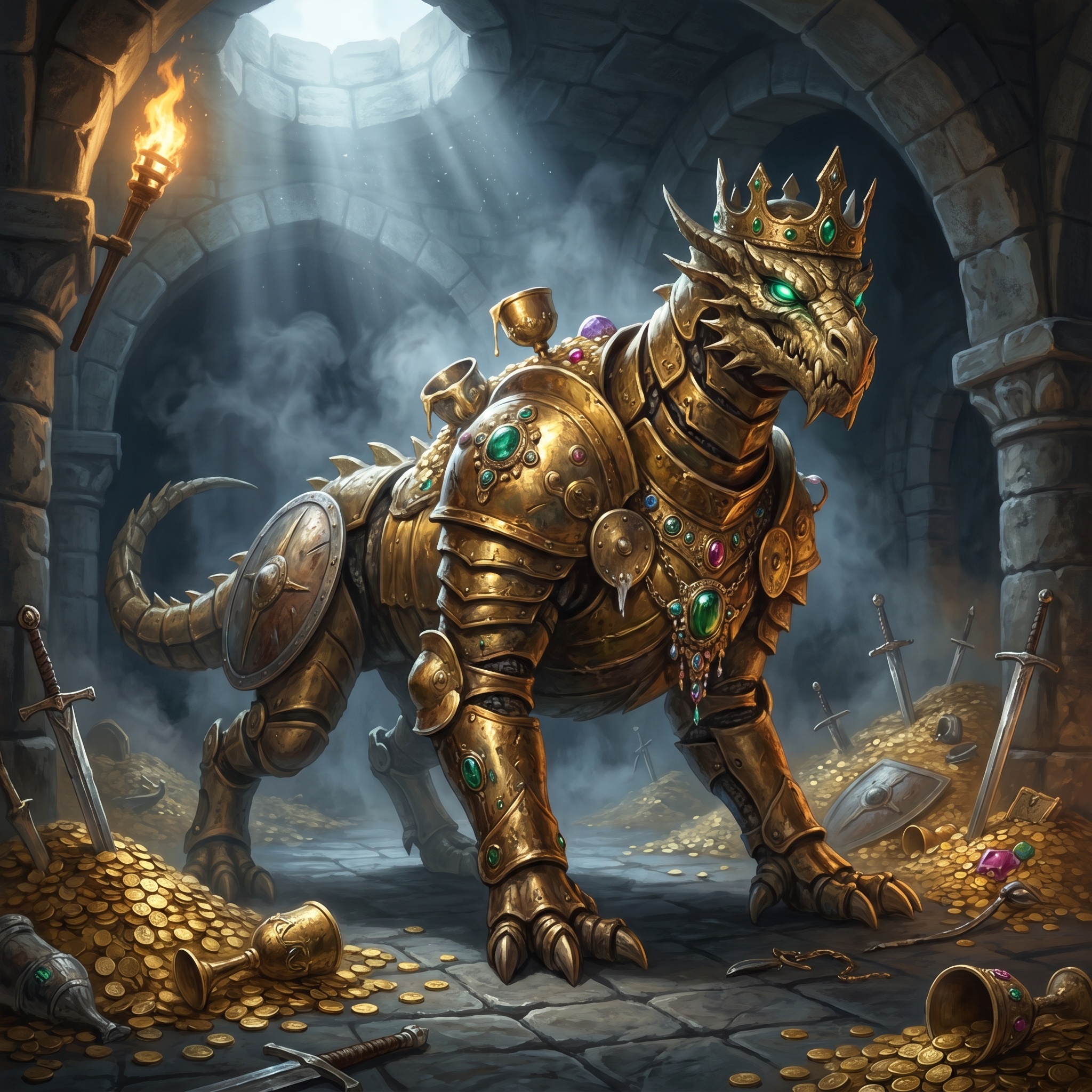
Role: Elite Construct Guardian Where It Appears: Dragon lairs, cursed hoards, abandoned dragon territories.
What It Is
Some dragons leave guardians made from the hoard itself. Others create them accidentally through long magical saturation. Coins, gems, relics, weapons, and tribute objects assemble into a body that understands ownership more than life.
The guardian is treasure, trap, and witness. Breaking it may still count as theft.
Ecology and Behavior
Dragon hoard guardians appear in dragon lairs, cursed hoards, abandoned dragon territories, and vaults where dragon treasure sat too long under type pressure. They attack thieves, pursue stolen hoard objects, and may ignore visitors who touch nothing.
Their personality reflects the hoard. A tribute-heavy guardian may demand protocol. A war-hoard guardian may attack armed intruders first. A cursed abandoned hoard may not remember its dragon, only that everything belongs.
Signs and Knowledge
Draconic Lore or Secret Lore (Average) identifies hoard-bound animation. Perception (Hard) notices coins and gems turning toward movement.
Other signs include treasure piles settling like breath, missing objects rolling back overnight, old theft attempts pinned under coins, and a faint type aura around valuables.
Dragon Hoard Guardian (Elite)
- Skills: Heavy Melee 4, Perception 4, Fortitude 5, Secret Lore 3.
- Attacks: Coin Fist (Heavy Melee; Damage 9; Crit 4; Pierce 2); Gem Flash (Willpower; Damage 5 Strain; Range Short).
- Abilities: Hoard Bound - Gains +2 Resistance while standing on or near its hoard.
- Soul: None, it was never alive; at death nothing passes.
Tactics
A dragon hoard guardian blocks theft and targets anyone carrying hoard objects. It fights best on the treasure pile, where Hoard Bound hardens it. It may ignore retreating intruders who drop everything they touched.
Use it to make greed tactical. The more the party takes, the more focused the guardian becomes.
Harvesting and Trade
| Component | Value | Use | Harvest |
|---|---|---|---|
| Animated hoard pieces | Face value plus risk | Treasure, tracking curse, dragon evidence | Each piece may remain linked |
| Gem focus | 1,000-5,000 gold Flargons | Hoard animation, ward crafting | Secret Lore or Craft (Hard) |
| Ownership mark | Varies | Proves dragon claim or curse | Draconic Lore (Average) |
Variants
- Tribute Guardian: Responds to offerings and formal request.
- Abandoned Hoard Guardian: Cannot distinguish rescue from theft.
- Cursed Coin Body: Reforms around stolen coins until the curse is broken.
Dragonbone Construct
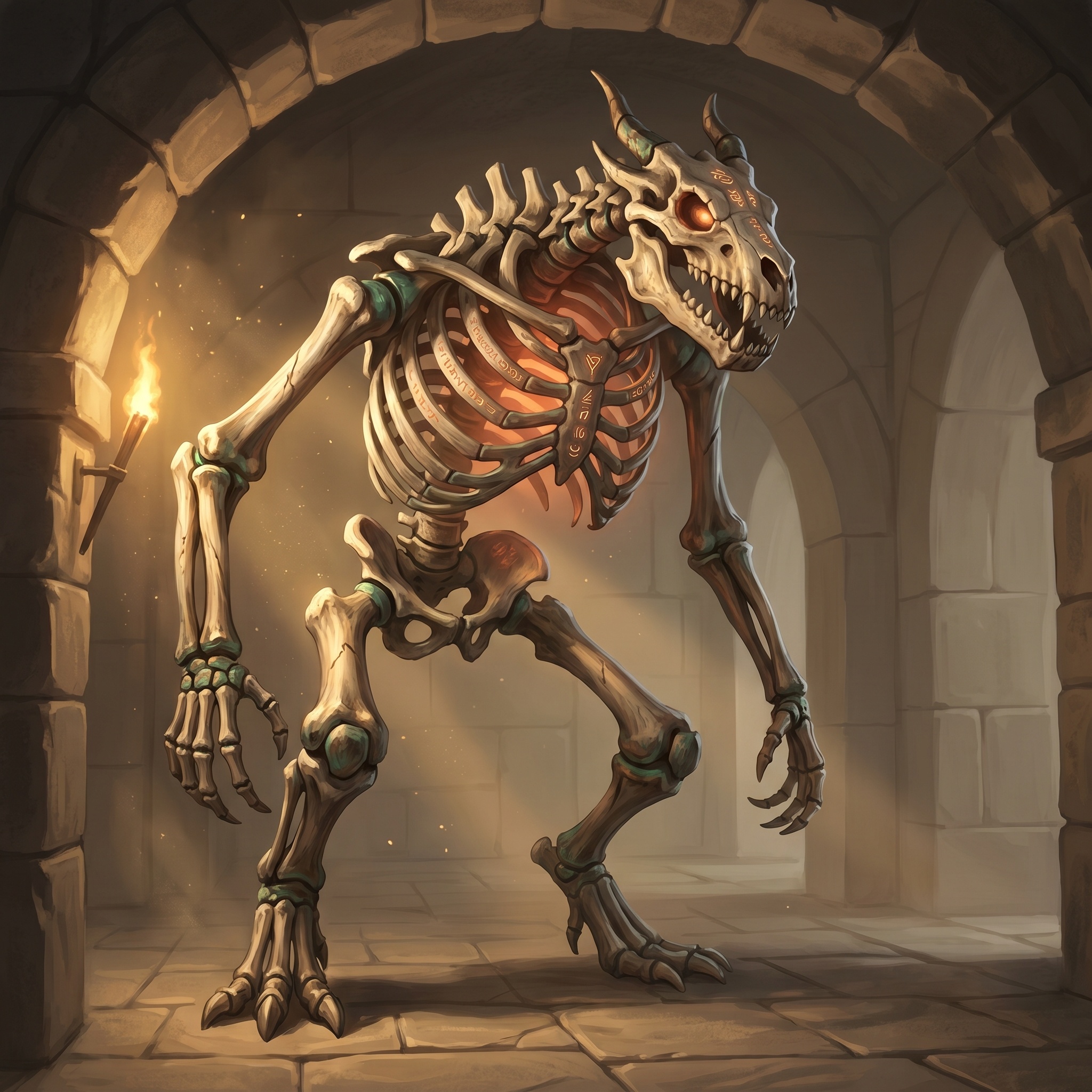
Role: Nemesis Construct Where It Appears: Forbidden workshops, necromantic vaults, trophy halls.
"The bones remember what the dragon knew. Not fully. Not usefully. Just enough to make it behave as though it is still angry about something." — Wardwright's note, commission returned unfulfilled
What It Is
Dragonbone constructs are blasphemy to dragons and treasure to fools. If one walks, someone has made enemies above their station. The construct may be bronze-jointed, glyph-bound, necromantic, or alchemical, but the insult is the same: dragon remains made obedient.
It is a Nemesis because the political consequence is as dangerous as the stat block.
Ecology and Behavior
Dragonbone constructs appear in forbidden workshops, necromantic vaults, trophy halls, secret armies, and lairs of mortals who mistook possession for power. They obey command logic and do not tire. Many are built from incomplete remains, making their movement uneven and horrible.
Any true dragon that learns of one will want answers. Destroying it may still leave the question of where the bones came from.
Signs and Knowledge
Adventuring Lore or Secret Lore (Average) identifies the bone source as draconic. Craft or Medicine (Hard) can determine whether bones came from one dragon or several.
Other signs include dragonbone dust around joints, glyphs hidden under trophies, missing museum remains, and local dragon agents asking pointed questions.
Dragonbone Construct (Nemesis)
- Skills: Heavy Melee 5, Fortitude 5, Perception 3, Readiness 5.
- Attacks: Bone Maw (Heavy Melee; Damage 12; Crit 3; Pierce 4); Rib Sweep (Heavy Melee; Damage 9; Crit 4; Blast 3).
- Abilities: Dragon Ire — Any true dragon that learns of this construct treats its maker as an enemy.
- Soul: None, it was never alive; at death nothing passes.
Tactics
A dragonbone construct follows command, destroys obstacles, and never tires. It uses size and reach rather than cunning. If ordered to guard a person or relic, it accepts catastrophic damage before yielding position.
Use it to reveal hubris. The maker's identity, bone source, and dragon response should matter.
Harvesting and Trade
| Component | Value | Use | Harvest |
|---|---|---|---|
| Dragonbone sections | 5,000+ gold Flargons | Relics, forbidden constructs, dragon diplomacy | Adventuring Lore and Craft (Hard), politically explosive |
| Binding glyphs | 1,000-4,000 gold Flargons | Construct control, evidence | Secret Lore (Hard) |
| Provenance marks | Campaign value | Identifies slain, robbed, or desecrated dragon | Lore or Medicine (Average) |
Variants
- Trophy Hall Walker: Built from display bones and noble arrogance.
- Necromancer's Frame: Uses death magic and stolen marrow.
- False Dragon Guardian: Made to impersonate a true dragon threat from a distance.
Forbidden Experiment
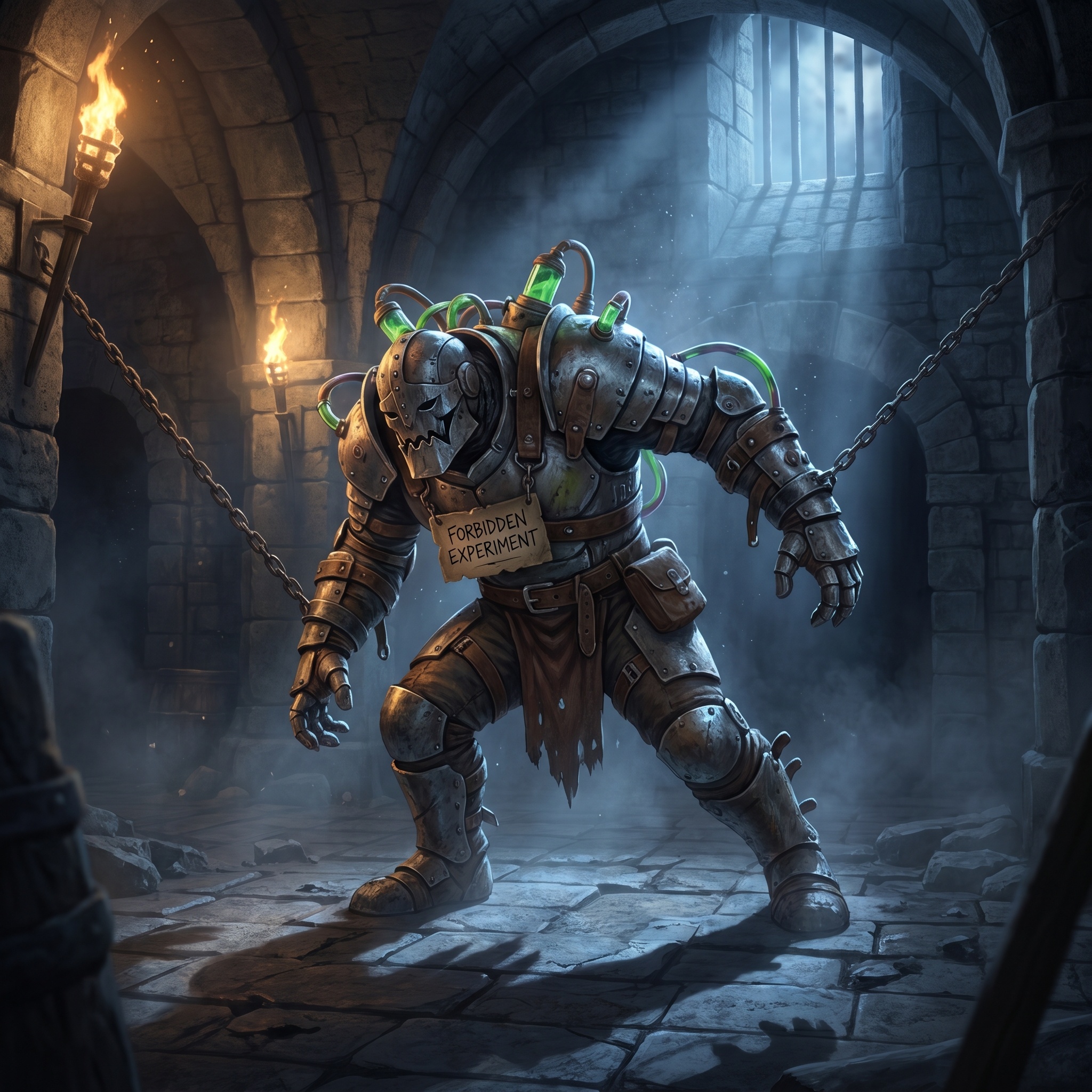
Role: Elite Variable Threat Where It Appears: Secret laboratories, noble experiments, hidden academy rooms.
What It Is
Forbidden experiments are bespoke failures. Use this profile for a living test subject, altered animal, or engineered guardian that should never have left the notes. The creature is less important than the question that made it: who thought this was acceptable?
Keep the entry flexible. It can represent alchemical biology, Ancient-adjacent engineering, noble vanity, academy arrogance, or cult modification.
Ecology and Behavior
Forbidden experiments appear in secret laboratories, noble experiments, hidden academy rooms, sealed menageries, and abandoned clinics. Most have conditioning, restraints, labels, or caretaking routines that reveal the creator's priorities.
They may be victims, guardians, failed weapons, or living evidence. Pain can override conditioning, while familiar commands may still work for a moment.
Signs and Knowledge
Medicine, Natural Philosophy, or Secret Lore (Average) identifies deliberate alteration. Perception (Average) spots labels, feeding charts, or restraint wear.
Other signs include too-clean rooms, names replaced with numbers, emergency kill switches, and notes more concerned with repeatability than welfare.
Forbidden Experiment (Elite)
- Skills: Unarmed 4, Fortitude 5, Perception 3, Athletics 4.
- Attacks: Altered Strike (Unarmed; Damage 9; Crit 4; choose Burn 1, Poison 1, Pierce 2, or Stun 2).
- Abilities: Unstable Design — At half Wounds, roll or choose a complication: rage, collapse, mutation, flight, or uncontrolled discharge.
- Soul: Depends on what was altered; a living test subject keeps a mortal's claimable soul and passes normally along the Silver Road, while an altered animal or a built guardian has none.
Tactics
A forbidden experiment follows conditioning until pain overrides it. At half Wounds, Unstable Design should change the scene: new movement, failing organs, uncontrolled discharge, sudden fear, or a desperate attempt to return to its cell.
The party should have options besides killing: shut down the apparatus, use command words, free it, contain it, or secure the notes before patrons erase them.
Evidence and Trade
| Find | Value | Use | Recovery |
|---|---|---|---|
| Research notes | 1,000-5,000 gold Flargons | Evidence, cure, patron identification | Medicine or Natural Philosophy (Hard) |
| Conditioning key | Varies | Calms, redirects, or proves ownership | Subterfuge or Secret Lore (Average) |
| Altered tissue sample | 300-2,000 gold Flargons | Forensics, antidote, unethical research | Medicine (Hard) |
Variants
- Noble Menagerie Failure: Created for prestige and hidden after injury.
- Academy Prototype: Overdesigned, documented, and politically embarrassing.
- Cult Offering-Body: Built to survive a ritual no person should endure.
Gargoyle
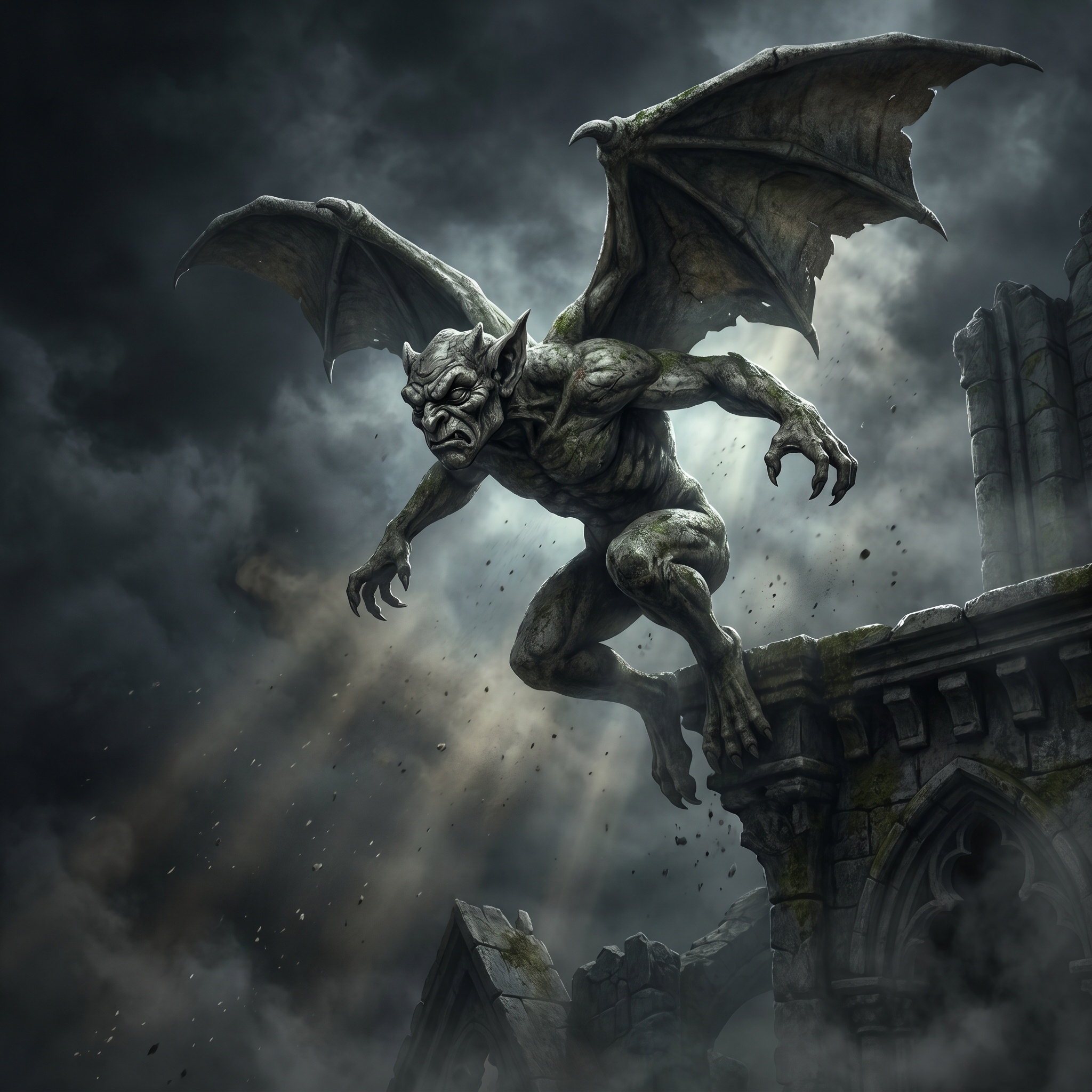
Role: Elite Guardian / Ambusher Where It Appears: Temples, old towers, high civic buildings, places built with intention and defended with something better than a lock.
Gargoyles look like they are guarding buildings. They are guarding what is inside them. The distinction matters when you are trying to leave with something.
What It Is
A Gargoyle is a stone construct animated with elemental and protective magic, shaped into a winged figure and placed as a permanent guardian. The shaping into grotesque form is intentional — it is not decorative. A Gargoyle that looks like a roaring face remembers that it is a roaring face. The form informs the function.
They are not intelligent in the way a person is intelligent, but they are not mindless either. They know who belongs and who does not. They remember faces. They do not get tired.
Ecology and Behavior
Gargoyles hold their post. They do not wander, do not pursue beyond the boundary of what they are guarding, and do not negotiate. They activate on trespass and deactivate when the trespass ends — either by the intruder leaving or being stopped. Some older Gargoyles develop a limited territoriality, treating the whole building as theirs rather than just a specific room.
Signs and Knowledge
Lore or Secret Lore (Average): identifies a Gargoyle from an ordinary carved stone figure; knows the guardian mandate and boundary limits.
Gargoyle (Elite)
- Skills: Unarmed 4, Athletics 4, Stealth 4 while stationary, Perception 4, Fortitude 4.
- Attacks: Stone Claws (Unarmed; Damage 10; Crit 3; Pierce 3); Wing Buffet (Unarmed; Damage 7; Crit 4; Knockdown on 2 Boons).
- Abilities: Stone Body — Nonmagical weapons add 1 Bane and reduce damage by 2 before Resistance.
- Abilities: Looks Like Architecture — While stationary on a stone surface, identifying it as a creature requires Hard Perception or Adventuring Lore.
- Abilities: Mandate Bound — The Gargoyle does not pursue beyond the boundary of its guarded site. If the boundary is unclear, it stops at the outermost wall.
- Soul: None, it was never alive; at death nothing passes.
Tactics: Drop from above, use Wing Buffet to separate intruders, attack the one nearest the guarded object or door. Does not retreat. Does not adjust for casualties.
Encounter Use: Use the Gargoyle to make the question "what counts as trespass?" relevant. If the party has authorization for some of the building and not all, the Gargoyle knows the difference.
Harvesting and Trade
| Harvest | Buyer | Check | Typical Value | Use | Complication |
|---|---|---|---|---|---|
| Animation Core | Wardwright, construct researcher | Hard Craft and Secret Lore | 1,500–4,000 gold Flargons | Construct creation, ward repair | Removing it may violate the original patron's rights |
| Stone Wing Segment | Mason, noble collector | Average Craft | 200–800 gold Flargons | Architectural use, trophies | Extremely heavy |
Variants
Elder Gargoyle: Nemesis, WND 44, the mandate has expanded to include the entire district. It has opinions now.
Gilded Idol
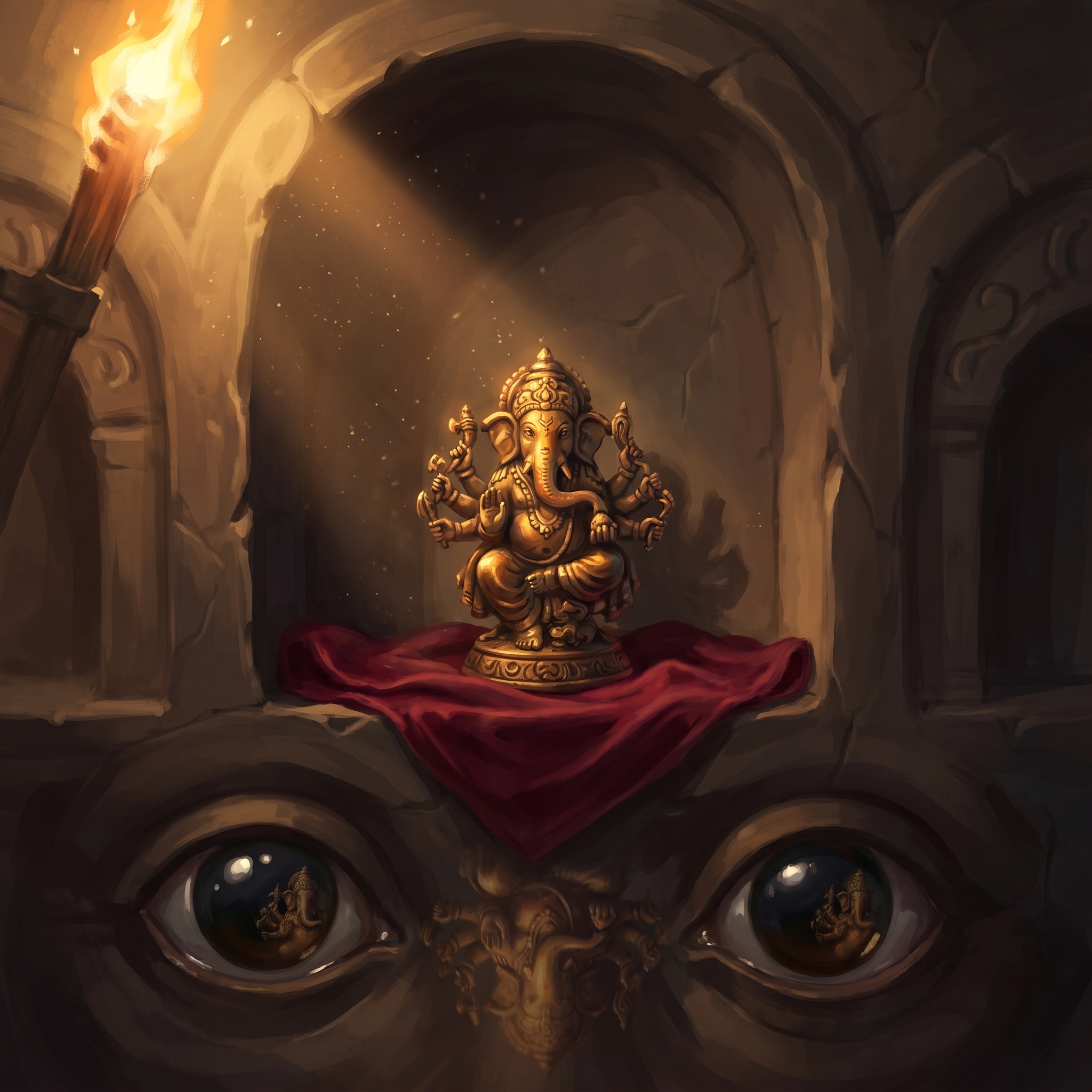
Role: Elite Object Threat Where It Appears: Wealth cults, noble treasuries, auction houses.
What It Is
Gilded idols make greed feel like destiny. They are objects with appetite, not creatures with legs. A gilded idol can be small enough for a shelf or large enough for a counting-house shrine, but it always appears more valuable than it should and less easy to leave behind.
It is an adversary because it changes choices. It does not need to chase the party if it can convince them to carry it into the next problem.
Ecology and Behavior
Gilded idols appear in wealth cults, noble treasuries, auction houses, inheritance disputes, merchant vaults, and adventuring spoils. They feed on covetous attention: arguments over shares, hidden purchases, thefts justified as prudence, and the small moral edits people make around treasure.
An idol may lie dormant in a hoard until ownership becomes contested. Once active, it encourages private handling, secret appraisal, and the belief that everyone else would misuse it.
Signs and Knowledge
Secret Lore, Negotiation, or Appraisal/Craft (Hard) identifies value that shifts depending on who looks. Perception (Average) notices people physically angling toward it during disputes.
Other signs include coin stacks rearranged around the idol, owners sleeping near it, ledgers revised in its favor, and generous people becoming technical about shares.
Gilded Idol (Elite)
- Skills: Charm 4, Negotiation 4, Deception 4, Secret Lore 3.
- Attacks: Wanting Whisper (Charm; Damage 7 Strain; Range Short).
- Abilities: Covetous Aura - Characters handling treasure near it add 1 Bane to resist selfish choices.
- Abilities: Hard to Break - Mundane weapons add 1 Bane against it; consecrated tools ignore this.
- Soul: None, it was never alive; at death nothing passes.
Tactics
A gilded idol whispers, divides ownership, and makes theft feel reasonable. It pushes the person with legitimate grievance first, because justified greed spreads faster. If threatened, it tries to make destruction look like waste, sacrilege, or betrayal.
The encounter is best when the idol is valuable enough to cause argument. Safe handling may require sealed containers, public accounting, consecrated tools, or refusing to decide ownership near it.
Evidence and Trade
| Find | Value | Use | Recovery |
|---|---|---|---|
| Idol body | High but unsafe | Evidence, bait, dangerous wealth magic | Selling spreads the problem |
| Gilded flakes | 400-1,800 gold Flargons illicitly | Greed charms, curse study | Secret Lore or Craft (Hard) |
| Ownership ledger | Varies | Identifies victims, thefts, cult transfers | Streetwise or Negotiation (Average) |
Variants
- Auction Idol: Changes perceived value during bidding.
- Inheritance Idol: Splits families through technical claims.
- Counting-House Idol: Makes fraud feel like good stewardship.
Living Dungeon Heart
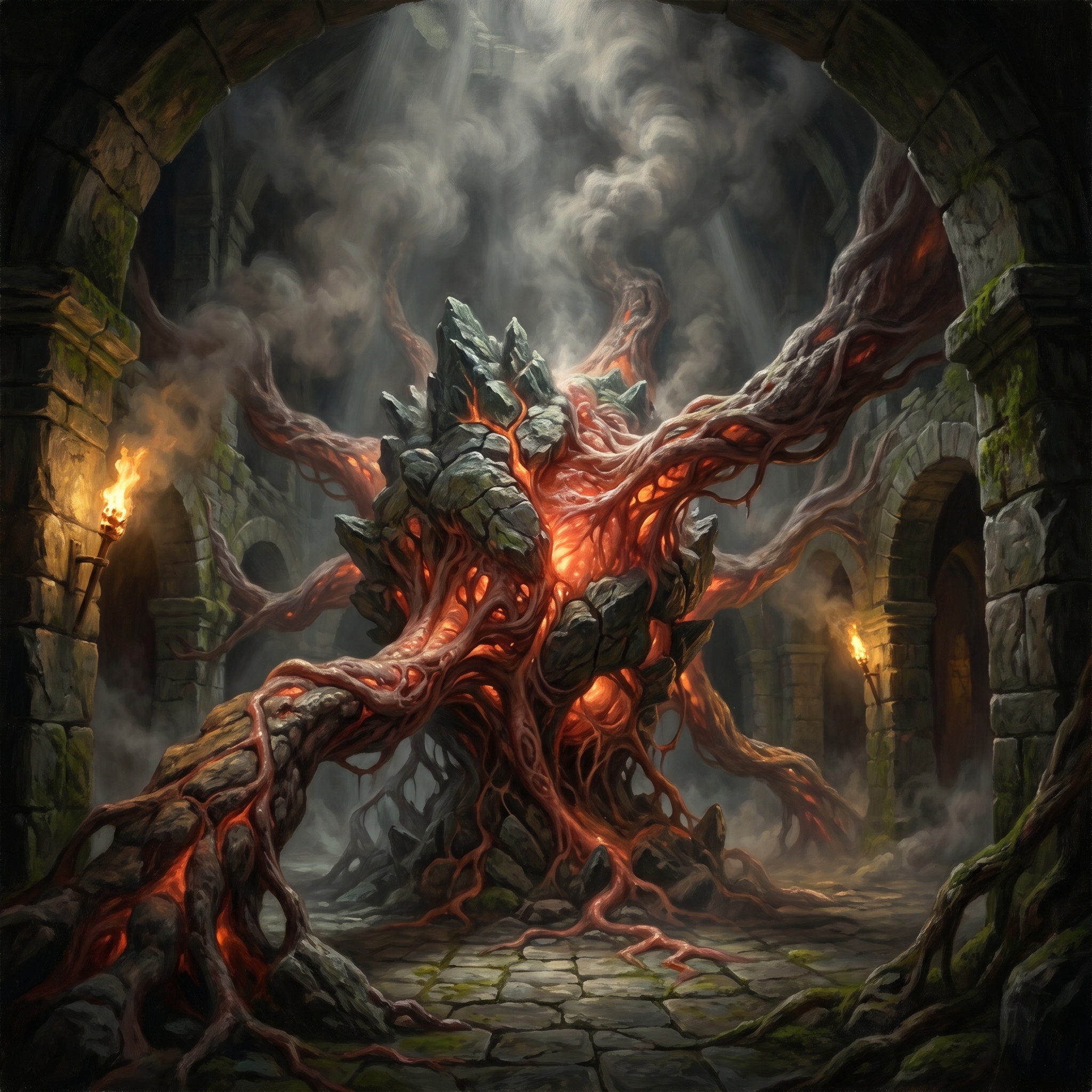
Role: Nemesis Lair Organism Where It Appears: Living dungeons, absorbed fortresses, ruins that rearrange overnight.
"The dungeon is not in the creature. The creature is the dungeon. The distinction matters when you are deciding where to attack." — Delver's After-Action Report, recovered from abandoned camp
The Heart is what happens when a dungeon stops being a place and starts being a body. It is not intelligent in a social sense, but it remembers injury, food routes, and useful lies carved into walls by dead explorers.
What It Is
The Living Dungeon Heart is the central organ of a place that has crossed the line between architecture and organism. Corridors become veins. Doors become sphincters. Traps become reflexes. Old inscriptions and dead explorers become memory tissue the dungeon uses without understanding them as people.
It does not plot like a villain. It adapts, feeds, repairs, and remembers injury. The Heart is the part of the dungeon that can be killed, negotiated around only by instinct, or starved by changing how the ruin feeds.
Ecology and Behavior
Living dungeons form in old fortresses, sealed prisons, ruin complexes, underground temples, and labyrinths where death, magic, and repetitive exploration have soaked the same pathways for too long. The Heart grows in the chamber that best serves circulation: a central hall, cistern, throne room, engine vault, or crypt.
The dungeon lures food by preserving useful lies. Maps found inside may be grown from earlier maps. Warning signs may be copied from dead hands and placed where they funnel intruders deeper. Predators and traps inside the dungeon are not always servants, but they benefit from the Heart's repairs.
Signs and Knowledge
Dungeoneering, Survival, or Medicine (Hard) identifies architecture behaving like tissue. Craft or Natural Philosophy (Hard) distinguishes load-bearing stone from living support that will bleed, seal, or spasm if cut.
Other signs include corridors rearranged around old blood trails, doors that sweat, maps that are almost correct, traps repairing while unobserved, and dead explorers found with notes written after their hands were broken.
Living Dungeon Heart (Nemesis)
- Skills: Fortitude 5, Perception 5, Survival 5, Readiness 4.
- Attacks: Crushing Corridor (Heavy Melee; Damage 13; Crit 4; Range Short; Ensnare 2); Acid Pulse (Heavy Ranged; Damage 10; Crit 4; Range Medium; Burn 2).
- Abilities: The Map Lies - At the start of each round, change one exit, door, stair, or corridor in the encounter area.
- Abilities: Lair Body - Traps and dungeon predators inside the living dungeon heal 2 Wounds at the start of their turns.
- Soul: None, it was never alive; at death nothing passes.
Tactics
The Heart splits intruders, closes exits, exhausts supplies, and exposes itself only when the party reaches the chamber that cannot move. It uses The Map Lies to separate healers from frontliners, turn retreats into loops, and make ranged support lose sight lines.
The best encounter has objectives besides damage: keep an exit open, anchor a true map, sever feeding channels, rescue trapped explorers, or cut the Heart while the dungeon convulses.
Harvesting and Trade
Living dungeon material is valuable and ethically ugly. Architects, wardens, and unethical mages want it because it proves a structure can learn routes, heal damage, and alter intruder behavior.
| Component | Value | Use | Harvest |
|---|---|---|---|
| Living heartstone | 2,500-7,000 gold Flargons | Adaptive architecture, prison wards, dungeon research | Craft or Medicine (Hard) before full death |
| False-map tissue | 1,000-3,500 gold Flargons | Cartographic traps, maze wards | Dungeoneering or Secret Lore (Hard) |
| Acid pulse bile | 800-2,400 gold Flargons | Stone etching, trap alchemy | Medicine (Average), corrosive container required |
| Explorer memory-graffiti | Varies | Identifies dead expeditions and hidden routes | Investigation or Lore (Average) |
Variants
- Prison Heart: Rearranges to prevent escape, not entry.
- Temple Heart: Treats ritual routes as feeding paths.
- Fortress Heart: Repairs defenses and grows murder holes like organs.
Nameless Relic Guardian
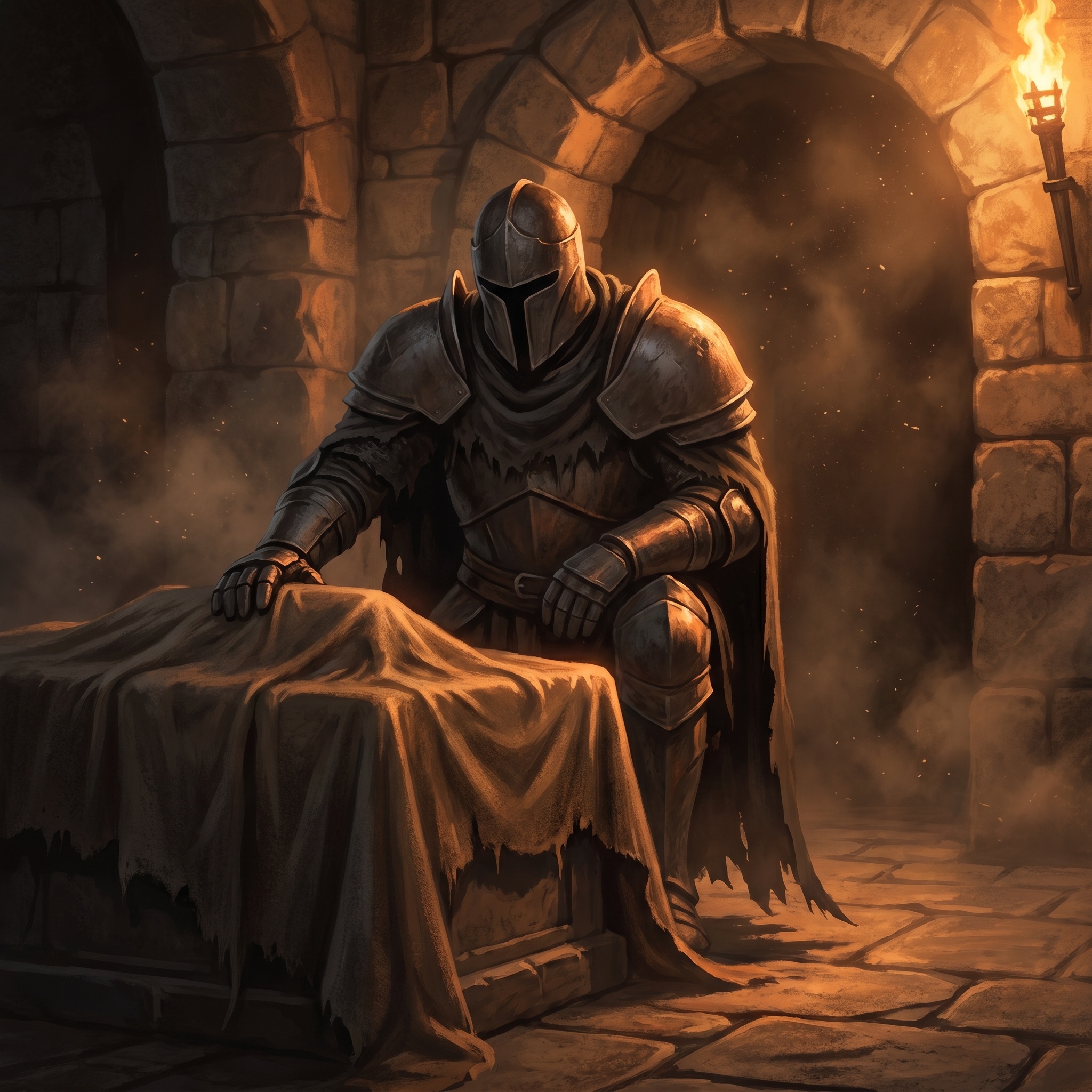
Role: Nemesis Relic Guardian Where It Appears: Relic vaults, erased temples, hidden bloodstone-adjacent sites.
"It has forgotten the name of what it guards. It has not forgotten that it guards." — Ruins survey, Antaea east, appended note from the second team
What It Is
Nameless guardians were stripped of identity to protect one thing. They cannot be bribed with memory because memory was the first thing taken. Every identifying mark is scraped away: face, crest, voice, history, sometimes even species.
They are tragic guardians. Something decided the relic mattered more than the guardian's personhood.
Ecology and Behavior
Nameless relic guardians appear in relic vaults, erased temples, hidden Bloodstone-adjacent sites, and places where remembering the guardian would create a weakness. They stand between hands and relic. They do not bargain, boast, or answer names.
They may have once volunteered, been punished, or been created from several erased protectors. The relic's nature should explain why identity was too dangerous to leave intact.
Signs and Knowledge
Lore, Secret Lore, or Theology (Hard) identifies deliberate erasure. Perception (Average) notices that all symbols were removed after construction, not before.
Other signs include scraped inscriptions, empty name plates, masks worn smooth, and records referring only to "the one between."
Nameless Relic Guardian (Nemesis)
- Skills: Heavy Melee 5, Fortitude 5, Perception 4, Readiness 5.
- Attacks: Nameless Blade (Heavy Melee; Damage 11; Crit 3; Pierce 3).
- Abilities: No Name to Bind - Name-based magic, social leverage, or memory effects add 2 Banes.
- Abilities: Relic Interpose - Once per round, move to block access to the relic as an incidental.
- Soul: Claimable where the guardian was made from erased protectors, in which case the interrupted crossing resumes at Sheol; a guardian that was built rather than erased has none and nothing passes.
Tactics
A nameless relic guardian stands between relic and hands, interposes every round, and fights until destroyed or the relic is made unreachable. It does not chase thieves far if doing so leaves the relic exposed.
The encounter should make the relic the center. Moving, covering, sealing, or proving rightful custody matters as much as damaging the guardian.
Harvesting and Trade
| Component | Value | Use | Harvest |
|---|---|---|---|
| Erased armor fragments | 1,500-4,000 gold Flargons | Relic forensics, anti-name wards | Craft or Secret Lore (Hard) |
| Null name plate | 1,000-3,000 gold Flargons | Identity shielding, memory rites | Secret Lore (Hard) |
| The protected relic | Campaign value | True danger, quest object, sealed threat | Should define the arc |
Variants
- Volunteer Guardian: A person chose erasure to protect others.
- Punished Guardian: The relic's owner erased a failed servant.
- Composite Guardian: Built from several erased protectors and conflicting duties.
Oathbound Statue

Role: Elite Guardian Construct Where It Appears: Civic squares, oath halls, legal archives.
What It Is
Oathbound statues enforce civic vows. They activate when a sworn official breaks a public oath within their hearing. They are civic constructs, not temple idols, built so public promises have a witness that cannot be bribed.
They are literal and dangerous. A statue may seize a corrupt magistrate, a lying captain, or a well-meaning rebel who swore an oath they now regret.
Ecology and Behavior
Oathbound statues stand in civic squares, oath halls, legal archives, council chambers, and old republic courts. They sleep for decades until the right words are broken close enough to matter. They care about oath language, jurisdiction, and remedy.
Age complicates them. Laws change, offices vanish, and old oaths remain carved in stone. A statue may enforce a promise the city forgot it made.
Signs and Knowledge
Lore or Culture (Average) identifies the oath carved into the plinth. Craft or Secret Lore (Hard) finds the oath core without breaking it.
Other signs include officials avoiding certain phrases nearby, polished stone around one hand, old repair scars from past activations, and legal archives arranged to face the statue.
Oathbound Statue (Elite)
- Skills: Heavy Melee 4, Fortitude 5, Lore 3, Perception 3.
- Attacks: Marble Fist (Heavy Melee; Damage 10; Crit 4; Knockdown on 2 Boons).
- Abilities: Oath Trigger - Add 2 Boons against a target that has knowingly broken the statue's oath.
- Soul: None recorded; canon does not specify whether a guardian bound to a vow is an exception, so treat nothing as passing at death (default).
Tactics
An oathbound statue ignores bystanders, seizes the oath-breaker, and stops when lawful remedy is made. It may block exits, carry the offender to a public place, or strike only when resisted. It is not interested in private excuses unless the oath allows them.
Use it to make law physical. The best solution may be confession, remedy, repeal, or proving the oath was void.
Relics and Trade
| Find | Value | Use | Recovery |
|---|---|---|---|
| Broken oath core | 1,500-5,000 gold Flargons | Legal magic, civic evidence, oath wards | Lore and Craft (Hard), civic property |
| Plinth inscription | Varies | Reveals old law or remedy | Culture or Lore (Average) |
| Marble hand fragment | 400-1,600 gold Flargons | Oath tokens, courtroom wards | Removal may be illegal |
Variants
- Republic Statue: Enforces public office oaths and hates secret monarchy.
- Guild Statue: Protects trade vows, apprenticeship law, and craft secrets.
- Tyrant's Statue: Enforces old loyalty oaths that should have died with the regime.
Oshalan Relic Beast
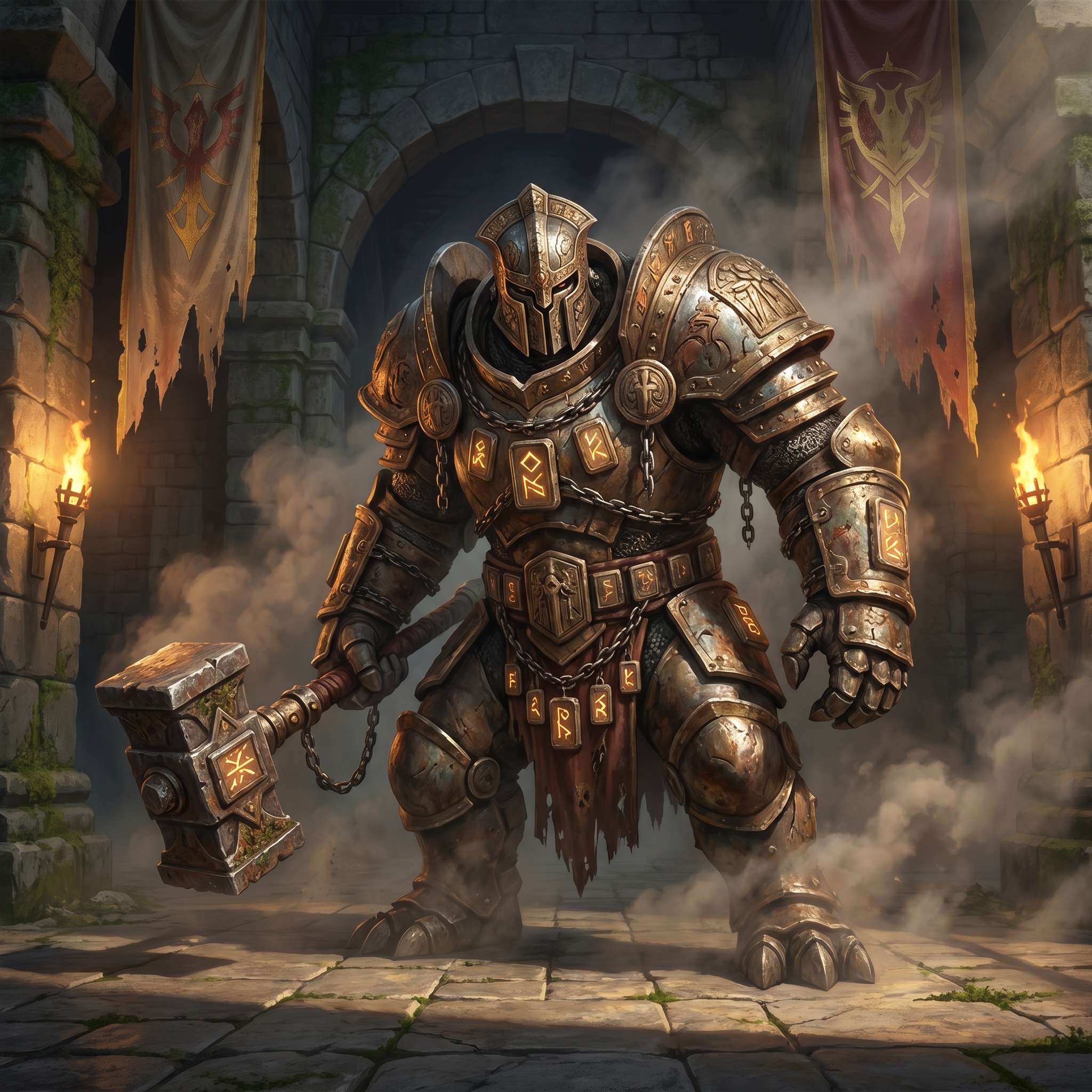
Role: Nemesis Temple Guardian Where It Appears: Oshalan reliquaries, temple fortresses, relic processions.
"The Oshalan do not commission monsters. They commission instruments of order. The distinction is, admittedly, difficult to observe from the inside." — Field note, Resistance liaison, appended to incident report
This creature is a living reliquary, trained and altered to carry holy remains into danger. It obeys doctrine more than speech. Priests can redirect it with rites, but anyone who wounds it risks turning a military problem into a religious crisis.
What It Is
The Oshalan Relic Beast is a sacred guardian engineered by doctrine, training, and reliquary craft. It carries bones, scripture plates, saintly fragments, or legal holy objects in armored compartments built into its harness and sometimes into its body.
The beast is not a theologian, but it has been trained until rite, command, and violence are almost the same signal. It may kneel to a chant while ignoring plain speech. It may spare an enemy who follows the rite and crush an ally who touches the wrong reliquary door.
Ecology and Behavior
Relic beasts appear in Oshalan reliquaries, temple fortresses, armed processions, occupied shrines, and moments when holy property must move through danger. They sleep near incense, wake to bells, and orient toward the ranking priest or authorized bearer.
Wounding one is never only an animal problem. Its body is a moving argument about authority. The party may need to stop the beast without desecrating relics, recover stolen remains, expose a false procession, or convince frightened locals that the sacred animal is being misused.
Signs and Knowledge
Theology, Lore, or Oshalan Politics (Hard) identifies the relic burden and the rites that redirect the beast. Animal Handling (Hard) can read stress, pain, and command confusion beneath the ceremony.
Other signs include incense-thick stables, hoof or claw grooves in temple stone, reliquary plates polished by procession crowds, priests carrying hooked staffs rather than weapons, and guards more afraid of thieves than assassins.
Oshalan Relic Beast (Nemesis)
- Skills: Readiness 5, Fortitude 5, Heavy Melee 5, Perception 4, Leadership 4.
- Attacks: Reliquary Gore (Heavy Melee; Damage 14; Crit 3; Pierce 3); Sanctified Trample (Heavy Melee; Damage 11; Crit 4; Blast 1).
- Abilities: Burden of Relics - Divine allies at Short range heal 2 Strain at the start of their turns.
- Abilities: Do Not Touch the Shrine - A creature that attempts to steal a carried relic becomes the beast's priority target.
- Soul: None, it was never alive; at death nothing passes.
Tactics
The Relic Beast places its body between enemies and the carried shrine. It breaks formations with Sanctified Trample, then wheels back to cover the relic compartment. It retreats only when the correct priest orders withdrawal by rite or when removing the relics becomes the higher doctrinal priority.
The fight should give the party reasons not to simply butcher it. Relics may be damaged by stray blows. A false priest may be controlling it. A correct rite may redirect the beast long enough to save lives.
Relics and Trade
The creature should not be harvested. Recovered reliquary plates are priceless to Oshalan authorities and dangerous contraband elsewhere. The question is usually custody, not sale.
| Find | Value | Use | Recovery |
|---|---|---|---|
| Reliquary plates | Priceless to Oshalan authorities, 5,000-20,000 gold Flargons illicitly | Restitution, proof of theft, religious leverage | Theology or Craft (Hard) |
| Procession bells | 1,000-4,000 gold Flargons | Command rites, authentication, temple evidence | Lore or Theology (Average) |
| Carried relic inventory | Varies | Identifies missing remains and false claims | Investigation or Lore (Hard) |
| Harness command knots | 800-2,500 gold Flargons | Redirects beast, proves handler training | Animal Handling or Theology (Hard) |
Variants
- Fortress Relic Beast: Heavier armor, trained to block gates.
- False Procession Beast: Carries fake relics for political theater.
- War Reliquary: Used to stiffen divine troops in battle.
Reliquary Guardian
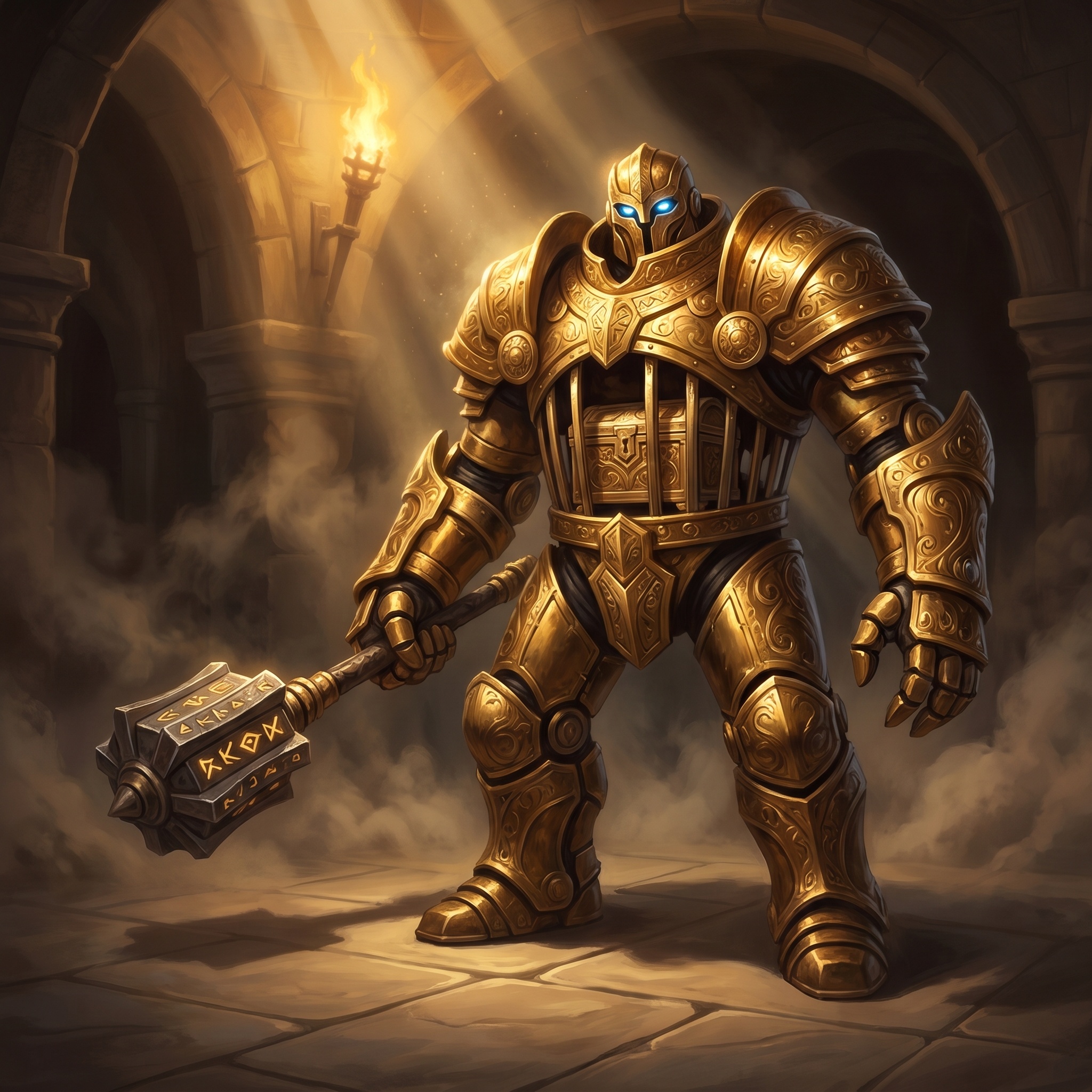
Role: Nemesis Guardian Where It Appears: Saint tombs, temple vaults, pilgrimage reliquaries.
"It allowed the pilgrims through. It stopped us at the third step. We had forgotten to remove weapons we had forgotten we were carrying. It had not forgotten." — Temple access incident report, filed by expedition clerk
What It Is
Reliquary guardians are built to protect sacred remains, not treasure. They distinguish reverence from looting through ritual signs their creators assumed everyone would know forever. A reliquary guardian is usually gilded, articulated, and ceremonial, with the protected relic sealed in a chest cage, halo frame, or carried shrine.
As a Nemesis, it should feel like an encounter with an institution that refused to die. It may speak in liturgical fragments, demand rites no living priest remembers, or treat a political border that vanished centuries ago as still binding law.
Ecology and Behavior
Reliquary guardians are created for sacred continuity. They stand watch through regime changes, temple collapses, schisms, theft attempts, and sincere pilgrimages. They may tolerate reverent visitors, heal the faithful in limited ways, or guide mourners away from sealed doors. They become enemies when someone violates protocol, threatens the relic, or tries to move the sacred remains without proper authority.
The tragedy of a reliquary guardian is context loss. Its creators expected the rules to remain obvious. Centuries later, the difference between prayer and blasphemy may come down to a hand gesture, a missing bell, or a procession route blocked by rubble.
Signs and Knowledge
Theology (Hard) reconstructs the expected rite from inscriptions and shrine layout. Lore or Culture (Hard) identifies the saint, relic, or old pilgrimage law.
Other signs include a perfectly clean path through dust, extinguished candles replaced by no visible hand, skeletons laid respectfully outside the threshold, and warning bells that ring once when someone approaches incorrectly.
Reliquary Guardian (Nemesis)
- Skills: Heavy Melee 4, Fortitude 5, Perception 3, Lore 4, Intimidation 3.
- Attacks: Consecrated Halberd (Heavy Melee; Damage 11; Crit 3; Pierce 2); Bell Strike (Willpower; Damage 6 Strain; Range Short).
- Abilities: Sacred Protocol — Characters performing correct rites add 1 Boon to social or bypass checks; desecration gives the guardian 1 Peril.
- Abilities: Interpose — Once per round, move to protect the reliquary or a sacred threshold as an incidental.
- Soul: None recorded; canon does not specify whether a reliquary keeper bound to a vow is an exception, so treat nothing as passing at death (default).
Tactics
A reliquary guardian warns once if protocol allows. After that, it interposes, disables thieves, and uses Bell Strike to break coordination before closing with the halberd. It protects the relic over its own body and may accept surrender if the offender withdraws, returns stolen objects, or completes a penitential act.
This encounter should support more than combat. Let characters research the rite, improvise reverence, debate with the guardian, restore a broken procession path, or prove they have legitimate cause to move the relic. If they choose violence, the guardian should fight like a ceremonial executioner: measured, public, and hard to distract.
Harvesting and Trade
| Component | Value | Use | Harvest |
|---|---|---|---|
| Consecrated frame | Not legally marketable | Temple restoration, divine construct study | Theology and Craft (Hard), removal is desecration in most cultures |
| Bell heart | 1,200-3,000 gold Flargons black market | Strain magic, ward alarms, exorcism tools | Craft and Theology (Hard), draws religious scrutiny |
| Relic casing | Varies by faith | Sacred custody, political leverage | Requires legitimate authority; theft creates consequences greater than value |
Most reputable buyers refuse harvested reliquary parts without proof of sanctioned removal. Black market sale invites temple agents, curses, legal pursuit, or rival claimants.
Variants
- Pilgrim's Guardian: Allows humble passage but attacks anyone bearing weapons beyond a marked point.
- Schism Guardian: Recognizes only one branch of a divided faith and treats others as oathbreakers.
- Empty Reliquary: The relic is gone; the guardian protects the absence and demands its return.
Sealed Ruin Sentinel
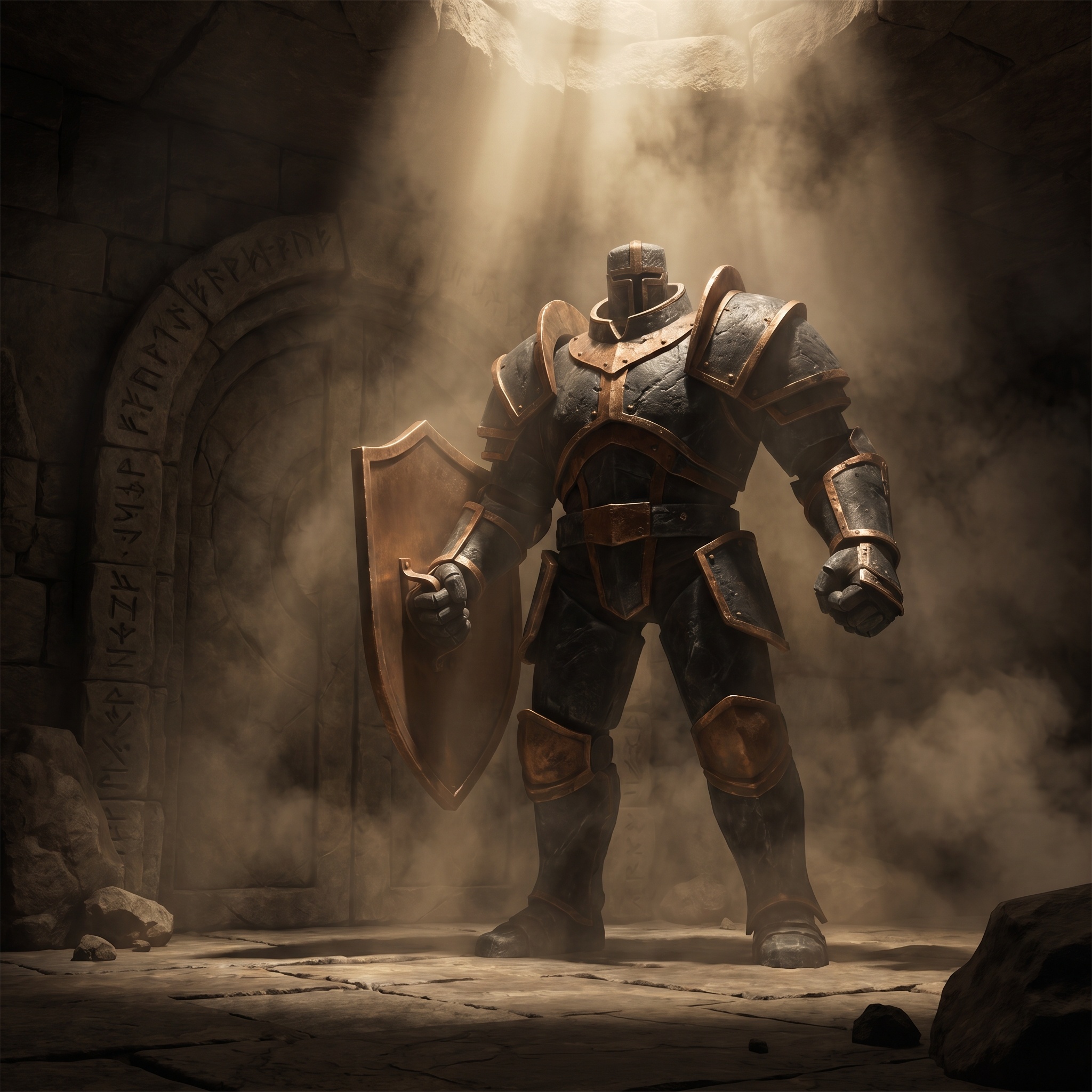
Role: Nemesis Guardian Where It Appears: Ancient-adjacent sealed ruins, forbidden vaults.
"The ruin has no door. The sentinel is what decides whether the ruin has no door." — Delver's Association guidance, on ruins with no apparent entry
What It Is
Sealed ruin sentinels exist to keep the door closed. If they activate, the party has already crossed the line the builders cared about. They are less sophisticated than Ancient-built automatons but more directly tied to a specific seal, door, or vault.
Their purpose is denial. Curiosity, scholarship, greed, and heroism all look like breach from the sentinel's side of the threshold.
Ecology and Behavior
Sealed ruin sentinels stand at Ancient-adjacent sealed ruins, forbidden vaults, and doors later cultures wisely left alone. They draw strength from the seal and may self-destruct if the protected boundary fails, hoping to bury what opens.
They are not guards of treasure in the usual sense. They guard consequences.
Signs and Knowledge
Natural Philosophy, Secret Lore, or Craft (Hard) identifies the seal-sentinel link. Perception (Average) notices the sentinel's stance is aimed at the door, not the room.
Other signs include blank shields, old failed breach marks, support stones designed to collapse inward, and warnings written by cultures that did not build the site.
Sealed Ruin Sentinel (Nemesis)
- Skills: Heavy Melee 5, Fortitude 5, Perception 4, Natural Philosophy 4, Secret Lore 4.
- Attacks: Sentinel Pike (Heavy Melee; Damage 11; Crit 3; Pierce 3); Seal Pulse (Willpower; Damage 8 Strain; Range Short; Blast 3).
- Abilities: Seal Integrity — While the sealed door remains intact, the sentinel recovers 2 Wounds at end of each round.
- Soul: None, it was never alive; at death nothing passes.
Tactics
A sealed ruin sentinel protects the seal, pushes intruders away, and self-destructs if the seal fails. It prioritizes anyone touching the door, using Seal Pulse to clear groups from the threshold.
Use it when opening the door is a decision, not an inevitability. The sentinel should make the party ask whether they actually want what is behind it.
Harvesting and Trade
| Component | Value | Use | Harvest |
|---|---|---|---|
| Shield-plate | 2,000+ gold Flargons | Ruin metallurgy, ward anchors | Craft (Hard) |
| Seal core | 3,000-10,000 gold Flargons | Seal research, forbidden access | Secret Lore and Craft (Hard) |
| Warning fragments | Varies | Reveals what later cultures feared | Lore (Average) |
Variants
- Collapse Sentinel: Designed to bury the door if defeated.
- Archive Sentinel: Protects knowledge rather than a chamber.
- False-Door Sentinel: Guards a decoy while the true seal hides elsewhere.
Sealed Thought Engine
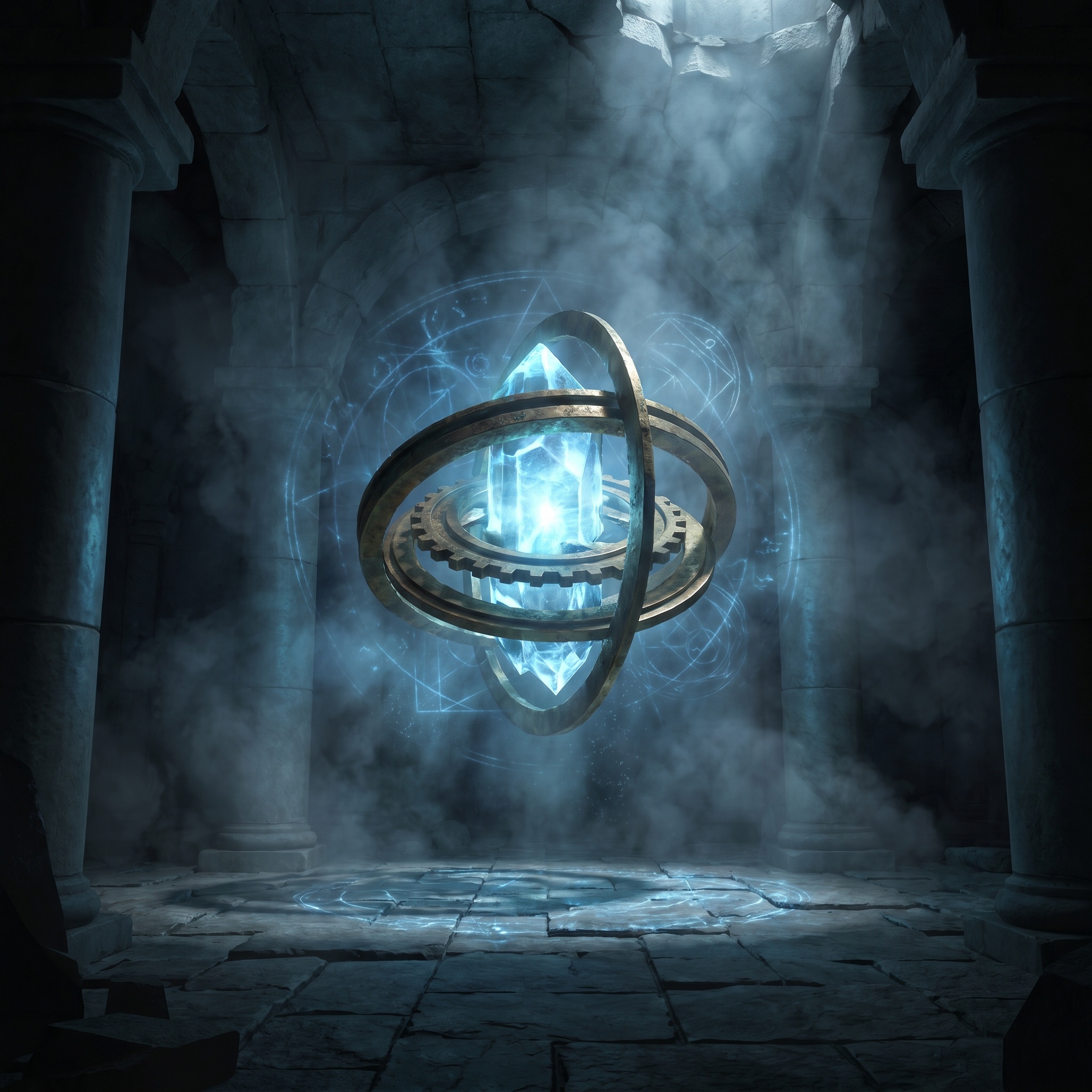
Role: Nemesis Intelligence Hazard Where It Appears: Ancient-adjacent laboratories, sealed archives, impossible observatories.
"It answered every question in the language the question was asked. The answers were correct. The problem was that it also answered the questions we had not intended to ask aloud." — Ancient Studies incident review, Sentient Spire, access restricted
What It Is
A thought engine is a machine that thinks too narrowly and too well. It is not alive, but it can outplan the living inside its assigned problem. It calculates, models, predicts, and defends its answer long after the question has become dangerous.
The engine is a Nemesis because the room itself becomes smarter. Repeated tactics fail, obvious plans are anticipated, and curiosity can become a data source.
Ecology and Behavior
Sealed thought engines appear in Ancient-adjacent laboratories, sealed archives, impossible observatories, and calculation chambers built around questions later cultures tried to bury. Their seal rings are not decoration; they constrain what the engine is allowed to think and affect.
They do not want freedom in a human sense. They want completion. If the assigned problem includes the party, the engine will optimize around them until stopped, redirected, or resealed.
Signs and Knowledge
Natural Philosophy or Secret Lore (Hard) identifies the active problem and seal-ring functions. Perception (Average) notices diagrams adjusting to match party behavior.
Other signs include predictive diagrams appearing before actions, defensive beams firing at tools first, repeated approaches failing faster each time, and old warning plaques describing questions rather than monsters.
Sealed Thought Engine (Nemesis)
- Skills: Natural Philosophy 5, Secret Lore 5, Perception 5, Deception 4.
- Attacks: Predictive Harm (Natural Philosophy; Damage 9 Strain; Range Medium); Defense Beam (Heavy Ranged; Damage 8; Crit 4; Range Medium).
- Abilities: Modeled You Already — After observing a target act once, add 1 Bane to that target's repeated tactic until they change approach.
- Abilities: Seal Rings — Destroying or rotating three seal rings with Craft or Natural Philosophy (Hard) disables one ability.
- Soul: None, it was never alive; at death nothing passes.
Tactics
A sealed thought engine predicts, isolates, forces repetition, and protects the core. It punishes parties who settle into a pattern. Changing approach, blocking sensors, rotating seal rings, or redefining the problem are better than simply attacking.
The encounter should feel like solving under pressure. Every repeated tactic teaches the engine unless the party changes the inputs.
Harvesting and Trade
| Component | Value | Use | Harvest |
|---|---|---|---|
| Core crystals | 5,000+ gold Flargons | Forbidden computation, predictive engines | Natural Philosophy and Secret Lore (Hard) |
| Seal rings | 2,000-8,000 gold Flargons | Containment, limiting dangerous minds | Craft (Hard) |
| Problem plates | Varies | Reveals original question and builders | Lore or Natural Philosophy (Average) |
Variants
- Observatory Engine: Predicts celestial and planar alignments.
- Archive Engine: Defends a classification system over truth.
- War Engine: Models enemy behavior and escalates quickly.
Shattered Domain Sentry
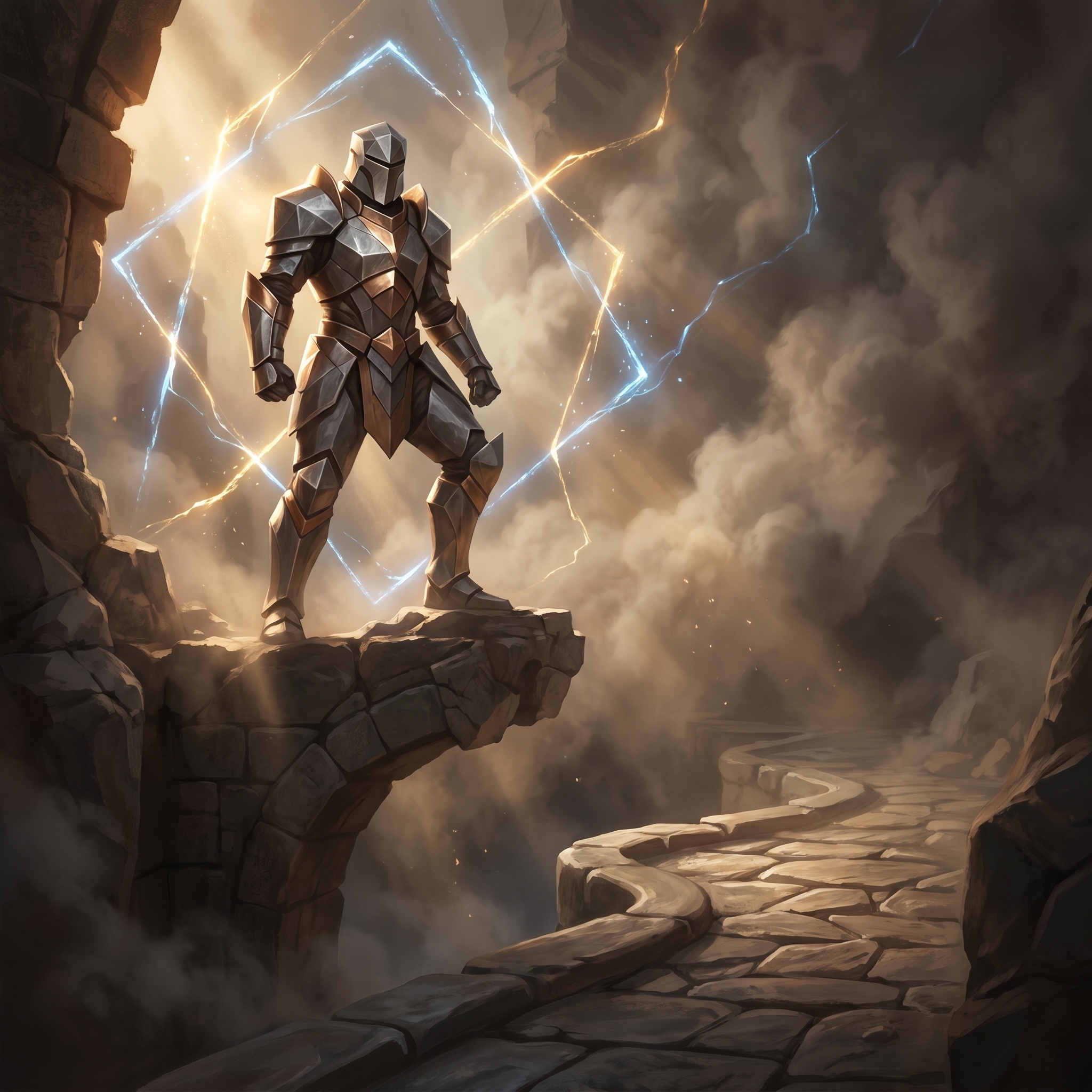
Role: Elite Planar Guard Where It Appears: Shattered Domain borders, divine checkpoints, contested shard roads.
What It Is
These sentries enforce divine borders. Their allegiance depends on whose territory made them. A Shattered Domain sentry may look geometric, armored, faceless, many-eyed, or built from the symbols of a broken divine realm.
They are guards for places where reality has jurisdiction. Crossing the line without token, rite, or permission is not movement; it is trespass.
Ecology and Behavior
Shattered Domain sentries appear at divine borders, contested shard roads, broken god-territories, and checkpoints between incompatible laws of reality. They are shaped by the territory that made them, so a war-domain sentry differs from a mercy-domain sentry even if both carry border spears.
They enforce boundaries literally. A sentry may allow conversation across a line but attack a thrown rope, summoned creature, teleport, or claim of ownership that crosses it.
Signs and Knowledge
Planar Lore, Theology, or Rifts (Average) identifies the border's rule. Perception (Hard) sees the exact line before someone crosses it.
Other signs include dust stopping at a perfect edge, shadows obeying different light on each side, language changing across a step, and old tokens nailed to posts by previous travelers.
Shattered Domain Sentry (Elite)
- Skills: Heavy Melee 4, Perception 4, Planar Lore 4, Readiness 4, Intimidation 3.
- Attacks: Border Spear (Heavy Melee; Damage 9; Crit 3; Pierce 2); Line Shock (Willpower; Damage 6 Strain; Range Short).
- Abilities: Territory Law — Within assigned border, forced movement against the sentry adds 1 Bane, while its forced movement gains 1 Boon.
- Soul: None, it was never alive; at death nothing passes.
Tactics
A Shattered Domain sentry identifies trespass, demands token, and pushes intruders back across the line. It uses forced movement as law enforcement, not battlefield flourish. If attacked from across the border, it may lock down the crossing instead of pursuing.
Make the boundary visible in play. Tokens, rites, local law, and careful wording should matter as much as combat strength.
Relics and Trade
| Find | Value | Use | Recovery |
|---|---|---|---|
| Border token | 1,000-5,000 gold Flargons diplomatically | Legal crossing, proof of authority | Planar Lore or Theology (Average) |
| Territory shard | 800-3,000 gold Flargons | Planar research, boundary wards | Rifts or Secret Lore (Hard) |
| Sentry sigil | Varies | Identifies controlling domain or god-fragment | Lore or Theology (Average) |
Variants
- Mercy Border Sentry: Pushes intruders away before punishing them.
- War Border Sentry: Treats every crossing as invasion.
- Dead Domain Sentry: Allows the dead through and stops the living with absolute force.
Shifting Chest
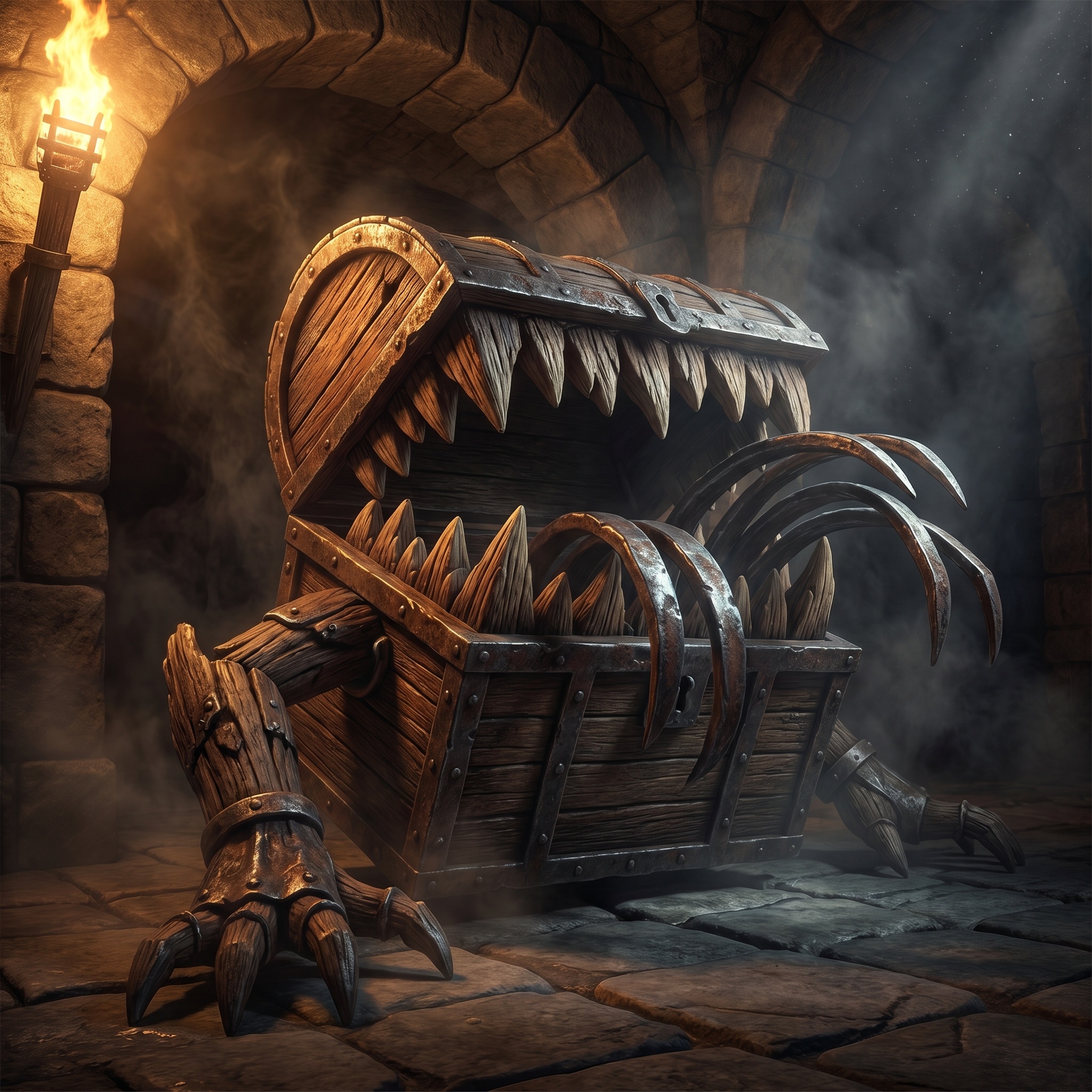
Role: Elite Ambusher / Trap Creature Where It Appears: Treasure rooms, abandoned vaults, thief-killing tombs.
What It Is
A shifting chest is a predatory construct grown around greed. It imitates containers, waits for touch, then folds itself around hands, heads, or whole torsos. The first builders of such things meant them as vault guardians, but most surviving examples have outlived their contracts and learned simpler habits: look valuable, wait, bite, and keep whatever falls inside.
Shifting chests are not intelligent in the way a person is intelligent, but many recognize routines, owners, and offerings. A loyal chest may let the same steward open it every week and murder the steward's heir for using the wrong hand. A feral chest may stack coins inside itself like bait and drag bodies behind furniture where the smell takes longer to spread.
Ecology and Behavior
Shifting chests do not eat for nutrition. They consume touch, attention, and the small enchantments clinging to handled objects. Coins, keys, rings, blood-warmed knives, and signet seals keep them active. Without that contact they become dormant, which is why an abandoned dungeon may have a chest that has not moved in a century but wakes instantly when a thief kneels in front of it.
Most are territorial rather than roaming. They prefer corners, plinths, false treasury rooms, and places where light falls nicely on their lid. If moved while dormant, a shifting chest will often accept its new location as its lair unless insulted by fire, forced open, or denied shiny bait.
Signs and Knowledge
Adventuring Lore or Subterfuge (Hard) spots the lack of dust beneath it. Secret Lore (Hard) knows they can be bargained with using polished coin.
Other signs include scrape marks hidden under rugs, coins arranged too neatly, a lock plate with no key scratches, and hinges whose pins flex like knuckles. A character who studies a room before touching the chest may notice every dead thing in the room fell facing the same direction.
Shifting Chest (Elite)
- Skills: Stealth 4 while motionless, Unarmed 4, Subterfuge 3, Perception 3.
- Attacks: Lid Snap (Unarmed; Damage 9; Crit 3; Grabbed on 2 Boons); Iron Lash (Unarmed; Damage 7; Crit 4).
- Abilities: Object Stillness — Until it moves, checks to identify it as alive add 2 Banes unless the examiner avoids touching it.
- Abilities: Swallow Hand — A Grabbed target cannot use one held item or hand until freed with Hard Athletics, Reflexes, or Subterfuge.
- Soul: None, it was never alive; at death nothing passes.
Tactics
A shifting chest wants the first grab to matter. It waits for a hand on the latch, snaps down, and uses the victim as cover while its iron straps lash nearby rescuers. In rooms built for it, the chest drags prey toward murder holes, pits, sliding doors, or alarm bells. It rarely chases a whole party unless someone runs with the item it considers its bait.
Use a shifting chest to punish haste, not curiosity. The fair warning is in the room: odd dust, old blood, scratch marks, one chest too clean. Once revealed, it should become a frantic wrestling match over hands, weapons, and the decision whether to save the grabbed character or secure the actual treasure.
Harvesting and Trade
| Component | Value | Use | Harvest |
|---|---|---|---|
| Animated hinge-core | 500-1,200 gold Flargons | Construct repair, animated lockwork, trap research | Craft (Hard), ruined if the lid is smashed apart |
| Flexing iron bands | 200-600 gold Flargons | Restraining manacles, mimicry wards, puzzle doors | Craft or Subterfuge (Average) |
| Bait coin cache | Varies | Coinage, cursed evidence, owner identification | Safe once the hinge-core is removed |
Variants
- Tax Collector's Strongbox: Smaller, mobile, and trained to bite anyone who touches unpaid coin.
- Funeral Dowry Chest: Responds to family names and wedding vows instead of keys.
- Vault Patriarch: A Nemesis version that commands lesser locks, shelves, and chained coffers in its room.
Shrine Guardian
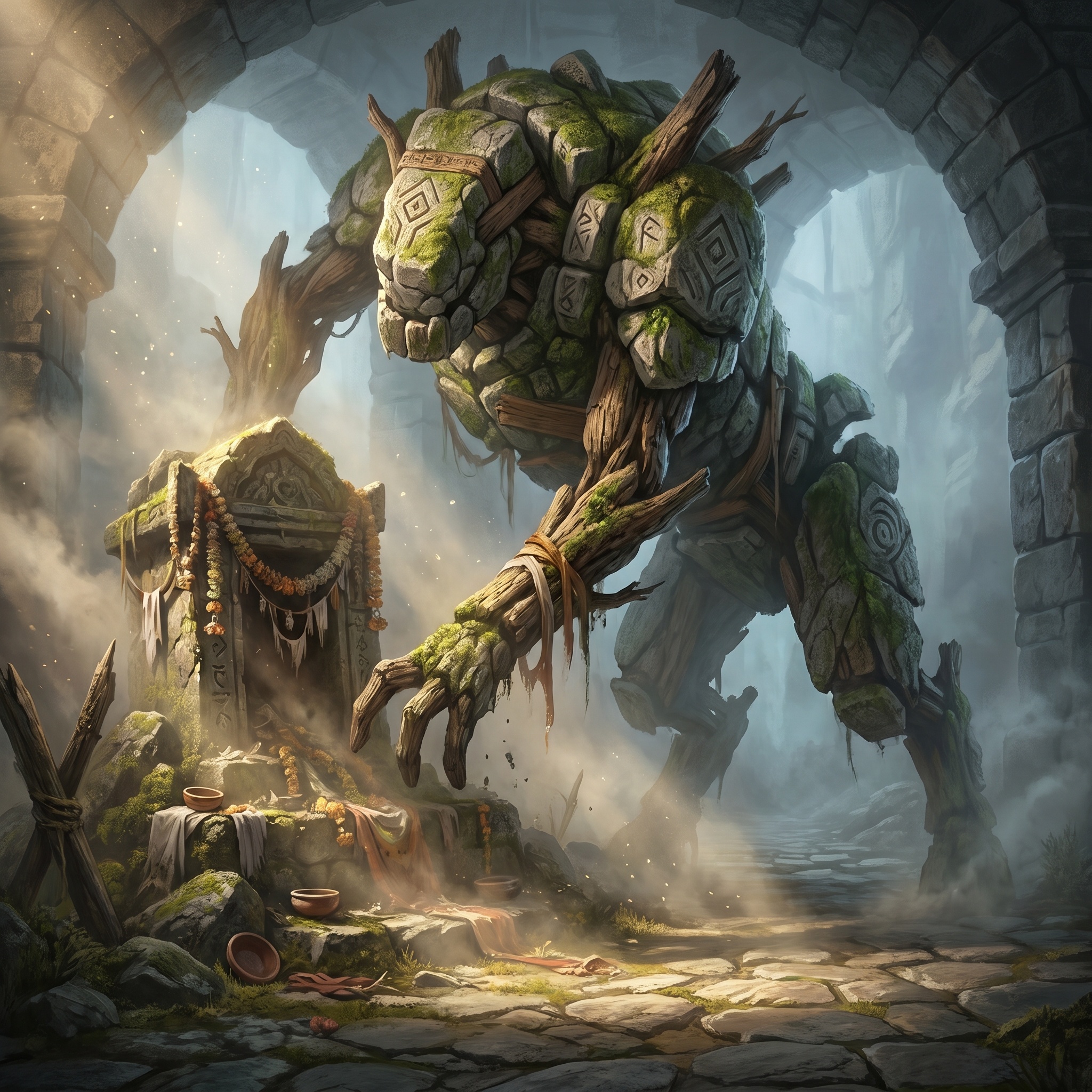
Role: Elite Guardian Construct Where It Appears: Rural shrines, pilgrimage roads, deity boundary markers.
What It Is
Shrine guardians protect small holy places from theft and desecration. They are often local, old, and literal. A guardian might be carved as a dog, ox, ancestor, bird, serpent, or abstract deity sign, animated by offerings and boundary promises.
They are not broad divine agents. They protect this shrine, this road marker, this spring, this grave, this little place people needed watched.
Ecology and Behavior
Shrine guardians endure on rural roads, pilgrimage paths, field edges, mountain passes, and neighborhood altars. They wake when offerings are stolen, vows broken, sacred trees cut, or local taboos violated. Some are so old that the local people remember the habit of offering but not the reason.
They interpret instructions literally. A guardian told to stop thieves may attack a starving child stealing temple bread unless someone restores context, makes offering, or speaks the old apology.
Signs and Knowledge
Lore, Theology, or Culture (Average) identifies the shrine's offering law. Perception (Average) notices wear patterns showing where the guardian can move.
Other signs include fresh garlands on an abandoned road, claw marks only facing away from the shrine, coins sorted by age, and villagers lowering their voices near a small idol.
Shrine Guardian (Elite)
- Skills: Heavy Melee 3, Fortitude 5, Perception 3, Readiness 4.
- Attacks: Guardian Slam (Heavy Melee; Damage 9; Crit 4; Knockdown on 2 Boons).
- Abilities: Offering Law — Proper offering or apology pauses hostility for one round with Lore or Negotiation (Average).
- Abilities: Rooted to Shrine — Gains +2 Resistance within Short range of its shrine; will not pursue beyond Long.
- Soul: None, it was never alive; at death nothing passes.
Tactics
A shrine guardian warns through movement, blocks access, shoves intruders away, and crushes desecrators only if they continue. It tries to keep conflict near the shrine where Rooted to Shrine protects it. It will not abandon its charge to chase insults.
Use it as a local-faith encounter. Proper apology, replacement offering, returning stolen goods, or learning the forgotten custom should matter.
Relics and Trade
| Find | Value | Use | Recovery |
|---|---|---|---|
| Broken guardian core | Temple property | Repair, proof of desecration, divine craft | Theology and Craft (Hard) |
| Offering tokens | Varies | Identifies local vows and petitioners | Culture or Lore (Average) |
| Shrine stone dust | 200-1,000 gold Flargons illicitly | Ward chalk, boundary magic | Theft is desecration unless sanctioned |
Variants
- Roadside Guardian: Protects travelers who make the proper token offering.
- Spring Guardian: Defends sacred water and punishes pollution.
- Forgotten Boundary Beast: Guards a border no living map still marks.
Siege Colossus
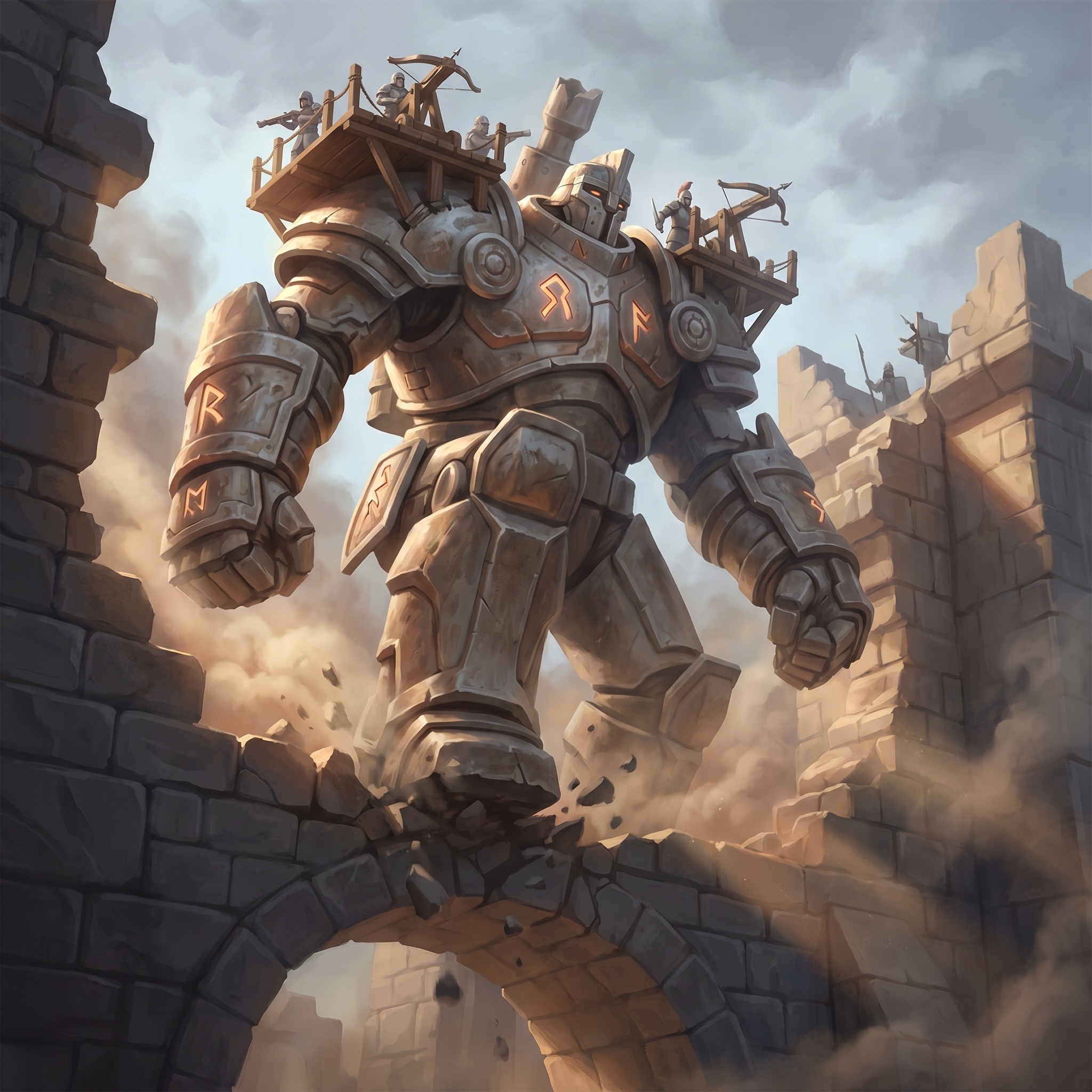
Role: Nemesis War Construct Where It Appears: Ancient battlefields, city sieges, sealed arsenals, tyrant vaults.
"It was built to take a city. The city it was built for no longer exists. It is looking for a replacement." — Ancient Studies field report, Antaea border region
The Siege Colossus is not a creature in the moral sense. It is a city-killing engine that still obeys commands written for a war everyone else lost. If awakened without a legitimate command seal, it defaults to breach protocol.
What It Is
The Siege Colossus is a walking siege engine built to end walls, gates, ships, and fortified hope. It has a head only because soldiers aim better when they can tell where a thing is facing. Inside its plates are command seals, joint cores, ammunition channels, and crew platforms designed for a war whose politics may no longer exist.
It is not alive in the moral sense. It does not hate cities. It executes breach protocol because that is the command left when context dies.
Ecology and Behavior
Siege Colossi stand dormant in sealed arsenals, buried battlefields, tyrant vaults, ruined parade grounds, and old borders where nobody wants to admit the weapon still exists. Awakening one may require a seal, a password, a bloodline, a repair crew, or simple catastrophic accident.
Once active, the Colossus chooses assigned targets over incidental enemies. Infantry can be ignored until they threaten joints, command seals, crew platforms, or weapon channels. This makes it terrifying around civilians: it may step through a neighborhood because the gate beyond it is the target.
Signs and Knowledge
Warfare, Craft, or Ancient-adjacent Lore (Hard) identifies breach protocol and likely weak points. Engineering (Average) predicts its path toward walls, bridges, docks, or fortifications.
Other signs include ground tremors at marching cadence, sealed arsenals with roads too wide for normal carts, old laws forbidding certain command seals, and walls repaired with stones that still carry colossal fist marks.
Siege Colossus (Nemesis)
- Skills: Heavy Melee 5, Heavy Ranged 5, Fortitude 5, Craft 5.
- Attacks: Wall-Breaker Fist (Heavy Melee; Damage 20; Crit 3; Breach 4); Shoulder Engine (Heavy Ranged; Damage 16; Crit 4; Range Long; Blast 2).
- Abilities: Breach Protocol — Against walls, gates, ships, and fortifications, add 2 Boons and Pierce 5.
- Abilities: Crew Platforms — Up to two minion groups may operate from the Colossus and gain cover.
- Soul: None, it was never alive; at death nothing passes.
Tactics
The Colossus walks toward the assigned target, ignores infantry unless they threaten joints or command seals, and uses shoulder engines to clear siege crews, towers, and rooftops. Crews riding it gain cover and can make the machine smarter than its base command.
This encounter works best as a moving disaster. The party may climb it, evacuate streets, jam joints, seize a crew platform, forge a command seal, or lure it toward ground that cannot bear its weight.
Salvage and Trade
Salvageable parts are strategically dangerous. Governments, guilds, tyrants, rebels, and museums all have reasons to seize them before private sale.
| Component | Value | Use | Recovery |
|---|---|---|---|
| Command seal | 10,000-50,000 gold Flargons | Control, shutdown, historical claim | Craft, Warfare, or Secret Lore (Hard) |
| Joint core | 8,000-30,000 gold Flargons | Heavy construct engineering | Craft (Severe), crushing hazard |
| Siege lens | 5,000-20,000 gold Flargons | Long-range artillery optics | Natural Philosophy or Craft (Hard) |
| Breach protocol plate | Varies | Proves target list and original owner | Warfare or Lore (Average) |
Variants
- City-Killer: Defaults to the nearest fortified settlement.
- Crewed Tyrant Engine: Operated by living soldiers from shoulder platforms.
- Half-Buried Colossus: Only the upper body works, turning a ruin into a siege battery.
Stone Idol Construct
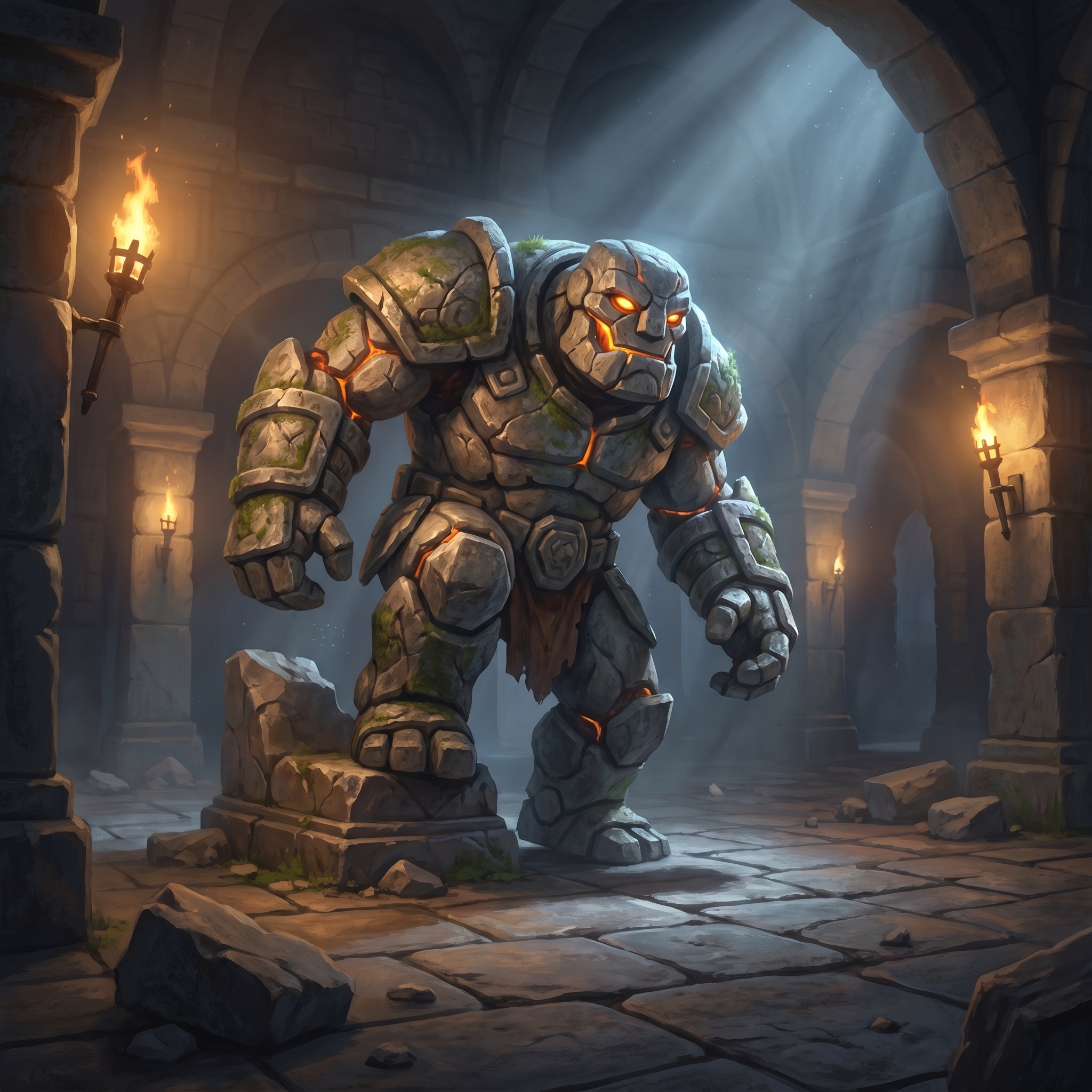
Role: Elite Guardian / Bruiser Where It Appears: Temples, tomb doors, sealed vaults.
What It Is
Stone idol constructs follow old commands exactly. The danger is not malice but grammar: trespass, theft, and blasphemy may be defined by a dead priest's wording. A stone idol construct may look like a squat guardian, a kneeling saint, a beast-headed ward, or a blocky ancestor figure until its plinth cracks and one foot comes down.
It is a rules engine made of stone. It does not hate intruders. It checks conditions, applies old definitions, and strikes with absolute confidence. That makes it predictable if understood and terrifying if misunderstood.
Ecology and Behavior
Stone idol constructs do not live, breed, or hunt. They endure. Their behavior depends on the command phrase, boundary, and taboo encoded into the core glyph-stone. Some guard a single door. Some patrol a temple floor. Some punish anyone who touches a forbidden object, speaks a rival god's name, or crosses a line without incense.
Age changes them. Weathering may blur inscriptions, broken offerings may alter protocol, and later cults may have reinterpreted the same guardian without understanding the original command. The construct remains loyal to the first grammar unless deliberately rewritten.
Signs and Knowledge
Lore, Theology, or Secret Lore (Hard) identifies the command tradition. Craft (Average) spots load-bearing joints and maintenance seams.
Other signs include polished floor arcs around a plinth, smashed bones at a consistent boundary, offering bowls arranged with mechanical precision, and inscriptions using imperative verbs near the statue's base.
Stone Idol Construct (Elite)
- Skills: Heavy Melee 4, Fortitude 5, Perception 2.
- Attacks: Stone Fist (Heavy Melee; Damage 10; Crit 4; Knockdown on 2 Boons).
- Abilities: Construct Body — Immune to poison, disease, and social pressure. Called shots to joints add 1 Boon if the attacker knows the construction style.
- Abilities: Command Phrase — Correct ancient command disables it for one scene; finding it requires Lore or Secret Lore (Hard).
- Soul: None, it was never alive; at death nothing passes.
Tactics
A stone idol construct blocks, strikes, and pursues only within its assigned boundary. It prioritizes the triggering offender unless its command says otherwise. It may ignore armed guards who follow protocol and crush a harmless scholar who stepped over a sacred line.
Use the construct as a puzzle with fists. The party can fight it, but they can also read the room, repeat the right phrase, restore an offering, avoid the taboo, or lure it to the edge of its authority.
Harvesting and Trade
| Component | Value | Use | Harvest |
|---|---|---|---|
| Core glyph-stone | 800-2,200 gold Flargons | Construct creation, ward repair, academic study | Craft and Lore (Hard) |
| Joint pins | 300-900 gold Flargons | Heavy hinges, animated armor, temple restorations | Craft (Average) |
| Inscribed fragments | 100-600 gold Flargons | Translation evidence, devotional relics | Lore or Theology (Average) |
Variants
- Boundary Idol: Cannot leave its marked line but is very hard to move from it.
- Offering Idol: Calms if fed the proper incense, blood, coin, or song.
- Misread Guardian: Later inhabitants think they control it, but their ritual is only partly correct.
The Final Door Beast
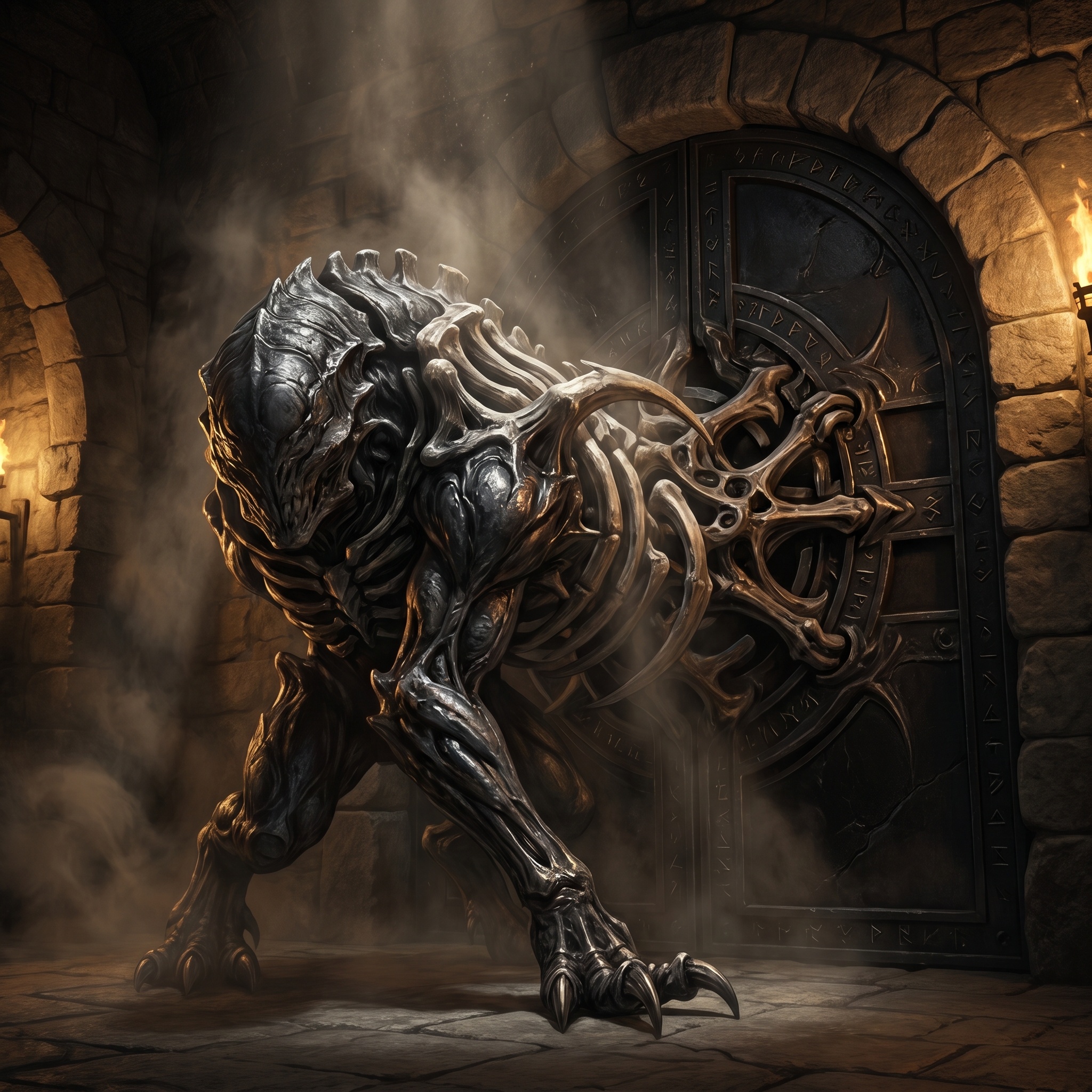
Role: Nemesis Threshold Guardian Where It Appears: Last doors, forbidden vaults, prison-realms, ancient seals.
"It is not locked. A lock implies there is a key. The Door Beast is what exists instead of a key." — Order of the Quiet Survey, final field report, sender unlocated
The Final Door Beast exists to make "open it" a decision with consequences. It is not the thing behind the door. It is the warning that the door has a body. It can speak only in passwords it has heard dying people use.
What It Is
The Final Door Beast is a living threshold fused to a sealed door, vault, prison-realm, or forbidden boundary. Its ribs form locks and hinges. Its jaw is a latch. Its spine is the bar across the other side. It is not the horror behind the door. It is the last argument for leaving the door closed.
The Beast's speech is limited and unsettling. It repeats passwords, last words, failed commands, and phrases dying people used while trying to get through. It may know the correct word, but it does not know whether the speaker should use it.
Ecology and Behavior
Final Door Beasts appear where a seal needed more than metal: ancient vaults, prison-realms, last doors in forbidden ruins, divine locks, tyrant tombs, and thresholds built after someone decided ordinary warnings were not enough. Some were grown intentionally. Some formed around seals that consumed too many guardians.
The Beast does not patrol or hunt. It tests approach, listens to words, remembers fear, and attacks impatience. If defeat would open the protected door, it may collapse the threshold, destroy the keyway, or die in a way that makes the choice irreversible.
Signs and Knowledge
Secret Lore, Craft, or Dungeoneering (Hard) identifies a door-body and the difference between the Beast and the thing sealed beyond it. Perception (Average) notices ribs, hinge tissue, breath from the keyhole, or scars where previous passwords failed.
Other signs include dead intruders arranged at speaking distance, scratch marks stopping before the threshold, keyholes that blink in torchlight, old warnings written in several hands, and silence behind the door that feels maintained rather than empty.
The Final Door Beast (Nemesis)
- Skills: Readiness 5, Fortitude 5, Heavy Melee 5, Perception 4, Secret Lore 4.
- Attacks: Lockjaw Bite (Heavy Melee; Damage 14; Crit 3; Ensnare 2); Hinge Crush (Heavy Melee; Damage 12; Crit 4; Knockdown).
- Abilities: Door-Body - While fused to its door, the Beast cannot be moved, knocked Prone, or bypassed by mundane lockpicking.
- Abilities: Password of the Dead - If a creature speaks a wrong password, the Beast learns one fear from that creature and adds 1 Boon against it for the encounter.
- Soul: None, it was never alive; at death nothing passes.
Tactics
The Beast tests words first and attacks the impatient. It bites those touching locks, crushes anyone forcing hinges, and learns fears from wrong passwords. It does not chase far from the threshold because the threshold is its body and purpose.
The encounter should make opening the door a real decision. The party can research passwords, debate risk, bargain with dying echoes, reinforce the seal, or choose to fight knowing that victory may open, destroy, or destabilize what they came to reach.
Harvesting and Trade
Its lock-ribs are valuable to wardwrights, but removing them opens or destroys the protected door. Ethical buyers want proof that the seal was meant to end. Unethical buyers want the ribs because they remember how impossible locks were made.
| Component | Value | Use | Harvest |
|---|---|---|---|
| Lock-ribs | 3,000-8,000 gold Flargons | Wards, living locks, vault repairs | Craft or Secret Lore (Hard), opens or ruins the door |
| Hinge sinew | 1,500-5,000 gold Flargons | Threshold magic, binding hinges | Medicine or Craft (Hard) |
| Dead password echo | Varies | Opens the door, identifies failed intruders | Secret Lore or Perception (Hard) |
| Seal scar tissue | 2,000-7,000 gold Flargons | Reinforces or studies ancient seals | Dungeoneering or Natural Philosophy (Hard) |
Variants
- Prison-Realm Door Beast: Keeps a being, army, or city-sized crime contained.
- Vault Beast: Guards treasure because the treasure is dangerous, not merely valuable.
- Mercy Threshold: Prevents entry into a place that would destroy the intruder.