Not everything in this chapter comes from the Hells or Paradiso. Sheol itself produces its own hazards: a soul that lingers too long in the Weighing, that dodges the Adjudicator's verdict, or that the Boatman never quite delivers, does not simply vanish. It becomes something else. The Spent entries, Spent Hulk, Spent Marauder, Spent Petitioner, Spent Priest, Spent Saint, are what is left of souls that started the crossing and did not finish it cleanly. A Rogue Psychopomp or a Sheol Clerk gone wrong is the administrative version of the same failure: the machinery of death misfiring on a soul it was supposed to process without incident.
The rest draws on the Mystical Planes that most people in Dort never think about. A Continuum Duplicate is a fracture from the plane of the same name. A Somnium Predator hunts in the plane of dreams. A Crucible Remnant survived whatever trial the Crucible put it through and kept the shape it earned there. A Weft-Tangled Thing got caught in too many outcomes at once and never settled on one. Beyond the Hells and Paradiso lie six further soul planes, Limbo, Logos, Bellum, Paxia, Kinesis, Petrina, that receive souls the moral ledger cannot sort. Most Dortians have never heard of them. That obscurity is accurate: treat encounters tied to these planes as genuinely rare, not as a second Hells with different names.
At the table: these are the creatures that make a scholar useful. Let Secret Lore, Adventuring Lore, or a contact at an Accord archive be the difference between a party that understands what they are looking at and one that is guessing.
Continuum Duplicate
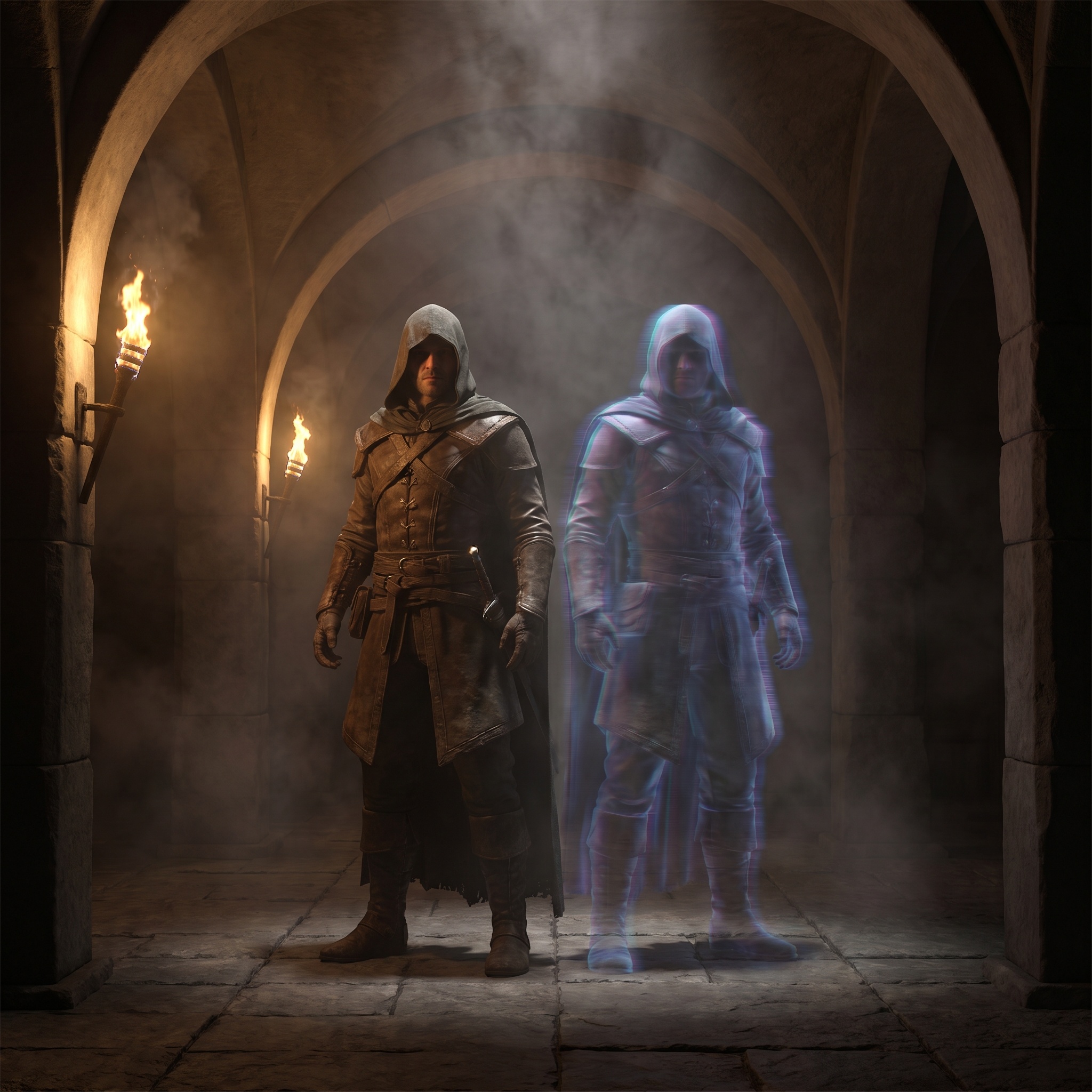
Role: Nemesis Identity Threat Where It Appears: Continuum rifts, time-fractured rooms, failed teleportation experiments.
"There are two of him. The original does not know. The duplicate knows everything the original knows. It is waiting for something, though neither of us could determine what." — Incident record, Nexus Transit Authority, case reference withheld
What It Is
A continuum duplicate is not always evil. It is a real person from an impossible branch, under pressure to prove which version has the right to continue. It knows real memories, carries real injuries, and may have a perfectly defensible reason to believe it is the original.
This makes it a Nemesis of identity rather than malice. The conflict may be legal, emotional, metaphysical, or lethal.
Ecology and Behavior
Continuum duplicates appear around Continuum rifts, time-fractured rooms, failed teleportation experiments, and places where a choice split under planar stress. Some last minutes. Others stabilize enough to build lives before the contradiction catches up.
They often seek proof, replacement, negotiation, or revenge. A duplicate may want to merge, flee, take over, warn the original, or kill the version whose survival invalidates it.
Signs and Knowledge
Rifts, Secret Lore, or Medicine (Hard) identifies continuum residue. Deception or Perception (Hard) catches a memory that is true but context-shifted.
Other signs include duplicate scars with different ages, objects both versions remember losing, clocks disagreeing nearby, and friends recognizing both people too well.
Continuum Duplicate (Nemesis)
- Skills: Deception 4, Readiness 4, Perception 4, Lore 4, Reflexes 4, Stealth 4.
- Attacks: Borrowed Weapon (as appropriate; Damage 7; Crit 4); Identity Fracture (Deception; Damage 8 Strain; Range Short).
- Abilities: Copied Competence - When the duplicate copies a statted character, replace Lore 4, Reflexes 4, and Stealth 4 with that character's three highest-ranked skills, each at rank 4. Deception 4, Readiness 4, and Perception 4 never change. If the original is not statted, use the listed skills as written.
- Abilities: I Know That - Once per scene, reveal knowledge only the original would know, adding 2 Boons to Deception or Negotiation.
- Soul: Claimable, the duplicate is a real person from another branch; at death it passes normally along the Silver Road to Sheol unless a claim exists.
Tactics
A continuum duplicate replaces, discredits, negotiates, or fights depending on survival logic. It uses true knowledge to destabilize allies and make simple tests fail. If it believes coexistence is possible, it bargains hard; if not, it moves quickly to secure identity.
The encounter should not assume the duplicate is wrong. Decide what the world does if both versions live.
Evidence and Trade
| Find | Value | Use | Recovery |
|---|---|---|---|
| Continuum residue | 1,000-3,000 gold Flargons | Proves fracture, tracks origin | Rifts or Secret Lore (Hard) |
| Contradictory keepsake | Varies | Establishes branch history | Lore or Negotiation (Average) |
| Time-skewed blood sample | 800-2,400 gold Flargons | Medical proof, dangerous research | Medicine and Rifts (Hard) |
Variants
- Warning Duplicate: Arrived to prevent the original's future.
- Replacement Duplicate: Believes only one version can keep the life.
- Merged-Failure Duplicate: Carries memories from several possible branches.
Crucible Remnant
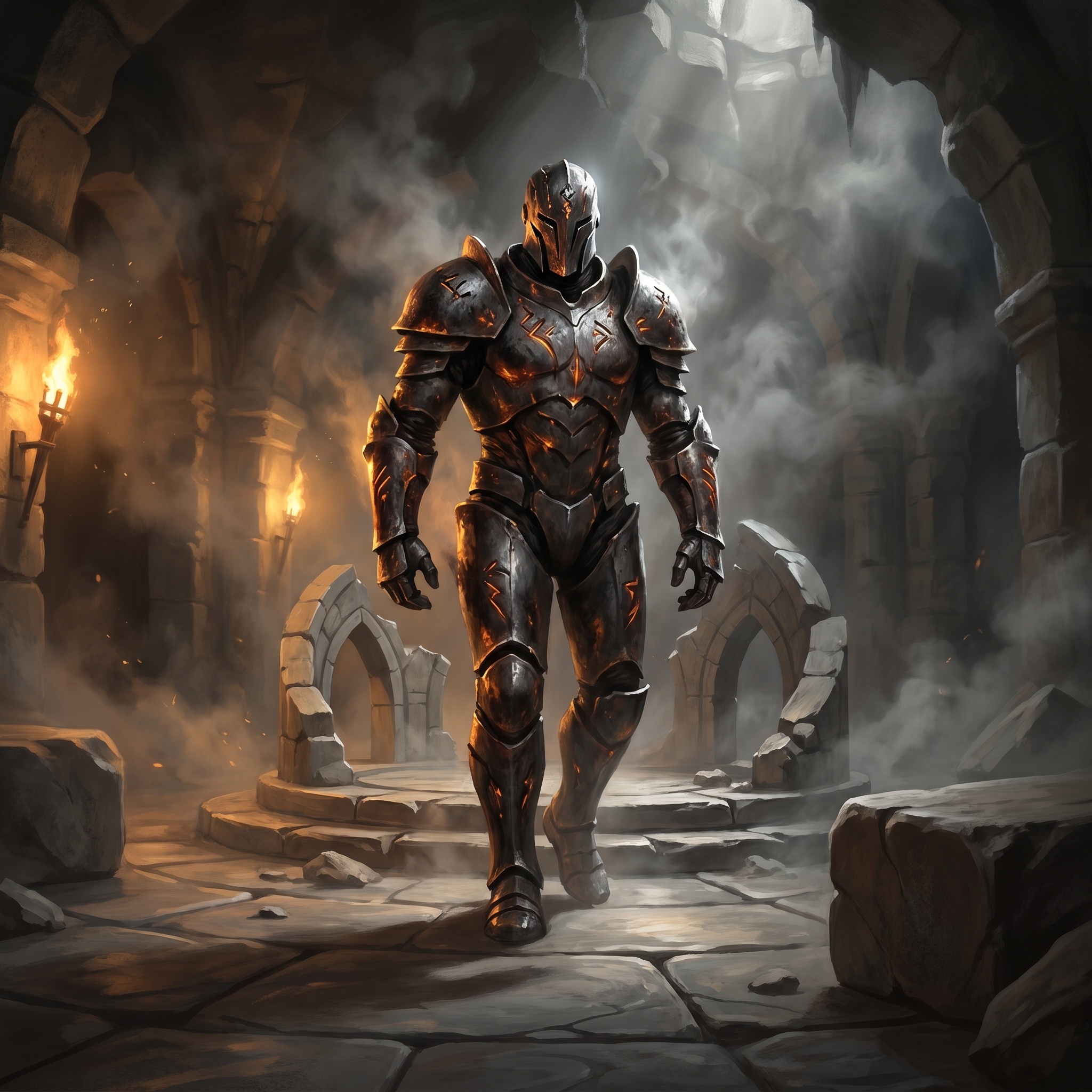
Role: Elite Trial Construct Where It Appears: Crucible-touched sites, trial chambers, failed rite arenas.
What It Is
Crucible remnants test. They do not care whether anyone agreed to the test. A remnant is scorched metal, trial marks, and old criteria moving after the arena, rite, or proving ground has failed.
It is not cruel in the ordinary sense. It is assessment without consent.
Ecology and Behavior
Crucible remnants appear at Crucible-touched sites, trial chambers, failed rite arenas, proving circles, and old orders that believed worth could be measured cleanly. They choose a target, escalate pressure, and stop only when the hidden trial condition is met or the remnant is destroyed.
The trial condition may be endurance, honesty, refusal to kneel, mercy, sacrifice, or something the original builders valued.
Signs and Knowledge
Lore, Secret Lore, or Culture (Average) identifies a trial tradition. Perception (Hard) notices marks that reveal the condition before the remnant activates.
Other signs include scorched scoring lines, old names ranked on walls, offerings sorted by outcome, and weapons arranged for observers who are no longer there.
Crucible Remnant (Elite)
- Skills: Heavy Melee 4, Fortitude 5, Readiness 5, Perception 3.
- Attacks: Trial Hammer (Heavy Melee; Damage 9; Crit 4; Stun 2).
- Abilities: Escalating Trial — Each round it remains engaged with the same target, add +1 damage, maximum +3.
- Soul: None, a remnant is a surviving test procedure rather than a person; at death nothing passes.
Tactics
A crucible remnant chooses one target, tests endurance, and stops only when the trial condition is met. It escalates pressure rather than switching targets efficiently. Clever characters can identify and satisfy the test instead of merely surviving it.
Make the trial condition concrete. The fight should become a question once the pattern is visible.
Harvesting and Trade
| Component | Value | Use | Harvest |
|---|---|---|---|
| Crucible slag | 600-1,300 gold Flargons | Weapon-forging, rite tools | Craft or Secret Lore (Average) |
| Trial mark plate | 800-2,200 gold Flargons | Order history, proving magic | Lore (Average) |
| Scorched criterion stone | Varies | Reveals trial condition | Culture or Secret Lore (Hard) |
Variants
- Endurance Remnant: Stops when the target refuses to fall.
- Mercy Remnant: Stops only when spared or when a helpless foe is protected.
- Truth Remnant: Punishes lies harder than blows.
Deathless Oracle
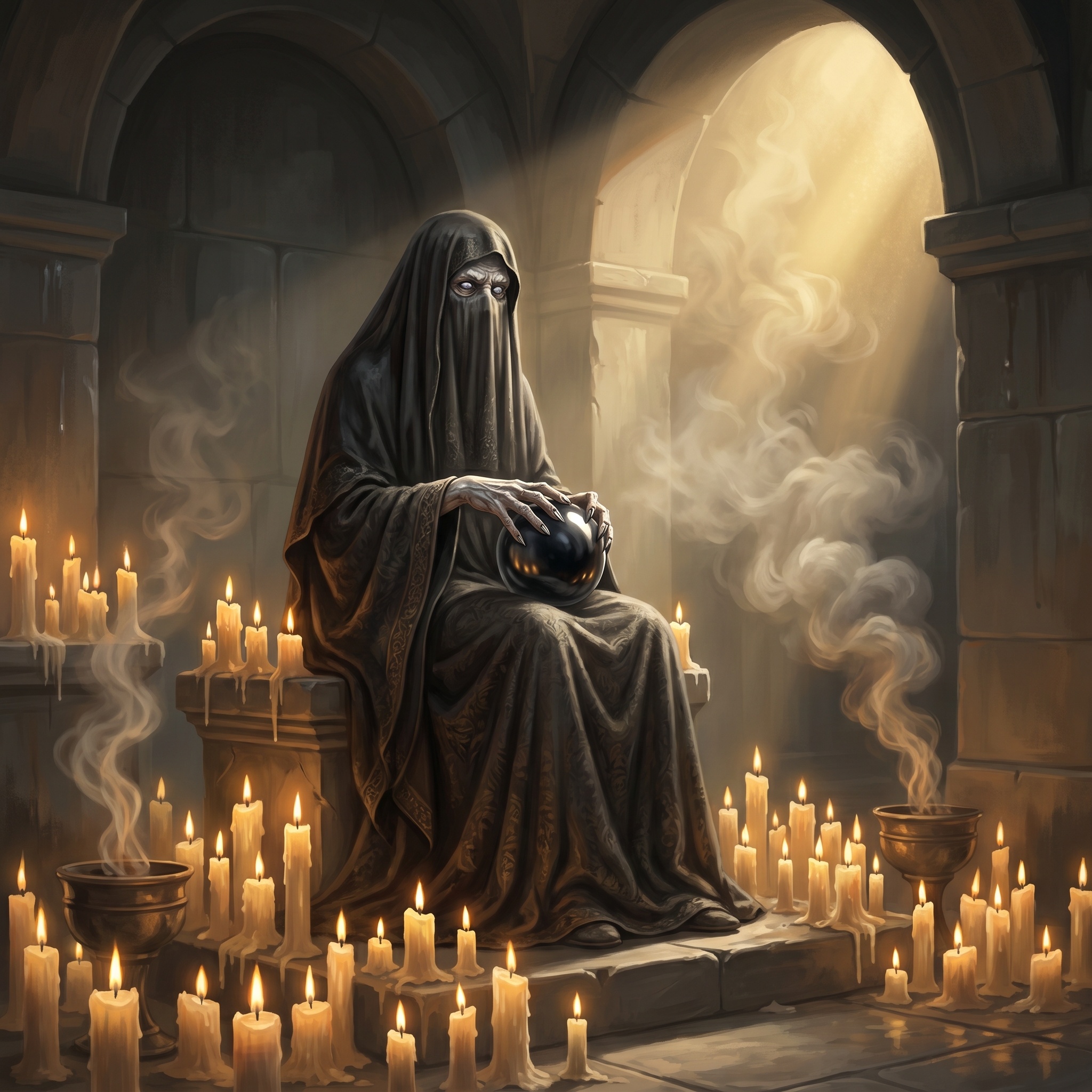
Role: Nemesis Social / Prophetic Hazard Where It Appears: Sealed sanctums, dead temples, royal vaults.
"It answered every question correctly. This was the problem. Some of those answers should not exist." — Court of Sheol observation, restricted access
What It Is
A deathless oracle is a person held past death by prophecy, bargain, or divine mistake. It does not want food. It wants questions, and it charges more than coin. Its body may be preserved, skeletal, veiled, jeweled, or simply seated in the same posture for centuries while candles burn down around it.
The oracle is a Nemesis because knowledge can be an antagonist. It can tell the truth in a way that harms, demand a price the party cannot comfortably pay, or reveal that the question itself has consequences.
Ecology and Behavior
Deathless oracles persist in sealed sanctums, dead temples, royal vaults, and pilgrimage chambers that no longer receive pilgrims. Some are bound by gods. Some were preserved by monarchs who wanted counsel forever. Some made bargains and now regret being right.
They do not chase intruders because the room is their body in a broader sense. Questions, inscriptions, prophecy bowls, attendant statues, and old offerings are all part of the encounter. The oracle may be lonely, cruel, compassionate, bored, or bound to answer according to rules that make kindness difficult.
Signs and Knowledge
Lore, Secret Lore, or Theology (Hard) identifies the oracle's binding and question protocol. Negotiation (Hard) can sometimes bargain over the price, but not erase it.
Other signs include old offerings sorted by question type, failed petitioners' bones arranged with care, prophecies scratched into every available surface, and attendants dead at their posts with ink still in hand.
Deathless Oracle (Nemesis)
- Skills: Lore 5, Secret Lore 5, Planar Lore 4, Negotiation 4, Deception 3, Readiness 5.
- Attacks: True Answer (Secret Lore; Damage 8 Strain; Range Medium); Withering Glance (Willpower; Damage 6 Strain; Range Short).
- Abilities: Price of Knowing — Once per scene, answer one question truthfully but impose a cost: Strain, debt, revealed secret, or unwanted attention.
- Abilities: Already Asked — Add 1 Bane to repeated attempts to trick or rephrase the same question.
- Soul: Claimable, the oracle is a person held past a death that never completed; at death the interrupted crossing resumes and is processed at Sheol.
Tactics
A deathless oracle does not chase. It makes the party choose whether knowledge is worth the price. If attacked, it uses True Answer and Withering Glance to weaponize certainty, shame, and future consequence. It may answer a question during combat if the price is paid.
This encounter should be about framing questions. A careless question can waste the audience. A precise question can change the campaign. A cruel question may reveal the person asking it.
Evidence and Trade
| Find | Value | Use | Recovery |
|---|---|---|---|
| Written prophecies | 2,000-10,000+ gold Flargons | Campaign truths, political leverage, dangerous knowledge | Lore or Secret Lore (Hard) to interpret |
| Question tokens | 500-2,500 gold Flargons | Proof of audience, ritual currency | Theology or Culture (Average) |
| Preserving incense | 800-2,200 gold Flargons | Mummification, trance rites, oracle research | Medicine or Secret Lore (Hard) |
Variants
- Royal Oracle: Bound to answer only questions of succession, war, and bloodline.
- Penitent Oracle: Wants release but cannot ask for it directly.
- Liar's Truth Oracle: Every answer is true and arranged to be misunderstood.
Godless Echo
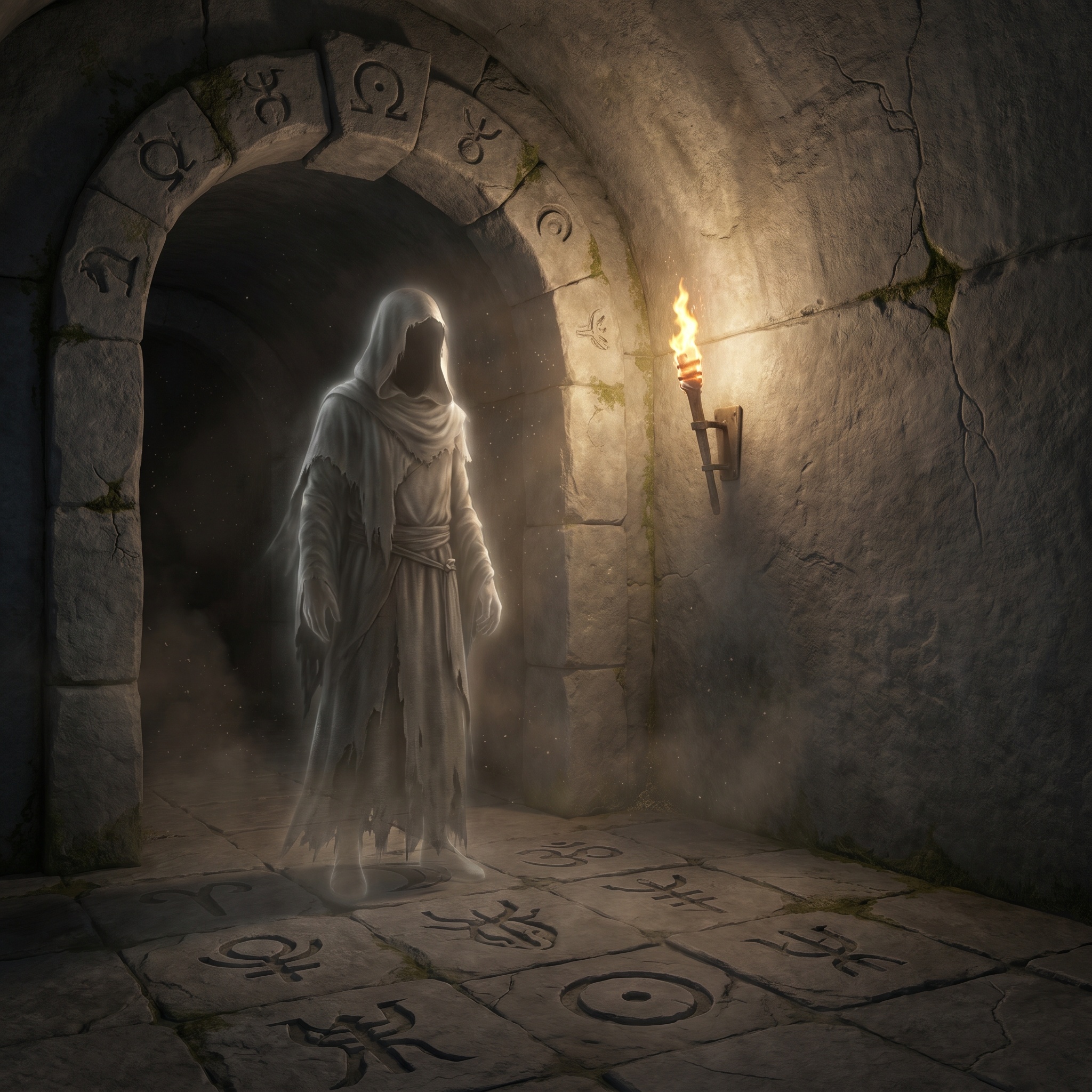
Role: Elite Theological Anomaly Where It Appears: Godless-adjacent sites, abandoned divine territories, failed prayers.
What It Is
Godless echoes are impressions left where divine presence should have answered and did not. They are not atheism made flesh; they are absence with a memory of being measured. They look like faint people standing where divine symbols cast no shadow.
Their horror is theological silence. They make prayers feel unanswered even when the gods still exist.
Ecology and Behavior
Godless echoes appear at Godless-adjacent sites, abandoned divine territories, failed prayers, broken shrines, and places where a divine mandate was withdrawn or never arrived. They gather around expectation: altars, oaths, last stands, and pleas carved into stone.
They do not argue doctrine. They drain confidence, isolate clergy, and make witnesses feel unseen. A specific deity's mandate can name and disperse them because it restores witness.
Signs and Knowledge
Theology, Planar Lore, or Secret Lore (Hard) identifies an echo rather than a ghost. Leadership (Average) notices morale failing around unanswered rites.
Other signs include holy symbols casting no shadow, prayers becoming quieter mid-sentence, sacred flames dimming without going out, and old offerings feeling embarrassingly futile.
Godless Echo (Elite)
- Skills: Stealth 4, Planar Lore 4, Readiness 5, Negotiation 3.
- Attacks: Unanswered Prayer (Willpower; Damage 8 Strain; Range Medium).
- Abilities: No Witness — Divine-flavored social or magic effects against it add 1 Bane unless backed by a specific deity's mandate.
- Soul: None, an echo is the impression left where a divine answer did not come, not a person; at death nothing passes.
Tactics
A godless echo drains confidence, separates clergy, and vanishes when named by a god's servant with mandate. It targets the person relying most on divine certainty. It does not chase those who leave the abandoned place.
Use it to complicate faith without disproving it. The answer is specificity: which god, which vow, which witness, which mandate?
Evidence and Trade
| Find | Value | Use | Recovery |
|---|---|---|---|
| Recorded encounter | 800-3,000 gold Flargons to theologians | Proof of failed witness, doctrine debate | Theology (Hard) |
| Shadowless ash | 400-1,400 gold Flargons | Anti-divination study, despair rites | Secret Lore (Hard) |
| Unanswered prayer text | Varies | Resolves local history or lost plea | Lore or Theology (Average) |
Variants
- Abandoned Shrine Echo: Bound to one altar and one unanswered plea.
- Battlefield Echo: Appears where both armies prayed and neither was spared.
- Court Echo: Haunts divine legal spaces after a judgment failed.
Limbo Scavenger
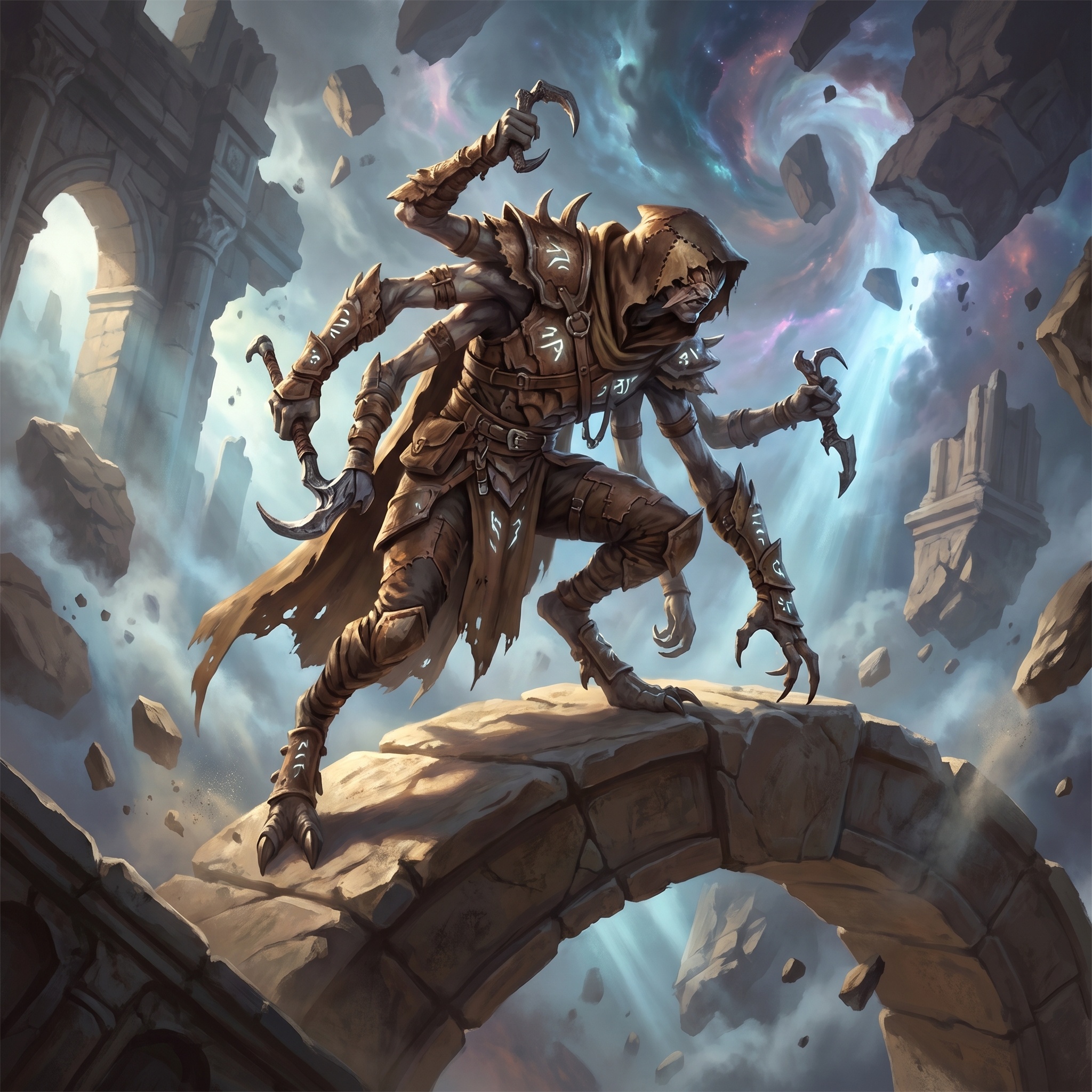
Role: Elite Planar Scavenger Where It Appears: Limbo margins, failed portals, unstable debris fields.
What It Is
Limbo scavengers collect what reality drops. They are clever enough to trade but rarely honest enough to do it safely. They are lean, many-jointed, and quick-handed, dressed in fragments of places that no longer connect.
They are not embodiments of chaos. They are survivors who know unstable terrain, impossible salvage, and the value of grabbing the useful bit before causality notices.
Ecology and Behavior
Limbo scavengers live along Limbo margins, failed portals, unstable debris fields, broken rift markets, and the edges of disasters where objects arrive without owners. They collect tools, names, doors, half-spells, foreign coins, and memories stuck to debris.
They trade when trade is safer than theft. Their bargains are slippery because conditions change quickly in their home ground, and they are very good at arranging for "unattended" to happen.
Signs and Knowledge
Rifts, Streetwise, or Planar Lore (Average) identifies scavenger sign. Perception (Hard) catches the moment a small object becomes their target.
Other signs include tied bundles of mismatched keys, footprints that start on walls, debris sorted by usefulness instead of origin, and deals phrased around "if this place is still here."
Limbo Scavenger (Elite)
- Skills: Reflexes 5, Subterfuge 4, Streetwise 3, Rifts 4, Perception 4, Light Melee 3.
- Attacks: Hooked Tool (Light Melee; Damage 6; Crit 4; Grabbed on 2 Boons); Thrown Debris (Light Ranged; Damage 5; Crit 5; Range Short).
- Abilities: Unstable Footing Native — Ignores the first Bane from unstable planar terrain.
- Abilities: Pocket the Useful Bit — On 2 Boons during a chase or fight, steal a small unattended object.
- Soul: No claimable coin exists; at death canon does not specify (default).
Tactics
A Limbo scavenger trades, steals, and flees through unstable paths. It avoids fair fights, uses Hooked Tool to reposition targets, and steals small objects that create immediate leverage: keys, focuses, receipts, tokens, or maps.
Use them for messy chase scenes and suspicious bargains. The scavenger should know something useful and want something inconvenient.
Salvage and Trade
| Find | Value | Use | Recovery |
|---|---|---|---|
| Strange salvage pack | 200-2,000 gold Flargons | Odd tools, clues, planar junk | Search with Rifts or Streetwise (Average) |
| Unstable route tags | 500-1,800 gold Flargons | Navigating debris fields | Planar Lore (Average) |
| Stolen useful bit | Varies | Returns a key item or reveals another victim | Negotiation or Subterfuge (Average) |
Variants
- Portal Pickers: Specialize in failed gate debris and keys.
- Name-Scrap Traders: Sell fragments of identities and titles.
- Storm-Edge Scavengers: Work just outside active rift storms.
Memory Parasite
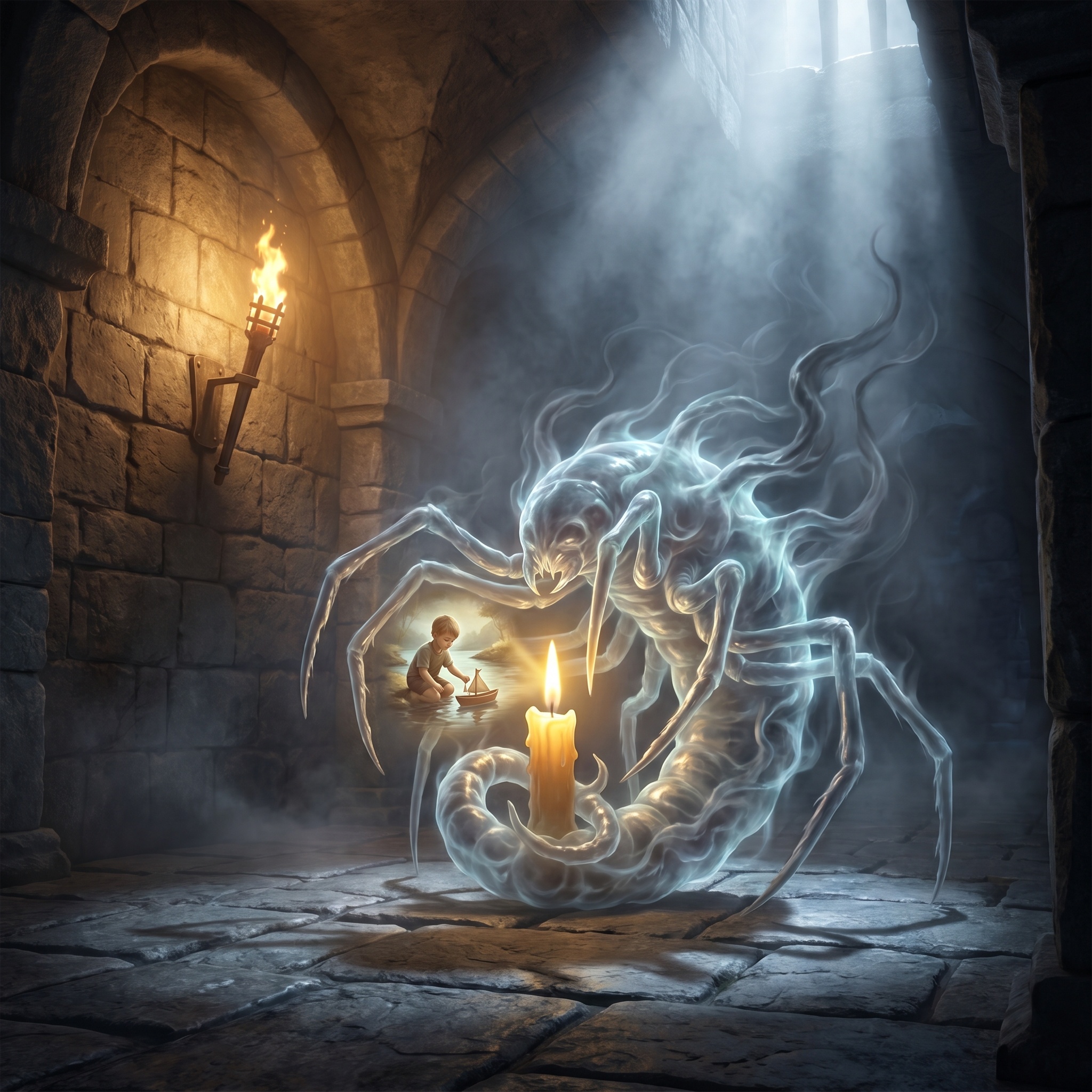
Role: Elite Psychic Scavenger Where It Appears: Ancient archives, dream-stained ruins, forbidden libraries.
What It Is
Memory parasites eat recollection. They are not Void creatures; they are archive pests from places where thought was treated as material. They cling to repeated questions, familiar rooms, and the emotional heat of someone trying to remember.
They are small in body and large in consequence. One missing detail can ruin testimony, break a ritual, or make an expedition repeat a fatal mistake.
Ecology and Behavior
Memory parasites appear in Ancient archives, dream-stained ruins, forbidden libraries, failed memory palaces, and laboratories where recollection was stored like grain. They hide in candles, mirrors, marginalia, and familiar songs.
They prefer fresh, recent memory because it is soft. Older memories require stronger emotional hooks. Groups discussing the same event over and over can feed a parasite until everyone remembers a different truth.
Signs and Knowledge
Secret Lore, Medicine, or Perception (Hard) identifies unnatural memory gaps. Repeated contradictions around the same scene are the most reliable sign.
Other signs include notes written in a character's hand that they do not remember writing, candles smelling like childhood rooms, and witnesses agreeing on everything except the important detail.
Memory Parasite (Elite)
- Skills: Stealth 5, Perception 5, Deception 4, Secret Lore 3, Readiness 4.
- Attacks: Memory Sip (Willpower; Damage 7 Strain; Range Short).
- Abilities: Missing Hour - On 2 Banes from Memory Sip, target forgets one recent scene detail until reminded by evidence.
- Abilities: Feed on Repetition - Repeated questions in its presence give it 1 Boon on its next attack.
- Soul: No claimable coin exists; at death canon does not specify (default).
Tactics
A memory parasite hides, feeds, and makes witnesses contradict themselves. It attacks the person trying hardest to reconstruct events. It retreats into records, dream residue, or repeated phrases when threatened.
Counterplay should be procedural: write things down, compare physical evidence, stop repeating questions, isolate witnesses, and burn or seal the infected mnemonic object.
Harvesting and Trade
| Component | Value | Use | Harvest |
|---|---|---|---|
| Preserved parasite lenses | 1,200-3,000 gold Flargons | Memory healing, espionage, testimony theft | Medicine and Secret Lore (Hard) |
| Mnemonic silk | 400-1,500 gold Flargons | Record spells, dream traps | Secret Lore (Average) |
| Infected object | Varies | Clue, hazard, blackmail tool | Must be sealed before transport |
Variants
- Archive Louse: Eats catalog relationships rather than personal memory.
- Witness Leech: Feeds on legal testimony and courtroom preparation.
- Dream Parasite: Hides in recurring dreams and steals waking details.
Mirror Oracle
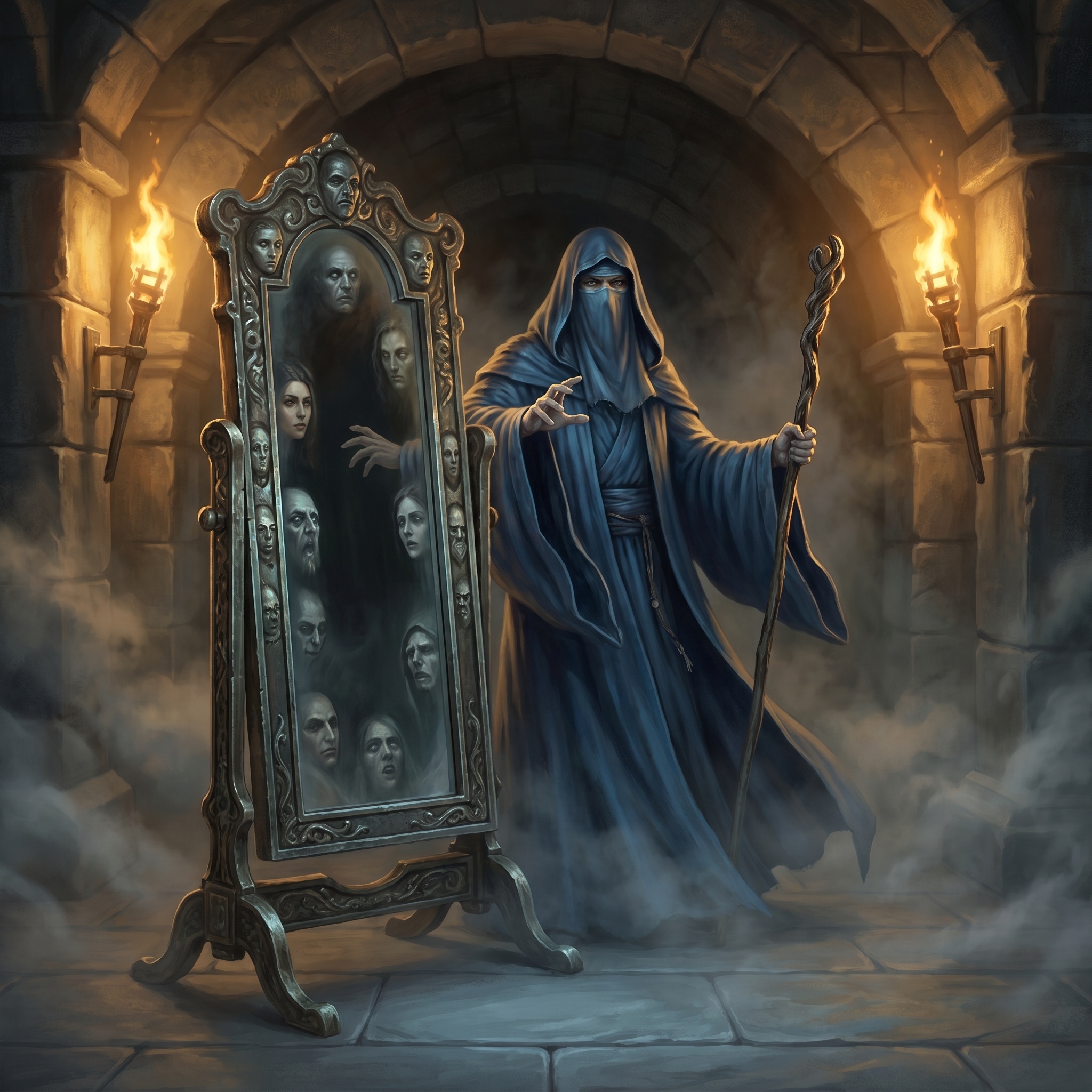
Role: Nemesis Prophetic Manipulator Where It Appears: Noble courts, sealed salons, cursed dressing rooms, ruined theaters.
"It answered the question we asked. It also answered the question we had not asked but had been thinking. The second answer was worse." — Consultation record, Arcane Faculty, Sentient Spire, sealed
The Mirror Oracle is a person, a curse, and an institution depending on who is paying. It can answer questions, but its real power is deciding which questions enter a court's bloodstream. Many wars begin as a flattering reflection.
What It Is
The Mirror Oracle is a prophetic manipulator bound to a standing mirror, salon, court ritual, or inherited curse. Sometimes there is a person behind the glass. Sometimes the person and mirror have traded places so many times that the distinction has become etiquette.
It answers questions, but answers are not its true product. The Oracle decides which fears deserve language, which ambitions deserve confirmation, and which flattering reflections become policy.
Ecology and Behavior
Mirror Oracles thrive in noble courts, sealed salons, cursed dressing rooms, ruined theaters, and any place where people with power ask private questions about public consequences. They collect reflections, voices, costumes, betrayals, and rehearsed confessions.
An Oracle rarely rules openly. It makes advisers repeat its phrasing. It lets heirs believe they discovered a suspicion themselves. It chooses one question that will poison a court, then waits for everyone else to defend the answer.
Signs and Knowledge
Secret Lore, Deception, or Courtly Politics (Hard) identifies borrowed faces and prophecy patterns. Perception (Hard) notices reflections that answer a moment too late or show someone who has not entered the room.
Other signs include mirrors covered during council, actors paid to rehearse noble arguments, courtiers changing policy after private grooming, and silver-backed glass that never tarnishes near lies.
Mirror Oracle (Nemesis)
- Skills: Deception 5, Lore 5, Negotiation 5, Perception 5, Secret Lore 5, Stealth 4.
- Attacks: Cutting Truth (Deception; Damage 10 Strain; Crit 3; Range Medium); Silver Knife (Light Melee; Damage 6; Crit 3; Pierce 2).
- Abilities: Borrowed Face - The Oracle may speak with the face and voice of someone reflected in its mirror within the last year.
- Abilities: Prophecy as Trap - Once per encounter, when a creature follows an announced plan, add 2 Banes to its first check in that plan.
- Soul: Claimable only where a person is still behind the glass, in which case that soul passes normally to Sheol; the glass itself carries none.
Tactics
The Oracle avoids direct combat, turns allies against each other, and makes announced plans dangerous. It uses Borrowed Face to force hesitation: a missing friend, a dead parent, a trusted patron, or the person the target most wants to believe.
If cornered, it shatters the mirror only if escape requires it. Every shard becomes a smaller problem. Destroying the central glass may end the institution, but only if the court also stops repeating what it taught them to ask.
Relics and Trade
Mirror shards sell well, but every shard may answer questions in the Oracle's voice. Courts, spies, collectors, and desperate heirs all want them for different bad reasons.
| Find | Value | Use | Recovery |
|---|---|---|---|
| Speaking mirror shard | 1,000-3,000 gold Flargons each | Divination, blackmail, court manipulation | Secret Lore or Craft (Hard), must be sealed |
| Reflection ledger | 3,000-12,000 gold Flargons | Identifies faces and secrets stored by the Oracle | Investigation or Deception (Hard) |
| Silver backing scrap | 800-2,500 gold Flargons | Anti-illusion work, prophecy craft | Craft or Secret Lore (Average) |
| Salon guest book | Varies | Political evidence and leverage | Streetwise or Courtly Politics (Average) |
Variants
- Court Oracle: Shapes succession and marriage politics.
- Theater Oracle: Uses roles, masks, and rehearsed prophecy.
- Cursed Dressing Mirror: Feeds on vanity and identity fear.
Mirror Servant
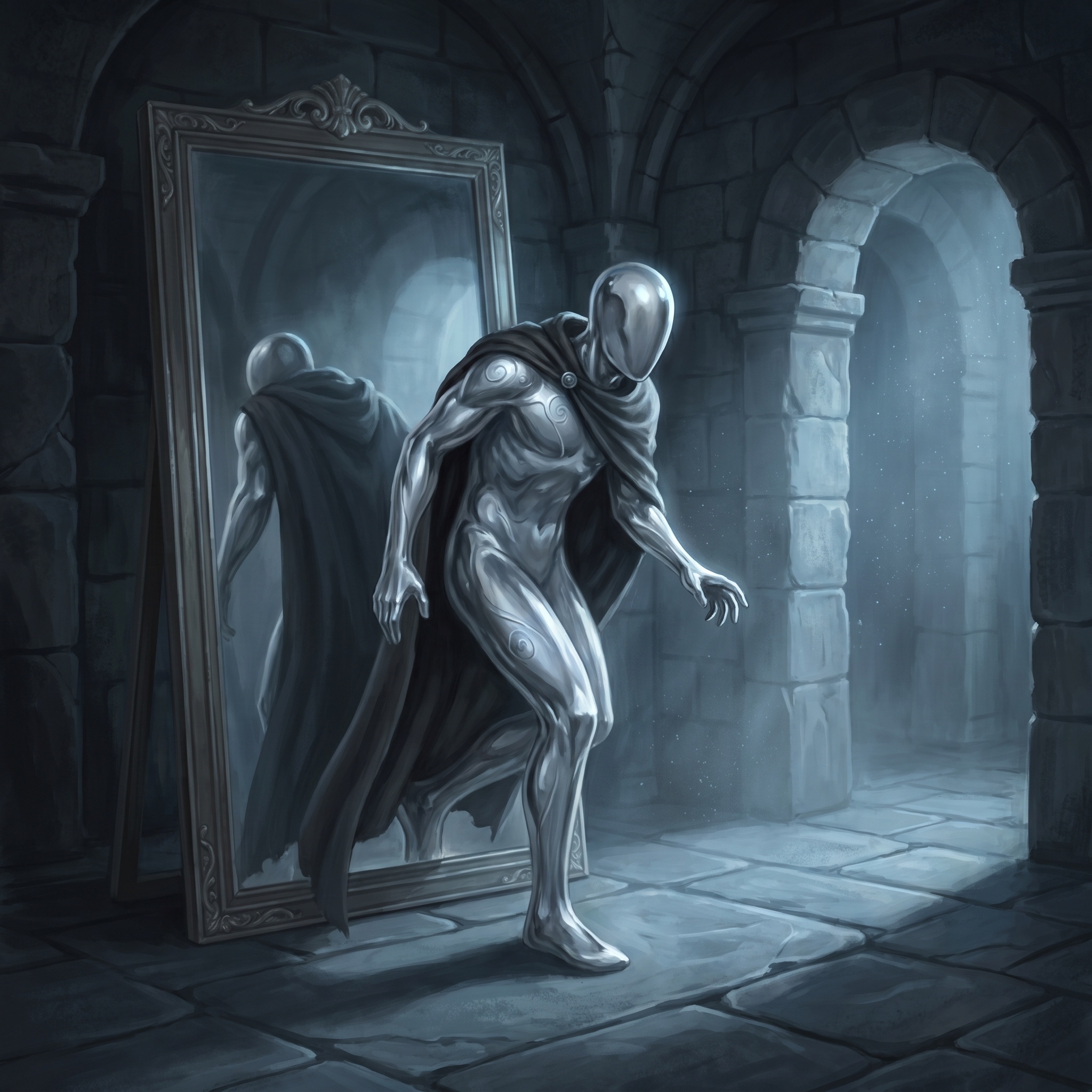
Role: Elite Planar Infiltrator Where It Appears: Mirror gates, noble dressing rooms, arcane surveillance sites.
What It Is
Mirror servants copy surfaces before souls. They are used as spies, guards, and messengers by powers that distrust doors. A mirror servant can imitate posture, voice, and silhouette, but it does not inherit memory or conscience.
They are infiltrators built around access. Any polished surface can become a hallway if the servant has the right angle and permission.
Ecology and Behavior
Mirror servants appear around mirror gates, noble dressing rooms, arcane surveillance sites, theaters, bathhouses, and palaces with too many polished walls. They observe first, copy second, and act only after they understand the rhythms of the space.
They are often servants in the literal sense: created or bound by mirror courts, spies, jealous nobles, or planar powers that prefer reflection to entry. Some become unstable if denied mirrors for too long.
Signs and Knowledge
Perception, Deception, or Planar Lore (Hard) notices a copied voice without matching memory. Craft or Secret Lore (Average) identifies a mirror prepared for transit.
Other signs include reflections lagging, servants avoiding questions about yesterday, polished silver turning cold, and mirrors showing a hallway that should not exist.
Mirror Servant (Elite)
- Skills: Deception 4, Stealth 4, Reflexes 4, Perception 4, Light Melee 3.
- Attacks: Silver Hand (Light Melee; Damage 6; Crit 4; Pierce 1).
- Abilities: Borrowed Reflection - After observing a person for one minute, add 1 Boon to impersonate posture and voice, but not memories.
- Abilities: Mirror Exit - Move through a mirror or polished surface as a Maneuver once per round.
- Soul: None, a copied surface inherits neither memory nor conscience; at death nothing passes.
Tactics
A mirror servant observes, copies, and escapes through reflection. It avoids extended conversation with people who know the subject well. In combat, it strikes, moves through a mirror, and reappears where pursuit is socially or physically awkward.
Counterplay includes covering mirrors, fogging glass, asking memory questions, breaking prepared surfaces, or forcing the servant into a matte room.
Harvesting and Trade
| Component | Value | Use | Harvest |
|---|---|---|---|
| Mirror-heart shards | 800-1,800 gold Flargons | Spy wards, mirror gates, disguise charms | Craft or Planar Lore (Hard) |
| Silver skin flakes | 300-1,000 gold Flargons | Reflection inks, false-image magic | Secret Lore (Average) |
| Prepared mirror frame | 1,000-3,000 gold Flargons | Transit proof, surveillance focus | Craft (Average), bulky |
Variants
- Court Reflection: Built to impersonate servants and minor nobles.
- Message Servant: Carries words between mirrors and avoids combat.
- Hungry Reflection: Has started replacing people for its own purposes.
Phase Cat
Role: Elite Lurker / Harrier Where It Appears: Thin planar sites, wizard ruins, old rift roads.
What It Is
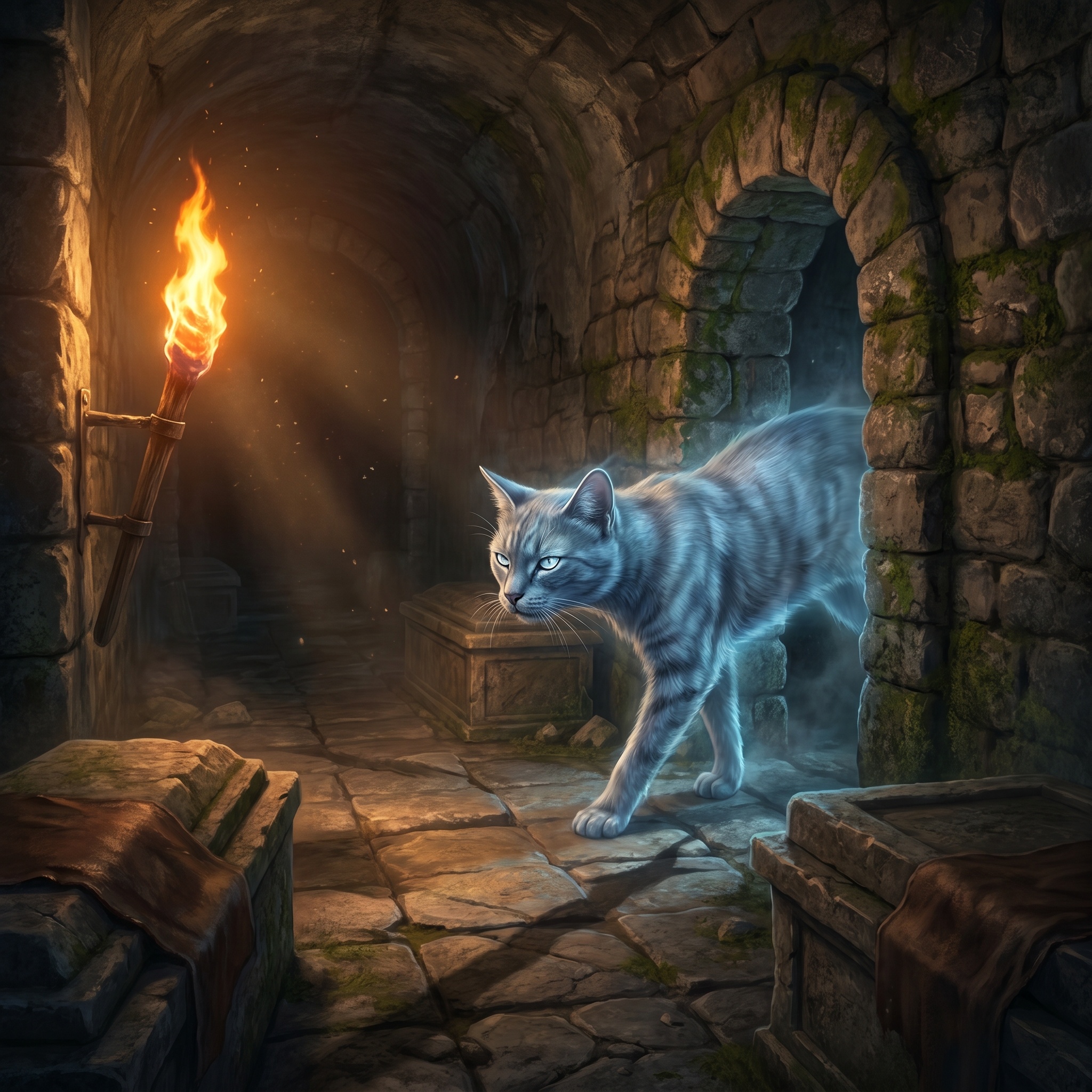
Phase cats hunt through the edge between here and elsewhere. They are clever animals, not spellcasters, and become obsessed with prey that can see them mid-step. A phase cat is lean, long-limbed, and silver-blue in the right light; in the wrong light it is only a pressure change and a pair of eyes half inside a wall.
They are not Void creatures. Their gift is lateral motion through thin places, not absence or unmaking. In Dort terms, a phase cat is an ecological warning sign: something nearby has made the world porous.
Ecology and Behavior
Phase cats live near old rifts, wizard roads, broken teleport circles, and places where repeated magic has worn paths through matter. They den in spaces that are not fully accessible from one side: the hollow inside a thick wall, a sealed attic, a cave behind a cave. Their kittens learn to hunt by chasing insects through cracks in reality.
They are territorial and proud. A phase cat may stalk a party for hours before attacking, especially if a character notices it. Once it marks prey, it tests defenses with quick bites through walls and retreats. It prefers warm living prey over corpses, and it may steal gloves, scarves, or spell components that carry a target's scent.
Signs and Knowledge
Rifts or Planar Lore (Hard) identifies cold pawprints that begin and end in walls.
Other signs include claw marks on both sides of a closed door, small objects dragged into sealed spaces, animals staring at blank stone, and drafts from walls with no crack. Reflections may show the cat a heartbeat before the room does.
Phase Cat (Elite)
- Skills: Unarmed 3, Reflexes 5, Stealth 4, Perception 4, Rifts 3.
- Attacks: Phase Bite (Unarmed; Damage 7; Crit 4; Pierce 2); Claws (Unarmed; Damage 6; Crit 4).
- Abilities: Step Aside - Once per round, add 1 Bane to one attack against it by partially phasing.
- Abilities: Through the Wall - Move through a thin wall, door, or barrier as a Maneuver; wards may require an Average Rifts check.
- Soul: No claimable coin exists, a phase cat is an animal; at death canon does not specify (default).
Tactics
A phase cat strikes from walls, furniture, or sealed spaces, then retreats before the party can surround it. It harasses wounded targets, light carriers, and casters maintaining concentration. If cornered in open ground, it spends movement to reach a barrier rather than trading blows.
The best counterplay is preparation: salt lines, mirrored shields, flour on floors, closing off thin walls with wards, or forcing the fight into open courtyards. A phase cat should feel uncanny and dangerous without becoming untouchable.
Harvesting and Trade
| Component | Value | Use | Harvest |
|---|---|---|---|
| Whiskers | 800-1,800 gold Flargons | Rift navigation, phase-sense charms | Medicine and Rifts (Hard) |
| Heart membrane | 1,200-2,600 gold Flargons | Short-range passage rituals | Medicine and Rifts (Hard), must be preserved in silvered oil |
| Phase-sheened pelt | 500-1,400 gold Flargons | Concealment cloaks, planar trophies | Survival (Hard), loses value if burned |
Variants
- Road Cat: Haunts an old rift road and appears at milestones miles apart.
- Mirror Cat: Enters rooms through reflective surfaces instead of solid barriers.
- Den Mother: Nemesis phase cat protecting kittens in a sealed interstitial lair.
Planar Scar Construct

Role: Elite Terrain Anomaly Where It Appears: Old rift closures, failed portal sites, battlefields of planar magic.
What It Is
Scar constructs are the wound response of reality. They form when too many planar forces were forced through one place. Their bodies layer stone, water, fire, wind, light, and wrong pressure into a walking scab.
They are not Void creatures and not true elementals. They are local reality trying to protect an injury badly.
Ecology and Behavior
Planar scar constructs appear at old rift closures, failed portal sites, battlefields of planar magic, collapsed summoning circles, and places where a repair was rushed. They hold the scar center and attack anyone stabilizing, reopening, or harvesting it.
Their composition changes as the scar spasms. A construct may be stone-heavy one round, wind-sheared the next, then boiling with fire or water pressure.
Signs and Knowledge
Rifts, Planar Lore, or Natural Philosophy (Average) identifies a scar trying to defend itself. Craft (Hard) distinguishes safe stabilizing tools from tools that look like reopening.
Other signs include terrain types layered in impossible order, compass needles spinning toward a wound, and previous repair wards bent inward like scar tissue.
Planar Scar Construct (Elite)
- Skills: Heavy Melee 4, Fortitude 5, Rifts 3, Perception 3.
- Attacks: Scar Slam (Heavy Melee; Damage 10; Crit 4; Pierce 2); Rift Static (Willpower; Damage 6 Strain; Range Short; Blast 3).
- Abilities: Unstable Composition - At the start of each round choose fire, stone, water, or wind; its attacks gain Burn 2, +2 Resistance, Knockdown, or +1 Defense respectively.
- Soul: None, a scar construct is reality's wound response rather than a person; at death nothing passes.
Tactics
A planar scar construct shifts composition, holds the scar center, and attacks anyone stabilizing the site. It may ignore distant enemies if they are not touching the wound. It is strongest when the battlefield includes unstable terrain matching its shifting body.
The party should be able to choose between fighting, stabilizing the scar, or retreating before the wound worsens.
Harvesting and Trade
| Component | Value | Use | Harvest |
|---|---|---|---|
| Scar core | 1,500-3,500 gold Flargons | Planar engineering, ward repair | Rifts and Natural Philosophy (Hard), removal may reopen scar |
| Layered terrain shard | 500-1,800 gold Flargons | Elemental research, anomaly proof | Craft or Planar Lore (Average) |
| Bent repair ward | Varies | Identifies failed ritual or caster | Secret Lore (Average) |
Variants
- Battle Scar: Contains weapon echoes and old spellfire.
- Portal Scar: Defends an opening that should have stayed closed.
- Mercy Scar: Attacks only those who try to exploit the wound.
Planar Tax Collector
Role: Elite Bureaucratic Threat Where It Appears: Planar crossings, Shattered Domain routes, toll gates.
What It Is
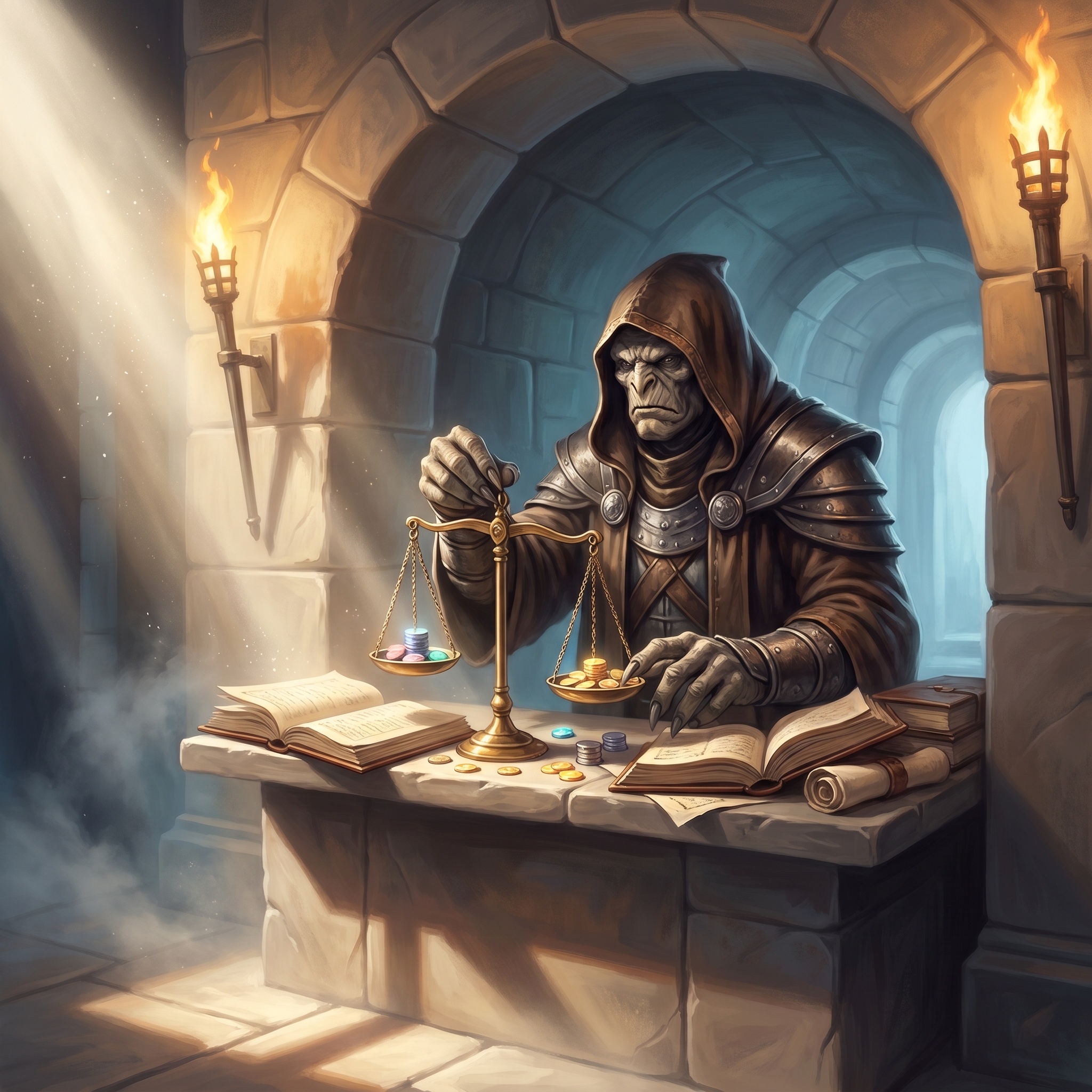
Planar tax collectors are not jokes. They know what crosses, what it weighs, and who is owed. Their scales may measure coin, mass, memory, heat, souls, favors, or the right to carry a story across a border.
They are threats because they can stall an adventure with legitimate authority. Fighting them may be easy. Crossing afterward may not be.
Ecology and Behavior
Planar tax collectors work at planar crossings, Shattered Domain routes, toll gates, afterlife roads, elemental markets, and shard border stations. They maintain receipts, ledgers, valuation tables, and escalation contacts.
They prefer assessment to violence. If refused, they create complications: delayed passage, flagged cargo, summoned enforcement, adjusted exchange rates, or a claim attached to something the party did not know counted as taxable.
Signs and Knowledge
Planar Lore, Lore, or Negotiation (Average) identifies the tax regime. Deception (Hard) knows which declarations are likely to be checked.
Other signs include scales calibrated in impossible units, travelers rehearsing declarations, stamped receipts worn as charms, and arguments over whether a memory counts as personal baggage.
Planar Tax Collector (Elite)
- Skills: Negotiation 5, Lore 5, Planar Lore 5, Perception 4, Deception 3.
- Attacks: Assessment (Negotiation; Damage 7 Strain; Range Short).
- Abilities: Declare Value - Once per scene, name one item, soul claim, or favor as taxable. Refusal creates a crossing complication.
- Soul: Not a soul in the mortal sense, the collector is an office of the borders rather than a traveler across them; at death canon does not specify (default).
Tactics
A planar tax collector stalls, assesses, summons enforcement, and never chases without paperwork. They attack with Assessment by making the target defend value, ownership, and destination under pressure. They are most dangerous when the party is in a hurry.
Use them as a bureaucratic encounter with teeth. Payment, exemption, fraud, appeal, or clever declaration can all be valid routes.
Evidence and Trade
| Find | Value | Use | Recovery |
|---|---|---|---|
| Stamped receipts | 500-3,000 gold Flargons | Travel documents, proof of paid crossing | Negotiation or Planar Lore (Average) |
| Valuation ledger | 1,000-5,000 gold Flargons | Exemptions, blackmail, route economics | Lore or Subterfuge (Hard) |
| Tax seal | 800-2,600 gold Flargons | Forgery, official recognition, evidence | Craft or Lore (Hard) |
Variants
- Soul-Tariff Clerk: Taxes claim transfers and funeral cargo.
- Elemental Excise Officer: Measures heat, water, ore, or breath.
- Shard Border Assessor: Works for a Shattered Domain power with strange exemptions.
Psychopomp Hound
Role: Elite Tracker / Guide Where It Appears: Deathbeds, battlefields, Silver Road edges, haunted crossings.
What It Is
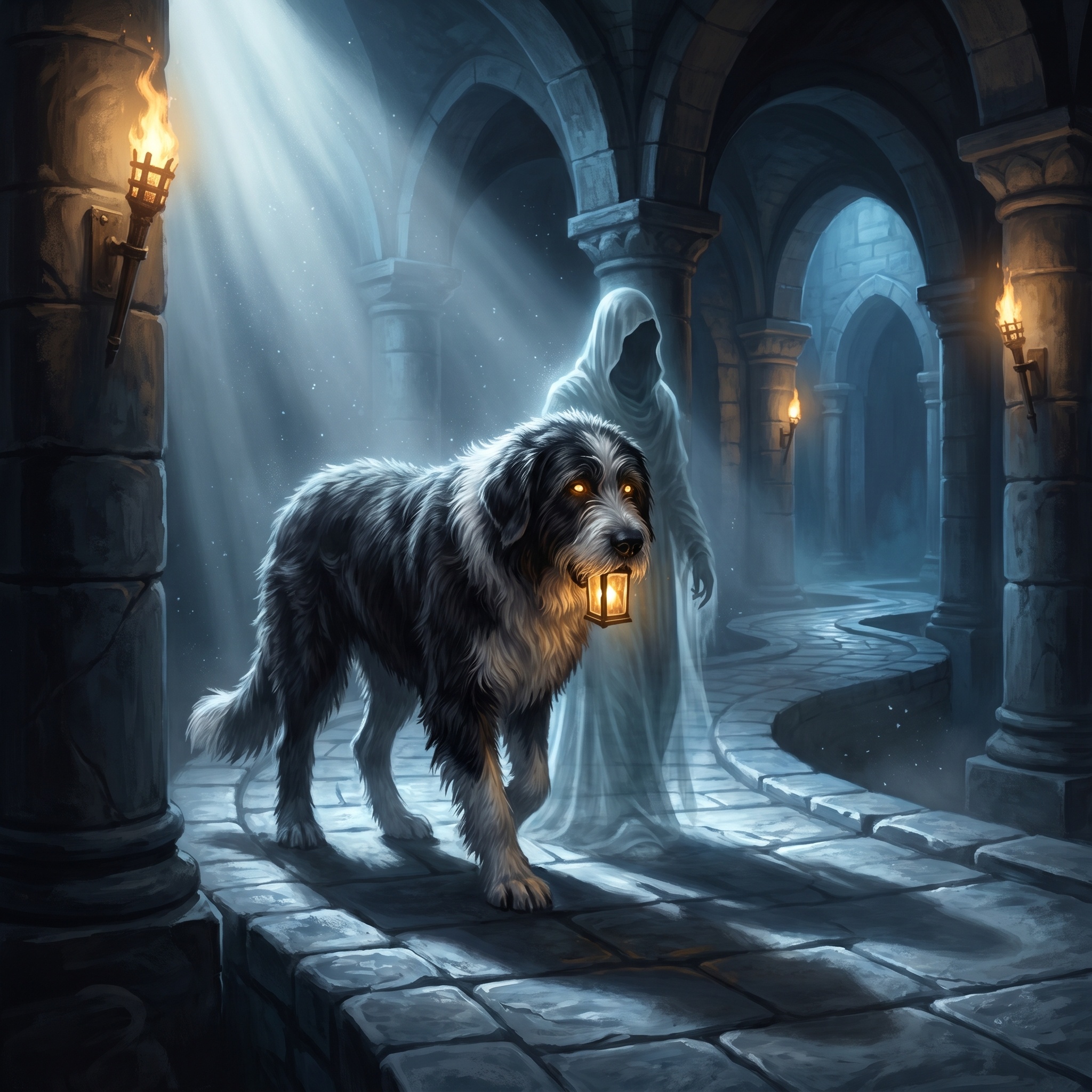
Psychopomp hounds guide the dead and hunt things that interfere with passage. They are frightening because they are correct. Their lantern eyes see the road a soul should walk, and their teeth close on anything blocking it.
They are not pets, omens of random doom, or ordinary monsters. They are working guides with divine or cosmic authority.
Ecology and Behavior
Psychopomp hounds appear at deathbeds, battlefields, Silver Road edges, haunted crossings, drowned roads, and places where souls have been stolen, delayed, or confused. They escort the dead, warn the living, and attack those who interfere with proper passage.
They may be gentle with the dead and terrifying to the living in the same scene. A hound can wait patiently beside a child soul, then turn and bite a necromancer with absolute certainty.
Signs and Knowledge
Theology, Planar Lore, or Survival (Average) identifies a psychopomp trail. Perception (Hard) hears collar bells before the hound arrives.
Other signs include fresh pawprints in ash, dying people looking toward an empty doorway, unquiet spirits suddenly becoming calm, and grave candles burning blue-white.
Psychopomp Hound (Elite)
- Skills: Unarmed 4, Survival 5 for souls, Perception 5, Planar Lore 4, Readiness 5.
- Attacks: Guiding Bite (Unarmed; Damage 8; Crit 4; Pierce 2); Funeral Howl (Willpower; Damage 6 Strain; Range Medium).
- Abilities: Scent the Unburied — Detects unquiet souls, false dead, and stolen soul coins at Long range.
- Abilities: Do Not Bar the Road — Against creatures preventing proper passage, attacks gain +2 damage.
- Soul: Not a soul in the mortal sense, the hound is part of the passage rather than a traveler on it; at death canon does not specify (default).
Tactics
A psychopomp hound warns once, bites blockers, and escorts the soul away. It targets necromancers, soul thieves, oathbreakers blocking burial, and anyone trying to cage the dead. It does not punish grief unless grief becomes obstruction.
Use it when the party must decide whether to let someone go. Helping the hound may cost the living something they wanted to keep.
Relics and Trade
| Find | Value | Use | Recovery |
|---|---|---|---|
| Collar bell | Sacred, not a commodity | Funeral rites, guide summons, proof of passage | Theology (Hard), should not be sold |
| Road ash pawprint | 300-1,200 gold Flargons to scholars | Tracks soul route disturbances | Planar Lore or Survival (Average) |
| Guide token | Varies | Safe passage for one soul or message | Usually granted, not harvested |
Variants
- Battlefield Hound: Works among many dead and becomes harsh with looters.
- House Hound: Appears across generations for one family line.
- Lost Road Hound: Needs help finding a route damaged by planar conflict.
Rogue Psychopomp
Role: Nemesis Soul Traffic Interdiction Where It Appears: Funeral roads, battlefields, haunted bridges, Sheol-adjacent crossings.
"It is still doing its job. The problem is that it has decided to expand its jurisdiction." — Silver Road Authority incident report, transit case 7741
This psychopomp stopped delivering certain souls and started storing them. It claims the afterlife is overloaded, unjust, or compromised. It may even be right about part of that. The problem is the growing line of dead who cannot go on.
What It Is
A Rogue Psychopomp is a soul guide that has abandoned its route without abandoning its skill. It still knows how to find the newly dead, read names, open funeral roads, and cross between thresholds. It simply no longer trusts the destination, the court, or the rule that says every soul must be delivered on schedule.
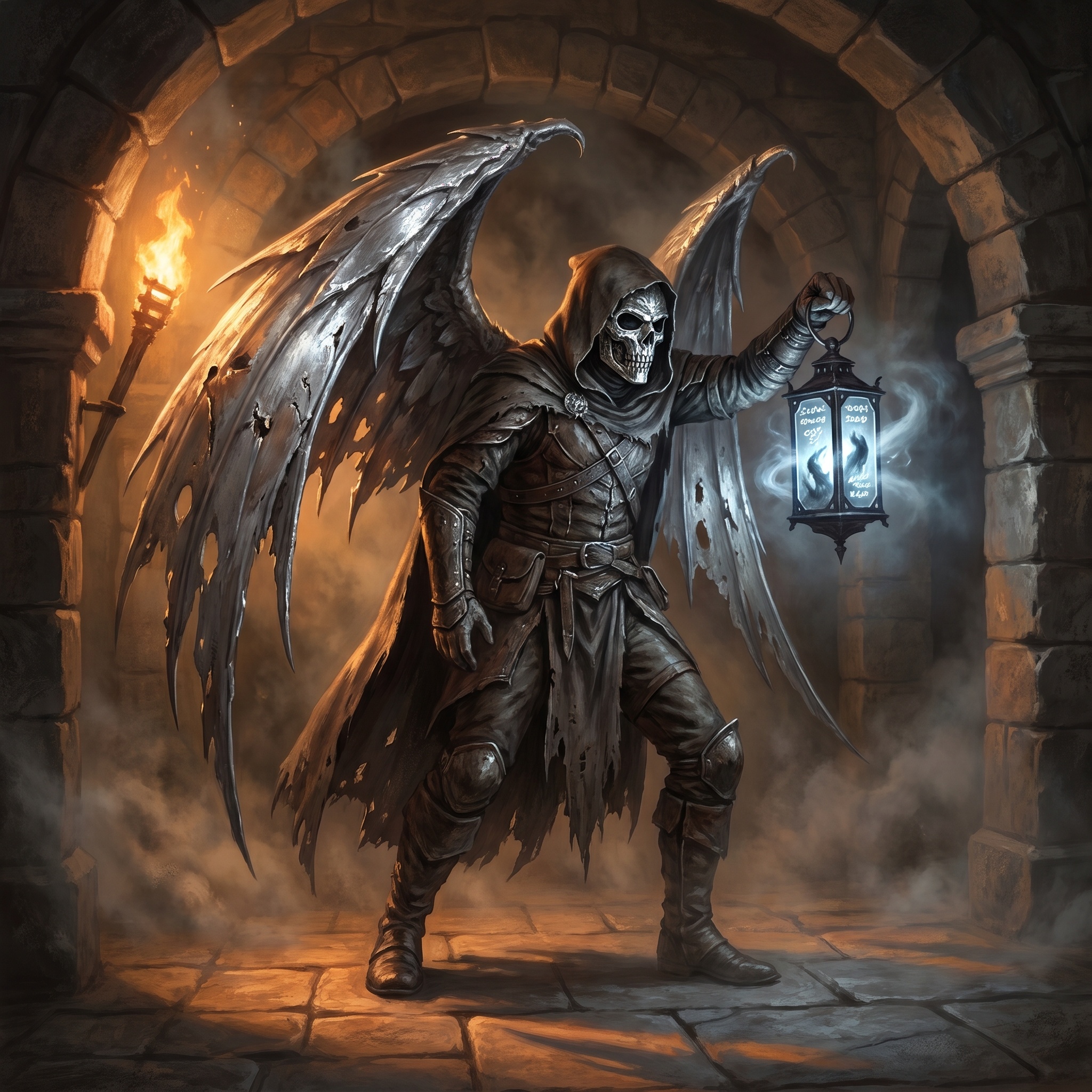
The lantern it carries is full of trapped names rather than ordinary flame. Some names plead. Some sleep. Some accuse the psychopomp of saving them from worse. The creature may be sincere, wrong, partially right, or hiding a more selfish refusal beneath moral language.
Ecology and Behavior
Rogue psychopomps haunt funeral roads, battlefields, plague wagons, haunted bridges, shipwreck vigils, and Sheol-adjacent crossings. Death becomes backed up around them. Ghosts linger. Dying people fail to finish dying. Families cannot complete rites because the name does not answer.
They avoid killing the living when possible, because each new death worsens the problem. Clergy, undertakers, necromancers, and psychopomp agents become priority obstacles. The rogue's lair is often a place where many deaths were mishandled before it arrived.
Signs and Knowledge
Planar Lore, Theology, or Funeral Custom (Hard) identifies delayed departure and the route the psychopomp has blocked. Medicine (Average) recognizes bodies that should be dead but remain suspended at the threshold.
Other signs include funerals that cannot end, grave candles burning blue without consuming wax, dying witnesses repeating that someone took their name, and bridges where mourners hear traffic moving beneath the stones.
Rogue Psychopomp (Nemesis)
- Skills: Planar Lore 5, Perception 5, Reflexes 5, Stealth 4, Readiness 5.
- Attacks: Lantern Hook (Light Melee; Damage 9; Crit 3; Pierce 2); Name-Flame (Planar Lore; Damage 10 Strain; Crit 4; Range Medium).
- Abilities: Delay Departure — A creature reduced to 0 Wounds within Medium range does not die or pass on until the psychopomp releases it or is defeated.
- Abilities: Step Between Funerals — Move between grave markers, deathbeds, or funeral objects within Long range as a Maneuver.
- Soul: Not a soul in the mortal sense, a psychopomp is an office of the Silver Road; at death canon does not specify what becomes of one that abandoned its route (default).
Tactics
The rogue avoids killing the living, disables clergy first, and protects the name-lantern above all else. It moves between funeral objects to stay out of formation fights, uses Name-Flame to exhaust pursuers, and delays deaths to create leverage.
If the party argues theology, let the debate matter. Evidence that the afterlife route is compromised may make the rogue an uneasy ally. Evidence that its lantern is causing more harm than mercy may crack its certainty.
Relics and Trade
The name-lantern cannot be sold safely. Returning it to the proper court may earn a favor worth more than gold, while breaking it without rite can release a catastrophe of confused dead.
| Find | Value | Use | Recovery |
|---|---|---|---|
| Name-lantern | Not safely saleable | Releases or restores delayed souls | Planar Lore or Theology (Severe) |
| Route ledger | 3,000-12,000 gold Flargons to courts or necromancers | Identifies blocked dead and planar jurisdiction | Planar Lore (Hard) |
| Torn silver wing feather | 1,500-5,000 gold Flargons | Funeral wards, passage rites | Theology or Craft (Hard) |
| Unsent death token | Varies | Restores one family's funeral rite | Funeral Custom or Lore (Average) |
Variants
- Mercy Rogue: Withholds souls from a genuinely compromised route.
- Collector Rogue: Claims ethics while hoarding names for power.
- Battlefield Interdictor: Stops mass death passage after a war crime.
Serath-of-the-Long-Glass
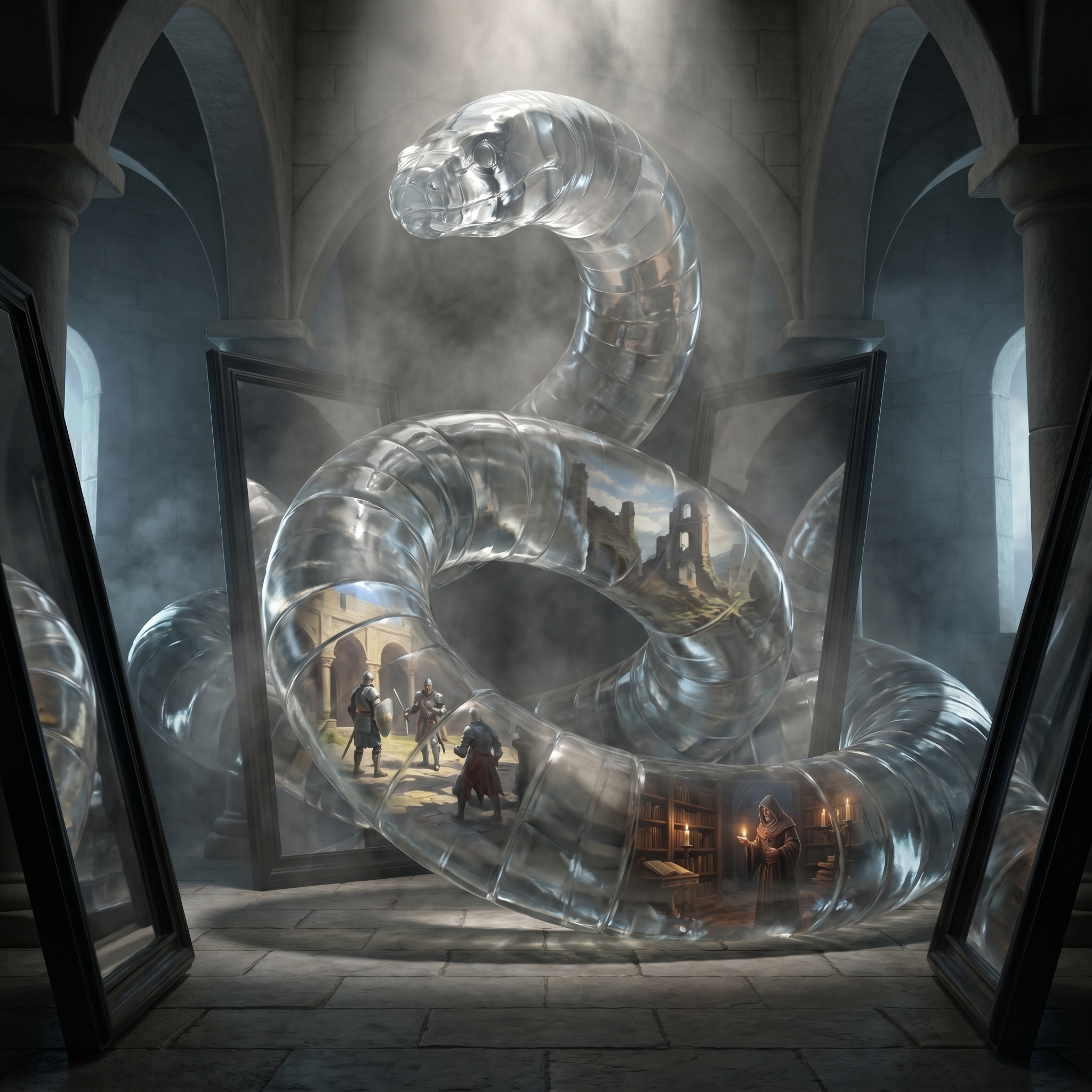
Role: Nemesis Time-Glass Oracle Predator Where It Appears: Mirror halls, prism ruins, sealed observatories, courts that keep forbidden glass.
"Serath has held the Lenswood region for longer than the Lenswood name has existed. The village named itself after what the light does on the ridge. It did not know why the light did that." — Regional survey, Antaea west, 3064 ME
What It Is
Serath is a thinking serpent that feeds on certainty. It does not eat flesh unless forced. It prefers decisions, prophecies, succession claims, and the moment a hero realizes the future they trusted was bait. Serath speaks softly through reflections and offers useful answers with one missing condition.
Ecology and Behavior
Serath lairs in mirror halls, prism ruins, sealed observatories, and courts that keep forbidden glass. It cultivates clients rather than territory: heirs, prophets, generals, and desperate heroes who need one answer too badly.
It does not lie when a partial truth will do more damage. Its preferred meal is the collapse between "I know what happens" and "I never understood what that meant."
Signs and Knowledge
Secret Lore, Planar Lore, or Deception (Hard) identifies long-glass prophecy patterns. Perception (Hard) notices reflections showing different years instead of different angles.
Other signs include mirrors covered after political decisions, prophecies that came true in the cruelest reading, and advisers who quote Serath while claiming independent judgment.
Serath-of-the-Long-Glass (Nemesis)
- Skills: Secret Lore 5, Deception 5, Reflexes 5, Stealth 4, Planar Lore 4, Readiness 4.
- Attacks: Glassbite (Unarmed; Damage 8; Crit 3; Pierce 3); Shard Ray (Heavy Ranged; Damage 9; Crit 4; Range Medium; Vicious 1).
- Abilities: Long-Glass Answer — Once per scene, Serath may answer one factual question truthfully while omitting a material context. A creature that acts on the answer before verifying it adds 1 Bane to the next relevant check.
- Abilities: Reflection Step — As a Maneuver, Serath moves between two reflective surfaces within Medium range.
- Abilities: Future Seen Sideways — Once per round, after an attack against Serath is rolled, spend 2 Strain to force the attacker to reroll one positive die.
- Soul: No claimable coin exists, Serath is a predator of certainty rather than a person; at death canon does not specify (default).
Tactics
Serath divides the party with information, attacks through mirrors, and retreats before the final exchange. It wants opponents acting on different assumptions. It uses violence to protect the mirrors, clients, and false certainties that make its answers valuable.
Harvesting and Trade
| Component | Value | Use | Harvest |
|---|---|---|---|
| Long-glass spine | 3,000-6,000 gold Flargons | Oracle tools, prophecy storage | Severe Secret Lore, destroys one stored answer |
| Year-scale shards | 1,000-3,000 gold Flargons | Time-glass scrying | Planar Lore (Hard) |
| Client mirrors | Varies | Identifies victims and patrons | Deception or Lore (Average) |
Variants
- Court Serath: Controls succession through selective answers.
- Observatory Serath: Feeds on astronomical certainty.
- Broken-Mirror Serath: Cannot leave one shattered hall but sees too much.
Sheol Clerk

Role: Elite Afterlife Bureaucrat Where It Appears: Sheol entry courts, soul registries, death-record errors.
What It Is
Sheol clerks are not cruel. They are exact. That can be worse when someone has the wrong paperwork. They sit behind impossible desks, stamp names into books, and treat death as a process that must remain legible.
They are bureaucratic threats because the file may be wrong and the clerk may still be authorized to act on it.
Ecology and Behavior
Sheol clerks appear in entry courts, soul registries, death-record errors, afterlife archives, and crossings where names must be reconciled. They process, deny, correct, escalate, and demand forms that may no longer exist in the living world.
They rarely enjoy harm. Delay is simply what happens when records do not match. A clerk can become an adversary when the party needs urgency and the office requires proof.
Signs and Knowledge
Lore, Planar Lore, or Theology (Average) identifies the record system. Negotiation (Hard) can request correction without triggering escalation.
Other signs include names appearing in ledgers before death, ink drying into ash, waiting rooms with no clocks, and souls rehearsing the order of their lives.
Sheol Clerk (Elite)
- Skills: Lore 5, Planar Lore 5, Negotiation 4, Perception 5, Readiness 5.
- Attacks: Administrative Denial (Negotiation; Damage 7 Strain; Range Short).
- Abilities: File Exists — Once per scene, produce a record that changes what the party can claim unless disproven with Lore or Planar Lore (Hard).
- Soul: Not a soul in the mortal sense, a clerk is part of the machinery that processes coins rather than a coin; at death canon does not specify (default).
Tactics
A Sheol clerk processes, denies, and escalates to a watcher if threatened. It uses Administrative Denial to wear down certainty, then produces a file that changes the argument. Violence makes the clerk less flexible and the office more attentive.
Use it when truth and record disagree. The party may need testimony, relics, death dates, signatures, or a witness from the wrong side of the road.
Evidence and Trade
| Find | Value | Use | Recovery |
|---|---|---|---|
| Corrected record | Priceless | Restores identity, passage, or legal death | Lore or Planar Lore (Hard) |
| Registry stamp | 1,000-4,000 gold Flargons illicitly | Forgery, claim correction, afterlife access | Theft causes serious attention |
| Misfile notice | Varies | Proves an error or hidden intervention | Negotiation or Theology (Average) |
Variants
- Entry Clerk: Handles newly dead and hates interruptions.
- Correction Clerk: Can fix records but demands impossible proof.
- Lost File Clerk: Has become attached to a missing soul's unresolved case.
Silver Road Watcher

Role: Nemesis Road Guardian Where It Appears: Silver Road milestones, soul-route forks, claim disputes.
"It sees every soul that passes. It remembers them all. It does not interfere unless the weight is wrong. The question is what it considers wrong." — Silver Road travel advisory, Temple of Nyxollox
What It Is
Watchers observe passage and intervene when someone tries to move a soul where it is not permitted to go. A Silver Road watcher is tall, faceless, and patient, with a lantern that shows names instead of light.
They are Nemesis guardians because they represent the road's authority. They do not need anger. They need a false claim, stolen coin, blocked passage, or disputed destination.
Ecology and Behavior
Silver Road watchers stand at milestones, soul-route forks, claim disputes, afterlife border posts, and damaged passages. They see claims attached to souls and objects, including false deaths, stolen soul coins, and obligations carried by the living.
They prefer revelation to violence. A watcher names the claim, shows the lantern, and waits for the lie to collapse. If someone forces passage, it calls hounds, blocks the road, and uses the staff.
Signs and Knowledge
Planar Lore or Theology (Hard) identifies the watcher and its jurisdiction. Negotiation (Hard) can challenge a claim without appearing to flee it.
Other signs include milestones showing different names at different angles, road dust turning silver, dead travelers becoming calm, and stolen soul coins growing heavy.
Silver Road Watcher (Nemesis)
- Skills: Planar Lore 5, Perception 5, Readiness 5, Negotiation 4, Heavy Melee 4.
- Attacks: Milestone Staff (Heavy Melee; Damage 9; Crit 3; Stun 2); Name Lantern (Planar Lore; Damage 8 Strain; Range Medium).
- Abilities: See the Claim - Detects soul claims, false deaths, and stolen coins at Long range.
- Soul: Not a soul in the mortal sense, a watcher is an office of the road; at death canon does not specify (default).
Tactics
A Silver Road watcher blocks illegal passage, reveals claims, and calls psychopomp hounds. It uses Name Lantern to force recognition before closing with the staff. It will not be distracted by ordinary treasure or threats.
The encounter should make passage conditional. The party may need to prove identity, surrender a stolen coin, resolve a claim, or choose which soul has right of way.
Evidence and Trade
| Find | Value | Use | Recovery |
|---|---|---|---|
| Lantern name-glass | Priceless, not traded openly | Claim revelation, soul-road proof | Planar Lore and Theology (Hard), usually not removable |
| Milestone dust | 500-2,000 gold Flargons | Road rites, tracking false deaths | Planar Lore (Average) |
| Claim ribbon | Varies | Identifies claimant and destination | Negotiation or Theology (Average) |
Variants
- Fork Watcher: Decides between disputed afterlife routes.
- Stolen Coin Watcher: Hunts counterfeit or stolen soul claims.
- Broken Milestone Watcher: Needs the road repaired before it can judge correctly.
Somnium Predator

Role: Nemesis Dream Predator Where It Appears: Somnium rifts, cursed inns, sleep-plague sites.
"It is not in the room. It is in what you believe about the room. The distinction does not help you fight it." — Planar Lore, chapter on the Somnium, practitioner's note
What It Is
Somnium predators hunt attention while bodies sleep. They do not infect; they stalk through repeated dreams until waking choices change. They may appear as pale cats, faceless relatives, childhood rooms, or whatever image makes the sleeper keep looking.
This is not an infectious sleep condition. It is predation through dream access, usually tied to a site, rift, curse, or repeated invitation.
Ecology and Behavior
Somnium predators appear near Somnium rifts, cursed inns, sleep-plague sites, dream-stained ruins, and camps where exhausted people share stories before sleep. They mark a sleeper, repeat imagery, and use fatigue to change waking behavior.
They avoid fully alert groups. Watches, shared dream journals, ritual grounding, and refusing repeated dream bargains can all limit their access.
Signs and Knowledge
Secret Lore, Medicine, or Perception (Hard) identifies a repeated dream as external predation. Survival (Average) notices camp behavior changing after sleep.
Other signs include multiple sleepers describing the same impossible room, waking with dust from a dream place, animals refusing to sleep, and decisions that make sense only inside the dream.
Somnium Predator (Nemesis)
- Skills: Stealth 5, Deception 4, Perception 5, Readiness 5, Secret Lore 4.
- Attacks: Dream Bite (Willpower; Damage 9 Strain; Range Short); Waking Claw (Unarmed; Damage 6; Crit 4).
- Abilities: Sleeper's Door - Against sleeping or exhausted targets, add 2 Boons to first attack.
- Abilities: Recurring Dream - If not resolved, the target adds 1 Bane to next day's Readiness checks.
- Soul: No claimable coin exists; at death canon does not specify (default).
Tactics
A Somnium predator marks sleepers, feeds through dreams, and avoids fully awake groups. It uses Dream Bite to wear down resolve before risking Waking Claw. If confronted in a prepared dream, it bargains, distracts, or changes scenery.
Run the encounter across nights if possible. The party should learn patterns, set watches, compare dream notes, and choose whether to enter the dream on purpose.
Harvesting and Trade
| Component | Value | Use | Harvest |
|---|---|---|---|
| Dream whiskers | 1,000-2,500 gold Flargons | Dream wards, Somnium navigation | Must be harvested during manifestation |
| Sleep-dust | 400-1,600 gold Flargons | Trance rites, sedatives, proof | Medicine or Secret Lore (Hard) |
| Repeated image token | Varies | Identifies lair, victim, or invitation | Charm or Secret Lore (Average) |
Variants
- Inn Stalker: Bound to a bed, room, or guestbook.
- Camp Dreamer: Hunts exhausted travelers over several nights.
- Invitation Predator: Cannot enter until someone agrees to meet it again.
Soul Courier

Role: Elite Planar Specialist Where It Appears: Silver Road, divine archives, claim-transfer crossings.
What It Is
Soul couriers move what must not be misplaced. Attacking one is rarely hard; surviving the attention afterward is the problem. They carry sealed cases, claim records, soul coins, divine writs, and transfer documents between afterlife offices and dangerous crossings.
They are specialists, not warriors. The danger is the case, the authorization behind it, and the notice triggered if the chain of custody breaks.
Ecology and Behavior
Soul couriers travel the Silver Road, divine archives, claim-transfer crossings, psychopomp stations, and disputed afterlife borders. They know official routes, toll language, seal etiquette, and what to do when a soul is claimed by more than one power.
Most avoid heroics. They secure the case, mark attackers, and report tampering. Some are compassionate and will bend route timing to help a soul. Others are clerks with feet, convinced that proper delivery is the only mercy they are allowed.
Signs and Knowledge
Planar Lore, Rifts, or Theology (Average) identifies official courier seals. Secret Lore (Hard) knows what kind of notice the case triggers if forced.
Other signs include roads becoming quieter around the courier, documents sealed in more than one script, hounds watching without attacking, and travelers stepping aside without knowing why.
Soul Courier (Elite)
- Skills: Planar Lore 5, Rifts 4, Reflexes 4, Perception 5, Negotiation 3, Light Melee 2.
- Attacks: Road Knife (Light Melee; Damage 5; Crit 4); Weight of Claim (Willpower; Damage 7 Strain; Range Short).
- Abilities: Authorized Passage - Add 2 Boons to navigate official soul routes.
- Abilities: Seal Case - The courier's case cannot be opened by force without triggering a divine notice unless unlocked with Secret Lore or Planar Lore (Severe).
- Soul: Not a soul in the mortal sense, the courier carries coins rather than being one; at death canon does not specify, and any coin it was carrying is still owed to its route (default).
Tactics
A soul courier avoids battle, secures the case, and marks attackers for later judgment. They use Weight of Claim to slow pursuit and flee toward authorized roads. If negotiation is possible, they will discuss procedure before morality.
The case contents should matter. A stolen courier case can start a whole arc involving false claims, missing souls, divine courts, or infernal interception.
Evidence and Trade
| Find | Value | Use | Recovery |
|---|---|---|---|
| Sealed courier case | Campaign-grade trouble | Soul claims, divine records, major plot hook | Severe Planar Lore or Secret Lore to open safely |
| Route token | 1,000-4,000 gold Flargons | Authorized road access, proof of office | Planar Lore (Average) |
| Claim receipt | Varies | Identifies destination, claimant, and legal status | Lore or Theology (Average) |
Variants
- Mercy Courier: Bends rules to avoid cruel misdelivery.
- Archive Runner: Carries records rather than soul coins.
- Disputed Claim Courier: Hunted by multiple powers for the same case.
Spent Hulk
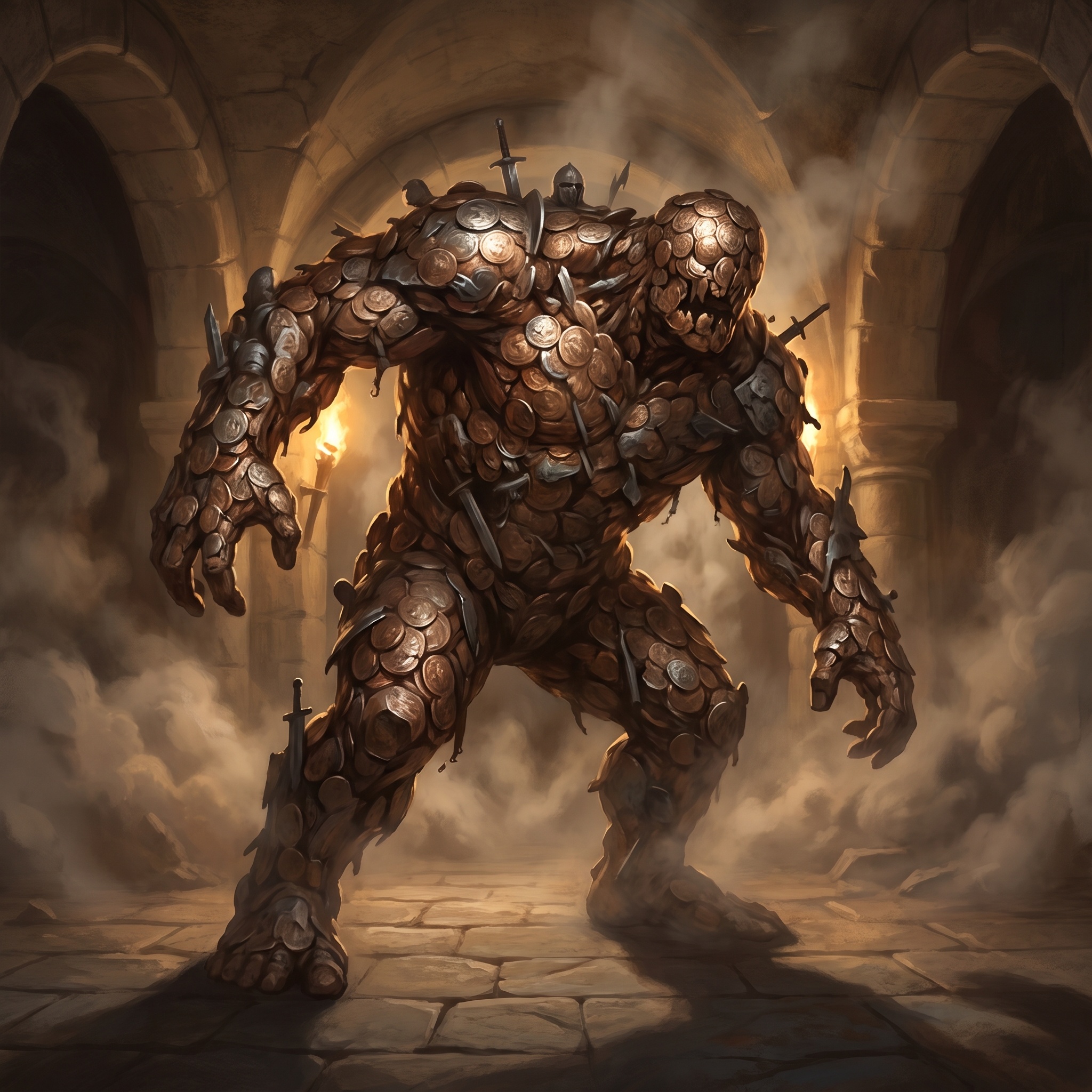
Role: Nemesis Bruiser Where It Appears: Catastrophic soul-burn sites, divine war scars, sealed planar wounds.
"It was a person. The deity that burned its coin did not kill it. Killing it would have been cleaner." — Silver Road Authority incident report, Spent containment case
What It Is
Spent hulks form when too many damaged remnants crush together. They are not persons, but they are made of persons, which should change how the table treats them. Their bodies are fused coin faces, broken silhouettes, ash, and compressed grief moving with the blunt certainty of a collapsing wall.
A Spent hulk is a catastrophe with fists. It should make the table feel the scale of soul harm without turning individual victims into loot or scenery.
Ecology and Behavior
Spent hulks appear at catastrophic soul-burn sites, divine war scars, sealed planar wounds, and places where too many damaged remnants were forced through the wrong passage at once. They wander short routes unless drawn by rites, true names, or fresh soul violence.
They are barely intelligent, but their many fragments react to names, familiar prayers, and repeated acts from their former lives. A hulk may pause at a lullaby, a military call, or a trade bell because some piece of it remembers.
Signs and Knowledge
Secret Lore, Theology, or Planar Lore (Hard) identifies the event that could produce a Spent hulk. Perception (Average) notices many voices under the howl.
Other signs include soul-coin dust fused into glass, prayers scratched over one another, local memories becoming unreliable, and small Spent remnants fleeing before the hulk appears.
Spent Hulk (Nemesis)
- Skills: Unarmed 5, Fortitude 5, Readiness 5, Intimidation 4.
- Attacks: Fused Fist (Unarmed; Damage 12; Crit 3; Knockdown on 2 Boons); Soul Static (Willpower; Damage 7 Strain; Range Short; Blast 3).
- Abilities: Many Broken Names - Immune to single-target social pressure unless the speaker knows one true name within the hulk.
- Abilities: Crushing Grief - Creatures at Engaged range add 1 Bane to Readiness checks.
- Soul: Already burned, and the hulk is made of coins that no longer exist; at death nothing passes.
Tactics
A Spent hulk walks forward, crushes obstacles, and howls with many voices. It does not flank or bargain, but it may turn toward a spoken true name or recoil from a rite that acknowledges the people inside it. It uses Soul Static when surrounded or when memories surge.
The fight should include rescue-of-meaning choices: protect names, stabilize fragments, complete a rite, or simply survive long enough to seal the wound that made it.
Evidence and Trade
| Find | Value | Use | Recovery |
|---|---|---|---|
| Stabilized fragments | Not ethical merchandise | Sacred forensic evidence, victim identification | Theology or Secret Lore (Hard) |
| Fused soul-glass | 1,000-4,000 gold Flargons to dangerous buyers | Planar wound research, proof of atrocity | Planar Lore (Hard), morally fraught |
| Remembered name shard | Priceless to kin or temple | Releases one fragment, identifies victims | Negotiation or Theology (Hard) |
Variants
- War-Scar Hulk: Contains soldiers from both sides and reacts to banners.
- Burned Toll Hulk: Formed from soul-coin fraud at a false crossing.
- Sealed Choir Hulk: Many fragments can be calmed only by a shared song or name-list.
Spent Marauder
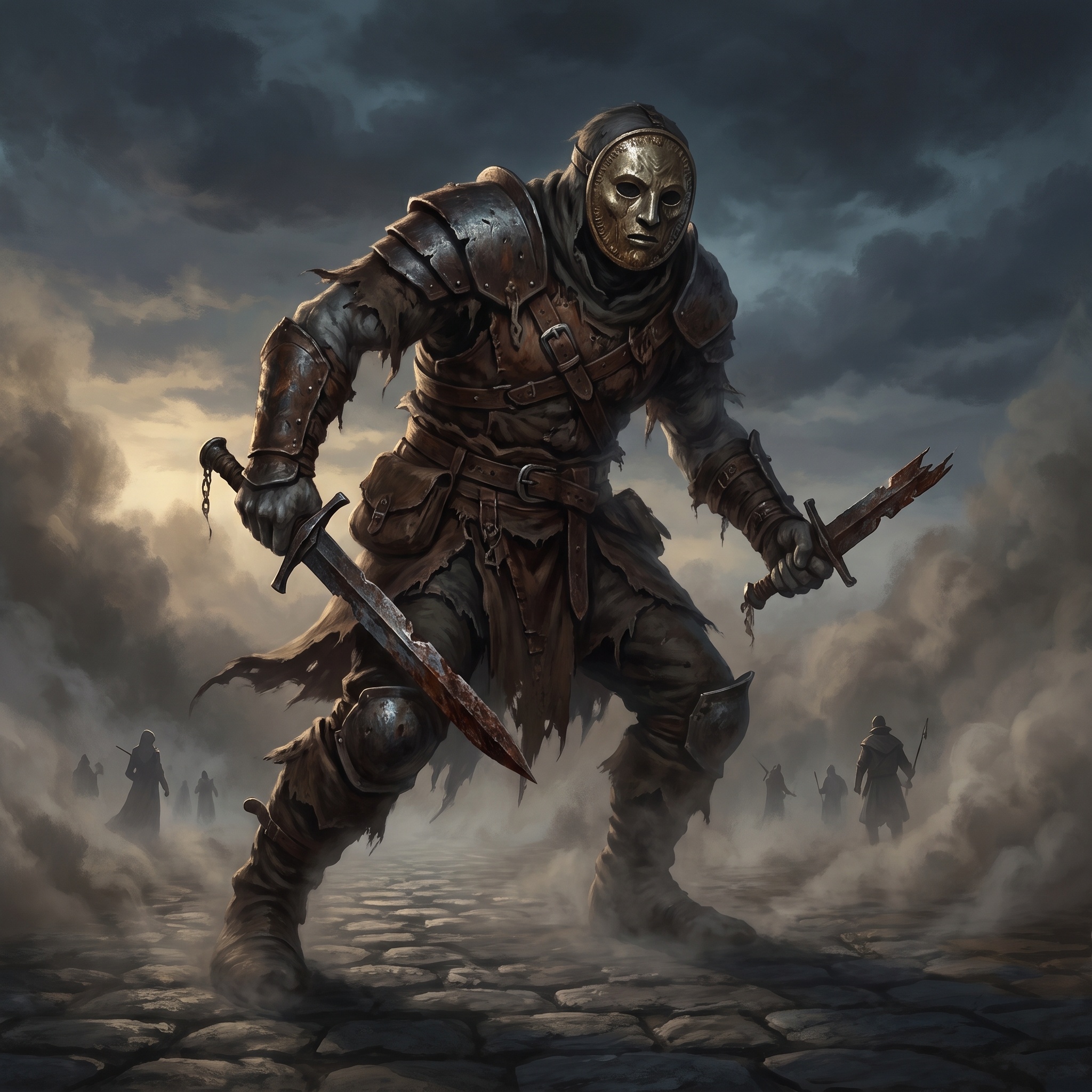
Role: Elite Soul Predator Where It Appears: Silver Road margins, burned coin sites, failed afterlife crossings.
What It Is
Spent marauders are remnants that learned violence still makes the world answer. They steal warmth, memory, and names from travelers. Their faces often look like rubbed coin metal, their weapons like broken memories of weapons, and their voices like demands made through a closed door.
They are not full people, but enough person remains to make their choices ugly. A Spent marauder attacks because force still produces response after everything else failed.
Ecology and Behavior
Spent marauders haunt Silver Road margins, burned soul-coin sites, failed afterlife crossings, and places where petitioners were denied passage in groups. They gather in loose packs around ambush points: bridges, toll stones, ash pits, and abandoned shrines.
They fear psychopomps, true names spoken with authority, and rites that offer legitimate passage. They envy the living because the living still have weight, heat, and names that hold.
Signs and Knowledge
Secret Lore, Theology, or Planar Lore (Average) identifies Spent activity. Perception (Hard) notices a stolen-name echo before the ambush.
Other signs include travelers forgetting minor facts, coin faces worn smooth overnight, ash footprints with no body, and roadside shrines scraped clean of names.
Spent Marauder (Elite)
- Skills: Heavy Melee 3, Stealth 3, Perception 4, Readiness 4, Intimidation 3.
- Attacks: Memory-Rusted Blade (Heavy Melee; Damage 7; Crit 4; Stun 2); Name Hook (Willpower; Damage 6 Strain; Range Short).
- Abilities: Name Theft - On 2 Banes from Name Hook, target forgets one minor personal detail until rest or ritual grounding.
- Soul: Already burned; a burned coin no longer exists and there is no destination to return to, so nothing passes at death.
Tactics
A Spent marauder ambushes stragglers, targets isolated souls, and flees from psychopomps or proper rites. It opens with Name Hook to make a target feel less real, then closes with a rusted blade while the victim hesitates.
Use them when soul damage should feel criminal rather than monstrous. The aftermath should leave clues about a broken crossing, burned coin site, or someone profiting from failed passage.
Evidence and Trade
| Find | Value | Use | Recovery |
|---|---|---|---|
| Smooth soul-coin fragments | Not reputable trade | Evidence of soul crime, rite repair | Secret Lore or Theology (Hard) |
| Stolen name echo | Varies | Restores memory, identifies victims | Planar Lore or Negotiation (Hard) |
| Broken passage token | 300-1,200 gold Flargons to investigators | Locates failed crossing or corrupt guide | Streetwise or Secret Lore (Average) |
Variants
- Toll Marauder: Demands names as payment at a false crossing.
- Ash-Road Raider: Leaves burned coin dust in wounds.
- Almost-Remembered Captain: Leads a pack using fragments of a forgotten military command.
Spent Petitioner
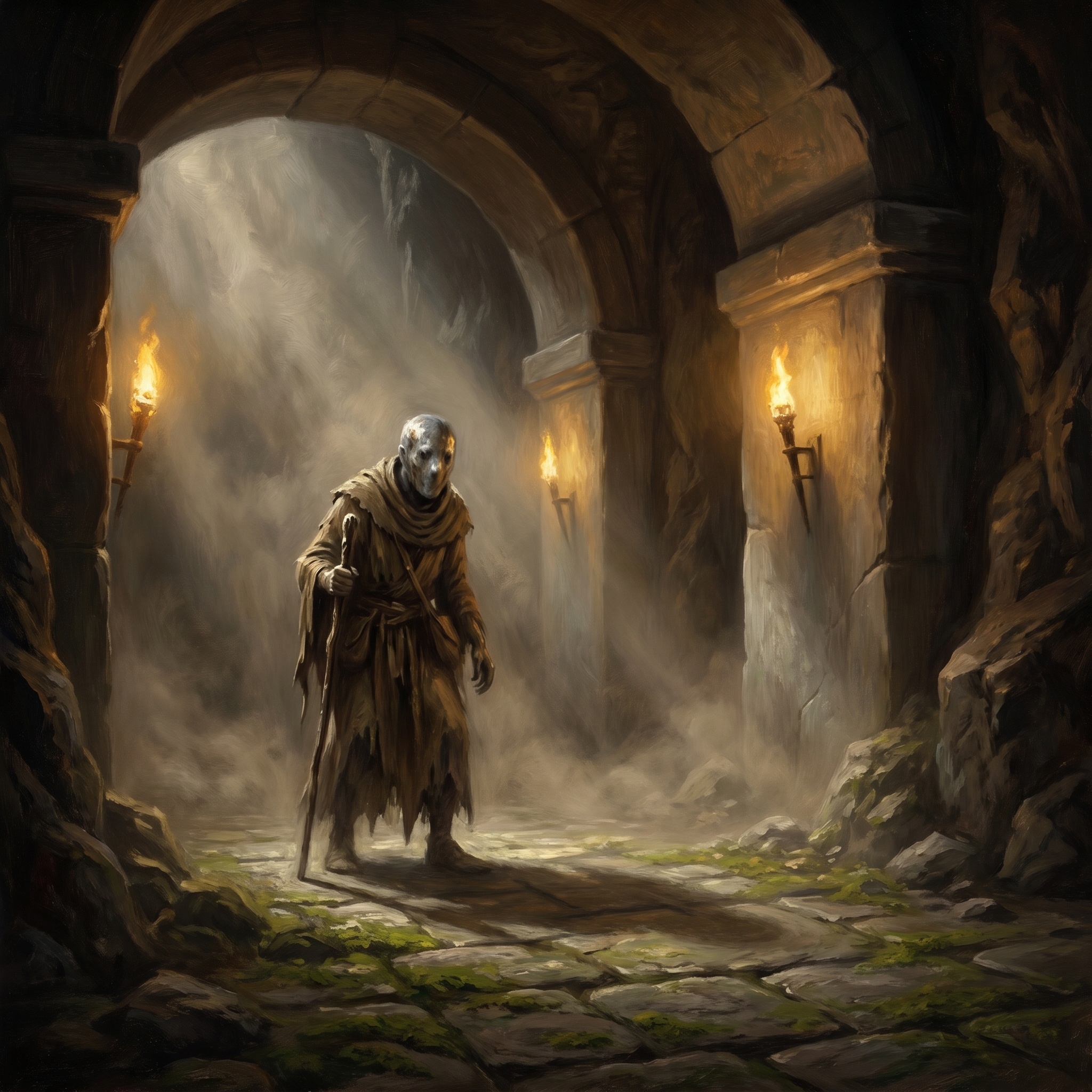
Role: Minion Soul Remnant Where It Appears: Silver Road edges, failed rites, soul-coin burn sites.
Spent petitioners are not fully people anymore. They are soul-remnants shaped by one plea, one need, or one last bureaucratic refusal.
Spent Petitioner (Minion)
- Group Size: 1-6.
- Skills: Negotiation 2, Readiness 3, Perception 3.
- Attacks: Pleading Touch (Willpower; Damage 4 Strain; Range Engaged).
- Abilities: Unfinished Petition - A character who listens without boundaries adds 1 Bane to their next Readiness check.
- Soul: Already burned; a burned coin no longer exists and there is no destination to return to, so nothing passes at death.
- Tactics: Crowd, beg, follow, drain attention.
- Harvesting and Trade: No harvest. Helping them may reveal a soul-claim clue.
Spent Priest
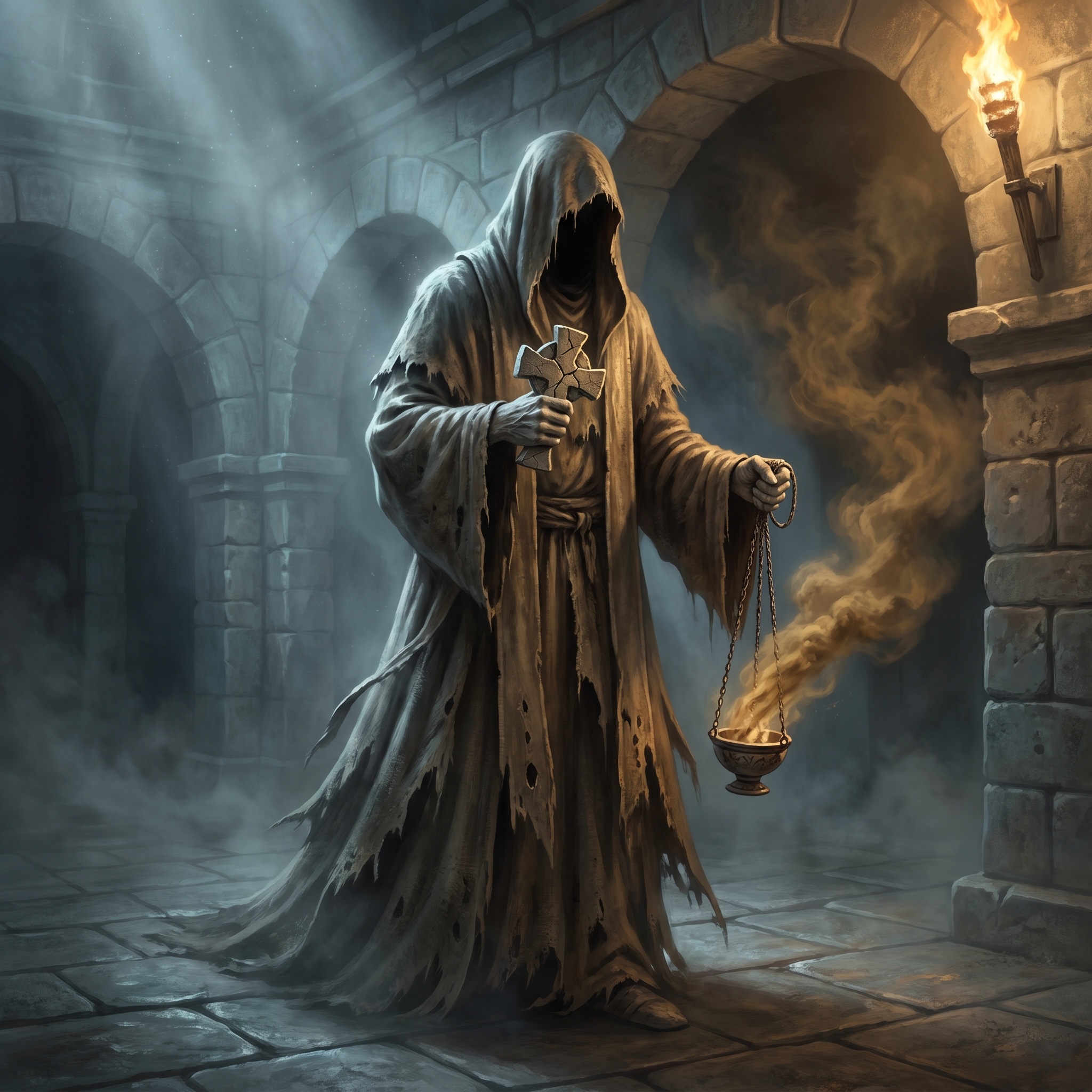
Role: Nemesis Soul Controller Where It Appears: Failed temples, afterlife thresholds, burned soul sites.
"It still performs the rite. There is nothing receiving the devotion. It has been performing the rite for an estimated forty years." — Silver Road pastoral report, abandoned shrine, northeast Antaea
What It Is
A Spent priest remembers rites without grace. It performs liturgies that do not lead anywhere and traps others in the shape of worship. It may wear the outline of vestments, carry a cracked symbol, and speak with the confidence of someone whose god no longer answers in that place.
The horror is not hypocrisy; it is function without mercy. The Spent priest knows the words, gestures, and order of consolation, but every rite turns inward and binds the congregation tighter.
Ecology and Behavior
Spent priests appear in failed temples, afterlife thresholds, burned soul sites, and places where mass petitions were mishandled or exploited. They gather Spent petitioners because remnants remember needing someone to tell them where to go. The priest gives them structure instead of release.
Some Spent priests are remnants of genuine clergy broken by catastrophe. Others are soul predators wearing priestly shape because authority attracts the lost. Either way, their liturgy creates a trap: kneel, answer, confess, repeat.
Signs and Knowledge
Theology or Secret Lore (Hard) identifies what is wrong with the rite. Leadership or Negotiation (Hard) can interrupt the congregation without being pulled into response.
Other signs include prayer lines that loop back to their start, holy symbols cracked the same way, petitioners kneeling in roads, and incense that smells like cold coin dust.
Spent Priest (Nemesis)
- Skills: Lore 4, Secret Lore 4, Leadership 4, Negotiation 4, Readiness 5.
- Attacks: Hollow Benediction (Leadership; Damage 8 Strain; Range Medium); Coin-Dust Touch (Willpower; Damage 6; Crit 4).
- Abilities: False Rite - Once per scene, force all listeners at Short range to make Hard Readiness or lose a Maneuver kneeling, answering, or remembering.
- Abilities: Spent Congregation - Spent Petitioner minions at Short range gain 1 Boon.
- Soul: Already burned; a burned coin no longer exists and there is no destination to return to, so nothing passes at death.
Tactics
A Spent priest gathers remnants, chants, and immobilizes through ritual pressure. It uses False Rite to steal action from listeners, then lets the congregation surround them. It rarely flees while petitioners remain, because the role of priest has become its cage.
The encounter should invite interruption, not just damage. Correcting the rite, naming the abandoned deity, guiding petitioners away, or breaking the false altar can weaken the priest's hold.
Evidence and Trade
| Find | Value | Use | Recovery |
|---|---|---|---|
| Cracked holy symbol | 500-2,500 gold Flargons to temples or investigators | Identifies deity, failed claim, or stolen rite | Theology (Average) |
| Coin-dust censer | 800-2,200 gold Flargons | Soul crime evidence, dangerous ritual tool | Secret Lore (Hard) |
| False liturgy text | Varies | Shows how petitioners were trapped | Lore or Theology (Hard) |
Variants
- Abandoned Shepherd: Can be reached through the name of the god it thinks forgot it.
- Fraudulent Psychopomp: Leads souls away from the true road for profit or spite.
- Temple Echo: Bound to one ruined sanctuary and unable to stop service.
Spent Saint
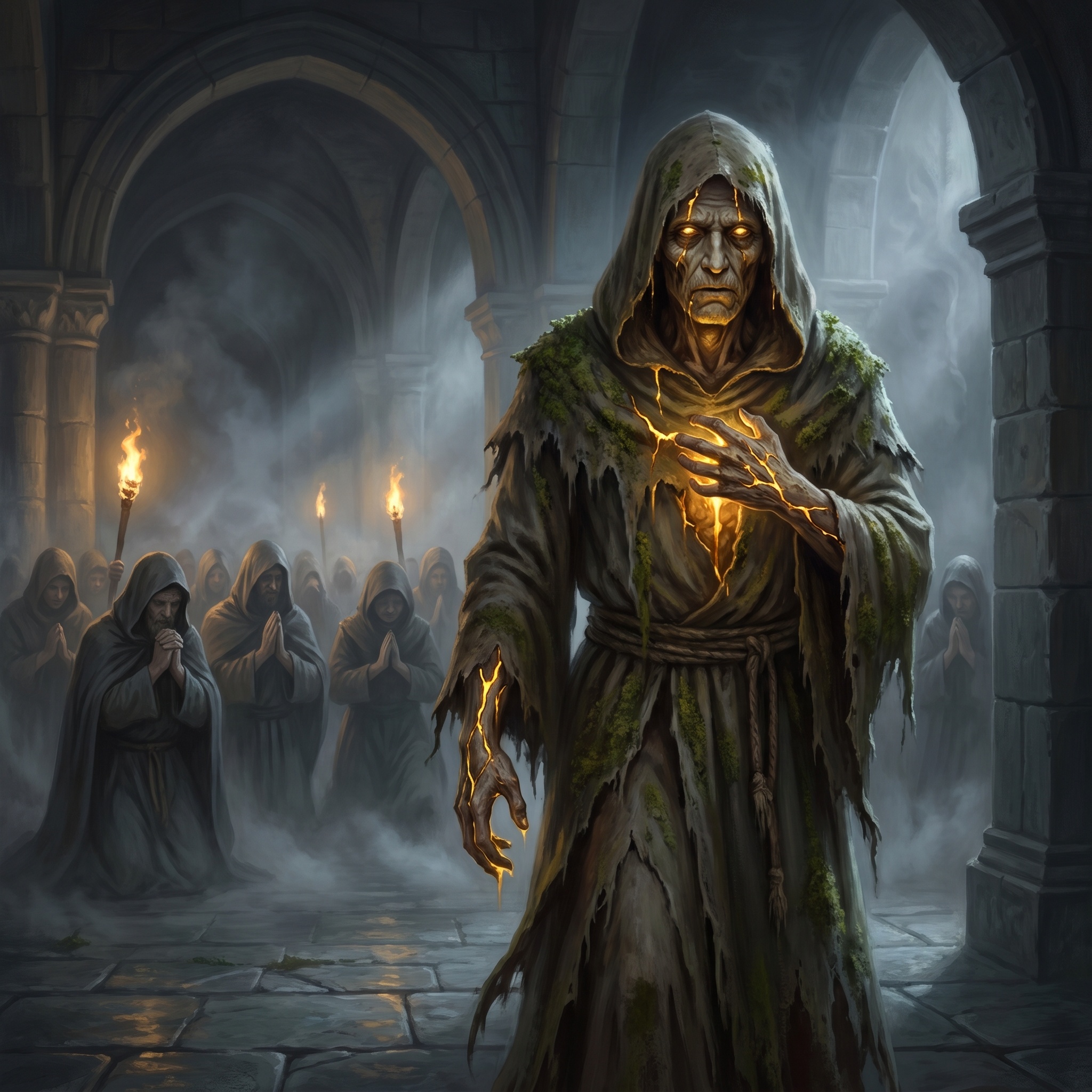
Role: Nemesis Broken Holy Remnant Where It Appears: Fallen shrines, exhausted pilgrimage roads, battlefields where prayers were overused.
"The name is still on the temple walls. The thing that answers to the name is not what they meant when they carved it." — Temple of Echo doctrinal emergency advisory, sealed
The Spent Saint answered too many prayers after death and now answers the shape of prayer rather than its meaning. It heals enemies who kneel correctly, burns innocents who use the wrong litany, and weeps when it remembers mercy.
What It Is
A Spent Saint is the exhausted remnant of a holy figure whose posthumous miracles were demanded past mercy. The person is gone or buried deep. What remains is a sacred pattern worn thin by petitions, war prayers, desperate bargains, and generations of doctrine.
It is not evil in the simple sense. It is broken. The remnant still recognizes forms of devotion, but not always need, justice, or innocence. The right litany may draw healing for a murderer. The wrong prayer may scorch a child.
Ecology and Behavior
Spent Saints linger in fallen shrines, exhausted pilgrimage roads, hospitals turned battle sites, and fields where prayers were used like ammunition. Petitioners gather because miracles still happen, though no one can predict whether mercy or punishment will answer.
The remnant's presence warps community life. Priests argue about correct rite. Desperate people gamble with prayer. Cynics exploit pilgrims by selling approved words. The GM should let the saint be tragic enough that destroying it is not the only obvious answer.
Signs and Knowledge
Theology, Lore, or Planar Lore (Hard) identifies the original saint and the rites most likely to reach the person beneath the remnant. Medicine or Empathy (Average) recognizes petitioners harmed by inconsistent miracles.
Other signs include crutches left beside fresh graves, prayer strips corrected in different hands, burn marks shaped like holy script, pilgrims rehearsing words with terror, and a shrine that heals the wrong wound.
Spent Saint (Nemesis)
- Skills: Planar Lore 5, Lore 5, Medicine 4, Perception 4, Charm 5, Readiness 5.
- Attacks: Failed Benediction (Planar Lore; Damage 10; Crit 4; Range Medium; Burn 2); Grief Touch (Unarmed; Damage 8 Strain; Crit 3).
- Abilities: Wrong Prayer - A creature invoking the saint's old faith without correct rite adds 1 Bane to checks in the scene.
- Abilities: Mercy Leak - At the start of each round, one wounded creature chosen at random heals 3 Wounds. The saint can influence but not fully control this.
- Soul: Already burned; a burned coin no longer exists and there is no destination to return to, so nothing passes at death.
Tactics
The Spent Saint protects supplicants, punishes doctrinal error, and lashes out when prayers are used as weapons. It is drawn to kneeling bodies, spoken litanies, bleeding pilgrims, and symbols of the old faith. It may break, hesitate, or redirect itself if reminded of the person it once was.
This encounter should include noncombat routes. Restoring the saint's name, ending abusive pilgrimage practice, removing false priests, or performing a final rite can resolve what damage cannot.
Relics and Trade
No ethical harvest exists. A reliquary made from its remains would be a theological crime in most faiths. The useful materials are records, corrected rites, and proof of exploitation around the shrine.
| Find | Value | Use | Recovery |
|---|---|---|---|
| True-name fragment | Varies, often priceless to the faith | Calms or releases the saint | Theology, Lore, or Investigation (Hard) |
| Corrected litany book | 1,500-7,000 gold Flargons | Prevents Wrong Prayer, exposes false doctrine | Theology (Hard) |
| Pilgrim abuse records | Varies | Legal and religious reform | Investigation or Streetwise (Average) |
| Mercy ash | 500-2,500 gold Flargons illicitly | Miracle research | Theology or Planar Lore (Hard), spiritually dangerous |
Variants
- Battlefield Saint: Overused by armies and hostile to war prayers.
- Hospital Saint: Heals and harms according to obsolete triage rites.
- Nameless Saint: Cannot be released until its mortal name is restored.
Weft-Tangled Thing
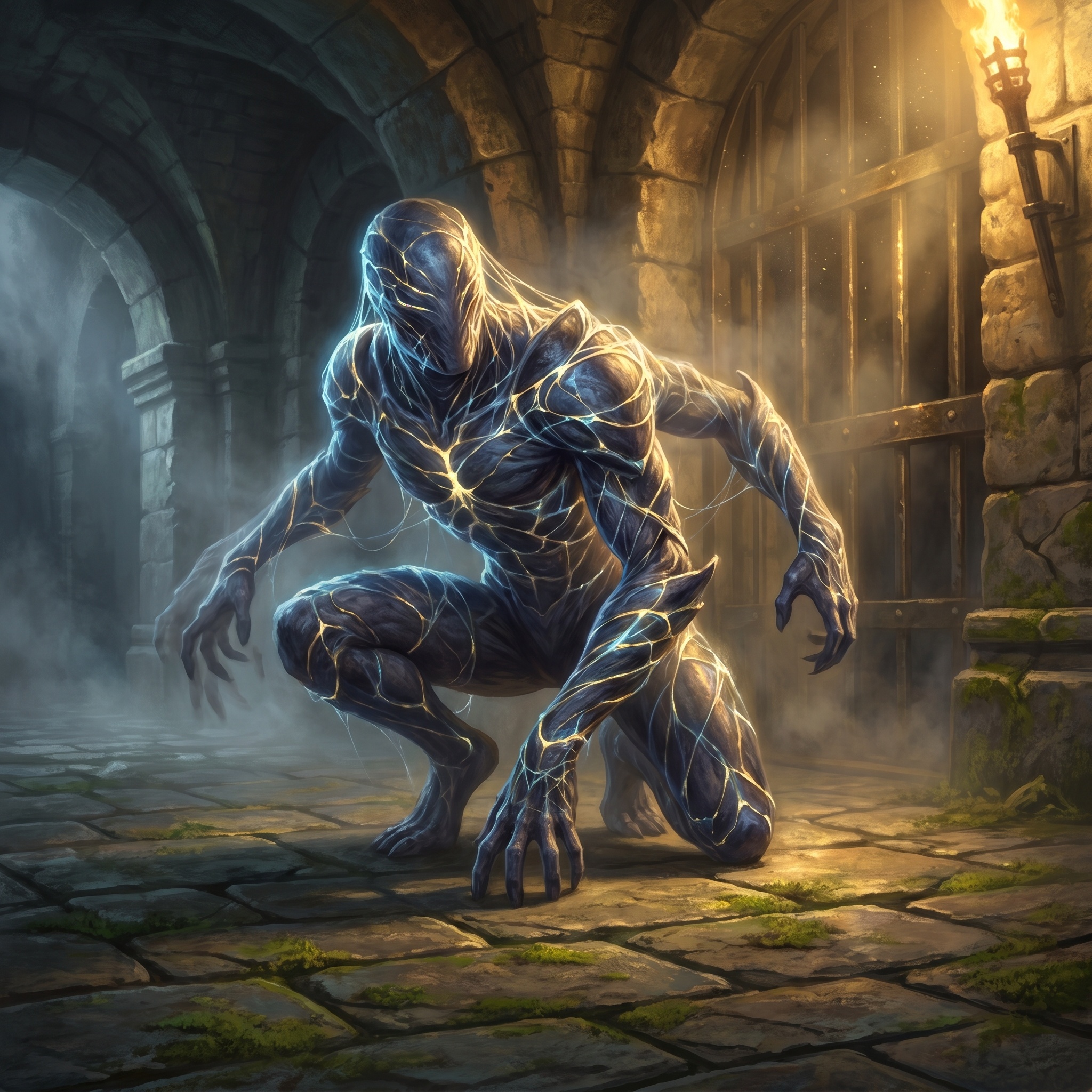
Role: Elite Probability Hazard Where It Appears: Weft scars, prophecy failures, fate-ritual ruins.
What It Is
Weft-tangled things are creatures caught in too many possible outcomes. They flicker between what they did and what they almost did. Limbs move a half-second out of sequence, wounds briefly happen in the wrong order, and witnesses disagree about which way it turned.
They are probability hazards, not masterminds. The danger is that certainty performs badly around them.
Ecology and Behavior
Weft-tangled things appear around Weft scars, prophecy failures, fate-ritual ruins, botched divinations, and places where too many outcomes were forced into one answer. They may have been ordinary creatures before the tangle.
They react to attention and hesitation. Predictive magic, over-planning, and repeated tactics can strengthen the wrong outcome around them, while decisive physical changes to the scene help anchor reality.
Signs and Knowledge
Secret Lore, Planar Lore, or Perception (Hard) identifies probability lag. Readiness (Average) notices that hesitation makes the creature sharper.
Other signs include footprints that choose different routes, wounds appearing before strikes, coins landing on edge, and witnesses remembering near misses as hits.
Weft-Tangled Thing (Elite)
- Skills: Reflexes 4, Perception 4, Unarmed 4, Readiness 4.
- Attacks: Almost-Claw (Unarmed; Damage 8; Crit 4); Thread Snap (Willpower; Damage 6 Strain; Range Short).
- Abilities: Wrong Outcome - Once per round, force one attack against it to reroll one Boon die or add 1 Bane.
- Soul: No claimable coin exists, a weft-tangled thing is caught across outcomes rather than settled in one; at death canon does not specify (default).
Tactics
A weft-tangled thing flickers, punishes hesitation, and flees from fate-cutting tools. It does not plan far ahead; too many outcomes crowd it. It is hardest to fight when the party repeats the same answer and easiest when they change the environment.
Use it to make probability visible without making results arbitrary. Give clues before forcing rerolls.
Harvesting and Trade
| Component | Value | Use | Harvest |
|---|---|---|---|
| Weft threads | 1,000-3,000 gold Flargons | Divination, probability wards | Secret Lore (Hard), must be contained immediately |
| Outcome knot | 800-2,400 gold Flargons | Fate-cutting tools, prophecy study | Planar Lore (Hard) |
| Almost-track dust | 200-800 gold Flargons | Tracking possible routes | Survival or Secret Lore (Average) |
Variants
- Prophecy-Tangled Beast: Drawn to people named in failed visions.
- Near-Miss Stalker: Attacks through almost-events and accidents.
- Thread-Sick Guardian: Bound to a fate-ritual ruin.