PDF Download the Ix Creature Catalog 102.6 MB
An ooze is not undead, elemental, or planar, it is simply wrong: matter behaving without the structure matter is supposed to have. Four kinds are described here: the transparent Glass Ooze, the Cellar Slime that fills damp stonework, the Marrow Ooze that carries the bones of what it has eaten, and the Slag Ooze of dead forges. This chapter is a start rather than a ceiling, and more aberrant, non-classifiable threats belong here as they are written.
At the table: an ooze's threat is usually attrition and corrosion rather than raw damage. Let equipment and terrain suffer along with the party, not just their Wound totals.

Cellar Slime
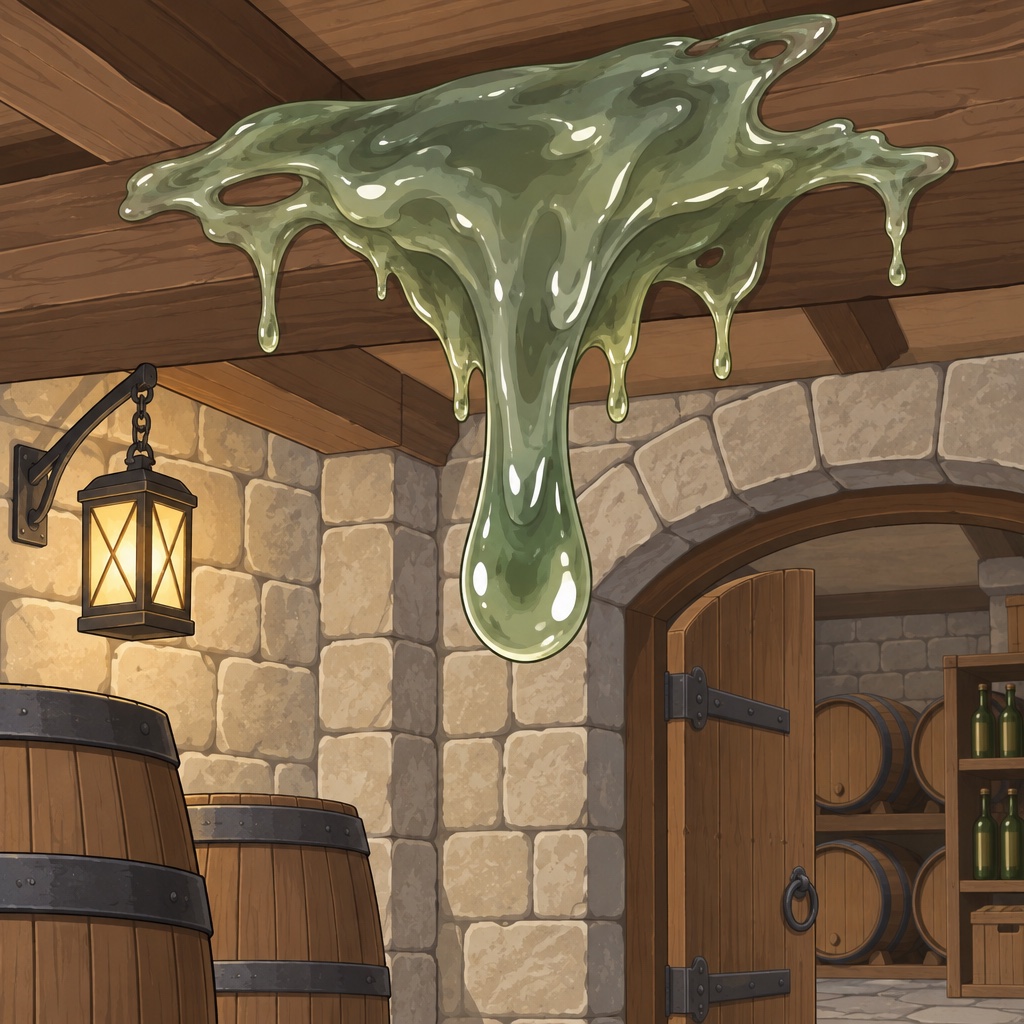
Role: Minion Hazard / Ambusher Where It Appears: Damp cellars, old cisterns, sewer walls, flooded storerooms.
Cellar Slime (Minion)
- Skills: Stealth 2 while still, Brawl 2.
- Attacks: Clinging Drop (Unarmed; Damage 2; Crit 5; Ensnare 1).
- Abilities: Drop From Above — The first attack from a hidden slime against a target below it adds 1 Boost.
- Abilities: Salt Sensitive — Salt or brine thrown on it deals 2 damage, ignoring Resilience.
- Soul: No claimable coin exists; at death canon does not specify (default).
What It Is
Cellar slime is a green-grey film that grows on wet stone and thickens wherever something warm keeps passing. It has no mind and no shape of its own. It gathers into a wet, shaking lump when it senses vibration overhead, then drops onto the nearest neck or shoulder and clings.
It is a nuisance alone and a real problem in numbers. A cellar that has gone quiet for a season can hold dozens of patches, each one waiting on a different beam, shelf or archway.
Ecology and Behavior
Cellar slime feeds on dead plant matter, spilled grain and the small animals that die in damp corners. It does not hunt in the usual sense. It positions itself above anything that moves regularly and waits. It dies in dry heat and in strong brine, so old cellars with salt barrels stay clean.
Signs and Knowledge
Survival or Natural Philosophy (Easy) recognizes slime streaks on stone and the sour smell that goes with them. A lantern held close makes the film shine, and a thrown handful of salt makes it shrivel at once.
Other signs include beams that glisten without a leak, shelves stuck to the wall, and rat bones lying in neat piles beneath a ceiling.
Tactics
Cellar slime waits above a doorway, stair or narrow passage and drops when the first person passes underneath. In a group it drops one patch at a time, so the party spends its early rounds peeling slime off one another instead of fighting.
Fire and salt end the encounter fast. Let players who think to look up spot the film before it drops, and let those who do not learn why cellars should be lit.
Variants
- Cistern Slime: Larger, wound threshold 8; stays under water and pulls prey in as Ensnared.
- Glowing Slime: Faintly lit; loses the Stealth bonus but lures the curious.
Glass Ooze
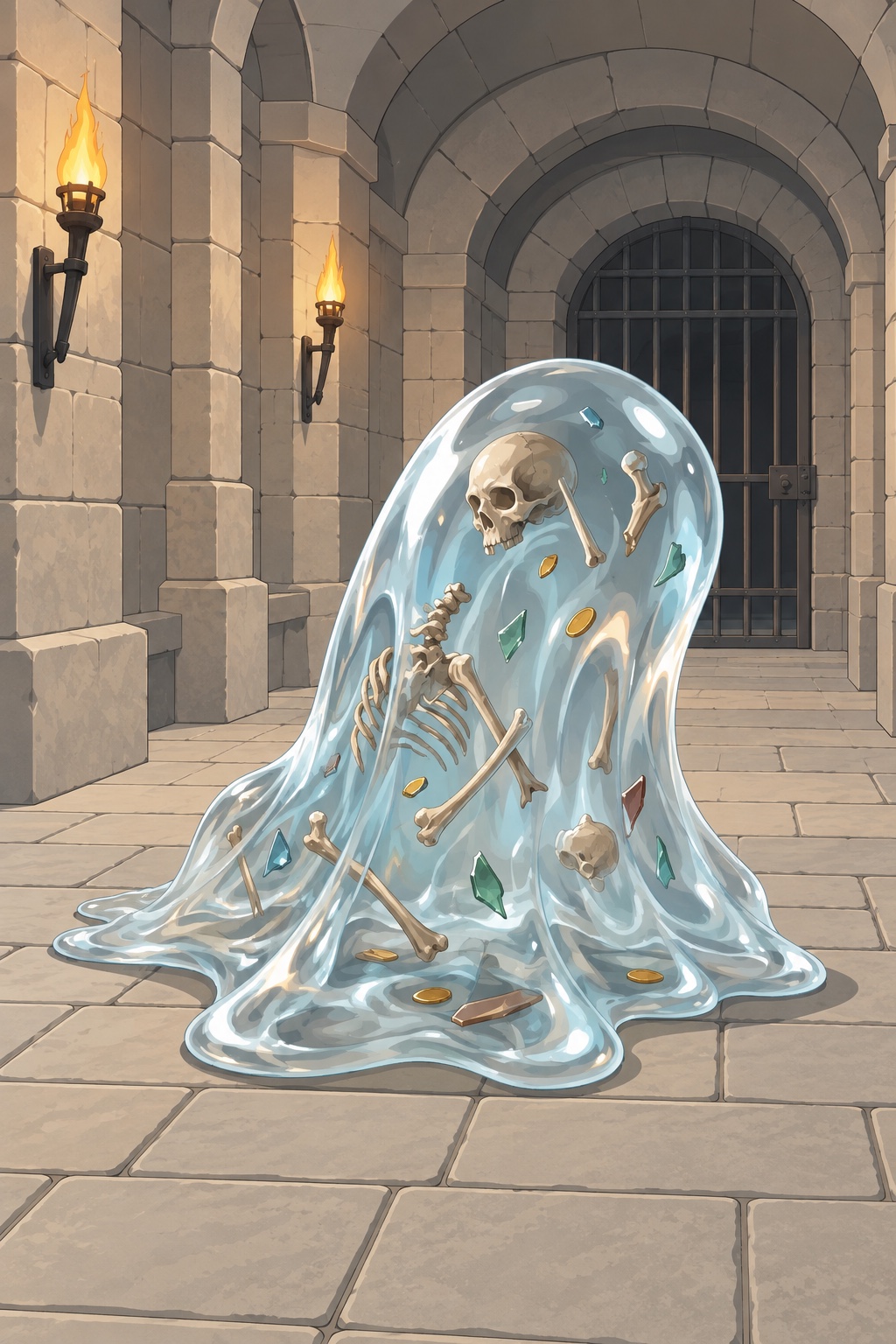
Role: Elite Hazard / Lurker Where It Appears: Alchemical ruins, glassworks, prism-drained sites, sealed laboratories.
What It Is
Glass ooze is nearly invisible until it moves. It digests mineral, flesh, and polish, leaving armor etched and bones slick as wet porcelain. Most form where alchemical runoff seeps through sand, powdered crystal, and old reagent waste. A few are deliberate laboratory creations meant to clean vats and dispose of evidence.
It is mindless, but not harmlessly stupid. A glass ooze follows heat, vibration, and the chemical taste of sweat. It spreads thin across floors, thresholds, and shallow pools, then rises when a boot or hand breaks its surface. In torchlight it can look like a slick of water. In darkness it can be nothing at all until the first scream.
Ecology and Behavior
Glass oozes thrive in sealed places where little disturbs them. They polish stone, dissolve mortar, and leave tunnels eerily clean except for etched metal and fused grit. They do not build lairs, but they create rooms that feel prepared: no dust, no insects, no leather straps left intact, and glassy streaks along low points where they have flowed for years.
Glass Ooze (Elite)
- Skills: Stealth 3 while still, Fortitude 3, Unarmed 3.
- Attacks: Dissolving Touch (Unarmed; Damage 4; Crit 4; Pierce 2); Shard Surge (Unarmed; Damage 3; Crit 4; Bleeding 1).
- Abilities: Transparent Body — Ranged attacks add 1 Bane unless the ooze is dusted, wet with colored liquid, or backlit.
- Abilities: Etch Gear — On 2 Banes from a defender hit by Dissolving Touch, one exposed nonmagical item is damaged.
- Soul: No claimable coin exists; at death canon does not specify (default).
Signs and Knowledge
Perception (Hard) sees distortion. Natural Philosophy (Average) identifies acid-etched glass trails.
Tactics
A glass ooze begins as terrain. It waits across a doorway, under shallow water, or on a floor where people must kneel to examine something. Once discovered, it tries to hold the center of movement rather than pursue at speed. It engulfs feet, dissolves straps, and makes the party choose between standing still in acid or stumbling into other hazards.
It is strongest when the room has bad visibility and valuable gear. Give players ways to reveal it: dust, spilled wine, lamp soot, colored chalk, or reflected light. Once revealed, the encounter becomes a positioning problem instead of a gotcha.
Variants
- Mirror Ooze: Reflective surface adds confusion in candlelight and may imitate nearby silhouettes.
- Bottle Ooze: Tiny version sealed in old lab glass; dangerous when thrown or broken.
- Prism-Fed Ooze: Takes on colored bands and can split light into dazzling flashes when struck by bright magic.
Marrow Ooze
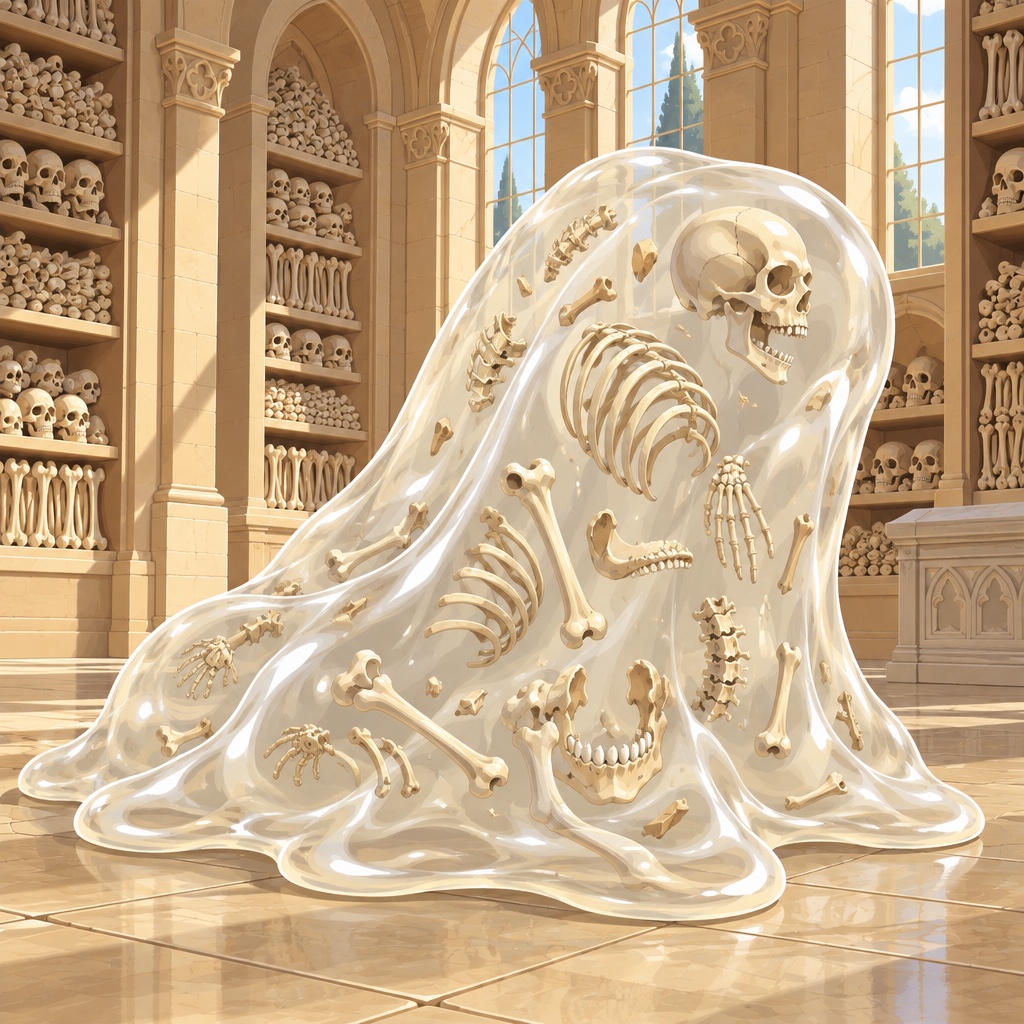
Role: Elite Brute / Hazard Where It Appears: Ossuaries, battlefield pits, slaughterhouse cellars, old plague trenches.
Marrow Ooze (Elite)
- Skills: Brawl 3, Fortitude 3.
- Attacks: Bone-Studded Slam (Brawl; Damage 5; Crit 4; Knockdown); Bone Spurt (Ranged [Short]; Damage 3; Crit 4; Pierce 1).
- Abilities: Bone Armor — Reduce damage from the first hit each round by 2, after Resilience.
- Abilities: Slow and Heavy — Take one fewer maneuver each round, but ignore the Knockdown and Disoriented conditions.
- Soul: No claimable coin exists; at death canon does not specify (default).
What It Is
A marrow ooze is a pale, thick jelly full of bone. Ribs, jaws and finger bones float inside it, some half dissolved, some freshly taken. It slides along the floor in a slow swell, and the bones shift inside it like pebbles in a stream.
It is not undead and nothing remembers in it. It is a slow, hungry mass that grows by taking in what it finds, and it uses the bones it carries as hard points inside its own body.
Ecology and Behavior
Marrow oozes form wherever bone and wet decay sit together for years. They eat flesh and leave bones, but keep the bones they cannot dissolve, so an old one can carry the remains of a whole garrison. They stay near their feeding ground and rarely travel far.
They are slow, but they are heavy and do not stop. A marrow ooze will walk through a door a person cannot easily break.
Signs and Knowledge
Natural Philosophy (Average) identifies the smell of boiled marrow. Adventuring Lore (Average) recognizes the drag marks and wet bone polish the ooze leaves on stone.
Other signs include very clean bones in odd places, small piles of teeth, and a trail of wet, pale slime that never quite dries.
Tactics
A marrow ooze advances straight at the loudest thing in the room and keeps going. It does not flank or retreat. It is best used where space is tight and the party must choose between holding a doorway and being driven back into worse ground.
It is easy to outrun and hard to outlast. Give the party a reason to stand and fight, such as a locked door, a wounded ally or a prize it sits on.
Variants
- Plague-Pit Marrow Ooze: Adds a disease risk to every hit; the party should have a way to wash and burn afterward.
- Young Marrow Ooze: Wound threshold 9, Damage 4, no Bone Armor.
Slag Ooze
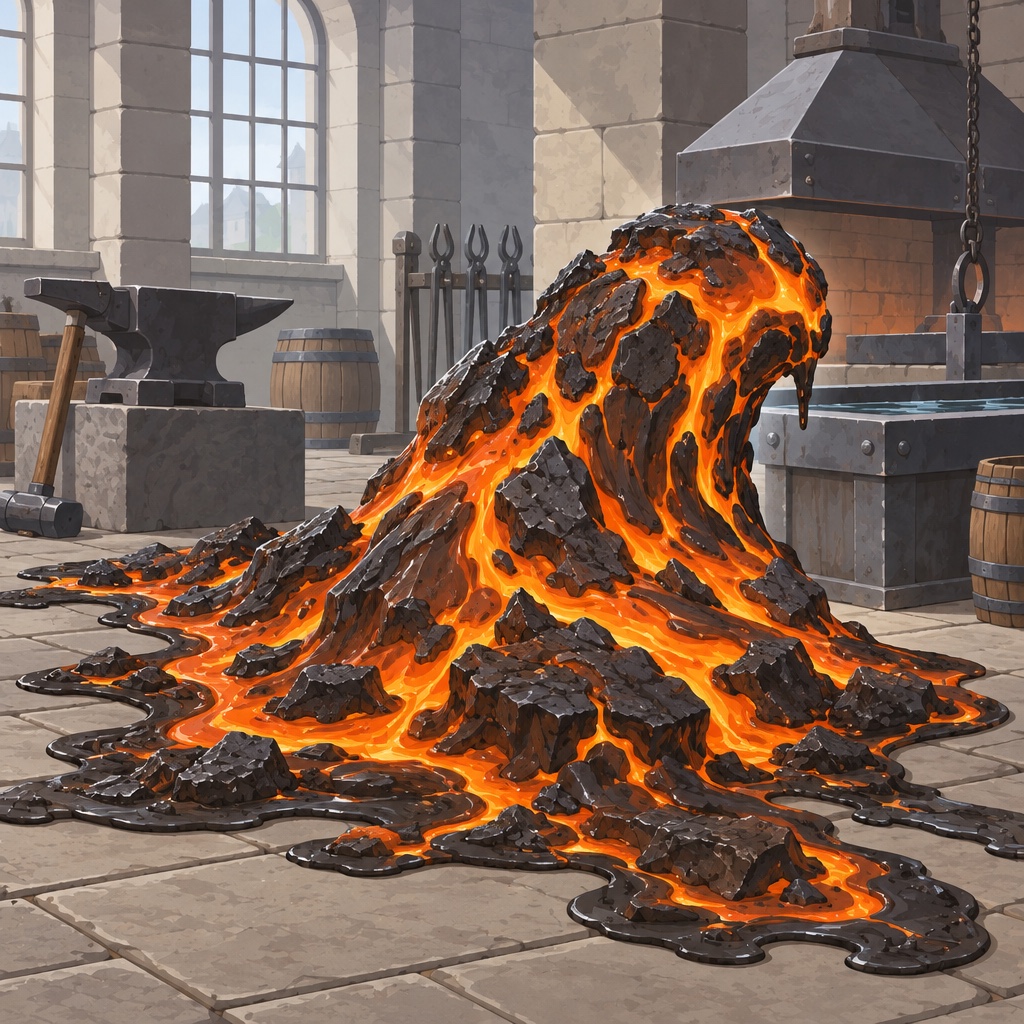
Role: Elite Hazard / Bruiser Where It Appears: Cold forges, smelters, slag heaps, foundry cellars, volcanic seeps.
Slag Ooze (Elite)
- Skills: Brawl 3, Fortitude 3.
- Attacks: Scalding Pseudopod (Brawl; Damage 4; Crit 3; Burn 1); Slag Splash (Ranged [Short]; Damage 3; Crit 4; Burn 1).
- Abilities: Cooling Crust — Reduce damage from non-fire sources by 1; a full quench of water removes this ability until the ooze feeds on metal again.
- Abilities: Heat Haze — Targets within Engaged range suffer 1 Strain at the start of their turn.
- Soul: No claimable coin exists; at death canon does not specify (default).
What It Is
Slag ooze is a heap of half-molten waste that has learned to move. Its crust is dull orange and black, and cracks glow along its flanks as it flows. It oozes along floors and walls, leaving blackened glass and warped metal behind.
It is not alive in a way a smith would recognize. It is waste that kept its heat and its hunger, left in a place where nobody dared clear it away.
Ecology and Behavior
Slag oozes form where forges sit cold but their heaps do not. They feed on metal, coal and anything flammable, and they stay warm by eating. Water slows them, and a full quench turns them into brittle clinker that breaks apart.
They prefer the dark of old foundries and rarely leave a heap they have settled into. A slag ooze left alone for years can fill a whole cellar.
Signs and Knowledge
Natural Philosophy (Average) reads the glowing cracks as a body that has lost heat and is feeding. Craft (Average) recognizes the cooled slag trails smiths leave behind.
Other signs include warped doors, glassy floors, cold forges that are warm to the touch, and tools fused into the slag.
Tactics
A slag ooze sits in a hot place and lets the party come to it. It uses Slag Splash first, then closes into Scalding Pseudopod range and holds a doorway.
Water is the answer, if the party thinks to bring it. Give them barrels, a well or a flooded corridor nearby, and let the encounter turn on getting the ooze to the water.
Variants
- Forge Ooze: Larger, wound threshold 20; heats the whole room by 1 Strain a round.
- Quenched Slag: Wound threshold 8, no Heat Haze, brittle and slow.
Ooze Remains and Trade
What each creature leaves behind, who will buy it, and the check to recover it, grouped here so a game master can price a find from one place. Values are in gold Flargons.
Cellar Slime
| Component | Value | Use | Harvest |
|---|---|---|---|
| Dried slime film | 20-60 gold Flargons | Damp-proofing paste, tanners' glue | Craft (Easy) |
| Salt-cured patches | 30-90 gold Flargons | Sealant for casks and hulls | Craft (Average) |
Glass Ooze
| Component | Value | Use | Harvest |
|---|---|---|---|
| Stabilized ooze solvent | 400-900 gold Flargons | Etching, glass cutting, alchemical cleaning | Craft or Natural Philosophy (Hard), ceramic vessels required |
| Clear digestive nodules | 600-1,400 gold Flargons | Acid-resistant glass, reagent catalysts | Natural Philosophy (Hard), dangerous if warmed |
| Polished residue | 100-300 gold Flargons | Lens grinding, counterfeit gem polish | Craft (Average) |
Marrow Ooze
| Component | Value | Use | Harvest |
|---|---|---|---|
| Cleaned bone fragments | 50-200 gold Flargons | Carved fittings, ritual material | Craft (Average) |
| Rendered marrow jelly | 200-600 gold Flargons | Glue, medicinal tonic | Medicine or Craft (Hard) |
| Large intact bones | 100-400 gold Flargons | Tools and weapon hafts | Survival (Average) |
Slag Ooze
| Component | Value | Use | Harvest |
|---|---|---|---|
| Cooled slag cores | 150-500 gold Flargons | Smelting flux, glazing | Craft (Average) |
| Heat-hardened crust | 200-600 gold Flargons | Furnace linings, armor plates | Craft (Hard) |
| Glowing seam stone | 300-900 gold Flargons | Light sources, alchemical heat | Natural Philosophy (Hard), dangerous if warmed |