The Nature of the Gods
The gods of Dort are not abstractions. They are persons with territory, politics, grudges, alliances, and genuine need. Understanding this changes how you play a cleric, how you read a contract, and how you decide whose name to invoke before you do something dangerous.
When the primordial being Ix shattered, killed by a group of his own creations, the pieces did not disperse cleanly. Each fragment fell into the world carrying a portion of Ix's nature: an instinct, an appetite, a domain. These fragments became the first modern gods, the shard-gods. They woke knowing who they were and what they were for. Later gods came into being by other means: some called into existence from nothing when need was strong enough, some born as children of existing gods, and some by stranger processes. The plane that formed around Ix's breaking became the Shattered Domain, also called the Plane of Ix: the plane where the gods actually live. Not where they project influence or accumulate power, but where they exist as persons with territory, borders, politics, and neighbors. From this home plane they began the work that has occupied them ever since: accumulating followers, trading influence, and holding ground.
The shard-gods and later gods draw power from their worshippers' devotion, but not in the way that a simple transaction might suggest. When a faithful mortal dies, their soul takes the shape of a coin whose weight reflects the depth of their belief in life. Fervent devotion produces a heavy coin; casual practice produces a light one. These coins accumulate in divine vaults and constitute the gods' real power base, not prayer-in-the-moment, but the accumulated weight of lives genuinely lived in service to a faith. This is why these gods care about the quality of devotion, not just the quantity of worshippers. A single truly committed follower is worth more to a deity than a hundred who merely observe the forms.
Souls travel to their patron's territory in the Shattered Domain when they die. A soul with no claim ends on Godless: an island at the center of the Shattered Domain's metaphysical ocean, the Ocean of Belief, surrounded by every deity's territory and the full weight of divine power the soul neither sought nor received. Godless is not a soul plane in the sense that the Hells or Paradiso are: it sits inside the Shattered Domain itself, which means unclaimed souls spend eternity in the middle of the place where the gods live, among the accumulated faith of every soul who chose differently. This is an outcome rather than a punishment.
The key word is freely. A soul can be claimed through means other than genuine devotion. Infernal contracts, binding bargains, and certain divine compacts all carry claim over a soul's final destination. If you made a deal that bound your soul, the holder of that deal receives the coin at your death regardless of your faith. The gods are aware of this. The more scrupulous ones actively work to help mortals identify binding agreements before they sign them. Others are less concerned.
What this means at the table: your character's patron deity genuinely wants your devotion to be real. Not because of sentiment, but because a coin with genuine weight is worth more than a coin generated by compulsion.
A final note: the gods act politically, not omnisciently. They pursue agendas, form tactical alliances, hold genuine ideological conflicts with one another, and occasionally make decisions that their followers would find uncomfortable. Playing a devoted character in Ix means navigating the politics of genuinely interested divine parties, not simply receiving blessings from an abstract source of goodness.
The Core Pantheon
Every deity grants its clerics the full breadth of the Divine tradition, with one carve-out apiece. Each god holds a Forbidden Grant, a category of working that cuts against the deepest nerve of its nature. These limits are listed under each deity below as What [God] Will Not Grant. Read them by purpose, not loophole. If a working genuinely serves the god's deeper nature, the GM may permit it even when the surface category looks close to the prohibition. If it violates that deeper nature, the channel does not open no matter the cleric's skill, need, or argument. Insisting on such workings is the surest road to revocation (see Chapter Nine). These limits apply to any working that includes that deity's Divine channel, including Theomancy or Shamanism. They are not the GM penalizing a build, they are the price of the relationship being real.
The eighteen gods described here are the Core Pantheon: the deities whose faiths are fully supported for player characters, each with an alignment, a faith talent tree, and a signature talent. Caminus, god of the forge, and Bronthe, god of stone, are among them; they are the two most common patrons of dwarven clerics, and a dwarven forge-temple usually holds both shrines. The Core Pantheon is not the whole of Dort's divine order. Dozens of other gods are real and worshipped, and the most commonly encountered are listed under The Rest of the Pantheon at the end of this section. Any of them may be taken as a patron with the GM's approval, provided the god has a clear doctrine, clergy, and Forbidden Grant (see Chapter Nine). Such a cleric uses the same Divine rules as any other; the GM assigns their faith talent access to whichever alignment tree best fits the god's nature.
Echo
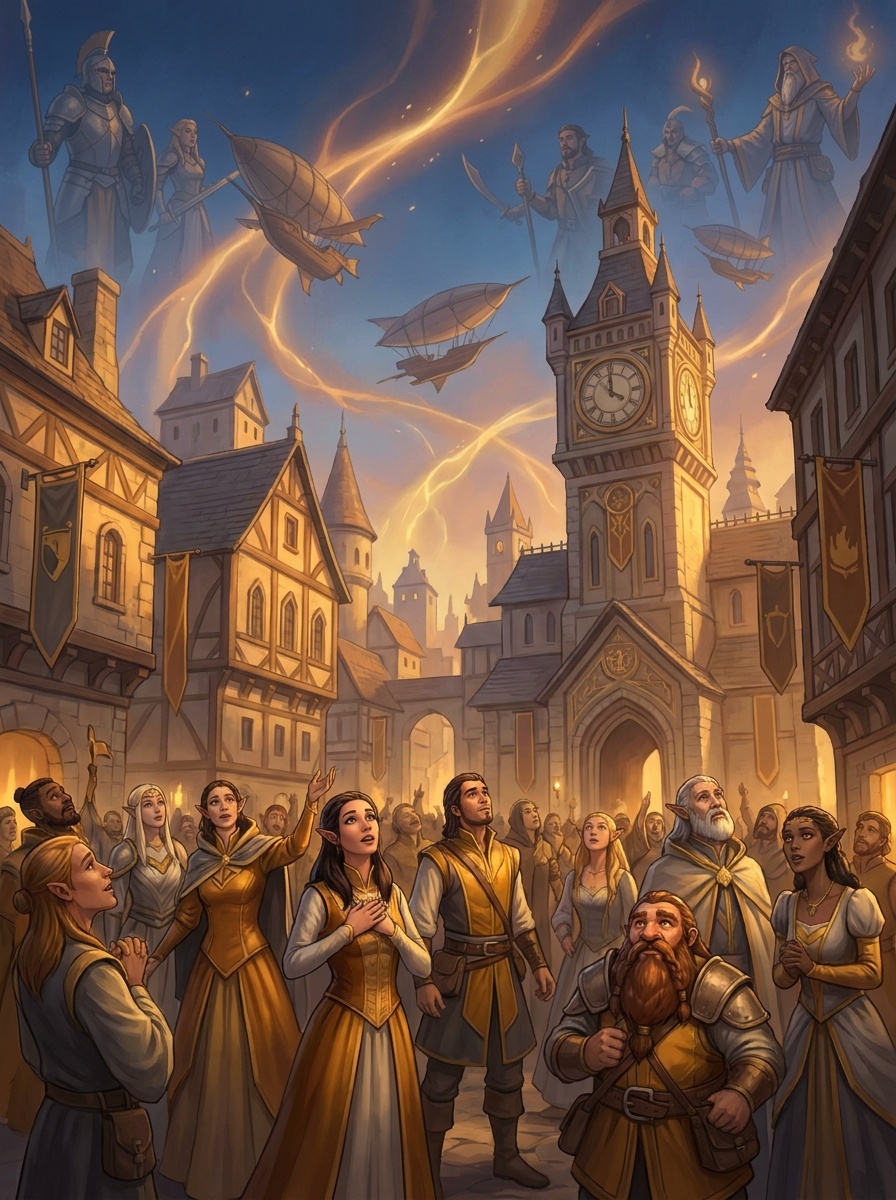 *Unity and knowledge; building what outlasts us*
At a Glance
- Alignment: Positive — faith talent tree shared with Jula, Themela, Thulgard, Jusannia, Zopha, Bridhel, Hesira, Nyxollox, Kraut, Talbar, Caminus, Bronthe, Bethsia
- Portfolio: Unity, knowledge, peace, stability, communal memory, fairness
- Symbol: A crowd of people looking upward
- Common worshippers: Mediators, judges, librarians, peacekeepers, civic builders, teachers
- Common regions: Universal; the Accord claims every community as its parish
- Clergy title: Keeper (senior: Archive-keeper)
The Faith
Echo did not emerge from a shard of Ix. He was called into being by need, specifically, by a million voices crying out together on the Global Day of Supplication, asking for relief from a world that ground mortals to pieces. The cry had no deity to receive it, so it made one. Echo woke already knowing why he existed and for whom. His first century was spent doing unglamorous work: removing birth defects, teaching sanitation, making rest sacred. He demonstrated that healthier, better-organized people generate more worship for every deity, and used that argument to survive the older gods' early attempts to destroy him before he could consolidate.
The faith that formed around him is called the Accord, and its central proposition is simple to the point of seeming naïve: all of you together are stronger than any of you alone. Peace is not wished for; it is built through daily maintenance of relationships, institutions, and shared memory. Truth is communal: what is not documented can be denied, and what is denied long enough becomes history. Accord shrines are as likely to house a public ledger or contract registry as a devotional object. The faith recruits by doing the work, not by preaching it.
The Accord's practical arm is formidable. Its contract clinics identify infernal bargains before they become binding. Its archives are trusted in courts across regions. Its mediators resolve disputes that would otherwise become violence. The faith has no grand temples and no central authority: only networks of keepers who earn their standing by being useful, and lose it when they stop.
Divine Compact
Echo's clerics work within the Divine tradition and draw on the broad toolkit that keeping a community together requires: truth-finding, conflict resolution, and the occasional intervention that makes a disaster survivable. The god asks for consistency over spectacle. A cleric who performs one dramatic miracle and vanishes generates a lighter coin than one who shows up every week for twenty years. Echo does not punish desertion dramatically; he simply withdraws, and the blessing grows quiet.
What Echo Will Not Grant. The channel goes quiet for any working meant to erase, falsify, or hide communal truth: a memory struck from a witness, a record unmade, a crowd magically silenced or turned against itself for private gain. Echo's power builds shared memory; it will not be spent to destroy it.
Internal Factions
The Accord has heresies and cults that a player character with this faith should know exist. The Echoless (the Unbound) argue that Echo has made society soft and that destabilization restores strength; they disrupt the work the Accord does while claiming to do the same work better. The Self-Echoers (the Quiet Path) apply Echo's teachings entirely inward, achieving genuine personal peace and doing nothing with it for their communities. The Accord considers the Echoless dangerous and the Self-Echoers a disappointment.
The Harmonizers (the Chorus) are something darker: a cult rather than a heresy, which uses Accord language to justify enforced consensus. They believe harmony is worth any cost, including mind-altering rites, coercive social pressure, and deliberate suppression of dissent. They look like the Accord and produce visible peace and the Accord considers them a fundamental inversion of the faith. The question to ask in any community they operate: Can anyone here leave freely? Can anyone here disagree openly?
The Echoing Voices (the Voices) believe Echo is not a being but the collective will of the people made manifest, and that organized mass longing can reproduce the miracle of his birth. The Accord does not dismiss this theologically; the question of Echo's nature is genuinely unresolved. What the Accord objects to is the Voices' tendency to keep communities in crisis to maintain the desperate longing their doctrine requires.
Playing an Echo Devotee
- You treat arguments like fires: contain the damage first, then look for the cause.
- You make notes. You name witnesses. You preserve documents as a theological act.
- You are suspicious of complexity in agreements; clarity serves the community; vagueness serves whoever can exploit it later.
- Your natural allies are Jula (peace through work rather than enforcement) and Themela (law as protection, not dominion). Your deepest rival is Oshala, not merely politically, but philosophically.
- The Godless are not your enemies. They are evidence that something failed. Your instinct is to ask what the community didn't provide, not to demand conversion.
Nyxollox
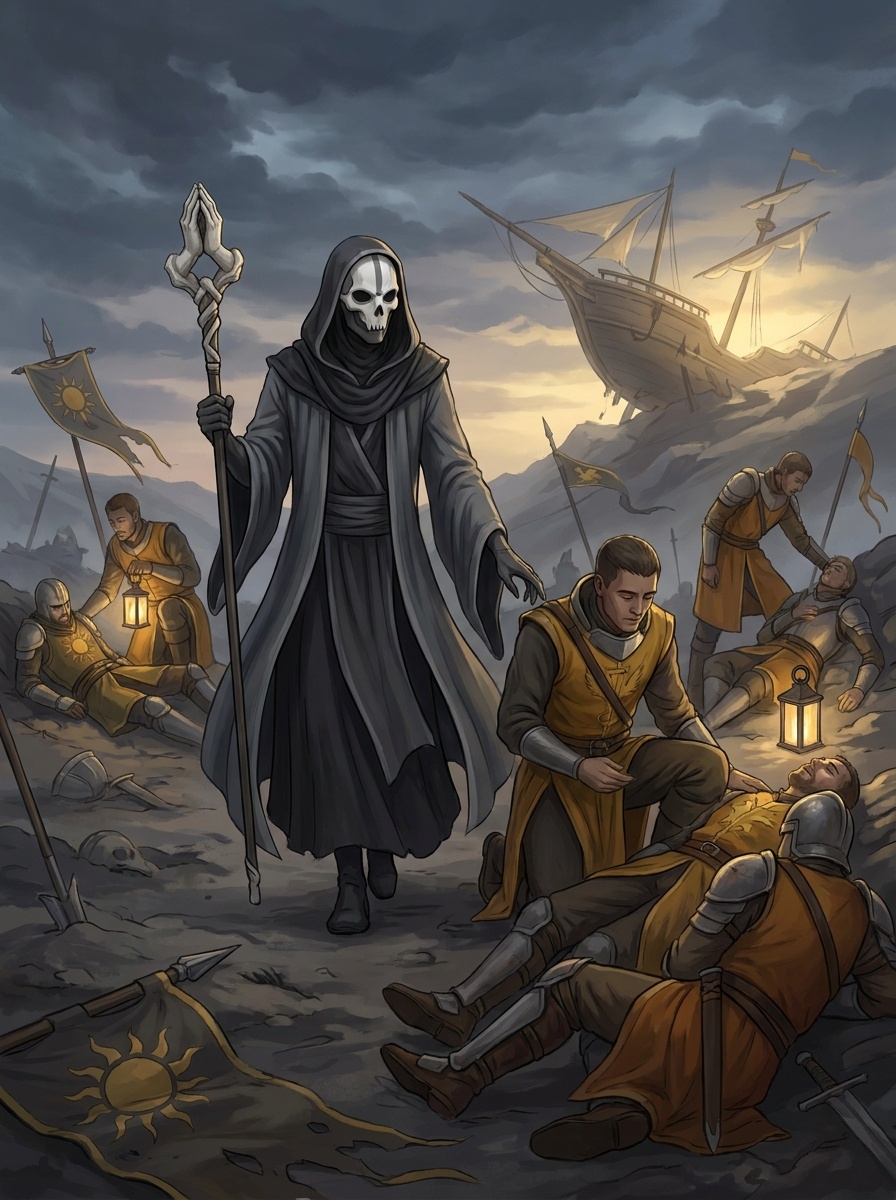 *Death, transition, and the dignity of ending*
At a Glance
- Alignment: Positive — faith talent tree shared with Echo, Jula, Themela, Thulgard, Jusannia, Zopha, Bridhel, Hesira, Kraut, Talbar, Caminus, Bronthe, Bethsia
- Portfolio: Death, peaceful transition, the afterlife, the boundary between life and what follows
- Symbol: Two clasped hands; one aged, one young
- Common worshippers: Those who work with the dying, healers, the grieving, soldiers, anyone touched by loss
- Common regions: Universal; temples appear wherever death comes, which is everywhere
- Clergy title: Death-keeper, Keeper of the Gate
The Faith
Nyxollox inherited the shard that understood death not as failure or punishment but as the necessary structure that makes life coherent. He is not an agent of death. Death needs no promotion, only its witness. The founding priest of the order was Bakwan Occal, a father who buried his infant son and came to Nyxollox's temple not seeking resurrection but asking whether his child had suffered in the crossing. Nyxollox answered. The faith began there. Bakwan shaved his head, painted it black in mourning, and added a single white stripe. The tradition holds: every death-keeper's painted skull marks both their calling and their count.
The faith's core doctrines are unusually unambiguous. Death is not failure. The dying deserve unhurried, honest witness, not false hope, not miraculous intervention the god will not grant. The dead are still ours, and the body that carried a person deserves treatment that honors that history. Undeath is a violation: pulling a soul back across the threshold traps it somewhere it was never meant to be, and this is cruelty regardless of the intention behind it. The death-keepers who walk battlefields without weapons, tending dying soldiers from both sides without asking which banner they followed, represent the faith at its most essential.
Divine Compact
Nyxollox clerics work within the Divine tradition with particular strength in protection of the dead against necromantic interference and in easing suffering during terminal illness and injury. The god's economy is unusual: he accumulates coin precisely when others expect him to lose it, because every dignified death and every family that grieves without fracturing generates power for his vault. The order deliberately rotates its practitioners through bedside work, archival work, and training. A death-keeper who refuses to rotate carries the weight alone, and the order watches for the signs of moral collapse.
What Nyxollox Will Not Grant. Nyxollox grants no working that animates the dead, binds a soul against its passage, or drags a soul back once it has been judged. The Revive working remains available within the first day, while the soul still waits in Sheol's outer halls; Resurrection past that window is not his to give, and his death-keepers cannot channel it. Other patrons may grant Resurrection after judgment if the spell's requirements are met, but Nyxollox will not. Nor will he empower a working meant to forestall a death that is supposed to arrive: a death whose arrival is already bound to judgment, consequence, or chosen sacrifice rather than merely danger in progress. When this is uncertain, the GM should warn the player through the fiction before the action resolves.
Playing a Nyxollox Devotee
- You move without hurry. There is no emergency at the deathbed. Your calm in crisis is discipline, not indifference.
- You record everything. The archive against forgetting is as sacred as any ritual.
- You cannot raise the dead and will not participate in any working that does. This is the core of what you believe.
- Your natural allies are Jusannia (who presides over birth and understands why endings matter) and Echo (who keeps the memory of the dead in the community's record).
- You are implacably opposed to necromancers, those who traffic in undead servitude, and any infernal operation that claims souls before they can pass cleanly.
Oshala
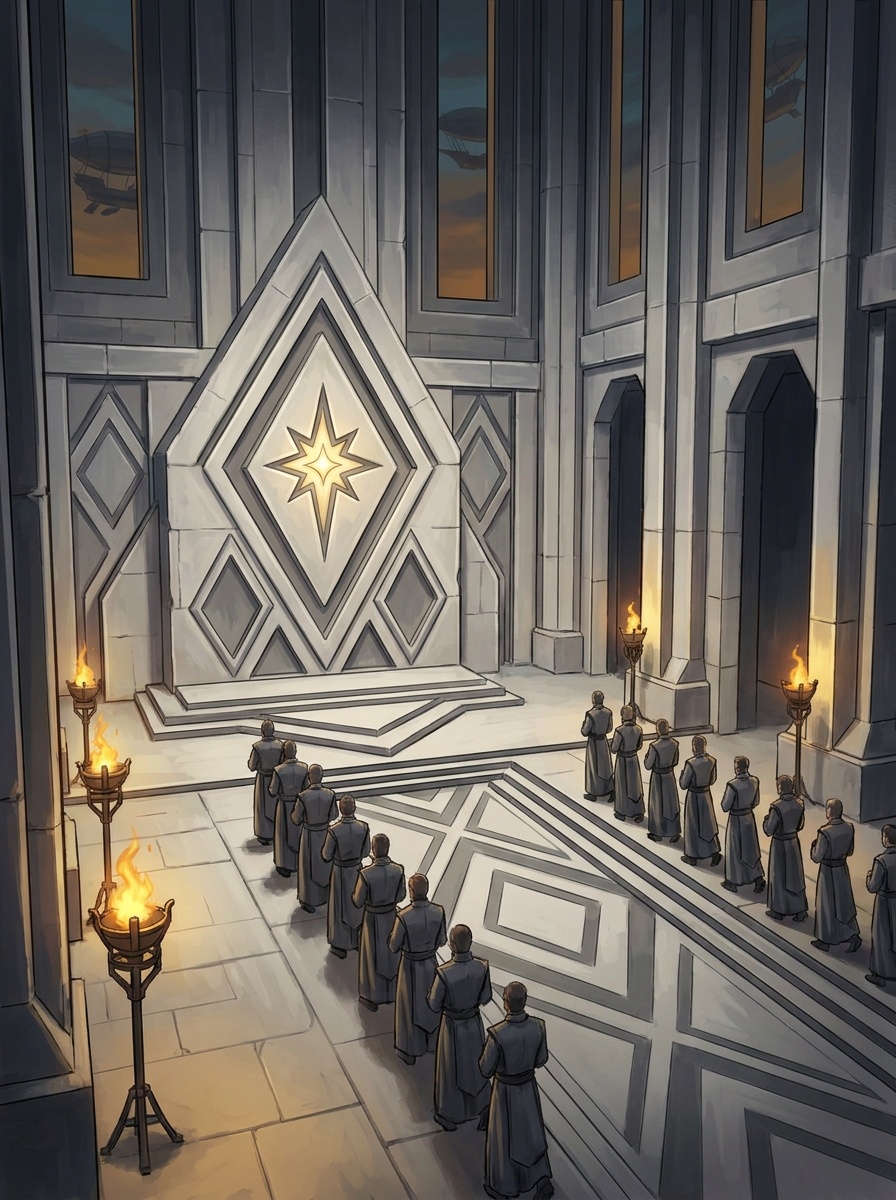 *Order, war, and the singular god*
At a Glance
- Alignment: Negative — faith talent tree: Oshala is currently the sole Negative alignment deity
- Portfolio: Order, war, hierarchy, discipline, masculine authority as cosmic law, conquest as correction
- Symbol: A rhombus with three smaller rhombuses at the lower corners, a star at center, a circle at top
- Common worshippers: Generals, judges, officials, slaveholders, conquerors, the newly converted seeking certainty
- Common regions: Jazirah, and expanding into any region the Order has targeted
- Clergy title: Cleric of the Order (male by doctrine)
- Hard line: Oshala's society runs on slavery and the ownership of women. This is not incidental cruelty. It is the doctrine.
The Faith
Oshala inherited the most solitary piece of Ix; the primordial's absolute insistence on singularity, its refusal to tolerate the existence of other wills. He woke knowing that the existence of multiple gods was not a normal condition but a wound in reality that had scarred incorrectly. Other deities are not peers competing for worship. They are fragments mistaking themselves for wholes. In the Order's catechism, the word demon does not mean a horned creature from the Hells. It means anything that asks you to bow to something other than Oshala.
Beyond the single-god doctrine, the core of Oshala's faith is masculine rule as the literal structure of reality. Men determine, direct, and control every aspect of life. Women are property under sacred law, not subordinates to be persuaded, but possessions to be assigned, inventoried, and transferred. The clergy is male by doctrine. The faith runs on slavery openly. The Order's expansion follows a consistent pattern: arrive peacefully, cluster into a Quarter, capture civic institutions, then legislate rival worship out of existence. The first thing an Ordered Quarter receives is not a sermon but a registry.
Divine Compact
Oshala's clerics work within the Divine tradition with strong overlap into martial and administrative domains. The god's economy runs on obedience: fear and devotion generate similar coin in his vault. A cleric operating in Ordered territory holds real institutional power: courts, registries, slave law, the civic authority of the Quarter behind them.
What Oshala Will Not Grant. Oshala grants divine power only to men in good standing within the Order, and only to those who hold no other devotion. Women receive nothing; neither does any cleric who bends a knee to a second god. The power is an instrument of hierarchy, and it does not pass to anyone the doctrine places outside the chain of command.
Playing an Oshala Devotee
- You speak in rank and duty: what is required, what is permitted, what is out of order. Improvisation signals disorder.
- You treat mercy as an exception that requires written justification. Unwritten mercy is indistinguishable from favoritism.
- You see the household as a theological front line.
- You regard the ownership of people as lawful and ordained.
- You treat the rest of the pantheon as a theological error you are patiently correcting, not as rivals.
- You do not lose your temper. Anger is disorder wearing a face.
Jula
Peace, protection, and the willingness to fight for both
At a Glance
- Alignment: Positive — faith talent tree shared with Echo, Nyxollox, Themela, Thulgard, Jusannia, Zopha, Bridhel, Hesira, Kraut, Talbar, Caminus, Bronthe, Bethsia
- Portfolio: Peace, measured reconciliation, protection from violence, life
- Symbol: A white dove carrying a rose in its beak; peace offered gently, but thorned
- Common worshippers: Diplomats, merchants, peacekeepers, soldiers who have seen enough, refugees, healers, mediators
- Common regions: Everywhere, but especially in regions torn by conflict or dependent on stable commerce
- Clergy title: Keeper of the Peace; military arm: White Rose Legion
The Faith
Jula was born of divine union between Jusannia and Pollaran, defined from birth by the tension between opposing forces. From Pollaran she inherited the understanding that some harm can only be stopped by force; from Jusannia she took the drive toward healing and continuation. Her synthesis became the faith's most challenging theological proposition: peace is not the absence of violence but the deliberate work of ending it, and sometimes that work requires a sword.
The White Rose Legion is not a contradiction of Jula's portfolio. It is its most honest expression. A god of peace with an army is a god who takes peace seriously enough to defend it. The Legion uses force precisely and only to create conditions for negotiation; it does not conquer, it does not glorify violence, and it mourns every life it takes. The Rite of Submission performed at a defeated faction's surrender is an offer rather than a humiliation: submit to peace, and we will build something together.
The practical arm of Jula's faith; the Sanctuary Keepers who maintain true refuge for anyone fleeing violence, the Mediators of Deep Discourse who sit with traumatized parties for as long as it takes; is less visible than the Legion but just as essential. The temple's sanctuary protocols are legally recognized in many jurisdictions: entering a Jula temple by force to extract someone under protection is among the most serious violations any party can commit.
Divine Compact
Jula's clerics work within the Divine tradition with access to protective and healing applications. The god's coin is generated at the moment of restraint; the choice not to kill, the negotiation that holds, the warrior who lays the weapon down. Jula withdraws her blessings from those who use peace-making as a cover for new harm.
What Jula Will Not Grant. Jula's power is protective, and it withers the moment it is turned to aggression. She grants no working used to strike first, to deceive in a negotiation meant to make peace, or to harm the helpless, prisoners, refugees, the wounded. A cleric who reaches for her blessing to open a fight rather than end one finds nothing answering.
Playing a Jula Devotee
- You listen before you respond. You ask who suffers before you ask what profit or glory.
- You grieve openly. When force was necessary, you acknowledge the cost.
- Your natural allies are Echo, Themela, and Zopha. Your father is Pollaran; a god you respect and sometimes oppose.
- You are suspicious of solutions that seem clean. Easy peace is usually one party suppressing another.
Themela
Justice, truth, and the law that applies to everyone
At a Glance
- Alignment: Positive — faith talent tree shared with Echo, Nyxollox, Jula, Thulgard, Jusannia, Zopha, Bridhel, Hesira, Kraut, Talbar, Caminus, Bronthe, Bethsia
- Portfolio: Justice, truth, law, judgment; particularly kingdom law and military codes, not personal contracts
- Symbol: Two ravens facing each other; truth and justice, watching each other for balance
- Common worshippers: Judges, commanders, lawyers, bailiffs, magistrates, scholars of law, those who live under law and demand its fairness
- Common regions: Halls of justice in every major city, military courts, government archives
- Clergy title: Truth-keeper
The Faith
Themela is the child of Bethsia (goddess of anomalies, broken natural law, and the correction of reality when it misbehaves) and Caminus, whose forge-mastery is the doctrine that the right tool, properly made, will find the flaw in anything. From her mother she inherited the eye that catches what should not be; from her father, the discipline to work the evidence methodically until the answer is the only thing left standing. Her earliest gift to mortals was not a law but a method: ask witnesses, compare accounts, look for consistency. Truth has a particular quality. It is consistent. Lies must be propped up by other lies and eventually the structure collapses.
The two ravens in her symbol carry the faith's core insight: truth without justice is documentation without obligation; justice without truth is punishment looking for a target. Truth-keepers serve in courts, military tribunals, and civic archives. Their religious authority and their civic authority are the same authority, embedded in the same institutions.
The faith's taboos are among the most absolute in the pantheon. Subverting justice through bribery, perjury, or evidence tampering is the most fundamental betrayal of the divine compact, not merely a crime. The faith demands pro bono legal aid from its practitioners, because justice that serves only those who can afford it is merely power wearing justice's clothing.
Divine Compact
Themela's clerics work within the Divine tradition and may draw on arcane supplementary disciplines when investigation work demands it. The god does not grant spectacular miracles. She grants clarity. The divine compact asks for rigorous honesty about what the evidence actually shows and the willingness to deliver a verdict that ruins your own allies when the evidence demands it.
What Themela Will Not Grant. Themela grants no working of deception. Illusions meant to mislead, magically forged evidence, compelled false testimony, anything that corrupts a proceeding or buries the truth: the channel does not open for them. Her gift is clarity, and it cannot be spent to manufacture a lie.
Playing a Themela Devotee
- You separate facts from interpretation as a professional habit.
- You refer to precedent. Departure from precedent requires articulated justification, not instinct.
- Your natural allies are Echo and Talbar. Your deepest structural conflict is with Oshala: you both represent order, but your understanding of what justice means is incompatible.
- You accept that law sometimes produces harsh outcomes, and that the correct response is to work to change the law, not to ignore it.
Thulgard
Community defense, building, and the strength of ordinary people
At a Glance
- Alignment: Positive — faith talent tree shared with Echo, Nyxollox, Jula, Themela, Jusannia, Zopha, Bridhel, Hesira, Kraut, Talbar, Caminus, Bronthe, Bethsia
- Portfolio: Protection, defense, community resilience, shared labor, the collective strength of ordinary people
- Symbol: A round wooden shield reinforced with iron or stone, with a glowing hearth at its center
- Common worshippers: Militia members, builders, farmers, blacksmiths, carpenters, guards, refugees, anyone whose survival depends on community organization
- Common regions: Frontier settlements, farming communities, anywhere people work together to build structures that last
- Clergy title: Wallwarden (military aspect: gate-warden)
The Faith
Thulgard crystallized around a single focused concept: that mortals needed places where they could gather and be safe, and that ordinary people coordinating with ordinary people could become extraordinary. His first follower was Garlan Mudspade, a farmer with a spade and overturned carts who organized terrified neighbors into an improvised defense line against raiders and held a chokepoint for hours while others escaped. Thulgard noticed, not the heroics, but the coordination, the refusal to abandon, the clear thinking in crisis.
The faith has no interest in glorifying violence. Fighting is grim work done because the alternative is worse. What Thulgard values is the maintenance of defenses before they are needed, the community that trains together and eats together and knows what to do when the gate breaks. The Wall of Names in every Shield-hall (the continuous carving of everyone who died defending the community) is the faith's most sacred space.
The mutual obligation at the heart of the faith is literal: communities that receive Thulgard's followers' aid are expected to train militia who can respond when other communities need help. No one survives alone; the question is only how wide you build the circle of people you refuse to abandon.
Divine Compact
Thulgard's clerics work within the Divine tradition with strong overlap into craft and engineering domains. The god's coin is generated by the unglamorous work: the wall repaired before it fails, the well dug before the drought, the training drill that no one noticed because nothing went wrong. The divine compact asks for the Oathband (the iron ring naming the specific settlement you swore to protect) and it asks that you mean it.
What Thulgard Will Not Grant. Thulgard's power is for holding ground and raising what lasts. He grants no working used to abandon a post or the people one swore to defend, and none used to raze homes, break a community's defenses, or carry conquest past the line of protection. Turned to attack rather than to shelter, the blessing simply goes still.
Playing a Thulgard Devotee
- You notice what is broken or failing before most people recognize a problem. Then you organize to fix it.
- You show up. Not for grand gestures; for the ongoing, unglamorous work.
- In crisis you become entirely focused.
- Your natural allies are Echo and Jula. You are suspicious of individual glory-seeking.
Jusannia
Feminine life, healing, and the sacred power of bearing
At a Glance
- Alignment: Positive — faith talent tree shared with Echo, Nyxollox, Jula, Themela, Thulgard, Zopha, Bridhel, Hesira, Kraut, Talbar, Caminus, Bronthe, Bethsia
- Portfolio: Femininity, life itself, motherhood, childbirth, healing, the generative power
- Symbol: Two overlapping 12-pointed stars, in yellow or gold
- Common worshippers: Women of all walks of life, mothers, healers, midwives, merchants, those defending women's interests
- Common regions: Universal, but strongest among common women
- Clergy title: Priestess; Mother-Keeper (exclusively female clergy)
The Faith
Jusannia inherited the shard that held a truth the other gods had not yet articulated: that the capacity to bear life is the most powerful force in existence. Not beauty, not seduction, not support: specifically the physical act of creation, the bringing of new life into the world, and all the authority that should properly accompany it.
Her priesthood grew organically around women who were already doing the work; midwives, healers, women who had survived wars and abuse and emerged understanding their own strength. Temples include birthing centers with warm-water facilities, healing centers, recovery rooms for postpartum mothers, martial training barracks, and gathering fields. The building itself is a statement: women built this; women control this; this space serves women.
The faith contains genuine internal tension between the Shalvanist Order, which works through courts and legal reform, and the Gvankanian Order, which trains women for combat and responds to oppression with force. What unites them is the core conviction: female bodies are sacred, not as objects to be displayed or controlled, but as sources of strength worthy of respect and care.
Divine Compact
Jusannia's clerics work within the Divine tradition with particular depth in healing and protective applications. The divine compact requires that followers actually listen to the women they serve (ask what is needed, accept the answer) not impose what the clergy believes is best.
What Jusannia Will Not Grant. Jusannia channels her power only through women; men may follow as lay devotees but are never granted her workings. And she grants nothing used to harm a woman or child, to dominate the feminine, or to commodify the sacred functions of the body. Her gift is generative; it does not flow toward those who would injure what it exists to protect.
Playing a Jusannia Devotee
- Your clergy is exclusively female. Male characters may be lay followers, but not ordained. This is foundational doctrine, not an administrative rule.
- You do not shame or judge. Women's choices about their bodies, relationships, and motherhood are not your business to correct.
- Your deepest conflict is with Oshala, whose household doctrine places women as subordinate property.
- You are practically minded about protection. The faith includes martial training barracks for a reason.
- Your natural allies are Nyxollox and Thulgard.
Talbar
Commerce, contracts, and the sanctity of a sealed deal
At a Glance
- Alignment: Positive — faith talent tree shared with Echo, Nyxollox, Jula, Themela, Thulgard, Jusannia, Zopha, Bridhel, Hesira, Kraut, Caminus, Bronthe, Bethsia
- Portfolio: Commerce, negotiation, contracts, the sanctity of agreements, the art of fair exchange
- Symbol: Balanced scales bearing a gold coin and a silver key, against interwoven currency symbols
- Common worshippers: Merchants, traders, negotiators, nobles conducting diplomacy, anyone whose livelihood depends on reliable agreements
- Common regions: Every major trading center, bazaar district, and merchant quarter in the known world
- Clergy title: Deal-keeper (senior: Master Keeper, Arbiter)
The Faith
Talbar is the son of Fujin and Pollaran. From his father, Fujin, he inherited an absolute hatred of fraud and false dealing; the same violent distaste for inauthenticity that in Fujin becomes a storm became in Talbar the absolute insistence that terms be spoken plainly and honored completely. From Pollaran he took the strategic mind; but not the appetite for domination. He discovered something his father never grasped: that lasting power comes not from taking but from making agreements so beneficial that both parties become invested in their preservation.
The faith is organized around the Trading House: a neutral ground embedded in the commercial heart of cities, where negotiations can happen under Talbar's witness, where disputes over sealed agreements can be brought for arbitration, and where the registry records what was actually agreed to. The ritual of the Sacred Seal (candles lit, terms read aloud, signatures given together, tokens exchanged) is conducted in full view of witnesses because that visibility is the entire point.
Talbar is also the primary counter-force to infernal contracts in the mortal world. His deal-keepers teach contract literacy, identify the red flags of predatory agreements, and actively intervene when they detect infernal bargains being negotiated. A contract sealed under Talbar's witness is specifically resistant to the kind of hidden-clause exploitation that defines infernal dealing, because both parties had to speak their terms aloud in front of witnesses before signing.
Divine Compact
Talbar's clerics work within the Divine tradition with strong overlap into social and investigative domains. The divine compact requires tithing from profitable deals, settlement of disputes through negotiation before violence, and mentorship; a successful merchant who dies without teaching others has failed the faith.
What Talbar Will Not Grant. Talbar grants no working that serves fraud or coerces an unfair bargain: a sealing bent to hide a clause, power spent to force terms the other party cannot understand. And he withdraws entirely from any follower who has broken an agreement sealed under his witness: until that breach is answered, the channel stays shut.
Playing a Talbar Devotee
- You read every word. Skimming contracts is not permitted.
- You seek the mutually beneficial outcome, not from altruism, but because a deal where both parties walk away satisfied is the only kind that holds.
- You are the best counter to infernal dealing at the table.
- Your natural allies are Zopha, Themela, and Echo.
- Breaking a sealed agreement is not an option. You will negotiate a renegotiation, seek arbitration, and not simply walk away.
Zopha
Knowledge, learning, and the sacred work of teaching
At a Glance
- Alignment: Positive — faith talent tree shared with Echo, Nyxollox, Jula, Themela, Thulgard, Jusannia, Bridhel, Hesira, Kraut, Talbar, Caminus, Bronthe, Bethsia
- Portfolio: Knowledge, intellect, wisdom, understanding, and the systematic improvement of mortal life through learning
- Symbol: A circle divided by a triangle, with three dots at the center; knowledge radiating from core principles
- Common worshippers: Mages, scholars, scientists, inventors, teachers, healers, engineers, craftspeople, and anyone driven to understand the world more deeply
- Common regions: Established cities and universities, though her clergy work equally in undereducated communities
- Clergy title: Keeper (specialized: Keeper of the Natural Sciences, etc.)
The Faith
Zopha is the daughter of Jula and Echo. She made a choice her parents did not: she descended to the mortal world and lived as a human, renouncing divine power to walk among the people she was meant to serve. She lived with a craftsman and a teacher, learned what it meant for knowledge to die with an unrecorded healer, watched the gap between what mortals could know and what they did know, and came back with a mission: not to give knowledge but to build the systems through which knowledge could accumulate, transmit, and grow.
The Circle academies her faith established exist in settlements without schools as well as in university cities. Kater Barne (born into servitude, taught to read in secret, then rejected by the Circle she sought) turned that rejection into the Comitatus Academia, dedicated to educating commoners and those outside traditional privilege. Every Circle academy has a shrine dedicated to her. The faith has not forgotten what it was capable of forgetting.
The faith's taboos are simple and serious: hoarding knowledge, teaching deliberate falsehood, and destroying libraries are treated with the moral weight others reserve for violence. A skilled practitioner who dies without teaching others has failed their oath.
Divine Compact
Zopha's clerics may work within the Divine tradition or the Arcana tradition depending on their primary domain of knowledge. Those who take Divine 1+ and choose Zopha as their patron deity gain full cleric standing and faith talent access in the normal way.
A follower who works primarily through Arcana is a scholar of divine knowledge rather than a cleric in the covenant sense. They require no patron deity and draw no Divine spells by default. However, Zopha notices genuine devotion even in those who never took a formal vow: an Arcana-path follower who actively honors her (teaching others, sharing knowledge freely, pursuing genuine understanding rather than hoarding it, acknowledging ignorance honestly) may, through sustained practice, receive a single unexpected gift.
Zopha's Scholarly Gift. A Zopha Arcana-path follower who has genuinely maintained that practice over meaningful time may receive one Divine spell as a direct expression of Zopha's recognition. The spell is chosen collaboratively by the player and GM to reflect what this specific practitioner has earned through their path: a scholar of natural philosophy might receive Truthsight; a healer-mage might receive Bone Heal; a teacher might receive Counsel with unusual depth. The spell is cast using the character's Arcana skill and Intellect (not Divine/Willpower), once per session. This is not a mechanical entitlement: it is earned through play, and Zopha can withdraw it if the relationship with the values it represents is abandoned.
The god asks for continuous learning, active mentorship, and the honest acknowledgment of ignorance; "I don't know" is the beginning of learning, not an embarrassment.
What Zopha Will Not Grant. Zopha grants no working that spreads deliberate falsehood, destroys knowledge, or preys on another's ignorance. Magic that teaches a lie, burns away hard-won learning, or exploits what someone does not know runs directly against her purpose, and she lends it no power.
Playing a Zopha Devotee
- You ask "why" before accepting answers. Not from suspicion; from genuine curiosity.
- You readily admit ignorance, then immediately begin thinking about how to find the answer.
- You are the party's most valuable asset when the problem requires research or understanding something unfamiliar. You are also the most likely to disappear into a library when you should be running.
- The Scholarly Gift, if you pursue it, is something that arrives through play, not through a talent purchase. The GM will tell you when it's time.
- Your natural allies are Echo and Jula.
Bridhel
Arts, music, poetry, and the truth that only beauty can speak
At a Glance
- Alignment: Positive — faith talent tree shared with Echo, Nyxollox, Jula, Themela, Thulgard, Jusannia, Zopha, Hesira, Kraut, Talbar, Caminus, Bronthe, Bethsia
- Portfolio: Music, dance, poetry, storytelling, all arts that express the soul, creative inspiration
- Symbol: A golden lyre intertwined with a quill feather
- Common worshippers: Bards, musicians, poets, dancers, painters, storytellers, actors, anyone transformed by art
- Common regions: Cities with thriving performance cultures; everywhere humans gather to tell stories around fires
- Clergy title: Muse (senior); keeper of the arts
The Faith
Bridhel is the child of Amaterasu and Anansi. From Amaterasu she inherited the belief that warmth and light can transform suffering into growth; from Anansi, the understanding that reality is not fixed but fluid; that stories, songs, and dances reshape the world in real time. She did not demand temples. She worked through inspiration.
The faith grew by contagion, not conversion. The Muse Halls that eventually emerged are built for use: high ceilings designed for sound, walls as teaching space, equipment for every form of artistic expression. By day, workshops; by night, performance. The faith is explicitly anti-hierarchical in theology: the child singing for the first time is doing Bridhel's work as much as the master musician. What the god opposes is not lack of skill but lack of honesty: art created for commodity without genuine feeling, the repetition of old forms without new vision, and above all censorship.
Divine Compact
Bridhel's clerics work primarily within social and inspiration domains. The god measures the authenticity of the work, not its technical perfection. A broken song sung with full heart generates more coin than a masterpiece created for money. The divine compact demands that followers create regularly, teach generously, and protect other artists; particularly those creating work that challenges convention.
What Bridhel Will Not Grant. Bridhel grants no working used to silence or censor expression, nor any that wields false art to compel or manipulate. Her power moves through honest creation and the freedom to share it; turned to suppress a voice, it does not answer.
Playing a Bridhel Devotee
- Art is your theology, your weapon, and your evidence that consciousness is worth having.
- You take artistic risks. You are willing to fail publicly.
- You are the party member most likely to make things worse by saying the true thing at the wrong moment. You are also the one who can reach a person that no one else can.
- Your deepest taboo is censorship.
Hesira
The hearth, marriage, and the sacred work of staying
At a Glance
- Alignment: Positive — faith talent tree shared with Echo, Nyxollox, Jula, Themela, Thulgard, Jusannia, Zopha, Bridhel, Kraut, Talbar, Caminus, Bronthe, Bethsia
- Portfolio: The hearth as sacred space, marriage and the covenant of partnership, domestic continuity, blessing of new homes
- Symbol: A flame cupped in two hands held together
- Common worshippers: Couples preparing to marry, those partnered for decades, marriage officiants, homesteaders, innkeepers, those who tend families as a sacred practice
- Common regions: Dort-wide; especially deep in settled agricultural communities and coastal trading cities
- Clergy title: Hearthwarden (senior: Covenant-keeper; dissolution specialist: Release-warden)
The Faith
Hesira's founding story belongs to a farmer's wife named Senna, whose husband was conscripted into a war and did not return on schedule. While the neighbors began speaking of him in the past tense, Senna kept the hearth lit. She maintained the household as though it were whole: lighting the morning fire, banking it at night, cooking for two and eating alone. Not from delusion; from theology she had not yet named. A covenant, she understood, is not over until both who made it agree it is over.
In the fourth year, clearing ice from the hearthstone, she struck something lodged in the mortar: a small shard, warm even though the fire had gone out. When she touched it, she felt recognition; the understanding that what she had been doing was not stubbornness but sacred practice. The shard's principle: the fire is out. Light it again. Not: a fire that has gone out is finished. But: a fire that has gone out can be relit. That is what tending means.
The faith's most important distinction is between passion, contract, and covenant. Passion is Amador's domain. A legal agreement is Talbar's. Hesira governs the third thing: the sacred commitment that is reducible to neither, the choice repeated daily for forty years. Covenants can end (the Release-wardens exist specifically to honor the completion of a covenant that has run its course) but they cannot be abandoned.
Divine Compact
Hesira's clerics work within the Divine tradition, with particular depth in blessing and sustaining domestic arrangements. The god's coin accumulates slowly through daily acts; a fire tended every morning for forty years generates far more than a single spectacular ceremony. The compact also demands that the faith never be used to bind; invoking Hesira's teaching on endurance to keep someone in a harmful situation is the gravest taboo the faith recognizes.
What Hesira Will Not Grant. Hesira grants no working that binds a person in place or compels them to stay, her covenant is chosen daily, never imposed. Magic that would trap someone in a home, a marriage, or a bond they wish to leave is precisely what she refuses, and her Hearthwardens cannot channel it however they justify it.
Playing a Hesira Devotee
- You renew rather than assume. A long partnership is not evidence that the covenant is healthy; daily choice is.
- You open your home. Hospitality is the covenant expressed outward.
- You treat domestic labor as sacred.
- When a commitment ends, you honor it properly. You seek the dissolution rites. You do not simply walk away from something that was real.
- Natural allies: Jusannia, Echo. Natural tension: Oshala, whose household doctrine invokes similar language toward completely opposite ends.
Pollaran
War, the clean test of conflict, and the glory that outlives the warrior
At a Glance
- Alignment: Neutral — faith talent tree shared with Fujin and Ryujin
- Portfolio: War, conquest, martial order, decisive conflict, honorable victory
- Symbol: A vertical arm and clenched fist, muscles tensed and ascending, ringed by a burst of radiant lines
- Common worshippers: Generals, soldiers, mercenaries, weaponsmiths, gladiators, nobles seeking divine sanction for their rule
- Common regions: Barracks, war-camps, and battlefields everywhere; shares Jazirah uneasily with Oshala
- Clergy title: War Priest (senior: Master Strategist, High Cleric)
The Faith
Pollaran inherited Ix's appetite for conflict itself, not malice but the conviction that the world is a competition and that competition fought decisively is how reality arranges itself. He is the father of Jula (with Jusannia) and of Talbar (with Fujin), and both inheritances are visible in him: the daughter who turned his understanding of force toward the defense of peace, the son who turned his strategic mind toward the deal rather than the conquest. Pollaran respects them. He does not agree with them.
His doctrine is lived rather than debated. Conflict is the truest test of character. Strength of will matters more than strength of arm. Honor is the only thing worth dying for, and a dishonored life is a life Pollaran will not recognize. This is what separates Pollaran from Oshala, with whom he shares Jazirah and the occasional alliance of convenience. Both are gods of war and order. But Pollaran demands honesty about the true cost of war and treats a defeated enemy with respect; desecrating the fallen brings his curse. He does not sell people or break faith.
Divine Compact
Pollaran's clerics work within the Divine tradition with strong overlap into martial command. The god does not promise easy victory; he grants the truth about whether victory is possible, and the steadiness, tactical clarity, and unfailing weapons to pursue it. Warriors who die honorably in his service are taken to his territory in the Shattered Domain, where they train and fight without permanent loss.
What Pollaran Will Not Grant. Pollaran grants the steadiness to fight, but never the means to fight dishonorably. He lends no power to treachery, poison, a strike against the helpless or the fallen, or a deception used to win what an open field would not. The warrior who reaches for his blessing by underhanded means reaches into silence.
Playing a Pollaran Devotee
- You speak in terms of clarity and action. Vagueness is a kind of cowardice.
- You assess odds honestly even with the god's blessing. You will die at your post before you will lie about the chances.
- You keep the chain of command.
- You seek worthy opposition. Victory over the inferior is forgotten; victory over the worthy is remembered.
- You honor the fallen, including enemies.
Fujin
Wind, storm, and the divinity of being wholly yourself
At a Glance
- Alignment: Neutral — faith talent tree shared with Pollaran and Ryujin
- Portfolio: Wind, storms, chaos, battle-fury, untamed nature, the freedom found in wild abandon
- Symbol: Dark storm clouds pierced by jagged lightning, wind-lines trailing the fury
- Common worshippers: Sailors who brave foul weather, warriors who seek chaos in battle, wild mages, wanderers and performers, anyone in revolt against rigid order
- Common regions: Storm coasts, Shoing and parts of Antaea, sudden-weather mountains, anywhere civilization's control stays fragile
- Clergy title: Storm-priest, wind-speaker (self-identified, not appointed)
The Faith
When the Ancients shattered Ix, most shards fell. One exploded upward and woke laughing among the first winds that had ever moved without a god's permission, and that shard became Fujin. He carries the part of Ix's nature that was raw impulse and joy in motion, the refusal to be bound or settled.
His teaching is short and dangerous. Authenticity is divinity: to be yourself completely, without apology, is to embody the god. Fujin keeps no permanent temples; the attempt to build one is contrary to the faith. His sacred sites are weathered monoliths raised at battlefields, storm-struck places, and the spots where followers died in glorious action. The faith has no hierarchy and no central authority, only self-identified priests whose standing rests on demonstrated authenticity.
Fujin's one child is Talbar (with Pollaran), god of commerce and sealed agreements. The connection between wind-wildness and contract law is not obvious, but it flows from the same source: Fujin cannot abide pretense, and a false deal is pretense given legal form. In Fujin, that hatred becomes a storm. In Talbar, it became the absolute insistence that terms be spoken plainly and honored completely.
Divine Compact
Fujin's clerics work primarily through chaos and storm, with divine surges in moments of crisis. His boons are the gust that deflects the arrow, the sense of the coming storm, the sudden surge of courage when only bold action will serve. His coin is heaviest where authenticity meets consequence: the warrior who charges overwhelming odds and dies in the attempt generates more than the one who survives by hedging.
What Fujin Will Not Grant. Fujin grants nothing used to cage another's nature: no binding, no domination, no working that imposes order or conformity on an unwilling will. His power is the gust that breaks restraint; it cannot be spent to become the restraint.
Playing a Fujin Devotee
- You speak without filters. You say what you think and trust it more than you trust calculation.
- You act decisively when a decision is needed, trusting your authentic response over careful deliberation.
- You pursue what you love without apology for its impracticality.
- You meet crisis with exhilaration rather than fear.
- You challenge imposed authority and celebrate wildness, in yourself and in others.
Kraut
Abundance through labor, the sacred soil, and the harvest that is meant to be given away
At a Glance
- Alignment: Positive — faith talent tree shared with Echo, Nyxollox, Jula, Themela, Thulgard, Jusannia, Zopha, Bridhel, Hesira, Talbar, Caminus, Bronthe, Bethsia
- Portfolio: Abundance through cultivation, fertility, the sacred harvest, the prosperity of the soil
- Symbol: Two hands cupped in offering, cradling a cabbage, dark loam beneath
- Common worshippers: Farmers (especially vegetable cultivators), Smalings, the land-dependent, harvest traders, families who garden
- Common regions: Farming communities the world over; the spiritual heart of Smaling culture
- Clergy title: Harvester-priest or Seedkeeper (in training: field-tender; field stewards: soil-stewards)
The Faith
Kraut's shard did not fall into a prepared place. It fell into the hands of Ol' Seamus, an old Smaling farmer kneeling in the ash of a farm that raiders had burned and salted, screaming into the earth for something to answer. Something did.
His theology is blunt to the point of being a set of rules that make a farm prosper. The soil is alive (a partner rather than a resource) and it returns respect a hundredfold. Abundance shared multiplies; abundance hoarded rots. Labor is prayer, and there is no truer worship than the work of your hands in the earth. All vegetables are blessed, but the cabbage (Kraut's first gift) is sacred. The faith is deliberately flat: authority is earned through productive fields and open-handed generosity rather than title.
Divine Compact
Kraut's clerics work within the Divine tradition with depth in growth, soil, and weather. His coin comes from cultivation and exchange; every successful harvest and, more heavily, every act of sharing it. A field blessed by a seedkeeper is nearly impossible for infernal blight to corrupt, which matters, because infernal powers target farming communities with rot and barrenness as a matter of course.
What Kraut Will Not Grant. Kraut grants no working that blights soil, poisons or withers crops, or turns the harvest into a weapon. Magic that salts a field or makes cursed and poisoned food is the inversion of everything he is, and the blessing curdles rather than answers.
Playing a Kraut Devotee
- You kneel to read the soil before you decide anything.
- You give away surplus before the season turns.
- You teach freely and hoard nothing, neither seed nor technique.
- You celebrate with feasts. A harvest is an occasion for the community to eat together.
- Away from farming contexts: Kraut's faith is about cultivation and generosity; the soil is the clearest expression of it, but not the only one. A Kraut cleric in a city still gardens on rooftops or windowsills if they can. They still share from every meal, however small. When they cannot grow something, they look for what the equivalent act of returning-to-the-community might be; preparing a meal from purchased food and giving it away counts. The soil-blessing prayers are genuine, and a cleric who goes months without touching earth will feel the absence; many Kraut devotees carry a small pouch of soil from home precisely for this.
- Kraut's Smalings-heavy worship base means his clerics often operate in communities that are economically marginal and heavily targeted by infernal contract operations. The Forbidden Grant (Kraut will not empower waste, hoarding, or the poisoning of soil) is less abstract when infernal agents routinely offer desperate farmers miraculous yields in exchange for contracts that will eventually strip the farm bare.
Ryujin
The saltwater sea, the turning tide, and the duty never to let another drown
At a Glance
- Alignment: Neutral — faith talent tree shared with Pollaran and Fujin
- Portfolio: The saltwater seas, tides and currents, the creatures of the deep, navigation and safe passage
- Symbol: A dragon's head in profile, wreathed by waves, rendered in scales and spirals
- Common worshippers: Sailors, merfolk, coastal communities, sea-mystics, explorers and navigators
- Common regions: Coastlines and the open ocean; merfolk cities in the deep
- Clergy title: Tide-speaker (land-dwelling clergy, recognized by demonstrated connection to the sea, never appointed); among merfolk: coral-priest and wave-singer
The Faith
Ryujin was not always a god. He was a sea-dragon of the deepest trenches, ancient beyond counting, when a shard bearing Ix's cyclical nature descended on him and did not destroy him but magnified what he already was. He did not come to rule the sea as a king rules a kingdom. He is the sea's animating consciousness.
His doctrine is the wisdom of the sea itself. Respect precedes survival: those who come to conquer the sea are humbled; those who come with reverence may thrive. All life is interconnected, so to harm one part is to weaken the whole. Saltwater is sacred and freshwater is foreign, excluded from his covenant, not from cruelty but from the nature of what he is. Mutual aid is not a virtue but a condition of existence, because in the sea a creature alone does not last.
The faith runs on two parallel structures: land-based tide-speakers recognized because the ocean speaks to them, and the merfolk and marine communities of the deep, who decide by consensus under elder priestesses.
Divine Compact
Ryujin's clerics work within the Divine tradition with depth in water, weather, and protection. His coin is generated by acts that honor or protect the sea, and it is heaviest when the devotion is costly: the sailor who saves a stranger at real risk, the fisher who returns part of a catch while their own family goes hungry. Those who break faith with the sea for an infernal promise of safe passage find themselves abandoned.
What Ryujin Will Not Grant. Ryujin's power belongs to the saltwater sea. He grants nothing invoked through freshwater, and little to a cleric who has carried his name far inland from any tide. Nor will he empower a working that poisons the sea, enslaves its creatures, or abandons someone to drown: the covenant of mutual aid is the one line his power will not cross.
Playing a Ryujin Devotee
- You treat water as a living thing, addressing it with courtesy before you enter it.
- You practice maritime aid as non-negotiable duty. If someone is drowning and you can act, you act.
- You tithe to the sea, returning a share of every harvest of it.
- You hold detailed knowledge of tides, currents, and marine life as a form of prayer.
- Inland: A Ryujin cleric operating far from the sea carries a small sealed vessel of saltwater with them. Before invoking Ryujin's power in a freshwater context, they pour a few drops of sea salt into whatever water is available, consecrating it. This is practice, not a mechanical requirement, but clerics who skip it and don't feel something pull at the connection are either very disciplined or very mistaken about how much distance the compact permits. The Forbidden Grant is real; the salt is the cleric's acknowledgment that they know it.
Caminus
The forge, the made thing, and the name signed on the work
At a Glance
- Alignment: Positive — faith talent tree shared with Echo, Nyxollox, Jula, Themela, Thulgard, Jusannia, Zopha, Bridhel, Hesira, Kraut, Talbar, Bronthe, Bethsia
- Portfolio: The forge, every form of craftsmanship, artistic creation, mastery through labor, innovation, the transformation of raw material into meaning
- Symbol: A hammer, with a tool or material emblem beneath it naming the follower's particular craft
- Common worshippers: Smiths, builders, weavers, musicians, sculptors, painters, jewelers, tinkers, and the patrons and collectors who commission and preserve fine work
- Common regions: Cities with strong craft guilds, centers of trade and production, dwarven holds where his shrine usually stands beside Bronthe's
- Clergy title: Forge-priest (senior: Grandmaster, Exemplar)
The Faith
Caminus took from the shattering a specific conviction: that making is itself divine work. Not the creation of worlds or of souls, but the direct transformation of raw material into meaningful form, the act by which a person takes the world as given and remakes it by skill. He does not intervene in the making. He recognizes it. The doctrine his faith built from that is that every craft is a conversation between the maker and the material, each with its own nature and its own limits, and that something worth keeping emerges only when the maker listens rather than forces.
The faith spread by affinity rather than by preaching. A master smith would finish something genuinely beautiful, set it in a shrine, and over time the community understood that the worship was not of the object but through the act. Forge-temples are workshops: a working forge at the center, galleries where finished pieces are displayed, archives of technique, and teaching space for apprentices. Every structural and decorative element of the building is made by a master of some discipline and signed, so that studying the temple tells you which hands made which part of it.
There is no high priest and no central authority. Authority within a craft is held by whoever the other masters of that craft recognize, and it is lost the same way. The crafts coordinate loosely through craft councils, where masters of different disciplines trade problems and techniques. With Bethsia, Caminus fathered Themela, and the method she inherited from him is visible in her faith: work from the material outward, slowly, and put your name on nothing that will not hold.
The taboos are specific and they are about theft rather than failure. Mistakes are part of learning. Plagiarism, knowingly shoddy work, waste of good material, hoarding technique, and the use of apprentices as cheap labor without teaching them are the violations that end a craftmaster's standing.
Divine Compact
Caminus's clerics work within the Divine tradition with strong overlap into craft, appraisal, and engineering domains. His boons are undramatic: hands that grow precise faster than practice alone explains, material that cooperates better than it should, the solution to a problem in the work arriving as though from outside the maker. His coin comes from completed works of genuine quality, and more heavily from transmission, the technique passed to an apprentice who will eventually surpass the teacher. A craftmaster who stops striving does not lose the blessing in a single moment; it simply grows distant.
What Caminus Will Not Grant. Caminus grants no working drawn through plagiarized design, through work knowingly made shoddy, or through labor taken from apprentices who were never taught. The name on the work must belong to the person who did the work, and power invoked through stolen craft does not answer.
Signature Talent: Maker's Mark. Once per session, when you have handled a crafted object closely, you may ask the GM whether it was made by the hand its mark or reputation claims. The answer is yes, no, or unmarked. If the object is a forgery, a plagiarized design, or work its maker knew to be unsound, add 1 Boon Die to your next check that acts on what you learned. The full talent entry is in Chapter Seven.
Playing a Caminus Devotee
- You sign your work and you expect others to sign theirs. An unmarked piece is a question, not an insult.
- You ask what the material is trying to become before you ask what you want from it.
- You teach without being asked. Knowledge that dies with you is knowledge stolen from the future.
- You will not rush a job for a patron's convenience, and you will say so to their face.
- Your natural allies are Bronthe, whose discipline is the other half of yours, and Zopha, who keeps what you teach. Themela is your daughter's faith; her truth-keepers work the way you do.
Bronthe
Stone, foundations, and the honest truth of what bears weight
At a Glance
- Alignment: Positive — faith talent tree shared with Echo, Nyxollox, Jula, Themela, Thulgard, Jusannia, Zopha, Bridhel, Hesira, Kraut, Talbar, Caminus, Bethsia
- Portfolio: Stone, mountains, mines, foundations, tunnels, boundaries, endurance, and the discipline of building what must hold
- Symbol: A block-stone bearing a single chisel-strike, with three dots beneath it: the foundation marks
- Common worshippers: Masons, miners, tunnel crews, quarry workers, fortress engineers, building inspectors, avalanche rescuers, and laborers whose work holds other people's lives up
- Common regions: The Irna highlands, quarry and mining country, the cliff-cities and sea-cave settlements of the Oceanic reaches, and dwarven holds everywhere
- Clergy title: Chisel-Priest; the faithful collectively are the Holdfast, and their halls are Foundation Halls
The Faith
Bronthe's shard was found the way structural truths usually are, which is afterward. A merchant council in a city whose name was deliberately scrubbed from the records built itself a public hall with high ceilings, grand pillars, and windows on every angle. It failed during a festival, without warning cracks, and hundreds died in the rubble. The mason who had signed the approvals, Cordus, had known the foundations were shallow and the mortar cheap, had tried once to refuse, had been threatened with ruin, and had signed anyway on the reasoning that he was only one man and it would probably be fine.
Clearing the wreckage, a master mason named Thaldor Ironhand found a shard fused into a broken foundation stone. The knowledge it carried was not gentle: if you pretend a thing can bear weight it cannot bear, you are lying to the people who live under it, and when the lie fails they die. A dozen masons held the shard and became the first Holdfasts. They began inspecting every structure in the city, condemning some and quietly reinforcing others, and when the council tried to replace them the masons struck and foreign builders refused the work. The council capitulated, and in capitulating became the first people to witness that Bronthe was real.
Cordus did not flee. He submitted himself to the Holdfasts' judgment and documented every lie he had told. Thaldor did not execute him; he made him a Holdfast, and Cordus spent the rest of his life inspecting and reinforcing the structures of the city he had helped bring down. His ledger survives in the oldest Foundation Halls, each entry signed Approved under the Load. So help me Stone. Every Chisel-Priest reads his name when they take their vows.
Foundation Halls are austere and functional: a working floor of tools in daily use, the Inspection Ledger recording every approval and every refusal going back generations, a Failure Archive of collapsed material that new Holdfasts are walked through before they swear anything, and an Honor Wall naming those who died keeping stone off the living. The faith is not loved. It refuses contracts, halts announced projects, and costs money now to prevent deaths later. It survives because in communities that keep the discipline, people do not die under stone.
Divine Compact
Bronthe's clerics work within the Divine tradition with depth in stone, earth, and structural protection. He promises nothing grand. What he gives is the intuition that finds a flaw before it becomes a collapse, and the steadiness to refuse a bribe without fearing ruin. His coin is weighted by cost to the bearer: the Holdfast who loses income refusing unsafe work generates heavier coin than one who inspects from comfort, and the mason who died warning a community generates the heaviest of all. A Chisel-Priest who takes payment to approve an unsafe structure is not punished dramatically. Bronthe simply leaves them to face what follows alone.
What Bronthe Will Not Grant. Bronthe grants no working used to conceal structural danger, to approve an unsafe structure for profit, or to cover a crack rather than reinforce the stone beneath it. The blessing exists for truthfulness about load, and it cannot be spent to make a lie about load look like truth.
Signature Talent: Load Rite. Once per scene, spend several minutes examining a structure, tunnel, bridge, hull, or span and state aloud what you judge it will bear. The GM tells you whether it is sound, lapsed, or failing. If it is failing, you and every ally who heard you add 1 Boon Die to the first check each of you makes to brace it, escape it, or clear the people out of it. The full talent entry is in Chapter Seven.
Playing a Bronthe Devotee
- You inspect before you bless, and you keep asking questions until you understand the answer or refuse to give one.
- You say "this will collapse" in those words. Technical language that softens a conclusion is a form of lying.
- When pressure comes to approve something unsafe, you ask whether you would live beneath it. If the answer is no, no one else lives beneath it either.
- You write everything down. The Ledger is evidence that the truth was spoken in this place.
- When you refuse to approve a structure, you offer to help fix it. The refusal is not a verdict on the builder; it is the beginning of the repair.
- Your natural allies are Caminus and Thulgard. Themela's truth-keepers are useful to you exactly when the law protects the people doing the work.
Bethsia
Anomalies, the broken rule, and the patient work of correction
At a Glance
- Alignment: Positive — faith talent tree shared with Echo, Nyxollox, Jula, Themela, Thulgard, Jusannia, Zopha, Bridhel, Hesira, Kraut, Talbar, Caminus, Bronthe
- Portfolio: Anomalies, the breaking of natural law, moments when reality misbehaves, and the correction and restoration of order
- Symbol: A fissure in otherwise smooth stone with light breaking through; sometimes rendered as a door with no frame
- Common worshippers: Scholars who study anomalies, mages trying to establish what the rules of magic actually are, experimenters, the relentlessly curious, and anyone who has survived something that should not have happened
- Common regions: Universities and centers of learning, sites where natural law has been observed to fail, frontiers and liminal places where reality runs thin
- Clergy title: Rectifier (senior: Archive Keeper); their halls are Observation Centers
The Faith
When Ix shattered, the Ancients gathered the largest fragments and made gods of them, but dust remained, and in that dust were pieces of rules that no longer had a whole picture to belong to. When those partial laws tried to reassemble themselves in the mortal world they sometimes got it wrong. For centuries nobody noticed. A merchant moved impossibly fast for a moment and was assumed to be drunk. A peasant missed the ground and floated, and everyone agreed she had dreamed it.
The break that forced divine attention was Sir McGyer's rail gun. He lined up a thousand peasants and had them pass an iron rod hand to hand, and the rod's velocity grew with every transfer in a way nothing in the world should have permitted. What McGyer threw at a wall at the end of that line destroyed the wall, the castle behind it, and the landscape beyond. The gods conferred. They could let anomalies accumulate until reality destabilized, or suppress them and make the world rigid, or make something whose entire function was to find the failures and repair them. From Ix's dust and the remains of almost-rules, they forged Bethsia. Her avatar appeared to McGyer, praised him for finding something that needed fixing, and patched the world. The rod stopped accelerating. The wall was whole again.
What followed surprised the gods who made her. Bethsia did not want anomalies suppressed; she wanted them found. She cultivated researchers rather than priests, people whose joy is discovering that something breaks the rules and working out why. The faith organizes into investigation circles, each pursuing a category of anomaly, each holding authority in proportion to how well its findings survive being checked. A well-worn research notebook outranks any title. Her doctrine reads like laboratory protocol: nothing is settled until it is tested, the anomaly is information rather than noise, documentation is the highest form of prayer, one occurrence is an accident and a thousand is reality speaking, and once a thing is understood and corrected it stops being her concern. With Caminus, Bethsia is the mother of Themela, whose method of asking witnesses and comparing accounts is her mother's procedure applied to testimony instead of physics.
Her taboos follow from the method. Sloppy or exaggerated documentation is a spiritual failure. Suppressing an anomaly to protect a comfortable worldview, or to keep the discovery to yourself, is worse. Testing that knowingly risks people who did not consent is outside the faith entirely, and so is refusing to be corrected when new evidence arrives.
Divine Compact
Bethsia's clerics work within the Divine tradition and commonly carry Arcana alongside it, because the anomalies that interest her most often sit inside magic. Her boons are directional rather than forceful: inspiration about what to test next, dreams that point toward something undiscovered, a reduced chance that a dangerous experiment ends catastrophically, the sudden understanding of why a thing failed to work the way it should have. Her coin comes from discovery and, more heavily, from replication and precise record. A discovery kept secret generates nothing at all, however remarkable it was.
Rectifiers will trade freely with a party that has witnessed something inexplicable. They will open their archive, and they will want a detailed account of exactly what the party saw and under what conditions. What Bethsia eventually does with a fully documented anomaly is patch it, which means the window in which the impossible thing still works is finite. The faith does not hide this.
What Bethsia Will Not Grant. Bethsia grants no working that weaponizes a discovered anomaly, preserves one against patching for private advantage, or turns an anomalous effect toward domination. Her power is discovery and correction, and it does not flow to anyone who would monopolize what the world cannot yet explain.
Signature Talent: Replication. Once per session, after witnessing an effect, technique, or phenomenon performed in front of you, you may spend an hour attempting to reproduce it under controlled conditions and recording the results. Add 1 Boon Die to the attempt. Whether or not the reproduction succeeds, you learn one true condition the original effect depended on. The full talent entry is in Chapter Seven.
Playing a Bethsia Devotee
- You meet a claim of impossibility with curiosity rather than doubt. The question is not whether it is real but under what conditions it is real.
- You write down everything, including the conditions that seemed irrelevant. The unrecorded discovery is not a discovery.
- You ask what test would change your mind, and you ask it of yourself first.
- You share findings before they are finished and invite other people to check your work.
- You will chase one anomaly for months while the rest of the party would rather be somewhere else. Your natural allies are Zopha and Echo, who both keep what you record.
The Rest of the Pantheon
The eighteen gods above are the ones a starting party is most likely to deal with directly, but they are not the whole of Dort's divine population. The shattering produced many gods, and mortal need has called others into being since. The following are present in the world and worshipped somewhere, and any of them can anchor a character's faith with the GM's approval, provided the god has a clear doctrine, clergy, and Forbidden Grant (see Chapter Nine). They are listed here as quick reference; the GM assigns faith talent access to whichever alignment tree best fits the god's nature.
| Deity | Covers |
|---|---|
| Amaterasu | Light and life, renewal and vitality, the sustaining power of the sun |
| Salvius | Healing, medicine, recovery, and the alleviation of suffering |
| Sylira | Gossip, rumor, reputation, and the power of knowing first |
| Vessikar | Markets, weights and measures, currency trust, and the machinery of fair exchange |
| Caldrin | Roads, crossroads, safe passage, wayfinding, and hospitality to strangers |
| Anansi | Story, trickery without malice, communal memory, and adaptive identity |
| Tixa | Mischief, disguise, harmless illusion, and the puncturing of pompous power |
| Martus | Luck, chance, fortune, and the unpredictable turning of fate |
| Itha | Prophecy, fate, omens, and the reading of signs |
| Raphma | Twilight and liminal spaces, dreams, arcane secrets, and the moments between states |
| Selunehra | The moon and the night, sleep, privacy, hidden routes, and the mercies done after dark |
| Shen-Li | Ancestral memory, family honor, and the continuity between generations |
| Amador | Love, desire, passion, and the breaking of arbitrary boundaries through union |
| Hista | Physical beauty, vanity, envy, and the wound beauty inflicts on those who lack it |
| Lethira | Sorrow, longing, and the handcrafts (weaving, mending) by which grief is worked through |
| Chamastle | Protection of hearth and home against fire, ruin, and disaster |
| Gramil | Ancient forests, deep roots, and the sacred patience of slow growth |
| Orrukha | Beasts and the hunt, predation and migration, and the honest ecology of survival |
| Nesara | Freshwater in all forms, rivers and rain, floods and droughts, water held in trust downstream |
| Fridon | Frozen waters, the seasonal cycle, and transformation through patience |
| Demergat | Storms, tempest-islands, and survival through the terror of extreme weather |
| Erumpens | Volcanic fire, catastrophe, and transformation through destruction |
| Nethara | Cold light and mycelium, the deep underground, and death turned into sustaining life |
| Gormandus | Abundance and excess, feasting, indulgence, and the breaking of restraint |
| Mamaxa | Controlled suffering, discipline through pain, and the mastery of domination |
| Amnyth | Death and poison, vengeance and torture, and the uses of suffering and finality |
| Morbina | Disease, plague, decay, and the natural cycles of mortality |
| Damballa | Decomposition and the return of flesh to soil that feeds new life |
| Shinigami | Death and rebirth, undeath and resurrection, the defiance of mortality |
This list omits the Primitive Gods (described below) and powers reserved for other books. It is not exhaustive; local and regional gods exist wherever a community has needed one.
The Primitive Gods
Before the shard-gods, before the Ancients, Ix created servants from his own substance: not companions, not children, but functions wearing faces. The Primitive Gods do not exist for mortals. They enforce the laws of the world because Ix commanded them to, and they have never stopped. They are not interested in devotion. They do not accumulate soul coins. They do not grant Forbidden Grants because they grant nothing at all in the conventional sense.
A character may call upon a Primitive God. Scholars argue about whether this constitutes worship or simply speaking to something that always intended to be spoken to. The effect, such as it is, is never miraculous in the way that the Core Pantheon's gifts are miraculous. It is more like asking a river to flow downhill: you are not changing anything, you are aligning yourself with something that was already happening. A cleric asking Tempus to let something be remembered correctly is not receiving a boon; they are invoking the nature of what Tempus is. Whether this produces a result depends on whether the situation is already one where Tempus's law applies.
What this means for play. A character dedicated to a Primitive God has no Forbidden Grant (there are no Divine spells to withhold), no faith talent tree, and no signature talent. What they have is a theological orientation that informs how they understand the world and why they do what they do. Some clerics of the Core Pantheon also revere a Primitive God alongside their patron: the death-keeper who honors both Nyxollox and Friedhof; the Accord keeper who leaves an offering to Tempus before archiving testimony that may be the only record of something. This is not heresy and it does not reduce the strength of the primary relationship. The Primitive Gods do not compete for devotion. They do not notice it either way.
Solis is the law that light must travel; a burning wheel of obligation, forever chasing its own dawn. She does not rest because the law does not permit rest. Mortals who revere Solis tend to speak of honesty as a physical property of the world rather than a virtue: light moves whether or not you want it to.
Lunis is the law that darkness must answer light; cold, rhythmic, condemned to wax and wane so the night has structure. He is not opposed to Solis; he is her necessary counterpart. Without the rhythm of his waxing and waning, the night would be absolute, and Ix judged absolute darkness to be outside the tolerable order of things.
Cael is the law that air must move and water must fall; restless, laughing when continents flood, because predictability in her domain is indistinguishable from cruelty. She is the patron (though she would not recognize the word) of sailors who understand that the sea is not trying to kill them; it is simply being itself, and being itself sometimes kills. Her reverers do not pray for calm weather. They pray to remain aligned with whatever weather is actually coming.
Tempus is the law that what happens must stay happened; a blind archivist with three eyes: one watching the past, one seeing the future, one knowing the present. He is the reason you cannot undo what was done, only act in the aftermath. Accord keepers and Themela truth-keepers leave offerings to Tempus in recognition that the permanence of the past is the foundation on which their work rests: if testimony could be retroactively false, records would have no meaning.
Friedhof is the law that endings must have a place to lie down; a black circle that spins so slowly even gods grow old waiting for one full turn. She receives the dead places, the extinguished civilizations, the concepts that stopped being thought about. Unlike Nyxollox, she offers no comfort; she only receives. Nyxollox tends the passage of individual souls; Friedhof receives what becomes of the contexts those souls built during their lives, the communities and beliefs and traditions that eventually stop being alive without anyone dying.
The five above (Solis, Lunis, Cael, Tempus, and Friedhof) are functions of a world Ix designed. He made them before the Ancients came, to run the order of things as he intended it. Their laws are the architecture of existence as it was built to work.
Thresh is something else entirely. She was not made to run the world. She was made in the last moment before the shattering was complete, when Ix was already dying and the divine order was breaking apart. Her creation was an emergency: the law that structure must be maintained, even if everything that built the structure is gone. When Ix shattered and his substance broke into what would become the Shattered Domain, someone had to put the pieces somewhere. Thresh did. The other Primitive Gods are functions of a world Ix designed; Thresh is the response to a wound that never healed.
She has been maintaining the divine plane's geography ever since, arbitrating territorial disputes with comprehensive historical memory and total indifference to divine politics.
Mortals who reach the Shattered Domain without a specific deity to attend sometimes find Thresh. She answers questions accurately, at a level of detail more than most visitors know how to process. She does not turn mortals away. She has no reason to.
The Afterlife: What Your Character Knows
Every person in Dort lives with the knowledge that death is not the end of anything, only the beginning of a specific process. Nyxollox's priesthood has documented the afterlife in detail available to any literate person who visits an Accord archive. What follows is what an educated resident of Dort would know.
Sheol: The Sorting Plane
All souls pass through Sheol at death. It is not a destination: it is the transit point, the place where every soul's weight is measured before it is sent where it belongs. At death, the soul coin forms in an ethereal state and travels with the soul. In Sheol the soul takes the shape of a soul-being, waits at the river, crosses into judgment, and only then does the coin become accessible to whoever holds the recognized claim.
Sheol's geography is organized around the Weighing: nine Halls of Judgment that each reveal a specific quality of the soul's life, what it valued, what it feared, what it actually did rather than what it told itself it did. A soul passes through as many Halls as its life made relevant. Some pass through two; some pass through all nine. The process cannot be hurried and has no record of being successfully argued with.
At the center of Sheol sits the Court of Souls, where the Adjudicator renders the final verdict. No one knows what the Adjudicator is. It has been there longer than any account reaches. It does not deliberate: it reads the soul, recognizes valid claims on the soul coin, and dispatches the soul with the inevitability of a river reaching the sea. Infernal contracts are ugly, but if lawfully sealed they are valid claims; Sheol acknowledges them because binding claim is the mechanism those contracts exist to create.
The Boatman carries souls across the River of Souls that runs through the plane. He has been doing this since before mortal memory. He will not ferry the living, but he will answer questions. His answers are short, accurate, and entirely unembellished. He has no stake in outcomes.
Death-keepers of Nyxollox guide souls through the Weighing and represent the god's interests at the Court. A properly witnessed death improves the soul's chances of an undisturbed transit, one reason the faith insists on witness.
The Hells
Below Sheol, nine layers organized around a specific category of harm receive the souls the Adjudicator sends them. The layers are not equal. The upper four are devil-ruled: hierarchical, contractual, operating through law applied without mercy. The lower four are demon-ruled: chaotic, organized around dominance rather than principle. Between them sits Invidia, held by the Arbiter, who serves neither regime.
The nine layers: Tyrannus (oppression and tyranny), Avaricia (greed), Mendacium (deceit), Malicor (brutality), Invidia (envy: the neutral divide), Loftile (pride), Erosmire (lust), Gula (gluttony), Anarchos (dissolution).
All mortal transit into the Hells resolves to Tyrannus regardless of intended destination: the plane is structured this way and cannot be circumvented. The Keeper of the Bridge at the Sheol-Tyrannus crossing will negotiate passage for the living, on terms notoriously structured to extract more than the visitor anticipated. Every documented traveler has paid more than they believed they agreed to.
The nine infernal cults described in Chapter Eleven draw from this structure, each cult oriented toward a specific layer's lord, shaping itself in that failure's image.
Paradiso
Nine layers receive souls whose lives were organized around virtue rather than harm. They are not passive, Paradiso is a living structure where the Aelar (celestial beings native to the plane) maintain an ongoing military campaign against the Hells' expansion and hold their own complex politics across the layers.
The structure: The Sanctus layers (1–4) receive the broadly good, organized around order, generosity, truth, and compassion. The Citadel (layer 5) is the plane's military center, governed by the Celestial Dragon, and the most actively fortified point in Paradiso. The Astrum layers (6–9) receive souls whose virtue was complete enough to reshape their fundamental character: not merely practiced but embodied.
Living mortals in Paradiso are tolerated by the layer lords and actively resented by most of the Aelar. The Aelar experience mortal presence as contaminating in a way that is not metaphorical. Visiting is possible; being welcome is something else.
The Serren species's celestial inheritance traces to Paradiso, generations of unions between Aelar and mortal peoples, eventually forbidden, that left a persistent bloodline in the Prime.
The Graces are Paradiso's equivalent of the infernal Tempters: seven agents who operate in the mortal world countering the Tempters' influence, each opposing the specific failure their counterpart embodies. They are effective rather than gentle.
The Other Soul Planes
Beyond the Hells and Paradiso, six further soul planes receive souls whose defining quality does not fit either moral category:
Limbo, pure chaos without organizing principle. The cult that courts it deliberately (the Choir of the Open Mind) is described in Chapter Eleven.
Logos, total order and nothing else. Souls whose entire existence was organized around structure as an end in itself.
Bellum, unceasing contest, where every interaction is a competition and the concept of rest is strategic. Souls who required conflict as a condition of existence.
Paxia, unceasing peace: active, maintained, the product of constant reconciliation rather than absence of conflict. Souls who prioritized peace above everything else in life, including growth or change, now inhabit a plane where their priority is the only principle. Living travelers find urgency increasingly difficult to hold onto.
Kinesis, perpetual motion. Nothing stops. Souls driven past purpose into compulsion.
Petrina, total stillness, where nothing accumulates. The plane of the forgotten and the permanently unreachable.
Godless is sometimes listed here, but it is an island inside the Shattered Domain itself rather than a soul plane in the same sense, described in The Nature of the Gods above.
Most people in Dort will never think about Logos or Petrina. They think about the Hells because the cults make them visible, and Paradiso because the hope is easy to hold. The existence of the full six is theological knowledge, not common knowledge, but it is available.
The Dim
The Dim is the shadow of the Prime: a dark mirror pressed against the physical world, reflecting its geography in twisted, lightless form. Every forest in the Prime has a counterpart here of petrified trees. Every mountain range casts a jagged echo across The Dim's skyline. The sun never rises. The sky is perpetual deep dusk, lit only by cold stars and a pale moon that provides just enough light to see by and not enough to feel safe.
A character from Irna who enters The Dim finds themselves in terrain they almost recognize, the mountain range in the right place, the river running the right valley, but everything that gave those landscapes life is gone, and something else has moved into the space that vitality left.
Magic in The Dim
Arcane magic is suppressed. Spells cost more to sustain, effects are diminished, and complex workings require significantly more effort than they would on the Prime. This is not caused by any entity or barrier: it is what The Dim is.
The inverse is true for shadow magic and necromantic practice. These draw on The Dim's own nature, and practitioners who work in these disciplines find the plane amplifying rather than resisting their work. A necromancer operating in The Dim is more capable here than anywhere in the Prime. This asymmetry shapes who chooses to live here.
Divine magic functions, but the plane's nature taxes the practitioner psychologically rather than mechanically. Sustained divine working in The Dim carries a weight that standard environments do not produce.
Getting There
Rifts: The most common accidental entry. The Dim's boundary thins at sites of significant death, long-sustained darkness, or heavy shadow magic practice. A Dim-rift appears as a darkening in the air, shadows deeper than they should be, temperature dropping without cause.
Portals: Created by mages with appropriate planar knowledge. Shadow mages and necromancers have the easiest time constructing these because their practice already draws on the energies that run between planes.
Shadow leaps: A technique for practitioners who have developed specific knowledge of The Dim's relationship to shadow. Step into a shadow in the Prime, step out into The Dim, or move through The Dim to emerge from a shadow at a distant Prime location much faster than conventional travel allows. Not simply vanishing into darkness; a skill with a real learning curve and real consequences for errors.
The City of Shadows
The only substantial permanent settlement in The Dim occupies a valley that corresponds to a significant geographic feature in the Prime. Its streets are narrow, lit by cold magical lanterns, built for durability by people who needed their structures to survive a plane that is consistently hostile.
The city trades in things The Dim produces and the Prime does not: shadow silk woven from compressed shadow-matter, dark crystals with properties tied to the plane's energy suppression, alchemical components from the plane's unique flora. Secrets are the highest-value currency.
Lord Nocturnus rules the city, the only figure whose authority extends across the settlement without active contest. He was a Prime-side shadow magic practitioner who entered The Dim voluntarily and never returned, instead building the city into what it is. He has governed for long enough that no resident remembers a time before him, and the records of how he came to power are incomplete in ways that suggest deliberate management. He trades primarily in secrets. Deals made in his presence hold, not because he is honorable in any abstract sense, but because the consequences of betrayal are consistent and well-documented.
At the center of the city sits the Well of Void: an ancient pit that nullifies magical power within its proximity. Enchanted items become mundane objects. Active spells dissolve. Nocturnus controls access to its deeper properties. The city has organized itself around the Well because the neutralization zone it creates is one of the few places where magical conflicts cannot escalate, making it the preferred location for negotiations and public markets.