Maps of Dort
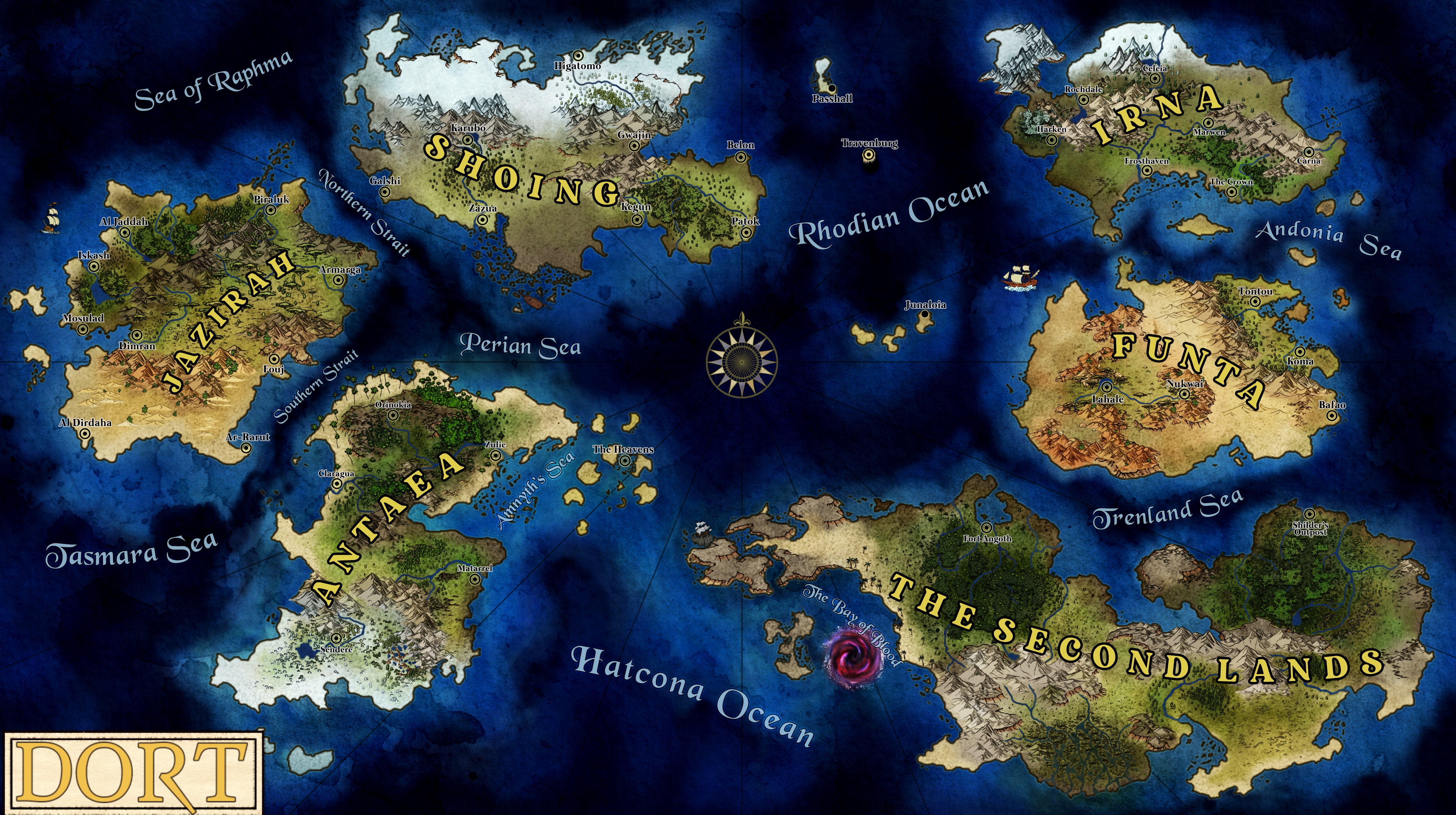
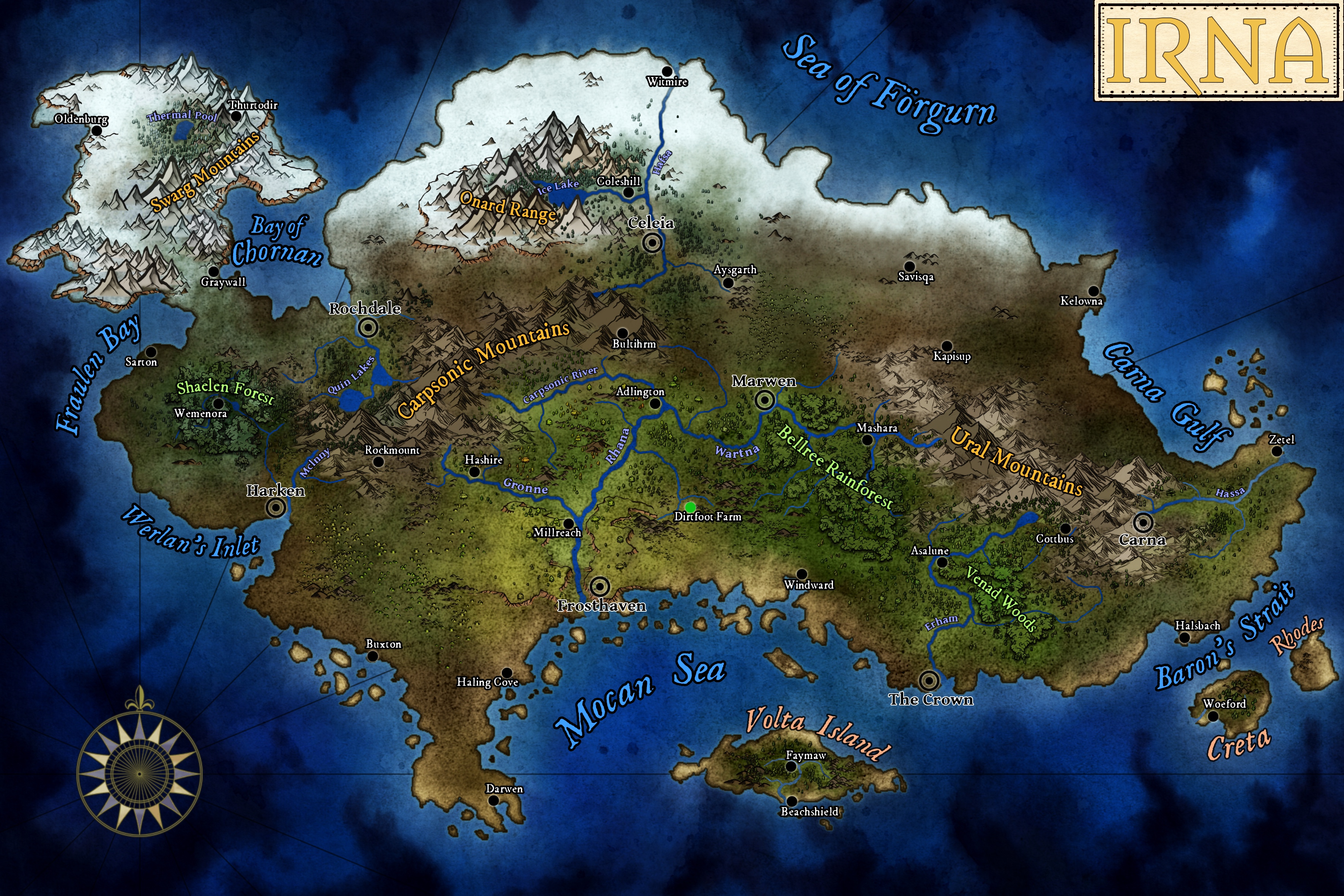
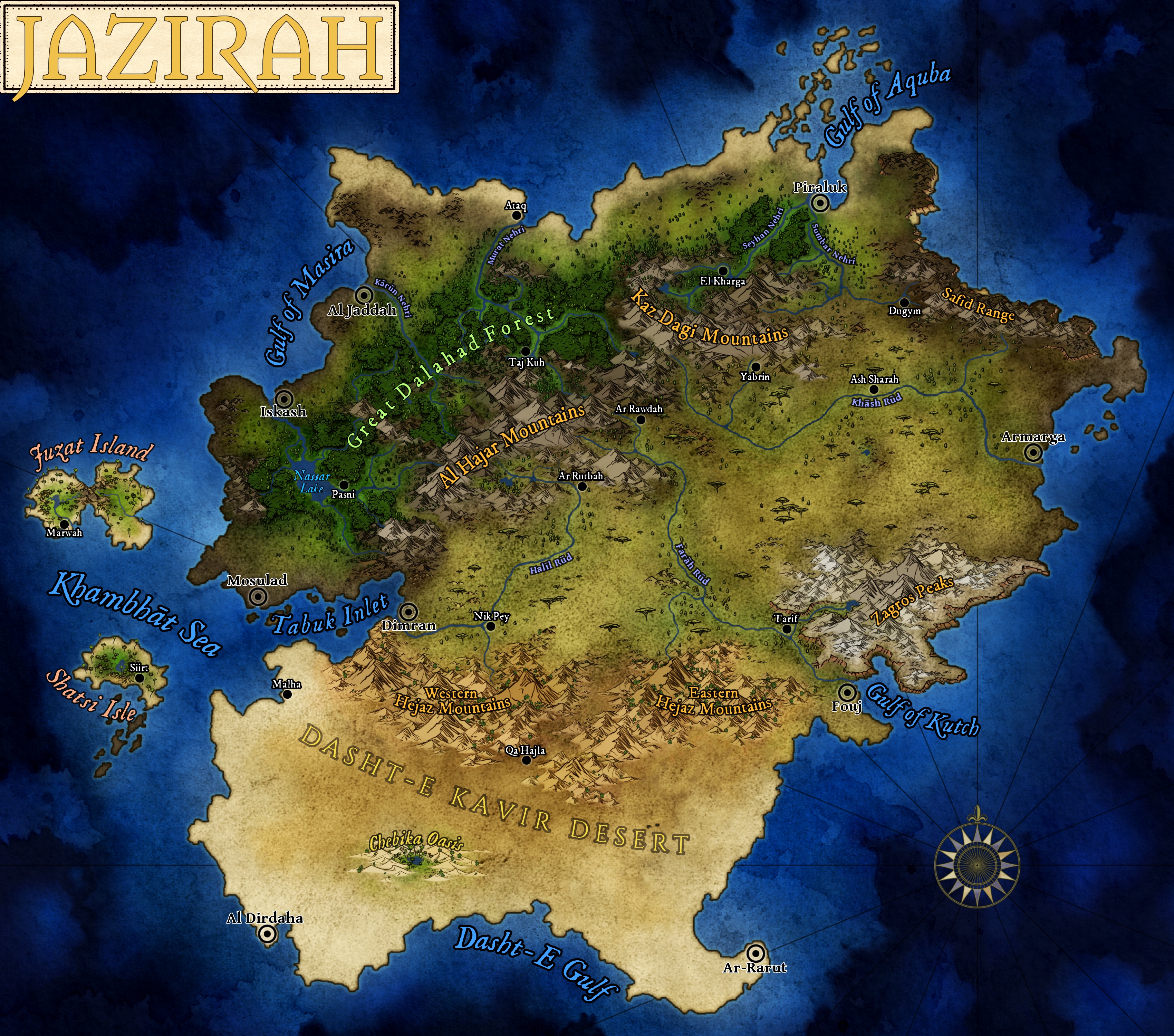
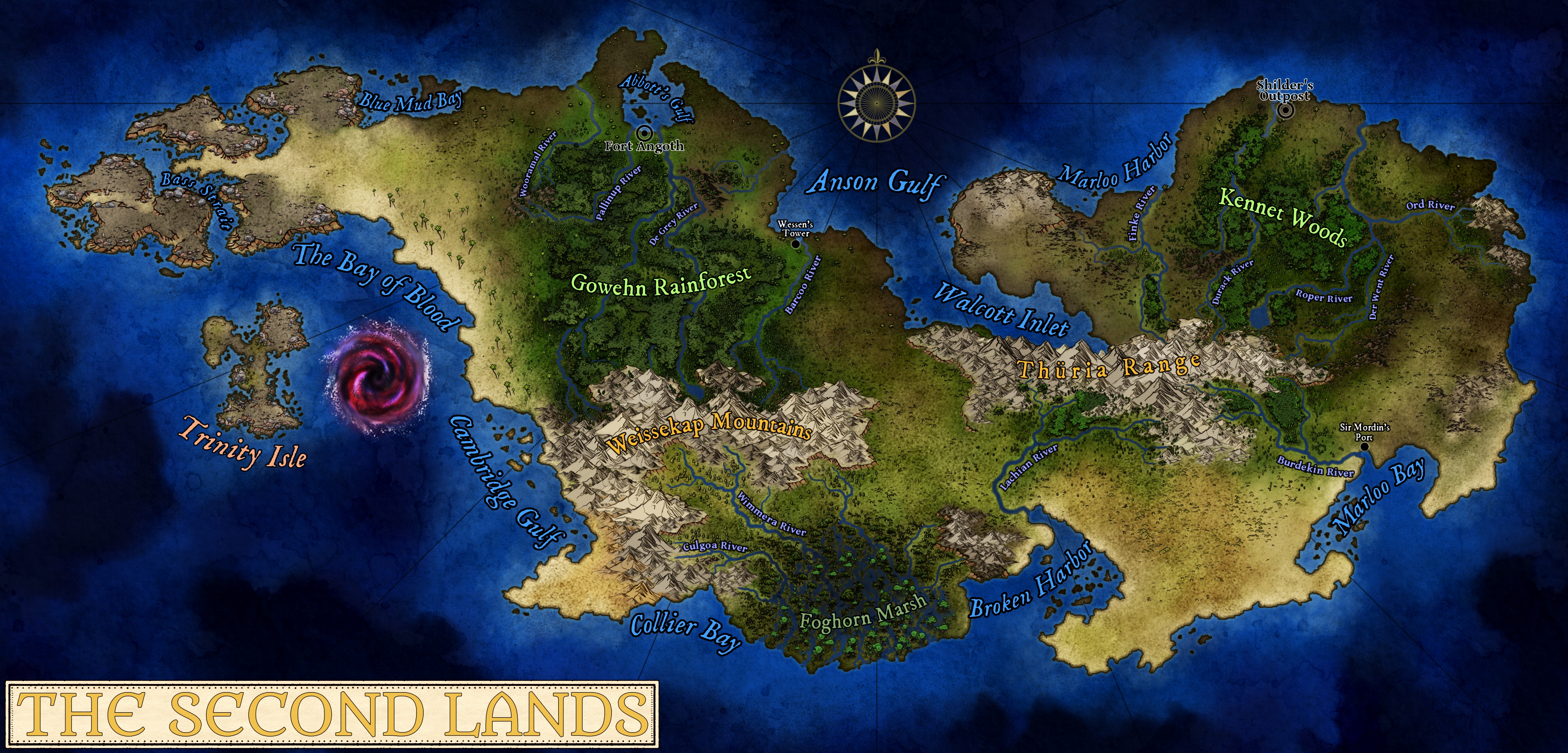
These are the maps a literate traveller in Dort can buy, borrow, or copy. They are what your character consults before setting out, and what the Game Master reads a journey off.
Dort has no table of fixed distances between cities. Distance is read off the map, along the route you actually choose to take. Trace your road on the continent map, follow the coastline or the pass or the river as it is drawn rather than cutting a straight line across it, read the distance against the scale bar, and convert it to days with the rates below. Two parties leaving the same gate for the same destination arrive on different days, because one took the coast road and the other went over the mountains. Terrain is the reason: a road is a road, but forest, marsh, and mountain routes cost you between half and two thirds of your daily distance, and the Game Master applies that reduction from the full table in GM Guide Chapter Sixteen.
| Mode | Miles per day |
|---|---|
| On foot | 20 |
| Mounted | 30 on a riding horse, 20 on a pony or mule, 25 on a camel |
| Wagon or cart | 15 |
| Ship | 60 coastal, 90 open sea, 40 downriver by barge, 10 upriver |
| Flying ship | 50 per point of the ship's Speed rating |
Multiply by three quarters in open country or hills, by half in forest, desert, or snow, and by a third in mountain or marsh. Your party travels at the speed of its slowest member.



Who Operates in Dort
Every organization in Dort has a public face and a private agenda. The two often share the same words and sometimes even the same intentions. The institutions below are the ones a character in Ix is most likely to deal with; the ones that hire, the ones that regulate, the ones that recruit, and the ones that hunt. Understanding what they want from you is different from understanding what they want. This chapter gives you the first. The second is something to discover.
The list is not exhaustive. For every guild named here there are dozens more, regional and specialized, and for every cult there are many that have not yet surfaced. Treat these as examples and seeds, not as the limit of what operates in Dort.
Religious Organizations
The major faiths of Dort are described in Chapter Ten. What follows are the institutional structures of the three most organizationally active; the bodies that hire people, regulate practice, and take positions in the world.
The Accord (Echo's Faith)
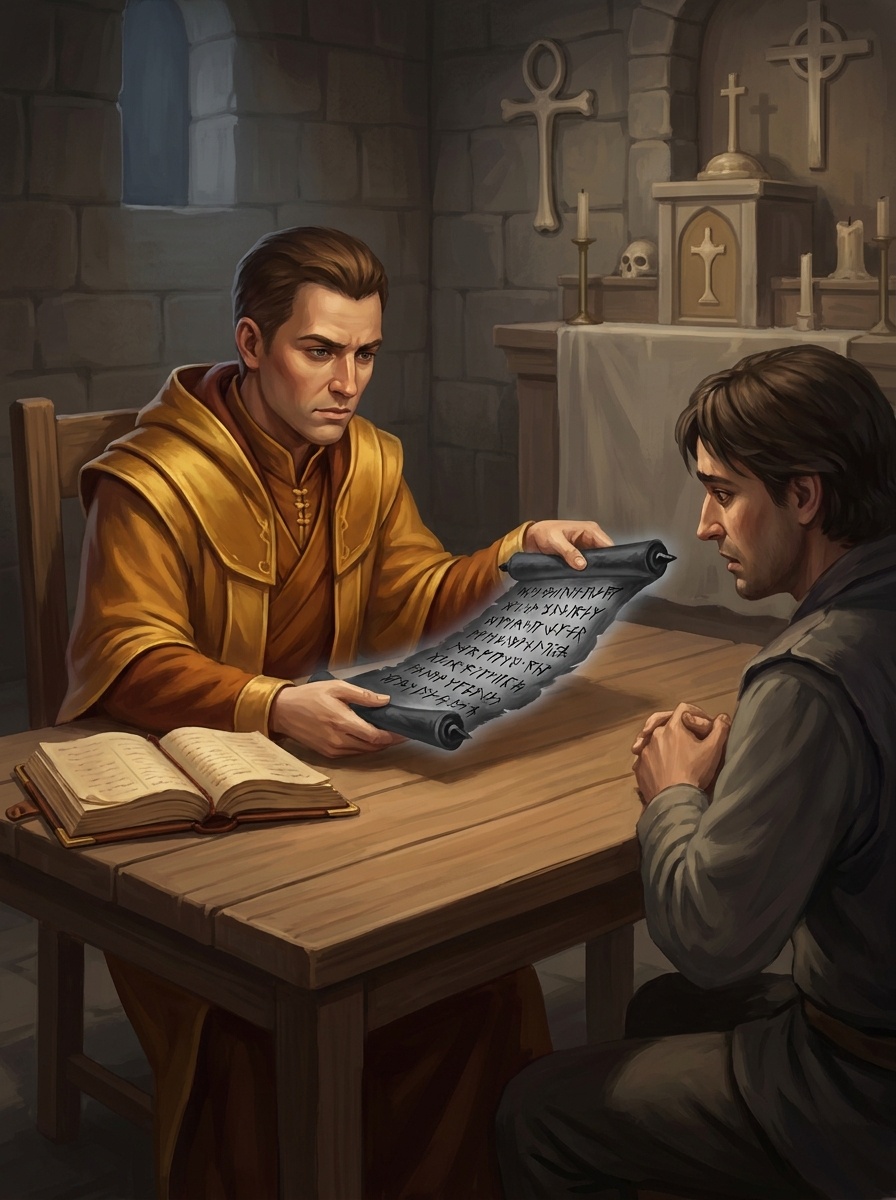
The Accord does not have a homeland and does not want one. It presents itself, accurately, as the faith that serves every community equally, because its power comes not from controlling territory but from making itself indispensable to whoever lives in it.
The organization runs on earned trust rather than appointment. A keeper who cannot reconcile people will not hold authority for long; the community simply stops bringing disputes to them. There is no high keeper, no central authority, no structure a rival could decapitate. Regional networks of keepers coordinate through the same mediation processes they apply to everyone else.
The Accord's most practically significant operations are its contract clinics, discreet services, usually run from an Accord shrine in a larger town, where trained keepers review unusual agreements before they are signed. The work is specifically targeted at infernal bargains and predatory commercial agreements. Several clinicians have been killed for it. The Accord considers this a cost of doing necessary business.
What they offer characters: Mediation services, contract review, community access, and a network of goodwill. An Accord connection opens doors that authority alone does not. They are reliable employers for work that requires discretion and integrity rather than raw force.
What they want from characters: Honest work. The Accord does not hire people to do things it finds embarrassing; it either does the thing openly or does not do it. Characters whose personal ethics are not catastrophically misaligned with the faith will find the Accord a straightforward patron.
Internal factions: The Echoless heresy pursues "strength through destabilization," using the language of discipline to justify disruption. Some cells sincerely believe disruption restores communal strength; others use the doctrine to bury truth or break institutions they judge too comfortable. The Self-Echoers achieve personal serenity while doing nothing with it. The Harmonizers are the most dangerous, using Accord language to justify coercion, mind-altering rites, and suppression of dissent in the pursuit of enforced peace.
Relationship to other faiths: Deep alliance with Jula and Themela; cooperative relationship with Thulgard on community defense; deep structural conflict with the Order. These two faiths are competing for the same ground with incompatible answers.
The Order (Oshala's Faith)
The Order behaves like a government because in its theology, government is religion. Its courts, registries, household law, and institutional practice are the same thing as its worship. When the Order arrives in a new region, the first institution it establishes is not a temple but a registry: a list of households, names, trades, debts, oaths, and the people each household owns. What is not recorded cannot be controlled.
The Order's three sects operate as a coordinated sequence: the Manis arrive first, offering services and building goodwill. The Armenites follow when diplomatic means have reached their limit, carrying military force and a theology that calls conquest "sanitation." The Nasallians consolidate; registries, patrol routes, the administrative strangulation of competing worship through legal means. Each sect is internally coherent. Together they are difficult to dislodge once all three phases are complete.
What they offer characters: Structure, legitimacy, resources, and access to the Order's extensive administrative network. Characters who operate within Order-controlled regions will find it easier to work with the faith than against it; at least in the short term.
What they want from characters: Compliance, record-keeping participation, and the conversion of goodwill into institutional loyalty. The Order's interest in any given individual is proportional to their usefulness to its administrative apparatus.
Internal tensions: The Egalitarians, who argue that the Order's social doctrine is a misreading of its foundational texts, are the faith's most dangerous internal heresy, not because they reject the faith but because they have read it carefully. The Pacifist heretics accept the household doctrine but reject military expansion.
Relationship to other faiths: The Order tolerates other faiths tactically and rejects them theologically. Its deepest structural conflicts are with Echo, Jusannia, and Themela.
The Death-Keepers (Nyxollox's Faith)
Nyxollox's priesthood is strictly hierarchical but organized around witness rather than power. Rank is marked in paint on the shaved skull (black base, white stripes added for decades of service) and authority flows through mentorship rather than command. A senior priest demonstrates and bears the weight of example; they do not simply order.
The order has three active sects. The Shanoaites practice both healing and death-tending as two halves of the same calling, working in plague zones and battlefields with white-painted heads in reversal of the standard marks. The Warborn specialize in battlefield service and rotate out after a decade, because no one should carry that weight forever. The Silent Keepers dedicate themselves to archive work, ensuring that every name is preserved and that no one passes into the afterlife unmemorialized.
Their shared practical discipline is the Order of Witness: the rite and record by which a death-keeper confirms that a dying person was attended, named, and allowed to pass without coercion or infernal interference. A person who follows the Order of Witness before death makes arrangements for who should attend them, where their name should be entered, and what signs would indicate that something disrupted the passage.
The order's most active external conflict is with necromancers and infernal operators who traffic in undead servitude. The priesthood trains specifically to recognize these operations and to protect the dying from being offered false alternatives at the threshold. A soul that passes through Nyxollox's domain with a death-keeper present is sealed against infernal claim, which is among the most practically valuable services the faith provides to any community willing to maintain a temple.
What they offer characters: The faith's archive access, its network of presence in even remote communities, and its expertise in identifying infernal interference with the dead. Death-Keepers are not warriors, but they are not passive either.
What they want from characters: Respect for the compact between the living and the dead, and practical assistance with the external threats the order is too few and too geographically spread to handle alone.
Guilds
The Arcanum Conclave
The body that regulates magical practice in Irna; which schools of magic are licensed, which practitioners are certified, which applications are permitted. Established when mages organized ahead of the alternative (noble houses regulating magic themselves), the Conclave has maintained institutional independence from the crown through a relationship of mutual necessity and mutual suspicion.
Internally, the Conclave is divided into six sects with incompatible goals. The Rationalists want magic treated as a science with rigorous methodology. The Dominionists want power acknowledged as the point. The Experimentalists want laboratory access and tolerate everything else as its cost. The Umbral Circle works in the parts of magical practice the Conclave officially forbids and practically tolerates. The Battlemages want direct military application recognized as the Conclave's most valuable product. The Harmonists want community magic recognized as its most durable asset. The Council operates by exhaustion: decisions get made when enough sect leaders have stopped objecting.
What they offer characters: Access to certified magical resources, research support, institutional credentials within Irna, and employment on retrieval or escort work they cannot conduct internally.
What they want from characters: Retrieval of artifacts or texts. Escort of researchers into dangerous areas. Investigation of unauthorized magical practice. Occasionally, something the Conclave cannot be seen doing officially. The Umbral Circle's requests tend to be the most interesting and the least documented.
Where they operate: The Arcane Spire in the Irnan capital, with affiliate academies and authorized practitioners throughout Irna. Limited presence outside Irna.
The Iron Hand Guild
The organization that controls metalwork movement in Irna, not the making of it, but the supply chain. Ore, transport, market prices, institutional relationships with buyers and suppliers. It began as a defensive measure by a generation of blacksmiths being squeezed by noble house buyers and has become something more comprehensive: a trade control operation with metalwork knowledge as the foundation and logistics and information as the actual instrument of power.
The Guild is not interested in political conquest or ideological expansion. It is interested in the market remaining structured in a way that makes its position within it permanent. This makes it a reliable patron: it defines scope, pays consistently, and does not forget favors or failures.
What they offer characters: Reliable pay, clearly scoped work, and access to a national trade network with reach into neighboring regions.
What they want from characters: Retrieval of stolen goods. Investigation of supply chain disruptions. Escort through regions where reliability has degraded. Occasionally, something that Master Alaric Blackthorn will not put in writing but that Lilith Flameheart will brief you on in full.
Master Alaric Blackthorn: a master smith before he was a guild leader and still one; the iron gauntlet on his right hand is his own work and he maintains it personally. He has run the Guild for twelve years and reads a situation several moves ahead of the people standing in it. He is not warm. He is fair in the way the Guild's rules are fair: stated standards, consistent application, consequences known in advance. He never puts anything that could embarrass the Guild in writing, which means he trusts his memory for everything that matters. Do not assume he has forgotten something.
Lilith Flameheart: the Guild's intelligence, and the operational contact for work Blackthorn keeps off the ledger. She maintains the network of factors, harbormasters, house secretaries, and transport captains whose small debts tell her what is coming before it arrives. She is direct and precise about scope and payment; her briefings are thorough and her tolerance for improvisation outside agreed parameters is minimal. She is the person who tells you what you are actually being hired for.
Where they operate: Headquartered in Harken, with national reach through Irna and tendrils into neighboring regions through trade relationships.
House Carna
House Carna rules the city of Carna in Irna's eastern mountains, built around the largest gold mine in the region. This has made them extraordinarily wealthy and correspondingly certain of their own superiority: over other houses, other nations, and other species. Their bigotry against non-human races is not incidental to their identity; it is central to it. The ideology that human dominance is the natural order of things was written into the city's founding charter and has been reinforced by every generation since.
The city of Carna announces itself with the Carnelian Bridge (iron-and-gold-inlaid, the primary entrance, and the city's most visible statement about what it values). Inside, the streets slope upward through the social hierarchy: the Gold District at the top where House Carna's mansion overlooks everything, the Silver Quarter below it, the Copper District below that, and the gravel pits at the edges. The stratification is architectural as much as social. The mines never close. The air smells of hot metal year-round.
House Carna operates through legal privilege rather than open violence. They challenge non-human property registrations in court, establish checkpoint operations at contested frontier roads, and fund political candidates who will advance restrictive guild licensing. They are not subtle; their position is publicly known, but they are careful about which laws they break. Their most dangerous moves are made through paperwork.
The house has a private army under Sir Reginald Carna, an heir being groomed for eventual leadership whose combat skill is genuine and whose brash personality is also genuine. The public face of House Carna's diplomatic work is Seraphim Whitlock, a professional spokesman of exceptional social skill who has spent decades perfecting the art of explaining, smoothing over, and reframing whatever the family has recently done. Their magical advisor, Master Benedict Fairweather, is a respected wizard well past sixty who remains formidable. Clarissa Carna, a distant cousin and the house's outlier, is a bard who actively uses her influence to push back against what her family represents; she is kept at arm's length precisely because she is capable enough to matter.
Notable: Henry Carna, the family's celebrated tournament competitor, carries a Zoranti weapon and fights with genuine honor. He shares the family's convictions about human superiority but expresses them through demonstrated excellence rather than humiliation. Percival Carna, the family's scholarly eccentric, has recently encountered an artifact he calls the Eye of Ix, which appears to have complicated his relationship with the family's ideology in ways he has not yet disclosed.
What they offer characters: Legal access, commercial leverage in the eastern regions, and introductions in Irnan court circles. The price is always alignment with or tolerance of their position. Human characters who do not visibly oppose them are offered more.
What they want from characters: Work that doesn't appear in official correspondence. Competitive intelligence on rivals. Retrieval of items the family would prefer not to acknowledge having lost. The occasional problem solved in ways that Seraphim Whitlock cannot explain away in advance.
What this means for characters: Non-human characters in Irna's eastern regions will encounter Carna checkpoint operations, legal challenges to property and guild registration, and a city that structurally marginalizes them without requiring overt cruelty to do so. Human characters may be approached as potential allies or clients. Any character investigating the noble houses of Irna will find House Carna's fingerprints on a significant portion of the continent's property disputes and political appointments. The Accord and Themela's faith both maintain quiet files on Carna's methods. The Accord's contract clinics in the eastern regions are specifically aware that House Carna creates populations of desperate non-human workers who become prime targets for infernal contract operations.
The Greyfang
The Greyfang are the most widely known orcish military organization in the known world: not a single warband but a tradition of military discipline, tactical doctrine, and martial culture originating in the territories of Antaea. The name comes from the founding warband that codified the tradition; that warband dissolved into history, but the standards it set became the baseline that other orcish military organizations either measure themselves against or deliberately reject.
Greyfang-tradition warbands operate primarily as mercenaries and contract soldiers. They have a battle record that commands serious institutional respect: the White Rose Legion has contracted them, the Irnan crown has contracted them, and Jazirah's military orders have contracted them when the math required it. The reputation is earned: Greyfang units hold their discipline under pressure, respect their contracts, and do not prey on civilian populations without explicit authorization.
The Greyfang's most distinctive mounted element is the War Brute: a large, heavily built creature bred by the original Greyfang tribe in Antaea to match orcish riders in size, ferocity, and endurance. War Brutes tower over standard warhorses and are dense enough to carry heavily armored warriors without strain. Their hide provides natural protection, their temperament is aggressive by default, and they fight alongside their riders rather than simply carrying them. An orc on a War Brute charges with combined force: the rider attacks and the mount tramples in the same movement, and the sight of a Greyfang heavy cavalry unit in formation has ended several documented engagements before they became full battles.
War Brutes do not appear in conventional stables or markets. Acquiring one outside orcish territory requires either significant personal relationship with a Greyfang warband, rare private arrangement, or theft (which few attempt twice). Non-orcish riders face significant difficulty establishing authority over an unfamiliar War Brute; the animal tests any new handler through escalating dominance challenges, and three successful mountings are required before the bond takes hold.
What they offer characters: Reliable contracted muscle, professional escort services, and tactical support of a quality that commands premium rates. Greyfang officers are worth talking to if you have work that requires military discipline and clear parameters.
What they want from characters: Contracts respected, payment rendered as agreed, and the professional courtesy of treating them as what they are. Greyfang warbands notice when clients underestimate them, and they remember.
What this means for characters: Greyfang soldiers appear as escort contracts, caravan guards, garrison troops, and battlefield opponents depending on who has hired them. They are professionals; negotiating with them is possible if you have something to offer. Fighting them is serious work: their formation discipline makes a Greyfang unit significantly more dangerous than an equal number of undisciplined fighters, and their heavy cavalry can close engagements before parties with ranged advantages can make use of them.
Cults
Cults in Dort fall roughly into two kinds. The great majority serve the Hells, taking a Devil or Demon lord of the nine infernal layers as their patron and shaping themselves in that lord's image. A few serve other powers entirely, including powers whose nature their own members may not fully understand. Both kinds are below.
A word about what the infernal lords are, because it matters at the table and is easy to get wrong. The Devils and Demons are not misunderstood. They are not victims of bad theology, not creatures who would soften if someone listened to them. Each lord's realm extends from its will, which means each layer of the Hells is the lord's appetite turned into geography. The mortal cults that serve these lords mimic them: a cult takes on the depravity and specific hunger of its patron, because that resemblance is how the cult believes it draws the lord's attention. The lords rarely intervene directly, and a cult's certainty that it is seen is usually wrong. That does not make the cults less dangerous. It makes them less rewarded.
The 9 Eyes
The 9 Eyes are publicly visible as a network of economic disruption: gold and silver stolen, melted into raw ore, and reintroduced into the mining supply chain to corrode confidence in metal provenance. They operate in the margins of legitimate commerce, identifying systemic vulnerabilities in supply chains and exploiting them at scale. Their founder, Glim Carpsonic, is a blind gnome out of the Carpsonic Mountains who rebuilt the cult into its present form over the last fourteen years; Irnan warrants name him for economic crimes and suspected murder and list no confirmed location. He is a true believer in whatever this operation is building toward, and he expects other people to remain ignorant of the full picture.
The cult is not welcoming. You do not seek out the 9 Eyes; they find people whose profiles interest them, and contact is always on their terms. What they want from any given contact is rarely straightforward, and the full scope of any arrangement is disclosed only when it is too late to reconsider.
What makes them dangerous: Their methods are indirect, their goals are not legible from the outside, and their reach appears disproportionate to their visible membership.
The Infernal Cults of the Nine Hells
Below the soul planes lie the Hells: nine layers, each a realm organized around a single human failure, each ruled by a lord whose nature is that failure perfected. The upper four layers (Tyrannus, Avaricia, Mendacium, Malicor) are devil-ruled: hierarchical, contractual, lawful. The lower four (Loftile, Erosmire, Gula, Anarchos) are demon-ruled: chaotic, appetitive. Between them sits Invidia, held by neither.
At any given time there are at least nine major cults operating in Dort, one oriented toward each layer. They compete with each other. Within each cult, members compete for the favor of a lord who is mostly not watching.
The Iron Decree (Tyrannus, Zagan, Oppression). A cult that pursues total control dressed as order. It captures the administrative apparatus of a place (the watch, the courts, the records) and then narrows what is permitted until the population is legible and obedient. It does not rant about freedom; it abolishes it by paperwork, one regulation at a time, and calls the result safety.
The Gilded Assay (Avaricia, Pyxata, Greed). A cult that treats a community as a balance sheet to be acquired. It lends, forecloses, converts debt into ownership, and warehouses the people it has reduced to assets. Its contracts are precise rather than tricky, which makes them worse, because they hold.
The Shifting Face (Mendacium, Cozen, Deceit). A cult built on systematic deception as a discipline: infiltration, forged provenance, the patient corruption of a community's ability to trust what it knows. The Shifting Face does not lie clumsily; it makes truth unrecoverable, so that even accurate information can no longer be acted on.
The Red Discipline (Malicor, Ustura, Brutality). A cult that treats the infliction of suffering as a skill to be perfected, not a loss of control. These are not berserkers; they are practitioners, and they keep records of their work. The cult prizes precision over rage.
The Unanswered (Invidia, the Arbiter, Envy). Uniquely, the Unanswered worship a power that does not respond. The Arbiter grants nothing, answers nothing. Its cult is organized around the conviction that others must have less, and so its members do not build; they tear down, poisoning the success of anyone within reach.
The Crown of Ash (Loftile, Kian, Pride). A cult that forms around a magnificent figure who demands to be regarded as more than they are, raising spectacular projects (temples, towers, movements) that begin failing before they are finished. Impressive on approach and hollow underneath.
The Reaching (Erosmire, Buuna Moc, Lust). Described separately below.
The Endless Table (Gula, Edaxius, Gluttony). A cult of appetite that consumes without pause and is never satisfied. It cultivates addiction, hoards until others starve, and devours the substance and patience of every community it touches.
The Undoing (Anarchos, Ta'amah, Dissolution). The purest and least coherent of the nine: destroyers who find meaning in unmaking, pursuing the erasure of structure as an end in itself. They cannot build a stable organization, because stability is the thing they are against.
The Reaching (the Cult of Buuna Moc)
Of all the infernal cults, the one that forms around Buuna Moc, demon lord of Erosmire, is the most predatory. The Reaching's doctrine is that another person's will is irrelevant to its members' wants; a cold and specific conviction, not passion or appetite, but the organized principle that desire itself justifies anything done in its service.
The cult does not announce itself. It is most useful as the thing underneath a welcoming surface, surfaced slowly, recognized late. What makes it genuinely dangerous is that its members are incapable of being reached by appeal to the suffering of others, because the other person's suffering was never a consideration. There is no shared ground to stand on, and no argument to make.
The Choir of the Open Mind (the Cult of Limbo)
Not every cult serves the Hells. Beyond the soul planes lies Limbo, a plane of pure chaos that has a tendency rather than a will; the way a fire has a tendency toward wind. What it responds to most is madness. A traveler who arrives already insane may find Limbo interested, and if it is interested, it writes the madness permanently into the person at a level no restoration has reliably reached.
The Choir of the Open Mind courts exactly this. Its members believe that to have one's madness made permanent and noticed by the plane is the highest attainment; an alignment with a deeper reality that ordered minds cannot perceive. They pursue derangement deliberately, as sacrament. Some seek out particular locations where the boundary between ordinary madness and Limbo's attention grows thin.
The Choir is recognizable by its members' coherence: their specific derangements are too organized, too thematically consistent with each other, to be ordinary madness. What comes back from their most devoted practices is not reliably the person who left.
Notable Places
Dort is a world framed by five major lands, the Second Lands, and the Oceanic Reaches that connect and complicate them. Your character would know the places listed below by reputation whether or not they have visited. This is the public geography: the names, the rough characters, the facts that appear in Accord archives and are discussed in trade houses.
The Crown — Irna's Capital, Dort's Diplomatic Center
The Crown is the second largest city in the known world and the seat of the Irnan Emperor. It does not rule Dort, but it leads more often than any other city because treaties, embassies, guild offices, religious institutions, and foreign missions accumulate here until every major power needs a presence. It was designed as a demonstration of what civilization means, and it functions as one. When rulers across Dort need to speak face to face, they often do it here.
The city runs under the Emperor's law and the Watch's gray cloaks. It is expensive, cosmopolitan, and dense with competing institutional interests. Secrets are an industry. Spies are an assumption. The Crown is the correct place to go when you need access to something that only exists inside an institution, and the wrong place to go if you want to remain anonymous.
What characters find here: Every guild, every licensed faith, every regional government with money. The highest courts in Irna. Contract clinics that handle the largest infernal operations in the north. The Arcanum Conclave's primary political office (though not its research spire). The most accomplished criminal networks in Dort, operating in the shadow of the highest-density surveillance on the continent.
Frosthaven — Irna's Northern Hub
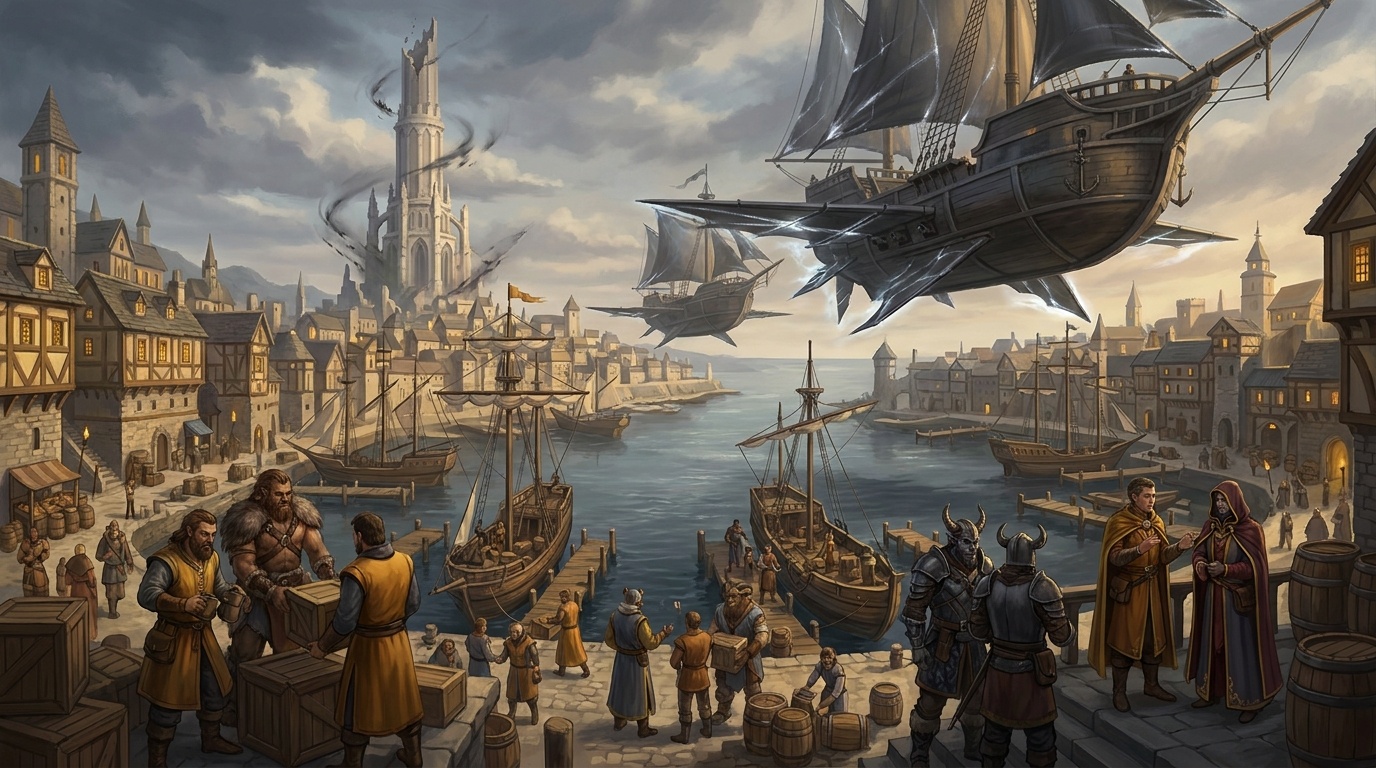
The city the rest of Irna sometimes calls the "practical capital" because its people actually look like the continent, mixed species, pragmatic, proud of practical results. Frosthaven is Irna's commercial nerve: the main import hub for goods from Funta, the headquarters of the Irna navy, the location of the regional court that hears appeals from the surrounding kingdoms, and the city that exports more adventurers per capita than anywhere else on the continent.
The Sentient Spire of Frosthaven stands at the city's northern edge. Its current occupant, Verrell the Transmuter, is known for research the Arcanum Conclave officially considers out of scope and practically tolerates. The tower's upper section is visibly damaged from an incident that occurred approximately two centuries ago and has never been explained to public satisfaction.
What characters find here: A working naval port, a regional court system that has actual authority, the Irna navy's officer class, House Kronsta's shipping networks (the most reliable logistics company in the north), and regular work for people with relevant skills.
Iskash — The Order's Capital, Jazirah
At the mouth of the Dalahad River on Jazirah's western coast, Iskash is where the Order functions at its most complete. The Golden Tablets are held in the Grand Temple's Inner Sanctum. The Sultan governs through the Grand Clerical Council. Registry offices cover every household. The calls to prayer structure the city's rhythm the way bells structure other cities'.
Visiting Iskash without an established status inside the Order's registry is technically permissible and practically uncomfortable. Unregistered arrivals are noted. Unregistered foreigners are assessed. An Accord keeper, a Nyxollox death-keeper, or any representative of a faith the Order considers competition will be watched from the moment of arrival.
What characters find here: The complete institutional infrastructure of the Order. The highest concentration of Oshalan religious authority in the world. The Dalahad merchant quarter, which operates under Order law but maintains extensive commercial connections across Jazirah and beyond. Also: the largest population of Talbar's deal-keepers operating counter-infernal contract clinics anywhere in the world, which suggests something about the volume of infernal operations the Order indirectly enables.
Al Jaddah — Jazirah's Holy City
Farther north along the Gulf of Masira, Al Jaddah holds the Tomb of the First Witness, Oshala's original mortal follower, and the Scholarly Council whose interpretive rulings on the Sacred Laws are binding across Jazirah. Where Iskash is military and administrative, Al Jaddah is theological and academic.
The tension between these two centers, between the Sultan's authority and the Scholars' interpretive power, has been the defining internal conflict of Jazirah's governance for two centuries. Characters operating in Jazirah need to know which authority they are under at any given moment; the answers are not always the same.
The Heavens — Five Floating Islands, Northeastern Antaea
Five islands floating above the Sea of Heaven, connected by arching stone bridges, governed by Lord Arcturus Stormborne through the Lord's Council. Home to approximately 380,000 permanent residents and an unknown number of transients, because three portals on the highest island, Sanctus Perceptum, connect to off-world destinations.
No one knows who built the portals. The city grew up managing the access problem and became the only settlement in Dort where off-world arrivals are a routine administrative matter. Every major faith has a presence here. The Order has applied for a Quarter charter twice. The Lord's Council has declined both times.
What characters find here: Off-world commerce, the Luminous University (the only institution of learning in Dort that offers courses in off-world cultures), the most diverse population on the planet, and guarded neutrality maintained by charter law, patrols, restricted districts, embassy protocols, and a Lord's Council determined not to become an Irnan dependency. The Heavens runs on its own rules and is trying to become the place powers use when The Crown is too Irnan, too watched, or too politically loaded.
Districts: Sanctus Perceptum (portals and government); Aurum Heights (the wealthy residential island); Meridian Precinct (markets, guilds, the Colossus Vortex stadium, entertainment); Labora Quarters (the working-class island); Isolus Penitentiary (the prison island, used when ordinary cells are too reachable, too political, or too dangerous). Common greeting: "May clouds cover your porch."
Gwajin — Shoing's Eastern Capital
The largest city in the known world and the seat of the Grand Duke, Gwajin is where Shoing's honor culture reaches its most formal expression. Ceremony is precise and deliberately maintained. A social slight here is a serious matter with established procedures for addressing it, and a well-executed courtesy opens more doors than a credential. The city's commercial activity is real and substantial, but trade happens within a framework of relationship and obligation that outsiders spend months learning to read correctly.
Shoing is not like Irna or Jazirah. There is no registry. No licensed guild structure. No institutional authority that an outsider can appeal to in a dispute. What there is: a community that remembers what you did and how you did it, and that memory persists longer than most people expect. A character who works in Shoing is building a reputation, not a credential, and those are accumulated differently.
Shoing is widely acknowledged to be where dragons originate. The mountain ranges across the northern land and its surrounding islands are the structural habitat of a species measured in geological time. Dragon eggs are coveted across Dort. They come from Shoing. Shoing has strong opinions about who may pursue them, and the Grand Duke's court enforces those opinions with the patience of a culture that has been managing the problem for longer than most nations have existed.
Shoing is home to a dense mix of the peoples detailed in Chapter Four: humans in the ports and courts, Sea Elves in navigation houses and coastal enclaves, Drakin families with old ties to the mountain nesting ranges, and smaller communities of Dwarves, Serren, Zerren, and others whose status is earned through the same demonstrated-reliability standard as anyone else. Shoing's honor culture is not species-blind, but it is reputation-forward: what matters most is whether a person has shown discipline, courtesy, and the ability to keep obligations under pressure.
What characters find here: Work organized around personal reputation rather than institutional commission. The strictest honor culture on the continent, which creates specific obligations if you accept hospitality and specific protections if you observe it correctly. The best navigation expertise in the known world, held by a maritime culture whose relationship with the sea predates the current calendar. And, somewhere in the mountain ranges, the oldest dragon nesting sites on Dort.
Southern Shoing: Away from Gwajin's formal east, southern Shoing runs through Zazua in the Cracked Sea and Karubo in the highland passes. More commercially fluid, warmer in every sense, still unmistakably Shoing in that it runs on demonstrated reliability rather than paperwork. The two regions share a culture the way a family shares a name while disagreeing about nearly everything else.
LaHale — Funta's Scholar City
In Funta's central riverlands near the Volta River and the great lake, LaHale is an anomaly: a city of scholars in a continent of warriors, created through Funta-Irna cooperation and protected by neutrality rather than conquest. Its great library draws academics from across Dort. Irnan legal models influenced its charters, but LaHale is not an Irnan possession; its scholar-elected council, local obligations, Zopha influence, and Fire Swinger protection all matter. The Fire Swingers, an all-female order of warrior monks who destroyed an entire invasion fleet at the Battle of Bafao, guard it. Nobody sensible treats LaHale as easy prey.
What characters find here: The largest collection of Funta-specific lore outside the continent's oral traditions, academic resources on a dozen subjects that are unrepresented elsewhere, and a community of international scholars who owe their institutional safety to a people whose culture they are studying and must therefore treat with particular care.
The Second Lands — South of Funta, Beyond Reliable Maps
Not a place to underestimate. South of Funta lies a vast, partially charted land whose first recorded expedition, 1350 ME, sent no word back. What subsequent expeditions established: the Second Lands are dangerous, politically difficult, and not empty. Local communities, hard-held outsider settlements, monstrous territories, ruins, rifts, and the creature called the behemoth all complicate the map. Some expeditions return. Many do not.
Several hard-held places support travel at the navigable edges: Fort Angoth (built from a royal pact, improbably survived), Shilder's Outpost (grew from a single explorer's stubbornness), Wessen's Tower (restored and warded by a later scholar), and Sir Mordin's Port (a pirate haven interested less in the interior than in existing beyond every navy's jurisdiction).
What characters find here: The most genuinely unknown territory in the world. Historical ruins that predate Dort's recorded civilization. Things the Second Lands have been accumulating, undisturbed, for millennia. The highest casualty rate of any destination on the planet.
The Oceanic Reaches
The major continents have names, histories, and the kind of cultural gravity that draws maps toward them. The Oceanic Reaches are what exist between those gravitational fields: the islands, the port cities cut into cliffs, the structures that float above open water, and the places that appear and vanish on schedules no cartographer has fully mapped.
They do not share a common culture. They share an ocean.
What they have in common is this: they are all places where the rules work differently. Some of them decided that deliberately. Others had it decided for them.
These are not faction-affiliated territories in the way Irna's cities or Jazirah's ports are. Major institutions can appear here, but they rarely define the place. What characters find in the Oceanic Reaches is not one political pattern. It is the specific texture of each port, island, or anomaly.
Frankton Island — The Kingdom That Owns You
Frankton Island is an island kingdom in Antaean coastal waters, ruled by King Harold Frankon II and known for complete state control, salt mines, and deliberate isolation.
Frankton Island is grey before it is anything else. Persistent easterly winds carry cold moisture year-round, settlements are arranged by class in ways visible at a glance, and the only road on the island connects every significant location to Darton Fortress at one end and Frankton town at the other. Order here is not a civic value. It is infrastructure.
The Frankon Dynasty has run the island since Harold I seized it at his own wedding ceremony, killed his bride, and persuaded the three noble houses to finish what he started. His grandson Harold II has spent his reign making the same system feel like care: longer education, more meat meals per month, sporting competitions between towns. The population, largely born under Frankon rule and knowing nothing else, has found this persuasive. The elves and dwarves, who remember what was before, have been stationed at the periphery.
The salt mines at Stormpost are the island's only export and its most lethal workplace. The Skyshadow visits twice yearly to collect them and delivers something in return that no one outside the castle has seen.
What characters find here: Complete state control presented as public order, isolation treated as stability, and people who may not believe they need rescuing.
Passhall — The Independent Port
Passhall sits where the mountains end and the sea begins, and everything about it is shaped by that position, including its politics. The city sits between the two largest economies in the world, collects 10 percent of everything that moves between them, and has been doing so as an independent city-state since 1900 ME, when it declared independence from Irna, and since 1920 ME, when Irna's warships came to dispute that declaration and went home with several fewer ships than they arrived with.
The elected government governs. The Rhodar family, descendants of the founder and controllers of the warehouses and shipping interests, defines the space within which the elected government operates. This arrangement has held for over a thousand years and is accepted by a population realistic about oligarchies and willing to prefer this one to the alternative of becoming an Irnan territory.
Passhall honors no foreign titles. Pirates are welcome in its harbor provided they do not prey on ships arriving or departing. Slavery carries zero tolerance, one of the city's genuine ethical positions rather than a policy of convenience. The food in the dockside bars is Irna-Shoing fusion developed by cooks who were not trying to make culinary history and made it anyway.
What characters find here: One of the few port cities where no external power has authority. A genuine open market for trade moving between Irna and Shoing. Work for people with maritime or criminal skills, provided they understand which lines the Rhodars enforce absolutely.
Junaloia — Jewel of the Dort Islands
Junaloia rises from the Rhodian Ocean as a mountain with a harbor at its base and a stone fort on the hill above it. Three patrol vessels are always on the water. The welcome is real: the island is warm to traders, workers, and visitors who understand what they are. What they are is guests, and guests do not own land, hold governance positions, or take island-born partners without social consequences that the community enforces without needing a law for it.
The island's self-sufficiency is a moral position rather than an economic policy. Common goods cannot be imported. The island produces what it needs, and the memory of the Years of Scarcity, hurricanes, drought, and a brief volcanic eruption that tested everything, is encoded in law rather than left to cultural transmission.
The one thing the island exports voluntarily is Manalani fruit: small, round, purple-skinned, gold-fleshed, and harvested once yearly during the Ryujin festival. Demand exceeds supply by a significant margin and the price reflects it. The legend of Johanna, an Eldar prism dragon who ranged across the Oceanic Reaches in ancient times and unified the archipelago before eventually relocating to the Ennedi Desert of Funta, is the island's founding story and Kaimana claims descent from her. The distinction between history and legend is not considered important here.
What characters find here: Academic resources on Dort Islands lore, Ryujin-tradition practitioners, the best thatchwork construction in the ocean, and a community that will remember everything they do and act accordingly for years afterward.
The Floating City of Travenburg
Travenburg arrives as a silhouette against the sky. It is a city-sized mass of stone and architecture suspended above the Rhodian Ocean, with flying ships docking at its air harbors and cable cars crossing between districts. The Delman family built it as a neutral trade point accessible to all powers and subject to none. It functions as designed.
The city's defining character is order. Everyone wears white. The streets are broad and stone-paved, cleaned by water towers at scheduled intervals and maintained by goblin custodians in the undercity who are essential and rarely visible. Every major street is lined with sentient trees whose leaves shift color to reflect the emotions of those who pass beneath them: blue, red, yellow, purple, white, and the rare black that brings guards within minutes. Touching the trees is a capital offense, enforced without exceptions. What the Delman family does with the information the trees communicate is not a topic the administration addresses.
The social classes are four, visible from dress, and movement between them is theoretically possible and practically uncommon. The city functions. Most residents believe in the social contract. Those who do not are in the re-education programs.
What characters find here: A genuinely neutral financial center, the most controlled environment in the Oceanic Reaches, and a city whose administration knows more about what its residents are feeling than most governments know about what their residents are doing.
Velthmir Isle — The Wandering Grave
Velthmir Isle announces itself with fog before it is visible: a wall of grey cold that dims the sun and kills sound beyond thirty feet, inside which navigation instruments behave strangely and the western cliffs emerge without warning. The island disappears every seven days in a flash of light visible through the fog and reappears at one of five fixed locations across Dort's seas. Anyone still on land when it phases cannot leave until it returns to the same location in a future cycle. The population of approximately 400 is almost entirely descended from people this has happened to.
The four villages, Ravencross on the western cliffs, Shadewood Hollow hidden in the forest, Fogveil on the eastern salvage beaches, and Gravemire near the cave entrances, do not govern together and do not particularly like each other. What they share is the seven-day cycle, the subsistence economy of fishing and salvaged wrecks, and the lich Tyranor in the deepest chambers of the underground ruins, who commands the undead that emerge from the cave systems and whose phylactery, somewhere in the dark below, is what makes the island what it is.
Halan Faer in Ravencross believes someone will eventually arrive with the knowledge to break the curse. He has believed this for thirty years. He is still willing to help.
What characters find here: The most unusual imprisonment in the known world, salvage from ships wrecked on the western cliffs over centuries, and a contained, dangerous island where leaving on time is the central problem.
A Note on Unlisted Factions
The organizations above are the ones a character in Ix is most likely to encounter first. They are not the whole of what operates in Dort. Noble houses control significant territory and loyalty and operate according to their own factional logic. Criminal organizations, regional trade associations, and local power brokers fill every city and crossroads community that the major guilds and faiths do not directly service. Planar organizations; the Silver Road authorities, the Shattered Domain's diplomatic corps, the various groups that operate across rift-accessible planes; are a category of their own.
Your character's background will determine which of these they already know. The ones that matter to any particular campaign are the ones that have already been making decisions about the region you are about to enter. Your GM will introduce those as the situation warrants.