Printable cards Spell Cards 119
Magic in Dort is not a single thing. It is one word stretched across several phenomena that share a surface resemblance (they all produce effects beyond ordinary physics) while drawing from different sources, working through different methods, and exacting different costs from those who practice them. A scholar who treats "magic" as one subject will eventually be wrong about something that matters. The distinctions in this chapter are not academic. They decide what a practitioner can do, what it costs them, and who, if anyone, gets to take it away.
This chapter covers two things. The first half explains what magic means in Ix: where power comes from, who can reach it, and what reaching it implies about a person. The second half is the complete casting system; spell blocks, costs, overload, empower, dispel, and the full spell list. Read the world first. The spell list will read like a map of a country you already understand.
The single most important idea in this chapter is also the simplest: how you reach power says as much about you as what you do with it. A flame called from the Ember plane, a flame granted by a god's judgment, and a flame structured out of Arcana-plane technique all look like fire. They are not the same act. The source and the cost are never identical, and the difference becomes visible in the precise moments when magic meets magic directly.
The Three Traditions and Ancient Magic
There are three player-facing magical traditions in Dort: Arcane, Primal, and Divine. These are the traditions player characters can study, pray through, train in, and roll at the table. Above and outside them sits Ancient magic, which is not a player tradition and not a mortal technique.
The traditions are not merely spell lists. They describe how a practitioner reaches power and how that power becomes dice at the table. Arcane casters use trained mortal technique to shape magic through the Arcana plane. Primal casters draw from living natural sources and the elemental planes through orientation, instinct, and pact with the world. Divine casters channel a patron deity's will through faith. Ancient magic is different in kind: the direct capacity of Ancients, not a road mortals can walk.
Ancient Magic
The oldest form of magic, and the only one no mortal can practice.
Ancient magic is the direct application of will to the planes. No gestures. No spoken words. No material components. No staff, wand, or focus. No intermediary of any kind between the practitioner's intent and the result. The practitioner reaches into a planar source and pulls out what they want by wanting it hard enough. The method is exactly as simple as it sounds, and exactly as dangerous as the consequences imply.
It is called Ancient magic because it is how the Ancients use magic: an innate capacity of a specific kind of being, not a school of study or a technique mortals have failed to discover yet, and mortals are not that kind of being. A person who claims to practice Ancient magic is either mistaken about what they are doing or lying about what they are. This matters at the table because the difference between a powerful mortal spellcaster and an Ancient is not a difference of degree. It is a difference of category. No amount of study closes that gap.
The Beacon Problem. An Ancient who draws too deeply, too often, or at too great a scale becomes luminous across the planes; a brightness in the planar fabric that tells anything paying attention that an Ancient is here and using power. The gods have standing orders regarding Ancients, and they act on what they see. The practical result is that Ancient magic is self-limiting through consequence, not through capacity. This is why escaped Ancients work through proxies and long arrangements rather than open displays of force. The constraint has held so far, though it guarantees nothing about mortal safety.
Arcane Magic
The magic most people mean when they say the word without qualifying it.
Arcane magic works by using physical technique (gestures, vocal components, material components, and focal devices such as staves, wands, and ritual implements) to draw power from the Arcana plane and structure it into an effect. The technique is the whole point. Power does not flow to mortal practitioners freely the way it does to Ancients. It has to be invited, shaped, and channeled through a specific grammar of physical action that the practitioner has trained for years to perform. Disrupt the gestures, spoil required components, or break a focus the spell specifically requires, and the working fails; losing an ordinary optional focus only removes its casting bonus.
This is both a limitation and a protection. The same structure that makes mortal magic difficult to perform makes it controllable and teachable. Mortal magic can be written down, studied, transmitted between practitioners, and built into institutions. A mortal practitioner is, in the most literal sense, a person who learned a craft.
Most arcane practitioners draw exclusively from the Arcana plane, because it is the source they were taught to reach and the one most responsive to standard technique.
Primal Magic

Power drawn from life, weather, blood, wilderness, and the elemental planes.
Primal magic is mortal practice, but it does not approach power through academy grammar. A primal caster orients themself toward a living source: root, beast, storm, saltwater, flame, stone, breath, instinct, or the elemental planes that give those things their oldest shape. Some traditions teach it as pact. Some as inherited community practice. Some as listening hard enough to hear what the world has been saying all along.
The four established elemental sources are Ember (fire, heat, combustion), Mineral (stone, earth, ore, the endurance of buried things), Tidal (water in all its states, current, pressure), and Zephyr (wind, air, storm). An elementalist does not simply swap one source for another the way a traveler changes roads. Drawing from an elemental plane requires a genuine orientation toward the element, something closer to devotion than to technique.
Because primal casters are still mortals, they have limits. Terrain matters. Source matters. A sealed stone dungeon with no living growth resists them differently from a forest during rain. Technique still exists, but the grammar is older and less institutional than Arcana's.
Divine Magic
Power granted by a god to a mortal who has earned it.
Divine casters do not reach into a plane directly. Divine magic comes through a deity; a specific deity, with a specific portfolio, who has decided that a specific petitioner has shown enough devotion and standing within the faith to be trusted with divine power. Arcana is still the ultimate source of the magical energy, but the god shapes, filters, and grants it through divine will. A mortal cannot study their way to divine magic, cannot develop the technique alone, and cannot find it waiting as an impersonal resource. It can only be given, and it is given conditionally, by beings who have their own agendas and their own standards.
This is why divine magic is, in practice, almost entirely the province of clergy. A novice cleric and a high priest of the same god may both channel divine power, but they do not channel the same amount of it, and the god keeps full discretion over what is permitted. Choosing a divine patron means entering a relationship with a person who has opinions, rivals, and a price. Chapter Ten is the catalog of who those persons are.
Revocation. Divine magic can be withdrawn. A practitioner who falls from the faith, violates their god's core doctrine, or is judged to have misused the power they were lent may find the channel simply closed. This never happens by accident and is never a random mechanical penalty. It is a theological statement made by a divine person, and recovering from it (if recovery is possible at all) demands genuine reckoning with whatever broke the relationship.
The Arcana Plane and the Divine Barrier
Mortal magic is the magic of a craft, but a craft needs raw material, and the raw material of mortal magic is the Arcana plane.
Arcana is the source of all magic; the plane from which magical energy ultimately flows into every other realm in the cosmos. That does not mean every caster touches Arcana directly. Arcane casters do. Primal casters draw that power through living and elemental planes that have already been saturated by it. Divine casters receive it through a deity: the power originates in Arcana, passes through the god's portfolio, will, and judgment, and reaches the cleric as a personal grant rather than a raw planar channel. Arcana is a place made of magic rather than a place that contains it: the substance of the plane itself is the medium, the atmosphere, the ground. Its native inhabitants, the fey, are not creatures who happen to live in a magical place. They are expressions of the plane's magic given biological form, which is why they do not thrive on the Prime and why their relationship to the arcane is a different category of thing than a mortal practitioner's hard-won technique.
The plane is divided, fundamentally, between wild magic and orderly magic; energy that is unstructured and responsive to presence, against energy that follows precise and powerful laws. The fey courts split along the same line and have contested it since before mortal records of Arcana begin.
The barrier. The gods sealed Arcana from the Prime in an age before the current divine order took shape. Their reasoning was blunt: unfettered access to the source of all arcane energy would produce mortal practitioners more powerful than the gods were prepared to tolerate. The barrier does not prevent crossing. It prevents easy crossing. Opening a portal through it requires powerful, often ancient magic, and the knowledge of how to do so is closely held and inconsistently passed down.
The barrier is why mortal magic is what it is. Prime-side practitioners draw on a filtered, attenuated version of what Arcana actually contains. The most powerful mortal magic is on the far side of a wall the gods built on purpose, and the gods have never revised the arrangement.
For travel through the barrier and the wild rifts that sometimes tear it open without anyone's permission, see the Rifts and Planar Lore skills in Chapter Six and the planar-travel material in the GM Guide.
Magic at the Table
Everything to this point is the world. This section is the bridge from the world to the dice.
Magic in Ix resolves the same way everything else does: with dice, difficulty, and consequence. The full casting system (spell blocks, costs, overload, empower, dispel, and the complete spell list) lives in the second half of this chapter. What follows here is the orientation a player needs to find their place in that system.
Three Player Traditions
All castable magic is organized into three traditions: Arcana, Divine, and Primal. These are casting skills as much as they are worldviews. Arcana studies structure, pattern, and the disciplined architecture of impossible things. Divine moves through faith, covenant, and the will of powers beyond mortal reach. Primal speaks in instinct, blood, weather, and the older language of the living world.
The traditions resolve as follows:
| Tradition | Casting Skill | Casting Characteristic | Notes |
|---|---|---|---|
| Arcane | Arcana | Intellect | The trained, technique-based craft of the academies. The default meaning of "a mage." |
| Primal | Primal | Savvy | Power drawn from living sources, wilderness, instinct, and the elemental planes. |
| Divine | Divine | Willpower | Power granted by a patron deity. Requires a patron chosen at character creation. |
| Ancient | None | — | Not available to player characters. An Ancient's capacity, not a mortal tradition. |
What matters at the table is that every player-castable spell in Ix belongs to Arcana, Divine, or Primal, and every caster trains one of those three skills. Ancient effects can exist in the fiction, but they are GM-facing phenomena, relic consequences, or the direct work of Ancients, not options on a player spell list.
How a Caster Grows
The spell list in this chapter is organized into tiers of increasing demand: Cantrips and Apprentice magic, then Journeyman, then Adept, then Master. A caster begins with the small, reliable workings and earns access to the larger ones through skill and experience. A player choosing a caster at creation should expect to start at the cantrip and apprentice end of their chosen tradition; the impressive end of the spell list is something a character reaches, not something they begin with.
Spell Selection: How Many and Which Ones
Unlike games where characters memorize or prepare a limited number of spells, Exodus NDS works differently: you have access to every spell in your tradition at your current tier or below. There is no selection process and no daily spell limit. What constrains a caster is their skill rank (which determines which tiers they can reach), their strain (the cost of casting), and the inherent difficulty of each working.
The moment you raise Arcana to rank 2, every Journeyman Arcane spell is available to you; you do not choose a subset. The same is true across all three traditions.
Spell tiers unlock by skill rank:
| Tradition Skill Rank | Tier Unlocked |
|---|---|
| Rank 1 | Cantrips and Apprentice |
| Rank 2 | Journeyman |
| Rank 3 | Adept |
| Rank 4 | Master |
Combined tradition spells (Theomancy, Necromancy, Shamanism) require the corresponding talent in addition to meeting the listed skill prerequisites. High Magic requires the Archmage talent.
What this means in play: A starting caster with Arcana 1 has every Arcane Cantrip and Apprentice spell available on day one. They cast whichever low-tier working fits the moment. When they advance to Arcana 2, every Journeyman Arcane spell becomes available immediately. There is no "spell known" bookkeeping; the spell list is a menu, and your skill rank is what determines how far down the menu you can read.
Where a High-XP Caster Goes
The rank-4 plateau. Spell access tops out at rank 4, at that point, your entire tradition's menu is open. Rank 5 in a casting skill does not unlock new spells; it deepens the dice pool, making every cast more reliable and generating more Boons for Empower. This is intentional: breadth is earned fast; power with that breadth is the long game.
What to pursue after rank 4:
-
Reliability and Boons. Raising the casting skill to rank 5 and the linked characteristic to 4–5 makes difficult casts consistent and produces surplus Empower symbols every session. A Master-tier working you succeed on easily, with 3 Boons to spend, plays very differently from one you barely land.
-
Combined traditions. The Theomancer, Necromancer, and Shaman talent tracks open spells that no single tradition contains. Combined casting uses the floor of the average of your two skills, so your second tradition needs investment too, which makes this a deliberate long arc, not a weekend's work.
-
Archmage. The apex destination for a committed caster: 245+ XP beyond starting, and every rank does something meaningful (see Chapter Seven). High Magic is the work of years in-fiction and in XP.
-
Caster talents. Combat Caster removes the Engaged-casting penalty. Reaching Caster extends range. Efficient Casting reduces Cantrip and Journeyman strain costs. Controlled Overload lets you push a spell without the extra Trial Die once per encounter. These compound quietly and matter most in the sessions when resources are tight.
The Strain throttle. Arcana keys Intellect; most arcanists reasonably build high Intellect and lower Willpower. But Strain Points use your species' Strain base + Willpower, and encounter-end recovery = Willpower. A caster with Willpower 2 and a species Strain base of 10 has 12 Strain and recovers 2 per encounter, roughly 5–6 casts at standard cost before hitting the wall. The Tradition talent rank 4 reduces strain cost by 1 (minimum 1); Archmage rank 3 does the same and stacks. Steadfast adds Strain Points. Efficient Casting cuts Cantrip and Journeyman costs. These are not optional for a caster planning to still be standing in the last encounter of the day.
Combined Traditions and High Magic
The borders between Arcana, Divine, and Primal are useful for teaching and doctrine, but they are borders drawn around the same fire. A caster with enough study, nerve, or arrogance can learn to work at the seam. The spell list in this chapter includes three combined traditions, each unlocked by a ranked talent:
- Theomancy (Arcana and Divine); the discipline of treating the sacred as something that can be measured, named, and reproduced. Blasphemous to priests, sentimental to arcanists, and uncomfortable to be near.
- Necromancy (Arcana and Primal); the structured study of the moment a thing stops being alive and what remains afterward. In Ix, this tradition carries theological weight that it does not carry in a generic setting. See the section on Necromancy below.
- Shamanism (Divine and Primal); Primal magic practiced as relationship, with Divine discipline shaping the pact. A Shaman does not command the living world. They approach it as a community of powers, memories, and obligations that can answer, refuse, or remember.
Above all three sits High Magic, the apex discipline that draws on Arcana, Divine, and Primal at once. It is built from the combined traditions, never learned first. The Theomancer, Necromancer, Shaman, and Archmage talent entries (including full prerequisites, XP costs, and the formula for which skill rank you roll) are in Chapter Seven.
Combined tradition casting: how the pool works. Two values determine the pool for any combined tradition spell.
Skill rank (upgrades): Use the floor of the average of the two prerequisite casting skills. For High Magic (three skills), use the lowest of the three instead of averaging.
Characteristic (dice count): Use the highest of the characteristics paired with the tradition's component skills. On a tie, choose either.
| Tradition | Component Skills | Characteristic |
|---|---|---|
| Theomancy | Arcana + Divine | Highest of Intellect or Willpower |
| Necromancy | Arcana + Primal | Highest of Intellect or Savvy |
| Shamanism | Divine + Primal | Highest of Willpower or Savvy |
| High Magic | Arcana + Divine + Primal | Highest of Intellect, Willpower, or Savvy |
Combined Tradition Worked Examples
Theomancy (Arcana + Divine):
A caster has Arcana 3, Divine 1, Intellect 3, Willpower 2. Skill rank = floor((3+1)/2) = 2. Characteristic = highest of Intellect 3 or Willpower 2 = Intellect 3. Pool: 3 dice, 2 upgrades.
Necromancy (Arcana + Primal):
A caster has Arcana 2, Primal 2, Intellect 3, Savvy 2. Skill rank = floor((2+2)/2) = 2. Characteristic = highest of Intellect 3 or Savvy 2 = Intellect 3. Pool: 3 dice, 2 upgrades.
Necromancy with an imbalanced skill spread:
A caster has Arcana 4, Primal 1, Intellect 4. Skill rank = floor((4+1)/2) = 2. Even with Arcana 4, the low Primal drags upgrades to 2. Characteristic = Intellect 4. Pool: 4 dice, 2 upgrades. The imbalanced spread costs upgrades, not dice.
Shamanism (Divine + Primal):
A caster has Divine 3, Primal 3, Willpower 2, Savvy 3. Skill rank = floor((3+3)/2) = 3. Characteristic = highest of Willpower 2 or Savvy 3 = Savvy 3. Pool: 3 dice, 3 upgrades.
High Magic (Arcana + Divine + Primal):
A caster has Arcana 4, Divine 3, Primal 3, Intellect 4, Willpower 3, Savvy 2. Skill rank = lowest of the three = 3. Characteristic = highest of Intellect 4, Willpower 3, or Savvy 2 = Intellect 4. Pool: 4 dice, 3 upgrades.
What Casting Feels Like in Play
Every spell is a complete, written working with an explicit cost, a defined difficulty, and clear points where the caster may choose to take on more risk for more power. The caster declares the spell and confirms a legal target, builds a dice pool from the spell's difficulty plus their characteristic and any advantages, optionally chooses to Overload for greater output before rolling, pays Strain, and rolls. Success determines whether the spell works at all. Empower turns extra symbols on the roll into added effect. Fallout (banes and calamity) is the price unstable power charges in return. Many spells include a Mishap entry: this is the specific Calamity outcome for that working, describing exactly what goes wrong when a Calamity occurs during that cast.
Two costs are worth understanding in advance because they shape how casters play. Strain is what the spell costs you: mental and spiritual fatigue, the body's price for overextension. Difficulty is what the spell costs the roll: how much the working asks of the dice. A low-difficulty spell can still be exhausting, and a high-difficulty spell can be efficient but unstable. The full casting procedure and all spell entries follow in the second half of this chapter.
Divine Magic in Ix
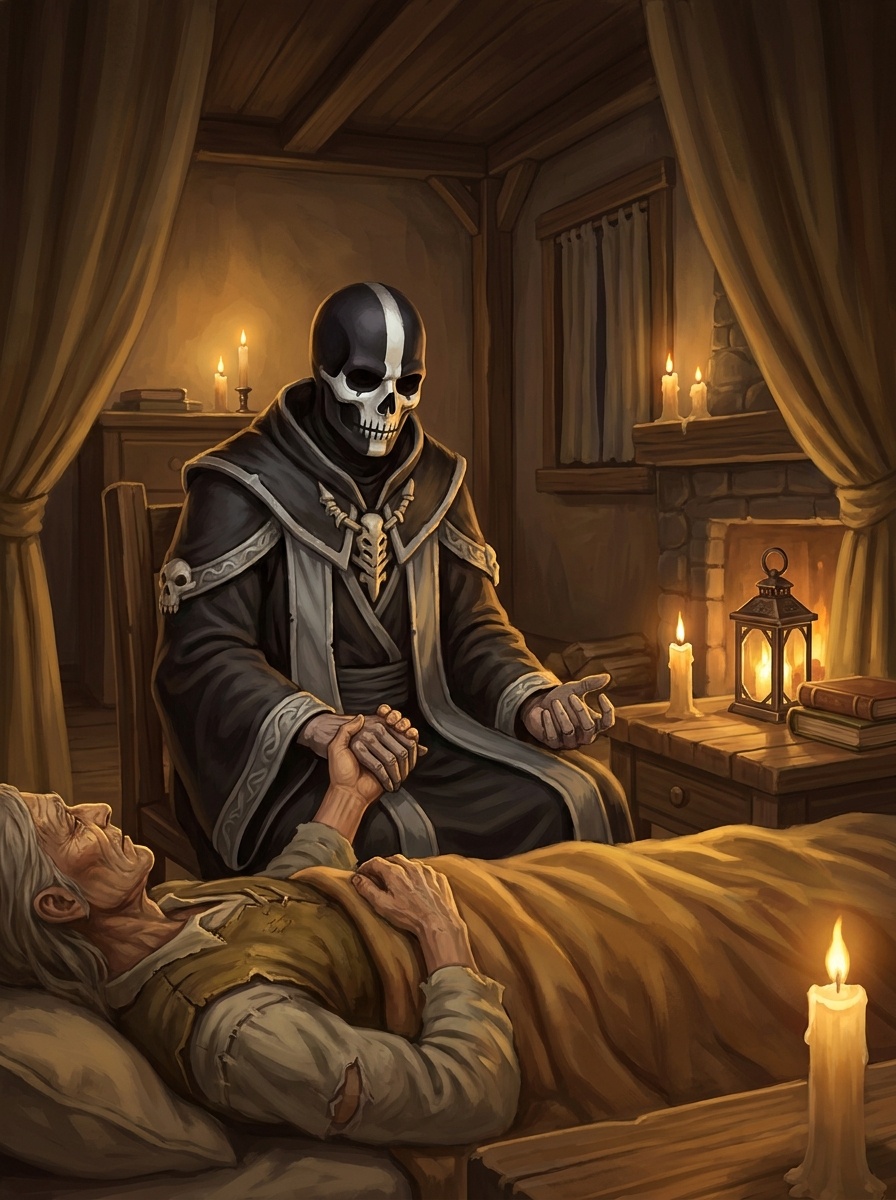
Divine magic deserves its own treatment because it is the access method most entangled with the rest of the setting.
The patron requirement. A player whose character casts in the Divine tradition must choose a patron deity at character creation. Most player characters choose from the Core Pantheon described in Chapter Ten, but the GM may approve a non-core patron if that deity has a clear profile, doctrine, clergy, and Forbidden Grant. This is not a flavor note. The choice is visible in the Shattered Domain, your devotion is legible to the divine politics described throughout this book, and it determines whose doctrine your character is bound to, whose rivals regard your character with suspicion, and whose coin your soul will eventually weigh into. A cleric of Themela and a cleric of Oshala are not two flavors of the same class. They have chosen sides in a live theological conflict, and the world treats them accordingly.
Portfolio shapes fiction, not the spell list, with one exception. A patron's portfolio does not restrict which Divine spells a character may learn, save for a single carve-out unique to each god: the Forbidden Grant described in Chapter Ten. That one prohibition aside, a cleric of any god draws on the full Divine tradition. Each deity refuses to empower the category of working that cuts against the deepest nerve of its nature; see each deity's What [God] Will Not Grant entry. The test is purpose, not loophole wording. A working that appears to brush a prohibition but plainly serves the god's deeper aim may still be permitted by the GM; a working that uses pious language to violate that aim does not open the channel. Beyond that line, what the portfolio governs is meaning and consequence. A Nyxollox death-keeper who uses divine power to ease a passing is acting squarely within the covenant. The same death-keeper using divine power in a way that violates the faith's core doctrine is straining the relationship that grants the power in the first place. The portfolio is the lens through which the god reads the cleric's choices.
Forbidden Grants also apply to combined traditions that include Divine. A Theomancy or Shamanism working cannot use its Arcana or Primal component to bypass the patron whose power is part of the spell.
Revocation is the teeth. Because the spell list is not portfolio-locked, the discipline of divine magic lives in the relationship, not in a restriction sheet. A god who concludes that a cleric has betrayed the covenant can make divine casting harder, narrow what the cleric can safely invoke, or finally close the channel. This is never a random failure and never a tax on ordinary casting. It is triggered by genuine, sustained doctrinal violation, judged by the GM from the deity's profile. Restoring a damaged or severed channel requires repentance, and may require a quest or absolution from a cleric who keeps a temple or shrine.
The cleric who carries this possibility plays differently from the mage who fears only running out of strain, and that difference is the entire point of choosing a divine path in Ix.
The GM Guide gives the full four-stage revocation track. In brief, revocation begins by adding Banes to affected divine workings, then narrows access to higher-tier spells, then suspends the affected channel, and can finally sever the relationship until the covenant is repaired in play.
Primal magic is source-limited. In places cut off from living natural sources or elemental relationship, sealed stone vaults, fully artificial interiors, Oshalan administrative districts scrubbed of wild growth, or areas warped by strong Dim proximity, the GM may add a Bane Die to Primal casting checks. This is a judgment call, not an automatic city penalty: a walled city with gardens, rivers, insects, and weather still gives a Primal caster something to answer.
Necromancy and the Death Taboo
This chapter includes Necromancy as a combined tradition, available to any caster who meets its Arcana and Primal prerequisites and buys the gating talent. It is a legitimate, learnable discipline: the careful study of endings, remains, and the stubborn memory of flesh. A village eventually needs someone who can speak to the buried, settle the unquiet, and tell a grieving family what really happened. That work is honorable.
Ix adds a theological charge that a generic setting does not. Death has a god, a priesthood, and a doctrine, and that doctrine is unusually unambiguous: pulling a soul back across the threshold traps it somewhere it was never meant to be, and that is cruelty regardless of intent. Nyxollox's faith treats undeath as a violation of the order of things, and the death-keepers train specifically to recognize and oppose those who traffic in it.
The Necromancy spell list in this chapter spans a wide range of practice, and most of it sits comfortably beside Nyxollox's work. The narrow, specific act of animating the dead or binding a soul against its passage is the line. The spell rules do not forbid crossing it; the cosmology condemns it, a priesthood hunts it, and the soul economy remembers it.
A necromancer in Ix is not automatically a villain, and a party should not assume the tradition is evil because a generic instinct says so. But a necromancer who raises the dead has made an enemy of an entire faith and has taken a position on one of the setting's load-bearing questions. Play that as the serious choice it is.
What Magic Is Not
Some effects in the world do not fit any of the four access methods. There are entities whose presence unravels minds, and creatures shaped by the Void whose mere proximity warps what is real. These are not a fifth kind of magic: no school teaches them, no plane a practitioner has learned to reach yields them, and no technique transmits them between people. What such entities do is a property of what they are, not a discipline anyone can study, practice, or buy with experience.
When a scholar encounters a phenomenon that does not draw from Arcana, does not invoke a deity, does not draw from an elemental plane, and is not the work of an Ancient, the explanation is almost never "a new kind of magic." It is either an entity operating outside mortal categories or something that has not yet been understood.
Magic Quick Reference
| Question | Where the Answer Lives |
|---|---|
| What does a spell do, cost, and risk? | Spell list in the second half of this chapter |
| Which traditions can my character cast? | Arcana, Divine, or Primal; see the mapping table above |
| Which characteristic do I roll with? | Arcana → Intellect; Divine → Willpower; Primal → Savvy. Combined traditions: highest of the paired characteristics (see table in this chapter) |
| How do combined traditions and High Magic work? | See the combined tradition casting rule and worked examples in this chapter; talent prerequisites in Chapter Seven |
| Do I need a patron to cast Divine spells? | Yes. Choose a core deity, or a GM-approved non-core deity with a clear doctrine |
| Can my patron take my magic away? | Yes, by revocation, for sustained doctrinal violation. GM-adjudicated, never random |
| Can a player character use Ancient magic? | No. It is not a mortal capacity |
| Why is wild planar transit so dangerous? | See the Rifts skill (Chapter Six) and planar travel (GM Guide Ch 5) |
| Are psychic or void powers a tradition? | No. They are properties of certain entities, and are out of scope here |
| How do I read a spell block? | See "Reading the Spell Block" in this chapter |
| What is Overload? | See "Overload" in this chapter |
| What is Dispel vs. Resist? | See "Dispel" and "Resist" in this chapter |
Casting Rules
Reading the Spell Block
The colored bar before each spell name marks the tradition of the spell.
- Single-color bars indicate a core tradition: Arcane, Divine, or Primal.
- Vertical gradients indicate a combined tradition: Theomancy, Necromancy, or Shamanism.
- Triple gradients indicate High Magic, drawing from all three traditions.
The pill row beneath the title is read left to right:
- Difficulty — the base difficulty of the casting check. Some spells begin with an upgraded Trial Die (red ), indicating an inherently unstable or dangerous working.
- Strain — how much strain the caster suffers when the spell is cast.
- Range — the maximum legal target distance.
- Duration — how long the effect remains active.
- Dispel — present only on non-instant spells; this is the base difficulty to end the spell early.
If a spell deals damage or behaves like a weapon, a second row appears:
- Damage · Crit · Qualities — resolved exactly as weapon profiles are resolved.
Each spell entry lists an Action type inside the spell block: Attack, Augment, Reveal, Bind, Curse, Conjure, Predict, Ward, Heal, Utility, and similar. All listed action types are Actions (costing your Action for the turn) unless the entry explicitly says otherwise. Spells marked as Maneuvers or Quick Actions will say so directly. If a spell description says "as a Maneuver" or "as a Quick Action," that overrides the default. When in doubt: if casting the spell would change the battlefield in a meaningful way or require concentration, it is an Action.
The Empower / Fallout section lists what extra symbols do. Most entries are positive (spend Boons for benefits). Some spells also list Bane-triggered entries: these describe what happens when Bane symbols appear in the result. They are penalties or complications, not optional spends. Apply them when the Bane symbols are present.
Casting a Spell: The Workflow
Spellcasting in Exodus follows the same sequence every time:
- Declare the spell. Choose the spell, confirm a legal target, and verify you meet all listed prerequisites.
- Build the pool. Take the spell's listed Difficulty, then add characteristic dice, Mastery upgrades, and situational modifiers.
- Choose Overload (optional). Before rolling, you may increase risk to increase output.
- Pay strain. Suffer the listed strain cost, modified by talents or effects.
- Roll the check. Resolve Success, Failure, Boon, Bane, Breakthrough, and Calamity.
- Resolve the base effect. On at least one net success, the spell functions.
- Spend Empower symbols. Spend matching symbols to trigger listed enhancements.
- Resolve fallout. Banes and Calamity create cost, complication, or consequence. If the spell has a Mishap entry, that entry describes the specific Calamity outcome for this working.
Every spell follows this order. Once learned, the format does not change.
Range and Duration Abbreviations
| Code | Meaning |
|---|---|
SELF |
Self |
TCH |
Touch |
ENG |
Engaged |
SHRT |
Short |
MED |
Medium |
LONG |
Long |
EXT |
Extreme |
INST |
Instant |
RND |
One round / until stated round endpoint |
ENC |
Encounter |
SCN |
Scene |
UTL |
Until ended / until condition is met |
Success, Empower, and Fallout
Every spell resolves in three layers.
Success determines whether the spell works.
If the roll produces at least one net success, the spell resolves and its base Effect occurs. If it does not, the spell fails and the base effect does not occur.
Empower determines how much more the spell does.
Empower entries are optional upgrades attached to the spell's result. If the spell succeeds, the caster may spend listed symbols from the roll to trigger any matching Empower effects. These are additive and stack onto the spell's base effect unless stated otherwise.
Fallout determines what the spell costs.
Banes and Calamity are the price of unstable power. They do not usually prevent the spell from functioning, but they often determine whether casting it was worth the cost. A spell's Mishap entry is its specific Calamity outcome: what happens to this particular working when a Calamity is rolled. Spells without a Mishap entry use the standard GM Calamity spend menu.
Strain & Difficulty
A spell's two primary costs are strain and difficulty.
Strain is the cost paid by the caster. It reflects mental effort, spiritual fatigue, bodily stress, and magical overextension.
- 1 Strain — minor workings, reflexive effects, cantrip-tier magic.
- 2 Strain — standard spellcasting; the default cost for most practical magic.
- 3–5 Strain — powerful, sustained, wide-reaching, or forcefully compressed effects.
Strain measures what the spell costs you.
Difficulty measures what the spell asks of the dice.
Difficulty rises when a spell exceeds what should be free at its tier: more damage, wider targeting, longer duration, stronger control, added utility, or effects that bend action economy or scene logic.
Difficulty measures what the spell costs the roll.
A low-difficulty spell may still be exhausting. A high-difficulty spell may be efficient but unstable. These costs are related, but not interchangeable.
Overload
Overload is how a caster pushes beyond the printed baseline.
Each spell lists one or more Overload options that may be chosen before the roll. Overload modifies the spell at cast-time by increasing difficulty, adding instability, or accepting a drawback in exchange for more output.
Overload is optional. It is not required to cast the spell.
Use Overload when the caster wants more: more damage, more range, more duration, more targets, or more force than the printed version safely provides.
When you choose an Overload option, add its Trial Die to the pool. Overload Trial Dice are added to whatever difficulty the spell already has; they do not replace existing Trial Dice. A Difficulty 2 spell with one Overload option selected becomes Difficulty 3 for that cast.
The spell block tells you what may be pushed. Overload tells you what it costs to push it.
Dispel: Ending an Active Spell
Any spell with a duration longer than Instant may be ended early.
The original caster may end their own active spell as an out-of-turn Quick Action at no cost.
Any caster may attempt to end the spell. The dispelling caster chooses any casting skill they possess (Arcana, Divine, or Primal) and makes a check against the spell's listed Dispel difficulty. Tradition does not restrict this: an Arcana practitioner can Dispel a Divine working and vice versa. The source of the dispel does not need to match the source of the original spell.
The dispelling caster suffers strain as normal for making the attempt.
When the spell was first cast, the original caster's net successes are added to its listed Dispel difficulty. A well-cast spell is harder to unravel than a barely-stable one.
On success, the spell ends immediately.
On failure, the spell remains active and the dispelling caster still pays the cost.
Dispel is external: one caster breaking another caster's work from outside the effect.
Resist: Breaking Free
Some spells may also be broken from within.
When a spell directly binds, compels, curses, or controls a target and remains active beyond the moment of casting, the target may attempt to throw it off.
The target suffers the spell normally through the round it was cast.
Beginning at the end of each of the target's turns thereafter, they may attempt the listed resist check as a Maneuver. Each spell names the resist skill directly; build the pool from that skill and its linked characteristic. The defaults by effect type are Discipline (Willpower) for mental compulsion, fear, domination, soul-adjacent effects, and divine compulsion; Fortitude (Might) for poison, pain, and bodily transformation; and Athletics (Might) or Reflexes (Agility) for physical restraint, depending on whether the target is forcing through or slipping free. When a spell offers no explicit skill, use the closest match to what the spell is actually doing to the target.
The difficulty of that check equals the caster's original net successes, minimum 1 and maximum 5.
On success, the spell ends.
On failure, the spell remains in effect.
Resist is internal: the target forcing the spell out from inside the effect.
A sustained spell may be ended either way: externally by Dispel, or internally by Resist.
Whichever succeeds first ends the effect.
Concentration
Some spells hold an active effect that requires the caster to maintain a mental lock on the working, continuously shaping and sustaining the spell rather than releasing it. These spells carry Concentration as their Duration.
What Concentration requires. While concentrating on a spell, you cannot cast another spell. You can still move, attack, use items, and take other actions, but the moment you cast a second spell, the first ends immediately. Only one Concentration spell may be active at a time.
Suffering Wounds. When you suffer Wounds while concentrating, whether from damage after Resistance or direct Wound loss, you must make a check to hold the working. Build a pool from the linked casting characteristic alone (Intellect for Arcana, Willpower for Divine, Savvy for Primal; for combined traditions, use the same characteristic you used to cast the spell) at a difficulty equal to the Wounds suffered (minimum 1 Trial Die, maximum 5). On success, the spell holds. On failure, it ends immediately.
Example: An arcanist with Intellect 3 suffers 4 Wounds while maintaining a Concentration spell. They roll 3 Ability dice against 4 Trial Dice. If they succeed, the spell continues. If they fail, it collapses.
Calamity ends it. Any Calamity on a roll while you are concentrating, whether the casting check itself or any subsequent roll, ends the Concentration spell immediately. No check is required; the working simply fails.
Breaking concentration by force. An attacker who scores a Breakthrough on an attack against a concentrating caster may spend that Breakthrough to collapse the spell instead of triggering a Critical Injury. This is a deliberate tactical choice: the attacker decides before the Breakthrough resolves whether they want the injury or the disruption.
Voluntarily ending. The original caster may end their own Concentration spell as a Quick Action at any time, at no cost.
Ritual Casting
Some workings can be performed two ways: cast in the moment, or worked slowly as a ritual. A spell that allows this carries a Ritual box, and that box is the rule: it states the extended casting time, any change to the spell's difficulty and Strain, the altered or expanded effect, and any requirements (a focus, a consecrated space, components, assistants, a particular hour).
Ritual casting trades speed for power and safety. The long working is almost never usable in structured play, but it typically lowers the casting difficulty, reduces or spreads the Strain, and reaches effects a snap-cast version cannot. A spell with no Ritual box cannot be ritualized, and the Ritual Tome focus (Chapter Eight) aids only casting checks made as rituals.
Cantrips & Apprentice Magic
The spells on the first page of each tradition's list are divided into Cantrips and Apprentice workings. Both require only Rank 1 in the relevant casting skill to access. The distinction is primarily narrative: cantrips are the quick, low-cost working (Strain 1), reflexive effects a practitioner reaches for without much effort. Apprentice spells are the first genuinely practical workings (Strain 2): real effects with real range and real consequences, but still within reach of a new caster. When you have Rank 1 in a casting skill, you have access to everything in both groups.
Arcane Cantrips
Arcane Bolt — Arcane
- Prerequisites: Arcana 1
- Action: Attack
- Effect: Hurl a compact bolt of raw force at one target within Short range. The bolt strikes as pure kinetic force and carries no elemental rider.
- Overload (): Increase damage by +2, or extend range to Medium.
- Empower: The target is pushed one range band directly away if Scale 1 or smaller · Add Knockdown
Auralight — Arcane
- Prerequisites: Arcana 1
- Action: Reveal
- Effect: For one round, the caster perceives the lingering aura of any magical effect within Short range, identifying its tradition (Arcane, Divine, Primal, Theomancy, Necromancy, Shamanism, or High Magic).
- Overload (): Range extends to Medium, or the caster also identifies the approximate strength of each detected aura (cantrip, journeyman, adept, or high magic).
- Empower: The caster identifies one specific magical effect by name · The caster perceives magical effects cast within the last hour even if no longer active · The caster senses the direction and approximate distance of the strongest magical effect within Long range
Conjure Spark — Arcane
- Prerequisites: Arcana 1
- Action: Conjure
- Effect: The caster summons a small mote of arcane light that hovers near them or perches on a worn item. The mote sheds light to Short range and follows the caster at engaged range. It can be directed by gesture to perch, hover, or float ahead within Short range.
- Overload (): The mote sheds light to Medium range, or it brightens when a living creature is within Short range of it (silent lifesign detector).
- Empower: The mote can be tinted any color · The mote is silent and undisturbed by wind or water · The mote can carry a small item up to encumbrance 1
Galvanize — Arcane
- Prerequisites: Arcana 1
- Action: Attack
- Effect: Make a melee spell attack against one engaged target. On a successful hit, the target cannot perform out-of-turn Quick Actions until the end of its next turn.
- Overload (): Add Stun 2, or increase damage by +2 against a target wearing metal armor.
- Empower: The caster may immediately disengage without spending a Maneuver · The target drops one unsecured held object
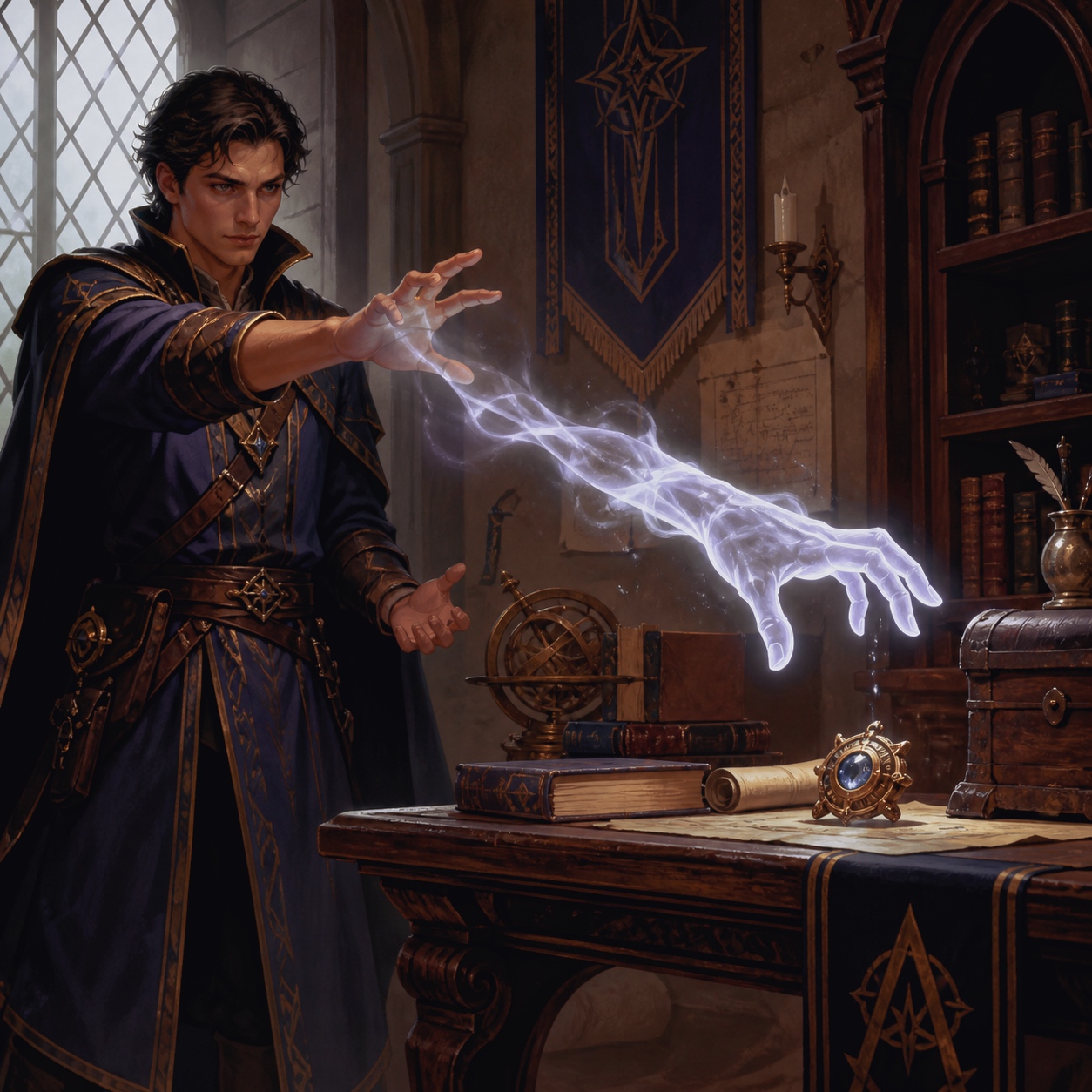
Helping Hand — Arcane
- Prerequisites: Arcana 1
- Action: Utility
- Effect: A spectral hand of force manipulates unattended objects up to encumbrance 1 within Short range. It cannot attack, but it may open doors, retrieve items, press switches, or use simple tools.
- Overload (): Increase the object limit to encumbrance 3, or extend range to Medium.
- Empower: The hand performs the task quietly · The hand becomes invisible for one round
Mirage — Arcane
- Prerequisites: Arcana 1
- Action: Utility
- Effect: Create a small image or simple sound within Short range. The illusion cannot cause damage, provide physical cover, or convincingly perform a complex action.
- Overload (): Increase the illusion to Scale 1, or allow both image and sound.
- Empower: Add to an ally's Stealth or Deception check using the illusion · The illusion persists until dispelled or caster moves past Medium range from the spell.
Parlor Tricks — Arcane
- Prerequisites: Arcana 1
- Action: Utility
- Effect: Perform a harmless minor trick within engaged range: clean or soil an object, chill or warm a small item, flavor food, light a candle, dampen a small sound, project a faint static image on a flat surface, tint cloth a different color, mark a surface, create a tiny sensory effect, or produce a small harmless spark. The effect cannot harm, cannot lift more than a quarter encumbrance, and is unmistakably magical to anyone watching closely. Instant effects remain, sensory effects last for the duration.
- Overload (): Affect all appropriate objects within Engaged range, produce two distinct tricks in the same cast, or extend a single trick's reach to Short range.
- Empower: Add to a related Charm, Subterfuge, or Deception check · The trick is precise enough to mimic a practiced artisan's small flourish · The next casual observer adds to checks made to recognize the affected object
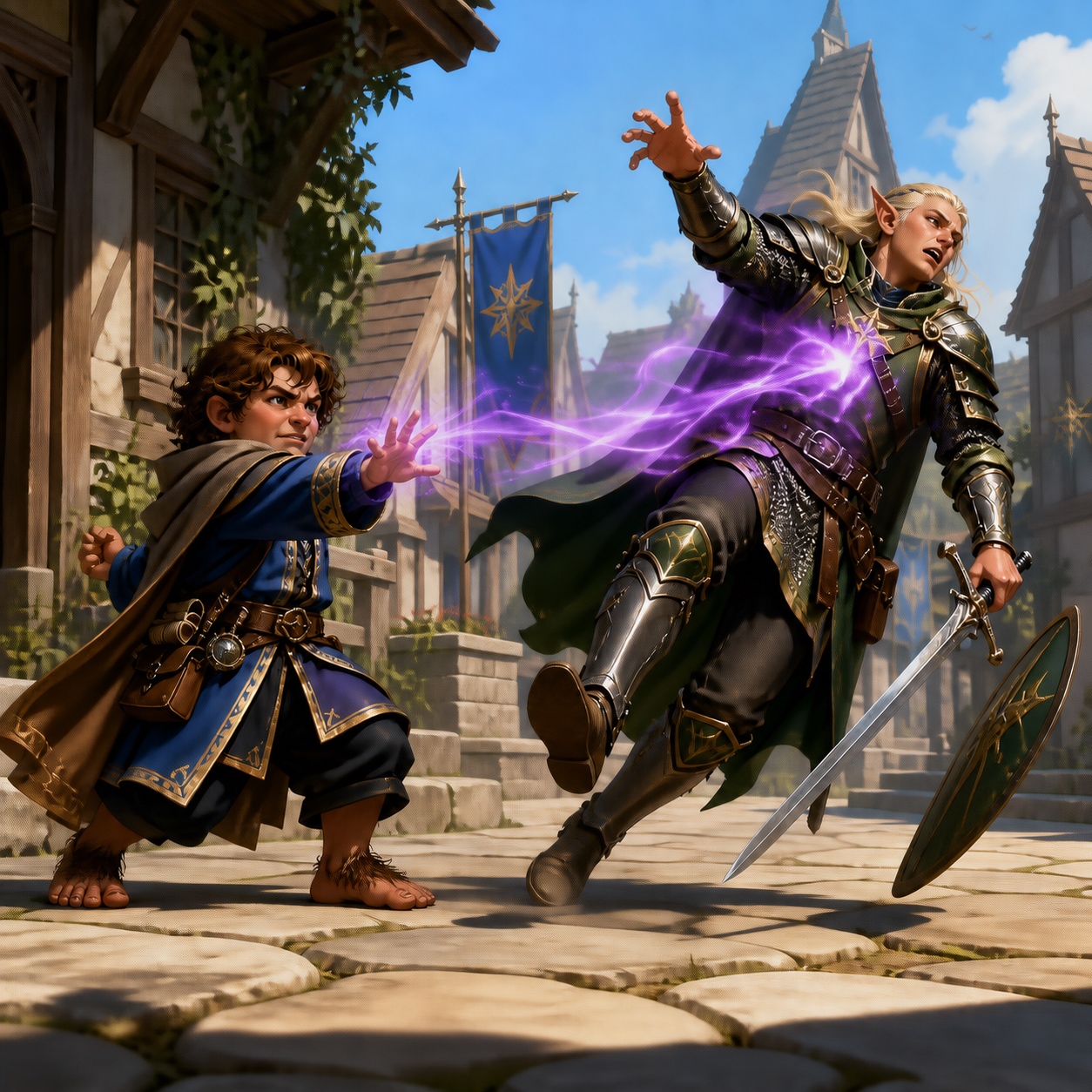
Drobo casts stumble on Elenvant
Pin — Arcane
- Prerequisites: Arcana 1
- Action: Bind
- Effect: One engaged target is pinned by arcane force. Until the end of the target's next turn, they cannot leave their current position, but they may otherwise act normally.
- Resist: The pinned target may attempt Resist (Athletics) as a Maneuver, per the convention above. Difficulty equals the caster's net successes.
- Overload (): The effect lasts two rounds, or the target also adds to Unarmed, Light Melee, and Heavy Melee checks while pinned (footwork denied).
- Empower: The next attack against the target adds to its attack pool · Each ally engaged with the target may add to their first attack against it before the end of this round · The pin has no fixed duration; it persists until the target succeeds at Resist (Athletics) or the spell is Dispelled
Stumble — Arcane
- Prerequisites: Arcana 1
- Action: Curse
- Effect: One target within Short range trips on nothing. Minion-tier targets gain the Prone condition. Non-minion targets add to their next check.
- Overload (): Affect Medium range, or the Bane Die persists across the next two checks.
- Empower: The target also drops one held item · The target's next attack against the caster adds
Whisper — Arcane
- Prerequisites: Arcana 1
- Action: Utility
- Effect: Send a brief whispered message to one creature within Medium range that the caster can see. The target hears the words as if whispered beside them.
- Overload (): The target may reply with a short whispered answer, or the message may pass around one corner or through one thin barrier.
- Empower: The message is inaudible to eavesdroppers · The caster may include a simple emotional impression or image
Whisper Veil — Arcane
- Prerequisites: Arcana 1
- Action: Augment
- Effect: For one round, sound made by the caster does not travel beyond engaged range. The caster may speak, fight, or move silently to ears outside the engaged zone.
- Overload (): The effect persists for one additional round, or also applies to one ally engaged with the caster.
- Empower: The caster also leaves no footprints for the round · The silent movement adds to Stealth checks · Hostile casters within Engaged range add to casting checks.
Divine Cantrips
Bulwark — Divine
- Prerequisites: Divine 1
- Action: Ward
- Effect: Ward one engaged ally against immediate harm. Until the end of their next turn, they add to one Fortitude, Discipline, or Reflexes check made to resist an effect.
- Overload (): The target also gains +1 Resistance against the next hit before the end of their next turn.
- Empower: The target recovers 1 strain after resisting the effect · The target may suppress one condition until the end of the next round. If the condition's duration extends past this, it returns.
Counsel — Divine
- Prerequisites: Divine 1
- Action: Augment
- Effect: Choose one engaged ally. Before the end of their next turn, they may add to one skill check.
- Overload (): Extend the range to Short, or let the target hold the blessing until the end of the encounter.
- Empower: The target also recovers 1 strain · The target may remove from the blessed check instead
Glance — Divine
- Prerequisites: Divine 1
- Action: Predict
- Effect: The caster glances at the immediate future. The GM tells the caster whether the visible circumstances favor or hinder the declared course of action.
- Overload (): The question may be about another creature's next action, or the caster gains a brief glimpse of a key detail in the next round.
- Empower: The caster adds to their next check, informed by the foresight · The glimpse reveals one specific obstacle or aid · The caster gains advance warning of an immediate threat; the next attack against the caster adds
Holy Spark — Divine
- Prerequisites: Divine 1
- Action: Attack
- Effect: Call down a flash of holy fire on one target within Short range. The attack ignores 1 Ranged Defense from cover, or removes 1 concealment-based Bane Die from attacks into darkness.
- Overload (): Increase damage by +2 against undead, demons, or creatures opposed to the caster's faith.
- Empower: The target glows faintly until the end of its next turn · Remove one concealment-based from the next attack against the target
Lesser Heal — Divine
- Prerequisites: Divine 1
- Action: Heal
- Effect: One engaged ally recovers 3 wounds.
- Overload (): The target recovers 5 wounds instead, or recovers 3 strain instead of wounds.
- Empower: The target also recovers 1 strain · The caster suffers 1 wound to channel an additional 2 wounds of healing · The caster perceives the target's current wounds and any active conditions
Light of Truth — Divine
- Prerequisites: Divine 1
- Action: Reveal
- Effect: An object or creature the caster touches sheds clear light out to Short range. Illusions, disguises, and concealment within Engaged range of the light suffer on checks to remain unnoticed.
- Overload (): The light extends to Medium range, or the anti-deception penalty applies within Short range.
- Empower: One ally in the light recovers 1 strain · The light reveals one hidden mark, trail, or clue the caster could reasonably perceive
Sanctified Light — Divine
-
Prerequisites: Divine 1
-
Required Focus: Holy symbol
-
Action: Utility
-
Effect: A floating mote of warm, sourceless light fills the air within Short range with bright illumination. The caster may move the mote up to Short range each turn as a free Quick Action. Suggested patron: Hesira for hearth-light, or Themela when the light is used for clarity, witness, and the exposure of concealment.
-
Overload (): The light is sacred. Undead and shadow-aligned creatures within Short range of the mote add to attacks they make against targets in the lit area, or extend the lit area to Medium.
-
Empower: Light is shaped (halo, lantern beam, shoulder-torch) · Mote follows a designated ally instead of the caster · Once during the encounter, mote flares; enemies Engaged with the mote add to one attack.
Stabilizing Heal — Divine
- Prerequisites: Divine 1
- Action: Heal
- Effect: Stabilize one engaged living creature that is incapacitated or dying. This does not heal wounds or remove critical injuries.
- Overload (): The target also recovers 1 strain, or the spell may be cast at Short range.
- Empower: The target adds to their next Fortitude check this encounter · One ally who sees the miracle recovers 1 strain
Wonderworking — Divine
- Prerequisites: Divine 1
- Action: Utility
- Effect: Manifest a harmless sign of divine presence: booming voice, flickering flames, tremors, slamming doors, glowing eyes, or another dramatic omen within Short range.
- Overload (): Affect a full room or small outdoor area, or make the manifestation convincing enough to startle mundane bystanders.
- Empower: Add to Intimidation, Leadership, or Charm using the display · Affected minions hesitate and suffer on their next action
Primal Cantrips
Some Primal spells list a non-casting-skill prerequisite alongside the Primal skill rank (for example, "Adventuring Lore 1"). This is intentional: certain Primal workings require genuine lived attunement to the natural world, not just magical technique. The knowledge skill reflects that the spell draws on something the caster has actually experienced and understood, not merely studied.
Gale — Primal
- Prerequisites: Primal 1
- Action: Utility
- Effect: Command a sharp burst of wind within Short range. The gust may shove light objects, scatter smoke, slam an unsecured door, or push one Scale 1 or smaller creature one range band if the casting check succeeds.
- Overload (): Affect all valid targets in engaged range of a chosen point, or increase the push to Scale 2.
- Empower: Remove one smoke, gas, or dust-based from an ally's next check · Inflict Prone on a flying minion or drive it off-course
Kindle — Primal
- Prerequisites: Primal 1
- Action: Attack
- Effect: Conjure a small flame in the caster's hand that sheds light to Short range. The flame does not harm the caster or their gear. The caster may immediately hurl it at one target within Short range as a fire attack, ending the spell, or hold it for later; while held, hurling it costs an Action.
- Overload (): Increase damage by +2, or the held flame may ignite unattended flammable objects without ending the spell.
- Empower: The flame burns clean: no smoke, no scorch, nothing ignites that the caster does not intend · Activate Burn 1
Mending Root — Primal
- Prerequisites: Primal 1
- Action: Utility
- Effect: Living fibers, rootlets, resin, bark, or natural growth repair a small break in a mundane object made of wood, leather, bone, cloth, or other once-living material.
- Overload (): Repair a larger object up to encumbrance 3, or repair one point of item damage to a suitable mundane item.
- Empower: The repair blends naturally and is difficult to notice · The repaired item gains on its next use before the end of the scene
Numbing Frost — Primal
- Prerequisites: Primal 1
- Action: Attack
- Effect: Snap-freeze the air around one target within Short range. If the attack succeeds, the target suffers on its next Unarmed, Light Melee, Heavy Melee, or Athletics check before the end of its next turn.
- Overload (): Increase damage by +2, or immobilize a minion target until the end of its next turn.
- Empower: The ground under the target becomes difficult terrain until the end of the round · Add Ensnare 1
Quickstep — Primal
- Prerequisites: Primal 1
- Action: Augment
- Effect: For one round, the cost to take a second Maneuver is reduced to 0 Strain (instead of the usual 2 Strain), and the caster ignores difficult terrain.
- Overload (): The effect lasts two rounds, or also applies to one ally engaged with the caster.
- Empower: The caster adds to their next Athletics or Reflexes check · The caster's movement counts as one range band greater this round · The caster may take one additional Maneuver this round at no strain cost, ignoring the normal two-Maneuver limit
Read the Wind — Primal
- Prerequisites: Primal 1, Adventuring Lore 1
- Action: Predict
- Effect: Caster takes a moment to read omens; bird-flight, tide-turn, the way the smoke curls. On the next Survival, Perception, or Readiness check the caster makes this scene, they add .
- Overload (): The bonus extends to one ally's check too, or the caster may apply the bonus to any check (not just the listed three).
- Empower: The bonus remains across two consecutive checks · Caster also senses whether hostile creatures lurk within Medium range (yes/no, no detail) · Caster intuits one truthful answer to a single factual question about local terrain or weather (GM volunteers).
Sproutshield — Primal
- Prerequisites: Primal 1
- Action: Ward
- Effect: Brief sprouts of bramble curl around the caster. Until the end of their next turn, the caster gains +1 melee defense.
- Overload (): The defense bonus also applies to one ally engaged with the caster, or the effect persists for one additional round.
- Empower: The caster adds to their next Fortitude check · The first creature that hits the caster with a melee attack takes 2 piercing damage from the brambles · The caster also gains +1 ranged defense for the duration
Thornlash — Primal
- Prerequisites: Primal 1
- Action: Attack
- Effect: Lash one target within Short range with a thorned vine. The caster may target an unattended object instead of a creature; on a hit, pull it one range band without damaging it. Against a creature, on a hit, the caster may pull a Scale 1 or smaller target one range band closer.
- Overload (): Add Ensnare 1, or affect a Scale 2 target with the pull.
- Empower: The target suffers on its next Athletics or Reflexes check · A pulled target arrives Prone
Trail Sense — Primal
- Prerequisites: Primal 1
- Action: Reveal
- Effect: Examine the ground, surface, or air within engaged range. The caster perceives the most recent passage of a creature within the last hour: a general type (human-sized humanoid, deer-like beast, large reptile), an approximate time, and the direction it went.
- Overload (): Sense passage from up to six hours ago, or also perceive the creature's emotional state at the time.
- Empower: The caster adds to their next Survival check tracking the creature · One identifying detail surfaces (a limp, distinctive footwear, unusual weight) · The caster perceives whether the creature was wounded, fleeing, or carrying something heavy
Wildlore — Primal
- Prerequisites: Primal 1
- Action: Utility
- Effect: Produce a minor natural sign: a tiny bloom, leaf-fall, faint animal sound, weather-sense, seed sprout, natural scent, or harmless elemental twitch.
- Overload (): Ask the local environment one simple yes/no question about weather, nearby animals, water, or recent passage.
- Empower: Add to a related Survival or Adventuring Lore check · The sign points toward the safest immediate natural path
Journeyman Spells
Arcane Journeyman
Counterspell, Lesser — Arcane
- Prerequisites: Arcana 2, Lore 1
- Action: Dispel (Reactive)
- Effect: As an out-of-turn Quick Action when an enemy caster within Short range begins to cast a spell, the caster makes their Counterspell check (paying the strain). If the caster's net successes equal or exceed the enemy's net successes from the cast in progress, the enemy spell fizzles entirely (the enemy still pays strain). This spell can only counter spells of casting difficulty 3 or lower.
- Overload (): Counter spells of casting difficulty 4 or lower; or on the caster's turn, spend a Maneuver to ready this counterspell; it may then trigger as an out-of-turn Quick Action at any point until the start of the caster's next turn.
- Empower: Caster recovers 1 strain · Caster's next casting check this encounter adds · The countered caster suffers 2 strain from feedback · Caster suffers 1 additional strain.
Force Darts — Arcane
- Prerequisites: Arcana 2, Intellect 2
- Action: Attack
- Effect: Launch three force darts at one or more targets within Medium range. Make one attack roll and apply it to each chosen target. Distribute the 6 force damage freely among all struck targets before applying Resistance; each target receives at least 1.
- Overload (): Add 2 to the damage pool, or extend range to Long.
- Empower: +1 damage · Add Accurate 1 · One additional target within range may receive a share of the damage
Glimpse — Arcane
- Prerequisites: Arcana 2, Intellect 3
- Action: Predict
- Effect: The caster glimpses one possible immediate future. Before their next check this turn, the caster may add or remove one (their choice). If the check has not been made by the end of their next turn, the foresight fades.
- Overload (): An ally engaged with the caster benefits instead, or the foresight applies to a check made within the next round.
- Empower: The caster also recovers 1 strain · The check benefits from both and -removal · The caster gains advance warning of one ambush, trap, or surprise within Short range
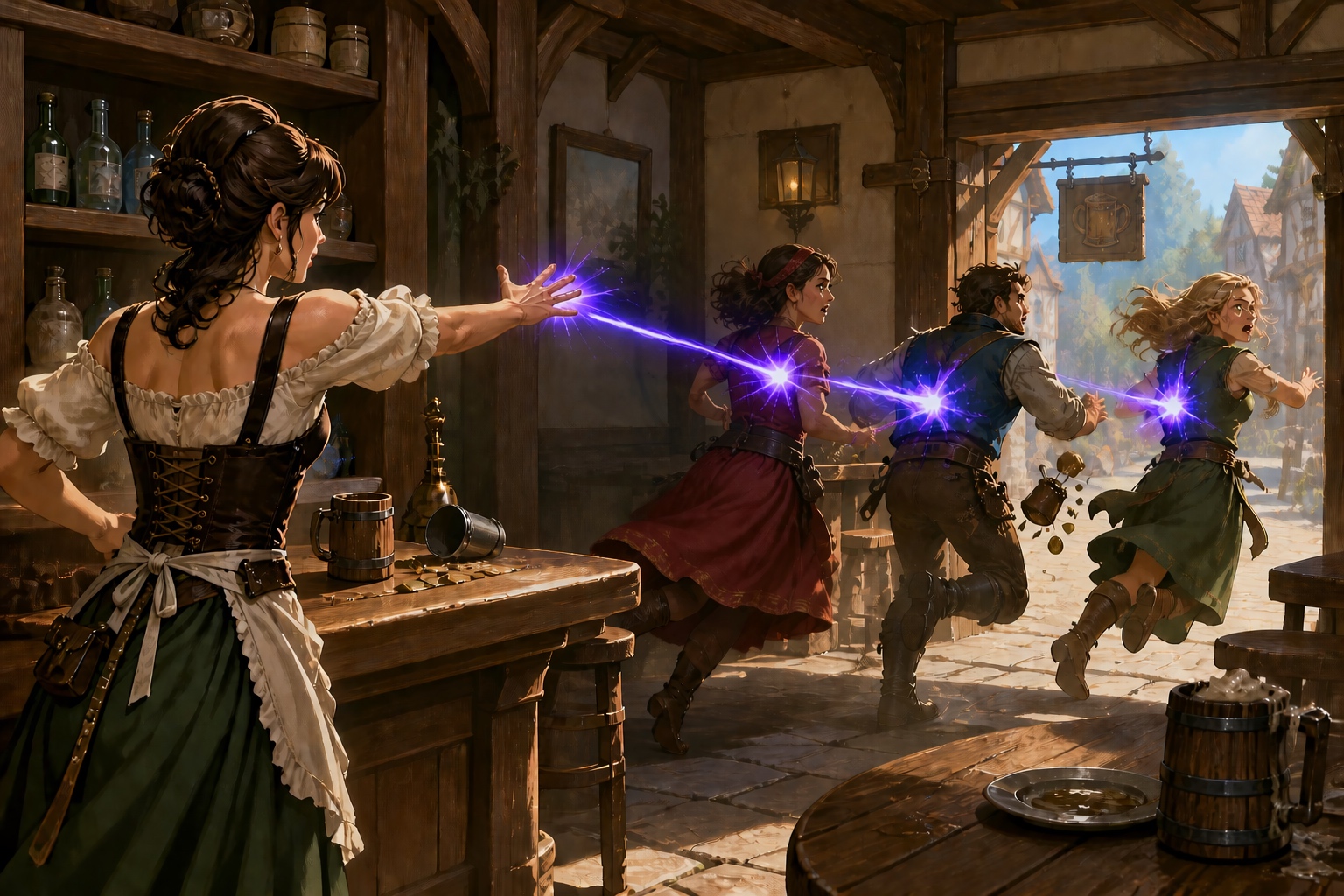
Dashers get Force Darts
Jinx — Arcane
- Prerequisites: Arcana 2, Savvy 2
- Action: Curse
- Effect: One target within Short range is jinxed for the duration. The target adds to the next three checks they make. Once three checks have suffered the Bane, the spell ends.
- Overload (): The jinx persists for five checks instead of three, or attacks against the target add while the target is jinxed.
- Empower: The target's first jinxed check adds 2 instead of 1 · The caster adds to their next attack against the jinxed target · When the jinx triggers, the target audibly mutters one minor truth (a name, a recent location, an obvious motive)
Slowfall — Arcane
- Prerequisites: Arcana 2
- Action: Augment
- Effect: Cast as an out-of-turn Quick Action when one creature within Short range begins to fall. The target descends gently and takes no damage from the fall, regardless of distance.
- Overload (): Affect up to three falling creatures within Short range, or the target may glide one range band horizontally during the descent.
- Empower: The target lands ready to act (no Maneuver needed to stand) · The spell may be cast at Medium range · The slowfall extends to allies engaged with the target as they land
Sparkbolt — Arcane
- Prerequisites: Arcana 2, Intellect 2
- Action: Attack
- Effect: Hurl a snapping shockwave of compressed air and arcane force at one target within Short range. The bolt deals 7 sonic damage; the deafening clap rattles the target with Disorient 1.
- Overload (): +2 damage, or extend range to Medium.
- Empower: +1 damage · Add Stun 1 · Disorient 1 increases to Disorient 2 · Caster suffers 1 strain
Unraveling — Arcane
- Prerequisites: Arcana 2, Secret Lore 2
- Action: Dispel
- Effect: Choose one active magical effect within Short range. The caster makes a casting check against the spell's listed dispel pool; on success, the spell ends.
- Overload (): Affect Medium range, or also dispels one minor magical residue (lingering aura, recent charge) within engaged range.
- Empower: The caster identifies the original tradition of the dispelled effect · The caster recovers 1 strain on a successful dispel · If the dispelled spell had less than encounter-duration remaining, the caster gains on their next casting check
Wardlock — Arcane
- Prerequisites: Arcana 2, Intellect 2
- Action: Ward
- Effect: Seal one door, chest, gate, or similar object you touch with a visible or invisible arcane ward. Mundane attempts to open it add .
- Overload (): Extend duration to one day, or affect one additional lockable object.
- Empower: Designate one creature who may open it freely · The ward becomes invisible · Add one to forced entry attempts
Watcher's Eye — Arcane
- Prerequisites: Arcana 2, Intellect 2
- Action: Predict
- Effect: A tiny invisible eye manifests at any point within Medium range that the caster can see, or has personally visited and can accurately visualize. For one round the caster sees through the eye as a free Quick Action on their turn (eyes-closed perception). The eye is fixed where placed; it cannot move on the base spell. Observers must succeed on a Hard () Perception check to notice it.
- Overload (): Eye persists for the encounter (treat as ENC, Dispel ); or the caster may move it up to Short range each turn as a free Quick Action.
- Empower: Add 1 round to the duration · The eye also hears (faintly) · The next ally to act on what the caster sees adds to that check · The eye catches something wrong; the caster either suffers 1 strain from the shock, or an observer within Short range of the eye senses its presence (GM chooses which).
Divine Journeyman
Bone Heal — Divine
- Prerequisites: Divine 2, Willpower 2
- Required Focus: Holy symbol
- Action: Heal
- Effect: Lay hands on an engaged ally. Target heals wounds equal to net generated, minimum 1, to a maximum of 5. Suggested patron: any deity of restoration or mercy (e.g., Jusannia).
- Overload (): Target also recovers 1 strain, or the cast may attempt to remove a Critical Injury (treat as the Medicine action at one step easier).
- Empower: +1 wound healed · Heal an additional engaged ally for the same amount · Target adds to their next check this encounter · Caster suffers 1 strain.
Cleanse — Divine
- Prerequisites: Divine 2, Willpower 2
- Action: Heal
- Effect: Remove one active condition from one target within Short range. This spell ends any single condition listed in the Conditions table (Staggered, Disoriented, Immobilized, Prone, Silenced, Restrained, Bleeding, Immolation, or Hidden) as well as any condition imposed by a Boon spend, Critical Injury, or talent effect. It does not remove conditions that are part of a sustained spell's ongoing effect; those require Dispel. It does not remove Critical Injuries, which are injuries rather than conditions.
- Overload (): Remove conditions from two targets within Short range, or also grant the cleansed target on their next check as the clarity settles.
- Empower: The target recovers 1 strain as the burden lifts · Remove one additional condition from the same target · The target is also immune to the same condition type until the end of their next turn
Compel — Divine
- Prerequisites: Divine 2, Willpower 3
- Action: Bind
- Effect: Speak a single-word command to one creature within Short range that shares a language with the caster. Until the end of the target's next turn, they must obey: drop, freeze, flee, kneel, halt, or approach. The target may resist with a Discipline check opposed by the casting if the command would cause obvious self-harm.
- Overload (): Affect a second target with the same command, or extend duration to two rounds.
- Empower: The target must spend a Maneuver to stand again after Drop or Kneel · The command persists if the target is engaged with the caster · The target also drops one held item · The caster's voice cracks; they suffer 1 strain
Foreseen Wound — Divine
- Prerequisites: Divine 2, Savvy 2
- Action: Predict
- Effect: The caster sees a momentary glimpse of an incoming attack. Until the end of their next turn, the caster may add to one incoming attack against them; their choice of which attack.
- Overload (): The effect applies to one ally engaged with the caster instead, or the caster may add to two incoming attacks before the end of their next turn.
- Empower: The caster gains on Discipline checks against the foreseen attacker · If the foreseen attack misses, the caster's next attack against that attacker adds · The foresight also reveals the attacker's general intent (target, weapon, type of attack)
Halo of Resolve — Divine
- Prerequisites: Divine 2, Willpower 2
- Required Focus: Holy symbol
- Action: Augment
- Effect: Choose one ally engaged with the caster. For the encounter, the target adds to all Discipline, Readiness, Perception, and Fortitude checks. Suggested patron: any deity of courage, oaths, or the watch (e.g., Pollaran, Thulgard).
- Overload (): The bonus extends to Charm and Leadership too (the halo becomes a presence aura), or affects two engaged allies instead of one.
- Empower: Target may immediately recover 1 strain · The target adds to Fear checks this encounter · The halo flares once as a Quick Action; enemies Engaged with the target add to one attack against that target.
Lash of Light — Divine
- Prerequisites: Divine 2, Willpower 2
- Action: Attack
- Effect: A whip of golden light strikes one target within Short range, dealing 6 radiant damage. The target adds to its next check from the temporary blindness.
- Overload (): Damage increases by +3, or the target also drops one held item.
- Empower: +1 damage · Stun 1 → Stun 2 · Adds Pierce 2 against undead and fiends

Galorn heals Slara and Hanrl
Reactive Heal — Divine
- Prerequisites: Divine 2
- Action: Heal (Out of Turn)
- Effect: Cast as an out-of-turn Quick Action at any point during a turn. One ally within Medium range recovers 4 wounds.
- Overload (): The target recovers 6 wounds instead, or also recovers 1 strain.
- Empower: The caster also recovers 1 strain · The healing reaches a second ally engaged with the first (3 wounds) · The healing also clears one condition that would end at the start or end of the target's next turn (such as Staggered)
Saint's Voice — Divine
- Prerequisites: Divine 2, Charisma 3
- Action: Augment
- Effect: One engaged ally's words carry divine resonance. Their next Charm, Intimidation, Leadership, or Negotiation check adds and removes one .
- Overload (): Affect two allies, or the effect persists across the next two checks.
- Empower: The GM reveals one minor objection a listener holds that the speaker can now address · One ally who hears the words recovers 1 strain · The next Discipline check by one hostile listener within Short range adds (caster's choice of target)
Spirit Whisper — Divine
- Prerequisites: Divine 2, Willpower 2
- Action: Utility (Mental)
- Effect: The caster sends up to three short messages of silent thought to one creature within Medium range whom they have personally met. Full sentences only; no images. The transmission is one-directional on the base spell. The link cannot pierce magical mental wards. The recipient knows whose mind reaches them.
- Overload (): Link lasts the encounter (treat as ENC, Dispel ), or extends to two creatures simultaneously.
- Empower: One brief image accompanies the words · The recipient may reply with up to three messages of their own · The recipient's emotional state is faintly conveyed alongside the words · The link bleeds; anyone within Engaged of the recipient overhears one fragment (GM chooses which).
Steady Hand — Divine
- Prerequisites: Divine 2, Willpower 2
- Action: Augment
- Effect: Bless one engaged ally's next ranged attack made before the end of their next turn. The attack adds and gains Pierce 1 on the hit.
- Overload (): Affect two allies, or the effect persists for one additional turn.
- Empower: The attack ignores one · A successful hit means the next attack against that target before the end of its next turn adds · If the attack causes a Critical Injury, add +10 to that Critical Injury roll
Truthsight — Divine
- Prerequisites: Divine 2, Willpower 3
- Action: Reveal
- Effect: For the duration, the caster detects deliberate falsehoods spoken within Short range: statements the speaker believes are false. Omissions, honest mistakes, figurative speech, and technically-true evasions do not register. Magical disguises and illusions add on attempts to mislead the caster.
- Overload (): Range extends to Medium, or the caster can pierce one specific magical disguise, seeing the true form beneath.
- Empower: The caster adds to Charm or Intimidation checks that follow up on a detected lie · The caster reads broad emotional state (calm, fearful, angry, guilty) from each speaker; fine distinctions between similar states may be unclear · The caster gains advance warning if a creature within Short range is about to initiate violence before the end of the current round
Primal Journeyman
Bloom Heal — Primal
- Prerequisites: Primal 2, Willpower 2
- Action: Heal
- Effect: Living tendrils briefly bloom around one engaged ally. The target recovers 4 wounds immediately and 2 more wounds at the start of their next turn.
- Overload (): Affect a second engaged ally with the same healing, or the healing also removes one -imposing condition.
- Empower: The initial heal increases by 2 wounds · The target also recovers 1 strain · The blooming reveals one hidden ally or unconscious creature within Short range
Bramble Snare — Primal
- Prerequisites: Primal 2, Adventuring Lore 1
- Action: Curse
- Effect: Vines, roots, or thorned creepers lash up beneath one target within Short range. Until the end of the target's next turn, the target adds to all Athletics, Reflexes, and Unarmed checks. (Base duration is one round; the target rides it out; no resist roll on the base spell.)
- Overload (): Up to 2 targets within Short, or duration extends to 2 rounds, when extended, the target may attempt Resist (Athletics) at the end of round 1 per the convention above.
- Empower: Bane becomes · Target also gains Prone · The terrain remains difficult for the encounter (Short-range patch) · Caster's footing tangles too; caster adds to their next physical check.
Earthbind — Primal
- Prerequisites: Primal 2
- Action: Bind
- Effect: One target within Short range is pulled to the ground by gravity-strong primal magic. A flying or hovering target descends harmlessly to ground level and cannot rise; a grounded target adds to Athletics or Reflexes checks until the end of their next turn.
- Overload (): The effect lasts two rounds, or the descent is not harmless; a flying target takes 2 falling damage per range band it fell.
- Empower: Nearby rocks ripple; the caster gains on their next Survival check · The target also suffers Ensnare 1 · The caster's next Athletics check this scene adds
Howl — Primal
- Prerequisites: Primal 2, Willpower 3
- Action: Curse
- Effect: The caster lets out a primal howl. All hostile creatures within Short range must succeed on a Discipline check opposed by the casting or add to all checks until the end of their next turn. Minion-tier targets cannot oppose; they automatically suffer the Bane and may not move closer to the caster on their next turn.
- Overload (): Affect Medium range, or the duration extends to two rounds for those who failed.
- Empower: One affected minion immediately drops one held weapon · One affected creature of any tier drops one held weapon from the shock · One ally engaged with the caster gains on attacks against an affected creature
Stonebark — Primal
- Prerequisites: Primal 2, Might 2
- Action: Barrier
- Effect: Caster's skin hardens to bark, scale, or rough stone (player's choice; descriptive only). For the encounter, the caster gains +1 Resistance.
- Overload (): Effect extends to one ally engaged with the caster at cast time, or gain +1 melee defense in addition to the Resistance.
- Empower: First incoming hit gains an extra +1 Resistance (then back to baseline) · Caster adds to Fortitude checks while the spell is active · The hardening cracks: caster adds to Reflexes checks for the encounter.
Summon Pack-Mate — Primal
- Prerequisites: Primal 2, Adventuring Lore 1
- Action: Conjure
- Consumed Material: A small offering of fresh meat, bone, or blood (10 sf or freely sourced in the field); placed on the ground as the spirit is called. The offering gives the spirit a reason to answer. A primal caster in the field can always find something suitable; in a city, a butcher's offal suffices.
- Effect: Caster calls a small spirit-bound creature to their side. The Pack-Mate manifests as a Minion with the following stats: MIG 1, AGI 2, INT 1, SAV 1, WIL 1, CHA 1; Resistance 1, Wounds 4. Skills: Perception 2, Stealth 2, Unarmed 1. Bite: Unarmed, 2 dmg, Crit 5, Engaged. The Pack-Mate acts on the caster's initiative; the caster spends a Maneuver to direct it, otherwise it stays Engaged with the caster and takes no offensive action unless directly attacked. Lasts the encounter or until destroyed.
- Overload (): Summon a hardier form (MIG 2, Wounds 6, Bite 4 dmg Crit 4), or summon two basic Pack-Mates instead of one.
- Empower: Pack-Mate gains +1 Resistance this encounter · The first single-target attack against the caster that the Pack-Mate could physically intercept instead targets the Pack-Mate · Pack-Mate adds to caster's next Survival or Perception check based on its senses · Pack-Mate is hostile to one specific ally for one round (claims them as prey).

Yulk howls, driving the orcs back
Sweep — Primal
- Prerequisites: Primal 2
- Action: Attack
- Effect: A surge of wind sweeps through Short range, striking up to two targets. Make a separate attack roll against each target. The attack has Knockdown.
- Overload (): Damage increases by +2, or the sweep affects a third target.
- Empower: One hit target drops one held item · Hit targets are pushed one range band away from the caster · Hit targets add to their next attack
Adept Spells
Arcane Adept
Fly — Arcane
- Prerequisites: Arcana 3, Intellect 3
- Action: Augment
- Effect: Grant one touched creature the ability to fly at normal movement speed for the duration. Use the Flying Characters rules in Chapter Thirteen for endurance, hover, disruption, and stealth while airborne.
- Overload (): Affect one additional target, or the target may move one additional range band when taking a Move Maneuver while flying.
- Empower: Hover without movement · Ignore difficult terrain while airborne · Gain +1 ranged defense while flying
Invisibility — Arcane
- Prerequisites: Arcana 3, Savvy 2
- Action: Augment
- Consumed Material (optional): A pinch of powdered moonstone (1 gf); adds to the casting check. The lunar mineral's light-scattering properties amplify the working's reach. Standard casting functions without it.
- Effect: One touched creature becomes visually invisible until the duration ends, or until it makes an attack or casts a hostile spell. While invisible, the creature may attempt to become Hidden even in plain sight when observers rely on vision; sound, scent, tracks, and contact can still reveal it.
- Overload (): Affect one additional target or extend duration to Scene.
- Empower: Remove from Stealth · Muffle footfalls and gear · Spell does not break on one Quick Action interaction (opening a latch, drawing an item, passing an object)
Mirrored Mind — Arcane
The caster reads the surface thoughts, active intentions, and immediate plans of one engaged target for the duration. The target may attempt to notice the probe with a Discipline check opposed by the caster's net successes; on success, the target becomes aware they are being watched. The target adds on attempts to deceive the caster verbally.
The caster also experiences faint emotional resonance from the target, moods, fears, and lies feel like background noise that won't quite quiet.
- Reach Further (): Range extends to Short.
- Stealthy Probe (): The target does not notice the surveillance even on a successful Discipline check.
- Deep Probe (→): The caster also reads short-term memory; significant events from the past hour.
- Caster gains on Charm or Deception checks against the target.
- Caster identifies the target's strongest current desire.
- Caster identifies one creature the target has interacted with in the past day.
- Caster suffers 1 strain.

Gerra flying over the city
Servitor — Arcane
- Prerequisites: Arcana 3, Intellect 3
- Action: Conjure
- Consumed Material: A small clay figure and a pinch of copper dust (1 gf total); the clay collapses to powder as the construct forms. The shape of the figure determines the servitor's appearance. A practitioner who keeps a pouch of prepared clay figures and dust never lacks for this.
- Effect: A small construct of arcane energy appears engaged with the caster. The servitor has Resistance 1, 5 wounds, Scale 0, and may carry encumbrance 3. It performs simple manual tasks (open doors, fetch items, light torches, hold a rope) on the caster's command. It cannot attack, but it may aid an ally engaged with it; adding to one Athletics or Craft check per round.
- Overload (): Conjure two servitors that share initiative, or the servitor's carry limit becomes encumbrance 6.
- Empower: The servitor performs its task one round faster than usual · The servitor is silent and unobtrusive (allies gain on Stealth checks using it) · The servitor persists for one additional encounter at no extra strain
Slow — Arcane
- Prerequisites: Arcana 3, Intellect 3
- Action: Curse
- Effect: Up to three targets within Medium range move and react as if time drags around them; affected targets add to checks and cannot take a second Maneuver. Significant unwilling targets may attempt Resist (Discipline or Reflexes) at the end of each of their turns, at difficulty equal to the caster's net successes; on success, the slow effect on that target ends.
- Overload (): Affect one additional target or extend duration to Scene.
- Empower: Add one additional to one target · One target cannot perform out-of-turn Quick Actions until the start of their next turn · One target is Staggered for one round
Veil of Disguise — Arcane
The caster's outline shimmers and resettles as a different humanoid of similar size and build. Voice timbre, gait, and small mannerisms must still be played by the caster; the spell does not provide skill at impersonation, only the visual frame. Observers within Engaged range who have reason to suspect deception may roll Perception opposed to the caster's casting result to see through the veil; observers at Short or further must rely on what they see and hear.
One worn or carried item is also disguised; a battered sword reads as a cane, a holy symbol as a merchant's seal, an obvious wand as a quill. The disguised item still functions normally; only its appearance is changed.
- Voice Match (): The caster's voice also conforms to the disguise; accent, pitch, and timbre. Useful when impersonating someone the listener has met.
- Cross-Frame (): Disguise crosses one size or build category; appearing as a Small humanoid while Average, or as a heavily-built warrior while slight. The frame mismatch imposes to Athletics checks while maintaining an extreme build.
- Quick-Cast (→): Replace one Trial Die with a Crisis Die. On success, the cast becomes a Maneuver instead of an action; useful when caught mid-encounter.
- The veil persists for the scene rather than the encounter (extending only out-of-combat).
- The first observer to actively study the caster adds to their Perception check.
- A specific named individual the caster has seen is matched closely enough to fool casual recognition.
- The veil flickers under stress; the caster adds to social checks while disguised.

Lissa under the Veil of Disguise speaking to the city
Veil-Walk — Arcane
- Prerequisites: Arcana 3, Agility 2
- Action: Utility (Movement)
- Effect: Caster vanishes in a swirl of pale mist and reappears at any point within Short range they can see. The teleport does not provoke disengage actions, and ignores intervening difficult terrain or low obstructions. Caster may bring carried items but no other creatures.
- Overload (): Range becomes Medium, or one ally engaged with the caster at the moment of cast comes along.
- Empower: Caster gains +1 melee defense against the next attack they suffer this round (mist trail confuses) · The next attack against the caster this round adds · Caster may take a Maneuver immediately after the teleport at no additional strain · The mist clings; caster adds to their next Stealth check.
Divine Adept
Far Voice — Divine
- Prerequisites: Divine 3, Willpower 3
- Action: Utility
- Effect: The caster speaks to one specific creature they have personally met. The target hears the message (up to 25 words) as if whispered beside them, regardless of distance, including across planes. The target may ignore the message and is never compelled to reply; if willing, they may reply with the same word limit immediately.
- Overload (): Message length doubles to 50 words, or the caster may receive a second reply within the next minute.
- Empower: The reply is also visible to the caster as a brief mental image · The caster senses the target's general emotional state · The caster senses the direction of the target if within the same plane
Sanctified Word — Divine
- Prerequisites: Divine 3, Willpower 3
- Action: Banish
- Effect: All undead and infernal beings within Short range are repelled. On each affected creature's next turn, it must spend its first available Maneuver to move at least one range band away from the caster, if able. Those that cannot move take 6 radiant damage. Minion-tier targets that cannot retreat are destroyed outright.
- Overload (): Affect Medium range, or damage to non-retreating creatures increases to 9.
- Empower: Affected creatures add to their next attack · The caster also recovers 2 strain · Affected creatures cannot perform out-of-turn Quick Actions on the next round
Revive — Divine
Call a recently departed soul back from Sheol's waiting halls. The target must have died within the last 24 hours: their soul has entered Sheol and awaits judgment, but has not yet been processed. When the soul hears the call, it may return.
The caster must have personally met the target. You cannot revive a stranger whose name you do not know; the call requires recognition to reach.
On a successful cast, the target returns at 1 Wound with all strain cleared. They retain any Critical Injuries they had at death; these must still be treated normally. If the target died from a Killed result (141–150), Revive returns them alive but that injury is reduced to Lights Going Out (131–140) and still requires immediate treatment before the start of their next turn. The trauma of crossing back reduces the target's maximum strain by 2 until they complete a full week of rest.
Death in Dort is not instantaneous passage. Sheol, the plane of the dead, runs like a bureaucracy; souls queue, petitioners are logged, and the paperwork of eternity moves at its own pace. A newly dead soul waits in the outer halls of Sheol for up to a day before their case is called before a death-priest and judgment is rendered. In that window, the soul is findable. After judgment, it has moved deeper; processed, filed, and no longer reachable by this working.
- Stronger Call (): A gem worth 250+ gf is used instead. The casting check gains , representing a more substantial offering to the powers of passage.
- The target returns at 3 wounds instead of 1.
- The trauma is gentler; maximum strain reduction is only 1 instead of 2.
- Remove one Critical Injury from the returned character at the moment of revival.
- The caster suffers 2 strain from the effort of bridging the veil.
- The soul comes back disoriented; the target is Staggered for the remainder of the encounter and adds to all checks until they complete a full rest.
Divine Strike — Divine
- Prerequisites: Divine 3, Willpower 3
- Action: Attack
- Effect: Call down a focused bolt of divine judgment on one target within Medium range. The bolt carries the weight of the patron's doctrine; against undead, infernal beings, or targets who have directly violated your patron's Forbidden Grant domain this encounter, increase damage to 14.
- Overload (): Extend range to Long, or the attack also damages an additional target engaged with the primary target for half the rolled damage (before Resistance).
- Empower: The target is Disoriented until end of its next turn · The attack ignores 2 Resistance · The target cannot take out-of-turn Quick Actions until the start of your next turn; witnesses of the patron's faith who see the strike recover 1 strain
Condemn — Divine
- Prerequisites: Divine 3, Willpower 3
- Action: Judgment
- Effect: Mark one target within Medium range with divine censure. Until the end of your next turn: the target cannot benefit from cover or concealment (divine sight cuts through both), the target's attacks add , and any ally who attacks the marked target adds . The target may attempt a Hard Discipline check to resist; on success, they shrug it off as arrogance. On failure, they know they are marked.
- Overload (): The effect lasts two rounds, or extend range to Long.
- Empower: The target cannot use two Move Maneuvers during one turn while condemned · One ally within Short range of the target may immediately make an out-of-turn Quick Action attack against them · The condemnation is visible to all: a faint aura of censure others can see, giving allies the Boon Die benefit without knowing they are in the pattern
Faith's Shield — Divine
- Prerequisites: Divine 3, Willpower 3
- Action: Ward
- Effect: Choose up to three allies within Short range (including yourself). For the duration of the encounter, each protected ally adds +2 to their Resistance against infernal attacks, undead attacks, and spells or abilities that impose compulsion, control, or forced action. Additionally, if any infernal, undead, or compulsion effect would impose a condition on a warded ally, the condition is prevented and the ally instead adds to their next check (the patron intercedes at the last moment).
- Overload (): Extend to four allies, or the Resistance bonus applies to all damage types for the first hit each protected ally takes this encounter.
- Empower: Warded allies recover 1 strain immediately · The ward's Resistance bonus increases to +3 against its covered damage types · The first time any warded ally would be reduced to 0 Wounds this encounter, they remain at 1 Wound instead; no incapacitation Critical Injury is triggered from that hit
Sanctified Ground — Divine
- Prerequisites: Divine 3, Willpower 3
- Action: Consecrate
- Effect: Consecrate the ground within Short range of the caster's position. While standing within the consecrated zone: allies add to Discipline, Readiness, and resist checks; undead and infernal beings add to all checks and take 2 radiant damage at the start of each of their turns while inside. The zone is stationary; it does not move with the caster.
- Overload (): Extend the zone to Medium range from the point of casting, or the radiant damage to undead and infernal increases to 4.
- Empower: Allies who enter the zone for the first time this encounter recover 2 strain · The zone is also warded against illusions and compulsion; the Disoriented condition cannot be applied to allies within it · The zone persists for one hour after the encounter ends; infernal contracts signed within it are null
Primal Adept
Beast Bond — Primal
- Prerequisites: Primal 3, Willpower 3
- Action: Augment
- Effect: One non-hostile beast within Short range becomes bonded with the caster. While the bond persists, the caster and the beast share visual awareness and add to checks involving each other (caring for, riding, or directing the beast). The beast obeys the caster's general intent without need for verbal commands.
- Overload (): The bond extends to two beasts, or the distance limit becomes Long.
- Empower: The caster perceives through the beast's senses for one round · The beast adds to its next attack as the caster guides it · The bond persists for one additional encounter without further casting
Roots of the World — Primal
- Prerequisites: Primal 3, Willpower 3
- Action: Bind
- Consumed Material: A handful of living earth or seeds (10 sf or freely sourced outdoors); pressed to the ground or thrown toward the target as the working begins. The roots grow from something; without a seed, they have no anchor point.
- Effect: Roots erupt from the ground at a point within Medium range. All creatures engaged with the point are Ensnared 2: they cannot move from their current position and add to checks until they break free with a Hard Athletics or Reflexes check.
- Overload (): Affect a Short-range area centered on the point instead, or Ensnare 2 → Ensnare 3.
- Empower: Affected creatures also add to their attacks · The roots inflict 3 piercing damage to each creature when first ensnared · One ensnared creature also falls Prone
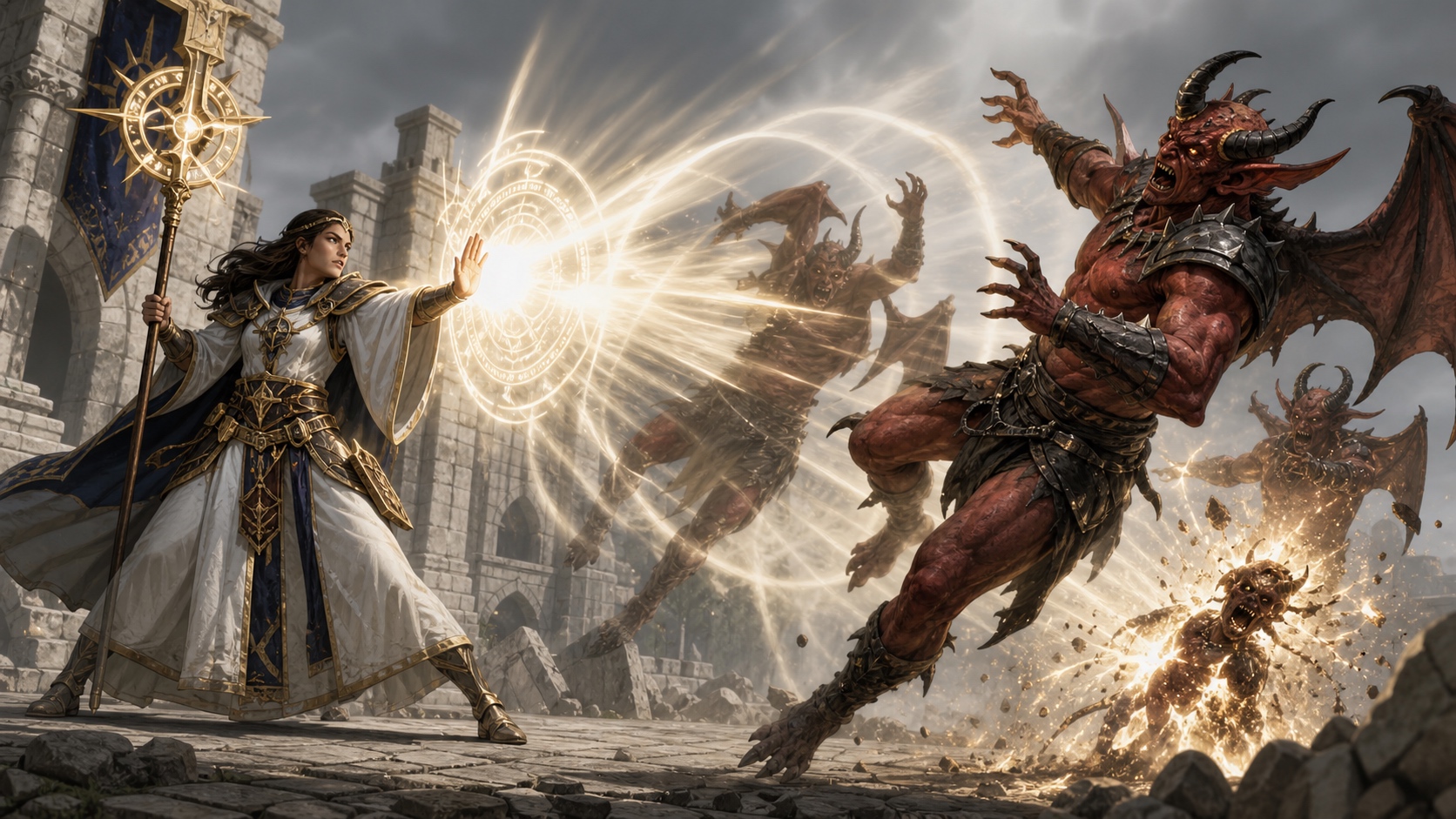
Shapestone — Primal
- Prerequisites: Primal 3, Willpower 3
- Action: Transform
- Effect: The caster reshapes stone of up to Scale 2 within engaged range into a simple form: wall (filling a corridor), opening (clearing a passage), basin, ramp, alcove, or rough statue. The reshaping is permanent until physically altered.
- Overload (): Affect Scale 4 of stone, or the reshaped stone forms difficult terrain in adjacent zones.
- Empower: The reshaping is precise enough to function as a hidden compartment · The new form provides cover against attacks crossing it (+1 Ranged Defense) · The reshaping disturbs nothing; no dust, no sound, no debris · Caster suffers 1 strain from working living stone
Stormwall — Primal
- Prerequisites: Primal 3, Willpower 3
- Action: Ward
- Effect: A wall of howling wind and crackling lightning forms within Short range, occupying one zone. Ranged attacks crossing the wall add . Creatures passing through the wall take 4 lightning damage. The wall has 8 wounds and may be attacked directly.
- Overload (): The wall extends to Scale 3 (filling two adjacent zones), or passage damage increases to 6.
- Empower: Allies who pass through the wall harmlessly recover 1 strain · One creature within Short range is briefly deafened ( to Perception until end of next turn) · For one round, the wall provides concealment in addition to its damage; sight crossing it suffers
Nature's Wrath — Primal
- Prerequisites: Primal 3, Savvy 3
- Action: Attack
- Effect: Channel raw natural force through the target: a sudden surge of earth, vine, water, or elemental pressure appropriate to the terrain. One target within Medium range takes 9 natural damage. Natural damage ignores armor bonuses to Resistance (though base Resistance from Might still applies). On a hit, the target also suffers Ensnare 1 as the environment momentarily holds them.
- Overload (): Increase damage to 12, or affect every creature within Engaged range of the primary target for 5 natural damage (the natural force spreads).
- Empower: The terrain under the target becomes difficult for one round · The target also falls Prone · Natural damage ignores all Resistance for this strike; the land itself refuses to be denied
Elemental Burst — Primal
- Prerequisites: Primal 3, Savvy 3
- Action: Attack
- Effect: Draw on the nearest available elemental source and detonate it in a burst at one point within Short range. The burst deals 7 damage of the appropriate element type (fire in a forge room or Ember-adjacent area, cold in a winter mountain or Tidal-adjacent area, lightning in a storm or Zephyr-adjacent area, force/stone in a mine or Mineral-adjacent area). The GM determines the element based on surroundings. Choose one creature at or nearest the point as the primary target; it takes the full 7 damage before Resistance. Blast 3 activates automatically: all other creatures Engaged with the primary target take 3 damage of the same element.
- Overload (): Increase damage to 10, or increase Blast to 5 (affecting all within Engaged of a chosen point, not just a single target's Engaged zone).
- Empower: The burst leaves difficult terrain in the impact zone for one round · Add an elemental rider appropriate to the element (fire: Burn 2; cold: Ensnare 1; lightning: Stun 1; stone: Knockdown) · The caster draws from the element so efficiently they recover 2 strain
Master Spells
Arcane Master
Fireball — Arcane
- Prerequisites: Arcana 4, Intellect 3
- Action: Attack
- Consumed Material: A sulfur-and-resin pellet (10 sf); hurled with the casting gesture and incinerated on detonation. Available in any alchemist's shop. Casters who work with fire regularly typically carry a dozen in a belt pouch.
- Effect: Hurl a blazing sphere to a point within Long range; it erupts in a violent explosion. Blast 6 activates automatically as part of this spell, dealing 8 fire damage to all creatures Engaged with the chosen point. Resistance applies to each target normally.
- Overload (): Increase damage by +2 or increase Blast by +2.
- Empower: +1 damage · Activate Burn 2 · Increase Blast by +2
Iceshard — Arcane
- Prerequisites: Arcana 4, Intellect 3
- Action: Attack
- Effect: Hurl a long shard of crystallized cold at one target within Long range. On a hit, the target adds to its next two checks as the freeze settles into its limbs.
- Overload (): Increase damage by +3, or the shard ignores cover.
- Empower: The target's movement is halved on its next turn · Target gains the Staggered condition · Pierce 3 increases to Pierce 5 for this attack
Arcane Binding — Arcane
- Prerequisites: Arcana 4, Intellect 4
- Action: Control
- Consumed Material: A length of silver wire knotted three times (30 sf); destroyed as the lattice forms around the target. The wire's physical knot becomes the binding's structural anchor. Without it, the lattice has no frame to hold.
- Effect: Bind one target within Medium range in a lattice of arcane force. The target is Immobilized and Restrained for the duration. They can take Actions normally but cannot move, and any attempt to use abilities requiring free movement adds . The binding can be dispelled or resisted (Hard Athletics or Reflexes, checked at the end of each of the target's turns). Minion-tier targets cannot resist; the binding holds until dispelled or the caster releases it.
- Overload (): Affect two targets within Medium range of each other, or also leave the bound target Staggered when the binding is applied (they cannot take Actions for one round).
- Empower: Extend range to Long · The lattice is also a physical barrier; the target cannot be moved by any means short of dispelling the binding · The binding tightens; resist difficulty increases to Severe, and the target takes 4 force damage each turn it attempts to resist and fails
Blink — Arcane
- Prerequisites: Arcana 4, Intellect 3
- Action: Teleport
- Effect: Step through a momentary arcane fold and reappear at any point within Long range that the caster can see or clearly visualize from their current position. The caster arrives immediately as part of the casting Action; the teleport cannot be interrupted mid-transit. The caster may bring one willing engaged creature or object of Scale 1 or smaller.
- Overload (): Carry one additional willing Engaged creature or significant object, or teleport to a location not in line of sight (an adjacent room the caster knows well; Severe difficulty if the space is unfamiliar).
- Empower: One temporary movement or positional condition (such as Prone or Restrained) affecting the caster clears on arrival · One immediate attack triggered by the caster's movement before the teleport is cancelled; they were already gone · The caster may carry one creature of Scale 2 or take a passenger to anywhere within Extreme range; the passenger must be willing
"I know how small
the room is!"
-Verrell the Transmuter
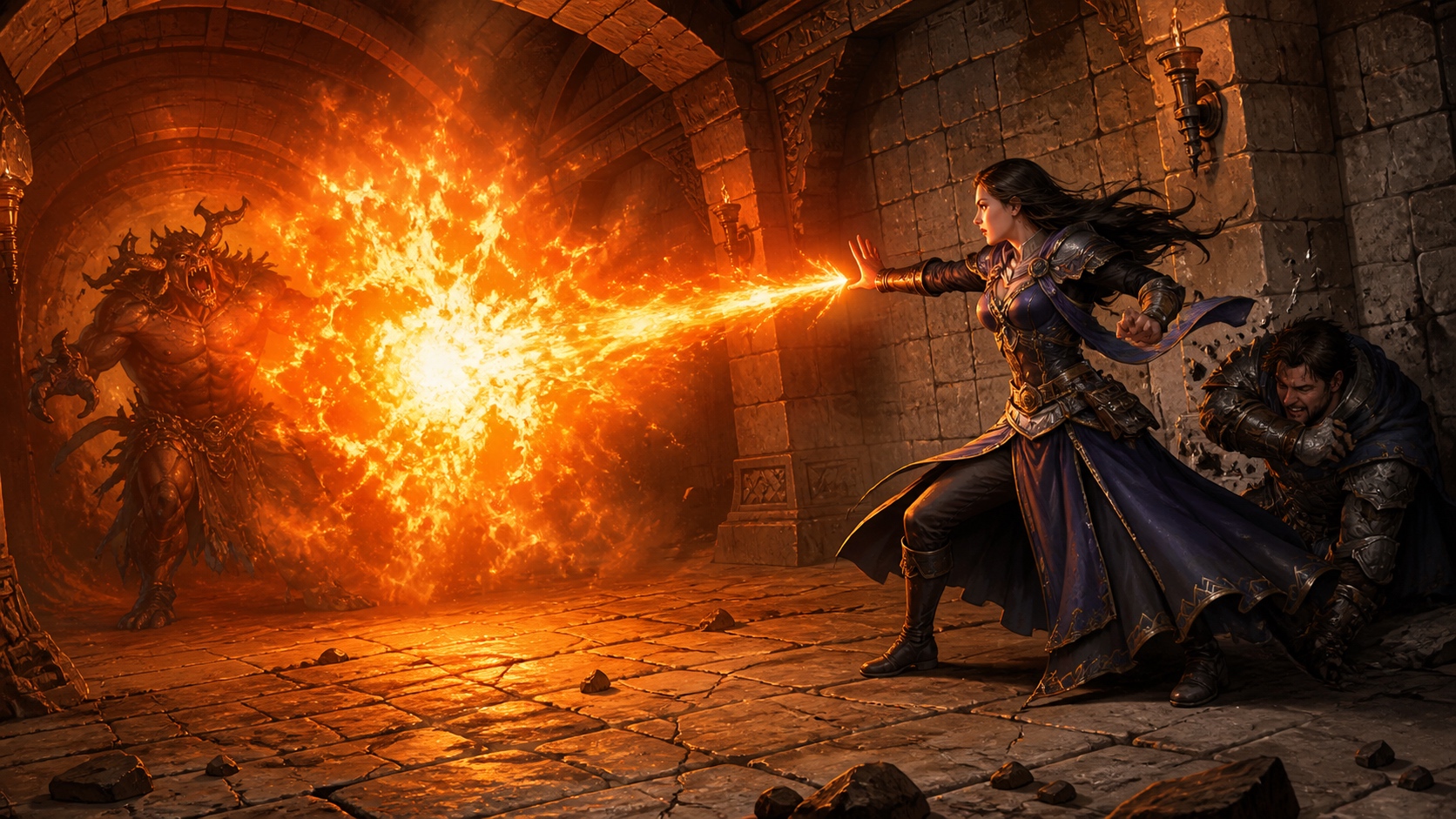
Divine Master
Greater Heal — Divine
The caster lays both hands on an engaged ally and draws warmth into them. The target heals wounds equal to twice generated, to a maximum of 10. The target also recovers all strain.
A pulse of warm light radiates outward at the moment of healing; every other ally engaged with the caster recovers 1 strain.
-
Communal (): Also heals one additional ally within Short range for half successes (rounded down) and 2 strain.
-
Recall the Recently Dead (): Target may have been dead for up to one round (since the end of their last turn). On a successful cast, they return at 1 Wound. The caster suffers 3 strain in addition to the spell's cost.
-
Mother's Touch (→): Replace one Trial Die with a Crisis Die. On success, the caster also removes one Critical Injury of their choice from the target.
- +1 wound healed.
- Target adds to their next check this scene.
- The healing leaves a faint mark; that mark adds to the next Heal cast on this target.
- Caster suffers 1 strain.
- The wound transfers; after healing is calculated, the caster suffers 2 Wounds, ignoring Resistance.
Refuge — Divine
A consecrated circle of ground forms at the caster's engaged location, occupying one zone. Allies within the circle gain +1 melee defense, +1 ranged defense, and ignore the first 2 strain they would suffer each round. Hostile creatures attacking allies within the circle add to those attacks.
Hostile creatures that enter the warded zone hear a faint chorus and suffer on their first action within it.
- Enhance Ward (): Defense bonuses also apply against magical effects.
- Anchor (): The circle persists if the caster moves out of it; otherwise the spell ends when the caster leaves.
- Twin Circles (→): A second circle forms within Short range; both circles count as the same warded zone.
- Allies in the circle add to the next attack made from within it.
- One ally in the circle recovers 2 strain.
- Hostile creatures within Short range cannot benefit from cover against allies in the circle.
- Caster suffers 1 strain.
Still Person — Divine
Choose one humanoid within Short range. On a successful cast, divine compulsion seizes the target's body; they freeze in their current posture and may take only free Quick Actions (speech, perception). They cannot move, attack, or perform Maneuvers. Resist (Discipline), see the convention at the start of this section: target rides out the casting round, then rolls Discipline at the end of each subsequent turn at difficulty equal to the caster's net successes.
The target locks in exactly the posture they held at the moment of casting; mid-step, drawing a blade, mouth open mid-word. Allies looking on can read what the target was about to do.
- Silence (): Target also cannot speak; no verbal commands, no spellcasting, no Leadership checks while held.
- Extend Range (): Range becomes Medium.
- Multi-Bind (): Up to 2 humanoids within Short range. Each rolls its own resist independently.
- Iron Word (→): Replace one Trial Die with a Crisis Die. On a successful cast the target is also Staggered when the spell ends, until the end of their next turn.
- Caster recovers 1 strain from the conviction of the binding.
- When the spell ends, target adds to their first action that turn.
- The hold visibly humbles witnesses; caster adds to their next Intimidation or Leadership check this encounter.
- The binding sears caster too; caster suffers 2 strain (in addition to base cost).
- The compulsion turns inward; the caster is held for one round instead.
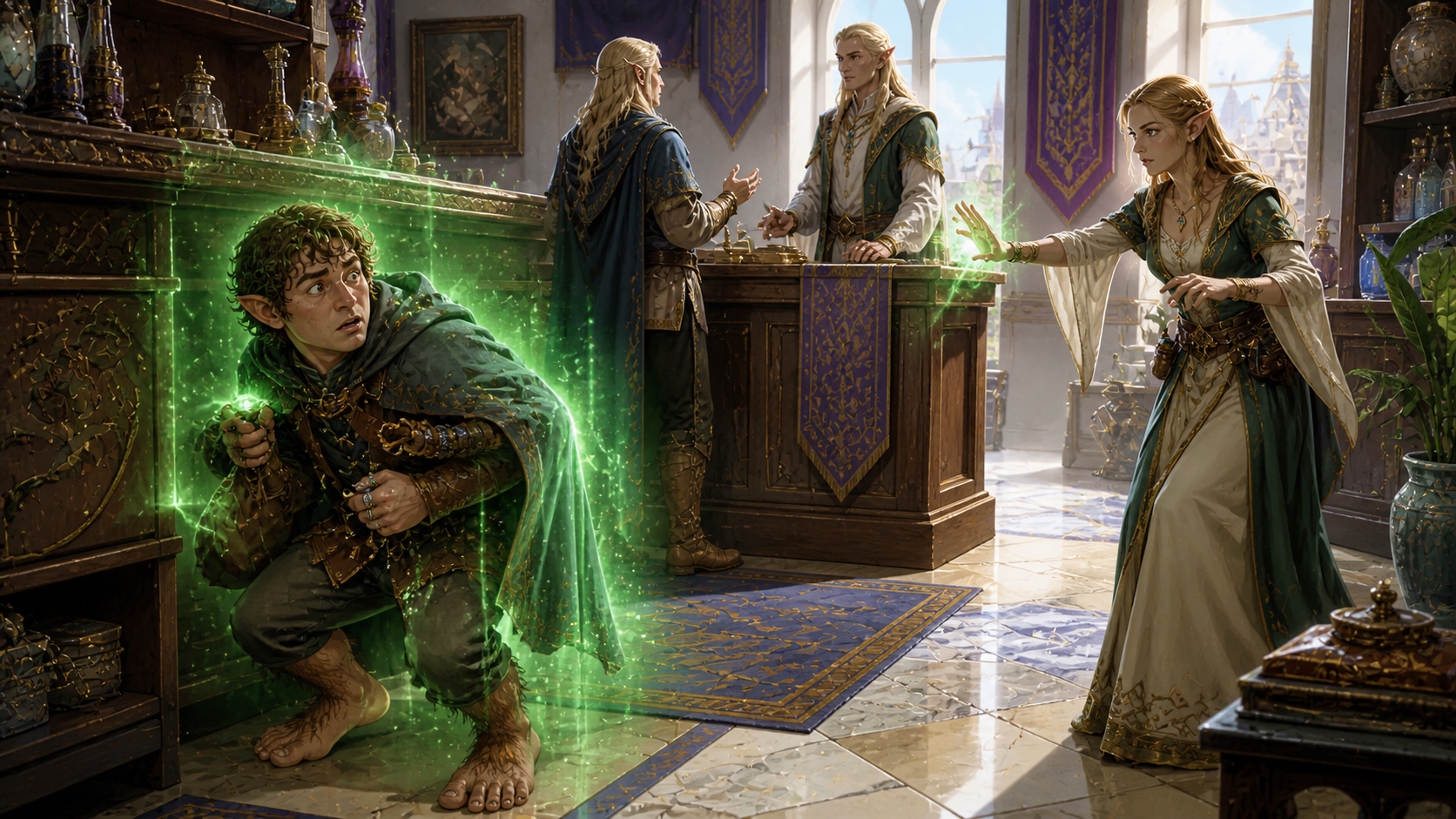
Eirmira cast still person on Perrin, the thief
Resurrection — Divine
Call a soul back from beyond judgment. The target has been dead for more than 24 hours, has passed through Sheol's courts, and has been judged and processed. Their soul is no longer in the waiting halls; it has been filed, assigned, and is somewhere deeper.
The caster must speak the target's full name and have personally known them. This is not a working that functions on strangers.
On a successful cast, the target returns at 3 wounds. All Critical Injuries persist and must be treated. If the target died from a Killed result (141–150), that injury is reduced to Lights Going Out (131–140) on return and still requires immediate treatment; Resurrection does not erase the cause of death, only reverses it. The target's maximum strain is reduced by 3 until they complete a full week of rest; most of those who return describe the experience as wrong in a way they struggle to articulate.
A failed Resurrection does not mean the target cannot be brought back; it means this casting could not do it. There are two reasons a soul may not answer: it is refusing to return, or something more powerful has claimed it. The GM determines which is true, and may not tell the party immediately. Both can be stories.
A failed Resurrection consumes the gem regardless.
- Richer Offering (automatic with 1,000+ gf gem): A gem of this quality adds to the casting check. This represents literal bribery of the divine bureaucracy, not disrespectful so much as practical, and well understood by most death-adjacent clergy.
- The target returns at 5 wounds instead of 3.
- The maximum strain penalty is reduced to 1 instead of 3.
- Remove one Critical Injury from the returned character. They carry the others.
- The caster suffers 3 strain and is Staggered until the end of their next turn from the effort.
- Something came back with the soul, or instead of it. GM's discretion; the gem is consumed and the target is technically present, but something is off.
Primal Master
Skin of the Wild — Primal
The caster's body reshapes into one chosen animal form for the encounter. Worn gear melds into the form (and reappears intact when the form ends). Choose one form at cast time:
- Wolf Form: Might becomes 3 (or +1 if higher), gain Bite (Unarmed, 6 damage, Crit 3, Vicious 1, Engaged); add to all Athletics and Survival checks. Cannot wield held weapons or wear armor.
- Bear Form: Might becomes 4 (or +2 if higher), gain Claws (Unarmed, 8 damage, Crit 4, Knockdown, Engaged); +1 Resistance. Cannot wield held weapons, wear armor, or cast non-Primal spells.
- Hawk Form: Agility becomes 4 (or +1 if higher), gain flight at Short speed; add to Perception checks. Cannot make melee attacks; thrown attacks deal half damage rounded down. Cannot cast non-Primal spells.
The caster may revert to humanoid form at any time as a free Quick Action, ending the spell early.
- Greater Form (): Wolf becomes Dire (+1 Might beyond form, Bite 8 dmg). Bear becomes Cave Bear (+1 Might, +1 Resistance). Hawk becomes Roc-Spawn (Might +1 also, talons 4 dmg melee).
- Tongue of Beasts (): Caster retains the ability to speak normally in the chosen form.
- Two-Form (→): Replace one Trial Die with a Crisis Die. On a successful cast, choose two forms; caster may switch between them once during the duration as an action.
- The form is unusually marked (silver pelt, white feathers); caster gains to the next Intimidation or Charm check made while in form.
- First time the caster suffers wounds in the form, ignore 2 of those wounds.
- A nearby spirit-animal of the same kind appears for one round and acts as a Pack-Mate (see Summon Pack-Mate).
- The form is restless; caster suffers 1 strain at the start of each turn while in form (in addition to base costs).
- The form takes too well; at the end of the spell, caster must roll Easy Discipline or remain in form for one additional round.

Pordin transforms into the bear skin of the wild
Stoneform — Primal
The caster's body becomes living stone for the duration. They gain +2 Resistance, +2 Wound Points, immunity to poison and disease, and melee defense of 1. Their movement is reduced one range band, they add to all Agility-based checks, and they cannot benefit from healing magic while transformed.
The caster's voice becomes deep and resonant; they add to Intimidation checks intended to intimidate.
- Fluid Stone (): The movement-reduction penalty is removed.
- Hardened Form (): Resistance bonus increases to +4 instead of +2.
- Granite Soul (→): The caster is also immune to mind-affecting effects for the duration.
- The caster gains Pierce 1 on their next Unarmed attack from the heavier weight.
- The caster recovers 2 strain at the start of each of their turns.
- The caster has Resistance 6 against fire and cold specifically; they are stone, after all.
- The caster suffers 1 strain.
Stormcall — Primal
A boiling stormcloud condenses overhead, low and crackling. On the casting turn the caster may immediately call one bolt as part of the cast (one ranged attack against any target within Medium range, no extra cost). On each of the caster's subsequent turns, the caster may spend a Maneuver and suffer 1 strain to call another bolt, same range, same combat profile. The strain pacing is what keeps the storm from being a free turret; the cap is the caster's reserves. The spell ends at the end of the encounter, when the caster ends it as a Quick Action, when the caster is incapacitated, or when the caster is moved indoors.
The first bolt each round flashes ahead of its thunder. Allies engaged with a struck target add to their next attack against that target this round.
- Thunderhead (): +2 damage on every bolt called by this casting.
- Forked Strike (): Each bolt may strike a second target within Short range of the first at half base damage (rounded down).
- Storm-Driven (): Range becomes Long.
- Wild Sky (→): Replace one Trial Die with a Crisis Die. On a successful cast, every bolt called gains Stun 2 and Pierce 1; but the caster cannot suppress the storm; it lasts the full encounter regardless of the caster's wishes.
- +1 damage on this bolt only.
- This bolt inflicts Prone on the target.
- The thunder rattles bystanders; all enemies within Short of the struck target add to their next check.
- Backlash; caster suffers 2 strain.
- The bolt finds the caster too; caster suffers Wounds equal to half base damage (ignoring Resistance).
Combined Tradition Magic
A Note on Casting Combined Traditions
Combined tradition spells use two values to build the pool.
Skill rank (upgrades): floor of the average of the two prerequisite skills (e.g., Arcana 3 + Divine 1 = floor(2) = 2 upgrades). The talent rank gates access; the averaged skill rank determines the upgrades once you qualify.
Characteristic (dice count): the highest of the characteristics paired with the tradition's component skills: Intellect or Willpower for Theomancy, Intellect or Savvy for Necromancy, Willpower or Savvy for Shamanism. On a tie, choose either.
See the full rule and worked examples in the first half of this chapter.
Theomancy
Anointed Edge — Theomancy
- Prerequisites: Theomancer talent rank 1+, Arcana 2, Divine 2
- Action: Augment
- Effect: Touch one allied weapon. For the duration, attacks with this weapon deal +2 radiant damage and gain Pierce 1 against infernal beings and undead.
- Overload (): Affect a second weapon held by an ally engaged with the caster, or change the bonus damage type to silver against lycanthropes.
- Empower: The wielder adds to their next Discipline check · The first hit each round adds Burn 1 against infernal beings and undead · The weapon ignores 2 Resistance on its next hit
Banner of Hosts — Theomancy
- Prerequisites: Theomancer talent rank 1+, Arcana 3, Divine 3
- Action: Augment
- Effect: The caster plants a sanctified banner at their engaged location. While it stands, the caster and any allies engaged with the banner add to their first attack each round and gain +1 ranged defense. The banner has Resistance 4 and 8 wounds; if destroyed, the spell ends.
- Overload (): The banner's benefit extends to allies within Short range (instead of Engaged), or the banner also grants +1 melee defense.
- Empower: One ally engaged with the banner recovers 1 strain · Allies near the banner add to their next Readiness or Discipline check against fear · The first foe to attack the banner adds to that attack
Mark of Wrath — Theomancy
- Prerequisites: Theomancer talent rank 1+, Arcana 2, Divine 2
- Action: Curse
- Effect: A glowing sigil burns onto one target within Short range. While the mark persists, all attacks against the target add .
- Overload (): The mark also reveals the target's location to the caster within Long range, negating concealment, or the mark spreads to one ally of the target if they are engaged.
- Empower: The first attack against the marked target gains Pierce 2 · The marked target suffers 1 Wound from holy backlash when an attack against it causes it to suffer Wounds (the sigil burns brighter on each strike) · The marked target adds to Stealth and Deception checks while the mark persists
Sacred Ground — Theomancy
- Prerequisites: Theomancer talent rank 1+, Arcana 2, Divine 2
- Action: Ward
- Effect: The caster sanctifies the engaged zone for the duration. Allies in the zone add to Readiness or Discipline checks against fear, and to Discipline checks against corruption. Hostile undead and infernal beings in the zone add to attacks.
- Overload (): Effect extends to allies within Short range, or adds +1 ranged defense for allies in the zone.
- Empower: Allies in the zone recover 1 strain at the start of each of their turns · Caster identifies any extraplanar creature in the zone · Allies in the zone add to Lore checks for the duration

Weskin cast sacred ground covering his allies
Sanctified Sigil — Theomancy
- Prerequisites: Theomancer talent rank 1+, Arcana 2, Divine 2, Willpower 3
- Required Focus: Holy symbol and a written sigil-strip (renewable, not consumed)
- Action: Barrier
- Effect: A glowing sigil hovers above the caster. The caster and any allies engaged with the caster gain +1 Ranged Defense and +1 Resistance vs. unholy and necrotic damage for the duration. Undead and possessed creatures within Short range of the sigil add to attacks against warded creatures.
- Overload (): Defense bonus also applies to melee, or the sigil moves with the caster (otherwise the warded zone is anchored where the spell was cast).
- Empower: One ally in the warded zone recovers 1 strain · Allies in the warded zone add to the first Readiness or Discipline check against fear, or the first Discipline check against compulsion · The sigil burns bright against the undead; they take 2 radiant damage when entering the warded zone (once per creature).
Sundering Blade — Theomancy
- Prerequisites: Theomancer talent rank 2+, Arcana 3, Divine 3
- Action: Attack
- Effect: A blade of light and force forms in the caster's hand and strikes one engaged target. The target takes 9 damage (half radiant, half force) with Pierce 2. The blade ignores Resistance from natural armor.
- Overload (): Damage increases by +3, or the blade extends to Medium range as a thrown effect.
- Empower: The strike adds Vicious 1 · The strike adds Stun 1 · The caster gains on their next Discipline check this scene · The caster suffers 1 strain
Vital Heal — Theomancy
- Prerequisites: Theomancer talent rank 1+, Arcana 3, Divine 3
- Action: Heal
- Effect: One engaged target recovers 8 wounds and 3 strain. The healing weaves arcane life-force with divine grace.
- Overload (): The target recovers 12 wounds instead, or the healing also removes one Critical Injury with a rolled result of 30 or lower.
- Empower: The target gains on their next check · Healing extends to one ally engaged with the target (3 wounds) · The caster also recovers 2 strain · The caster suffers 1 strain to channel an additional 2 wounds of healing
Word of Sundering — Theomancy
- Prerequisites: Theomancer talent rank 1+, Arcana 2, Divine 2, Willpower 3
- Required Focus: Theomancer's bound symbol-strip
- Action: Dispel (Active)
- Effect: A spoken word of negation strikes one ongoing spell or magical effect within Short range. The caster makes the Word of Sundering check against that effect's Dispel pool; if the caster's net successes equal or exceed the dispel threshold, the targeted spell ends entirely. Effects with no listed Dispel pool require a Hard () check to sunder.
- Overload (): Target two spell-effects in the same cast (make a separate Word of Sundering check against each effect's Dispel pool), or sunder a permanent magical ward (treat as a Severe check; significant net successes required).
- Empower: The original caster of the sundered spell suffers 1 strain from the feedback · Caster gains to their next casting check this encounter · A vague impression of the sundered spell's caster (silhouette, mood, distance) reaches the Theomancer · Caster suffers 1 additional strain.
Necromancy
Animating Whisper — Necromancy
- Prerequisites: Necromancer talent rank 2+, Arcana 3, Primal 3
- Action: Conjure
- Consumed Material: Grave ash mixed with a drop of the caster's own blood (free to produce; the caster takes no damage, but the blood must be willingly given). Alternatively, a prepared vial of charred bone-ash (10 sf). The caster's life-force seeds the animation; without it, the whisper has nothing to carry the spark.
- Effect: The caster touches a mostly intact corpse (Scale 1 or smaller). The body animates as a minion-tier zombie (Might 3, Agility 1, Resistance 4, wounds 6) that obeys the caster's commands and acts on the caster's turn. The zombie attacks with an Unarmed pool dealing 4 damage. If the zombie falls or the duration ends, the body reverts to an inert corpse.
- Overload (): Animate one additional corpse, or the zombie has Resistance 6 instead of 4.
- Empower: The zombie has 8 wounds instead of 6 · The zombie's attack deals 6 damage instead of 4 · The zombie can attempt a grapple; the target adds to its next Maneuver · The caster suffers 1 strain to invest more of their will into the body
Bone Wall — Necromancy
- Prerequisites: Necromancer talent rank 1+, Arcana 3, Primal 2
- Action: Conjure
- Consumed Material: A bone fragment of any size (10 sf or freely sourced from any corpse); crushed between the caster's palms as the wall rises. The fragment is the seed from which the wall grows. A necromancer in the field has no shortage of these; in polite company, the purchase of butcher's bones is less conspicuous.
- Effect: A wall of yellowed bones erupts from the ground within Short range, occupying one zone. The wall has Resistance 6, 12 wounds, and Scale 2. Creatures cannot pass through it without destroying it; ranged attacks crossing the wall add .
- Overload (): The wall extends to Scale 4 (filling two adjacent zones), or creatures engaged with the wall on the caster's side use it as full cover.
- Empower: A foe engaged with the wall takes 2 unholy damage at the start of its turn · The wall whispers menacingly; foes within Short range add to Discipline checks · The wall has 6 additional wounds
Deny Will — Necromancy
On a successful cast, the caster's mind overlays the target humanoid's. On each of the target's turns, the caster declares one action, up to two Maneuvers, and any free Quick Actions. The target's body executes them. The target retains awareness; they see and feel what they are doing, but cannot disobey.
The target uses their own skills, characteristics, and equipment; the caster cannot make the target use abilities or talents the target does not possess. The target cannot be compelled to directly suicide or to attack themselves; at the moment of such an action, the target collapses unconscious and the spell ends.
Resist (Discipline), see the convention at the start of this section. The target rides out the casting round, then rolls Discipline at the end of each subsequent turn at difficulty equal to the caster's net successes.
The target's eyes briefly mirror the caster's at the moment the binding takes; a tell that witnesses with relevant Lore or Medicine training (or who have seen Necromancy before) may recognize.
- Through Their Eyes (): The caster also perceives what the target perceives, in real time. The caster may end this perception as a Quick Action.
- Subtle (): The target perceives all dominated actions as their own free choice. They do not realize they were under duress until the spell ends. This is the version most often used for assassinations and forced confessions; it is widely banned.
- Multi-Bind (): Up to 2 humanoid targets, each rolling resist independently. The caster splits action-declarations between them on each of their turns.
- Iron Will (→): Replace one Trial Die with a Crisis Die. On a successful cast, the target also cannot speak (no shouting for help, no spellcasting requiring verbal components) for the duration.
- Caster recovers 1 strain from the rush of dominance.
- The first time the target rolls resist, they add to that check.
- The target retains no memory of the dominated period after the spell ends; useful for cover, dangerous for narrative trust.
- The binding sears in both directions; caster suffers 2 strain (in addition to base cost).
- The target's resist rolls add for the duration (the binding never quite settles).
Drain Vigor — Necromancy
- Prerequisites: Necromancer talent rank 1+, Arcana 2, Primal 2
- Action: Attack (touch)
- Effect: The caster grasps a creature engaged with them and pulls warmth from it. Treat as a melee attack using the caster's casting skill against the target's Melee Defense; success deals 6 unholy damage with Crit 4. The drained life feeds the caster; see Empower.
- Overload (): +2 damage, or the attack also bypasses one point of Resistance (Pierce 1).
- Empower: Caster recovers 1 strain · Caster recovers wounds equal to half the Wounds the target suffered (rounded down) · Target adds to their next check (sapped) · The hunger lingers; caster adds to social checks until the end of the encounter.
Soul Echo — Necromancy
- Prerequisites: Necromancer talent rank 1+, Arcana 3, Primal 2
- Action: Reveal
- Effect: The caster touches a corpse dead for less than 24 hours. The spirit briefly returns and answers up to three yes/no questions truthfully, to the limit of what the spirit knew while alive. The corpse must be mostly intact; deeply mutilated remains halve the question count.
- Overload (): The spirit may answer one open-ended question with a single sentence, or the spirit also describes the manner of its death.
- Empower: The caster perceives the spirit's emotional state at the moment of death · The spirit reveals one significant possession it carried in life and where it last saw the item · The spirit names one creature it considered an enemy at the time of death · The caster's empathy with the spirit lingers; they suffer 1 strain from the contact
Soul Scar — Necromancy
- Prerequisites: Necromancer talent rank 1+, Arcana 2, Primal 2
- Action: Curse
- Effect: One target within Short range is marked with an invisible necromantic scar. Significant unwilling targets may immediately attempt Resist (Discipline) opposed by the caster's net successes; on success, the scar fails to take hold. On a failed resist or against willing and minion-tier targets, the caster always knows the target's general direction and approximate distance, regardless of separation, until the scar is dispelled. The scar is detectable by any caster using a Reveal effect against necromancy.
- Overload (): The caster also senses the target's emotional state, or the scar registers visibly to any necromantic detection (undead instinct, profane auras, dark ritual residue).
- Empower: The caster senses the target's general activity (resting, fighting, traveling) · The mark cannot be removed by the target's own magic, only by another caster's intervention · The caster gains to checks made to physically track or find the target
Soulbleed — Necromancy
- Prerequisites: Necromancer talent rank 1+, Arcana 3, Primal 3
- Action: Attack
- Effect: One target within Short range takes 8 unholy damage. The caster recovers wounds equal to half the Wounds the target suffered (rounded down).
- Overload (): Increase damage by +2, or the caster recovers wounds equal to the full Wounds suffered instead of half.
- Empower: The target adds to its next check from the chill · The caster also recovers 1 strain · The target's allies Engaged with it add to their next check as the death-fear spreads
Wither Bones — Necromancy
The target's bones briefly ache and grow brittle. For the duration, the target's Wound Points are reduced by 4 (minimum 1). If their current Wounds exceed the reduced maximum, lower current Wounds to the reduced maximum immediately. If this reduction drops the target to 0 current Wounds, it triggers incapacitation but does not itself cause a Critical Injury. When the spell ends, the target's Wound Points return to normal; current Wounds do not increase automatically. They also suffer on all Athletics, Unarmed, and Reflexes checks.
The target moves stiffly, like an old soul in a young body; a visible sign of the curse for any observer who has seen necromancy at work.
- Deepen Curse (): Wound Points reduction increases to 6.
- Extend Range (): Short → Medium.
- Bone Rot (→): Target also takes 2 unholy damage at the start of each of its turns for the duration.
- Target adds to its next Might-based check.
- One ally engaged with the target adds to attacks against it.
- The curse persists for 1 hour after the encounter ends.
- Caster suffers 1 strain.
Wraithskin — Necromancy
- Prerequisites: Necromancer talent rank 1+, Arcana 2, Primal 3
- Action: Augment
- Effect: The caster becomes partially incorporeal. Until the end of their next turn, the caster gains +2 Melee Defense, +2 Ranged Defense, immunity to nonmagical caltrops, pressure plates, and minor physical environmental hazards (major threats such as falls, fire, and siege still apply), and may move through one solid mundane barrier (a door, or a wall up to one meter thick) during the duration.
- Overload (): The effect lasts to the end of the encounter, or the caster may pass through two barriers instead of one.
- Empower: The caster adds to their next Stealth check · The caster sees through mundane illusions for the duration · The caster's next melee attack ignores 2 Resistance; the touch comes from outside the physical · The caster suffers 1 strain
Shamanism
Ancestor's Counsel — Shamanism
- Prerequisites: Shaman talent rank 1+, Divine 3, Primal 3
- Action: Predict (Ritual)
- Consumed Material: A smoke-herb or incense offering (10 sf); burned during the meditation. Smoke carries the call to ancestor spirits; without it the spirits hear the question but have less reason to answer. In the field, dried pine needles or sweet grass suffices.
- Effect: The caster spends five minutes in meditation, calling on ancestor spirits. They ask one specific question about the next 24 hours; the spirits answer with one sentence of advice or warning, GM-narrated. The answer is honest but may be cryptic.
- Overload (): The spirits answer two questions, or the caster may also ask about the previous 24 hours.
- Empower: The spirits reveal one specific person, place, or thing relevant to the question · The caster gains on a check made within the next 24 hours that follows the spirits' advice · The spirits offer a single warning of immediate danger within the next hour
Augur of the Three — Shamanism
- Prerequisites: Shaman talent rank 1+, Divine 2, Primal 2, Lore 1
- Action: Predict
- Effect: The caster opens their senses to the threads of likely outcome; the spirit-trio of "what was, what is, what may be." For the encounter, once per round as an out-of-turn Quick Action, the caster may either (a) add to one ally's check before it is rolled, or (b) downgrade one die in an enemy's attack pool against the caster or an ally engaged with the caster.
- Overload (): Also applies to all Initiative checks at the start of the encounter (the caster sees the moment of clash before it lands), or may be used twice per round instead of once.
- Empower: Caster gains to their own next check · One ally's first check this encounter benefits from the augury automatically (no Quick Action needed) · Caster also receives a brief glimpse of one significant near-future event (GM volunteers a hint).
Channel Spirit — Shamanism
- Prerequisites: Shaman talent rank 1+, Divine 3, Primal 3
- Action: Conjure
- Effect: The caster opens themselves to a specific spirit chosen at casting (animal, ancestor, elemental, or guardian). For the duration, the caster adds to one specific skill chosen at casting, and speaks with the spirit's voice and mannerisms.
- Overload (): The caster may swap the chosen skill once per round, or add instead of .
- Empower: Attacks against the caster from one specific damage type or source (poison, fire, mind effects; chosen with the spirit) add · The spirit shares a single piece of lore or insight relevant to the situation · The bonus also extends to one ally engaged with the caster · The caster suffers 1 strain to deepen the connection
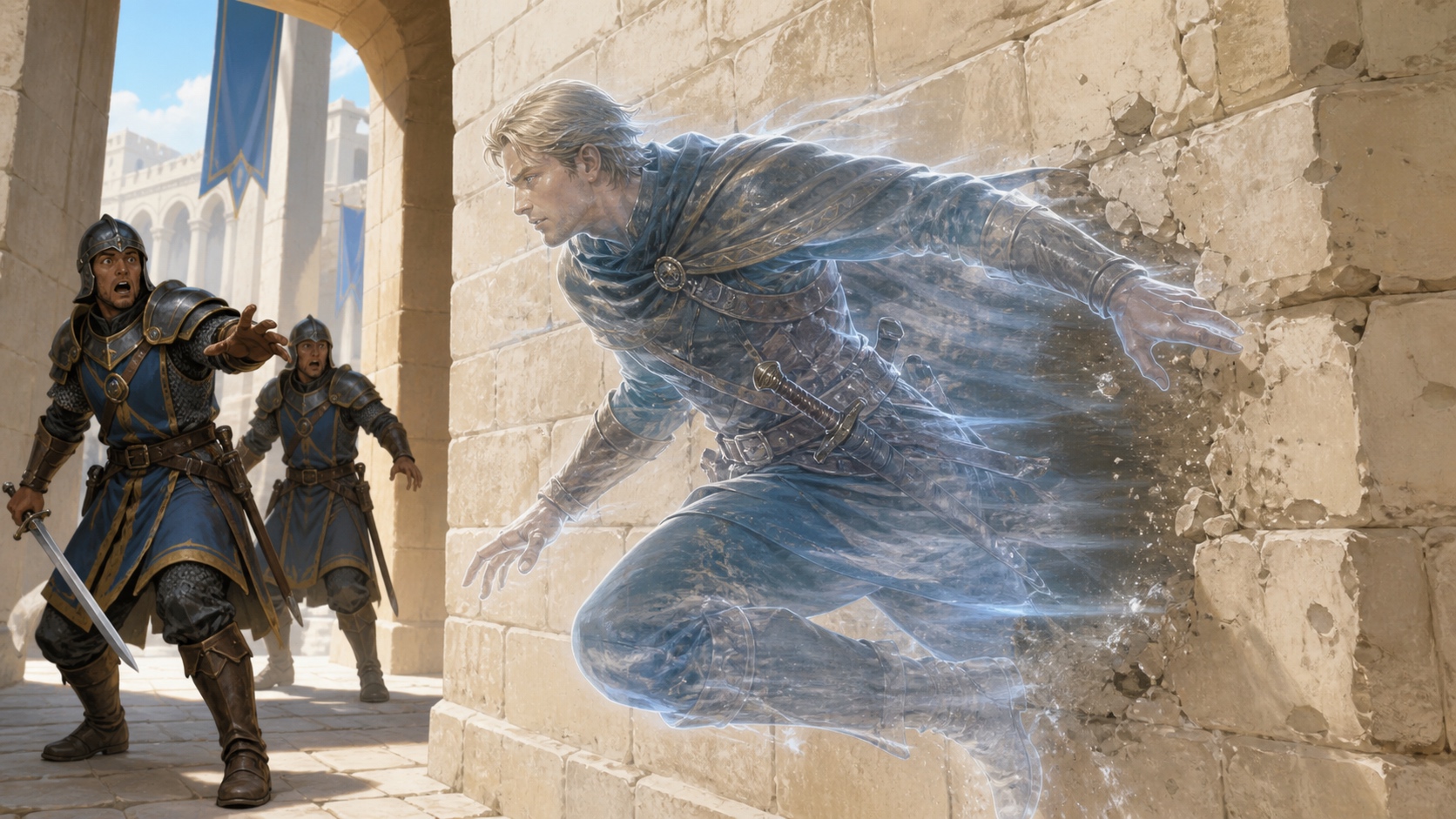
Hasten escapes using Wraithskin, too bad guards are ready
Scout Spirit — Shamanism
- Prerequisites: Shaman talent rank 1+, Divine 2, Primal 2
- Action: Conjure
- Effect: A small spirit-shape appears engaged with the caster. The caster may direct the spirit to scout up to Medium range each round; it silently reports terrain, creatures, and Banes it perceives within Short range of itself. The spirit cannot be attacked, but it dissipates if it crosses Medium range from the caster.
- Overload (): The spirit scouts to Long range with thinner reporting, or it disrupts one foe's tracking attempts as it passes.
- Empower: The caster adds to their next Survival or Perception check using the spirit's report · The spirit's reports include the emotional sense of nearby creatures · The spirit briefly distracts one minion, who adds to its next attack
Spirit Drum — Shamanism
- Prerequisites: Shaman talent rank 1+, Divine 2, Primal 2
- Action: Augment
- Effect: A drumming pulse fills the air around the caster. The caster and all allies engaged with the caster recover 1 strain at the start of each of their turns for the duration.
- Overload (): The drum reaches Short range, or strain recovery becomes 2 per turn.
- Empower: One ally adds to their next attack · The drum's heartbeat heals; the caster recovers 1 Wound at the end of their next turn · Foes within Short range add to their first check this round
Stormcaller — Shamanism
The caster calls a sudden storm to a point within Long range. Lightning, hail, and wind erupt. Blast 4 activates automatically as part of this spell: all creatures Engaged with the point take 8 lightning damage. Resistance applies to each target normally. Minion-tier targets also fall Prone.
For one round after the strike, the affected area counts as difficult terrain; rain-soaked footing and buffeting wind hamper movement and balance.
- Intensify Strike (): Damage increases by +3.
- Hailshatter (): The attack also gains Knockdown.
- Sustained Storm (→): The storm persists at the strike location for one additional round, dealing 4 lightning damage to creatures still in the area at the start of the round.
- One target loses an out-of-turn Quick Action this round.
- The attack also gains Disorient 1.
- Allies in the area gain +1 Ranged Defense from the cover of rain until end of round.
- Caster suffers 1 strain.
Tide Heal — Shamanism
- Prerequisites: Shaman talent rank 1+, Divine 3, Primal 3
- Action: Heal
- Effect: A surge of spirit-touched water rolls over up to three willing allies within Short range. Each affected target recovers 6 wounds and removes one -imposing condition.
- Overload (): Affect up to five targets, or each target also recovers 3 strain.
- Empower: One target heals 2 additional wounds · One target also recovers from a Critical Injury with a rolled result of 30 or lower · The tide reveals one hidden ally within Short range · Caster suffers 1 strain as the tide pulls hard at their spirit

This is my land - Kavor
Wild Tongue — Shamanism
- Prerequisites: Shaman talent rank 1+, Divine 2, Primal 2, Adventuring Lore 1
- Action: Utility
- Effect: For the duration, the caster understands and is understood by ordinary beasts within Short range. Beasts answer in the rough register of their kind; a wolf gives terse, present-tense impressions; a crow trades news of recent sights; a mouse remembers smells more than shapes. Hostile or wild beasts may still refuse to talk; this spell does not compel them.
- Overload (): Range becomes Medium, or one beast within range becomes friendly to the caster for the duration (does not override hunger or pack instinct).
- Empower: One nearby beast adds to the caster's next Perception or Survival check based on what it has sensed · The caster also briefly perceives the area through one beast's senses (one round of sight, sound, or scent) · A beast volunteers to carry a short message to a place it knows.
High Magic
A Note on Casting High Magic
High Magic spells require the Archmage talent and call upon all three magical traditions.
Skill rank (upgrades): the lowest of your Arcana, Divine, and Primal skills; no averaging.
Characteristic (dice count): the highest of Intellect, Willpower, or Savvy. On a tie, choose either.
These spells are meant to be the work of years; expect to spend strain liberally and to lose entire scenes to a single casting.
Echoes of Power — Mastery
- Prerequisites: Archmage talent rank 1+, Arcana 3, Divine 3, Primal 3
- Action: Augment
- Consumed Material (optional): A gemstone of any kind (minimum 50 sf); held in the casting hand and reduced to powder as the three currents align. Adds to the casting check. The gem resonates with all three magical currents simultaneously; its destruction in this moment is considered by most Archmages to be a meaningful sacrifice, not a waste.
- Effect: Until the end of the caster's next turn, every spell the caster casts adds to its casting check, regardless of tradition.
- Overload (): The effect lasts two rounds, or the caster may reduce the strain cost of one cast spell during the duration by 1 (minimum 1).
- Empower: The next spell cast during the effect adds an additional on success · The caster recovers 2 strain · Allies engaged with the caster who hear the casting also add to their next check from sympathetic resonance
Genesis Surge — Mastery
You call the three great currents of magic into violent alignment and release them as a single catastrophic convergence at a point within Long range. Blast 8 activates automatically, dealing 12 force damage to all creatures Engaged with the point. Choose two effects from the following list when the spell is cast; each applies immediately and, where noted, alters the battlefield for the duration:
- Searing Firestorm: The area ignites. All creatures Engaged with the point also suffer Burn 4 and the terrain in the blast zone counts as difficult terrain (fire and ash) for the duration.
- Sanctified Shockwave: A pulse of divine force radiates outward. Undead and infernal beings Engaged with the point are Staggered until the end of their next turn. Allies in the blast zone are unharmed by this effect.
- Grasping Wild Growth: Primal roots erupt. All creatures Engaged with the point are Ensnared 2 until they break free (Hard Athletics or Reflexes). The terrain remains entangled difficult terrain for the duration.
- Radiant Restoration: A burst of healing light follows the devastation. One ally within Long range per two net successes recovers 4 Wounds. This effect does not damage enemies.
- Arcane Collapse: The fabric of local magic tears. Any spell or magical effect with a Dispel pool of 3 or lower within the blast zone ends immediately. Casters in the zone add to any spell cast until the end of their next turn.
Genesis Surge is not a spell of destruction alone, but of imposed change. The caster tears open reality and forces the world to reconcile all three magical truths at once: law, will, and life. Enemies caught within the surge are broken, allies may be restored, and the terrain itself becomes hostile, sanctified, or remade according to the caster’s will.
- Enhance Surge (→): Increase damage by +3, or add one additional chosen effect.
- Extend Range (→): Increase range to Extreme.
- Widen Cataclysm (→): Increase Blast by +4.
- Sustain (→): Maintain the altered battlefield as a Maneuver each turn for the duration.
- One ally in the area recovers 3 wounds or 3 strain.
- One chosen effect intensifies for one round (GM-approved escalation).
- Add one additional chosen effect immediately.
- Caster suffers 2 strain (in addition to base cost).
Reweave — Mastery
Choose one significant action that occurred within the last round; an attack, a death, a fall, a Critical Injury, a movement. The action and its immediate consequences are erased from the timeline. This includes Wounds suffered, conditions gained, and resources spent by the direct target of that action. Resources, actions, and reactions spent by others in response to the erased action are not restored. If a creature died as a direct result of the erased action, they return at 1 Wound. The caster and all witnesses retain a hazy memory of the original event, like a dream that won't quite settle. Physical evidence follows the new timeline.
Witnesses (allies and enemies who saw the original event) suffer on their next check from the dragging deja vu.
- Reach Further (): The undone action may have occurred up to two rounds ago.
- Twin Threads (): The Reweave affects up to two related actions in the same round.
- Erase Cleanly (→): Witnesses retain no memory of the original event. The world simply changes.
- One ally affected by the original action recovers 1 strain.
- One foe affected by the original action loses an out-of-turn Quick Action this round.
- The caster's next casting check this scene adds .
- The caster suffers 1 wound as the rewriting tears at their body.
Severance — Mastery
One creature within Short range is severed from this plane and cast into the Veil. Significant unwilling targets may attempt Resist (Discipline) opposed by the caster's net successes; on success, the casting fails and strain is still spent. On a failed resist or against minion-tier targets, the target cannot return to this plane while the spell persists. While severed, the target cannot be perceived, targeted, or contacted by anyone on this plane; the caster included. The target experiences time normally and may attempt to dispel from the Veil side using their own Arcana, Divine, or Primal skill at Severe difficulty; this requires a full Action and may be attempted once per hour.
The target's possessions on this plane remain; only the creature itself is severed. Allies of the target see them simply vanish.
- Sever Possessions (): The target's possessions are also severed, leaving no trace on this plane.
- Bind in the Veil (): While severed, the target's veiled form is also bound; they cannot move, cast spells, or attempt to dispel. This option costs two Trial Dice given it removes all target-side counterplay.
- Eternal Severance (→): If the target dies in the Veil while severed, they cannot be revived by any means short of another High Magic casting.
- One ally engaged with the caster recovers 2 strain.
- The caster adds on their next casting check this scene.
- The severance leaves a temporal echo; witnesses add on their next Discipline check.
- The caster suffers 1 strain.
Twin Strike — Mastery
- Prerequisites: Archmage talent rank 1+, Arcana 3, Divine 3, Primal 3
- Action: Attack
- Effect: The caster strikes twice; two separate attacks against one target within Long range, or one attack against each of two targets within Long range. Each attack deals 10 damage of a chosen elemental type (fire, cold, lightning, force, holy, or profane), picked at casting time. Both attacks use the same element.
- Overload (): Damage increases by +3 on both attacks, or each attack gains Pierce 2.
- Empower: The caster picks two different elements (one per strike) · Both attacks gain Vicious 1 · The strikes inspire; one ally engaged with the caster recovers 2 strain · The caster suffers 1 strain
World Knell — Mastery
Toll a knell that strikes one creature within Short range. Extraplanar creatures (fiends, celestials, elementals, fey, summoned beings) are immediately returned to their plane of origin and cannot voluntarily return to this plane for 24 hours. Native creatures may resist with a Discipline check opposed by the casting; on a fail, they take 12 unholy damage with Pierce 4 from the dissonance.
Every creature within Short range hears the knell as a single clear bell-tone, regardless of distance, barrier, or magical concealment.
- Reach Further (): Short → Medium.
- Toll Twice (): Affect a second extraplanar creature within range.
- Eternal Toll (→): Banishment is permanent; the creature cannot return to this plane by any means short of another Mastery casting.
- Allied creatures who heard the toll add to their next Discipline check.
- One ally recovers 2 strain.
- The banished creature drops one bound item or possession in this plane.
- Caster suffers 1 strain.
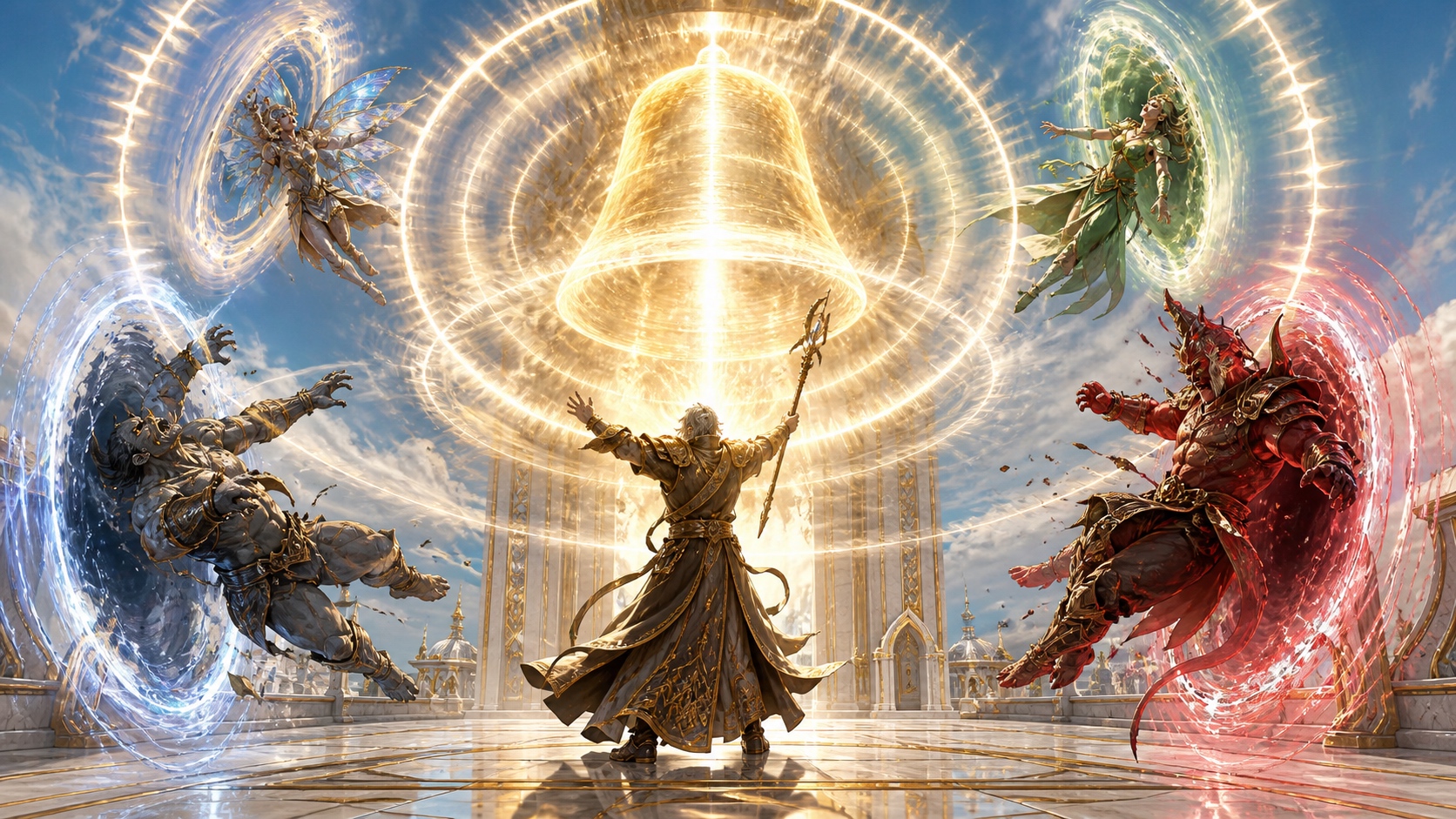
You shall return! - Archmage Zepon
Spell Index
Every player-castable spell in this chapter. Difficulty is the number of Trial Dice in the spell's base pool; Overload adds more. Range and Duration use the abbreviation key in Casting Rules.
| Spell | Tradition | Tier | Diff | Strain | Range | Duration |
|---|---|---|---|---|---|---|
| Ancestor's Counsel | Shamanism | Shamanism | 3 | 3 | SELF | INST |
| Animating Whisper | Necromancy | Necromancy | 3 | 3 | ENG | ENC |
| Anointed Edge | Theomancy | Theomancy | 2 | 2 | TCH | ENC |
| Arcane Binding | Arcane | Master | 4 | 4 | MED | ENC |
| Arcane Bolt | Arcane | Cantrip | 1 | 1 | SHRT | INST |
| Augur of the Three | Shamanism | Shamanism | 3 | 2 | SELF | ENC |
| Auralight | Arcane | Cantrip | 1 | 1 | SELF | RND |
| Banner of Hosts | Theomancy | Theomancy | 3 | 3 | ENG | ENC |
| Beast Bond | Primal | Adept | 3 | 3 | SHRT | ENC |
| Blink | Arcane | Master | 4 | 3 | SELF | INST |
| Bloom Heal | Primal | Journeyman | 2 | 2 | ENG | RND |
| Bone Heal | Divine | Journeyman | 2 | 2 | ENG | INST |
| Bone Wall | Necromancy | Necromancy | 3 | 3 | SHRT | ENC |
| Bramble Snare | Primal | Journeyman | 2 | 2 | SHRT | RND |
| Bulwark | Divine | Cantrip | 1 | 1 | ENG | RND |
| Channel Spirit | Shamanism | Shamanism | 3 | 3 | SELF | ENC |
| Cleanse | Divine | Journeyman | 2 | 2 | SHRT | INST |
| Compel | Divine | Journeyman | 2 | 2 | SHRT | RND |
| Condemn | Divine | Adept | 3 | 3 | MED | RND |
| Conjure Spark | Arcane | Cantrip | 1 | 1 | TCH | ENC |
| Counsel | Divine | Cantrip | 1 | 1 | ENG | RND |
| Counterspell, Lesser | Arcane | Journeyman | 2 | 2 | SHRT | INST |
| Deny Will | Necromancy | Necromancy | 5 | 4 | SHRT | ENC |
| Divine Strike | Divine | Adept | 3 | 3 | MED | INST |
| Drain Vigor | Necromancy | Necromancy | 3 | 2 | ENG | INST |
| Earthbind | Primal | Journeyman | 2 | 2 | SHRT | RND |
| Echoes of Power | High Magic | High Magic | 3 | 3 | SELF | RND |
| Elemental Burst | Primal | Adept | 3 | 4 | SHRT | INST |
| Faith's Shield | Divine | Adept | 3 | 3 | SHRT | ENC |
| Far Voice | Divine | Adept | 3 | 3 | EXT | INST |
| Fireball | Arcane | Master | 4 | 4 | LONG | INST |
| Fly | Arcane | Adept | 3 | 3 | TCH | ENC |
| Force Darts | Arcane | Journeyman | 2 | 3 | MED | INST |
| Foreseen Wound | Divine | Journeyman | 2 | 2 | SELF | RND |
| Gale | Primal | Cantrip | 1 | 1 | SHRT | INST |
| Galvanize | Arcane | Cantrip | 1 | 1 | ENG | INST |
| Genesis Surge | High Magic | High Magic | 5 | 5 | LONG | ENC |
| Glance | Divine | Cantrip | 1 | 1 | SELF | INST |
| Glimpse | Arcane | Journeyman | 2 | 2 | SELF | INST |
| Greater Heal | Divine | Master | 4 | 2 | ENG | INST |
| Halo of Resolve | Divine | Journeyman | 2 | 2 | ENG | ENC |
| Helping Hand | Arcane | Cantrip | 1 | 1 | SHRT | ENC |
| Holy Spark | Divine | Cantrip | 1 | 1 | SHRT | INST |
| Howl | Primal | Journeyman | 2 | 2 | SELF | INST |
| Iceshard | Arcane | Master | 4 | 4 | LONG | INST |
| Invisibility | Arcane | Adept | 3 | 3 | TCH | ENC |
| Jinx | Arcane | Journeyman | 2 | 2 | SHRT | ENC |
| Kindle | Primal | Cantrip | 1 | 1 | SHRT | ENC |
| Lash of Light | Divine | Journeyman | 2 | 2 | SHRT | INST |
| Lesser Heal | Divine | Cantrip | 1 | 1 | ENG | INST |
| Light of Truth | Divine | Cantrip | 1 | 1 | ENG | SCN |
| Mark of Wrath | Theomancy | Theomancy | 2 | 2 | SHRT | ENC |
| Mending Root | Primal | Cantrip | 1 | 1 | ENG | INST |
| Mirage | Arcane | Cantrip | 1 | 1 | SHRT | ENC |
| Mirrored Mind | Arcane | Adept | 3 | 3 | ENG | ENC |
| Nature's Wrath | Primal | Adept | 3 | 3 | MED | INST |
| Numbing Frost | Primal | Cantrip | 1 | 1 | SHRT | INST |
| Parlor Tricks | Arcane | Cantrip | 1 | 1 | ENG | SCN |
| Pin | Arcane | Cantrip | 1 | 1 | ENG | RND |
| Quickstep | Primal | Cantrip | 1 | 1 | SELF | RND |
| Reactive Heal | Divine | Journeyman | 2 | 2 | MED | INST |
| Read the Wind | Primal | Cantrip | 1 | 1 | SELF | INST |
| Refuge | Divine | Master | 4 | 4 | ENG | ENC |
| Resurrection | Divine | Master | 5 | 5 | ENG | INST |
| Revive | Divine | Adept | 3 | 4 | ENG | INST |
| Reweave | High Magic | High Magic | 5 | 5 | SHRT | INST |
| Roots of the World | Primal | Adept | 3 | 3 | MED | ENC |
| Sacred Ground | Theomancy | Theomancy | 2 | 2 | ENG | ENC |
| Saint's Voice | Divine | Journeyman | 2 | 2 | ENG | RND |
| Sanctified Ground | Divine | Adept | 3 | 3 | SHRT | ENC |
| Sanctified Light | Divine | Cantrip | 1 | 1 | SHRT | ENC |
| Sanctified Sigil | Theomancy | Theomancy | 3 | 2 | ENG | ENC |
| Sanctified Word | Divine | Adept | 3 | 3 | SHRT | INST |
| Scout Spirit | Shamanism | Shamanism | 2 | 2 | SHRT | SCN |
| Servitor | Arcane | Adept | 3 | 3 | SHRT | ENC |
| Severance | High Magic | High Magic | 5 | 5 | SHRT | UTL |
| Shapestone | Primal | Adept | 3 | 3 | ENG | INST |
| Skin of the Wild | Primal | Master | 4 | 3 | SELF | ENC |
| Slow | Arcane | Adept | 3 | 3 | MED | ENC |
| Slowfall | Arcane | Journeyman | 2 | 2 | SHRT | INST |
| Soul Echo | Necromancy | Necromancy | 3 | 3 | ENG | INST |
| Soul Scar | Necromancy | Necromancy | 2 | 2 | SHRT | UTL |
| Soulbleed | Necromancy | Necromancy | 3 | 3 | SHRT | INST |
| Sparkbolt | Arcane | Journeyman | 2 | 2 | SHRT | INST |
| Spirit Drum | Shamanism | Shamanism | 2 | 2 | ENG | ENC |
| Spirit Whisper | Divine | Journeyman | 2 | 2 | MED | RND |
| Sproutshield | Primal | Cantrip | 1 | 1 | SELF | RND |
| Stabilizing Heal | Divine | Cantrip | 1 | 1 | ENG | INST |
| Steady Hand | Divine | Journeyman | 2 | 2 | ENG | RND |
| Still Person | Divine | Master | 4 | 4 | SHRT | ENC |
| Stonebark | Primal | Journeyman | 2 | 2 | SELF | ENC |
| Stoneform | Primal | Master | 4 | 4 | SELF | ENC |
| Stormcall | Primal | Master | 4 | 4 | MED | ENC |
| Stormcaller | Shamanism | Shamanism | 4 | 4 | LONG | INST |
| Stormwall | Primal | Adept | 3 | 3 | SHRT | ENC |
| Stumble | Arcane | Cantrip | 1 | 1 | SHRT | INST |
| Summon Pack-Mate | Primal | Journeyman | 2 | 2 | SHRT | ENC |
| Sundering Blade | Theomancy | Theomancy | 3 | 3 | ENG | INST |
| Sweep | Primal | Journeyman | 2 | 3 | SHRT | INST |
| Thornlash | Primal | Cantrip | 1 | 1 | SHRT | INST |
| Tide Heal | Shamanism | Shamanism | 3 | 3 | SHRT | INST |
| Trail Sense | Primal | Cantrip | 1 | 1 | ENG | INST |
| Truthsight | Divine | Journeyman | 2 | 2 | SELF | ENC |
| Twin Strike | High Magic | High Magic | 5 | 4 | LONG | INST |
| Unraveling | Arcane | Journeyman | 2 | 2 | SHRT | INST |
| Veil of Disguise | Arcane | Adept | 3 | 2 | SELF | ENC |
| Veil-Walk | Arcane | Adept | 3 | 2 | SELF | INST |
| Vital Heal | Theomancy | Theomancy | 3 | 3 | ENG | INST |
| Wardlock | Arcane | Journeyman | 2 | 2 | TCH | SCN |
| Watcher's Eye | Arcane | Journeyman | 2 | 2 | MED | RND |
| Whisper | Arcane | Cantrip | 1 | 1 | MED | INST |
| Whisper Veil | Arcane | Cantrip | 1 | 1 | SELF | RND |
| Wild Tongue | Shamanism | Shamanism | 2 | 2 | SHRT | ENC |
| Wildlore | Primal | Cantrip | 1 | 1 | ENG | SCN |
| Wither Bones | Necromancy | Necromancy | 4 | 4 | SHRT | ENC |
| Wonderworking | Divine | Cantrip | 1 | 1 | SHRT | SCN |
| Word of Sundering | Theomancy | Theomancy | 3 | 2 | SHRT | INST |
| World Knell | High Magic | High Magic | 5 | 5 | SHRT | INST |
| Wraithskin | Necromancy | Necromancy | 3 | 3 | SELF | RND |
Modifying Your Spells
Every spell in this chapter is fully playable as written. The base Effect, Range, Duration, Strain, Difficulty, and Overload options define the complete legal version of that spell. This section describes what you can do beyond the baseline, how to push, shape, and personalize your spells using the Exodus NDS magic system's built-in flexibility.
Overload: Pushing the Baseline
Every spell lists one or more Overload options. These are the canonical way to modify a spell's output above its printed baseline. Overload is chosen before the roll.
An Overload option adds instability to the check, typically an additional Trial die (red, unstable) to the pool, in exchange for a specific enhancement. The enhancement is defined in the spell block.
How to read an Overload: "Overload (Trial die): Increase damage by +2, or extend range to Medium." You choose one option from the list, add the Trial die, and roll. The enhancement applies if the spell succeeds; the instability is always present.
Key rules:
- You can only use one Overload option per cast unless the spell specifies otherwise.
- Adding a Trial die means adding an unstable die to the pool. More potential symbols, including more potential Calamity and Bane results.
- Overload is the primary player-facing modification tool. Use it first before reaching for the custom modification rules below.
Signature Spells
Once a caster has used the same spell ten or more times in play, they may declare it their Signature Spell: a working they know so well the casting has become instinctive.
A caster may have one Signature Spell per tradition they hold (one Arcana, one Divine, one Primal, etc.).
Mechanical effect: Once per session, when casting your Signature Spell, you may add 1 Boon die to the casting pool before rolling. This represents muscle memory, deep familiarity, and the particular efficiency that comes from doing something repeatedly under real conditions.
Declaring a Signature Spell: Tell the GM which spell. The declaration is permanent unless you spend one session without casting the spell at all (it fades back to ordinary familiarity). You can rededicate to a new Signature Spell after two sessions of not casting the old one.
Adjusting a Known Spell's Parameters
Outside Overload, a caster may adjust one parameter of a known spell at cast-time by accepting an additional Trial die. This is a deliberate variation: a known working pushed slightly outside its normal shape.
| Parameter Adjustment | Added to Pool |
|---|---|
| Extend range by one step (Engaged → Short, Short → Medium, etc.) | +1 Trial die |
| Add one additional target (beyond the spell's listed target count) | +1 Trial die per target |
| Extend duration by one step (Instant → Concentration, Concentration → Scene) | +1 Trial die |
| Reduce strain cost by 1 (minimum 1) | +2 Trial dice |
The constraint: You may adjust only one parameter per cast. Stack two adjustments and you are building a custom working, which requires GM approval and the creation rules in the Ix GM Guide.
The cost: This is not free improvisation. The extra Trial dice represent a working being done in a way the caster has not fully drilled, less reliable, more dangerous. Use Overload first. Reach for parameter adjustment when Overload does not offer the specific change you need.
Combining Empower Spends
The Empower section of each spell lists optional enhancements you may trigger after a successful cast by spending matching symbols from the roll. Most casters spend one Empower option per cast.
You may spend multiple Empower options in one cast if the roll produced enough of the required symbols. Each Empower option lists its own symbol cost; they are resolved simultaneously. There is no additional difficulty penalty for spending multiple: the cost is already built into the symbol requirement.
The practical limit: Empower options that conflict in effect (two that alter the same aspect of the spell) cannot both apply. Options that stack (bonus damage + extended duration, for example) are fully compatible.