Presenting Dort
The world-text in the Player Guide is accurate. The gods are real persons with territory in the Shattered Domain. Magic operates through the mechanisms the Player Guide, Chapter Nine, describes. The soul economy is a real system with real stakes. When you present Dort at the table, present it as a place that functions by these rules and has always functioned by these rules: not as a collection of mysteries to be revealed over many sessions, but as a world that was here before the party arrived and expects them to learn how it works.
The single most common GMing mistake in a setting like Ix is protecting secrets too aggressively. A character who succeeds at a Lore check about infernal contracts should learn something accurate and useful. A character who asks a priest of Nyxollox about the Spent should get a truthful answer from within that faith's genuine knowledge. A character who consults a Shattered Domain cartographer should receive a real map of divine territory, not a frustrating "nobody really knows." The world rewards investigation. If investigation never produces accurate information, players learn not to investigate, which makes the setting's depth irrelevant.
The GM's job is to make the setting's density feel like richness rather than overwhelming weight, not to hold back the setting. Give players real answers to their real questions, let the implications of those answers produce the complexity, and trust the setting to do its work once the players understand it.
The Tone of Ix
Dort is consequential, not grimdark. The distinction matters at the table.
In a grimdark setting, horror is the default aesthetic: the world is broken, morality is illusory, and suffering is the inevitable outcome. In Dort, the world is hard and morally serious, but people build things that last, relationships create genuine protection, and the choices characters make register in the cosmological record. A Nyxollox death-keeper who keeps her oaths for twenty years is a person who matters in a measurable way, her devotion has weight in a god's vault, her community knows what she is, and the dead she has properly witnessed have been properly witnessed.
Maintain this by letting victories be real. When characters stop an infernal contractor from completing a contract, the people who were not claimed feel that differently than if it were simply delayed. When characters expose Oshalan expansion tactics, the community that survives does something with that information. When characters broker a real peace, it holds, or it fails for reasons the players understand and could have prevented. The world is not rigged toward failure. It is rigged toward consequence.
Living World Defaults
These are always true in an Ix campaign, regardless of what the players do. You do not need to engineer them. They are the background against which everything else moves.
The gods are watching and moving. Every session that passes without the players doing something, the gods' agendas advance. Echo's keepers are negotiating treaty updates somewhere. Oshalan missions are expanding into a new market district. Nyxollox death-keepers are managing unusual Spent concentrations near an unmarked mass grave. Jula's Legion has taken a position on a border dispute that is about to become the party's problem. None of this needs to be in a session the players are not in. Note it in your faction clocks, advance it between sessions, and have it be visibly true when the players look.
Factions are moving. At any given moment, at least three factions the players are aware of are pursuing something. At least one of those somethings will intersect with whatever the players are doing within two sessions. This is not coincidence engineering: it is the natural result of running a world with multiple active agendas. Track it with the clock tools in Chapter Six.
Planar pressure is a background fact. Rifts open and close without anyone's permission. The Arcana plane bleeds into the Prime at weak points. The Dim grows close in places of heavy loss. The elemental planes assert themselves near ley junctions. Players in Ix exist in a world where the planes are not occasional dramatic events but ambient conditions that vary by region and moment. Not every rift is a threat. Some are resources, nuisances, or navigational markers. Let them be normal in the way weather is normal.
The dead accumulate. Every death that is not properly tended creates a potential problem. A body on a battlefield without a death-keeper's rite is a body that might not stay quiet. A mass grave without sanctification is a site that Nyxollox's faith is professionally concerned about. A soul intercepted by an infernal contractor before it reaches the Silver Road is a soul that has a Pact Collector looking for it somewhere. The death economy runs in the background of every campaign, and the party will eventually interact with it directly.
The World of Dort
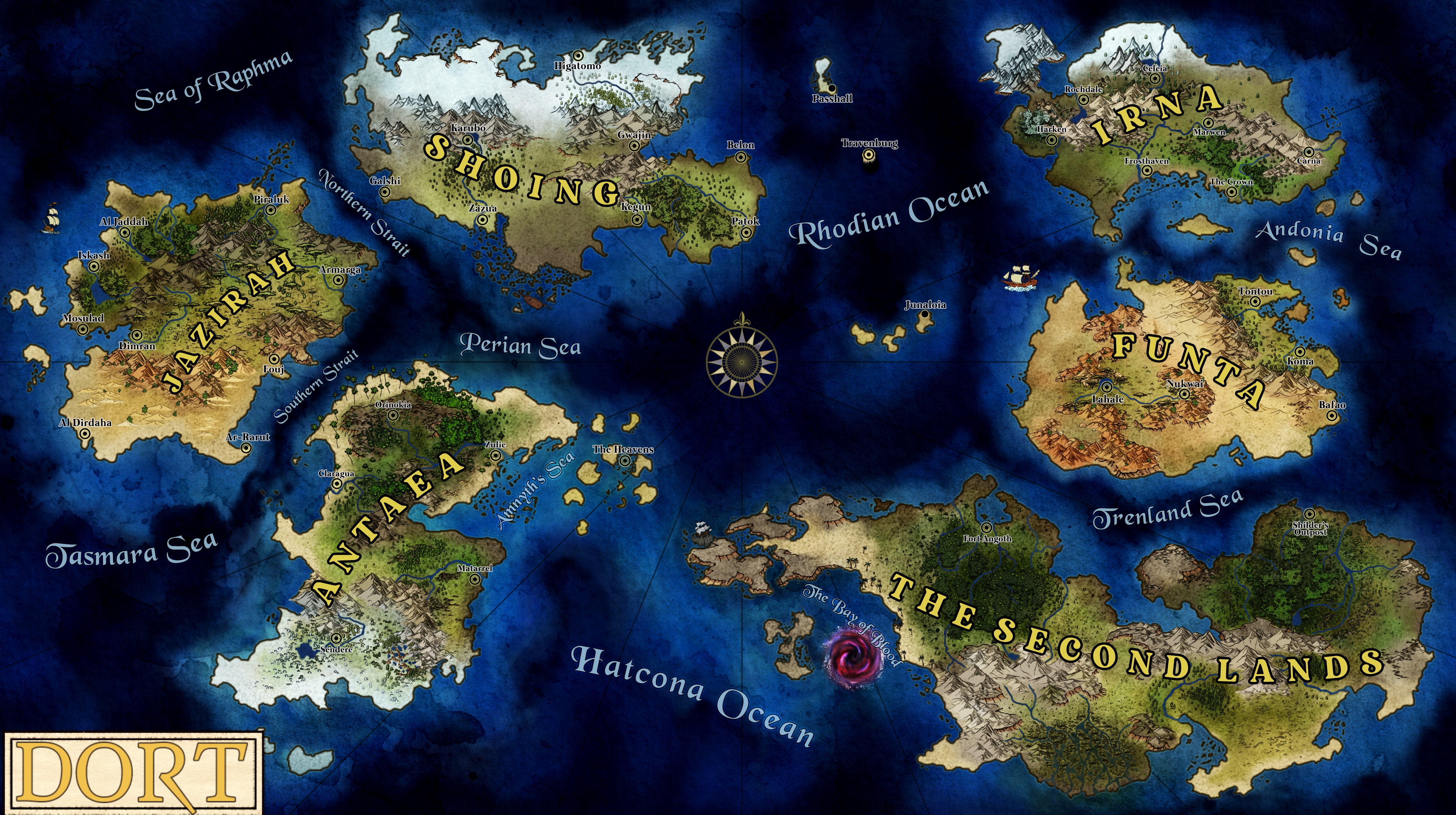
Dort is the mortal world at the heart of Ix. Its great lands are separated by wide seas but connected by centuries of exploration, trade, migration, conquest, religious conflict, and political rivalry.
Five lands dominate the settled world: Irna, Shoing, Funta, Jazirah, and Antaea. Beyond them lie the Second Lands, a vast and dangerous region where settlement remains difficult, maps remain incomplete, and the established powers have never gained more than a precarious foothold. Between them run the Oceanic Reaches, not a continent, but a web of islands, routes, ports, and sea-borne anomalies that matter because they connect the lands without belonging neatly to any one of them.
Each land has its own rulers, cultures, languages, faiths, and internal divisions. None is merely a variation on another. Crossing an ocean means entering a place shaped by different histories, customs, assumptions, and rivalries.
A World Shaped by the Divine
The peoples of Dort live in a world shaped by divine power. Magic is part of the structure of the universe, not a distant mystery or a rare exception to ordinary life.
Prayers may be answered. The shard-gods and later divine powers gain strength through worship. Powerful beings can alter nature, reshape societies, and leave consequences that endure for generations. The supernatural is not confined to lost ruins or isolated cults. It exists within the same world as merchants, nobles, soldiers, farmers, sailors, and adventurers.
Dort's oldest stories begin with Ix, the original being whose dreams became reality. The Ancients, created in the earliest ages of existence, eventually rebelled against Ix and shattered him. The first modern gods, the shard-gods, came from the fragments of Ix; later gods arose by other means, including ex nihilo creation and divine children. The Ancients were banished into the Void.
The Ancients are no longer openly present in the world, but their artifacts survive. Their influence has not entirely vanished. Their possible return remains one of the deepest threats within the setting.
Echo and the Remaking of the World
Dort was once far harsher than it is now. Before the coming of Echo, the peoples of Dort struggled against disease, dangerous creatures, hostile environments, and one another. Echo arose in response to the suffering of the mortal races and spent a century remaking the conditions of life.
Echo reduced illness, tempered environmental dangers, purified waterways, taught sanitation and medicine, and culled the worst predators that made settled civilization nearly impossible. Much of what the people of Dort consider ordinary life exists because Echo made it possible.
Echo did not make the world safe.
Dort's history is marked by events whose consequences still shape the present: wars between peoples, the rise and fall of nations, divine conflicts, plagues, magical disasters, unexplained years when the normal rules of death changed, and the death of the god Izon after he manifested directly in the mortal world.
Since Izon's fall, the gods have avoided openly walking Dort. They remain active through worshippers, institutions, miracles, omens, agents, and rival faiths.
The Lands of Dort
Modern Dort is politically connected but not unified.
Most kingdoms acknowledge larger regional powers, and the major lands maintain formal relations with one another, but peace is often a matter of appearance. Kingdoms compete through diplomacy, trade, espionage, religious influence, covert operations, mercenary forces, and carefully limited violence.
Open wars are unusual enough to matter. Conflict is constant.
Irna remains the oldest political center of the known world. Its rulers established the first major post-Echo civilization, and its influence spread outward through exploration, settlement, conquest, diplomacy, and trade. The Crown remains a major seat of political authority, while Irna Common has become the most widely used language of international business and diplomacy. Irna is influential, but it does not rule Dort.
Shoing is populous, fertile, magically adventurous, and increasingly confident in its own power.
Funta is a land of difficult environments, old tribal identities, formidable warriors, and the scholarly city of LaHale.
Jazirah carries the scars of conquest, religious extremism, resistance, and unresolved violence. Its Oshalan rulers are more openly expansionist than most powers in Dort, and their treatment of those they regard as enemies has made them a threat far beyond their own borders.
Antaea is politically fragmented but economically inventive, with strong regional identities and the floating city of The Heavens rising as one of the most important centers of trade and off-world travel.
The Second Lands remain something else entirely: vast, dangerous, poorly controlled, and capable of swallowing expeditions without explanation.
Between and beyond these lands are the Oceanic Reaches: islands, open-water ports, cliff cities, drifting structures, and sea routes that connect the major continents without belonging cleanly to any of them. They are not a sixth continent and they do not share a single culture, but they matter to Dort's politics because travel, trade, piracy, exile, and off-world strangeness often pass through them before reaching a capital.
Language and Travel
Language matters in Dort. Each major land has its own Common tongue, with Irna Common serving as the dominant international language and Shoing Common also widely spoken.
A traveler who crosses an ocean has not merely entered a different climate. They have entered a place with different assumptions, different histories, different faiths, and often a different language.
Magic can ease some barriers, but not all of them. The Ancient language is itself magical and cannot be bypassed so easily.
Adventurers in Dort
Adventurers occupy an important place in this world.
Dort is old enough that many dangers have histories behind them. A threat may be connected to a forgotten war, a divine bargain, a failed magical experiment, a buried artifact, a missing expedition, an old family grudge, or a political decision that was never truly resolved.
A local problem may remain local, or it may become the visible edge of something much larger.
Running Dort
A Dort campaign should feel layered.
The immediate problem matters, but it rarely exists in isolation. A monster attack may threaten a village, but the creature may have escaped from an old magical site. A trade dispute may conceal a struggle between noble houses. A religious quarrel may be part of a broader conflict between gods competing for worshippers. A recovered artifact may be valuable, dangerous, politically sensitive, and connected to the Ancients all at once.
The setting supports local adventures without requiring the players to understand the entire world at the beginning of a campaign.
Start with the land, city, or region where the characters live.
Let the wider world emerge as they encounter it: through travelers, rumors, relics, foreign merchants, rival faiths, political pressure, and the consequences of old events that refuse to remain buried.
Irna
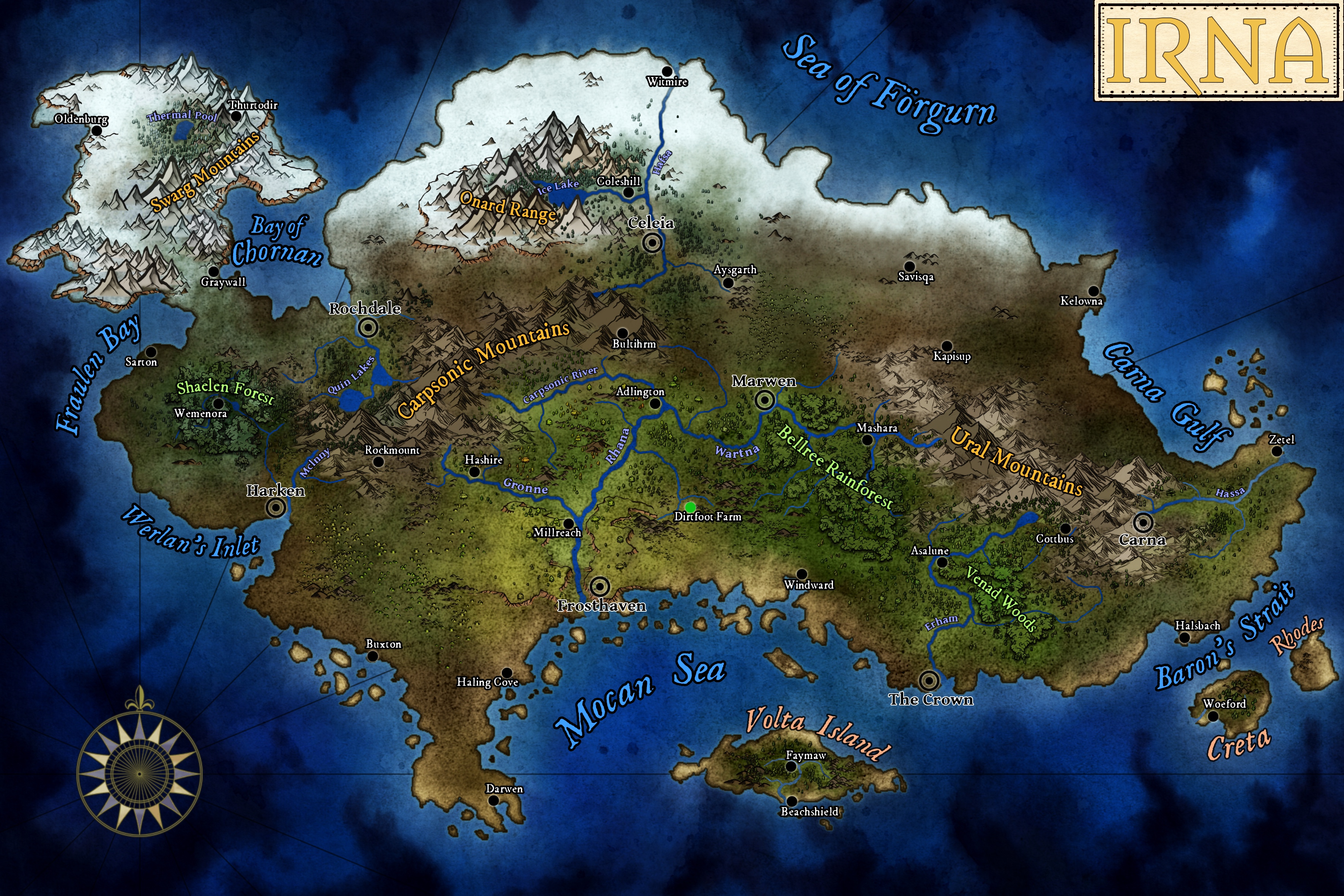
Irna is the historical center of Dort and the oldest continuously organized civilization in the known world. Its cities, laws, roads, and noble houses predate many of the nations beyond its shores. Its explorers established the first lasting connections between the continents, and its merchants, soldiers, administrators, and settlers carried Irnan customs far beyond the mainland.
This influence should not be confused with universal rule. Irna does not govern Dort as a whole, and the cultures of the other continents are not extensions of its own. Even so, every major land has been affected by Irna in some way. Some maintain close alliances with it. Some adopted Irnan institutions and adapted them to local needs. Others remember conquest, cultural pressure, or political interference and regard Irna with deep suspicion.
At the center of the continent stands The Crown, the imperial capital and the seat of the Emperor. The city remains one of the most influential political and cultural centers in Dort, but Irna itself is not a single centralized state. It is an empire of kingdoms, each with its own rulers, industries, traditions, and degree of loyalty to imperial authority.
The First Civilization
Irna's claim to be the cradle of civilization is supported by surviving records, ruins, and institutions whose origins reach farther back than those of any other known land.
Long before Irnan ships crossed the oceans, communities in the continent's plains and river valleys had developed settled agriculture, permanent roads, written law, large cities, formal systems of government, and military organizations capable of operating across substantial distances. These foundations allowed Irna to expand through exploration, trade, diplomacy, colonization, and, when necessary, force.
The lands reached by Irnan explorers were never empty. Their inhabitants possessed their own traditions, political structures, and histories. Contact with Irna changed those societies, but it did not erase them. In many cases, the result was a long and complicated relationship in which Irnan customs were adopted, resisted, altered, or combined with older local practices.
Irna remains the point from which much of Dort's recorded international history is measured. It is not the beginning of every culture's story, but it is often the point at which those stories became connected.
The Land
Irna is a temperate continent divided by mountain ranges, forests, river valleys, fertile plains, and long coastlines.
The Carpsonic Mountains cut across the western interior, separating the kingdoms of Rochdale and Harken from the central heartlands. The range is crossed by old roads and trade routes, but travel remains difficult in many places, particularly during severe weather.
Farther north, the Onard Range rises near Celeia. This region is colder and more rugged, with mountain lakes, fortified settlements, and communities shaped by long winters and difficult terrain.
The Ural Mountains dominate the southeast near Carna. Their mines provide much of Irna's gold and have made the region strategically important to the imperial economy.
The northwestern reaches are colder still. The Swarg Mountains rise above the Bay of Chornan, where isolated settlements endure harsher conditions than those of the central plains.
Irna's forests are equally important. The Shaelen Forest lies in the west near Harken. The Bellree Rainforest occupies a large part of the eastern interior. The Venad Woods spread across the southeast above The Crown.
Rivers descend from the mountains into the central lowlands and toward the southern coast. These waterways support farming, trade, travel, and the movement of goods between the kingdoms. The most heavily settled regions lie along these rivers and across the fertile plains, but even the heartlands contain old woods, remote farms, isolated villages, and stretches of road where local authority matters more than imperial administration.
The Crown
The Crown is the imperial capital and the political center of Irna.
Unlike many great cities, it did not begin as a small settlement that gradually expanded around a harbor or crossroads. The Crown was planned deliberately as a seat of imperial power. Its streets, plazas, walls, government buildings, and ceremonial spaces were designed to project order, permanence, and authority.
The Emperor resides in The Crown and issues laws that apply throughout the continent. Foreign rulers send ambassadors to its courts. Noble houses maintain representatives there. Merchants, priests, scholars, military officers, petitioners, and political opportunists all compete for access to the city's institutions.
The Crown has influenced architecture and government far beyond Irna. Cities on other continents have borrowed from its layout, and foreign administrations still use systems originally developed by Irnan officials. Even where Irnan power is unwelcome, its influence is difficult to avoid.
The Kingdoms of Irna
Irna is an empire of kingdoms rather than a single unified territory.
The Emperor's laws apply throughout the continent, but each kingdom retains substantial autonomy. Local rulers govern according to regional needs, inherited traditions, and their own political interests. In some kingdoms, imperial law is enforced closely. In others, local practice matters just as much as the wording of the law.
The Crown Kingdom
The Emperor's own territory is administered directly from The Crown.
Imperial officials are more visible here than anywhere else in Irna. Roads, courts, tax collection, military obligations, and law enforcement receive close attention. The region is not free of corruption or political maneuvering, but those who engage in either must account for the proximity of the imperial court.
Rochdale Kingdom
Rochdale is ruled by House Irna, the original noble family of the continent.
The family's name carries considerable weight. Its members can trace their lineage back to the earliest periods of Irnan political history, and the house retains a strong sense of its place within the Empire.
Rochdale lies near the western approaches to the Carpsonic Mountains. Its position gives it access to the central plains, the western kingdoms, and the trade routes crossing the mountains.
Harken Kingdom
Harken is ruled by House Orn.
The kingdom lies in the west near the Shaelen Forest and the coast. Harken has a reputation for uneven enforcement of imperial law and for local customs that can matter as much as official rules.
Travelers are advised to understand the authority of the local nobility before assuming that the law will be interpreted in the same way it is in The Crown.
Celeia Kingdom
Celeia lies near the Onard Range, where mountain terrain, cold lakes, and valuable resources have shaped both its economy and its culture.
The kingdom is governed by Clan Kaldersteinn, a dwarven noble family with a long history of rule in the northern interior.
Clan Kaldersteinn is known for careful administration, skilled craftsmanship, and a long institutional memory. The clan's approach to politics is generally methodical, although its patience should not be mistaken for passivity.
Marwen Kingdom
Marwen sits near the Warta River and the Bellree Rainforest, a position that provides access to fertile land, river trade, and forest resources.
The kingdom is ruled by House Slvanna, an elven family with one of the longest continuous records of noble rule in Irna.
House Slvanna's greatest strength is continuity. Its rulers have governed through generations of imperial change, giving the family a detailed understanding of precedent, alliances, and old obligations.
Carna Kingdom
Carna lies beneath the Ural Mountains, where the kingdom's mines produce much of the gold used throughout the Empire. The kingdom is ruled by House Carna.
This wealth gives House Carna substantial influence, but it also attracts close attention from rival nobles and imperial officials. Mining output, trade agreements, labor disputes, and succession politics in Carna can have consequences well beyond the kingdom's borders.
Frosthaven Kingdom
Frosthaven stands on the southern coast of the Mocan Sea and controls some of Irna's most important importing cargo docks. Its prosperity depends on shipping, warehousing, contracts, and the reliable movement of goods.
House Frost rules the kingdom, governing with a practical focus on stability and commerce. Frosthaven is a busy port city where sailors, merchants, dockworkers, travelers, and foreign traders bring together influences from across Dort.
The city is also home to one of Irna's most unusual landmarks: the Sentient Spire.
The Island Territories
Irna's authority extends beyond the mainland to several island territories.
Volta Island
Volta Island lies south of the mainland in the Mocan Sea.
The island is hot, humid, and highly productive. Its climate supports citrus, sugar, tropical timber, seafood, and other goods valued throughout the Empire.
Volta's residents are accustomed to mainland visitors finding the climate difficult. They are also accustomed to those same visitors developing a more favorable view of the island once they have sampled its rum.
Creta
Creta lies southeast of the mainland near Baron's Strait.
Once known primarily for agriculture and fishing, the island has become an important military stronghold. Its location places it on the front line of Irna's defenses against raids and pressure from Jazirah.
Fortifications, naval yards, supply depots, orchards, fisheries, and military patrols now exist side by side. The island remains productive, but its strategic role increasingly shapes daily life.
Rhodes
Rhodes lies near Creta.
The island is smaller, drier, and less developed than its neighbor. Fishing villages dominate the coastline, while formal mainland oversight remains limited.
Jaziran raiders occasionally test the island's defenses. The residents have learned to prepare for this possibility without allowing it to define the whole of their lives.
Law and Local Authority
Irna's noble hierarchy affects daily life throughout the continent.
The Emperor rules from The Crown. Kings and queens govern the major kingdoms. Dukes and duchesses hold substantial territories. Earls and countesses oversee regions, towns, and strategic holdings. Barons and baronesses govern towns and their surrounding lands. Lords and ladies manage villages, estates, and smaller holdings. Knights may command outposts, serve noble households, or hold modest lands of their own.
The hierarchy determines who collects taxes, settles disputes, maintains roads, raises troops, grants trade privileges, and responds to local threats.
The Laws of Irna are posted at the gates of major towns and cities. These laws establish the imperial standard, but they do not eliminate regional variation. A local ruler may enforce a law rigorously, interpret it loosely, or supplement it with additional rules.
For travelers and adventurers, the practical question is often not simply what the law says, but how it is applied in the place where they currently stand.
The People of Irna
Irna is too large and too old to be culturally uniform.
The central heartlands are densely settled and shaped by long traditions of agriculture, craft, trade, and civic administration. These regions produced many of the practices associated with imperial culture.
The northeastern plains are home to nomadic and semi-nomadic communities whose lives are closely tied to seasonal movement, weather patterns, and the behavior of wildlife.
The central northern mountains support fortified settlements known for metalwork, stonecraft, and practical engineering. The northwestern peaks contain communities adapted to cold, isolation, and difficult terrain.
Regional differences appear in architecture, clothing, food, festivals, manners, and expectations of hospitality. A traveler moving from Harken to Celeia, or from Rochdale to Carna, will encounter communities that share an Irnan identity while expressing it in distinctly different ways.
Food and Daily Life
Irna's food traditions reflect its varied geography.
The central plains produce wheat, rye, vegetables, dairy products, and livestock. Bread, stews, pastries, cheese, and roasted meats are common throughout the heartlands.
Northern communities rely more heavily on root vegetables, cabbage, dark breads, preserved fish, venison, fowl, and berries. Coastal settlements make greater use of seafood, while western regions favor maize, beans, squash, and one-pot meals suited to local agriculture.
Apples, grapes, cider, wine, and seasonal preserves are common in many parts of the continent.
Meals vary considerably by region, but hospitality is widely valued. An invitation to share food is usually sincere, and travelers who take local customs seriously are more likely to receive help when they need it.
Notable Places
Dirtfoot Farm
Dirtfoot Farm is a Smaling-run cabbage farm known across Irna for its magically self-souring sauerkraut.
The Dirtfoot clan is suspicious of anyone taller than four and a half feet. They will conduct business with taller people when necessary, but they do not extend trust casually.
The family considers a handshake binding. Written contracts are regarded as less reliable.
The Sentient Spire of Frosthaven
The Sentient Spire of Frosthaven stands on a hill near the city's docks.
Generations of powerful mages have lived and worked in the tower. Over time, magical energy accumulated within the structure until the Spire developed an awareness of its own.
Most residents of Frosthaven do not know this.
The tower quietly selects its occupants, protects its interests, and resists periodic attempts by the local nobility to place it under military control.
Its current occupant is Verrell the Transmuter.
Verrell has installed a sentient door named Door, which serves as the Spire's guardian and has developed a strong sense of its own importance.
Irna and the Wider World
Irna's influence reaches across Dort through trade, language, law, architecture, diplomacy, and historical expansion.
Irna Common remains the most widely used language of international business and diplomacy. The Crown receives envoys from other lands. Irnan ships continue to carry goods and travelers across the world's seas.
This influence is not viewed the same way everywhere.
Some foreign rulers regard Irna as a useful ally and a source of political stability. Others see it as an aging power that remains too confident in its own importance. In many places, both attitudes exist at the same time.
Irna's role in Dort is therefore best understood as a combination of historical authority, practical influence, and inherited tension.
Running Irna
Irna is well suited to campaigns that begin close to the established centers of civilization.
The Crown supports political intrigue, diplomacy, espionage, and disputes involving imperial law. Rochdale and Harken offer noble rivalries and local conflicts shaped by the distance between written rules and actual practice. Celeia and Marwen support stories involving long memories, regional traditions, and old obligations. Carna offers mining disputes, economic pressure, and political competition. Frosthaven provides maritime trade, dockside trouble, foreign visitors, and magical complications.
Beyond the cities, the continent contains mountain roads, forests, farming communities, isolated settlements, ancient ruins, and local authorities with their own interests.
Irna is a useful starting point because it provides familiar institutions without requiring every campaign to remain within them. Its kingdoms are connected, but they are not uniform. Its laws are established, but they are not always applied consistently. Its history is well documented, but it still contains unresolved conflicts and overlooked places.
A campaign set in Irna can remain local, expand into imperial politics, or use the continent's ports and roads as the starting point for travel across the wider world.
Jazirah
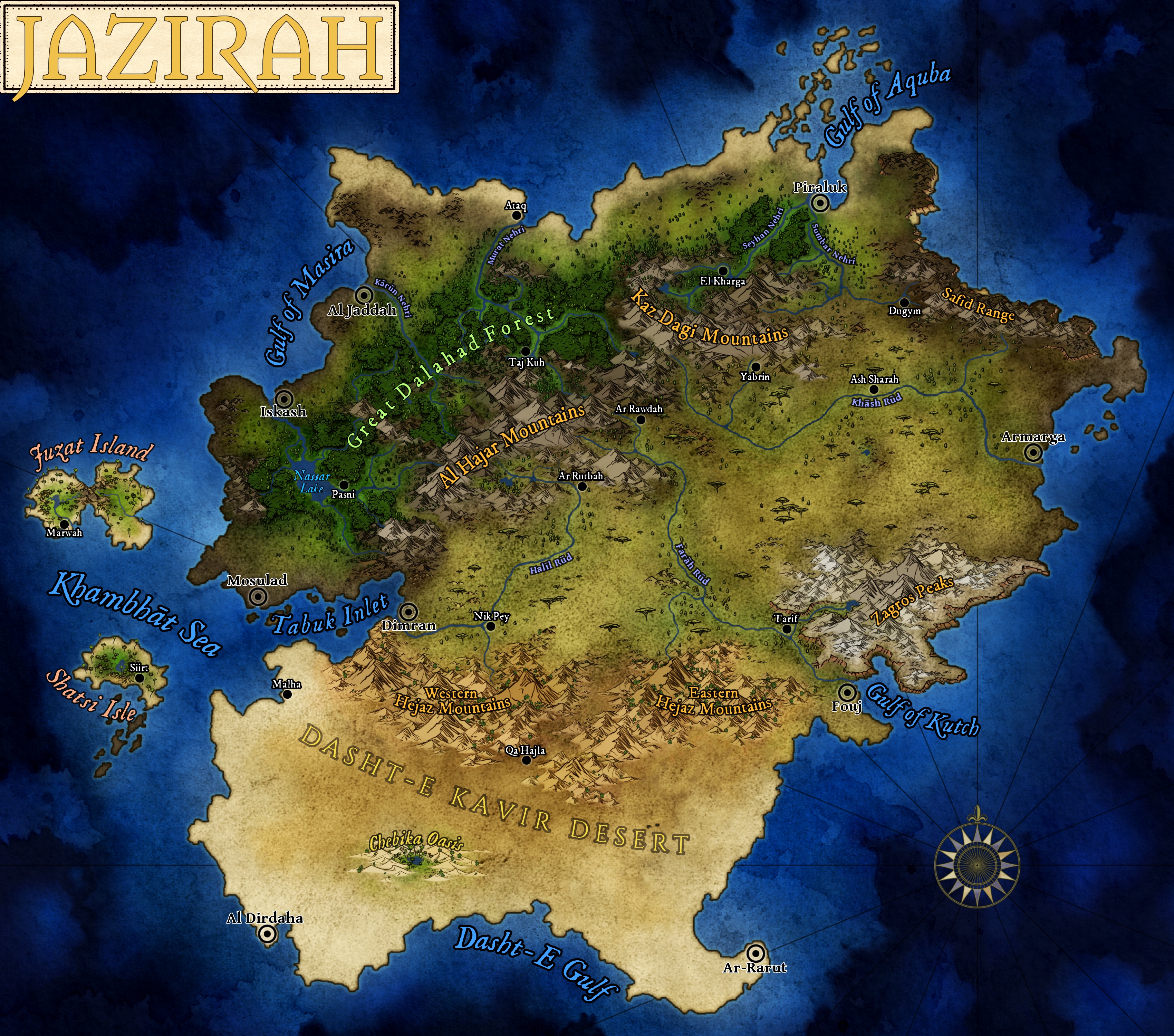
Jazirah is a land shaped by beauty, faith, conquest, and an old wound that has never fully healed.
The continent stretches from the fertile shores of the Gulf of Aquba in the north to the vast Dasht-E Kavir Desert in the south. Between them lie the Great Darahad Forest, the open grasslands of the eastern interior, the mountain corridors of the Al Hajar and Yaz Dagi ranges, the southern Hejaz Mountains, the Zagos Peaks, and a long coastline broken by gulfs, islands, fishing settlements, and fortified ports.
Jazirah is often described by outsiders as a desert land. That description is incomplete.
Its southern reaches are harsh and dry, but much of the continent is green, fertile, and heavily settled. Rivers descend from the mountains into the forests and plains. Herds graze across the central grasslands. Farmland surrounds the northern cities. Coastal communities draw food and wealth from the surrounding seas. Even the desert contains old travel routes, isolated settlements, and oases such as Chebika.
The geography matters. Jazirah is large enough that no single city, faith, or ruler can entirely define it.
The Arrival of Irna
The central conflict of Jazirah began with the arrival of settlers from Irna.
In 540 ME, Irnan explorers reached the fertile northern shores of the continent. They found land suitable for farming, trade, and permanent settlement. As they moved farther inland, they encountered the Sand Elves, a people previously unknown to the Irnans.
The first meetings were peaceful, but the peace did not last.
A powerful Irnan general learned that his daughter had formed a relationship with a Sand Elf. Driven by prejudice and rage, he engineered a deception that transformed a private matter into a public justification for war. The resulting campaign was not a border dispute or a limited military conflict. It was an attempt to destroy an entire people. The Sand Elves were hunted, scattered, and driven into hiding.
A small number survived.
The Return of the Sand Elves
During their long exile, the surviving Sand Elves turned increasingly toward Oshala. They came to believe that their survival had not been chance, but preparation. Oshala had preserved them so that they could return stronger than before.
Centuries later, they emerged from isolation.
Their return was not merely a political recovery. It was a religious resurgence. The Sand Elves spread the worship of Oshala throughout Jazirah, gathering converts among those who saw their survival as proof of divine favor and among those who had their own grievances against the old order. Many accepted the new faith willingly; others did not.
The tragedy of Jazirah is that some of those who had survived persecution came to use the methods of their former persecutors. Communities that resisted conversion faced intimidation, punishment, and violence. An old atrocity became the foundation for new ones.
This history is not distant background. It shapes how people understand authority, loyalty, justice, and faith in modern Jazirah.
The Sacred Laws
Modern Jazirah is governed under the Sacred Laws of Jazirah Under the Divine Oshala.
The capital, Iskash, is the center of Oshalan authority. Religious law, political power, and public life are tightly intertwined. In Iskash, adherence to the dominant faith is expected, visible, and closely watched. Transgressions can bring swift punishment.
The farther one travels from the capital, the more varied Jazirah becomes.
In many towns and villages, Oshalan traditions are part of ordinary life without consuming every aspect of it. Families observe rituals because their parents and grandparents did. Merchants invoke customary blessings before negotiating a price. Local leaders may publicly follow the Sacred Laws while quietly adapting them to the realities of their communities.
Some people are deeply devout.
Some are culturally Oshalan but personally indifferent.
Some worship in private.
Some resent the rulers of Iskash while remaining loyal to Oshala.
Some oppose the entire religious order.
A GM should resist presenting every Jaziran as a fanatic or every follower of Oshala as an enemy. Jazirah is a continent, not a single faction.
Cities and Regions
Iskash is the political and religious center of Jazirah. Its influence reaches across the continent, but its authority is strongest in the west and along the established routes connecting the northern coast to the central lands.
Al Jaddah, farther north along the Gulf of Masira, stands near the river valleys and the western approaches to the Great Darahad Forest. It is well positioned for trade moving between the coast and the inland settlements.
Mosulad and Dimran sit near the Tabuk Inlet, where the forested west gives way to the southern interior. The nearby port communities connect inland Jazirah to the islands and sea routes beyond the coast.
Piraluk overlooks the Gulf of Aquba in the northeast. It is distant from Iskash and surrounded by fertile lands, rivers, and smaller settlements. The northeastern cities may acknowledge the laws of the capital while developing their own local character.
Armarga stands on the eastern coast, facing open water beyond the plains.
Fouj lies beside the Gulf of Kitch, where the Zagos Peaks and the eastern Hejaz Mountains create a natural boundary between the eastern coast and the desert interior.
Al Dirdaha and Ar-Rarut sit on the southern shores of the continent, separated from the northern heartlands by the immense Dasht-E Kavir Desert. They are distant outposts of settled life, dependent upon sea travel and the difficult routes that cross the desert.
Between the major cities lie smaller communities with their own concerns: forest settlements such as Taj Kuh and Pasni, mountain towns such as Ar Rawdah and Ar Rutbah, interior settlements such as Yabrin and Ash Sharaf, and desert-edge communities such as Malha, Nik Pey, Tarif, and Qat Hajla.
Jazirah's islands also matter. Juzat Island and Shatri Isle sit off the western coast, close enough to the mainland to participate in its trade but distant enough to develop traditions of their own.
A Continent Preparing for War
The rulers of Jazirah are no longer content to govern their own land.
War fleets are being constructed. Armies are being trained. Religious leaders speak openly about carrying Oshala's teachings beyond Jazirah's shores. To the most committed expansionists, conquest is not merely a political goal. It is a sacred duty.
That ambition threatens the rest of Dort, and it threatens Jazirah itself.
Resistance exists within the continent. Some oppose the expansionist movement because they reject Oshalan rule. Others are faithful followers of Oshala who believe that forced conversion corrupts the faith. Some fear that war will destroy their towns, disrupt trade, or bring foreign retaliation. Others carry private memories of family members who disappeared into prisons, fled into hiding, or were punished for refusing to conform.
The resistance is not a single organization. It is a collection of hidden networks, local grievances, rival leaders, frightened families, disillusioned believers, smugglers, political opponents, and communities trying to survive between the demands of Iskash and the threat of war.
Life in Jazirah
Jazirah's cities are known for markets, formal hospitality, poetry, music, skilled crafts, and strongly observed social customs.
Food varies by region but commonly includes grains, flatbreads, rice dishes, lamb, chicken, fish, legumes, yogurt, cheese, dates, figs, pomegranates, apricots, preserved lemons, and spices. Coastal settlements make greater use of seafood. Inland communities rely more heavily on livestock, grains, and produce grown along rivers or carried through established trade routes.
Hospitality carries weight. Guests are expected to respect local customs. Elders are treated with deference. Formal greetings and blessings are common. Meals, gifts, and promises are not casual gestures when offered in earnest.
These customs should not be reduced to scenery. In Jazirah, a poorly chosen word can close a door, while a sincere act of respect can create an ally in an unexpected place.
Running Jazirah
Jazirah works best when its contradictions remain visible.
It is a beautiful land with a violent history.
Its ruling order was shaped by the survival of a persecuted people, but parts of that order now persecute others.
Its faith offers meaning and community to many ordinary people, but ambitious leaders use that faith to justify expansion.
Its cities can be welcoming, sophisticated, and prosperous while still existing beneath the pressure of religious law.
A campaign in Jazirah can focus on resistance against the expansionist regime, political intrigue within Iskash, smuggling along the coast, desert expeditions, disputes between local leaders and distant authorities, lost sites in the mountain ranges, tension between Oshalan factions, or the recovery of buried evidence about the continent's founding war.
Adventurers should not arrive in Jazirah expecting a simple struggle between heroes and villains.
They are entering a land where almost every conflict has a history, almost every faction believes it has been wronged, and the most dangerous people are often those who have convinced themselves that their cruelty is an act of justice.
Shoing
Shoing is a vast northern continent of old mountains, fertile river valleys, deep forests, frozen coasts, and island-dotted southern waters. It is the largest of Dort's established lands and one of the most geographically varied.
Its northern reaches face the cold waters of the Koko Nor Ocean. Snowfields, tundra, and high mountain ranges dominate much of the northwest. The interior is divided by the Sayaan, Hangyin, Bei, Altai, and Tienshaw mountain systems, while the Kacun Range rises above the western lowlands. South of those barriers, the land opens into greener country: broad plains, navigable rivers, productive farmland, thick forests, and coastal wetlands.
The Malaa Sea lies to the west. The Suuli Sea borders the east. Along the southern coast, Banda Bay, the Gozier Inlet, and the island-strewn waters of the Cracked Sea connect Shoing to the maritime trade routes of Dort.
Shoing does not have a single landscape, culture, or center of gravity.
The eastern heartlands are shaped by old noble courts, maritime power, calligraphy, martial traditions, and precisely ordered social expectations. The southern and western lands are warmer, wetter, commercially active, and more fluid in their political arrangements. The highlands and far north have their own customs, built around difficult terrain, isolation, and the practical demands of survival.

The Land Where Dragons Were Born
Shoing is the origin land of dragonkind.
The evidence is unusually strong: Shoing has a greater concentration of dragons than any other continent, the oldest confirmed dragon remains have been found within its mountain systems, and several living dragons have expressed memories or traditions that place their ancestry there.
The mountains of Shoing are therefore more than difficult terrain. They are ancient territories occupied by intelligent beings whose relationships with the land are older than any surviving human kingdom.
Dragons are not a single political faction. Their attitudes toward the peoples of Shoing vary considerably. Some are indifferent to humanoid affairs. Some take an active interest in nearby communities. Some maintain old agreements with nobles, towns, or mountain settlements. Others expect only to be left undisturbed.
The most important of these relationships are known collectively as the Dragon Compacts.
Each compact is local. It exists between specific parties and carries specific obligations. A mountain village may maintain grazing boundaries that leave a dragon's territory undisturbed. A noble house may preserve an old tribute tradition in exchange for protection. A timber community may follow harvesting restrictions whose original purpose has been forgotten by almost everyone except the dragon.
These arrangements require attention: the most dangerous community is often not one that has openly defied a dragon, but one that has inherited a compact whose terms it no longer fully understands.
Dragon eggs are coveted across Dort. In Shoing, they are not treated as unclaimed resources. They exist within the territories of dragons who generally have strong opinions about anyone attempting to take them.
The World Before Irna
When Irnan explorers reached Shoing's eastern coast in 980 ME, they did not discover an empty land.
Shoing was already home to numerous peoples, including humans, elves, dwarves, smalings, gnomes, Drakin, and older local communities whose histories extend far beyond outside contact. Their societies ranged from nomadic communities to established settlements and organized political systems. Their relationships with the land were equally varied: practical, spiritual, territorial, commercial, and often deeply local.
The first encounters with Irnan explorers differed from region to region. Some communities offered cautious hospitality. Others established firm boundaries. Some accepted trade and limited settlement. Others had little interest in newcomers.
The Irnans also found something unexpected: foreign mages had already begun arriving in Shoing before any formal expedition.
These practitioners were drawn by the freedom the continent offered. Shoing did not possess the same restrictive magical institutions found elsewhere. Mages who wanted to explore unusual methods, study dragons, or pursue work without institutional supervision could find space there.
By the time Irna formally established contact, some of those mages had already lived in Shoing for a generation.
Shoing absorbed these arrivals without being defined by them.
The result is a continent that is deeply multicultural but still unmistakably its own. The Irnan presence altered Shoing's development, but it did not create Shoing's identity.
Two Cultural Spheres
Shoing is large enough to contain two broad cultural spheres, each with its own political traditions, aesthetics, foodways, and social rhythms.
They overlap. They trade. They share the same honor culture. They are not interchangeable.
Eastern Shoing
Eastern Shoing is centered on Gwajin, the largest city on the continent and the seat of the Grand Duke. The eastern realms are shaped by noble hierarchies, maritime strength, courtly obligations, and traditions refined over centuries.
The region is known for lacquerwork, ink, calligraphy, swordcraft, martial disciplines, ceremonial etiquette, and carefully structured social expectations. These are not foreign imports. They were developed within Shoing and are central to the eastern understanding of civilization.
The eastern lands extend from the White Gulf and Higatomo in the north to the Gulf of Siem, the Luxiang Forest, Banda Bay, and the southeastern ports.
Major centers include Gwajin, Higatomo, Baoshan, Chon Buri, Lishui, Kegun, Belon, Anshun, and Patok.
The forests matter as much as the cities. The Hatleng Forest dominates the northeast, while the Luxiang Forest shapes the southeastern interior. Rivers descending from the mountains connect the inland settlements to the coast and sustain some of the richest agricultural lands in eastern Shoing.
Southern and Western Shoing
Southern and western Shoing are warmer, wetter, and more commercially varied.
The region includes the western coast facing the Malaa Sea, the riverlands around Galshi and Chengdu, the central highland approaches near Karubo, the fertile lands surrounding Zazua, and the island communities of the Cracked Sea.
The south is shaped by trade, pearl diving, fishing, navigation, highland wool, silk, coastal markets, and the constant movement of goods between ports.
Major centers include Galshi, Chengdu, Baoji, Pingyi, Karubo, Minxain, Xinyi, Zazua, Cam Pha, Saraburi, and Kon Tum.
The Cracked Sea is especially important. Its island communities have accumulated generations of navigation knowledge, sea-lore, and maritime independence. The waters are commercially valuable, difficult to govern, and essential to southern Shoing's identity.
The Fabric of Honor
Honor is not confined to Shoing's nobles; it governs ordinary life.
A person's conduct reflects upon their family, household, business partners, and community. Personal honor and family honor are rarely treated as separate concerns. A public failure may affect everyone connected to the person who caused it. An apology, repayment, or act of restoration often requires witnesses because the harm was social as well as personal.
Honor disputes are not always legal disputes.
A formal duel, a witnessed apology, a public acknowledgment of failure, a gift offered in restitution, or an agreed act of service may resolve a conflict more effectively than a court judgment. This does not make Shoing peaceful, but it gives conflict recognizable channels.
The most difficult disputes are those that cannot be openly named: the insult that everyone understands but no one can acknowledge without worsening the situation, the obligation inherited by a family that no longer knows how to fulfill it, or the wrongdoing committed by someone whose public exposure would damage innocent relatives as much as the guilty party.
Shoing's literature, theater, and poetry return to these tensions constantly.
The Realms of Shoing
Shoing is not governed by a single authority.
Its political organization follows the geography of the land: a network of realms, leagues, highland territories, coastal powers, subject counties, and prefectures whose relationships range from formal alliance to careful distance.
Seven major power centers shape the continent.
The Gwajin Realm
The Gwajin Realm is the most formally organized political structure in eastern Shoing.
Grand Duke Haruo Tessawa governs from Gwajin, the continent's largest city. The Grand Fleet gives the realm real maritime power, while the noble hierarchy extends its authority inland and along the eastern coast.
The settlements of Lishui and Chon Buri support the realm's wider interests. Lishui is associated with freshwater pearl production along the Lian River. Chon Buri is known for its relationship with the Drakine Flame Runners of the caldera slopes.
The Higatomo Northern Provinces
The Higatomo Northern Provinces control the northeastern forest coast, the approaches to the White Gulf, and routes leading toward the northern archipelagos.
House Murano governs from Higatomo.
The region is known for lacquerwork, highland ink, mineral extraction, and an old compact with the dragon Sorath. Sorath has remained silent for forty years, a fact that concerns those responsible for maintaining the agreement.
The subordinate settlements of Baoshan and Chamodo support the province's commercial and maritime networks.
The Karubo Highlands
The Karubo Highlands control the passes through the Hangyin Mountains.
House Thornwald's authority rests on geography. Most interior trade between eastern and western Shoing must pass through routes controlled by the duchy.
Karubo is the heart of the territory. Minxain stands near the Fenling Pass, while Xinyi serves as an inland administrative and certification center.
The Highlands are less populous than the coastal realms, but their control of the mountain crossings gives them influence far beyond their size.
The Galshi Western Coast
The Galshi Western Coast faces the Malaa Sea and maintains a maritime identity distinct from the eastern Gwajin sphere.
The region depends upon fishing, shipbuilding, silk, preserved goods, resin, and trade across the western waters.
Galshi is the major coastal center. Chengdu, Baoji, and Pingyi provide the region with inland goods, shipbuilding materials, and northern resources.
The Zazua Cracked Sea League
The Zazua Cracked Sea League governs the southern archipelago through a compact of seven ports.
No single ruler possesses absolute authority over the League. House Dharmakar of Zazua holds the convening role: not sovereignty, but the authority to provide a neutral table at which the ports can negotiate.
The League manages navigation, piracy response, maritime trade, and the pearl industry that gives the Cracked Sea much of its commercial importance.
Its member ports include Cam Pha, Saraburi, and Kon Tum.
The Senior County of Kegun
The Senior County of Kegun is formally subordinate to the Gwajin Realm but commercially indispensable to it.
House Veshi has spent generations arguing that Kegun's wealth is not merely a resource to be extracted by the eastern court.
The medicinal trade from Hechi and the Luxiang Forest, along with the road junction at Maha, makes Kegun essential to the eastern economy.
The Prefecture of Belon
The Prefecture of Belon is known for its salt works and its careful relationship with the Gwajin court.
The Drell family maintains the court specifications that protect Belon's status and commercial position.
The subordinate settlement at Anshun governs the rice-growing lands of the Chandu River basin, which supply much of the eastern interior.
Northern Shoing
Far northern Shoing is colder, more isolated, and less densely settled than the southern realms.
The region includes snowfields, mountain plateaus, islands, and the coastlines facing the Koko Nor Ocean. Communities such as Pingyi, Baoji, Minxain, Xinyi, Higatomo, and Chamodo live with harsher winters and longer travel times than the southern ports.
The north is not an empty wilderness. Its settlements maintain trade routes, resource industries, family alliances, and dragon compacts that may be older than the political structures of the south. The distance from the great courts often creates practical independence, even where formal allegiance is clear.
Food and Daily Life
Shoing's food traditions reflect its two major cultural spheres.
Eastern cooking emphasizes precision, technique, seasonality, and balance. Rice, noodles, fish, shellfish, pork, chicken, cabbage, mushrooms, bamboo shoots, mountain herbs, soy products, fermented sauces, pickled vegetables, tea, and rice cakes are common.
Southern cooking is richer, more aromatic, and strongly shaped by the coast and inland trade routes. Long-grain rice, lentils, flatbreads, seafood, chicken, goat, coconut, tamarind, turmeric, cumin, cardamom, coriander, curry leaf, mango, papaya, and jackfruit appear frequently.
The contrast is not a measure of refinement: eastern and southern traditions developed from different climates, resources, and histories. Both are established parts of Shoing's identity.
The Honorable Laws
Shoing's civic life is structured by the Honorable Laws of Shoing.
These laws express the honor system as public obligation rather than private preference. They apply to nobles and commoners alike, although different positions carry different duties, privileges, and expectations.
Local nobles serve as the primary legal authorities in most communities. A Baron, Thakur, Prefect-Warden, or Harbor-Baron may handle ordinary disputes directly, while more serious matters can rise through the regional hierarchy.
Formal enforcement matters; community knowledge often matters more.
A person's neighbors, family, business partners, and rivals are all participants in the social consequences of misconduct. In Shoing, reputation is a practical form of power, not a vague abstraction.
Running Shoing
Shoing works best when its scale remains visible.
A campaign in the continent's eastern courts should feel different from one set among the Cracked Sea ports. An adventure in the Karubo Highlands should not resemble a journey through the Luxiang Forest or an expedition into the frozen northwest.
Honor should create choices rather than function as background decoration.
A dispute may be legally simple but socially dangerous. A noble may need adventurers to solve a problem without publicly exposing the person who caused it. A family may inherit a dragon compact that no one fully understands. A merchant may have fulfilled the words of an agreement while violating its spirit. A town may depend upon a dragon whose silence has lasted too long.
Shoing supports court intrigue, maritime adventures, mountain expeditions, dragon politics, regional rivalries, trade disputes, family obligations, honor conflicts, magical experimentation, and stories involving communities that must decide which traditions still protect them and which have become dangerous to preserve.
The continent should feel old, confident, and internally complex. Visitors may arrive with assumptions about Shoing, and the continent is under no obligation to confirm them.
Antaea
Antaea is a vast and politically fragmented continent whose people have never shown much interest in being governed from a single center.
Its regions are linked by trade, shared history, and practical necessity, but they remain fiercely protective of their autonomy. River confederations, forest compacts, island alliances, coastal cities, and independent settlements have developed systems of cooperation that function without requiring the continent to become a unified state.
To outsiders, this can make Antaea appear disorganized, but it is not. Antaea's political arrangements are local by design. Its people generally prefer a limited agreement that solves a specific problem to a distant authority claiming the right to solve every problem. This has produced a continent of strong regional identities, distinct legal traditions, varied architecture, and unusually diverse local cultures.
The nearest thing Antaea has to a shared political center is The Heavens, a floating city of five islands off the northeastern coast where major disputes are arbitrated and trade agreements negotiated.
The Heavens is influential because it offers neutral ground; it does not rule the continent.
The Land
Antaea is divided into several distinct geographic regions.
The northern mainland is warmer, greener, and more heavily settled than the south. Its forests, rivers, grasslands, and coastal plains support most of the continent's major cities and trade networks.
The Moriche Rainforest stretches across the northern interior near Sonoro and the upper riverlands. Farther south, the Gran Floresta dominates the central-western region around Claragua and Orinokia. These forests provide timber, medicinal plants, game, and valuable materials, but they also complicate travel and preserve communities whose customs have developed with limited outside interference.

The Cordillera Sulana cuts across the center of the continent, forming a natural barrier between the northern regions and the lands farther south. Roads and river routes cross the mountains in places, but the range has always limited the movement of armies, merchants, and settlers.
East of the central highlands lies the Canal Agrietado, a fractured channel filled with islands, narrow passages, and dangerous waters. Beyond it sits the eastern archipelago, where The Heavens and its neighboring island settlements have become central to Antaea's maritime trade.
The southern mainland is colder and more difficult.
The Sierra de Verno divides the eastern lowlands from the southern interior, while the Curamba Peaks rise in the southwest. Beyond those ranges lie frozen plains, snowbound settlements, thermal springs, deep forests, and territories that remain poorly mapped.
The Arboleda Esmeralda, Grove of Ysidir, Lake Chabaji, and the river systems flowing toward the southern coast create pockets of settlement within an otherwise difficult region.
Antaea's coastlines are equally varied. The Bahía del Monzón lies along the western shore. The Golfo de Nicoya opens toward the southwest. The Mar Helado borders the frozen south, while the Bahía de los Dedos reaches into the southeastern coastline. To the east, Ammyth's Sea separates the mainland from the archipelago and the open waters of the Hatcona Ocean.
Antaea is not one wilderness and not one civilization. It is a continent whose geography has encouraged regional independence at every stage of its development.
The Arrival of Irna
Irnan explorers reached Antaea in 1244 ME.
They found a land already inhabited by communities that had survived for generations amid difficult terrain and dangerous humanoid populations. These settlements were not waiting for outside guidance. They possessed their own customs, alliances, defensive practices, and territorial knowledge.
The Irnans recognized that conquest would be costly and that cooperation offered better returns.
Trade agreements followed. Alliances were negotiated. Settlements willing to work with Irna gained access to wider commercial networks, military support, and imported resources. In exchange, Irnan administrators mapped regions, formalized trade relationships, and helped identify cities that could function as regional centers.
When the time came to confront the hostile humanoid forces that had restricted settlement and trade, Irna supplied armies. Funta contributed its Fire Swingers, whose abilities proved decisive in several campaigns.
The balance of power changed, but Antaea did not become an Irnan territory. Its communities accepted trade, military assistance, and useful administrative tools while resisting any suggestion that these arrangements gave Irna the right to govern them. The distinction remains central to Antaean political culture.
The Fragmented Land
Antaea has no emperor, no single national capital, and no continent-wide government.
Its political structure is better understood as a collection of agreements between communities that have concluded cooperation is useful in particular circumstances.
These agreements are not weak substitutes for centralized rule. They are the form of government Antaea's people prefer.
A river confederation may coordinate tolls, irrigation, and defense without claiming authority over every aspect of village life. A forest compact may regulate logging and trade routes while leaving local disputes to community leaders. An island alliance may organize piracy response without demanding political loyalty beyond the ports directly involved.
This structure can be frustrating for foreign diplomats.
An agreement negotiated in The Heavens may matter greatly in Zulie and not at all in Sendere. A merchant may need separate permissions to move the same cargo through several neighboring regions. A military alliance may exist for one threat and dissolve when that threat passes.
Antaea functions through overlapping obligations rather than a single chain of command.
Understanding which agreement applies in a given place is often more useful than knowing who claims the highest title.
The Heavens
The Heavens is a floating city of five islands above the Sea of Heaven, off Antaea's eastern coast.
Its position has made it the continent's most important neutral meeting ground. Regional leaders gather there to negotiate trade agreements, settle disputes, coordinate responses to shared threats, and manage relationships with foreign powers.
The Heavens does not possess the authority of an imperial capital. It is not under Irnan law and does not want to be.
Its influence depends upon consent, guarded neutrality, and the belief that Antaea and the wider world need a meeting ground not controlled by The Crown.
The city works because Antaea's power blocs find neutral arbitration preferable to direct conflict and because no mainland faction wants one of its rivals to control the meeting place. Many of its leaders also intend The Heavens to become the place major powers must use when The Crown is too Irnan, too watched, or too politically loaded. The Heavens offers coordination without requiring the regions to submit to a permanent central government.
The city is also a major center of maritime trade and off-world travel. Its markets, docks, embassies, guarded portals, patrol routes, and administrative halls attract merchants, travelers, scholars, diplomats, and opportunists from across Dort.
The surrounding archipelago contains several settlements aligned with The Heavens, including Santo Rey, Acarinha, Miravay, Vistazul, Delsol, and Caripi.
These cities are partners rather than subjects.
The Power Blocs of Antaea
Five major political arrangements account for much of Antaea's organized public life.
They differ in structure because they developed in response to different landscapes and needs.
The Heavens Sphere
The Heavens Sphere is the network of island and coastal communities aligned with The Heavens.
Its members benefit from shared trade access, arbitration, mutual protection, and the maritime connections created by the eastern archipelago.
The Sphere does not impose a uniform government upon its members. Each settlement retains control over its own internal affairs.
This arrangement works because The Heavens is careful not to overreach.
The Zulie River Confederation
The Zulie River Confederation governs the northeastern river basin.
Zulie is the largest city in the network and provides much of its political coordination. The settlements of Maxan, Huasco, Sonoro, and Punta Seca contribute river access, agricultural goods, trade connections, and collective defense.
The Confederation is one of Antaea's most stable political arrangements because its members have clear practical reasons to cooperate. River management, transport, flood control, trade, and security all require coordination.
The relationship is transactional in the best sense: everyone understands what the agreement provides.
The Gran Floresta Compact
The Gran Floresta Compact binds the central forest regions and the western coast.
Orinokia is the dominant interior power. Claragua controls important access to the western coast and the Bahía del Monzón. Cumane and Bocay are smaller members whose positions remain important to regional trade and movement.
The Compact works because no single member can easily ignore the others. Orinokia needs coastal access. Claragua needs the resources and trade routes of the interior. The smaller settlements benefit from an arrangement that limits the ability of either larger city to dominate the region completely.
The question of whether Orinokia or Claragua is more important has never been settled, and most participants prefer to leave it that way.
The Eastern Lowlands Confederation
The Eastern Lowlands Confederation follows the river systems east of the central highlands.
Matarrel serves as the lead city, with Dolega, Masagua, and Chumbicha forming the core of the network.
The Confederation receives less attention from foreign powers than the Zulie River Confederation or The Heavens Sphere. Its settlements are not positioned on the most prominent maritime routes, and its leaders generally see no reason to object to being overlooked.
The eastern lowlands are productive, connected, and comparatively stable, and their communities consider that enough.
The Southern Cold Marches
The Southern Cold Marches exist because the southern settlements could not rely upon northern powers to solve southern problems.
Sendere leads the compact, with Morrito and Sulaco serving as its most important supporting settlements.
The Cold Marches occupy a difficult region near the Curamba Peaks, the Sierra de Verno, Lake Chabaji, and the frozen southern plains. Travel is dangerous. Winters are severe. The surrounding wilderness contains threats that northern Antaeans often discuss in abstract terms and southern communities encounter directly.
The Cold Marches value preparedness, practical cooperation, and local knowledge, and their leaders have little patience for distant authorities offering advice without resources.
Moramora
Moramora sits near The Heavens but no longer belongs to the Heavens Sphere.
Its separation was gradual rather than violent.
Moramora's leaders came to believe that the relationship had shifted from partnership toward direction. The Heavens disputes this interpretation, but the disagreement was substantial enough that Moramora withdrew from the arrangement.
The city now maintains an independent position.
It continues to trade with its neighbors and attends negotiations in The Heavens when doing so serves its interests. It has also shown interest in closer ties with the Zulie River Confederation.
Moramora's future alignment remains unresolved.
The question matters because it may establish how easily a city can leave one Antaean bloc and join another without provoking a wider political crisis.
The Northern Regions
Northern Antaea contains the continent's most prosperous and densely connected territories.
The climate is warmer than in the south. Rivers support agriculture and trade. Forests supply valuable resources. Coastal routes connect mainland settlements to the eastern archipelago and to foreign markets.
Northern artisans are known for textiles, metalwork, ceramics, woodworking, and other skilled crafts. These goods command high prices elsewhere in Dort.
The region's prosperity has encouraged experimentation and invention. Communities compete to improve tools, ships, irrigation systems, construction methods, and commercial practices.
This restless practicality is one of northern Antaea's defining characteristics, and it is also a source of tension. New roads, logging operations, mines, canals, and settlements may threaten older agreements with forest communities or draw attention from dangerous inhabitants of the interior.
The Southern Lands
South of the Cordillera Sulana and Sierra de Verno, Antaea becomes more difficult to map and more dangerous to cross.
The region contains established settlements, but the spaces between them remain poorly understood.
Giants occupy portions of the deep interior. Ice Elves control territories that outsiders approach cautiously. White Dwarves maintain their own enclaves in the frozen mountain ranges. Practitioners of dangerous or forbidden magic are drawn to the region's remoteness and unusual ambient power.
Expeditions have attempted to chart the southern wilderness in greater detail, and many have failed.
The difficulty is not simply the weather. The south contains old places, isolated communities, dangerous creatures, and powers whose intentions are unclear.
A GM should avoid treating southern Antaea as empty land: it is inhabited, simply not controlled by the political blocs of the north.
Law and Local Authority
Antaea's laws reflect its decentralized political culture.
Most legal traditions developed locally rather than through continent-wide decree. A traveler moving between regions may encounter different rules concerning trade, land use, weapons, contracts, public conduct, and the authority of local officials.
The Heavens maintains a more formal constitutional system because its role requires one. Arbitration between competing cities, foreign trade agreements, and the administration of a neutral meeting ground demand clear procedures.
On the mainland, local leaders retain greater discretion.
Antaean noble titles follow the continent's own traditions:
- Sapa is the highest sovereign title within a territory.
- Ñusta is a royal title used for a queen, princess, or female sovereign.
- Apu identifies a regional noble or territorial leader.
- Kuraka is the local authority of a village or small settlement.
These titles do not always map neatly onto Irnan expectations.
A Kuraka may possess limited formal rank but substantial practical influence. An Apu may govern a large region while remaining constrained by local councils, trade agreements, or older community obligations.
In Antaea, authority must usually be maintained through relationships; a title alone is rarely enough.
People and Daily Life
Antaea's people are as varied as its regions.
Northern river communities depend upon agriculture, fishing, transport, and seasonal trade. Forest settlements maintain traditions shaped by the resources and dangers of the interior. Coastal cities look outward toward the seas. Island communities develop the independence common to places where boats matter more than roads.
Southern settlements place greater emphasis on self-sufficiency, preparedness, and mutual aid.
Antaean cuisine reflects this variety.
Maize is one of the continent's foundational crops and appears in tortillas, tamales, arepas, and other everyday foods. Quinoa, amaranth, cassava, beans, lentils, beef, pork, chicken, and fish are common across many regions.
Coastal communities make greater use of seafood. Highland regions favor heartier foods suited to colder conditions. Tropical fruits such as pineapple, mango, guava, and passion fruit are widely used in the north.
Chilies, tomatoes, avocado, queso fresco, and crema appear frequently in regional cooking.
There is no single Antaean table; the cuisine changes with the land.
Running Antaea
Antaea supports campaigns built around regional politics, exploration, trade, and the tension between independence and cooperation.
The Heavens is well suited to diplomatic intrigue, commercial disputes, espionage, and conflicts involving rival political blocs.
The Zulie River Confederation offers river travel, agricultural disputes, trade problems, and conflicts over shared resources.
The Gran Floresta Compact supports forest expeditions, logging conflicts, rival cities, and stories involving communities whose agreements are under strain.
The eastern lowlands provide a quieter setting for local adventures, where threats may be less visible to the wider world but no less serious to the people affected.
The Southern Cold Marches are appropriate for frontier campaigns involving dangerous travel, isolated settlements, lost expeditions, old magic, and threats emerging from the unmapped interior.
Antaea works best when its fragmented structure is treated as a functioning political system rather than as a problem waiting to be solved.
Its communities cooperate when cooperation is useful. They resist central authority when central authority becomes intrusive. That tension is the foundation of the continent's identity, not a flaw in the setting.
Funta

Funta is a continent of deserts, highlands, river valleys, forested coasts, and long-established tribal territories. Its people are known throughout Dort for their martial traditions, strong communal obligations, and oral histories maintained with the same care other cultures give to written archives.
The continent is often described by outsiders as harsh, but that description is incomplete. Much of the interior is dry and difficult to cross, yet Funta also contains fertile riverlands, productive coastal regions, forests, mountain settlements, and several important ports. The challenge of the land has shaped its communities, but it has not prevented them from developing complex political relationships, trade networks, and cultural institutions.
Funta has never been governed as a unified empire. Authority is regional, usually centered on major chieftains and extended through networks of local leaders, clan obligations, trade relationships, and military protection. Some territories are closely administered. Others are held together by looser agreements whose value lies in mutual defense and practical cooperation.
The Land
Funta is divided by broad environmental zones.
The central and western regions are dominated by the Great Ennedi Desert, a wide expanse of arid land, scrub, rocky plateaus, and difficult travel routes. The desert is not empty. It contains seasonal paths, protected water sources, nomadic communities, tribal territories, and dangerous creatures adapted to the region.
West of the desert, the Northern Tellery Pan and Southern Tellery Pan form rugged interior zones marked by broken hills, dry basins, and scattered settlements. Farther west, the coast opens onto the Gulf of Duaria and Sodwana Bay.
The central riverlands around LaHale are more fertile. The city stands near a lake and the Volta River, surrounded by cultivated land and settlements that benefit from dependable water. These river valleys support farming, travel, and trade between the interior and the coast.
The eastern side of the continent is greener and more densely settled. The Greater Karoo Mountains and Lesser Karoo Mountains divide the interior from the coastal lowlands. The forests of Bugoye and Zumbai lie along the eastern rivers, while the wetlands and islands around Tontou and the Tana Gulf support fishing, agriculture, and maritime trade.
The southeastern coast contains Bafao, one of Funta's most important defensive cities. The northeastern coast is centered on Tontou, while Koma anchors the shipbuilding communities of the Tana Gulf.
Funta's islands also matter. The Twin Sisters lie off the northeastern coast, and smaller islands are scattered along the southern shoreline and the Bay of Mahajamba.
First Contact with Irna
Irnan explorers reached Funta's eastern coast in 350 ME.
The coastal regions offered navigable rivers, fertile soil, and practical sites for settlement. The interior was more difficult. As Irnan expeditions moved inland, they encountered tribes whose survival depended on detailed knowledge of the land and whose warriors were experienced in fighting across terrain unfamiliar to outsiders.
The early encounters led to serious conflict.
Irna's armies were disciplined and well organized, but Funta's tribes were not easily displaced. Their knowledge of the desert, mountains, and riverlands gave them a substantial advantage in local warfare. Prolonged conflict proved costly to both sides.
The eventual truce established the basis for the relationship that followed.
Irna gained trade access, military cooperation, and a lasting presence in selected settlements. Funta retained its tribal structures and regional authority. The continent was never incorporated into an Irnan imperial system, and Irnan titles did not replace local forms of leadership.
The agreement was practical rather than sentimental. Both sides recognized that cooperation offered more than continued warfare.
Tribal Authority
Funta's political structure is based on territories rather than fixed provinces.
The largest chieftains exercise influence across broad regions, but their authority is not uniform. A settlement may owe tribute, accept military protection, maintain a traditional alliance, or simply acknowledge a nearby power because the arrangement remains preferable to conflict.
Territorial borders are often understood locally rather than marked precisely on a map. A traveler may pass from one chieftain's influence into another without crossing a gate or visible boundary.
This does not mean the boundaries are unimportant. Local communities usually know which leader claims authority over a road, river crossing, oasis, fishing ground, forest tract, or grazing route. Visitors who fail to ask may discover the difference only after violating an expectation they did not know existed.
The Territories of Funta
Four major territorial powers shape much of Funta's political life, while LaHale maintains an unusual degree of independence.
The Nukwai Western Protectorate
The Nukwai Western Protectorate is the largest territory by land area.
Its influence extends across much of the desert interior, the western coast, and the riverlands surrounding Nukwai. The territory is sparsely populated compared with the eastern coast, and its settlements are separated by long distances and difficult terrain.
Chieftain Amina's authority depends upon protection, reputation, and the general recognition that coordination is necessary in a region where isolation creates vulnerabilities.
The Protectorate does not administer every settlement closely. Its practical function is to maintain enough stability that trade, travel, and local life remain possible.
Nukwai serves as the major center of authority. LaHale lies within the Protectorate's geographic reach but operates under its own legal arrangements. Melfi also maintains a strong independent character.
The Tontou Lagoon Coast
The Tontou Lagoon Coast occupies the northeastern shoreline.
Tontou is widely regarded as Funta's cultural capital. The city is known for textiles, theater, storytelling traditions, and its relationship with the lagoon and nearby waterways.
The Tamrat Clan leads the region through influence rather than direct control over every surrounding settlement. Nearby communities such as Sekomi, D'Kar, and Chitobe retain substantial autonomy while remaining oriented toward Tontou's markets and cultural institutions.
The Lagoon Coast is more accustomed to foreign visitors than many inland regions. Its ports connect Funta to the wider trade routes of Dort.
The Koma Shipwright Coast
The Koma Shipwright Coast lies along the Tana Gulf.
The city of Koma developed around shipbuilding. Its yards produce vessels used by fishing communities, merchants, and coastal travelers throughout the region.
The Koma Family's influence rests primarily on commerce. Communities around the Gulf rely upon the city's shipwrights, repair yards, and trade connections.
Pambuka is the other major settlement within the coast's sphere and benefits from the same maritime network.
The Bafao Eastern Gate
The Bafao Eastern Gate controls the southeastern coastline.
Its importance is military as well as commercial. Bafao occupies a strategic position near the Karibi Inlet and the sea routes leading toward the eastern coast.
The city is closely associated with the Fire Swingers and the defense against Lord Valgrant's invasion. The Niazi Tribe governs a region whose political culture places considerable weight on preparedness, public service, and the memory of past attacks.
The settlements around Bafao understand their position as part of a defensive frontier.
LaHale
LaHale occupies a distinctive place within Funta.
The city stands near the center of the continent's riverlands and contains one of the great libraries of Dort. It was established through cooperation between Funta and Irna as a neutral scholarly center open to researchers, travelers, and students from across the known world.
LaHale follows Irnan legal models rather than the tribal laws common elsewhere in Funta. This arrangement has survived because the city's independence serves the interests of several competing powers.
The city is governed by a scholar-elected council, traditionally associated with the worship of Zopha, and protected by the Fire Swingers.
Its neutrality is deliberately and carefully maintained.
The Fire Swingers
The Fire Swingers are an all-female order of warrior monks whose combat traditions are closely associated with Funta.
Their mastery of fire-based martial techniques has given them a reputation throughout Dort. They are respected not only for individual skill but also for disciplined coordination and their ability to shape the conditions of a battlefield.
Their best-known action took place at the Battle of Bafao, where they helped destroy an invading fleet and its supporting land forces under Lord Valgrant.
The battle secured Bafao's place in Funta's historical memory and reinforced the wider understanding that military action against the continent carries substantial risks.
The Fire Swingers also guard LaHale. Their presence helps preserve the city's independence and discourages attempts to seize its library, influence its council, or use its position for territorial advantage.
Laws and Local Authority
Funta does not have a single legal system applied uniformly across the continent.
In the western and interior territories, chieftain authority remains broad. Tribute, public obedience, clan obligations, and the authority of local leaders are central to the legal order.
LaHale is the major exception. Within the city, Irnan legal models apply under long-standing agreement.
The eastern coastal settlements are changing more gradually. Trade relationships with Irna and other foreign powers have encouraged legal reforms in some cities, particularly where merchants require predictable contracts, port rules, and dispute resolution.
The result is a continent where the law may change substantially from one region to another.
Travelers should ask local residents about the rules that apply before conducting business, carrying weapons openly, entering sacred sites, or becoming involved in disputes.
Funta's traditional titles include:
- Kgosi or Kgosigadi for the supreme leader of a tribe or major territory.
- Morwa or Morwadi for the son or daughter of a Kgosi or Kgosigadi.
- Morena or Morenadi for a regional leader within a larger domain.
- Dikgosi for chiefs overseeing smaller clans or territories.
- Induna for the leader of a village or local community.
The practical authority of a title depends on the territory, the leader's reputation, and the support of the communities involved.
Culture and Oral History
Funta's tribes are not culturally uniform.
Coastal communities are shaped by maritime trade, fishing, shipbuilding, and regular contact with foreign visitors. Desert communities maintain traditions adapted to scarce water, long travel routes, and difficult environments. Highland settlements have their own agricultural practices, defensive concerns, and relationships with the forests and mountain passes.
Several values appear widely across the continent.
Community obligations are important. Hospitality is treated as a serious responsibility. Elders, storytellers, and custodians of oral history hold respected positions.
A proper greeting is rarely rushed. In many communities, it includes questions about family, health, and absent relatives. Visitors who treat these exchanges as unnecessary delays risk signaling that they do not understand local expectations.
Oral tradition carries substantial authority in Funta.
Stories preserve genealogies, agreements, historical events, territorial claims, and cultural obligations. A person entrusted with maintaining these histories is not merely an entertainer. They hold a public responsibility.
Music, dance, and storytelling are important forms of historical preservation as well as artistic expression.
Food and Daily Life
Funta's food traditions follow the land.
Sorghum, millet, teff, fonio, cassava, yams, and legumes form the foundation of many meals. Goat, chicken, guinea fowl, and fish are common proteins.
River communities smoke or dry fish for later use. Coastal settlements rely more heavily on seafood, shellfish, and spiced gravies. Interior communities prepare stews suited to available grains, vegetables, and livestock.
Okra, eggplant, bitter leaf, cowpeas, and groundnuts appear widely. Mango, papaya, passion fruit, and baobab fruit are used in regional dishes and drinks.
Fermented milk and goat cheese are common in some communities.
Hospitality is expressed through food. A shared meal may establish trust, settle a disagreement, or create obligations that extend beyond the immediate visit.
Running Funta
Funta supports campaigns involving tribal politics, desert travel, coastal trade, military history, scholarly expeditions, and conflicts between local authority and foreign influence.
LaHale is an appropriate base for campaigns centered on research, ancient records, political neutrality, or the protection of valuable knowledge.
The Nukwai Western Protectorate supports desert journeys, disputes over protection and tribute, isolated settlements, and conflicts involving water, trade routes, or territorial obligations.
The Tontou Lagoon Coast and Koma Shipwright Coast offer port intrigue, trade disputes, shipbuilding interests, river travel, and contact with foreign merchants.
Bafao is suited to military stories, coastal defense, the legacy of past invasions, and the involvement of the Fire Swingers.
The most important feature of Funta is that its political and cultural structures should not be treated as incomplete versions of Irnan institutions. The continent developed its own systems in response to its own land and history.
Visitors who understand those systems will find a complex network of alliances, obligations, and traditions. Visitors who ignore them will create problems quickly.
The Second Lands
The Second Lands are a large and only partially charted region south of Funta. They are not governed by a single power, connected by reliable roads, settled in any stable sense, or divided into clearly recognized territories. Most maps record the coastlines, major mountain ranges, rivers, forests, and a small number of fortified places where outsiders can survive for a time. Beyond those points, the available information becomes increasingly uncertain.
The region is dangerous, but it is not empty. Communities have existed there for generations, including peoples with little interest in contact with outsiders. Several hard-held settlements support trade, exploration, and limited travel along the coasts and river systems. That support should not be mistaken for safety. Many expeditions enter the Second Lands. Few return whole, and the interior remains beyond the reach of every outside power that has tried to master it.
The Second Lands occupy an unusual position in Dort. They are close enough to the known world to attract explorers, merchants, scholars, fugitives, and opportunists, but difficult enough that no major power has successfully imposed lasting control over them.
The Land
The Second Lands consist of two broad regions separated by the waters of Anson Gulf and the broken coastlines around Walcott's Inlet.
The western region contains the Gowehn Rainforest, one of the largest forested areas in the known world. The forest is crossed by several major rivers, including the Pallinn, de Grau, Barracoo, and Moonbeam. Seasonal flooding, dense vegetation, and limited overland routes make river travel essential.
North of the rainforest lies Fort Angoth, positioned near Albutter's Gulf. Farther south, the Weissekap Mountains divide the rainforest from the western coast and the wetlands of the lower river basin.
The southern lowlands drain into Foghorn Marsh, a wide region of waterways, mudflats, reed beds, and partially submerged forest. The marsh extends toward Collier Bay and Broken Harbor. Travel through the region is possible, but routes shift with weather and seasonal flooding.
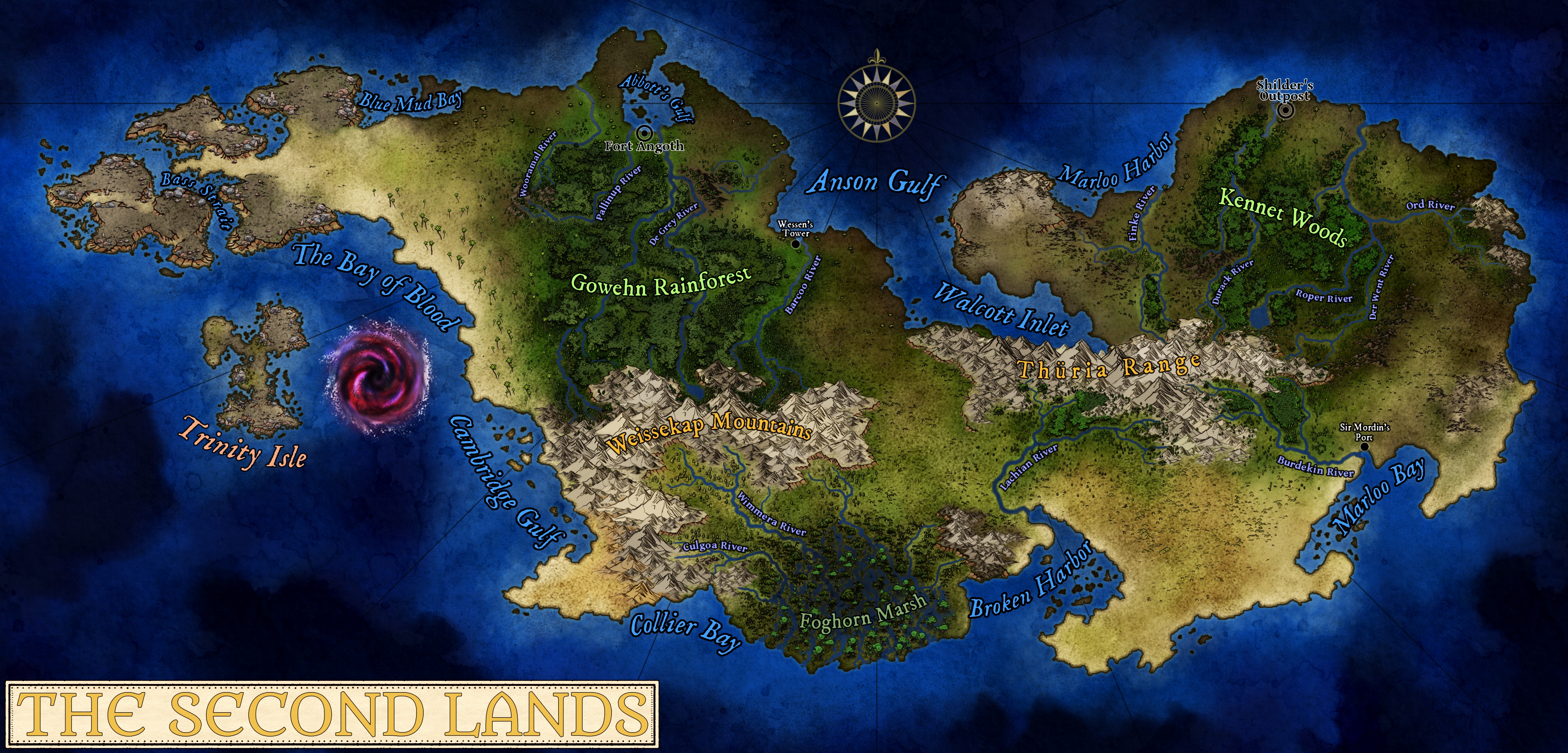
The western coastline is irregular and difficult to navigate. Blue Mud Bay, the Bays of Screech, the Bay of Blood, and the Cambridge Gulf are separated by rocky shores, islands, and shoals. The island group known as Trinity Isle lies off the western coast near a persistent planar disturbance.
The eastern region is divided by the Thuria Range, which stretches across much of the mainland. The mountains separate the northern forests from the southern grasslands and coastal plains.
North of the range, the Kennet Woods cover a large portion of the interior. Numerous rivers flow through the forest toward Marloo Harbor, the Ord River basin, and the northern coast. Shilder's Outpost stands near the northern edge of this region.
South of the Thuria Range, the land becomes more open. Rivers flow toward Marloo Bay, Broken Harbor, and the southern coast. Sir Mordin's Port occupies a position on the southeastern shoreline.
The map provides a useful outline, but it should not be treated as complete. Rivers change course. Marsh routes disappear. Forest paths may be seasonal or deliberately concealed. Settlements omitted from foreign maps may still be well known to local inhabitants.
Early Expeditions
The first recorded foreign expedition into the Second Lands departed in 1350 ME. It did not return.
In 1521 ME, later explorers discovered remnants of its settlement. The site had been abandoned for many years. The surviving records were incomplete, and the available reports did not establish a single cause for the settlement's failure.
Since then, additional expeditions have attempted to chart the region, recover resources, study unusual creatures, or establish trade routes. Results have varied: some expeditions returned with useful maps and valuable materials. Some established temporary camps or outposts. Others disappeared or returned with substantial losses.
The history of exploration in the Second Lands is therefore uneven. The region has not resisted every attempt at settlement, but it has consistently punished poor preparation and unrealistic expectations.
The Interior
The interior contains dangerous creatures, hostile groups, and regions affected by planar instability.
Reports describe large predators, aggressive humanoid societies, and territories where ordinary travel becomes difficult or impossible. Some routes appear safe for years and then become unusable. Certain valleys and forest clearings contain persistent or recurring portals through which demons, devils, and other extraplanar beings may enter Dort.
The frequency, duration, and origin of these portals remain uncertain.
Scholars disagree over whether the planar disturbances share a common cause. Some argue that they are remnants of a single ancient event. Others believe the Second Lands contain multiple unrelated points of weakness between worlds.
The distinction matters to researchers; it matters less to anyone responsible for defending a settlement near an active breach.
The Behemoth
The interior is also associated with reports of a creature known as the behemoth.
Descriptions vary significantly. Most agree only that it is enormous, destructive, and capable of moving through terrain that would impede most large creatures.
Some scholars regard the behemoth as a myth produced by several unrelated sightings. Others believe the name refers to a single creature. A smaller number argue that more than one behemoth may exist.
Tracks, damaged vegetation, and abandoned camps have been attributed to it, but reliable evidence remains limited. Its role in the disappearance of the 1350 ME expedition is unknown.
The behemoth is useful in a campaign precisely because it does not need to appear frequently. Evidence of its passage can affect travel routes, settlement planning, local politics, and the decisions of experienced explorers long before the party encounters the creature directly.
Fort Angoth
Fort Angoth is the most substantial fortified settlement in the western Second Lands.
It stands near Albutter's Gulf and the upper rainforest rivers, where it serves as a defensive position, supply center, and base for expeditions into the Gowehn Rainforest.
The settlement was established under the Pact of the Second Lands, a royal agreement among Irna's northern kingdoms, and survived its early failures through the intervention of the sage Angoth. Its continued existence depends on fortifications, river access, and careful management of the surrounding territory.
Fort Angoth is one of the few places in the western region where travelers can obtain reliable supplies, hire guides, repair equipment, and find people familiar with the interior.
Its residents are accustomed to dealing with explorers, and equally accustomed to explaining why certain expeditions should not proceed.
Shilder's Outpost
Shilder's Outpost is the most important settlement in the northeastern Second Lands.
It began as a small expedition camp and expanded over time into a permanent frontier town. Its location near the Kennet Woods and northern river systems makes it a useful staging point for travel into the eastern region.
The settlement is less formal than Fort Angoth but no less important.
Traders, hunters, guides, researchers, mercenaries, and settlers pass through the outpost regularly. Its population changes with the season and with the condition of nearby routes.
Shilder's Outpost supports exploration because it has learned to adapt quickly. New information about a river crossing, dangerous creature, or planar event may alter travel plans within hours.
Wessen's Tower
Wessen's Tower stands near the coast between the western interior and Anson Gulf.
The tower has a difficult history. It is associated with an earlier failed attempt to establish control over the region and is now maintained by the elf wizard Elysia, who restored its wards and uses the site as a waypoint.
Travelers use Wessen's Tower as a place to obtain information, confirm routes, and prepare for movement along the nearby coast.
The tower is not a large settlement, and its resources are limited. Its value lies in its position and in the knowledge maintained there.
Sir Mordin's Port
Sir Mordin's Port lies on the southeastern coast near Marloo Bay.
The settlement is a haven for pirates, smugglers, independent captains, and merchants who prefer to conduct business beyond the reach of the established navies.
Sir Mordin's Port is not primarily concerned with the exploration of the interior. Its interests are maritime: shelter, repair, trade, concealment, and access to sea routes that allow crews to avoid unwanted attention.
The port is dangerous in the ordinary sense rather than the exceptional one. Its problems are generally caused by people, money, contraband, and competing claims.
For some adventurers, that makes it more predictable than the interior.
Trinity Isle and the Western Disturbance
Trinity Isle lies off the western coast near the Bay of Blood.
A visible planar disturbance persists in the waters near the islands. Its behavior is not fully understood, and reliable navigation requires caution.
The islands and surrounding waters attract researchers, treasure seekers, cults, smugglers, and groups interested in extraplanar activity.
They also attract creatures and phenomena that would be unusual elsewhere in Dort.
Trinity Isle is one of the more accessible locations for a campaign involving planar instability because it can be reached by ship without requiring a long overland expedition. Accessible should not be confused with safe.
Local Communities
Foreign accounts often describe the Second Lands as though the region begins at the edge of the map; this is inaccurate. Local communities possess their own histories, territorial claims, travel routes, and systems of survival. Some trade with Fort Angoth, Shilder's Outpost, or coastal settlements. Others avoid outside contact. Some are openly hostile to trespassers, particularly in regions where previous expeditions behaved as though unclaimed territory and unfamiliar territory were the same thing.
A GM should distinguish between communities that present a genuine threat and communities defending their land from intrusion; not every conflict in the Second Lands is caused by monsters or extraplanar forces.
Travel and Survival
Travel in the Second Lands requires planning.
Reliable guides are valuable. River routes are often preferable to roads. Supply lines matter. Seasonal conditions can determine whether a route is merely difficult or effectively unusable.
The primary hazards vary by region:
- The Gowehn Rainforest presents dense vegetation, flooding, disease, predators, and limited visibility.
- The Weissekap Mountains and Thuria Range create difficult crossings, unstable weather, and isolated valleys.
- Foghorn Marsh requires boats, local knowledge, and careful attention to shifting waterways.
- The Kennet Woods contain long stretches of forest with few reliable landmarks.
- The coastlines include shoals, islands, narrow channels, and waters affected by planar activity.
The Second Lands should not require constant survival checks for ordinary movement. Travel becomes more interesting when the environment shapes meaningful choices: which route to take, what supplies to carry, whom to trust, whether to continue after conditions change, and how far the party can move from a defensible base before retreat becomes difficult.
Running the Second Lands
The Second Lands are appropriate for campaigns focused on exploration, frontier settlements, planar disturbances, dangerous creatures, lost expeditions, maritime crime, and the limits of outside authority.
Fort Angoth works well as a base for expeditions into the Gowehn Rainforest, the western mountains, or Foghorn Marsh.
Shilder's Outpost supports a looser frontier campaign centered on the Kennet Woods, the Thuria Range, and the northern river systems.
Sir Mordin's Port is suitable for maritime adventures, smuggling, piracy, and coastal expeditions.
Trinity Isle provides a direct connection to planar threats without requiring the campaign to begin deep in the interior.
The region should remain partially unknown.
A map gives the GM a framework, not a complete inventory. New settlements, ruins, creatures, routes, and hazards can be introduced without contradicting established material.
The Second Lands are most effective when the unknown is used selectively. The region is dangerous because its risks are difficult to predict and because support is limited, not because every mile contains a new catastrophe.
Campaigns in the Second Lands should emphasize preparation, local knowledge, and the practical consequences of traveling beyond the stable infrastructure of the settled world.
History of Dort
The History That Shapes the Present
The history of Dort is long, unevenly documented, and shaped by divine intervention. Some events are preserved in contemporary records. Others survive through religious teachings, archaeological evidence, oral histories, and accounts whose reliability remains debated.
A GM does not need to memorize the full chronology before running a campaign. The most important historical events are those that continue to affect the present: the origin of the gods, Echo's transformation of the world, the expansion of Irna, the death of Izon, the rise of new peoples and technologies, the development of international politics, and the recurring crises that taught the nations of Dort to distrust simple explanations.
Mythic Origins
The oldest accounts begin with Ix, the singular consciousness from whose dreams the universe emerged.
Ix created the Primordial Gods to oversee the natural world. These beings were forces of nature given will, rather than the more familiar gods of later ages. They do not change in response to mortal worship, do not seek followers, and do not accumulate soul coins. Later divine powers are different: for the shard-gods and the gods who came after them, worship is not merely an expression of faith but a source of divine strength.
Ix later created the Ancients, the first fully intelligent beings. The Ancients were immortal, powerful, and capable of reshaping worlds. They altered ecosystems, created monsters, domesticated animals, and spread across the universe in small groups.
Their abilities were extensive but not unlimited. Ix alone retained the power to create life from nothing.
The Ancients eventually rebelled in an attempt to seize that power. Their unfinished weapon failed to destroy Ix completely, but it shattered him. The fragments became the first modern gods, the shard-gods. Later gods arose by other means: some created ex nihilo by divine need, some born as children of existing gods, and some by stranger processes. In his final act, Ix bound the planes into their current structure and imprisoned the Ancients within the last remaining void pocket.
Very little reliable information survives from the age of the Ancients. Their artifacts are rare, powerful, and often dangerous. Scholars, religious orders, and collectors continue to search for them, although the responsible recovery of an Ancient artifact usually requires more caution than enthusiasm.
The possibility that the Ancients may eventually return remains a serious concern among those familiar with the oldest records.
Before Echo
The period before Echo's arrival was marked by disease, environmental hardship, dangerous predators, and prolonged conflict between the peoples of Dort.
Elves and dwarves were among the oldest mortal races. Smalings, gnomes, humans, goblins, orcs, ogres, and Drakin appeared later. Agriculture, writing, mathematics, astronomy, metalworking, and sailing developed gradually over thousands of years, but technological progress did not eliminate competition over land and resources.
The first major conflict was the Primordial Conflict, beginning around 600 BE. Elves and dwarves fought over scarce resources in what later historians called the First War of the Races. Humans emerged as influential intermediaries, using alliances and diplomacy to bring the conflict to an end.
That peace did not resolve the underlying tensions. Human political power expanded during the centuries that followed. Smalings and gnomes were often treated as lesser subjects, while goblins, orcs, and ogres were pushed toward marginal lands. Elves withdrew toward forests and dwarves toward mountain regions. These pressures contributed to the Great Schism around 400 BE and the Second War of the Races.
The second war caused widespread casualties through violence, disease, and starvation. It ended without a decisive victor. Exhausted populations withdrew into separate territories, beginning the Era of Isolation.
Jolem and the Global Supplication
The most important figure of the late pre-Echo period was Jolem, the son of a human mother and an elven father.
His parents had left their communities to raise him away from the racial divisions that shaped the age. As an adult, Jolem advocated cooperation, hospitality, and the sharing of resources across racial lines.
His message attracted followers among both humans and elves. It also alarmed leaders who regarded cooperation as a threat to their authority.
Jolem was executed approximately 180 years before Echo's arrival. His followers dispersed and continued spreading his teachings. The movement had no central institution and could not be suppressed through the removal of a single leader.
Approximately fifty years before Echo, Jolem's followers organized a coordinated act of prayer now known as the Global Day of Supplication. Communities across Dort appealed to the gods for relief from the conditions under which they lived.
Echo emerged in response.
Echo's Century
Echo appeared as a fully formed god with a clear purpose: to improve the conditions of mortal life.
His earliest actions addressed immediate suffering. He reduced the frequency of severe birth defects, lessened the effects of several devastating diseases, strengthened mortal constitutions, reduced the harm caused by prolonged sun exposure, and expanded the regions suitable for stable settlement.
The older gods initially opposed his intervention. Echo proposed a bargain. If a century of reform increased the number and devotion of mortal worshippers, the gods would accept his place among them.
They agreed, and during the century that followed, Echo reshaped the conditions of life across Dort.
The Taming of Predators
Before Echo's intervention, enormous predators made permanent settlement difficult in many regions. Some required armies to kill. Others could devastate livestock, villages, and trade routes with little warning.
Echo reduced their numbers substantially, preserving only weaker representatives of many species and allowing the most dangerous populations to decline.
One major exception survived: the Behemoth, an enormous creature that remains associated with rare periods of widespread destruction. Reports of its appearance are infrequent but persistent, particularly in accounts connected to the Second Lands.
Waterways and Sanitation
Echo initially purified polluted waterways directly.
The improvement did not last. Growing communities continued disposing of waste into rivers and coastal waters, recreating the same problems within months.
Echo changed his approach. He taught sanitation, waste management, and the relationship between contaminated water and disease. Communities became responsible for maintaining their own waterways.
This reform had a lasting effect because it changed behavior rather than merely repairing damage.
Health and Rest
In the final decades of his century, Echo taught methods of healthcare, wound treatment, and the management of illness. He also established the principle that one day in seven should be reserved for rest and recovery.
At the end of the century, the other gods reviewed the results. Mortal populations had grown healthier and more stable. Worship had increased. The gods accepted Echo into the pantheon.
The conclusion of Echo's century marks the beginning of the Modern Era, abbreviated ME.
The Expansion of the Known World
Irna emerged as the first major post-Echo civilization. Its systems of law, agriculture, administration, and military organization gave it an influence that extended far beyond its own borders.
Irnan expeditions established lasting contact with Funta, Jazirah, Shoing, and Antaea. These lands were not empty and did not simply become extensions of Irna. Each developed its own relationship with Irnan influence.
Some benefited from trade and military cooperation. Some adapted Irnan institutions to local needs. Some experienced conquest, colonization, or political pressure. Some combined several of these experiences.
The history of modern Dort is therefore not the history of a single expanding empire. It is the history of different lands responding to the same influential power in different ways.
Condensed Timeline of the Modern Era
| Date | Event | Continuing Importance |
|---|---|---|
| 30 ME | Irna is founded | Irna becomes the oldest major post-Echo civilization and the center of recorded international history. |
| 350 ME | Irnan explorers reach Funta | Conflict gives way to a lasting relationship based on trade, military cooperation, and the survival of Funta's tribal structures. |
| 540 ME | Irnan settlers reach Jazirah | Settlement and later persecution of the Sand Elves create the historical conditions that continue to shape Jazirah. |
| 660–700 ME | Rhodar's voyages | Rhodar discovers Passhall and reaches the western lands, expanding the known world and creating new maritime routes. |
| 980 ME | Irnan explorers reach Shoing | Irna encounters established peoples, dragon territories, and a continent with its own political traditions. |
| Date | Event | Continuing Importance |
|---|---|---|
| 1190 ME | Civil war begins in Irna | The conflict weakens the continent and reshapes its internal politics. |
| 1244 ME | Irnan explorers reach Antaea | Trade and military cooperation alter the balance of power without producing direct Irnan rule. |
| 1320 ME | Animal-lings emerge | Arcane experimentation in the western lands produces new mortal peoples whose status remains ethically and legally contested. |
| 1350 ME | First recorded expedition to the Second Lands | The settlement disappears. Its remains are discovered in 1521 ME. |
| 1599 ME | The Heavens is founded | The floating city becomes Antaea's principal neutral meeting ground and an important center of trade. |
| 1788 ME | Irna constructs the first teleportation circles | Long-distance travel and political coordination change substantially. |
| 1900–1920 ME | Passhall declares independence and survives the resulting war | Passhall becomes an independent maritime power with a strong tradition of self-government. |
| 2000–2001 ME | The Year of Immortality and the Year of Mortality | Death temporarily ceases to function, then returns without warning. The cause remains unknown. |
| 2300 ME | The Fall of Izon | Izon becomes the first god confirmed to have died in the modern era. The gods subsequently avoid direct physical manifestation on Dort. |
| 2400 ME | Shoing's civil war | The continent divides politically, leaving regional tensions that remain important in the present. |
| 2576 ME | Followers of Oshala conquer Jazirah | Oshalan rule reshapes Jazirah's political and religious order. |
| 2657 ME | Flying ships are created | Travel and commerce begin adapting to a new form of long-distance transportation. |
| 2712 ME | The Crimson Scourge begins | A blood-borne plague causes severe population loss across Dort. |
| 2818 ME | The Adronian Sea War | Maritime conflict reinforces the need for more durable international agreements. |
| 2925–2927 ME | The Kings meet and establish peace accords | Formal diplomacy reduces the frequency of open war between major powers. |
| 3181 ME | The Assault of Chaslia at Frosthaven | A demonic attack leads to the creation of the Order of Chaslia, dedicated to combating supernatural threats. |
| 3398 ME | Dragons appear to become extinct | The disappearance of dragons creates uncertainty, particularly in lands where old agreements depended upon them. |
| 3428 ME | The age of spies begins | Espionage becomes a standard instrument of international politics. |
| 3485 ME | The Chollian exodus | A major population movement alters regional demographics and political relationships. |
| 3510 ME | Planetary portals are discovered | Magus Zendar's discovery expands the known scope of travel and introduces new strategic concerns. |
| 3561 ME | The Year of the Crimson Sun | The sun remains red for a year, causing unrest and shortages despite the absence of a confirmed plague. |
| 3587 ME | A cannibalistic interstate cabal is uncovered | The investigation exposes the limits of existing political oversight. |
| Date | Event | Continuing Importance |
|---|---|---|
| 3646 ME | The War of the Blood Sea | Irna and Shoing fight over rumored artifacts near the Second Lands. Neither side secures the alleged treasure. |
| 3823 ME | The Great Drought begins | Irna's heartlands suffer three years of crop failure, prompting reforms in water conservation and regional planning. |
| 4220–4225 ME | The War of Shadows | The Veiled Hand infiltrates major cities. Its defeat permanently expands the role of intelligence networks. |
| 4561 ME | The Miracle of Harken | A priestess of Echo cures hundreds during a plague, strengthening Echo's worship and creating a major pilgrimage site. |
| 4998 ME | The 9 Eyes begin coordinated attacks | A cult serving an unknown force called the Master targets wealthy individuals and destabilizes established powers. |
| 5214 ME | The Cleansing | Lord Frost deploys strike teams against suspected 9 Eyes cells. The campaign suppresses the cult but causes civilian casualties and remains controversial. |
Events with Continuing Relevance
The timeline provides context, but several events deserve particular attention because they continue to shape present-day campaigns.
The Voyages of Rhodar
Rhodar was an Irnan explorer whose early expeditions ended in repeated losses.
When official support disappeared, she commandeered a ship and continued without authorization. Her navigation method relied on releasing birds and following those that did not return, reasoning that they had found land.
This method led her to Passhall and later to the western lands.
After returning to Irna, Rhodar avoided prosecution by selling her charts to the Lords of Harken. She then sold the same information to every other interested buyer.
Her voyages expanded the known world and established her as one of Dort's most successful explorers. They also left a lasting cautionary example for rulers who assume that an agreement includes restrictions that were never written into it.
The Animal-lings
The western lands attracted mages seeking fewer restrictions than those imposed by established magical institutions.
In 1320 ME, arcane researchers succeeded in creating stable humanoid-animal peoples. These peoples became collectively known as the Animal-lings.
The Animal-lings had no control over the circumstances of their creation. They nevertheless established communities, developed cultures of their own, and became a permanent part of the known world. The recognized Animal-ling peoples include the Aviari, Borun, Canix, Felari, Lapori, Pachari, Serathi, Taurik, and Torten. They are part of Dort's approved and extended species roster, though most are not described as player-facing species in the Player Guide.
Their origins remain a subject of ethical, legal, and religious debate.
The Year of Immortality and the Year of Mortality
In 2000 ME, death ceased functioning. Wounds closed. Diseases lost their lethality. Age no longer killed. No god claimed responsibility.
The effects were immediate. People undertook risks that would ordinarily have been fatal. Soldiers, explorers, criminals, and ordinary citizens adjusted quickly to a world without lasting consequences.
In 2001 ME, mortality returned without warning. The result was a sharp increase in deaths during the first days and weeks, followed by years of social caution. Construction, travel, warfare, and other risky activities declined as societies adjusted.
The cause of both changes remains unknown.
The Fall of Izon
In 2300 ME, Izon, the god of winter and snow, physically manifested during a religious celebration. Followers of Amnyth ambushed and killed him.
The Fall of Izon established that a god could die on the Prime Plane. In response, the surviving gods agreed to avoid direct physical manifestation.
This agreement did not end divine influence. Miracles, omens, empowered servants, religious institutions, and indirect intervention remain common.
The location of Izon's death is unknown. Claims that godstones or other divine remnants can be recovered from the site continue to attract expeditions, frauds, and dangerous speculation.
The Crimson Scourge
The Crimson Scourge began in 2712 ME.
The disease caused blood to rise visibly beneath the skin and prevented wounds from clotting. Minor injuries became potentially fatal. The plague spread for two years and caused severe population loss.
The leading theory attributes the disease to an uncontrolled attempt at blood magic, but no responsible party was identified.
The plague ended without a confirmed cure.
The Assault of Chaslia at Frosthaven
In 3181 ME, a sorcerer lost control of a bound demon in Frosthaven.
The resulting attack caused extensive casualties and exposed serious failures among the city's defenders and officials. Princess Chaslia, the youngest daughter of King Yukan, was taken captive and fatally injured during the incident.
King Yukan established the Order of Chaslia in response. The Order was charged with identifying, hunting, and eliminating supernatural threats before similar failures could occur again.
The event remains an important reference point in debates concerning magical regulation, noble responsibility, and the authority granted to organizations that operate outside ordinary law enforcement.
The War of the Blood Sea
The War of the Blood Sea began in 3646 ME after rumors circulated of powerful artifacts beneath the Bay of Blood near the Second Lands.
Irna and Shoing both deployed naval forces, each unwilling to allow the other to recover potentially dangerous objects.
The resulting conflict lasted several months and caused substantial losses. Neither side recovered the alleged artifacts.
Reports from the war describe spectral vessels and aggressive sea creatures in unusual numbers. The consistency of these accounts has prevented their complete dismissal.
The Bay of Blood remains a dangerous and politically sensitive region.
The Great Drought
A severe drought struck Irna's agricultural heartlands in 3823 ME and continued for three years.
Crops failed. Rivers receded. Food prices rose beyond the means of many households. Civil unrest spread across several cities.
The crisis also produced significant cooperation. Communities shared supplies, merchants opened stored grain to the public, and mages coordinated efforts to provide water and preserve crops.
The drought led to lasting changes in irrigation, conservation, farming practices, and regional planning.
The War of Shadows
Between 4220 and 4225 ME, the Veiled Hand attempted to control Dort's major cities through infiltration and covert manipulation.
The conflict did not resemble a conventional war. It involved intelligence networks, hidden agents, coded communications, targeted violence, and the gradual identification of compromised institutions.
The Veiled Hand was dismantled, but its leader was never identified.
The War of Shadows permanently changed international politics. Espionage became a routine concern for rulers, merchants, military leaders, and religious organizations.
The Miracle of Harken
In 4561 ME, Harken suffered a major plague.
A priestess of Echo named Eladora reportedly received divine power and cured hundreds of people in a single day. The event is one of the most widely documented cases of direct divine intervention after the Fall of Izon.
Eladora's monastery became a pilgrimage site, and Echo's worship grew substantially in the years that followed.
Religious scholars continue to debate whether the event represented direct intervention by Echo or divine power channeled through a mortal servant.
The 9 Eyes and the Cleansing
The cult known as the 9 Eyes emerged in 4998 ME.
Its members targeted nobles, wealthy merchants, and other individuals with significant holdings. Captured wealth was redistributed, while the cult's public message condemned existing structures of power and wealth in the name of an unknown force called the Master.
The cult remained active for more than two centuries. Its cells were difficult to eliminate because the Master's influence, whatever its true nature, allowed members to evade many conventional operations.
In 5214 ME, Lord Frost authorized specialized strike teams of war mages and paladins to attack suspected cells directly. The campaign became known as the Cleansing.
The operation appears to have suppressed the 9 Eyes as an active organization, but it also caused civilian deaths and extensive property damage. The cult's leader was never captured or confirmed dead.
Whether the 9 Eyes were destroyed, dispersed, or driven into deeper secrecy remains unresolved.
Using History in Play
Dort's history is most useful when it provides context for present-day problems rather than functioning as a list of trivia.
A ruined settlement may be connected to the Second Lands expeditions. A religious dispute may involve the legacy of Echo or the Fall of Izon. A noble house may still hold grudges dating back to a civil war. A recovered artifact may attract attention because of the War of the Blood Sea or the surviving fear of Ancient relics. A suspicious official may be reacting to lessons learned during the War of Shadows. A community may distrust aggressive magical enforcement because it remembers the Cleansing.
Players do not need a complete historical education before the campaign begins.
Provide the history relevant to the region where the characters live and expand outward as the campaign requires. The purpose of the chronology is to give the world continuity, establish the origins of current tensions, and provide the GM with material that can be introduced when it becomes useful.
Magic in Context
How magic manifests varies by region more than by tradition.
In Irna, arcane magic is institutionalized. The Arcanum Conclave produces licensed practitioners and its credential carries weight in civic courts. Unauthorized arcane practice is not illegal but attracts Conclave scrutiny and, in cities with Oshalan Quarters, potential classification under registry law. The rift communities on Irna's eastern edge have developed practical relationships with elemental overflow that exist outside both the Conclave's framework and the Order's registry.
In Jazirah, divine magic under Oshala's tradition is the civic expectation. Other divine traditions operate under varying degrees of restriction depending on local Order strength: a Nyxollox cleric in an Ordered city holds a restricted license; one in a non-Ordered coastal city operates freely. Primal magic is associated with the desert communities and treated as suspect by Order administrators who find it unregisterable. Arcane practice exists but is less credentialed than in Irna; the Conclave has a presence on Jazirah's coast cities but holds no institutional authority there.
In Shoing, magical practice is embedded personally rather than institutionally. A community's relationship to a Primal practitioner is about whether that practitioner's work has been reliable, not about credentials. Shamanism, the combined Divine-Primal tradition, is more common here than anywhere else. The oldest practices on the storm coast predate the current divine structure and have been in conversation with Fujin's and Ryujin's theologies long enough that the formal boundaries are genuinely unclear.
Everywhere: the planes bleed through. The Arcana plane is not a distant abstraction. It leaks. Where it leaks most, magic behaves unexpectedly, items charge too quickly, and practitioners become alert in the way that people near open electrical current become alert. This is background texture, not emergency. Build it into the setting before it becomes encounter content.
Table Procedures
When to Call for Checks
Call for a check when the outcome is genuinely uncertain, the stakes are meaningful, and failure has a real consequence that changes the situation. Do not call for checks to see whether something is interesting, to see whether the players "deserve" information, or to fill time. Three checks that feel unnecessary teach the table that checks are not meaningful. One check with real stakes teaches the table to care.
The right question before calling for a check: What changes if they fail? If the answer is "nothing, they try again until they succeed," do not call for a check. Decide what success produces, decide what failure produces, and call for the check only if both outcomes are worth happening.
Setting Difficulty
| Difficulty | Typical Task |
|---|---|
| Easy | Clear task with minimal risk; a trained person under no pressure |
| Average | Trained person, favorable conditions, nothing unusual |
| Hard | Requires expertise, time pressure, or complicating factor |
| Severe | Expert-level execution, significant obstacle, or high stakes |
| Extreme | The best in the world, under terrible conditions |
Difficulty sets the opposition dice added to the pool before the roll. Those dice can generate Failures, Banes, and Calamities that cancel or complicate the character's positive results. Match the difficulty to the task, not to the character's skill rank. A novice attempting a Hard task rolls the Hard difficulty. A master attempting an Average task rolls easier opposition dice but still resolves against Average. The difficulty describes the task; the character's build describes how well-equipped they are for it.
Managing Boons and Banes as GM Tools
Boons and Banes are how the world intrudes on the dice pool. Use them to make the situation visible in the mechanics, not to reward or punish characters morally.
Boons represent preparation, advantage, information, good equipment, help, and favorable circumstances. Award them for meaningful preparation, established relationships, correct tool use, or a genuine situational advantage. "The character planned for this" is a Boon. "The character has done this before and told me about it" is a Boon.
Banes represent complication, pressure, partial information, poor equipment, interference, and unfavorable circumstances. Add them for real obstacles: the character is rushing in darkness, the information they have is wrong, they are working against someone actively opposing them, or the situation has genuinely deteriorated. "This seems hard" is not enough. "The negotiation is happening while the character's ally is visibly suffering across the room" is a Bane.
Never use Boons or Banes as a narrative override. If the character should logically succeed given their preparation and circumstances, let them succeed without a check. If they should logically fail, do not give them a Boon to roll and then require an extreme result. Be honest about what the world would actually produce.
Spend Menus for Boons and Banes
After a roll, unspent Boons (positive results the player does not claim) may be spent by the GM to add scene texture: a complication that arrives later, a cost the success carries, or a detail that enriches without undermining the outcome. Similarly, unspent Banes after a failure may be spent to increase the failure's weight: the character does not just fail, they fail and something secondary goes wrong.
Establish your spend menus by combat type before sessions involving structured play. A generic spend menu for most scenes: each Boon converts to one minor advantage (knowledge, position, resource, time); each Bane converts to one minor complication (loss of position, resource drain, attention drawn, time cost). Extreme results escalate the grade.
Social Checks Against Resistance
When a player character attempts to influence, deceive, charm, or intimidate an NPC who is not simply neutral (who is cautious, suspicious, or actively resistant), use a static social check following the same framework as the haggling rules in the Player Guide (Chapter Eight). This is one rule, not two; commercial negotiation uses the same mechanic, just with a harder ceiling because a stranger's money is at stake.
Base difficulty by NPC disposition:
| NPC Disposition | Base Difficulty |
|---|---|
| Open, cooperative, or already inclined | Easy |
| Neutral or uncertain | Average |
| Cautious, guarded, or skeptical | Hard |
| Actively resistant or hostile | Hard (upgraded; see below) |
The ceiling. General social resistance caps at Hard (3 Trial Dice) as its starting maximum. Commercial haggling starts at up to Severe (4 Trial Dice) for a seller with a fixed price and no incentive to move. The difference reflects that people are generally harder to part from their money than from their wariness.
Upgrading for resistance. For each point of the NPC's relevant resisting characteristic above 1, upgrade one Trial Die to a Crisis Die (adding Bane and Calamity risk without increasing the base difficulty tier). Choose the characteristic based on what is being resisted:
| Attempt | Resisting Characteristic |
|---|---|
| Intimidation, command, dominance | Willpower |
| Deception, manipulation, disguise | Savvy |
| Charm, social pressure, persuasion | Charisma |
| Negotiation in an adversarial context | Willpower or Savvy (whichever is higher) |
One attempt per interaction. A failed social check ends the attempt; further tries require genuinely new leverage, a changed situation, or a different approach. The same character cannot simply reroll until they succeed.
Narrative versus Structured Play
Narrative play covers everything that does not have a strict turn order and time pressure. Conversation, investigation, travel, exploration, and most social encounters run narratively. Players describe what their characters do; the GM describes what the world produces. Checks happen when the outcome is uncertain; most of the time the world simply responds to what the characters do.
Structured play (initiative) begins when timing matters and multiple parties are in active conflict: combat, chases, races against a countdown, and any scene where "who acts first" or "how much time passes" materially changes the outcome. Transitioning in: when a scene tips into structured play, call for initiative (On Watch for prepared characters; Surprised for those caught unaware) and establish the order. Transitioning out: when the immediate conflict resolves (enemies defeated, fled, or surrendered; deadline reached; the countdown ends), return to narrative play. The transition should be felt, structured play signals to the table that everything matters now.