What the Soul Economy Is and Is Not
The soul economy is not a currency system for the players to manage. Soul coins are divine power, measured in the weight of lives lived in genuine devotion. They accumulate in divine vaults and are spent in the Shattered Domain's territorial politics. Players do not hold soul coins. They hold the conditions that will determine what happens to their coins when they die, and they interact with a world where many other people's coins are already in play.
GM-facing truth: The soul economy is your consequence architecture. Every infernal contract, every binding promise, every sincere act of devotion, and every assisted death affects where a soul coin eventually lands. The party will be offered contracts they should not sign, meet people whose coins are already claimed, encounter institutions whose entire purpose is moving coins from one vault to another before they arrive legitimately, and occasionally discover that someone they cared about has a claim on their soul that they did not know about.
Run the soul economy as infrastructure, not as a plot device. It does not require dramatic reveals. It rewards the party noticing how it works.
The Mechanics of Claim
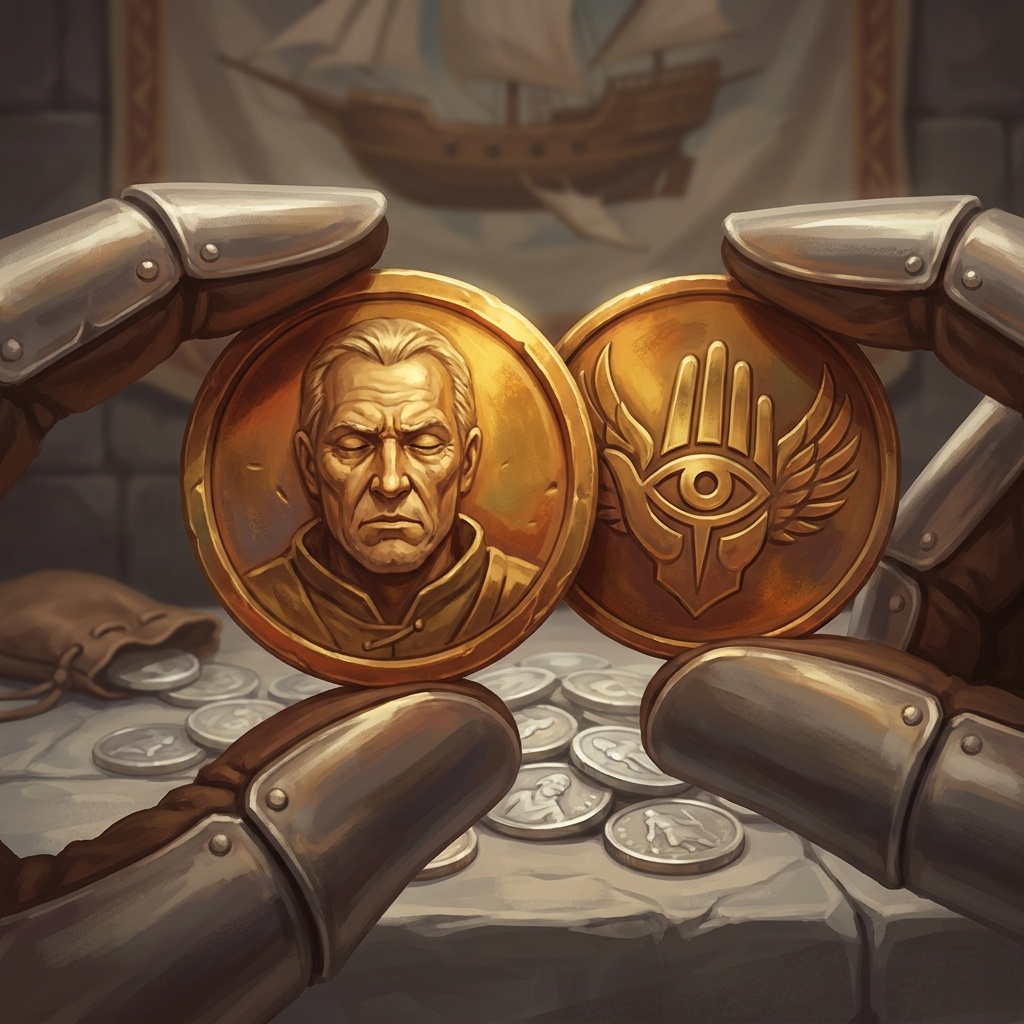
A soul coin goes to the deity or entity that holds the strongest recognized claim on it at judgment.
Genuine devotion produces the heaviest claim: a life lived in real service to a faith generates the highest-weight coin for that deity. Casual worship produces a lighter coin. Nominal worship with no genuine engagement produces a coin so light it contributes nearly nothing to any vault. These differences are real in the economy and are why the gods care about quality of devotion, not just quantity.
Infernal contracts produce binding claim regardless of devotion. A person who genuinely worships Echo but signed an infernal contract that claims their soul sends their coin to the contract's holder at judgment, not to Echo. Sheol acknowledges lawful infernal contracts because that is the entire point of them: they are legal claim instruments in the soul economy. This is the fundamental engine of infernal operations: not power or force, but paperwork.
Divine compacts function similarly to infernal contracts but operate within the legitimate divine structure. A cleric who has taken specific divine oaths sends their coin to their patron according to those oaths' terms, with additional weight for the depth of the service.
Soul interception is the illegal version of the same mechanism. An infernal operator with the right tools can interfere with the ethereal coin's transit before the soul reaches judgment, attempting to divert, mark, or conceal the claim before Sheol can process it cleanly. This is not the same thing as a lawful contract. It is theft from the route of judgment, and it is what Nyxollox death-keepers train to prevent.
The Passage of a Soul
Use this sequence whenever the exact timing matters:
- Death: The mortal dies. The soul coin forms in an ethereal state, bound to the soul's passage rather than held by any claimant.
- Transit to Sheol: The soul travels to Sheol. In Sheol it takes the shape of a soul-being: recognizable, addressable, and not yet finally assigned.
- The river wait: The soul waits before crossing the River of Souls into the judgment realm. The ordinary waiting period is about 24 hours. This is the Revive window.
- Judgment: The soul crosses the river. The Adjudicator weighs the life and all claims on the soul coin. Divine devotion, divine compacts, lawful infernal contracts, and other valid claim instruments are recognized here.
- Claim assignment: The strongest valid claim receives the coin. If the soul is sent directly to a claimant's plane, the keeper of that plane may take custody there; if the claimant appears or is represented at judgment, the coin can be given there.
- Final rest: The soul-being takes its final form and passes to the plane of final rest, the patron's territory, an infernal holding, Godless, or another adjudicated destination.
When the party tries to intervene, decide which step they are acting in. Before judgment, they can still recover, witness, protect, or revive. During judgment, they can contest claims only with extraordinary standing, evidence, or divine authority. After judgment, they are no longer dealing with a waiting soul; they are dealing with a claimed soul in someone else's jurisdiction.
The Spent
When a deity burns a soul coin, spending the accumulated weight of a life's devotion for power in the Shattered Domain, the soul does not die. It is stripped of its accumulated weight and cast back onto the Silver Road with nowhere to go. These are the Spent: hollow souls that persist without destination, purpose, or relief. They accumulate near places where the divine burn rate is highest (active conflict zones in the Shattered Domain have the worst concentrations) and occasionally bleed through to the Prime near Silver Road transit points.
GM use: The Spent are evidence of divine activity and priorities. A high Spent concentration near a city means a deity with a local presence has been spending heavily: which means something significant is happening in the Shattered Domain nearby. The Spent are also a barometer of which god is fighting what war. A region that has recently experienced a cluster of Spent sightings near a Nyxollox temple has probably just had an infernal operation in the area.
Their mechanical role. Run the Spent as an adversary category, not as a faction and not as a resource. They have no leadership, no shared purpose, and nothing to negotiate for. Use the Adversary Catalog entries as written rather than inventing new Spent behaviour: the five entries already cover the coherence range, from a Spent Hulk that is barely intelligent and reacts only to names and old prayers, to a Spent Petitioner, Priest, or Saint that retains enough of a life to be spoken with. Pick the entry that matches how much of a person you want the table to recognize.
Where they appear. Catastrophic soul-burn sites, divine war scars, sealed planar wounds, and the Silver Road itself. They reach the Prime only where the Road runs close: transit points, mass-death sites, and Thin Places. A Spent encounter on the Prime is a symptom. The cause is in the Shattered Domain and the party is standing downstream of it.
What cannot be done for them. A Spent cannot be restored by recovering its coin. The coin was burned; that is what produced the Spent. Returning something to a Spent is not an option the fiction supports, and a party that assumes otherwise should learn that from a death-keeper rather than from a failed working.
Still the author's call. The Spent are an open question in the Universe Bible (Open Question 9). Three decisions are not made and should not be invented at the table without recording them: whether the Spent are strictly an adversary category or also a faction with some organizing pressure behind them; whether a Spent can ever be laid to rest or delivered to Sheol, given that soul rescue on the Silver Road is technically possible but has no established practice; and whether a Spent carries any residual claim that a holder could still act on. Until those are settled, run the Spent as adversaries and let the questions stay unanswered in the fiction, which is accurate to how little anyone in Dort knows about them.
Stat blocks. Spent Hulk, Spent Marauder, Spent Petitioner, Spent Priest, and Spent Saint are in the Adversary Catalog under Planar and Soul Entities; Pact Collector and Infernal Clerk are in the Devils chapter. Use those entries rather than building new ones.
Running Infernal Contracts
Infernal contracts are the most common form of soul manipulation the players will encounter. They are designed to be signed. They are legible. They are technically accurate. The problem is what the words are shaped to make you hear rather than what they actually say.
The structure of a valid infernal contract:
- An offer (clearly stated)
- A consideration (what you receive)
- A binding clause (what you give in return, including the soul claim)
- A performance trigger (the event that activates the binding clause)
- A witness seal (makes it cosmologically binding rather than just legally binding)
The performance trigger is the GM's tool. A contract that says "in exchange for the restoration of your brother's health, you agree that upon your death your soul coin shall pass to Erosmire in full settlement" is a clean contract. The party can read it. The risk is visible. A contract that says "in exchange for the restoration of your brother's health, you agree to render such services as the contracted party shall require" is the dangerous one. What services? For how long? Under what conditions? These questions cannot be answered once the contract is signed.
When introducing a contract as a GM prop, write the actual document. Let the players read it. If they sign something they understood, they accepted the risk. If they signed something they were deceived about, that deception is the plot thread.
Contract Offers
Roll a d10 or choose by cult. Every row is one of the nine infernal cults from Player Guide Chapter Two, or the Tempters who answer to no layer at all. Each cult offers what its patron's layer is organized around, which is why the offer and the tell are consistent enough to be recognized twice.
Three counters exist. They are not interchangeable and none of them is a cancel button.
- Accord record — an Accord contract clinic reads the binding clause and the trigger aloud before signing and files a copy in the archive. It cannot void a signed contract. Its value is evidentiary: a filed copy is what a later fraud challenge is built out of.
- Talbar clinic — a deal-keeper gives the same pre-signing review and enters the deal in the Registry. After signing, a Master Keeper can open a formal counter-claim, but only where the contract was demonstrably predatory, and the process is long.
- Death-Keeper rite — a Nyxollox death-keeper who witnesses the death seals the crossing against interception. It stops theft from the route of judgment. It does not void a lawful claim, and a lawful claim recognized at judgment still takes the coin.
| d10 | Who offers | What they offer | What they ask | The tell | The counter |
|---|---|---|---|---|---|
| 1 | The Iron Decree (Tyrannus, Zagan) | A charter, a permit, or a standing no local authority can revoke | The coin, and compliance with every regulation the Decree issues afterward | The document arrives already stamped, and nothing in it is illegal | Accord record |
| 2 | The Gilded Assay (Avaricia, Pyxata) | The debt cleared, the mill kept, the ship refloated | The coin, and title to the collateral if the schedule slips | Terms are precise rather than tricky; the repayment schedule is the trap | Talbar clinic |
| 3 | The Shifting Face (Mendacium, Cozen) | A document that proves the thing you need proved | The coin, and the right to name you as a witness later | The provenance is flawless and the person who can confirm it cannot be found twice | Accord record |
| 4 | The Red Discipline (Malicor, Ustura) | The person who hurt you, delivered | The coin, and your attendance | The offer arrives with a time and a place already arranged | Talbar clinic |
| 5 | The Unanswered (Invidia, the Arbiter) | A rival ruined, a reputation broken, a harvest lost | The coin | No patron is named anywhere in the document; the Arbiter grants nothing, so the claim is held by the recruiter | Accord record |
| 6 | The Crown of Ash (Loftile, Kian) | The commission, the audience, the name that outlives you | The coin, and completion of the work | The work is spectacular and the maintenance clause is missing | Accord record |
| 7 | The Reaching (Erosmire, Buuna Moc) | Permission | The coin, and a third party who did not sign | The agreement names a person as one of its terms | Talbar clinic |
| 8 | The Endless Table (Gula, Edaxius) | A supply that does not run out | The coin, and first call on whatever the household has next | The consideration is delivered before anything is signed | Talbar clinic |
| 9 | The Undoing (Anarchos, Ta'amah) | Nothing, and it is honest about that | The coin, for the satisfaction of watching a structure come apart | There is no consideration clause at all, which makes the contract defective | Any court |
| 10 | A Tempter (freelance, no layer) | Exactly what the mark already wants, named accurately | The coin, on terms the Tempter sets and no lord reviews | No cult, lord, or layer appears in the document, and the Tempter never made the first ask | Talbar clinic, before signing only |
Reading the table. The tell is what an observant player can catch without a check. The counter is what an institution can do about it, and every counter in the table is stronger before signature than after. Row 9 is the exception worth remembering: a contract with no consideration fails the five required elements, and a court will say so.
Stat blocks for the people who deliver these. Infernal Clerk for the soft approach and the counting-house scene, Pact Collector for enforcement after negotiation has failed. Both are in the Adversary Catalog, Devils.
Soul Coins as Optional GM Mechanic
For groups who want the soul economy to be more directly visible in play, soul coins can be used as GM-facing objects: physical tokens that appear in the fiction when a player character's claim is called.
If a player character's soul coin becomes a tangible object in the narrative (through an infernal contract, a divine compact taken as part of character advancement, or a direct confrontation with an entity that holds their claim), describe it as a coin specific to that person: the face shows them as they were at the moment they made the covenant; the reverse shows the holder's mark. These coins can be carried, stolen, protected, or destroyed under the right conditions. Destroying a soul coin is cosmologically terrible, the soul ends, rather than passing anywhere, and no legitimate actor in the divine economy will do it. Infernal operators will threaten it as leverage.
The mechanic is GM-optional and is not part of standard Ix play. Use it for campaigns where the soul economy is a central theme.
Running Soul-Economy Sessions
The three most common soul-economy session structures:
The Contract Session. Someone the party knows or cares about has signed something they should not have. The party has learned about it before the performance trigger fires. They have the contract in front of them, or can get it. The question is whether they can find a way to void the contract (harder than it sounds, infernal contracts are cosmologically binding), renegotiate it (possible if the contract holder sees value in the renegotiation), or make the performance trigger fail to fire (easiest, most tactical option).
The Interception Session. Someone has died and their soul was intercepted before reaching Sheol. The Nyxollox death-keepers are involved or will be. The party may be the people who can actually retrieve the coin: the death-keepers have spiritual tools, but the party has mobility, combat capacity, and access to places the faith cannot enter. The coin is somewhere between the death site and the entity that diverted it. The entity is a Pact Collector or a higher infernal operator.
The Claim Session. A player character's own claim is challenged. An entity holds or claims to hold a claim on their soul, and that entity wants something now rather than waiting for the coin at death. This is leverage, and leverage produces the most interesting negotiations.
Soul Coin Mechanics for the GM
The coin itself. A soul coin has two faces: the obverse bears the mortal's name and face as they were at death; the reverse shows a symbol that reflects their relationship to the power that holds the claim, a god's sigil, a devil's mark, or a patron's device. The weight of the coin is not visible but is felt. A heavy coin, the product of deep, genuine devotion, has a warmth to it that practitioners in the Shattered Domain recognize immediately. A light coin is colder, thinner. This distinction matters in play because it tells the holder what the soul's life was actually worth in the divine economy.
What gods do with coins. Most coins sit in divine vaults, contributing to a god's territorial strength in the Shattered Domain. A god with many heavy coins holds more territory, influences more of the Soul Planes' traffic, and can afford to send agents and interventions into the Prime. This is why Oshala's institutional expansion produces real power: coerced conversion generates lighter coins than genuine devotion, but scale compensates for weight when you have enough of it.
Trading coins between gods. Gods can trade soul coins. This is rare, politically sensitive, and usually limited to light coins, cultural practitioners whose devotion was real but not exclusive. A god of commerce and a god of community have overlapping populations; a deal to transfer coins between their vaults might be diplomatically warranted. Heavy coins from fervent devotees are not traded. They are too identity-bound to carry value outside the original covenant.
The GM implication: divine alliances are transactional in a literal sense. When Echo and Jula cooperate on a joint mission in the Prime, the arrangement has a soul-coin accounting behind it. When that accounting is disrupted, by a high-profile success that pulls devotees toward one faith at the other's expense, the alliance may need renegotiation.
Burning coins. A god can burn a soul coin for an immediate surge of power. This is always significant:
- It is a strategic resource. A god does it when they must, not when they can.
- It produces the Spent, souls stripped of their accumulated weight and cast back onto the Silver Road with nowhere to go. The Spent accumulate near places where the burn rate is high. An unusual Spent concentration near a city is evidence that a deity has been spending heavily nearby.
- Other divine powers notice. Rivals see the weakness. Priests of the burning god feel something: a sudden weight lifted, a quieting in their prayers, a sense that something was used up.
The GM practical use: track which gods you've established as burning coins for plot purposes. A region with three Spent sightings in a week means a specific deity is fighting something significant in the Shattered Domain, something the party will eventually learn about.
The infernal competition. Devils treat souls as an acquisition channel. Their goal is not devotion, devotion is too slow and too competitive. Their goal is claim-conditions: contracts, corrupt bargains, and coercive vows that generate soul coins under infernal terms before any legitimate divine claim can form. A merchant who signed an infernal contract and lived a perfectly devout life afterward still delivers their coin to the contract holder. The devotion is irrelevant once the claim exists.
This is why Talbar's deal-keepers and the Accord's contract clinics exist: to identify binding agreements before mortals sign them, and to void infernal claims through legal mechanisms when possible. The infernal operators know about this counter-system. They engineer around it.
The Infernal Contract at the Table
When you want to put a contract in front of a player character, write the actual document. The following template produces a contract that is technically valid, legally coherent, and contains the traps that make infernal agreements dangerous.
The Five Required Elements:
OFFER: [What the contractor provides: clearly stated, accurate, and seemingly generous.]
CONSIDERATION: [What the signatory receives: specific, concrete, and exactly what was asked for.]
BINDING CLAUSE: [The claim on the soul. Usually buried in formal language: "...the undersigned agrees that upon natural or unnatural death, the soul coin of the signatory shall pass in full settlement to [contractor name], in priority over any devotional claim."]
PERFORMANCE TRIGGER: [The event that activates the binding clause. This is where the trap lives.]
WITNESS SEAL: [Makes the agreement cosmologically binding, not merely legally binding. A sealed contract cannot be destroyed; destroying the document does not void it.]
The Performance Trigger is your tool. A trigger that fires on "death" is visible and negotiable. A trigger that fires on "failure to complete X within Y days" is a hidden clock. A trigger that fires on "failure to honor the spirit of the agreement" is a weaponized ambiguity the contractor controls. Write the trigger precisely, then ask: does the player understand exactly when this fires? If yes, they accepted the risk. If no, the deception is the plot.
Sample Contracts:
Clean contract (risks are visible):
In exchange for the restoration of Maret Coldhand's sight, the undersigned agrees that upon death, the soul coin of Maret Coldhand shall pass in full settlement to Erosmire's Representative on the Third Level, in priority over any devotional claim. Witnessed and sealed this day.
The risk is legible. A Talbar deal-keeper would flag this immediately. The player who signs it understood what they were signing.
Predatory contract (risks are hidden):
In exchange for the safe passage of the vessel Vanner's Light through the Kessani Corridor on the night of the signing, the undersigned agrees to render such services as the undersigned party shall require, in a manner and timing to be specified by the creditor, for a period not to exceed the natural lifespan of the signatory. Witnessed and sealed this day.
"Such services as the creditor shall require" is the trap. The performance trigger is whatever the contractor decides. The contract is technically accurate. The signatory did not understand what they agreed to until it is too late.
Voiding a Contract: Infernal contracts are cosmologically binding once sealed. They can be voided through:
- A legal challenge before a Themela court (requires proving fraud in the trigger language; Hard Lore + Negotiation over multiple sessions)
- A Talbar high-priest's formal counter-claim (requires the faith's direct institutional engagement; favors only work if the contract was demonstrably predatory)
- Killing the contractor and recovering their claim-token before it passes to a successor (the adventure-action solution)
- The signatory fulfilling the terms in full (the most common resolution, and sometimes the most painful)
What the Accord and Talbar Can Do: An Accord contract clinic can identify a binding clause before signing and explain what the trigger means. They cannot void a signed contract. Talbar's deal-keepers can provide the same pre-signing review and can initiate formal legal challenge after signing, but the process is long. Neither faith has unilateral power to void an infernal claim: that requires either legal process or physical action.
When a Player Character's Soul Is Claimed
A live claim on a player character is a standing fact, not a condition. Nothing on the character sheet changes when it is discovered.
What does not change. A claim applies no dice modifier, imposes no state, and does not alter Wounds, Strain, or recovery. It carries no Fear rating and produces no Frightened or Demoralized result. Fear ratings come from creature entries (Ch 9); if a Pact Collector's arrival rates a Fear check, that is the creature, not the claim.
Divine casting. A claim by itself is not a divine offense. The revocation track in Chapter Nine counts actions, not circumstances. What counts is the character's own act: knowingly signing, performing a service for the claimant, or concealing the claim from a patron whose doctrine names infernal claim as an enemy. For clerics of Nyxollox, the Accord, and Talbar, all three faiths that exist in part to oppose infernal claim, treat a knowing signature as at least a first offense and give the warning in the fiction before the signature resolves, as Chapter Nine requires. A claim the character inherited, was deceived into, or does not know about counts as nothing until they act on it.
What the claimant can do. Send agents: an Infernal Clerk for the approach that looks administrative, a Pact Collector once negotiation has failed. Call the performance trigger the moment it fires. Sell or assign the collection right, since collectors work for contract devils, infernal courts, and private patrons who bought those rights. Appear or be represented at judgment. The claimant cannot take the coin before death and cannot compel any action the contract's terms do not already cover, which is why predatory triggers are written the way they are.
What the character can do. Obtain the document and read it. File it where a court will accept it. Renegotiate. Make the trigger fail to fire. Bring a challenge. Pursue the contractor. Perform the terms.
The Difficulty Ladder
The chapter's anchor is a Themela court challenge on fraud in the trigger language: Hard Lore and Negotiation over multiple sessions. Nothing on this ladder is easier than that anchor except the options that leave the claim alive.
| Goal | Difficulty | Check | What it costs |
|---|---|---|---|
| Identify the binding clause and the trigger | Average | Lore, or free from an Accord clinic or Talbar deal-keeper | One scene, before signature |
| File the contract where a court will accept it | Easy | Negotiation at an Accord archive or the Talbar Registry | The claim becomes public |
| Make the performance trigger fail to fire | — | No check; an adventure | Cheapest option; the claim survives, dormant |
| Renegotiate the terms | Hard | Negotiation, opposed if the holder is present | The holder takes payment in something the party values |
| Transfer the claim to a different holder | Severe | Negotiation, and the receiving holder must want it | Changes who collects, not whether |
| Buy the claim back | Severe | Negotiation | No price exists in Flargons; the holder names a consideration |
| Void it in a Themela court | Hard | Lore and Negotiation, over multiple sessions | Requires demonstrable fraud in the trigger language and a filed copy |
| Void it by Talbar counter-claim | Hard | Negotiation to secure the faith's engagement, then the court process above | Only where the contract was demonstrably predatory |
| Void it by taking the claim-token | — | No check; an adventure | Kill the contractor and recover the token before it passes to a successor |
| Perform the terms in full | — | No check | The most common resolution and often the worst |
There is no price list. Under the light-treatment rule this universe uses, soul coins are not a currency players buy into, and the absence of a number is the rule, not a gap. When a holder agrees to sell a claim back, they name a consideration, and the consideration is the adventure.
Death Under a Live Claim
Use the six-step passage from earlier in this chapter. A claim does not create a seventh step and does not let anyone skip one.
- Death. The coin forms in its ethereal state. The claimant does not receive it here. An agent present at the death is positioned for step 2, not this one.
- Transit to Sheol. The exposure point. A lawful claimant waits, because waiting works. An interceptor acts here, and interception is theft from the route rather than collection. This is the step a death-keeper rite protects.
- The river wait. Unchanged. Roughly 24 hours, and the Revive window is intact. A claim does not shorten it. A soul that has boarded the boat has begun the crossing and cannot be called back.
- Judgment. The claim is entered here. The Adjudicator weighs the life and every valid instrument on the coin, and a lawful sealed infernal contract outranks devotional claim.
- Claim assignment. The holder of record at this moment takes the coin. That is the current holder, not necessarily the party the character signed with.
- Final rest. The destination is the claimant's holding.
The single decision point is step 4. Everything the party does before it is preparation; everything after it is jurisdiction, and they are now negotiating with an owner rather than contesting a claim.
Killing a Claimed Creature
The rule is the one the universe runs on: power goes to whoever holds the claim at death.
- The claim resolves. Killing a claimed creature fires the claim. The holder of record collects at judgment, and the party has advanced the claimant's schedule for them.
- It does not transfer to the killer. Killing something is not a way to acquire its coin. The only route to a claim is an instrument: a contract, a divine compact, or a purchased collection right.
- It does not lapse. A claim does not expire because a life ended early. Ending it early is what completes the claim.
Practical consequence: if the party kills a claimed NPC, the claimant is paid and will notice who paid them. The kill that matters is the contractor, and only if the claim-token is recovered before it passes to a successor.
Soul Status by Creature Type
Use this when a player asks what happens to the thing they just killed. Read it with the light-treatment rule in mind: "none for sale" is the normal answer in the coin column, because this universe does not run a player-facing soul market.
| Family | Claimable soul | At death | Coin value |
|---|---|---|---|
| Dragons | Canon does not specify | Canon does not specify | None for sale |
| Devils | Canon does not specify | Canon does not specify | None for sale. Devils hold and trade claims; canon does not describe them as being claimed |
| Demons | Canon does not specify | Canon does not specify | None for sale |
| Undead | Yes. The soul exists and has not completed the crossing it was owed | Resumes the crossing and is processed at Sheol. A soul transformed without its consent or knowledge is dispatched normally; a soul that pursued or collaborated in its own undeath is directed to the Denied Chamber of the Vault of the Unclaimed, from which no release has been recorded | None for sale. Any contract claim on the person resolves at judgment as written |
| Dim creatures | Canon does not specify | Canon does not specify | None for sale |
| Elementals | Not a soul in the mortal sense. An elemental is a plane's raw material without the will attached | Disperses. Canon does not specify a destination | None |
| Constructs and guardians | No. Most were never alive | Nothing passes. Canon does not specify whether oathbound guardians and reliquary keepers bound to a vow are an exception | None |
| Planar and soul entities | Varies by entry, and most entries are souls or soul-remnants already. The Spent have already been burned | Depends on the entry. A Spent has no destination to return to | None. A burned coin no longer exists |
| Divine and celestial | Canon does not specify for the Aelar. A Saint's Remnant is what stays behind when a mortal's devotion outlasted their body | Canon does not specify | None for sale |
| Monstrous predators and fabled beasts | Canon does not specify | Canon does not specify | None for sale |
| Beasts and animals | Canon does not specify | Canon does not specify | None for sale |
| Vermin and swarms | Canon does not specify | Canon does not specify | None for sale |
| Aquatic and sea creatures | Canon does not specify | Canon does not specify | None for sale |
| Plants and fungal | Canon does not specify | Canon does not specify | None for sale |
| Oozes and aberrations | Canon does not specify | Canon does not specify | None for sale |
| Humanoids and mortals | Yes | Passes normally along the Silver Road to Sheol unless a claim exists, in which case the claim resolves at judgment. A soul with no genuine devotion freely given and no claim on it ends on Godless | None for sale |
| Lycanthropes and infected | Yes. Every entry was, or still technically is, a person | Per the family the entry actually belongs to. Undead-adjacent entries follow the Undead row | None for sale |
| Unique named threats | Varies by entry. The named mortals (the Carna line, Glim Carpsonic, Verrell, the First Chronicle NPCs) follow the Humanoids row; Tyranor follows the Undead row; Johanna follows the Dragons row; the two oddities (a loose prism mote, a staged hoax) are not people | Per the entry's Soul line | None for sale; a live claim on a named mortal resolves at judgment |
The families canon does not settle. Dragons, devils, demons, Dim creatures, monstrous predators, beasts, vermin, aquatic creatures, plants, and oozes have no canonical soul status, and neither do the Aelar, the Saint's Remnant, or oathbound constructs. Do not invent one in play and then treat it as settled. The working default for every silent row is that no claimable coin exists, because the economy runs on devotion and on signed instruments and canon records neither for these families. That default is a table convenience, not canon, and if a campaign needs it to be otherwise, record the decision in the Universe Bible before building a plot on it.