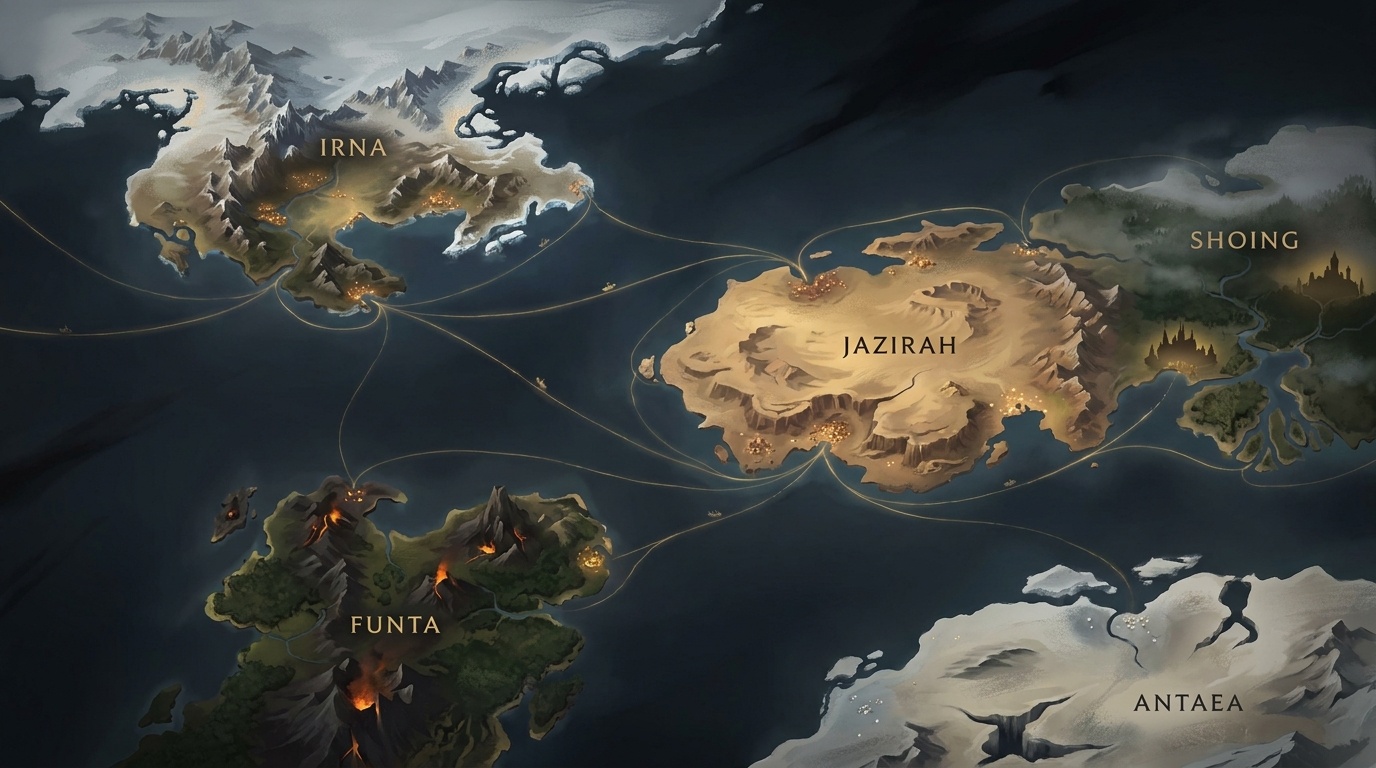
Irna is not the whole world. Characters in an Ix campaign may be hired to find someone who fled to Frosthaven, tasked with retrieving something from the markets of Gwajin, or compelled by circumstance to sail south toward a coastline that no reasonable person sails toward. When that happens, you need enough of a picture to run it.
This chapter is a city and notable-places guide, not a second history of the world. Chapter Two establishes the lands, their histories, and the broad structures that shape them. The entries here give you what you need to frame a session: the character of the place, what makes it interesting, and what kinds of stories happen there. Settle on a look and feel, establish what the locals want and fear, and build from there. The chapter opens with the travel rules that carry a party from one entry to the next.
Travel on Dort
Dort has no fixed distance table. Where two places sit relative to one another is read off the continent maps in Chapter Two, along the route the party actually chooses, and converted to days with the rates below. Two parties leaving the same city for the same destination can spend very different numbers of days getting there, because one took the coast road and the other cut through the range.
Reading Distance from the Map
Use the continent map for the land the party is crossing (Chapter Two carries the world map, Irna, Shoing, Jazirah, Antaea, Funta, and the Second Lands).
- Trace the route the players declare. Follow roads, rivers, passes, and coastlines as drawn. Do not measure in a straight line unless the party is flying or sailing open water.
- Read the distance off the map's scale bar and note it in miles. Round to the nearest 25 miles; this is a travel system, not a survey.
- Break the route into legs. A leg ends where the terrain changes, where a route decision is available, or at a named settlement. Most journeys are two to five legs.
- For each leg, take the base rate for the party's slowest mode from the rate table, multiply by the terrain factor, and divide the leg's miles by the result. Round up to whole days.
- Add the legs together. That total is the journey length, and it is what the party's provisioning, the Journey clock, and any pursuing faction are measured against.
A party is only as fast as its slowest member, its wagon, or its pack string. A mounted scout who rides ahead has left the party and is running their own journey.
Travel Rates
Base rates are miles per day of ordinary travel: roughly ten hours moving, with halts, on a maintained road in fair weather. Apply the terrain factor from the next table to anything that is not a road.
| Mode | Miles per day | Notes |
|---|---|---|
| On foot | 20 | Unencumbered. Encumbrance above threshold drops this to 15. |
| Mounted, riding horse | 30 | Needs grazing or fodder; see Provisioning. |
| Mounted, pony or mule | 20 | Surefooted; ignores one step of the mountain and hills penalty. |
| Mounted, camel | 25 | Treats desert as open country and needs water once every three days. |
| Wagon or cart | 15 | Roads and open country only. Cannot use a mountain or marsh route without a road. |
| River barge, downstream | 40 | Current does the work. |
| River barge, upstream | 10 | Poled, towed, or warped against the current. |
| Coastal sailing | 60 | Anchors at night or in weather; hugs charted water. |
| Open-sea sailing | 90 | Continuous passage, watch on watch. |
| Flying ship, by Speed | Speed × 50 | Speed 1 = 50, Speed 2 = 100, Speed 3 = 150, Speed 4 = 200. |
Flying-ship Speed is the same rating the ship carries in its profile in Chapter Fourteen. A Courier Skiff at Speed 4 covers 200 miles a day; a Trade Cutter or a patrol Corvette at Speed 3 covers 150; a galleon at Speed 2 covers 100; a leviathan-class hull at Speed 1 covers 50 and is slower than a good sea captain. A ship that has lost Speed to a Critical Hit travels at its reduced Speed until it is repaired.
Water and air routes ignore the land terrain factors. Apply instead: against a strong current or a headwind, halve the rate; running before a following wind or a spring flood, add one quarter.
Terrain Factors
Multiply the base rate by the factor for the terrain the leg crosses. Where a leg crosses two terrains, split it into two legs.
| Terrain | Factor | At the table |
|---|---|---|
| Road | 1 | Maintained imperial, realm, or toll road. Full rate. |
| Open country | 3/4 | Plains, steppe, grazing land, farmland, cleared valley floor. |
| Forest | 1/2 | Bellree, Gowehn, Moriche, Gran Floresta, Zumbal, taiga. |
| Hills | 3/4 | Broken ground, terraces, foothills, badlands. |
| Mountain | 1/3 | Carpsonic, Swarg, Hangyin, Cordillera Sulana, Weissekap, Sierra de Verno. |
| Desert | 1/2 | Ennedi, Jazirah interior, pan desert. Camels treat this as open country. |
| Marsh | 1/3 | Foghorn Marsh, delta channels, reed flats, drowned forest. |
| Snow | 1/2 | Winter road, glacier margin, Southern Cold Marches in season. A sled or snowshoes raise this to 3/4. |
Trackless terrain with no guide drops one further step on this ladder. A route the party is following blind, without a map or a local, always counts as trackless.
Forced March
A party may push a leg. Declare a forced march at the start of a day, before any check is rolled.
- Gain: that day's distance is increased by half. A party making 20 miles on foot covers 30.
- Cost: at the end of the day, every traveller makes an Average Fortitude check. Failure costs 2 Strain. Mounts are handled with an Average Riding check by their rider; failure lames the mount for the following day, which drops it to the pony and mule rate.
- Escalation: on a second consecutive forced-march day the check is Hard, and failure costs 2 Strain and 1 Wound. A third consecutive day is not permitted; the party halts.
A forced march is one of the standing sources of a Bane Die on the campaign pressure table in Chapter Eight. Keep the two consistent: a party that arrives by forced march arrives tired, and the next scene should show it.
Running a Journey
A journey is a structured scene, not a fade to black. Run it when the route matters, when something is chasing the party, or when the players have chosen a hard road over a safe one. Skip it when the party is travelling a patrolled imperial road in good weather with money for inns.
1. Provision the party. Each traveller consumes one day of trail rations per day of travel (Player's Guide, Chapter Eight sells them by the week at Encumbrance 2). A party without rations for a leg adds 1 Bane Die to every check made during it, and characters begin taking Strain on the second unprovisioned day. Water is free in temperate and forest terrain and on any river route. In desert, pan desert, or salt flat, each traveller needs one full waterskin per day, and the guide must name a water source at the end of each leg or the party turns back.
2. Set the Journey clock. Give each leg a clock of one tick per day of travel, to a maximum of six. A leg longer than six days is split. The clock fills as the party travels; the leg ends when the clock fills.
3. Roll one guide check per tick. One character is the guide for the leg. Overland, the guide rolls Survival. On a vehicle, river craft, or sailing ship the helm rolls Operate; on a flying ship the helm rolls Piloting. Difficulty follows the terrain factor: Easy on a road, Average in open country or hills, Hard in forest, desert, or snow, Severe in mountain, marsh, or trackless country.
- On a success, the tick fills and the leg proceeds.
- On a failure, the tick fills anyway and the leg costs one extra day. The party is not lost; it is slow.
- On a failure with a , the party is lost: the leg costs half again its remaining days and the next guide check is one difficulty higher.
4. Spend the symbols. Journey checks generate Boons and Banes like any other check. Spend them from this list.
| Spend | Result |
|---|---|
| A dry camp, a clear ford, or a shepherd's directions. Remove 1 Strain from each traveller. | |
| Shortcut. The leg costs one day fewer, to a minimum of one. | |
| Forage or salvage. The party gains a day of rations each, or recovers a useful item from a wreck, cairn, or abandoned camp. | |
| The party arrives unobserved, or the guide finds a route no pursuer knows. Skip the next encounter roll on this leg. | |
| Lost time. The leg costs one extra day. | |
| Spoiled supplies, a soaked pack, or fouled water. The party loses one day of rations each. | |
| A mount is lamed, an axle splits, or a sail tears. The party's rate drops one mode for the rest of the leg. | |
| The weather turns. Roll on Weather and Exposure below and apply it for the remainder of the leg. |
5. Roll for an encounter. Roll once per tick on the table for the terrain the leg crosses. On a d10 result of 8, 9, or 10, nothing happens beyond ordinary road traffic; the numbered entries are what the party meets. Roll a second time on any tick where the party is making a forced march, is travelling at night, or has just failed a guide check.
Weather and Exposure
Weather is a leg-long condition, not a single round of damage. The base rule lives in the Player's Guide, Chapter Thirteen, under Extreme Cold and Heat: a Fortitude check at the end of each extended period of exposure, failure adding 2 Wounds that do not recover until the character reaches survivable conditions, and appropriate equipment, species adaptation, or magical protection removing the base difficulty entirely. Use the difficulties and costs there; this table sets which check applies and what negates it.
| Condition | Check | Cost of failure | Gear that negates it |
|---|---|---|---|
| Heat, desert day or Volta summer | Fortitude, Player's Guide Ch. Thirteen | 2 Wounds, and the traveller's water use doubles for the day | Robed desert dress and a head covering, plus water in hand. Sand Elves are adapted. |
| Cold, winter road or glacier margin | Fortitude, Player's Guide Ch. Thirteen | 2 Wounds, plus 1 Bane Die on all physical checks until the party makes a warm camp | Furs or quilted winter clothing, a tent, and a lit fire. Cold-adapted species are exempt. |
| Storm, at sea or on open ground | Fortitude (Average), and the helm's Operate or Piloting check is upgraded once | 2 Strain and the leg costs one extra day | Shelter: a tent, a ship's below-decks, or a wagon's cover. On the water, sea room and an anchorage. |
| High altitude, above the pass line | Fortitude (Hard) once per day above the line | 2 Strain and 1 Wound, and the mountain terrain factor drops one further step | Acclimatisation of three days at the pass town, or a Primal or Divine working that supplies breath. |
Gear only removes the base difficulty. A traveller in furs on a glacier still rolls when the storm arrives on top of the cold.
Encounter Tables
Ten tables follow, one for every terrain in the factor table above, so step 5 of Running a Journey can be rolled on any leg the party chooses. Every entry below is either a creature that exists in the Ix Adversary Catalog under that exact name, or a non-combat event. Roll d10. Results 8, 9, and 10 are the non-combat entries on every table and should be used as often as the fights; a journey in which every roll is a monster stops being a journey.
Scale the encounter to the party. A single Elite is a scene; the same creature in a group is a crisis. Catalog entries carry variants and a Role line that says which is which.
Road
| d10 | Encounter |
|---|---|
| 1 | Bandit Gang holding a bend where the verge closes in. |
| 2 | Wild Dog Pack working the ditch line behind a recent caravan. |
| 3 | Wolf, trailing the party at dusk, testing whether the fire is watched. |
| 4 | Corrupted Bailiff at an improvised toll post with a forged writ. |
| 5 | Pact Collector working a night road, asking after a name. |
| 6 | Cairn Shade risen at a battlefield mound the road runs past. |
| 7 | Carna House Enforcer patrol demanding papers, non-humans first. |
| 8 | Travellers: a pilgrim party, a mail rider, or a family moving house. Rumours, a shared fire, a small favour asked. |
| 9 | Weather turns. Roll on Weather and Exposure and apply it for the rest of the leg. |
| 10 | A milestone, a shrine, or a way station stocked and unattended. Something has been left in it. |
Open Country
| d10 | Encounter |
|---|---|
| 1 | Gnarra Pack Hunter raiding party reading the party's line of march from a rise. |
| 2 | Aurochs herd across the only dry crossing, and a bull that will not give ground. |
| 3 | Saber-Toothed Cat working the grass at the edge of the firelight. |
| 4 | Drakin Flame Runner scouts of an outlaw courier route, curious about the party's cargo. |
| 5 | Skull Wasp Swarm lifting off an execution field the route runs straight through. |
| 6 | Carrion Cowl waiting on ground where something is already scheduled to die. |
| 7 | Nyxollox Death-Keeper walking a battlefield the party did not know was there, asking who witnessed it. |
| 8 | Drovers moving stock to summer pasture, or a surveyor's party marking a boundary somebody will dispute. |
| 9 | Weather turns. Roll on Weather and Exposure; open ground gives no shelter from the storm row. |
| 10 | A boundary stone with two realms' marks cut into it, the newer one cut over the older. |
Forest
| d10 | Encounter |
|---|---|
| 1 | Giant Spider anchored across the trail at head height. |
| 2 | Razorback Boar in a river bottom, unwilling to yield the path. |
| 3 | Werewolf, met first as an isolated farmer a day back. |
| 4 | Owlcat Brute hunting in silence through a preserve nobody warned the party about. |
| 5 | Shadow Panther shadowing the party across a moonless ravine. |
| 6 | Crowned Stag at a druidic boundary marker. Killing it has consequences. |
| 7 | Living Trapvine grown over the remains of a forest shrine. |
| 8 | A charcoal burner's camp, or a Wood Elf boundary party who want to know the party's business. |
| 9 | Weather turns. Roll on Weather and Exposure. |
| 10 | A Hedge Witch's cottage at the forest edge, and a price for help that is not coin. |
Hills and Mountains
| d10 | Encounter |
|---|---|
| 1 | Rock Lurker on a quarry-edge switchback. |
| 2 | Griffon defending an aerie the road passes under. |
| 3 | Mountain Lion working a scrubland pass. |
| 4 | Manticore above a canyon road, in no hurry. |
| 5 | Frostbound Dead in a glacial pass that has given up its dead. |
| 6 | Lesser Drake ranging a dragon-adjacent highland. |
| 7 | Great Eagle contesting a wind-carved ledge the party needs. |
| 8 | A toll station of the Karubo Highlands, or a herders' summer camp. |
| 9 | Weather turns. Roll on Weather and Exposure; at altitude, use the high-altitude row. |
| 10 | A ruined watchtower with a fire burning in it and no one present. |
Snow and Ice
| d10 | Encounter |
|---|---|
| 1 | Dire Wolf pack quartering a winter road behind the party's tracks. |
| 2 | Musk Ox herd holding the only sheltered ground on the leg. |
| 3 | Dire Wolverine at a cache the party was counting on. |
| 4 | Cave Bear turned out of a denning cave by the noise of the crossing. |
| 5 | Elemental Gale raised where a blizzard runs over a storm altar. |
| 6 | Frost Wight in a snowbound fort the route shelters in. |
| 7 | Failed Bloodstone Seeker camped on the ice, certain the party is here for the same thing. |
| 8 | A trapper's line, a Shoing courier on skis, or a Frosthaven supply sledge headed the other way. |
| 9 | Weather turns. Roll on Weather and Exposure; use the cold row, and the high-altitude row above the pass line. |
| 10 | A cairn raised over a previous expedition, with the record of what killed them still legible inside. |
Desert
| d10 | Encounter |
|---|---|
| 1 | Blackclaw Scorpion under the shade the party chose for a halt. |
| 2 | Dunemaw Pit across a caravan grave route. |
| 3 | Caravan Raiders reading the party's water supply from a ridge. |
| 4 | Striped Hyena following the party's leavings for three days. |
| 5 | Sand Elemental raised over a failed ritual circle. |
| 6 | Mummy uncovered where a sealed tomb has opened in a wind scour. |
| 7 | Ambush Cactus and a Spineweed Cluster narrowing a canyon mouth. |
| 8 | An Oshalan caravan under Registrar escort, or a well with a family sitting on it. |
| 9 | Weather turns. Roll on Weather and Exposure; use the heat row. |
| 10 | An omen: the Ennedi's horizon carries a shape too large to be cloud, and it is not moving toward the party. Yet. |
Marsh and River
| d10 | Encounter |
|---|---|
| 1 | Marsh Troll under a drowned road's causeway. |
| 2 | Crocodile at a warm-water ford. |
| 3 | Giant Leech taken on while wading, discovered at camp. |
| 4 | Gangly Mireling in fog at the reed margin. |
| 5 | River Drake in a delta channel it considers its own. |
| 6 | Corpse Candle on a drowned path, leading somewhere. |
| 7 | Drowned Dead rising out of a river grave the barge poled over. |
| 8 | A river pilot offering the channel for a fee, or a barge crew wanting news downstream. |
| 9 | Weather turns. Roll on Weather and Exposure; flooding adds a day to the leg. |
| 10 | A reed-choked ruin with a dry upper floor and a door that was barred from the inside. |
Coast and Sea
| d10 | Encounter |
|---|---|
| 1 | Pirate Boarding Crew closing under a false flag. |
| 2 | Great Shark following a bloodied hull. |
| 3 | Tide Serpent over a reef the chart does not show. |
| 4 | Harpy flight off a cliff face with good thermals and a ship below. |
| 5 | Giant Crab at a tidal cave the party put in at. |
| 6 | Merfolk on a contested sea lane, with a grievance and a proposal. |
| 7 | Sea Snake in a warm harbour approach. |
| 8 | An Accord Patrol Corvette hailing for inspection, or a fishing fleet with a warning. |
| 9 | Weather turns. Roll on Weather and Exposure; use the storm row. |
| 10 | A drifting hull, provisioned, undamaged, and empty. |
Underground and Ruins
| d10 | Encounter |
|---|---|
| 1 | Carrion Crawler in a passage with accessible corpses. |
| 2 | Giant Rat colony where a settlement stored grain. |
| 3 | Ghoul pack at a plague pit nobody consecrated. |
| 4 | Stonehook Crawler on a tomb ceiling above the party's line of march. |
| 5 | Gargoyle that has been a decoration for the last four hours. |
| 6 | Shadow where the Dim presses close against a sealed crypt. |
| 7 | Sealed Ruin Sentinel at a door that was meant to stay shut. |
| 8 | A Tomb Robber crew already inside, and willing to talk terms. |
| 9 | A collapse ahead. The party backtracks and the leg costs an extra day. |
| 10 | An Ancient-adjacent inscription that a Lore or Planar Lore check can read, and a reason to wish it had not been read. |
Urban
| d10 | Encounter |
|---|---|
| 1 | Scragg Raider band working a forgotten service tunnel. |
| 2 | Wererat broker who knows what the party is carrying. |
| 3 | Cult Rabble spilling out of a cellar shrine into the street. |
| 4 | Infernal Clerk with a correction to make to a document the party signed. |
| 5 | Noble Assassin at a function the party had no intention of attending. |
| 6 | Poltergeist in the inn room the party was given cheap. |
| 7 | Oshalan Zealot street enforcement, escalating. |
| 8 | A faction patrol: grey cloaks in The Crown, Iron Hand escorts, or a Temple Guard detail. Papers, questions, a name written down. |
| 9 | A festival, a funeral procession, or a market closure that puts the party a day behind. |
| 10 | An Archive Keeper with a question about a record the party has been asking after. |
Planar Encounter Tables
These tables cover the planes Chapter Five describes as environments a party can actually walk into. Roll d10 as above; 8, 9, and 10 are non-combat.
Chapter Five's remaining planes carry no table on purpose. The Void is a prison, not a destination, and its horrors are not statted. The Continuum, The Source, The Drain, The Nexus, and The Veil are plot locations that should be built for the plot that reaches them. Logos, Paxia, Kinesis, and Petrina are soul-destinations whose hazard is the plane itself rather than anything living in it; use the Sustained Exposure Cost line in Chapter Five instead of an encounter roll. Limbo carries one catalog entry, the Limbo Scavenger; place it directly rather than rolling. Paradiso and the Citadel draw on the catalog's Divine and Celestial chapter, which the Shattered Domain table already covers.
Arcana
| d10 | Encounter |
|---|---|
| 1 | Arcane Prism Mote drawn to the party's active workings. |
| 2 | Glass Ooze pooled in a saturation sink. |
| 3 | Planar Scar Construct assembled from a failed working. |
| 4 | Prism Newt shoal in an arcane pool, harmless until disturbed. |
| 5 | Arcana-Burned Mage who came here to fix what the last attempt did. |
| 6 | Phase Cat, curious, and impossible to keep out of anything. |
| 7 | Rift Storm Creature riding a discharge front. |
| 8 | A practitioner's camp with a ward circle, an open invitation, and a price. |
| 9 | The bleed surges. Every spell cast this tick behaves one step wrong. |
| 10 | An abandoned working still running, and a note explaining what it was for. |
The Dim
| d10 | Encounter |
|---|---|
| 1 | Shadow detaching from a shadow-version of a street the party knows. |
| 2 | Shadow Monitor along an old wall. |
| 3 | Umbral Dragon ranging a lightless corridor. |
| 4 | Tomb Wraith in a shadow temple to a forgotten god. |
| 5 | Wight in a household that was destroyed in both worlds. |
| 6 | Death Hound where the Silver Road runs near the surface. |
| 7 | Cemetery Sovereign holding a necropolis district's Dim reflection. |
| 8 | Residents of the City of Shadows, suspicious, practical, and willing to trade. |
| 9 | The flattening. Every traveller takes 1 Strain and cannot recover it while on the plane. |
| 10 | A shadow version of a building the party has been in, changed in one specific way. |
Ember
| d10 | Encounter |
|---|---|
| 1 | Elemental Flame at a vent the party has to pass. |
| 2 | Ash Salamander in burned ruin. |
| 3 | Ember Dragon over a glass field. |
| 4 | Funeral Pyre Remnant walking out of a burn scar. |
| 5 | Glasswing Drake in heat-blasted territory. |
| 6 | Sin-Fed Brute driven here from an infernal pit. |
| 7 | Rift Storm Creature on a combustion front. |
| 8 | An elemental-tolerant work crew with a cistern and no interest in visitors. |
| 9 | Combustion rises. Apply the heat row of Weather and Exposure for the rest of the leg. |
| 10 | A structure that has not burned, and should have. |
Mineral
| d10 | Encounter |
|---|---|
| 1 | Elemental Ore in a collapsed forge gallery. |
| 2 | Tunnel Drake in a deep road. |
| 3 | Ironjaw Mole through a buried foundation. |
| 4 | Rust Eater in a metal-rich seam. |
| 5 | Ore Dragon holding a mountain root. |
| 6 | Stone-Gaze Basilisk at a sunning stone. |
| 7 | Glassweb Spider in a crystal cave. |
| 8 | A dwarven survey party who will guide the party out, for a share. |
| 9 | Pressure. The passage narrows; the leg costs an extra day and confined spaces deal crushing damage. |
| 10 | A worked vault door with no mechanism on this side. |
Tidal
| d10 | Encounter |
|---|---|
| 1 | Elemental Tide in a flooded temple. |
| 2 | Deep Angler at the bottom of a drowned approach. |
| 3 | Tide Dragon in a contested current. |
| 4 | Drowned Dead in a submerged village. |
| 5 | Great Serpent through a flooded ruin. |
| 6 | Tide Serpent on a reef shelf. |
| 7 | Bone Crab in a flooded tomb. |
| 8 | Merfolk who navigate here and will pilot the party for a favour. |
| 9 | The current shifts. Movement this tick is current-dependent; the leg costs an extra day. |
| 10 | An air pocket with a structure in it, dry, and recently used. |
Zephyr
| d10 | Encounter |
|---|---|
| 1 | Elemental Gale across an open reach. |
| 2 | Storm Kite riding a front. |
| 3 | Gale Dragon on a storm corridor. |
| 4 | Roc over a wind-carved landing the party needs. |
| 5 | Harpy flight using the thermals. |
| 6 | Ashwing Courier crossing on infernal business. |
| 7 | Rift Storm Creature in a weather front that is not weather. |
| 8 | A flying ship at anchor with a torn sail and a crew who need hands. |
| 9 | The wind rises. Apply the storm row of Weather and Exposure; nothing set down stays down. |
| 10 | A floating anchorage, tethered, provisioned, and abandoned. |
The Shattered Domain
| d10 | Encounter |
|---|---|
| 1 | Shattered Domain Sentry at a divine checkpoint. |
| 2 | Planar Tax Collector at a toll gate on a shard road. |
| 3 | Lesser Angel with a question about the party's business here. |
| 4 | Judgment Herald arriving at a violated sanctuary. |
| 5 | Divine Beast in a deity's shrine wilderness. |
| 6 | Shard-Warped Knight left over from a failed divine quest. |
| 7 | Godless Echo in an abandoned divine territory. |
| 8 | A soul-population of a god's territory, going about a life, entirely willing to talk. |
| 9 | The party is noticed. A divine response arrives within hours; the GM sets the clock now. |
| 10 | The Ocean of Belief comes into view, and the party's position on the territory map changes to match its significance rather than its distance. |
Sheol and the Silver Road
| d10 | Encounter |
|---|---|
| 1 | Spent Petitioner at a failed rite site. |
| 2 | Spent Marauder on the Road's margin. |
| 3 | Psychopomp Hound at a haunted crossing. |
| 4 | Rogue Psychopomp working a funeral road off the books. |
| 5 | Silver Road Watcher at a soul-route fork with a claim dispute. |
| 6 | Spent Saint on an exhausted pilgrimage road. |
| 7 | Spent Hulk at a divine war scar. |
| 8 | A Sheol Clerk with a death-record error and no authority to fix it. |
| 9 | A Soul Courier passing on a claim transfer, and willing to carry a message. |
| 10 | A milestone naming a soul the party knows. |
The Hells, Upper Layers
Tyrannus through Malicor, devil-ruled and law-based. See Chapter Five for the layer roster.
| d10 | Encounter |
|---|---|
| 1 | Hell Hound pair off an infernal kennel. |
| 2 | Contract Devil holding a debt-claim scene. |
| 3 | Pact Collector working a default. |
| 4 | Oath-Eater at an oath site. |
| 5 | Sealed Gate Warden at a threshold the party needs open. |
| 6 | Infernal Provincial Collector touring a conquered province. |
| 7 | Ash Tempter working a famine road. |
| 8 | An Infernal Clerk in a counting house who will answer questions accurately, for a fee that is not money. |
| 9 | An Infernal Advocate offering to represent the party in an arbitration they did not know had been filed. |
| 10 | A ledger with the party's names already in it, and a date. |
The Hells, Lower Layers
Loftile through Anarchos, demon-ruled, where authority lasts only as long as it can be enforced in the room.
| d10 | Encounter |
|---|---|
| 1 | Gut-Sack and Scrapplers over one of Gula's feeding pits. |
| 2 | Carrion Cowl circling a field where death is already scheduled. |
| 3 | Bloaten in the lowest feeding grounds. |
| 4 | Comely and Gallant in Erosmire's mirrored halls, offering exactly what the party wants. |
| 5 | The Hollow presiding over one of Loftile's false shrines. |
| 6 | The Uncrowned in a shattered command hall, dismantling a chain of command. |
| 7 | Unravelinger and Cracklin across one of Anarchos's dissolving fields. |
| 8 | Herald of Kian holding court, and prepared to receive the party formally. |
| 9 | Structure fails. The route the party arrived by is not where it was; the leg costs an extra day. |
| 10 | The Nothing, settled somewhere ahead and waiting, at a tear that goes all the way through. |
The Somnium
| d10 | Encounter |
|---|---|
| 1 | Somnium Predator working a sleep-plague site. |
| 2 | Memory Parasite in a dream-stained archive. |
| 3 | Mourning Veil in a dreamed nursery. |
| 4 | Hunger Ghost in a dreamed famine house. |
| 5 | Possession Vessel walked in from a summoning rite. |
| 6 | Poltergeist built out of a dreamer's unresolved rage. |
| 7 | Forgottens where the substrate has worn through. |
| 8 | The Hall of Dreams, Mirror Lake, or the Forgotten City, and a Shaman already working there. |
| 9 | A dream collision: a second dreamer's landscape overlaps the party's route. |
| 10 | The Somnarch, oblique, in a shape the viewer's own mind supplied. |
The Weft
| d10 | Encounter |
|---|---|
| 1 | Weft-Tangled Thing at a fate-ritual ruin. |
| 2 | Dire Wolf pack answering a spirit pair's pattern. |
| 3 | Crowned Stag at a spirit-of-place boundary. |
| 4 | Great Serpent through a living-world reflection. |
| 5 | Beacon-Touched Beast where Ancient magic scarred the substrate. |
| 6 | Dragon-Blooded Beast drawn from a dragon's long tenure. |
| 7 | Gravity-Broken Animal out of an Anchor Dragon's territory. |
| 8 | An untethered spirit pair for a species the world has lost, holding its pattern intact. |
| 9 | The plane reads the party. Travellers with a genuine relationship to the natural world halve this leg; the rest add a day. |
| 10 | A spirit of place that wants something in the physical world put right. |
Irna
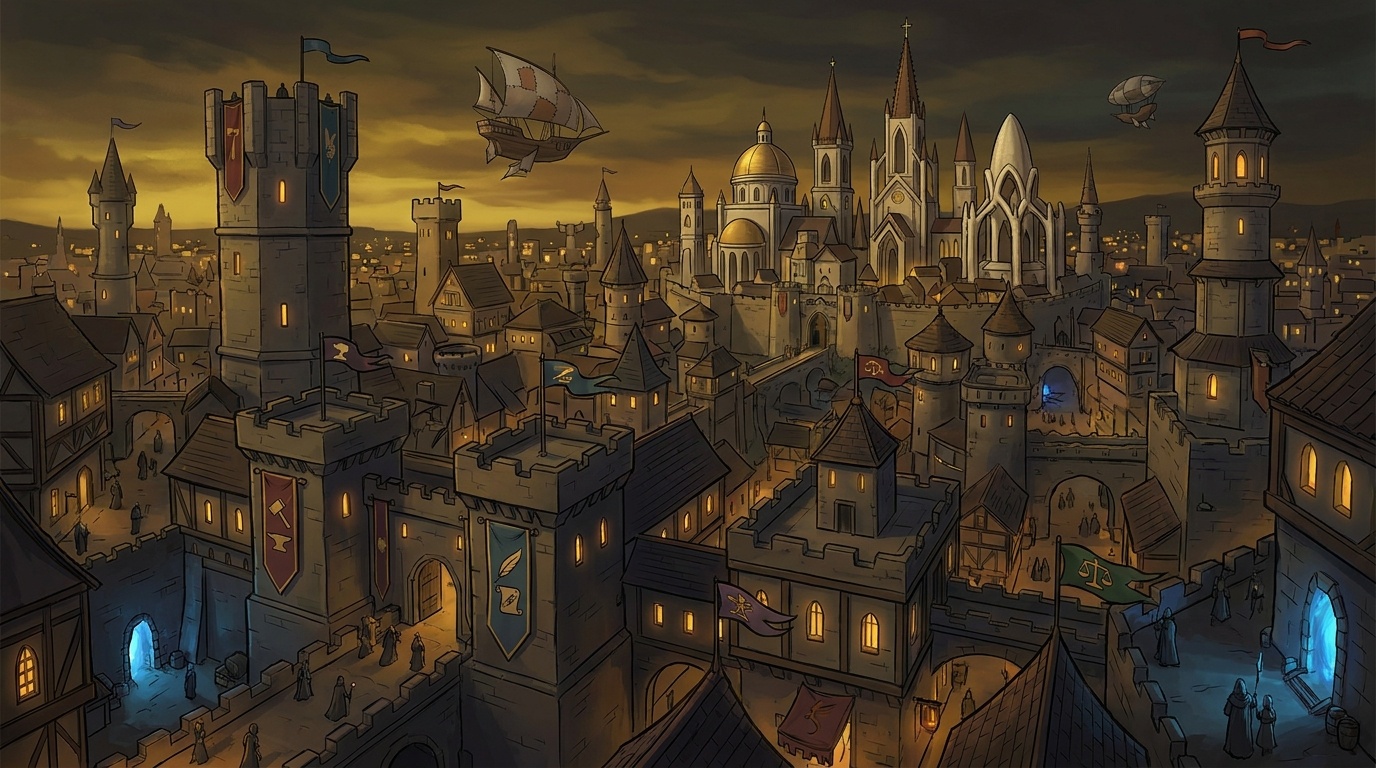
Irna is the oldest major post-Echo political center, and it does not let anyone forget this. What came out of Irna, its governance model, its architecture, its administrative culture, spread across every continent Irnan merchants, soldiers, diplomats, and explorers reached, carried by the general confidence of a people who believed, with some justification, that they had worked out how to do things correctly. Those continents were never blank extensions of Irna, and Irna does not rule Dort. Today Irna itself is an empire of kingdoms, each with its own ruling house and its own character, all ultimately subject to the Emperor who governs from The Crown.
The continent's peoples are as varied as its geography: nomadic tribal communities in the northern plains, hardy dwarven and mountain folk in the Carpsonic and Swarg ranges, elven forest settlements in the rainforest margins, and the cosmopolitan populations of its great port cities. What connects them is the shared scaffolding of Irnan law, Irnan commerce, and the Irnan calendar.
The Crown
Population: second largest city in the known world; largest city in Irna | House Harrington lineage (Emperor) | Cosmopolitan trade, imperial administration, every major faith represented
The Crown is Irna's imperial capital and Dort's most important diplomatic stage. It does not rule the world; it leads because treaties, embassies, courts, guild offices, religious institutions, and foreign missions accumulate here until every major power needs a presence. Built to specification following Irna's civil war, the city was designed from the beginning as a demonstration of what civilization means and what it should look like: dwarven engineering, elven gardens, a constitution that kept the kings in line and gave the Emperor enough power to hold things together without enough to abuse unchallenged. The resulting concentration of diplomats, spies, scholars, and merchants makes The Crown the most information-dense city on Dort, which is either an asset or a hazard depending on what your party is carrying and who wants it. The grey cloaks patrol the outer city; gold cloaks guard the castle; and the Shadowviel counter-intelligence organization operates without any easily visible presence at all. Anywhere a GM needs high-stakes intrigue, a complex social web, or a location so significant that something happening here changes the whole diplomatic order, The Crown delivers.
Frosthaven
Population: major city | House Frost | Importing trade, shipbuilding, naval headquarters, regional court
Frosthaven sits where it does for a reason: it is the epicentre of northern Irnan trade, the receiving point for goods from Funta, and the home port of the Irna navy. Its wharf divides neatly into cargo docks, noble yacht berths, and military slips, with the shipyards extending east beyond all of them. The regional court gives it legal weight that most cities lack; appeals from settlements across the north are settled here, and House Frost's authority extends accordingly. The city sends more adventurers into the world than anywhere else on the continent, which means it also collects more adventurers looking for work, information, or a place to recuperate. A session that starts in Frosthaven has access to every kind of job board and every kind of trouble in one walled package.
Marwen
Population: ~28,000 | House Slvanna (elven, matriarchal) | Woodworking, silk and lace textiles, master weaponry
Marwen is built into the edge of the Bellree Rainforest in the most literal sense: the streets wind around trees too large to fell, the buildings show their grain like woodwork rather than architecture, and the royal palace is constructed inside living trees that have been growing since before the current empire existed. House Slvanna is an elven matriarchal house whose tenure outlasts the institutional memory of most of its peers, which gives the kingdom a continuity that human houses simply cannot match. The city is prosperous, artistically sophisticated, and governed with the particular calm of those who have seen five empires rise and are prepared to see this one through to wherever it ends. Good for intrigue built on deep history, or for players who need something from a ruling family that has been watching the continent since before their ancestry was traceable.
Rochdale
Population: ~18,000 | House Irna (the original noble family) | Whaling, ceramics, maritime trade
Rochdale sits on the Bay of Chornan where the taiga breaks and the sea begins, its stone-and-brick facades reflecting a city that was built to last by people who knew whose name they were carrying. House Irna is the founding noble family of the continent itself, and the weight of that history shows in the city's character: ceremonious, proud of its precedence, and occasionally suffocating in both. The canal system that runs through the districts is its arteries; in winter they freeze solid and the city takes to the ice on skates, which is one of those details that makes a place feel real. The ceramic industry that has grown here reaches noble houses from Rochdale to Gwajin. Useful when you need a city with deep roots, complex political lineage, and the specific social pressure of a place where everyone has opinions about who came first.
Carna
Population: ~14,200 | House Carna (hereditary dynasty) | Gold mining, silversmithing, jewelry and decorative metalwork
The city is built on an incline that matches its social hierarchy almost exactly: the Gold District at the top where House Carna's mansion overlooks everything, the Silver Quarter below it, the Copper District below that, and the gravel pits at the edges where the lowest-status residents work. The Hassa River serves as the city's moat; the Carnelian Bridge across it, inlaid with iron and gold, announces the city's values before you are through the gate. Non-human residents occupy peripheral positions by design, and the human supremacy ideology is not subtle. The mines run on magical infrastructure that keeps the operation safer than comparable digging, and they never stop. Good for stories about inequality made architectural, or as the source of a political crisis when something disrupts the gold supply that funds a significant portion of the Empire.
Harken
Population: ~2,800 | House Orn (King Alden Orn) | Agriculture, Smaling leatherwork, maritime trade; all subject to heavy taxation
Harken is a prosperous-looking city that does not feel prosperous. The Smaling artisan quarter produces leatherwork of genuine quality: saddles, boots, harness pieces refined across generations. The fields are productive. The markets are busy. And House Orn's gothic spires dominate the skyline from every angle, the dark armor of its household guard visible from most of the main streets, with a patrol frequency that does not match any honest crime rate. The residents have learned to conduct ordinary life without appearing to be doing it, which is a skill that requires constant attention and produces a particular kind of exhaustion. A growing resistance movement associated with the Echo faith operates quietly in the shadow of everything else. This is a city for political pressure campaigns, escape scenarios, and morally complicated decisions about when to intervene.
Irna: Island Territories
Creta Island
Irna's southeastern defensive island, positioned as the first line of resistance against Jazirah's persistent naval ambitions. What was once agricultural land has been substantially converted to fortress infrastructure and naval yard under the governance of an Earl and naval command. Druids maintain the natural balance to ensure the transformation does not become purely extractive. Good for military operations, naval intrigue, and scenarios that require a contested forward position.
Volta Island
Brutally hot, perpetually humid, and infested with insects of a size that mainlanders find difficult to accept until one lands on them. Volta is also extraordinarily productive: citrus, sugar, rum, seafood, and tropical timber in quantities that justify every complaint the inhabitants have about the climate. Most inhabitants have quite a few complaints. House Volta governs not because it is particularly powerful but because nobody else has wanted the position badly enough to take it. Useful for tropical extraction scenarios, supply-chain stories, and the specific flavour of colonial infrastructure run by people who are miserably successful.
Shoing
Shoing is a vast northern land of mountains, forests, river valleys, cold coasts, and island-dotted southern waters, and one of the established lands that most feels old. Its mountains are old. Its rivers are old. It is also the origin land of dragonkind, which is not a poetic claim but a geological and genealogical one, confirmed by the fossil record and by the dragons themselves. Every compact a Shoing community holds with a dragon was negotiated specifically, maintained actively, and is currently either being honored or quietly deteriorating in ways that have not yet produced consequences. The land divides into two broad cultural spheres: the eastern realm structure centered on Gwajin, with its hierarchical honor code and millennia of continuous craft refinement; and the southern and western coast, warmer, more commercially fluid, organized around pearl trade, navigation, island ports, and highland pass routes. Both are Shoing. Both express the same underlying framework of honor. They express it differently.
Shoing's political structure organizes around seven primary realms: the Gwajin Realm (eastern heartland, centered on Gwajin); the Higatomo Northern Provinces (cold northern coast and forest interior); the Karubo Highlands (mountain pass kingdom controlling east-west transit); the Zazua Cracked Sea League (southern archipelago confederation); the Galshi Western Coast (Malaa Sea-facing maritime culture); the Senior County of Kegun (commercially indispensable subject county); and the Prefecture of Belon (salt works and rice basin administration). The cities below are organized under those structures; knowing which realm a character is operating in determines whose law, honor code, and trade relationships apply.
Gwajin
Population: ~1,000,000 | House Tessawa (Grand Duke) | Imperial trade, maritime commerce, silk and ceramic manufacturing, military production
The largest city in the known world, Gwajin is the seat of the Gwajin Realm's full administrative apparatus. Ships from the Grand Fleet are visible twenty miles out to sea; the harbor district at the base of the tiered city gives way to commercial districts climbing the foothills, and the Tessawa Palace at the summit ties the whole vertical settlement together. The court aesthetic of Gwajin defines what "refined" means across eastern Shoing, which means everything from lacquerwork to calligraphy to the specific way a sword is worn at a formal occasion has been shaped here and radiated outward. The navy controls the Gulf of Siem. Sessions in Gwajin are sessions in a place where your players' social skills will be tested alongside their other capabilities.
Kegun
Population: ~85,000 | House Veshi (Senior Count, Gwajin Realm) | Banda Bay maritime trade, shipbuilding, Commodity Exchange
The second-largest city in the Gwajin Realm and its primary commercial port, Kegun is where southern Shoing trade prices are set at the Commodity Exchange, where the commercial shipyards produce the vessels the Grand Fleet does not, and where the organized chaos of a major trade hub plays out every day. Less ceremonially demanding than Gwajin, more commercially accessible, and sufficiently large that players can find almost any resource or contact they need. The long stone warehouses along the inner bay's eastern shore are the city's most distinctive feature, built for the cycle of cargo that never stops moving through.
Karubo
Population: ~18,000 | House Thornwald (Duke, Karubo Highlands) | Pass-toll administration, highland wool, mountain metalworking, pilgrimage services
Capital of the highland pass-control kingdom that governs the Hangyin range crossings, Karubo is where anyone moving between eastern and central Shoing pays their toll and where the prices for highland wool are set every season. The mountain metalwork here is bought by the Gwajin court and by discriminating buyers across the continent. Two rivers converge in the valley the city occupies, and the terraced layout gives every district a different elevation and character. Useful when the story needs a transit chokepoint, a city with genuine commercial leverage, and the specific dynamics of a place that controls access to somewhere else.
Zazua
Population: ~9,500 | House Dharmakar (convening house, Zazua Cracked Sea League) | Pearl redistribution, delta trade brokerage, river piloting services
Convening city of the Zazua Cracked Sea League, and one of the most dangerous harbor approaches in southern Shoing. The river delta mouth spreads into four braided channels called the Fingers; only the Third Finger is navigable by a loaded ship, and finding the Third Finger without a Zazua pilot has been done successfully approximately three times in the last century. The largest pearl exchange in southern Shoing operates here under League governance. River pilots command extraordinary fees and earn every coin. Sessions in Zazua are sessions in a city that controls movement through specific, unavoidable expertise.
Higatomo
Population: ~7,300 | House Murano (Baron, Higatomo Northern Provinces) | Lacquerwork, ink and pigment production, mountain herb cultivation
The finest lacquerwork in eastern Shoing comes from here, as does the ink that Shoing's calligraphers consider the standard. Both products depend on the specific combination of volcanic soil, lacquer trees, and herb varieties that only Higatomo's particular mountain slope produces. House Murano holds a centuries-old compact with the dragon Sorath, who sleeps in the mountain above the town and has not been heard from in forty years, which either means the compact is in good health or that nobody has checked recently. The dragon's presence is felt in the town's character whether Sorath is active or not. Good for stories that pivot on an old agreement, or that involve someone deciding to investigate why the mountain has been quiet.
Jazirah
Jazirah is Oshala's continent, built in the crucible of a genocide that the faith's founders survived and were transformed by. When Irnan explorers arrived in 540 ME, early contacts were promising. A general's prejudice destroyed them: the systematic destruction of the Sand Elves that followed drove the survivors into the desert interior, where exile forged faith into something absolute and implacable. When they emerged, Oshala was no longer one truth among many. He was the organizing principle of everything, and the civilization that grew from that certainty is strict, architecturally austere, deeply scholarly, and currently building a war fleet. The Sultan's twenty-year shipbuilding program has been running continuously, and the public statements about the timeline for expansion are, by informed estimates, conservative.
Iskash
Population: ~46,000 | Sultan Karim al-Uzam al-Saffari | Maritime trade, timber, military logistics, religious administration
The capital sits at the mouth of the Dalahad River delta, and the first thing anyone notices is the harbor: the largest concentration of warships in the world alongside merchant vessels, the distinction between them sometimes unclear. The strictest enforcement of the Sacred Laws anywhere on the continent governs daily life here. Registry tracks every resident from birth through death. The calls to prayer structure the city's rhythm. The Inner Sanctum of Oshala's oldest temple holds the Golden Tablets. Sessions in Iskash are sessions in a place where every action has a religious and a political dimension, and where the appropriate body has an opinion about what you are doing.
Reach: Half a day's ride upstream to the cedar forests of the Dalahad Interior.
Al Jaddah
Population: ~16,000 permanent; 30,000 or more during pilgrimage seasons | Grand Imam Jalal al-Din al-Saffar | Pilgrimage industry, religious education, manuscript production
Jazirah has two centers of power, and Al Jaddah is the theological one. The Scholarly Council whose interpretive rulings on the Sacred Laws are authoritative across the continent operates from here, from the city that holds the Tomb of the First Witness. The ongoing tension between Al Jaddah's interpretive authority and Iskash's political and military authority is the central unresolved question of Jazirah's governance, conducted in the formal language of cooperation that covers a genuine structural disagreement. Pilgrimage seasons double or triple the population. Good for stories built on religious controversy, contested interpretation, and the politics of doctrine.
Mosulad
Population: ~19,000 | Wali Kassim al-Rashid (Iskash appointment) | Traditional: fishing and commercial shipping; current: war fleet construction
Mosulad has the finest natural deep-water harbor on Jazirah's western coast, which is why it has been a fishing and commercial port for centuries and why Iskash decided it was the right place to build a war fleet. The warship frames are visible at various construction stages in the harbor, and the city's entire character is in the process of being reshaped around them. Workers displaced from the fishing economy sit alongside military engineers. A city that knew what it was is discovering what it is becoming. Useful for stories about state power transforming a community, or as the departure point for the naval threat that the rest of the continent is watching.
Armarga
Population: ~11,000 | Bey Mansour al-Nasir | Maritime trade, merchant banking, luxury goods
Jazirah's gateway to the Perian Sea, with a Shoing merchant quarter and the cosmopolitanism that comes from a city whose position at a major trade junction draws everyone regardless of where they started. Wealthier and more permissive in practice than the mainland cities, operating under the Sacred Laws with what Iskash would diplomatically call local interpretation. The harbor is always in motion. Good as a commercial crossroads where players can acquire things they cannot find on the Jazirah mainland and make connections to the wider trade world.
Ash Sharah
Population: ~14,000 | Emir Rashid al-Khash VI (with merchant co-advisors) | Trade, logistics, caravans
The Sultan's primary eastern trade hub, built where the Khash River cuts its only reliable crossing for three weeks in either direction. Ash Sharah announces itself by the dust columns of a thousand camels and the sound of a city-sized bazaar that operates at volume regardless of hour. The old quarter sits high on the north bank in white-mud buildings; the real commercial activity has spilled south in a chaotic accretion of caravanserais, warehouses, and improvised markets. Useful as a transit hub, a source of caravan-related complications, and any story that needs the specific momentum of a city whose defining characteristic is that things are always in transit.
Funta
Funta is a continent of contrasts: the Great Ennedi Desert divides it in two, with the arid interior and western pan desert on one side and the lush tropical east on the other. The desert is physically crossable. It is simply not survived. Johanna, the Eldar dragon of prism lineage who is the matriarch of all current dragon lineages, has claimed the Ennedi as her domain. She spent the early ages of her existence ranging across the Oceanic Reaches before relocating to the desert interior, and she has held it since against all comers. The expeditions that have attempted to cross without her permission have not returned. All of them. The result is a continent that developed its eastern and western communities in semi-isolation, connected by coastal routes rather than interior ones.
Governance across Funta is generally chieftain-based, with governance structures that range from hereditary chieftaincies to tribal councils to the unique scholarly republic of LaHale. Foreign influence from Irna and Jazirah is present in the coastal cities but has not overwritten what was already here.
LaHale
Population: ~92,000 permanent | High Priestess of Zopha (elected by Scholar's Council) | Scholarship, trade, manuscript production, academic tourism
LaHale sits on the southern shore of Volta Lake and holds the Grand Library: the largest and most prestigious repository of knowledge in the world. It was established through Funta-Irna cooperation as a neutral scholarly center, and it follows Irnan legal models without being an Irnan possession. A scholar-elected council governs the city under arrangements that survive because several competing powers benefit from LaHale's independence. The Academy of Magical Arts operates here. Scholars from every continent take up residence to access the collections. The city is prosperous, cosmopolitan, and oriented around the accumulation and exchange of knowledge as a primary civic value. Sessions here are sessions in a place where the most dangerous thing is what someone knows, or what they are about to find out.
Tontou
Population: ~22,000 | House Tamrat (chieftaincy tradition) | Cotton cultivation, textile dyeing, lagoon trade
Funta's eastern textile capital, built on the Kelta Lagoon where the cotton fields run to the water's edge. The color-based social hierarchy is visible in what people wear: white marks those still striving, vibrant colors mark those who have arrived, and the silks and jewelry of the highest quarter mark those who are not concerned with proving anything. The city has emerged as a cultural capital for Funtan theater and storytelling, with a performing arts tradition that has begun attracting visitors from the mainland. Good for stories about class mobility, cultural production, and the specific social grammar of a place that expresses status through dress.
Koma
Population: ~14,000 | House Koma (hereditary chieftain with family council) | Shipbuilding, trade, agriculture
The finest shipyards in eastern Funta operate from Koma's Tana Gulf harbor, and the city knows it. The prosperity is visible in the tiered architecture: worker and artisan quarters at the base, wealthy merchant houses climbing toward the estate that overlooks the gulf, the color and material of each level marking the economic distance traveled from the waterfront. Koma is in the middle of a cultural renaissance driven by the chieftain's conscious policy of supporting arts and craft alongside commerce. Useful as a source of maritime assets, a cultural hub with ambitions, and any scenario that needs a city comfortable with its own success.
Nukwai
Population: ~18,000 | Amina Tribe (north side); autonomous wealthy families (south side) | Agriculture, livestock, river trade corridor supply
The only city in Funta where the river running through the middle is also the political border. The north side operates under the Amina Tribe's strict law enforcement and is agricultural, organized, and formally governed. The south side is controlled by a council of wealthy families who do not acknowledge the Chieftain's jurisdiction and enforce their own version of order through a combination of hired security and mutual advantage. The divide is structural, old, and unresolved. Sessions in Nukwai are sessions in a city where which side of the river you are standing on determines which rules apply to you.
Bafao
Population: ~7,500 | The Niazi Clan (chieftaincy) | Fishing, shipbuilding, adventure outfitting
The last civilized port before the voyage to the Second Lands sits on the eastern Tana Gulf coast with the energy of a city that knows it is the last reliable stop. The Fire Swingers' combat display tradition brings reputation and tourism; the shipwrights' yard keeps the expedition traffic moving; and the outfitting trade serves everyone who has decided to go south and needs supplies and someone to talk them out of it. Sessions here are sessions at the edge of the known: everything that is about to go wrong has not yet happened, and everything that might help is still available.
Reach: One day's travel inland to the nearest real farmland; the coastal plain behind the city grows kitchen gardens and nothing larger.
Antaea
Antaea entered Irna's formal diplomatic record later than the other great continents. Its settlements, local histories, and regional agreements predate Irna's formal involvement by centuries. When Irnan envoys and traders arrived in force, they found a continent that had been developing on its own terms. The result is a patchwork of independent city-states, confederations, and small kingdoms that have never consolidated under a single authority, making it politically fragmented but commercially rich. The Sea of Heaven sits off Antaea's northeastern coast, its islands ranging from difficult harbors to sacred neutrality. The most unusual feature of the continent is the floating city of The Heavens, suspended above the sea on five islands, the only confirmed active off-world portal location in all of Dort.
Antaea's political landscape groups loosely into five power blocs: the Heavens Sphere (The Heavens and its allied island and coastal ports: Santo Rey, Acarinha, Miravay, Vistazul, Delsol, Caripi); the Zulie River Confederation (eastern river-basin network led by Zulie: Zulie, Maxan, Huasco, Sonoro, Punta Seca); the Gran Floresta Compact (central forest and western coast led by Orinokia, with Claragua as the western port rival: Orinokia, Claragua, Cumane, Bocay); the Eastern Lowlands Confederation (river-mouth kingdom centered on Matarrel: Matarrel, Dolega, Masagua, Chumbicha); and the Southern Cold Marches (hard frontier settlements: Sendere, Morrito, Sulaco). Moramora, despite its Heavens proximity, operates independently. This structure is loose; bloc membership shifts with trade incentives, and cities at the edges of multiple spheres conduct politics accordingly.
The Heavens
Population: ~380,000 permanent; higher with off-world portal traffic | Lord Arcturus Stormborne | Inter-continental trade, off-world commerce, arcane goods, academia, entertainment
Five floating islands above the Sea of Heaven, sustained by means that the Lord's Council has not published: Sanctus Perceptum, Aurum Heights, Meridian Precinct, Labora Quarters, and Isolus Penitentiary. No race holds a majority; every race of Dort is present, and off-world species are common near the Sanctus Perceptum district where the only confirmed active portals in Dort operate. Political neutrality is formal city policy, enforced by distance, layered security, guarded docks, charter law, and the practical reality that no military force on Dort has successfully projected power upward at this altitude. The city runs on its own charters and council procedures, outside Irnan rule. It is the most cosmopolitan location in the known world, and many of its leaders are trying to make it the alternative to The Crown: the place where powers meet when they want distance from Irna's institutions. If something can be traded, adjudicated, imprisoned beyond ordinary reach, or academically examined, it is available here. Sessions in The Heavens are sessions in a place where mainland law does not control the city, but the city's own rules absolutely do.
Matarrel
Population: ~19,000 | House of Valeros (Eastern Lowlands Confederation) | Shipbuilding, maritime trade, sanctioned pirate commerce
The Pirate Accord that governs Matarrel represents a specific, practical decision: privateers operating under the Accord's conditions bring commercial traffic, demand craft services, and generate tax revenue that legitimate trade alone would not produce. House Valeros manages this arrangement with the professionalism of people who have decided that calling something legal makes it workable, and the harbor is notably more orderly than outsiders expect. The finest shipbuilders on the Hatcona coast work here. The Seasonal Bacchanalia's reputation has spread further than the city might prefer. Good for morally complex scenarios about what governance looks like when the conventional options are not available.
Zulie
Population: ~19,000 | Grand Consul Elias Marcantore (elected) | River trade terminus, maritime trade, manufacturing, banking
Capital of the Zulie River Confederation and the largest city in eastern Antaea, Zulie is governed by an elected merchant-civic government whose Exchange is the commercial heart of the confederation's economy. The Castano River terminus here means that goods from the interior of the continent pass through Zulie before reaching the sea. The banking services support the trade network across a region that has no central political authority but has found commercial integration a workable substitute. Useful as a commercial hub, a political neutral ground, and any story that needs the specific atmosphere of a city where the real power is held by people who were elected by other people who know how to count money.
Claragua
Population: ~26,000 | House Valerio (Gran Floresta Compact) | Maritime fishing, timber, agriculture, salt crystal harvesting, scholarly institutions
Western Antaea's regional capital sits on the Bahia de Mourayo coast where the reef edges produce the distinctive Claraguan salt crystals that have become a trade commodity across the continent. The Arcane Lyceum operates here alongside a rare concentration of active temples, and the governance style that House Valerio has developed over generations has made the city one of the more genuinely livable capitals in Antaea. Not spectacular in any one direction, but reliable in all directions: a good base city for a western Antaea campaign.
Acarinha
Population: ~22,000 | House Nereid (Heavens Sphere) | Tropical fruit, fishing, expedition services, nautical instrument production
The closest port to the Second Lands, Acarinha is the primary departure point for expeditions headed south. The nautical instruments produced here are specifically sought-after for accuracy that other craftspeople have not replicated. Expedition staging brings seasonal populations of adventurers, scholars, and the commercially minded people who serve them. The Whispering Sails Festival marks the beginning of each sailing season. Any campaign that reaches toward the Second Lands passes through Acarinha; it is a good city for last preparations, final intelligence, and the specific fatalism of people who know what the departure point usually means.
Reach: Roughly four days' sail east to the Second Lands in favourable conditions, and the last reliable water and provisioning stop before the crossing.
Orinokia
Population: ~11,000 | House of Amorvale (Gran Floresta Compact) | Defensive engineering, viticulture, olive production
The Orinokian Ballista is the most imitated siege engine in Antaea, and the city that produced it has been under intermittent siege for centuries without ever being taken. The highlands position and the wall system that House Amorvale has continuously refined are what make both facts simultaneously true. The Temple of Amador dominates the civic character. The vineyards and olive groves supply quality goods to a continent that has learned to appreciate them. Sessions here are sessions in a city that has made an identity out of endurance.
The Oceanic Reaches
The major continents have names, histories, and the kind of cultural gravity that draws maps toward them. The Oceanic Reaches are what exist between those gravitational fields: the islands, the port cities cut into cliffs, the structures that float above open water, and the places that appear and vanish on schedules no cartographer has fully mapped.
They do not share a common culture. They share an ocean.
What they have in common is this: they are all places where the rules work differently. Some of them decided that deliberately. Others had it decided for them.
Frankton Island
Population: ~28,000 | King Harold Frankon II | Complete state control, salt mines, deliberate isolation
Frankton Island is grey before it is anything else. Persistent easterly winds carry cold moisture year-round, the settlements are arranged by class in ways visible at a glance, and the only road on the island connects every significant location to the Darton Fortress at one end and Frankton town at the other. Order here is not a civic value. It is infrastructure.
The Frankon Dynasty has run the island since Harold I seized it at his own wedding ceremony, killed his bride, and persuaded the three noble houses to finish what he started. His grandson Harold II has spent his reign making the same system feel like care: longer education, more meat meals per month, sporting competitions between towns. The population, largely born under Frankon rule and knowing nothing else, has found this persuasive. The elves and dwarves, who remember what was before, have been stationed at the periphery.
The salt mines at Stormpost are the island's only export and its most lethal workplace. The Skyshadow visits twice yearly to collect them and delivers something in return that no one outside the castle has seen. Good for stories about control that presents itself as order, isolation maintained as public good, and the cost of reaching people who may not believe they need rescuing.
Passhall
Population: ~18,000 | Nominal elected government; Rhodar family influence | Independence from Irna, pirate welcome code, zero tolerance for slavery
Passhall sits where the mountains end and the sea begins, and everything about it is shaped by that position, including its politics. The city sits between the two largest economies in the world, collects 10 percent of everything that moves between them, and has been doing so as an independent city-state since 1900 ME, when it declared independence from Irna, and since 1920 ME, when Irna's warships came to dispute that declaration and went home with several fewer ships than they arrived with.
Reach: Three days' sail from Oldenburg on the Irnan coast when the weather holds, which Oldenburg's sailors say it never does.
The elected government governs. The Rhodar family, descendants of the founder and controllers of the warehouses and shipping interests, defines the space within which the elected government operates. This arrangement has held for over a thousand years and is accepted by a population realistic about oligarchies and willing to prefer this one to the alternative of becoming an Irnan territory.
Passhall honors no foreign titles. Pirates are welcome in its harbor provided they do not prey on ships arriving or departing. Slavery carries zero tolerance, one of the city's genuine ethical positions rather than a policy of convenience. The food in the dockside bars is Irna-Shoing fusion developed by cooks who were not trying to make culinary history and made it anyway. Good for maritime politics, neutral-but-not-honest commerce, and work where independence is both protection and problem.
Junaloia
Population: ~3,500 on the main island; several thousand across the archipelago | Kaimana, Council Head | Manalani fruit, self-sufficiency laws, strict insularity, the dragon legend of Johanna
Junaloia rises from the Rhodian Ocean as a mountain with a harbor at its base and a stone fort on the hill above it. Three patrol vessels are always on the water. The welcome is real: the island is warm to traders, workers, and visitors who understand what they are. What they are is guests, and guests do not own land, hold governance positions, or take island-born partners without social consequences that the community enforces without needing a law for it.
The island's self-sufficiency is not economic policy. It is a moral position. Common goods cannot be imported. The island produces what it needs, and the memory of the Years of Scarcity, hurricanes, drought, and a brief volcanic eruption that tested everything, is encoded in law rather than left to cultural transmission.
The one thing the island exports voluntarily is Manalani fruit: small, round, purple-skinned, gold-fleshed, and harvested once yearly during the Ryujin festival. Demand exceeds supply by a significant margin and the price reflects it. The legend of Johanna, an Eldar prism dragon who ranged across the Oceanic Reaches in ancient times and unified the archipelago before eventually relocating to the Ennedi Desert of Funta, is the island's founding story and Kaimana claims descent from her. The distinction between history and legend is not considered important here.
Travenburg
Population: significant urban population; exact census withheld | The Delman Family | Obsessive cleanliness, strict social order, sentient emotion-reading trees, flying ship connectivity
Travenburg arrives as a silhouette against the sky. It is a city-sized mass of stone and architecture suspended above the Rhodian Ocean, with flying ships docking at its air harbors and cable cars crossing between districts. The Delman family built it as a neutral trade point accessible to all powers and subject to none. It functions as designed.
The city's defining character is order. Everyone wears white. The streets are broad and stone-paved, cleaned by water towers at scheduled intervals and maintained by goblin custodians in the undercity who are essential and rarely visible. Every major street is lined with sentient trees whose leaves shift color to reflect the emotions of those who pass beneath them: blue, red, yellow, purple, white, and the rare black that brings guards within minutes. Touching the trees is a capital offense, enforced without exceptions. What the Delman family does with the information the trees communicate is not a topic the administration addresses.
The social classes are four, visible from dress, and movement between them is theoretically possible and practically uncommon. The city functions. Most residents believe in the social contract. Those who do not are in the re-education programs. Useful for neutral finance, tightly controlled environments, flying-ship access, and the unease of a place where civic beauty and surveillance are the same system.
Velthmir Isle
Population: ~400 permanent across four villages | No unified governance | Subsistence fishing, hunting, salvage
Velthmir Isle announces itself with fog before it is visible: a wall of grey cold that dims the sun and kills sound beyond thirty feet, inside which navigation instruments behave strangely and the western cliffs emerge without warning. The island disappears every seven days in a flash of light visible through the fog and reappears at one of five fixed locations across Dort's seas. Anyone still on land when it phases cannot leave until it returns to the same location in a future cycle. The population of approximately 400 is almost entirely descended from people this has happened to.
The four villages, Ravencross on the western cliffs, Shadewood Hollow hidden in the forest, Fogveil on the eastern salvage beaches, and Gravemire near the cave entrances, do not govern together and do not particularly like each other. What they share is the seven-day cycle, the subsistence economy of fishing and salvaged wrecks, and the lich Tyranor in the deepest chambers of the underground ruins, who commands the undead that emerge from the cave systems and whose phylactery, somewhere in the dark below, is what makes the island what it is.
Halan Faer in Ravencross believes someone will eventually arrive with the knowledge to break the curse. He has believed this for thirty years. He is still willing to help. Good for contained horror, salvage, trapped-visitor stories, and campaigns where leaving on time is the central problem.
The Second Lands
The Second Lands are south of Funta, vast and only partially charted, and they are not a place that rewards optimism. The first recorded expedition in 1350 ME sent no word back. Their ruins were found in 1521 ME, silent and overgrown, with whatever the excavators found not put to paper. Subsequent expeditions confirmed what the sailors had been saying: the land is dangerous, politically difficult, and capable of swallowing outsiders who arrive with the wrong assumptions. Monstrous creatures, shifting territories, local communities with their own reasons to resist outside control, and interior rifts that sometimes shine with infernal light are all part of the record. The behemoth of the deep interior is either myth or the reason that most of the deep interior expeditions do not return.
Several hard-held settlements and ports support travel along the edges. All of them are remarkable for having survived. None of them should be approached without preparation.
Fort Angoth
The only major fortified castle city in the Second Lands, Fort Angoth was founded by the four royal heirs of Irna's northern kingdoms under the Pact of the Second Lands, built on the route inland from Albutter's Gulf toward the Gowehn Rainforest where stone, timber, and defensible ground made survival plausible. The founding generation's story is woven into the city's identity: the failures that nearly destroyed the settlement in its first years, the sage Angoth's intervention that reoriented the leadership, and the decision by all four founders to stay rather than return to the mainland, because the roots had grown too deep for transplanting. House Orn, House Irna, House Frost, and House Slvanna all have founding lineages here. The Songmaidens trace their tradition to Princess Carys Slvanna and perform her compositions in the market squares on festival nights. Fort Angoth is the most civilized outsider settlement in the Second Lands, which is a distinction it holds by a considerable margin and that should not be mistaken for safety.
Shilder's Outpost
The outpost that grew from a single explorer's tent into a genuine frontier town through accumulated stubbornness, Shilder's Outpost sits near the northern river systems and the edge of the Kennet Woods, built around a Hall of Stone that Dwarven craftsmen raised in the settlement's seventh year as an argument for permanence. A communal tavern, a temple of mercy, a stables, a provisions store, and a farm and fishery supply the community year-round. The legend of Avalar, a lost city deeper inland, draws adventurers every season; most return with nothing; some do not return at all; the legend sustains the outpost's commercial life regardless. Currently run by Nella, a descendant of the dwarven founding mason who governs with architectural sensibility and practical sense. This is the settlement where a party resupplies, gathers intelligence, and hears what the last three expeditions found, or didn't.
Wessen's Tower
A stone tower on the northern coast, built at enormous cost by an explorer who had the talent for strategy and the hubris to treat the Second Lands as something to be conquered rather than understood. The original expedition lost people to disappearance, saw its wooden walls burn with impossible specificity, suffered a plague that defeated every remedy, and finally fell to a Zoranti artifact whose malevolence the last expedition carried back from the ruins it should have left alone. The tower stood abandoned for centuries. Currently restored and warded by an elf wizard named Elysia, who approached the tower with research and appropriate humility and installed enchanted defenses calibrated to turn away those arriving with malice as their primary intention. The tower serves as a way station for the northern coast, a repository of fragmentary records about what the Second Lands have done to those who came before, and a working demonstration of the difference between Wessen's approach and a better one.
Sir Mordin's Port
On the southeastern coast, beyond the reach of every navy in the world, Sir Mordin's Port is a pirate haven of the most unapologetic variety that is interested not in the Second Lands' interior at all, only in the freedom that distance provides. Founded when three pirate ships seized an Irnan expeditionary base camp whose governor fled, the port has been governed ever since by the practical logic of whoever controls it. Currently the domain of Wily Jack, a Smaling who consolidated power so gradually that those displaced barely noticed until the displacement was complete, and who maintains order not from principle but from the reliable calculation that chaos costs more than it earns. The five rules of the port are: no killing inside a place that isn't yours; no theft from the warehouse; no touching another's ship; no collecting bounties in port; no taking an unwilling to bed. These are guidelines rather than mandates, enforced by consequences that do not advertise themselves in advance. Virtually anything can be found here if you know who to ask and are prepared for what the asking price eventually becomes.